Chapter One
Challenge and Change
in Comparative Politics
Learning Objectives
• 1.1 Briefly describe the public and authoritative aspects of political
decisions.
• 1.2 Discuss the challenges of building a national identity for a
nonhomogeneous population.
• 1.3 Explain the processes and challenges of economic
development, giving specific examples from various countries.
• 1.4 Describe the characteristics of representative democracy and
the connections between economic development and
democratization.
• 1.5 Discuss the positive and negative effects of globalization.
• 1.6 List five ways in which a government can help its citizens.
• 1.7 List five ways in which a government can harm or hinder its
citizens.
© 2014 Pearson Education, Inc. All rights reserved.
Issues in Comparative Politics
• In the past few decades, the world has
undergone a fundamental transformation.
• Three forces drive this transformation:
• Democratization
• Socioeconomic modernization
• Globalization
© 2014 Pearson Education, Inc. All rights reserved.
What Is Comparative Politics?
• Political decisions are social, public, and
authoritative.
• They take place within a political system.
• The public sphere deals with collective decisions
that extend beyond the individual and typically involve
government action.
• Private sphere deals with actions that do not bind
anyone outside a group (e.g., family, friends).
© 2014 Pearson Education, Inc. All rights reserved.
What Is Comparative Politics?
• Politics is authoritative.
• Formal power rests with individuals or groups
whose decisions are expected to be carried
out and respected.
• Decisions are binding on the political system.
• Politics: activities associated with the control of
public decisions among a given people and
within a given territory.
© 2014 Pearson Education, Inc. All rights reserved.
Challenges
• Despite their diversity, states face common challenges:
• Building community and identity;
• Securing economic development and growth; and
• Advancing democracy and civil liberties.
© 2014 Pearson Education, Inc. All rights reserved.
Building Community
• Absence of common identity can have severe political
consequences.
• Conflict over national, ethnic, or religious identities
can cause political turmoil.
© 2014 Pearson Education, Inc. All rights reserved.
States and Nations
• “Nation” refers to the self-identification of a
people with a common identity.
• Built upon a common language, history, race, or
culture, or simply upon the fact that this group
has occupied the same territory.
• May or may not have their own state or
independent government.
© 2014 Pearson Education, Inc. All rights reserved.
Nationality and Ethnicity
• Ethnicity is an important part of identity
• The German sociologist Max Weber argued that ethnic
groups are usually defined by common physical traits,
languages, and cultures that individuals believe
separates them from other people.
© 2014 Pearson Education, Inc. All rights reserved.
Language
• Language and social division
• 5,000 different languages in use in the world today
• 200 languages have a million or more speakers
• Only 8 classified as world languages
• Political systems cannot avoid committing themselves to
one or several languages.
• Conflicts over educational policies or language use in
government
© 2014 Pearson Education, Inc. All rights reserved.
Religious Differences and
Fundamentalism
• States vary in their religious characteristics.
• Religion may be basis of national identity.
• Religion can be rallying point for political movements.
• Religion can be a source of intense disagreement:
• religious groups can coexist peacefully
• some may commit acts of violence, cruelty, terrorism
• fundamentalism has emerged in all major faiths
© 2014 Pearson Education, Inc. All rights reserved.
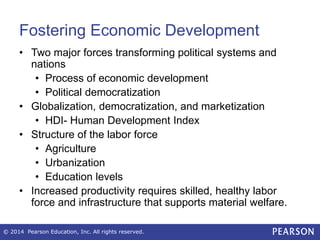
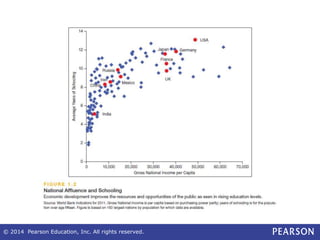
Fostering Economic Development
• Two major forces transforming political systems and
nations
• Process of economic development
• Political democratization
• Globalization, democratization, and marketization
• HDI- Human Development Index
• Structure of the labor force
• Agriculture
• Urbanization
• Education levels
• Increased productivity requires skilled, healthy labor
force and infrastructure that supports material welfare.
© 2014 Pearson Education, Inc. All rights reserved.
Problems of Economic Development
• Unequal distribution of resources and
opportunities are among the most serious
causes of political conflict.
• Large GDP may conceal significant
differences in distribution of these resources.
• Country’s politics affected by internal divisions
of income, wealth, etc.
• Economic development improves the equality
of income over time, but first stages of
industrialization may increase income
inequality.
© 2014 Pearson Education, Inc. All rights reserved.
Problems of Economic Development
• Population growth:
• Population increases due to health care improvement,
increased living standards, increased life expectancy
• Rapid population growth can pose policy challenges
for developing nations.
• Environmental costs:
• Despoiled forests, depleted soils and fisheries,
polluted air and water, nuclear waste, endangered
species, and ozone questions.
• Shortages of clean water, air, and adequate
sanitation.
© 2014 Pearson Education, Inc. All rights reserved.
Fostering Democracy, Human Rights,
and Civil Liberties
• Democratization:
• second major force transforming political
systems
• includes enhancement of human rights and
expansion of freedom
• Democracy:
• political system where citizens enjoy basic
civil and political rights
• political leaders are elected in free and fair
elections and are accountable under the law
© 2014 Pearson Education, Inc. All rights reserved.
Fostering Democracy, Human Rights,
and Civil Liberties
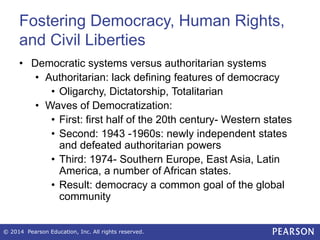
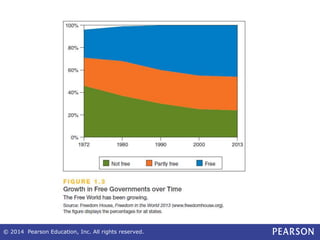
• Democratic systems versus authoritarian systems
• Authoritarian: lack defining features of democracy
• Oligarchy, Dictatorship, Totalitarian
• Waves of Democratization:
• First: first half of the 20th century- Western states
• Second: 1943 -1960s: newly independent states
and defeated authoritarian powers
• Third: 1974- Southern Europe, East Asia, Latin
America, a number of African states.
• Result: democracy a common goal of the global
community
© 2014 Pearson Education, Inc. All rights reserved.
The Contribution of Globalization
• Positive Effects
• Negative Effects
© 2014 Pearson Education, Inc. All rights reserved.
What Governments Do?
• Community and Nation Building
• Security and Order
• Protecting Rights
• Promoting Economic Efficiency and Growth
• Public goods
• Externalities
• Social Justice
• Protecting the Weak
© 2014 Pearson Education, Inc. All rights reserved.
When Does Government Become the
Problem?
• Destruction of Community
• Violations of Basic Rights
• Economic Inefficiency
• Government for Private Gain
• Vested Interests and Inertia
© 2014 Pearson Education, Inc. All rights reserved.
Looking Forward
• Average child born today can look forward to a
longer, better, freer life than his parents.
• Still, problems remain and some result from
progress that is made.
• Environmental quality, changing lifestyles,
challenges of globalization and
multiculturalism.
• More affluent and better informed citizenry
may be less inclined to trust political parties,
interest groups, parliaments, political
executives.
© 2014 Pearson Education, Inc. All rights reserved.

Powell_Ch.1.pptx

  • 1.
    Chapter One Challenge andChange in Comparative Politics
  • 2.
    Learning Objectives • 1.1Briefly describe the public and authoritative aspects of political decisions. • 1.2 Discuss the challenges of building a national identity for a nonhomogeneous population. • 1.3 Explain the processes and challenges of economic development, giving specific examples from various countries. • 1.4 Describe the characteristics of representative democracy and the connections between economic development and democratization. • 1.5 Discuss the positive and negative effects of globalization. • 1.6 List five ways in which a government can help its citizens. • 1.7 List five ways in which a government can harm or hinder its citizens. © 2014 Pearson Education, Inc. All rights reserved.
  • 3.
    Issues in ComparativePolitics • In the past few decades, the world has undergone a fundamental transformation. • Three forces drive this transformation: • Democratization • Socioeconomic modernization • Globalization © 2014 Pearson Education, Inc. All rights reserved.
  • 4.
    What Is ComparativePolitics? • Political decisions are social, public, and authoritative. • They take place within a political system. • The public sphere deals with collective decisions that extend beyond the individual and typically involve government action. • Private sphere deals with actions that do not bind anyone outside a group (e.g., family, friends). © 2014 Pearson Education, Inc. All rights reserved.
  • 5.
    What Is ComparativePolitics? • Politics is authoritative. • Formal power rests with individuals or groups whose decisions are expected to be carried out and respected. • Decisions are binding on the political system. • Politics: activities associated with the control of public decisions among a given people and within a given territory. © 2014 Pearson Education, Inc. All rights reserved.
  • 6.
    Challenges • Despite theirdiversity, states face common challenges: • Building community and identity; • Securing economic development and growth; and • Advancing democracy and civil liberties. © 2014 Pearson Education, Inc. All rights reserved.
  • 7.
    Building Community • Absenceof common identity can have severe political consequences. • Conflict over national, ethnic, or religious identities can cause political turmoil. © 2014 Pearson Education, Inc. All rights reserved.
  • 8.
    States and Nations •“Nation” refers to the self-identification of a people with a common identity. • Built upon a common language, history, race, or culture, or simply upon the fact that this group has occupied the same territory. • May or may not have their own state or independent government. © 2014 Pearson Education, Inc. All rights reserved.
  • 9.
    Nationality and Ethnicity •Ethnicity is an important part of identity • The German sociologist Max Weber argued that ethnic groups are usually defined by common physical traits, languages, and cultures that individuals believe separates them from other people. © 2014 Pearson Education, Inc. All rights reserved.
  • 10.
    Language • Language andsocial division • 5,000 different languages in use in the world today • 200 languages have a million or more speakers • Only 8 classified as world languages • Political systems cannot avoid committing themselves to one or several languages. • Conflicts over educational policies or language use in government © 2014 Pearson Education, Inc. All rights reserved.
  • 11.
    Religious Differences and Fundamentalism •States vary in their religious characteristics. • Religion may be basis of national identity. • Religion can be rallying point for political movements. • Religion can be a source of intense disagreement: • religious groups can coexist peacefully • some may commit acts of violence, cruelty, terrorism • fundamentalism has emerged in all major faiths © 2014 Pearson Education, Inc. All rights reserved.
  • 12.
    Fostering Economic Development •Two major forces transforming political systems and nations • Process of economic development • Political democratization • Globalization, democratization, and marketization • HDI- Human Development Index • Structure of the labor force • Agriculture • Urbanization • Education levels • Increased productivity requires skilled, healthy labor force and infrastructure that supports material welfare. © 2014 Pearson Education, Inc. All rights reserved.
  • 13.
    © 2014 PearsonEducation, Inc. All rights reserved.
  • 14.
    Problems of EconomicDevelopment • Unequal distribution of resources and opportunities are among the most serious causes of political conflict. • Large GDP may conceal significant differences in distribution of these resources. • Country’s politics affected by internal divisions of income, wealth, etc. • Economic development improves the equality of income over time, but first stages of industrialization may increase income inequality. © 2014 Pearson Education, Inc. All rights reserved.
  • 15.
    © 2014 PearsonEducation, Inc. All rights reserved.
  • 16.
    Problems of EconomicDevelopment • Population growth: • Population increases due to health care improvement, increased living standards, increased life expectancy • Rapid population growth can pose policy challenges for developing nations. • Environmental costs: • Despoiled forests, depleted soils and fisheries, polluted air and water, nuclear waste, endangered species, and ozone questions. • Shortages of clean water, air, and adequate sanitation. © 2014 Pearson Education, Inc. All rights reserved.
  • 17.
    Fostering Democracy, HumanRights, and Civil Liberties • Democratization: • second major force transforming political systems • includes enhancement of human rights and expansion of freedom • Democracy: • political system where citizens enjoy basic civil and political rights • political leaders are elected in free and fair elections and are accountable under the law © 2014 Pearson Education, Inc. All rights reserved.
  • 18.
    Fostering Democracy, HumanRights, and Civil Liberties • Democratic systems versus authoritarian systems • Authoritarian: lack defining features of democracy • Oligarchy, Dictatorship, Totalitarian • Waves of Democratization: • First: first half of the 20th century- Western states • Second: 1943 -1960s: newly independent states and defeated authoritarian powers • Third: 1974- Southern Europe, East Asia, Latin America, a number of African states. • Result: democracy a common goal of the global community © 2014 Pearson Education, Inc. All rights reserved.
  • 19.
    © 2014 PearsonEducation, Inc. All rights reserved.
  • 20.
    The Contribution ofGlobalization • Positive Effects • Negative Effects © 2014 Pearson Education, Inc. All rights reserved.
  • 21.
    What Governments Do? •Community and Nation Building • Security and Order • Protecting Rights • Promoting Economic Efficiency and Growth • Public goods • Externalities • Social Justice • Protecting the Weak © 2014 Pearson Education, Inc. All rights reserved.
  • 22.
    When Does GovernmentBecome the Problem? • Destruction of Community • Violations of Basic Rights • Economic Inefficiency • Government for Private Gain • Vested Interests and Inertia © 2014 Pearson Education, Inc. All rights reserved.
  • 23.
    © 2014 PearsonEducation, Inc. All rights reserved.
  • 24.
    Looking Forward • Averagechild born today can look forward to a longer, better, freer life than his parents. • Still, problems remain and some result from progress that is made. • Environmental quality, changing lifestyles, challenges of globalization and multiculturalism. • More affluent and better informed citizenry may be less inclined to trust political parties, interest groups, parliaments, political executives. © 2014 Pearson Education, Inc. All rights reserved.