



Western Political Thought
John Paul Tabakian, Ed.D.
Political Science 5
Fall 2014 – Power Point #7
Course Lecture: Week #7
Today’s Lecture Covers The Following:
• Meridel Le Sueuer
• Agee & Evans
• Franklin Delano Roosevelt
• Post World War II America
• Betty Friedan
• William Whyte
• J.C. Holmes
•Reading this speech accusing individuals of un-
American activities, one becomes aware of the same
use of the rhetoric of pathos that was apparent in
Palmer’s 1920 statement about the aliens in our
midst.
•The appeal of McCarthy’s attack is to characterize
an individual’s political position as irreligious
(“engaged in a final all-out battle between
communistic atheism and Christianity”) and
unpatriotic (describing the greatness of the nation
and promoting America as the great “beacon”).
SENATOR JOSEPH MCCARTHY’S ACCUSATIONS
OF DISLOYALTY – SPEECH” – 1
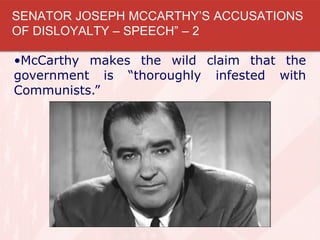
•McCarthy makes the wild claim that the
government is “thoroughly infested with
Communists.”
SENATOR JOSEPH MCCARTHY’S ACCUSATIONS
OF DISLOYALTY – SPEECH” – 2
JOSEPH MCCARTHY
DISCUSSION: AMERICAN MILITARY POWER
The United States possesses the
most advanced military hardware
known to man. Here is a sample of
our overwhelming firepower.
Students will be asked the
following question following this
video presentation: “What prevents
the United States from utilizing its
full military capacity?
ULTIMATE POWER
MERIDEL LE SUEUER
Meridel Le Sueur was the daughter of socialist feminist parents,
Marion Wharton and Alfred Le Sueur. She was raised in the
Midwestern U.S. surrounded by radical farmers, populists and the
IWW. Wanting to pursue her literary talents she moved to the East
Coast where lived with Emma Goldman and was friendly with
literary figures like John Reed and Edna St. Vincent Millay. Le
Sueuer's first article was published in 1927. She continued to write
widely-acclaimed journalism and experimental fiction into her 90s.
She incorporated political themes into her poetry and fictional
writings as well as reportage on labor struggles, the plight of
Indians, farm and rural people, the poor during the Depression, and
women's issues. A member of the Communist Party, during the
McCarthy-era 1950s, she was blacklisted but wrote prolifically,
stashing work in her home.
•This book is a Depression-era classic of famous photographs
and text that examines the live of the rural poor. Poverty in the
rural areas is as devastating as poverty in the city.
•Sharecroppers are also known as “tenant farmers”. One
should be aware of the special conditions that result from
seasonal patterns of work and production in an agrarian
(peasant) society; also, the workers’ dependency on an
almost feudal economic system.
AGEE & EVANS – LET US NOW PRAISE
FAMOUS MEN & WOMEN (1)
Let us now praise famous men, and our fathers in their
generations giving counsel by their understanding, and
proclaiming prophecies;leaders of the people in their deliberations
and in understanding of learning for the people,
wise in their words of instruction; those who composed musical
tunes, and set forth verses in writing; rich men furnished with
resources, living peaceably in their habitations -- all these were
honored in their generations, and were the glory of their times..
The LORD apportioned to them great glory, his majesty from the
beginning. There were those who ruled in their kingdoms, and
were men renowned for their power, There are some of them who
have left a name, so that men declare their praise. And there are
some who have no memorial, who have perished as though they
had not lived; they have become as though they had not been
born, and so have their children after them. Ecclesiasticus 44:1-9
AGEE & EVANS – LET US NOW PRAISE
FAMOUS MEN & WOMEN (2)
• Before entering the War, FDR urged support for countries
that had come under attack by the Axis military. Congress
passed the Lend-Lease Act, which allowed Americans to
extend loans of “military supplies” to any country that was
threatened by aggression and whose national defense
could be interpreted as “vital to the defense of the United
States.”
• The “Four Freedoms” were part of the President’s annual
address to Congress.
• An expression of fundamental human and political rights,
perhaps indicative of what would arise in the form of a
United Nations document after the war. It is also indicative
of an ongoing international movement that promotes an
understanding of “universal” human rights.
FRANKLIN DELANO ROOSEVELT
“THE FOUR FREEDOMS”
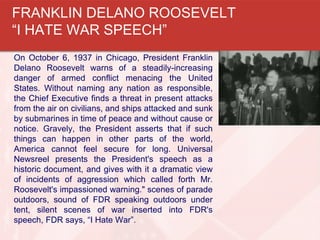
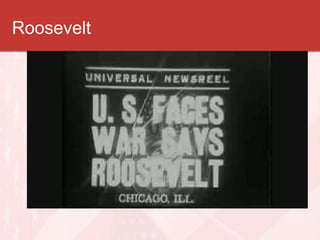
On October 6, 1937 in Chicago, President Franklin
Delano Roosevelt warns of a steadily-increasing
danger of armed conflict menacing the United
States. Without naming any nation as responsible,
the Chief Executive finds a threat in present attacks
from the air on civilians, and ships attacked and sunk
by submarines in time of peace and without cause or
notice. Gravely, the President asserts that if such
things can happen in other parts of the world,
America cannot feel secure for long. Universal
Newsreel presents the President's speech as a
historic document, and gives with it a dramatic view
of incidents of aggression which called forth Mr.
Roosevelt's impassioned warning." scenes of parade
outdoors, sound of FDR speaking outdoors under
tent, silent scenes of war inserted into FDR's
speech, FDR says, “I Hate War”.
FRANKLIN DELANO ROOSEVELT
“I HATE WAR SPEECH”
Roosevelt
POST WORLD WAR II AMERICA (1)
•America after the War was “victorious,” not only as a military
power. It had come away from WW II with its economy
bolstered by war production, unlike its European allies who
had suffered destruction of their infrastructures.
•An “American era” that reflected a certain degree of
chauvinism that had come with victory and infected the
American mentality; but America’s role and success in the war
also reflected the definite reality of the U.S. as having become
the “preeminent military and economic power in the world”
(T&S, 1376).
•By 1955 the U.S. was producing half of the world’s goods.
America had entered an era of prosperity.
POST WORLD WAR II AMERICA (2)
•The “cold war” had begun immediately after the War with
the emergence of two great Communist powers: the Soviet
Union and The Peoples Republic of China who would
challenge America’s hegemony as a world leader. An
ideological battle ensued between the forces of democratic
capitalism and totalitarian communism. This led to a certain
“cold war mentality” among Americans that led to the “witch
hunts” of Joe McCarthy and the Un-American Activities
Committee.
•When General Eisenhower was elected to the presidency in
1952, the nation returned to an era of conservative
republicanism.
BETTY FRIEDAN – THE FEMININE MYSTIQUE
DISCUSSION: What do you gather from Friedan’s conclusion?
If I am right, the problem that has no name stirring in the
minds of so many American women today is not a matter of
loss of femininity or too much education, or the demands of
domesticity. It is far more important than anyone recognizes. It
is the key to these other new and old problems which have
been torturing women and their husbands and children, and
puzzling their doctors and educators for years. It may well be
the key to our future as a nation and a culture. We can no
longer ignore that voice within women that says: "I want
something more than my husband and my children and my
home."
W.H. WHYTE, JR. - THE ORGANIZATION MAN
•“By the mid-1950s, white-collar (salaried) workers outnumbered blue-
collar (hourly-wage) workers for the first time in American history” (T&S,
1439). Before 1929: 31% vs. the 1950s: 60%.
•This parallels the rise of large corporations that displaced or acquired
through mergers smaller enterprises. “The traditional notion of the
hardworking, strong-minded individual advancing by dint of competitive
ability and creative initiative gave way to the concept of a new
managerial personality and an ethic of corporate cooperation and
achievement (T&S, 1440).”
•Whyte’s book examined the rise of the “organization man” as it
countered the old Protestant work ethic and the rugged individualism of
earlier American centuries (Turner’s “frontier thesis”). It was replaced by
a groupthink type of individual who shunned individualism as tended to
conform to the status quo. Refer also to De Toqueville.
J.C. HOLMES – NOTHING MORE TO DECLARE
•The Beat Generation is the name given to a group of artists, writers
and social bohemians who rebelled against the conformity of the
post-War years and chose to live an open and free existence that
was anti-materialistic and which sought mystical enlightenment.
•The Beats were part of a general rebellion at the time that was also
reflected in other forms of rebellion in response to the alienation of
youth.
•In many respects they hark back to the Transcendentalists of the
1830s in their attention to eastern mysticism and spirituality,
individualism, romantic inclinations.
•I’ve included by own review of a series of books about the Beat
generation that offers its own perspective as the Beats continued to
influence a new generation of 1960's youth.

Tabakian Pols 5 PP7 Fall 2014

  • 1.
    Western Political Thought JohnPaul Tabakian, Ed.D. Political Science 5 Fall 2014 – Power Point #7
  • 2.
    Course Lecture: Week#7 Today’s Lecture Covers The Following: • Meridel Le Sueuer • Agee & Evans • Franklin Delano Roosevelt • Post World War II America • Betty Friedan • William Whyte • J.C. Holmes
  • 3.
    •Reading this speechaccusing individuals of un- American activities, one becomes aware of the same use of the rhetoric of pathos that was apparent in Palmer’s 1920 statement about the aliens in our midst. •The appeal of McCarthy’s attack is to characterize an individual’s political position as irreligious (“engaged in a final all-out battle between communistic atheism and Christianity”) and unpatriotic (describing the greatness of the nation and promoting America as the great “beacon”). SENATOR JOSEPH MCCARTHY’S ACCUSATIONS OF DISLOYALTY – SPEECH” – 1
  • 4.
    •McCarthy makes thewild claim that the government is “thoroughly infested with Communists.” SENATOR JOSEPH MCCARTHY’S ACCUSATIONS OF DISLOYALTY – SPEECH” – 2
  • 5.
  • 6.
    DISCUSSION: AMERICAN MILITARYPOWER The United States possesses the most advanced military hardware known to man. Here is a sample of our overwhelming firepower. Students will be asked the following question following this video presentation: “What prevents the United States from utilizing its full military capacity?
  • 7.
  • 8.
    MERIDEL LE SUEUER MeridelLe Sueur was the daughter of socialist feminist parents, Marion Wharton and Alfred Le Sueur. She was raised in the Midwestern U.S. surrounded by radical farmers, populists and the IWW. Wanting to pursue her literary talents she moved to the East Coast where lived with Emma Goldman and was friendly with literary figures like John Reed and Edna St. Vincent Millay. Le Sueuer's first article was published in 1927. She continued to write widely-acclaimed journalism and experimental fiction into her 90s. She incorporated political themes into her poetry and fictional writings as well as reportage on labor struggles, the plight of Indians, farm and rural people, the poor during the Depression, and women's issues. A member of the Communist Party, during the McCarthy-era 1950s, she was blacklisted but wrote prolifically, stashing work in her home.
  • 9.
    •This book isa Depression-era classic of famous photographs and text that examines the live of the rural poor. Poverty in the rural areas is as devastating as poverty in the city. •Sharecroppers are also known as “tenant farmers”. One should be aware of the special conditions that result from seasonal patterns of work and production in an agrarian (peasant) society; also, the workers’ dependency on an almost feudal economic system. AGEE & EVANS – LET US NOW PRAISE FAMOUS MEN & WOMEN (1)
  • 10.
    Let us nowpraise famous men, and our fathers in their generations giving counsel by their understanding, and proclaiming prophecies;leaders of the people in their deliberations and in understanding of learning for the people, wise in their words of instruction; those who composed musical tunes, and set forth verses in writing; rich men furnished with resources, living peaceably in their habitations -- all these were honored in their generations, and were the glory of their times.. The LORD apportioned to them great glory, his majesty from the beginning. There were those who ruled in their kingdoms, and were men renowned for their power, There are some of them who have left a name, so that men declare their praise. And there are some who have no memorial, who have perished as though they had not lived; they have become as though they had not been born, and so have their children after them. Ecclesiasticus 44:1-9 AGEE & EVANS – LET US NOW PRAISE FAMOUS MEN & WOMEN (2)
  • 11.
    • Before enteringthe War, FDR urged support for countries that had come under attack by the Axis military. Congress passed the Lend-Lease Act, which allowed Americans to extend loans of “military supplies” to any country that was threatened by aggression and whose national defense could be interpreted as “vital to the defense of the United States.” • The “Four Freedoms” were part of the President’s annual address to Congress. • An expression of fundamental human and political rights, perhaps indicative of what would arise in the form of a United Nations document after the war. It is also indicative of an ongoing international movement that promotes an understanding of “universal” human rights. FRANKLIN DELANO ROOSEVELT “THE FOUR FREEDOMS”
  • 12.
    On October 6,1937 in Chicago, President Franklin Delano Roosevelt warns of a steadily-increasing danger of armed conflict menacing the United States. Without naming any nation as responsible, the Chief Executive finds a threat in present attacks from the air on civilians, and ships attacked and sunk by submarines in time of peace and without cause or notice. Gravely, the President asserts that if such things can happen in other parts of the world, America cannot feel secure for long. Universal Newsreel presents the President's speech as a historic document, and gives with it a dramatic view of incidents of aggression which called forth Mr. Roosevelt's impassioned warning." scenes of parade outdoors, sound of FDR speaking outdoors under tent, silent scenes of war inserted into FDR's speech, FDR says, “I Hate War”. FRANKLIN DELANO ROOSEVELT “I HATE WAR SPEECH”
  • 13.
  • 14.
    POST WORLD WARII AMERICA (1) •America after the War was “victorious,” not only as a military power. It had come away from WW II with its economy bolstered by war production, unlike its European allies who had suffered destruction of their infrastructures. •An “American era” that reflected a certain degree of chauvinism that had come with victory and infected the American mentality; but America’s role and success in the war also reflected the definite reality of the U.S. as having become the “preeminent military and economic power in the world” (T&S, 1376). •By 1955 the U.S. was producing half of the world’s goods. America had entered an era of prosperity.
  • 15.
    POST WORLD WARII AMERICA (2) •The “cold war” had begun immediately after the War with the emergence of two great Communist powers: the Soviet Union and The Peoples Republic of China who would challenge America’s hegemony as a world leader. An ideological battle ensued between the forces of democratic capitalism and totalitarian communism. This led to a certain “cold war mentality” among Americans that led to the “witch hunts” of Joe McCarthy and the Un-American Activities Committee. •When General Eisenhower was elected to the presidency in 1952, the nation returned to an era of conservative republicanism.
  • 16.
    BETTY FRIEDAN –THE FEMININE MYSTIQUE DISCUSSION: What do you gather from Friedan’s conclusion? If I am right, the problem that has no name stirring in the minds of so many American women today is not a matter of loss of femininity or too much education, or the demands of domesticity. It is far more important than anyone recognizes. It is the key to these other new and old problems which have been torturing women and their husbands and children, and puzzling their doctors and educators for years. It may well be the key to our future as a nation and a culture. We can no longer ignore that voice within women that says: "I want something more than my husband and my children and my home."
  • 17.
    W.H. WHYTE, JR.- THE ORGANIZATION MAN •“By the mid-1950s, white-collar (salaried) workers outnumbered blue- collar (hourly-wage) workers for the first time in American history” (T&S, 1439). Before 1929: 31% vs. the 1950s: 60%. •This parallels the rise of large corporations that displaced or acquired through mergers smaller enterprises. “The traditional notion of the hardworking, strong-minded individual advancing by dint of competitive ability and creative initiative gave way to the concept of a new managerial personality and an ethic of corporate cooperation and achievement (T&S, 1440).” •Whyte’s book examined the rise of the “organization man” as it countered the old Protestant work ethic and the rugged individualism of earlier American centuries (Turner’s “frontier thesis”). It was replaced by a groupthink type of individual who shunned individualism as tended to conform to the status quo. Refer also to De Toqueville.
  • 18.
    J.C. HOLMES –NOTHING MORE TO DECLARE •The Beat Generation is the name given to a group of artists, writers and social bohemians who rebelled against the conformity of the post-War years and chose to live an open and free existence that was anti-materialistic and which sought mystical enlightenment. •The Beats were part of a general rebellion at the time that was also reflected in other forms of rebellion in response to the alienation of youth. •In many respects they hark back to the Transcendentalists of the 1830s in their attention to eastern mysticism and spirituality, individualism, romantic inclinations. •I’ve included by own review of a series of books about the Beat generation that offers its own perspective as the Beats continued to influence a new generation of 1960's youth.