Mike Slater
Content
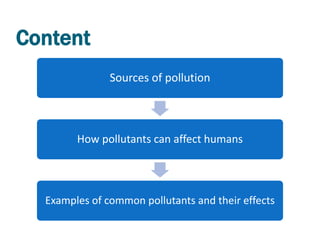
               Sources of pollution


        How pollutants can affect humans


  Examples of common pollutants and their effects
http://www.slideshare.net/mikeslater

michael.slater@manchester.ac.uk

http://diamondenv.wordpress.com

Twitter @diamondenv
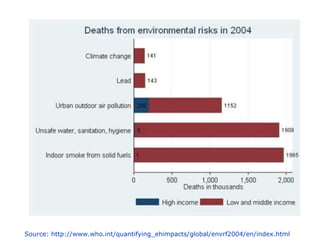
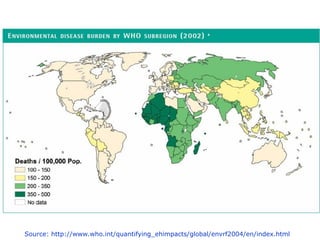
Source: http://www.who.int/quantifying_ehimpacts/global/envrf2004/en/index.html
The effects of pollution on
human health can be
Direct
Indirect
The effects of pollution on
human health can be
Immediate
Delayed
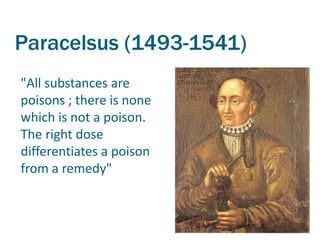
Paracelsus (1493-1541)
"All substances are
poisons ; there is none
which is not a poison.
The right dose
differentiates a poison
from a remedy"
Risk is the likelihood that harm
will occur in practice


  RISK = Hazard x Exposure
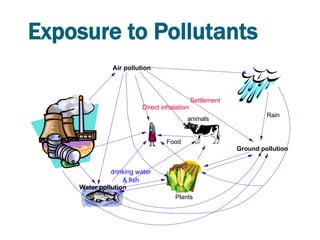
Exposure to Pollutants
               Air pollution


                                             Settlement
                         Direct inhalation
                                                                   Rain
                                         animals


                                 Food
                                                          Ground pollution


              drinking water
                  & fish
    Water pollution
                                     Plants
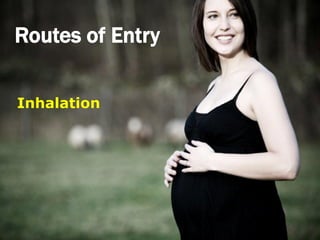
Routes of Entry
Routes of Entry

Inhalation
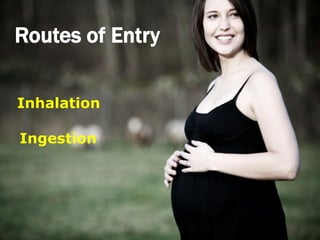
Routes of Entry

Inhalation

Ingestion
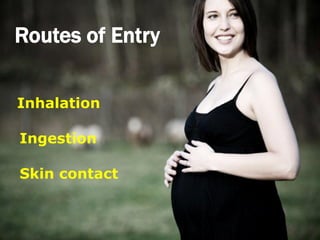
Routes of Entry

Inhalation

Ingestion

Skin contact
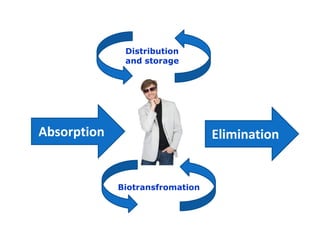
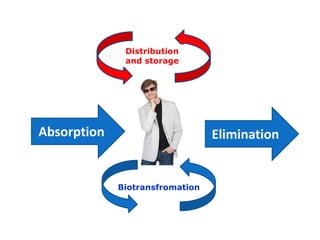
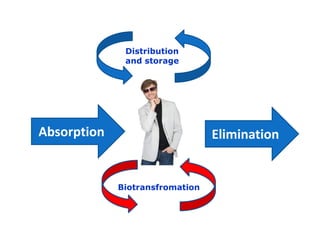
Distribution
              and storage


Absorption                       Elimination


             Biotransfromation
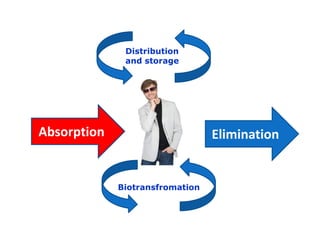
Distribution
              and storage


Absorption                       Elimination


             Biotransfromation
Inhalation
Gases
Aerosols
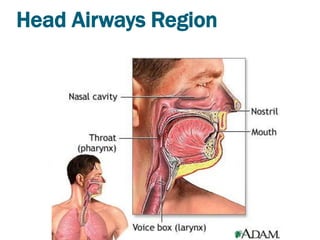
Head Airways Region
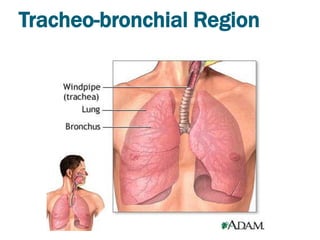
Tracheo-bronchial Region
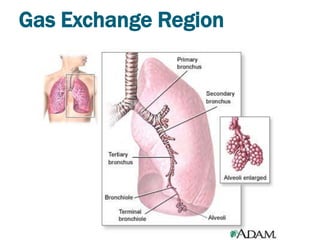
Gas Exchange Region
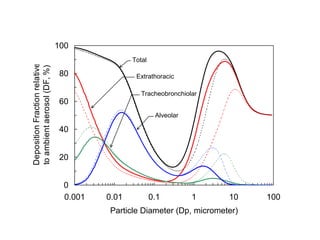
100
                                               Total
Deposition Fraction relative
to ambient aerosol (DF, %)


                               80               Extrathoracic

                                                  Tracheobronchiolar
                               60
                                                        Alveolar

                               40


                               20


                                0
                                0.001   0.01           0.1         1   10    100
                                        Particle Diameter (Dp, micrometer)
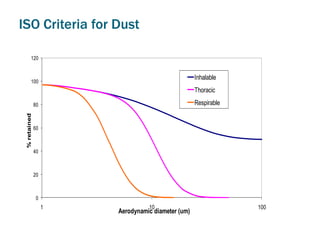
ISO Criteria for Dust

         120


                                                   Inhalable
         100
                                                   Thoracic

              80                                   Respirable
 % retained


              60


              40


              20


               0
                   1             10                             100
                       Aerodynamic diameter (um)
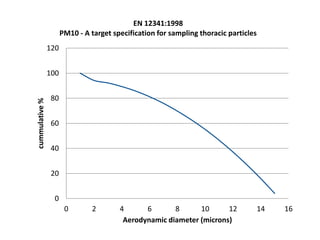
EN 12341:1998
                      PM10 - A target specification for sampling thoracic particles
                120


                100


                 80
cummulative %


                 60


                 40


                 20


                 0
                       0        2       4      6       8      10      12              14   16
                                         Aerodynamic diameter (microns)
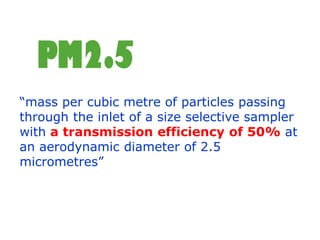
PM2.5
“mass per cubic metre of particles passing
through the inlet of a size selective sampler
with a transmission efficiency of 50% at
an aerodynamic diameter of 2.5
micrometres”
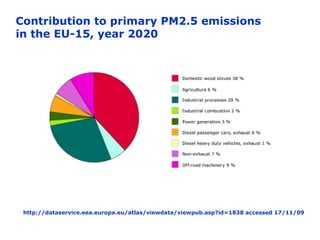
Contribution to primary PM2.5 emissions
in the EU-15, year 2020


 http://dataservice.eea.europa.eu/atlas/viewdata/viewpub.asp?id=1838 accessed 17/11/09
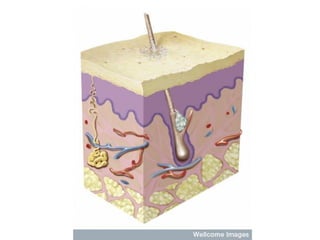
The
Skin


bfcfranco's @flickr
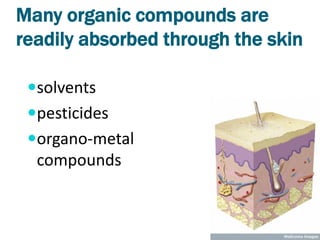
Many organic compounds are
readily absorbed through the skin

 solvents
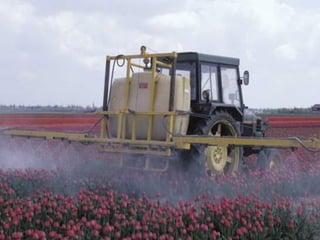
 pesticides
 organo-metal
  compounds
Ingestion can occur due to:
 Foodstuff
  contamination
 Drinking water
  contamination
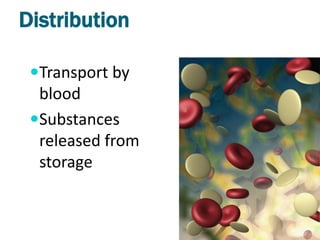
Distribution
              and storage


Absorption                       Elimination


             Biotransfromation
Distribution

 Transport by
  blood
 Substances
  released from
  storage
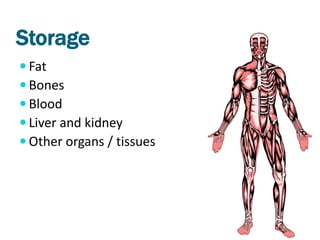
Storage
 Fat
 Bones
 Blood
 Liver and kidney
 Other organs / tissues
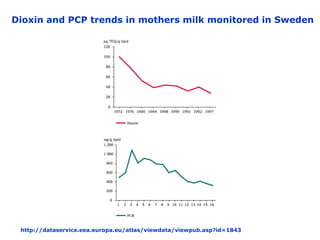
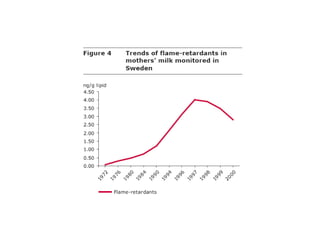
Dioxin and PCP trends in mothers milk monitored in Sweden


 http://dataservice.eea.europa.eu/atlas/viewdata/viewpub.asp?id=1843
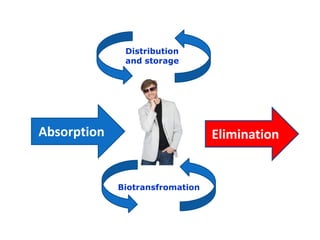
Distribution
              and storage


Absorption                       Elimination


             Biotransfromation
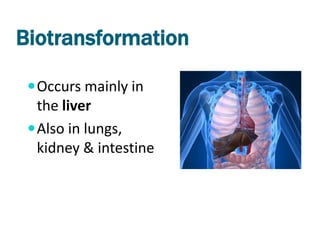
Biotransformation

  Occurs mainly in
   the liver
  Also in lungs,
   kidney & intestine
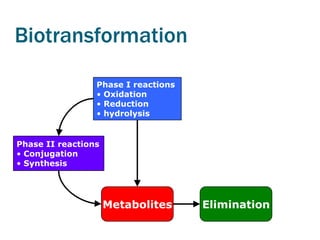
Biotransformation

                 Phase I reactions
                 • Oxidation
                 • Reduction
                 • hydrolysis


Phase II reactions
• Conjugation
• Synthesis


                     Metabolites     Elimination
Biotransformation
Sometimes biotransformation
 increases toxicity
Distribution
              and storage


Absorption                       Elimination


             Biotransfromation
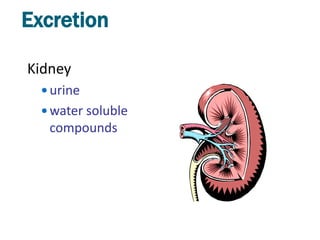
Excretion

Kidney
   urine
   water soluble
   compounds
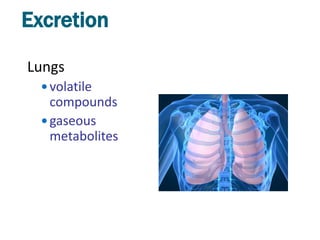
Excretion

Lungs
   volatile
    compounds
   gaseous
    metabolites
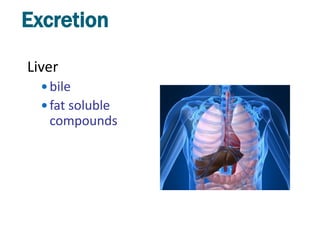
Excretion

Liver
   bile
   fat soluble
   compounds
Excretion

Other routes
   Hair
   Nails
   Skin
   Sweat
   Milk
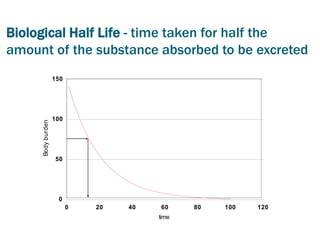
Biological Half Life - time taken for half the
amount of the substance absorbed to be excreted
                   150


                   100
     Body burden


                   50


                    0
                         0   20   40   60     80   100   120
                                       time
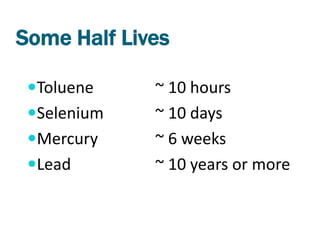
Some Half Lives

 Toluene    ~ 10 hours
 Selenium   ~ 10 days
 Mercury    ~ 6 weeks
 Lead       ~ 10 years or more
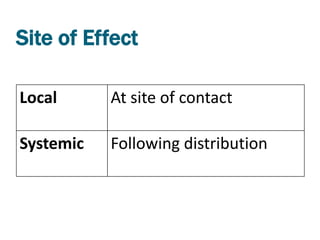
Site of Effect

Local      At site of contact

Systemic   Following distribution
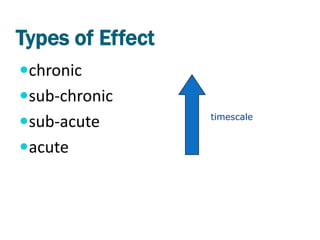
Types of Effect
chronic
sub-chronic
                  timescale
sub-acute
acute
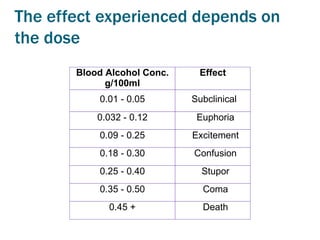
The effect experienced depends on
the dose
       Blood Alcohol Conc.    Effect
             g/100ml
           0.01 - 0.05       Subclinical
           0.032 - 0.12       Euphoria
           0.09 - 0.25       Excitement
           0.18 - 0.30       Confusion
           0.25 - 0.40         Stupor
           0.35 - 0.50         Coma
             0.45 +            Death
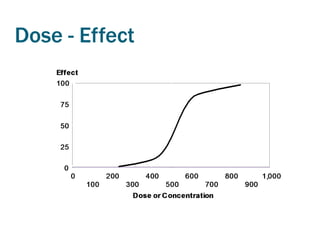
Dose - Effect
Susceptibility
 Variation in susceptibility
 between individuals
Susceptibility
 Different doses required
 to produce same effect
Susceptibility
 The most susceptible
 groups include
   Elderly,
   Children,
   People with pre-existing
   disease
Susceptibility
 Inter-species variation
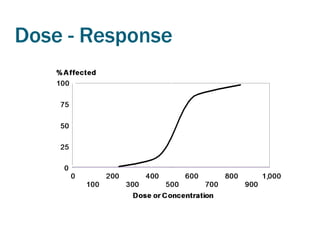
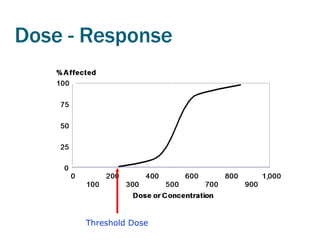
Dose - Response
Dose - Response


      Threshold Dose
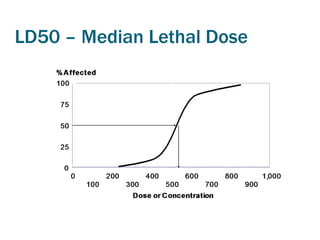
LD50 – Median Lethal Dose
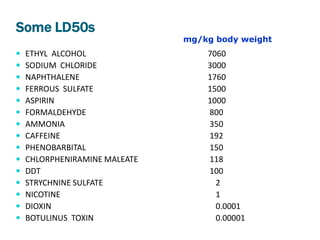
Some LD50s
                               mg/kg body weight
   ETHYL ALCOHOL                  7060
   SODIUM CHLORIDE                3000
   NAPHTHALENE                    1760
   FERROUS SULFATE                1500
   ASPIRIN                        1000
   FORMALDEHYDE                   800
   AMMONIA                        350
   CAFFEINE                       192
   PHENOBARBITAL                  150
   CHLORPHENIRAMINE MALEATE       118
   DDT                            100
   STRYCHNINE SULFATE               2
   NICOTINE                         1
   DIOXIN                           0.0001
   BOTULINUS TOXIN                  0.00001
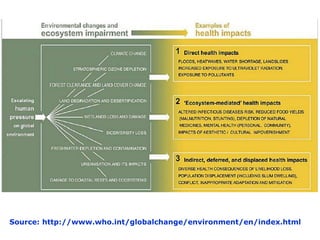
Pollution
Effects on Human Health
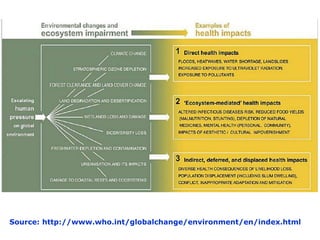
Direct effects
Indirect effects
Source: http://www.who.int/globalchange/environment/en/index.html
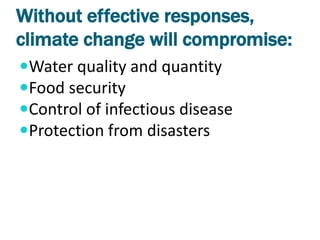
Without effective responses,
climate change will compromise:
Water quality and quantity
Food security
Control of infectious disease
Protection from disasters
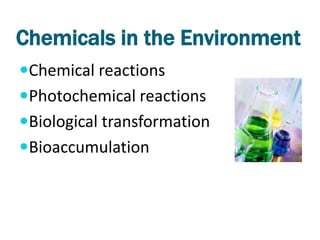
Chemicals in the Environment
Chemical reactions
Photochemical reactions
Biological transformation
Bioaccumulation
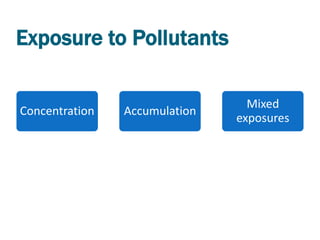
Exposure to Pollutants

                                 Mixed
Concentration   Accumulation
                               exposures
Evidence for Effects of Pollution
Animal experiments
Human volunteer studies
Epidemiological evidence
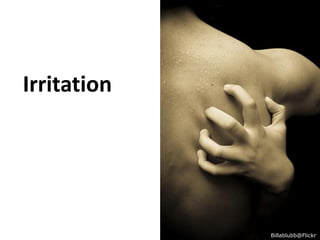
Irritation


             Billablubb@Flickr
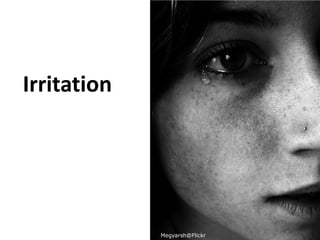
Irritation


             Megyarsh@Flickr
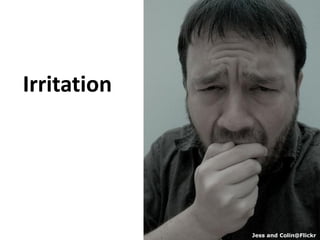
Irritation


             Jess and Colin@Flickr
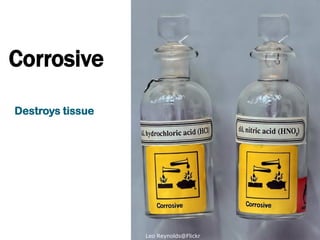
Corrosive

Destroys tissue


                  Leo Reynolds@Flickr
Chronic obstructive pulmonary
disease (COPD)
  Chronic bronchitis
  Emphysema
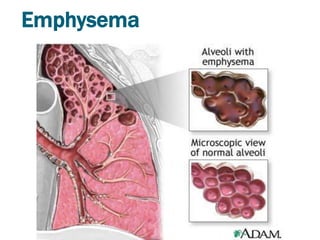
Emphysema
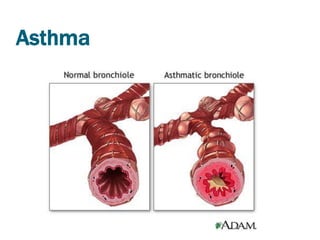
Asthma
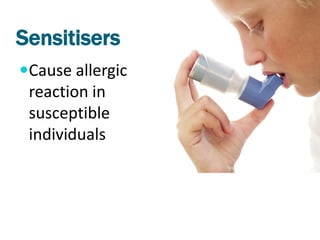
Sensitisers
Cause allergic
 reaction in
 susceptible
 individuals
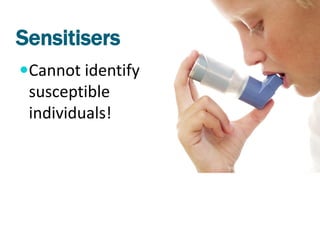
Sensitisers
Cannot identify
 susceptible
 individuals!
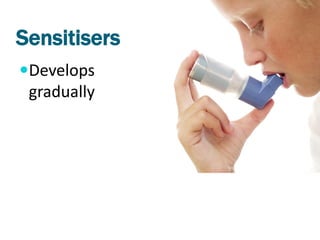
Sensitisers
Develops
 gradually
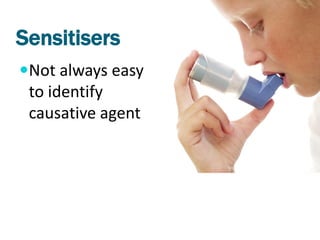
Sensitisers
Not always easy
 to identify
 causative agent
Cancer

Unregulated
 growth and
 proliferation of
 cells
Carcinogens

Long latency
 period
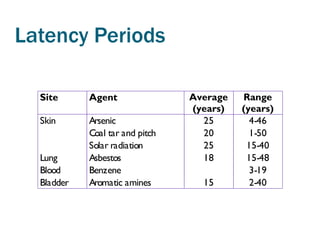
Latency Periods

  Site      Agent                Average   Range
                                 (years)   (years)
  Skin      Arsenic                25        4-46
            Coal tar and pitch     20        1-50
            Solar radiation        25       15-40
  Lung      Asbestos               18       15-48
  Blood     Benzene                          3-19
  Bladder   Aromatic amines        15        2-40
Mutagens
Teratogens
Systemic effects
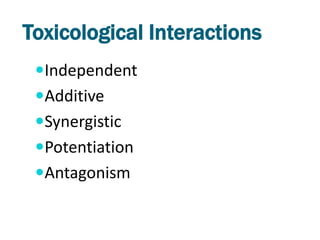
Toxicological Interactions
 Independent
 Additive
 Synergistic
 Potentiation
 Antagonism
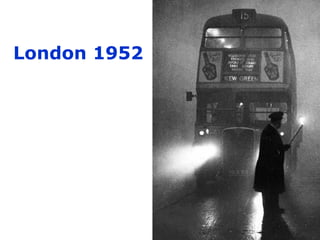
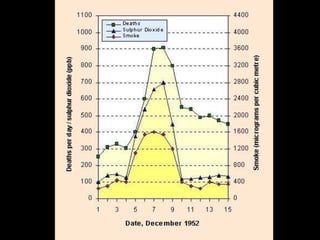
London 1952
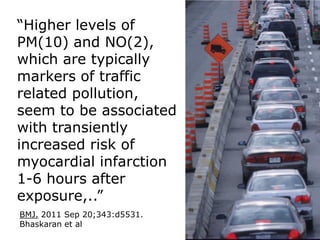
“Higher levels of
PM(10) and NO(2),
which are typically
markers of traffic
related pollution,
seem to be associated
with transiently
increased risk of
myocardial infarction
1-6 hours after
exposure,..”
BMJ. 2011 Sep 20;343:d5531.
Bhaskaran et al
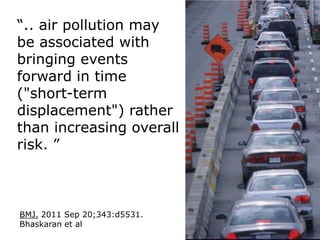
“.. air pollution may
be associated with
bringing events
forward in time
("short-term
displacement") rather
than increasing overall
risk. ”


BMJ. 2011 Sep 20;343:d5531.
Bhaskaran et al
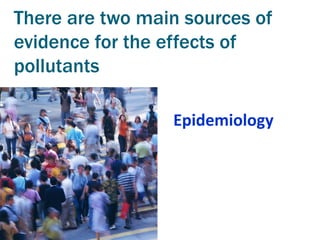
There are two main sources of
evidence for the effects of
pollutants
There are two main sources of
evidence for the effects of
pollutants

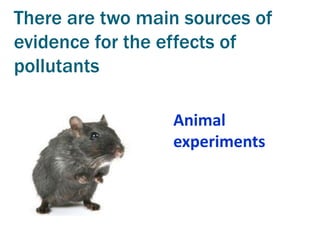
                 Animal
                 experiments
There are two main sources of
evidence for the effects of
pollutants

                 Epidemiology
Problems with animal
experiments
Problems with animal
experiments

               Inter-species
               variation
Problems with animal
experiments

               They evaluate:
               acute effects from
               high doses of
               single substances
               over a short period
Problems with animal
experiments

                 Ethics
Problems with epidemiological
studies
Problems with epidemiological
studies

                Simultaneous
                exposure to many
                environmental
                pollutants
Problems with epidemiological
studies

                Other exposures to
                chemicals
Problems with epidemiological
studies

                Other confounders
                such as
                • temperature,
                • smoking
Problems with epidemiological
studies

                Low level effects
                are difficult to
                quantify
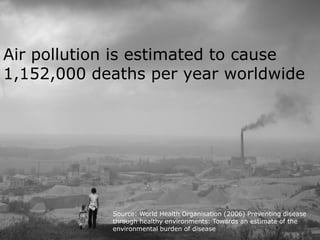
Air pollution is estimated to cause
1,152,000 deaths per year worldwide


            Source: World Health Organisation (2006) Preventing disease
            through healthy environments: Towards an estimate of the
            environmental burden of disease
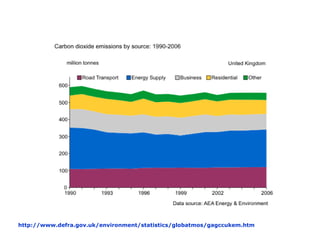
http://www.defra.gov.uk/environment/statistics/globatmos/gagccukem.htm
Source: http://www.who.int/globalchange/environment/en/index.html
Carbon Monoxide
Chemical asphyxiant
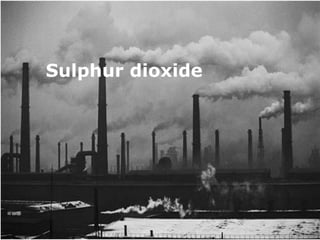
Sulphur dioxide

 Sulphur dioxide
Sulphur dioxide


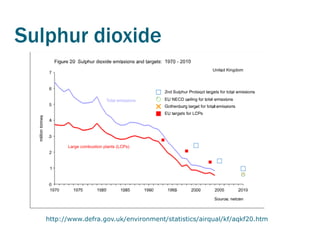
   http://www.defra.gov.uk/environment/statistics/airqual/kf/aqkf20.htm
Sulphur Dioxide - Effects

Soluble acid gas
Upper respiratory tract
 irritation
Sulphur Dioxide - Effects

Increased effect on people
 with pre-existing
 respiratory disease
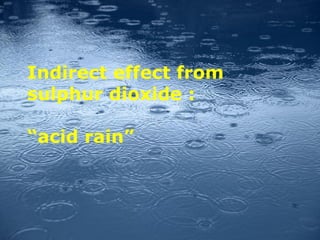
Indirect effect from
sulphur dioxide :

“acid rain”
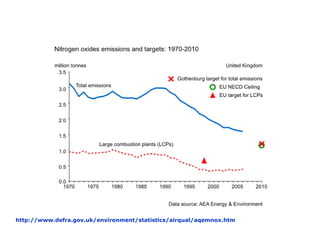
http://www.defra.gov.uk/environment/statistics/airqual/aqemnox.htm
Nitrogen Dioxide

Deep lung irritant
Less evidence for
 effect on pre-existing
 conditions
Nitrogen oxides, as acidic
Gases can also contribute
To “acid rain”
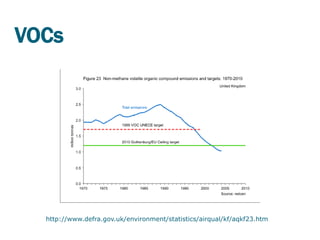
VOCs


  http://www.defra.gov.uk/environment/statistics/airqual/kf/aqkf23.htm
VOCs - Direct effects
Depends on
 compound
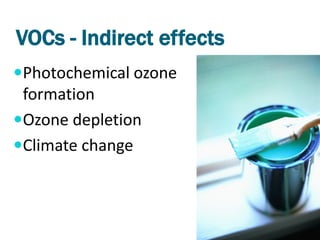
VOCs - Indirect effects
Photochemical ozone
 formation
Ozone depletion
Climate change
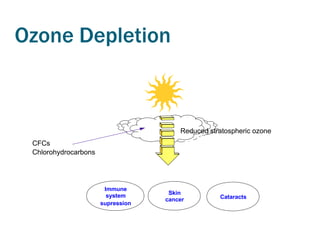
Ozone Depletion


                                       Reduced stratospheric ozone
 CFCs
 Chlorohydrocarbons


                       Immune
                        system      Skin
                                   cancer         Cataracts
                      supression
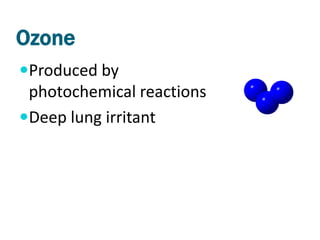
Ozone
Produced by
 photochemical reactions
Deep lung irritant
Ozone - Acute effects
Reduced lung function
Aggravates asthma
Damages lining of respiratory
 passages
Ozone - Chronic effects
Permanent reduction in
 lung function?
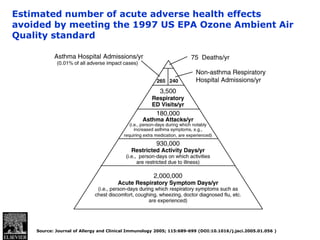
Fig 2
Estimated number of acute adverse health effects
avoided by meeting the 1997 US EPA Ozone Ambient Air
Quality standard


    Source: Journal of Allergy and Clinical Immunology 2005; 115:689-699 (DOI:10.1016/j.jaci.2005.01.056 )
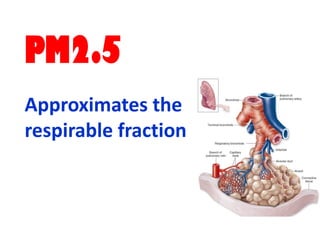
Particulate Matter
PM2.5
Approximates the
respirable fraction
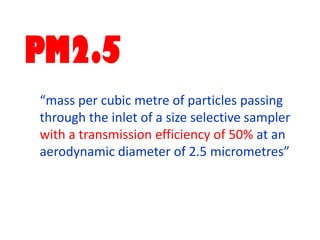
PM2.5
“mass per cubic metre of particles passing
through the inlet of a size selective sampler
with a transmission efficiency of 50% at an
aerodynamic diameter of 2.5 micrometres”
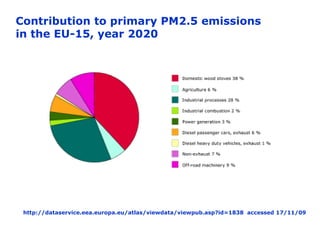
Contribution to primary PM2.5 emissions
in the EU-15, year 2020


 http://dataservice.eea.europa.eu/atlas/viewdata/viewpub.asp?id=1838 accessed 17/11/09
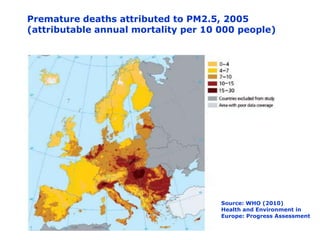
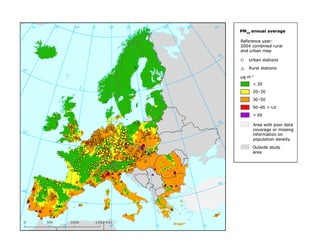
Premature deaths attributed to PM2.5, 2005
(attributable annual mortality per 10 000 people)


                                      Source: WHO (2010)
                                      Health and Environment in
                                      Europe: Progress Assessment
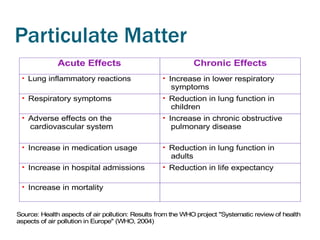
Particulate Matter
              Acute Effects                                  Chronic Effects
   Lung inflammatory reactions                      Increase in lower respiratory
                                                     symptoms
    Respiratory symptoms                            Reduction in lung function in
                                                    children
    Adverse effects on the                          Increase in chronic obstructive
    cardiovascular system                            pulmonary disease

    Increase in medication usage                    Reduction in lung function in
                                                    adults
    Increase in hospital admissions                 Reduction in life expectancy

    Increase in mortality


Source: Health aspects of air pollution: Results from the WHO project "Systematic review of health
aspects of air pollution in Europe" (WHO, 2004)
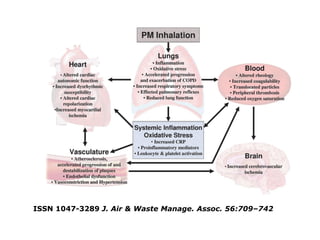
ISSN 1047-3289 J. Air & Waste Manage. Assoc. 56:709–742
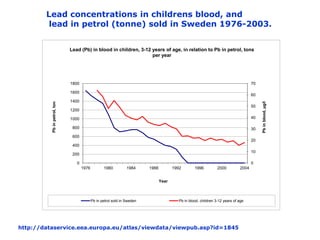
Lead concentrations in childrens blood, and
         lead in petrol (tonne) sold in Sweden 1976-2003.


                              Lead (Pb) in blood in children, 3-12 years of age, in relation to Pb in petrol, tons
                                                                   per year


                              1800                                                                                                    70

                              1600
                                                                                                                                      60
                              1400
          Pb in petrol, ton


                                                                                                                                           Pb in blood, µg/l
                                                                                                                                      50
                              1200

                              1000                                                                                                    40

                               800                                                                                                    30
                               600
                                                                                                                                      20
                               400
                                                                                                                                      10
                               200

                                 0                                                                                                    0
                                     1976          1980          1984     1988          1992        1996          2000         2004


                                                                                 Year


                                            Pb in petrol sold in Sweden                    Pb in blood, children 3-12 years of age


http://dataservice.eea.europa.eu/atlas/viewdata/viewpub.asp?id=1845
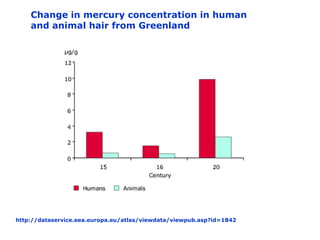
Change in mercury concentration in human
    and animal hair from Greenland


http://dataservice.eea.europa.eu/atlas/viewdata/viewpub.asp?id=1842
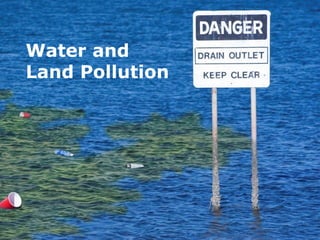
Water and
Land Pollution
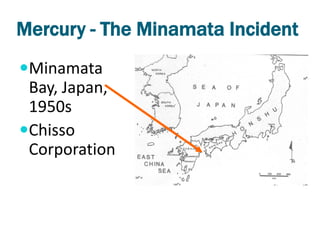
Mercury - The Minamata Incident
Minamata
 Bay, Japan,
 1950s
Chisso
 Corporation
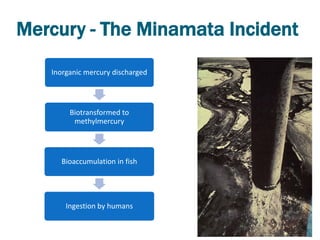
Mercury - The Minamata Incident
   Inorganic mercury discharged


        Biotransformed to
         methylmercury


     Bioaccumulation in fish


       Ingestion by humans
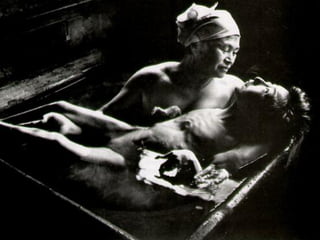
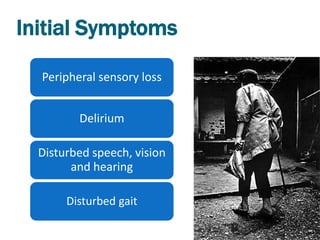
Initial Symptoms

  Peripheral sensory loss


         Delirium

  Disturbed speech, vision
        and hearing

       Disturbed gait
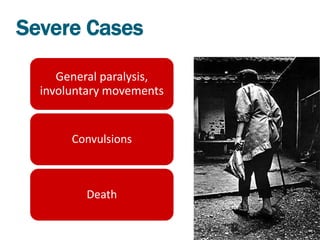
Severe Cases

     General paralysis,
  involuntary movements


       Convulsions


         Death
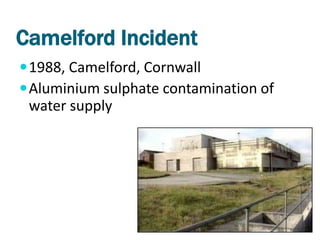
Camelford Incident
 1988, Camelford, Cornwall
 Aluminium sulphate contamination of
 water supply
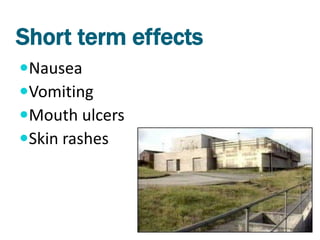
Short term effects
Nausea
Vomiting
Mouth ulcers
Skin rashes
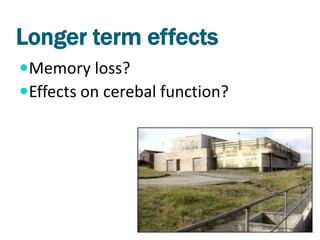
Longer term effects
Memory loss?
Effects on cerebal function?
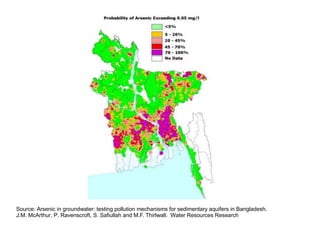
Source: Arsenic in groundwater: testing pollution mechanisms for sedimentary aquifers in Bangladesh.
J.M. McArthur, P. Ravenscroft, S. Safiullah and M.F. Thirlwall. Water Resources Research
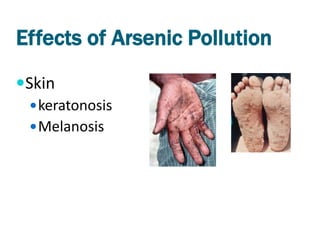
Effects of Arsenic Pollution
Skin
  keratonosis
  Melanosis
Effects of Arsenic Pollution
Gastrointestinal disturbances
Cancer
http://www.slideshare.net/mikeslater

michael.slater@manchester.ac.uk

http://diamondenv.wordpress.com

Twitter @diamondenv
Websites
 US National Library of Medicine Toxicology Tutor
    http://sis.nlm.nih.gov/enviro/toxtutor.html

 UK DEFRA air quality statistics
    http://www.defra.gov.uk/environment/statistics/airqual/aqemissions.htm

 European Environmental Agency report – “Europe's environment: the
  third assessment - Chapter 12 - Environment and human health”
    http://reports.eea.europa.eu/environmental_assessment_report_2003_10/Chapter12

 European Environmental Agency report “Environment and Health”
    http://reports.eea.europa.eu/eea_report_2005_10/en

 WHO Systematic review of health aspects of air pollution in Europe
    http://www.euro.who.int/eprise/main/WHO/Progs/AIQ/activities/20030528_3

 Committee on the Medical Effects of Air Pollutants (COMEAP)
    http://www.dh.gov.uk/ab/comeap/index.htm

 Video on Minamata incident
    http://science.education.nih.gov/supplements/nih2/chemicals/activities/lesson5.htm

Pollution And Human Health