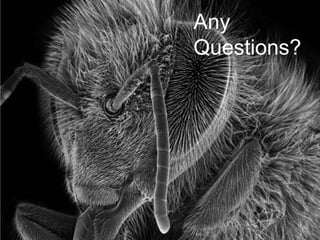
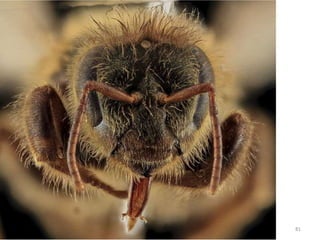
Beekeeping
Chris Cardew 16th May 2015
1
Content
• The Honeybee
• Social Insects, Castes of honeybee, Colony, Bee biology
• History of beekeeping
• Ancients, Langstroth
• Hives and Apiaries
• Hive types, Season,
• Produce
• Honey, wax, pollen, propolis
• Issues
• Pesticides, varroa, disease, asian hornet
• Getting started
• Courses, suppliers, beekeeping associations, mentors
2
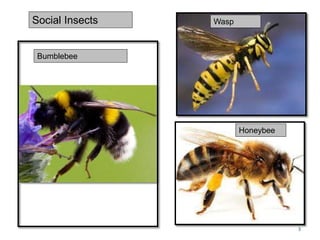
Social Insects
Bumblebee
Wasp
Honeybee
3
4
5
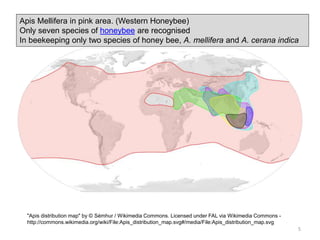
"Apis distribution map" by © Sémhur / Wikimedia Commons. Licensed under FAL via Wikimedia Commons -
http://commons.wikimedia.org/wiki/File:Apis_distribution_map.svg#/media/File:Apis_distribution_map.svg
Apis Mellifera in pink area. (Western Honeybee)
Only seven species of honeybee are recognised
In beekeeping only two species of honey bee, A. mellifera and A. cerana indica
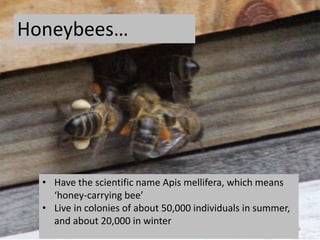
• Have the scientific name Apis mellifera, which means
‘honey-carrying bee’
• Live in colonies of about 50,000 individuals in summer,
and about 20,000 in winter
Honeybees…
6
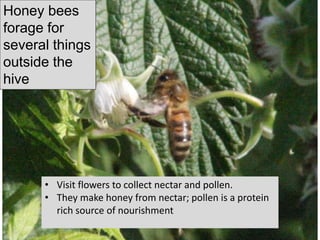
• Visit flowers to collect nectar and pollen.
• They make honey from nectar; pollen is a protein
rich source of nourishment
Honey bees
forage for
several things
outside the
hive
7
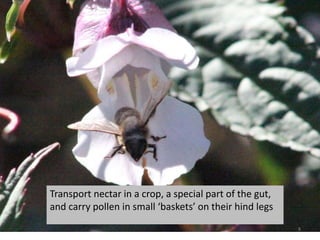
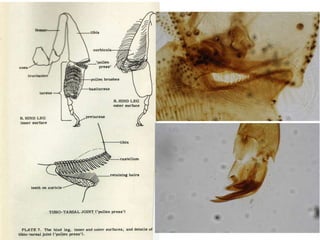
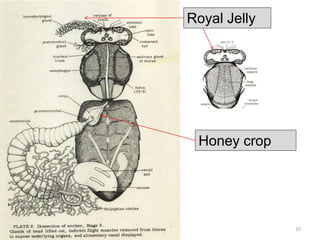
Transport nectar in a crop, a special part of the gut,
and carry pollen in small ‘baskets’ on their hind legs
8
10
Honey crop
Royal Jelly
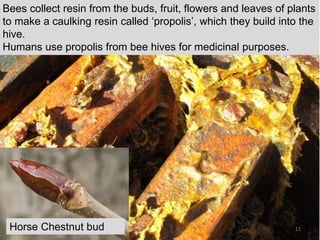
Horse Chestnut bud
Bees collect resin from the buds, fruit, flowers and leaves of plants
to make a caulking resin called ‘propolis’, which they build into the
hive.
Humans use propolis from bee hives for medicinal purposes.
11
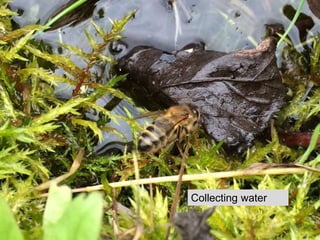
Collecting water
12
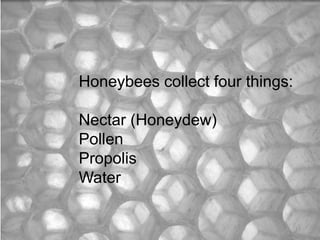
Honeybees collect four things:
Nectar (Honeydew)
Pollen
Propolis
Water
13
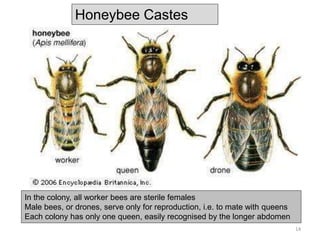
In the colony, all worker bees are sterile females
Male bees, or drones, serve only for reproduction, i.e. to mate with queens
Each colony has only one queen, easily recognised by the longer abdomen
Honeybee Castes
14
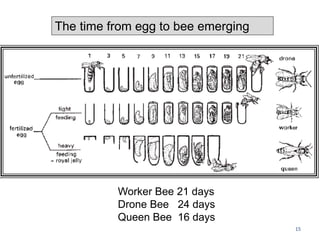
The time from egg to bee emerging
Worker Bee 21 days
Drone Bee 24 days
Queen Bee 16 days
15
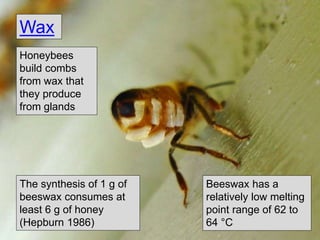
Honeybees
build combs
from wax that
they produce
from glands
Wax
16
The synthesis of 1 g of
beeswax consumes at
least 6 g of honey
(Hepburn 1986)
Beeswax has a
relatively low melting
point range of 62 to
64 °C
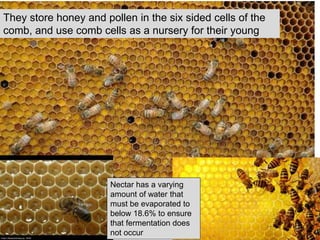
They store honey and pollen in the six sided cells of the
comb, and use comb cells as a nursery for their young
Nectar has a varying
amount of water that
must be evaporated to
below 18.6% to ensure
that fermentation does
not occur
17
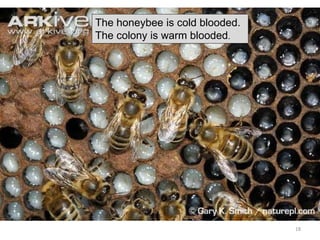
The honeybee is cold blooded.
The colony is warm blooded.
18
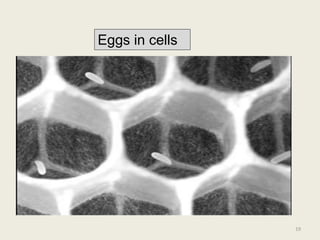
Eggs in cells
19
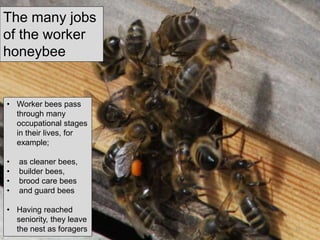
• Worker bees pass
through many
occupational stages
in their lives, for
example;
• as cleaner bees,
• builder bees,
• brood care bees
• and guard bees
• Having reached
seniority, they leave
the nest as foragers
The many jobs
of the worker
honeybee
20
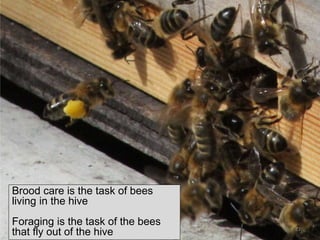
Brood care is the task of bees
living in the hive
Foraging is the task of the bees
that fly out of the hive 21
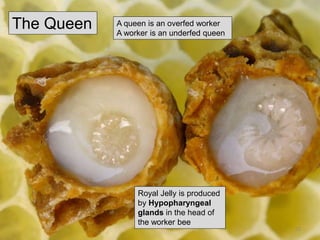
Royal Jelly is produced
by Hypopharyngeal
glands in the head of
the worker bee
A queen is an overfed worker
A worker is an underfed queen
The Queen
22
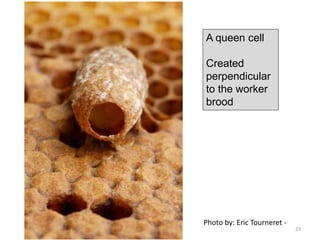
Photo by: Eric Tourneret -
A queen cell
Created
perpendicular
to the worker
brood
23
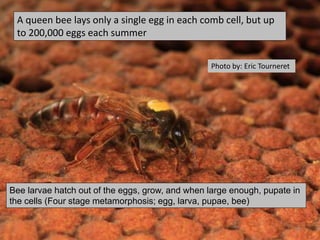
Photo by: Eric Tourneret
A queen bee lays only a single egg in each comb cell, but up
to 200,000 eggs each summer
Bee larvae hatch out of the eggs, grow, and when large enough, pupate in
the cells (Four stage metamorphosis; egg, larva, pupae, bee)
24
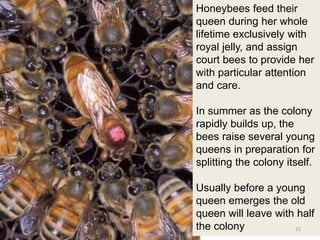
Honeybees feed their
queen during her whole
lifetime exclusively with
royal jelly, and assign
court bees to provide her
with particular attention
and care.
In summer as the colony
rapidly builds up, the
bees raise several young
queens in preparation for
splitting the colony itself.
Usually before a young
queen emerges the old
queen will leave with half
the colony 25
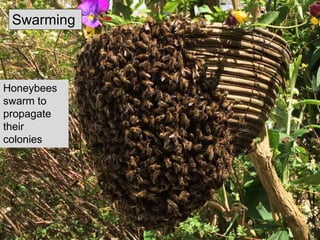
Honeybees
swarm to
propagate
their
colonies
Swarming
26
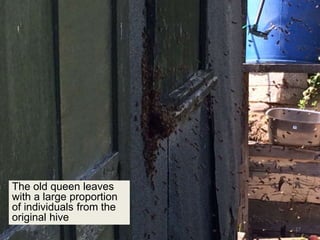
The old queen leaves
with a large proportion
of individuals from the
original hive
27
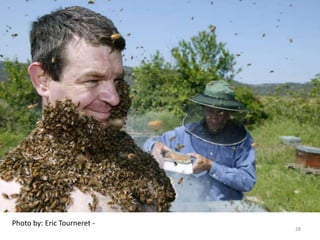
Photo by: Eric Tourneret -
28
Photo by: Eric Tourneret -
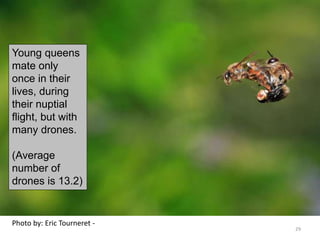
Young queens
mate only
once in their
lives, during
their nuptial
flight, but with
many drones.
(Average
number of
drones is 13.2)
29
Photo by: Eric Tourneret -
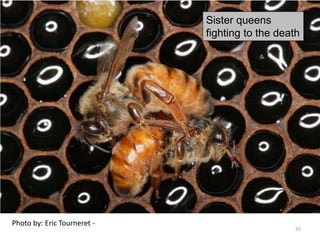
Sister queens
fighting to the death
30
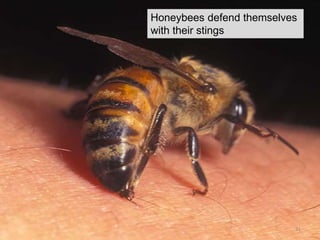
Honeybees defend themselves
with their stings
31
Photo by: Eric
Tourneret
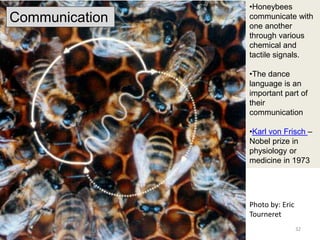
•Honeybees
communicate with
one another
through various
chemical and
tactile signals.
•The dance
language is an
important part of
their
communication
•Karl von Frisch –
Nobel prize in
physiology or
medicine in 1973
Communication
32
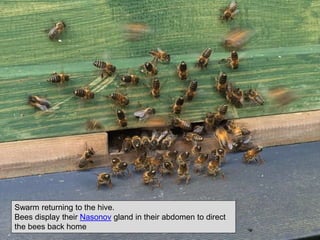
Swarm returning to the hive.
Bees display their Nasonov gland in their abdomen to direct
the bees back home 33
Photo by: Eric Tourneret -
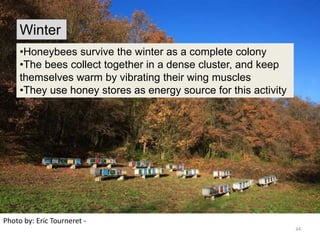
•Honeybees survive the winter as a complete colony
•The bees collect together in a dense cluster, and keep
themselves warm by vibrating their wing muscles
•They use honey stores as energy source for this activity
34
Winter
Photo by: Eric Tourneret -
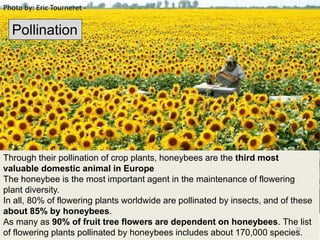
Through their pollination of crop plants, honeybees are the third most
valuable domestic animal in Europe
The honeybee is the most important agent in the maintenance of flowering
plant diversity.
In all, 80% of flowering plants worldwide are pollinated by insects, and of these
about 85% by honeybees.
As many as 90% of fruit tree flowers are dependent on honeybees. The list
of flowering plants pollinated by honeybees includes about 170,000 species.
Pollination
35
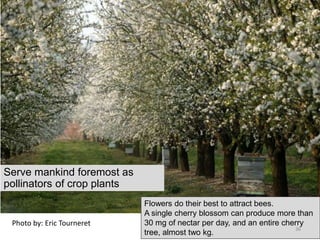
Photo by: Eric Tourneret
Serve mankind foremost as
pollinators of crop plants
Flowers do their best to attract bees.
A single cherry blossom can produce more than
30 mg of nectar per day, and an entire cherry
tree, almost two kg.
36
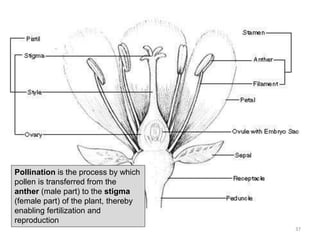
Pollination is the process by which
pollen is transferred from the
anther (male part) to the stigma
(female part) of the plant, thereby
enabling fertilization and
reproduction
37
Content
• The Honeybee
• Social Insects, Castes of honeybee, Colony, Bee biology
• History of beekeeping
• Ancients, Langstroth
• Hives and Apiaries
• Hive types, Season,
• Produce
• Honey, wax, pollen, propolis
• Issues
• Pesticides, varroa, disease, asian hornet
• Getting started
• Courses, suppliers, beekeeping associations, mentors
38
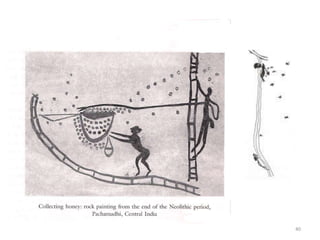
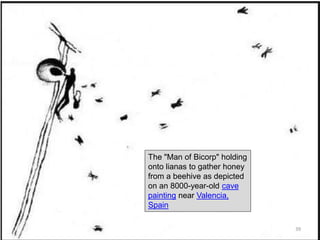
The "Man of Bicorp" holding
onto lianas to gather honey
from a beehive as depicted
on an 8000-year-old cave
painting near Valencia,
Spain
39
40
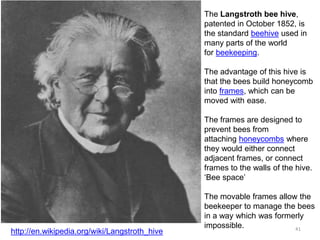
The Langstroth bee hive,
patented in October 1852, is
the standard beehive used in
many parts of the world
for beekeeping.
The advantage of this hive is
that the bees build honeycomb
into frames, which can be
moved with ease.
The frames are designed to
prevent bees from
attaching honeycombs where
they would either connect
adjacent frames, or connect
frames to the walls of the hive.
‘Bee space’
The movable frames allow the
beekeeper to manage the bees
in a way which was formerly
impossible.
http://en.wikipedia.org/wiki/Langstroth_hive 41
Content
• The Honeybee
• Social Insects, Castes of honeybee, Colony, Bee biology
• History of beekeeping
• Ancients, Langstroth
• Hives and Apiaries
• Hive types, Season,
• Produce
• Honey, wax, pollen, propolis
• Issues
• Pesticides, varroa, disease, asian hornet
• Getting started
• Courses, suppliers, beekeeping associations, mentors
42
43
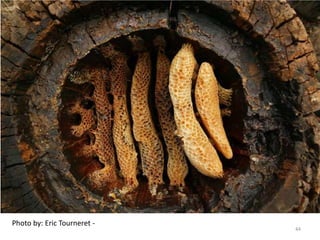
Photo by: Eric Tourneret -
44
Photo by: Eric Tourneret -
45
Photo by: Eric Tourneret -
46
Photo by: Eric Tourneret -
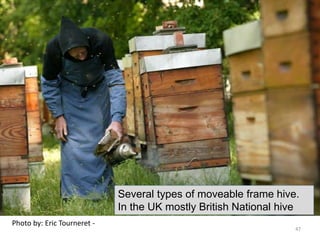
Several types of moveable frame hive.
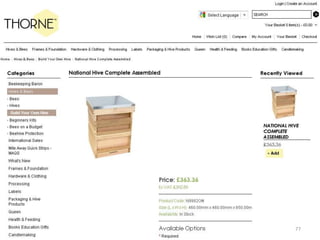
In the UK mostly British National hive
47
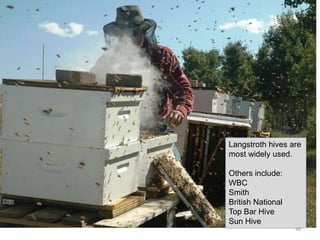
Langstroth hives are
most widely used.
Others include:
WBC
Smith
British National
Top Bar Hive
Sun Hive
48
49
50
52
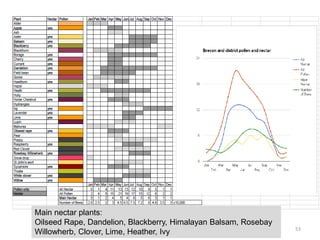
Main nectar plants:
Oilseed Rape, Dandelion, Blackberry, Himalayan Balsam, Rosebay
Willowherb, Clover, Lime, Heather, Ivy 53
54
55
Content
• The Honeybee
• Social Insects, Castes of honeybee, Colony, Bee biology
• History of beekeeping
• Ancients, Langstroth
• Hives and Apiaries
• Hive types, Season,
• Produce
• Honey, wax, pollen, propolis
• Issues
• Pesticides, varroa, disease, asian hornet
• Getting started
• Courses, suppliers, beekeeping associations, mentors
56
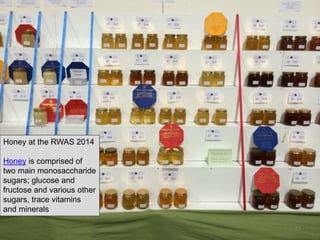
Honey at the RWAS 2014
Honey is comprised of
two main monosaccharide
sugars; glucose and
fructose and various other
sugars, trace vitamins
and minerals
57
Honey facts²
• Honey produces hydrogen peroxide when it is diluted, and in 1962 it was
shown that this made the honey antibacterial.
• Most bacteria prefer a pH of between 7.2 to 7.4 for optimum growth,
whereas the normal range in honey is 3.2 to 4.5.
• It is often said that if honey wasn’t so sweet it would really be sour.
• Honeybees have lived in cold-temperate climates for at least the last 10–
12 million years, and in order to cope with long, harsh winters they have
developed the ability to collect and store many kilograms of honey; so
many, in fact, that there is usually enough for them to make it through to
the spring, as well as provide a goodly amount for us.
• Glucose is the sugar in honey that solidifies. Fructose is much sweeter
than glucose (by a factor of 2.5 to 1).
• Today the total world production of honey represents less than 1% of all
the sugar we consume each year.
• In fact, if everyone in the world ate a tablespoon of honey each day, we
would consume the entire world’s annual honey production in less than
three weeks
58
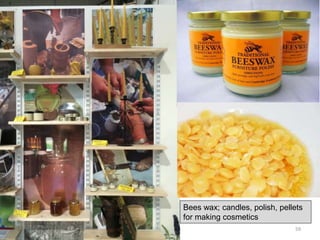
Bees wax; candles, polish, pellets
for making cosmetics
59
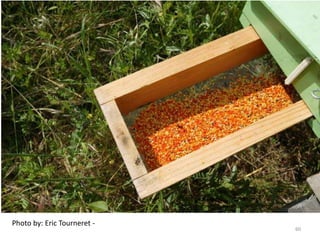
Photo by: Eric Tourneret -
60
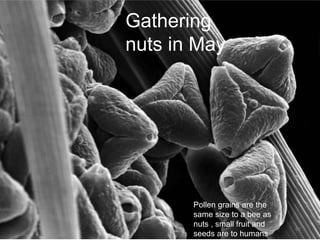
Gathering
nuts in May
Pollen grains are the
same size to a bee as
nuts , small fruit and
seeds are to humans
61
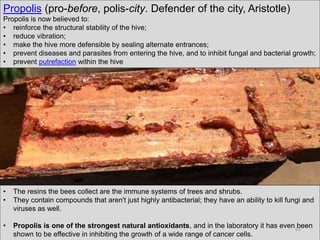
Propolis (pro-before, polis-city. Defender of the city, Aristotle)
Propolis is now believed to:
• reinforce the structural stability of the hive;
• reduce vibration;
• make the hive more defensible by sealing alternate entrances;
• prevent diseases and parasites from entering the hive, and to inhibit fungal and bacterial growth;
• prevent putrefaction within the hive
• The resins the bees collect are the immune systems of trees and shrubs.
• They contain compounds that aren't just highly antibacterial; they have an ability to kill fungi and
viruses as well.
• Propolis is one of the strongest natural antioxidants, and in the laboratory it has even been
shown to be effective in inhibiting the growth of a wide range of cancer cells.
62
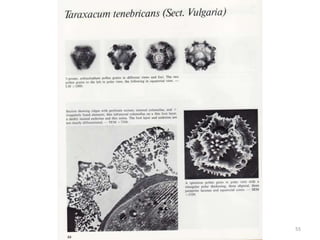
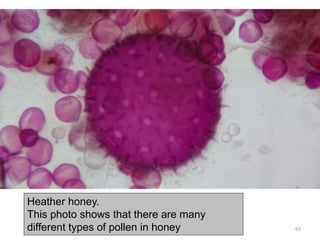
Heather honey.
This photo shows that there are many
different types of pollen in honey 63
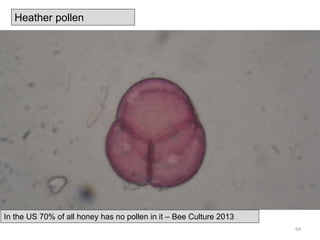
Heather pollen
In the US 70% of all honey has no pollen in it – Bee Culture 2013
64
Content
• The Honeybee
• Social Insects, Castes of honeybee, Colony, Bee biology
• History of beekeeping
• Ancients, Langstroth
• Hives and Apiaries
• Hive types, Season,
• Produce
• Honey, wax, pollen, propolis
• Issues
• Pesticides, varroa, disease, asian hornet
• Getting started
• Courses, suppliers, beekeeping associations, mentors
65
Photo by: Eric Tourneret -
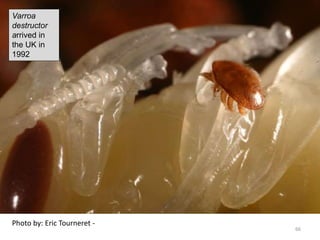
Varroa
destructor
arrived in
the UK in
1992
66
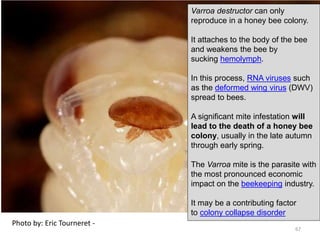
Photo by: Eric Tourneret -
Varroa destructor can only
reproduce in a honey bee colony.
It attaches to the body of the bee
and weakens the bee by
sucking hemolymph.
In this process, RNA viruses such
as the deformed wing virus (DWV)
spread to bees.
A significant mite infestation will
lead to the death of a honey bee
colony, usually in the late autumn
through early spring.
The Varroa mite is the parasite with
the most pronounced economic
impact on the beekeeping industry.
It may be a contributing factor
to colony collapse disorder
67
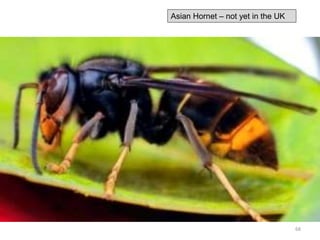
Asian Hornet – not yet in the UK
68
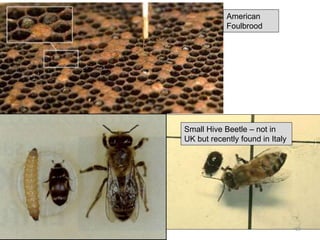
Small Hive Beetle – not in
UK but recently found in Italy
American
Foulbrood
69
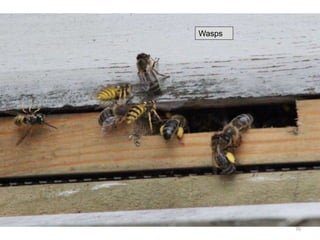
Wasps
70
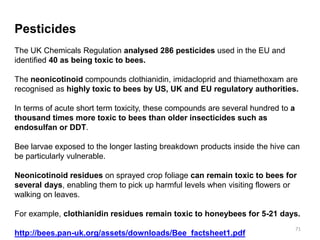
Pesticides
The UK Chemicals Regulation analysed 286 pesticides used in the EU and
identified 40 as being toxic to bees.
The neonicotinoid compounds clothianidin, imidacloprid and thiamethoxam are
recognised as highly toxic to bees by US, UK and EU regulatory authorities.
In terms of acute short term toxicity, these compounds are several hundred to a
thousand times more toxic to bees than older insecticides such as
endosulfan or DDT.
Bee larvae exposed to the longer lasting breakdown products inside the hive can
be particularly vulnerable.
Neonicotinoid residues on sprayed crop foliage can remain toxic to bees for
several days, enabling them to pick up harmful levels when visiting flowers or
walking on leaves.
For example, clothianidin residues remain toxic to honeybees for 5-21 days.
http://bees.pan-uk.org/assets/downloads/Bee_factsheet1.pdf
71
Content
• The Honeybee
• Social Insects, Castes of honeybee, Colony, Bee biology
• History of beekeeping
• Ancients, Langstroth
• Hives and Apiaries
• Hive types, Season,
• Produce
• Honey, wax, pollen, propolis
• Issues
• Pesticides, varroa, disease, asian hornet
• Getting started
• Courses, suppliers, beekeeping associations, mentors
72
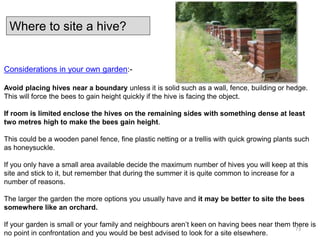
Considerations in your own garden:-
Avoid placing hives near a boundary unless it is solid such as a wall, fence, building or hedge.
This will force the bees to gain height quickly if the hive is facing the object.
If room is limited enclose the hives on the remaining sides with something dense at least
two metres high to make the bees gain height.
This could be a wooden panel fence, fine plastic netting or a trellis with quick growing plants such
as honeysuckle.
If you only have a small area available decide the maximum number of hives you will keep at this
site and stick to it, but remember that during the summer it is quite common to increase for a
number of reasons.
The larger the garden the more options you usually have and it may be better to site the bees
somewhere like an orchard.
If your garden is small or your family and neighbours aren’t keen on having bees near them there is
no point in confrontation and you would be best advised to look for a site elsewhere.
Where to site a hive?
73
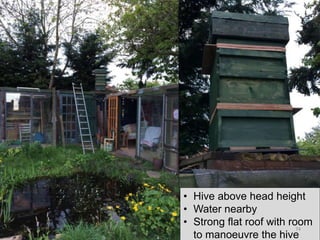
• Hive above head height
• Water nearby
• Strong flat roof with room
to manoeuvre the hive
74
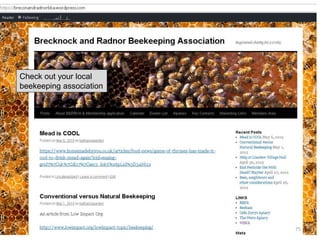
Check out your local
beekeeping association
75
Getting started
76
77
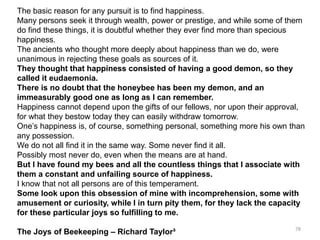
The basic reason for any pursuit is to find happiness.
Many persons seek it through wealth, power or prestige, and while some of them
do find these things, it is doubtful whether they ever find more than specious
happiness.
The ancients who thought more deeply about happiness than we do, were
unanimous in rejecting these goals as sources of it.
They thought that happiness consisted of having a good demon, so they
called it eudaemonia.
There is no doubt that the honeybee has been my demon, and an
immeasurably good one as long as I can remember.
Happiness cannot depend upon the gifts of our fellows, nor upon their approval,
for what they bestow today they can easily withdraw tomorrow.
One’s happiness is, of course, something personal, something more his own than
any possession.
We do not all find it in the same way. Some never find it all.
Possibly most never do, even when the means are at hand.
But I have found my bees and all the countless things that I associate with
them a constant and unfailing source of happiness.
I know that not all persons are of this temperament.
Some look upon this obsession of mine with incomprehension, some with
amusement or curiosity, while I in turn pity them, for they lack the capacity
for these particular joys so fulfilling to me.
The Joys of Beekeeping – Richard Taylor³ 78
References
1. The Buzz about Bees – Jürgen Tautz
2. Manuka: The Biography of an Extraordinary
Honey - Cliff Van Eaton
3. The Joys of Beekeeping - Richard Taylor
4. Anatomy and Dissection of the Honeybee -
Harry Arthur Dade.
5. Bee - Rose Lynn Fisher. Princeton
Architectural Press.
6. My blog https://ccardew.wordpress.com/ 79
Any
Questions?
80
81

Beekeeping May 16th 2015 Smallholder's Fair

  • 1.
  • 2.
    Content • The Honeybee •Social Insects, Castes of honeybee, Colony, Bee biology • History of beekeeping • Ancients, Langstroth • Hives and Apiaries • Hive types, Season, • Produce • Honey, wax, pollen, propolis • Issues • Pesticides, varroa, disease, asian hornet • Getting started • Courses, suppliers, beekeeping associations, mentors 2
  • 3.
  • 4.
  • 5.
    5 "Apis distribution map"by © Sémhur / Wikimedia Commons. Licensed under FAL via Wikimedia Commons - http://commons.wikimedia.org/wiki/File:Apis_distribution_map.svg#/media/File:Apis_distribution_map.svg Apis Mellifera in pink area. (Western Honeybee) Only seven species of honeybee are recognised In beekeeping only two species of honey bee, A. mellifera and A. cerana indica
  • 6.
    • Have thescientific name Apis mellifera, which means ‘honey-carrying bee’ • Live in colonies of about 50,000 individuals in summer, and about 20,000 in winter Honeybees… 6
  • 7.
    • Visit flowersto collect nectar and pollen. • They make honey from nectar; pollen is a protein rich source of nourishment Honey bees forage for several things outside the hive 7
  • 8.
    Transport nectar ina crop, a special part of the gut, and carry pollen in small ‘baskets’ on their hind legs 8
  • 10.
  • 11.
    Horse Chestnut bud Beescollect resin from the buds, fruit, flowers and leaves of plants to make a caulking resin called ‘propolis’, which they build into the hive. Humans use propolis from bee hives for medicinal purposes. 11
  • 12.
  • 13.
    Honeybees collect fourthings: Nectar (Honeydew) Pollen Propolis Water 13
  • 14.
    In the colony,all worker bees are sterile females Male bees, or drones, serve only for reproduction, i.e. to mate with queens Each colony has only one queen, easily recognised by the longer abdomen Honeybee Castes 14
  • 15.
    The time fromegg to bee emerging Worker Bee 21 days Drone Bee 24 days Queen Bee 16 days 15
  • 16.
    Honeybees build combs from waxthat they produce from glands Wax 16 The synthesis of 1 g of beeswax consumes at least 6 g of honey (Hepburn 1986) Beeswax has a relatively low melting point range of 62 to 64 °C
  • 17.
    They store honeyand pollen in the six sided cells of the comb, and use comb cells as a nursery for their young Nectar has a varying amount of water that must be evaporated to below 18.6% to ensure that fermentation does not occur 17
  • 18.
    The honeybee iscold blooded. The colony is warm blooded. 18
  • 19.
  • 20.
    • Worker beespass through many occupational stages in their lives, for example; • as cleaner bees, • builder bees, • brood care bees • and guard bees • Having reached seniority, they leave the nest as foragers The many jobs of the worker honeybee 20
  • 21.
    Brood care isthe task of bees living in the hive Foraging is the task of the bees that fly out of the hive 21
  • 22.
    Royal Jelly isproduced by Hypopharyngeal glands in the head of the worker bee A queen is an overfed worker A worker is an underfed queen The Queen 22
  • 23.
    Photo by: EricTourneret - A queen cell Created perpendicular to the worker brood 23
  • 24.
    Photo by: EricTourneret A queen bee lays only a single egg in each comb cell, but up to 200,000 eggs each summer Bee larvae hatch out of the eggs, grow, and when large enough, pupate in the cells (Four stage metamorphosis; egg, larva, pupae, bee) 24
  • 25.
    Honeybees feed their queenduring her whole lifetime exclusively with royal jelly, and assign court bees to provide her with particular attention and care. In summer as the colony rapidly builds up, the bees raise several young queens in preparation for splitting the colony itself. Usually before a young queen emerges the old queen will leave with half the colony 25
  • 26.
  • 27.
    The old queenleaves with a large proportion of individuals from the original hive 27
  • 28.
    Photo by: EricTourneret - 28
  • 29.
    Photo by: EricTourneret - Young queens mate only once in their lives, during their nuptial flight, but with many drones. (Average number of drones is 13.2) 29
  • 30.
    Photo by: EricTourneret - Sister queens fighting to the death 30
  • 31.
  • 32.
    Photo by: Eric Tourneret •Honeybees communicatewith one another through various chemical and tactile signals. •The dance language is an important part of their communication •Karl von Frisch – Nobel prize in physiology or medicine in 1973 Communication 32
  • 33.
    Swarm returning tothe hive. Bees display their Nasonov gland in their abdomen to direct the bees back home 33
  • 34.
    Photo by: EricTourneret - •Honeybees survive the winter as a complete colony •The bees collect together in a dense cluster, and keep themselves warm by vibrating their wing muscles •They use honey stores as energy source for this activity 34 Winter
  • 35.
    Photo by: EricTourneret - Through their pollination of crop plants, honeybees are the third most valuable domestic animal in Europe The honeybee is the most important agent in the maintenance of flowering plant diversity. In all, 80% of flowering plants worldwide are pollinated by insects, and of these about 85% by honeybees. As many as 90% of fruit tree flowers are dependent on honeybees. The list of flowering plants pollinated by honeybees includes about 170,000 species. Pollination 35
  • 36.
    Photo by: EricTourneret Serve mankind foremost as pollinators of crop plants Flowers do their best to attract bees. A single cherry blossom can produce more than 30 mg of nectar per day, and an entire cherry tree, almost two kg. 36
  • 37.
    Pollination is theprocess by which pollen is transferred from the anther (male part) to the stigma (female part) of the plant, thereby enabling fertilization and reproduction 37
  • 38.
    Content • The Honeybee •Social Insects, Castes of honeybee, Colony, Bee biology • History of beekeeping • Ancients, Langstroth • Hives and Apiaries • Hive types, Season, • Produce • Honey, wax, pollen, propolis • Issues • Pesticides, varroa, disease, asian hornet • Getting started • Courses, suppliers, beekeeping associations, mentors 38
  • 39.
    The "Man ofBicorp" holding onto lianas to gather honey from a beehive as depicted on an 8000-year-old cave painting near Valencia, Spain 39
  • 40.
  • 41.
    The Langstroth beehive, patented in October 1852, is the standard beehive used in many parts of the world for beekeeping. The advantage of this hive is that the bees build honeycomb into frames, which can be moved with ease. The frames are designed to prevent bees from attaching honeycombs where they would either connect adjacent frames, or connect frames to the walls of the hive. ‘Bee space’ The movable frames allow the beekeeper to manage the bees in a way which was formerly impossible. http://en.wikipedia.org/wiki/Langstroth_hive 41
  • 42.
    Content • The Honeybee •Social Insects, Castes of honeybee, Colony, Bee biology • History of beekeeping • Ancients, Langstroth • Hives and Apiaries • Hive types, Season, • Produce • Honey, wax, pollen, propolis • Issues • Pesticides, varroa, disease, asian hornet • Getting started • Courses, suppliers, beekeeping associations, mentors 42
  • 43.
  • 44.
    Photo by: EricTourneret - 44
  • 45.
    Photo by: EricTourneret - 45
  • 46.
    Photo by: EricTourneret - 46
  • 47.
    Photo by: EricTourneret - Several types of moveable frame hive. In the UK mostly British National hive 47
  • 48.
    Langstroth hives are mostwidely used. Others include: WBC Smith British National Top Bar Hive Sun Hive 48
  • 49.
  • 50.
  • 52.
  • 53.
    Main nectar plants: OilseedRape, Dandelion, Blackberry, Himalayan Balsam, Rosebay Willowherb, Clover, Lime, Heather, Ivy 53
  • 54.
  • 55.
  • 56.
    Content • The Honeybee •Social Insects, Castes of honeybee, Colony, Bee biology • History of beekeeping • Ancients, Langstroth • Hives and Apiaries • Hive types, Season, • Produce • Honey, wax, pollen, propolis • Issues • Pesticides, varroa, disease, asian hornet • Getting started • Courses, suppliers, beekeeping associations, mentors 56
  • 57.
    Honey at theRWAS 2014 Honey is comprised of two main monosaccharide sugars; glucose and fructose and various other sugars, trace vitamins and minerals 57
  • 58.
    Honey facts² • Honeyproduces hydrogen peroxide when it is diluted, and in 1962 it was shown that this made the honey antibacterial. • Most bacteria prefer a pH of between 7.2 to 7.4 for optimum growth, whereas the normal range in honey is 3.2 to 4.5. • It is often said that if honey wasn’t so sweet it would really be sour. • Honeybees have lived in cold-temperate climates for at least the last 10– 12 million years, and in order to cope with long, harsh winters they have developed the ability to collect and store many kilograms of honey; so many, in fact, that there is usually enough for them to make it through to the spring, as well as provide a goodly amount for us. • Glucose is the sugar in honey that solidifies. Fructose is much sweeter than glucose (by a factor of 2.5 to 1). • Today the total world production of honey represents less than 1% of all the sugar we consume each year. • In fact, if everyone in the world ate a tablespoon of honey each day, we would consume the entire world’s annual honey production in less than three weeks 58
  • 59.
    Bees wax; candles,polish, pellets for making cosmetics 59
  • 60.
    Photo by: EricTourneret - 60
  • 61.
    Gathering nuts in May Pollengrains are the same size to a bee as nuts , small fruit and seeds are to humans 61
  • 62.
    Propolis (pro-before, polis-city.Defender of the city, Aristotle) Propolis is now believed to: • reinforce the structural stability of the hive; • reduce vibration; • make the hive more defensible by sealing alternate entrances; • prevent diseases and parasites from entering the hive, and to inhibit fungal and bacterial growth; • prevent putrefaction within the hive • The resins the bees collect are the immune systems of trees and shrubs. • They contain compounds that aren't just highly antibacterial; they have an ability to kill fungi and viruses as well. • Propolis is one of the strongest natural antioxidants, and in the laboratory it has even been shown to be effective in inhibiting the growth of a wide range of cancer cells. 62
  • 63.
    Heather honey. This photoshows that there are many different types of pollen in honey 63
  • 64.
    Heather pollen In theUS 70% of all honey has no pollen in it – Bee Culture 2013 64
  • 65.
    Content • The Honeybee •Social Insects, Castes of honeybee, Colony, Bee biology • History of beekeeping • Ancients, Langstroth • Hives and Apiaries • Hive types, Season, • Produce • Honey, wax, pollen, propolis • Issues • Pesticides, varroa, disease, asian hornet • Getting started • Courses, suppliers, beekeeping associations, mentors 65
  • 66.
    Photo by: EricTourneret - Varroa destructor arrived in the UK in 1992 66
  • 67.
    Photo by: EricTourneret - Varroa destructor can only reproduce in a honey bee colony. It attaches to the body of the bee and weakens the bee by sucking hemolymph. In this process, RNA viruses such as the deformed wing virus (DWV) spread to bees. A significant mite infestation will lead to the death of a honey bee colony, usually in the late autumn through early spring. The Varroa mite is the parasite with the most pronounced economic impact on the beekeeping industry. It may be a contributing factor to colony collapse disorder 67
  • 68.
    Asian Hornet –not yet in the UK 68
  • 69.
    Small Hive Beetle– not in UK but recently found in Italy American Foulbrood 69
  • 70.
  • 71.
    Pesticides The UK ChemicalsRegulation analysed 286 pesticides used in the EU and identified 40 as being toxic to bees. The neonicotinoid compounds clothianidin, imidacloprid and thiamethoxam are recognised as highly toxic to bees by US, UK and EU regulatory authorities. In terms of acute short term toxicity, these compounds are several hundred to a thousand times more toxic to bees than older insecticides such as endosulfan or DDT. Bee larvae exposed to the longer lasting breakdown products inside the hive can be particularly vulnerable. Neonicotinoid residues on sprayed crop foliage can remain toxic to bees for several days, enabling them to pick up harmful levels when visiting flowers or walking on leaves. For example, clothianidin residues remain toxic to honeybees for 5-21 days. http://bees.pan-uk.org/assets/downloads/Bee_factsheet1.pdf 71
  • 72.
    Content • The Honeybee •Social Insects, Castes of honeybee, Colony, Bee biology • History of beekeeping • Ancients, Langstroth • Hives and Apiaries • Hive types, Season, • Produce • Honey, wax, pollen, propolis • Issues • Pesticides, varroa, disease, asian hornet • Getting started • Courses, suppliers, beekeeping associations, mentors 72
  • 73.
    Considerations in yourown garden:- Avoid placing hives near a boundary unless it is solid such as a wall, fence, building or hedge. This will force the bees to gain height quickly if the hive is facing the object. If room is limited enclose the hives on the remaining sides with something dense at least two metres high to make the bees gain height. This could be a wooden panel fence, fine plastic netting or a trellis with quick growing plants such as honeysuckle. If you only have a small area available decide the maximum number of hives you will keep at this site and stick to it, but remember that during the summer it is quite common to increase for a number of reasons. The larger the garden the more options you usually have and it may be better to site the bees somewhere like an orchard. If your garden is small or your family and neighbours aren’t keen on having bees near them there is no point in confrontation and you would be best advised to look for a site elsewhere. Where to site a hive? 73
  • 74.
    • Hive abovehead height • Water nearby • Strong flat roof with room to manoeuvre the hive 74
  • 75.
    Check out yourlocal beekeeping association 75
  • 76.
  • 77.
  • 78.
    The basic reasonfor any pursuit is to find happiness. Many persons seek it through wealth, power or prestige, and while some of them do find these things, it is doubtful whether they ever find more than specious happiness. The ancients who thought more deeply about happiness than we do, were unanimous in rejecting these goals as sources of it. They thought that happiness consisted of having a good demon, so they called it eudaemonia. There is no doubt that the honeybee has been my demon, and an immeasurably good one as long as I can remember. Happiness cannot depend upon the gifts of our fellows, nor upon their approval, for what they bestow today they can easily withdraw tomorrow. One’s happiness is, of course, something personal, something more his own than any possession. We do not all find it in the same way. Some never find it all. Possibly most never do, even when the means are at hand. But I have found my bees and all the countless things that I associate with them a constant and unfailing source of happiness. I know that not all persons are of this temperament. Some look upon this obsession of mine with incomprehension, some with amusement or curiosity, while I in turn pity them, for they lack the capacity for these particular joys so fulfilling to me. The Joys of Beekeeping – Richard Taylor³ 78
  • 79.
    References 1. The Buzzabout Bees – Jürgen Tautz 2. Manuka: The Biography of an Extraordinary Honey - Cliff Van Eaton 3. The Joys of Beekeeping - Richard Taylor 4. Anatomy and Dissection of the Honeybee - Harry Arthur Dade. 5. Bee - Rose Lynn Fisher. Princeton Architectural Press. 6. My blog https://ccardew.wordpress.com/ 79
  • 80.
  • 81.