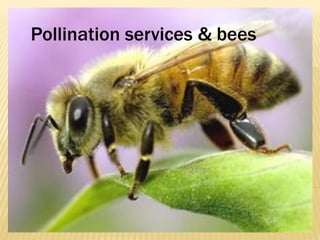
Pollination services & bees
POLLINATION
 pollen is transferred in the reproduction of
plants, thereby enabling fertilization and sexual
reproduction.
 > 3/4 of food crops
require pollinators
 20% Abiotic
 80% Biotic
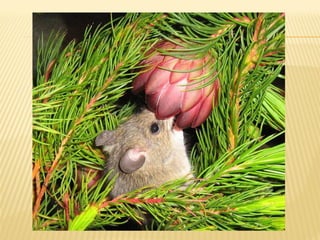
 Bees, butterflies, flies,
bats, birds, rodents, etc.
BEES
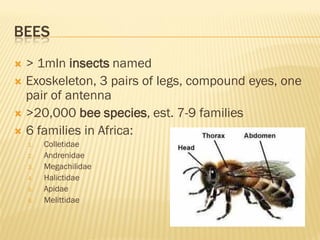
 > 1mln insects named
 Exoskeleton, 3 pairs of legs, compound eyes, one
pair of antenna
 >20,000 bee species, est. 7-9 families
 6 families in Africa:
1. Colletidae
2. Andrenidae
3. Megachilidae
4. Halictidae
5. Apidae
6. Melittidae
BEES
BEE
HONEY BEE
 Generalists
 Rent out hives
 Honey production
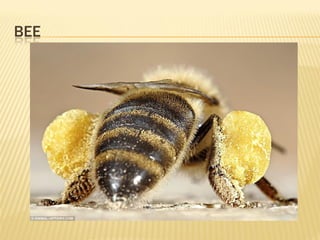
 Some carry pollen
(for “building” – close, as pollen is collected
more quickly), others nectar (far).
 Threat: mites, fungi, Colony Collapse Disorder
TOMATOES
 Wind
 Mechanical
shaking
 Bees
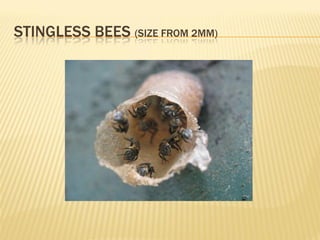
STINGLESS BEES (SIZE FROM 2MM)
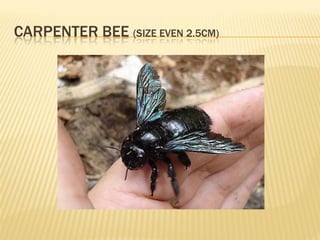
CARPENTER BEE (SIZE EVEN 2.5CM)
CARPENTER BEE – STEALING NECTAR
CARPENTER BEE WITH POLLEN
CARPENTER BEE
THREATS
 Harmful practices (Clearing of natural areas,
Monocultures, Grazing, Pesticides)
 Invasion of non-native plant and animals
HAND POLLINATION
GOOD PRACTICES
FORAGING – NESTING - SHELTER
E.g.
 Food sources
 Create nesting sites
 Corridors
 Consider blooming seasons (pesticides)
THANKS

Pollination services and bees