Big Bees – Part 2
Acknowledgements This presentation has been put together by a consortium of North American bee biologists This presentation has developed over many years and the original web picture acknowledgements were lost, if you see one of your pictures let us know and we will add your picture credit Correspondence can be sent to Sam Droege at sdroege@usgs.gov
Format Each Genus has an information page followed by a page of illustrations and a map of the distribution of Eastern North American species; western populations of Eastern species are shown, but the Western species are not mapped The number of Eastern species are listed at the top of the page
Bee Song Bees in the late summer sun Drone their song Of yellow moons Trimming black velvet Droning, droning a sleepysong. - Carl Sandburg
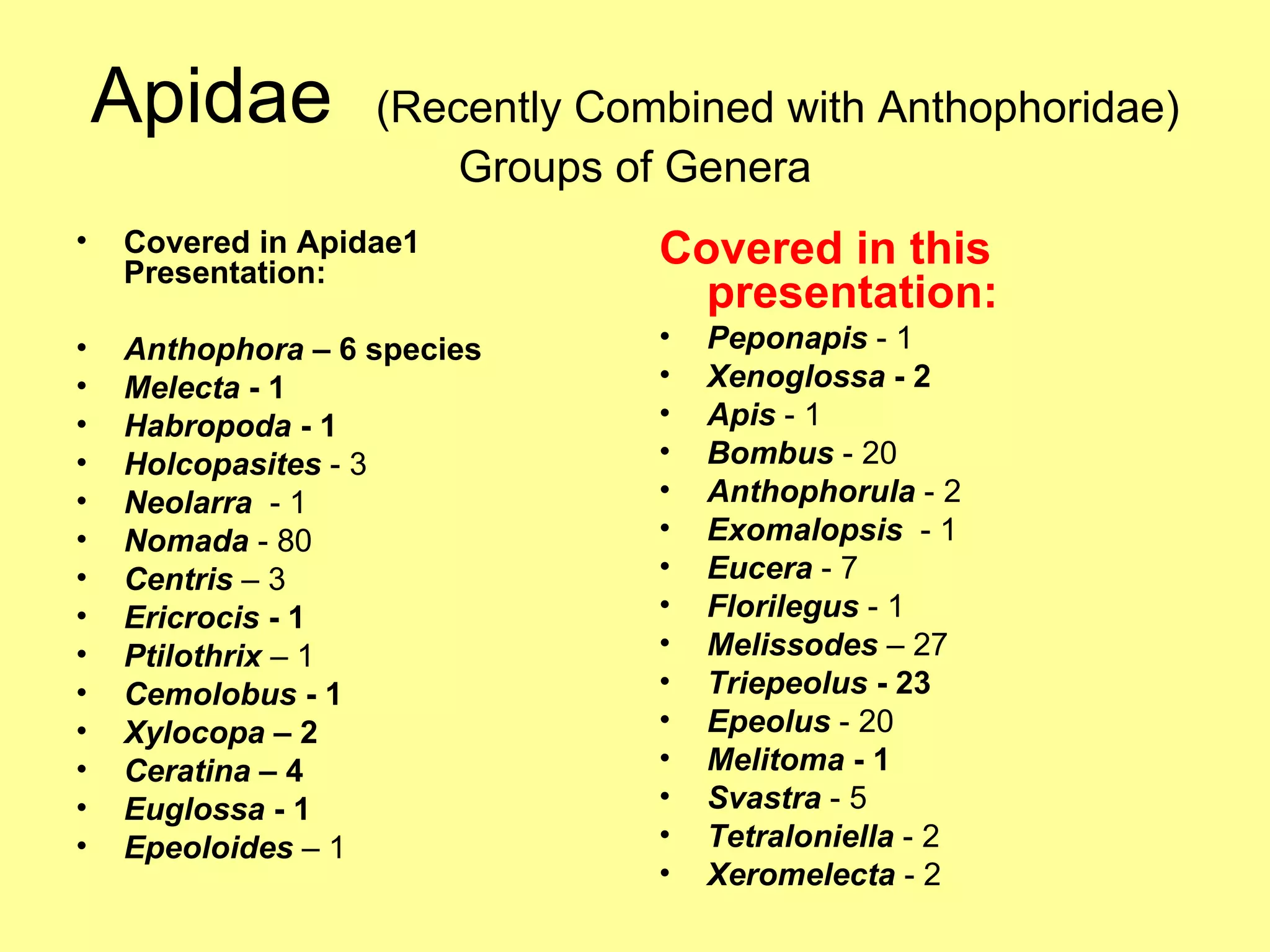
Apidae  (Recently Combined with Anthophoridae) Groups of Genera Covered in Apidae1 Presentation: Anthophora  – 6 species Melecta  - 1 Habropoda  - 1   Holcopasites  - 3 Neolarra   - 1 Nomada  - 80 Centris  – 3 Ericrocis  - 1 Ptilothrix  – 1 Cemolobus  - 1 Xylocopa  – 2 Ceratina  – 4 Euglossa  - 1 Epeoloides  – 1 Covered in this presentation: Peponapis  - 1 Xenoglossa  - 2 Apis  - 1 Bombus  - 20 Anthophorula  - 2 Exomalopsis   - 1 Eucera  - 7 Florilegus  - 1 Melissodes  – 27 Triepeolus  - 23 Epeolus  - 20 Melitoma  - 1 Svastra  - 5 Tetraloniella  - 2 Xeromelecta  - 2
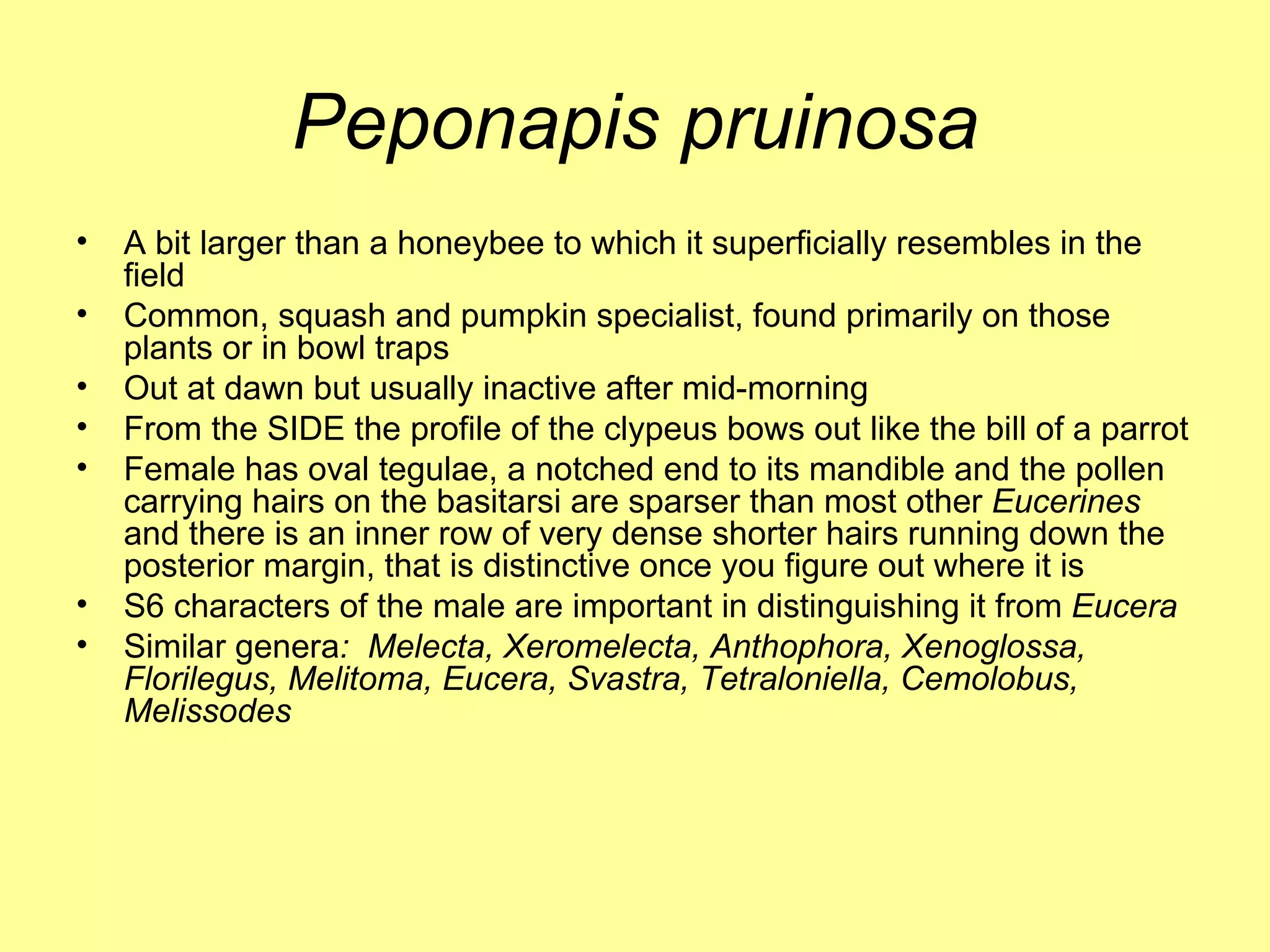
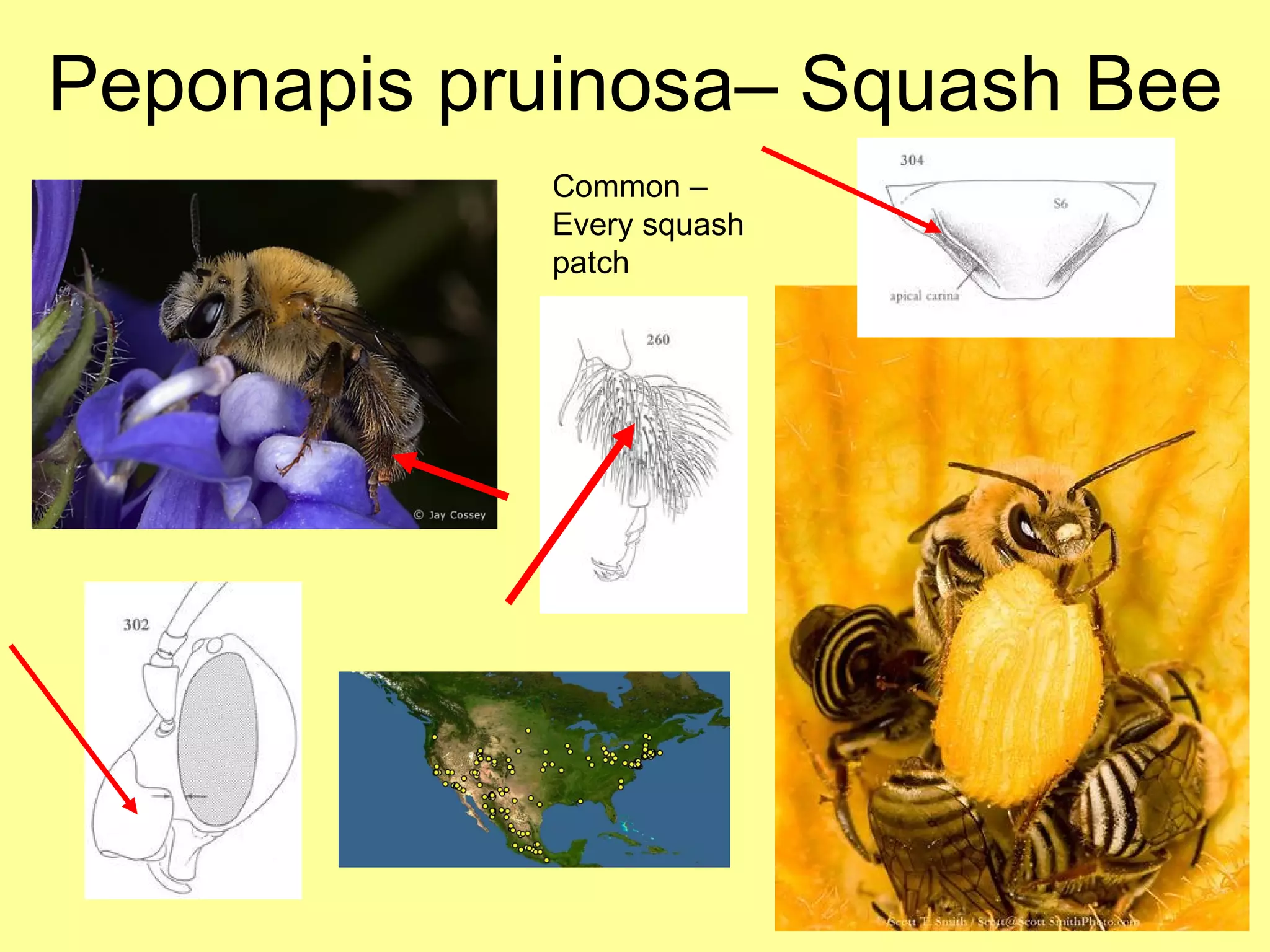
Peponapis pruinosa A bit larger than a honeybee to which it superficially resembles in the field Common, squash and pumpkin specialist, found primarily on those plants or in bowl traps Out at dawn but usually inactive after mid-morning From the SIDE the profile of the clypeus bows out like the bill of a parrot Female has oval tegulae, a notched end to its mandible and the pollen carrying hairs on the basitarsi are sparser than most other  Eucerines  and there is an inner row of very dense shorter hairs running down the posterior margin, that is distinctive once you figure out where it is S6 characters of the male are important in distinguishing it from  Eucera Similar genera :  Melecta, Xeromelecta, Anthophora, Xenoglossa, Florilegus, Melitoma, Eucera, Svastra, Tetraloniella, Cemolobus, Melissodes
Peponapis pruinosa– Squash Bee Common – Every squash patch
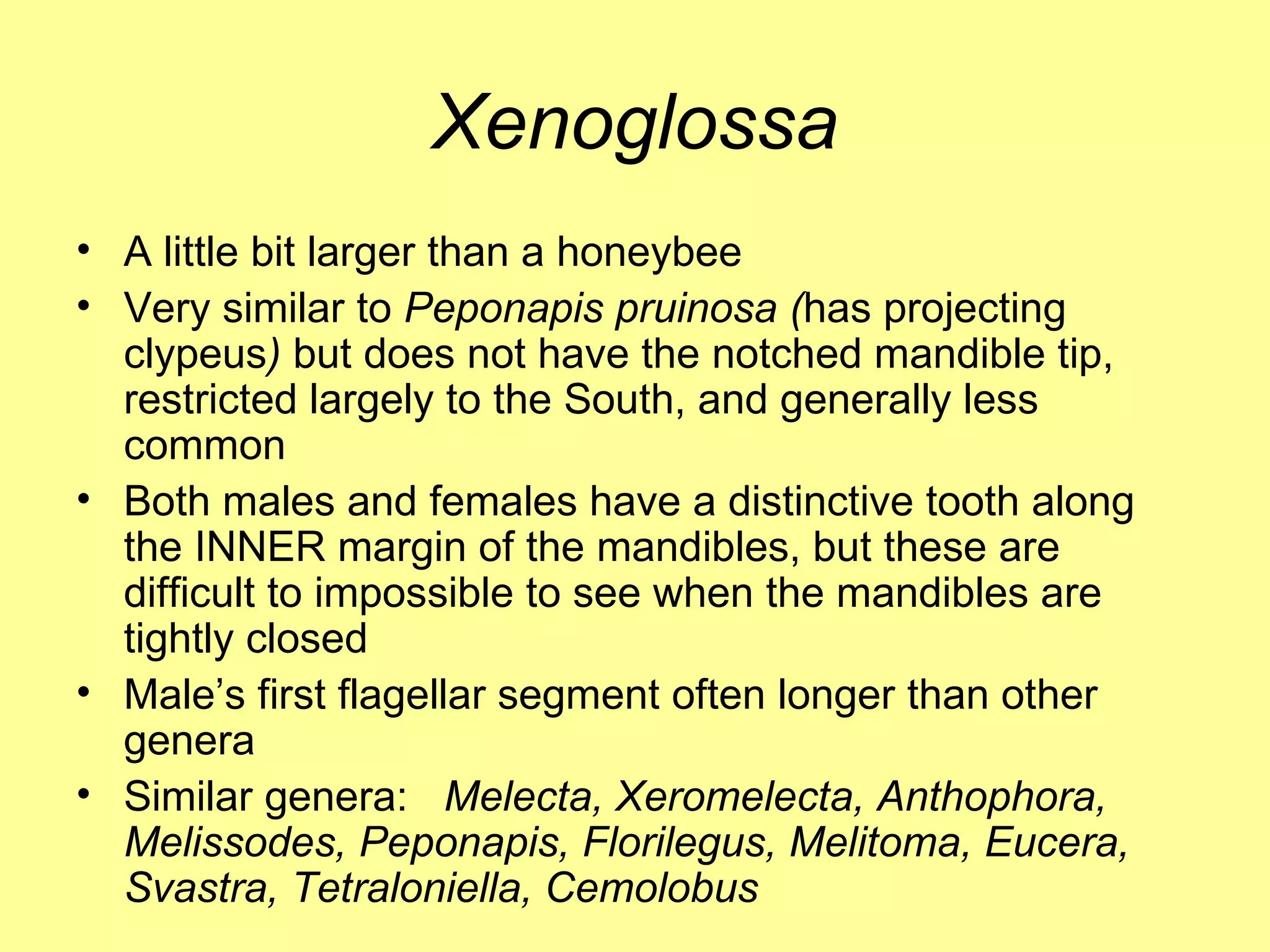
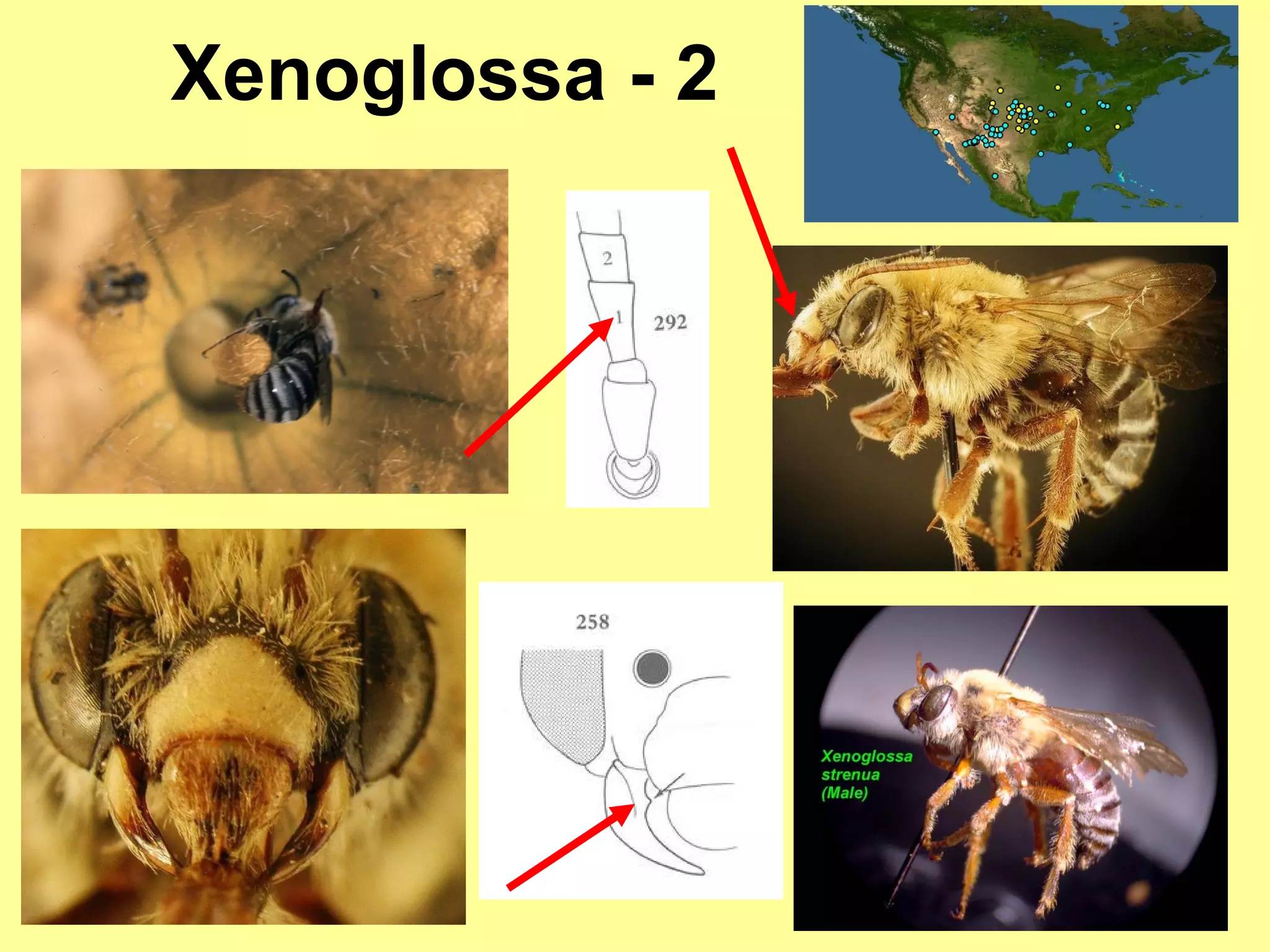
Xenoglossa A little bit larger than a honeybee Very similar to  Peponapis pruinosa ( has projecting clypeus )  but does not have the notched mandible tip, restricted largely to the South, and generally less common Both males and females have a distinctive tooth along the INNER margin of the mandibles, but these are difficult to impossible to see when the mandibles are tightly closed Male’s first flagellar segment often longer than other genera Similar genera:  Melecta, Xeromelecta, Anthophora, Melissodes, Peponapis, Florilegus, Melitoma, Eucera, Svastra, Tetraloniella, Cemolobus
Xenoglossa - 2
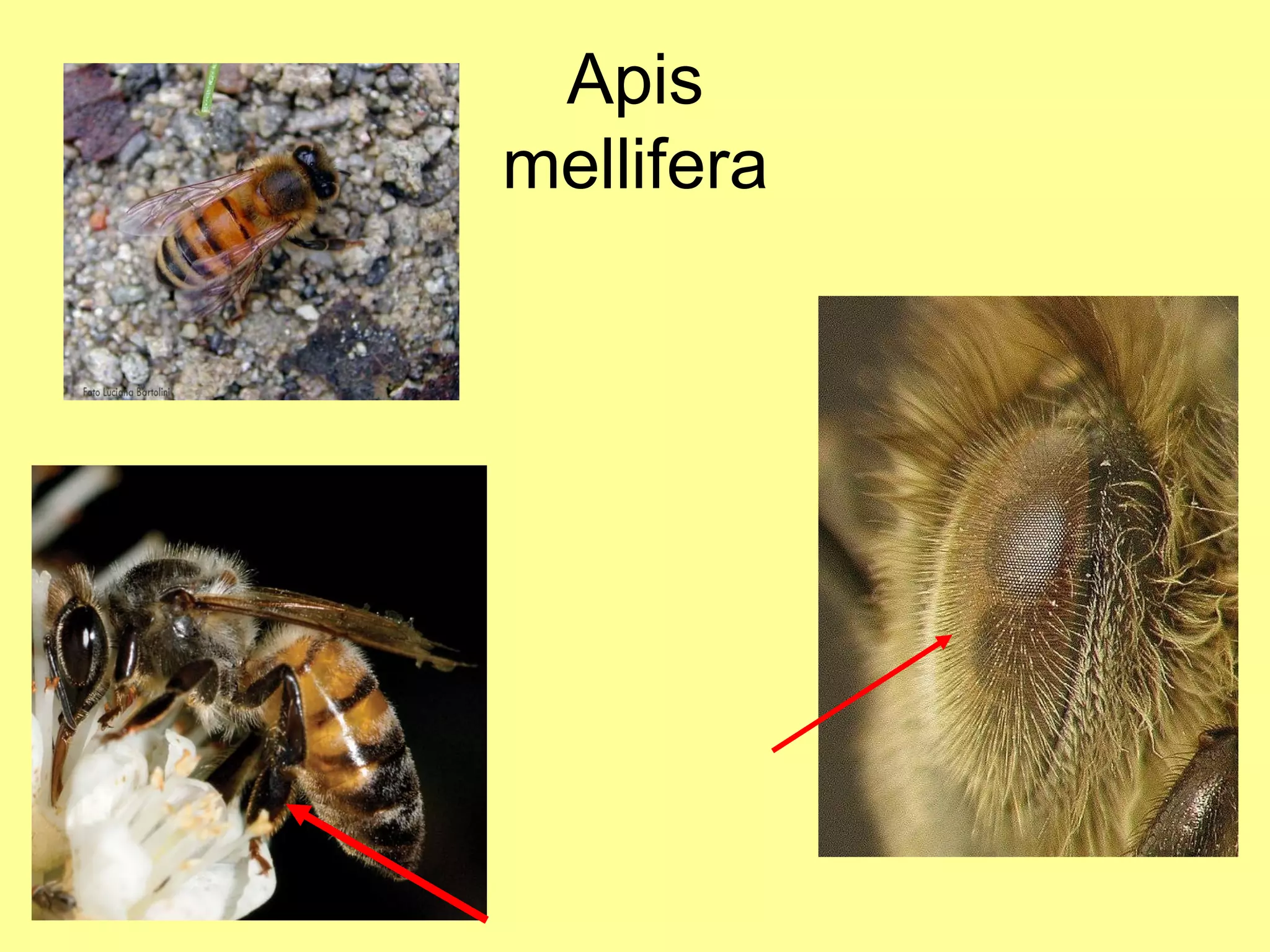
Apis Size of a honeybee because, of course, it is the honeybee Long hair on they compound eyes distinctive, only  Coelioxys  has hair on the eyes and then only short hair Hind tibia in the female is wide, flattened, and smooth except for hair around the outside edges Males are very rarely seen or collected
Apis mellifera
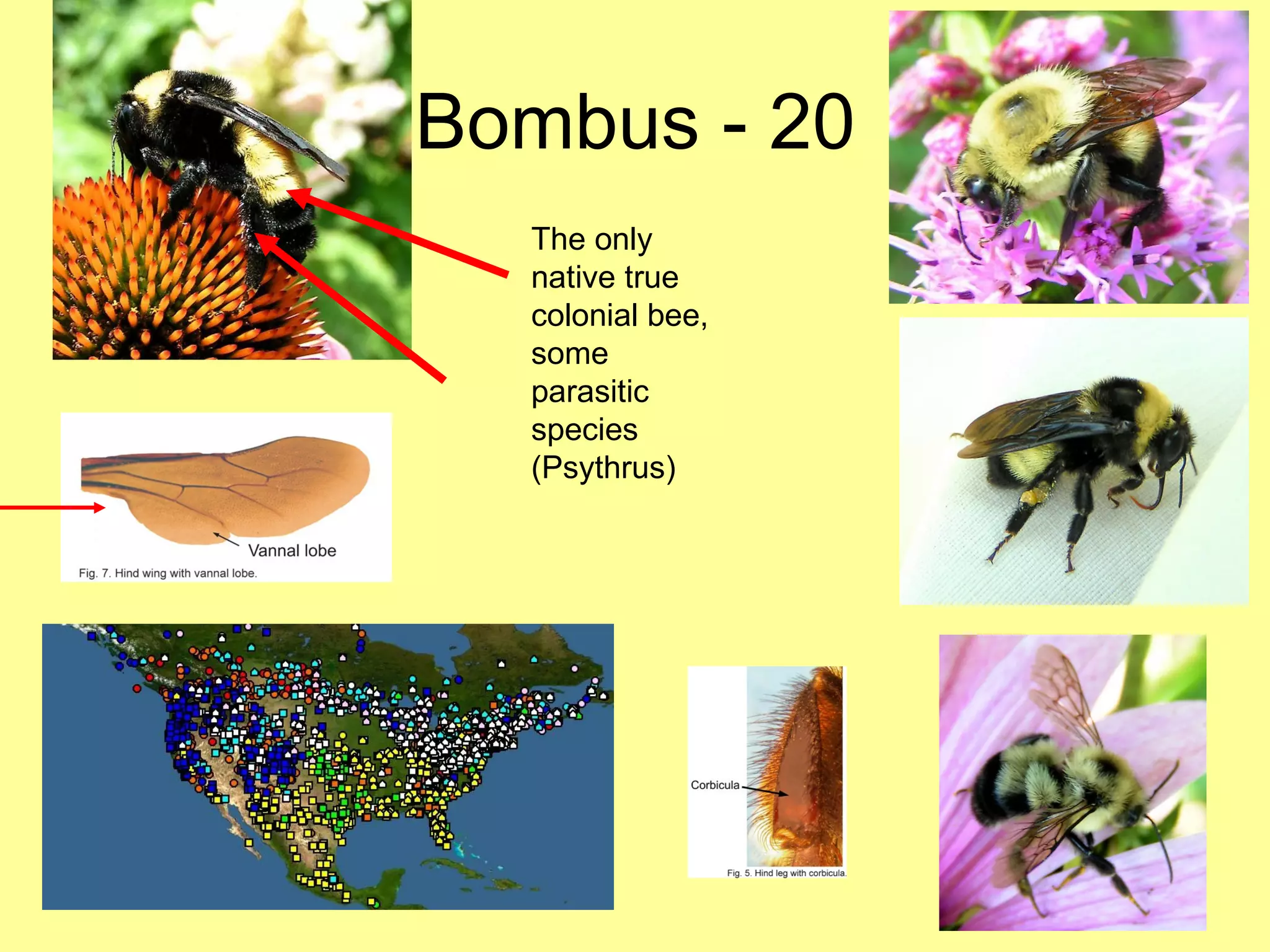
Bombus The only native colonial bee Unique in that the hind wing has no jugal lobe Parasitic members were considered in the past to be a separate Genus ( Psithyrus ) Non-parasitic females have a wide tibia, the outer side of which is completely bare in the center (corbiculate) and surrounded by long hairs Patterns of yellow, black, reddish hairs often, but not always, unique to species, several species pairs have to be identified under the microscope Several other genera have species that look similar:  Habropoda, Anthophora, Ptilothrix, Xylocopa
Bombus - 20 The only native true colonial bee, some parasitic species (Psythrus)
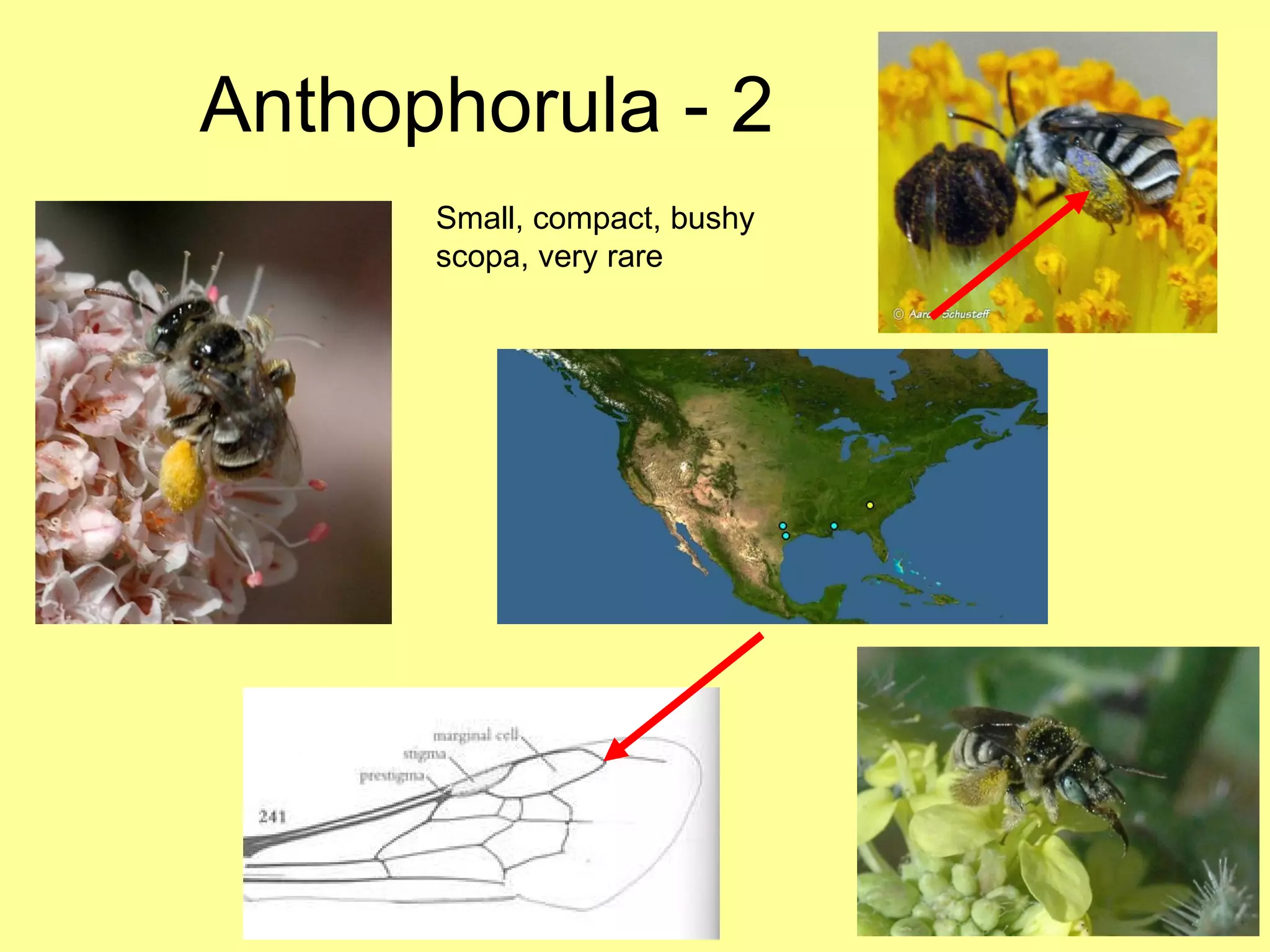
Anthophorula Extremely rare, a little more than half the size of a honeybee 2 species, one is a specialist on asters and the other on  Agalinis The pollen carrying hairs are very dense and voluminous Has a truncate marginal cell, but unlike most others in that group has 3 submarginal cells Most similar to, and in the past lumped with,  Exomalopsis , which in the males has a dark clypeus unlike the yellow one in  Anthophorula Similar genera:  Exomalopsis
Anthophorula - 2 Small, compact, bushy scopa, very rare
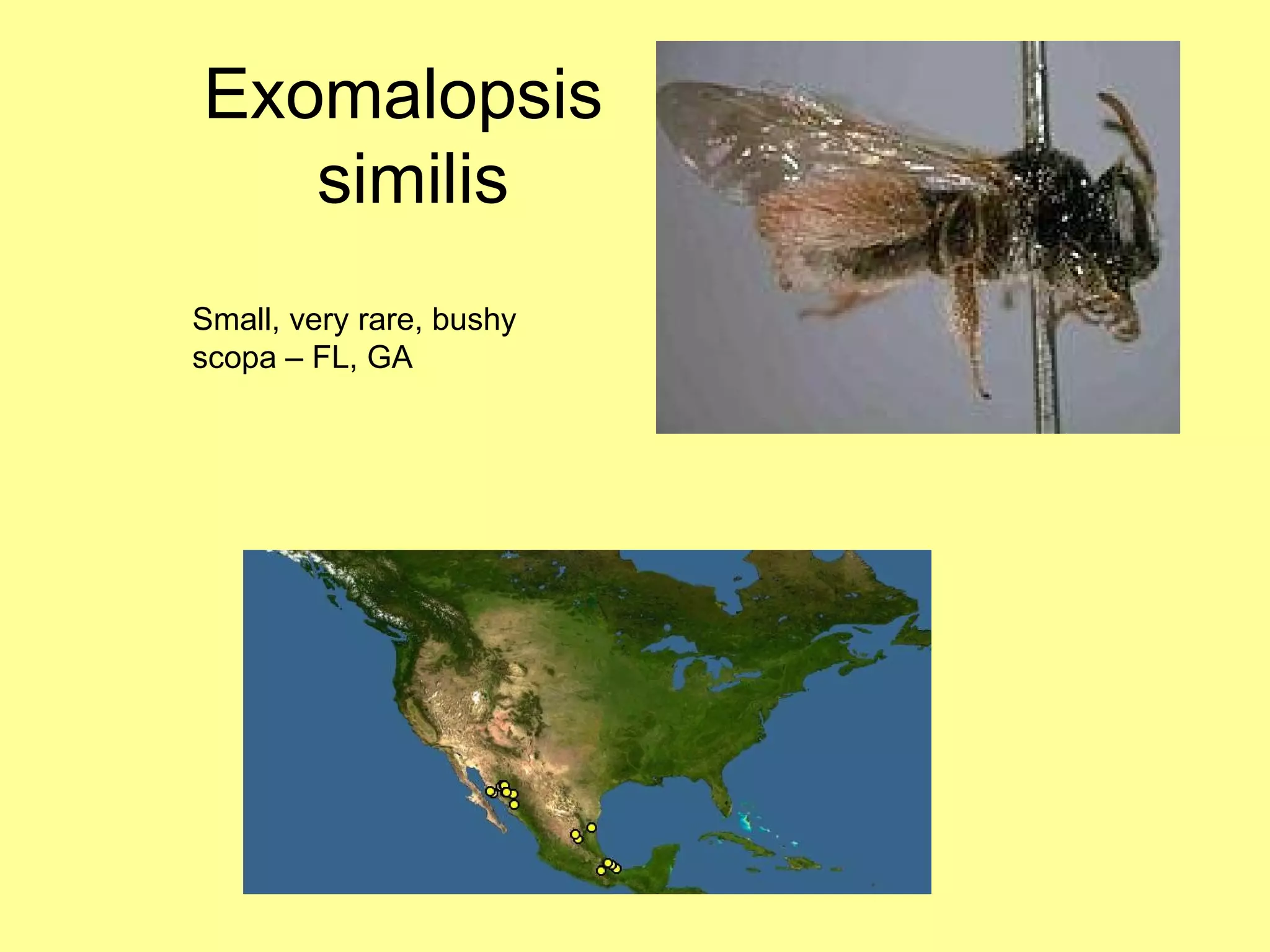
Exomalopsis similis Extremely rare, only 3 records from south Florida (1 recent) About half the size of a honeybee Very similar to  Anthophorula  in having 3 submarginal cells and a truncate marginal cell Unlike  Anthophorula , the males have a dark clypeus Similar genera:  Anthophorula
Exomalopsis  similis Small, very rare, bushy scopa – FL, GA
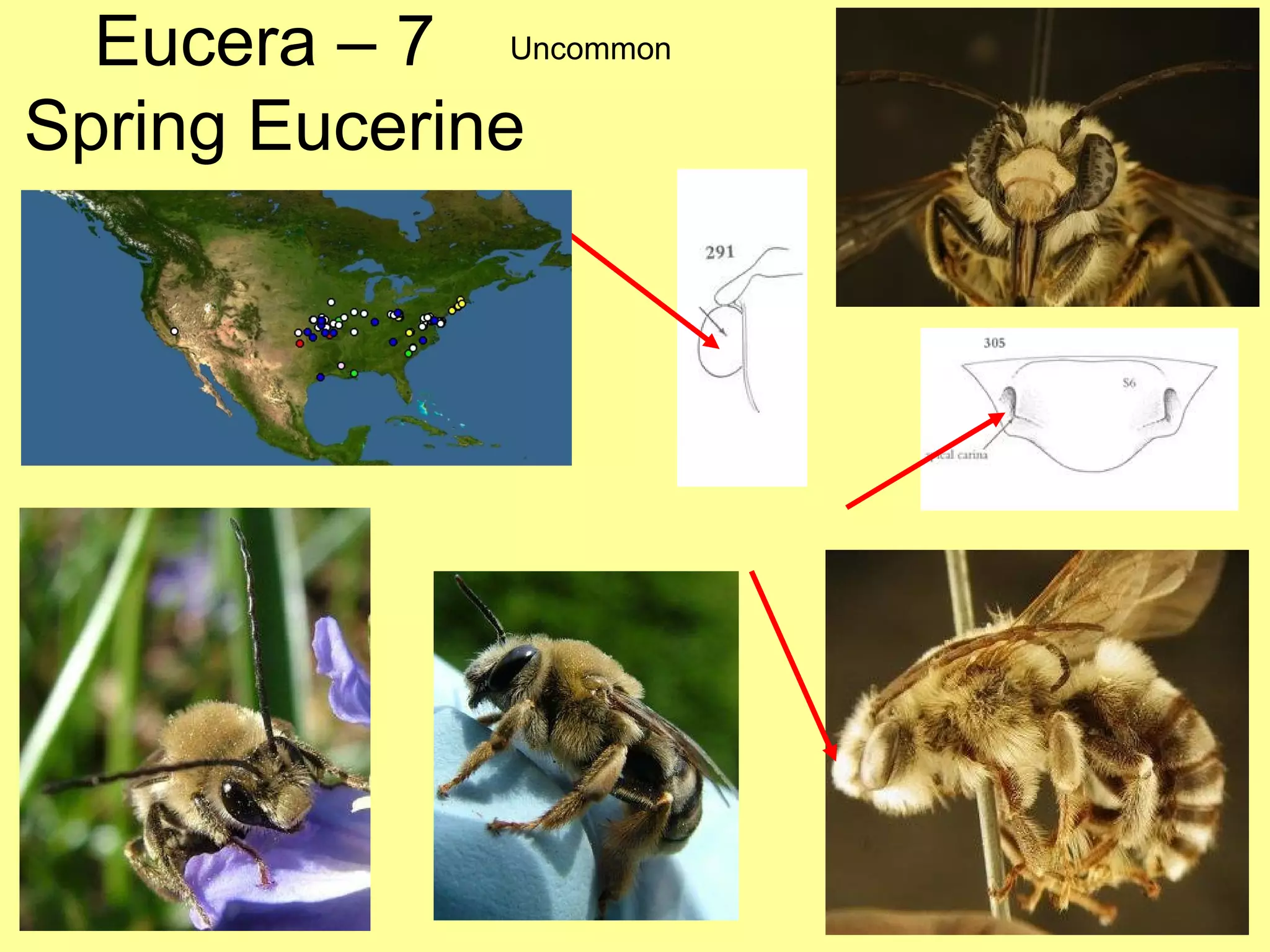
Eucera About 1.5 times as large as a honeybee, uncommon Spring bees Key features are the oval tegula, projecting clypeus, the relatively large distance between the lateral edges of the clypeus and the eye and S6 characters in the males (in most other genera the sides of the clypeus touch the rim of the eye or are within a pit diameter of the eye) The tegula is usually covered with hair and needs to be scraped all the way to the tip with a pin to remove hairs to detect the shape In profile, the clypeus of the female often projects outward (similar to  Peponapis ), making it look rather parrot-beak-like Most other species in similar groups occur later in the year Similar genera:  Melissodes, Tetraloniella, Melecta, Xeromelecta, Cemolobus, Anthophora, Florilegus, Xenoglossa, Peponapis, Svastra
Eucera – 7  Spring Eucerine Uncommon
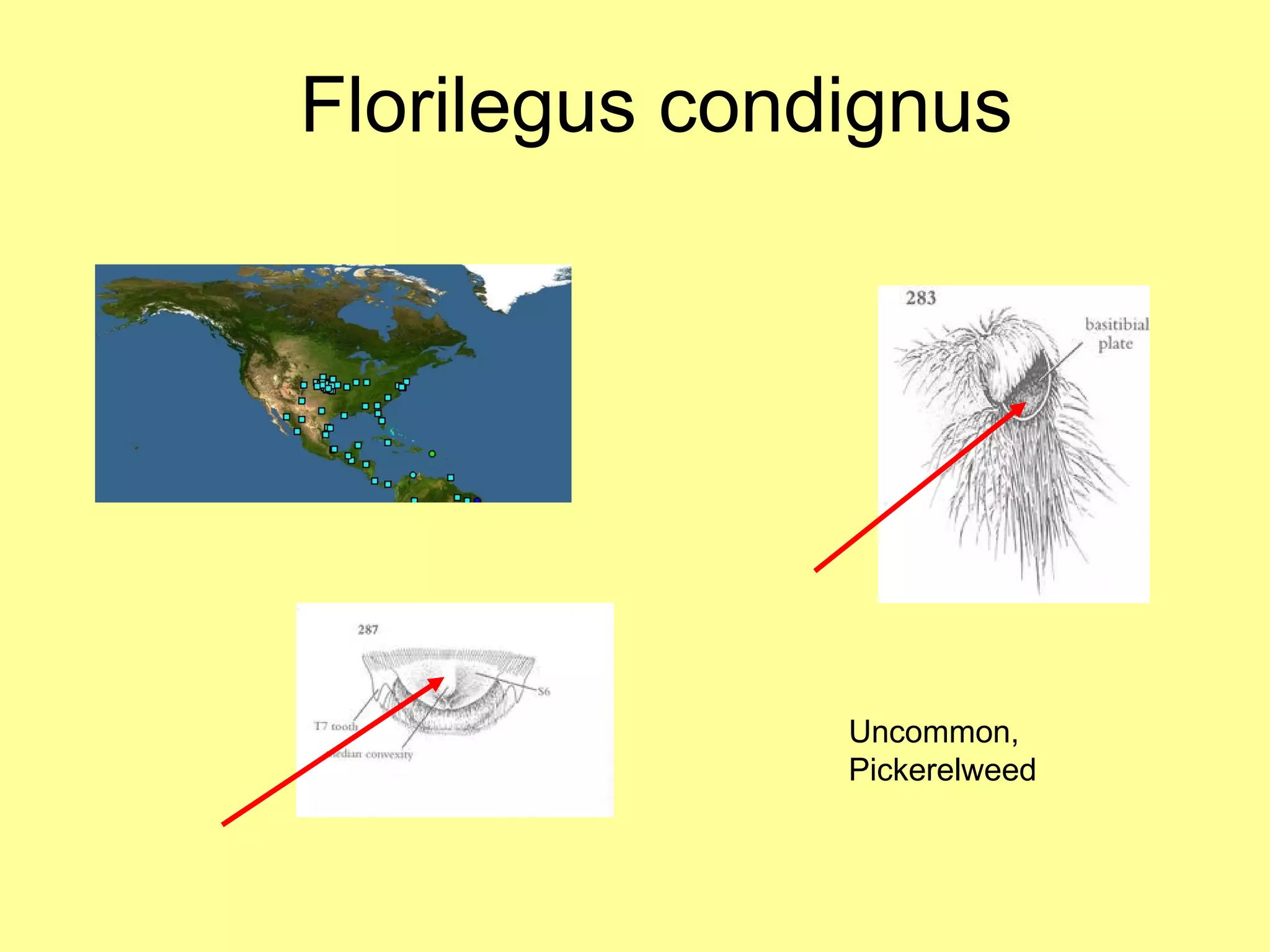
Florilegus Uncommon, pollen specialist on Pickerelweed ( Pontedaria )  Shape of the S6 distinct in males Basitibial plate in females helpful in discriminating it from other genera Similar genera:  Melissodes, Melecta, Eucera, Tetraloniella, Melitoma, Svastra, Anthophora, Peponapis
Florilegus condignus Uncommon, Pickerelweed
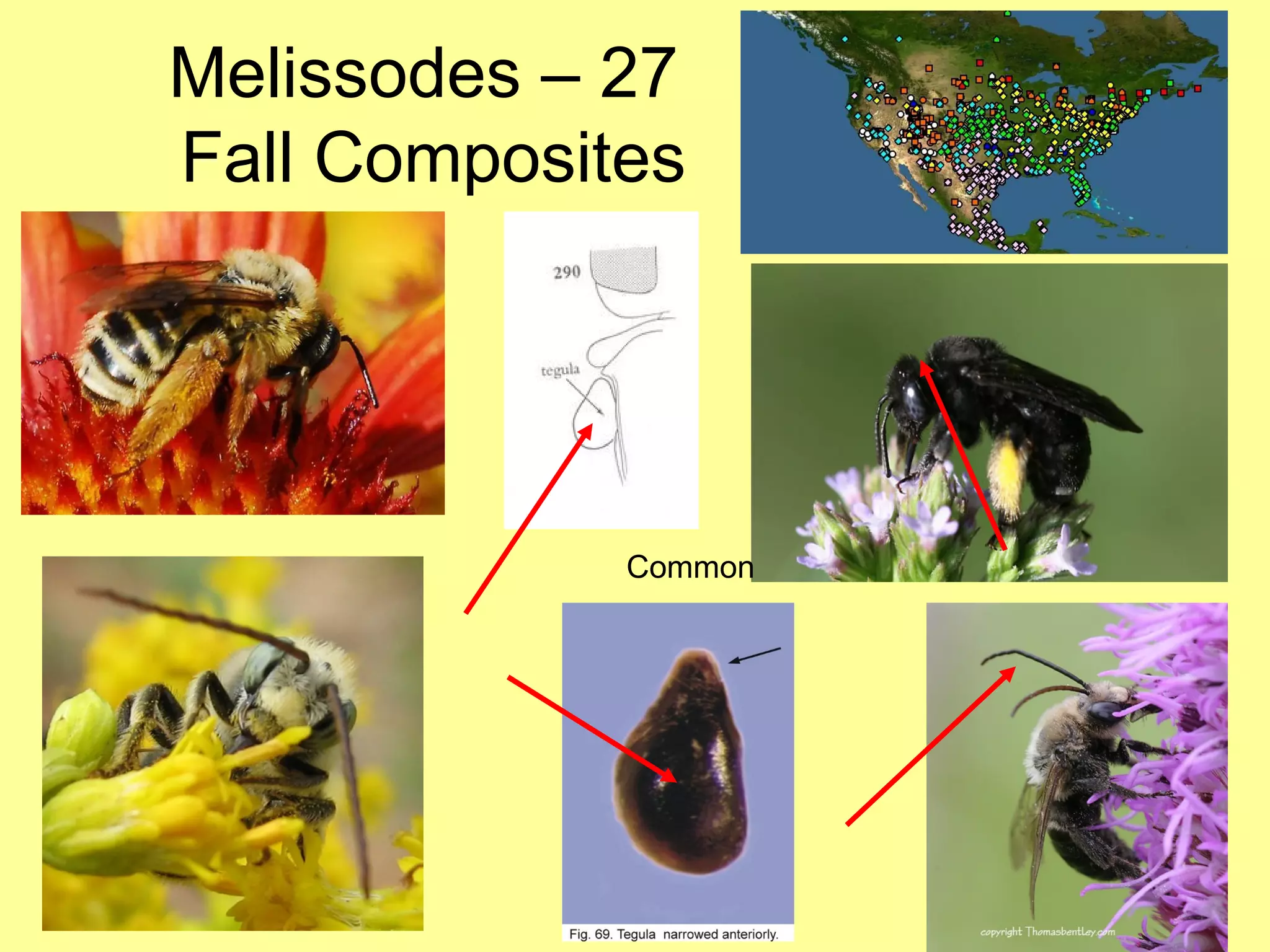
Melissodes Common to relatively common from mid-Summer to Fall Varies in size from about the same as a honeybee to almost twice its size Female is often mistaken for other genera, the tegula is elongated towards the bee’s head and the upper, outside edge is either straight or slightly concave, however, to see this the hairs on the tegula have to be scraped off all the way to the tip Males have spines on the far sides of T7, but note that these can be hidden in the hair and please be careful about spines on S6-S7 looking like they are on T7 Similar genera:  Melecta, Xeromelecta, Anthophora, Xenoglossa, Peponapis, Florilegus, Melitoma, Eucera, Svastra, Tetraloniella, Cemolobus
Melissodes – 27  Fall Composites Common
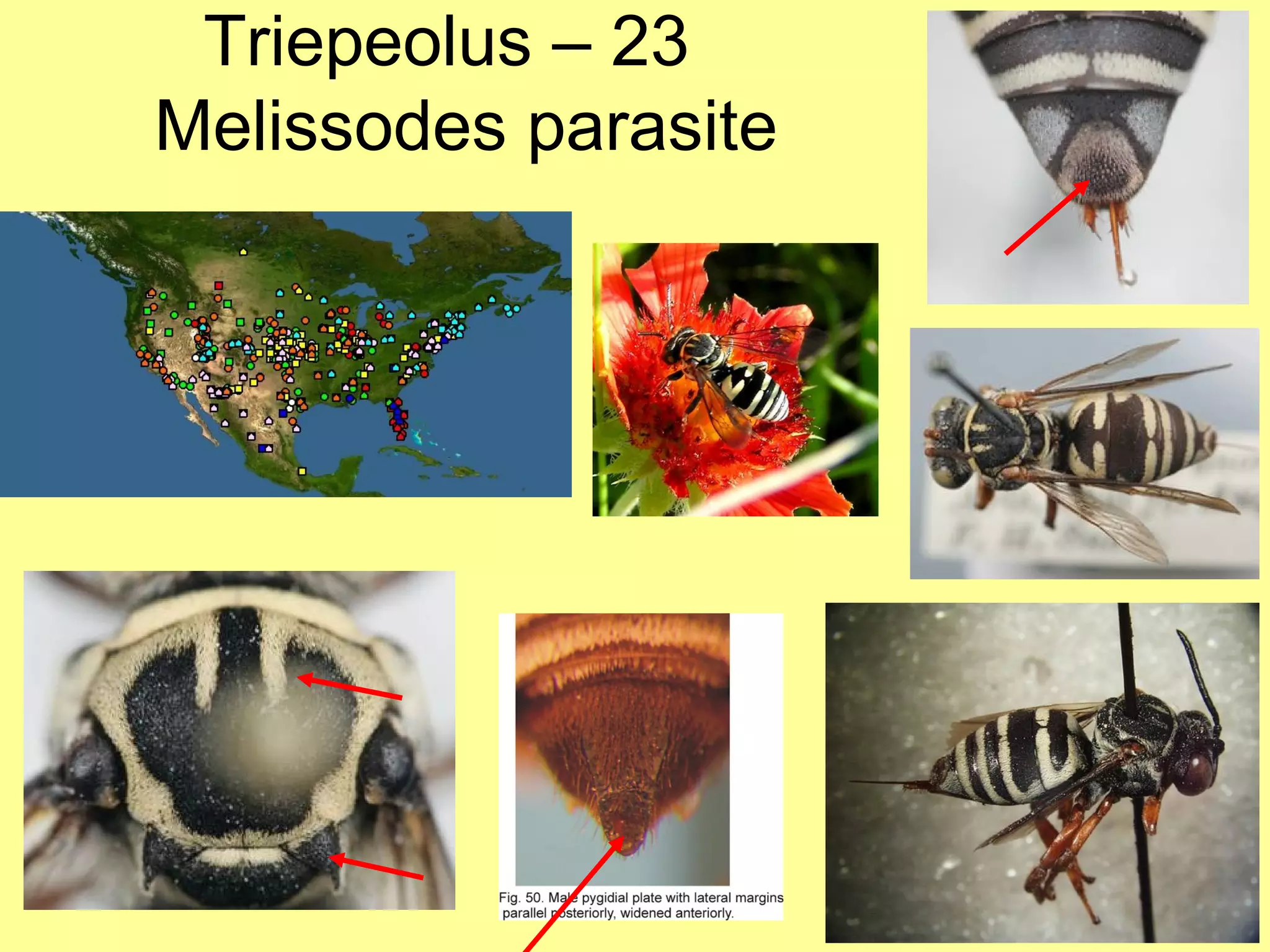
Triepeolus Uncommon to rare, honeybee sized, mid-Summer to Fall nest parasite of  Melissodes  and a few other genera Triepeolus ,  Epeolus , and  Xeromelecta  all have unique and distinctive color patterns on their abdomens and thoraxes composed of minute, prone hairs.  Also present are prominent and projecting axilae (not present or obvious in  Xeromelecta ) Triepeolus  can often be told from  Epeolus  by simply being larger, but see the technical details given in the guides to be sure Similar genera:  Epeolus, Epeoloides, Ericrocis, Xeromelecta
Triepeolus – 23  Melissodes parasite
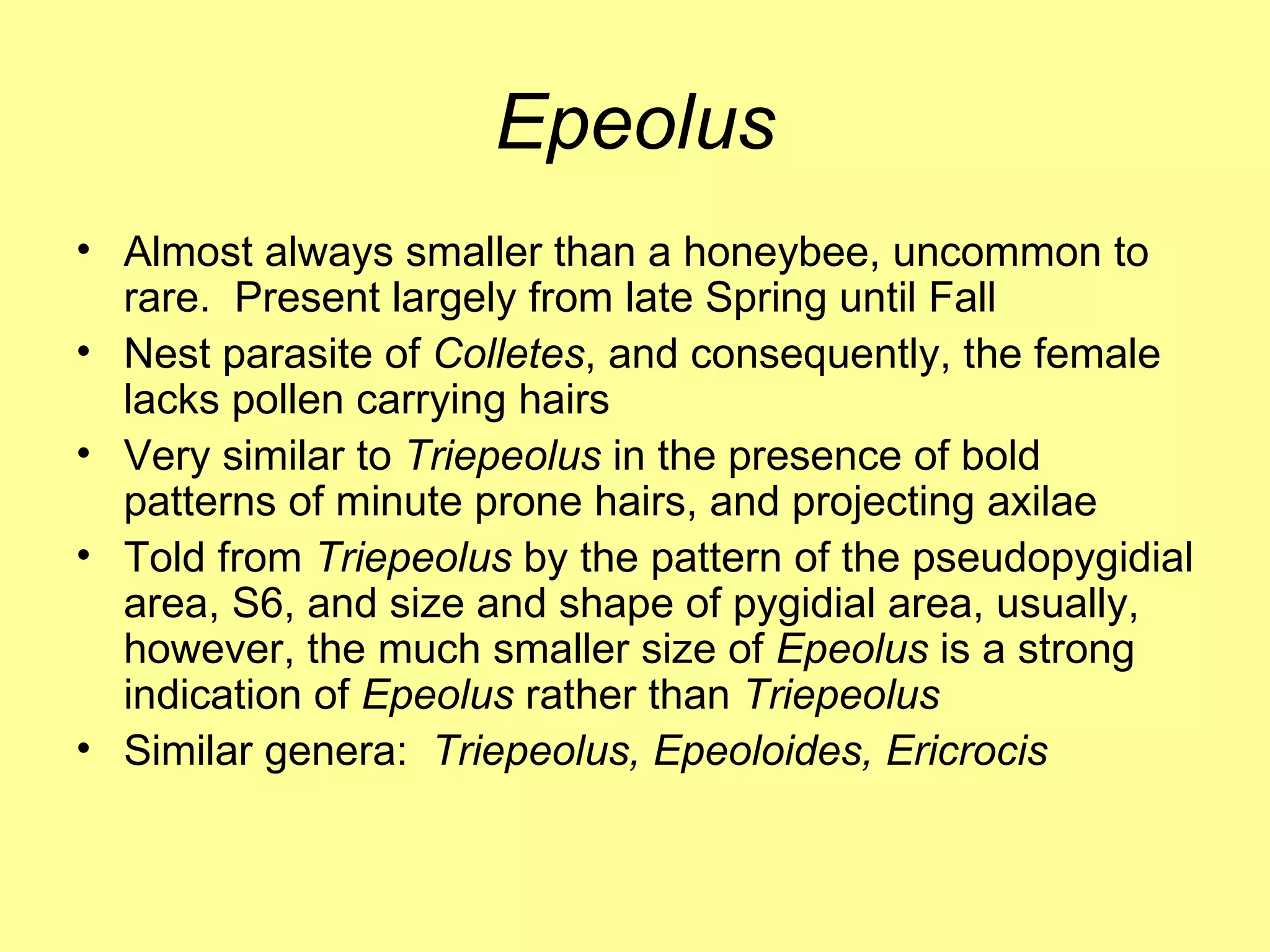
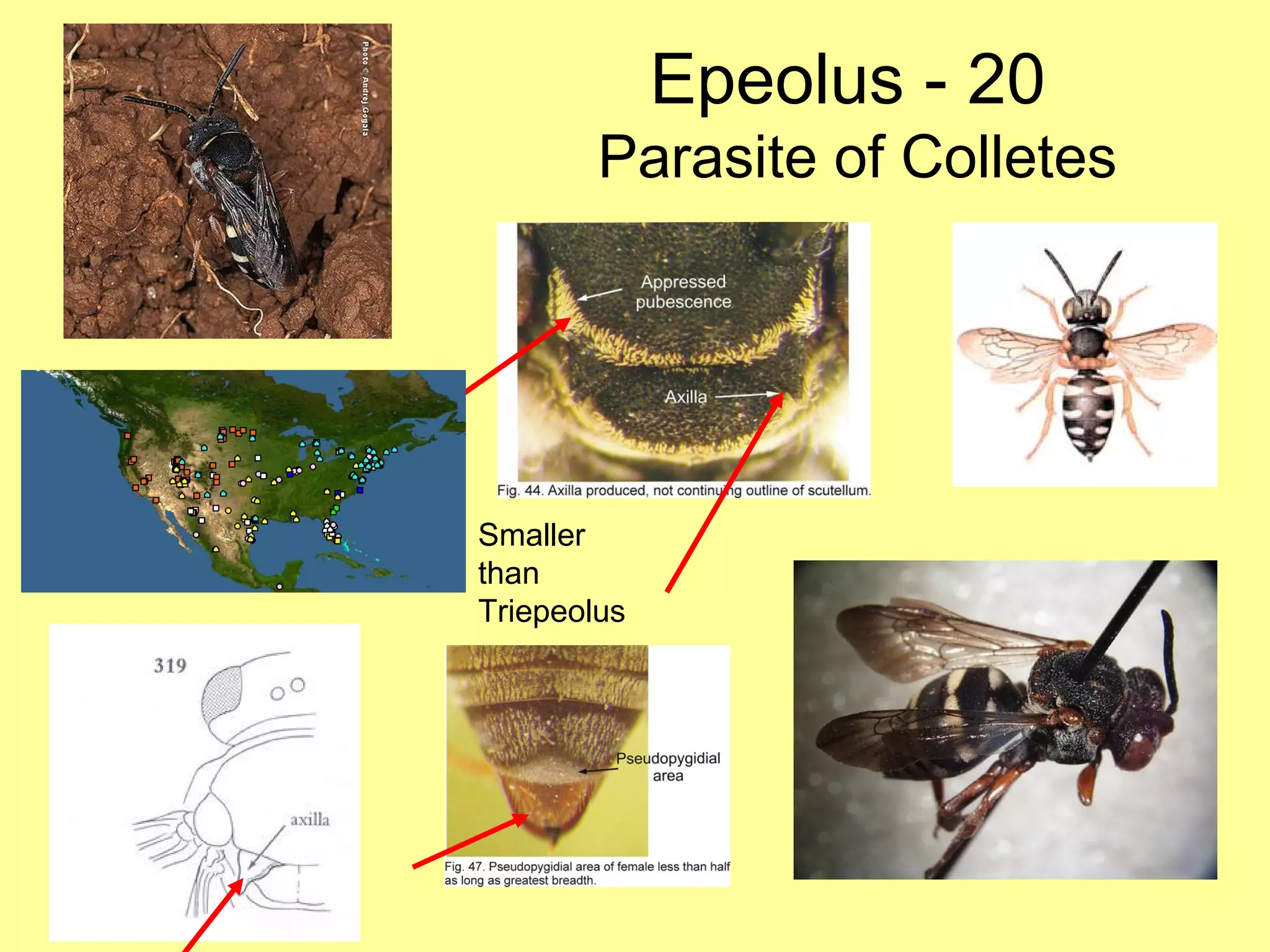
Epeolus Almost always smaller than a honeybee, uncommon to rare.  Present largely from late Spring until Fall Nest parasite of  Colletes , and consequently, the female lacks pollen carrying hairs Very similar to  Triepeolus  in the presence of bold patterns of minute prone hairs, and projecting axilae Told from  Triepeolus  by the pattern of the pseudopygidial area, S6, and size and shape of pygidial area, usually, however, the much smaller size of  Epeolus  is a strong indication of  Epeolus  rather than  Triepeolus Similar genera:  Triepeolus, Epeoloides, Ericrocis
Epeolus - 20  Parasite of Colletes Smaller than Triepeolus
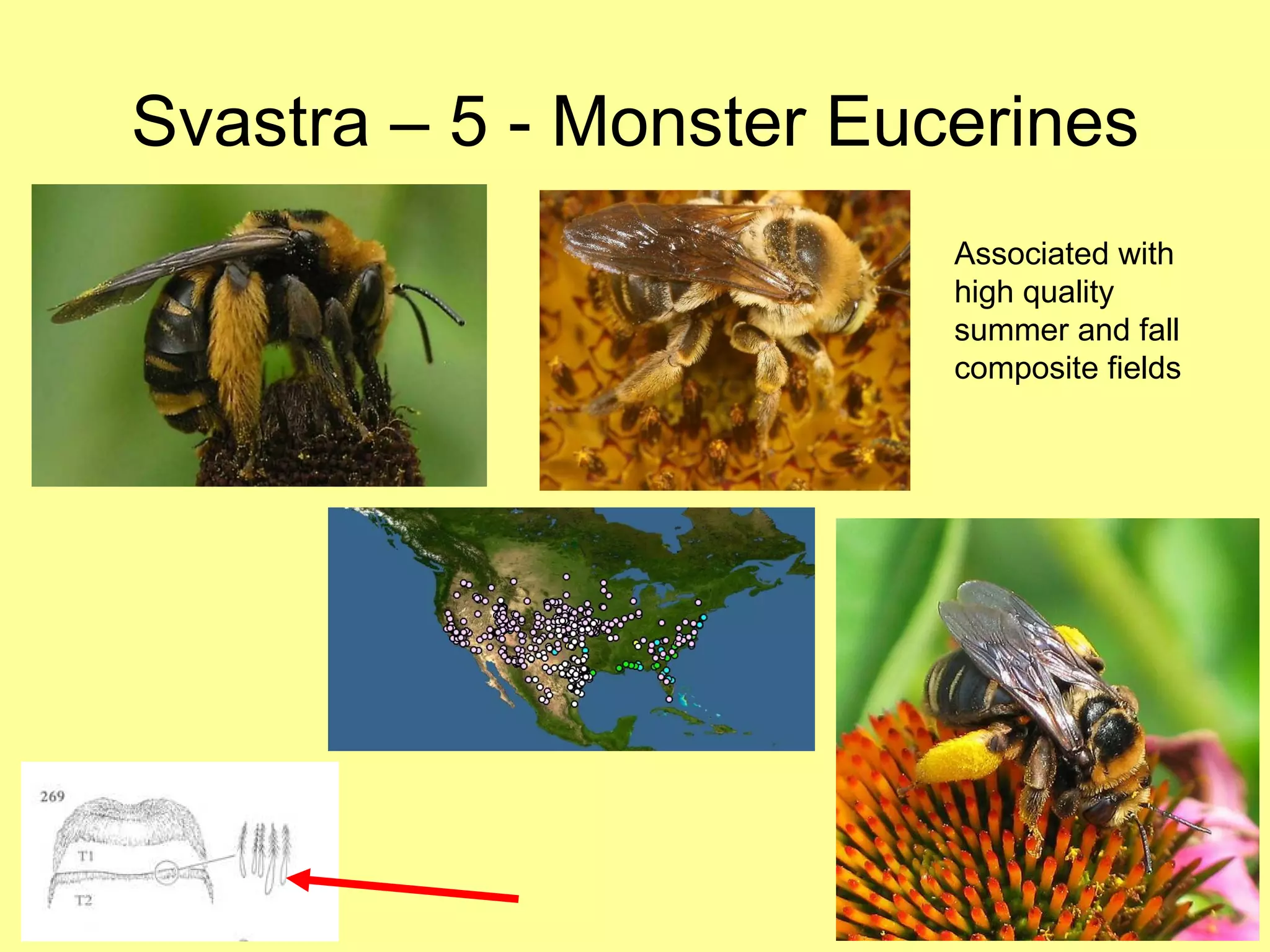
Svastra Large, 1.5 to 2x the size of honeybees Late Summer and Fall species Indicator of high quality field/prairie habitat Unlike other  Eucerines  has spatulate hairs.  These hairs look like tiny, transparent, table knives and are not significantly longer than the surrounding hairs.  These hairs primarily occur at the BASE of T2 peaking out from under the rim of T1 along with more abundant simple hairs, usually present only in small numbers and difficult to impossible to see in most species, so often not a useful character, but one worth looking for Told from female  Melissodes  by the clearly oval shape of the tegula (hairs must be scraped from the tip)  Told from  Eucera  by nearly complete lack of overlap in occurrence ( Eucera  come out in the Spring and early Summer) and the relatively wide distance between the sides of the clypeus and the eye in Eucera (this gap often the size of the width of the antennae) Similarly told from the rarer  Tetraloniella  by the greater distance between eye and sides of clypeus In unworn specimens there is USUALLY a distinct tuft of longer hairs in the center of the metanotum, the surrounding hairs clearly much shorter, in other groups these hairs are uniform in height Similar genera:  Melecta, Xeromelecta, Anthophora, Xenoglossa, Peponapis, Florilegus, Melitoma, Eucera, Melissodes, Tetraloniella, Cemolobus
Svastra – 5 - Monster Eucerines Associated with high quality summer and fall composite fields
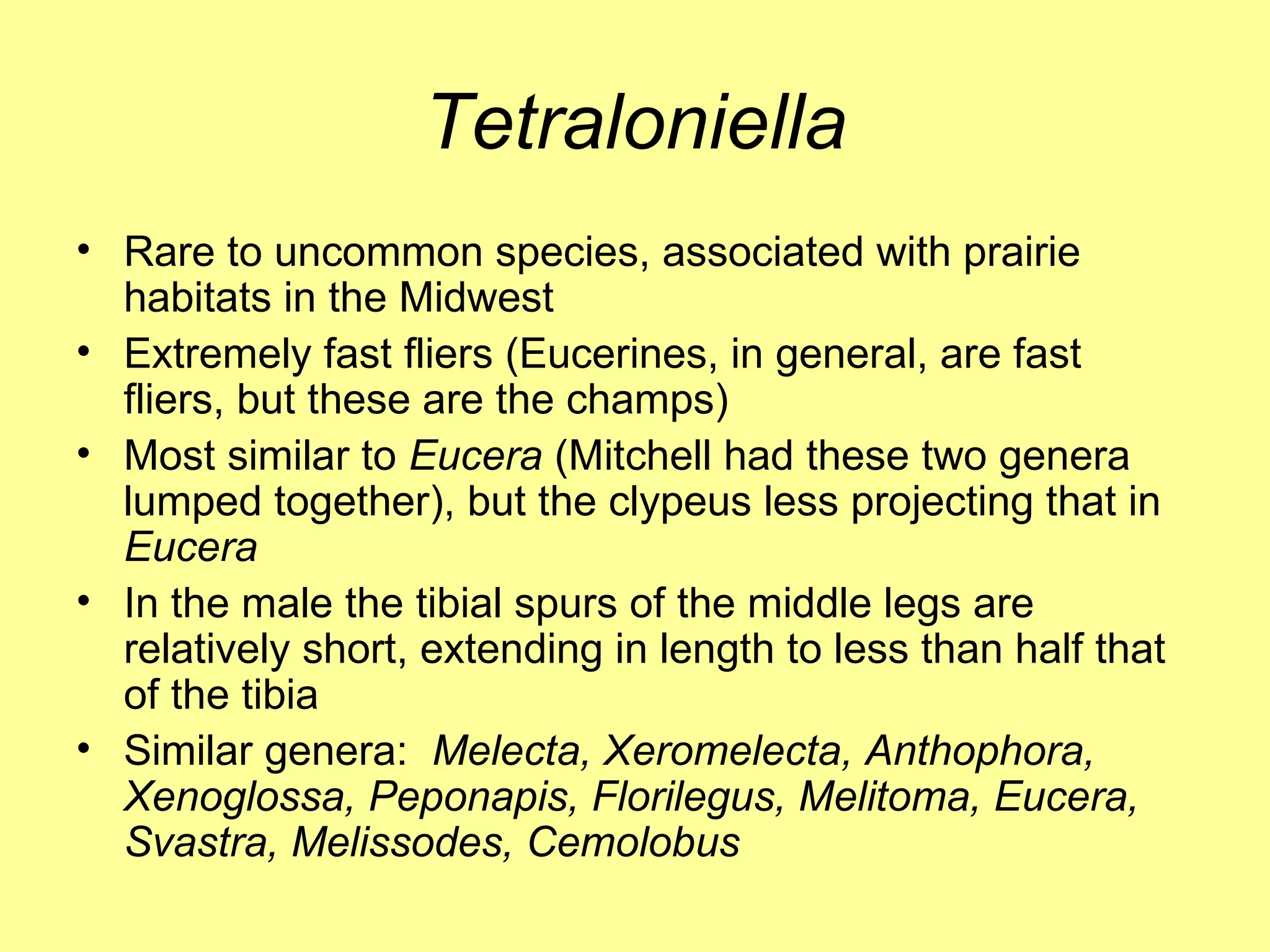
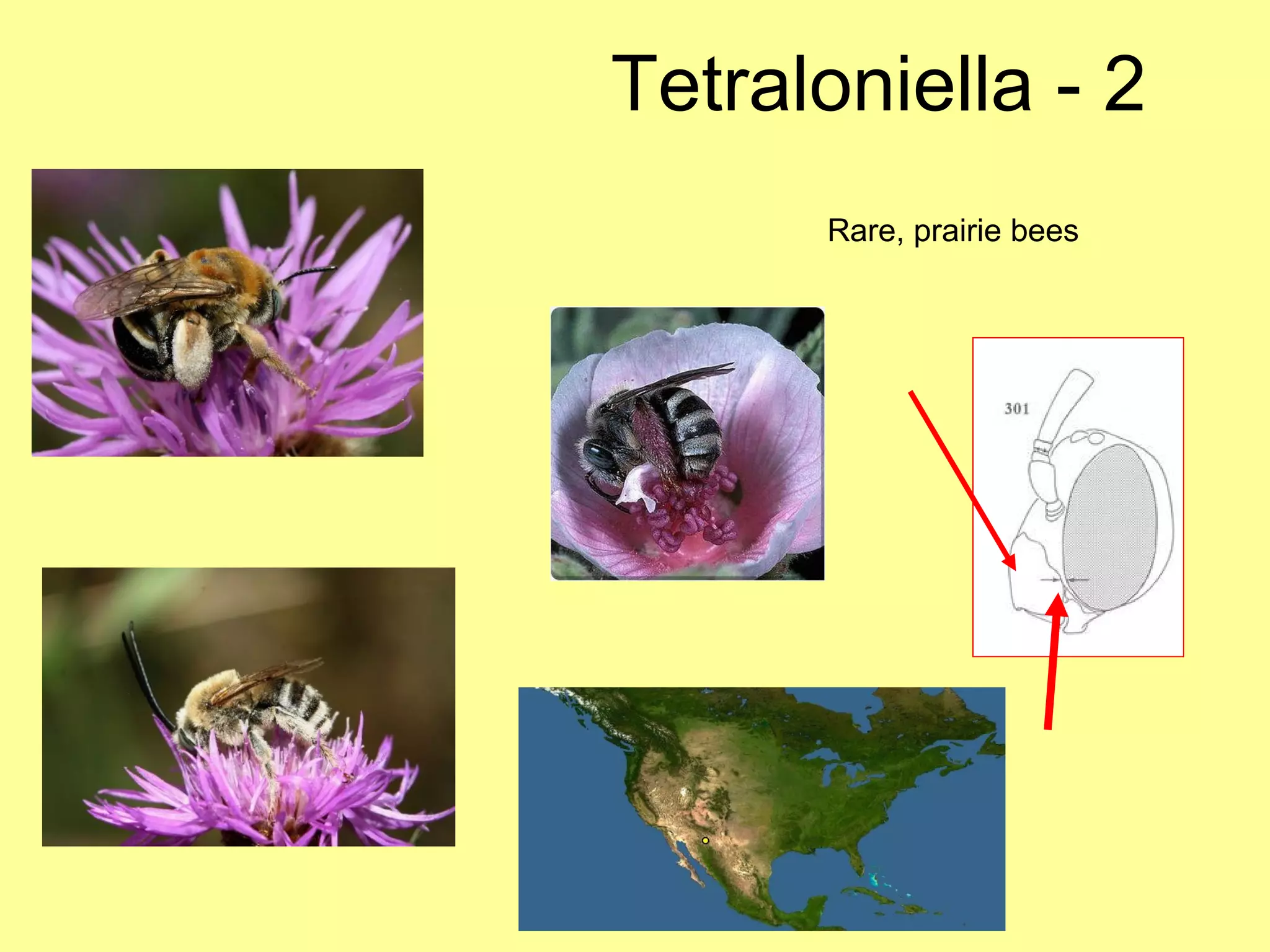
Tetraloniella Rare to uncommon species, associated with prairie habitats in the Midwest Extremely fast fliers (Eucerines, in general, are fast fliers, but these are the champs) Most similar to  Eucera  (Mitchell had these two genera lumped together), but the clypeus less projecting that in  Eucera In the male the tibial spurs of the middle legs are relatively short, extending in length to less than half that of the tibia Similar genera:  Melecta, Xeromelecta, Anthophora, Xenoglossa, Peponapis, Florilegus, Melitoma, Eucera, Svastra, Melissodes, Cemolobus
Tetraloniella - 2 Rare, prairie bees
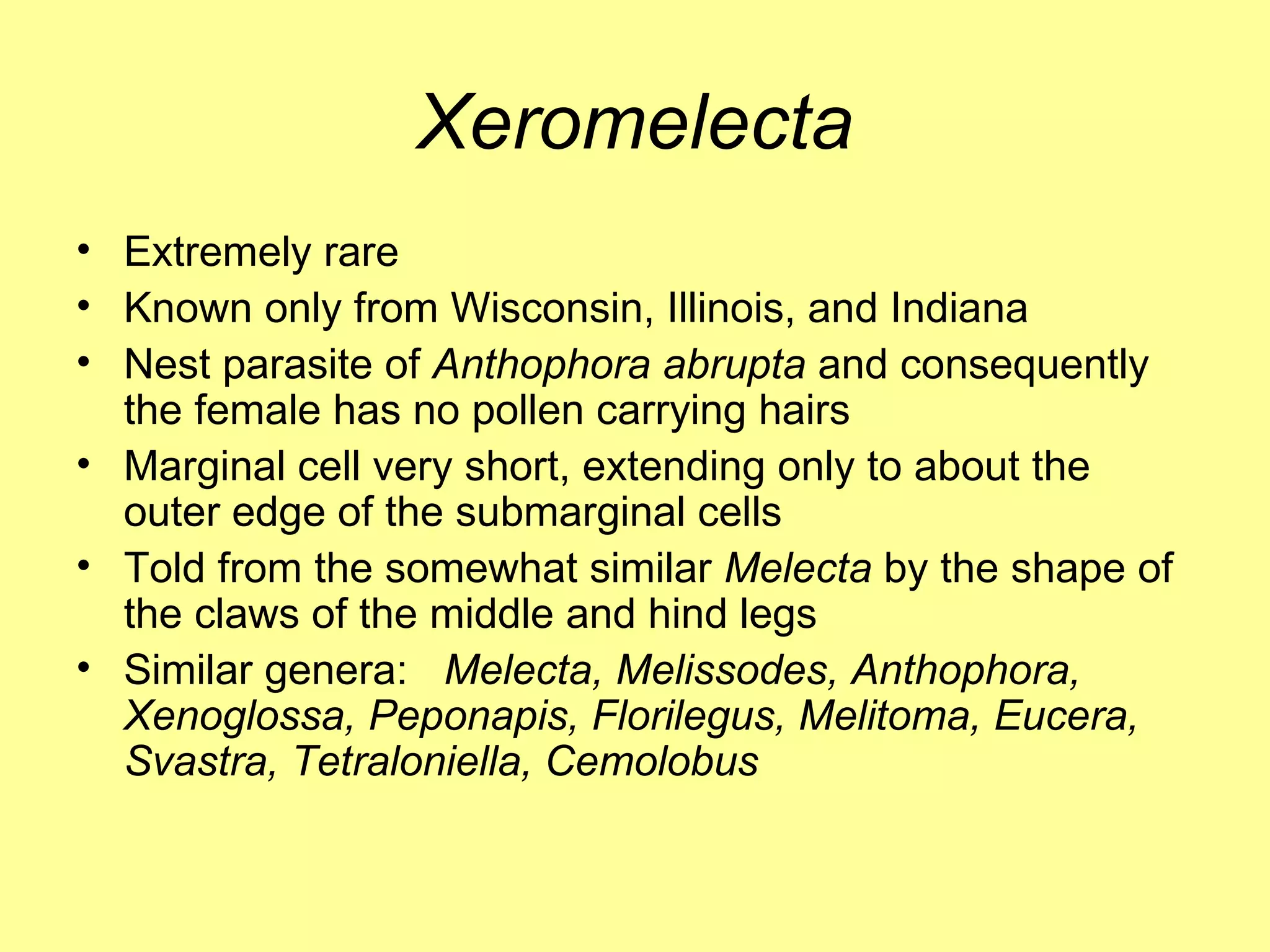
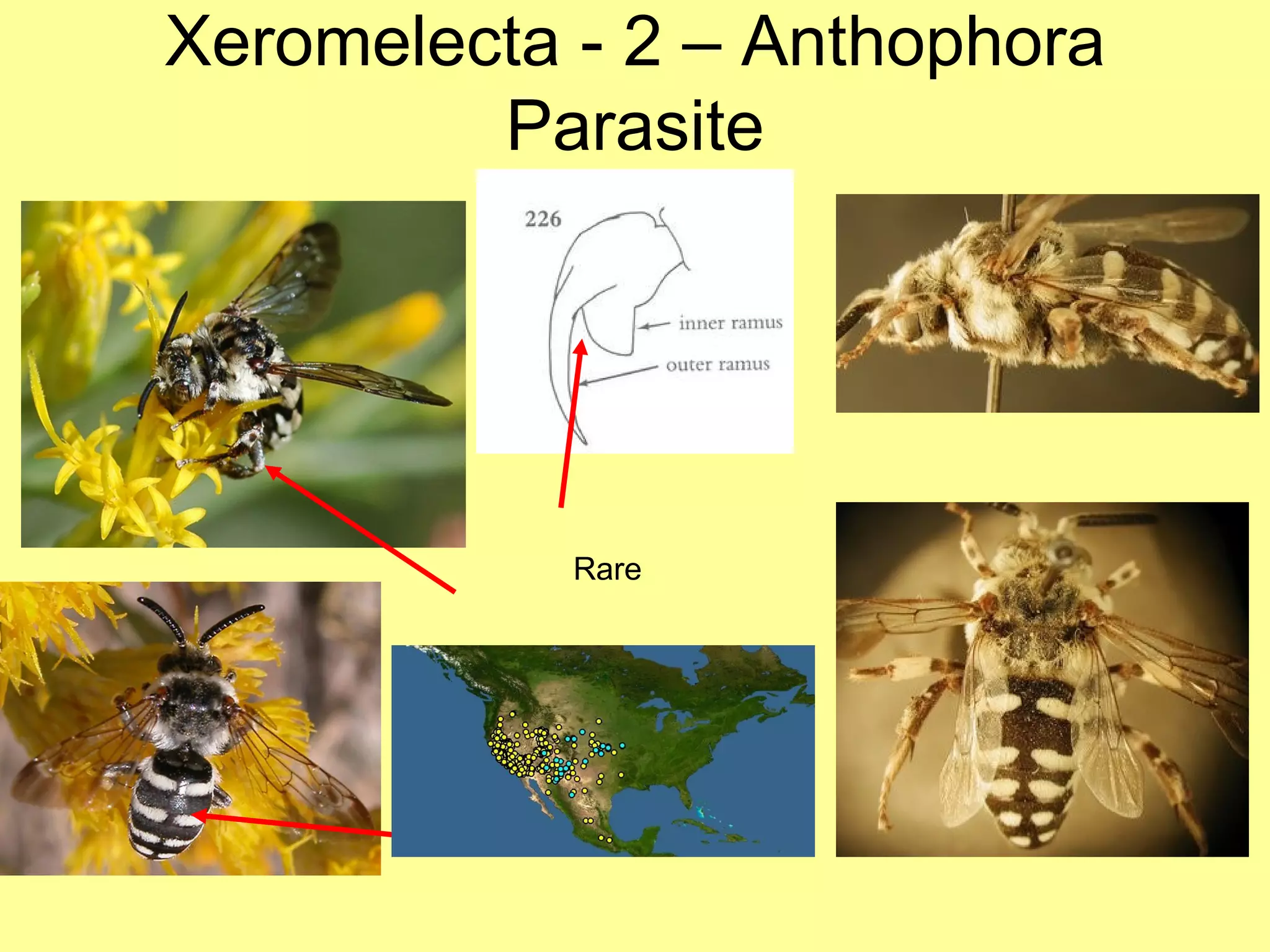
Xeromelecta Extremely rare Known only from Wisconsin, Illinois, and Indiana  Nest parasite of  Anthophora abrupta  and consequently the female has no pollen carrying hairs Marginal cell very short, extending only to about the outer edge of the submarginal cells Told from the somewhat similar  Melecta  by the shape of the claws of the middle and hind legs Similar genera:  Melecta, Melissodes, Anthophora, Xenoglossa, Peponapis, Florilegus, Melitoma, Eucera, Svastra, Tetraloniella, Cemolobus
Xeromelecta - 2 – Anthophora Parasite Rare
Resources Species lists, Identification Guides, and Maps for genera and species are available at:  http://www.discoverlife.org/20/q?search=Apoidea A guide to the genera of the bees of Canada is available at: http://www.biology.ualberta.ca/bsc/ejournal/pgs_03/pgs_03.html Mitchell’s 1960’s book on the bees of the Eastern United States is available as a series of pdf files at: http://insectmuseum.org/easternBees.php A slightly out of date guide to the identification of the genera of ALL of North America is available at: http://www.knoxcellars.com/Merchant5/merchant.mvc?Screen=PROD&Store_Code=KCNP&Product_Code=BGNA&Category_Code=BL

Guide to the Bee Genera within Apidae of Eastern North America, Part 2

  • 1.
  • 2.
    Acknowledgements This presentationhas been put together by a consortium of North American bee biologists This presentation has developed over many years and the original web picture acknowledgements were lost, if you see one of your pictures let us know and we will add your picture credit Correspondence can be sent to Sam Droege at sdroege@usgs.gov
  • 3.
    Format Each Genushas an information page followed by a page of illustrations and a map of the distribution of Eastern North American species; western populations of Eastern species are shown, but the Western species are not mapped The number of Eastern species are listed at the top of the page
  • 4.
    Bee Song Beesin the late summer sun Drone their song Of yellow moons Trimming black velvet Droning, droning a sleepysong. - Carl Sandburg
  • 5.
    Apidae (RecentlyCombined with Anthophoridae) Groups of Genera Covered in Apidae1 Presentation: Anthophora – 6 species Melecta - 1 Habropoda - 1 Holcopasites - 3 Neolarra - 1 Nomada - 80 Centris – 3 Ericrocis - 1 Ptilothrix – 1 Cemolobus - 1 Xylocopa – 2 Ceratina – 4 Euglossa - 1 Epeoloides – 1 Covered in this presentation: Peponapis - 1 Xenoglossa - 2 Apis - 1 Bombus - 20 Anthophorula - 2 Exomalopsis - 1 Eucera - 7 Florilegus - 1 Melissodes – 27 Triepeolus - 23 Epeolus - 20 Melitoma - 1 Svastra - 5 Tetraloniella - 2 Xeromelecta - 2
  • 6.
    Peponapis pruinosa Abit larger than a honeybee to which it superficially resembles in the field Common, squash and pumpkin specialist, found primarily on those plants or in bowl traps Out at dawn but usually inactive after mid-morning From the SIDE the profile of the clypeus bows out like the bill of a parrot Female has oval tegulae, a notched end to its mandible and the pollen carrying hairs on the basitarsi are sparser than most other Eucerines and there is an inner row of very dense shorter hairs running down the posterior margin, that is distinctive once you figure out where it is S6 characters of the male are important in distinguishing it from Eucera Similar genera : Melecta, Xeromelecta, Anthophora, Xenoglossa, Florilegus, Melitoma, Eucera, Svastra, Tetraloniella, Cemolobus, Melissodes
  • 7.
    Peponapis pruinosa– SquashBee Common – Every squash patch
  • 8.
    Xenoglossa A littlebit larger than a honeybee Very similar to Peponapis pruinosa ( has projecting clypeus ) but does not have the notched mandible tip, restricted largely to the South, and generally less common Both males and females have a distinctive tooth along the INNER margin of the mandibles, but these are difficult to impossible to see when the mandibles are tightly closed Male’s first flagellar segment often longer than other genera Similar genera: Melecta, Xeromelecta, Anthophora, Melissodes, Peponapis, Florilegus, Melitoma, Eucera, Svastra, Tetraloniella, Cemolobus
  • 9.
  • 10.
    Apis Size ofa honeybee because, of course, it is the honeybee Long hair on they compound eyes distinctive, only Coelioxys has hair on the eyes and then only short hair Hind tibia in the female is wide, flattened, and smooth except for hair around the outside edges Males are very rarely seen or collected
  • 11.
  • 12.
    Bombus The onlynative colonial bee Unique in that the hind wing has no jugal lobe Parasitic members were considered in the past to be a separate Genus ( Psithyrus ) Non-parasitic females have a wide tibia, the outer side of which is completely bare in the center (corbiculate) and surrounded by long hairs Patterns of yellow, black, reddish hairs often, but not always, unique to species, several species pairs have to be identified under the microscope Several other genera have species that look similar: Habropoda, Anthophora, Ptilothrix, Xylocopa
  • 13.
    Bombus - 20The only native true colonial bee, some parasitic species (Psythrus)
  • 14.
    Anthophorula Extremely rare,a little more than half the size of a honeybee 2 species, one is a specialist on asters and the other on Agalinis The pollen carrying hairs are very dense and voluminous Has a truncate marginal cell, but unlike most others in that group has 3 submarginal cells Most similar to, and in the past lumped with, Exomalopsis , which in the males has a dark clypeus unlike the yellow one in Anthophorula Similar genera: Exomalopsis
  • 15.
    Anthophorula - 2Small, compact, bushy scopa, very rare
  • 16.
    Exomalopsis similis Extremelyrare, only 3 records from south Florida (1 recent) About half the size of a honeybee Very similar to Anthophorula in having 3 submarginal cells and a truncate marginal cell Unlike Anthophorula , the males have a dark clypeus Similar genera: Anthophorula
  • 17.
    Exomalopsis similisSmall, very rare, bushy scopa – FL, GA
  • 18.
    Eucera About 1.5times as large as a honeybee, uncommon Spring bees Key features are the oval tegula, projecting clypeus, the relatively large distance between the lateral edges of the clypeus and the eye and S6 characters in the males (in most other genera the sides of the clypeus touch the rim of the eye or are within a pit diameter of the eye) The tegula is usually covered with hair and needs to be scraped all the way to the tip with a pin to remove hairs to detect the shape In profile, the clypeus of the female often projects outward (similar to Peponapis ), making it look rather parrot-beak-like Most other species in similar groups occur later in the year Similar genera: Melissodes, Tetraloniella, Melecta, Xeromelecta, Cemolobus, Anthophora, Florilegus, Xenoglossa, Peponapis, Svastra
  • 19.
    Eucera – 7 Spring Eucerine Uncommon
  • 20.
    Florilegus Uncommon, pollenspecialist on Pickerelweed ( Pontedaria ) Shape of the S6 distinct in males Basitibial plate in females helpful in discriminating it from other genera Similar genera: Melissodes, Melecta, Eucera, Tetraloniella, Melitoma, Svastra, Anthophora, Peponapis
  • 21.
  • 22.
    Melissodes Common torelatively common from mid-Summer to Fall Varies in size from about the same as a honeybee to almost twice its size Female is often mistaken for other genera, the tegula is elongated towards the bee’s head and the upper, outside edge is either straight or slightly concave, however, to see this the hairs on the tegula have to be scraped off all the way to the tip Males have spines on the far sides of T7, but note that these can be hidden in the hair and please be careful about spines on S6-S7 looking like they are on T7 Similar genera: Melecta, Xeromelecta, Anthophora, Xenoglossa, Peponapis, Florilegus, Melitoma, Eucera, Svastra, Tetraloniella, Cemolobus
  • 23.
    Melissodes – 27 Fall Composites Common
  • 24.
    Triepeolus Uncommon torare, honeybee sized, mid-Summer to Fall nest parasite of Melissodes and a few other genera Triepeolus , Epeolus , and Xeromelecta all have unique and distinctive color patterns on their abdomens and thoraxes composed of minute, prone hairs. Also present are prominent and projecting axilae (not present or obvious in Xeromelecta ) Triepeolus can often be told from Epeolus by simply being larger, but see the technical details given in the guides to be sure Similar genera: Epeolus, Epeoloides, Ericrocis, Xeromelecta
  • 25.
    Triepeolus – 23 Melissodes parasite
  • 26.
    Epeolus Almost alwayssmaller than a honeybee, uncommon to rare. Present largely from late Spring until Fall Nest parasite of Colletes , and consequently, the female lacks pollen carrying hairs Very similar to Triepeolus in the presence of bold patterns of minute prone hairs, and projecting axilae Told from Triepeolus by the pattern of the pseudopygidial area, S6, and size and shape of pygidial area, usually, however, the much smaller size of Epeolus is a strong indication of Epeolus rather than Triepeolus Similar genera: Triepeolus, Epeoloides, Ericrocis
  • 27.
    Epeolus - 20 Parasite of Colletes Smaller than Triepeolus
  • 28.
    Svastra Large, 1.5to 2x the size of honeybees Late Summer and Fall species Indicator of high quality field/prairie habitat Unlike other Eucerines has spatulate hairs. These hairs look like tiny, transparent, table knives and are not significantly longer than the surrounding hairs. These hairs primarily occur at the BASE of T2 peaking out from under the rim of T1 along with more abundant simple hairs, usually present only in small numbers and difficult to impossible to see in most species, so often not a useful character, but one worth looking for Told from female Melissodes by the clearly oval shape of the tegula (hairs must be scraped from the tip) Told from Eucera by nearly complete lack of overlap in occurrence ( Eucera come out in the Spring and early Summer) and the relatively wide distance between the sides of the clypeus and the eye in Eucera (this gap often the size of the width of the antennae) Similarly told from the rarer Tetraloniella by the greater distance between eye and sides of clypeus In unworn specimens there is USUALLY a distinct tuft of longer hairs in the center of the metanotum, the surrounding hairs clearly much shorter, in other groups these hairs are uniform in height Similar genera: Melecta, Xeromelecta, Anthophora, Xenoglossa, Peponapis, Florilegus, Melitoma, Eucera, Melissodes, Tetraloniella, Cemolobus
  • 29.
    Svastra – 5- Monster Eucerines Associated with high quality summer and fall composite fields
  • 30.
    Tetraloniella Rare touncommon species, associated with prairie habitats in the Midwest Extremely fast fliers (Eucerines, in general, are fast fliers, but these are the champs) Most similar to Eucera (Mitchell had these two genera lumped together), but the clypeus less projecting that in Eucera In the male the tibial spurs of the middle legs are relatively short, extending in length to less than half that of the tibia Similar genera: Melecta, Xeromelecta, Anthophora, Xenoglossa, Peponapis, Florilegus, Melitoma, Eucera, Svastra, Melissodes, Cemolobus
  • 31.
    Tetraloniella - 2Rare, prairie bees
  • 32.
    Xeromelecta Extremely rareKnown only from Wisconsin, Illinois, and Indiana Nest parasite of Anthophora abrupta and consequently the female has no pollen carrying hairs Marginal cell very short, extending only to about the outer edge of the submarginal cells Told from the somewhat similar Melecta by the shape of the claws of the middle and hind legs Similar genera: Melecta, Melissodes, Anthophora, Xenoglossa, Peponapis, Florilegus, Melitoma, Eucera, Svastra, Tetraloniella, Cemolobus
  • 33.
    Xeromelecta - 2– Anthophora Parasite Rare
  • 34.
    Resources Species lists,Identification Guides, and Maps for genera and species are available at: http://www.discoverlife.org/20/q?search=Apoidea A guide to the genera of the bees of Canada is available at: http://www.biology.ualberta.ca/bsc/ejournal/pgs_03/pgs_03.html Mitchell’s 1960’s book on the bees of the Eastern United States is available as a series of pdf files at: http://insectmuseum.org/easternBees.php A slightly out of date guide to the identification of the genera of ALL of North America is available at: http://www.knoxcellars.com/Merchant5/merchant.mvc?Screen=PROD&Store_Code=KCNP&Product_Code=BGNA&Category_Code=BL