Politics and Governance:
History, Government and
Constitution
Transition of Philippine Government: From Katipunan
to the Second Republic
Transition of Philippine
           Government
  Structure of the Revolutionary Movement

KKK

  Established after the failure of revolutionary groups to
  bring reform.

  Founded by Deodato Arellano, Roman Basa and
  Andres Bonifacio

  Three objectives namely: reform the political, civic and
  moral
Transition of the Philippine
        Government
Transition of the Philippine
        Government
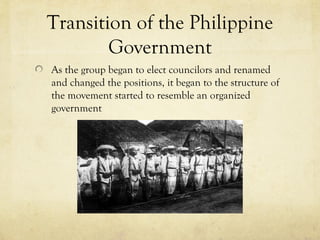
As the group began to elect councilors and renamed
and changed the positions, it began to the structure of
the movement started to resemble an organized
government
Transition of the Philippine
            Government
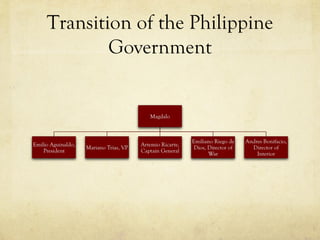
    The Magdalo-Magdiwang rivalry and the rise of the Magdalo
    Government
   Magdiwang – faction of Bonifacio while the Magdalo
    represented the faction of Aguinaldo
   The Magdalo’s felt that a new government should replace
    the KKK.
   The failure of Bonifacio to secure the leadership position
    led to the dissolution of the KKK.
   While it led to the election of Aguinaldo and the rise of the
    Magdalo government
Transition of the Philippine
        Government
Transition of the Philippine
            Government
    Biak na Bato Republic
   Named after a town in Bulacan where the constitution
    was drafted by Isabelo Artacho
   It was deliberated by the revolutionary generals of
    Aguinaldo, acting as constitutional assembly.
   Was copied from the Cuban 1895 Himaguayu
    Constitution.
   Was adopted and later became the Biak – na- Bato
    Constitution
Transition of the Philippine
        Government
Under this constitution, the Supreme council wielded
power

This Supreme Council was composed of the President,
Vice President and 4 secretaries (interior, foreign
affairs, treasury and war

The Supreme Council of Grace and Justice exercised
judiciary functions.

Momentarily ended when Aguinaldo went into exile.
Transition of Philippine
     Government
Transition of Philippine
           Government
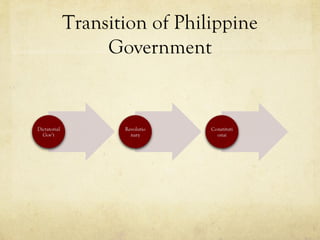
    Dictatorial Government
   Established after Aguinaldo’s return from exile
   It was established, upon recommendation of Ambrocio
    Rianzares Bautista since it suited the political
    condition
   In a dictatorial government, the government can
    prosecute war criminals and address the war.
   This phase was known for?
Transition of Philippine
       Government
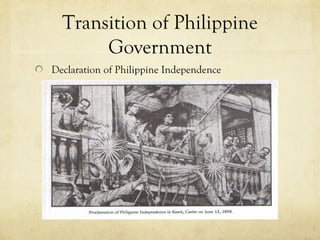
Declaration of Philippine Independence
Transition of Philippine
           Government
    Revolutionary Government
   It started right after the end of the dictatorial
    government
   Recommended by Apolinario Mabini, the new adviser
    of Aguinlado
   Revolutionary Government enabled the government to
    rally for the people’s support
   Remain vigilant against Spanish tyranny
Transition of Philippine
           Government
    Achievements
   Organization of the first cabinet
   Observance/compliance with the mandate of the decrees
    on the election and appointment of members of the Malolos
    Congress
   Setting up of the Malolos Congress and its transformation
    as a component/constituent body to formulate a new
    constitution (agreement, charter) for the country.
   Adoption of the 1899 Malolos Constitution
Transition of Philippine
           Government
    Malolos Congress
   Approved the Malolos Congress
   Adopted the Malolos Constitution
 Malolos Constitution

   Drafted by Felipe Calderon
   Influenced by the constitutions of 7 countries namely:
   As stated, the constitution provides for a parliamentary
    system, with the president elected by the Assembly and
    special representatives, lasting for 4 years.
Transition of the Philippine
        Government
France
Belgium
Mexico
Costa Rica
Guatemala
Nicaragua
Brazil
Transition of the Philippine
            Government
    Constitutional Government
   First act after the circulation of the constitution was to
    reorganize the cabinet (Mabini became the head of the
    cabinet and secretary of foreign affairs)
   Creation of the first Republic (as dictated in the
    constitution)
   Establishment of the three branches of government
    (legislative, executive and judicial)
Transition of the philippine
            Government
    Purpose of the three branches:

   So as not to concentrate power in just one entity

   To be more representative and democratic


   Legislative

   Adopted a unicameral congress, known as the Assembly of Representatives

   In principle, it wielded more power than the two branches with its authority
    to create a Permanent Commission

   Permanent Commission – 7 members which can designate the president and
    secretary of the country.
Transition of the Philippine
            Government
    Executive Power
   Exercised by the President
   His power was also manifested through his department
    secretaries.
   His secretaries were also responsible to the Assembly,
    and were given seats in the assembly and allowed to
    participate in deliberations
Transition of Philippine
           Government
    Judicial
   Power was vested in the Supreme Court and in other
    courts
   Headed by the Chief Justice
   Despite the fact that the CJ and Solicitor Generals
    were chosen by the Assembly (with the agreement of
    the President and secretaries) the judicial was still free
    from influence and, independent.
Transition of the Philippine
          Government
   Government during the American Occupation

Occupation began after Spain and the US sealed the
   Treaty of Paris on December 20, 1898.


Treaty of Paris – the “ownership” of the Philippines was
   transferred from Spain to US, for 20 million dollars.

- Also part of an agreement of Spain to cede its colonies to
    the US
Transition of Philippine
Beginning of the US Military Government

US Military Government (August 14, 1898 – July 4, 1901)

First governor was General Wesley Merritt

Achievements:

Laid down the foundation (basis) of the US Civil Government

Introduced the American system of education

Organized the civil courts

Established the local government in towns and provinces

Conducted the first local election
Transition of the Philippine
        Government
While the Military Government was still in full swing,
two commissions were created by the US President:


1st Philippine Commission/Schurman – laid down the
foundation, based on the outcome of the survey
conducted.

Second Philippine Commission – terms were on the
establishment of a civil government
Transition of Philippine
           Government
    1. First Philippine Commission/Schurman
   Establishment of a territorial government with
    legislature of 2 houses (elective and appointive)
   Withdrawal of military rule in the pacified areas
   Conservation of natural resources
   Organization of autonomous local government
   Free elementary schools
   Appointment of trustworthy men to
    higher/government offices
Transition of Philippine
           Government
    2. Second Philippine Commission – shift from military
    to civil government
   First to exercise legislative functions
   First order was the appropriation (allocation/use) 2
    million pesos for the repair of roads and bridges.
Transition of Philippine
       Government
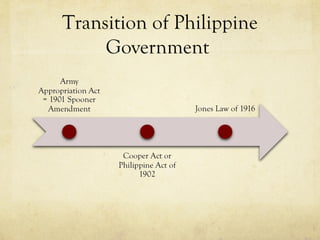
US Civil Government (July 4, 1901 – Nov. 15, 1935) –
replaced the Military Government after the authority
to govern the Philippines was transferred from the US
President to US Congress (1st Organic Act).

The transfer was a result of the amendment to the
Appropriation Act by Sen. John C. Spooner.

Inaugurated on July 4, 1901 (synchronized with the
date of US independence)
Transition of Philippine
     Government
Transition of the Philippine
          Government
   Cooper Act of Philippine Bill of 1902 (2nd Organic
   Act)

Highlights of the law:

   Extension of Bill of Rights

   Appointment of 2 resident Commissioners to
   Washington

   Continuation of the Philippine Commission as the
   upper house and the Philippine Assembly as lower
   house.
Transition of the Philippine
          Government
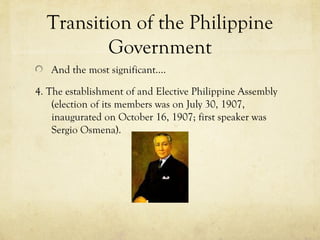
   And the most significant….

4. The establishment of and Elective Philippine Assembly
    (election of its members was on July 30, 1907,
    inaugurated on October 16, 1907; first speaker was
    Sergio Osmena).
Transition of the Philippine
          Government
   Jones Law of 1916 (3rd Organic Act) – granted the
   Filipinos self-government (autonomy)

Highlights:

   Legislative function was transferred to the bicameral
   legislature (replaced the Philippine Commission);
   composed of the Senate (upper house) and lower house
   (House of representatives.

   Election of Manuel Quezon as first senate president
   and again, Sergio Osmena as Speaker of the House of
   Rep.
Transition of the Philippine
            Government
    Prelude to Independence

2   OSROX Mission (introduced the Hare-Hawes Cutting
    Act)

3   Tydings-McDuffie Law of 1934 (successfully adopted by
    the Phil. Legislature and ratified/approved on June 5,
    1934 )

4   Election of delegates to the 1934 Constitutional
    Convention
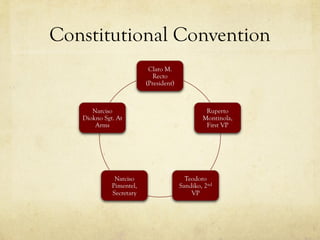
Constitutional Convention
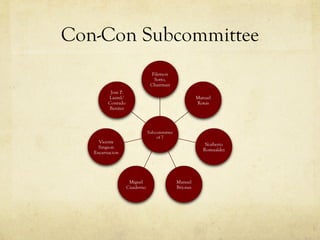
Con-Con Subcommittee
Transition of the Philippine
            Government
    1935 Constitution
   Established the Commonwealth of the
    Philippines/Government (10-year transition
    government)
   Upon withdrawal of American sovereignty and
    declaration of independence, the commonwealth shall
    be known as a republican state
   The constitution also enumerated the constitution of
    the state, the powers and duties of the 3 branches of
    government namely:
Transition of the Philippine
        Government
Executive

Legislative - unicameral

Judicial

Submitted to US President Franklin Roosevelt for
approval and was eventually ratified on May 4, 1935.

Amendments were made in 1940, which changed the
legislative from unicameral to bicameral congress and,
reducing the term of the President from 6 to 4 years.
Transition of the Philippine
               Gov’t
    Commonwealth Government
   Election for the first set of officers was on September
    17, 1935
   Manuel Quezon was elected as President
   Sergio Osmena as Vice President.

*Sergio Osmena became the 2nd president of the
    Commonwealth (in exile) after Quezon’s death in the
    US on August 1, 1944
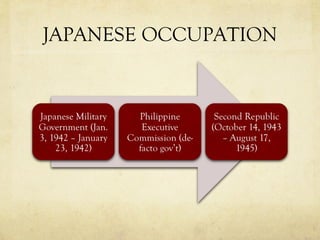
JAPANESE OCCUPATION
Transition of Philippine
           Government
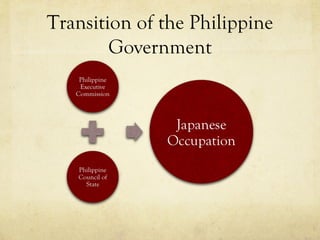
    Philippine Executive Commission
   Reorganized the government
   Renamed the national government as Central
    Administrative Organization
   Created the KALIBAPI (Kapisanan sa Paglilingkod sa
    Bagong Pilipinas, propaganda unit), which later
    became the only political party during the Japanese
    Occupation
Transition of the Philippine
        Government
Transition of Philippine
           Government
    Second Republic (October 14, 1943 – August 17,
    1945)
   Replaced the Philippine Executive Commission
   Adopted the 1943 Constitution, through the
    Preparatory Commission for Philippine Independence
    headed by Dr. Jose P. Laurel
   Ratified on September 7, 1943.
   Composed of 12 articles, a preamble and a provision
    stating the creation of the 3 branches of government.
Transition of Philippine
           Government
    Executive
   Elected for a single term of 6 years
   Headed by the President who was more powerful than
    the three branches of gov’t (absolute power in
    appointing even local gov’t officials and half of the
    members of the National Assembly.
Transition of Philippine
           Government
   Legislative – unicameral known as the National
   Assembly

   Judiciary – still in existence but its power was usurped
   (taken over) by the president or Executive branch of
   government.

*Second Republic ended on August 17, 1945 after the
    surrender of Japan to America
Transition of Philippine
           Government
    Third Republic of the Philippines
   Commonwealth became a republic after the
    declaration of independence on July 4, 1946
   Last election under the Commonwealth was on April
    23, 1946.
   The third republic lasted for 26 years, led by 6
    presidents.
Transition of the Philippine
        Government
Manuel Roxas (May 28, 1946 – July 4, 1946) – last
president of the Commonwealth, first president of the
3rd Republic. Known for the passage of the Parity
Rights under the Bell Trade Act and economic
rehabiltation

Elpidio Quirino – served from April 17, 1948 to
December 30, 1953. Under his term, the Central
Bank of the Philippines was created.
Transition of the Philippine
        Government
Ramon Magsaysay (December 30, 1953 – March 17,
1957. Two of his achievements were the passage of the
Agricultural Tenancy Act of 1954 and, the
establishment of the NARRA (National Resettlement
and Rehabilitation Administration of 1955.

Carlos Garcia (March 18, 1957 – December 30, 1961).
Known for his Filipino First Policy

Diosdado Macapagal (December 30, 1961 – December
30, 1965 – known for enacting the Agricultural Land
Reform Code, formation of MAPHILINDO,
Transition of Philippine
           Government
Changing the date of Philippine independence.
 Ferdinand Marcos – (December 30, 1965 – February
   25, 1986) Known for the creation of blueprint and
   construction of the LRT; campaign again the
   Communist Party of the Philippines and its
   revolutionary army NPA; adoption of the 1973
   Constitution, etc.

Political science

  • 1.
    Politics and Governance: History,Government and Constitution Transition of Philippine Government: From Katipunan to the Second Republic
  • 2.
    Transition of Philippine Government Structure of the Revolutionary Movement KKK Established after the failure of revolutionary groups to bring reform. Founded by Deodato Arellano, Roman Basa and Andres Bonifacio Three objectives namely: reform the political, civic and moral
  • 3.
    Transition of thePhilippine Government
  • 4.
    Transition of thePhilippine Government As the group began to elect councilors and renamed and changed the positions, it began to the structure of the movement started to resemble an organized government
  • 5.
    Transition of thePhilippine Government The Magdalo-Magdiwang rivalry and the rise of the Magdalo Government  Magdiwang – faction of Bonifacio while the Magdalo represented the faction of Aguinaldo  The Magdalo’s felt that a new government should replace the KKK.  The failure of Bonifacio to secure the leadership position led to the dissolution of the KKK.  While it led to the election of Aguinaldo and the rise of the Magdalo government
  • 6.
    Transition of thePhilippine Government
  • 7.
    Transition of thePhilippine Government Biak na Bato Republic  Named after a town in Bulacan where the constitution was drafted by Isabelo Artacho  It was deliberated by the revolutionary generals of Aguinaldo, acting as constitutional assembly.  Was copied from the Cuban 1895 Himaguayu Constitution.  Was adopted and later became the Biak – na- Bato Constitution
  • 8.
    Transition of thePhilippine Government Under this constitution, the Supreme council wielded power This Supreme Council was composed of the President, Vice President and 4 secretaries (interior, foreign affairs, treasury and war The Supreme Council of Grace and Justice exercised judiciary functions. Momentarily ended when Aguinaldo went into exile.
  • 9.
  • 10.
    Transition of Philippine Government Dictatorial Government  Established after Aguinaldo’s return from exile  It was established, upon recommendation of Ambrocio Rianzares Bautista since it suited the political condition  In a dictatorial government, the government can prosecute war criminals and address the war.  This phase was known for?
  • 11.
    Transition of Philippine Government Declaration of Philippine Independence
  • 12.
    Transition of Philippine Government Revolutionary Government  It started right after the end of the dictatorial government  Recommended by Apolinario Mabini, the new adviser of Aguinlado  Revolutionary Government enabled the government to rally for the people’s support  Remain vigilant against Spanish tyranny
  • 13.
    Transition of Philippine Government Achievements  Organization of the first cabinet  Observance/compliance with the mandate of the decrees on the election and appointment of members of the Malolos Congress  Setting up of the Malolos Congress and its transformation as a component/constituent body to formulate a new constitution (agreement, charter) for the country.  Adoption of the 1899 Malolos Constitution
  • 14.
    Transition of Philippine Government Malolos Congress  Approved the Malolos Congress  Adopted the Malolos Constitution  Malolos Constitution  Drafted by Felipe Calderon  Influenced by the constitutions of 7 countries namely:  As stated, the constitution provides for a parliamentary system, with the president elected by the Assembly and special representatives, lasting for 4 years.
  • 15.
    Transition of thePhilippine Government France Belgium Mexico Costa Rica Guatemala Nicaragua Brazil
  • 16.
    Transition of thePhilippine Government Constitutional Government  First act after the circulation of the constitution was to reorganize the cabinet (Mabini became the head of the cabinet and secretary of foreign affairs)  Creation of the first Republic (as dictated in the constitution)  Establishment of the three branches of government (legislative, executive and judicial)
  • 17.
    Transition of thephilippine Government Purpose of the three branches:  So as not to concentrate power in just one entity  To be more representative and democratic  Legislative  Adopted a unicameral congress, known as the Assembly of Representatives  In principle, it wielded more power than the two branches with its authority to create a Permanent Commission  Permanent Commission – 7 members which can designate the president and secretary of the country.
  • 18.
    Transition of thePhilippine Government Executive Power  Exercised by the President  His power was also manifested through his department secretaries.  His secretaries were also responsible to the Assembly, and were given seats in the assembly and allowed to participate in deliberations
  • 19.
    Transition of Philippine Government Judicial  Power was vested in the Supreme Court and in other courts  Headed by the Chief Justice  Despite the fact that the CJ and Solicitor Generals were chosen by the Assembly (with the agreement of the President and secretaries) the judicial was still free from influence and, independent.
  • 20.
    Transition of thePhilippine Government Government during the American Occupation Occupation began after Spain and the US sealed the Treaty of Paris on December 20, 1898. Treaty of Paris – the “ownership” of the Philippines was transferred from Spain to US, for 20 million dollars. - Also part of an agreement of Spain to cede its colonies to the US
  • 21.
    Transition of Philippine Beginningof the US Military Government US Military Government (August 14, 1898 – July 4, 1901) First governor was General Wesley Merritt Achievements: Laid down the foundation (basis) of the US Civil Government Introduced the American system of education Organized the civil courts Established the local government in towns and provinces Conducted the first local election
  • 22.
    Transition of thePhilippine Government While the Military Government was still in full swing, two commissions were created by the US President: 1st Philippine Commission/Schurman – laid down the foundation, based on the outcome of the survey conducted. Second Philippine Commission – terms were on the establishment of a civil government
  • 23.
    Transition of Philippine Government 1. First Philippine Commission/Schurman  Establishment of a territorial government with legislature of 2 houses (elective and appointive)  Withdrawal of military rule in the pacified areas  Conservation of natural resources  Organization of autonomous local government  Free elementary schools  Appointment of trustworthy men to higher/government offices
  • 24.
    Transition of Philippine Government 2. Second Philippine Commission – shift from military to civil government  First to exercise legislative functions  First order was the appropriation (allocation/use) 2 million pesos for the repair of roads and bridges.
  • 25.
    Transition of Philippine Government US Civil Government (July 4, 1901 – Nov. 15, 1935) – replaced the Military Government after the authority to govern the Philippines was transferred from the US President to US Congress (1st Organic Act). The transfer was a result of the amendment to the Appropriation Act by Sen. John C. Spooner. Inaugurated on July 4, 1901 (synchronized with the date of US independence)
  • 26.
  • 27.
    Transition of thePhilippine Government Cooper Act of Philippine Bill of 1902 (2nd Organic Act) Highlights of the law: Extension of Bill of Rights Appointment of 2 resident Commissioners to Washington Continuation of the Philippine Commission as the upper house and the Philippine Assembly as lower house.
  • 28.
    Transition of thePhilippine Government And the most significant…. 4. The establishment of and Elective Philippine Assembly (election of its members was on July 30, 1907, inaugurated on October 16, 1907; first speaker was Sergio Osmena).
  • 29.
    Transition of thePhilippine Government Jones Law of 1916 (3rd Organic Act) – granted the Filipinos self-government (autonomy) Highlights: Legislative function was transferred to the bicameral legislature (replaced the Philippine Commission); composed of the Senate (upper house) and lower house (House of representatives. Election of Manuel Quezon as first senate president and again, Sergio Osmena as Speaker of the House of Rep.
  • 30.
    Transition of thePhilippine Government Prelude to Independence 2 OSROX Mission (introduced the Hare-Hawes Cutting Act) 3 Tydings-McDuffie Law of 1934 (successfully adopted by the Phil. Legislature and ratified/approved on June 5, 1934 ) 4 Election of delegates to the 1934 Constitutional Convention
  • 31.
  • 32.
  • 33.
    Transition of thePhilippine Government 1935 Constitution  Established the Commonwealth of the Philippines/Government (10-year transition government)  Upon withdrawal of American sovereignty and declaration of independence, the commonwealth shall be known as a republican state  The constitution also enumerated the constitution of the state, the powers and duties of the 3 branches of government namely:
  • 34.
    Transition of thePhilippine Government Executive Legislative - unicameral Judicial Submitted to US President Franklin Roosevelt for approval and was eventually ratified on May 4, 1935. Amendments were made in 1940, which changed the legislative from unicameral to bicameral congress and, reducing the term of the President from 6 to 4 years.
  • 35.
    Transition of thePhilippine Gov’t Commonwealth Government  Election for the first set of officers was on September 17, 1935  Manuel Quezon was elected as President  Sergio Osmena as Vice President. *Sergio Osmena became the 2nd president of the Commonwealth (in exile) after Quezon’s death in the US on August 1, 1944
  • 36.
  • 37.
    Transition of Philippine Government Philippine Executive Commission  Reorganized the government  Renamed the national government as Central Administrative Organization  Created the KALIBAPI (Kapisanan sa Paglilingkod sa Bagong Pilipinas, propaganda unit), which later became the only political party during the Japanese Occupation
  • 38.
    Transition of thePhilippine Government
  • 39.
    Transition of Philippine Government Second Republic (October 14, 1943 – August 17, 1945)  Replaced the Philippine Executive Commission  Adopted the 1943 Constitution, through the Preparatory Commission for Philippine Independence headed by Dr. Jose P. Laurel  Ratified on September 7, 1943.  Composed of 12 articles, a preamble and a provision stating the creation of the 3 branches of government.
  • 40.
    Transition of Philippine Government Executive  Elected for a single term of 6 years  Headed by the President who was more powerful than the three branches of gov’t (absolute power in appointing even local gov’t officials and half of the members of the National Assembly.
  • 41.
    Transition of Philippine Government Legislative – unicameral known as the National Assembly Judiciary – still in existence but its power was usurped (taken over) by the president or Executive branch of government. *Second Republic ended on August 17, 1945 after the surrender of Japan to America
  • 42.
    Transition of Philippine Government Third Republic of the Philippines  Commonwealth became a republic after the declaration of independence on July 4, 1946  Last election under the Commonwealth was on April 23, 1946.  The third republic lasted for 26 years, led by 6 presidents.
  • 43.
    Transition of thePhilippine Government Manuel Roxas (May 28, 1946 – July 4, 1946) – last president of the Commonwealth, first president of the 3rd Republic. Known for the passage of the Parity Rights under the Bell Trade Act and economic rehabiltation Elpidio Quirino – served from April 17, 1948 to December 30, 1953. Under his term, the Central Bank of the Philippines was created.
  • 44.
    Transition of thePhilippine Government Ramon Magsaysay (December 30, 1953 – March 17, 1957. Two of his achievements were the passage of the Agricultural Tenancy Act of 1954 and, the establishment of the NARRA (National Resettlement and Rehabilitation Administration of 1955. Carlos Garcia (March 18, 1957 – December 30, 1961). Known for his Filipino First Policy Diosdado Macapagal (December 30, 1961 – December 30, 1965 – known for enacting the Agricultural Land Reform Code, formation of MAPHILINDO,
  • 45.
    Transition of Philippine Government Changing the date of Philippine independence.  Ferdinand Marcos – (December 30, 1965 – February 25, 1986) Known for the creation of blueprint and construction of the LRT; campaign again the Communist Party of the Philippines and its revolutionary army NPA; adoption of the 1973 Constitution, etc.