ARTICLE X:
LOCAL
GOVERNMENT
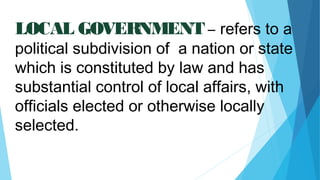
LOCAL GOVERNMENT – refers to a
political subdivision of a nation or state
which is constituted by law and has
substantial control of local affairs, with
officials elected or otherwise locally
selected.
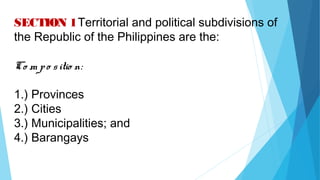
SECTION 1Territorial and political subdivisions of
the Republic of the Philippines are the:
Co m po sitio n:
1.) Provinces
2.) Cities
3.) Municipalities; and
4.) Barangays
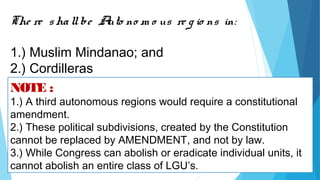
The re shallbe Auto no m o us re g io ns in:
1.) Muslim Mindanao; and
2.) Cordilleras
NOTE :
1.) A third autonomous regions would require a constitutional
amendment.
2.) These political subdivisions, created by the Constitution
cannot be replaced by AMENDMENT, and not by law.
3.) While Congress can abolish or eradicate individual units, it
cannot abolish an entire class of LGU’s.
IMPORTANCE OF LOCAL GOVERNMENTS
Local governments are viable organs for
the performance of local functions. As local
affairs can best be regulated by the people in
the locality rather than by the central authority,
the grant of local autonomy to local units is
considered extremely necessary for a more
efficient local government system.
04/26/16
TERRITORIAL ANDPOLITICAL
SUBDIVISIONS OF THE PHILIPPINES
1.) Provincies, cities, municipalities, and baranggays
are political bodies corporate endowed with powers to
be exercised by and through their respective local
governments conformably with law.
(a) Provincies are composed of several
municipalities and (in some cases) cities. Cities are
urban centers of population. Barangays are units of
cities (except a few where there are no barangays) or
04/26/16
(b) As they are now provided in the Constitution,
there must always be political subdivisions known as
provincies, cities, municipalities, and barangays.
2.) The creation of special metropolitan political
subdivisions and autonomous regions for Muslim
Mindanao and for the Cordilleras by law must comply
with the provisions of Sections 11 and 18, respectively.
04/26/16
SECTION 2 Local Autonomy of the territorial and
political subdivisions
Local Autonomy - is the exercise of certain basic powers, i.e.,
police power, power of eminent domain, and taxing power, by
local government units so as to best serve the interest and
promote the general well-being of their inhabitants.
04/26/16
1.) All political subdivisions shall enjoy local autonomy.
2.) This doesn't mean that the LGU's are completely free from
the central government.
(a) Judiciary may still pass on LGU actions
(b) President may exercise disciplinary power over
LGU officials.
Decentralization - is the process of transferring basic powers
from the national to the local governments to allow maximum
participation of the citizens in governmental and community
activities. The degree of local autonomy is dependent upon
the extent decentralization is affected.
04/26/16
REASONS FORGRANTING LOCAL AUTONOMY
1.) Importance of local solutions to local problems.
2.) Need for orderly management of local affairs.
3.) Desirability of self-reliance.
4.) Need for fullest development of local governments.
5.) Innate desire for self-government.
04/26/16
SECTION 3 Congress shall enact a local government
code which shall provide for a more responsive and
accountable local government structure instituted
through a system of decentralization with effective
mechanisms of recall, initiative, and referendum,
allocate among the different local government units their
powers, responsibilities, and resources, and provide for
the qualifications, election, appointment and removal,
term, salaries, powers and functions and duties of local
officials, and all other matters relating to the organization
and operation of the local units.
04/26/16
Mechanisms of recall, initiative, and referendum.
1.) Recall of officers - legal process by which the registered
voters of a local government unit remove, for loss of
confidence, elective local officials. It is the method of removing
persons from office by the submission of the question as to
whether or not they shall be removed, to the qualified voters at
an election held for the purpose or at a general election.
04/26/16
2.) Initiative - legal process whereby the registered voters of
a local government unit may directly propose, enact, or
amend any law or ordinance at polls called for the purpose
independently or the regularly constituted local legislative
body.
3.) Referendum- legal process whereby the registered voters
of the local government unit concerned may approve, amend,
or reject an ordinance enacted by a local legislative body
when the question is submitted to them for decision.
04/26/16
SECTION 4 Presidential Supervision of LGUs
Supervision of President
1.) The President exercises general supervision over all LGUs.
2.) The President exercises DIRECT supervision over;
(a) Provinces
(b) Autonomous regions, and
(c) Independent cities
3.) This power is limited to ensuring that lower officers
exercise their functions in accordance with law.
04/26/16
4.) The President cannot substitute his judgement for that of
an LGU official unless the latter is acting contrary to law.
5.) The President may,however, impose administrative
sanctions against LGU officials, such as suspension for 120
days, and may even remove them from their posts, in
accordance with law.
6.) Provinces exercise direct supervision over component
cities and municipalities.
7.) Cities and municipalities exercise direct supervision over
component barangays.
04/26/16
SECTION 5Each local government shall have the power
to create own sources of revenue/levy taxes, fees and
charges.Limitations on Power
1) It is subject to such guidelines and limitations as Congress may
provide. See Local Government Code for examples.
2) The guidelines set by Congress should be consistent with the
basic policy of local autonomy.
Accrual of taxes, fees, charges
The taxes, fees and charges shall accrue exclusively to the local
governments.

POLSC16 Article X Sections 1-5

  • 1.
  • 2.
    LOCAL GOVERNMENT –refers to a political subdivision of a nation or state which is constituted by law and has substantial control of local affairs, with officials elected or otherwise locally selected.
  • 3.
    SECTION 1Territorial andpolitical subdivisions of the Republic of the Philippines are the: Co m po sitio n: 1.) Provinces 2.) Cities 3.) Municipalities; and 4.) Barangays
  • 4.
    The re shallbeAuto no m o us re g io ns in: 1.) Muslim Mindanao; and 2.) Cordilleras NOTE : 1.) A third autonomous regions would require a constitutional amendment. 2.) These political subdivisions, created by the Constitution cannot be replaced by AMENDMENT, and not by law. 3.) While Congress can abolish or eradicate individual units, it cannot abolish an entire class of LGU’s.
  • 5.
    IMPORTANCE OF LOCALGOVERNMENTS Local governments are viable organs for the performance of local functions. As local affairs can best be regulated by the people in the locality rather than by the central authority, the grant of local autonomy to local units is considered extremely necessary for a more efficient local government system.
  • 6.
    04/26/16 TERRITORIAL ANDPOLITICAL SUBDIVISIONS OFTHE PHILIPPINES 1.) Provincies, cities, municipalities, and baranggays are political bodies corporate endowed with powers to be exercised by and through their respective local governments conformably with law. (a) Provincies are composed of several municipalities and (in some cases) cities. Cities are urban centers of population. Barangays are units of cities (except a few where there are no barangays) or
  • 7.
    04/26/16 (b) As theyare now provided in the Constitution, there must always be political subdivisions known as provincies, cities, municipalities, and barangays. 2.) The creation of special metropolitan political subdivisions and autonomous regions for Muslim Mindanao and for the Cordilleras by law must comply with the provisions of Sections 11 and 18, respectively.
  • 8.
    04/26/16 SECTION 2 LocalAutonomy of the territorial and political subdivisions Local Autonomy - is the exercise of certain basic powers, i.e., police power, power of eminent domain, and taxing power, by local government units so as to best serve the interest and promote the general well-being of their inhabitants.
  • 9.
    04/26/16 1.) All politicalsubdivisions shall enjoy local autonomy. 2.) This doesn't mean that the LGU's are completely free from the central government. (a) Judiciary may still pass on LGU actions (b) President may exercise disciplinary power over LGU officials. Decentralization - is the process of transferring basic powers from the national to the local governments to allow maximum participation of the citizens in governmental and community activities. The degree of local autonomy is dependent upon the extent decentralization is affected.
  • 10.
    04/26/16 REASONS FORGRANTING LOCALAUTONOMY 1.) Importance of local solutions to local problems. 2.) Need for orderly management of local affairs. 3.) Desirability of self-reliance. 4.) Need for fullest development of local governments. 5.) Innate desire for self-government.
  • 11.
    04/26/16 SECTION 3 Congressshall enact a local government code which shall provide for a more responsive and accountable local government structure instituted through a system of decentralization with effective mechanisms of recall, initiative, and referendum, allocate among the different local government units their powers, responsibilities, and resources, and provide for the qualifications, election, appointment and removal, term, salaries, powers and functions and duties of local officials, and all other matters relating to the organization and operation of the local units.
  • 12.
    04/26/16 Mechanisms of recall,initiative, and referendum. 1.) Recall of officers - legal process by which the registered voters of a local government unit remove, for loss of confidence, elective local officials. It is the method of removing persons from office by the submission of the question as to whether or not they shall be removed, to the qualified voters at an election held for the purpose or at a general election.
  • 13.
    04/26/16 2.) Initiative -legal process whereby the registered voters of a local government unit may directly propose, enact, or amend any law or ordinance at polls called for the purpose independently or the regularly constituted local legislative body. 3.) Referendum- legal process whereby the registered voters of the local government unit concerned may approve, amend, or reject an ordinance enacted by a local legislative body when the question is submitted to them for decision.
  • 14.
    04/26/16 SECTION 4 PresidentialSupervision of LGUs Supervision of President 1.) The President exercises general supervision over all LGUs. 2.) The President exercises DIRECT supervision over; (a) Provinces (b) Autonomous regions, and (c) Independent cities 3.) This power is limited to ensuring that lower officers exercise their functions in accordance with law.
  • 15.
    04/26/16 4.) The Presidentcannot substitute his judgement for that of an LGU official unless the latter is acting contrary to law. 5.) The President may,however, impose administrative sanctions against LGU officials, such as suspension for 120 days, and may even remove them from their posts, in accordance with law. 6.) Provinces exercise direct supervision over component cities and municipalities. 7.) Cities and municipalities exercise direct supervision over component barangays.
  • 16.
    04/26/16 SECTION 5Each localgovernment shall have the power to create own sources of revenue/levy taxes, fees and charges.Limitations on Power 1) It is subject to such guidelines and limitations as Congress may provide. See Local Government Code for examples. 2) The guidelines set by Congress should be consistent with the basic policy of local autonomy. Accrual of taxes, fees, charges The taxes, fees and charges shall accrue exclusively to the local governments.