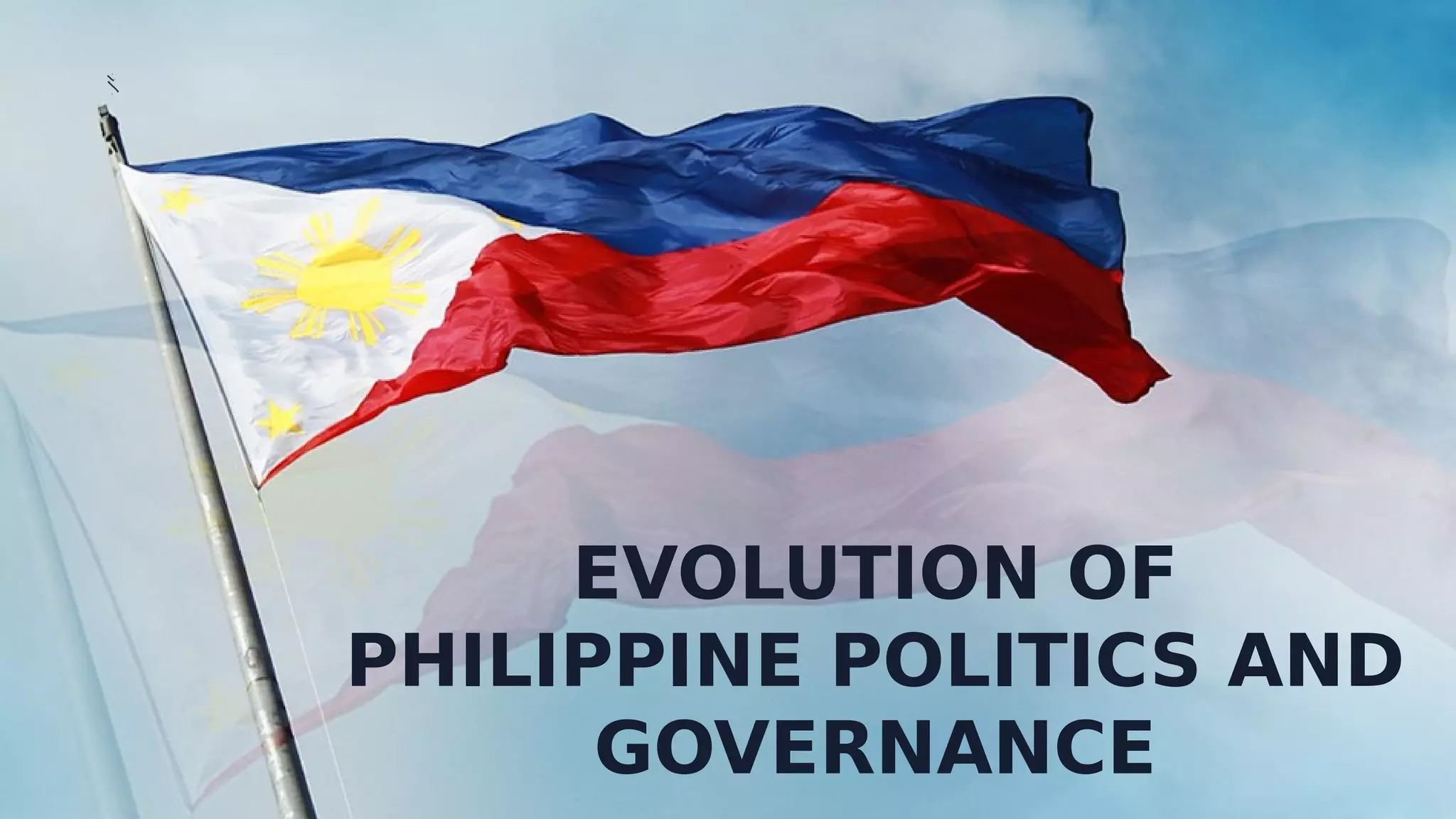
EVOLUTION OF
PHILIPPINE POLITICS AND
GOVERNANCE
Objectives
● Analyze the evolution of
Philippine politics and
governance
2
Objectives
● Analyze the evolution of
Philippine politics and
governance
3
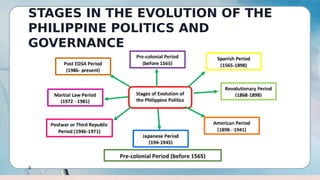
STAGES IN THE EVOLUTION OF THE
PHILIPPINE POLITICS AND
GOVERNANCE
4
PRE-COLONIAL PERIOD
5
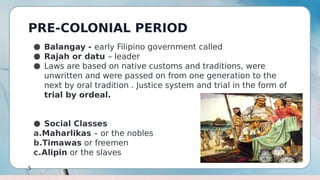
● Balangay - early Filipino government called
● Rajah or datu – leader
● Laws are based on native customs and traditions, were
unwritten and were passed on from one generation to the
next by oral tradition . Justice system and trial in the form of
trial by ordeal.
● Social Classes
a.Maharlikas – or the nobles
b.Timawas or freemen
c.Alipin or the slaves
Spanish Period (1565-1898)
6
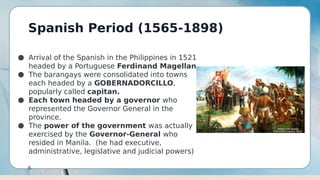
● Arrival of the Spanish in the Philippines in 1521
headed by a Portuguese Ferdinand Magellan
● The barangays were consolidated into towns
each headed by a GOBERNADORCILLO,
popularly called capitan.
● Each town headed by a governor who
represented the Governor General in the
province.
● The power of the government was actually
exercised by the Governor-General who
resided in Manila. (he had executive,
administrative, legislative and judicial powers)
Spanish Period (1565-1898)
7
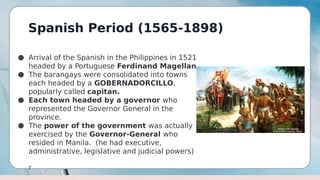
● Arrival of the Spanish in the Philippines in 1521
headed by a Portuguese Ferdinand Magellan
● The barangays were consolidated into towns
each headed by a GOBERNADORCILLO,
popularly called capitan.
● Each town headed by a governor who
represented the Governor General in the
province.
● The power of the government was actually
exercised by the Governor-General who
resided in Manila. (he had executive,
administrative, legislative and judicial powers)
Revolutionary Period (1868-1898)
8
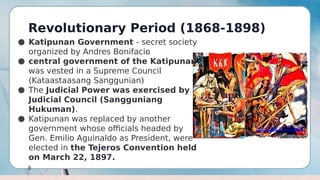
● Katipunan Government - secret society
organized by Andres Bonifacio
● central government of the Katipunan
was vested in a Supreme Council
(Kataastaasang Sanggunian)
● The Judicial Power was exercised by a
Judicial Council (Sangguniang
Hukuman).
● Katipunan was replaced by another
government whose officials headed by
Gen. Emilio Aguinaldo as President, were
elected in the Tejeros Convention held
on March 22, 1897.
Revolutionary Period (1868-1898)
9
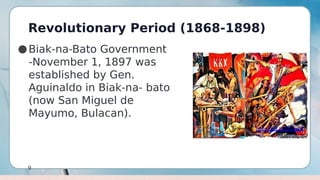
●Biak-na-Bato Government
-November 1, 1897 was
established by Gen.
Aguinaldo in Biak-na- bato
(now San Miguel de
Mayumo, Bulacan).
The Dictatorial Government
10
● Aguinaldo in view of the chaotic conditions in the country,
established the Dictatorial Government on May 24, 1898.
● Proclamation of the Philippine Independence at Kawit
Cavite on June 12, 1898 and the reorganization of local
governments.
● June 23, 1898, Gen. Aguinaldo established the Revolutionary
Government replacing the Dictatorial Government.
● e “struggle for the independence of the Philippines, until all
nations including Spain will expressly recognize it,” and “to
prepare the country for the establishment of a real Republic.”
American Period (1898 - 1941)
11
● The Military Government- rule in the Philippines on
April 4, 1898, the day after the occupation of Manila.
● Commander-in-Chief of all Armed Forces - military
governor who exercised as long as the war lasted, all
powers of government – executive, legislative and
judicial.
● The first American Military Governor was General
Wesley Merritt, the second was General Elwell E.
Otis, and the third and last was Major General Arthur
MacArthur.
American Period (1898 - 1941)
12
● The Civil Government- was inaugurated in Manila on
July 4, 1901
● Civil Governor, also exercised legislative powers. He
remained as President of the Philippine Commission, the
sole law-making body of the government
American Period (1898 - 1941)
13
● The Commonwealth Government of the Philippines
● Tydings- McDuffie Law - transition period of ten years
during which the Philippines Commonwealth would
operate and at the expiration of said period on July 4,
1896, the independence of the Philippines would be
proclaimed and established.
● Manuel L. Quezon Sergio Osmeña, as President and
Vice-President (November 15, 1935, following the first
national election under the 1935 Constitution held on
September 12, 1935)
Japanese Period (1941-1945)
14
●Military Administration
●It was established in Manila on January 3,
1942
●The sovereignty of United States over the
Philippines was declared terminated.
Japanese Period (1941-1945)
15
● Philippine Executive Commission - Civil government
● exercised both the executive and legislative powers.
● Law enactment subject to the approval of the
Commander-in-Chief of the Japanese Forces
Japanese Period (1941-1945)
16
●Japanese Sponsored Government - so-called
Japanese- sponsored Republic of the Philippines
was inaugurated with Jose P. Laurel as President.
Postwar or Third Republic Period (1946-
1971)
17
● Manuel Roxas was the first president under the
Third republic followed by Elpidio Quirino, Ramon
Magsaysay, Carlos Garcia, Diosdado Macapagal and
the first term of Ferdinand Marcos.
● 1935 Constitution, the country’s politics and
government was structured (president and unitary
system)
● The government will also have a bicameral legislature
that is composed of senate and house of
representatives
● Judicial body also created hat is composed of Supreme
Court and the lower courts.
Martial Law Period (1972 - 1981)
18
● January 1973 Marcos proclaimed the ratification of a new
constitution based on the parliamentary system, with
himself as both president and prime minister.
● the government was forced to borrow large sums from the
international banking community. Also troubling to the
regime, reports of widespread corruption began to surface
with increasing frequency.
Post EDSA Period (1986- present)
19
●After the fall down of Marcos, the constitution
shifts toward democratization and the return
of constitutionalism.
●A Freedom Constitution was formed that served
as the pillar of transition of the government.
EFFECTS OF COLONIAL EXPERIENCE ON
PHILIPPINE POLITICS AND GOVERNANCE
20
● Spanish Period 
● Loss of freedom on the part of the Filipinos 
● Establishment of highly centralized government and
bureaucratic set-up 
● The influence of the Catholic Church
- The union of church and state
- The role of Spanish priest in colonial administration was given a
de facto
- High influence of the church on the state was exposed by Filipino
reforms recognition
EFFECTS OF COLONIAL EXPERIENCE ON
PHILIPPINE POLITICS AND GOVERNANCE
21
● American Period
● American’s greatest achievement in the Philippine was the
introduction of public school system.
● The improvement of trade and industry
● The public Health and welfare
● Give importance on transportation and communication.
- Political Parties has a political platforms which Filipinos learned.
This results to increase in the knowledge of government
machinery and government affairs by wealthy and educated
Filipinos.
- The country become dependent exclusively on the US to continue
to proper.
EFFECTS OF COLONIAL EXPERIENCE ON
PHILIPPINE POLITICS AND GOVERNANCE
22
● Japanese Period  Exposed the people to extreme
deprivation. It would take decades for the country’s
economy and infrastructure to recover. 
● Gave birth to to a mentality to stay alive at all costs, even
robbing and cheating fellow Filipinos. 
● Dorobo mentality (the tendency to steal) was carried over
to the post liberation and independence era as the
government could not provide adequate jobs and
education
9.__THE_EVOLUTION_OF_PHILIPPINE_POLITICS_AND_GOVERNANCE___Copy.pptx.pdf

9.__THE_EVOLUTION_OF_PHILIPPINE_POLITICS_AND_GOVERNANCE___Copy.pptx.pdf

  • 1.
  • 2.
    Objectives ● Analyze theevolution of Philippine politics and governance 2
  • 3.
    Objectives ● Analyze theevolution of Philippine politics and governance 3
  • 4.
    STAGES IN THEEVOLUTION OF THE PHILIPPINE POLITICS AND GOVERNANCE 4
  • 5.
    PRE-COLONIAL PERIOD 5 ● Balangay- early Filipino government called ● Rajah or datu – leader ● Laws are based on native customs and traditions, were unwritten and were passed on from one generation to the next by oral tradition . Justice system and trial in the form of trial by ordeal. ● Social Classes a.Maharlikas – or the nobles b.Timawas or freemen c.Alipin or the slaves
  • 6.
    Spanish Period (1565-1898) 6 ●Arrival of the Spanish in the Philippines in 1521 headed by a Portuguese Ferdinand Magellan ● The barangays were consolidated into towns each headed by a GOBERNADORCILLO, popularly called capitan. ● Each town headed by a governor who represented the Governor General in the province. ● The power of the government was actually exercised by the Governor-General who resided in Manila. (he had executive, administrative, legislative and judicial powers)
  • 7.
    Spanish Period (1565-1898) 7 ●Arrival of the Spanish in the Philippines in 1521 headed by a Portuguese Ferdinand Magellan ● The barangays were consolidated into towns each headed by a GOBERNADORCILLO, popularly called capitan. ● Each town headed by a governor who represented the Governor General in the province. ● The power of the government was actually exercised by the Governor-General who resided in Manila. (he had executive, administrative, legislative and judicial powers)
  • 8.
    Revolutionary Period (1868-1898) 8 ●Katipunan Government - secret society organized by Andres Bonifacio ● central government of the Katipunan was vested in a Supreme Council (Kataastaasang Sanggunian) ● The Judicial Power was exercised by a Judicial Council (Sangguniang Hukuman). ● Katipunan was replaced by another government whose officials headed by Gen. Emilio Aguinaldo as President, were elected in the Tejeros Convention held on March 22, 1897.
  • 9.
    Revolutionary Period (1868-1898) 9 ●Biak-na-BatoGovernment -November 1, 1897 was established by Gen. Aguinaldo in Biak-na- bato (now San Miguel de Mayumo, Bulacan).
  • 10.
    The Dictatorial Government 10 ●Aguinaldo in view of the chaotic conditions in the country, established the Dictatorial Government on May 24, 1898. ● Proclamation of the Philippine Independence at Kawit Cavite on June 12, 1898 and the reorganization of local governments. ● June 23, 1898, Gen. Aguinaldo established the Revolutionary Government replacing the Dictatorial Government. ● e “struggle for the independence of the Philippines, until all nations including Spain will expressly recognize it,” and “to prepare the country for the establishment of a real Republic.”
  • 11.
    American Period (1898- 1941) 11 ● The Military Government- rule in the Philippines on April 4, 1898, the day after the occupation of Manila. ● Commander-in-Chief of all Armed Forces - military governor who exercised as long as the war lasted, all powers of government – executive, legislative and judicial. ● The first American Military Governor was General Wesley Merritt, the second was General Elwell E. Otis, and the third and last was Major General Arthur MacArthur.
  • 12.
    American Period (1898- 1941) 12 ● The Civil Government- was inaugurated in Manila on July 4, 1901 ● Civil Governor, also exercised legislative powers. He remained as President of the Philippine Commission, the sole law-making body of the government
  • 13.
    American Period (1898- 1941) 13 ● The Commonwealth Government of the Philippines ● Tydings- McDuffie Law - transition period of ten years during which the Philippines Commonwealth would operate and at the expiration of said period on July 4, 1896, the independence of the Philippines would be proclaimed and established. ● Manuel L. Quezon Sergio Osmeña, as President and Vice-President (November 15, 1935, following the first national election under the 1935 Constitution held on September 12, 1935)
  • 14.
    Japanese Period (1941-1945) 14 ●MilitaryAdministration ●It was established in Manila on January 3, 1942 ●The sovereignty of United States over the Philippines was declared terminated.
  • 15.
    Japanese Period (1941-1945) 15 ●Philippine Executive Commission - Civil government ● exercised both the executive and legislative powers. ● Law enactment subject to the approval of the Commander-in-Chief of the Japanese Forces
  • 16.
    Japanese Period (1941-1945) 16 ●JapaneseSponsored Government - so-called Japanese- sponsored Republic of the Philippines was inaugurated with Jose P. Laurel as President.
  • 17.
    Postwar or ThirdRepublic Period (1946- 1971) 17 ● Manuel Roxas was the first president under the Third republic followed by Elpidio Quirino, Ramon Magsaysay, Carlos Garcia, Diosdado Macapagal and the first term of Ferdinand Marcos. ● 1935 Constitution, the country’s politics and government was structured (president and unitary system) ● The government will also have a bicameral legislature that is composed of senate and house of representatives ● Judicial body also created hat is composed of Supreme Court and the lower courts.
  • 18.
    Martial Law Period(1972 - 1981) 18 ● January 1973 Marcos proclaimed the ratification of a new constitution based on the parliamentary system, with himself as both president and prime minister. ● the government was forced to borrow large sums from the international banking community. Also troubling to the regime, reports of widespread corruption began to surface with increasing frequency.
  • 19.
    Post EDSA Period(1986- present) 19 ●After the fall down of Marcos, the constitution shifts toward democratization and the return of constitutionalism. ●A Freedom Constitution was formed that served as the pillar of transition of the government.
  • 20.
    EFFECTS OF COLONIALEXPERIENCE ON PHILIPPINE POLITICS AND GOVERNANCE 20 ● Spanish Period  ● Loss of freedom on the part of the Filipinos  ● Establishment of highly centralized government and bureaucratic set-up  ● The influence of the Catholic Church - The union of church and state - The role of Spanish priest in colonial administration was given a de facto - High influence of the church on the state was exposed by Filipino reforms recognition
  • 21.
    EFFECTS OF COLONIALEXPERIENCE ON PHILIPPINE POLITICS AND GOVERNANCE 21 ● American Period ● American’s greatest achievement in the Philippine was the introduction of public school system. ● The improvement of trade and industry ● The public Health and welfare ● Give importance on transportation and communication. - Political Parties has a political platforms which Filipinos learned. This results to increase in the knowledge of government machinery and government affairs by wealthy and educated Filipinos. - The country become dependent exclusively on the US to continue to proper.
  • 22.
    EFFECTS OF COLONIALEXPERIENCE ON PHILIPPINE POLITICS AND GOVERNANCE 22 ● Japanese Period  Exposed the people to extreme deprivation. It would take decades for the country’s economy and infrastructure to recover.  ● Gave birth to to a mentality to stay alive at all costs, even robbing and cheating fellow Filipinos.  ● Dorobo mentality (the tendency to steal) was carried over to the post liberation and independence era as the government could not provide adequate jobs and education