The role ofideas in politics
What people think and believe about society, power, rights,
etc., determines their actions
Everything has to pass through the mind of the individual
before he or she acts
How do the ideas and beliefs appear in our minds?
Critical examination of reality – thinking for oneself
Influence of others’ opinions – family, education, mass
media, etc.
Some forms of teaching imprison the mind
Others liberate the mind, enabling it to think critically
Subjugation by force is the crudest form of social control
Mind control is a much more effective method
But is it really effective?
3.
2 main conceptsabout the role of ideas in politics
Political culture – the broad pattern of political orientations
shared by a large group of people (a nation, a region, a
class, an ethnic group)
Political ideology – a system of political ideas, developed for
the purposes of political action (governing a country,
launching a social movement or a political party, organizing
a revolution – or a counterrevolution, etc.)
4.
What are politicalideologies for?
To provide people with programs of political action:
to govern societies, or
to struggle for change
Both for integration and for conflict, you need an ideology – a coherent set
of ideas for purposeful action
The earliest ideologies were religions. Many of the earliest rulers in history
were priests.
In the Modern Age, political ideologies become increasingly secular (non-
religious, some anti-religious), but religions continue to serve as
important sources for ideologies to this day
Examples: Christian democracy, Christian socialism, Protestant
fundamentalism, Islamic radicalism
5.
It is thevery essence of political ideology to differ from another
ideology on what to do with the status quo (the existing order
of things):
To keep it – or to change it.
At the core of every political idea, every political action is a
choice between YES and NO. Look at the work of the
parliament… Or the UN… Or an election…
The differences between ideologies are rooted in basic
assumptions about:
human nature – are humans naturally peaceful, cooperative,
rational?
individual and society: which interests come first?
equality: how much social inequality is acceptable?
6.
Ideology vs. pragmatism
Doestoo much ideology make you narrow-minded?
Should one’s political beliefs be based on one ideology - be
doctrinaire?
Shouldn’t politicians be free to borrow ideas from different
ideologies if they work better in a particular situation?
At issue: orthodoxy vs. pluralism
Orthodoxy (traditionalist, pre-modern view): the rulers should
maintain one ideology as dominant – to foster unity and
harmony in society.
UNITY THROUGH UNIFORMITY
Can work only: in traditional, pre-modern societies – or, in
societies in transition to modernity, in periods of extreme
crisis. Requires generally low educational levels
7.
Pluralism (modern viewassociated with liberalism): the rulers
allow different ideologies in society to compete.
UNITY THROUGH TOLERATION OF DIFFERENCES
“E pluribus unum”
Works better in developed, modern and postmodern, complex
societies with high educational levels
Are there limits to toleration? Should some ideologies be
banned?
Is there such a thing as liberal orthodoxy?
8.
The challenge ofliberal-democratic politics:
To accept ideological pluralism as a normal condition
of society -
And try to maintain social unity through toleration of
differences and management of conflict
It is not always possible
Some ideologies can coexist with each other
Others are so strongly opposed to each other that
they cannot be reconciled by means of compromise
Or can they?
9.
Political Spectrum: FromLeft to Right
Political ideologies, through opposition, competition,
fusion, mixing, etc. –
exist in constant interaction with each other
Together, they form a political spectrum
It is a useful tool of political analysis
10.
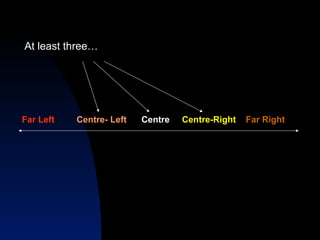
Far Left Centre-Left Centre Centre-Right Far Right
At least three…
11.
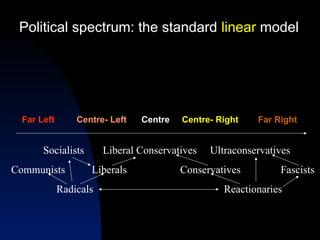
Far Left Centre-Left Centre Centre- Right Far Right
Political spectrum: the standard linear model
Socialists Liberal Conservatives Ultraconservatives
Communists Liberals Conservatives Fascists
Radicals Reactionaries
12.
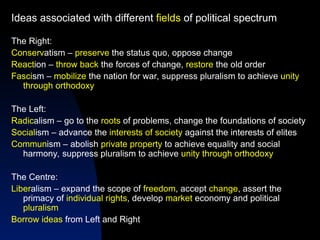
Ideas associated withdifferent fields of political spectrum
The Right:
Conservatism – preserve the status quo, oppose change
Reaction – throw back the forces of change, restore the old order
Fascism – mobilize the nation for war, suppress pluralism to achieve unity
through orthodoxy
The Left:
Radicalism – go to the roots of problems, change the foundations of society
Socialism – advance the interests of society against the interests of elites
Communism – abolish private property to achieve equality and social
harmony, suppress pluralism to achieve unity through orthodoxy
The Centre:
Liberalism – expand the scope of freedom, accept change, assert the
primacy of individual rights, develop market economy and political
pluralism
Borrow ideas from Left and Right
13.
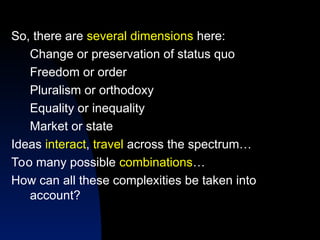
So, there areseveral dimensions here:
Change or preservation of status quo
Freedom or order
Pluralism or orthodoxy
Equality or inequality
Market or state
Ideas interact, travel across the spectrum…
Too many possible combinations…
How can all these complexities be taken into
account?
14.
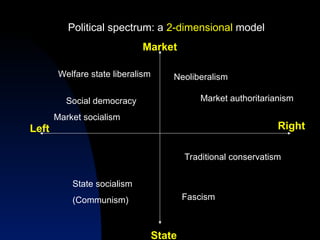
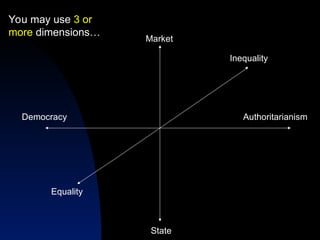
Political spectrum: a2-dimensional model
Market
Right
Left
State
Social democracy
Market socialism
Welfare state liberalism
State socialism
(Communism) Fascism
Neoliberalism
Market authoritarianism
Traditional conservatism
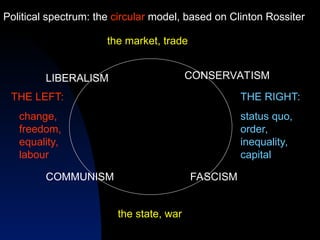
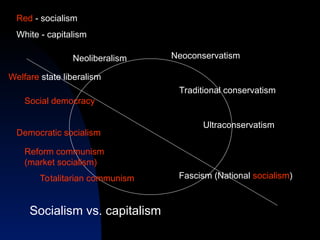
Political spectrum: thecircular model, based on Clinton Rossiter
THE LEFT:
change,
freedom,
equality,
labour
THE RIGHT:
status quo,
order,
inequality,
capital
FASCISM
COMMUNISM
CONSERVATISM
LIBERALISM
the state, war
the market, trade
Fascism (National socialism)
Welfarestate liberalism
Social democracy
Democratic socialism
Reform communism
(market socialism)
Totalitarian communism
Neoliberalism Neoconservatism
Traditional conservatism
Ultraconservatism
Red - socialism
White - capitalism
Socialism vs. capitalism
19.
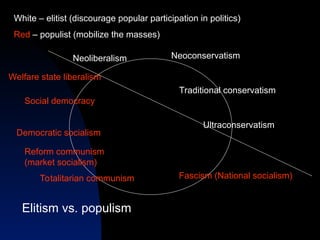
Fascism (National socialism)
Welfarestate liberalism
Social democracy
Democratic socialism
Reform communism
(market socialism)
Totalitarian communism
Neoliberalism Neoconservatism
Traditional conservatism
Ultraconservatism
White – elitist (discourage popular participation in politics)
Red – populist (mobilize the masses)
Elitism vs. populism
20.
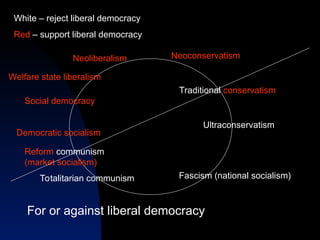
Fascism (national socialism)
Welfarestate liberalism
Social democracy
Democratic socialism
Reform communism
(market socialism)
Totalitarian communism
Neoliberalism Neoconservatism
Traditional conservatism
Ultraconservatism
White – reject liberal democracy
Red – support liberal democracy
For or against liberal democracy
21.
Three major factorswhich produce, shape and
reshape ideologies:
1. TIME,
1. CLASS, AND
1. CRISIS
22.
TIME
The flow oftime
The course of history
Social evolution and development
The 5 centuries of modernization
The issue of change -
social, technological, cultural, economic
Also: age (individuals, countries, systems) and readiness to
embrace change
The influence of liberalism today is partly explained by the fact
that liberalism was created as the ideology of change.
Conservatism’s main problem: how to keep order in a changing
world
23.
CLASS
Each major ideologyhas its main roots in the interests of a
certain class, or a section of a class, or several aligned
classes
For instance, in 19th
century Europe:
Conservative ideologies were rooted in the interests of landed
aristocracy and clergy – classes losing power as a result of
modernization
Liberalism was rooted in the interests of the rising bourgeoisie
Socialism was rooted in the interests of the working classes
The special role of the intellectuals in the production of ideas
24.
CRISIS
A catastrophe (majorwar, economic collapse, ecological
disaster, famine)
Major deterioration of social conditions
Breakdown of a state
A revolution or a counterrevolution
Crises create powerful demand for new ideas
And people commit themselves to ideas much more strongly
(become more ideological) than in normal times
25.
Liberalism,
conservatism,
socialism,
and fascism
have offeredcomprehensive political worldviews
Other important ideologies which have not developed
into comprehensive systems of thought -
but have had major influence on national and global
politics:
26.
Nationalism: creating independentstates, fostering
national unity
Anarchism: rejection of the state as a social
mechanism
Feminism: struggle for gender equality
Environmentalism: saving the planet
What about religious fundamentalisms?
27.
Explore the Canadianpolitical spectrum:
Liberals, Conservatives, NDP, PQ
Liberal Party of Canada
http://www.conservative.ca/media/20050319-POLIC
Y%20DECLARATION.pdf
NDP | The New Democratic Party of Canada
Parti Québécois > Other languages > English



![Understanding political ideas and movements] The role of ideology in politics...](https://cdn.slidesharecdn.com/ss_thumbnails/understandingpoliticalideasandmovementstheroleofideologyinpoliticsandsociety-220615093305-d70e2d83-thumbnail.jpg?width=640&height=640&fit=bounds)


