







VEHICLE ELECTRIFICATION IN NEW YORK CITYPrepared forCouncilmember Gale A. BrewerBy: Richard Beadle, Elizabeth Friedrich, Chandler Griffith, & Christine Hadlow
AgendaIntroduction …………………………………………..Christine Hadlow Background…………………………………………………..Chandler GriffithNature of the Problem & Criteria……………………………..Liz FriedrichAlternatives……………………………………………………..Richard BeadleFinal Analysis & Recommendation ………….………..Christine Hadlow
Central Policy IssueWhat is the most effective approach for Councilmember Brewer to take in order to make New York City (NYC) a world-class electric vehicle (EV) friendly city?
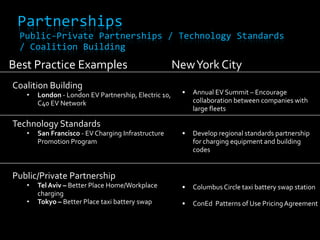
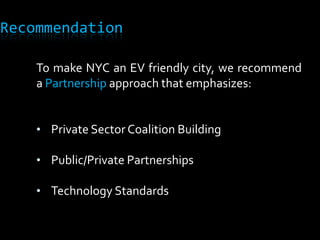
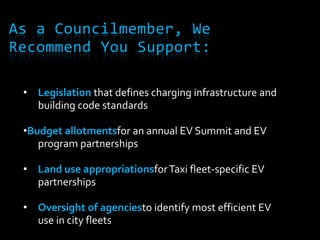
RecommendationTo make NYC an EV friendly city, we recommend a Partnership approach that emphasizes:	Coalition Building
	Public/Private Partnerships
	Technology StandardsMethodology	Best Practices/Case Studies
	Outreach/Interviews
	Strategies/Analysis
	Recommendation AssumptionsEVs hold significant public interest as part of the electricity infrastructure
Elements of our strategies will most likely be developed by other city agencies as EV adoption progresses
Changes in Federal and State legislation will allow for more municipal emission regulationAgendaIntroduction …………………………………………………Christine Hadlow Background……………………………………………Chandler GriffithNature of the Problem & Criteria……………………………..Liz FreidrichAlternatives……………………………………………………..Richard BeadleFinal Analysis & Recommendation ………….………..Christine Hadlow
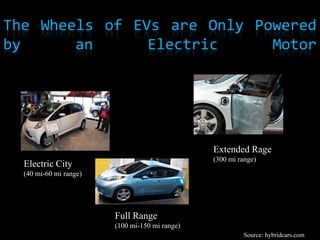
The Wheels of EVs are Only Powered by an Electric MotorExtended Rage(300 mi range) Electric City(40 mi-60 mi range) Full Range(100 mi-150 mi range) Source: hybridcars.com
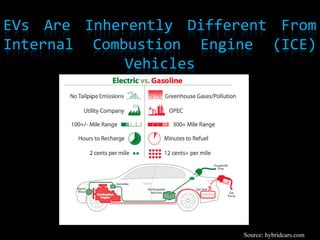
EVs Are Inherently Different From Internal Combustion Engine (ICE) VehiclesSource: hybridcars.com
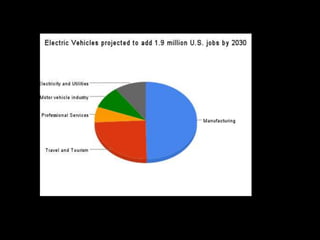
Benefits of EVs Over ICEs Economic Benefits	EVs have potential to add 1.9 	million U.S. jobs by 2030
	EVs make the U.S. economy 	more resilient to oil price 	shocks
	100% conversion reduces U.S. 	oil consumption by 75%
	Supports grid efficiency  Environmental Benefits 	Reduce overall carbon 	emissions by up to 70% (	100% if charged from 	renewable source)
	Lower fuel costs by about 	80%
	Potential for increased 	renewable energy use Sources: Economic Impact of the Electrification Roadmap, Electrification Coalition:2010, Press Release, Senator Gillibrand: 2010
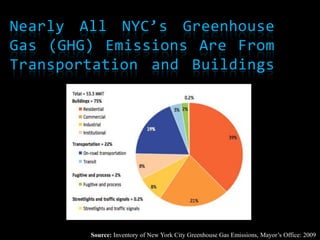
Nearly All NYC’s Greenhouse Gas (GHG) Emissions Are From Transportation and BuildingsSource: Inventory of New York City Greenhouse Gas Emissions, Mayor’s Office: 2009
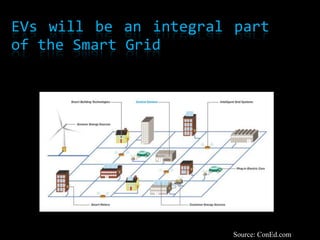
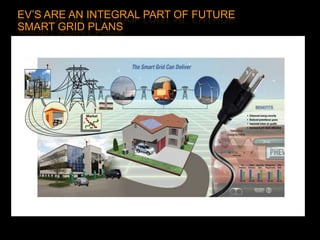
EVs will be an integral part of the Smart Grid Source: ConEd.com
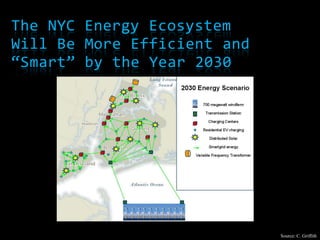
 The NYC Energy Ecosystem Will Be More Efficient and “Smart” by the Year 2030  Source: C. Griffith
AgendaIntroduction …………………………………………………Christine Hadlow Background…………………………………………………..Chandler GriffithNature of the Problem & Criteria………………………Liz FreidrichAlternatives……………………………………………………..Richard BeadleFinal Analysis & Recommendation ………….………..Christine Hadlow
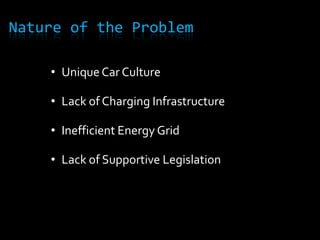
 Nature of the ProblemUnique Car Culture
Lack of Charging Infrastructure
Inefficient Energy Grid
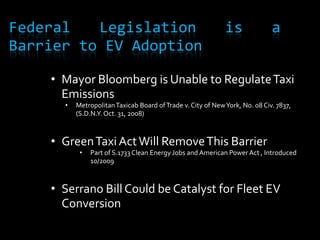
Lack of Supportive LegislationFederal Legislation is a Barrier to EV AdoptionMayor Bloomberg is Unable to Regulate Taxi Emissions
Metropolitan Taxicab Board of Trade v. City of New York, No. 08 Civ. 7837, (S.D.N.Y. Oct. 31, 2008)
Green Taxi Act Will Remove This Barrier
Part of S.1733 Clean Energy Jobs and American Power Act , Introduced 10/2009
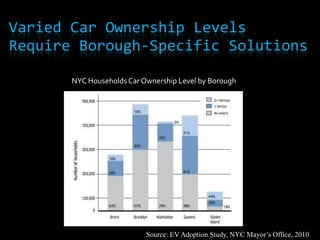
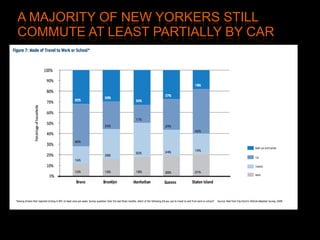
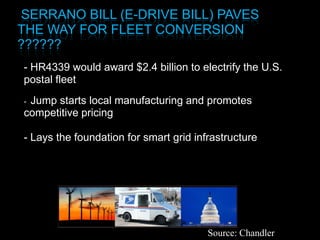
Serrano Bill Could be Catalyst for Fleet EV ConversionVaried Car Ownership Levels Require Borough-Specific SolutionsNYC Households Car Ownership Level by Borough Source: EV Adoption Study, NYC Mayor’s Office, 2010
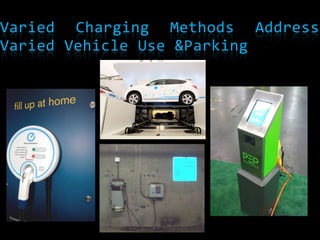
Varied Charging Methods AddressVaried Vehicle Use & Parking
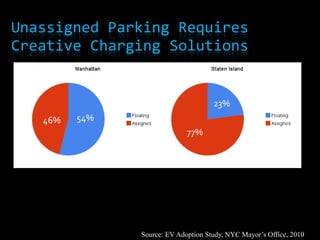
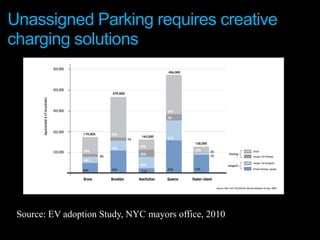
Unassigned Parking Requires Creative Charging Solutions23% 54% 46% 77% Source: EV Adoption Study, NYC Mayor’s Office, 2010
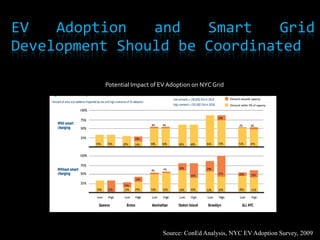
EV Adoption and Smart Grid Development Should be CoordinatedPotential Impact of EV Adoption on NYC GridSource: ConEd Analysis, NYC EV Adoption Survey, 2009
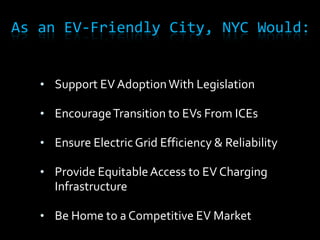
As an EV-Friendly City, NYC Would:	Support EV Adoption With Legislation
	Encourage Transition to EVs From ICEs
	Ensure Electric Grid Efficiency & Reliability
	Provide Equitable Access to EV Charging 	Infrastructure
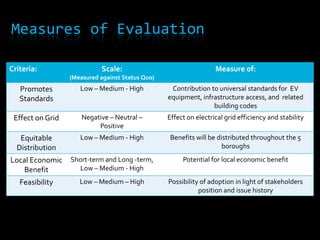
	Be Home to a Competitive EV MarketMeasures of Evaluation
AgendaIntroduction …………………………………………………Christine Hadlow Background…………………………………………………..Chandler GriffithNature of the Problem & Criteria……………………………..Liz FreidrichAlternatives………………………………………………Richard BeadleFinal Analysis & Recommendation ………….………..Christine Hadlow
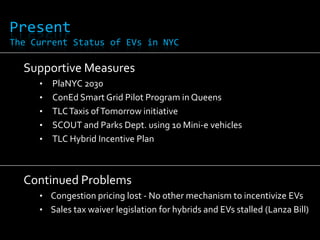
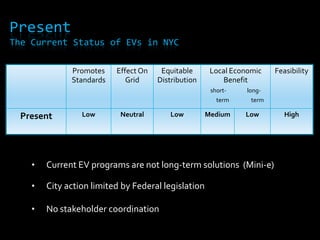
PresentThe Current Status of EVs in NYCSupportive Measures	PlaNYC 2030
	ConEd Smart Grid Pilot Program in Queens
	TLC Taxis of Tomorrow initiative
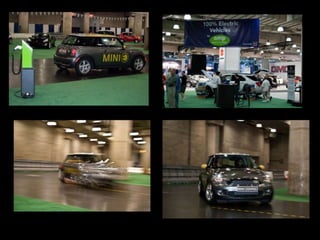
	SCOUT and Parks Dept. using 10 Mini-e vehicles
	TLC Hybrid Incentive PlanContinued Problems	Congestion pricing lost - No other mechanism to incentivize EVs
	Sales tax waiver legislation for hybrids and EVs stalled (Lanza Bill)PresentThe Current Status of EVs in NYC	Current EV programs are not long-term solutions  (Mini-e)
	City action limited by Federal legislation
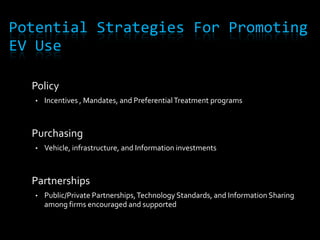
	No stakeholder coordination Potential Strategies For Promoting EV UsePolicy

Policy Lab: Vehicle Electrification in NYC

Editor's Notes

  • #3 Introduction Christine Hadlow Background& Chandler GriffithNature of the Problem & Criteria Liz FreidrichAlternatives Richard BeadleAnalysis and Recommendation Christine Hadlow
  • #7 not simply as a private transportation option, but as part of the electricity infrastructure. and, so, with a signficant public interest” – On assumptions:“A wave of change is inevitable [describe in a few words]. The alternatives all seek to amplify this wave”“EVs should be conceived of not simply as a private transportation option, but as part of the electricity infrastructure and, so, with a signficant public interest” – Assuming that ConEd
  • #8 Introduction Christine Hadlow Background& Chandler GriffithNature of the Problem & Criteria Liz FreidrichAlternatives Richard BeadleAnalysis and Recommendation Christine Hadlow
  • #9 From here out, EV = plug inElectric city- 40-60EV fueling is inherently different from Internal Combustion Engines (ICEs)
  • #10 From here out, EV = plug inEV fueling is inherently different from Internal Combustion Engines (ICEs)
  • #11 $25 to $180 billion annually. These costs could soar if outages or disturbances become more frequent or longer in duration.
  • #12 NYC’s Greenhouse Gas (GHG) Emissions Are Predominantly From Transportation and Electricity
  • #13 Improving the nations grid efficiency by 5% is equivalent to take 53 million cars off the road (source:USDOE)Con Edison has recieved $181 million in stimulus funds for regional Smart Grid developmentThe “information economy” requires a reliable, secure, and affordable electric system to grow and prosper. Unless substantial amounts of capital are invested over the next several decades in new generation, transmission, and distribution facilities, service quality will degrade and costs will go up.Information technologies (IT) have already revolutionized telecommunications, banking, and certain manufacturing industries. Similarly, the electric power system represents an enormous market for the application of IT to automate various functions such as meter reading, billing, transmission and distribution operations, outage restoration, pricing, and status reporting.
  • #14 Grid 2030 is a fully automated power delivery network that monitors and controls every customer and node, ensuring a two-way flow of electricity and information between the power plant and the appliance, and all points in between. Its distributed intelligence, coupled with broadband communications and automated control systems, enables real-time market transactions and seamless interfaces among people, buildings, industrial plants, generation facilities, and the electric network.A national electricity “backbone” à Regional interconnections, whichinclude Canada and Mexicoà Local distribution, mini- and micro- grids providing services to customers and obtaining services from generation resources anywhere on the continent
  • #15 Introduction Christine Hadlow Background& Chandler GriffithNature of the Problem & Criteria Liz FreidrichAlternatives Richard BeadleAnalysis and Recommendation Christine Hadlow
  • #19 L = homeR = streetTop = Taxi SwapBottom = Public garageVaried Charging Methods Address Specific Vehicle Use & Parking
  • #22 Encourage switching from ICE to EV, not new driversPromote public and private collaboration to learn from one another and advance more quickly and efficiently Ensure electric grid efficiency and reliabilityProvide equitable access to the EV charging infrastructurePromote the development of local EV related market
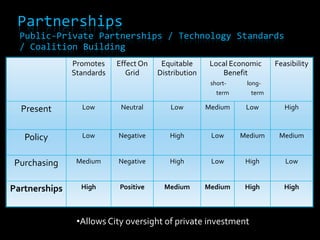
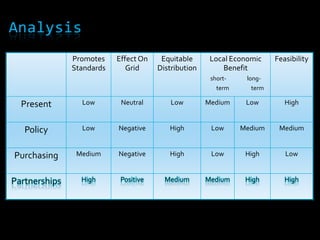
  • #23 Contribution to collaborative and standardized adoptionThis criteria measures the extent to which the alternative will contribute to universal standards for equipment, infrastructure access, and building codes.Effect on grid efficiency and stabilityThis criteria measures the effect of the alternative on the electrical grid in terms of efficiency and stability.Improved equitable access to chargingMeasures extent alternative is equitably distributed to citizens with various needsPotential local economic benefitMeasures the potential of the alternative to have positive local economic benefitPolitical feasibility Measures the practicality of our proposition
  • #24 Introduction Christine Hadlow Background& Chandler GriffithNature of the Problem & Criteria Liz FreidrichAlternatives Richard BeadleAnalysis and Recommendation Christine Hadlow
  • #25 Appears promising, but is uncoordinatedReady or not, EVs are coming…Absent congestion pricing, there is no mechanism to provide preferential pricing for fuel-effi cient,low-emission vehicles. However, the City has supported national legislation to improve vehicle fueleconomy and California’s efforts to adopt greenhouse gas standards for vehicles.Air quality progress report2007•    Mayor Bloomberg announces PlaNYC 2030•    The Metropolitan Transit Authority – New York City Transit (MTA - NYCT) participated in the  Clean-Fueled Bus Program2009•    BMW lends NYC 10 MINI E cars for use by Street Conditions Observation Unit (SCOUT) and the Parks Department.  Department of Sanitation will use 2 new hybrid electric-diesel collection trucks  •    Representative Nadler introduces and Senator Gillibrand supports the Green Taxis Act of 2009•    ConEd launches “Smart Grid” pilot program in Queens2010•    Taxi & Limousine Commission (TLC) launches Taxis of Tomorrow initiative•    Th!nk ranked New York City as third most EV-ready city in the U.S.
  • #26 Absent congestion pricing, there is no mechanism to provide preferential pricing for fuel-effi cient,low-emission vehicles. However, the City has supported national legislation to improve vehicle fueleconomy and California’s efforts to adopt greenhouse gas standards for vehicles.Air quality progress reportMini-e program is not establishing EV infrastructure, publicity for NYC and Mini2007•    Mayor Bloomberg announces PlaNYC 2030•    The Metropolitan Transit Authority – New York City Transit (MTA - NYCT) participated in the  Clean-Fueled Bus Program2009•    BMW lends NYC 10 MINI E cars for use by Street Conditions Observation Unit (SCOUT) and the Parks Department.  Department of Sanitation will use 2 new hybrid electric-diesel collection trucks  •    Representative Nadler introduces and Senator Gillibrand supports the Green Taxis Act of 2009•    ConEd launches “Smart Grid” pilot program in Queens2010•    Taxi & Limousine Commission (TLC) launches Taxis of Tomorrow initiative•    Th!nk ranked New York City as third most EV-ready city in the U.S.
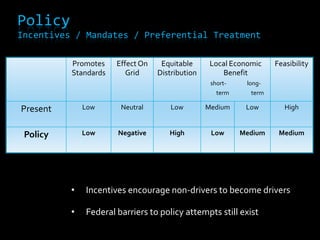
  • #27 Policy SolutionsIncentives , mandates, and preferential treatment programs encourage adoption of EVs Addresses economic and infrastructure barriersInvestmentGovernment spurs market development through Car and Infrastructure investment as well as providing education resourcesAddresses infrastructure and minimal market level barriersCoalition Building / Corporate PartnershipsCorporate partnerships and technology standards encouraged and supported through city governmentAddresses lack of standards and unproven technology barriersNoP:Charging is complicatedLack of supportive legislationUpfront Costs and long term benefits Lack of charging infrastructureInefficient energy gridAn EV friendly city has:-efficient grid-equitable and accessible charging-healthy supply and demand with competitive pricing-cross sector support in the form of public and private collaboration 
  • #30 Mandates have failed – CA, NY, and MA all had requirements for EV sales in 1990’s as % of total car sales – all were relaxedIncentives encourage non-drivers to become drivers
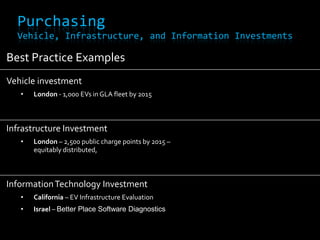
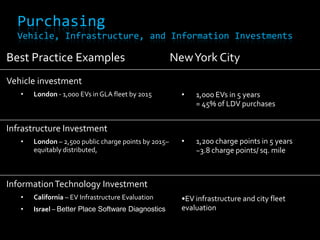
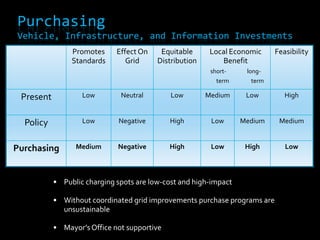
  • #31 437 city fleet Light Duty Vehicles (LDVs) purchased in FY091,000 EVs in 5 years = 45% of LDV purchasesLondon at 659 sq. miles is 3.8 charge points / sq. mileNYC would require 1,157Free technology, installation, general info workshops for individuals and fleet managers
  • #32 437 city fleet Light Duty Vehicles (LDVs) purchased in FY091,000 EVs in 5 years = 45% of LDV purchasesLondon at 659 sq. miles is 3.8 charge points / sq. mileNYC would require 1,157Free technology, installation, general info workshops for individuals and fleet managers
  • #34 Electric Vehicle (EV) Charging Infrastructure Promotion - Bay Area9 point plan to simply regulations standards and permittingMayors of San Francisco, San Jose, and Oakland will follow a policy plan to develop and expand the infrastructure needed to promote the use of EVs. Policy steps include: expediting the permit and installation processes for charging outlets; providing incentives for employers and other organizations who install charging infrastructure at the workplace and other parking facilities; developing standard regulations governing EV infrastructure across the region; and establishing programs to purchase EVs for use by city and state employees. The mayors will work with other cities in the Bay Area as well as regional government organizations and private sector partners.Electric Vehicle (EV) Charging RequirementsNew EVs and plug-in hybrid electric vehicles (PHEVs) must be equipped with a conductive charger inlet port that meets the specifications contained in Society of Automotive Engineers (SAE) standard J1772. EVs and PHEVs must be equipped with an on-board charger with a minimum output of 3.3 kilovolt amps. These requirements do not apply to EVs and PHEVs that are only capable of Level 1 charging, a charging method that allows a vehicle to be charged by having its charger connected to the most common grounded receptacle. (Reference California Code of Regulations Title 13, Section 1962.2)
  • #35 Electric Vehicle (EV) Charging Infrastructure Promotion - Bay Area9 point plan to simply regulations standards and permittingMayors of San Francisco, San Jose, and Oakland will follow a policy plan to develop and expand the infrastructure needed to promote the use of EVs. Policy steps include: expediting the permit and installation processes for charging outlets; providing incentives for employers and other organizations who install charging infrastructure at the workplace and other parking facilities; developing standard regulations governing EV infrastructure across the region; and establishing programs to purchase EVs for use by city and state employees. The mayors will work with other cities in the Bay Area as well as regional government organizations and private sector partners.Electric Vehicle (EV) Charging RequirementsNew EVs and plug-in hybrid electric vehicles (PHEVs) must be equipped with a conductive charger inlet port that meets the specifications contained in Society of Automotive Engineers (SAE) standard J1772. EVs and PHEVs must be equipped with an on-board charger with a minimum output of 3.3 kilovolt amps. These requirements do not apply to EVs and PHEVs that are only capable of Level 1 charging, a charging method that allows a vehicle to be charged by having its charger connected to the most common grounded receptacle. (Reference California Code of Regulations Title 13, Section 1962.2)
  • #36 Public Investment in fleet and infrastructure as supporting standardization by establishing one
  • #37 Introduction Christine Hadlow Background& Chandler GriffithNature of the Problem & Criteria Liz FreidrichAlternatives Richard BeadleAnalysis and Recommendation Christine Hadlow
  • #40  Propose legislation to mandate that a certain percentage of city fleets are at least partially powered by electricity over a designated period of time (e.g., 25% of city fleet converted to EV in 5 years)•    Propose the City hold an EV Summit in an effort to build a coalition of main stakeholders•    Start a EV public education campaign to debunk common misconceptions on EVs
  • #46 Improving the nations grid efficiency by 5% is equivalent to take 53 million cars off the road (source:USDOE)Con Edison has recieved $181 million in stimulus funds for regional Smart Grid development