PLANNING PRINCIPLES FOR
FULL FLEET ELECTRIFICATION
WRI Webinar: August 29, 2023
WELCOME
• All attendees are in listen-only mode. Please use the
Q&A feature to ask questions of the presenters and
panelists.
• The recording and slides will be shared with participants
after the webinar.
SPEAKERS
Ian Goldsmith
Research Analyst,
WRI
Moderator
Joseph Womble
Research Analyst I,
WRI
Presenter
WEBINAR AGENDA
• Planning for Full Fleet Electrification: Lessons
Learned (15 minutes)
• Panel Discussion (30 minutes)
• Audience Q&A (10 minutes)
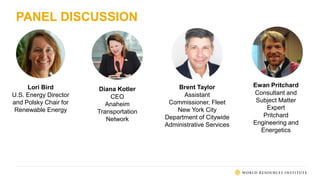
PANEL DISCUSSION
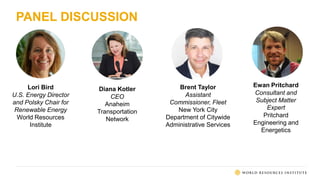
Lori Bird
U.S. Energy Director
and Polsky Chair for
Renewable Energy
World Resources
Institute
Diana Kotler
CEO
Anaheim
Transportation
Network
Brent Taylor
Assistant
Commissioner, Fleet
New York City
Department of Citywide
Administrative Services
Ewan Pritchard
Consultant and
Subject Matter
Expert
Pritchard
Engineering and
Energetics
PLANNING FOR FULL FLEET
ELECTRIFICATION: LESSONS
LEARNED
Presenter: Joseph Womble, WRI
Contributors: Ian Goldsmith, Michelle Levinson, WRI
DISCLAIMER
• This research on key considerations related to full fleet
electrification was funded by the UPS Foundation.
• However, the information contained in this presentation only
expresses the views and opinions of the presenters and does not
necessarily reflect the views and opinions of the UPS Foundation.
RESEARCH ACTIVITIES
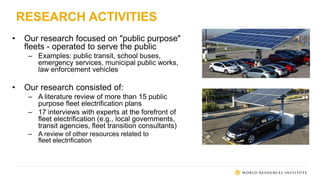
• Our research focused on "public purpose"
fleets - operated to serve the public
– Examples: public transit, school buses,
emergency services, municipal public works,
law enforcement vehicles
• Our research consisted of:
– A literature review of more than 15 public
purpose fleet electrification plans
– 17 interviews with experts at the forefront of
fleet electrification (e.g., local governments,
transit agencies, fleet transition consultants)
– A review of other resources related to
fleet electrification
TRENDS IN VEHICLE ELECTRIFICATION
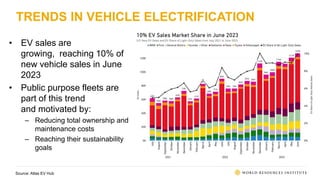
• EV sales are
growing, reaching 10% of
new vehicle sales in June
2023
• Public purpose fleets are
part of this trend
and motivated by:
– Reducing total ownership and
maintenance costs
– Reaching their sustainability
goals
Source: Atlas EV Hub
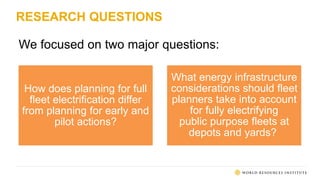
RESEARCH QUESTIONS
We focused on two major questions:
How does planning for full
fleet electrification differ
from planning for early and
pilot actions?
What energy infrastructure
considerations should fleet
planners take into account
for fully electrifying
public purpose fleets at
depots and yards?
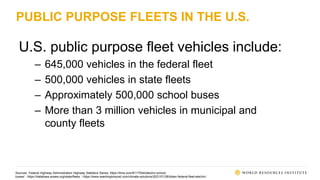
PUBLIC PURPOSE FLEETS IN THE U.S.
U.S. public purpose fleet vehicles include:
– 645,000 vehicles in the federal fleet
– 500,000 vehicles in state fleets
– Approximately 500,000 school buses
– More than 3 million vehicles in municipal and
county fleets
Sources: Federal Highway Administration Highway Statistics Series; https://time.com/6117544/electric-school-
buses/ ; https://database.aceee.org/state/fleets ; https://www.washingtonpost.com/climate-solutions/2021/01/28/biden-federal-fleet-electric/
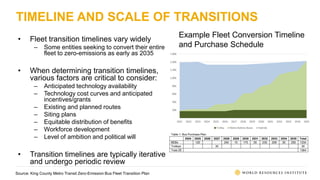
TIMELINE AND SCALE OF TRANSITIONS
• Fleet transition timelines vary widely
– Some entities seeking to convert their entire
fleet to zero-emissions as early as 2035
• When determining transition timelines,
various factors are critical to consider:
– Anticipated technology availability
– Technology cost curves and anticipated
incentives/grants
– Existing and planned routes
– Siting plans
– Equitable distribution of benefits
– Workforce development
– Level of ambition and political will
• Transition timelines are typically iterative
and undergo periodic review
Source: King County Metro Transit Zero-Emission Bus Fleet Transition Plan
Example Fleet Conversion Timeline
and Purchase Schedule
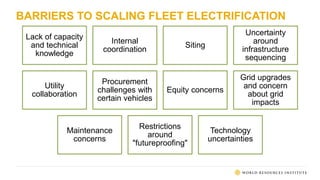
BARRIERS TO SCALING FLEET ELECTRIFICATION
Lack of capacity
and technical
knowledge
Internal
coordination
Siting
Uncertainty
around
infrastructure
sequencing
Utility
collaboration
Procurement
challenges with
certain vehicles
Equity concerns
Grid upgrades
and concern
about grid
impacts
Maintenance
concerns
Restrictions
around
"futureproofing"
Technology
uncertainties
PLANNING PRINCIPLES
Consider how fleet electrification affects staff roles and
coordination across the organization
Engage with your utility early and often
Be creative with how you site electric vehicle depots and
infrastructure
Determine how you will pay for EVSE maintenance and
replacement costs
Identify pathways for exploring new technologies
COORDINATION AND NEW RESPONSIBILITIES
Consider how fleet electrification affects staff
roles and coordination across the organization
– What new staff roles are needed?
– Are there new organizational structures that might be
needed to facilitate coordination?
– What needs exist today that may multiply as you
further electrify your fleet?
– How can you share relevant data internally and with
partner organizations?
– What ways can you simplify internal coordination
around procurement processes?
– How can you avoid taking on significant additional
responsibilities internally while advancing your goals?
Mayor Michael Bloomberg established
New York's Department of Citywide
Administrative Services, which
oversees and manages fleets for all
other departments.
UTILITY ENGAGEMENT
Engage with your utility early and often
– How can you prepare your utility for anticipated
electrification loads 2, 5, and 10 years out?
– How can you proactively lock in beneficial
charging rates?
– What constraints does your utility face?
– What are your highest priority concerns?
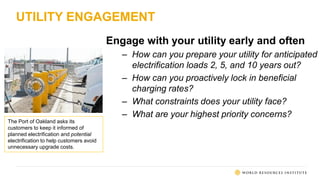
The Port of Oakland asks its
customers to keep it informed of
planned electrification and potential
electrification to help customers avoid
unnecessary upgrade costs.
SITING
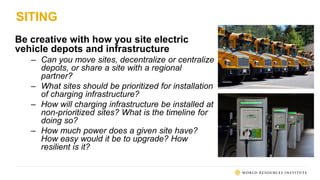
Be creative with how you site electric
vehicle depots and infrastructure
– Can you move sites, decentralize or centralize
depots, or share a site with a regional
partner?
– What sites should be prioritized for installation
of charging infrastructure?
– How will charging infrastructure be installed at
non-prioritized sites? What is the timeline for
doing so?
– How much power does a given site have?
How easy would it be to upgrade? How
resilient is it?
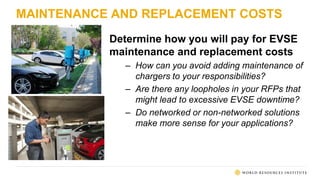
MAINTENANCE AND REPLACEMENT COSTS
Determine how you will pay for EVSE
maintenance and replacement costs
– How can you avoid adding maintenance of
chargers to your responsibilities?
– Are there any loopholes in your RFPs that
might lead to excessive EVSE downtime?
– Do networked or non-networked solutions
make more sense for your applications?
NEW AND CHANGING TECHNOLOGIES
Identify pathways for exploring new
technologies, such as vehicle-to-grid
(V2G) and microgrids
– How can you leverage grants or other
funds to explore adoption of these
technologies?
– How can you build strong partnerships with
your utility and other players to allow you
low-risk ways to pilot new technologies?
– What impact does your geography and
climate have on battery range and the need
for other technologies?
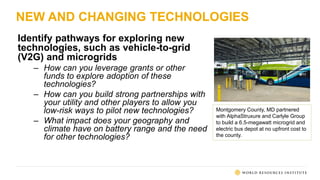
Montgomery County, MD partnered
with AlphaStruxure and Carlyle Group
to build a 6.5-megawatt microgrid and
electric bus depot at no upfront cost to
the county.
FLEET ELECTRIFICATION PLANS AND RESOURCES
• Alameda Contra Costa Transit District
• Champaign-Urbana Mass Transit District
• Colorado DOT ZEV Transition Planning Template
• The District of Columbia's Municipal Fleet
• King County Metro Transit
• New York City Department of Citywide Administrative Services
• Philadelphia's Municipal Fleet
Example fleet electrification plans:
OTHER KEY FINDINGS
• Being forward-looking is ideal when conducting funding needs
assessments, workforce analyses, and partnership
assessments.
• Considering customer preferences and needs is critical to
ensuring successful fleet transitions.
• Understanding the policy picture is important for
planning and determining timelines
• Purchasing EVs and installing infrastructure should be as
aligned as possible, but infrastructure sequencing may vary
depending on various factors.
THANK YOU
Please reach out to joseph.womble@wri.org with any questions.
PANEL DISCUSSION
Lori Bird
U.S. Energy Director
and Polsky Chair for
Renewable Energy
Diana Kotler
CEO
Anaheim
Transportation
Network
Brent Taylor
Assistant
Commissioner, Fleet
New York City
Department of Citywide
Administrative Services
Ewan Pritchard
Consultant and
Subject Matter
Expert
Pritchard
Engineering and
Energetics

Planning Principles for Full Fleet Electrification

  • 1.
    PLANNING PRINCIPLES FOR FULLFLEET ELECTRIFICATION WRI Webinar: August 29, 2023
  • 2.
    WELCOME • All attendeesare in listen-only mode. Please use the Q&A feature to ask questions of the presenters and panelists. • The recording and slides will be shared with participants after the webinar.
  • 3.
    SPEAKERS Ian Goldsmith Research Analyst, WRI Moderator JosephWomble Research Analyst I, WRI Presenter
  • 4.
    WEBINAR AGENDA • Planningfor Full Fleet Electrification: Lessons Learned (15 minutes) • Panel Discussion (30 minutes) • Audience Q&A (10 minutes)
  • 5.
    PANEL DISCUSSION Lori Bird U.S.Energy Director and Polsky Chair for Renewable Energy World Resources Institute Diana Kotler CEO Anaheim Transportation Network Brent Taylor Assistant Commissioner, Fleet New York City Department of Citywide Administrative Services Ewan Pritchard Consultant and Subject Matter Expert Pritchard Engineering and Energetics
  • 6.
    PLANNING FOR FULLFLEET ELECTRIFICATION: LESSONS LEARNED Presenter: Joseph Womble, WRI Contributors: Ian Goldsmith, Michelle Levinson, WRI
  • 7.
    DISCLAIMER • This researchon key considerations related to full fleet electrification was funded by the UPS Foundation. • However, the information contained in this presentation only expresses the views and opinions of the presenters and does not necessarily reflect the views and opinions of the UPS Foundation.
  • 8.
    RESEARCH ACTIVITIES • Ourresearch focused on "public purpose" fleets - operated to serve the public – Examples: public transit, school buses, emergency services, municipal public works, law enforcement vehicles • Our research consisted of: – A literature review of more than 15 public purpose fleet electrification plans – 17 interviews with experts at the forefront of fleet electrification (e.g., local governments, transit agencies, fleet transition consultants) – A review of other resources related to fleet electrification
  • 9.
    TRENDS IN VEHICLEELECTRIFICATION • EV sales are growing, reaching 10% of new vehicle sales in June 2023 • Public purpose fleets are part of this trend and motivated by: – Reducing total ownership and maintenance costs – Reaching their sustainability goals Source: Atlas EV Hub
  • 10.
    RESEARCH QUESTIONS We focusedon two major questions: How does planning for full fleet electrification differ from planning for early and pilot actions? What energy infrastructure considerations should fleet planners take into account for fully electrifying public purpose fleets at depots and yards?
  • 11.
    PUBLIC PURPOSE FLEETSIN THE U.S. U.S. public purpose fleet vehicles include: – 645,000 vehicles in the federal fleet – 500,000 vehicles in state fleets – Approximately 500,000 school buses – More than 3 million vehicles in municipal and county fleets Sources: Federal Highway Administration Highway Statistics Series; https://time.com/6117544/electric-school- buses/ ; https://database.aceee.org/state/fleets ; https://www.washingtonpost.com/climate-solutions/2021/01/28/biden-federal-fleet-electric/
  • 12.
    TIMELINE AND SCALEOF TRANSITIONS • Fleet transition timelines vary widely – Some entities seeking to convert their entire fleet to zero-emissions as early as 2035 • When determining transition timelines, various factors are critical to consider: – Anticipated technology availability – Technology cost curves and anticipated incentives/grants – Existing and planned routes – Siting plans – Equitable distribution of benefits – Workforce development – Level of ambition and political will • Transition timelines are typically iterative and undergo periodic review Source: King County Metro Transit Zero-Emission Bus Fleet Transition Plan Example Fleet Conversion Timeline and Purchase Schedule
  • 13.
    BARRIERS TO SCALINGFLEET ELECTRIFICATION Lack of capacity and technical knowledge Internal coordination Siting Uncertainty around infrastructure sequencing Utility collaboration Procurement challenges with certain vehicles Equity concerns Grid upgrades and concern about grid impacts Maintenance concerns Restrictions around "futureproofing" Technology uncertainties
  • 14.
    PLANNING PRINCIPLES Consider howfleet electrification affects staff roles and coordination across the organization Engage with your utility early and often Be creative with how you site electric vehicle depots and infrastructure Determine how you will pay for EVSE maintenance and replacement costs Identify pathways for exploring new technologies
  • 15.
    COORDINATION AND NEWRESPONSIBILITIES Consider how fleet electrification affects staff roles and coordination across the organization – What new staff roles are needed? – Are there new organizational structures that might be needed to facilitate coordination? – What needs exist today that may multiply as you further electrify your fleet? – How can you share relevant data internally and with partner organizations? – What ways can you simplify internal coordination around procurement processes? – How can you avoid taking on significant additional responsibilities internally while advancing your goals? Mayor Michael Bloomberg established New York's Department of Citywide Administrative Services, which oversees and manages fleets for all other departments.
  • 16.
    UTILITY ENGAGEMENT Engage withyour utility early and often – How can you prepare your utility for anticipated electrification loads 2, 5, and 10 years out? – How can you proactively lock in beneficial charging rates? – What constraints does your utility face? – What are your highest priority concerns? The Port of Oakland asks its customers to keep it informed of planned electrification and potential electrification to help customers avoid unnecessary upgrade costs.
  • 17.
    SITING Be creative withhow you site electric vehicle depots and infrastructure – Can you move sites, decentralize or centralize depots, or share a site with a regional partner? – What sites should be prioritized for installation of charging infrastructure? – How will charging infrastructure be installed at non-prioritized sites? What is the timeline for doing so? – How much power does a given site have? How easy would it be to upgrade? How resilient is it?
  • 18.
    MAINTENANCE AND REPLACEMENTCOSTS Determine how you will pay for EVSE maintenance and replacement costs – How can you avoid adding maintenance of chargers to your responsibilities? – Are there any loopholes in your RFPs that might lead to excessive EVSE downtime? – Do networked or non-networked solutions make more sense for your applications?
  • 19.
    NEW AND CHANGINGTECHNOLOGIES Identify pathways for exploring new technologies, such as vehicle-to-grid (V2G) and microgrids – How can you leverage grants or other funds to explore adoption of these technologies? – How can you build strong partnerships with your utility and other players to allow you low-risk ways to pilot new technologies? – What impact does your geography and climate have on battery range and the need for other technologies? Montgomery County, MD partnered with AlphaStruxure and Carlyle Group to build a 6.5-megawatt microgrid and electric bus depot at no upfront cost to the county.
  • 20.
    FLEET ELECTRIFICATION PLANSAND RESOURCES • Alameda Contra Costa Transit District • Champaign-Urbana Mass Transit District • Colorado DOT ZEV Transition Planning Template • The District of Columbia's Municipal Fleet • King County Metro Transit • New York City Department of Citywide Administrative Services • Philadelphia's Municipal Fleet Example fleet electrification plans:
  • 21.
    OTHER KEY FINDINGS •Being forward-looking is ideal when conducting funding needs assessments, workforce analyses, and partnership assessments. • Considering customer preferences and needs is critical to ensuring successful fleet transitions. • Understanding the policy picture is important for planning and determining timelines • Purchasing EVs and installing infrastructure should be as aligned as possible, but infrastructure sequencing may vary depending on various factors.
  • 22.
    THANK YOU Please reachout to joseph.womble@wri.org with any questions.
  • 23.
    PANEL DISCUSSION Lori Bird U.S.Energy Director and Polsky Chair for Renewable Energy Diana Kotler CEO Anaheim Transportation Network Brent Taylor Assistant Commissioner, Fleet New York City Department of Citywide Administrative Services Ewan Pritchard Consultant and Subject Matter Expert Pritchard Engineering and Energetics