INTRODUCTION TO ELECTRIC
VEHICLES FOR DUMMIES
But Smart People Are Welcome Too!
Th e r e a r e 4 m a i n t yp e s
o f e l e c t r i c ve h i c l e s t h a t
yo u n e e d t o k n o w ...
EVTYPES
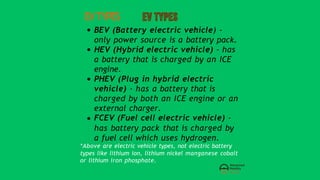
BEV (Battery electric vehicle) -
only power source is a battery pack.
HEV (Hybrid electric vehicle) - has
a battery that is charged by an ICE
engine.
PHEV (Plug in hybrid electric
vehicle) - has a battery that is
charged by both an ICE engine or an
external charger.
FCEV (Fuel cell electric vehicle) -
has battery pack that is charged by
a fuel cell which uses hydrogen.
*Above are electric vehicle types, not electric battery
types like lithium ion, lithium nickel manganese cobalt
or lithium iron phosphate.
EVTYPES
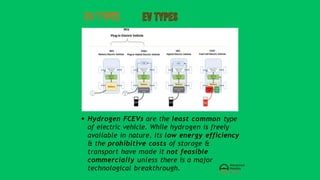
Hydrogen FCEVs are the least common type
of electric vehicle. While hydrogen is freely
available in nature, its low energy efficiency
& the prohibitive costs of storage &
transport have made it not feasible
commercially unless there is a major
technological breakthrough.
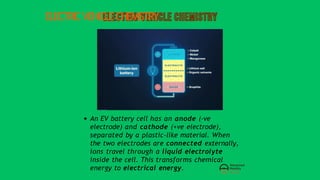
ELECTRICVEHICLECHEMISTRY
An EV battery cell has an anode (-ve
electrode) and cathode (+ve electrode),
separated by a plastic-like material. When
the two electrodes are connected externally,
ions travel through a liquid electrolyte
inside the cell. This transforms chemical
energy to electrical energy.
MOREDEFINITIONS
Recently PHEVs (Plug in hybrid
electric vehicle) are being known
as PHICE (Plug in hybrid internal
combustion engine vehicle) as a
reminder that they still use fossil
fuels.
HICEV (Hydrogen internal
combustion engine vehicle) is a
type of hydrogen vehicle using an
internal combustion engine. HICEVs
are different from hydrogen FCEVs,
which utilize hydrogen electro-
chemically rather than through
combustion.
Th e r e a r e 3 m a i n
c h a l l e n g e s t o t h e
a d o p t i o n o f e l e c t r i c
ve h i c l e s ...
EVCHALLENGES
Purchase cost - EVs have a higher
purchase cost (X2-X3) than ICEVs but
lower operational cost (30-75%).
Range - EVs currently have single
charge range of 300 - 500 km while
ICEVs have full tank range of 400 -
700 km.
Charging infrastructure - there are
only 2.8 million public EV chargers
globally serving probably 10
vehicles each daily. Compared to
over 2.5 million public fuel pumps
each serving probably 100 vehicles
daily.
T h e r e a r e m a n y l i e s , h a l f
t r u t h s & i g n o r a n t c l a i m s
a b o u t e l e c t r i c ve h i c l e s ...
EVMYTHS
1.EVs damage the environment.
2.EVs take too long to charge.
3.EVs are too expensive.
4.EV batteries catch fire.
5.EVs have short life span.
6.EVs have limited range.
7.EVs are too slow.
8.EVs need subsidies to work.
9.EVs will take decades to work.
10. EVs cant work on the current grid.
These claims are mainly pushed by
ignorance, & entities that stand to
lose most when fossil fuel based
industries lose their markets.
GREENWASHING
'Green’ advertising by companies
most responsible for climate
change & environmental damage
to mislead the public about their
sustainability.
Mainly done by oil marketers and
ICE vehicle manufacturers whose
core business remains fossil fuel
based, but they give a false view of
working towards net zero goals.
They lobby governments & policy
makers to have their products
categorised as green or sustainable
when they are not.
The fossil fuel
industry is the
polluted heart of
the climate crisis.
ANTONIO GUTERRES
UN SECRETARY GENERAL
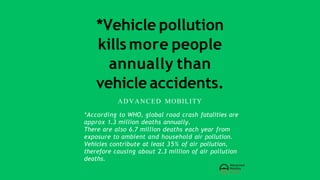
*Vehicle pollution
kills more people
annually than
vehicle accidents.
ADVANCED MOBILITY
*According to WHO, global road crash fatalities are
approx 1.3 million deaths annually.
There are also 6.7 million deaths each year from
exposure to ambient and household air pollution.
Vehicles contribute at least 35% of air pollution,
therefore causing about 2.3 million of air pollution
deaths.
M a r k e t n u m b e r s g i ve a
g o o d i n s i g h t o n t h e
f u t u r e o f e l e c t r i c
ve h i c l e s ...
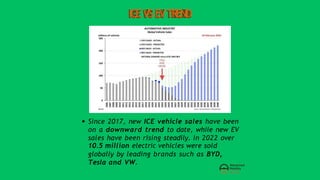
ICEVSEVTREND
Since 2017, new ICE vehicle sales have been
on a downward trend to date, while new EV
sales have been rising steadily. In 2022 over
10.5 million electric vehicles were sold
globally by leading brands such as BYD,
Tesla and VW.
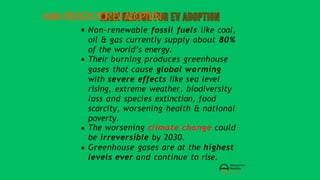
MAINREASONFOREVADOPTION
Non-renewable fossil fuels like coal,
oil & gas currently supply about 80%
of the world’s energy.
Their burning produces greenhouse
gases that cause global warming
with severe effects like sea level
rising, extreme weather, biodiversity
loss and species extinction, food
scarcity, worsening health & national
poverty.
The worsening climate change could
be irreversible by 2030.
Greenhouse gases are at the highest
levels ever and continue to rise.
We are the first
generation to feel
the impact of
climate change &
the last one that
can do something
about it.
B A R A C K O B A M A
COMMERCIALREASONFOREVADOPTION
Generally EVs have lower total
cost of ownership than ICE
vehicles. EVs have a higher
purchase cost (X2-X3) than ICEs but
lower operational cost (30-75%).
Currently an EV has to do generally
high mileage daily (100-200 km) to
achieve a lower total cost.
By 2025 an EV is expected to have
equal or lower purchase cost than
an ICE vehicle due to improvements
in technology, production and
economies of scale.
NATIONALREASONFOREVADOPTION
For most countries the biggest forex
cost is oil, this has given OPEC
countries global political leverage for
many decades. Many wars right now
are also because of oil.
EVs can be charged with energy from
any source whether hydro,
geothermal, solar, wind, coal or
nuclear - not just oil.
They bring an opportunity for energy
security and economic
independence for a nation, hence
most countries are putting policies
to support e-mobility.
Control oil and
you control
nations; control
food and you
control the
people.
H E N R Y A. K I S S I N G E R
POLICYREASONFOREVADOPTION
Over 40 countries are on course to
banning sale of ICE vehicles in their
markets by 2040.
China is the world's largest auto
market at 26.8 million new vehicles
annually. By 2035 50% of all their
new vehicles must be electric, fuel
cell, or plug-in hybrid – the
remaining 50% to be hybrid
vehicles.
Ford, Mercedes, Volvo, BYD &
Jaguar Land Rover are among the
carmakers with a goal to end ICE
vehicle production by 2035.
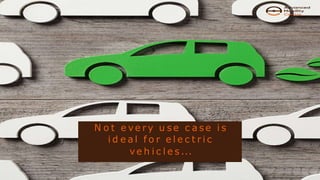
N o t e ve r y u s e c a s e i s
i d e a l f o r e l e c t r i c
ve h i c l e s ...
EVBESTUSECASE
Vehicle range radius - movement
to be within the range of the
battery or nearest charger.
Adequate daily mileage* - vehicle
to have frequent daily mileage to
accumulate enough operation
savings to offset the higher
purchase cost.
Overnight charging - availability of
overnight charging point, usually at
home or work where 95% of EV
charging occurs.
*Most vehicles are parked 95% of the time. This is
gross underutilization & most ineffective use of an EV.
CONCLUSION
There are over 2.1 billion ICE
vehicles on the planet. The
sustainability goal is not to replace
all of them with EVs. It is to reduce
the overall global fleet size as
people find better means of
mobility.
Mass transit options like buses &
trains, micro mobility options like
bikes & scooters, vehicle sharing
options, work from or closer to
home options, and more 2W/3W
vehicles rather than big 4W types.
The earth will
move to a
sustainable
energy future in
our lifetime
E L O N M U S K
If you find t his sum m ary
interest ing or insig ht ful, let 's
c onn ec t on
Link ed In & k eep sharp enin
eac h ot her.
#H e r e W e G o E l e c t r i c
A lex M unene
F leet M ob ilit y E xp ert
a l e x.m u n e n e @ a d va n c e d m o b i l i t y.c o .k e
D O Y O U A G R E E T H A T
E - M O B I L I T Y IS T H E
R E V O L U T I O N O F T H E
C E N T U R Y ?

Electric Mobility Introduction for Dummies Summary.pptx

  • 1.
    INTRODUCTION TO ELECTRIC VEHICLESFOR DUMMIES But Smart People Are Welcome Too!
  • 2.
    Th e re a r e 4 m a i n t yp e s o f e l e c t r i c ve h i c l e s t h a t yo u n e e d t o k n o w ...
  • 3.
    EVTYPES BEV (Battery electricvehicle) - only power source is a battery pack. HEV (Hybrid electric vehicle) - has a battery that is charged by an ICE engine. PHEV (Plug in hybrid electric vehicle) - has a battery that is charged by both an ICE engine or an external charger. FCEV (Fuel cell electric vehicle) - has battery pack that is charged by a fuel cell which uses hydrogen. *Above are electric vehicle types, not electric battery types like lithium ion, lithium nickel manganese cobalt or lithium iron phosphate.
  • 4.
    EVTYPES Hydrogen FCEVs arethe least common type of electric vehicle. While hydrogen is freely available in nature, its low energy efficiency & the prohibitive costs of storage & transport have made it not feasible commercially unless there is a major technological breakthrough.
  • 5.
    ELECTRICVEHICLECHEMISTRY An EV batterycell has an anode (-ve electrode) and cathode (+ve electrode), separated by a plastic-like material. When the two electrodes are connected externally, ions travel through a liquid electrolyte inside the cell. This transforms chemical energy to electrical energy.
  • 6.
    MOREDEFINITIONS Recently PHEVs (Plugin hybrid electric vehicle) are being known as PHICE (Plug in hybrid internal combustion engine vehicle) as a reminder that they still use fossil fuels. HICEV (Hydrogen internal combustion engine vehicle) is a type of hydrogen vehicle using an internal combustion engine. HICEVs are different from hydrogen FCEVs, which utilize hydrogen electro- chemically rather than through combustion.
  • 7.
    Th e re a r e 3 m a i n c h a l l e n g e s t o t h e a d o p t i o n o f e l e c t r i c ve h i c l e s ...
  • 8.
    EVCHALLENGES Purchase cost -EVs have a higher purchase cost (X2-X3) than ICEVs but lower operational cost (30-75%). Range - EVs currently have single charge range of 300 - 500 km while ICEVs have full tank range of 400 - 700 km. Charging infrastructure - there are only 2.8 million public EV chargers globally serving probably 10 vehicles each daily. Compared to over 2.5 million public fuel pumps each serving probably 100 vehicles daily.
  • 9.
    T h er e a r e m a n y l i e s , h a l f t r u t h s & i g n o r a n t c l a i m s a b o u t e l e c t r i c ve h i c l e s ...
  • 10.
    EVMYTHS 1.EVs damage theenvironment. 2.EVs take too long to charge. 3.EVs are too expensive. 4.EV batteries catch fire. 5.EVs have short life span. 6.EVs have limited range. 7.EVs are too slow. 8.EVs need subsidies to work. 9.EVs will take decades to work. 10. EVs cant work on the current grid. These claims are mainly pushed by ignorance, & entities that stand to lose most when fossil fuel based industries lose their markets.
  • 11.
    GREENWASHING 'Green’ advertising bycompanies most responsible for climate change & environmental damage to mislead the public about their sustainability. Mainly done by oil marketers and ICE vehicle manufacturers whose core business remains fossil fuel based, but they give a false view of working towards net zero goals. They lobby governments & policy makers to have their products categorised as green or sustainable when they are not.
  • 12.
    The fossil fuel industryis the polluted heart of the climate crisis. ANTONIO GUTERRES UN SECRETARY GENERAL
  • 13.
    *Vehicle pollution kills morepeople annually than vehicle accidents. ADVANCED MOBILITY *According to WHO, global road crash fatalities are approx 1.3 million deaths annually. There are also 6.7 million deaths each year from exposure to ambient and household air pollution. Vehicles contribute at least 35% of air pollution, therefore causing about 2.3 million of air pollution deaths.
  • 14.
    M a rk e t n u m b e r s g i ve a g o o d i n s i g h t o n t h e f u t u r e o f e l e c t r i c ve h i c l e s ...
  • 15.
    ICEVSEVTREND Since 2017, newICE vehicle sales have been on a downward trend to date, while new EV sales have been rising steadily. In 2022 over 10.5 million electric vehicles were sold globally by leading brands such as BYD, Tesla and VW.
  • 16.
    MAINREASONFOREVADOPTION Non-renewable fossil fuelslike coal, oil & gas currently supply about 80% of the world’s energy. Their burning produces greenhouse gases that cause global warming with severe effects like sea level rising, extreme weather, biodiversity loss and species extinction, food scarcity, worsening health & national poverty. The worsening climate change could be irreversible by 2030. Greenhouse gases are at the highest levels ever and continue to rise.
  • 17.
    We are thefirst generation to feel the impact of climate change & the last one that can do something about it. B A R A C K O B A M A
  • 18.
    COMMERCIALREASONFOREVADOPTION Generally EVs havelower total cost of ownership than ICE vehicles. EVs have a higher purchase cost (X2-X3) than ICEs but lower operational cost (30-75%). Currently an EV has to do generally high mileage daily (100-200 km) to achieve a lower total cost. By 2025 an EV is expected to have equal or lower purchase cost than an ICE vehicle due to improvements in technology, production and economies of scale.
  • 19.
    NATIONALREASONFOREVADOPTION For most countriesthe biggest forex cost is oil, this has given OPEC countries global political leverage for many decades. Many wars right now are also because of oil. EVs can be charged with energy from any source whether hydro, geothermal, solar, wind, coal or nuclear - not just oil. They bring an opportunity for energy security and economic independence for a nation, hence most countries are putting policies to support e-mobility.
  • 20.
    Control oil and youcontrol nations; control food and you control the people. H E N R Y A. K I S S I N G E R
  • 21.
    POLICYREASONFOREVADOPTION Over 40 countriesare on course to banning sale of ICE vehicles in their markets by 2040. China is the world's largest auto market at 26.8 million new vehicles annually. By 2035 50% of all their new vehicles must be electric, fuel cell, or plug-in hybrid – the remaining 50% to be hybrid vehicles. Ford, Mercedes, Volvo, BYD & Jaguar Land Rover are among the carmakers with a goal to end ICE vehicle production by 2035.
  • 22.
    N o te ve r y u s e c a s e i s i d e a l f o r e l e c t r i c ve h i c l e s ...
  • 23.
    EVBESTUSECASE Vehicle range radius- movement to be within the range of the battery or nearest charger. Adequate daily mileage* - vehicle to have frequent daily mileage to accumulate enough operation savings to offset the higher purchase cost. Overnight charging - availability of overnight charging point, usually at home or work where 95% of EV charging occurs. *Most vehicles are parked 95% of the time. This is gross underutilization & most ineffective use of an EV.
  • 24.
    CONCLUSION There are over2.1 billion ICE vehicles on the planet. The sustainability goal is not to replace all of them with EVs. It is to reduce the overall global fleet size as people find better means of mobility. Mass transit options like buses & trains, micro mobility options like bikes & scooters, vehicle sharing options, work from or closer to home options, and more 2W/3W vehicles rather than big 4W types.
  • 25.
    The earth will moveto a sustainable energy future in our lifetime E L O N M U S K
  • 26.
    If you findt his sum m ary interest ing or insig ht ful, let 's c onn ec t on Link ed In & k eep sharp enin eac h ot her. #H e r e W e G o E l e c t r i c A lex M unene F leet M ob ilit y E xp ert a l e x.m u n e n e @ a d va n c e d m o b i l i t y.c o .k e D O Y O U A G R E E T H A T E - M O B I L I T Y IS T H E R E V O L U T I O N O F T H E C E N T U R Y ?