Citizen’s Committeefor New York City:  Combating Vehicular Noise Olivia FruChandler GriffithAngelina LopezMinerva MuzquizKelly Singer
Central Policy IssueWhat strategies can Citizens Committee for New York City (CCNYC) recommend to residents to increase community group involvement in combating vehicular noise in New York City?
ObjectiveTo devise a strategy that will:Effectively mobilize community resources to minimize vehicular noise pollutionBe executable by resident-led effortsAdhere to the mission of CCNYC
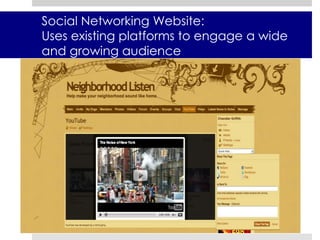
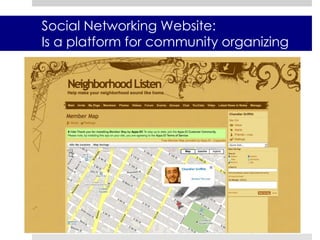
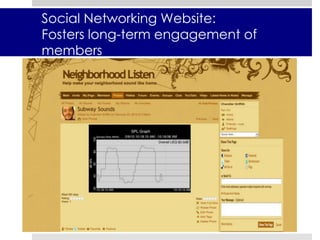
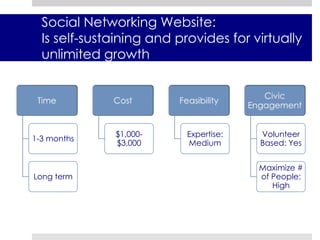
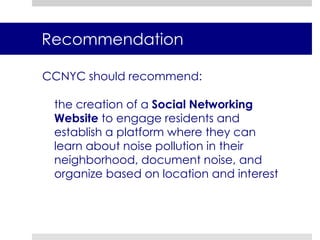
RecommendationCCNYC should recommend:	the creation of a Social Networking Website to engage residents and establish a platform where they can learn about noise pollution in their neighborhood, document noise, and organize based on location and interest
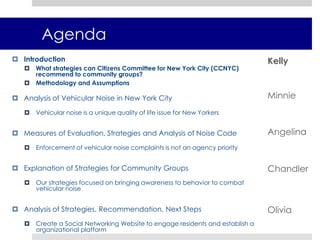
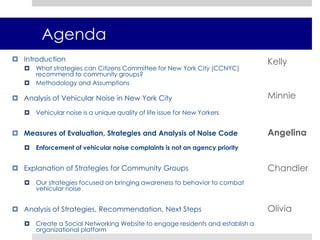
AgendaKellyIntroductionWhat strategies can Citizens Committee for New York City (CCNYC) recommend to community groups?Methodology and Assumptions Analysis of Vehicular Noise in New York City
Vehicular noise is a unique quality of life issue for New Yorkers
Measures of Evaluation, Strategies and Analysis of Noise Code
Enforcement of vehicular noise complaints is not an agency priority
Explanation of Strategies for Community Groups
Our strategies focused on bringing awareness to behavior to combat vehicular noise
Analysis of Strategies, Recommendation, Next Steps
Create a Social Networking Website to engage residents and establish a organizational platform Minnie Angelina Chandler Olivia
Research MethodologyReviewed current legislation to understand Noise Code regulations and policiesAnalyzed agency data to determine most frequent vehicular noise complaintsInterviewed city department officials regarding legislation and enforcement policy Researched best practices in community organizing and for mitigating noise pollutionEstablished measures of evaluation in accordance with CCNYC’s missionEvaluated strategies to be implemented by a community groupAssumptions An increase in 3-1-1 complaints does not correspond with greater enforcement of noise code violations Because 3-1-1 does not differentiate between different types of vehicular noise, we cross-referenced various types of enforceable noise with a public opinion survey Scope and size of projects to be implemented is dependent on the resources and capacity of various community groups
AgendaKelly IntroductionWhat strategies can Citizens Committee for New York City (CCNYC) recommend to community groups?Methodology and Assumptions Analysis of Vehicular Noise in New York City
Vehicular noise is a unique quality of life issue for New Yorkers
Measures of Evaluation, Strategies and Analysis of Noise Code
Enforcement of vehicular noise complaints is not an agency priority
Explanation of Strategies for Community Groups
Our strategies focused on bringing awareness to behavior to combat vehicular noise
Analysis of Strategies, Recommendation, Next Steps
Create a Social Networking Website to engage residents and establish a organizational platform Minnie Angelina Chandler Olivia
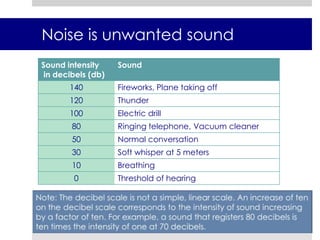
Noise is unwanted sound Note: The decibel scale is not a simple, linear scale. An increase of ten on the decibel scale corresponds to the intensity of sound increasing by a factor of ten. For example, a sound that registers 80 decibels is ten times the intensity of one at 70 decibels.
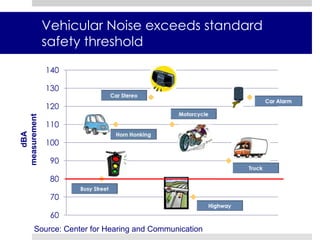
Vehicular Noise exceeds standard safety threshold Car StereoCar AlarmMotorcycledBA measurementHorn HonkingTruckBusy StreetHighwaySource: Center for Hearing and Communication
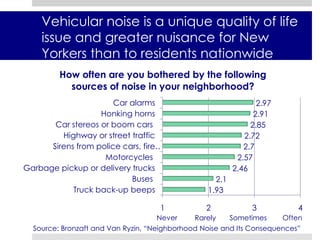
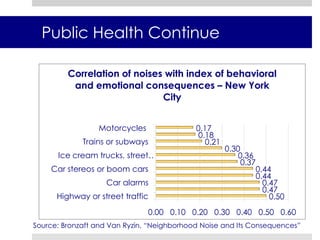
Vehicular noise is a unique quality of life issue and greater nuisance for New Yorkers than to residents nationwideNever         Rarely       Sometimes        Often Source: Bronzaft and Van Ryzin, “Neighborhood Noise and Its Consequences”
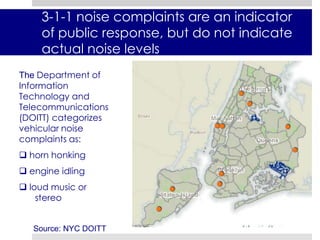
3-1-1 noise complaints are an indicator of public response, but do not indicate actual noise levelsThe Department of Information Technology and Telecommunications (DOITT) categorizes vehicular noise complaints as: horn honking
 engine idling
 loud music or          	stereoSource: NYC DOITT
AgendaKelly IntroductionWhat strategies can Citizens Committee for New York City (CCNYC) recommend to community groups?Methodology and Assumptions Analysis of Vehicular Noise in New York City
Vehicular noise is a unique quality of life issue for New Yorkers
Measures of Evaluation, Strategies and Analysis of Noise Code
Enforcement of vehicular noise complaints is not an agency priority
Explanation of Strategies for Community Groups
Our strategies focused on bringing awareness to behavior to combat vehicular noise
Analysis of Strategies, Recommendation, Next Steps
Create a Social Networking Website to engage residents and establish a organizational platform Minnie Angelina Chandler Olivia
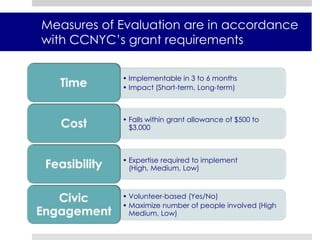
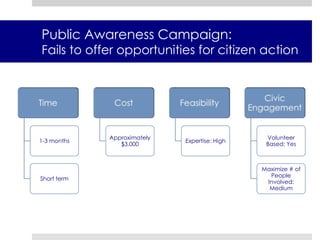
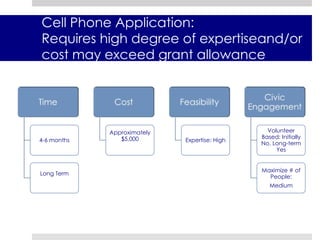
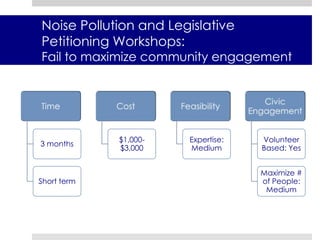
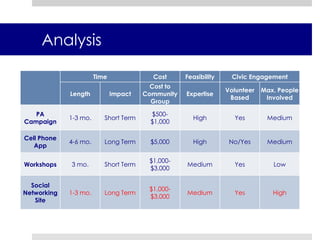
CCNYC is invested in empowering residents to improve the quality of life in their neighborhoods CCNYC “stimulates and supports self-help and civic action”:Award bi-annual grants, ranging from $500 to $3,000Projects are resident-led and volunteer-basedProjects expected to be implemented in 3 to 6 months
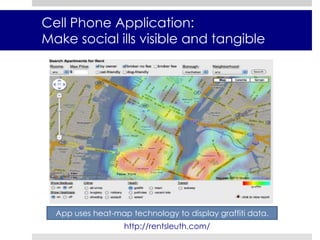
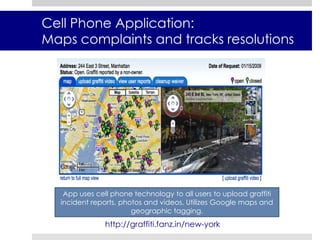
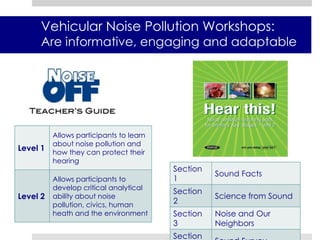
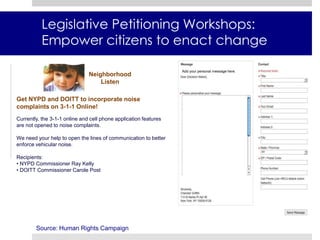
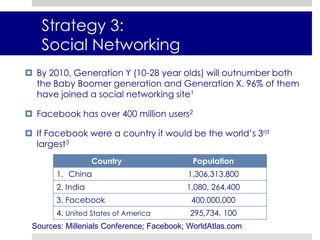
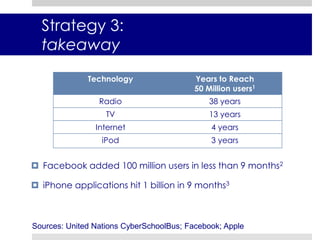
Our proposed strategies are designed to enable community groups to combat vehicular noise Maintain status quo of referring to 3-1-1 system Create a Public Awareness Campaign to educate residents on the effects of noise pollutionLaunch a Cell-phone Application to collect,  record and store noise code violations Offer Workshops on Noise pollution and Legislative Petitioning to mobilize residentsEstablish a Social Networking Website to engage residents and create a base for community action
Measures of Evaluation are in accordance with CCNYC’s grant requirements
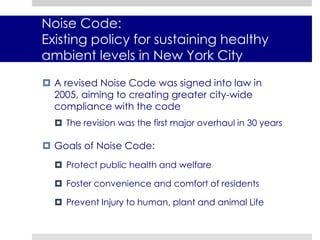
Noise Code:Existing policy for sustaining healthy ambient levels in New York CityA revised Noise Code was signed into law in 2005, aiming to creating greater city-wide compliance with the code The revision was the first major overhaul in 30 yearsGoals of Noise Code:Protect public health and welfareFoster convenience and comfort of residents Prevent Injury to human, plant and animal Life
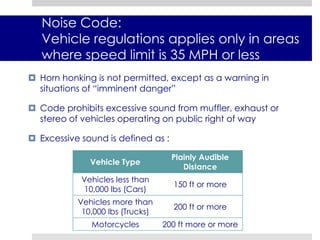
Noise Code:Vehicle regulations applies only in areas where speed limit is 35 MPH or lessHorn honking is not permitted, except as a warning in situations of “imminent danger” Code prohibits excessive sound from muffler, exhaust or stereo of vehicles operating on public right of wayExcessive sound is defined as :
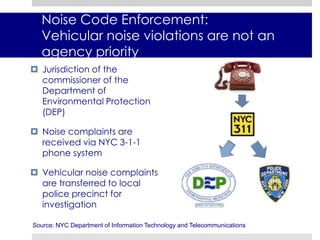
Noise Code Enforcement:Vehicular noise violations are not an agency priorityJurisdiction of the commissioner of the Department of Environmental Protection (DEP)Noise complaints are received via NYC 3-1-1 phone systemVehicular noise complaints are transferred to local police precinct for investigationSource: NYC Department of Information Technology and Telecommunications
AgendaKelly IntroductionWhat strategies can Citizens Committee for New York City (CCNYC) recommend to community groups?Methodology and Assumptions Analysis of Vehicular Noise in New York City
Vehicular noise is a unique quality of life issue for New Yorkers
Measures of Evaluation, Strategies and Analysis of Noise Code

Policy Lab: Combating Vehicular Noise

  • 1.
    Citizen’s Committeefor NewYork City: Combating Vehicular Noise Olivia FruChandler GriffithAngelina LopezMinerva MuzquizKelly Singer
  • 2.
    Central Policy IssueWhatstrategies can Citizens Committee for New York City (CCNYC) recommend to residents to increase community group involvement in combating vehicular noise in New York City?
  • 3.
    ObjectiveTo devise astrategy that will:Effectively mobilize community resources to minimize vehicular noise pollutionBe executable by resident-led effortsAdhere to the mission of CCNYC
  • 4.
    RecommendationCCNYC should recommend: thecreation of a Social Networking Website to engage residents and establish a platform where they can learn about noise pollution in their neighborhood, document noise, and organize based on location and interest
  • 5.
    AgendaKellyIntroductionWhat strategies canCitizens Committee for New York City (CCNYC) recommend to community groups?Methodology and Assumptions Analysis of Vehicular Noise in New York City
  • 6.
    Vehicular noise isa unique quality of life issue for New Yorkers
  • 7.
    Measures of Evaluation,Strategies and Analysis of Noise Code
  • 8.
    Enforcement of vehicularnoise complaints is not an agency priority
  • 9.
    Explanation of Strategiesfor Community Groups
  • 10.
    Our strategies focusedon bringing awareness to behavior to combat vehicular noise
  • 11.
    Analysis of Strategies,Recommendation, Next Steps
  • 12.
    Create a SocialNetworking Website to engage residents and establish a organizational platform Minnie Angelina Chandler Olivia
  • 13.
    Research MethodologyReviewed currentlegislation to understand Noise Code regulations and policiesAnalyzed agency data to determine most frequent vehicular noise complaintsInterviewed city department officials regarding legislation and enforcement policy Researched best practices in community organizing and for mitigating noise pollutionEstablished measures of evaluation in accordance with CCNYC’s missionEvaluated strategies to be implemented by a community groupAssumptions An increase in 3-1-1 complaints does not correspond with greater enforcement of noise code violations Because 3-1-1 does not differentiate between different types of vehicular noise, we cross-referenced various types of enforceable noise with a public opinion survey Scope and size of projects to be implemented is dependent on the resources and capacity of various community groups
  • 14.
    AgendaKelly IntroductionWhat strategiescan Citizens Committee for New York City (CCNYC) recommend to community groups?Methodology and Assumptions Analysis of Vehicular Noise in New York City
  • 15.
    Vehicular noise isa unique quality of life issue for New Yorkers
  • 16.
    Measures of Evaluation,Strategies and Analysis of Noise Code
  • 17.
    Enforcement of vehicularnoise complaints is not an agency priority
  • 18.
    Explanation of Strategiesfor Community Groups
  • 19.
    Our strategies focusedon bringing awareness to behavior to combat vehicular noise
  • 20.
    Analysis of Strategies,Recommendation, Next Steps
  • 21.
    Create a SocialNetworking Website to engage residents and establish a organizational platform Minnie Angelina Chandler Olivia
  • 22.
    Noise is unwantedsound Note: The decibel scale is not a simple, linear scale. An increase of ten on the decibel scale corresponds to the intensity of sound increasing by a factor of ten. For example, a sound that registers 80 decibels is ten times the intensity of one at 70 decibels.
  • 23.
    Vehicular Noise exceedsstandard safety threshold Car StereoCar AlarmMotorcycledBA measurementHorn HonkingTruckBusy StreetHighwaySource: Center for Hearing and Communication
  • 24.
    Vehicular noise isa unique quality of life issue and greater nuisance for New Yorkers than to residents nationwideNever Rarely Sometimes Often Source: Bronzaft and Van Ryzin, “Neighborhood Noise and Its Consequences”
  • 25.
    3-1-1 noise complaintsare an indicator of public response, but do not indicate actual noise levelsThe Department of Information Technology and Telecommunications (DOITT) categorizes vehicular noise complaints as: horn honking
  • 26.
  • 27.
    loud musicor stereoSource: NYC DOITT
  • 28.
    AgendaKelly IntroductionWhat strategiescan Citizens Committee for New York City (CCNYC) recommend to community groups?Methodology and Assumptions Analysis of Vehicular Noise in New York City
  • 29.
    Vehicular noise isa unique quality of life issue for New Yorkers
  • 30.
    Measures of Evaluation,Strategies and Analysis of Noise Code
  • 31.
    Enforcement of vehicularnoise complaints is not an agency priority
  • 32.
    Explanation of Strategiesfor Community Groups
  • 33.
    Our strategies focusedon bringing awareness to behavior to combat vehicular noise
  • 34.
    Analysis of Strategies,Recommendation, Next Steps
  • 35.
    Create a SocialNetworking Website to engage residents and establish a organizational platform Minnie Angelina Chandler Olivia
  • 36.
    CCNYC is investedin empowering residents to improve the quality of life in their neighborhoods CCNYC “stimulates and supports self-help and civic action”:Award bi-annual grants, ranging from $500 to $3,000Projects are resident-led and volunteer-basedProjects expected to be implemented in 3 to 6 months
  • 37.
    Our proposed strategiesare designed to enable community groups to combat vehicular noise Maintain status quo of referring to 3-1-1 system Create a Public Awareness Campaign to educate residents on the effects of noise pollutionLaunch a Cell-phone Application to collect, record and store noise code violations Offer Workshops on Noise pollution and Legislative Petitioning to mobilize residentsEstablish a Social Networking Website to engage residents and create a base for community action
  • 38.
    Measures of Evaluationare in accordance with CCNYC’s grant requirements
  • 39.
    Noise Code:Existing policyfor sustaining healthy ambient levels in New York CityA revised Noise Code was signed into law in 2005, aiming to creating greater city-wide compliance with the code The revision was the first major overhaul in 30 yearsGoals of Noise Code:Protect public health and welfareFoster convenience and comfort of residents Prevent Injury to human, plant and animal Life
  • 40.
    Noise Code:Vehicle regulationsapplies only in areas where speed limit is 35 MPH or lessHorn honking is not permitted, except as a warning in situations of “imminent danger” Code prohibits excessive sound from muffler, exhaust or stereo of vehicles operating on public right of wayExcessive sound is defined as :
  • 41.
    Noise Code Enforcement:Vehicularnoise violations are not an agency priorityJurisdiction of the commissioner of the Department of Environmental Protection (DEP)Noise complaints are received via NYC 3-1-1 phone systemVehicular noise complaints are transferred to local police precinct for investigationSource: NYC Department of Information Technology and Telecommunications
  • 42.
    AgendaKelly IntroductionWhat strategiescan Citizens Committee for New York City (CCNYC) recommend to community groups?Methodology and Assumptions Analysis of Vehicular Noise in New York City
  • 43.
    Vehicular noise isa unique quality of life issue for New Yorkers
  • 44.
    Measures of Evaluation,Strategies and Analysis of Noise Code

Editor's Notes

  • #2 -Greeting/Good morning. -Address clients and faculty—thanks for coming-Intro: analysis of policy issue-Say names
  • #3 How we understood CPI
  • #4 State objective through process
  • #5 State recommendation-acknowledge that group will address it later
  • #6 Present Agenda:--I have gone through the CPI, Objective, & Recommendation…next
  • #7 NYC Noise Code311 dataNYC DEP AND DOITTe-Town PollPublic health infoCommunity groups awarded grants by CCNYCReviewed Data to identify trends
  • #8 They way NYPD enforces things
  • #9 Present Agenda:--I have gone through the CPI, Objective, & Recommendation…next
  • #10 Make a new chart…what is noise and then results from study….we measure sound/noise is unwanted sound
  • #11 Focused on vehicular noise!
  • #12 Public TransportationMost residents do not drive personal cars
  • #13 Uniqueness of boroughs/geography
  • #14 Present Agenda:--I have gone through the CPI, Objective, & Recommendation…next
  • #17 Executable by..
  • #20 No point person!Noise complaints are received from service referrals from NYC 311 system or 911 The DEP works in coordination with the New York Police Department (NYPD) in investigating noise complaints and in issuing summonsNYPD policy does not publicly share its enforcement practicesMost complaints are treated as service requests; Noise complaints are received and transferred from the Department of Information Technology and Telecommunications (DOITT) 3-1-1 phone systemPer NYPD request, noise complaints are not collected on the 3-1-1 website or 3-1-1 iphone app
  • #21 Present Agenda:--I have gone through the CPI, Objective, & Recommendation…next
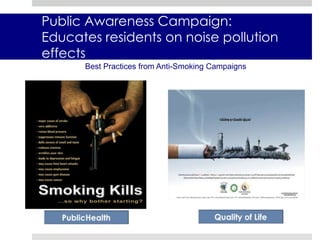
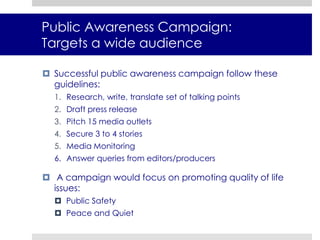
  • #23 Neighborhood Public Awareness CampaignReaching out to educate residents and merchants through signage in shop windows, fliers, bumper stickers etcPublic Health: permanent hearing loss, hypertension, psychological Stresses, cognitive delays in childrenQuality of Life: noise and safety, peace and quiet
  • #32 Taxis for tomorrow site
  • #36 Present Agenda:--I have gone through the CPI, Objective, & Recommendation…next
  • #40 -Greeting/Good morning. -Address clients and faculty—thanks for coming-Intro: analysis of policy issue-Say names
  • #41 Could be added to end…
  • #42 Health effects of noise exposure is dependent on: Length of time exposedDecibel level
  • #45 Need to indicate which month in notes