Information Communication and
Technology for Development
By:
Henry Clarke Kisembo
Chief Executive Officer – DALI
www.dalinternational.com
Profile
• CEO – DALI
• Technical Advisor – PSFU, PSFR, UTB, UNACC
• Fulbright Global Heath Scholar.
• Visiting Fellow Regent University –
Entrepreneurship / Business Management.
• Secretary General - International Network of
Resource Mobilizers.
• Local Content Advisor UNCDC – Gas and Oil.
PREAMBLE
INTRODUCTION
Since the 1980s ICT has evolved and gradually been
integrated in the development agenda of developing
countries like Uganda; it has become an important aspect
of growth and development thanks to science and
technology where there is constant research, experiments
and tests carried out. Without science growth and
development would be slow and livelihood generation for
communities would be challenged with looming poverty.
ICT FOR DEVELOPMENT
Health:
At all times science is a big part of health initiatives as information
is derived from tests carried out to inform medical personnel about
ailments, there magnitude and the required remedies and
medicines scientifically experimented and tested (Telemedicine), in
development poor health retards growth as an unhealthy work
force might not be fully productive; however even the
psychological effect that is on the person who is caring for the sick
affects their rational thinking most times so science is effective and
efficient.
ICT FOR DEVELOPMENT
Experimental and Scientific Research:
Scientific and Experimental research has enhanced development in
that it builds innovation for example machinery that is used in
agriculture, high value seeds, post harvest handling systems like
silos (storage facilities) and modern agricultural extension
mechanisms; enhancing food security are a result of science,
processing machines and manufacturing machines are all a result of
scientific research and which in turn boosts growth and
development for Ugandan communities and countries at large.
ICT FOR DEVELOPMENT
Vulnerability Surveillance Systems:
These are systems and gadgets which detect disasters
before they happen and in Uganda they have been very
effective in health as through cell phones and gateway
platforms one can detect the Global positioning system
(GPS) of a health need like births, outbreaks and plagues as
this can be communicated through cellular platforms even
in the most remote areas this has been successful in
Karamoja and Northern regions.
ICT FOR DEVELOPMENT
Business Growth and Development:
ICT has brought a new vision in doing business for micro small and
medium enterprises, as with cell or mobile phones information is
transmitted and transactions are cell phone and internet based;
there are platforms for information like weather information,
market prices, national information all transmitted and
communicated through mobile phones; village phones and public
access, Bulk sms, money transfers have taken a wave in doing
business as it saves on time and transport costs so through Mobile
money transfers and other platforms like internet banking,
payment can be done or money exchanged at the stroke of a
mobile phone and internet service.
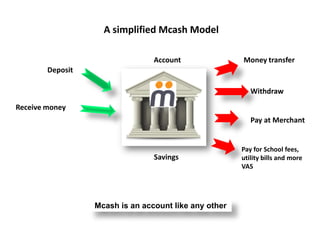
A simplified Mcash Model
Mcash is an account like any other
Deposit
Receive money
Savings
Money transfer
Withdraw
Pay at Merchant
Account
Pay for School fees,
utility bills and more
VAS
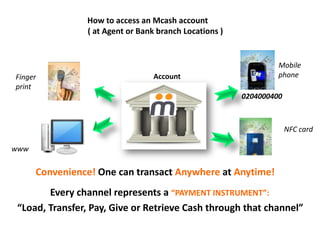
How to access an Mcash account
( at Agent or Bank branch Locations )
AccountFinger
print
Mobile
phone
0204000400
NFC card
www
Convenience! One can transact Anywhere at Anytime!
Every channel represents a “PAYMENT INSTRUMENT”:
“Load, Transfer, Pay, Give or Retrieve Cash through that channel”
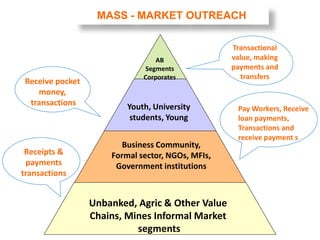
MASS - MARKET OUTREACH
AB
Segments
Corporates
Youth, University
students, Young
Business Community,
Formal sector, NGOs, MFIs,
Government institutions
Unbanked, Agric & Other Value
Chains, Mines Informal Market
segments
Receipts &
payments
transactions
Receive pocket
money,
transactions
Pay Workers, Receive
loan payments,
Transactions and
receive payment s
Transactional
value, making
payments and
transfers
ICT FOR DEVELOPMENT
Education and E-Learning Platforms:
Through science and ICT education is no longer a hassle as
there are learning platforms online and one doesn’t need
to be physically present in a class room setting but through
online platform, video conferencing, webinars, Telephone
conferencing, skype meetings and this is across the country
and inter-countries thus more communities and persons in
Uganda are accessing education, learning and training
through such platforms (online studies).
ICT FOR DEVELOPMENT
Social Media Networks:
These networks are as a result of science for example face
book, twitter, instagram, viber, chat rooms, LinkedIn are
very important and relevant in development as they
enhance connections, networking, marketing, information
sharing, and also build up of friends network, through
these social media there can also be services offered like
counseling, advisory services, employment opportunities
and this is very effective and on growth trend amongst
Ugandans as they realize the benefits.
ICT FOR DEVELOPMENT
Water Sanitation and Health (WASH):
In developing countries like Uganda communities are
affected by poor health due to unclean water and
sanitation there are various diseases and ailments as a
result of this has led to projects like boreholes, piped
water, water cleansing medicines and also sensitization
and ways of promoting good sanitation like modern
toilet building, drainage systems being developed thus
a healthy and productive population.
ICT FOR DEVELOPMENT
Renewable Energy:
Through scientific research it was realized that there was a need for
ways of protecting the environment, nature and mother earth;
reduce global warming and thus research and production of clean
cook-stoves, use of briquettes instead of charcoal which depletes
the environment through deforestation, thus sustainable growth
and livelihoods, such information through ICT is shared amongst
communities and countries following best learning practices; there
is a reduction on reliance of hydro electricity in Uganda thus biogas
promotion and usage and wind pipes.
ICT FOR DEVELOPMENT
Exploration and Production:
Uganda is endowed by natural resources such as oil and
gas, cobalt amongst others and through scientifically tested
machines; exploration, testing and production has been
made possible and this promises Uganda for alternative
economic growth and development, through employment
creation, income generation, and national revenue growth
thus increased social service delivery.
ICT FOR DEVELOPMENT
Others:
Include Management Information Systems which
have made organizations and institutions more
effective, efficient and productive for example
asset management, financial management,
Human resource management and project
management amongst others.
Setbacks
-Hackers
-Scam
-System failure
-Poor Networks
-Power sources
-Integrity and precision
-Different time zones
CONCLUSION
ICT in development is a great tool that can
minimize costs, quite effective and efficient,
provides for accountability and supports to
bridge gaps that in the past hindered stable
and sustainable growth and development
thus a need to embrace it in theory and
practice.

Information communication and technology for development

  • 1.
    Information Communication and Technologyfor Development By: Henry Clarke Kisembo Chief Executive Officer – DALI www.dalinternational.com
  • 2.
    Profile • CEO –DALI • Technical Advisor – PSFU, PSFR, UTB, UNACC • Fulbright Global Heath Scholar. • Visiting Fellow Regent University – Entrepreneurship / Business Management. • Secretary General - International Network of Resource Mobilizers. • Local Content Advisor UNCDC – Gas and Oil.
  • 3.
  • 4.
    INTRODUCTION Since the 1980sICT has evolved and gradually been integrated in the development agenda of developing countries like Uganda; it has become an important aspect of growth and development thanks to science and technology where there is constant research, experiments and tests carried out. Without science growth and development would be slow and livelihood generation for communities would be challenged with looming poverty.
  • 5.
    ICT FOR DEVELOPMENT Health: Atall times science is a big part of health initiatives as information is derived from tests carried out to inform medical personnel about ailments, there magnitude and the required remedies and medicines scientifically experimented and tested (Telemedicine), in development poor health retards growth as an unhealthy work force might not be fully productive; however even the psychological effect that is on the person who is caring for the sick affects their rational thinking most times so science is effective and efficient.
  • 6.
    ICT FOR DEVELOPMENT Experimentaland Scientific Research: Scientific and Experimental research has enhanced development in that it builds innovation for example machinery that is used in agriculture, high value seeds, post harvest handling systems like silos (storage facilities) and modern agricultural extension mechanisms; enhancing food security are a result of science, processing machines and manufacturing machines are all a result of scientific research and which in turn boosts growth and development for Ugandan communities and countries at large.
  • 7.
    ICT FOR DEVELOPMENT VulnerabilitySurveillance Systems: These are systems and gadgets which detect disasters before they happen and in Uganda they have been very effective in health as through cell phones and gateway platforms one can detect the Global positioning system (GPS) of a health need like births, outbreaks and plagues as this can be communicated through cellular platforms even in the most remote areas this has been successful in Karamoja and Northern regions.
  • 8.
    ICT FOR DEVELOPMENT BusinessGrowth and Development: ICT has brought a new vision in doing business for micro small and medium enterprises, as with cell or mobile phones information is transmitted and transactions are cell phone and internet based; there are platforms for information like weather information, market prices, national information all transmitted and communicated through mobile phones; village phones and public access, Bulk sms, money transfers have taken a wave in doing business as it saves on time and transport costs so through Mobile money transfers and other platforms like internet banking, payment can be done or money exchanged at the stroke of a mobile phone and internet service.
  • 9.
    A simplified McashModel Mcash is an account like any other Deposit Receive money Savings Money transfer Withdraw Pay at Merchant Account Pay for School fees, utility bills and more VAS
  • 10.
    How to accessan Mcash account ( at Agent or Bank branch Locations ) AccountFinger print Mobile phone 0204000400 NFC card www Convenience! One can transact Anywhere at Anytime! Every channel represents a “PAYMENT INSTRUMENT”: “Load, Transfer, Pay, Give or Retrieve Cash through that channel”
  • 11.
    MASS - MARKETOUTREACH AB Segments Corporates Youth, University students, Young Business Community, Formal sector, NGOs, MFIs, Government institutions Unbanked, Agric & Other Value Chains, Mines Informal Market segments Receipts & payments transactions Receive pocket money, transactions Pay Workers, Receive loan payments, Transactions and receive payment s Transactional value, making payments and transfers
  • 12.
    ICT FOR DEVELOPMENT Educationand E-Learning Platforms: Through science and ICT education is no longer a hassle as there are learning platforms online and one doesn’t need to be physically present in a class room setting but through online platform, video conferencing, webinars, Telephone conferencing, skype meetings and this is across the country and inter-countries thus more communities and persons in Uganda are accessing education, learning and training through such platforms (online studies).
  • 13.
    ICT FOR DEVELOPMENT SocialMedia Networks: These networks are as a result of science for example face book, twitter, instagram, viber, chat rooms, LinkedIn are very important and relevant in development as they enhance connections, networking, marketing, information sharing, and also build up of friends network, through these social media there can also be services offered like counseling, advisory services, employment opportunities and this is very effective and on growth trend amongst Ugandans as they realize the benefits.
  • 14.
    ICT FOR DEVELOPMENT WaterSanitation and Health (WASH): In developing countries like Uganda communities are affected by poor health due to unclean water and sanitation there are various diseases and ailments as a result of this has led to projects like boreholes, piped water, water cleansing medicines and also sensitization and ways of promoting good sanitation like modern toilet building, drainage systems being developed thus a healthy and productive population.
  • 15.
    ICT FOR DEVELOPMENT RenewableEnergy: Through scientific research it was realized that there was a need for ways of protecting the environment, nature and mother earth; reduce global warming and thus research and production of clean cook-stoves, use of briquettes instead of charcoal which depletes the environment through deforestation, thus sustainable growth and livelihoods, such information through ICT is shared amongst communities and countries following best learning practices; there is a reduction on reliance of hydro electricity in Uganda thus biogas promotion and usage and wind pipes.
  • 16.
    ICT FOR DEVELOPMENT Explorationand Production: Uganda is endowed by natural resources such as oil and gas, cobalt amongst others and through scientifically tested machines; exploration, testing and production has been made possible and this promises Uganda for alternative economic growth and development, through employment creation, income generation, and national revenue growth thus increased social service delivery.
  • 17.
    ICT FOR DEVELOPMENT Others: IncludeManagement Information Systems which have made organizations and institutions more effective, efficient and productive for example asset management, financial management, Human resource management and project management amongst others.
  • 18.
    Setbacks -Hackers -Scam -System failure -Poor Networks -Powersources -Integrity and precision -Different time zones
  • 19.
    CONCLUSION ICT in developmentis a great tool that can minimize costs, quite effective and efficient, provides for accountability and supports to bridge gaps that in the past hindered stable and sustainable growth and development thus a need to embrace it in theory and practice.