Module 2: Policy Development,
Implementation, and Review
2022 ProSPER.Net Leadership Programme – Shifting to Net Zero
Jihei SONG
International Development Cooperation Center
Senior Researcher
Dec. 6, 2022
I.
II.
Development of Korea’s Net Zero Policy
Plans for Implementation
III. Review of the Policy
IV. Summary and Conclusion
Ⅰ. Development of Korea’s Net Zero Policy
Development of Korea’s Net Zero Policy
 Background
1) To join the international community in the fight against climate change
 Changes in climate, including extreme weather events
 Paris Agreement, major economies increasing the level of ambition in NDCs and
announcing carbon neutrality (i.e. GER, USA, UK, JAP)
2) To respond to the changes in the international economy & trade
 Increasing trend in the adoption of carbon tariffs, RE100, ESG investment
 Pursuing sustainable development of the Korean economy and to booth competence
 Korea’s Carbon Neutral Framework Act legislated in 2021, replacing the
Framework Act on Low Carbon Green Growth of 2010
2022 ProSPER.Net Leadership Programme – Module 2. Policy Development, Implementation, and Review
4
Development of the Korean Net Zero Policy
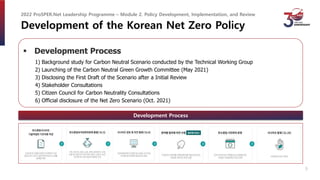
 Development Process
1) Background study for Carbon Neutral Scenario conducted by the Technical Working Group
2) Launching of the Carbon Neutral Green Growth Committee (May 2021)
3) Disclosing the First Draft of the Scenario after a Initial Review
4) Stakeholder Consultations
5) Citizen Council for Carbon Neutrality Consultations
6) Official disclosure of the Net Zero Scenario (Oct. 2021)
Development Process
2022 ProSPER.Net Leadership Programme – Module 2. Policy Development, Implementation, and Review
5
Development of Korea’s Net Zero Policy
 Guiding Principles (Art. 3)
1) Intergenerational equality and sustainable development
2) Transition to a carbon-neutral society and the promotion of green growth
3) Policies to reduce GHG and adapt to the climate crisis based on science and
comprehensiveness
4) Climate justice, considering social disparity and vulnerable groups, sectors, and regions
5) “Polluter Pays” principle
6) Addressing climate crisis while strengthening national competitiveness and creating jobs
7) Democratic participation of all citizens ensured
8) Participation in the global efforts to limit the temperature increase while protecting the
environment and social justice of developing countries, and strengthening global partnership
* Also note the information on the LSE Grantham Institute Website (https://climate-laws.org/geographies/south-korea/laws/carbon-neutral-green-
growth-framework-act-to-tackle-the-climate-crisis), second paragraph describing the Art. 3.
2022 ProSPER.Net Leadership Programme – Module 2. Policy Development, Implementation, and Review
6
II. Plans for Implementation
Plans for Implementation
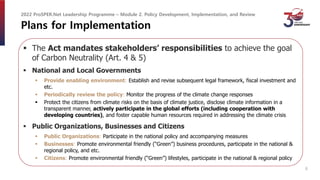
 The Act mandates stakeholders’ responsibilities to achieve the goal
of Carbon Neutrality (Art. 4 & 5)
 National and Local Governments
 Provide enabling environment: Establish and revise subsequent legal framework, fiscal investment and
etc.
 Periodically review the policy: Monitor the progress of the climate change responses
 Protect the citizens from climate risks on the basis of climate justice, disclose climate information in a
transparent manner, actively participate in the global efforts (including cooperation with
developing countries), and foster capable human resources required in addressing the climate crisis
 Public Organizations, Businesses and Citizens
 Public Organizations: Participate in the national policy and accompanying measures
 Businesses: Promote environmental friendly (“Green”) business procedures, participate in the national &
regional policy, and etc.
 Citizens: Promote environmental friendly (“Green”) lifestyles, participate in the national & regional policy
2022 ProSPER.Net Leadership Programme – Module 2. Policy Development, Implementation, and Review
8
Plans for Implementation
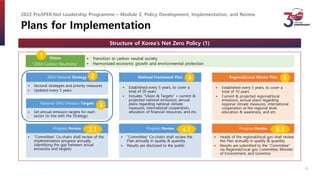
Structure of Korea’s Net Zero Policy (1)
Vision
“2050 Carbon Neutrality”
• Transition to carbon neutral society
• Harmonized economic growth and environmental protection
2050 National Strategy
• Sectoral strategies and priority measures
• Updated every 5 years
National GHG Emission Targets
• Set annual emission targets for each
sector (in line with the Strategy)
National Framework Plan
• Established every 5 years, to cover a
total of 20 years
• Includes “Vision & Targets” + current &
projected national emissions, annual
plans regarding national climate
measures, international cooperation,
allocation of financial resources, and etc.
Progress Review
• “Committee” Co-chairs shall review of the
implementation progress annually
(identifying the gap between actual
emissions and targets)
Regional/Local Master Plan
• Established every 5 years, to cover a
total of 10 years
• Current & projected regional/local
emissions, annual plans regarding
regional climate measures, international
cooperation at the regional level,
education & awareness, and etc.
Progress Review
• “Committee” Co-chairs shall review the
Plan annually in quality & quantity
• Results are disclosed to the public
Progress Review
• Heads of the regional/local gov shall review
the Plan annually in quality & quantity
• Results are submitted to the “Committee”
via Regional/Local gov Committee, Minister
of Environment, and Governor
1
2
3
4 5
5.1
4.1
3.1
2022 ProSPER.Net Leadership Programme – Module 2. Policy Development, Implementation, and Review
9
Plans for Implementation
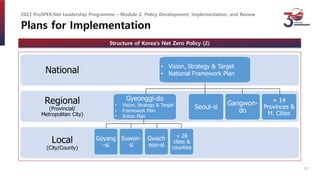
Structure of Korea’s Net Zero Policy (2)
Local
(City/County)
Regional
(Provincial/
Metropolitan City)
National
• Vision, Strategy & Target
• National Framework Plan
Goyang
-si
Gangwon-
do
Gyeonggi-do
• Vision, Strategy & Target
• Framework Plan
• Action Plan
Gwach
eon-si
Suwon-
si
+ 28
cities &
counties
Seoul-si
+ 14
Provinces &
M. Cities
2022 ProSPER.Net Leadership Programme – Module 2. Policy Development, Implementation, and Review
10
Plans for Implementation
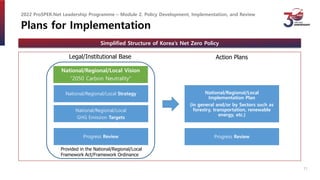
Simplified Structure of Korea’s Net Zero Policy
National/Regional/Local Vision
“2050 Carbon Neutrality”
National/Regional/Local Strategy
National/Regional/Local
GHG Emission Targets
National/Regional/Local
Implementation Plan
(in general and/or by Sectors such as
forestry, transportation, renewable
energy, etc.)
Progress Review Progress Review
Provided in the National/Regional/Local
Framework Act/Framework Ordinance
Legal/Institutional Base Action Plans
2022 ProSPER.Net Leadership Programme – Module 2. Policy Development, Implementation, and Review
11
Plans for Implementation
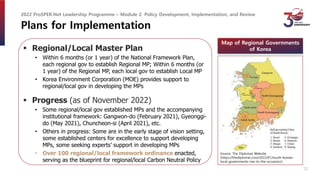
 Regional/Local Master Plan
• Within 6 months (or 1 year) of the National Framework Plan,
each regional gov to establish Regional MP; Within 6 months (or
1 year) of the Regional MP, each local gov to establish Local MP
• Korea Environment Corporation (MOE) provides support to
regional/local gov in developing the MPs
 Progress (as of November 2022)
• Some regional/local gov established MPs and the accompanying
institutional framework: Gangwon-do (February 2021), Gyeonggi-
do (May 2021), Chuncheon-si (April 2021), etc.
• Others in progress: Some are in the early stage of vision setting,
some established centers for excellence to support developing
MPs, some seeking experts’ support in developing MPs
• Over 100 regional/local framework ordinance enacted,
serving as the blueprint for regional/local Carbon Neutral Policy
Map of Regional Governments
of Korea
Source: The Diplomat Website
(https://thediplomat.com/2022/01/south-koreas-
local-governments-rise-to-the-occasion/).
2022 ProSPER.Net Leadership Programme – Module 2. Policy Development, Implementation, and Review
12
Plans for Implementation
 Gyeonggi-do
 Carbon Neutral Green Growth Framework Ordinance (July 2022)
 Purpose (Art. 1), Definition (Art. 2), Responsibilities of the Gyeonggi-do (Art. 3),
Businesses & Citizens (Art. 4)
 Vision (Art. 5), Target (Art. 6), Master Plan (Art. 7), Review (Art. 8), Committee (Art.
10-17)
 Other issues such as civic engagement, support centers, priority sectors, GHG info
system, transition to green industry, international cooperation, and etc. included
→ Framework Ordinance serves as the legal and institutional bases
for subsequent policy action
2022 ProSPER.Net Leadership Programme – Module 2. Policy Development, Implementation, and Review
13
Plans for Implementation
 Gyeonggi-do
 Sectors included in the Carbon Neutral Green Growth
Framework Ordinance: Renewable energy, Green Buildings, Green
Transportation, Eco-mobiles (including electrical, hydrogen, solar cars), Carbon Sink,
Adaptation, Climate Risks, Water, Green Finance
 Action plans for the mentioned sectors are under development
ex 1) “2050 Carbon Neutral Forest and Green Space Master Plan” (under development)
• In order to maximize carbon sink from forests and reduce Particulate Matter, increase forest coverage
to 8,780ha, facilitate biomass to fuel program, and newly develop strategy and programs under the
2050 Carbon Neutral Forest and Green Space Master Plan.
ex 2) “Carbon Neutral Action Fund” (July 2022)
• Total amount of 103 billion KRW: Gyeonggi-do 6 billion + Private sector 97 billion
• To be invested in the development and commercialization of eco-friendly and low emission
technology by SME & venture enterprises
2022 ProSPER.Net Leadership Programme – Module 2. Policy Development, Implementation, and Review
14
Plans for Implementation
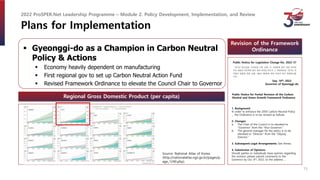
 Gyeonggi-do as a Champion in Carbon Neutral
Policy & Actions
 Economy heavily dependent on manufacturing
 First regional gov to set up Carbon Neutral Action Fund
 Revised Framework Ordinance to elevate the Council Chair to Governor
Regional Gross Domestic Product (per capita)
Revision of the Framework
Ordinance
Source: National Atlas of Korea
(http://nationalatlas.ngii.go.kr/pages/p
age_1240.php).
Public Notice for Legislative Change No. 2022-37
Public Notice for Partial Revision of the Carbon
Neutral and Green Growth Framework Ordinance
1. Background
In order to enhance the 2050 Carbon Neutral Policy
… the Ordinance is to be revised as follows.
2. Changes
a. The Chair of the Council is to elevated to
“Governor” from the “Vice-Governor.”
b. The general manager for the policy is to be
elevated to “Director” from the “Deputy
Director.”
3. Subsequent Legal Arrangements: See Annex.
4. Submission of Opinions
Should parties or individuals have opinion regarding
the revision, please submit comments to the
Governor by Oct. 6th, 2022, to the address …
Sep. 16th, 2022
Governor of Gyeonggi-do
2022 ProSPER.Net Leadership Programme – Module 2. Policy Development, Implementation, and Review
15
Plans for Implementation
 Gangwon-do
 Carbon Neutral Green Growth Framework Ordinance (June 2022)
 Purpose (Art. 1), Principles (Art. 2), Responsibilities of the Governor (Art. 3),
Responsibilities of the Citizens (Art. 4)
 Target (Art. 5), Master Plan (Art. 6), Review (Art. 7), Committee (Art. 9-17)
 Other issues such as civic engagement, support centers, priority sectors, GHG info
system, transition of the agriculture, forest, fishing industry, international cooperation,
and etc. included
→ Again, Framework Ordinance serves as the legal and institutional
basis for subsequent policy action
→ Main structure follows the National Framework while reflecting regional
properties. (i.e. Transition of agriculture, forest, fishing industry mentioned)
2022 ProSPER.Net Leadership Programme – Module 2. Policy Development, Implementation, and Review
16
Plans for Implementation
 Gangwon-do
 5 cities and 4 counties already have Framework Ordinance in place (as of Nov. 2022)
 Several cities and counties have developed Master Plan and are pursuing carbon
neutral action, reflecting regional/local properties
ex 1) “Chuncheon-si 2040 Carbon Neutral Master Plan” (April 2021)
• Main strategy: Energy independence (self-reliance), Green mobility, Increasing carbon sink &
promoting low carbon infrastructure, Waste recycling, and Reducing carbon emission in daily life
• Actions include, expanding renewable energy mainly through installing Solar PV in residential complex,
60% shift to electrical and hydrogen automobiles, increasing green mobile charging stations, planting
100 million trees, reducing municipal waste to half, increasing subsidies to small scale solar PV
ex 2) “Hwoengsung-gun Carbon Neutral City Master Plan”
• Focused on Agro-waste management, livestock emission management
ex 3) “Gangreung-si Carbon Neutral Master Plan” (expected by the end of 2022),
“Wonju-si Carbon Neutral Master Plan” (expected by Oct. 2023)
2022 ProSPER.Net Leadership Programme – Module 2. Policy Development, Implementation, and Review
17
III. Review of the Policy
Review of the Policy
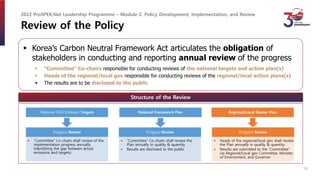
 Korea’s Carbon Neutral Framework Act articulates the obligation of
stakeholders in conducting and reporting annual review of the progress
 “Committee” Co-chairs responsible for conducting reviews of the national targets and action plan(s)
 Heads of the regional/local gov responsible for conducting reviews of the regional/local action plans(s)
 The results are to be disclosed to the public
Structure of the Review
2022 ProSPER.Net Leadership Programme – Module 2. Policy Development, Implementation, and Review
National GHG Emission Targets National Framework Plan
Progress Review
• “Committee” Co-chairs shall review of the
implementation progress annually
(identifying the gap between actual
emissions and targets)
Regional/Local Master Plan
Progress Review
• “Committee” Co-chairs shall review the
Plan annually in quality & quantity
• Results are disclosed to the public
Progress Review
• Heads of the regional/local gov shall review
the Plan annually in quality & quantity
• Results are submitted to the “Committee”
via Regional/Local gov Committee, Minister
of Environment, and Governor
19
Review of the Policy
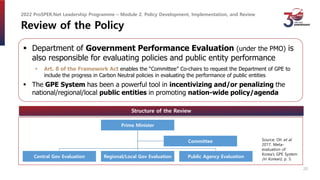
 Department of Government Performance Evaluation (under the PMO) is
also responsible for evaluating policies and public entity performance
 Art. 8 of the Framework Act enables the “Committee” Co-chairs to request the Department of GPE to
include the progress in Carbon Neutral policies in evaluating the performance of public entities
 The GPE System has been a powerful tool in incentivizing and/or penalizing the
national/regional/local public entities in promoting nation-wide policy/agenda
Structure of the Review
Prime Minister
Central Gov Evaluation Regional/Local Gov Evaluation Public Agency Evaluation
Committee Source: Oh et al.
2017. Meta-
evaluation of
Korea’s GPE System
(in Korean), p. 5.
2022 ProSPER.Net Leadership Programme – Module 2. Policy Development, Implementation, and Review
20
IV. Summary and Conclusion
Summary
 Characteristic of Korea’s Net Zero Policy
 Central-led policy, cascading to regional/local policy
 Coherence in the action areas
 Clear responsibilities for stakeholders in developing implementation plans,
reviews especially through the leadership of the “Committee”
 Measures to support Net Zero included, such as the establishment of Technical
Support Centers, Net Zero Champion Cities, etc.
 Enables regional/local policy & action plans to reflect on the regional/local
features and capability
 Gyeonggi-do focuses on the transition of industries, with carbon neutral action
plan by sectors
 Gangwon-do focuses on mitigating GHG from the agriculture and livestock
industry (nature-based solutions), with action plans developed by cities/counties
2022 ProSPER.Net Leadership Programme – Module 2. Policy Development, Implementation, and Review
22
Conclusion
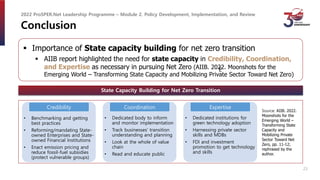
 Importance of State capacity building for net zero transition
 AIIB report highlighted the need for state capacity in Credibility, Coordination,
and Expertise as necessary in pursuing Net Zero (AIIB. 2022. Moonshots for the
Emerging World – Transforming State Capacity and Mobilizing Private Sector Toward Net Zero)
State Capacity Building for Net Zero Transition
Source: AIIB. 2022.
Moonshots for the
Emerging World –
Transforming State
Capacity and
Mobilizing Private
Sector Toward Net
Zero, pp. 11-12;
rephrased by the
author.
2022 ProSPER.Net Leadership Programme – Module 2. Policy Development, Implementation, and Review
• Benchmarking and getting
best practices
• Reforming/mandating State-
owned Enterprises and State-
owned Financial Institutions
• Enact emission pricing and
reduce fossil-fuel subsidies
(protect vulnerable groups)
Credibility
• Dedicated body to inform
and monitor implementation
• Track businesses’ transition
understanding and planning
• Look at the whole of value
chain
• Read and educate public
E
• Dedicated institutions for
green technology adoption
• Harnessing private sector
skills and MDBs
• FDI and investment
promotion to get technology
and skills
Coordination Expertise
23
Conclusion
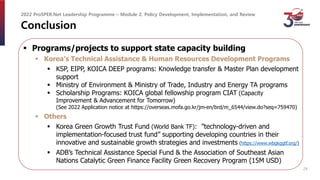
 Programs/projects to support state capacity building
 Korea’s Technical Assistance & Human Resources Development Programs
 KSP, EIPP, KOICA DEEP programs: Knowledge transfer & Master Plan development
support
 Ministry of Environment & Ministry of Trade, Industry and Energy TA programs
 Scholarship Programs: KOICA global fellowship program CIAT (Capacity
Improvement & Advancement for Tomorrow)
(See 2022 Application notice at https://overseas.mofa.go.kr/jm-en/brd/m_6544/view.do?seq=759470)
 Others
 Korea Green Growth Trust Fund (World Bank TF): ”technology-driven and
implementation-focused trust fund” supporting developing countries in their
innovative and sustainable growth strategies and investments (https://www.wbgkggtf.org/)
 ADB’s Technical Assistance Special Fund & the Association of Southeast Asian
Nations Catalytic Green Finance Facility Green Recovery Program (15M USD)
2022 ProSPER.Net Leadership Programme – Module 2. Policy Development, Implementation, and Review
24
Additional Notes
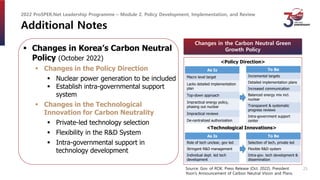
 Changes in Korea’s Carbon Neutral
Policy (October 2022)
 Changes in the Policy Direction
 Nuclear power generation to be included
 Establish intra-governmental support
system
 Changes in the Technological
Innovation for Carbon Neutrality
 Private-led technology selection
 Flexibility in the R&D System
 Intra-governmental support in
technology development
2022 ProSPER.Net Leadership Programme – Module 2. Policy Development, Implementation, and Review
Changes in the Carbon Neutral Green
Growth Policy
<Policy Direction>
<Technological Innovations>
As Is
Macro level target
Lacks detailed implementation
plan
Top-down approach
Impractical energy policy,
phasing out nuclear
Impractical reviews
De-centralized authorization
To Be
Incremental targets
Detailed implementation plans
Increased communication
Balanced energy mix incl.
nuclear
Transparent & systematic
progress reviews
Intra-government support
center
As Is
Role of tech unclear, gov led
Stringent R&D management
Individual dept. led tech
development
To Be
Selection of tech, private led
Flexible R&D system
Intra-gov. tech development &
dissemination
Source: Gov. of ROK. Press Release (Oct. 2022). President
Yoon’s Announcement of Carbon Neutral Vision and Plans.
25
Thank You
26

Policy Development, Implementation, & Review

  • 1.
    Module 2: PolicyDevelopment, Implementation, and Review 2022 ProSPER.Net Leadership Programme – Shifting to Net Zero Jihei SONG International Development Cooperation Center Senior Researcher Dec. 6, 2022
  • 2.
    I. II. Development of Korea’sNet Zero Policy Plans for Implementation III. Review of the Policy IV. Summary and Conclusion
  • 3.
    Ⅰ. Development ofKorea’s Net Zero Policy
  • 4.
    Development of Korea’sNet Zero Policy  Background 1) To join the international community in the fight against climate change  Changes in climate, including extreme weather events  Paris Agreement, major economies increasing the level of ambition in NDCs and announcing carbon neutrality (i.e. GER, USA, UK, JAP) 2) To respond to the changes in the international economy & trade  Increasing trend in the adoption of carbon tariffs, RE100, ESG investment  Pursuing sustainable development of the Korean economy and to booth competence  Korea’s Carbon Neutral Framework Act legislated in 2021, replacing the Framework Act on Low Carbon Green Growth of 2010 2022 ProSPER.Net Leadership Programme – Module 2. Policy Development, Implementation, and Review 4
  • 5.
    Development of theKorean Net Zero Policy  Development Process 1) Background study for Carbon Neutral Scenario conducted by the Technical Working Group 2) Launching of the Carbon Neutral Green Growth Committee (May 2021) 3) Disclosing the First Draft of the Scenario after a Initial Review 4) Stakeholder Consultations 5) Citizen Council for Carbon Neutrality Consultations 6) Official disclosure of the Net Zero Scenario (Oct. 2021) Development Process 2022 ProSPER.Net Leadership Programme – Module 2. Policy Development, Implementation, and Review 5
  • 6.
    Development of Korea’sNet Zero Policy  Guiding Principles (Art. 3) 1) Intergenerational equality and sustainable development 2) Transition to a carbon-neutral society and the promotion of green growth 3) Policies to reduce GHG and adapt to the climate crisis based on science and comprehensiveness 4) Climate justice, considering social disparity and vulnerable groups, sectors, and regions 5) “Polluter Pays” principle 6) Addressing climate crisis while strengthening national competitiveness and creating jobs 7) Democratic participation of all citizens ensured 8) Participation in the global efforts to limit the temperature increase while protecting the environment and social justice of developing countries, and strengthening global partnership * Also note the information on the LSE Grantham Institute Website (https://climate-laws.org/geographies/south-korea/laws/carbon-neutral-green- growth-framework-act-to-tackle-the-climate-crisis), second paragraph describing the Art. 3. 2022 ProSPER.Net Leadership Programme – Module 2. Policy Development, Implementation, and Review 6
  • 7.
    II. Plans forImplementation
  • 8.
    Plans for Implementation The Act mandates stakeholders’ responsibilities to achieve the goal of Carbon Neutrality (Art. 4 & 5)  National and Local Governments  Provide enabling environment: Establish and revise subsequent legal framework, fiscal investment and etc.  Periodically review the policy: Monitor the progress of the climate change responses  Protect the citizens from climate risks on the basis of climate justice, disclose climate information in a transparent manner, actively participate in the global efforts (including cooperation with developing countries), and foster capable human resources required in addressing the climate crisis  Public Organizations, Businesses and Citizens  Public Organizations: Participate in the national policy and accompanying measures  Businesses: Promote environmental friendly (“Green”) business procedures, participate in the national & regional policy, and etc.  Citizens: Promote environmental friendly (“Green”) lifestyles, participate in the national & regional policy 2022 ProSPER.Net Leadership Programme – Module 2. Policy Development, Implementation, and Review 8
  • 9.
    Plans for Implementation Structureof Korea’s Net Zero Policy (1) Vision “2050 Carbon Neutrality” • Transition to carbon neutral society • Harmonized economic growth and environmental protection 2050 National Strategy • Sectoral strategies and priority measures • Updated every 5 years National GHG Emission Targets • Set annual emission targets for each sector (in line with the Strategy) National Framework Plan • Established every 5 years, to cover a total of 20 years • Includes “Vision & Targets” + current & projected national emissions, annual plans regarding national climate measures, international cooperation, allocation of financial resources, and etc. Progress Review • “Committee” Co-chairs shall review of the implementation progress annually (identifying the gap between actual emissions and targets) Regional/Local Master Plan • Established every 5 years, to cover a total of 10 years • Current & projected regional/local emissions, annual plans regarding regional climate measures, international cooperation at the regional level, education & awareness, and etc. Progress Review • “Committee” Co-chairs shall review the Plan annually in quality & quantity • Results are disclosed to the public Progress Review • Heads of the regional/local gov shall review the Plan annually in quality & quantity • Results are submitted to the “Committee” via Regional/Local gov Committee, Minister of Environment, and Governor 1 2 3 4 5 5.1 4.1 3.1 2022 ProSPER.Net Leadership Programme – Module 2. Policy Development, Implementation, and Review 9
  • 10.
    Plans for Implementation Structureof Korea’s Net Zero Policy (2) Local (City/County) Regional (Provincial/ Metropolitan City) National • Vision, Strategy & Target • National Framework Plan Goyang -si Gangwon- do Gyeonggi-do • Vision, Strategy & Target • Framework Plan • Action Plan Gwach eon-si Suwon- si + 28 cities & counties Seoul-si + 14 Provinces & M. Cities 2022 ProSPER.Net Leadership Programme – Module 2. Policy Development, Implementation, and Review 10
  • 11.
    Plans for Implementation SimplifiedStructure of Korea’s Net Zero Policy National/Regional/Local Vision “2050 Carbon Neutrality” National/Regional/Local Strategy National/Regional/Local GHG Emission Targets National/Regional/Local Implementation Plan (in general and/or by Sectors such as forestry, transportation, renewable energy, etc.) Progress Review Progress Review Provided in the National/Regional/Local Framework Act/Framework Ordinance Legal/Institutional Base Action Plans 2022 ProSPER.Net Leadership Programme – Module 2. Policy Development, Implementation, and Review 11
  • 12.
    Plans for Implementation Regional/Local Master Plan • Within 6 months (or 1 year) of the National Framework Plan, each regional gov to establish Regional MP; Within 6 months (or 1 year) of the Regional MP, each local gov to establish Local MP • Korea Environment Corporation (MOE) provides support to regional/local gov in developing the MPs  Progress (as of November 2022) • Some regional/local gov established MPs and the accompanying institutional framework: Gangwon-do (February 2021), Gyeonggi- do (May 2021), Chuncheon-si (April 2021), etc. • Others in progress: Some are in the early stage of vision setting, some established centers for excellence to support developing MPs, some seeking experts’ support in developing MPs • Over 100 regional/local framework ordinance enacted, serving as the blueprint for regional/local Carbon Neutral Policy Map of Regional Governments of Korea Source: The Diplomat Website (https://thediplomat.com/2022/01/south-koreas- local-governments-rise-to-the-occasion/). 2022 ProSPER.Net Leadership Programme – Module 2. Policy Development, Implementation, and Review 12
  • 13.
    Plans for Implementation Gyeonggi-do  Carbon Neutral Green Growth Framework Ordinance (July 2022)  Purpose (Art. 1), Definition (Art. 2), Responsibilities of the Gyeonggi-do (Art. 3), Businesses & Citizens (Art. 4)  Vision (Art. 5), Target (Art. 6), Master Plan (Art. 7), Review (Art. 8), Committee (Art. 10-17)  Other issues such as civic engagement, support centers, priority sectors, GHG info system, transition to green industry, international cooperation, and etc. included → Framework Ordinance serves as the legal and institutional bases for subsequent policy action 2022 ProSPER.Net Leadership Programme – Module 2. Policy Development, Implementation, and Review 13
  • 14.
    Plans for Implementation Gyeonggi-do  Sectors included in the Carbon Neutral Green Growth Framework Ordinance: Renewable energy, Green Buildings, Green Transportation, Eco-mobiles (including electrical, hydrogen, solar cars), Carbon Sink, Adaptation, Climate Risks, Water, Green Finance  Action plans for the mentioned sectors are under development ex 1) “2050 Carbon Neutral Forest and Green Space Master Plan” (under development) • In order to maximize carbon sink from forests and reduce Particulate Matter, increase forest coverage to 8,780ha, facilitate biomass to fuel program, and newly develop strategy and programs under the 2050 Carbon Neutral Forest and Green Space Master Plan. ex 2) “Carbon Neutral Action Fund” (July 2022) • Total amount of 103 billion KRW: Gyeonggi-do 6 billion + Private sector 97 billion • To be invested in the development and commercialization of eco-friendly and low emission technology by SME & venture enterprises 2022 ProSPER.Net Leadership Programme – Module 2. Policy Development, Implementation, and Review 14
  • 15.
    Plans for Implementation Gyeonggi-do as a Champion in Carbon Neutral Policy & Actions  Economy heavily dependent on manufacturing  First regional gov to set up Carbon Neutral Action Fund  Revised Framework Ordinance to elevate the Council Chair to Governor Regional Gross Domestic Product (per capita) Revision of the Framework Ordinance Source: National Atlas of Korea (http://nationalatlas.ngii.go.kr/pages/p age_1240.php). Public Notice for Legislative Change No. 2022-37 Public Notice for Partial Revision of the Carbon Neutral and Green Growth Framework Ordinance 1. Background In order to enhance the 2050 Carbon Neutral Policy … the Ordinance is to be revised as follows. 2. Changes a. The Chair of the Council is to elevated to “Governor” from the “Vice-Governor.” b. The general manager for the policy is to be elevated to “Director” from the “Deputy Director.” 3. Subsequent Legal Arrangements: See Annex. 4. Submission of Opinions Should parties or individuals have opinion regarding the revision, please submit comments to the Governor by Oct. 6th, 2022, to the address … Sep. 16th, 2022 Governor of Gyeonggi-do 2022 ProSPER.Net Leadership Programme – Module 2. Policy Development, Implementation, and Review 15
  • 16.
    Plans for Implementation Gangwon-do  Carbon Neutral Green Growth Framework Ordinance (June 2022)  Purpose (Art. 1), Principles (Art. 2), Responsibilities of the Governor (Art. 3), Responsibilities of the Citizens (Art. 4)  Target (Art. 5), Master Plan (Art. 6), Review (Art. 7), Committee (Art. 9-17)  Other issues such as civic engagement, support centers, priority sectors, GHG info system, transition of the agriculture, forest, fishing industry, international cooperation, and etc. included → Again, Framework Ordinance serves as the legal and institutional basis for subsequent policy action → Main structure follows the National Framework while reflecting regional properties. (i.e. Transition of agriculture, forest, fishing industry mentioned) 2022 ProSPER.Net Leadership Programme – Module 2. Policy Development, Implementation, and Review 16
  • 17.
    Plans for Implementation Gangwon-do  5 cities and 4 counties already have Framework Ordinance in place (as of Nov. 2022)  Several cities and counties have developed Master Plan and are pursuing carbon neutral action, reflecting regional/local properties ex 1) “Chuncheon-si 2040 Carbon Neutral Master Plan” (April 2021) • Main strategy: Energy independence (self-reliance), Green mobility, Increasing carbon sink & promoting low carbon infrastructure, Waste recycling, and Reducing carbon emission in daily life • Actions include, expanding renewable energy mainly through installing Solar PV in residential complex, 60% shift to electrical and hydrogen automobiles, increasing green mobile charging stations, planting 100 million trees, reducing municipal waste to half, increasing subsidies to small scale solar PV ex 2) “Hwoengsung-gun Carbon Neutral City Master Plan” • Focused on Agro-waste management, livestock emission management ex 3) “Gangreung-si Carbon Neutral Master Plan” (expected by the end of 2022), “Wonju-si Carbon Neutral Master Plan” (expected by Oct. 2023) 2022 ProSPER.Net Leadership Programme – Module 2. Policy Development, Implementation, and Review 17
  • 18.
    III. Review ofthe Policy
  • 19.
    Review of thePolicy  Korea’s Carbon Neutral Framework Act articulates the obligation of stakeholders in conducting and reporting annual review of the progress  “Committee” Co-chairs responsible for conducting reviews of the national targets and action plan(s)  Heads of the regional/local gov responsible for conducting reviews of the regional/local action plans(s)  The results are to be disclosed to the public Structure of the Review 2022 ProSPER.Net Leadership Programme – Module 2. Policy Development, Implementation, and Review National GHG Emission Targets National Framework Plan Progress Review • “Committee” Co-chairs shall review of the implementation progress annually (identifying the gap between actual emissions and targets) Regional/Local Master Plan Progress Review • “Committee” Co-chairs shall review the Plan annually in quality & quantity • Results are disclosed to the public Progress Review • Heads of the regional/local gov shall review the Plan annually in quality & quantity • Results are submitted to the “Committee” via Regional/Local gov Committee, Minister of Environment, and Governor 19
  • 20.
    Review of thePolicy  Department of Government Performance Evaluation (under the PMO) is also responsible for evaluating policies and public entity performance  Art. 8 of the Framework Act enables the “Committee” Co-chairs to request the Department of GPE to include the progress in Carbon Neutral policies in evaluating the performance of public entities  The GPE System has been a powerful tool in incentivizing and/or penalizing the national/regional/local public entities in promoting nation-wide policy/agenda Structure of the Review Prime Minister Central Gov Evaluation Regional/Local Gov Evaluation Public Agency Evaluation Committee Source: Oh et al. 2017. Meta- evaluation of Korea’s GPE System (in Korean), p. 5. 2022 ProSPER.Net Leadership Programme – Module 2. Policy Development, Implementation, and Review 20
  • 21.
    IV. Summary andConclusion
  • 22.
    Summary  Characteristic ofKorea’s Net Zero Policy  Central-led policy, cascading to regional/local policy  Coherence in the action areas  Clear responsibilities for stakeholders in developing implementation plans, reviews especially through the leadership of the “Committee”  Measures to support Net Zero included, such as the establishment of Technical Support Centers, Net Zero Champion Cities, etc.  Enables regional/local policy & action plans to reflect on the regional/local features and capability  Gyeonggi-do focuses on the transition of industries, with carbon neutral action plan by sectors  Gangwon-do focuses on mitigating GHG from the agriculture and livestock industry (nature-based solutions), with action plans developed by cities/counties 2022 ProSPER.Net Leadership Programme – Module 2. Policy Development, Implementation, and Review 22
  • 23.
    Conclusion  Importance ofState capacity building for net zero transition  AIIB report highlighted the need for state capacity in Credibility, Coordination, and Expertise as necessary in pursuing Net Zero (AIIB. 2022. Moonshots for the Emerging World – Transforming State Capacity and Mobilizing Private Sector Toward Net Zero) State Capacity Building for Net Zero Transition Source: AIIB. 2022. Moonshots for the Emerging World – Transforming State Capacity and Mobilizing Private Sector Toward Net Zero, pp. 11-12; rephrased by the author. 2022 ProSPER.Net Leadership Programme – Module 2. Policy Development, Implementation, and Review • Benchmarking and getting best practices • Reforming/mandating State- owned Enterprises and State- owned Financial Institutions • Enact emission pricing and reduce fossil-fuel subsidies (protect vulnerable groups) Credibility • Dedicated body to inform and monitor implementation • Track businesses’ transition understanding and planning • Look at the whole of value chain • Read and educate public E • Dedicated institutions for green technology adoption • Harnessing private sector skills and MDBs • FDI and investment promotion to get technology and skills Coordination Expertise 23
  • 24.
    Conclusion  Programs/projects tosupport state capacity building  Korea’s Technical Assistance & Human Resources Development Programs  KSP, EIPP, KOICA DEEP programs: Knowledge transfer & Master Plan development support  Ministry of Environment & Ministry of Trade, Industry and Energy TA programs  Scholarship Programs: KOICA global fellowship program CIAT (Capacity Improvement & Advancement for Tomorrow) (See 2022 Application notice at https://overseas.mofa.go.kr/jm-en/brd/m_6544/view.do?seq=759470)  Others  Korea Green Growth Trust Fund (World Bank TF): ”technology-driven and implementation-focused trust fund” supporting developing countries in their innovative and sustainable growth strategies and investments (https://www.wbgkggtf.org/)  ADB’s Technical Assistance Special Fund & the Association of Southeast Asian Nations Catalytic Green Finance Facility Green Recovery Program (15M USD) 2022 ProSPER.Net Leadership Programme – Module 2. Policy Development, Implementation, and Review 24
  • 25.
    Additional Notes  Changesin Korea’s Carbon Neutral Policy (October 2022)  Changes in the Policy Direction  Nuclear power generation to be included  Establish intra-governmental support system  Changes in the Technological Innovation for Carbon Neutrality  Private-led technology selection  Flexibility in the R&D System  Intra-governmental support in technology development 2022 ProSPER.Net Leadership Programme – Module 2. Policy Development, Implementation, and Review Changes in the Carbon Neutral Green Growth Policy <Policy Direction> <Technological Innovations> As Is Macro level target Lacks detailed implementation plan Top-down approach Impractical energy policy, phasing out nuclear Impractical reviews De-centralized authorization To Be Incremental targets Detailed implementation plans Increased communication Balanced energy mix incl. nuclear Transparent & systematic progress reviews Intra-government support center As Is Role of tech unclear, gov led Stringent R&D management Individual dept. led tech development To Be Selection of tech, private led Flexible R&D system Intra-gov. tech development & dissemination Source: Gov. of ROK. Press Release (Oct. 2022). President Yoon’s Announcement of Carbon Neutral Vision and Plans. 25
  • 26.

Editor's Notes

  • #18 Sources: https://www.yna.co.kr/view/AKR20210401090400062