VOLUME 2
STAGE 5 
F r o m W o r d s t o A c t i o n 
Th e Stakeholder Engagement Manual 
THE STAKEHOLDER ENGAGEMENT MANUAL 
VOLUME 2: THE PRACTITIONER'S HANDBOOK ON STAKEHOLDER ENGAGEMENT 
AccountAbility, the United Nations Environment Programme, and Stakeholder Research Associates 
By AccountAbility: 
Thomas Krick 
Maya Forstater 
Philip Monaghan 
Maria Sillanpää 
With contributions from: 
Cornis van der Lugt (United Nations Environment Programme) 
Katharine Partridge, Charles Jackson, Asaf Zohar (Stakeholder Research Associates) 
Acknowledgements: 
The authors are grateful to the members of the review panel, who oversaw the development of this handbook: 
Abra Brynne (International Social and Environmental Accreditation and Labelling (ISEAL) Alliance), 
Ambreen Waheed (Responsible Business Initiative Pakistan), Claus Frier (Novozymes), David Kingma (British American Tobacco), 
David Shandler (Commonground), Ed Freeman (Olsson Center for Applied Ethics, University of Virginia), 
Esther Trujillo Gimenez (Telefónica), Eva Beresford (The Environment Council UK), Gavin Andersson (Keystone), 
Harriet Eisner (Amicus Union), Ivar Oellingrath (Norsk Hydro), Jayanti Durai & Anne Pattberg (The Camelot Group), 
Jayn Harding (FTSE4Good), Kavita Prakash-Mani (SustainAbility), Lucianne Verweij (Philips), 
Marina Liborakina (Unifi ed Energy Systems of Russia), Nathalie Ledrich (Services Industriels de Geneve), 
Oliver Greenfi eld (Worldwide Fund for Nature), Peter Croal (Southern African Institute for Environmental Assessment), 
Sean Ansett (Gap Inc.), Stacey Smith (Business for Social Responsibility) 
Victor Tharage (Department of Environmental Affairs and Tourism in South Africa) 
Many other people and organisations contributed to the development of this handbook, for a full list please see the appendix. 
First Edition October 2005 
ISBN 1 901693 220 
Copyright 2005: AccountAbility, United Nations Environment Programme, Stakeholder Research Associates Canada Inc. 
This publication may be reproduced in whole or in part and in any form for educational or non-profi t purposes without special permission 
from the copyright holders, provided acknowledgment of the source is made. No use of this publication may be made for resale or for 
any other commercial purpose whatsoever without prior permission in writing from the copyright holders. Designations employed and 
the presentation of material in this publication do not imply the expression of any opinion whatsoever on the part of UNEP concerning 
the legal status of any country, territory, city or area or of its frontiers or boundaries. Moreover, the views expressed do not necessarily 
represent the decision or the stated policy of UNEP nor does citing of trade names or commercial processes constitute endorsement. 
PDF versions of this report are available at: www.accountability.org.uk, www.StakeholderResearch.com, www.uneptie.org 
THE PRACTITIONER'S HANDBOOK ON STAKEHOLDER ENGAGEMENT | 3
Forewords 
Foreword by AccountAbility 
Finding a path towards sustainable 
development will require the pooling 
of diverse perspectives, knowledge 
and resources. No single individual, 
organisation, nor even a single 
segment of global society is likely to 
by themselves identify and implement 
the solutions to the big challenges 
humanity is facing today. 
So, for each individual player, but 
also for society as a whole, there is at 
the same time a necessity for and an 
opportunity in engaging with each 
other to solve these problems. 
However, we should also not forget 
another reason for considering and 
listening to each other before taking 
signifi cant decisions: We all share this 
world and the consequences of many 
of our actions are not limited to our 
own ‘backyards’. Th ey impact others, 
too, whether it be directly or indirectly. 
Th is is why there also needs to be an 
acknowledgement that those who are 
impacted by an organisation’s activities 
have the right to be heard. 
All the above are reasons why 
encouraging eff ective stakeholder 
engagement is core to AccountAbility’s 
mission of promoting organisational 
accountability for sustainable 
development. For the past decade 
we have worked with pioneering 
organisations and a growing band of 
professionals in developing standards 
and best practice in integrating 
stakeholder viewpoints into decision-making. 
One outcome of these 
eff orts is the recent publication of 
the exposure draft of the AA1000 
Stakeholder Engagement Standard. 
Another complimentary output, this 
time produced in co-operation with 
the United Nations Environment 
Programme and Stakeholder Research 
Associates, is this handbook. 
One aim of this handbook is to provide 
guidance on how corporations can 
increase their knowledge, their abilities 
and their legitimacy by undertaking 
stakeholder engagement. Th is will 
enhance performance and enable 
corporations to reach more ambitious 
objectives for their own business, but 
also allow them to contribute towards 
a more sustainable world. In fact, 
helping to identify the space of synergy 
between these two benefi ts by aligning 
corporate strategy with sustainable 
development is the ultimate objective 
of this handbook. 
We would like to thank the United 
Nations Environment Programme for 
initiating this project. We also thank 
Stakeholder Research Associates, 
whose work for Volume 1 of the 
manual provided an excellent starting 
point for the further research and 
development activities that led to 
the publication of this handbook. 
Furthermore, we would like to thank 
the members of the review panel and 
the multitude of other individuals 
who took part in the interviews, 
consultations and workshops for 
their contributions to this handbook. 
Finally, we are indebted to the 
publication sponsors who have not 
only contributed resources, but also a 
wealth of experience and expertise to 
this handbook. 
May it be of benefi t. 
Maria Sillanpää 
Managing Director, AccountAbility 
Foreword by the United Nations 
Environment Programme 
What does a rail infrastructure 
company do if it needs to build a 
new railway line through an area 
where local inhabitants may have 
to move as a result? What does a 
telecommunications company do if 
the setting up of a new mast opposite 
a local school causes community 
protest? How does a food and drinks 
company recover from the reputational 
damage caused by the discovery of 
health threatening substances in one 
of its products? How does a chemicals 
company ensure the neighbouring 
community is aware of potential 
hazards, risks and safety measures 
applied at a local production plant? 
How does a mining company restore 
employee morale after an underground 
explosion in which fellow workers lost 
their lives? 
Th ese are just a few examples of 
diffi cult issues various companies have 
had to deal with, issues that display the 
close interplay between the business 
interest and the societal interest. Th ese 
are basic examples of dramatic events, 
often showing symptoms of upstream 
planning and decision-making that 
had severe shortcomings. Th e more 
important question therefore becomes: 
How can the pro-active company 
engage its stakeholders strategically? 
Does it know who its real stakeholders 
are? If yes, how can it improve its 
ability to listen to and work with those 
stakeholders in defi ning its mission, 
what it stands for, what it produces, 
how it produces, and how it takes 
responsibility for its impacts with a 
long term perspective?
Th is Practitioner’s Handbook on 
Stakeholder Engagement takes the 
company through some basic steps 
and considerations in planning and 
developing stakeholder engagement. 
As the second volume in the 
Stakeholder Engagement Manual 
by UNEP, AccountAbility and 
Stakeholder Research Associates, 
it builds on Volume 1 which gave a 
compilation of diff erent perspectives 
of companies, industry associations, 
labour unions and NGOs on 
stakeholder engagement. Both 
of the volumes confi rm growing 
recognition of the importance of 
stakeholder engagement in promoting 
environmentally and socially 
responsible behaviour by companies 
across all sectors. 
Th e origin of this Stakeholder 
Engagement Manual goes back to 
UNEP’s 19th Annual Consultative 
Meeting with Industry Associations 
and related stakeholder organisations 
in 2002. From discussions at that 
meeting and subsequent feedback 
in the development of this manual, 
it has been evident that stakeholder 
engagement can be extremely valuable 
to organisations of all kinds, in all parts 
of the world. 
I thank AccountAbility, Stakeholder 
Research Associates, all participants 
and interviewees who contributed to 
the production of this second volume. 
Let us use it and get to work. 
Monique Barbut 
Director, UNEP Division of 
Technology, Industry and Economics 
Forewords by Stakeholder 
Research Associates 
We believe that stakeholder 
engagement is fundamental to 
successful business in the 21st century. 
Value creation for everyone involved 
in enterprise is essential to creating 
common purpose and addressing the 
complex issues facing the planet. 
Th is handbook follows on research 
presented in Volume 1: Th e Guide 
to Practitioners’ Perspectives 
on Stakeholder Engagement. 
Practitioners told us that progressive 
businesses increasingly are aware 
of the interconnections between 
environment, social and economic 
issues and that they cannot act 
alone to fi nd solutions. Stakeholder 
engagement, they said, is rapidly 
emerging as a vital tool to develop an 
understanding of what sustainability 
means for companies and how it 
can add value and viability to their 
operations. 
Underpinning that notion, companies 
recognize that to be eff ective, engaging 
stakeholders must be elevated from 
a risk-management tool to a deep-seated 
element of corporate strategic 
planning. Th is highlights the 
importance of engaging with internal 
stakeholders – employees at head offi ce 
and in regional operations, labour 
unions, and management – to establish 
common ground and capabilities to 
eff ectively engage. 
Th e research for Volume 1 also 
underlined the notion that 
stakeholders’ perspectives and 
preferred modes of engagement vary 
widely – across stakeholder group, 
issue, geography, culture, etc. Th is 
suggests that stakeholder engagement 
is as multi-faceted as the issues it is 
meant to address. So, we learned, 
engagement is most successful when it 
is an iterative process that builds on the 
input of the stakeholders themselves. 
Th is Handbook provides a valuable 
step-by-step guide through 
the processes of engaging with 
stakeholders. We encourage all 
corporations interested in creating 
value for their organisation – whether 
they are launching an engagement 
programme or wish to enhance an 
existing one – to make it a part of 
their everyday operations, while 
remembering that the goal is to embed 
engagement processes in their strategic 
decisions by building on dialogue and 
collaboration with their stakeholders. 
Our thanks to UNEP for initiating 
this important project and to our 
colleagues at AccountAbility for 
leading on the Handbook. 
Katharine Partridge 
Charles Jackson 
Asaf Zohar 
Lara Korba 
David Wheeler 
Stakeholder Research Associates 
Forewords 
THE PRACTITIONER'S HANDBOOK ON STAKEHOLDER ENGAGEMENT | 3
Introduction 5 
Opening note 5 
Why engage 8 
What is in this handbook 10 
How to use the handbook 12 
Principles and standards for stakeholder engagement 14 
Process summary 17 
Think strategically about engagement 21 
P1: Mapping your stakeholders 24 
P2: Setting strategic objectives for engagement 26 
P3: Identifying issues 35 
P4: Prioritising stakeholders and issues 40 
Take time to analyse and plan the engagement 49 
P5: Reviewing your progress 52 
P6: Learning from others and identifying potential partners 56 
P7: Assessing your current engagements and drafting 
stakeholder specifi c objectives 59 
P8: Understanding and learning about stakeholders and their 
representatives 65 
P9: Checking for resource commitments and defi ning 
“margins of movement” 71 
P10: Creating an issue focused plan for stakeholder engagement 75 
Maintain and strengthen the capacities needed to engage 
eff ectively 79 
P11: Strengthening your company’s ability to respond 81 
P12: Developing the internal skills and characteristics needed 
for stakeholder engagement 86 
P13: Consider your stakeholders’ requirements for engagement 91 
Engage with your stakeholders in ways that work 93 
P14: Identifying the most eff ective engagement methods 96 
Common Stakeholder Engagement Approaches 100 
P15: Designing the engagement process 110 
Take action and review the engagement 119 
P16: Creating a plan for action 121 
P17: Reporting back and giving assurance to your stakeholders 124 
P18: Reviewing the engagement process 132 
Jargon buster 135 
Further resources 137 
Bibliography 138 
Further acknowledements 142 
WELCOME 
STAGE 1 
STAGE 2 
STAGE 3 
STAGE 4 
STAGE 5 
ANNEX 
Contents
The Stakeholder Engagement 
Manual, consisting of this 
“Practitioner’s Handbook on 
Stakeholder Engagement” and 
its sister volume: “The Guide 
to Practitioners’ Perspectives 
on Stakeholder Engagement” 
(Stakeholder Research Associates) 
are the result of UNEP’s interest 
in producing a best practice guide 
to stakeholder engagement, with 
the broader aim of promoting the 
use of stakeholder engagement 
worldwide as a way of advancing 
sustainable development goals. 
Welcome to this handbook, which 
provides practical guidance, advice 
and signposts for further information 
to those interested in how to make 
stakeholder engagement more eff ective 
and benefi cial for the organisation 
and its stakeholders. Whilst Volume 
1, "Th e Guide to Practitioners' 
Perspectives", provides engagement 
practitioners with an overview of the 
perspective of various stakeholders 
on stakeholder engagement, this 
Practitioner’s Handbook – Volume 2 
of the manual – is aimed primarily at 
corporate practitioners. In addition, 
large portions of this Handbook may 
also be of use to practitioners from 
any other type (i.e. non-business) 
of organisation. Th e hope is that a 
wide spectrum of users can take it 
up and adapt its recommendations 
to their own circumstances. As with 
all research projects of potentially 
widespread applicability, the initiative 
for Th e Stakeholder Engagement 
Manual grew from a simple 
proposition. Participants in UNEP’s 
Annual Consultative Meeting with 
Industry Associations, of October 
2002, requested guidance on how 
to engage in meaningful dialogue 
with stakeholders. UNEP began its 
exploration by surveying nearly two 
dozen leading corporations in order 
to understand the main engagement 
approaches they used and the major 
constraints they faced. Th is research 
revealed that the issues at stake 
diff er across stakeholder groups and 
highlighted the need to understand 
stakeholder engagement from multiple 
perspectives, including those of non-governmental 
organisations, labour 
unions and trade associations. Th is 
sparked a series of additional research 
interviews with an international 
selection of senior representatives from 
various organisations, which formed 
the basis for Volume 1. 
OPENING NOTE 
THE PRACTITIONER'S HANDBOOK ON STAKEHOLDER ENGAGEMENT | 5 
Introduction
Introduction 
Background to Volume 2: 
The Practitioner’s Handbook on 
Stakeholder Engagement 
As research on Volume 1 progressed, 
it became clear that corporate 
practitioners – whether already fully 
engaged or just beginning to explore 
the value of engagement – were 
looking for very practical guidance. 
Th is is the purpose of this handbook. 
It builds on the fundamentals 
summarized in Volume 1 (see below), 
as well as on further research and 
interviews, which were undertaken 
specifi cally for the handbook. An 
initial outline was subjected to a 
series of international consultations 
in Japan, the UK, South Africa 
and the United States, and specifi c 
parts were discussed in two one-day 
workshops with corporations and 
multiple stakeholders, which took 
place in London in April 2005. An 
international multi-stakeholder 
review panel (see inside cover), 
which was formed specifi cally for the 
development of this handbook, also 
made a signifi cant contribution to it 
not only by reviewing existing drafts, 
but also by adding much of their own 
knowledge and insights. Finally, the 
handbook also draws on the insights 
gained from a broad variety of other 
stakeholder engagement focused 
projects and initiatives undertaken 
or joined by AccountAbility in the 
past years. Th ese projects include 
the Multi-Fiber Agreement (MFA) 
Forum, a multi-stakeholder initiative 
that seeks to fi nd ways of mitigating 
the negative social eff ects caused by 
the end of a system of trade quotas 
on textiles, the Global Leadership 
Network, an initiative that explores 
the relationship between stakeholder 
engagement and corporate strategy, 
and of course the development of 
the AA1000 Series, including the 
AA1000 Assurance and Stakeholder 
Engagement Standards, which 
themselves have been developed and 
agreed upon in multi-stakeholder 
processes. 
Th e result, we hope, will help 
corporate practitioners in roles 
that involve interaction and 
communication with stakeholders; 
specifi cally practitioners that want 
to adopt a more strategic approach 
to their engagement activities. Such 
practitioners may reside within a 
Corporate Responsibility team but 
also other departments such as Risk 
Management, Corporate Aff airs or 
Human Resources, and could be 
located either at headquarters or in a 
particular end-market, business unit or 
subsidiary. It is targeted at companies 
of any size, yet smaller companies can 
skip sections where they fi nd detail less 
relevant to their situations. Companies 
who are just beginning to engage 
will fi nd guidance on how to start 
approaching stakeholder engagement, 
whilst those who are already engaging 
with their stakeholders will also fi nd 
it useful for identifying possibilities 
for improvement and/or further 
systematisation. We also hope the 
handbook will be of use to consultants 
advising business people in this area, 
as well as to non-corporate actors who 
want to gain a deeper understanding of 
the corporate approach to stakeholder 
engagement. 
OPENING NOTE
Background to Volume 1: 
The Guide to Practitioners’ 
Perspectives on Stakeholder 
Engagement 
Volume 1 complements the handbook 
by summarising and providing 
an overview of perspectives on 
stakeholder engagement from the 
point of view of a range of diff erent 
stakeholder groups. In doing this, Th e 
Guide to Practitioners’ Perspectives 
provides valuable information on the 
specifi c perspectives of individual 
stakeholder groups, but also more 
generally applicable advice which can 
be distilled from their experiences. 
Unlike Volume 2, the target group 
for the Guide on Practitioners’ 
Perspectives is not only corporate users 
but also practitioners from the whole 
spectrum of stakeholders. 
Volume 1 refl ects the perspectives of 
practitioners from: 
• Businesses – international 
corporations operating in 12 
sectors (mining, metals, oil and 
gas, electricity, construction, 
pharmaceuticals, water, 
telecommunications, consumer 
products, fi nance, automobile, and 
food) and having home operations 
located on fi ve continents. 
• Non-governmental organisations 
– representing environmental, 
consumer, health, equity and 
governance concerns. 
• Labour organisations – representing 
national and international bodies in 
15 countries on six continents. 
• Trade and industry associations 
– covering 10 sectors (mining and 
metals, iron and steel, oil and gas, 
water, chemicals, air transport, 
rail transport, food and beverages, 
cement and accounting). 
As for Volume 2, the practitioners 
interviewed for Volume 1 have been 
candid in sharing their experience 
of engaging with stakeholders: what 
their motivations were, what tools and 
outside expertise they drew on, what 
worked and what did not, and what 
general advice they would distil from 
their own specifi c experiences 
for others. 
Th e aim of the two-part Stakeholder 
Engagement Manual by UNEP, 
AccountAbility and Stakeholder 
Research Associates is not to replace 
existing frameworks or re-invent 
the wheel. Rather the aim is to 
complement them by providing 
practitioners’ perspectives and 
practical guidance that build on and 
further develop the key frameworks 
that companies are already using. 
We hope that together these volumes 
will contribute to the changing 
mindsets on stakeholder engagement, 
away from mistrust and towards 
mutual benefi t. Comments from 
all interested parties are welcome 
at thomas@accountability.org.uk, 
kpartridge@StakeholderResearch. 
com, and cornis.lugt@unep.fr. 
THE PRACTITIONER'S HANDBOOK ON STAKEHOLDER ENGAGEMENT | 7
Th e past few decades have seen a shift in the role of the corporation in society. 
Some of the key trends causing this are the globalisation of markets, the emergence 
of global social and environmental challenges like HIV / Aids and climate change, 
as well as the decreased ability of individual national governments to address such 
issues by themselves. Furthermore, there is the growing infl uence of civil society 
organisations. One outcome of these trends is an increase in the complexity 
and dynamics of the operating environment for all kinds of organisations, 
including businesses. In order to understand and address the issues emerging out 
of this dynamic complexity, individual actors, whether businesses, civil society 
organisations or governments, are becoming increasingly dependent on sharing 
knowledge and working together. 
In this changing environment, businesses now play a more important role than ever 
before. Th eir activities have economic, environmental and social impacts on society 
from a local through to a global scale. In many countries, businesses play an active 
part in the shaping of public policy and regulatory developments. Furthermore, a 
wave of privatisation in many parts of the world, and a growing number of public-private 
partnerships has increased the role of the private sector in delivering what 
has traditionally been seen as public services. Th e increased involvement of private 
corporations in international development activities, often in co-operation with 
inter- and supranational bodies, is another signifi cant development in this context. 
In response to the enhanced role of business in society, more and more members 
or representatives of diff erent social groups who are impacted, claim their right to 
be informed of, consulted on and involved in corporate decision-making. In many 
developed countries, these claims have been enshrined in legislation, which requires 
consultation before taking potential high-impact decisions, for example on the 
location of an industrial production plant. 
WHY ENGAGE? 
THREE GENERATIONS OF CORPORATE 
STAKEHOLDER ENGAGEMENT 1 
3rd Generation 
Integrated strategic 
engagement for sustainable 
competetiveness 
2nd Generation 
Systematic engagement for risk 
management and increased understanding 
of stakeholders 
1st Generation 
Pressure driven engagement for pain alleviation 
with localised benefi ts 
Introduction 
1 See also the complementary Figure 2.6 in Volume 1 “The Guide to Practitioners’ Perspectives on Stakeholder Engagement”, p.27.
Consequently, many corporations have come to regard engagement with a variety 
of individuals and entities on social, environmental and economic issues as an 
important aspect of how they manage their activities. However the fi rst steps in 
stakeholder engagement (1st Generation) were often driven by external pressures, 
undertaken in an ad-hoc manner and limited to issues that provoked confl ict with 
stakeholders. Many businesses, realising the benefi ts of a more proactive, broad 
and ongoing dialogue, then started to develop more sophisticated and systematic 
approaches to stakeholder engagement. Th ese 2nd Generation stakeholder 
engagement activities have proven to increase understanding, manage risks and solve 
confl icts more eff ectively. 
Today, leading companies have started to develop an appreciation that stakeholder 
engagement can contribute to learning and innovation in products and processes, 
and enhance the sustainability of strategic decisions within and outside of the 
company. Th is 3rd generation stakeholder engagement enables companies to 
align social, environmental and economic performance with core strategy. Such 
stakeholder engagement processes involve a pooling of resources (e.g. know-how, 
fi nancial, human or operational resources) that can help all parties involved to gain 
insights, solve problems, and reach goals that none of them could reach alone. 
The Benefi ts of Stakeholder Engagement 
Effective and strategically aligned stakeholder engagement can: 
– Lead to more equitable and sustainable social development by giving those who have a 
right to be heard the opportunity to be considered in decision-making processes; 
– Enable better management of risk and reputation; 
– Allow for the pooling of resources (knowledge, people, money and technology) to solve 
problems and reach objectives that cannot be reached by single organisations; 
– Enable understanding of the complex business environment, including market 
developments and identifi cation of new strategic opportunities; 
– Enable corporations to learn from stakeholders, resulting in product and process 
Despite the obvious challenges of stakeholder engagement, the outcomes of best 
possible practice in stakeholder engagement clearly justify the necessary eff orts. 
Successful stakeholder engagement not only helps companies to secure leadership in 
an increasingly complex and ever changing business environment, but will also help 
to bring about systemic change towards sustainable development. 
THE PRACTITIONER'S HANDBOOK ON STAKEHOLDER ENGAGEMENT | 9 
improvements; 
– Inform, educate and infl uence stakeholders and the business environment to improve their 
decision-making and actions that impact on the company and on society; 
– Build trust between a company and its stakeholders;
THIS HANDBOOK PRESENTS STAKEHOLDER ENGAGEMENT 
IN FIVE STAGES: 
- Th e fi rst Stage is an overall consideration of strategic business objectives, how 
these relate to stakeholders and specifi c issues, and how you can undertake an 
initial prioritisation of stakeholders and issues for further analysis. 
- Th e second Stage introduces diff erent levels of engagement, and guides you 
in analysing your existing relationships, available resources and organisational 
constraints. It also helps you to learn more about specifi c stakeholder’s 
representatives, and to decide on what kind of relationship you want to develop 
with these stakeholders. 
- Th e third Stage addresses questions of internal and external competencies and 
capacities to engage, and provides guidance on how you can ensure that all parties 
to an engagement are able to join and take part in it eff ectively. 
- Th e fourth Stage outlines diff erent engagement techniques, and – building 
on the previous steps – helps you to design an approach that suits the needs of 
your specifi c situation and helps you to reach your objectives. 
- Finally, in the fi fth Stage, this handbook will provide you with guidance on how 
to follow up on the outputs of engagement, and how to ensure that your 
stakeholders feel assured regarding the quality of your eff orts. 
For the sake of clarity and ease of use, the handbook presents stakeholder 
engagement as a process consisting of discrete stages. The stages represent groups 
of necessary questions and processes in planning and managing stakeholder 
engagement, but will not always be best covered in such a strict sequence. It may well 
be necessary to carry out several of the described activities at the same time, or to 
return to ‘previous’ steps in order to clarify or reconsider. 
Th e process for stakeholder engagement presented here is underpinned by the 
principles of materiality, completeness and responsiveness. Th e relevance of these 
principles in the individual stages is described in each chapter. Th ey are further 
outlined later in this introduction, on p15. 
Th e handbook includes a number of tables, tools and templates which users can 
apply to their own context. 
Th ese can be downloaded from www.accountability.org.uk. 
Each chapter consists of: 
- Purpose: An outline of the objectives and rationale for undertaking this Stage. 
- Principles: An explanation of how this Stage relates to the principles of 
materiality, completeness and responsiveness. 
- Process: Practical guidance for each of the key processes, decisions and actions 
involved at this Stage. 
- Practical examples: Organisational policies and experiences and fi rst hand 
comments from practitioners. 
I n t r o d u c t i o n 
WHAT IS IN THIS HANDBOOK?
FIVE STAGE STAKEHOLDER ENGAGEMENT FRAMEWORK 
THE PRACTITIONER'S HANDBOOK ON STAKEHOLDER ENGAGEMENT | 11
Introduction 
Forwards 
THROUGHOUT THE HANDBOOK, THE FOLLOWING ICONS 
IDENTIFY DIFFERENT RESOURCES: 
Background Information: 
explaining the ideas, processes and terms used at each Stage. 
Tools and Resources: 
which provide a framework for applying these concepts to your own 
organisation. 
Real-life Examples: 
case studies and comments from practitioners. 
Suggested Methodologies: 
for undertaking the individual steps of stakeholder engagement, and 
guidance in applying the tools laid out in this handbook. 
Important Things to Consider: 
to consider regarding the process or methodologies. 
Summary Templates: 
that help to capture the outputs of the different steps in the engagement 
process. These templates are merely suggestions, and you may want to 
adapt them to your needs by adding or modifying individual elements, 
or by simplifying them. They can be downloaded in Microsoft word or 
Excel-format from www.accountability.org.uk 
HOW TO USE THE HANDBOOK
THE ANNEXES INCLUDE: 
- Jargon buster: A glossary of terms used in the handbook and others that you 
might come across. 
- A list of further resources, publications and sources of expertise. 
THE ACCOMPANYING WEBSITE INCLUDES: 
- Printable copies of each section 
- Printable and modifi able copies of the blank templates used in the handbook. 
Additional resources relating to specifi c industries or approaches, as well as updates 
to the handbook, may be made available for download in the future. 
If you wish to be kept informed of developments or additions to the 
handbook, please send an email with “Subscribe to SE Handbook 
Updates” in the subject line to service-enquiries@accountability.org.uk. 
We would also appreciate if you could enclose some feedback, information 
on your organisation and the purpose you intend to use this handbook for! 
HOW TO USE THE HANDBOOK 
Th is handbook is designed both to be used for a whole organisation or for 
individual projects or processes. You can adapt it to your individual, project specifi c 
or organisational needs, by adding additional pages or selecting particular parts to 
draw on. Th e templates and tools that can be downloaded from the website www. 
accountability.org.uk are modifi able, too. 
Th e structure of the handbook outlined above provides guidance around most 
major decisions that you will have to make when considering and undertaking 
stakeholder engagement. However, in some cases your requirements may be much 
less extensive, and it may be better served by consulting just one or two stages of 
the handbook, or only some of the tools off ered in them. 
Remember that the stages presented in this handbook represent necessary questions 
and processes in managing stakeholder engagement, but not a strict cycle of 
engagement that must always be followed sequentially before you can start 
engaging with stakeholders. It may well be necessary to carry out several of the 
described activities at the same time, or to return to ‘previous’ steps in order to 
clarify or reconsider. 
THE PRACTITIONER'S HANDBOOK ON STAKEHOLDER ENGAGEMENT | 13
Introduction 
PRINCIPLES AND STANDARDS FOR STAKEHOLDER ENGAGEMENT 
Th ere are a range of frameworks, standards and codes, which organisations can 
draw on to provide guidance for the process of stakeholder engagement and which 
aim to improve the sustainability performance of the organisation. Th ese include 
the GRI Sustainability Reporting Guidelines (on reporting), SA8000 (on labour 
standards compliance), the AA1000 Series (on systematic accountability, including 
engagement), and the EFQM Excellence Model (on quality management). At 
the national level various bodies have issued guidance and standards on social 
responsibility, for example the SD21000 in France, SIGMA in the UK, AS8003 
in Australia and Standard SI 10000 in Israel. At an international level, these will be 
complemented by the current ISO process to develop international guidance on 
social responsibility, in which stakeholder engagement will feature prominently. 
Th ere are also a number of useful resources from organisations including Th e World 
Business Council for Sustainable Development, Business for Social Responsibility, 
CSR Europe, Th e Future 500 Initiative, the UK Environment Council, the South 
African Calabash Project, the Brazilian Instituto Ethos, the Indian Development 
Alternatives Group and the International Association for Public Participation. Such 
sources of guidance are highlighted throughout the handbook, wherever relevant 
and also in the resource list in Annex 1. 
Th e achievement of procedural quality in stakeholder engagement does not 
necessarily translate to a connection with the company’s core business activities or 
material issues. While many standards, frameworks and sources of practical guidance 
(including those from the fi elds of public and civil society participation) can help to 
measure and achieve such procedural quality, many of them provide less guidance on 
identifying and addressing the specifi c, important issues for each individual business. 
Th e AA1000 Series, especially the AA1000 Stakeholder Engagement Standard 
Exposure Draft provides guidance in how to use stakeholder engagement to deal 
with issues of material signifi cance to the business and its stakeholders, and how to 
align stakeholder engagement with an organisation’s core strategy. Th erefore it is 
used as the framework for this handbook. 
Th e AA1000 2 Series guides organisations in establishing systematic accountability 
processes that involve stakeholders in the generation of strategies, policies and 
programmes as well as associated indicators, targets and communication systems, 
which eff ectively guide decisions, activities and overall organisational performance. 
Th e AA1000 Framework is organised around the overarching principle of 
‘inclusivity’. 
“Striving for inclusivity means that an organisation is committed to refl ect, at all 
stages of a process, the views and needs of all Stakeholder groups. Stakeholder views 
are obtained through an engagement process that allows them to be expressed 
without fear or restriction. Inclusivity requires the consideration of ‘voiceless’ 
stakeholders including future generations and the environment”. 
2 The A11000 Series includes the AA1000 Assurance Standard, as well as the AA1000 Stakeholder Engagement Standard. 
Stakeholder engagement is central to all components of the AA1000 series.
Inclusivity can be achieved by adherence to the following three principles: 
Materiality: 
requires knowing what concerns and is important to you and your stakeholders. 
Completeness: 
requires understanding and management of material impacts and associated 
stakeholder views, needs, and performance perceptions and expectations. 
Responsiveness: 
requires coherently responding to stakeholders' and the organisation's material 
issues. 
THE ACCOUNTABILITY COMMITMENT AND PRINCIPLES 
The Accountability Commitment 
'Inclusivity' 
"acknowledging stakeholders right to be heard, and accounting for one's actions to stakeholders" 
Principles 
Materiality Completeness Responsiveness 
Hear that means: The organisation identifi es and addresses the most signifi cant impacts related to 
it's business operations and the stratergy, as well as the stakeholders that organisation identifi es and 
sddresses the stakeholders with signifi cant potential to infl uence the organisation. 
"Demonstraiting adequate 
response" 
"Understanding your impact 
& what people think of you" 
"Knowing what is important 
to you and stakeholders" 
Th ese principles are not unique to the AA1000 Series and will need to be integrated 
with your own language and existing frameworks. For example, Altria developed 
their stakeholder engagement process on the basis of these principles, but defi ned 
their own principles for stakeholder engagement under the headings involvement, 
candor, relevance, learning and action. Th e Global Reporting Initiative’s 
Sustainability Reporting Guidelines also use the principle of “inclusiveness” as a key 
one in forming the framework of a sustainability report, referring to the systematic 
engagement of stakeholders in sustainability report development and improvement. 
Th e GRI defi nes the principle of “completeness” diff erently, applied in the context 
of reporting, to refer to the scope (in terms of time, issues and organisational entities 
covered) of what is included in a report. Th is can again be linked with the above-listed 
principles applied in the context of stakeholder engagement, namely the 
challenge to engage with stakeholders on an agenda that is clearly demarcated in 
terms of time frame, issues and operational entities covered. 
THE PRACTITIONER'S HANDBOOK ON STAKEHOLDER ENGAGEMENT | 15
Introduction 
PRINCIPLES AND STANDARDS FOR STAKEHOLDER ENGAGEMENT 
THE RELEVANCE OF MATERIALITY, COMPLETENESS AND RESPONSIVENESS TO THE FIVE STAGES 
Stakeholder Engagement Stage 
Materiality 
Completeness 
Responsiveness 
In the context of this manual, these three principles are understood to relate to the 
key questions that people (both inside and outside of the organisation) will ask you 
when considering your relationships and engagement with stakeholders: 
- Firstly “Is it genuine?” Are you just going through the motions of consultation 
for public relations purposes, or are you serious about getting a complete and 
balanced picture of your organisation’s material impacts? 
- Secondly “Is it fair and well informed?” Does the process of engagement allow 
all stakeholders to be considered or are signifi cantly impacted stakeholders 
ignored? Are internal and external processes in place that enable the organisation 
to gain a good understanding of its impacts and what its stakeholders think of it? 
- And fi nally “What diff erence does it make?” What are you going to do about the 
issues raised, how does this impact on other aspects of your performance, and 
how does it benefi t your business? Are you willing to make the changes that 
are required to integrate possibly new issues into your management processes 
and strategy? Also: In which way does this benefi t your business? 
Th e handbook will guide you through an approach to stakeholder engagement that 
stands fi rm when assessed against these questions. Whilst each of the three principles 
applies at each Stage, they have particular relevance at diff erent points in the overall 
process. Th e dark cells in the table below indicate which principle is most important 
in each Stage. At the beginning of each chapter there is also an interpretation of these 
principles as they apply to that Stage. 
OF STAKEHOLDER ENGAGEMENT 
Think Strategically Analyse and Plan Strengthen Capacities Engage with Stakeholders Act and Review 
Dominant 
Principle 
Stage
To identify the strategic priorities for stakeholder engagement in your organisation. 
This Stage is crucial to ensuring the identifi cation of material issues and stakeholders: 
Have you identifi ed which issues and stakeholders appear to be most important for 
long-term success and sustainability? 
Key Steps Methodology 
• Stakeholder map (p25) 
STAGE 1 
Think Strategically 
Aim 
Principles 
Look at all the stakeholders and issues that affect or are affected by your 
organisation (or policy decision/project/site business unit etc.) 
Work out who the stakeholders are. 
Identify and consider strategic engagement risks, opportunities 
and objectives. 
Identify your strategic objectives, the underlying issues and how 
important they seem to different stakeholder groups. Prioritise. 
& Template 
Tools and Resources 
• Benefi ts of engagement (p9, p30) 
• 5-part materiality test (p35) 
• 4 stages of issue maturity (p41) 
• Stakeholder infl uence and dependency 
matrix (p43) 
M1 - T1(p25) 
M2 - T2(p34) 
M3 - T3(p38) 
M4 - T4(p46) 
• Changing drivers of engagement (p29) 
To build up a basis of knowledge about the organisation and its stakeholders in order to 
prioritise further and develop a plan for engagement. 
This Stage is crucial to developing your understanding of the materiality of issues and 
stakeholders and to allow for completeness in addressing them: 
Do you understand the issues and stakeholders enough to design an enagement process 
that really adresses stakeholder expectations and robust? 
Increase your understanding of the potentially material issues and 
stakeholders identifi ed as strategic priorities in Stage 1. 
• Organisational learning stages (p52) 
M5 - T5(p55) 
M6 
M7 
M8 - T8(p69) 
Review how these issues are currently managed within your 
organisation. 
Draw on learning from other organisations and networks about how 
best to respond to these issues. 
Review the current state of your relationships with these stakeholders. 
Build up a profi le of your stakeholders - their expectations, infl uence, 
characteristics and preferred approaches to engagement. 
Consider what the organisation is and is not able to do in relation to 
these issues and expectations. 
Develop a strategic engagement plan which lays out which groups of 
stakeholders you need to engage with, at what level and what you hope 
to achieve. 
• Issue / Response Matrix (p53) 
• Links into Learning Networks (p59) 
• Further Resources (Annex) 
• Levels of Engagement (p60) 
• Stakeholder Profi le - Key Issues (p66) 
M9 - T9(p74) 
M10 - T10 
(p76) 
STAGE 2 
Analyse and Plan 
Aim 
Principles 
Key Steps Methodology 
& Template 
Tools and Resources 
PROCESS SUMMARY 
THE PRACTITIONER'S HANDBOOK ON STAKEHOLDER ENGAGEMENT | 17
To develop the individual skills and organisational sysytems needed to engage effectively 
with stakeholders. 
Consider the strength of your organisational systems and 
identify gaps. 
Consider the individual skills and capacities needed for 
engagement and identify areas for improvement. 
Consider the capacities and practical issues of your stakeholders 
and identify ways to address these. 
Set up the process of engagement itself: 
To plan and effectively carry out engagement activities with stakeholders. 
M11-T11(p85) 
This Stage is crucial to ensuring materiality, completeness and responsiveness: 
Does the engagement processes meet the needs of both organisation and it's 
stakeholders? 
Decide the best way to engage with your stakeholders. • Levels of engagement (p87) 
Design and prepare for the engagement process. 
Engage with your stakeholders. 
• Common stakeholder 
engagement approaches (p109) 
M14 
M15 - T15 
(p116) 
(Specifi c 
engagement 
method 
decided 
in M14) 
• Questions for selecting 
engagement methods (p88) 
• Practical issues checklist (p110) 
• Guidance on when to use 
a facilitator (p112) 
STAGE 4 
Design the Process and Engage with Stakeholders 
Aim 
Principles 
Key Steps Methodology 
& Template 
Tools and Resources 
Introduction 
PROCESS SUMMARY 
This Stage is crucial to ensuring that your organisation is able to understand (completeness) 
and respond (responsiveness) in a coherent manner: 
Does your organisation have the capacity to understand the issues, engage effectively 
and act on that engagement? 
Develop and carry out plan to strengthen the capacities needed to 
engage effectively. 
• Organisational learning stages (p52) 
Look at your own organisation as well as your Stakeholders: 
• Stakeholder Engagement 
skills and characteristics map (p87) 
• Obstacles to participation (p91) 
M12-T12(p89) 
M13 
M11, M12, M13, 
T11(p85) 
T12(p89) 
• Strengthening enablers (p82) 
STAGE 3 
Strengthen Capacities for Engagement 
Aim 
Principles 
Key Steps Methodology 
& Template 
Tools and Resources
To translate new learning, insights and agreements into action. 
This Stage is crucial to ensuring that you respond adequately (responsiveness) and 
for validating your understanding of the materiality of issues: 
Are you able to respond to, and learn from stakeholders' concerns and opinions? 
Looking at the results of the engagement process: 
Develop a plan of action. • SMART Targets (p122) 
Report back to stakeholders. 
Review the process itself to improve future management. 
M16 - T16 
THE PRACTITIONER'S HANDBOOK ON STAKEHOLDER ENGAGEMENT | 19 
Put learning into action. 
• AA1000 Assurance Standard 
Checklist (p128) 
• Thinking about assurance (p131) 
M17 
M18 - T18 
(p133) 
M16, M17, M18 
• Impacts of reporting framework (p126) 
STAGE 5 
Act, Review and Report 
Aim 
Principles 
Key Steps Methodology 
& Template 
Tools and Resources
Defi ne overall scope 
The process outlined in this handbook can be 
applied at a number of levels. Specify how you 
intend to use it in this instance: 
To cover the entire company 
To focus on a single business line 
(or business unit or department): 
To focus on a specifi c program, initiative 
or product: 
Secure overall organisational commitment 
to stakeholder engagement at this level. 
You need to have basic commitment to the idea 
of stakeholder engagement before embarking 
on the process. This commitment will need to be 
revisited throughout the process as the 
particular costs, benefi ts and demands of the 
engagement process become clearer. 
Develop an understanding of the principles 
of materiality, completeness and 
responsiveness, how these relate to 
stakeholder engagement and to your own 
organisational values. 
Do you understand these principles? 
How do they differ from or relate to your 
organisation’s guiding principles and 
working practices? 
How can they best be communicated and 
applied in your context? 
Assemble a cross functional group of 
relevant people from within the organisation 
and outside. 
Stakeholder engagement should ideally begin 
with a process of internal learning and 
engagement. Those who have knowledge about 
the organisation, the issues of concern or the 
stakeholder groups involved as well as those in 
charge of putting insights and agreements into 
action need to be involved in the process at each 
step. Start by identifying these people – the list 
may change and grow throughout the process. 
It might include company insiders from the 
strategic planning, the legal department, risk 
management, external communications, 
operations, marketing, EHS, HR or investor 
relations. It could also include external 
consultants or stakeholders you already engage 
with. At many stages you will need to gather 
information and initiate discussion with these 
people through interviews, workshops or 
meetings as well as involving or keeping them 
informed of the engagement process itself. You 
may also want to formally convene a group to 
steer the process. 
Consider how you will keep track of 
information. 
The process outlined in this handbook has 
the potential of generating a mass of information 
– fi rst about general categories such as 
stakeholders and issues, and later about 
specifi c stakeholders, information sources, 
benchmarks and viewpoints. 
You will need a robust mechanism for organising 
this information both in order to make it useful 
and available to stakeholders and managers 
and to enable external assurance of the process 
if necessary. 
Each Stage includes a number of summary 
templates which provide useful means to record 
outputs at key stages in the process. You may 
also want to develop a database to track 
individual stakeholder contact details 
and concerns. 
Introduction 
BEFORE YOU START 
Before you start
STAGE 1 
Think strategically about engagement
STAGE 1 
PURPOSE 
Th e aim of this fi rst Stage is to identify your reasons for stakeholder engagement 
and the key stakeholder groups and issues that relate to your organisation. Th is 
will provide a basis for ensuring that stakeholder engagement informs and 
becomes part of your business strategy. 
It is important not to jump directly into engagement but to think strategically 
fi rst: Why do you and your stakeholders want to engage? Who do you need to 
engage with? About what issues? What do you want to achieve, and how will you 
know if you are successful? 
PRINCIPLES 
Th e key principle at this Stage is materiality. 
'Inclusivity' 
"acknowledging stakeholders right to be heard, and accounting for one’s actions to stakeholders'" 
Principles 
Materiality Completeness Responsiveness 
Here that means: The organisation identifi es and addresses the most material impacts related 
to it's business operations and the stratergy, as well as the stakeholders that are subject to these 
impacts. Futhermore, the organisation identifi es and addresses the stakeholders with signifi cant 
potential to infl uence the organisation. 
Think Strategically 
THE PRACTITIONER'S HANDBOOK ON STAKEHOLDER ENGAGEMENT | 21
PROCESS 
Th e actions and tools outlined in this Stage are based on three linked questions 
which need to be answered in order to align your stakeholder engagement 
processes with your organisation’s strategic objectives. 
You do not have to work through this Stage in the order presented in this 
chapter – where you start will depend on your own context, and on whether you 
are already engaging or are a newcomer. Th e four examples below highlight the 
routes taken by four diff erent organisations each starting from a diff erent point. 
Th ink Strategically 
Stage 1 
Think 
Strategically 
Example sequences in approaching stakeholder engagement strategically: 
Branded sportswear company 
Why? We need to respond to 
criticisms and campaigns, 
which are damaging our 
reputation. 
What issue? Labour standards 
in our supply chains. 
Who? Which NGOs and other 
groups can we work with 
constructively? 
Global retailer 
Who? Potential new customers, 
staff and communities in 
emerging markets. 
Why? To understand them 
and their social and cultural 
expectations. 
What issues? Identify issues 
considered important by 
stakeholder groups. 
Industry association 
Why? To develop and gain 
support for sector level 
sustainability strategy. 
Who? Member companies and 
wider stakeholders. 
What issues? Identify issues 
and challenges relevant to 
sector sustainability with 
stakeholders. 
Cement manufacturer 
What issue? 
Where should we site a new 
factory? 
Why? Engage with local 
community to help identify 
issues related to different sites 
and reduce risk of planning 
permission being blocked. 
Who? Local groups and 
individuals. 
STAGE 1. THINK STRATEGICALLY. 
Why 
engage? 
Who to 
engage with 
What to 
engage about 
Strategic 
Alignment
STAGE 1 
Th e process outlined in this Stage is for developing a comprehensive overview of 
material issues and relevant stakeholder groups. Th is does not necessarily need 
to be undertaken at the start of every individual engagement process. Often you 
need to react fl exibly and swiftly to a specifi c stakeholder group or issue, which 
arises unexpectedly. However, an understanding of the materiality of the issue is 
always important in guiding your responses. A strategic approach to stakeholder 
engagement ensures that your organisation is able to understand and respond to 
the full range of material issues and challenges facing it, not just lurch from crisis 
to crisis. 
Th e full process outlined here aims to provide a comprehensive and forward 
looking pre-assessment that helps companies to gain an overview and an 
understanding of the relative importance of the key issues and stakeholder groups 
that it should endeavour to address. A company does not necessarily have to go 
through the whole process, but it should ensure that it has answers for the most 
important questions: 
– Who are it's stakeholders? 
– Which are the most important objectives that stakeholder engagement should 
help us and others to achieve? 
– What is the societal Stage of maturity of the key issues that the company needs 
to address? [see p40 for further discussion on issue maturity]. 
Telefónica Partners with Main Representative Association of Disabled People 
As part of it’s wider Telefónica Accessible initiative, the telecommunications company has formed a partnership with CERMI, Spain’s 
largest organisation of disabled people, representing 3.5 million disabled people and their families. This collaboration enables it to fully 
understand their needs and expectancies, while helping Telefónica to learn from and innovate for the benefi t of disabled people, and 
ensuring the suitability of developed products and helping in the anticipation of future regulatory developments regarding accessibility. 
THE PRACTITIONER'S HANDBOOK ON STAKEHOLDER ENGAGEMENT | 23
Analyse and Plan the Engagement 
P1: MAPPING YOUR STAKEHOLDERS 
BACKGROUND 
Stakeholders are individuals or groups who aff ect, or are aff ected by an 
organisation and its activities.3 
Th ere is no generic list of stakeholders for all companies, or even for a single 
company (these will change over time) – those who aff ect and are aff ected depends 
on the industry, company, geography and the issue in question. New business 
strategies and changes in the business environment will often mean a new set of 
stakeholders. Th e box below highlights some of the broad groupings typically 
considered. 
Th ere are a number of diff erent dimensions that you can consider when identifying 
stakeholders; 
1. By responsibility: people to whom you have, or in the future may have, legal, 
fi nancial and operational responsibilities enshrined in regulations, 
contracts, policies or codes of practice. 
2. By infl uence: people who are, or in future may be, able to infl uence the ability of 
your organisation to meet its goals – whether their actions are likely to drive or 
impede your performance. Th ese can include those with informal infl uence and 
those with formal decision making power. 
3. By proximity: the people that your organisation interacts with most, including 
internal stakeholders, those with longstanding relationships, those you depend 
on in your day-to-day operations, and those living next to your production sites. 
4. By dependency: the people that are most dependent on your organisation, for 
example employees and their families, customers who are dependent on your 
products for their safety, livelihood, health or welfare or suppliers for whom you 
are a dominant customer. 
5. By representation: the people that are through regulatory structures or culture/ 
tradition entrusted to represent other individuals; e.g. heads of a local 
community, trade union representatives, councillors, representatives of 
membership based organisations, etc.. 
Stakeholders might include, but are not limited to: 
> Investors/shareholders/ members 
> Customers and potential customers 
> Suppliers/business partners 
> Employees 
> Government and regulators 
> The media 
> Trade Unions 
> NGOs and pressure groups 
> Host communities 
> Competitors/peers 
> Opinion leaders 
> Academia and the scientifi c community 
> Supranational institutions 
3 Freeman, R.Edward. Strategic Management: A Stakeholder Approach. Boston 1984.
STAGE 1 
SUGGESTED METHODOLOGY M1: 
MAPPING YOUR STAKEHOLDERS 
Th e purpose of this activity is to ensure that, as far as possible, all relevant stakeholders 
are identifi ed. 
Convene a cross-functional group of people who have broad knowledge about 
the organisation, project, department or even specifi c issue that you want to 
identify the stakeholders for. Th ese could include, but are not limited to, people 
from the legal department, risk management, external communications, 
procurement, EHS, HR, and investor relations. You could also involve external 
consultants and specialists. 
Brainstorm a list of stakeholder categories using the three dimensions outlined 
below (Depending on size of group you may want to do this in pairs or small 
groups before sharing conclusions as a wall display) 
People you have 
legal, fi nancial or operational 
responsibilities to. 
Stakeholders who are 
affected by your organisation's 
operations. 
People who are likely to infl uence 
your organisation's performance 
(those with infl uence and 
decision makers) 
SUMMARY TEMPLATE T1: MAPPING STAKEHOLDERS* 
THE PRACTITIONER'S HANDBOOK ON STAKEHOLDER ENGAGEMENT | 25 
*electronic version downloadable at www.accountability.org.uk
Analyse and Plan the Engagement 
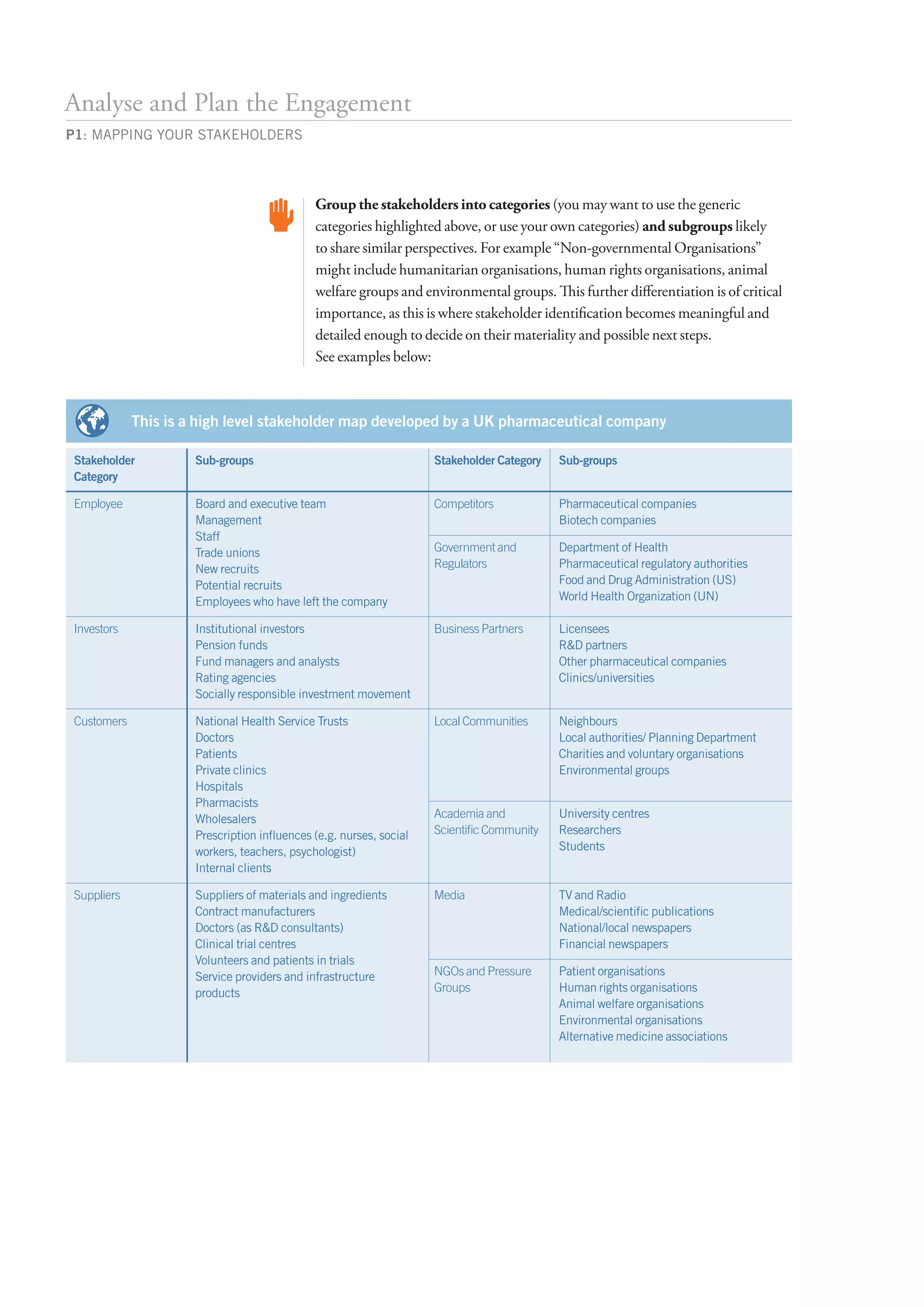
Group the stakeholders into categories (you may want to use the generic 
categories highlighted above, or use your own categories) and subgroups likely 
to share similar perspectives. For example “Non-governmental Organisations” 
might include humanitarian organisations, human rights organisations, animal 
welfare groups and environmental groups. Th is further diff erentiation is of critical 
importance, as this is where stakeholder identifi cation becomes meaningful and 
detailed enough to decide on their materiality and possible next steps. 
See examples below: 
P1: MAPPING YOUR STAKEHOLDERS 
This is a high level stakeholder map developed by a UK pharmaceutical company 
Sub-groups 
Board and executive team 
Management 
Staff 
Trade unions 
New recruits 
Potential recruits 
Employees who have left the company 
Institutional investors 
Pension funds 
Fund managers and analysts 
Rating agencies 
Socially responsible investment movement 
National Health Service Trusts 
Doctors 
Patients 
Private clinics 
Hospitals 
Pharmacists 
Wholesalers 
Prescription infl uences (e.g. nurses, social 
workers, teachers, psychologist) 
Internal clients 
Suppliers of materials and ingredients 
Contract manufacturers 
Doctors (as R&D consultants) 
Clinical trial centres 
Volunteers and patients in trials 
Service providers and infrastructure 
products 
Stakeholder 
Category 
Employee 
Investors 
Customers 
Suppliers 
Stakeholder Category 
Competitors 
Government and 
Regulators 
Business Partners 
Local Communities 
Academia and 
Scientifi c Community 
Media 
NGOs and Pressure 
Groups 
Sub-groups 
Pharmaceutical companies 
Biotech companies 
Department of Health 
Pharmaceutical regulatory authorities 
Food and Drug Administration (US) 
World Health Organization (UN) 
Licensees 
R&D partners 
Other pharmaceutical companies 
Clinics/universities 
Neighbours 
Local authorities/ Planning Department 
Charities and voluntary organisations 
Environmental groups 
University centres 
Researchers 
Students 
TV and Radio 
Medical/scientifi c publications 
National/local newspapers 
Financial newspapers 
Patient organisations 
Human rights organisations 
Animal welfare organisations 
Environmental organisations 
Alternative medicine associations
STAGE 1 
THINGS TO CONSIDER 
At this point, only consider general groups of stakeholders (e.g. environmental 
NGOs, not “Greenpeace” for example). Guidance on how to identify specifi c 
stakeholder group representatives will be provided in Stage 2. 
Many stakeholder groups will be included in more than one of these dimensions; 
you can situate them into the ‘overlaps’ between the circles. 
A stakeholder map is not analytically comprehensive. It is a tool that illustrates 
the range of stakeholders and helps you develop your engagement plan. 
Do not exclude any stakeholder groups at this Stage, even if you do not have good 
relations with them or you do not think they are willing to engage. 
Th e stakeholder map will evolve as the engagement process goes on and you learn 
more about your stakeholders. 
As you engage with stakeholders you should also ask them who else they think 
you should engage with. 
Camelot's Eight Stakeholder Groups 
Camelot, the operator of the UK national lottery, manages its social responsibilities and social impact in consultation with eight 
stakeholder groups: 
Players and Winners: The UK residents who regularly play National Lottery games, and winners of both large and small amounts. 
Employees: Around 900 full time equivalent staff. 
Local community: Communities represented by local charities, voluntary and community groups. 
Governmental bodies: The Department for Culture, Media and Sport, other government departments, the National Lottery 
Commission, the National Lottery Distribution Bodies and the National Lottery Promotions Unit. 
Retailers: Their network of around 28,000 retailers, ranging from the large supermarket chains to the corner shop. 
Suppliers and partners: Around 600 large and small suppliers of goods and services, and strategic partners. 
Public interest groups: Academic institutions, charities, religious groups, campaigning organisations and welfare groups 
representing amongst others those who may be at risk from gambling products, including young people, those on low incomes and 
those who may play excessively, or who work around environmental issues. 
Shareholders: Their fi ve corporate shareholders. 
THE PRACTITIONER'S HANDBOOK ON STAKEHOLDER ENGAGEMENT | 27
Analyse and Plan the Engagement 
P2: SETTING STRATEGIC OBJECTIVES FOR ENGAGEMENT 
BACKGROUND 
Why should you engage? Th e fact is you already do. Stakeholder engagement 
is not a new fad – it’s as old as business itself. Th e process by which you already 
communicate with your shareholders, customers, staff , business partners and 
suppliers is stakeholder engagement. In these cases, the strategic importance of 
engagement is immediately obvious. However, as we have seen, there are many 
good strategic and operational reasons to engage with less-traditional groups 
and on less-traditional issues. Th e table below highlights how the nature of 
stakeholder engagement is changing: 
Norsk Hydro in the Barents Sea Region 
The Norwegian oil and aluminium company Norsk Hydro started working with local communities to facilitate and support the 
development of a competitive local supplier industry in the Barents Sea region even before they had made a fi nal decision to build 
a production facility there. Developing a supply base alone would have been unfeasible for Norsk Hydro, due to a lack of local 
knowledge and insights into local development requirements. Working with local communities and the regional administration 
allowed them to learn from each other, develop a trust-based relationship, and to identify the best opportunities for developing the 
region to mutual advantage. 
THE CHANGING NATURE OF RELATIONSHIPS WITH STAKEHOLDERS 
Who are your stakeholders? 
From traditional 
business 
interactions: 
What issues do you need to address with them? 
From legal and 
contractual 
issues: 
From one-way 
communication 
Employees, customers, 
suppliers, investors, and 
regulators. 
Marketing, industrial relations, 
site selection, business 
planning, and procurement. 
Market research, corporate 
communications, advertising 
and media publicity. 
Local communities, supply 
chain workers, employees' 
families, civil society 
organisations, … 
Corruption, social exclusion, 
human rights, health risks, 
economic development, 
supply chain labour conditions, 
environmental impacts… 
Consultation, stakeholder 
advisory panels, online 
feedback, multi-stakeholder 
forums and partnerships, 
convening networks of 
stakeholders. 
How do you do it? 
To broader groups: 
To emerging issues 
and new 
responsibilities: 
To dialogue and 
partnership: 
These changes in the nature of relationship with stakeholders are driven by a 
broad but interlinked variety of changes in the business environment. Th ese include 
the eff ects of technological innovations, political and regulatory developments, 
societal trends as well as market developments. Th e table on the next page provides 
a brief overview:
STAGE 1 
The changing drivers for engagement 4 
New Legal and voluntary obligations to disclose information and engage with stakeholders, 
for example: 
– The US Sarbanes Oxley Act, Federal sentencing guidelines, Toxics Release Inventory and Community Reinvestment 
Act, as well as the Canadian Bank Act in North America. 
– The UK Operating and Financial Review and Pensions Act, the French New Economic Regulations, the Danish 
Financial Statements Act, the German Bilanzrechtsreformgesetz, Swedish Annual Accounts Act and Dutch 
Environmental Protection Act in Europe. 
– The Japanese Law of promotion of environmentally conscious business activities, the Australian Financial Services 
Reform Act, and voluntary stock exchange requirements for example in South Africa and Brazil. 
– Whilst various Governments in Europe have started to develop national corporate responsibility plans in which 
stakeholder engagement is a key ingredient, international fi nancial institutions (such as the International Finance 
Corporation and World Bank) today also require for stakeholder engagement in advance of major projects. 
More people have become interested in the conduct of business, in the past decade: 
– World’s number of NGOs has risen from 3,600 to 44,000 in the last two decades. 
– $1 in every $8 in the USA is invested according to some kind of ethical, social or environmental criteria. 
– The Internet has made information pervasive and immediately available. 
Companies need to understand their consumers, workers and related communities, who 
are increasingly concentrated in emerging markets: 
– Two out of fi ve people live in India or China. 
– 50% of the world’s people live on less than $2 per day. 
– By 2015 there will be 2 billion more people, almost all born in developing countries. 
Society increasingly expects business to be part of the solution in issues like equity, health and security. 
In the past decade: 
– Strong state intervention or the ‘welfare state’ has shrunk in many countries. 
– Foreign direct investment has grown tenfold and is now more than six times greater than international aid. 
– Multistakeholder partnerships and initiatives have become key vehicles mobilising business in development. 
Technological inventions and applications raise often complex ethical questions and dilemmas in applying precaution. 
In many cases companies alone may not have the answer and need societal / stakeholder dialogue to come to joint 
understanding of acceptable levels of risk. For example: 
– Genetically modifi ed organisms (GMOs) 
– Nanotechnology 
– Mobile phone technology 
– Nuclear power 
It has often taken a major incident for companies to realise that they need better systems for stakeholder engagement. 
For example : 
– The Bhopal tragedy in India led chemical companies to engage with stakeholders over environmental impacts, 
setting up the Responsible Care initiative. 
– Shell realised it had to engage with critical stakeholders after it faced campaigns against its handling of Brent Spar 
and treatment of the Ogoni people in Nigeria. 
– Press exposés on issues of child labour, forced labour and poor working conditions in chocolate, sportswear and 
mobile phone supply chains led to companies engaging with NGOs to address these issues. 
– The prevalence of industrial accident worldwide led to UNEP and the International Council Chemical Associations 
setting up the “Awareness and Preparedness for Emergencies at Local Level (APELL) Programme (see overleaf). 
New obligations 
Public Scrutiny 
New Markets 
Societal 
Expectations 
New 
Technologies 
Critical Events 
4 For a more historical overview of these trends, please see this handbook's sister publication, "The Guide to Practitioners' Perspectives". P16. Please also see the introduction in this Handbook. 
THE PRACTITIONER'S HANDBOOK ON STAKEHOLDER ENGAGEMENT | 27
Analyse and Plan the Engagement 
P2: SETTING STRATEGIC OBJECTIVES FOR ENGAGEMENT 
Many of the companies who actively engage with their stakeholders have been 
able to translate this into better decision-making both within and outside of 
the company, and have used it as a strategic tool to strengthen their business 
performance, for example: 
Examples of business benefi ts of engagement 
Agricultural company Monsanto admits that in the 1990s the company was arrogant and secretive in its dealings 
with the outside world over genetically modifi ed crops, which severely damaged its reputation, markets and investor 
confi dence. The fi rm has now committed to ‘The New Monsanto Pledge’ of dialogue, transparency, technology sharing 
and respect for stakeholders. 
The US company IBM considers community needs and benefi ts alongside the R&D efforts that IBM makes in creating 
new products. Sometimes IBM will use the community to beta-test new products before going to market. The dual 
benefi ts of this approach are that the community gets quicker and cheaper access to products that are useful to them 
and IBM gets valuable information about its products before going to market. 
Nike established a multi-stakeholder Report Review Committee to consult them during the development of their 2005 
CSR report. As an outcome of consultation and negotiation with these stakeholders, Nike disclosed an unprecedented 
wealth of information about its supply-chain, including labour and human rights abuses. In doing this, they raised 
the benchmark for corporate transparency and contributed to taking the societal dialogue on corporate responsibility 
issues to a higher level. 
The Spanish telecommunications company Telefónica has a history of extensive efforts to provide integrated support 
to the disabled, access to telecommunications to the disadvantaged, and of a range of other initiatives to contribute to 
society. It’s employees reward this with a remarkably high satisfaction rate: In a survey undertaken in 2004, 77% of the 
174,000 Telefónica employees responded with “Yes, I am happy to be working in this company”. The culture of social 
responsibility is reinforced by and expresses itself in initiatives like ATAM, a Telefónica association providing care for 
disabled people. ATAM was founded out of the commitment of employees in partnership with labour unions and the 
company itself in 1973. Telefónica employees give 1% of their salary to this initiative, Telefónica doubles this amount. 
Employees, company and unions are present in ATAM governance bodies. See also www.atam.es. 
The UK telecommunications company Orange engages with local communities and administrations in order to identify 
and ideally agree on the best possible location for new mobile phone transmitter masts. As the number of its masts 
determines its networks capacity and business potential, engaging with these communities to make its networks 
expansion as smooth as possible is a strategic priority. 
IBM's Community Relations Unit brokered a partnership between IBM's research labs and the non-profi t organisation 
SeniorNet to help them understand the needs of computer users with vision, motor and memory impairments and to 
develop and test solutions. 
The Norweigan oil and aluminium company Norsk Hydro is continously discussing common standards for corporate 
responsibility with industry peers. The key objective here is to take social and environmental issues out of business 
competition, as competitive pressures can keep companies from adopting more responsible practices. Within the 
IPIECA (International Petroleum Industry Environmental Conversation Association), the competitors agree on social 
standards that are promoted by the association in cooperation with governments. 
The French water company Suez is working with governments, NGOs and citizens to reduce the cost of delivering 
water and sewage services to poor communities. In Bolivia, Argentina and the Philippines local communities have 
been involved in designing, digging and installing a pipeline that provides affordable water services profi tably. 
Strengthened 
ability to assess 
and manage risks. 
Learning on 
products and 
processes. 
Greater credibility 
amongst 
stakeholders. 
Better 
recruitment and 
retention 
of employees. 
Securing the 
formal and 
informal licence 
to operate from 
government, 
regulators and 
communities. 
Learning and 
insights from 
non-traditional 
sources. 
Collaboration to 
address problems 
and opportunities, 
and to change 
the ‘rules of the 
game’.
STAGE 1 
Awareness and Preparedness for Emergencies at Local Level (APELL) Programme. 
In late 1986, following various chemical accidents, UNEP suggested a series of measures to help governments, particularly in 
developing countries, to reduce the occurrence and harmful effects of technological accidents and emergencies. A key outcome of 
this has been the development of a programme in which stakeholder engagement takes centre Stage in the form of the local level 
company plant working with the local community. 
The APPEL Programme (Awareness and Preparedness for Emergencies at Local Level) has been started by UNEP with the 
International Council of Chemical Associations (ICCA) and other industry associations, governments and local communities. 
The aim has been to minimise the occurrence and harmful effects of technological accidents and emergencies by raising awareness 
within local communities and by improving communication between the parties. APELL provides a well-structured, detailed 
process for developing a co-ordinated, integrated and well-functioning emergency response plan for local communities. It is a tool 
for bringing people together to allow effective communication concerning risks and emergency responses. This process aims to: 
• reduce risk; 
• improve effectiveness of response to accidents; 
• allow people to react appropriately during emergencies. 
The APPEL programme recognises that industries have a responsibility both to minimise risks and to ensure effective planning for 
response, even though it is normally government agencies that have the statutory responsibility to address emergencies outside 
industrial facilities. The APELL concept has been successfully introduced in more than 30 countries and in over 80 industrialised 
communities world wide. 
APELL was also featured at the World Conference on Disaster Reduction (WCDR), held in Kobe (Japan) in January 2005, where 
international priorities and mandates in disaster prevention for the following 10 years have been established. 
See further www.uneptie.org/pc/apell/home.html 
THE PRACTITIONER'S HANDBOOK ON STAKEHOLDER ENGAGEMENT | 31
Analyse and Plan the Engagement 
P2: SETTING STRATEGIC OBJECTIVES FOR ENGAGEMENT 
SUGGESTED METHODOLOGY M2: 
SETTING STRATEGIC OBJECTIVES FOR ENGAGEMENT 
Th e purpose of this activity is to clarify your overall reasons for stakeholder engagement 
and how they relate to broader strategic business objectives. 
Th e examples highlighted previously illustrate some of the business benefi ts that 
engaging with stakeholders can generate. However, it is important to identify the 
possible benefi ts that it can deliver for your specifi c company or project in your specifi c 
situation. Getting involved in wrong engagements can lead to a misuse of resources and 
distract you from more pressing priorities. 
To be eff ective, stakeholder engagement must be relevant to and aligned with your 
own business strategy. Setting strategic engagement objectives is a useful step towards 
developing robust approach to stakeholder engagement and to evaluating success. 
• Consider strategic business objectives, either for the company as a whole or for 
the department or project which is the focus of analysis. Where such objectives 
are not explicitly set, make sure you agree some key strategic objectives with the 
team responsible for the department or project. Strategic business objectives could 
for example be: 
– “To gain 10% annual sales increases in region X for the next fi ve years.” 
– “To meet our majority of customers’ expectations for responsibly produced goods.” 
– “To secure our long-term license to operate in countries that host our sites.” 
– “To identify and make use of new opportunities in less developed countries.” 
– “ Ensure that our products meet all current and future regulatory requirements in the 
European market.” 
– “To minimise negative social impacts resulting from the closure of production sites.” 
• Facilitate a discussion around these objectives, specifi cally focusing on the 
implications these have for your relationships with stakeholders. 
Consider the questions below, and capture the most important answers in Template 2. 
– How do these overall business objectives relate to our broader stakeholder groups? 
– What are the external drivers for stakeholder engagement for us? (and what are the 
risks of failing to engage?) 
– What are we trying to accomplish through stakeholder engagement? What would 
success look like? 
– Why is this important to us? How does it support our business objectives and 
strategies? 
Examples are given in summary Template T2.
STAGE 1 
• Identify Strategic Engagement Objectives, and capture them as brief 
declarations that link stakeholder engagement to strategic business 
objectives: 
– “To manage the risks associated with...” 
– “To develop a new approach to...” 
– “To learn more about...” 
– “To collaborate in addressing...” 
– “To improve our relationship with...” 
– “To fi nd an agreement on...” 
– “To develop our policy on...” 
– “To inform our decision on...” 
Examples are given in summary Template 2. 
THINGS TO CONSIDER 
Stakeholder engagement involves time, resources and commitment, to a degree 
that is easily under-estimated, as has already become clear in the research for 
Volume 1 of this manual. Although the resource implications will not be clear 
until you have developed a more detailed plan and a better understanding of your 
stakeholders expectations, it is important to start the process with the buy-in and 
participation of leadership. Top-level involvement in objective setting helps to 
secure alignment and buy-in. 
You may want to group the objectives, and/or formulate and categorise according 
to short, medium and long-term objectives for engagement. 
You will set more detailed objectives for engagement in Stage 2. 
THE PRACTITIONER'S HANDBOOK ON STAKEHOLDER ENGAGEMENT | 33
Analyse and Plan the Engagement 
P2: SETTING STRATEGIC OBJECTIVES FOR ENGAGEMENT 
SUMMARY TEMPLATE T2: 
SETTING STRATEGIC ENGAGEMENT OBJECTIVES* 
(This is partly fi lled in to match the example business objectives given above:) 
What are our external drivers for stakeholder 
engagement? 
Examples: 
Complex and dynamic development of markets 
in region x. 
Changing customer expectations regarding 
responsible products and services. 
Importance of maintaining ‘licence to operate’ 
Important opportunities in developing markets 
Increased regulation of products and services 
Decreased staff morale and negative media 
attention because of site closures. 
What benefi ts can we gain from stakeholder 
engagement? 
Examples: 
Understand the market and fi nd partners 
important to be successful in region X 
Increased understanding of expectations and 
requirements 
Securing the licence to operate 
Identifi cation and realisation of opportunities 
Improved anticipation of and infl uence on 
regulatory developments 
Improved staff morale, more welcoming 
communities for new sites. 
What are the risks of not engaging? 
Examples: 
Making the wrong development projections and failing to establish the relationships that 
are required for success in the market of region X. 
Failure to meet customers expectations regarding responsible products and services. 
Losing the licence to operate in host countries. 
Failure to make use of opportunities in and help in the development of developing countries. 
Failure of our products and services or research and development activities to correspond 
with regulatory developments. 
Less attractiveness as an employer and increasingly unwelcoming communities. 
Strategic objectives of engagement: 
Examples: 
Learn and understand long-term trends in the behaviour of stakeholders that shape the 
market in region X. 
Develop relationships that are key to success in region X. 
To understand customers’ expectations regarding the responsible production of goods. 
To inform our decision on the social and environmental management of our supply-chain. 
To manage the risks to our licence to operate in our host countries. 
To partner with those stakeholders for the development of and success in new markets in 
developing countries. 
To be informed of and involved in the shaping of current and potential regulatory 
developments regarding our products and services. 
To work with relevant stakeholders in understanding and mitigating socio-economic 
impacts of site closures. 
To enhance our reputation for responsible employment and site-management practices. 
*electronic version downloadable at www.accountability.org.uk
STAGE 1 
P3: IDENTIFYING ISSUES 
BACKGROUND 
Many issues you should consider engaging on will already be clear from the 
strategic engagement objectives discussed above. However, there are issues 
that may not be immediately strategically relevant, but nonetheless need to 
be identifi ed and addressed, as they also have the potential to impede business 
performance. In general, issues can be specifi c or general aspects of a companies 
activities or decisions where: 
– Th e organisation is perceived to have a positive or negative impact on 
stakeholders. 
AND 
– Th ere is a gap between what the company is doing or perceived to be doing, 
and what stakeholders expect the company to be doing in terms of 
management of impacts, behaviour or outcomes. 
Th is range of relevant issues goes beyond the limited defi nition of materiality 
used in fi nancial accounting standards, which are often interpreted conservatively 
to mean only those issues that are likely to have a measurable short-term 
impact on the fi nancial health of an organisation. Th is defi nition of materiality 
does not consider broader economic, social, environmental issues and leaves 
the organisation open to unanticipated risks and unable to identify new 
opportunities. On the other hand without some way of assessing the importance 
of diff erent issues to corporate performance, stakeholder engagement risks getting 
caught up by the short-term dynamics and moods of public opinion. 
A key challenge then is to identify those issues which are material to the business’s 
long-term sucess. Accountability's approach to assesing materiality is described 
below. 
5-Part Materiality Test 
AccountAbility has developed a fi ve-part materiality test as a framework for 
considering the materiality of issues.5 Issues are considered material if they can 
be identifi ed by one or more of the following tests: 
Issues that have direct short-term fi nancial impacts 
Issues where the company has agreed policy statements of a strategic nature – these are 
often in the form of commitments to key stakeholders. 
Issues that comparable organisations consider within their sphere of materiality; i.e. peer-based 
norms. 
Issues that your stakeholders consider important enough to act on (now or in the future). 
Issues which are considered social norms (as indicated by regulations, likely future 
regulation or institutionalised norms and standards). 
A 
B 
C 
D 
E 
5 For further explanation, please see AccountAbility & The UK Social Investment Forum: “Redefi ning Materiality”, London, 2003 
THE PRACTITIONER'S HANDBOOK ON STAKEHOLDER ENGAGEMENT | 35
Using this test entails many subjective judgements (for example whether 
stakeholders are really going to translate their stated concerns into investment or 
purchasing decisions). Th ere is also something of a ‘chicken and egg’ problem in 
using test D, which depends on stakeholders expressing their concerns to identify 
issues for stakeholder engagement. However in practice, the test is intended to 
be used iteratively; it builds on a company’s existing Stage of development in 
understanding stakeholder concerns, but you must also reconsider the answers 
you give ‘now’ later on when you have had more contact with stakeholders. 
SUGGESTED METHODOLOGY M3: 
IDENTIFYING MATERIAL ISSUES 
Th e purpose of this activity is to identify as comprehensively as possible the issues 
associated with the organisation, project or decision in question and to build an 
understanding of how they relate to specifi c stakeholders expectations or concerns. 
This step can be done in a group/workshop setting or as a research process by the 
team leading the engagement process (or by external contractors). 
Use the the 5-part materiality test to identify relevant issues: 
Relevant Sources of Information (see also 'Links into Learning Networks' p57) 
Issues relating to business strategy and plans, risk assessments, accidents and penalties / 
fi nes, areas of lobbying expenditure. 
Corporate policies and existing commitments to stakeholders. 
Policies and practices of competitor organisations. Issues highlighted by industry 
associations and corporate responsibility organisations (such as the International Business 
Leaders Forum, the World Business Council for Sustainable Development). 
(See below for sources of stakeholder information) 
Areas of regulation, proposed regulation and international agreement, voluntary codes and 
multi-stakeholder frameworks / initiatives (such as the Global Reporting Initiative Guidelines 
and the UN Global Compact principles). Emerging norms highlighted by governments, 
intergovernmental bodies and NGOs. 
Think Strategically 
Materiality test 
A. Short-term fi nancial 
impacts 
B. Policy commitment 
C. Peer based norms 
D. Stakeholder 
behaviour and 
concerns 
E. Societal norms 
Identify potential stakeholder concerns (test D) using existing organisational 
knowledge, research and exploratory engagement with key stakeholders as 
appropriate. Sources of information for identifying stakeholder concerns at 
this Stage include: 
P3: IDENTIFYING ISSUES 
Sources of information for materiality test
STAGE 1 
Sources of information for stakeholder concerns and expectations 
Individuals within the organisation will already have some knowledge of stakeholder 
concerns from their current contacts with stakeholders and understanding of the issues 
affecting their part of the organisation. Stakeholders will already be raising issues through 
existing feedback mechanisms from customer hotlines to investor relations meetings. This 
existing knowledge could be brought together through a process of systematic review, 
interviews or workshops with key managers and stakeholders close to the organisation. 
In some cases it may be best to leave the identifi cation of issues open and set the agenda 
with the stakeholders during the engagement process itself. However, while this does allow 
for maximum stakeholder involvement in identifying issues, it may lead to unmanageable 
dialogue which is diffi cult to feed into decision making processes, and leaves stakeholders 
frustrated that the engagement is all talk and no action. 
More passive monitoring of stakeholder viewpoints about the company and industry 
impacts and performance can also be used to identify issues without raising stakeholders’ 
expectations at this Stage. This might include monitoring information sources such 
as national, local, and relevant specialist and academic press, government and 
intergovernmental organisations’ communications or reports, NGO campaigns, infl uential 
public and opinion research and relevant internet discussion forums. 
‘What we know’ 
‘What they tell us’ 
‘ What they say 
about us’ 
Compare your strategic engagement objectives with the issues you have 
highlighted through the materiality test. Each of your strategic engagement 
objectives is likely to relate to a number of issues. E.g. satisfying your customers 
demand for responsibly produced goods may require you to consider various 
human rights, environmental and health and safety issues. If you feel that any 
issue is missing, make sure you include it into your list of issues, and assess it 
according to the fi ve-part test, too. 
Using the above-mentioned sources of information, as appropriate, list 
the issues in the matrix (T3). Th en insert the stakeholder groups or sub-groups 
already identifi ed. 
Apply the materiality test by considering each of the issues in relation to each 
of the fi ve dimensions. Insert a colour-code as suggested in the matrix, and/or 
provide descriptive assessments of the materiality of the issue to the individual 
dimensions of the materiality test. 
Consider the degree of concern amongst stakeholders regarding the issue 
and again capture your results in the table, by using the scoring suggested in the 
table, and/or by providing descriptive assessments of the stakeholders’ concerns. 
Ensure a validation of the matrix. The issue/stakeholder matrix provides a 
record of the identifi cation and analysis of stakeholders and issues at this Stage 
and should be validated by relevant managers and departments, as well as any 
other stakeholder groups or experts you are already working with. 
The matrix provides a preliminary prioritisation of stakeholders, telling 
you which ones are most concerned about which issues. Further steps for 
prioritisation will follow. See also the ‘How to Use’ guide at the bottom of the 
methodology. 
THE PRACTITIONER'S HANDBOOK ON STAKEHOLDER ENGAGEMENT | 37
P3: IDENTIFYING ISSUES 
SUMMARY TEMPLATE T3: OBJECTIVE, ISSUE AND STAKEHOLDER MATRIX* 
For the fi rst strategic objective, the tenplate has been fi lled in by the UK's Co-Operative Group, who used it to consider the impact of 
genetically modifi ed organisms (GM) on their business 
Objective, Issue and Stakeholder Matrix 
Strategic Engagement 
Objective (if applicable) 
1. To address signifi cant 
stakeholders 
concerns when 
dealing with 
genetically modifi ed 
organisms 
Materiality test Stakeholder 
A B C D E 
Group 1 
Issue 
Stakeholder 
Group 2 
Stakeholder 
Group 3 
Co-operative 
group members 
Farmcare (Co-op's 
Farming 
Business) 
Consumers 
2. (insert next strategic 
objective, if 
applicable...) 
Green: not relevant Yellow: low relevance Orange: medium Red: high relevance 
How to Use: 
1. Enter strategic engagement objectives and allocate issues where possible (issues may be relevant to several objectives 
– others may also not be directly related to a strategic objective!) 
2. Enter Materiality Score (see above) 
3. Assess the Stakeholders perception of issues either descriptively and/or using a rating, such as: 
0 not relevant 
1 awareness amongst a few, but no real concern 
2 broader awareness, but little concern 
3 considerable concern amongst a minority 
4 considerable concern amongst many 
5 high level of widespread concern 
Stakeholder 
Group 4 
NGOs 
The table provides you with a summary of key issues, why they are material and which stakeholder groups they are related to. 
You could also decide on threshold scores (or colours). 
Stakeholder 
Group 5 
Non-Food 
Suppliers 
i. Safety of GM 
in food 
ii. Impact of GM 
on biodiversity 
iii. Impact of the 
removal of GM 
within non-food 
iv. Impact of the 
removal of GM 
within packaging 
v. Intra-Group risk 
assosciated 
with implementing 
the policy 
vi. (..further 
issues..) 
4 4 5 5 1 
3 4 5 5 1 
1 3 0 4 1 
1 3 1 4 3 
0 4 4 0 1 
Think Strategically 
*electronic version downloadable at www.accountability.org.uk
STAGE 1 
THINGS TO CONSIDER 
This is only a preliminary identifi cation and assessment of which stakeholders 
are likely to be most concerned about which issues. Further steps for 
prioritisation will follow. 
Check your ‘results’. Show the matrix to relevant decision makers within your 
organisation, to some stakeholders you already have a good relationship with, 
or have experts of specifi c fi elds review it. Th is will enhance the reliability of the 
pre-assessment. 
Not all material issues can be allocated to strategic objectives. Th is does not 
mean you can ignore them. It is important for the compilation of the list 
to remain open-minded and fl exible to issues that may be important to 
stakeholders, but are not immediately seen as relevant to the organisation. 
Only then can the list be comprehensive. 
Th e issue/stakeholder matrix is not set in stone, but is likely to evolve and 
develop as you gain more understanding of stakeholders and issues. 
Review this table as you learn more about your stakeholders. 
Th e issue/stakeholder matrix also highlights where diff erent groups of 
stakeholders are concerned about the same issue and might be better approached 
through a multi-stakeholder process rather than on a one-to-one basis 
(see Stage 2 for more on multi-stakeholder engagement). 
THE PRACTITIONER'S HANDBOOK ON STAKEHOLDER ENGAGEMENT | 39
Think Strategically 
P4: PRIORITISING STAKEHOLDERS AND ISSUES 
BACKGROUND 
Engaging with all stakeholders or on all issues is neither possible nor desirable. 
Th is would go beyond any available resources, and at the same time make it very 
diffi cult to adequately respond to stakeholders, leading to frustration. Th erefore, 
you should try and prioritise your stakeholders and issues to ensure that time, 
resources and expectations are well managed. 
Th e previous processes have enabled an initial overview of the materiality of 
issues and the related concerns and expectations of stakeholders, as well as over 
their relationship to the organisation's strategic objectives. However, further 
factors need to be considered before deciding on priorities for engagement. 
Prioritisation is diffi cult because it is often not possible to quantify the various 
‘stakes’ and make objective comparisons. Nevertheless by setting clear criteria 
for prioritisation linked to the company processes and business strategy you 
are better able to steer the engagement away from being driven by un-strategic 
considerations such as the ‘noisiest’ stakeholders, the short-term focus of the 
media, or the comfort-zone of managers. Below are two ways of prioritising 
stakeholders: 
Prioritisation according to the social maturity of issues 
One useful way to understand the wide range of issues raised by the diversity 
of stakeholders is to consider the maturity of the issues. Pharmaceutical 
company Novo Nordisk created a scale to classify issues according to their 
maturity (see box). 
SIG's Initial Prioritisation and Categorisation of Stakeholders 
The Swiss utilities company SIG started the process of prioritisation with a discussion amongst the executive management team. 
The sustainable development team facilitated the discussion. It identifi ed an ‘a-priori’ set of stakeholder categories: shareholders, 
clients, business partners, employees, public contractors and civil society interest groups. 
The expectations of these groups, and their degree of satisfaction with SIG’s performance, were subsequently evaluated in various 
dialogues with stakeholders. Existing customer surveys also served to shed further light on these subjects. In the prioritisation of 
their stakeholders, SIG considered their importance to SIG’s strategic business objectives, and their current degree of satisfaction.
STAGE 1 
The Four Stages of Issue Maturity 
– Some activist communities and NGOs are aware of the issue. 
– There is weak scientifi c or other hard evidence. 
– The issue is largely ignored or dismissed by the business community, 
– There is political and media awareness of the societal issue. 
– There is an emerging body of research, but data are still weak. 
– Leading businesses experiment with approaches to dealing with the issue. 
– There is an emerging body of business practices around the societal issue. 
– Sector wide and issue-based voluntary initiatives are established. 
– There is litigation and an increasing recognition of the need for legislation. 
– Voluntary standards are developed, and collective action occurs. 
– Legislation or business norms are established. 
– The embedded practices become a normal part of a business-excellence model. 
Latent 
Emerging 
Consolidating 
Institutionalised 
The same issue can be at diff erent stages of maturity in diff erent regions 
or countries, and in diff erent industries. For example, biodiversity is an 
institutionalised issue for European businesses, but an emerging one in North 
America, whilst employee privacy is only an emerging issue in Europe but 
already institutionalised in the US. Similarly, whilst animal welfare has been on 
the agenda for the pharmaceutical industry for some time (in relation to animal 
testing) and business norms on animal testing have now become institutionalised 
in this industry, within the oil and gas industry it is only now emerging as an issue 
of controversy and debate, although animal welfare NGOs express much concern 
about the use of animals in testing petrochemical products. 
While acknowledging the fact that issues, which are high on the ‘maturity 
ladder’, receive quite a lot of attention in various ways, this does not mean 
that the societal debate about its resolution is over. At the same time, high 
social maturity also does not necessarily imply that a sustainable solution 
has been found – nor that the current approach is acceptable to the majority 
of stakeholders. Th erefore, an effi cient process of stakeholder engagement 
needs to be open to constant change and to the involvement of changing 
stakeholder groups, even if the issue is becoming increasingly institutionalised. 
A good example of this is the development of corporate reporting practices on 
environmental issues in the last 20 years. 
At each Stage of maturity there is a diff erent mix of stakeholder expectations, 
external pressures, risks and opportunities, all of which are essential to 
understand in prioritising areas for engagement and planning the actual 
engagement processes. 
THE PRACTITIONER'S HANDBOOK ON STAKEHOLDER ENGAGEMENT | 41
Think Strategically 
P4: PRIORITISING STAKEHOLDERS AND ISSUES 
In general, the more mature an issue is, the more essential it is for a company 
to address the issue. However, the response to the issue also depends on the 
company’s general approach towards stakeholder engagement, or issues of 
corporate responsibility more generally. Th e table below illustrates the way that 
a company, which considers stakeholder engagement as an opportunity, might 
typically decide to react to each Stage, as well as the reactions of a company that 
takes a more defensive, reactive approach. 
Leadership company’s 
stakeholder engagement 
process. 
Maintaining ongoing dialogue 
with NGOs and stakeholder 
opinion leaders. 
Working with an international 
organisation to develop new 
preventative or proactive 
management, production or 
marketing approaches that 
address stakeholder concerns. 
Play a leading role in multi-sector 
and sector-wide 
responses to the issue by 
promoting best practise and 
developing standards 
Formalised engagement 
processes such as industrial 
relations with trade unions or 
governments. 
Different responses to the maturity of issues 
Leadership company’s 
opportunity focused response: 
Gain early understanding of 
new risks and opportunities, 
and practise precaution as 
required. 
Address the issue early to win 
market shares, or competitive 
or reputational advantages. 
Finding allies for managing 
and addressing these impacts 
to prevent best practise from 
being undercut by companies 
that ignore the impacts. 
Making sure that everybody 
complies with social norms 
and commitments. 
Stage of 
issue maturity 
Defensive company’s response 
“ It’s not our job to understand 
that” 
“ It’s not our job to 
address that” 
“ It’s not our job to 
regulate that” 
“We’ll do it if we have to” 
Novo Nordisk and the growth of diabetes in the developing world 
The Danish healthcare company Novo Nordisk’s main business is the prevention and treatment of diabetes. Diabetes is now 
recognised as a pandemic, and the current number of people with diabetes, which in 2003 has been estimated to be 194million, is 
expected toincrease to 333 million by 2025. Two-thirds of future diabetes cases are expected to occur in the developing world. 
Meeting the associated challenges is complicated. Low- and middle-income countries often lack the healthcare information to meet 
the needs of a growing number of people with diabetes. Furthermore, a lacking awareness of and education about diabetes is a serious 
problem. Therefore, many experts believe that the solution lies in taking an approach that combines increased awareness, education 
and prevention with improved access to treatment. 
Novo Nordisk works together with governments, patient organisations and other partners to improve diabetes care in poorer countries, 
using its expertise and competence in diabetes to address some of the above issues. At the same time, Novo Nordisk is building a 
long-term sustainable business advantage as a leader in diabetes care in the developing world, while responding to growing pressure 
from society to increase access to medicine in developing countries. 
This strategy for improved access to diabetes care has been built on World Health Organisation’s recommendations. Novo Nordisk 
supports the building and development of national healthcare strategies and capacities with the National Diabetes Programme, which 
is setting up diabetes activities in eight developing or emerging economies. Activities include educating nurses, equipping diabetes 
clinics, supporting diabetes patient organisations and working with governments. It has also offered insulin to the public health 
systems of the 50 least developed countries, as defi ned by the UN, at prices not to exceed 20% of the average price in the highly 
developed countries of North America, Europe and Japan. 
Latent 
Emerging 
Consolidating 
Institutionalised 
Company 
response
STAGE 1 
Stakeholder dependence on 
the organisation 
Further to my points above, it's important to note that dialogue doesn't necessarily 
stop or 'just' become formaised once an issue becomes inststutionalised. 
Between defensive and opportunity focused companies, there is a spectrum 
of approaches where companies take an increasingly proactive and embedded 
approach to addressing issues raised by stakeholders. 
Prioritising according to the infl uence and dependence of stakeholders 
Another way to approach the question of strategic alignment is identifying those 
stakeholders that are likely to have the greatest impact on the achievement of 
your strategic objectives, and those stakeholders that will be most positively or 
negatively impacted by the company’s operations. Th is will enable you to prioritise 
your attention and action to ensure that you can achieve your strategic objectives, 
while respecting the rights of signifi cantly impacted stakeholders. 
In order to ensure this, a company might prioritise stakeholder groups in this way: 
However, for any particular company or issue, such a matrix may need to be 
adjusted to refl ect the most relevant prioritisation criteria in each case. For 
example, instead of company dependence, one could consider the dependence 
of specifi c strategic business objectives, or of specifi c business divisions on the 
stakeholders, which would allow for a more specifi c prioritisation of stakeholders. 
Also, it is important to be aware of the interactions between the diff erent 
stakeholder groups, for example through lobbying or advocacy activities. 
One key driver for corporate responsibility in recent years has been the 
development of coalitions of diverse stakeholders around key issues. In particular, 
high infl uence /low dependency stakeholders such as investors and consumers 
have ‘lent their infl uence to low infl uence high dependency stakeholders such as 
supply chain workers in developing countries, future generations and animals, 
in order to focus corporate attention on issues such as supply chain labour 
conditions, environmental care and animal welfare. 
High 
Low 
Low 
Treat fairly – honour commitments to 
these stakeholders in line with company 
policy, regulations and industry norms, 
otherwise endeavour to keep stakeholders 
satisfi ed insofar as balance of costs and 
benefi ts allow. 
Low priority - provide access to general 
channels of information and feedback. 
High 
Strategic threat or opportunity - invest in 
engagement processes to understand 
concerns and develop solutions. 
Keep involved and informed, but ensure 
balance between the concerns of high 
infl uence stakeholders and those of people 
actually impacted by decisions. 
Stakeholder Infl uence and Dependancy Matrix 
Stakeholder infl uence on organisation 
THE PRACTITIONER'S HANDBOOK ON STAKEHOLDER ENGAGEMENT | 43
Think Strategically 
Maturity of issue 
Latent 
Emerging 
Consolidating 
Institutionalised 
SUGGESTED METHODOLOGIES M4: 
PRIORITISING STAKEHOLDERS AND ISSUES 
Th e purpose of this activity is to identify which issues and/or stakeholders represent 
key priorities for engagement by your organisation. 
Decide whether to focus initially on prioritising by issues or stakeholders – this 
will depend on the context as outlined on p36 – If you have already determined 
which stakeholders you need to engage with, prioritise issues. If the engagement 
is issue driven, prioritise stakeholders. Otherwise be guided by whether you 
know more about the stakeholders or the issues. 
In both cases convene a workshop of managers from across the departments and 
functions that are likely to be knowledgeable about the stakeholders and issues, 
be concerned about the outcomes of engagement or be responsible for 
implementing follow up action. You may also consider inviting outsiders with 
expertise relating 
to the issues or stakeholder groups involved. 
Select a person either from inside or outside the company to facilitate. 
you can use the objective, issue and stakeholder matrix (T1) a basis for 
discussion. 
Prioritising issues 
Categorise the issues identifi ed in the issue/stakeholder matrix as latent, 
emerging, consolidating or institutionalised according to the following criteria: 
Evidence 
Weak scientifi c or other 
hard evidence. 
Emerging body of research, 
vbut no clear agreement on 
conclusions 
Strong evidence 
Less focus on evidence: 
the case has been made and 
accepted. 
Awareness 
Some activist communities, 
academics and NGOs are 
aware of the issue.Little 
business community awareness. 
Focus of NGO campaigning, 
political and media awareness. 
Leading businesses are 
experimenting with 
approaches to dealing 
with the issue. 
High level of general 
awareness of issue amongst 
relevant business, civil society 
and public bodies. 
Addressing this issue is a normal 
part of a business-excellence 
model. 
Expectations 
No regulation or 
recognised standards for 
business. 
Boundaries of business 
responsibility subject of 
public debate. 
Best practice approaches 
increasingly promoted and 
recognised. Voluntary 
standards are established 
and legislation may be 
proposed. 
Legislation or strong 
business norms are 
established. 
P4: PRIORITISING STAKEHOLDERS AND ISSUES 
Issue maturity rating
STAGE 1 
Discuss the objectives of your organisation in relation to the issues within each of 
the four categories of maturity, the risks and opportunities involved and the types 
of stakeholders that are relevant for this. Consider how to approach issues in each 
category and whether further prioritisation criteria are needed. 
Use the issue maturity analysis to assign levels of priority or broad approaches to 
engagement to each of the issues. 
Prioritising stakeholders 
Decide on prioritisation criteria for stakeholders. Infl uence, dependency and 
willingness to engage are good general starting points but you may also need to 
consider other more specifi c criteria. 
Discuss and analyse how each stakeholder group rates against these criteria. 
– Remove, grant or infl uence ‘license to operate’ 
– Restrict access to resources, operating sites or intellectual capital 
– Damage or build company reputation 
– Contribute or detract from companies ability to learn and innovate 
– Restrict or provide access to investment funds 
– Provide useful early warning signals about emerging issues and risks or cause 
distractions diverting management attention and time from core activities 
depending on the context of engagement may want to focus on some or all of 
these sources of infl uence. 
– Direct fi nancial dependence (e.g. who depend on you for wages, purchases, grants) 
– Indirect fi nancial dependence (e.g. whose livelihoods depend on you through your 
contributions to the regional economy, or for example low income customers who depend 
on low prices for basic goods which you may provide) 
– Non-fi nancial dependence (e.g. those who depend on you for essential services) 
– Non-fi nancial impairment or risk from your operations (e.g. through air or noise pollution 
or from risk to health for consumers of your products) 
– Low/no choice (e.g. employees facing compulsory redundancy, neighbours to a 
production plant, addicts in the case of addictive products, consumers vulnerable due 
to illiteracy, etc) 
– Adversarial/ hostile 
– Unknown 
– Uninterested 
– Engaged through formal mechanism (e.g. via governance, regulation, negotiation) 
– Cooperative 
– Competitive 
Plot stakeholders on the following grid using infl uence and dependency as the axes. 
High impact 
stakeholder groups 
are those with the 
power to: 
High dependency 
stakeholders are 
those who are in a 
position of: 
The willingness and 
ability of stakeholders 
to engage can be 
classifi ed in various 
ways as appropriate: 
THE PRACTITIONER'S HANDBOOK ON STAKEHOLDER ENGAGEMENT | 45
P4: PRIORITISING STAKEHOLDERS AND ISSUES 
SUMMARY TEMPLATE T4: STAKEHOLDER INFLUENCE DEPENDENCY MATRIX* 
Stakeholder dependence on company 
(or project, objective or business line...) 
High 
dependence 
- no choice 
No direct 
impacts - 
stakeholders 
have 
broad range 
of choice 
Stakeholder infl uence on company (or objective, project or business line) 
No Infl uence Low infl uence Some infl uence Formal power/ 
high infl uence 
Optional: illustrate relationships between stakeholders using arrows to show 
infl uence from one stakeholder to another. 
Discuss the mapped results; consider how to approach stakeholders in each 
quadrant and whether further prioritisation criteria are needed. 
Use the stakeholder analysis to assign levels of priority or broad approaches to 
engagement to each of the stakeholder groups 
Think Strategically 
*electronic version downloadable at www.accountability.org.uk
STAGE 1 
THINGS TO CONSIDER 
You might decide to prioritise issues and then go on to prioritise stakeholders 
relevant to the high priority issues where stakeholder engagement is identifi ed as 
necessary. 
Issues may not be clearly within one of the four stages of maturity, but might 
have characteristics of diff erent stages. Often for example, public knowledge and 
concern is not in step with the state of evidence and scientifi c consensus. 
Additional stakeholders and issues may emerge at any time, so the matrix and 
prioritisations should be continually updated to serve as a useful source of 
reference. 
Camelot's Integrated Prioritisation of Stakeholders and Issues 
Based on their strategic objectives and organisational mission, Camelot the operator of the UK national lottery, has constructed a two-level 
prioritisation of stakeholders (see p27 for Camelot’s stakeholder groups), where specifi c issues of importance are related to specifi c 
stakeholder groups. Below is an extract from their social report: 
KEY PRIORITIES 
Sales, players and winners: 
Our sales performance, the introduction of new games and the playing and winning 
experience are critical to building a growing National Lottery, and are of direct interest to 
many of our stakeholders - the public and players, retailers, employees, pressure groups, 
suppliers and shareholders. 
Good causes: 
Ensuring maximum returns to Good Causes and showing people the breadth of projects that 
The National Lottery has funded is critical to building a respected National Lottery, and is 
relevant to the public, retailers, community and shareholders. 
Our future: 
The discussions focused on distribution of lottery funds, how the third licence to operate 
the lottery will be awarded and the changes in gambling regulation are critical to the future 
of The National Lottery. The outcome of these discussions will have a huge impact on all of 
our stakeholders - the public and players, employees, retailers, community, pressure groups, 
suppliers and shareholders. 
Our people: 
The skills, motivation and commitment of our people are critical to our ability to deliver our 
strategic goal of building growth and respect. In addition, our people, and their behaviour and 
choices will directly infl uence our impact on the communities and environment in which we 
operate. This issue has particular bearing on our employees and shareholders. 
Responsible play: 
Ensuring the protection of vulnerable groups, such as young people, those on low incomes 
or those susceptible to gaming addiction is key to ensuring that The National Lottery is a 
respected institution, and is of importance to the public, retailers and pressure groups. 
SECONDARY PRIORITIES 
Investment in retail: 
Giving our retail partners the support 
they need is important to building a 
growing National Lottery and is relevant 
to the public, retailers, community, 
pressure groups, our suppliers and 
shareholders. 
Our supply chain: 
We operate one of the most effi cient 
lotteries in the world. Value for money 
and shared integrity are important 
to enable us to operate effi ciently 
and to ensure The National Lottery 
is respected. We are also mindful 
of the impact our suppliers have on 
the environment. These issues are 
particularly relevant to our suppliers 
and shareholders. 
Environment: 
Camelot’s environmental performance 
and that of our suppliers is part of 
being a respected operator of The 
National Lottery. This area is relevant 
to our employees and environment 
stakeholders. 
Community involvement: 
Camelot’s own contribution to the 
community is an integral part of being 
a respected operator, and is of key 
relevance to employees, pressure 
groups and community stakeholders. 
THE PRACTITIONER'S HANDBOOK ON STAKEHOLDER ENGAGEMENT | 47
ROUND UP 
STAGE 1 REVIEW 
By the end of this Stage you should have an overall understanding of the relationship 
between your overall business strategy and stakeholders, and defi ned related strategic 
objectives for engagement. However, be aware that your understanding will have to 
be verifi ed by your stakeholders. You will also have mapped the key groups of people 
who are aff ected by and can aff ect the way your organisation meets its goals, as well as 
the potential issues relevant to each stakeholder group. You will also have established 
priorities regarding the stakeholders and issues that you will intend to address. 
Outputs 
Strategic Engagement Objectives 
Objectives, Issues & Stakeholder matrix 
Initial prioritisation of stakeholders and/or issues 
Think Strategically
STAGE 2 
Take time to analyse and plan the engagement
STAGE 2 
Th ere is always an element of ‘learning on the job’ and opportunism with 
stakeholder engagement. Companies often start engaging with stakeholders they 
already know well, and then start talking to others outside of their traditional 
comfort zone. Others start by responding to a particular crisis or opportunity. 
Th e stakeholder engagement process itself is a learning cycle as both the company 
and its stakeholders learn more about each other’s motivations, ways of working 
and spheres of infl uence. 
However, this does not mean that stakeholder engagement cannot and should 
not be planned in the same way that other business activities are planned. 
Without good planning stakeholder engagement processes are unlikely to 
deliver where it counts for the business. Instead it may end in disappointment, 
recriminations and damaged relationships with the people that you have already 
recognised as essential to your organisation’s success 
Analyse and Plan 
PURPOSE 
Th e aim of this Stage is to collect information and develop a plan of action 
based on your strategic engagement priorities and current abilities. 
THE PRACTITIONER'S HANDBOOK ON STAKEHOLDER ENGAGEMENT | 49
Analyse and Plan 
PRINCIPLES 
Th e key principles that this Stage intends to deliver on are materiality 
and completeness. 
'Inclusivity' 
"Considering the stakeholders' interests in organisational decision making'" 
Principles 
Materiality Completeness Responsiveness 
Means here: Collecting and analysing further information from within and outside of the 
organisation to enable the business to make an informed decision on what the material issues 
and stakeholder are, and these can be addressed adequately. 
PROCESS 
Th e actions and tools outlined in this Stage take you through four linked 
questions to help develop a plan of action for engagement based on a clear 
understanding of the expectation gaps between your organisation, its 
stakeholders and peers as well as the changes and resources that might be 
necessary to close these gaps. 
Th is will help you to develop a strategically aligned, resource-effi cient approach 
to engagement and to initiate the process of internal learning and engagement of 
key departments and individuals needed to make stakeholder engagement more 
than just talk. 
You will want to develop a clear idea of: 
• How the issues that you have prioritised so far are currently managed within 
your organisation; 
• How you are currently engaging with stakeholders on these issues; 
• What others are doing, and with whom you could collaborate; 
• What you can and want to do about the specifi c issues; 
• Which specifi c stakeholder representatives you want to engage with, and 
what they expect. 
Th is Stage is outlined in fi ve steps that can be used as a process for collecting the 
information you need for successful stakeholder engagement. But the individual 
elements and associated tools can also be used within your existing management 
and planning processes where stakeholder engagement is seen as an integral part 
of achieving discrete business objectives.
STAGE 2 
Stage 1: Think strategically about stakeholder 
engagement 
Strategic objectives and list of 
priority stakeholders and/or 
issues 
Stage 2: Analyse and Plan 
Where do we want 
to go with our 
stakeholders? 
Stakeholder 
Representative 
Profi les & Priorities 
Organisational 
and Stakeholder 
Development Plan 
Resource 
commitments 
& margins of 
movement 
How are others 
addressing this 
issue 
Where are we now? 
What are our 
stakeholders' 
expectations? 
THE PRACTITIONER'S HANDBOOK ON STAKEHOLDER ENGAGEMENT | 51
Analyse and Plan 
BACKGROUND 
Before planning a stakeholder engagement process it is essential to know where 
you already are on the material issues in question: 
• How is the issue currently managed within your organisation? 
• What policies and systems do you already have in place? 
• What is it that you can and want to do about these issues? 
This information provides the practical basis for building more robust and 
responsive stakeholder engagement processes, but also the basis on which to 
assess your current practice against your objectives and against the level of 
maturity of the issues in question. 
An organisation’s stakeholder engagement practice in relation to an individual 
issue can be characterised within the following fi ve stages of development 
(see below) .5 
P5: REVIEWING YOUR PROGRESS 
Organisational Learning Stages 
No Engagement No engagement on an issue 
Exploratory 
Developing 
Embedded 
Strategic 
Ad-hoc engagement with stakeholders when opportunities or challenges arise: focused 
on learning and exploring the issue and often dependent on individual commitment. 
Good quality engagement processes with some thought to design and stakeholder 
needs, but management systems are patchy, the impact of engagements to actual 
operational decision making is unclear, and there are no clearly established 
performance objectives addressing the issue. 
High quality engagement processes feed into operational decision making and are 
embedded in core management processes. Engagement is systematised to ensure that 
the issue is adequately addressed. 
High quality engagement embedded in management and governance processes and 
linked to business strategy. Issues are addressed in-depth, often with the objective of 
systemic change and on a global and local level. 
These organisational responses can then be compared to the maturity of an 
issue, which you have already assessed in Stage 1. Th is is the purpose of the Issue 
Response Matrix opposite: 
5 This model aligns with the value creation model presented in "Volume 1. The Guide to Practitioners' Perspectives", on p.27.
STAGE 2 
The Issue Response Matrix 
Higher 
Opportunity Green 
Zone 
C 
B 
A 
LATENT EMERGING CONSOLIDATING INSTITUTIONALISED 
STRATEGIC 
EMBEDDED 
DEVELOPING 
EXPLORATORY 
Organisational 
Response 
Social Maturity of an Issue 
Risky Red Zone 
The issue response matrix guides you in comparing your company’s way of 
dealing with an issue with the maturity of debate about it within society more 
broadly. It thereby helps you to identify where you are in a leadership position 
and where you are at risk. On the other hand, it also helps you to identify where 
you might want to be in relation to an issue under consideration. 
Example Application for the Issue Response Matrix: Child Labour in the Supply Chain 
There is widespread consensus amongst citizens, consumers, business and governments that children should not be forced to work long 
hours in jobs that sacrifi ce their health, safety and education. 141 countries have ratifi ed the ILO Minimum Age Convention and 153 have 
ratifi ed the ILO Worst Forms of Child Labour Convention. Most of these countries have legislation on their statute books aimed at ending 
child labour and many have programmes to combat child labour often with technical or fi nancial support from the ILO or international 
donors. A number of industry associations, NGOs and multi-sector initiatives are also working to address the issue, voluntary guidance for 
buyers have been developed, and many businesses are working to improve the management and monitoring systems which help avoid 
child labour within their supply chains. It can be considered a consolidated issue. 
Yet the ILO estimates that 1 in 6 children is at work instead of at school and three-quarters of these are involved in hazardous work. 
Amongst companies whose operations and sourcing networks extend into countries and sectors where child labour is endemic, different 
levels of response can be seen. 
• The business which is still developing its basic policies, where any information it gains about child labour in its supply chain does not 
necessarily feed into operational decision making processes, and where there are no performance objectives, would locate its response 
at A. Here, the business is vulnerable to advocacy and brand damage, unprepared for potential regulation, and other businesses 
leading on the issue may shy away from collaborating with it. 
• A business which has systematic management and monitoring processes, policies, targets and ongoing engagement initiatives with 
suppliers in place to address and minimise child-labour in its own supply chain would locate its issue response at B and can consider 
itself to be in-step with societal development. 
• A business which has developed sophisticated organisational policies and management systems on the issue, has assigned top-level 
responsibility for avoiding child-labour, and is engaged with a wider range of stakeholders such as industry bodies, governments, NGOs 
and the ILO in initiatives to solve the associated challenges, could locate its response at C. This strategic approach might give this 
company the opportunity to profi le itself as a particularly responsible business in the marketplace and with regulators. 
THE PRACTITIONER'S HANDBOOK ON STAKEHOLDER ENGAGEMENT | 53
Analyse and Plan 
P5: REVIEWING YOUR PROGRESS 
SUGGESTED METHODOLOGY M5: 
ASSESSING YOUR CURRENT ORGANISATIONAL RESPONSE 
Th e purpose of this activity is to establish a clearer picture of the degree and 
mechanisms that the business currently has in place to address specifi c issues. It involves 
an assessment of current processes of management and stakeholder engagement in 
relation to the issue, and helps you to identify areas for improvement. 
• Using the Template 5 (below) as guidance, investigate what level of 
development your organisation has reached in relation to each of your 
prioritised issues, and note any particular areas where organisational response 
enablers are weak in relation to a particular issue. The Template guides you in 
doing this and helps to capture the results of this assessment. 
• Chart issues on Issue/Response matrix (above) to highlight those areas 
where you fall into the red risk zone or green opportunity zone. 
• Identify target levels of development for specifi c aspects of your approach to 
prioritised issues or stakeholder map. 
• Finally, consider the fi nancial resources that may be required for engagement, 
as well as for the possible outcomes of engagement. Are key budget holders 
committed to supporting this process? Is it clear to which degree fi nancial 
resources will be made available? 
THINGS TO CONSIDER 
• This process should draw on sources of expertise throughout the company, 
including aspects of stakeholder management processes already documented 
in policies and guidelines as well as through interviews, workshops or meetings 
with key individuals within the company. 
• The “current engagement activities” row should ideally be considered in 
conjunction with the analysis of current engagement undertaken described on 
p63. 
Explanation to Template T5 
The different rows of this table help you to assess whether your business’ current management systems / policies and processes 
are adequate for the maturity of the issue in question. 
If all of your responses are 1, your organisation is in a good position to respond to the issue in a strategic manner. 
If your answers are all 2, then your business response can be considered as embedded. 
If all answers are equal to 3, then the current processes are developing. 
Answers of 4 indicate an exploratory approach. Finally if the majority of responses are 5, this indicates that your company is 
not addressing the issue. 
Consider your organisational response in light of the maturity of the issue – are you a leader or a laggard in relation to this issue? 
How does this relate to your strategic objectives and assessment of risks and opportunities in this area? 
Highlight areas for improvement in the fi nal row.
STAGE 2 
SUMMARY TEMPLATE T5: 
ASSESSMENT OF ORGANISATIONAL ABILITY TO RESPOND TO AN ISSUE* 
1. Formal commitments in place with responsibility at board level. 
2. Formal commitments with responsibility at senior management level 
3. Formal statement or policies made but no formal responsibility at senior levels. 
4. Action to address issue driven by individual commitment and awareness. 
5. No awareness/action. 
Give details: __________________________________________________________ 
Overall adequacy of your ability to respond / areas which require improvement: 
Which improvements are required in the 6 areas (rows) given above? 
THE PRACTITIONER'S HANDBOOK ON STAKEHOLDER ENGAGEMENT | 55 
Governance and 
management 
commitment to issue 
Latent 
Policy regarding the 
issue 
1. Formal policy with objectives that are linked to business strategy. 
2. Formal policy with objectives that are not linked to business strategy. 
3. Draft or holding policy but no objectives. 
4. Early discussions about policy. 
5. No policy. 
Give details: __________________________________________________________ 
Current engagement 
activities regarding 
the issue 
1. Formalised and integrated into management and governance processes with robust documentation and 
reporting systems. 
2. Systematised engagement approach with documentation and some linkage into decision making processes. 
3. Established engagement processes for some relevant stakeholders/ issues. 
4. Sporadic engagement processes, limited internal controls. 
5. No engagement. 
Give details: __________________________________________________________ 
Performance 
indicators/ 
measurements 
regarding the issue 
1. Strategic objectives and SMART Key Performance Indicators (KPIs) set in order to meet management and 
stakeholders’ information needs. Internal and external reporting and assurance mechanisms in place. 
2. KPIs that respond only to internal management needs, internal reporting with little or no assurance. 
3. KPIs that only partially meet stakeholder information needs. 
4. Early discussions relating to development of KPIs and monitoring. 
5. No objectives set, no Key Performance Indicators. 
Give details: __________________________________________________________ 
Internal 
responsibility and 
competency to 
address the issue 
1. Issue related targets form part of the performance reviews of individuals, and are considered when deciding 
on potential performance rewards. 
2. Required competencies are addressed in recruitment and training, and considered in the rewarding of performance. 
3. Responsibilities assigned but no formal mechanisms to reward, recruit or train to ensure required competency. 
4. Early discussions relating to assignment of responsibilities and understanding of necessary competencies. 
5. No internal responsibility considered for this issue/ stakeholder 
Give details: __________________________________________________________ 
Review and learning 
processes in regards 
to the issue 
1. Continuous review and learning to innovate and adapt organisational policy and processes, with learning 
from engagements feeding into the organisation’s strategic decision making. 
2. Review and learning processes generate limited changes relating to specifi c issues and departmental 
functions. Organisational change management is starting to establish links with stakeholder analysis. 
3. Ad hoc review and learning processes leading to incremental changes. 
4. Review and learning processes driven and limited to individuals. 
5. No stakeholder engagement happening on this issue. 
Give details: __________________________________________________________ 
Enabler 
Emerging Consolidated Institutionalised 
Social maturity of the issue: 
Possible levels of action 
Prioritised Issue: 
(Example 1: re Performance measurements and indicators: “KPIs that provide internal guidance to managing the issue need to be developed.”) 
(Example 2: re Review and learning processes: “Need to establish continuous review and learning processes so that we can adapt organisational 
policies and processes in response to stakeholder expectations and organisational needs.”) 
*electronic version downloadable at www.accountability.org.uk
Analyse and Plan 
P6: LEARNING FROM OTHERS AND IDENTIFYING POTENTIAL PARTNERS 
BACKGROUND 
It is always worth knowing what others are doing in relation to similar issues 
and/or stakeholder groups. Which challenges have they encountered and how 
have they achieved success? What can you learn from them? Where there is 
evidence of positive outcomes of stakeholder engagement on a particular issue 
or in a particular part of the business? Are there ongoing partnership initiatives or 
associations addressing this issue where working together would be benefi cial? 
Your approach to stakeholder engagement does also not have to be developed 
from scratch. Indeed in many cases it may turn out that the issues identifi ed as 
material cannot be addressed by an individual business working alone or 
bilaterally with some of its stakeholders but may call for sector-wide or multi-sector 
action. Stakeholder engagement involves a cycle of learning and 
innovation within the organisation, but it can also be part of a wider cycle of 
‘civil learning and action’ both about how to do stakeholder engagement and 
how to address the issues raised. This cycle of learning is accelerated when 
organisations can learn from the mistakes and best practice of others. 
Increasingly such learning is facilitated though networks and partnerships and 
the development of resources in the form of case studies, tools and standards to 
enable lessons to be transferred from one organisation to another. 
The table below provides sources for ‘inspiration’ on what you could do to 
address the issues and stakeholders that you have found:
STAGE 2 
Links into Learning Networks6 
Information Source Examples 
• ISO 14001 (environmental management system standard) 
• International Labour Organisation (ILO) Standards 
• SA8000 Labour Standard 
• Business Principles for Countering Bribery (from TI and SA International) 
• OECD Guidelines for Multinational Enterprises 
• Global Reporting Initiative Sustainability Reporting Guidelines 
• AA1000 Series (quality framework for organisational accountability) 
• The Sigma Guidelines (www.projectsigma.com) 
• The Stakeholder Engagement Manual: Volume 1 – “The Guide to Practitioners’ 
Perspectives on Stakeholder Engagement”, Stakeholder Research Associates, 
UNEP, AccountAbility 
• CSR-Case Studies on www.wbcsd.org (World Business Council for SD) and on 
www.conversations-with-disbelievers.net 
• ‘Making Stakeholder Engagement Work’ www.csrcampaign.org 
• ‘Risk & Opportunity: Best Practice in Non-Financial Reporting’ UNEP / 
SustainAbility www.sustainability.com 
• Business & Economic Development sector specifi c reports www.economicfootprint.org 
• Industry as a Partner for Sustainable Development, 22 industry sector reports 
prepared for the 2002 Johannesburg Summit (WSSD) 
www.unep.fr/outreach/wssd/contributions/sector_reports/reports.htm 
• Dow Jones Sustainability Index 
• Accountability Rating 2005 
• FTSE4Good 
• Business in the Community Corporate Responsibility Index 
Conferences, events and business networks on relevant issues showcase best practice 
and provide opportunities to meet with others facing the same issues. 
Sustainability reports are good fi rst source of reference : 
• www.globalreporting.org (reports categorised according to use of GRI Guidelines) 
• www.corporateregister.com (online-database for non-fi nancial reports) 
Collaborations between companies, civil society and governments range from global to 
sector, region, or issue-specifi c initiatives: 
• United Nations Global Compact 
• UNEP associated voluntary initiatives, eg UNEP Finance Initiative, Global 
e-Sustainability Initiative, Tour Operators Initiative, Mobility Forum, Advertising and 
Communications Forum www.unep.fr/outreach/home.htm 
• Sector specifi c initiatives of the World Business Concil for Sustainable Development 
(WBCSD) , see “Sector Projects” www.wbcsd.org 
• Issue-based and industry associations, for example Fair Labour Association, 
International Council on Mining and Metals, International Petroleum Industry 
Environmental Conservation Association (IPIECA) (see examples of activities of 19 
associations at www.unep.fr/outreach/business/best_practice.htm ) 
• (Sub)Region specifi c initiatives for example the Calabash Project for the SADC region 
(see www.saiea.com/calabash) 
Codes, Standards, Frameworks, 
Guidelines and Tools 
provide principle-based or step-by-step 
guidance for action, as well as providing 
a benchmark for your own activities. 
Case-Studies, Best-Practice and 
Research Reports 
can provide inspiration when thinking 
about your own approach, and ensure 
that you learn from the experiences 
(and mistakes) of others. 
Benchmarks and Indexes 
point you towards competitors or peers 
with advanced practices. Use them to get 
a relative perspective on your activities. 
Competitors & other individual 
companies who face similar issues 
can be a rich source of information. 
They may even be willing to collaborate 
on issues with you. 
Partnerships, Industry Associations, 
NGOs 
can be a powerful and effi cient way to 
address issues. At the same time, such 
associations are also often a good source 
of information. 
6 See annex for more examples. 
THE PRACTITIONER'S HANDBOOK ON STAKEHOLDER ENGAGEMENT | 57
Analyse and Plan 
P6: LEARNING FROM OTHERS AND IDENTIFYING POTENTIAL PARTNERS 
SUGGESTED METHODOLOGY M6: 
LEARNING FROM OTHERS 
Th e purpose of this activity is to identify the most relevant sources of learning as well as 
some potential partners for engagement. 
Identify peers, partnerships, networks, tools and standards relevant to the 
prioritised issues or stakeholder groups. Use the table above to guide you in 
your search. 
Questions to ask while considering this information 
• What have other organisations done in order to engage with similar stakeholders 
or to address similar issues? 
• Which mistakes can we learn from, which practice has proven to be successful? 
• Which standards and frameworks off er relevant guidance? 
• How have others turned challenges into opportunities? 
• Are these initiatives credible from the perspective of my important stakeholder 
groups? 
Consider likely areas for engagement with peers, for example in the form of formal 
or informal networks, by signing up to shared codes of conduct or principles 
(e.g. the UN Global Compact), or by joining or forming partnership initiatives 
to address an issue. 
Create an electronic or hardcopy fi le where you collect relevant case-studies, 
documents, portraits of organisations, initiatives and standards for future reference. 
Reference the most interesting ones in Summary Template 9 (p74). 
THINGS TO CONSIDER 
When looking for learning from others, you can also make use of the information 
you have already collected for the materiality test in Stage 1 (p36). You may also 
reconsider the results of that materiality test in light of any new information that 
you may fi nd.
STAGE 2 
P7: ASSESSING YOUR CURRENT ENGAGEMENTS AND DRAFTING STAKEHOLDER SPECIFIC OBJECTIVES 
BACKGROUND 
In addition to fi nding out about your internal organisational ability to address 
an issue, and to learning from what others are doing, it is of course essential to 
fi nd out how you are currently engaging with your stakeholders on your material 
issues. In essence you want to consider the following questions: 
• How are you currently engaging on your prioritised issues? 
• How do you need to improve your engagement and what kind of results are 
you seeking? 
Your approach to stakeholder engagement can be characterised at a number of 
levels from passive/no engagement to empowering stakeholders to take decisions. 
THE PRACTITIONER'S HANDBOOK ON STAKEHOLDER ENGAGEMENT | 59
Analyse and Plan 
P7: ASSESSING YOUR CURRENT ENGAGEMENTS AND DRAFTING STAKEHOLDER SPECIFIC OBJECTIVES 
Levels of Engagement 7 
Goal 
Level Communication 
Remain Passive 
Monitor 
Inform 
Transact 
Consult 
Involve 
Collaborate 
Empower 
No goal. 
No engagement. 
Monitor stakeholders’ 
views. 
Inform or educate 
stakeholders. 
Work together in a 
contractual relationship 
where one partner 
directs the objectives and 
provides funding. 
No active communication 
One-way: stakeholder to 
company. 
One-way: company to 
stakeholder, there is no 
invitation to reply. 
Limited two-way: setting 
and monitoring 
performance according to 
terms of contract. 
Limited two-way: company 
asks questions and the 
stakeholders answer. 
Two-way, or multi-way 
between company and 
stakeholders. Learning 
takes place on both 
sides. Stakeholders and 
company take action 
individually. 
Two-way, or multi-way 
between company/ies and 
stakeholders. Learning, 
negotiation, and decision 
making on both sides. 
Stakeholders work 
together to take action. 
Nature of relationship 
No relationship 
No relationship 
Short or long term relation-ship 
with stakeholders. 
"We will keep you informed." 
Relationship terms set by 
contractual agreement. 
“We will do what we said we 
would” or “we will provide the 
resources to enable you to do 
what we agree”. 
7 See also the complementary Figure 1.3 in Volume 1: “The Guide to Practitioners’ Perspectives on Stakeholder Engagement”, p. 14 
Engagement Approaches 
Stakeholder concern expressed 
through protest, letters, media, web-sites 
etc., or pressure on regulatory 
bodies and other advocacy efforts. 
Media and internet tracking. 
Second-hand reports from other 
stakeholders possibly via targeted 
interviews. 
Bulletins and letters. Brochures, 
reports and websites. Speeches, 
conference and public presentations. 
Open houses and facility tours. Road 
shows and public displays. Press 
releases, press conferences, media 
advertising, lobbying. 
‘Public Private partnerships’ 
and Private Finance Initiatives, 
Grant-making, cause related 
marketing. 
Surveys. Focus Groups. Workplace 
assessments. One-to-one meetings. 
Public meetings and workshops. 
Standing stakeholder advisory 
forums. On-line feedback and 
discussion. 
Multi-stakeholder forums. 
Advisory panels. Consensus 
building processes. 
Participatory decision 
making processes. 
Joint projects, voluntary 
two-party or multi-stakeholder 
Initiatives, Partnerships. 
Integration of Stakeholders into 
Governance Structure. (eg. as 
members, shareholders or on 
particular committees etc.) 
Gain information 
and feedback from 
stakeholders to inform 
decisions made 
internally. 
Work directly with 
stakeholders to ensure 
that their concerns are 
fully understood and 
considered in decision 
making. 
Partner with or 
convene a network 
of stakeholders to 
develop mutually 
agreed solutions and 
joint plan of action. 
Delegate decision-making 
on a particular 
issue to stakeholders. 
Short- or long-term involvement. 
"We will keep you informed, 
listen to your concerns, consider 
your insights, and provide 
feedback on our decision." 
May be one-off or longer-term 
engagement. "We will work 
with you to ensure that your 
concerns are understood, to 
develop alternative proposals 
and to provide feedback 
about how stakeholders views 
infl uenced the decision making 
process”. 
Long- term. "We will look to 
you for direct advice and 
participation in fi nding and 
implementing solutions to 
shared challenges.” 
Long-term."We will implement 
what you decide.” 
New organisational 
forms of accountability: 
stakeholders have formal 
role in governance of an 
organisation or decisions 
are delegated out to 
stakeholders.
STAGE 2 
DIFFERENT LEVELS OF ENGAGEMENT  
DIFFERENT MAGNITUDES OF CHANGE 
In general, low level engagements such as monitoring or informing may 
be considered as adequate for solving or addressing minor challenges to 
stakeholder and corporate behaviour and strategy, while engaging at a higher 
level has the potential to enable bigger changes and transformation, and the 
solving of more systematic and deep-rooted challenges in managing corporate 
impacts or sustainability issues. 
However, this does not mean that, for example, providing information to your 
stakeholders can not lead to signifi cant changes in your relationship with them 
and in their behaviour. In fact, eff ective engagements are usually a combination 
of approaches from diff erent levels, and informing is an essential part of most 
higher-level engagements like consultation or collaboration. 
Important Note: Th e ‘fi rst’ three modes (passive, monitor, inform) are not 
really engagements as such, as real engagement is interactive. However, they are 
often the fi rst steps in a relationship with stakeholders and can lead on to more 
involved engagement. 
A key diff erence between the low levels and the high levels of engagement is the 
degree to which you pool resources (knowledge, human resources, operation 
capacities, fi nances or infl uence on others) in order to achieve a shared 
objective. In general, the more fundamental the transformation is that you 
and your stakeholders want to make happen, the more important it is that 
you work together closely and make the best use of each others resources. 
For example, if you simply want to address your stakeholders’ concerns 
resulting from their lack of knowledge about the health implications of one 
of your products, informing them may be suffi cient. However, if you want to 
develop a company policy that successfully serves as a guideline to developing 
all products in a way that addresses stakeholders health concerns, then you may 
have to consult more thoroughly with a number of stakeholders (e.g. internal 
research and development vs. customers) in order to make sure that the policy 
meets the diff erent expectations. Finally, if you want to encourage your whole 
industry to address consumer health issues in its products and marketing then 
you will have to collaborate with an even broader number of stakeholders (e.g. 
industry and consumer associations, governments, industry peers) – and often 
on a higher level – in order to make this happen. Th e level of and approaches 
to engagement that you and your stakeholders choose therefore depend 
on your strategic engagement objectives, i.e. on whether these imply only 
incremental or systemic changes, and also on the social maturity of the 
issue. If an issue is still ‘latent’, monitoring stakeholders may be a suffi cient 
reaction, but if an issue is consolidated and likely to become institutionalised, it 
is important to collaborate with a broad range of stakeholders to make sure that 
the issue is addressed thoroughly. 
THE PRACTITIONER'S HANDBOOK ON STAKEHOLDER ENGAGEMENT | 61
Analyse and Plan 
P7: ASSESSING YOUR CURRENT ENGAGEMENTS AND DRAFTING STAKEHOLDER SPECIFIC OBJECTIVES 
Philips' Stakeholders and Main Engagement Approaches 
The table below illustrates some of the ways in which the Dutch electronics company Philips engages different stakeholders. 
Stakeholder 
Economic Stakeholders 
Customers 
Employees 
Suppliers/business partners 
Mainstream investors 
Social investors 
Financial service providers 
Social Stakeholders 
Communities 
Local/national/international 
Non-governmental organisations 
Academia 
Media 
Main Means of Interaction 
• (B2C) Surveys (trend related, customer satisfaction related, application research), 
complaint resolution. Focus groups, 
• (B2B) Advisory boards, co-R&D, co-strategy development 
• Employee Engagement surveys, town hall meetings, People Performance system, 
compliance system, (local) ombudsman 
• Supplier days (local, global), co-R&D, industry membership (e.g. WBCSD) 
• Road shows, analyst (face to face) meetings, ratings 
• Surveys 
• Ongoing ad hoc involvement, fi nancial ratings 
• Social investment activities focused on education and health, local networking 
• Local networking (business/community driven). Participation regulatory bodies 
in advisory bodies, cooperation in community projects 
• Surveys, project development, ad hoc involvement 
• Co-R&D, exchange programs, local networking 
• Local networking, surveys
STAGE 2 
SUGGESTED METHODOLOGY M7: 
ASSESSING YOUR CURRENT ENGAGEMENTS AND DRAFTING 
STAKEHOLDER SPECIFIC OBJECTIVES 
Th e purpose of this activity is to identify the ways in which you are currently engaging 
with the relevant stakeholders on the material issues that you have prioritised, and 
at the same time to start thinking if and how you want to develop these relationships 
further. Th e outcomes help to fi ll in the stakeholder assessment Template (Template 6), 
and feed into further decisions. 
Conduct a workshop or have a series of internal discussions with those 
involved in managing stakeholder relationships. Get together with the people 
(e.g. procurement-manager, customer relations, external aff airs, etc.) within your 
company who are currently dealing with internal and external stakeholders on the 
issues prioritised. Explore the current relationship with them, and how 
these relate to the issues that you have identifi ed regarding the specifi c 
stakeholder group. 
Discuss the possibilities for engagement with these stakeholders. 
Is the current combination of approaches to engaging with them suffi cient 
to address the issues in a satisfactory way? Does it require other engagement 
approaches, maybe on a diff erent level? Would the stakeholders actually have 
the capacity (e.g. human and other resources, global presence) to take part in a 
diff erent approach to engagement? 
Formulate simple Stakeholder Specifi c Objectives that relate to the issues and 
stakeholders – considering the possible levels of engagement - using sentences like: 
• “To make sure they are well informed of our approach to XXX” 
• “To ensure that they do not become hostile to us.” 
• “To be aware of their actions regarding…” 
• “To convince them to…” 
• “To make sure our policy on XXX meets their expectations.” 
• “To share responsibility with them for…” 
For some stakeholders, you may wish to formulate several objectives. Be sure that 
these are aligned with your overall strategic engagement objectives for the issues 
that you are engaging on. 
THE PRACTITIONER'S HANDBOOK ON STAKEHOLDER ENGAGEMENT | 63
Analyse and Plan 
P7: ASSESSING YOUR CURRENT ENGAGEMENTS AND DRAFTING STAKEHOLDER SPECIFIC OBJECTIVES 
Document outcomes of the conversation in Template 8. 
Note the issue that you are engaging on, the current ‘owner’ of the relationship, 
the history of the engagement, the current level and approaches in the Template, 
as well as potential future levels and approaches. You can either do this for whole 
stakeholder groups, or ideally already for specifi c representatives – whatever seems 
most appropriate to your situation. 
Use your conversations to consider ‘specifi cations’ of further stakeholder 
representatives that you feel you need to identify in order to address your 
priority issues. Again, Template 8 – as well as the next step – provides you with 
an overview of a range of further factors you may wish to consider. 
THINGS TO CONSIDER 
It is important to be aware that you are not yet taking any fi nal decisions 
on how you will be proceeding with these stakeholders, this will happen in 
Stage 4. Th is is still an initial assessment, and helps you to gain a deeper 
understanding of the adequacy of current engagements, as well as of the potential 
for ‘more’. Th is also means that the fi lling in of Template 8 is only preliminary, 
you must reconsider your entries as you learn more about your stakeholders 
throughout the engagement process. The Template should be used as a 
constantly evolving documentation of your stakeholder relationships. 
If for any reason you feel you do not have enough information to fi ll in parts of 
the Template, just leave them blank. You may return to them later. Th e next step 
will also guide you in learning more about your stakeholders. 
The activities described above partly overlap with the next step of assessing 
stakeholder representatives. Where possible, you may wish to combine the two and 
address them in the same conversations and/or workshops.
P8: UNDERSTANDING AND LEARNING ABOUT STAKEHOLDERS AND THEIR REPRESENTATIVES 
BACKGROUND 
In order to design stakeholder engagement processes that work, you need 
a clear understanding of who your stakeholders are and how and why they 
may want to engage with you. 
In some cases you will need to engage directly with stakeholders themselves either 
as a self-selected or statistically representative sample. In other cases you will 
want to engage with stakeholders’ formal or informal representatives in the form 
of opinion leaders, elected representatives, community leaders or advocacy or 
membership organisations. 
Th is section will introduce a more detailed assessment of stakeholders. It will also 
include guidance on the selection of appropriate stakeholder representatives to 
engage with. 
Specifi cally important points to consider are the geographical scales at which 
the stakeholder representatives operate and their relationship to the level at 
which any outcomes may have to be implemented. For example, in engagements 
regarding the global issue of climate change, many of the organisations 
representing stakeholders’ viewpoints are themselves large global organisations, 
who may not always have the necessary insights into the expectations of local 
level stakeholders. In such cases, it is important to ensure that dialogues on 
a more local level with local stakeholders are also undertaken which then 
complement, feed into and verify the outputs of the global dialogue. 8 
When learning more about stakeholder representatives, the following factors 
should be considered: 
8 See box 4.2, p.53 in Volume 1: “The Guide to Practitioners’ Perspectives on Stakeholder Engagement” for further clarifying examples. 
STAGE 2 
THE PRACTITIONER'S HANDBOOK ON STAKEHOLDER ENGAGEMENT | 65
Analyse and Plan 
P8: UNDERSTANDING AND LEARNING ABOUT STAKEHOLDERS AND THEIR REPRESENTATIVES 
Stakeholder Profi le - Key Issues 
Stakeholders will have their own specifi c view regarding an issue, about potential 
problems, their causes and solutions. Furthermore, stakeholders investing time in 
engaging with you will expect a ‘return on investment’ in terms of action and response. 
Try and be as clear as possible about both, the stakeholders’ general view on the issue, 
and their expectations towards you. Some stakeholders only expect you to have an open 
and honest conversation with them, others may expect you to make specifi c operational 
changes or adhere to a certain set of performance standards. 
Compare the expectations to what you think you can and want to actually do about an 
issue, given your resources and strategic objectives (these ‘margins of movement’ are 
further considered in the next step.) 
Be clear about the representative’s knowledge of the issue. Some stakeholders know as 
much or even more about an issue than you. In such cases, you may wish to learn from 
them. Others know far less, and you may want to inform or educate them. This may be 
particularly important if their actions can have a strong direct or indirect impact on you, 
for example when they infl uence public policy regarding the issue. 
When engaging with an individual or an organisation you are often seeking for them 
to stand as representative of a larger group of stakeholders. Be clear about any 
assumptions or claims about who a representative speaks for. Are they an elected 
or recognised representative? Do they have legitimacy in terms of broad support or 
acknowledged expertise? Or are you seeking a representative sample opinion from 
individuals who refl ect the broader make-up of the community? 
Successful engagement requires willingness on both sides. If there is unwillingness, 
it is advisable to investigate the reasons for this. Sometimes, this may be due to 
circumstances which you can control and change. In other times, it is important to 
acknowledge the stakeholders’ right not to engage. 
Be clear about the specifi c possible impacts of the stakeholder on your business. 
How can s/he contribute to your objectives? How can s/he stop you from achieving them? 
When doing this, you also need to consider her/his indirect impacts on you via other 
stakeholders. 
Some representatives’ potential impacts on you or on the stakeholder engagement 
process may be so signifi cant that there is a defi nite necessity to engage them. 
Consider the specifi c cultural circumstances of the engagement, e.g. language, customs 
regarding social interaction, gender issues. This may be very relevant to the methods 
you choose for engagement, as well as to the resource implications. The consideration 
of cultural issues should ideally be undertaken together with someone familiar with that 
culture, whether from within or outside the organisation. 
The geographical scale at which the representative operates, or is willing to operate, 
should match your engagement plans and objectives. Do you need someone who 
can engage on a global issue (e.g climate change)? This would require that the 
representative organisation possesses a signifi cant degree of credibility, legitimacy 
and oversight for this (e.g. WWF). An issue like the environmental considerations in the 
building of a new plant, however, is for example more competently addressed with the 
local administration and/or community. 
Stakeholders must be treated as a scarce resource, which includes the respectful 
treatment of their attention and time. Smaller organisations may have very limited 
fi nancial means and staffi ng capacity. See Stage 3 for further considerations on 
stakeholder capacities. 
If you are intending to engage with different stakeholders at the same time, or maybe 
even involve them in the same activity or locality, it is important to understand their 
views of and relationships with each other. Tension between your stakeholders can, 
especially if they are not considered, have very negative infl uences on the outcomes of 
your engagements with them. 
Stakeholders’ expectations 
Knowledge of the issue 
Legitimacy of stakeholder 
representative 
Willingness to engage 
Possible impacts (negative or positive) 
of the representative 
Cultural context 
Geographical scale at which 
they operate 
Stakeholders’ engagement capacity 
Relationships of stakeholders with 
each other
STAGE 2 
Novozymes' Partnerships in China: 
Expanding a company’s business activities into China brings unique challenges, especially for companies from the western 
hemisphere. The different cultural, economic and regulatory environment in China poses unique challenges. Also, China faces 
huge pressure in balancing economic growth with environmental and social development. Danish biotech company Novozymes has 
taken cooperative approaches to managing such challenges and to make the most of the Chinese business environment. 
For example, Novozymes has teamed up with various Chinese and foreign businesses to set up the China Business Council for 
Sustainable Development (CBCSD) in January, and currently holds the vice presidency. This gives Novozymes in the opportunity of 
understanding the link between economic growth and sustainable development in China. Novozymes and all of the other involved 
companies have undertaken to promote sustainable business practice in China. The CBCSD is affi liated to the World Business 
Council on Sustainable Development. 
Another example are Novozymes various partnerships with Chinese universities. These help Novozymes to draw on China’s 
longstanding tradition in microbiology. In practice, this often involves Chinese students from e.g. Yunnan University in Southern 
China working together with researchers in Novozymes’ laboratories. Novozymes also invites customers to work with them to 
increase knowledge of different enzymes and allow them to infl uence the development of solutions to meet their needs. In the 
longer term, Novozymes expects these engagements with customers and universities to help identify completely new enzyme 
applications that are directly suitable for the large Asian market. 
SUGGESTED METHODOLOGY M8: 
BUILDING STAKEHOLDER PROFILES 
Th e purpose of this activity is to build up profi les of stakeholder representatives, their 
expectations, preferred levels of engagement, and their potential impacts. 
Identify potential representatives for the stakeholder groups that you have 
identifi ed. 
• Consider the stakeholders you are already engaging with (identifi ed in 
previous step), and those that you have come across in your previous research 
and analysis. 
• You also have the option of ‘spreading the word’ that you are looking for 
engagement partners as wide as possible. You may want to launch articles in 
industry or issue specifi c magazines – asking stakeholders who are willing to 
engage to approach you. Th is pre-empts the criticism that you are only dealing 
with ‘the same old stakeholders representatives’ who never push you hard. 
However, if you do this, make sure you have the resources to at least reply to all 
stakeholders that approach you. 
Use the table above as guidance in learning as much as you can about the 
stakeholder representatives. Visit their websites, read their reports, investigate 
others’ opinions. Talk to people internally and externally who have been in touch 
with these stakeholders. You may also want to have some initial conversation with 
stakeholders, but be careful not to create any false expectations at this Stage. 
Summarise your understanding by fi lling in parts of the summary Template 8 
(next page) for each stakeholder representative that you are already engaging 
with, or for those that you are considering seriously. 
THE PRACTITIONER'S HANDBOOK ON STAKEHOLDER ENGAGEMENT | 67
Analyse and Plan 
P8: UNDERSTANDING AND LEARNING ABOUT STAKEHOLDERS AND THEIR REPRESENTATIVES 
Based on the completed templates consider the advantages and disadvantages 
of each of the assessed stakeholder representative and create a prioritised list of 
representatives that you would like to engage with on specifi c issues. You may 
decide that you would like to engage with several representatives on a specifi c issue. 
Th is is very recommendable if there is no single legitimate representative for the 
stakeholder group (a common occurrence!), engaging with several representatives 
will then provide more ‘balance’ and contribute to the completeness of your 
response. 
THINGS TO CONSIDER 
This Template draws its contents from this step, the previously described step 
where you assessed your current engagements, and on further knowledge that 
you gain throughout the engagement process. Th erefore, it is important that you 
do not need to fi ll in the whole Template right from the start. Th e Template 
should be considered as a ‘living’ document’, used for capturing your growing 
and changing experience with and knowledge of stakeholders throughout the 
engagement history. You may only know enough to fi ll in some cells once you have 
gone through a full engagement cycle with a stakeholder. 
Continuously double check your answers with others – people within and outside 
of the organisation that have experience with these representatives. Some of the 
aspects you can also check directly with the stakeholders. 
Be aware that the Template suggested here is only one possible way of compiling 
this information. You may want to simplify it or add some rows. An alternative 
approach you could adopt is to use the table on p26, with a third column, as a 
means of compiling information about your stakeholders.
STAGE 2 
SUMMARY TEMPLATE T8: STAKEHOLDER PROFILE* 
Stakeholder Profi le Last Updated: 
Leading Opinion Good Knowledge 
Medium Knowledge Lacking Knowledge No Knowledge 
Give details:_____________________________________ 
Willing Moderately interested but friendly Uninterested Hostile 
Stakeholder group: 
Primary subject / issue of 
engagement with this group 
Stakeholder Objective 
Preferred level of engagement 
with this group 
Stakeholder group representative 
Specifi c representative / 
representing organisation 
Internal contact person 
Stakeholder’s general view 
on the issue 
Expectations towards the 
business regarding the issue 
Engagement history & current 
highest level of and approaches 
to engagement 
Stakeholders’ usual or preferred 
highest level of and approaches 
to engagement 
Stakeholder’s sources of funding 
[fi ll in if you are already engaging] 
Relationships/confl icts with 
other stakeholders 
Knowledge of the issue 
Legitimacy or perceived 
legitimacy 
High Legitimacy Limited Legitimacy Low Legitimacy No Legitimacy 
Give details:_____________________________________ 
Confl ict between perceived and actual legitimacy 
Give details:________________________________ 
Willingness to engage 
Actual and/or potential impacts 
of stakeholder on business – 
associated risks and opportunities 
Positive impacts / Opportunities: 
Negative impacts / Risks: 
Scale at which they operate Global Regional National Subnational Local 
Give details:___________________________________ 
Cultural issues to consider 
Practical issues to consider 
(e.g the stakeholder’s ability 
to engage given resources, 
staff, etc.) (see also Stage 3) 
Is it necessary to engage with 
this stakeholder? 
Other Comments 
*electronic version downloadable at www.accountability.org.uk THE PRACTITIONER'S HANDBOOK ON STAKEHOLDER ENGAGEMENT | 69
Analyse and Plan 
P8: UNDERSTANDING AND LEARNING ABOUT STAKEHOLDERS AND THEIR REPRESENTATIVES 
Philips’ Analysis of and Response to Trends and Issues 
The Dutch electronics company Philips takes another approach to considering their responses to specifi c issues than the one that is 
outlined above. The two can however be considered as complementary. 
Philips identifi es 5 subject areas of signifi cant strategic relevance: demographics, society, consumer behaviour, technology and 
business. The main trends in these are assessed and the related issues specifi ed. This is done under consideration of information from 
sources such as the World Bank, World Business Council for Sustainable Development, the World Summit in Johannesburg and the 
World Economic Forum, and combined with Philips’ own research and considerations. Based on this, one or more strategic responses 
are allocated to each issue. 
The chart below illustrates the resulting overview for two of the subject areas: 
Subject 
Trends Issues Philips Strategic Response 
Demand for reduction 
of hazardous 
substances in products 
Waste reduction 
Demand for decrease in 
complexity 
Rising attention for 
human rights 
Demand for security 
Increase of on - and 
off-line electronic 
communication, both in 
advanced and emerging 
markets 
Increase of 
accountability 
Spread of AIDS/HIV 
Demographics 
Growing population 
with an increasing 
demand for improved 
quality of life 
Society 
• Focus on healthcare products 
• Social investment program focused on health 
• EcoVision program 
• EcoDesign of products with weight, energy reduction 
and recyclability as focal areas 
• Social investment program focused on education 
• Pilots in new and emerging markets with sustainability 
as business driver 
• Health and communicable 
diseases 
• Climate change 
(global warming) 
• Limited resources 
(energy, materials) 
• Education 
• Eradication of poverty 
Aging population with 
an increasing demand 
for improved quality 
of life 
• Focus on early 
identifi cation of diseases 
and treatment 
• Expanding costs for 
healthcare 
• Preventive healthcare products 
• Personal healthcare products 
Retreating governments 
Emerging role of 
industries and NGOs 
(non-governmental 
organisations) 
• Limited supranational 
regulations 
• Stakeholder dialogue 
• NGOs and governments as business partners 
• Active role in WBCSD, GRI, UNEP, etc. 
• Lead-free soldering 
• Mercury reduction 
• Lead- free soldering program 
• EcoDesign with hazardous substances as focal area 
• Complicated use of 
electronic products 
• Focus on simplicity of products underlined by Sense 
and Simplicity brand promise 
• Dealing with privacy • RFID business development 
• Privacy policy 
• Lighting as security application 
• Changing business models • Joint ventures and partnerships 
• NGOs, academia and governments as business partners 
• Connected Planet approach 
• Product safety 
• Employee health and 
safety 
• Global product safety policy 
• Global health and safety reporting system 
• Increasing uncertainty 
• Strong impact on quality 
of life in developing 
countries 
• General Business Principles 
• Policy development for employees 
• Social investment program in communities 
focused on health and education 
• Take-back of electronic 
products 
• Active role and participation in recycling programs 
• Demand for transparency • General Business Principles 
• Supplier Sustainability Program
STAGE 2 
P9: CHECKING FOR RESOURCE COMMITMENTS AND DEFINING “MARGINS OF MOVEMENT” 
BACKGROUND 
Successful engagement may require signifi cant resources. Resources are 
required for the engagement process itself, but more signifi cantly in making 
any necessary changes in response to the outcomes of stakeholder engagement. 
Th e availability of resources, degree of organisational commitment and the 
operational and strategic necessities of the business infl uence the business’ 
“margins of movement” regarding the issue. Engagement outcomes may have 
signifi cant consequences for your business’ operations and strategy. Th erefore, it 
is important to consider these possible outcomes regarding specifi c issues before, 
and to relate these to the margin of movement that you have regarding an issue. 
You need to consider the possible costs of the process and the degree to which its 
outcomes and follow-up activities would confl ict or require alignment with other 
company objectives. If there is a discrepancy between what you think may be 
the outcomes of the engagement and your company’s, check your organisation’s 
willingness to adapt the objectives and strategy to respond to the stakeholder’s 
expectation. Be aware that you can only engage on a meaningful strategic 
level if your company is willing and able to reconsider its objectives and 
strategies. Th is should be understood as a potential opportunity, because an 
alignment of objectives and strategy with material stakeholder expectations 
is one of the key benefi ts of good stakeholder engagement! 
Local Adaptability in Risk Assesments at Telefónica 
The results of Telefónica’s CSR department’s risk assessments are compiled in individual reports for every country. They then form a 
basis for discussion and joint development of a strategy. An important fi rst step in this is to ensure that the CSR department’s view of 
the challenges and priorities corresponds to the reality as experienced in the local context. 
Defi ning the margins of movement - knowing which expectations you can 
and want to meet and which expectations you can’t meet - is a key step on your 
way towards developing a plan of action, and for identifying suitable stakeholder 
representatives to engage with. Being clear about your margins of movement 
is also important so that you and your stakeholders can be clear about the 
possibilities and limitations of a stakeholder engagement process. 
Th e following factors need to be considered when considering your resources 
for implementing outcomes and defi ning your margins of movement: 
THE PRACTITIONER'S HANDBOOK ON STAKEHOLDER ENGAGEMENT | 71
Analyse and Plan 
P9: CHECKING FOR RESOURCE COMMITMENTS AND DEFINING “MARGINS OF MOVEMENT” 
SIG’s Consideration of its Positioning in relation to stakeholder expectations 
Following a range of surveys, consultations and workshops evaluating the concerns and expectations of stakeholders, the Swiss 
utilities company SIG undertook internal dialogues in order to defi ne it’s position on the identifi ed issues and expectations. 
Amongst various functions, the internal dialogue also involved the executive management team. The dialogue focused on identifying 
ways of ensuring that material stakeholder expectations are met. This involved a consideration of the company’s limitations, in order 
to ensure that SIG does not commit to actions that would exceed them. Simultaneously, potential strategic opportunities that were 
indicated by the stakeholder consultations were considered. 
BACKGROUND 
Factors to consider for the engagement itself: 
• Confl icting interests and dilemmas (internal and external), which might 
prevent or derail successful engagement. 
• Possibility of using/building on existing engagement processes and structures 
both internally and externally (e.g. customer panels, investor relations 
meetings, industry bodies, multi-stakeholder initiatives). 
• Th e geographical scale of the engagement. Is engagement on a local, regional 
or global (or all) scales required? 
For the response and outcomes: 
• Internal resources (systems, people, budgets, etc.) necessary to put insights 
and possible commitments into practice. 
• Confl icting interests and dilemmas (internal and external), which might 
prevent or derail possible actions (e.g. strict and low pricing targets for 
procurement vs. objectives for improved labour standards in the supply chain). 
• Margins of movement in relation to a specifi c issue. Th is means, what can and 
what cannot be done regarding an issue. Which stakeholder expectations can 
be met under which circumstances? Which cannot be met? 
These are the guidelines that US consumer brand holding company Altria uses to help decide 
whether stakeholder engagement is appropriate. 
Use stakeholder engagement when: 
• There is a major issue confronting the company. 
• There is suffi cient overlap between the objectives and concerns 
of the company and those of the stakeholder. 
• There is concern about the impact of a company goal or strategy. 
• It is necessary to improve the company’s knowledge of an issue. 
• There is an opportunity to help shape company goals and 
strategies. 
• The company has suffi cient control or infl uence over a decision. 
• The company needs to create more options for a planned action. 
• All the decisions related to an issue have not yet been made. 
Don’t use stakeholder engagement when: 
• There is low or no company commitment to address an issue. 
• The company has already made key decisions on the issue. 
• There is insuffi cient time to engage stakeholders. 
• Addressing the issue is a relatively short-term business objective. 
• The company’s primary concern is risk mitigation. 
• The company is seeking buy-in through advocacy and persuasion.
STAGE 2 
SUGGESTED METHODOLOGY M9: 
ASSESSING MARGINS OF MOVEMENT 
Th e purpose of this activity is to ensure that the organisation has the ability and 
willingness to respond adequately to the outcomes of stakeholder engagement, and to 
be clear about its margins of movement. 
Conduct a workshop or individual conversations with senior management 
and budget holders, and representatives from headquarters and the relevant 
fi eld level. Make sure you include all the internal players that have the ability to 
signifi cantly infl uence the process and the implementation of outcomes. 
Discuss the possible outcomes of engaging with stakeholders, as well as the 
possible consequences of not engaging with them (use stakeholder representative 
assessment table as a basis). Consider worst- and best-case scenarios, and capture 
possible outcomes. 
Learn about the resources that would be available for engaging with the 
stakeholders, and discuss your own preliminary assessments of required resources 
with budget holders and decision makers. 
Discuss the business objectives and plans regarding the issues that you 
are considering engagement on. Come to an agreement with all relevant 
individuals or departments regarding your business’ possible ‘margins of 
movement’ on the issue. 
Use the following table as a guide to considering these questions and for 
summarising your results. 
THINGS TO CONSIDER 
If there seems to be contradictions between what individuals say, try and bring 
them together to consider these contradictions further. 
Th e resources required to act on engagement outcomes is likely to far outweigh 
the immediate costs of engagement itself. Th erefore it is important to not just 
focus on the resources required for the engagement itself. 
THE PRACTITIONER'S HANDBOOK ON STAKEHOLDER ENGAGEMENT | 73
Analyse and Plan 
P9: CHECKING FOR RESOURCE COMMITMENTS AND DEFINING “MARGINS OF MOVEMENT” 
SUMMARY TEMPLATE T9* 
Availability of resources & margins of movement assessment 
Stakeholder group to 
engage with 
Issue to engage on 
Stakeholder expectation 
(Template 6) 
Business' Margins of Movement 
What are we seeking to achieve? 
What is subject to discussion 
with stakeholder? 
What is not subject to discussion 
with stakeholder? 
Possible Outcomes of Engagement 
Possible Outcomes of 
Engagement 
Possible Outcomes of 
Not-engaging 
Best Case: 
Actions/abilities & resources 
required in response to the 
outcome 
Actions/abilities & resources 
required in response to the 
outcome 
Best Case: 
Worst Case: 
Worst Case: 
Company’s ability & resource availability for the implementation of potential outcomes 
(based on a preliminary assessment, reconsider once you have decided on an engagement 
process, and on further development of your abilities (Stage 3, T 11) 
Current abilities and available 
resources 
Defi ne lacking abilities and 
unavailable resources 
Currently lacking abilities, and 
unavailable resources, but 
commitment to development 
Other comments 
*electronic version downloadable at www.accountability.org.uk
STAGE 2 
P10: CREATING AN ISSUE FOCUSED PLAN FOR STAKEHOLDER ENGAGEMENT 
BACKGROUND 
Th e information you have collected in previous stages, as well as the preliminary 
decisions and prioritisations you have made now provide the basis for developing 
a plan of objectives for further developments. 
Th is plan will provide you with an overview of the diff erent stakeholders that 
you are considering to engage on an issue, and will help you to decide on specifi c 
approaches in Stage 4. 
SUGGESTED METHODOLOGY M10: 
CREATING AN ISSUE FOCUSED PLAN 
This step is primarily a summary of selected outputs from previous steps which will 
be particularly useful during the subsequent process of capacity building, and when 
deciding on a specifi c method of engagement. Th e Template summarises: 
• Fill in one of the summary templates for each of the issues that you consider 
engaging on. 
• Consider previously researched examples, the best-practice standards and 
the maturity of an issue when reviewing the strategic engagement objectives 
for engagement on an issue that you set in Stage 1. If you change the strategic 
engagement matrix, remember to also change it in the Template 3, the 
‘objective, issue and stakeholder matrix’. 
• Enter the diff erent stakeholder groups that you want to engage with on an 
issue and allocate the diff erent stakeholder representatives. Refer to the 
summary table of diff erent levels of engagement (p60), when capturing 
the current level of engagement, as well as the target level for engagement. 
Add additional rows if necessary. 
THE PRACTITIONER'S HANDBOOK ON STAKEHOLDER ENGAGEMENT | 75
Analyse and Plan 
P10: CREATING AN ISSUE FOCUSED PLAN FOR STAKEHOLDER ENGAGEMENT 
SUMMARY TEMPLATE T10: 
OVERVIEW OF STAKEHOLDER REPRESENTATIVES AND 
STAKEHOLDERSPECIFIC OBJECTIVES* 
Issue of Engagement 
Strategic objective(s) for 
engagement on the issue 
Stakeholder groups to engage 
with on the issue (Template 4): 
Description of Stage of Maturity 
Stakeholder 
representatives 
Current Level 
of engagement 
(if applicable) 
Business' preferred 
level(s) of 
engagement 
Stakeholder-specifi 
c 
objective 
Possible learning and examples from others (eg. standards, best-practise, benchmarks, etc.): 
*electronic version downloadable at www.accountability.org.uk
STAGE 2 
STAGE 2 REVIEW 
By the end of this Stage you will have developed a better understanding of the 
gaps between your organisation and its stakeholders’ expectations. You will have 
learnt about your peers’ and competitors activities in relation to the priority 
issues and stakeholders, and you will have identifi ed possible stakeholder 
representatives to engage with. You will also have gained an understanding of 
the resources that are available for the implementation of possible outcomes, as 
well as of the related Margins of Movement. 
Outputs 
Stakeholder Assessments for each Prioritised Stakeholder Group 
Assessment of your Resources for the Implementation of Possible Outcomes 
Understanding of your Margins of Movement 
Assessment of the Business’ Ability to Respond to an Issue 
Overview of Stakeholder Representatives and Stakeholder Specifi c 
Objectives 
THE PRACTITIONER'S HANDBOOK ON STAKEHOLDER ENGAGEMENT | 77
STAGE 3 
Maintain and strengthen the capacities needed to engage eff ectively
STAGE 3 
Strengthen Capacities for Engagement 
PURPOSE 
Th e aim of this Stage is to ensure that the company and its stakeholders have 
the organisational systems and skills to engage successfully in a productive 
relationship. It also looks at overcoming the barriers that may hinder stakeholders 
from engaging. 
Th e activities outlined in this chapter should be understood as an ongoing 
eff ort to build and maintain the company’s and its stakeholders’ abilities to 
engage. Th ese abilities concern not just the skills needed to facilitate dialogue 
and other engagement processes, but also for all the activities that lead up to and 
follow engagement, as described in stages one, two and fi ve. Th erefore activities 
such as recruitment, training, performance appraisals and the development 
of governance structures, policies and management systems should all refl ect 
the requirements of the ‘engaging company’. Th is Stage provides some basic 
guidance on how this can be done. 
Th e abilities of stakeholders to engage also require attention and may need 
strengthening. Companies who wish to engage with stakeholders need to 
consider the specifi c requirements and limitations of stakeholders, and may have 
to provide assistance to under-resourced stakeholders so that these can take part 
in engagements. 
THE PRACTITIONER'S HANDBOOK ON STAKEHOLDER ENGAGEMENT | 79
Strengthen Capacities for Engagement 
PRINCIPLES 
Th e principles of materiality, completeness and responsiveness provide guidance 
in ensuring that stakeholder engagement supports the goal of organisational 
accountability. Th is Stage aims to strengthen the company’s ability to deliver on 
all three principles. 
"Considering the stakeholders' interests in organisational decision making'" 
Materiality Completeness Responsiveness 
PROCESS 
The Accountability Commitment 'Inclusivity' 
Principles 
Ensuring that your company and it's employees are able to understand its stakeholders 
concerns and expectations, and preparing your company for being able to respond to these 
expectations and concerns adequately. 
Stage 2 
Stage 3: Strengthen Capacities for Engagement 
Strengthen the 
organisational 
ability to respond 
Consider the 
resource 
limitations and 
requirements 
of specifi c 
stakeholders 
Strengthen the 
skills of required 
individuals 
The company, the stakeholders, 
and the involved individuals are 
ready to engage
STAGE 3 
P11: STRENGTHENING YOUR COMPANY’S ABILITY TO RESPOND 
BACKGROUND 
The organisational ability to respond to issues has already been analysed in 
Stage two, the following focuses on what can be done in order to improve this 
‘response-ability’. 
Samarco 
Brazilian company Samarco has strengthened its ability to engage with employees at all levels, in order to improve both its quality and 
environmental management systems and its capacity to innovate. This producer of iron ore pellets is owned jointly by Companhia Vale 
do Rio Doce and BHP Billiton. Facing pressure from shareholders abroad, the company started phasing in ISO 14000 and ISO 9000 
with certifi cation in the mid-1990s. Its “Quality House” model with clear targets provides for regular engagement of employees at all 
levels and encourages the creative use of in-house knowledge. The result has been an environmental policy and management system that 
is not the sole responsibility of the environmental protection division, but of all employees. Employees from all divisions volunteer to 
assist in environmental monitoring and reporting. The start of a “Field of Ideas” programme at the initiative of the company president 
has also encouraged employees to provide innovative ideas on how to improve company performance in different areas. 
Th e key enablers to respond to specifi c issues, as already initially assessed and 
described in Stage 2 (p55), are: 
• Governance and management commitment 
• Policy regarding the issue 
• Performance indicators/measurements regarding the issue 
• Clear assignment of internal responsibility to competent individuals 
• Review and learning processes that ensure that the management of the issue is 
constantly adapted to changing circumstances and improved 
Norsk Hydro and Amnesty International 
The Norwegian oil and aluminium company Norsk Hydro and Amnesty International (AI) have established a long-standing successful 
partnership, in which Amnesty International advises Norsk Hydro to develop systems and principles for tackling issues related to 
corruption and human rights abuses. For example, when Norsk Hydro started considering setting up operations in China, Transparency 
International briefed the involved managers on human rights issues. While Norsk Hydro does provide fi nancial support to TI, TI still 
maintains the right to criticise Norsk Hydro’s behaviour. Despite occasional disagreements on some issues, both parties agree that there 
is a lot to learn from each other. 
The development of these enablers is part of ongoing improvement processes. 
Each organisation needs to fi nd its own approach that fi ts into already existing 
management systems. Frequently, the integration of stakeholder engagement 
into these management processes itself plays an important role. 
Th e following table suggest some of the actions that could be taken in order to 
improve an organisation’s ability to engage with and respond to stakeholders: 
THE PRACTITIONER'S HANDBOOK ON STAKEHOLDER ENGAGEMENT | 81
Strengthen Capacities for Engagement 
P11: STRENGTHENING YOUR COMPANY’S ABILITY TO RESPOND 
Strengthening Enablers for Successful Response 
Enabler Ways of Strengthening the Enabler 
• Senior level champions for specifi c issues can drive high level responsiveness. 
Internal allies can be very helpful in taking specifi c issues to top-level management, 
can be found across the company, for example risk managers, investor relations, the 
marketing department or quality management. 
• Executive remuneration can be linked with issue-specifi c metrics. 
• Key budget holders need to be involved in a conversation about necessary budgets 
and the availability of fi nancial resources. Their understanding of these issues is 
crucial to their buy-in, and for securing the necessary resources. 
• Board and management shall also be encouraged to take a leadership role 
in championing the issue. They need to be involved in order to understand their 
responsibility for leading the process and driving the associated vision, mission, 
strategic considerations and developing a responsive internal culture and values. 
Board and management 
commitment to issue 
Top management fully aware of the 
issue, the required resources, and 
understand linkages with business 
strategy and objectives, as well as the 
opportunities and the risks associated 
with engagement. 
• Not all internal groups will be involved in the development of a fi rst policy draft, but 
should be involved in shaping the fi nal policy through, for example, stakeholder 
advisory panels or consultations . 
• Corporate responsibility standards, like the ones mentioned in the table on p57. 
(where to look for further learning) or those developed by other companies can 
provide a model for policies, which draws on or has already been legitimised through 
stakeholder involvement. 
Agreed policies or procedures 
regarding the issue 
Policies developed through dialogues 
involving those responsible for 
implementation, those infl uenced 
by them, and those responsible for 
allocating the required resources for their 
implementation. 
• The timing of stakeholder interactions should allow them to feed into internal 
reporting, budgeting and management cycles. 
• Governance and management processes should include specifi c quality control 
mechanisms to control the quality of the organisational response. 
Current engagement activities 
regarding the issue 
Engagement activities aligned with the 
governance and management processes 
that direct the business. 
• Initial internal discussion about indicators and targets especially considered within 
the context of other business objectives and measurement systems can form a basis 
for discussion with other internal and external stakeholders. 
Performance indicators and targets 
regarding the issue 
Performance indicators, measurements 
and targets informed by stakeholder 
dialogue. 
• Integration of relevant skills into recruitment policies, job-requirements and 
performance-appraisals is essential. This should include both individuals with 
signifi cant contact with external stakeholders as well as for managers with signifi cant 
infl uence over internal stakeholders. 
Internal responsibility and competency 
to address the issue 
Staff involved have the required 
skills, personal characteristics 
and competencies to engage with 
stakeholders and address this issue. 
• A holistic approach to reviewing the whole engagement process is set out in Stage 5, 
but on a smaller scale learning circles, discussion forums as well as learning 
networks within or between different companies or stakeholders are a useful 
mechanism. 
Review and learning processes in regards 
to the issue 
Processes in place to ensure review 
and learning to innovate and adapt 
organisational policy and processes.
STAGE 3 
Novozymes’ Social Responsibility Policy 
“The Danish biotech company Novozymes will work to continuously improve our social performance. We will set ambitious objectives 
and integrate social and human rights considerations into our daily business. We will identify and focus our efforts on issues most 
relevant to us at an individual, national, regional and global level in order to make a positive difference. 
• We are all responsible for identifying and assessing areas and issues where our social performance can be improved - 
and act upon it. 
• In our daily work we must all be aware of our social responsibilities, follow best practices and respect each other. 
• We must always listen to the social responsibility concerns of our stakeholders and respond openly. We will have close 
relations to the communities where we operate and act as a good corporate citizen. 
• We will constantly challenge ourselves to improve our social performance and meet the local and global objectives. 
• We must ensure that we all have equal opportunities to grow and fully unlock our potential in a non-discriminatory 
environment. 
• We will respect basic human rights and labour standards by monitoring our own performance and collaborate with our 
suppliers and subcontractors to promote a socially responsible behaviour. 
• We will do our utmost to ensure that our business practices are open and honest. 
• We will seek partners with core values matching ours. 
• When we develop new products we will consider the social impact. 
• Product safety is a major priority - from development to customer application. We will not sell products that to our 
knowledge will be used in a way that violate safety and regulatory requirements. 
• We will report openly and honestly on our social performance on a regular basis.” 
Newmont Mining Corporation’s 5 Star Rating System to Assess Community and External Relations 
The US gold mining company has a ‘5 Star’ rating system for assessing community and external relations, from the top management 
down to site level. The 31 management system elements and aspects assessed with this rating system include: 
• Leadership & Commitment; 
• Objectives, targets, KPIs and Improvement Programmes; 
• Internal Communication and Consultation; 
• Stakeholder Engagement & Communication; 
• Risk management; 
• Training, competency & awareness; 
• Performance monitoring, measurement & reporting; and 
• Human Rights awareness 
Each of the elements is illustrated with a defi nition of fi ve different levels of achievement – detailing what is required from management 
and staff in order to perform well regarding the element/aspect. This serves to provide effective guidance, and – in combination with 
internal and external assurance procedures – also enables continuous performance monitoring and improvement. 
THE PRACTITIONER'S HANDBOOK ON STAKEHOLDER ENGAGEMENT | 83
Strengthen Capacities for Engagement 
P11: STRENGTHENING YOUR COMPANY’S ABILITY TO RESPOND 
SUGGESTED METHODOLOGY M11: 
FOR STRENGTHENING STAKEHOLDER ENGAGEMENT CAPACITY 
Th e purpose of this activity is to initiate an ongoing process of strengthening your 
company’s ability to address its specifi c priority issues more eff ectively, especially 
in its engagement activities, but also to strengthen the management of corporate 
responsibility issues more generally. 
• Use the assessment that you have undertaken in Stage 2, and captured in 
Template 4, as a starting point for identifying the areas where your policies, 
management systems and governance structures should be improved. 
Also, consider which potential outcomes you need to prepare for, as captured 
in Template 11. 
• Consider also what you have learned about the way other people manage these 
issues in the table on p57 (Where to look for learning from others), Stage 2. 
For example, you may want to use corporate responsibility standards listed 
there when developing policies on specifi c issues, or simply look at how other 
businesses have developed their systems to work with a range of issues. 
• Consider the advice given in the “Strengthening enablers for success” table, 
and agree on ways to strengthen your ability to respond to specifi c issues and 
to engage on them. Capture your plans in summary Template 10, below. 
• Determine priorities for improvements. 
• Identify learning resources. 
THINGS TO CONSIDER 
• Be aware that engagement itself is a key step in strengthening some of the 
enablers. For example, if you want to develop a policy, you may want to 
use one of the engagement methods in Stage 4 to do this, e.g. establish a board 
sub-committee that investigates and reports to the board on priority issues to 
strengthen top-level commitment.
STAGE 3 
SUMMARY TEMPLATE T11: SYSTEMS STRENGTHENING PLAN* 
Enabler Steps to strengthen the enabler Priority Timeframe Resources 
(e.g. toolkits, 
standards, best-practise 
examples, 
stakeholders 
Board and management 
commitment 
Agreed policies or procedures 
Current Engagement 
Activities 
Performance indicators/ 
measurements and targets 
regarding the issue 
Internal responsibility for 
an issue 
Review and learning 
processes in regards to 
the issue 
THE PRACTITIONER'S HANDBOOK ON STAKEHOLDER ENGAGEMENT | 85 
*electronic version downloadable at www.accountability.org.uk
Strengthen Capacities for Engagement 
P12: DEVELOPING THE INTERNAL SKILLS AND CHARACTERISTICS NEEDED FOR STAKEHOLDER ENGAGEMENT 
BACKGROUND 
When deciding to engage with stakeholders, it is vital that you consider what 
internal skills are required. Many path-breaking engagement processes involve or 
are driven by what Sean Ansett calls ‘boundary spanners’. Th ese are individuals 
within organisations that establish links across organisational boundaries, 
identify threats and opportunities, embed insights back into the organisation and 
make complex multi-stakeholder collaboration possible 9. However, engagement 
processes are likely to involve a broad variety of people with diff erent levels of 
expertise and experience in the area. Th is means eff orts to develop stakeholder 
engagement related skills should not only focus on sustainability and CSR 
managers or stakeholder engagement specialists, but also on general managers 
across functions. 
Th ere is no generic stakeholder engagement skill-set, as diff erent expertise and 
experience may be needed to engage with public policy makers, supply chain 
workers, or to moderate an internet discussion with consumer activists for 
example. However, a basic range of skills and characteristics can be identifi ed. 
Sometimes it may be practical to develop these skills with people who are dealing 
directly with stakeholders, but are not ‘engagement specialists’. In other cases, it 
may be more suitable to draw on the expertise of practitioners from established 
professions such as labour relations, lobbying, public aff airs, and market 
research 10 . Apart from skills, another key contributor to successful engagement 
is credibility. For example, facilitators who are from a similar background to 
the stakeholder group may be better able to understand cultural issues and put 
stakeholders at ease. 
In addition to the ability to engage successfully, being knowledgeable on relevant 
issues and being credible, benefi cial skills include project management and 
analytical skills, as well as certain personality traits. The engagement skills and 
characteristics map on the following page illustrates this required combination 
of skills and characteristics. The requirements associated with each of these skills 
and characteristics are described in further detail below, along with possible 
sources for improvement. 
Telefónica’s Internal Training 
Telefónica’s CSR and Human Resources department are working together to integrate CSR 
and stakeholder issues into internal training courses for employees from various departments 
and business functions. A focus lies on creating an awareness of the link between brand, 
reputation and social responsibility. This part of the training is tied to an introduction to 
Telefónica’s values, policies and vision. Apart from the direct benefi ts of increased awareness 
among employees, it also promotes an understanding of Telefónica’s CSR strategy and posi-tioning 
as a source of help for identifying risks, solving problems and generating opportuni-ties 
across the company. 
9 For more on boundary spanners, please also see: Sean Ansett's article in the AccountAbility 
Forum No.6 Stakeholder Engagement, London, 2005. 
10 See also the Placer Dome case study in Volume 1: :The Guide to Practitioners' Perspectives on 
Stakeholder Engagement", p29, box 2.4.
STAGE 3 
Engagement Skills and Characteristics Map 
Project management 
Description of Benefi cial Skills and 
Characteristics 
Area 
Stakeholder Engagement Skills and Characteristics 
Possible ways of Development 
and Improvement 
• Guidelines for and training in project 
management are available from the 
Project Management Institute at 
www.pmi.org. 
• Personal abilities must be 
complemented and guided by enabling 
policies and procedures, as described 
in the previous section. 
• Engaging with stakeholders in an 
effective manner, a timely fashion and 
within budget. 
• The ability to examine and interpret 
the outcomes of stakeholder 
engagement in a way that captures the 
key facts and fi gures, as well as 
messages and insights. 
Project Management 
& Analysis 
Personal Behaviour • Displaying individual personality traits 
such as integrity, ability to focus on 
solutions, motivation, and creativity, etc. 
• Different engagements may make some of 
these behaviours more or less important. 
For instance, unlike confl ict resolution 
processes over labour disputes, consumer 
focus groups on purchasing preferences 
do not require a ‘solutions oriented 
outlook’. 
• Develop ethical guidelines and policies 
for personal behaviour, as well as 
internal programmes to promote and 
develop these. 
Engagement 
techniques 
Issues 
knowledge 
Personal 
behaviour 
Credibility 
and analysis 
THE PRACTITIONER'S HANDBOOK ON STAKEHOLDER ENGAGEMENT | 87
Strengthen Capacities for Engagement 
P12: DEVELOPING THE INTERNAL SKILLS AND CHARACTERISTICS NEEDED FOR STAKEHOLDER ENGAGEMENT 
Stakeholder Engagement Skills and Characteristics (continued) 
Engagement 
Techniques 
• A knowledge of relevant approaches to 
stakeholder engagement is key (as 
outlined in Stage 4). 
• The skill sets needed for more involved 
engagements such as partnerships, 
community relations development or 
confl ict resolution differ from more 
‘traditional’ and sometimes one-way 
market research techniques such as 
questionnaire surveys or focus groups, etc. 
• These are unlikely to rest with the 
same individual(s), and so may involve 
an integrated multi-disciplinary team from 
different functions within the organisation, 
e.g. human resources, public relations, 
customer affairs etc. (or drawing upon skills 
from outside as necessary). 
• Internal learning groups can ensure 
that those engaging with stakeholders 
in different parts of the business can 
contribute from each other’s 
experiences. 
• Numerous service providers offer 
mentoring and support to build 
practitioner competencies, for example 
BSR and the Environment Council, 
see www.bsr.org or 
www.environment-council.org.uk 
respectively. 
• AccountAbility has developed training, 
professional certifi cation (with IRCA) 
and quality standards in stakeholder 
engagement aligned with its AA1000 
Series. Further information available at 
www.accountability.org.uk/ training. 
Issues Knowledge • Expertise and experience in the specifi c 
issues that are subject of the engagement 
may be a pre-requisite for the staff 
involved. This could include both 
knowledge of sustainable development 
issues such as labour rights or climate 
change as well as an understanding of the 
industry and political context. 
• Again, to engage on complex issues 
may require building a multi-disciplinary 
team that draws upon the ‘know-how’ of 
different departments, e.g. procurement, 
or environmental management, or 
drawing upon external expertise. 
• The sources already identifi ed in Stage 
2 (learning from others), can be a useful 
reference. Establishing an issue-specifi c 
database that individuals from all 
parts of the business can access and 
draw information from is a useful 
resource for learning as needed. 
• Again, numerous service providers offer 
advice and support to build practitioner 
competencies on specifi c issues (see the 
annex for some of these organisations). 
• Success in securing trust and providing 
assurance to stakeholders may in part 
depend upon how well those involved in 
stakeholder engagement relate to and 
are perceived by a particular stakeholder 
group. 
• Credibility here may mean ensuring 
that people involved in engagement 
have a good understanding of the 
communities involved. In general, 
recruitment from local environments, 
which ensures equal opportunities 
regardless of gender, religion, ethnicity, 
sexual orientation etc., will help to ensure 
that staff inside the company refl ect the 
diversity of stakeholders. 
• It may be necessary to involve external 
people or organisations in facilitating 
engagement processes. They can 
provide credibility by being perceived as 
independent or because of their track 
record in contributing towards positive 
outcomes in the area. 
Credibility
STAGE 3 
Gap Inc. Trains Internal Staff in Stakeholder Engagement 
The US apparel and garments company Gap Inc. recognised that more and more fi eld 
workers in labour compliance had to get involved in stakeholder engagement. For example, 
they had to engage with local factory managers, workers and local communities at the same 
time in order to address factory specifi c challenges. Therefore it became clear that fi eld 
teams needed to build their capacity to go beyond compliance management towards 
proactive engagements, as this was required to maintain trust throughout expanding 
multi-partner processes. At the same time, it has also become clear that senior management 
needed to learn more about the engagement, particularly the business case for engagement. 
The company subsequently initiated a range of training programmes to enhance the internal 
ability to address such issues and to work with stakeholders. 
SUGGESTED METHODOLOGY M12: 
STAFF DEVELOPMENT FOR ENGAGEMENT 
Th e purpose of this activity is to create a plan for improving the ability to identify 
the expertise and experience for stakeholder engagement. 
• Set performance standards in terms of necessary and desirable outcomes, 
and assess skill gaps. 
• Determine priorities for corrective action (e.g. further training or 
employment, or a reorganisation of teams). 
• Identify learning resources. 
SUMMARY TEMPLATE T12: STAFF DEVELOPMENT* 
Staff Development Template 
Role or Department: Responsibility: 
Skill or Characteristic Steps to strengthen 
the Enabler 
Priority Timeframe Resources 
Project management and 
analysis 
Personal behaviour 
Engagement techniques 
Issues knowledge 
THE PRACTITIONER'S HANDBOOK ON STAKEHOLDER ENGAGEMENT | 89 
*electronic version downloadable at www.accountability.org.uk
Strengthen Capacities for Engagement 
P13: CONSIDER YOUR STAKEHOLDERS’ REQUIREMENTS FOR ENGAGEMENT 
BACKGROUND 
It is also important to appreciate that some individuals and groups may fi nd it 
diffi cult to take up your invitation to engage, or that circumstances may hinder 
them in fully contributing to the engagement processes. Th is could, for example, 
be due to language, literacy or cultural barriers, problems of distance or lack of 
time or gaps in their knowledge about a specifi c issue. 
Th erefore, you may need to address capacity gaps of stakeholders to avoid 
their exclusion or to prevent them from disengaging. At the very least, you 
should always consider the circumstances of the engagement very carefully. In 
Cambodia, for example, Buddhist monasteries have proven a good location for 
human rights training, because these are already the usual communal centres of 
learning, and people are likely to be comfortable and speak more openly than 
in other spaces which can usually be considered as very neutral and supportive, 
like the local UN-offi ce. Language barriers may also be quite signifi cant, 
and concepts that seem obvious to some, like for example ‘development’, 
may be very diff erently perceived in diff erent cultural settings. Finally, the 
mode of information sharing is very important. Th e accessibility of modern 
communication technologies, notably the Internet should not be taken for 
granted and alternative information channels should be used where needed. 
Th e following table gives an overview of number of factors that can impede the 
ability of stakeholders to engage, and highlights possible ways of addressing 
these problems:
STAGE 3 
Areas 
Issues Potential Solutions/Enablers 
• Provide timely information 
• Use different communication channels 
(e.g. print - and online media, community 
radio, community theatre) 
• Provide training 
• Provide information in various languages 
• ‘Open-house’ days 
Obstacles to Participation 
• Issue-specifi c knowledge 
• Ability to use Information and 
Communications Technology (ICT) 
• Literacy 
• Communication styles 
• Language 
• Limited reach of press & media 
Knowledge / Education/ 
Communication 
Infrastructure • Choose accessible locations 
• Provide assistance with transportation 
• Provide equipment and training for ICT 
if necessary 
• Choose the right time (e.g. avoiding 
monsoon season) 
• Availability of ICT 
• Means of transport 
• Unreliable infrastructure 
(possibly season specifi c) 
Social-Cultural Context • Ensure anonymity if required 
• Be aware of potential confl icts between 
stakeholder groups 
• Ensure that timing and location of 
engagement processes takes into account 
stakeholder’s needs. 
• Social hierarchies (e.g. caste, gender, 
wealth) 
• Local confl icts 
• Lack of shared understanding of key 
customs 
• Religion 
• Culture-specifi c customs & 
communication styles 
• Family and other responsibilities 
(e.g. harvest times, childcare) 
Location • Be sensitive to stakeholder requirements 
regarding the locations 
• Do stakeholders feel comfortable? 
• Can there, if required, be adequate 
privacy or anonymity 
Finances • Compensate for lost working time 
• Compensate for travel and 
accommodation costs 
• Costs of travel & accommodation 
• Lost working-time 
Some of the key enablers for stakeholders to engage revolve either around 
knowledge, access to information, fi nances or time. Th e following guidelines 
regarding these areas are very helpful to keep in mind: 
• If you do provide fi nancial support to your stakeholders, do this on the basis 
of clear eligibility criteria and in a transparent manner. 
• Never lightly assume common levels of knowledge and similar understandings 
of concepts – be sure everybody involved understands the issues at stake. 
• Provide enough time: Stakeholders – just like the company – require time 
for digesting information, understanding and forming opinions amongst 
themselves. Good engagement also requires trust, which takes time to evolve. 
• Don’t just make stakeholders learn about your way of thinking – 
make sure you understand how they see things, too! 
THE PRACTITIONER'S HANDBOOK ON STAKEHOLDER ENGAGEMENT | 91
Strengthen Capacities for Engagement 
P13: CONSIDER YOUR STAKEHOLDERS’ REQUIREMENTS FOR ENGAGEMENT 
There is no discrete end to this Stage – it is the start of an ongoing process of 
people and systems development to ensure that you have the capacity to engage 
eff ectively with your stakeholders and they are able to engage with you. 
Outputs 
Enhanced ability of staff to engage 
Internal organisational systems that ensure successful engagement 
Ability of external stakeholders to engage 
The Environment Council 
This UK environmental charity undertakes a number of facilitation engagements for companies, often in controversial industries. 
These have included the airport authority BAA and the nuclear company BNFL. As part of its approach the Environment Council has 
established a ‘Stakeholder Support Fund’ to overcome barriers for inclusion for some stakeholders related to resource limitations or the 
perceived dilemma for accepting money directly from a company. There are strict rules for access to the fund. These grants are given on 
a confi dential basis. A committee was formed to judge if stakeholders’ claims were eligible. Importantly, the rules and decision-making 
are both transparent and so open to public scrutiny. 
STAGE 3 REVIEW
STAGE 4 
Engage with your stakeholders in ways that work
STAGE 4 
Engage with your stakeholders in ways that work 
PURPOSE 
The aim of this Stage is to design and implement engagement processes 
which meet stakeholder expectations and organisational objectives. 
When it comes to actually engaging with your stakeholders, there are a wide 
range of options; from basic meetings and phone calls to more innovative 
processes such as advisory panels or multi-stakeholder forums. Various examples 
are cited in Volume 1 to this manual, the Guide to Practitioners’ Perspectives. 
Th ere is also a large amount of guidance on how to carry out diff erent kinds of 
engagement processes, some coming from the fi eld of corporate stakeholder 
engagement, but also more broadly from the fi eld of public participation. The 
most common approaches are outlined briefl y in this chapter. 
Th e question is often not just one of choosing a fair and eff ective technique for 
dialogue but can extend to designing governance structures and decision making 
processes as engagement deepens into active partnerships. Th e key is to choose 
the right technique or governance structure for the job: this depends on your 
objectives and your stakeholders’ needs. 
THE PRACTITIONER'S HANDBOOK ON STAKEHOLDER ENGAGEMENT | 93
Engage with your stakeholders in ways that work 
PRINCIPLES 
Th e principles of materiality, completeness and responsiveness provide 
guidance in ensuring that stakeholder engagement supports the goal of 
organisational accountability. Th is Stage contributes to the delivery of all 
three principles. 
'Inclusivity' 
"Considering the stakeholders' interests in organisational decision making'" 
Principles 
Materiality Completeness Responsiveness 
Here that means: The company designs and carries out engagement processes which verify 
and address the stakeholder material expectations and concerns, integrate these processes into 
core management processes and allow their stakeholders' concerns, perceptions and 
viewpoints to be expressed and recorded fully and accurately. Finally, the engagement 
processes need to enable the company to provide a coherent response to stakeholders' 
expectations and concerns. 
PROCESS 
Th e actions and tools outlined in this Stage help you to decide what engagement 
processes you can use to meet the practical and strategic needs of both your 
organisation and those of your stakeholders. It then guides you through the 
particular design decisions concerning issues such as timing, pre-information, 
the use of external facilitators and setting ground rules that you will need to 
address in setting up the engagement process. Finally, it provides some generic 
tips for the actual engagement itself. 
Philips China Employee Survey 
Following a survey of employees in 2003 at the Dutch electronics company Philips’ China operations, the results have been used to 
shape a long-term people strategy and engagement process, incorporating various engagement methods. Some elements of this are 
described below: 
• Talent management and career development: TOTAL (Talent of Tomorrow Advanced Learning) focuses on high potentials. 
• Human resources practices: Programs include the formation of a China HR Council and a Policy Review Board (PRB). Comprised of 
HR leaders from the product divisions, the PRB reviews policies quarterly. 
• New hire orientation: China was a pilot site for the global Philips In-Touch program for new hire orientation. Plus a new extensive 
talent induction process. 
• Informing and involving employees: Initiatives include monthly information sessions led by senior management for all employees, as 
well as large town hall meetings and smaller product division or function specifi c town halls. Plans for 2005 include a new employee 
recognition program. 
• Management behavior: The results of the survey have also been used to identify the tools that the business’ China leaders require to 
create an engaged workforce.
STAGE 4 
Stage 1: Think strategically 
Strategic Engagement 
Objectives 
Stage 3: Strengthen capacities 
Validation of the materiality 
of an issue and / or 
identifi cation of additional 
material issues 
Stage 2: Analyse and plan 
Improved relationships, trust Identifi cation of next steps 
and transpareny 
Information, insights and 
viewpoints 
Required people and systems 
are in place 
Understanding of 
stakeholders 
Stage 4: Engage with stakeholders 
1. Identifying the 
Right Approach 
2. Designing the 
Engagement 
Engagement 
Process 
Governance 
Implications 
Outputs 
How this Stage relates to the other stages: 
THE PRACTITIONER'S HANDBOOK ON STAKEHOLDER ENGAGEMENT | 95
Engage with your stakeholders in ways that work 
P14: IDENTIFYING THE MOST EFFECTIVE ENGAGEMENT METHODS 
BACKGROUND 
The tools and methods of stakeholder engagement include processes already 
familiar to business such as market research surveys and focus groups, opinion 
leader research, conferences and workshops. Other, less familiar participation 
processes and facilitation techniques may also be useful; tools and techniques 
developed by practitioners in international development, public planning, 
democratic participation and online communities can be especially helpful in 
consensus building and problem solving with diverse groups of stakeholders. 
Th ere are a wide range of methods and tools available, each with advantages and 
limitations. Getting it right depends on picking the right combination of approaches 
and techniques for your particular situation, business and stakeholders. Th ere is no 
single formula for making this selection; in each case it will depend on a number 
of factors which have already been analysed in previous stages, for example: 
• Your strategic engagement objectives 
• Th e current approach to and level of engagement with your stakeholders 
• Th e maturity of the issue 
• Your and your stakeholders’ expectations regarding the outcomes of the engagement 
• Available resources to undertake engagements 
• Th e magnitude of change that you are seeking and your margins of movement 
In many cases, combinations or sequences of diff erent approaches may be necessary 
for achieving your objectives. For example, conducting focus groups may be an 
excellent way of gaining initial insights into stakeholders’ perspectives on an issue. 
Th ese insights could then be the starting point for developing a voluntary initiative 
with some industry peers to address the issue. When you are establishing such a 
voluntary initiative, you should then also make sure that relevant stakeholders who 
will be aff ected by it are informed in some way. Focus groups for the initial exploration 
of an issue are also an excellent way of preparing the design of a tailor made survey, 
for example to examine employee perspectives on internal management practices. 
Important Note: 
Th e ‘fi rst’ three modes (passive, monitor, inform) are not really engagements as 
such, as real engagement is interactive. However, ‘remaining passive’, ‘monitoring’ 
or ‘informing’ are three key approaches to stakeholders, which can form an 
important characteristic of your relationship with your stakeholders. Th ey can 
constitute your only relationship with a particular group of stakeholders, or they 
can be complementary to other activities.
STAGE 4 
Levels of Engagement 11 
Level Communication 
Remain Passive 
Monitor 
Inform 
Transact 
Consult 
Involve 
Collaborate 
Empower 
Goal 
No goal. 
No engagement. 
Monitor stakeholders’ 
views. 
Inform or educate 
stakeholders. 
Work together in a 
contractual relationship 
where one partner 
directs the objectives and 
provides funding. 
No active communication 
One-way: stakeholder to 
company. 
One-way: company to 
stakeholder, there is no 
invitation to reply. 
Limited two-way: setting 
and monitoring 
performance according to 
terms of contract. 
Limited two-way: company 
asks questions and the 
stakeholders answer. 
Two-way, or multi-way 
between company and 
stakeholders. Learning 
takes place on both 
sides. Stakeholders and 
company take action 
individually. 
Two-way, or multi-way 
between company/ies and 
stakeholders. Learning, 
negotiation, and decision 
making on both sides. 
Stakeholders work 
together to take action. 
Nature of relationship 
No relationship 
No relationship 
Short or long term relation-ship 
with stakeholders. 
"We will keep you informed." 
Relationship terms set by 
contractual agreement. 
“We will do what we said we 
would” or “we will provide the 
resources to enable you to do 
what we agree”. 
Engagement Approaches 
Stakeholder concern expressed 
through protest, letters, media, web-sites 
etc., or pressure on regulatory 
bodies and other advocacy efforts. 
Media and internet tracking. 
Second-hand reports from other 
stakeholders possibly via targeted 
interviews. 
Bulletins and letters. Brochures, 
reports and websites. Speeches, 
conference and public presentations. 
Open houses and facility tours. Road 
shows and public displays. Press 
releases, press conferences, media 
advertising, lobbying. 
‘Public Private partnerships’ 
and Private Finance Initiatives, 
Grant-making, cause related 
marketing. 
Surveys. Focus Groups. Workplace 
assessments. One-to-one meetings. 
Public meetings and workshops. 
Standing stakeholder advisory 
forums. On-line feedback and 
discussion. 
Multi-stakeholder forums. 
Advisory panels. Consensus 
building processes. 
Participatory decision 
making processes. 
Joint projects, voluntary 
two-party or multi-stakeholder 
Initiatives, Partnerships. 
Integration of Stakeholders into 
Governance Structure. (eg. as 
members, shareholders or on 
particular committees etc.) 
Gain information 
and feedback from 
stakeholders to inform 
decisions made 
internally. 
Work directly with 
stakeholders to ensure 
that their concerns are 
fully understood and 
considered in decision 
making. 
Partner with or 
convene a network 
of stakeholders to 
develop mutually 
agreed solutions and 
joint plan of action. 
Delegate decision-making 
on a particular 
issue to stakeholders. 
Short- or long-term involvement. 
"We will keep you informed, 
listen to your concerns, consider 
your insights, and provide 
feedback on our decision." 
May be one-off or longer-term 
engagement. "We will work 
with you to ensure that your 
concerns are understood, to 
develop alternative proposals 
and to provide feedback 
about how stakeholders views 
infl uenced the decision making 
process”. 
Long- term. "We will look to 
you for direct advice and 
participation in fi nding and 
implementing solutions to 
shared challenges.” 
Long-term."We will implement 
what you 
decide.” 
New organisational 
forms of accountability: 
stakeholders have formal 
role in governance of an 
organisation or decisions 
are delegated out to 
stakeholders. 
11 See also the complementary Figure 1.3 in Volume 1: “The Guide to Practitioners’ Perspectives on Stakeholder Engagement”, p. 14 
THE PRACTITIONER'S HANDBOOK ON STAKEHOLDER ENGAGEMENT | 97
Engage with your stakeholders in ways that work 
P14: IDENTIFYING THE MOST EFFECTIVE ENGAGEMENT METHODS 
SUGGESTED METHODOLOGY M14: IDENTIFYING THE MOST 
SUITABLE METHODS FOR ENGAGEMENT 
Th e purpose of this activity is to identify the most suitable methods for engagement to 
meet your and your stakeholders’ needs. 
Building on the information gained in the previous stages, the following process 
helps you to select the approach, or the combination of approaches, that you 
should consider more closely. It provides suggestions on which techniques are 
likely to work best in each case, as well as some tips and considerations for specifi c 
situations. 
Stakeholder engagement can range from a hands-off and marginal approach 
to a fully integrated part of decision making. Table 4.1 identifi es eight levels of 
engagement going up this ladder (see p60, Stage 2 for further discussion). Th e 
table highlights the key characteristics of the diff erent levels of engagement, and 
gives examples of some of the most common practical engagement approaches 
at each level. Th e accompanying spreadsheet downloadable on the website www. 
accountability.org.uk, summarises the specifi c characteristics of each approach 
and their suitability to diff erent engagement situations. 
• Convene a group of people who know these stakeholder groups, people that 
already interact with them, and/or were involved in conducting previous 
analysis of the issues and stakeholders. It is also advisable to integrate the 
stakeholders themselves into at least the fi nal design of the approach, to make 
sure that it meets their expectations. You should also allow for some fl exibility 
in any approach that you may be planning. 
• Review the outputs from previous stages, your fi ndings on what others 
have done, and templates 7-9. Template 9 gives a summary overview of the 
stakeholders that you could engage with on specifi c issues, where you are now 
and where you would like to go. 
• Consider whether you need to engage with these stakeholder groups 
separately (because of diff erent needs and practicalities or diff erent objectives 
and relationships between stakeholders) or whether you could involve them 
in the same engagement process (particularly where you have the same 
objectives in relation to diff erent stakeholder groups, or where you want to 
resolve confl ict between them). 
• For each issue and group of stakeholders consider the business’ preferred level 
of engagement, and the specifi c engagement approaches that are likely to be 
most appropriate to these levels of engagement. Use the descriptions of these 
specifi c approaches on the following pages to consider these further.
STAGE 4 
• Use the table, as well as the questions in the table below to refl ect on a small 
number of specifi c approaches that are suitable. Th e Levels of Engagement 
table, downloadable from www.accountability.org.uk also helps you to 
consider their suitability. Remember that all approaches are fl exible and 
adaptable. Often you will fi nd that you need several approaches, and especially 
high-level ones are often preceded or accompanied by more low-level 
approaches such as surveys or one-on-one meetings to prepare, collect some 
basic information or ensure that there are some fundamental agreements on 
important aspects. 
• Once you have selected an approach, discuss again the possible outcomes of it, 
and if this is what your business wants and is ready to deal with. Finally, 
double check any decision on approaches with your original strategic 
engagement objectives, to ensure that they do contribute to reaching them. 
Questions for Assessing Engagement Methods 
1. Does it help us to establish the kind of relationship that we want? 
2. Can it generate the short- and / or long-term outputs we need to reach our 
strategic objectives? 
3. Will it generate the qualitative or quantitative information that the business needs 
for making its decisions? 
4. Do I have suffi cient resources and time for applying this method / mix of methods? 
Organisational 
and Stakeholders' 
Objectives and Needs 
Stakeholder Profi les 5. Does it work for the stakeholders that I want to engage with? 
6. Considering the stakeholders’ mobility, is it suitable for their current location? 
7. Does it suit the stakeholders’ current level of awareness and understanding? 
8. What practical issues need to be considered and addressed in order to make the 
engagement accessible/attractive to them (see also Stage 3)? 
Relationship Context 9. Do we currently have a relationship with these stakeholders that makes this 
approach applicable? 
10. Have we known the stakeholders long enough? 
11. Is it suitable for the number of people we need to deal with? 
Issue Context 12. Is it appropriate for the level of maturity of the issue? 
13. Is the issue maybe too sensitive for this approach? 
14. Does it match with existing policy or legislative requirements that apply to the 
stakeholder group or issue? 
15. If the issue requires multi-stakeholder involvement, does this approach work for it? 
THE PRACTITIONER'S HANDBOOK ON STAKEHOLDER ENGAGEMENT | 99
Engage with your stakeholders in ways that work 
COMMON STAKEHOLDER ENGAGEMENT APPROACHES 
Some of the most common stakeholder engagement approaches are outlined below, 
followed by an introduction to some of the interactive techniques and methods that 
can be used in small and larger group meetings. Th e following engagement 
approaches are described: 
• Inviting written responses from stakeholders, e.g. via reply slips in reports 
• Telephone hotlines 
• One-to-one meetings 
• Online engagement mechanisms 
• Involvement of stakeholders into the investigation of issues, reporting and 
policy development 
• Focus groups 
• Public-meetings 
• Surveys 
• Stakeholder advisory or assurance panels 
• Multi-stakeholder forums 
• Multi-stakeholder alliances, partnerships, voluntary initiatives and joint-projects 
• Overview of common facilitation techniques 
Inviting Written Responses from Stakeholder / Reply Slips 
Invite written responses to formal consultations or ongoing response slips to enable 
stakeholders receiving issue briefi ngs or sustainability reports to provide feedback. 
Key things to consider 
• Generally low response rates, but provides an open mechanism for individual 
stakeholders to easily have their say without having to attend meetings. 
• Helps to build mailing list of interested stakeholders for further engagement. 
• Does not generate statistically valid result – can easily be skewed. 
Examples in action 
• Shell invites the general public to “Tell Shell” any questions, comments or opinions 
through tear off postcards in its sustainability report, letters or email. They commit to 
reply personally to all comments or questions received in this way. 
Telephone Hotlines 
Freephone hotlines for individual stakeholders to obtain information about an issue or 
project, to give feedback or to report problems. 
Key things to consider 
• Telephone communication is accessible to many people and enables individual 
stakeholders to respond with minimum effort and at a time and place convenient 
for them. 
• Does not allow for in-depth dialogue, but does allow for stakeholders to obtain 
information or respond rapidly, and to do this in confi dence or anonymously 
if necessary. 
• Telephone hotlines can be answered in-house by a corporate ombudsman, 
compliance offi cer, lawyer or trained administrator. In-house hotlines are able to 
respond to calls quickly and to give appropriate advice and feedback to callers. 
However, stakeholders may not feel comfortable reporting sensitive issues. 
• Independent outsiders can handle hotline calls on behalf of an organisation. 
They are less able to give feedback, but can be more credible and approachable to 
stakeholders, and can also be integrated into an assurance process.
STAGE 4 
Telephone Hotlines (continued) 
Freephone hotlines for individual stakeholders to obtain information about an issue or 
project, to give feedback or to report problems. (continued) 
Examples in action 
• Telephone hotlines are widely used by US companies as part of their ethics 
compliance programmes, response to Federal Sentencing Guidelines requirements 
– to allow employees to ‘blow the whistle’ on instances of fraud or unethical behaviour. 
• Telephone hotlines have also been used in supply chain labour standards compliance 
programmes to allow local employees to report labour standards violations to a 
trusted third party intermediary. 
• HP tracks consumer feedback about global citizenship issues that it receives via 
its customer support hotlines. They receive several hundred customer enquiries each 
month on issues such as product recycling, environmental specifi cations, packaging 
and human rights. As well as responding to individual queries the company collates 
reports on overall levels of concern to better understand customer priorities and the 
importance of environmental and social issues in the marketplace. 
One-to-One Meetings 
Individual Meetings with stakeholders, opinion leaders or organisational representatives. 
Key things to consider 
• One-to-one meetings are often the fi rst step in engaging with a particular stakeholder 
or group. They can be used for information gathering, exploring issues, getting 
feedback on how the company is viewed, ‘testing the water’, agreeing shared 
objectives or ground rules and building trust with key stakeholders before going on 
with wider stakeholder engagement. 
• One-to-one meetings provide a ‘safe’ space where stakeholders can discuss concerns 
without having to take or defend a public position. 
• Individual meetings are rarely considered or reported on as part of corporate 
stakeholder engagement programmes, but day-to-day individual meetings with 
key stakeholders including investors (including ‘responsible investment’ funds), 
institutional customers, regulators, politicians and offi cials and strategic suppliers 
are one of the most important ways in which expectations and issues are discussed). 
Examples in action 
• Telefónica regularly meets investors and analysts who have adopted socially and 
environmentally responsible investment criteria to discuss performance, risks as 
well as the strategic signifi cance of Telefónica’s corporate responsibility efforts. 
The company’s participation in the Carbon Disclosure Project (CDP), which provides 
a secretariat for the world’s largest institutional investor collaboration on the 
business implications of climate change, is one outcome of these one-on-one 
meetings. 
THE PRACTITIONER'S HANDBOOK ON STAKEHOLDER ENGAGEMENT | 101
Engage with your stakeholders in ways that work 
COMMON STAKEHOLDER ENGAGEMENT APPROACHES 
Online Engagement Mechanisms 
Web or email based feedback or discussion facilities 
Key things to consider 
• Provided that your stakeholders have access to the required technology, online 
engagement mechanisms reach across distance and enable stakeholders to 
participate without attending meetings. However, it is important to consider who 
will and who will not meet the technical requirements. Particularly when engaging 
with communities in developing countries, online mechanisms are extremely 
unlikely to allow for the integration of disadvantaged communities. In general, 
internet/online users are higher educated and wealthier than the ‘average’ 
representative in society. 
• Generally not statistically valid results – can be diffi cult to interpret volume 
of responses – internet based dialogue does not tend to be very good at reaching 
consensus. 
• Design of online engagement mechanism important in relation to organisational 
and stakeholder needs. Options include: multi-way web based discussion/bulletin 
board – can be ongoing or time limited, web forms for one way feedback, email 
discussions, real-time question and answer sessions (can be linked into 
simultaneous real world events), wikis (collaborative writing programmes), chat 
rooms as online focus groups, web based surveys or polls. 
Examples in action 
• Microsoft has set up a range of online technical communities to provide 
opportunities for users to interact with Microsoft employees, experts, and each 
other in order to discuss Microsoft products and technologies. Engagement 
options include newsgroups, chats, user groups and webcasts of conferences. 
Most recently they have introduced informal blogs by Microsoft employees 
including critical ‘celebrity blogger’ Robert Scoble. 
• Shell was one of the fi rst corporations to develop online stakeholder engagement. 
It has a web-based “Tell Shell” forum for people to discuss any issues relevant to 
Shell. The site started as a discussion forum for stakeholders to feedback on topics 
covered by the annual Shell Reports, however it has now been redesigned into a 
more general discussion forum with regularly refreshed discussion threads. It has 
been criticised for censorship and for the redesign which takes the focus away from 
Shell’s own performance and towards more general energy industry issues. A 
number of alternative activist maintained sites and discussions have been set up.
STAGE 4 
Involving Stakeholders in Investigating Issues, Drafting Reports and Policies. 
Stakeholder groups or experts from outside traditional business spheres are 
commissioned to write reports or commentaries on key issues or to comment on 
drafts prepared internally. Multi-stakeholder groups comprising internal and external 
stakeholders may work together to develop a report or policy. 
Key things to consider 
• Involves signifi cant time commitment for stakeholders/experts – may need to be 
paid, but this will have implications for perceived independence of stakeholders. 
• Transparency about the research procedures is important for many stakeholders, therefore 
this involvement of stakeholders needs to be refl ected in reporting processes. 
• Limited to engagement with professional stakeholders. 
• Need to ensure a purpose for the report and a way to translate it into action – output 
cannot just be on paper. 
Examples in action 
• BT commissioned a number of experts to write challenging commentaries on ‘hot topics’ 
such as the digital divide which were published, along with a response from the company, 
as part of its sustainability report. 
• The Global Reporting Initiative secretariat in Amsterdam asked some 30 stakeholders 
ranging from staff, to broader networks to provide detailed written or telephone 
comments on their draft sustainability report leading to signifi cant changes both to the 
report presentation and the organisations commitments to action. 
• Telecommunications companies participating in the Global e-Sustainability Initiative with 
UNEP and the International Telecommunication Union sponsored the NGO Fauna & Flora 
International to do an extensive report on “Coltan Mining in the Democratic Republic of 
the Congo”. The report gave valuable insights on the ethical and conservation issues 
involved, interviewing and setting out key stakeholders in the long tantalum industry 
supply and user chain. 
Focus Group 
Small group meeting to elicit feedback on a particular issue. Company representatives 
are usually present but group is facilitated or monitored by a third party. 
Key things to consider 
• Effective and fl exible means to obtain feedback on the companies handling of 
diverse issues or to learn about the breadth of stakeholders’ viewpoints. However, 
the views obtained from a focus group can deviate from the broader population of 
stakeholders, as the number of people involved in a focus group cannot be 
considered as a representative sample. This makes the careful selection of 
representatives even more important. 
Examples in action 
• Telefónica, after initial research on stakeholders views, opinions and expectations, 
regularly conducts focus groups with stakeholders to test their fi ndings and to verify 
their researcher’s results. 
• South Africa’s Nedbank, when reconsidering its sustainability strategy, hosted 
a stakeholder feedback workshop with a small and diverse group of stakeholder 
representatives. People with expertise in sustainability were chosen, but also 
analysts, NGOs, investors, customers and suppliers. Using the annual sustainability 
report as a starting point, its group strategy as well as a performance update were 
presented and subsequently discussed. 
THE PRACTITIONER'S HANDBOOK ON STAKEHOLDER ENGAGEMENT | 103
Engage with your stakeholders in ways that work 
COMMON STAKEHOLDER ENGAGEMENT APPROACHES 
Public Meetings 
Large scale meeting open to the public or representatives of different stakeholder groups. 
Particularly useful for dissemination of information, the sharing of opinions, and the 
discussion of non-controversial issues. 
Key things to consider 
• Can be facilitated by the company or by a third party. Can be hosted by the company or in 
partnership with other organisations. Involvement of other organisations that stakeholders 
already know or trust can help to attract participants and put them at ease. 
• Process needs to be designed to meet the aims of the organisation, concerns of the 
stakeholders and the nature of the issue. Traditional public hearings can encourage 
a ‘them and us feeling’ and don’t necessarily promote constructive discussion. They 
are not really suitable for decision making, nor do they allow for a deeper dialogue. 
Other options include workshop sessions, role play, consensus building sessions, 
samoan circles, world café, design charettes, open space technology. 
• Best suited for localised impacts and decisions such as specifi c planning issues, or 
site level environmental impacts, where stakeholders are concentrated in a 
geographic area. 
Examples in action 
• Swedish ICT companies Telia, Ericsson and AP Fastigheghter used the innovative 
‘World Café’ method to facilitate discussion about the sustainable future of the industry 
with corporate CEOs, public offi cials and NGO leaders. 
Surveys 
Mass surveys of whole stakeholder groups (e.g. all employees) or of a representative sample 
(e.g. consumers), and can focus on general or specifi c issues. Can be conducted online, by 
post, using computer terminals, by telephone or in-person. 
Key things to consider 
• Can be simple or complex, formal or informal. However, it can quickly get expensive 
and data heavy, be clear about how you are going to use the results before the technique 
is deployed. 
• If well designed and sampled it can provide statistically valid overview of stakeholder 
attitudes and opinions, and it avoids the ‘tyranny of the enthusiast’ problem of engaging 
with self-selected stakeholders. 
• Useful for gathering baseline or standardised information that can provide good guidance 
for action. Given that it is ‘one-way’ communication, it does not directly contribute to 
building trust or developing consensus. 
• Findings and the companies response to them should be communicated back to the 
surveyed stakeholders. 
Examples in action 
• Barclays plc commissioned a multi-stakeholder survey to obtain feedback on its corporate 
social responsibility report and the CSR strategy represented therein. Various experts, 
NGO representatives, media, community and government representatives were 
systematically interviewed on their perception of the report and Barclays presented 
performance and strategy. The results where then presented online, together with a 
response from Barclays regarding the primary issues that stakeholders raised.
STAGE 4 
Stakeholder Advisory or Assurance Panels 
Stakeholders are invited by the company to offer advice and comments on a particular project 
or ongoing set of issues, or to review corporate activities and provide independent assurance. 
Key things to consider 
• Be clear about what capacity advisory panel members are acting in: 
- Where stakeholders provide their advice and insights as individuals, not as 
representatives of their organisations or constituencies, this normally makes agreement 
of terms of references easier. 
- Where panel members are representing a group, be sure they are representative 
(they may need to be elected) and have time and capacity to go back and consult their 
constituencies and ensure support. 
• Advisory panels may be made up of stakeholders from various groups, or with several 
individuals representing a single group of stakeholders. 
• Good for dealing with long-term and complex issues and processes as members are able to 
develop good understanding of issues facing the company. 
• Involves signifi cant time commitment from stakeholders/experts – they may need to 
be paid for their time as well as expenses, and this may have implications for perceived 
independence of stakeholders if not handled carefully. 
• Ensure good balance of sectors represented on the panel, and be cautious that if a 
particular organisation is not invited, could that undermine the whole process? 
Examples in action 
• The US based clothing retailer Nike has established a multi-stakeholder panel to advise 
during the development of their 2005 CSR report. Ziba Cranmer, Nike’s senior manager 
of stakeholder relations, says of this: “When you have superfi cial stakeholder engagement, 
you don’t challenge your assumptions. It is helpful/useful to have dialogue or negotiation 
between diverse stakeholders that changes perspectives, promotes learning and pushes 
the parties further in constructive ways.” When Nike disclosed a wealth of available details 
about its supply-chain, including labour and human rights abuses, there was enough trust 
between Nike and its stakeholders for the company to feel that any public statements 
made would be balanced. This allowed Nike to raise the corporate transparency 
benchmark. 
• The French cement company Lafarge has created an expert stakeholder panel that meets 
once annually with senior management and provides comments on the development of 
the company’s sustainability report. The engagement between the company and the panel 
is facilitated by an external consultancy. Comments from stakeholders are also published 
in the sustainability report. 
• The US-based IT company Intel has created Community Advisory Panels around 
its facilities in Ireland, Arizona, New Mexico and Oregon. The panels advise Intel 
staff on community issues. Members include representatives of local government, public 
safety, residents’ associations, schools, youth organisations, businesses, environmental 
organisations and interested residents. Each member serves a term of three years, except 
for four standing members from local government. 
• Camelot, the operator of the UK National Lottery, has established three permanent 
consultative and advisory bodies which play a key role in developing Camelot’s stakeholder 
engagement programme: The Advisory Panel for Social Responsibility, made up of 
individuals with professional expertise in stakeholder concerns reviews the Social 
Report and advises on strategies for continuous improvement. The Staff Consultative 
Forum is elected by staff and meets every three months to discuss all major policies 
affecting employees. The Retailer Forum represents National Lottery retail outlets and 
discusses issues such as policy developments within Camelot, challenges facing retailers, 
retailer selection and the role of retailers in preventing illegal and/or excessive play. 
THE PRACTITIONER'S HANDBOOK ON STAKEHOLDER ENGAGEMENT | 105
Engage with your stakeholders in ways that work 
COMMON STAKEHOLDER ENGAGEMENT APPROACHES 
Multi-stakeholder Forum 
One-off or ongoing dialogue between representatives of different stakeholder groups, focused 
around an issue of mutual concern, which may not necessarily be an individual companies’ 
operations. Often convened or facilitated by an independent third-party. 
Key things to consider 
• Forum meetings can take a number of formats depending on need, for example: a one-off 
roundtable discussion about an issue with no commitment to do anything other than 
report on the meeting or a consensus building or participatory planning process. 
• Useful where issues are complex and cannot be addressed by an individual organisation 
acting alone. 
• There is often a tension between the aims of being an inclusive forum which welcomes 
new members, while at the same time managing to go beyond being a ‘talking shop’ to 
real action. 
Examples in action 
• The United Nations Global Compact is probably the most well known global multi-stakeholder 
forum to advance corporate citizenship. It engages over 2000 participating 
companies and related stakeholders through global and regional Policy Dialogues, 
Learning Forums and local level meetings of national Global Compact Networks. Policy 
dialogues are also open to newcomers, companies and organisations interested in joining 
the voluntary initiative. (see www.unglobalcompact.org) 
• MFA Forum: A working group including Nike, The Gap, AccountAbility, The World Bank, 
BSR and Oxfam came together to consider how apparel companies could responsibly 
respond to global shifts in the garment manufacturing market following the end of the 
‘Multi-Fibre Arrangement’ quota system. Following an initial meeting, working sessions 
of the forum took the form of telephone conferences. As a fi rst step they worked together 
to compile a set of rapid research reports bringing together expert predictions, national 
competitiveness and social development data, buyer and labour activist perspectives. 
This enabled them to develop a framework for action in key countries. 
• Gap Inc. organised a range of stakeholder forums in Washington DC and London, to 
discuss supply-chain issues. NGOs, trade unions, multilateral organisations, 
campaigners, government representatives, etc., got together to explore potential ways 
of working together to enhance the welfare of workers in global supply chains, and to avoid 
labour rights violations.
STAGE 4 
Multi-stakeholder Alliances, Partnerships,Voluntary Initiatives, Joint Projects 
Companies and stakeholders from public, private and voluntary sectors taking action together 
through collaborative ventures or mutually agreed commitments. This may be a partnership 
between a single company and a stakeholder organisation, or a multi-way alliance including 
several participants. 
Voluntary initiatives involving both industry and governments have increased since the early 
1990s in an effort to improve sustainability performance. They often include both a variety of 
commitments by individual member companies to achieve environmental or social objectives 
that go beyond existing regulations, and which can also take the form of codes of conduct 
adopted at the national or international level by industrial sector associations, or agreements 
on performance targets between a government and a company, a group of companies or an 
industry sector. These agreements can then be complimented with specifi c agreements to 
take mutually supportive or joint actions towards broader goals. 
Key things to consider 
• Partnership initiatives designs need to take account of the costs and benefi ts for each 
of the participants – they may not share a common set of goals or values but they can work 
together to achieve specifi c shared objectives. 
• Many partnership initiatives start in an informal manner and are initiated or catalysed 
by a strong individual champion within one of the organisations, who might be acting as 
a partnership broker to bring organisations together. In the longer term, in order to become 
durable and embedded within the organisations involved, partnerships need to develop a 
more formal structure and governance process. 
• A partnership often grows to include more partners over time, as needed to achieve its 
objectives and meet the needs of stakeholders within a changing environment. 
• As partnerships become more focused and technical, for example voluntary initiatives to 
develop specifi c codes, they tend to become more formalised in both process and 
outcome. In the late 1990s a study by the Canadian Government 12 identifi ed the 
following eight steps for developing effective voluntary codes: 1. Gathering information; 
2. Preliminary discussions with major stakeholders; 3. Create a working group; 
4. Preliminary draft of the code; 5. Consultations on Preliminary draft; 6. Publication and 
dissemination of the Code; 7. Implementation; 8. Review. 
12 Offi ce of Consumer Affairs “Voluntary Codes: A Guide for their Development and Use”, Canada, 1998. 
THE PRACTITIONER'S HANDBOOK ON STAKEHOLDER ENGAGEMENT | 107
Engage with your stakeholders in ways that work 
COMMON STAKEHOLDER ENGAGEMENT APPROACHES 
Multi-stakeholder Alliances, Partnerships,Voluntary Initiatives, Joint Projects 
(continued) 
Examples in action 
• The Union Bank of California established a partnership with not-for-profi t economic 
empowerment organisation Operation Hope in 1996, in order to understand the needs 
of consumers in poor areas and develop savings and mortgage products for low-income 
populations. The two organisations collaborated in opening check cashing and banking 
facilities in poor areas and developing a programme of fi nancial education. 
• The Ethical Trading Initiative is a partnership of food and clothing retail companies, 
development NGOs and trades unions. It has developed a ‘base code’ of labour 
standards in the supply chains of member companies and has on an ongoing programme 
of collaboration to develop, pilot and promote robust methodologies for monitoring 
compliance and impacts. 
• Since the early 1990s a number of international voluntary initiatives for different industry 
sectors have been created between UNEP and industry. The participating companies 
pool resources in developing and advancing environmentally sound practices. This 
includes work programmes with research projects that address issues on the global 
agenda faced by all industry members. Companies also use these platforms to engage 
with related stakeholder organisations. In each initiative participants commit themselves 
to a set of principles under the umbrella of sustainable development. Companies also use 
these initiatives to work with stakeholders in developing sector specifi c supplements to 
the GRI Guidelines on sustainability reporting 13. 
• In the environmental fi eld, various industry associations have been involved in the creation 
of international voluntary codes and guidelines. These include for example the 
International Chamber of Commerce (ICC), International Council of Chemicals 
Associations (ICCA), the International Council on Metals and Mining, and the World Travel 
and Tourism Council (WTTC). 
• The Seed Initiative of the IUCN – the World Conversation Union, UNEP and UNDP, is 
supporting the development of multistakeholder, local partnerships to advance the goals 
of the 2000 Millenium Declaration (the so-called MDGs) and the 2002 Johannesburg 
Plan of Implementation 14. 
• For further examples of partnerships, see also “Vol. 1: The Guide to Practitioners’ 
Perspectives on Stakeholder Engagement” (Fig. 2.5, p.25) 
13 Finance Initiative http://unepfi .net/, Tour Operators Initiative for Sustainable Tourism 
Development http://www.toinitiative.org, Global e-Sustainability Initiative www.gesi. 
org, Mobility Forum http://www.uneptie.org/outreach/vi/initiatives.htm#automotives, 
Advertising and Communication Forum http://www.uneptie.org/pc/sustain/advertising/ 
advertising.htm, Sustainable Building and Construction Forum http://www.unep.or.jp/ietc/ 
sbc/index.asp 
14 See the Seed website for examples of the emerging partnerships in all regions, with support 
services and partnership brokering provided to help business and social entrepreneurs to jointly 
set up new partnerships: www.seedinit.org
STAGE 4 
The table below outlines, very briefl y, some of the facilitation techniques that can be used in small or large group meetings. In most cases 
you would need an experienced facilitator to guide the process. 
Name 
Common Facilitation Techniques 
Purpose Description 
Identity and leverage 
resources and positive 
experiences which have 
contributed to success 
in the past. 
Appreciative inquiry used in stakeholder engagement seeks to identify “what works” through inviting participants 
to recount individual success stories regarding the relationship between a corporation and its stakeholders. 
These stories serve to inspire a more positive approach to the relationship, and more creativity. Once discovered, 
these stories are shared throughout the organisation. What is “wrong”, “inadequate” and/or “not good enough” 
moves out of awareness as the organisation taps into positive possibilities rather than past failings. 
Appreciate inquiry is based on the idea that a positive future can be built on the successes of the past. 
With the assistance of an unbiased mediator or facilitator, participants are guided through a structured process 
of raising issues, understanding each other’s views, and then cooperatively developing an agreed upon 
resolution. A short guide to consensus building: http://web.mit.edu/publicdisputes/practice/cbh_ch1.html 
A panel of stakeholders is brought together and asked to investigate a particular question. The panel selects 
and then publicly cross-examines experts and produces a report of its fi ndings. Most often used in relation to 
questions relating to new science or technology. 
Break down into small groups to discuss clearly articulated question. Note ideas on 5-8 cards per group. Cards 
grouped into logical categories and displayed on wall. Groups can prioritise ideas using voting with paper dots. 
Ideas are shared with larger group in a ‘marketplace’ display. 
In Open Space meetings, events and organisations, participants create and manage their own agenda of parallel 
working sessions around a central theme of strategic importance. Open Space conferences therefore have no 
keynote speakers, no pre-announced schedules or workshops and no panel discussions. Instead, sitting in a 
large circle, participants learn in the fi rst hour how they are going to create their own conference. Anyone who 
wants to initiate a discussion or activity, writes it down on a large sheet of paper in big letters and then stands up 
and announces it to the group. After selecting one of the many pre-established times and places, they post their 
proposed workshop on a wall. When everyone who wants to has announced and posted their initial offerings, 
participants mill around the wall, putting together their personal schedules for the remainder of the conference. 
The fi rst meetings begin immediately. 
Planning for Real is a process trademarked by the Neighbourhood Initiatives Foundation 
(www.nifonline.org.uk ). The process uses large-scale maps and three-dimensional models to promote 
discussion of planning and community development options. 
A small panel of stakeholders including decision makers and experts are guided by a facilitator to identify key 
issues relevant to the issue under discussion. From this key trends and driving force are determined. The most 
important possible trends are then fl eshed out into contingent futures. 
In a visioning process individuals and groups develop a vision for the future. Having developed the vision they 
then go through a process of ‘back casting’ to translate the vision into more concrete goals and action plans. 
Seat people at tables of 4 or 5 set up informally in a café style. Each table is hosted by one person who stays 
there. Each table discusses a related question linked to the overall theme, drawing and writing on the tablecloth 
to record ideas. After 30 minutes people move to a new table and are encouraged to link and carry over ideas 
from one conversation to the next. After several rounds draw together a fi nal synthesis discussion through a 
whole group discussion. www.theworldcafe.com 
Collaborative decision 
making and partnership 
building between 
diverse stakeholders. 
Stimulate informed 
public debate. 
Generate and organise 
ideas quickly. 
Giving everybody the 
opportunity to surface 
and engage on his/her 
'issues;, concerns or 
ideas. 
Collaborative decision 
making in local 
communities. 
Creative thinking and 
communication of 
complex ideas. 
Creative thinking and 
collaborative planning. 
Generate ideas, share 
knowledge, stimulate 
creative thinking, 
and explore action 
possibilities with quite 
large groups. 
Appreciative 
Inquiry 
Consensus 
Building 
Consensus 
Conference, 
Citizens Jury 
Nominal Group 
Technique 
Open Space 
Technology 
Planning for 
Real 
Scenario 
Planning 
Visioning 
World Café 
THE PRACTITIONER'S HANDBOOK ON STAKEHOLDER ENGAGEMENT | 109
Engage with your stakeholders in ways that work 
P15: DESIGNING THE ENGAGEMENT PROCESS 
BACKGROUND 
Within any engagement process, there are a number of design issues which you 
need to consider and prepare for. If you are working with an external facilitator 
they may address some of these issues with you. 
When designing the engagement process, Volume 1 of the Stakeholder Engagement Manual, 
the Guide to Practitioners’ Perspectives on Stakeholder Engagement, provides useful 
guidance, case studies and recommendations regarding the requirements and expectations 
of specifi c stakeholder groups and types of initiatives. 
Practical Issues - A Checklist 
Scope – determined by the margins of movement 
In Stage 3, you have already considered your margins of movement. 
The margins of movement defi ne the scope of the engagement process: what 
issues are up for discussion and which aren’t. 
Be clear in your communications with stakeholders such as invitations, written 
material and presentations about the scope and aims of the engagement. 
Make sure that the external facilitators, internal staff , meeting chairs and 
workshop leaders are clear about the scope and objectives. 
Orange’s Stakeholder Engagement Around Transmitter Sites 
Mobile phone network operating company Orange engages with local communities in order 
to identify and ideally agree on the best possible location for new mobile phone transmitter 
masts within the area. However, Orange makes clear from the start that its intention is to fi nd 
a location for its mast, not discuss the question of whether masts should be put up at all. 
Allow for a re-evaluation of materiality 
Be aware that in many engagement your stakeholders may raise issues that are 
outside of the scope of engagement. While it is important to be clear about your 
scope and to ensure that you are not derailed by less material issues, it is also 
crucial that you do not brush away new issues light-heartedly. Consider any other 
issues that stakeholders may have - in advance if possible – and if unexpected 
during the engagement. Some unanticipated issues may even be more important 
than the subject of the planned engagement. As meaningful engagement will be 
diffi cult if your stakeholders consider the topic as relatively irrelevant compared 
to other concerns they may have regarding your company’s activities, you need 
to stay fl exible and willing to reconsider your approach and priorities during the 
engagement process. However, at the same time, it may still be necessary to ‘park’ 
the new issue in order to not get distracted from nevertheless material issues of 
the current engagement. Your stakeholders are most likely to agree to this if you 
are prepared to make a clear and timed commitment to when and how you will 
address the other material issues with them.
STAGE 4 
Outcomes and process planning: 
What are the desired outcomes of the process, and how do they relate to your 
strategic objectives? Is it a decision between several alternatives, a consensus, a 
jointly agreed plan of action with individual commitments? Plan the agenda 
to move participants towards this output. Involve stakeholders in planning the 
process where appropriate, and certainly check your plans for your stakeholders’ 
approval. 
Plan to use appropriate in-person or virtual tools for information sharing, 
discussion, consensus building, decision making. 
Ensure timing of engagement and decision-making fi t together; don’t discuss 
questions that have already been decided, and don’t start a process whose 
conclusion would take more time than there is to make the decision. Always 
make sure that there is enough time for discussion and questions. Keep any 
presentations short and to the point. Make space for informal discussions and 
get-togethers. 
Preparation: 
Develop a communications strategy to target necessary stakeholders using 
networks, relevant media, mailing lists or personal visits. Be aware of cultural 
diff erences and customs when inviting people. 
Who needs to be there – are there particular attendees with authority that need 
to be there in order to be able to take decisions? You may need to organise the 
engagement around their availability. 
Ensure that pre-information gets to stakeholders in good time and takes into 
account any relevant language, disability and literacy issues and covers relevant 
substantive issues and practical information. Pay attention to presentations, but 
beware - making it look too ‘slick’ can make people suspicious of ‘PR spin’. 
Be careful not to underestimate the time that people require to read and digest 
pre-information. 
You may also need to prepare participants with pre-meetings, more informal 
conversations or even training (see Stage 3). 
THE PRACTITIONER'S HANDBOOK ON STAKEHOLDER ENGAGEMENT | 111
Engage with your stakeholders in ways that work 
P15: DESIGNING THE ENGAGEMENT PROCESS 
Engaging a Facilitator 
A good facilitator can make decision making and problem solving go more 
smoothly. Consider if you need a facilitator for any of the engagement activities. 
While a member of the engaging parties can eff ectively perform the role of 
facilitator in many situations, it is often preferable to use a facilitator who does 
not really have a stake in the outcomes of the engagement. Th is might best be an 
in-house facilitator who is not associated with the issue, but in some cases it is 
valuable to hire an independent facilitator. Th e box below includes guidance on 
when a facilitator may be appropriate, and outlines what a competent facilitator 
can do to enhance the process. 
Guidance on when to use a facilitator 
If the engagement interaction that you are planning is likely to show one, or even more, of 
the following attributes, a facilitating individual or organisation can prove to be very useful. 
Distrust? In situations where distrust or bias is apparent or suspected, the engaging 
parties should make use of an un-biased individual to facilitate (and perhaps convene) the 
engagement. 
Intimidation? The presence of an outside facilitator can encourage the articulation of 
opinions which might otherwise not be expressed, due to some parties feeling intimidated. 
Rivalry? Rivalries between individuals and organisations can be mitigated by the presence 
of a facilitating individual or organisation. 
Lacking defi nition of the problem? If the problem is poorly defi ned, or defi ned differently 
by multiple parties, an unbiased listener and analyst can help to construct an integrated, 
shared understanding of the problem. 
Possibly emotionally upsetting situation? Bringing in a facilitator to lead the process lets 
the engaging parties focus on the problem at hand, which can lead to better results. 
Complexity or novelty? In a complex or novel situation, a process expert can help the group 
do a better job of working together intellectually to solve the problem. 
Timeliness? If a timely decision is required, as in a crisis situation, the use of a facilitator 
can help the parties to reach necessary agreements faster. 
What does a competent facilitator do? 
Helps the engaging parties to defi ne the intended outputs and how they will be used. 
Design a tailor-made interaction that suits the requirements of all participants. 
Checks that the participants are supportive and involved in the process. 
Ensures independence and accountability in facilitation. 
Creates a suitable atmosphere. 
Holds clarity throughout the meeting. 
Encourages meaningful interaction. 
Manages the engagement interaction as a learning opportunity.
STAGE 4 
British American Tobacco Uses Independent Facilitators in 
Local Dialogues 
British American Tobacco uses independent facilitators in local dialogues 
BAT companies develop local dialogue structures in the numerous markets BAT operates in. 
These local structures enable them to identify and respond to local stakeholders’ interests 
in ways best suited to local cultures and operating environments. Independent local 
facilitators are selected to run these dialogues and produce dialogue reports. Examples 
of local facilitators include ethics and facilitation consultancies, well-known public fi gures 
in the media, politics or academia, former diplomats, human resources specialists and 
negotiation experts. 
The Group’s local Social Reports include details and extensive statements from these local 
facilitators and describe the structures and dialogues undertaken. Furthermore, the reports 
set out in detail the stakeholders’ expectations expressed in these dialogues, and give the 
local BAT companies’ responses. An independent assurance provider also verifi es these 
dialogue reports and processes. 
Ground-rules 
What are the procedural and behavioural ground rules and terms of reference 
for the participants in the engagement? What are your commitments to them? 
Many groups make a provisional confi dentiality agreement at the beginning of 
the meeting when they do not yet know what will happen, they then revisit it at 
the end of the meeting and may change it if all agree to do so. 
Agree with and then provide a clear overview to participants about the ground 
rules and what is expected of them. Some general ground rules for engagement 
could be: 
• Avoid assigning intentions, beliefs, or motives to others. (Ask others questions 
instead of stating untested assumptions about them.) 
• Honour each party’s right to “pass” if he or she is not ready or willing to speak. 
• Allow others to express their opinions completely. 
• Make sure that the opportunities for input are evenly distributed. 
• Respect all confi dentiality or anonymity requests that the group has agreed 
to honour. 
• Adopt a solutions-oriented approach. 
• Stay focused on the issue that is the subject of the agreement. 
THE PRACTITIONER'S HANDBOOK ON STAKEHOLDER ENGAGEMENT | 113
Engage with your stakeholders in ways that work 
P15: DESIGNING THE ENGAGEMENT PROCESS 
Logistics 
Where and when will the engagement take place? Will it be a ‘one-off ’, 
or a series of events? Take into account the needs of participants: Is the venue 
comfortable, accessible, neutral? Is the location convenient and accessible 
by public and private transportation? Does the timing fi t in with stakeholders’ 
other commitments and concerns e.g. work, childcare, harvest time, safety, 
religious festival. Provide food, lodging and transportation as necessary. If it is an 
international event, will some stakeholders be jet lagged or overwhelmed by the 
foreign environment? 
If you are planning an online engagement process make sure it is accessible from 
diff erent platforms and to people without broadband or the latest browsers and 
plug-ins. 
Make sure you have enough room for planned activities (e.g. break-outs), ensure 
that acoustics and lighting are good. Plan the seating arrangements to support 
your objectives (e.g. semi-circular or round formats for discussions rather than 
podium and audience, tables or fl ipcharts for writing on). 
Record keeping and assurance 
Make plans for keeping a record of who attended, proceedings, outcomes and 
any commitments made during the engagement, which will need to be followed 
up. How will this record be assured (for example by circulating to all present for 
comment/sign-off or through the involvement of an external facilitator/assurance 
provider – see Stage 5 for further details on assurance). 
How will the proceedings and outcomes of the engagement be communicated 
and to whom? What records need to be kept for your audit trail? Do you need 
to assure participants of complete confi dentiality or complete openness – or 
something in between (e.g. Chatham house rule)? 
Do you need to directly record the proceedings using video or audio recording 
or photography? Make sure participants know and don’t mind being recorded. 
What are you going to do with the recording? 
Signals of success 
Consider how you will judge whether the process has been successful. Set 
targets for input, output and outcome indicators of success such as, engagement 
going to plan, participant numbers, participant feedback, media coverage, 
consensus reached. 
Plan methods for participants to provide feedback about their satisfaction with 
the process itself. Th e case box below provides a good example of how this can 
be done.
STAGE 4 
Article 13's Method of Assesing Engagement with Stakeholders 
The consultancy Article 13, when carrying out stakeholder engagements, ask the following 
questions to identify the stakeholder perspectives and their measurements of success: 
• How was it for you? (Was it safe, accessible, transparent, clear, trust-building, 
informed, involved, relevant, participative?) 
• Did we achieve the purpose of the engagement? 
• How could we improve the engagement? 
• How could we move forward to ensure delivery to the objective/purpose? 
• How will you judge that we have listened, learned, and taken action? 
• What would make these evident for you? 
• Would you like to continue the engagement process? 
• How would you like to move on? 
Risk anticipation 
What could go wrong? (for example participants getting locked into defending 
combative positions, key stakeholders declining to engage, individuals breaking 
confi dentiality agreements). Make contingency plans to deal with the most likely 
or damaging risks. Consider what might happen if stakeholder expectations are 
not met. 
SUGGESTED METHODOLOGY M15: 
DESIGNING THE ENGAGEMENT PROCESS 
The purpose of this activity is to ensure that the engagement process is well designed 
to meet its objectives and well managed to run smoothly. 
• Identify people who will be involved in running the engagement process 
– both from inside and outside your organisation. Also identify any 
stakeholder representatives that can help with designing the process. 
• Either as a group or according to the individual responsibilities (e.g. logistics 
co-ordindator), run through the checklist of issues and options. 
• Write an engagement plan covering key design issues, associated tasks, 
responsibilities, resources and timelines. 
THE PRACTITIONER'S HANDBOOK ON STAKEHOLDER ENGAGEMENT | 115
Engage with your stakeholders in ways that work 
P15: DESIGNING THE ENGAGEMENT PROCESS 
SUMMARY TEMPLATE T15: STAKEHOLDER ENGAGEMENT PLAN* 
Timeframe 
Overview 
Subject of Engagement - Scope: 
Strategic Objectives - Intended Outcomes: 
Engagement Approach - Method(s): 
Targeted Stakeholder Groups & Representatives: 
Activities & Responsibility 
Resources 
Practical Plan 
Preparation 
Invitation / publicity 
Pre-information 
Logistics 
Venue, timing 
Transport, food, lodging etc. 
Equipment etc. 
Participants reimbursement 
Process to meet desired outcomes 
Agenda/plan for the event 
Ground rules and terms of reference 
On the day roles and facilitation 
Record keeping and Assurance 
Assurance Procedure 
Feedback to participant 
Wider communication of results 
Signals of success (hoped for inputs and outcomes) 
Participant satisfaction feedback method 
Risk Assesment 
Risks: 
Contingency plan: 
*electronic version downloadable at www.accountability.org.uk
STAGE 4 REVIEW 
STAGE 4 
By the end of this Stage you will have established a way of engaging with your 
stakeholders as part of an ongoing process of management and deliberation 
around issues material to your organisation’s success. 
Outputs 
Information, increased mutual understanding or an agreement on a course 
of action/next steps on issues of mutual interest. 
Deepened relationship with stakeholders 
Validation of the materiality of issues 
Possible identifi cation of additional material issues 
THE PRACTITIONER'S HANDBOOK ON STAKEHOLDER ENGAGEMENT | 117
STAGE 5 
Take action and review engagement
Take action and review the engagement STAGE 5 
PURPOSE 
Th e aim of this Stage is to translate new learning, insights and 
agreements into action, and to ensure that your stakeholders 
understand how you do this. 
Although a key engagement activity has now taken place, the whole process 
is far from over. New learning, insights and agreements need to be translated 
into decisions, policies and action plans and from there into improved business 
processes, or strategic or operational changes. 
Th e relationships that have been developed during the engagement process also 
need to be secured. Th is requires timely feedback about what actions you plan 
to take, and further engagement or more ongoing dialogue if necessary. Th at is, 
despite the best preparation and planning, during the course of engagement new 
material issues may come to light which require further dialogue. A consequence 
of which may be a reconsideration of the materiality of diff erent issues, their re-prioritisation 
and the need to identify further resources. 
Furthermore, the whole engagement process itself needs to be reviewed in order 
to identify possibilities for future improvements in subsequent stakeholder 
engagement cycles. 
THE PRACTITIONER'S HANDBOOK ON STAKEHOLDER ENGAGEMENT | 119
Take action and review the engagement 
PRINCIPLES 
Th e principles of materiality, completeness and responsiveness provide 
guidance in ensuring that stakeholder engagement supports the goal of 
organisational accountability. Th e key principle that this Stage intends to 
deliver on is the principle of responsiveness. 
'Inclusivity' 
"Considering the stakeholders' interests in organisational decision making'" 
Principles 
Materiality Completeness Responsiveness 
This means the company commits to ensuring that it reponds to stakeholders' material 
expectations, including the adequate communication of these responses to its stakeholders. 
PROCESS 
Th e tools and actions outlined in this Stage cover three processes which need to 
take place following the engagement process itself: action in terms of planning 
and monitoring agreed strategic and operational changes by using information 
gained to inform decisions concerning strategic intent, products, and processes; 
reporting and feedback to the stakeholders involved and to other interested 
parties; and, review of the engagement process itself to learn from successes and 
mistakes and to highlight any areas where further development of the stakeholder 
engagement process is needed. Th is will feedback into the next strategic 
engagement cycle to shape the prioritisation of key stakeholders and issues, and 
the commitment of the associated resources. 
Stage 4: Stakeholder engagement 
Insights, information, agreements, 
strengthened relationships 
Stage 5: Act 
What next? 
What decisions 
need to be taken? 
How to report 
and feedback on 
enegagement? 
What can we learn 
from the process 
itself? 
Reporting and 
assurance 
Action Planning Further 
improvements to 
the engagement 
process
STAGE 5 
BACKGROUND 
Depending on the type of relationship and objectives, taking action may be 
something that you initiate ‘back at home’ based on the information you 
have collected, or it may consist of implementing an agreement between the 
stakeholders to take individual and co-operative actions. You should also plan for 
monitoring the implementation of outcomes, especially if you have agreed on 
indicators or success factors with stakeholders during the engagement process. 
This exercise will then help you to develop an overview of the outcomes, and any 
necessary follow-up and monitoring of activities. In some cases, this may require 
further internal considerations of the outcomes, and often further engagements 
with stakeholders as noted earlier. In many cases, the engagement process will 
also result in information that may be of value to people and departments within 
your business that where not directly involved in the engagement process. To 
maximise value from the engagement process, ensure that these people and 
departments receive and understand this information. Furthermore, disclosure 
to external stakeholders on the outcomes of your engagement may be over and 
above the initial set, for instance peers, trade associations, the media, and the 
general public. 
Whether it is internal or external audiences, there may be the need to educate 
stakeholders. Th is may involve synthesising and translating the information for 
more impact, for example to empower internal business partners or secure more 
ownership of an approach to an issue amongst the stakeholders. Th is is especially 
important when you are seeking solutions to dilemmas which you cannot 
solve on your own. Th e conclusion may also be that you need to consider more 
engagement, and therefore need to pool your resources with your stakeholders 
in a more collaborative way to address the issue. On the other hand, it may 
also be that you fi nd out that you need to build competencies prior to further 
engagement. 
However you decide to respond to the engagement process, setting SMART 
targets during and after the engagement process can be very useful. 
THE PRACTITIONER'S HANDBOOK ON STAKEHOLDER ENGAGEMENT | 121 
P16: CREATING A PLAN FOR ACTION
Take action and review the engagement 
SMART Targets 
S Specifi c – state what exactly is to be achieved. 
M Measurable – so that it is possible to determine whether or how far it has 
been achieved. 
A Achievable – realistic given the circumstances and resources. 
R Relevant – to the overall objective/strategy, to the stakeholders, and to the 
people responsible for achieving them. 
T Time-specifi c - realistic time-frames for achievement. 
SMART targets set out what’s going to happen, who’s going to do it, when it’s going to be 
done by, and how achievement will be measured. 
Key to setting smart targets is ownership. As the targets are intended to assure stakeholders 
of your business responsiveness, you should try and seek their consent to them. This may 
sometimes, but not always, be possible during the engagement process. Sometimes people 
who need to have a say on the targets are not directly involved in the engagement process. 
In this case, make sure you report and feedback decisions on your targets (see following 
section on reporting). 
SUGGESTED METHODOLOGY M16: 
CREATING A PLAN FOR ACTION 
Th e purpose of this activity is to develop a plan for translating insights, information and 
agreements into action, and to ensure that this is monitored and can be reported on. 
Use the Template T16 to capture the results of this process. 
• Put together a group of internal participants who have been involved in the 
engagement process, and who are able to either take decisions on next steps, 
or have access to those that make these decisions. Revisit the outcomes of the 
engagement in a team meeting or workshop, and collate an overview of them. 
In doing this, ask yourself the following question: 
Considering our strategic objectives for the engagement (see engagement plan), 
what outcomes have we achieved? 
• Identify which operational and strategic implications this potentially has, and 
assign responsibilities for follow-up on this output. 
• Identify the next step(s), which may already have been agreed with stakeholders, 
and decide when these are to be delivered. 
• Identify any remaining questions or resulting issues that need to be addressed in 
subsequent engagement processes. Again, decide who is responsible for taking 
this further. 
• If there are actions which you and your business needs to deliver on, set 
SMART targets. 
• Assign responsibilities for implementing and monitoring the follow-up 
activities. 
• Make sure that information which could be of value to others within your 
organisation is communicated to them in an appropriate manner. 
• Communicate back to stakeholders appropriately. 
P16: CREATING A PLAN FOR ACTION
STAGE 5 
THINGS TO CONSIDER 
• Th e process of reviewing the engagement, set out below, also requires a team 
meeting or workshop. You may want to undertake both at the same time. 
• It is important that you discuss and validate any next steps that you commit 
to internally before communicating them back to your stakeholders. Does 
everybody who is required to deliver on them agree? Are all the required 
resources available, or does it require a realignment of internal objectives so 
that there are no confl icts with the outcomes of the engagement? Do people 
have the required competencies to fulfi l these commitments? (see Stage 3 for 
further related guidance on capacity building). 
• In order to ensure high-level buy-in and follow-up on learning and 
opportunities, as well as to make sure the information is used to inform 
corporate strategy, be sure to either involve members of the board directly, or 
to integrate members of relevant sub-committees that report to the board on 
these issues. 
SUMMARY TEMPLATE T16: 
THE ENGAGEMENT OUTCOME IMPLEMENTATION MATRIX* 
Strategic 
Objective 
Outcomes/ 
Results 
Strategic & 
Operational 
Implications 
Owner / 
Decision Maker 
Next step / 
Smart Target 
Internal 
Responsibility 
for Monitoring 
and Reporting 
Timeline 
THE PRACTITIONER'S HANDBOOK ON STAKEHOLDER ENGAGEMENT | 123 
*electronic version downloadable at www.accountability.org.uk
Take action and review the engagement 
P17: REPORTING BACK AND GIVING ASSURANCE TO YOUR STAKEHOLDERS 
BACKGROUND 
In order to demonstrate that you are giving due consideration to the outputs of the 
engagement process, it is of critical importance to report the decisions you have taken 
as a result of the engagement back to stakeholders. Th is is important to the stakeholders 
that you engage with, but as noted earlier, can also infl uence the decisions of other 
stakeholders who were not involved in the initial engagement (for example, internal 
business partners, consumers interested in how a manufacturer engages with supply 
chain workers, or investors concerned with risk management). 
There are numerous ways to report back to stakeholders that you have engaged 
with or want to engage with: 
• One-on-one conversations 
• Follow-up telephone briefi ngs 
• Letters of thanks summarising results and next steps 
• As part of regular reporting activities (e.g. in the corporate responsibility report) 
Barclays' Online Response to Focus Group's Feedback on CR Strategy 
The UK fi nancial services provider Barclays asked an independent consultancy to facilitate a review of their reporting and corporate 
responsibility strategy by a multi-stakeholder focus group. The focus group’s key comments and concerns were summarised in an 
online document, which Barclays published, together with a response to the individual points raised, and several commitments on 
how these will be addressed in future. 
Reporting is an integral part of stakeholder engagement processes both in terms 
of feedback to those directly involved in the engagement and as a mechanism of 
informing those that were not involved. 
Public reports can play a vital part in informing all kinds of stakeholders about 
corporate performance, but can also be understood as a further contribution to the 
global debate about the evolving role of business in society. Sustainability reporting 
can be both shaped by and inform stakeholder dialogue, as is clearly displayed in 
the UN Global Compact Performance Model . Th e GRI Guidelines also underline 
the value of stakeholder engagement. For the company wishing to improve the 
value added of its interaction with stakeholders, a management challenge lies in 
aligning its internal and external reporting systems and disclosure 15 . 
Quality reporting itself informs future engagement. For example, a fi rst time public 
statement on your sustainability performance may be used as a basis for an initial 
discussion with civil society actors or other stakeholders. Related to this then is 
the notion that you need to consider how diff erent communication pathways 
elicit diff erent responses with diff erent stakeholders. Indeed, what combination of 
pathways has most impact 16 . 
15 (On the UNGC Performance Model, see Fussler, C., Cramer, A. and Van der Vegt, 
S. (eds) 2004. Raising the Bar. Creating Value with the United Nations Global 
Compact. Sheffi eld: Greenleaf Publishing.) 
16 See Impacts of Reporting, CSR Europe & AccountAbility, 2003, for further 
investigation of different approaches to reporting.
STAGE 5 
The acid test of reporting back to stakeholders and to wider society is whether the organisation 
refl ects an adequate response to material issues surfaced by the engagement processes. 
However, the principle of responsiveness does not require that the reporting organisation 
agrees or complies with all stakeholder concerns and interests, but that it has responded 
coherently and consistently to them. Thus an adequate response should include 
acknowledgement of the key concerns, a prioritisation of issues (including how this was 
determined), what has taken place since the dialogue, benchmarks, and next steps within a 
fi xed timeframe. 
There are various guidelines on reporting. The most recognised internationally 
are the Global Reporting Initiative Sustainability Reporting Guidelines 
(www.globalreporting.org), which – together with various guidance documents 
and technical protocols – provide extensive guidance to reporting processes, 
including on principles and indicators for reporting. Th e GRI itself involves an 
extensive, global multi-stakeholder process contributes to the ongoing revision 
of the GRI Guidelines. 
A primary goal of reporting is to contribute to an ongoing stakeholder dialogue. Reports 
alone provide little value if they fail to inform stakeholders or support a dialogue that infl uences 
the decisions and behaviour of both the reporting organisation and its stakeholders. However, 
GRI clearly recognises that the engagement process neither begins nor ends with the 
publication of a sustainability report. 
Taken from the “GRI Sustainability Reporting Guidelines” 2002 
THE PRACTITIONER'S HANDBOOK ON STAKEHOLDER ENGAGEMENT | 125 
Camelot's Performance Reporting 
The “Our Performance ” Section of Camelot’s Social Report 2004 focuses on the extent to which the company is delivering on the 
expectations of the eight stakeholder groups that Camelot has identifi ed, and on what Camelot has committed to doing in the future. 
Against each stakeholder group, it reports on: 
- Camelot’s vision for the relationship with these stakeholders; 
- the progress made on the commitments from the previous year; 
- the performance against relevant key indicators and targets. Indicators are consistent year on year to show trends over time; 
- details of any consultation undertaken in 2003/2004, the issues stakeholders have raised, and Camelot’s responses; 
- commitments for the next year.
Take action and review the engagement 
P17: REPORTING BACK AND GIVING ASSURANCE TO YOUR STAKEHOLDERS 
By clarifying the organisation’s impacts and highlighting the learning that it takes 
from its engagements with stakeholders, public reporting can have signifi cant 
eff ects on the business, on internal and external stakeholders. In fact, the process 
of reporting itself often acts as a stimulus for internal discussion that results in a 
change in organisational culture and outcomes. 
Impacts of Reporting Framework 
IMPACT 
Actions 
Public Reporting 
Performance 
Decisions 
Perceptions 
Source: Impacts of Reporting, CSR Europe & AccountAbility, 2003.
STAGE 5 
BAT's Reporting on Stakeholder Dialogues and Assurance by Bureau Veritas 
In the material issues section of British American Tobacco plc’s Social Report 2004/2005, BAT reports on six topics identifi ed as 
being of material interest to the Group and its stakeholders, which emerged following stakeholder dialogue internationally over three 
reporting cycles. These topics are: Marketing and youth smoking prevention; Health risks and product information; Harm reduction; 
Public place smoking; BAT’s primary supply chain; Excise and tackling illicit trade. The stakeholder dialogue with UK companies in 
2004/2005’s social reporting cycle therefore focused on these six topics. 
For each topic in this section, BAT includes in the report: 
an independently compiled dialogue report and stakeholders’ comments; 
all commitments made in the previous year and a report on progress. 
Furthermore, each topic is prefaced by an independent commentary from the UK’s Institute of Business Ethics. 
In addition to these ‘soft’ assurance mechanisms, BAT plc’s Social Report 2004/2005 report also underwent a thorough external 
assurance process which is carried out by Bureau Veritas using the AA1000 Assurance Standard. Bureau Veritas employs different 
symbols for different levels of assurance; the symbols mark different elements of the reports. The highest level of assurance 
‘awarded’ meant that Bureau Veritas warranted that the information presented was supported by underlying evidence, the activities 
had been observed by the assuror, and the activities described were aligned to the requirements of the AA1000. Audit techniques 
employed by Bureau Veritas included: 
Face-to-face and telephone interviews with relevant British American Tobacco personnel, both at its headquarters in the UK and at 
local company level; 
• Reviewing of relevant systems and processes in place where available; 
• Detailed reviews of documentary evidence held at the British American Tobacco headquarters in London in relation to the 
activity conducted there and of information relating to British American Tobacco’s responses to the points raised in dialogue; 
• Discussions with external parties to corroborate information where appropriate; 
• Attendeding all stakeholder dialogue sessions held by British American Tobacco in London; Kenya and Brussels; 
• Attended four consumer dialogue sessions held by British American Tobacco in the UK 
• Reviewing reports compiled by the independent facilitators from each UK-based and international dialogue. 
Specifi cally when focusing on the use of a corporate responsibility report in 
relation to stakeholder engagement, the principles of materiality, completeness 
and responsiveness can be used to assess the quality of the report. Below is a 
checklist that you can use to check whether your report is aligned with these 
principles 17. 
17 See also the section ‘Principles and Standards for Stakeholder Engagement’ in the introduction. 
THE PRACTITIONER'S HANDBOOK ON STAKEHOLDER ENGAGEMENT | 127
Take action and review the engagement 
P17: REPORTING BACK AND GIVING ASSURANCE TO YOUR STAKEHOLDERS 
Checklist for Reporting to Stakeholders 
AA1000AS Principle 
Materiality …refl ect how the organisation defi nes which stakeholder issues are material to its 
business? 
…discuss what criteria are used in making decisions about materiality? 
…explain why the identifi ed stakeholders/issues are either material or not? 
…refl ect how dilemmas between different expectations regarding materiality are 
acknowledged? 
…discuss whether indicators and targets included in the report can be, and are, used in 
strategic and operational decision-making processes? 
Completeness …indicate how the organisation seeks to understand its performance and impacts 
relating to material issues (e.g. why it uses specifi c indicators, management and 
internal assurance processes etc)? 
…indicate how the organisation has decided on what performance aspects to include in 
its measurement (e.g. activities, products, sites and subsidiaries)? 
…indicate how the organisation integrates these measures with its core management, 
governance and change processes? 
…enable stakeholders to interpret the information in ways that is useful for their 
decision-making (e.g. ensuring accuracy of information)? 
Responsiveness 
Does the internal and / or external report. . . 
…discuss the reasoning used by the organisation in deciding what issues to respond to? 
…refl ect how the organisation allocates resources to enable the implementation of 
commitments to respond to material stakeholder issue? 
Do these resources appear adequate? 
…discuss how the organisation identifi es any shortfalls and subsequent corrective actions 
in relation to material issues? 
…specify targets relating to identifi ed improvement needs? What is the technical quality 
of these targets (i.e. are targets timely, measurable, specifi c, realistic etc.)? 
Finally, a report can also be a powerful tool for assuring your stakeholders. 
A high-quality report which meets many of the above criteria can assure 
stakeholders of the quality of your response to their concerns and expectations. 
However, more formal assurance of the process of stakeholder engagement, and 
of the resulting report, can enhance your credibility and build further trust. 
What is Assurance? 
Assurance is an evaluation method that uses a specifi ed set of principles and standards 
to assess the quality of a subject, such as an organisation’s internal and/or external report 
or stakeholder engagement activities, as well as the underlying systems, processes and 
competencies that underpin the organisation’s performance. Assurance includes the 
communication of the results of this assessment to provide credibility to the subject matter 
for its users. 
Assurance is not to be confused with audit, verifi cation or certifi cation. Assurance is the 
desired result. Audit, verifi cation and certifi cation are examples of tools to achieve such 
results, in addition to historical experiences, reputation, or indeed engagement itself. 
Source: AccountAbility 2005
STAGE 5 
SUGGESTED METHODOLOGY M17: 
DESIGNING AN ASSURANCE PROCESS 
Th e purpose of this methodology is to design a process that serves to assure your 
stakeholders that the preparation of the engagement, the engagement process itself 
as well as the decisions on and implementation of outcomes are undertaken in a fair, 
transparent and responsive manner under due consideration of the stakeholders’ 
expectations. 
• Use the table below to guide you through the diff erent considerations and 
options. It is important to start thinking about assurance early in the process; 
ideally you want to involve an assurance provider right from the outset of 
the engagement process when making initial decisions about the materiality of 
stakeholders and issues. Alternatively good documentation of previous steps, as 
well as consultation with stakeholders, can also allow an assurance provider 
coming into the process at a later point to provide a certain level of assurance. 
• A suitable assurance provider is, in general, a person, or a group of people 
(e.g. a stakeholder panel or professional assurance provider), who is and can be 
seen to be independent of the business and which is in a position to challenge 
and question the business’ approach to engagement. Apart from that, they of 
course need to be competent to undertake the required assurance process. 
• Ensure that this assurance provider possesses legitimacy with your stakeholders. 
• Overall, it is important to agree the design of the assurance process with your 
stakeholders. Th is includes that you agree with them on the scope and subject 
matter of the assurance process, on the principles that will be applied to this 
subject matter, and on the level of assurance that will be pursued in the process. 
THE PRACTITIONER'S HANDBOOK ON STAKEHOLDER ENGAGEMENT | 129
Take action and review the engagement 
P17: REPORTING BACK AND GIVING ASSURANCE TO YOUR STAKEHOLDERS 
Thinking about Assurance 
Consideration 
Assurance Appetite 
Options 
Indoor stakeholders: management and board concerned with risk and value creation 
require assurance that information is accurate and complete, and that systems are working 
Back-door stakeholders: investors and regulators interested in assurance that looks 
governance, risk and legal compliance 
Front-door stakeholders: media and NGOs who often remain cynical about corporate 
CSR or SD efforts, or customers that may well appreciate product certifi cation. 
What is the pupose 
of the assurance 
process? 
Meeting legal compliance requirements: e.g. for fi nancial and environmental reporting. 
Convincing: building trust and credibility or gaining a specifi c certifi cation. 
Decision-making: ensuring the credibility of information that stakeholders use for 
decision-making 
Learning: monitoring and continuous improvement of management systems. 
Who needs assuring? 
Assurance Methodology 
ISAE3000: offers practical guidance for non-fi nancial assurance engagement for 
professional service provides from fi nancial audit fi rms. 
AA1000 Assurance Standard: provides an overarching commitment to promote 
accountability for sustainable development through stakeholder inclusivity, which is 
supported by the three key principles of materiality, completeness and responsiveness; 
AA1000AS is compatible with other assurance standards such as ISAE3000 but also 
sustainability reporting frameworks like the GRI Sustainability Reporting Guidelines. 
National Standards: There are a vast range of further national assurance standards, 
which should also be taken into account. 
What standards and 
principles govern the 
assurance process? 
Assurance Scope 
Testing data: checking that the information presented is complete and accurate. 
Checking systems: testing if the management and information systems are robust. 
Assessing materiality and risk: understanding the core business implications for the 
organisation. 
Assessing compliance and responsiveness: assessing how the organisation is doing in 
response to standards, commitments and stakeholder expectations. 
Commentary: discourse on how well the organisation is doing and how it could improve. 
What is the objective? 
Broad: aims to cover overall sustainability performance 
Specifi c: specifi ed aspects of social, environmental and economic performance, 
qualitative and/or quantitative information and/or systems. Subject matter can 
be historical or forward looking 
What is the nature of 
the subject matter? 
Site-specifi c: e.g. supplier audits. 
Product-specifi c: e.g. assurance for labelling. 
Company or group level: e.g. sustainability reports. 
What are the 
‘boundaries’ of the 
assurance process?
STAGE 5 
Thinking about Assurance (continued) 
Consideration 
Assurance Providers 
Options 
Internal Assurance: functional areas, risk assessment/internal audit, or board level. 
External Assurance: audit professionals, CSR specialists, civil society organisations, 
opinion leaders, or advisory panels. 
What competencies 
are needed to provide 
assure the 
stakeholders? 
Credibility/stakeholder representation: 
Assurance competency: checking data and analysing systems, and understanding 
assurance roles. 
Process competency: communicating with stakeholders, determining materiality and 
responsiveness. 
Substantive/content competency: social, scientifi c, economic or industrial expertise. 
Who provides the 
assurance? 
Under ISAE3000 the level of assurance is understood as an evaluation aimed at reducing 
the risk of errors or omissions in the assured information to an acceptable level. ISAE3000 
differentiates between two levels of assurance: 
• “Reasonable assurance engagement” (risk reduced to a low level) and 
• “Limited assurance engagement” (risk reduced to a moderate level) 
A combination of these for different information or issues is also possible. The choice 
determines the amount and depth of work which the assurance provider undertakes and 
determines the wording in the assurance statement. 
AA1000AS argues that the assurance level to be pursued for the assurance assignment/ 
process/ engagement is dependent on the following factors: 
• The availability of data 
• The robustness of the management systems 
• Existing Assurance for specifi c aspects of performance 
• Internal assurance processes 
• Resources allocated for assurance by the reporting organisation 
• Legal or commercial constraints 
• Competencies of the assurance provider. 
Which level of 
assurance should be 
sought? 
PLEASE NOTE 
Assurance is a complex subject, and the above discussion of it is necessarily 
limited. For further information please refer to the further resources on assurance 
provided in the appendix. 
THE PRACTITIONER'S HANDBOOK ON STAKEHOLDER ENGAGEMENT | 131
Take action and review the engagement 
P18: REVIEWING THE ENGAGEMENT PROCESS 
BACKGROUND 
Finally, there is a need to learn from past engagement activities. What worked 
and what didn’t, and what could be done better next time? A thorough assessment 
of the stakeholder engagement activities undertaken to date provide ample 
opportunity for improving the business’ approach to future engagement. If the 
results of this assessment are captured in an adequate form, it also enables the 
business to share lessons learnt with others within the company and outside with 
their peers, business partners and stakeholders. 
SUGGESTED METHODOLOGY M18: 
REVIEWING THE ENGAGEMENT PROCESS 
The purpose of this activity is to review the engagement process to understand how it 
could be developed in the future. 
This could be something you do as a team, or may involve stakeholders either after the 
engagement process or as part of it. 
• There is a wide variety of ways in which stakeholders themselves can be involved 
in evaluating the process: (e.g. provide a bulletin board for comments during 
and after the process, use an anonymous mailbox, ask for hopes and fears that 
those who have been consulted have afterwards, etc.) 
• Revisit best and worst-case scenarios – what really happened? 
Place real engagement on spectrum between best and worst cases. 
• Revisit signals of success identifi ed in the stakeholder engagement plan. 
Did it happen? Was it better or worse than expected? Why? Were targets 
realistic? Did unexpected incidents, problems happen? 
• Overall, try to fi nd out what worked and what didn’t, and what can be done 
better next time. 
• Was there a gap between the material issues you identifi ed prior to the 
engagement process and what emerged during the process? How big was this 
gap and what are the consequences? 
• Summarise your results in the table opposite. 
THINGS TO CONSIDER 
• Parts of this process should ideally be undertaken during the engagement 
process itself. Article 13’s approach (p115, Stage 4) provides one example of how 
an organisation undertakes a fi rst assessment of the quality of the process 
together with its stakeholders. 
• Be aware that sometimes it sometimes it can take a long time before the 
engagement results in changes in the views or actions of the company. 
Therefore, this needs to be revisited periodically.
STAGE 5 
SUMMARY TEMPLATE T18: ENGAGEMENT REVIEW* 
Engagement Process 
Overall Engagement Assessment 
Did it happen? 
To what extent did this engagement 
meet its process targets? e.g. people 
participated, agreement was reached, 
stakeholders happy with the process) 
Process targets/ signals of 
success. 
Did you set any targets. e.g. on 
attendance, progress, stakeholder 
satisfaction? 
Engagement objectives. 
What did you want to achieve? 
Did it work? 
To what extent did this 
engagement meet its process 
objectives? 
Overall how well did it go?. 
(re-visit scenarios) 
Practical Review 
What went according to plan? 
What didn’t go according to 
plan? 
What would you do differently 
next time? 
Did the engagement make an 
impact on stakeholders’ views 
and/or behaviour? 
Did the engagement make an 
impact on the company’s views 
and/or actions? 
Worst case scenario Best case scenario 
THE PRACTITIONER'S HANDBOOK ON STAKEHOLDER ENGAGEMENT | 133 
*electronic version downloadable at www.accountability.org.uk
Take action and review the engagement 
P18: REVIEWING THE ENGAGEMENT PROCESS 
STAGE 5 REVIEW 
By the end of this Stage you should have conducted a review of the engagement, 
ensured information gained is delivered to necessary decision makers and put 
in place a plan for monitoring and reporting on outcomes. 
Outputs 
Relevant information delivered to decision makers inside and outside 
organisation, with an associated assurance framework 
Increased appreciation of existing material issues, or realisation of a new 
issue’s materiality 
Stakeholder engagement outcome implementation matrix 
Stakeholder engagement review
ANNEX
Annex 
JARGON BUSTER 
JARGON BUSTER 
Accountability 
An organisation can be considered as accountable when it accounts to its 
stakeholders regarding material issues (transparency), responds to stakeholders 
regarding these issues (responsiveness) on an ongoing basis, and complies with 
standards to which it is voluntarily committed, and with rules and regulations 
that it must comply with for statutory reasons (compliance). 
Communication 
Any manner of information-sharing with stakeholders, generally through one-way, 
non-iterative processes. 
Consultation 
Th e process of gathering information or advice from stakeholders and taking 
those views into consideration to amend plans, make decisions or set directions. 
Corporate Social Responsibility (CSR) 
A concept whereby companies integrate social and environmental concerns in 
their business operations and in their interaction with their stakeholders. Other 
terms used to refer to the same concept include CESR (corporate environmental 
and social responsibility), corporate citizenship and corporate responsibility. 
Dialogue 
An exchange of views and opinion to explore diff erent perspectives, needs and 
alternatives, with a view to fostering mutual understanding, trust and co-operation 
on a strategy or initiative. 
Engagement 
An organisation’s eff orts to understand and involve stakeholders and their 
concerns in its activities and decision-making processes. 
Margins of Movement 
The boundaries which defi ne what an organisation can and cannot do in 
order to address an issue and the related stakeholders’ expectations. Margins of 
movement are determined by the resources an organisation has for addressing an 
issue, and by organisational objectives which are not changeable but in confl ict 
with potential ways of addressing an issue that stakeholders might expect. 
THE PRACTITIONER'S HANDBOOK ON STAKEHOLDER ENGAGEMENT | 135
Annex 
JARGON BUSTER 
JARGON BUSTER 
Partnerships 
In the context of corporate social responsibility interactions, partnership has 
been defi ned as “people and organisations from some combination of public, 
business and civil constituencies who engage in common societal aims through 
combining their resources and competencies”18 sharing both risks and benefi ts. 
Stakeholder 
Any group or individual who can aff ect, or is aff ected by an organisation or its 
activities. Also, any individual or group that can help defi ne value propositions 
for the organisation. 
Sustainable Development 
First popularised in the 1980s by the Brundtland Commission report 
Our Common Future, which proposes that for development to be sustainable 
it should “meet the needs of the present without compromising the ability of 
future generations to meet their own needs.”19 
Triple Bottom Line 
The idea that the overall performance of a company should be measured based 
on its combined contribution to economic prosperity, environmental quality 
and social capital. 
18 Jane Nelson and Simon Zadek, Partnership Alchemy: New Social Partnerships in Europe 
(Copenhagen: The Copenhagen Centre, 2000). 
19 World Commission on Environment and Development, Our Common Future (Oxford, 
New York: Oxford University Press, 1987).
SOME USEFUL ORGANISATIONS AND RESOURCE CENTRES 
AccountAbility: www.accountability.org.uk 
African Institute of Corporate Citizenship: www.aiccafrica.com 
Amnesty International: www.amnesty.org/business 
Business for Social Responsibility: www.bsr.org 
Citizen’s Science Toolbox: www.coastal.crc.org.au/toolbox/index.asp 
Commonground: www.commonground.co.za 
CSR Europe: www.csreurope.org 
Development Alternatives Group: www.devalt.org 
Development Alternatives Inc.: www.dai.com 
Dialogue by Design: www.dialoguebydesign.co.uk 
ELDIS Participation Resource Centre: www.eldis.org/participation 
Global Reporting Initiative: www.globalreporting.org 
Keystone: www.keystonereporting.org 
InterAct Network: www.interactnetworks.co.uk, www.interactweb.co.uk 
International Association for Public Participation: www.iap2.org 
International Projects Bureau: www.dkipb.com/en 
International Business Leaders Forum: www.iblf.org 
International Institute for Environment and Development: www.iied.org 
International Institute for Sustainable Development: www.iisd.org 
International Register of Certifi ed Auditors (IRCA): www.irca.org 
International Social and Environmental Accreditation and Labelling Alliance: 
www.isealalliance.org 
Public Conversations Project: www.publicconversations.org 
Resource Centre for Participatory Learning and Action members: 
www.rcpla.org/members.html 
Responsible Business Initiative Pakistan: www.rbi.org.pk 
Southern African Institute for Development - Calabash Project: 
www.saiea.com/calabash 
Stakeholder Research Associates: www.stakeholderresearch.com 
SustainAbility: www.sustainability.com 
Th e Conference Board: www.conference-board.org 
Th e Consensus Building Institute: www.cbuilding.org 
Th e Environment Council: www.the-environment-council.org.uk 
Th e Future 500: www.Th efuture500.org 
Th e Sigma Project: www.projectsigma.com 
Th e World Bank Participation Sourcebook: 
www.worldbank.org/wbi/sourcebook/sbhome.htm 
Transparency International: www.transparency.org 
UNEP Division of Technology, Industry and Economics: www.uneptie.org 
World Business Council for Sustainable Development (WBCSD): www.wbcsd.ch 
International Register of Certifi ed Auditors (IRCA): www.irca.org 
Annex 
FURTHER RESOURCES 
THE PRACTITIONER'S HANDBOOK ON STAKEHOLDER ENGAGEMENT | 137
Annex 
FURTHER RESOURCES & BIBLIOGRAPHY 
MAJOR STANDARDS AND GUIDELINES 
AA1000 Stakeholder Engagement Standard (AA1000SES), AA1000 Assurance Standard 
(AA1000AS): www.accountability.org.uk 
Global Reporting Initiative’s Sustainability Reporting Guidelines: www.globalreporting.org 
ILO Declaration on Fundamental Principles and Rights at Work: www.ilo.org 
SA8000 Social Accountability Standard and Verifi cation System: www.sa-intl.org 
UN Human Rights Norms for Business: www.un.org 
Th e UN Global Compact Ten Principles: www.unglobalcompact.org 
OECD Guidelines for Multinational Enterprises: www.oecd.org 
UN Human Rights Guidance: www.unhchr.ch/business.htm 
Please see the bibliography for handbooks and various further guidelines 
20 See also the table on p57 for further resources. 
BIBLIOGRAPHY 
ACCA & AccountAbility: Future of Sustainability Assurance, London, 2004 
AccountAbility, Business for Social Responsibility, Brody Weiser Burns: Business 
& Economic Development: Financial Sector Report (2003), 
www.economicfootprint.org 
AccountAbility, Business for Social Responsibility, Brody Weiser Burns: 
Business & Economic Development: Mining Sector Report (2003), 
www.economicfootprint.org 
AccountAbility, Business for Social Responsibility, Brody Weiser Burns: Business 
& Economic Development: Th e impact of corporate responsibility standards and 
practices, London (2003) 
AccountAbility: AA1000 Assurance Standard: AA1000AS, London (2003) 
AccountAbility: AA1000 Stakeholder Engagement Standard Exposure Draft: 
AA1000SES, London (2005) 
AccountAbility: AccountAbility 1000 (AA1000): overview of standard and its 
applications, London (1999) 
AccountAbility: Does Reporting Work? Th e Eff ect of Regulation, in: 
AccountAbility Quarterly 21, London (2003) 
AccountAbility: Making stakeholder engagement work: the AA1000 Series, in: 
AccountAbility Quarterly 17, London (2001) 
AccountAbility: Stakeholder Engagement: a meeting of minds, in: 
AccountAbility Quarterly 12, London (2000)
AccountAbility: Stakeholder Engagement: Measuring and Communicating 
Quality, in: AccountAbility Quarterly 19, London (2002) 
Amnesty International, International Business Leaders Forum (IBLF): business 
& Human Rights: Geography of Corporate Risk, London (2002) 
www.amnesty.org/business 
British American Tobacco: Social Report 04/05, www.bat.com/socialreport 
Business Partners for Development: Endearing Myths, Enduring Truths: 
Enabling Partnerships between business, civil society and the public sector, 
London (2002) 
Business Partners for Development: Putting Partnering to Work: Tri-sector 
Partnership Results and Recommendations, London (2001) 
Commonground: Calabash – A One Stop Participation Guide: a handbook for 
public participation in environmental assessment in southern Africa, 
Tokai (2005) 
Camelot Group Plc: Social Report 2003, www.camelotgroup.co.uk 
Camelot Group Plc: Social Report 2004, www.camelotgroup.co.uk 
Centre for Innovation in Management: External Advisory and Monitoring 
Committees: Background Research on Best Practice, from a report prepared for 
Placer Dome Inc. Evaluation Working Group, (2001), 
www.cim.sfu.ca/pages/research_placer.htm 
Development - 10 years after Rio: the UNEP assessment, Nairobi, Paris (2002) 
www.uneptie.org/outreach/wssd/contributions/sector_reports/reports.htm 
Elkington, John: Cannibals with Forks: Th e Triple Bottom Line of 21st Century 
Business. Oxford (1997) 
Freeman, R. Edward: Strategic Management: A stakeholder approach. 
Boston (1984) 
Fussler, Claude, Cramer, Aron and van der Vegt, Sebastian (Eds.): Raising Th e 
Bar: Creating Value with the United Nations Global Compact, Sheffi eld (2004) 
Gap Inc: 2004 Social Responsibility Report: facing challenges, fi nding 
opportunities, Gap Inc: San Francisco (2005), www.gapinc.com 
Global Reporting Initiative and AccountAbility: Th e Future of Corporate 
Responsibility Codes, Standards and Frameworks, Prepared for the World 
Economic Forum Annual Meeting, 26-30 January, Davos (2005) 
Holmes, Tim and Scoones, Ian: Participatory environmental policy processes: 
experiences from North and South, Institute for Development Studies Working 
Paper 113, Brighton (2001) 
Annex 
THE PRACTITIONER'S HANDBOOK ON STAKEHOLDER ENGAGEMENT | 139
Interact Network: Framework for facilitator competencies, learning and 
improvement (Draft 4), London (2003), www.interactweb.org.uk 
Marine Stewardship Council: Guidance for Certifi cation Bodies on Stakeholder 
Consultation in Fishery Assessments, London (2004) 
Minu Hemmati: Multi-Stakeholder Processes for Governance and Sustainability 
- Beyond Deadlock and Confl ict, London (2001), 
www.earthsummit2002.org/msp/book.htm 
National Marine Protected Areas Center, with National Oceanic and 
Atmospheric Administration Coastal Service Center: Stakeholder Participation: 
A Synthesis of Current Literature, National Marine Protected Areas Center 
(2004), www.mpa.gov 
Nelson, Jane and Zadek, Simon, Partnership Alchemy: New Social Partnerships 
in Europe, Th e Copenhagen Centre, Denmark (2001) 
Nelson, Jane: Building Partnerships: Co-operation between the United Nations 
System and the Private Sector, New York, London (2002) 
New Economics Foundation: Participation Works! 21 techniques of community 
participation for the 21st century, London (1998) 
Newmont Mining: Now & Beyond 2004, www.newmont.com 
Nike, FY04 Corporate Responsibility Report, www.nike.com/nikebiz 
Novo Nordisk, Annual Report 2004: Financial, Social and Environmental 
Performance, www.novonordisk.com 
Novozymes: Th e Novozymes Report 2004, www.novozymes.com 
OECD: Citizens as Partners - OECD Handbook on Information, Consultation 
and Public Participation in Policy Making, Paris (2004) 
OECD: Citizens as Partners: OECD Handbook on Information, Consultation 
and Public Participation in Policy Making, Paris (2004) 
Philips: Sustainability Report 2004: Dedicated to Sustainability, 
www.philips.com 
Sabapathy, John; Weiser, John; Raynard, Peter; Nacamuli. Claire and Polycarpe, 
Marjorie: Community-enabled Innovation: Companies, communities and 
innovation – An Innovation through Partnership Report, AccountAbility, 
London: (2003) 
SIGMA Project: Th e Sigma Guidelines: Putting Sustainable Development 
Into Practice – A Guide For Organisations, BSI, London (2003) 
South African Institute for Environmental Assessment (SAIEA): A One Stop 
Participation Guide: A Handbook for Public Participation in Environmental 
Assessment in Southern Africa, Nambia (2005) 
SustainAbility and UNEP: Risk & Opportunity: Best Practice in Non-Financial 
Reporting, London (2004) 
SustainAbility and UNEP: Trust Us: Th e Global Reporters 2002 Survey of 
Corporate Sustainability Reporting, London, Paris (2002) 
Annex
Svendsen, Ann and Laberge, Myriam: “Convening Stakeholder Networks: A New 
Way of Th inking, Being and Engaging,” Journal of Corporate Citizenship, Issue 
19 (forthcoming) (2005) 
Telefónica: Corporate Responsibility Annual Report 2004, www.telefonica.es 
Tennyson, Ros: Managing Partnerships: Tools for mobilizing the public sector, 
business and civil society as partners in development, Th e Prince of Wales Business 
Leaders Forum, London (1998) 
Th e Center for Corporate Citizenship at Boston College: Enduring Partnerships: 
Resilence, Innovation, Success, Boston College, Boston (2004) 
The Environment Council and Shell International Limited: Guidelines for 
Stakeholder Dialogue – a joint venture, London (1999) 
The European Campaign on Corporate Responsibility, Making Stakeholder 
Engagement Work: Campaign Report on European CSR Excellence, Th e 
Copenhagen Centre, CSR Europe, Brussels: (2003) www.csrcampaign.org 
UN Global Compact / Offi ce of the UN High Commissioner for Human Rights: 
Embedding Human Rights in Business Practice, New York, Geneva (2004) 
United Nations Environment Programme (UNEP): Catalysing change - 
How industry associations can promote sustainable development, Nairobi, Paris 
(2002) www.uneptie.org/outreach/business/best_practice.htm 
United Nations Environment Programme (UNEP): Industry as a Partner for 
Sustainable Development: 10 years after Rio: the UNEP assessment (of 22 
Industry Sector Reports; to be followed by 2006 Industry Sector Report Cards 
Report). Nairobi, Paris (2002). English and French - 
www.unep.fr/outreach/wssd/contributions/publications/publications.htm 
Wheeler, David and Sillanpää, Maria: Th e Stakeholder Corporation. 
London (1997) 
World Business Council for Sustainable Development and AccountAbility: 
Strategic Challenges for Business in the Use of Corporate Responsibility Codes, 
Standards, and Frameworks, Geneva (2004) 
World Commission on Environment and Development: Our Common Future, 
Oxford, New York (1987) 
World Economic Forum Global Corporate Citizenship Initiative with 
AccountAbility: Mainstreaming Responsible Investment, Geneva (2005) 
World Wildlife Fund: Stakeholder Collaboration: Building Bridges for 
Conservation, (2000), www.worldwildlife.org 
Annex 
THE PRACTITIONER'S HANDBOOK ON STAKEHOLDER ENGAGEMENT | 141
In addition to our corporate sponsors and the members of the review panel, we 
wish to thank the following individuals who have assisted in the development of 
this handbook by contributing their experiences and insights in the international 
consultations, workshops or research interviews: 
Steve Lyons (Camelot) 
David Bickerton (BP) 
David Nussbaum (Transparency International) 
Amy Clarke (Microsoft) 
Andrew Conway (Puntino Ltd) 
Andrew Dunnett (CSRacademy) 
Andrew Kluth (Royal Mail Group plc) 
Ann Marie Greensmith (Royal Mail) 
Atsuko Ohishi (ChuoAoyama PwC Sustainability Research Institute Co. Ltd.) 
Ben Witchalls (BP Exploration) 
Charles Jackson (Stakeholder Research Associates) 
Christine du Plessis (De Beers Marine Namibia) 
Christine du Plessis (Namdeeb & de Beers) 
Claire Nacamuli (UK Sustainable Development Commission) 
ColinGomm (BP Asia & Pacifi c) 
Eva Halper (International Business Leaders Forum) 
Fraser Patterson (Scott Wilson) 
Georgina Compes (BT) 
Haruhisa Kayama (Japan Overseas Cooperative Association) 
Helen McDonald (NewMont Mining) 
Isao Kawakami (ChuoAoyama PwC Sustainability Research Institute Co. Ltd. Japan) 
Jaqueline Sibanda (Orange) 
Jennie Gibbons (Co-operative Group) 
John Turner (BNFL) 
Justin Smith (Nedbank) 
Kristi Ragan (Development Alternatives Inc.) 
Kyoji Okamoto (IBM Japan Ltd.) 
Lila Preston (Generation Investment Management) 
Manouchehr Yazhari (European Bahá’í Business Forum) 
Megan Parks (BP) 
Mikkiko Miyaji (E-Square) 
Naoko Kawahara (Kawahara & Associates) 
Nicola Lindsey (People Science & Policy Ltd) 
Nina Abassi (Abassi Ltd) 
Petrus Gildenhuys (PwC South Africa) 
Prishani Satyapal (PwC South Africa) 
Reiko Yamazaki (ChuoAoyama PwC Sustainability Research Institute Co. Ltd.) 
Richard Boele (Banarra) 
Robert Lloyd (One World Trust) 
Annex 
FURTHER ACKNOWLEDGEMENTS
Sandra Ainley (Standard Bank) 
Simon Burall (One World Trust) 
Stephen Crane (NHS) 
Takashi Notomi (Konica Minolta) 
Toshie Inoue (ChuoAoyama Sustainability Certifi cation Co. Ltd.) 
Yuko Koike (ChuoAoyama PwC Sustainability Research Institute Co. Ltd.) 
Zanele Mvelase (African Bank Investment Limited) 
Ziba Cranmer (Nike) 
Th e authors gratitude also belongs to the other AccountAbility staff 
members and associates who have contributed with valuable comments, 
insights and other contributions: 
Alan Knight 
Chabuca Brac 
Fabian Pattberg 
Itziar Castello Molina 
Jeannette Oelschlaegel 
Laura Henworth 
Nicoletta Landi 
Sasha Radovich 
Saskia Walzel 
Annex 
THE PRACTITIONER'S HANDBOOK ON STAKEHOLDER ENGAGEMENT | 143
ACCOUNTABILITY 
AccountAbility’s mission is to promote accountability for sustainable 
development. Established in 1995 and now enjoying its 10th anniversary year, 
AccountAbility is a leading international non-profi t institute that brings together 
members and partners from business, civil society and the public sector from 
more than 30 countries across the world. AccountAbility’s work includes: 
• Th e development of innovative and eff ective accountability tools and 
standards concerning corporate governance, stakeholder engagement, and 
reporting and assurance, notably the AA1000 Series. 
• Undertaking cutting-edge strategic research that explores best practice 
for practitioners and policy-makers in organisational accountability, such as 
‘Partnership Accountability’ and ‘Responsible Competitiveness’. 
• Working to build accountability competencies across the professions through 
training and mentoring, but also joint ventures on thematic issues such as 
‘Keystone’ for the non-profi t sector and ‘Great Place to Work’ in the area of 
human resources. 
• Securing an enabling environment in markets and public policies, such 
as through the work on ‘Mainstreaming Responsible Investment’ and 
‘Responsible Lobbying’. 
AccountAbility has embraced an innovative, multi-stakeholder governance 
model, enabling the direct participation of its members. 
Address 1 
Unit A, 137 Shepherdess Walk 
London N1 7RQ 
United Kingdom 
Telephone +44 (0)207 549 04 00 
Fax +44 20 72 53 74 40 
Email services-enquiries@accountability.org.uk 
Website www.accountability.org.uk 
Annex
UNITED NATIONS ENVIRONMENT PROGRAMME 
Th e mission of UNEP is to provide leadership and encourage partnership in 
caring for the environment by inspiring, informing, and enabling nations and 
peoples to improve their quality of life without compromising that of future 
generations. UNEP has its headquarters in Nairobi, Kenya, and regional offi ces 
in Africa, Asia and the Pacifi c, West Asia, Europe, North America, Latin America 
and the Caribbean. Th e UNEP Division of Technology, Industry and Economics 
(UNEP DTIE) is the division within UNEP responsible for working with 
business and industry. Situated in Paris and Geneva, UNEP DTIE reaches out 
through the regional offi ces of UNEP as well as its International Environmental 
Technology Centre (IETC) based in Osaka, Japan. With its longstanding 
activities in the areas of sustainable production and consumption, energy, ozone, 
chemicals, trade, fi nance, economics and corporate responsibility, UNEP DTIE 
aims to help decision-makers develop and adopt policies that are cleaner and 
safer; make effi cient use of natural resources; incorporate environmental costs; 
and reduce pollution and risks for humans and the environment. UNEP works 
closely with partners from the business community to advance its mission and 
activities in the fi eld of technology, industry and economics. Th is involves 
working with representatives of business - large and small - from all parts of the 
world. It also involves working with related stakeholders, ranging from labour 
and consumers to NGOs and research organisations. 
Address 1 
UNEP Headquarters 
United Nations Avenue, Gigiri 
Nairobi, Kenya 
Telephone +254 20 621234 
Fax +254 20 624489/90 
Website www.unep.org 
Address 2 
UNEP Division of Technology, Industry and Economics (DTIE) 
Tour Mirabeau 
39-43, quai André Citroën 
75739 Paris Cedex 15, France 
Telephone +33 1 44 37 14 41 
Fax +33 1 44 37 14 74 
Email unep.tie@unep.fr 
Website www.uneptie.org 
Annex 
THE PRACTITIONER'S HANDBOOK ON STAKEHOLDER ENGAGEMENT | 145
STAKEHOLDER RESEARCH ASSOCIATES 
Stakeholder Research Associates brings together a team of academics and expert 
practitioners who specialize in mobilizing formal and informal channels of 
stakeholder opinion to senior business, government and civil society leaders 
in support of eff ective governance, strategy formulation and integrity-based 
communications. Our mission is to create sustainable value – for organisations 
and for their stakeholders. Our team of experts challenge established ways of 
thinking to bring fresh perspectives to emerging issues. We help organisations 
build the relationships they need to drive economic, social and environmental 
value creation. At Stakeholder Research Associates, we don’t rely on conventional 
stakeholder analysis and dialogue. With a focus on shared vision, internal 
capabilities and action, we help organisations transform stakeholder engagement 
into responsive management, cohesive decision-making, increased credibility 
and enhanced trust and loyalty. Stakeholder Research Associates operates out of 
three international centres - in London, Toronto and Dallas. 
Address 
355 Division Street 
Cobourg, ON K9A 3R5 
Canada 
Telephone +1 905 377 1144 
Fax +1 905 377 1143 
Email kpartridge@stakeholderresearch.com 
Website www.StakeholderResearch.com 
Annex
Our publication sponsors: 
Printed by Beacon Press on Black Label Satin using vegetable based inks.

Stakeholder engagement handbook

  • 1.
  • 3.
    STAGE 5 Fr o m W o r d s t o A c t i o n Th e Stakeholder Engagement Manual THE STAKEHOLDER ENGAGEMENT MANUAL VOLUME 2: THE PRACTITIONER'S HANDBOOK ON STAKEHOLDER ENGAGEMENT AccountAbility, the United Nations Environment Programme, and Stakeholder Research Associates By AccountAbility: Thomas Krick Maya Forstater Philip Monaghan Maria Sillanpää With contributions from: Cornis van der Lugt (United Nations Environment Programme) Katharine Partridge, Charles Jackson, Asaf Zohar (Stakeholder Research Associates) Acknowledgements: The authors are grateful to the members of the review panel, who oversaw the development of this handbook: Abra Brynne (International Social and Environmental Accreditation and Labelling (ISEAL) Alliance), Ambreen Waheed (Responsible Business Initiative Pakistan), Claus Frier (Novozymes), David Kingma (British American Tobacco), David Shandler (Commonground), Ed Freeman (Olsson Center for Applied Ethics, University of Virginia), Esther Trujillo Gimenez (Telefónica), Eva Beresford (The Environment Council UK), Gavin Andersson (Keystone), Harriet Eisner (Amicus Union), Ivar Oellingrath (Norsk Hydro), Jayanti Durai & Anne Pattberg (The Camelot Group), Jayn Harding (FTSE4Good), Kavita Prakash-Mani (SustainAbility), Lucianne Verweij (Philips), Marina Liborakina (Unifi ed Energy Systems of Russia), Nathalie Ledrich (Services Industriels de Geneve), Oliver Greenfi eld (Worldwide Fund for Nature), Peter Croal (Southern African Institute for Environmental Assessment), Sean Ansett (Gap Inc.), Stacey Smith (Business for Social Responsibility) Victor Tharage (Department of Environmental Affairs and Tourism in South Africa) Many other people and organisations contributed to the development of this handbook, for a full list please see the appendix. First Edition October 2005 ISBN 1 901693 220 Copyright 2005: AccountAbility, United Nations Environment Programme, Stakeholder Research Associates Canada Inc. This publication may be reproduced in whole or in part and in any form for educational or non-profi t purposes without special permission from the copyright holders, provided acknowledgment of the source is made. No use of this publication may be made for resale or for any other commercial purpose whatsoever without prior permission in writing from the copyright holders. Designations employed and the presentation of material in this publication do not imply the expression of any opinion whatsoever on the part of UNEP concerning the legal status of any country, territory, city or area or of its frontiers or boundaries. Moreover, the views expressed do not necessarily represent the decision or the stated policy of UNEP nor does citing of trade names or commercial processes constitute endorsement. PDF versions of this report are available at: www.accountability.org.uk, www.StakeholderResearch.com, www.uneptie.org THE PRACTITIONER'S HANDBOOK ON STAKEHOLDER ENGAGEMENT | 3
  • 4.
    Forewords Foreword byAccountAbility Finding a path towards sustainable development will require the pooling of diverse perspectives, knowledge and resources. No single individual, organisation, nor even a single segment of global society is likely to by themselves identify and implement the solutions to the big challenges humanity is facing today. So, for each individual player, but also for society as a whole, there is at the same time a necessity for and an opportunity in engaging with each other to solve these problems. However, we should also not forget another reason for considering and listening to each other before taking signifi cant decisions: We all share this world and the consequences of many of our actions are not limited to our own ‘backyards’. Th ey impact others, too, whether it be directly or indirectly. Th is is why there also needs to be an acknowledgement that those who are impacted by an organisation’s activities have the right to be heard. All the above are reasons why encouraging eff ective stakeholder engagement is core to AccountAbility’s mission of promoting organisational accountability for sustainable development. For the past decade we have worked with pioneering organisations and a growing band of professionals in developing standards and best practice in integrating stakeholder viewpoints into decision-making. One outcome of these eff orts is the recent publication of the exposure draft of the AA1000 Stakeholder Engagement Standard. Another complimentary output, this time produced in co-operation with the United Nations Environment Programme and Stakeholder Research Associates, is this handbook. One aim of this handbook is to provide guidance on how corporations can increase their knowledge, their abilities and their legitimacy by undertaking stakeholder engagement. Th is will enhance performance and enable corporations to reach more ambitious objectives for their own business, but also allow them to contribute towards a more sustainable world. In fact, helping to identify the space of synergy between these two benefi ts by aligning corporate strategy with sustainable development is the ultimate objective of this handbook. We would like to thank the United Nations Environment Programme for initiating this project. We also thank Stakeholder Research Associates, whose work for Volume 1 of the manual provided an excellent starting point for the further research and development activities that led to the publication of this handbook. Furthermore, we would like to thank the members of the review panel and the multitude of other individuals who took part in the interviews, consultations and workshops for their contributions to this handbook. Finally, we are indebted to the publication sponsors who have not only contributed resources, but also a wealth of experience and expertise to this handbook. May it be of benefi t. Maria Sillanpää Managing Director, AccountAbility Foreword by the United Nations Environment Programme What does a rail infrastructure company do if it needs to build a new railway line through an area where local inhabitants may have to move as a result? What does a telecommunications company do if the setting up of a new mast opposite a local school causes community protest? How does a food and drinks company recover from the reputational damage caused by the discovery of health threatening substances in one of its products? How does a chemicals company ensure the neighbouring community is aware of potential hazards, risks and safety measures applied at a local production plant? How does a mining company restore employee morale after an underground explosion in which fellow workers lost their lives? Th ese are just a few examples of diffi cult issues various companies have had to deal with, issues that display the close interplay between the business interest and the societal interest. Th ese are basic examples of dramatic events, often showing symptoms of upstream planning and decision-making that had severe shortcomings. Th e more important question therefore becomes: How can the pro-active company engage its stakeholders strategically? Does it know who its real stakeholders are? If yes, how can it improve its ability to listen to and work with those stakeholders in defi ning its mission, what it stands for, what it produces, how it produces, and how it takes responsibility for its impacts with a long term perspective?
  • 5.
    Th is Practitioner’sHandbook on Stakeholder Engagement takes the company through some basic steps and considerations in planning and developing stakeholder engagement. As the second volume in the Stakeholder Engagement Manual by UNEP, AccountAbility and Stakeholder Research Associates, it builds on Volume 1 which gave a compilation of diff erent perspectives of companies, industry associations, labour unions and NGOs on stakeholder engagement. Both of the volumes confi rm growing recognition of the importance of stakeholder engagement in promoting environmentally and socially responsible behaviour by companies across all sectors. Th e origin of this Stakeholder Engagement Manual goes back to UNEP’s 19th Annual Consultative Meeting with Industry Associations and related stakeholder organisations in 2002. From discussions at that meeting and subsequent feedback in the development of this manual, it has been evident that stakeholder engagement can be extremely valuable to organisations of all kinds, in all parts of the world. I thank AccountAbility, Stakeholder Research Associates, all participants and interviewees who contributed to the production of this second volume. Let us use it and get to work. Monique Barbut Director, UNEP Division of Technology, Industry and Economics Forewords by Stakeholder Research Associates We believe that stakeholder engagement is fundamental to successful business in the 21st century. Value creation for everyone involved in enterprise is essential to creating common purpose and addressing the complex issues facing the planet. Th is handbook follows on research presented in Volume 1: Th e Guide to Practitioners’ Perspectives on Stakeholder Engagement. Practitioners told us that progressive businesses increasingly are aware of the interconnections between environment, social and economic issues and that they cannot act alone to fi nd solutions. Stakeholder engagement, they said, is rapidly emerging as a vital tool to develop an understanding of what sustainability means for companies and how it can add value and viability to their operations. Underpinning that notion, companies recognize that to be eff ective, engaging stakeholders must be elevated from a risk-management tool to a deep-seated element of corporate strategic planning. Th is highlights the importance of engaging with internal stakeholders – employees at head offi ce and in regional operations, labour unions, and management – to establish common ground and capabilities to eff ectively engage. Th e research for Volume 1 also underlined the notion that stakeholders’ perspectives and preferred modes of engagement vary widely – across stakeholder group, issue, geography, culture, etc. Th is suggests that stakeholder engagement is as multi-faceted as the issues it is meant to address. So, we learned, engagement is most successful when it is an iterative process that builds on the input of the stakeholders themselves. Th is Handbook provides a valuable step-by-step guide through the processes of engaging with stakeholders. We encourage all corporations interested in creating value for their organisation – whether they are launching an engagement programme or wish to enhance an existing one – to make it a part of their everyday operations, while remembering that the goal is to embed engagement processes in their strategic decisions by building on dialogue and collaboration with their stakeholders. Our thanks to UNEP for initiating this important project and to our colleagues at AccountAbility for leading on the Handbook. Katharine Partridge Charles Jackson Asaf Zohar Lara Korba David Wheeler Stakeholder Research Associates Forewords THE PRACTITIONER'S HANDBOOK ON STAKEHOLDER ENGAGEMENT | 3
  • 6.
    Introduction 5 Openingnote 5 Why engage 8 What is in this handbook 10 How to use the handbook 12 Principles and standards for stakeholder engagement 14 Process summary 17 Think strategically about engagement 21 P1: Mapping your stakeholders 24 P2: Setting strategic objectives for engagement 26 P3: Identifying issues 35 P4: Prioritising stakeholders and issues 40 Take time to analyse and plan the engagement 49 P5: Reviewing your progress 52 P6: Learning from others and identifying potential partners 56 P7: Assessing your current engagements and drafting stakeholder specifi c objectives 59 P8: Understanding and learning about stakeholders and their representatives 65 P9: Checking for resource commitments and defi ning “margins of movement” 71 P10: Creating an issue focused plan for stakeholder engagement 75 Maintain and strengthen the capacities needed to engage eff ectively 79 P11: Strengthening your company’s ability to respond 81 P12: Developing the internal skills and characteristics needed for stakeholder engagement 86 P13: Consider your stakeholders’ requirements for engagement 91 Engage with your stakeholders in ways that work 93 P14: Identifying the most eff ective engagement methods 96 Common Stakeholder Engagement Approaches 100 P15: Designing the engagement process 110 Take action and review the engagement 119 P16: Creating a plan for action 121 P17: Reporting back and giving assurance to your stakeholders 124 P18: Reviewing the engagement process 132 Jargon buster 135 Further resources 137 Bibliography 138 Further acknowledements 142 WELCOME STAGE 1 STAGE 2 STAGE 3 STAGE 4 STAGE 5 ANNEX Contents
  • 7.
    The Stakeholder Engagement Manual, consisting of this “Practitioner’s Handbook on Stakeholder Engagement” and its sister volume: “The Guide to Practitioners’ Perspectives on Stakeholder Engagement” (Stakeholder Research Associates) are the result of UNEP’s interest in producing a best practice guide to stakeholder engagement, with the broader aim of promoting the use of stakeholder engagement worldwide as a way of advancing sustainable development goals. Welcome to this handbook, which provides practical guidance, advice and signposts for further information to those interested in how to make stakeholder engagement more eff ective and benefi cial for the organisation and its stakeholders. Whilst Volume 1, "Th e Guide to Practitioners' Perspectives", provides engagement practitioners with an overview of the perspective of various stakeholders on stakeholder engagement, this Practitioner’s Handbook – Volume 2 of the manual – is aimed primarily at corporate practitioners. In addition, large portions of this Handbook may also be of use to practitioners from any other type (i.e. non-business) of organisation. Th e hope is that a wide spectrum of users can take it up and adapt its recommendations to their own circumstances. As with all research projects of potentially widespread applicability, the initiative for Th e Stakeholder Engagement Manual grew from a simple proposition. Participants in UNEP’s Annual Consultative Meeting with Industry Associations, of October 2002, requested guidance on how to engage in meaningful dialogue with stakeholders. UNEP began its exploration by surveying nearly two dozen leading corporations in order to understand the main engagement approaches they used and the major constraints they faced. Th is research revealed that the issues at stake diff er across stakeholder groups and highlighted the need to understand stakeholder engagement from multiple perspectives, including those of non-governmental organisations, labour unions and trade associations. Th is sparked a series of additional research interviews with an international selection of senior representatives from various organisations, which formed the basis for Volume 1. OPENING NOTE THE PRACTITIONER'S HANDBOOK ON STAKEHOLDER ENGAGEMENT | 5 Introduction
  • 8.
    Introduction Background toVolume 2: The Practitioner’s Handbook on Stakeholder Engagement As research on Volume 1 progressed, it became clear that corporate practitioners – whether already fully engaged or just beginning to explore the value of engagement – were looking for very practical guidance. Th is is the purpose of this handbook. It builds on the fundamentals summarized in Volume 1 (see below), as well as on further research and interviews, which were undertaken specifi cally for the handbook. An initial outline was subjected to a series of international consultations in Japan, the UK, South Africa and the United States, and specifi c parts were discussed in two one-day workshops with corporations and multiple stakeholders, which took place in London in April 2005. An international multi-stakeholder review panel (see inside cover), which was formed specifi cally for the development of this handbook, also made a signifi cant contribution to it not only by reviewing existing drafts, but also by adding much of their own knowledge and insights. Finally, the handbook also draws on the insights gained from a broad variety of other stakeholder engagement focused projects and initiatives undertaken or joined by AccountAbility in the past years. Th ese projects include the Multi-Fiber Agreement (MFA) Forum, a multi-stakeholder initiative that seeks to fi nd ways of mitigating the negative social eff ects caused by the end of a system of trade quotas on textiles, the Global Leadership Network, an initiative that explores the relationship between stakeholder engagement and corporate strategy, and of course the development of the AA1000 Series, including the AA1000 Assurance and Stakeholder Engagement Standards, which themselves have been developed and agreed upon in multi-stakeholder processes. Th e result, we hope, will help corporate practitioners in roles that involve interaction and communication with stakeholders; specifi cally practitioners that want to adopt a more strategic approach to their engagement activities. Such practitioners may reside within a Corporate Responsibility team but also other departments such as Risk Management, Corporate Aff airs or Human Resources, and could be located either at headquarters or in a particular end-market, business unit or subsidiary. It is targeted at companies of any size, yet smaller companies can skip sections where they fi nd detail less relevant to their situations. Companies who are just beginning to engage will fi nd guidance on how to start approaching stakeholder engagement, whilst those who are already engaging with their stakeholders will also fi nd it useful for identifying possibilities for improvement and/or further systematisation. We also hope the handbook will be of use to consultants advising business people in this area, as well as to non-corporate actors who want to gain a deeper understanding of the corporate approach to stakeholder engagement. OPENING NOTE
  • 9.
    Background to Volume1: The Guide to Practitioners’ Perspectives on Stakeholder Engagement Volume 1 complements the handbook by summarising and providing an overview of perspectives on stakeholder engagement from the point of view of a range of diff erent stakeholder groups. In doing this, Th e Guide to Practitioners’ Perspectives provides valuable information on the specifi c perspectives of individual stakeholder groups, but also more generally applicable advice which can be distilled from their experiences. Unlike Volume 2, the target group for the Guide on Practitioners’ Perspectives is not only corporate users but also practitioners from the whole spectrum of stakeholders. Volume 1 refl ects the perspectives of practitioners from: • Businesses – international corporations operating in 12 sectors (mining, metals, oil and gas, electricity, construction, pharmaceuticals, water, telecommunications, consumer products, fi nance, automobile, and food) and having home operations located on fi ve continents. • Non-governmental organisations – representing environmental, consumer, health, equity and governance concerns. • Labour organisations – representing national and international bodies in 15 countries on six continents. • Trade and industry associations – covering 10 sectors (mining and metals, iron and steel, oil and gas, water, chemicals, air transport, rail transport, food and beverages, cement and accounting). As for Volume 2, the practitioners interviewed for Volume 1 have been candid in sharing their experience of engaging with stakeholders: what their motivations were, what tools and outside expertise they drew on, what worked and what did not, and what general advice they would distil from their own specifi c experiences for others. Th e aim of the two-part Stakeholder Engagement Manual by UNEP, AccountAbility and Stakeholder Research Associates is not to replace existing frameworks or re-invent the wheel. Rather the aim is to complement them by providing practitioners’ perspectives and practical guidance that build on and further develop the key frameworks that companies are already using. We hope that together these volumes will contribute to the changing mindsets on stakeholder engagement, away from mistrust and towards mutual benefi t. Comments from all interested parties are welcome at thomas@accountability.org.uk, kpartridge@StakeholderResearch. com, and cornis.lugt@unep.fr. THE PRACTITIONER'S HANDBOOK ON STAKEHOLDER ENGAGEMENT | 7
  • 10.
    Th e pastfew decades have seen a shift in the role of the corporation in society. Some of the key trends causing this are the globalisation of markets, the emergence of global social and environmental challenges like HIV / Aids and climate change, as well as the decreased ability of individual national governments to address such issues by themselves. Furthermore, there is the growing infl uence of civil society organisations. One outcome of these trends is an increase in the complexity and dynamics of the operating environment for all kinds of organisations, including businesses. In order to understand and address the issues emerging out of this dynamic complexity, individual actors, whether businesses, civil society organisations or governments, are becoming increasingly dependent on sharing knowledge and working together. In this changing environment, businesses now play a more important role than ever before. Th eir activities have economic, environmental and social impacts on society from a local through to a global scale. In many countries, businesses play an active part in the shaping of public policy and regulatory developments. Furthermore, a wave of privatisation in many parts of the world, and a growing number of public-private partnerships has increased the role of the private sector in delivering what has traditionally been seen as public services. Th e increased involvement of private corporations in international development activities, often in co-operation with inter- and supranational bodies, is another signifi cant development in this context. In response to the enhanced role of business in society, more and more members or representatives of diff erent social groups who are impacted, claim their right to be informed of, consulted on and involved in corporate decision-making. In many developed countries, these claims have been enshrined in legislation, which requires consultation before taking potential high-impact decisions, for example on the location of an industrial production plant. WHY ENGAGE? THREE GENERATIONS OF CORPORATE STAKEHOLDER ENGAGEMENT 1 3rd Generation Integrated strategic engagement for sustainable competetiveness 2nd Generation Systematic engagement for risk management and increased understanding of stakeholders 1st Generation Pressure driven engagement for pain alleviation with localised benefi ts Introduction 1 See also the complementary Figure 2.6 in Volume 1 “The Guide to Practitioners’ Perspectives on Stakeholder Engagement”, p.27.
  • 11.
    Consequently, many corporationshave come to regard engagement with a variety of individuals and entities on social, environmental and economic issues as an important aspect of how they manage their activities. However the fi rst steps in stakeholder engagement (1st Generation) were often driven by external pressures, undertaken in an ad-hoc manner and limited to issues that provoked confl ict with stakeholders. Many businesses, realising the benefi ts of a more proactive, broad and ongoing dialogue, then started to develop more sophisticated and systematic approaches to stakeholder engagement. Th ese 2nd Generation stakeholder engagement activities have proven to increase understanding, manage risks and solve confl icts more eff ectively. Today, leading companies have started to develop an appreciation that stakeholder engagement can contribute to learning and innovation in products and processes, and enhance the sustainability of strategic decisions within and outside of the company. Th is 3rd generation stakeholder engagement enables companies to align social, environmental and economic performance with core strategy. Such stakeholder engagement processes involve a pooling of resources (e.g. know-how, fi nancial, human or operational resources) that can help all parties involved to gain insights, solve problems, and reach goals that none of them could reach alone. The Benefi ts of Stakeholder Engagement Effective and strategically aligned stakeholder engagement can: – Lead to more equitable and sustainable social development by giving those who have a right to be heard the opportunity to be considered in decision-making processes; – Enable better management of risk and reputation; – Allow for the pooling of resources (knowledge, people, money and technology) to solve problems and reach objectives that cannot be reached by single organisations; – Enable understanding of the complex business environment, including market developments and identifi cation of new strategic opportunities; – Enable corporations to learn from stakeholders, resulting in product and process Despite the obvious challenges of stakeholder engagement, the outcomes of best possible practice in stakeholder engagement clearly justify the necessary eff orts. Successful stakeholder engagement not only helps companies to secure leadership in an increasingly complex and ever changing business environment, but will also help to bring about systemic change towards sustainable development. THE PRACTITIONER'S HANDBOOK ON STAKEHOLDER ENGAGEMENT | 9 improvements; – Inform, educate and infl uence stakeholders and the business environment to improve their decision-making and actions that impact on the company and on society; – Build trust between a company and its stakeholders;
  • 12.
    THIS HANDBOOK PRESENTSSTAKEHOLDER ENGAGEMENT IN FIVE STAGES: - Th e fi rst Stage is an overall consideration of strategic business objectives, how these relate to stakeholders and specifi c issues, and how you can undertake an initial prioritisation of stakeholders and issues for further analysis. - Th e second Stage introduces diff erent levels of engagement, and guides you in analysing your existing relationships, available resources and organisational constraints. It also helps you to learn more about specifi c stakeholder’s representatives, and to decide on what kind of relationship you want to develop with these stakeholders. - Th e third Stage addresses questions of internal and external competencies and capacities to engage, and provides guidance on how you can ensure that all parties to an engagement are able to join and take part in it eff ectively. - Th e fourth Stage outlines diff erent engagement techniques, and – building on the previous steps – helps you to design an approach that suits the needs of your specifi c situation and helps you to reach your objectives. - Finally, in the fi fth Stage, this handbook will provide you with guidance on how to follow up on the outputs of engagement, and how to ensure that your stakeholders feel assured regarding the quality of your eff orts. For the sake of clarity and ease of use, the handbook presents stakeholder engagement as a process consisting of discrete stages. The stages represent groups of necessary questions and processes in planning and managing stakeholder engagement, but will not always be best covered in such a strict sequence. It may well be necessary to carry out several of the described activities at the same time, or to return to ‘previous’ steps in order to clarify or reconsider. Th e process for stakeholder engagement presented here is underpinned by the principles of materiality, completeness and responsiveness. Th e relevance of these principles in the individual stages is described in each chapter. Th ey are further outlined later in this introduction, on p15. Th e handbook includes a number of tables, tools and templates which users can apply to their own context. Th ese can be downloaded from www.accountability.org.uk. Each chapter consists of: - Purpose: An outline of the objectives and rationale for undertaking this Stage. - Principles: An explanation of how this Stage relates to the principles of materiality, completeness and responsiveness. - Process: Practical guidance for each of the key processes, decisions and actions involved at this Stage. - Practical examples: Organisational policies and experiences and fi rst hand comments from practitioners. I n t r o d u c t i o n WHAT IS IN THIS HANDBOOK?
  • 13.
    FIVE STAGE STAKEHOLDERENGAGEMENT FRAMEWORK THE PRACTITIONER'S HANDBOOK ON STAKEHOLDER ENGAGEMENT | 11
  • 14.
    Introduction Forwards THROUGHOUTTHE HANDBOOK, THE FOLLOWING ICONS IDENTIFY DIFFERENT RESOURCES: Background Information: explaining the ideas, processes and terms used at each Stage. Tools and Resources: which provide a framework for applying these concepts to your own organisation. Real-life Examples: case studies and comments from practitioners. Suggested Methodologies: for undertaking the individual steps of stakeholder engagement, and guidance in applying the tools laid out in this handbook. Important Things to Consider: to consider regarding the process or methodologies. Summary Templates: that help to capture the outputs of the different steps in the engagement process. These templates are merely suggestions, and you may want to adapt them to your needs by adding or modifying individual elements, or by simplifying them. They can be downloaded in Microsoft word or Excel-format from www.accountability.org.uk HOW TO USE THE HANDBOOK
  • 15.
    THE ANNEXES INCLUDE: - Jargon buster: A glossary of terms used in the handbook and others that you might come across. - A list of further resources, publications and sources of expertise. THE ACCOMPANYING WEBSITE INCLUDES: - Printable copies of each section - Printable and modifi able copies of the blank templates used in the handbook. Additional resources relating to specifi c industries or approaches, as well as updates to the handbook, may be made available for download in the future. If you wish to be kept informed of developments or additions to the handbook, please send an email with “Subscribe to SE Handbook Updates” in the subject line to service-enquiries@accountability.org.uk. We would also appreciate if you could enclose some feedback, information on your organisation and the purpose you intend to use this handbook for! HOW TO USE THE HANDBOOK Th is handbook is designed both to be used for a whole organisation or for individual projects or processes. You can adapt it to your individual, project specifi c or organisational needs, by adding additional pages or selecting particular parts to draw on. Th e templates and tools that can be downloaded from the website www. accountability.org.uk are modifi able, too. Th e structure of the handbook outlined above provides guidance around most major decisions that you will have to make when considering and undertaking stakeholder engagement. However, in some cases your requirements may be much less extensive, and it may be better served by consulting just one or two stages of the handbook, or only some of the tools off ered in them. Remember that the stages presented in this handbook represent necessary questions and processes in managing stakeholder engagement, but not a strict cycle of engagement that must always be followed sequentially before you can start engaging with stakeholders. It may well be necessary to carry out several of the described activities at the same time, or to return to ‘previous’ steps in order to clarify or reconsider. THE PRACTITIONER'S HANDBOOK ON STAKEHOLDER ENGAGEMENT | 13
  • 16.
    Introduction PRINCIPLES ANDSTANDARDS FOR STAKEHOLDER ENGAGEMENT Th ere are a range of frameworks, standards and codes, which organisations can draw on to provide guidance for the process of stakeholder engagement and which aim to improve the sustainability performance of the organisation. Th ese include the GRI Sustainability Reporting Guidelines (on reporting), SA8000 (on labour standards compliance), the AA1000 Series (on systematic accountability, including engagement), and the EFQM Excellence Model (on quality management). At the national level various bodies have issued guidance and standards on social responsibility, for example the SD21000 in France, SIGMA in the UK, AS8003 in Australia and Standard SI 10000 in Israel. At an international level, these will be complemented by the current ISO process to develop international guidance on social responsibility, in which stakeholder engagement will feature prominently. Th ere are also a number of useful resources from organisations including Th e World Business Council for Sustainable Development, Business for Social Responsibility, CSR Europe, Th e Future 500 Initiative, the UK Environment Council, the South African Calabash Project, the Brazilian Instituto Ethos, the Indian Development Alternatives Group and the International Association for Public Participation. Such sources of guidance are highlighted throughout the handbook, wherever relevant and also in the resource list in Annex 1. Th e achievement of procedural quality in stakeholder engagement does not necessarily translate to a connection with the company’s core business activities or material issues. While many standards, frameworks and sources of practical guidance (including those from the fi elds of public and civil society participation) can help to measure and achieve such procedural quality, many of them provide less guidance on identifying and addressing the specifi c, important issues for each individual business. Th e AA1000 Series, especially the AA1000 Stakeholder Engagement Standard Exposure Draft provides guidance in how to use stakeholder engagement to deal with issues of material signifi cance to the business and its stakeholders, and how to align stakeholder engagement with an organisation’s core strategy. Th erefore it is used as the framework for this handbook. Th e AA1000 2 Series guides organisations in establishing systematic accountability processes that involve stakeholders in the generation of strategies, policies and programmes as well as associated indicators, targets and communication systems, which eff ectively guide decisions, activities and overall organisational performance. Th e AA1000 Framework is organised around the overarching principle of ‘inclusivity’. “Striving for inclusivity means that an organisation is committed to refl ect, at all stages of a process, the views and needs of all Stakeholder groups. Stakeholder views are obtained through an engagement process that allows them to be expressed without fear or restriction. Inclusivity requires the consideration of ‘voiceless’ stakeholders including future generations and the environment”. 2 The A11000 Series includes the AA1000 Assurance Standard, as well as the AA1000 Stakeholder Engagement Standard. Stakeholder engagement is central to all components of the AA1000 series.
  • 17.
    Inclusivity can beachieved by adherence to the following three principles: Materiality: requires knowing what concerns and is important to you and your stakeholders. Completeness: requires understanding and management of material impacts and associated stakeholder views, needs, and performance perceptions and expectations. Responsiveness: requires coherently responding to stakeholders' and the organisation's material issues. THE ACCOUNTABILITY COMMITMENT AND PRINCIPLES The Accountability Commitment 'Inclusivity' "acknowledging stakeholders right to be heard, and accounting for one's actions to stakeholders" Principles Materiality Completeness Responsiveness Hear that means: The organisation identifi es and addresses the most signifi cant impacts related to it's business operations and the stratergy, as well as the stakeholders that organisation identifi es and sddresses the stakeholders with signifi cant potential to infl uence the organisation. "Demonstraiting adequate response" "Understanding your impact & what people think of you" "Knowing what is important to you and stakeholders" Th ese principles are not unique to the AA1000 Series and will need to be integrated with your own language and existing frameworks. For example, Altria developed their stakeholder engagement process on the basis of these principles, but defi ned their own principles for stakeholder engagement under the headings involvement, candor, relevance, learning and action. Th e Global Reporting Initiative’s Sustainability Reporting Guidelines also use the principle of “inclusiveness” as a key one in forming the framework of a sustainability report, referring to the systematic engagement of stakeholders in sustainability report development and improvement. Th e GRI defi nes the principle of “completeness” diff erently, applied in the context of reporting, to refer to the scope (in terms of time, issues and organisational entities covered) of what is included in a report. Th is can again be linked with the above-listed principles applied in the context of stakeholder engagement, namely the challenge to engage with stakeholders on an agenda that is clearly demarcated in terms of time frame, issues and operational entities covered. THE PRACTITIONER'S HANDBOOK ON STAKEHOLDER ENGAGEMENT | 15
  • 18.
    Introduction PRINCIPLES ANDSTANDARDS FOR STAKEHOLDER ENGAGEMENT THE RELEVANCE OF MATERIALITY, COMPLETENESS AND RESPONSIVENESS TO THE FIVE STAGES Stakeholder Engagement Stage Materiality Completeness Responsiveness In the context of this manual, these three principles are understood to relate to the key questions that people (both inside and outside of the organisation) will ask you when considering your relationships and engagement with stakeholders: - Firstly “Is it genuine?” Are you just going through the motions of consultation for public relations purposes, or are you serious about getting a complete and balanced picture of your organisation’s material impacts? - Secondly “Is it fair and well informed?” Does the process of engagement allow all stakeholders to be considered or are signifi cantly impacted stakeholders ignored? Are internal and external processes in place that enable the organisation to gain a good understanding of its impacts and what its stakeholders think of it? - And fi nally “What diff erence does it make?” What are you going to do about the issues raised, how does this impact on other aspects of your performance, and how does it benefi t your business? Are you willing to make the changes that are required to integrate possibly new issues into your management processes and strategy? Also: In which way does this benefi t your business? Th e handbook will guide you through an approach to stakeholder engagement that stands fi rm when assessed against these questions. Whilst each of the three principles applies at each Stage, they have particular relevance at diff erent points in the overall process. Th e dark cells in the table below indicate which principle is most important in each Stage. At the beginning of each chapter there is also an interpretation of these principles as they apply to that Stage. OF STAKEHOLDER ENGAGEMENT Think Strategically Analyse and Plan Strengthen Capacities Engage with Stakeholders Act and Review Dominant Principle Stage
  • 19.
    To identify thestrategic priorities for stakeholder engagement in your organisation. This Stage is crucial to ensuring the identifi cation of material issues and stakeholders: Have you identifi ed which issues and stakeholders appear to be most important for long-term success and sustainability? Key Steps Methodology • Stakeholder map (p25) STAGE 1 Think Strategically Aim Principles Look at all the stakeholders and issues that affect or are affected by your organisation (or policy decision/project/site business unit etc.) Work out who the stakeholders are. Identify and consider strategic engagement risks, opportunities and objectives. Identify your strategic objectives, the underlying issues and how important they seem to different stakeholder groups. Prioritise. & Template Tools and Resources • Benefi ts of engagement (p9, p30) • 5-part materiality test (p35) • 4 stages of issue maturity (p41) • Stakeholder infl uence and dependency matrix (p43) M1 - T1(p25) M2 - T2(p34) M3 - T3(p38) M4 - T4(p46) • Changing drivers of engagement (p29) To build up a basis of knowledge about the organisation and its stakeholders in order to prioritise further and develop a plan for engagement. This Stage is crucial to developing your understanding of the materiality of issues and stakeholders and to allow for completeness in addressing them: Do you understand the issues and stakeholders enough to design an enagement process that really adresses stakeholder expectations and robust? Increase your understanding of the potentially material issues and stakeholders identifi ed as strategic priorities in Stage 1. • Organisational learning stages (p52) M5 - T5(p55) M6 M7 M8 - T8(p69) Review how these issues are currently managed within your organisation. Draw on learning from other organisations and networks about how best to respond to these issues. Review the current state of your relationships with these stakeholders. Build up a profi le of your stakeholders - their expectations, infl uence, characteristics and preferred approaches to engagement. Consider what the organisation is and is not able to do in relation to these issues and expectations. Develop a strategic engagement plan which lays out which groups of stakeholders you need to engage with, at what level and what you hope to achieve. • Issue / Response Matrix (p53) • Links into Learning Networks (p59) • Further Resources (Annex) • Levels of Engagement (p60) • Stakeholder Profi le - Key Issues (p66) M9 - T9(p74) M10 - T10 (p76) STAGE 2 Analyse and Plan Aim Principles Key Steps Methodology & Template Tools and Resources PROCESS SUMMARY THE PRACTITIONER'S HANDBOOK ON STAKEHOLDER ENGAGEMENT | 17
  • 20.
    To develop theindividual skills and organisational sysytems needed to engage effectively with stakeholders. Consider the strength of your organisational systems and identify gaps. Consider the individual skills and capacities needed for engagement and identify areas for improvement. Consider the capacities and practical issues of your stakeholders and identify ways to address these. Set up the process of engagement itself: To plan and effectively carry out engagement activities with stakeholders. M11-T11(p85) This Stage is crucial to ensuring materiality, completeness and responsiveness: Does the engagement processes meet the needs of both organisation and it's stakeholders? Decide the best way to engage with your stakeholders. • Levels of engagement (p87) Design and prepare for the engagement process. Engage with your stakeholders. • Common stakeholder engagement approaches (p109) M14 M15 - T15 (p116) (Specifi c engagement method decided in M14) • Questions for selecting engagement methods (p88) • Practical issues checklist (p110) • Guidance on when to use a facilitator (p112) STAGE 4 Design the Process and Engage with Stakeholders Aim Principles Key Steps Methodology & Template Tools and Resources Introduction PROCESS SUMMARY This Stage is crucial to ensuring that your organisation is able to understand (completeness) and respond (responsiveness) in a coherent manner: Does your organisation have the capacity to understand the issues, engage effectively and act on that engagement? Develop and carry out plan to strengthen the capacities needed to engage effectively. • Organisational learning stages (p52) Look at your own organisation as well as your Stakeholders: • Stakeholder Engagement skills and characteristics map (p87) • Obstacles to participation (p91) M12-T12(p89) M13 M11, M12, M13, T11(p85) T12(p89) • Strengthening enablers (p82) STAGE 3 Strengthen Capacities for Engagement Aim Principles Key Steps Methodology & Template Tools and Resources
  • 21.
    To translate newlearning, insights and agreements into action. This Stage is crucial to ensuring that you respond adequately (responsiveness) and for validating your understanding of the materiality of issues: Are you able to respond to, and learn from stakeholders' concerns and opinions? Looking at the results of the engagement process: Develop a plan of action. • SMART Targets (p122) Report back to stakeholders. Review the process itself to improve future management. M16 - T16 THE PRACTITIONER'S HANDBOOK ON STAKEHOLDER ENGAGEMENT | 19 Put learning into action. • AA1000 Assurance Standard Checklist (p128) • Thinking about assurance (p131) M17 M18 - T18 (p133) M16, M17, M18 • Impacts of reporting framework (p126) STAGE 5 Act, Review and Report Aim Principles Key Steps Methodology & Template Tools and Resources
  • 22.
    Defi ne overallscope The process outlined in this handbook can be applied at a number of levels. Specify how you intend to use it in this instance: To cover the entire company To focus on a single business line (or business unit or department): To focus on a specifi c program, initiative or product: Secure overall organisational commitment to stakeholder engagement at this level. You need to have basic commitment to the idea of stakeholder engagement before embarking on the process. This commitment will need to be revisited throughout the process as the particular costs, benefi ts and demands of the engagement process become clearer. Develop an understanding of the principles of materiality, completeness and responsiveness, how these relate to stakeholder engagement and to your own organisational values. Do you understand these principles? How do they differ from or relate to your organisation’s guiding principles and working practices? How can they best be communicated and applied in your context? Assemble a cross functional group of relevant people from within the organisation and outside. Stakeholder engagement should ideally begin with a process of internal learning and engagement. Those who have knowledge about the organisation, the issues of concern or the stakeholder groups involved as well as those in charge of putting insights and agreements into action need to be involved in the process at each step. Start by identifying these people – the list may change and grow throughout the process. It might include company insiders from the strategic planning, the legal department, risk management, external communications, operations, marketing, EHS, HR or investor relations. It could also include external consultants or stakeholders you already engage with. At many stages you will need to gather information and initiate discussion with these people through interviews, workshops or meetings as well as involving or keeping them informed of the engagement process itself. You may also want to formally convene a group to steer the process. Consider how you will keep track of information. The process outlined in this handbook has the potential of generating a mass of information – fi rst about general categories such as stakeholders and issues, and later about specifi c stakeholders, information sources, benchmarks and viewpoints. You will need a robust mechanism for organising this information both in order to make it useful and available to stakeholders and managers and to enable external assurance of the process if necessary. Each Stage includes a number of summary templates which provide useful means to record outputs at key stages in the process. You may also want to develop a database to track individual stakeholder contact details and concerns. Introduction BEFORE YOU START Before you start
  • 23.
    STAGE 1 Thinkstrategically about engagement
  • 24.
    STAGE 1 PURPOSE Th e aim of this fi rst Stage is to identify your reasons for stakeholder engagement and the key stakeholder groups and issues that relate to your organisation. Th is will provide a basis for ensuring that stakeholder engagement informs and becomes part of your business strategy. It is important not to jump directly into engagement but to think strategically fi rst: Why do you and your stakeholders want to engage? Who do you need to engage with? About what issues? What do you want to achieve, and how will you know if you are successful? PRINCIPLES Th e key principle at this Stage is materiality. 'Inclusivity' "acknowledging stakeholders right to be heard, and accounting for one’s actions to stakeholders'" Principles Materiality Completeness Responsiveness Here that means: The organisation identifi es and addresses the most material impacts related to it's business operations and the stratergy, as well as the stakeholders that are subject to these impacts. Futhermore, the organisation identifi es and addresses the stakeholders with signifi cant potential to infl uence the organisation. Think Strategically THE PRACTITIONER'S HANDBOOK ON STAKEHOLDER ENGAGEMENT | 21
  • 25.
    PROCESS Th eactions and tools outlined in this Stage are based on three linked questions which need to be answered in order to align your stakeholder engagement processes with your organisation’s strategic objectives. You do not have to work through this Stage in the order presented in this chapter – where you start will depend on your own context, and on whether you are already engaging or are a newcomer. Th e four examples below highlight the routes taken by four diff erent organisations each starting from a diff erent point. Th ink Strategically Stage 1 Think Strategically Example sequences in approaching stakeholder engagement strategically: Branded sportswear company Why? We need to respond to criticisms and campaigns, which are damaging our reputation. What issue? Labour standards in our supply chains. Who? Which NGOs and other groups can we work with constructively? Global retailer Who? Potential new customers, staff and communities in emerging markets. Why? To understand them and their social and cultural expectations. What issues? Identify issues considered important by stakeholder groups. Industry association Why? To develop and gain support for sector level sustainability strategy. Who? Member companies and wider stakeholders. What issues? Identify issues and challenges relevant to sector sustainability with stakeholders. Cement manufacturer What issue? Where should we site a new factory? Why? Engage with local community to help identify issues related to different sites and reduce risk of planning permission being blocked. Who? Local groups and individuals. STAGE 1. THINK STRATEGICALLY. Why engage? Who to engage with What to engage about Strategic Alignment
  • 26.
    STAGE 1 The process outlined in this Stage is for developing a comprehensive overview of material issues and relevant stakeholder groups. Th is does not necessarily need to be undertaken at the start of every individual engagement process. Often you need to react fl exibly and swiftly to a specifi c stakeholder group or issue, which arises unexpectedly. However, an understanding of the materiality of the issue is always important in guiding your responses. A strategic approach to stakeholder engagement ensures that your organisation is able to understand and respond to the full range of material issues and challenges facing it, not just lurch from crisis to crisis. Th e full process outlined here aims to provide a comprehensive and forward looking pre-assessment that helps companies to gain an overview and an understanding of the relative importance of the key issues and stakeholder groups that it should endeavour to address. A company does not necessarily have to go through the whole process, but it should ensure that it has answers for the most important questions: – Who are it's stakeholders? – Which are the most important objectives that stakeholder engagement should help us and others to achieve? – What is the societal Stage of maturity of the key issues that the company needs to address? [see p40 for further discussion on issue maturity]. Telefónica Partners with Main Representative Association of Disabled People As part of it’s wider Telefónica Accessible initiative, the telecommunications company has formed a partnership with CERMI, Spain’s largest organisation of disabled people, representing 3.5 million disabled people and their families. This collaboration enables it to fully understand their needs and expectancies, while helping Telefónica to learn from and innovate for the benefi t of disabled people, and ensuring the suitability of developed products and helping in the anticipation of future regulatory developments regarding accessibility. THE PRACTITIONER'S HANDBOOK ON STAKEHOLDER ENGAGEMENT | 23
  • 27.
    Analyse and Planthe Engagement P1: MAPPING YOUR STAKEHOLDERS BACKGROUND Stakeholders are individuals or groups who aff ect, or are aff ected by an organisation and its activities.3 Th ere is no generic list of stakeholders for all companies, or even for a single company (these will change over time) – those who aff ect and are aff ected depends on the industry, company, geography and the issue in question. New business strategies and changes in the business environment will often mean a new set of stakeholders. Th e box below highlights some of the broad groupings typically considered. Th ere are a number of diff erent dimensions that you can consider when identifying stakeholders; 1. By responsibility: people to whom you have, or in the future may have, legal, fi nancial and operational responsibilities enshrined in regulations, contracts, policies or codes of practice. 2. By infl uence: people who are, or in future may be, able to infl uence the ability of your organisation to meet its goals – whether their actions are likely to drive or impede your performance. Th ese can include those with informal infl uence and those with formal decision making power. 3. By proximity: the people that your organisation interacts with most, including internal stakeholders, those with longstanding relationships, those you depend on in your day-to-day operations, and those living next to your production sites. 4. By dependency: the people that are most dependent on your organisation, for example employees and their families, customers who are dependent on your products for their safety, livelihood, health or welfare or suppliers for whom you are a dominant customer. 5. By representation: the people that are through regulatory structures or culture/ tradition entrusted to represent other individuals; e.g. heads of a local community, trade union representatives, councillors, representatives of membership based organisations, etc.. Stakeholders might include, but are not limited to: > Investors/shareholders/ members > Customers and potential customers > Suppliers/business partners > Employees > Government and regulators > The media > Trade Unions > NGOs and pressure groups > Host communities > Competitors/peers > Opinion leaders > Academia and the scientifi c community > Supranational institutions 3 Freeman, R.Edward. Strategic Management: A Stakeholder Approach. Boston 1984.
  • 28.
    STAGE 1 SUGGESTEDMETHODOLOGY M1: MAPPING YOUR STAKEHOLDERS Th e purpose of this activity is to ensure that, as far as possible, all relevant stakeholders are identifi ed. Convene a cross-functional group of people who have broad knowledge about the organisation, project, department or even specifi c issue that you want to identify the stakeholders for. Th ese could include, but are not limited to, people from the legal department, risk management, external communications, procurement, EHS, HR, and investor relations. You could also involve external consultants and specialists. Brainstorm a list of stakeholder categories using the three dimensions outlined below (Depending on size of group you may want to do this in pairs or small groups before sharing conclusions as a wall display) People you have legal, fi nancial or operational responsibilities to. Stakeholders who are affected by your organisation's operations. People who are likely to infl uence your organisation's performance (those with infl uence and decision makers) SUMMARY TEMPLATE T1: MAPPING STAKEHOLDERS* THE PRACTITIONER'S HANDBOOK ON STAKEHOLDER ENGAGEMENT | 25 *electronic version downloadable at www.accountability.org.uk
  • 29.
    Analyse and Planthe Engagement Group the stakeholders into categories (you may want to use the generic categories highlighted above, or use your own categories) and subgroups likely to share similar perspectives. For example “Non-governmental Organisations” might include humanitarian organisations, human rights organisations, animal welfare groups and environmental groups. Th is further diff erentiation is of critical importance, as this is where stakeholder identifi cation becomes meaningful and detailed enough to decide on their materiality and possible next steps. See examples below: P1: MAPPING YOUR STAKEHOLDERS This is a high level stakeholder map developed by a UK pharmaceutical company Sub-groups Board and executive team Management Staff Trade unions New recruits Potential recruits Employees who have left the company Institutional investors Pension funds Fund managers and analysts Rating agencies Socially responsible investment movement National Health Service Trusts Doctors Patients Private clinics Hospitals Pharmacists Wholesalers Prescription infl uences (e.g. nurses, social workers, teachers, psychologist) Internal clients Suppliers of materials and ingredients Contract manufacturers Doctors (as R&D consultants) Clinical trial centres Volunteers and patients in trials Service providers and infrastructure products Stakeholder Category Employee Investors Customers Suppliers Stakeholder Category Competitors Government and Regulators Business Partners Local Communities Academia and Scientifi c Community Media NGOs and Pressure Groups Sub-groups Pharmaceutical companies Biotech companies Department of Health Pharmaceutical regulatory authorities Food and Drug Administration (US) World Health Organization (UN) Licensees R&D partners Other pharmaceutical companies Clinics/universities Neighbours Local authorities/ Planning Department Charities and voluntary organisations Environmental groups University centres Researchers Students TV and Radio Medical/scientifi c publications National/local newspapers Financial newspapers Patient organisations Human rights organisations Animal welfare organisations Environmental organisations Alternative medicine associations
  • 30.
    STAGE 1 THINGSTO CONSIDER At this point, only consider general groups of stakeholders (e.g. environmental NGOs, not “Greenpeace” for example). Guidance on how to identify specifi c stakeholder group representatives will be provided in Stage 2. Many stakeholder groups will be included in more than one of these dimensions; you can situate them into the ‘overlaps’ between the circles. A stakeholder map is not analytically comprehensive. It is a tool that illustrates the range of stakeholders and helps you develop your engagement plan. Do not exclude any stakeholder groups at this Stage, even if you do not have good relations with them or you do not think they are willing to engage. Th e stakeholder map will evolve as the engagement process goes on and you learn more about your stakeholders. As you engage with stakeholders you should also ask them who else they think you should engage with. Camelot's Eight Stakeholder Groups Camelot, the operator of the UK national lottery, manages its social responsibilities and social impact in consultation with eight stakeholder groups: Players and Winners: The UK residents who regularly play National Lottery games, and winners of both large and small amounts. Employees: Around 900 full time equivalent staff. Local community: Communities represented by local charities, voluntary and community groups. Governmental bodies: The Department for Culture, Media and Sport, other government departments, the National Lottery Commission, the National Lottery Distribution Bodies and the National Lottery Promotions Unit. Retailers: Their network of around 28,000 retailers, ranging from the large supermarket chains to the corner shop. Suppliers and partners: Around 600 large and small suppliers of goods and services, and strategic partners. Public interest groups: Academic institutions, charities, religious groups, campaigning organisations and welfare groups representing amongst others those who may be at risk from gambling products, including young people, those on low incomes and those who may play excessively, or who work around environmental issues. Shareholders: Their fi ve corporate shareholders. THE PRACTITIONER'S HANDBOOK ON STAKEHOLDER ENGAGEMENT | 27
  • 31.
    Analyse and Planthe Engagement P2: SETTING STRATEGIC OBJECTIVES FOR ENGAGEMENT BACKGROUND Why should you engage? Th e fact is you already do. Stakeholder engagement is not a new fad – it’s as old as business itself. Th e process by which you already communicate with your shareholders, customers, staff , business partners and suppliers is stakeholder engagement. In these cases, the strategic importance of engagement is immediately obvious. However, as we have seen, there are many good strategic and operational reasons to engage with less-traditional groups and on less-traditional issues. Th e table below highlights how the nature of stakeholder engagement is changing: Norsk Hydro in the Barents Sea Region The Norwegian oil and aluminium company Norsk Hydro started working with local communities to facilitate and support the development of a competitive local supplier industry in the Barents Sea region even before they had made a fi nal decision to build a production facility there. Developing a supply base alone would have been unfeasible for Norsk Hydro, due to a lack of local knowledge and insights into local development requirements. Working with local communities and the regional administration allowed them to learn from each other, develop a trust-based relationship, and to identify the best opportunities for developing the region to mutual advantage. THE CHANGING NATURE OF RELATIONSHIPS WITH STAKEHOLDERS Who are your stakeholders? From traditional business interactions: What issues do you need to address with them? From legal and contractual issues: From one-way communication Employees, customers, suppliers, investors, and regulators. Marketing, industrial relations, site selection, business planning, and procurement. Market research, corporate communications, advertising and media publicity. Local communities, supply chain workers, employees' families, civil society organisations, … Corruption, social exclusion, human rights, health risks, economic development, supply chain labour conditions, environmental impacts… Consultation, stakeholder advisory panels, online feedback, multi-stakeholder forums and partnerships, convening networks of stakeholders. How do you do it? To broader groups: To emerging issues and new responsibilities: To dialogue and partnership: These changes in the nature of relationship with stakeholders are driven by a broad but interlinked variety of changes in the business environment. Th ese include the eff ects of technological innovations, political and regulatory developments, societal trends as well as market developments. Th e table on the next page provides a brief overview:
  • 32.
    STAGE 1 Thechanging drivers for engagement 4 New Legal and voluntary obligations to disclose information and engage with stakeholders, for example: – The US Sarbanes Oxley Act, Federal sentencing guidelines, Toxics Release Inventory and Community Reinvestment Act, as well as the Canadian Bank Act in North America. – The UK Operating and Financial Review and Pensions Act, the French New Economic Regulations, the Danish Financial Statements Act, the German Bilanzrechtsreformgesetz, Swedish Annual Accounts Act and Dutch Environmental Protection Act in Europe. – The Japanese Law of promotion of environmentally conscious business activities, the Australian Financial Services Reform Act, and voluntary stock exchange requirements for example in South Africa and Brazil. – Whilst various Governments in Europe have started to develop national corporate responsibility plans in which stakeholder engagement is a key ingredient, international fi nancial institutions (such as the International Finance Corporation and World Bank) today also require for stakeholder engagement in advance of major projects. More people have become interested in the conduct of business, in the past decade: – World’s number of NGOs has risen from 3,600 to 44,000 in the last two decades. – $1 in every $8 in the USA is invested according to some kind of ethical, social or environmental criteria. – The Internet has made information pervasive and immediately available. Companies need to understand their consumers, workers and related communities, who are increasingly concentrated in emerging markets: – Two out of fi ve people live in India or China. – 50% of the world’s people live on less than $2 per day. – By 2015 there will be 2 billion more people, almost all born in developing countries. Society increasingly expects business to be part of the solution in issues like equity, health and security. In the past decade: – Strong state intervention or the ‘welfare state’ has shrunk in many countries. – Foreign direct investment has grown tenfold and is now more than six times greater than international aid. – Multistakeholder partnerships and initiatives have become key vehicles mobilising business in development. Technological inventions and applications raise often complex ethical questions and dilemmas in applying precaution. In many cases companies alone may not have the answer and need societal / stakeholder dialogue to come to joint understanding of acceptable levels of risk. For example: – Genetically modifi ed organisms (GMOs) – Nanotechnology – Mobile phone technology – Nuclear power It has often taken a major incident for companies to realise that they need better systems for stakeholder engagement. For example : – The Bhopal tragedy in India led chemical companies to engage with stakeholders over environmental impacts, setting up the Responsible Care initiative. – Shell realised it had to engage with critical stakeholders after it faced campaigns against its handling of Brent Spar and treatment of the Ogoni people in Nigeria. – Press exposés on issues of child labour, forced labour and poor working conditions in chocolate, sportswear and mobile phone supply chains led to companies engaging with NGOs to address these issues. – The prevalence of industrial accident worldwide led to UNEP and the International Council Chemical Associations setting up the “Awareness and Preparedness for Emergencies at Local Level (APELL) Programme (see overleaf). New obligations Public Scrutiny New Markets Societal Expectations New Technologies Critical Events 4 For a more historical overview of these trends, please see this handbook's sister publication, "The Guide to Practitioners' Perspectives". P16. Please also see the introduction in this Handbook. THE PRACTITIONER'S HANDBOOK ON STAKEHOLDER ENGAGEMENT | 27
  • 33.
    Analyse and Planthe Engagement P2: SETTING STRATEGIC OBJECTIVES FOR ENGAGEMENT Many of the companies who actively engage with their stakeholders have been able to translate this into better decision-making both within and outside of the company, and have used it as a strategic tool to strengthen their business performance, for example: Examples of business benefi ts of engagement Agricultural company Monsanto admits that in the 1990s the company was arrogant and secretive in its dealings with the outside world over genetically modifi ed crops, which severely damaged its reputation, markets and investor confi dence. The fi rm has now committed to ‘The New Monsanto Pledge’ of dialogue, transparency, technology sharing and respect for stakeholders. The US company IBM considers community needs and benefi ts alongside the R&D efforts that IBM makes in creating new products. Sometimes IBM will use the community to beta-test new products before going to market. The dual benefi ts of this approach are that the community gets quicker and cheaper access to products that are useful to them and IBM gets valuable information about its products before going to market. Nike established a multi-stakeholder Report Review Committee to consult them during the development of their 2005 CSR report. As an outcome of consultation and negotiation with these stakeholders, Nike disclosed an unprecedented wealth of information about its supply-chain, including labour and human rights abuses. In doing this, they raised the benchmark for corporate transparency and contributed to taking the societal dialogue on corporate responsibility issues to a higher level. The Spanish telecommunications company Telefónica has a history of extensive efforts to provide integrated support to the disabled, access to telecommunications to the disadvantaged, and of a range of other initiatives to contribute to society. It’s employees reward this with a remarkably high satisfaction rate: In a survey undertaken in 2004, 77% of the 174,000 Telefónica employees responded with “Yes, I am happy to be working in this company”. The culture of social responsibility is reinforced by and expresses itself in initiatives like ATAM, a Telefónica association providing care for disabled people. ATAM was founded out of the commitment of employees in partnership with labour unions and the company itself in 1973. Telefónica employees give 1% of their salary to this initiative, Telefónica doubles this amount. Employees, company and unions are present in ATAM governance bodies. See also www.atam.es. The UK telecommunications company Orange engages with local communities and administrations in order to identify and ideally agree on the best possible location for new mobile phone transmitter masts. As the number of its masts determines its networks capacity and business potential, engaging with these communities to make its networks expansion as smooth as possible is a strategic priority. IBM's Community Relations Unit brokered a partnership between IBM's research labs and the non-profi t organisation SeniorNet to help them understand the needs of computer users with vision, motor and memory impairments and to develop and test solutions. The Norweigan oil and aluminium company Norsk Hydro is continously discussing common standards for corporate responsibility with industry peers. The key objective here is to take social and environmental issues out of business competition, as competitive pressures can keep companies from adopting more responsible practices. Within the IPIECA (International Petroleum Industry Environmental Conversation Association), the competitors agree on social standards that are promoted by the association in cooperation with governments. The French water company Suez is working with governments, NGOs and citizens to reduce the cost of delivering water and sewage services to poor communities. In Bolivia, Argentina and the Philippines local communities have been involved in designing, digging and installing a pipeline that provides affordable water services profi tably. Strengthened ability to assess and manage risks. Learning on products and processes. Greater credibility amongst stakeholders. Better recruitment and retention of employees. Securing the formal and informal licence to operate from government, regulators and communities. Learning and insights from non-traditional sources. Collaboration to address problems and opportunities, and to change the ‘rules of the game’.
  • 34.
    STAGE 1 Awarenessand Preparedness for Emergencies at Local Level (APELL) Programme. In late 1986, following various chemical accidents, UNEP suggested a series of measures to help governments, particularly in developing countries, to reduce the occurrence and harmful effects of technological accidents and emergencies. A key outcome of this has been the development of a programme in which stakeholder engagement takes centre Stage in the form of the local level company plant working with the local community. The APPEL Programme (Awareness and Preparedness for Emergencies at Local Level) has been started by UNEP with the International Council of Chemical Associations (ICCA) and other industry associations, governments and local communities. The aim has been to minimise the occurrence and harmful effects of technological accidents and emergencies by raising awareness within local communities and by improving communication between the parties. APELL provides a well-structured, detailed process for developing a co-ordinated, integrated and well-functioning emergency response plan for local communities. It is a tool for bringing people together to allow effective communication concerning risks and emergency responses. This process aims to: • reduce risk; • improve effectiveness of response to accidents; • allow people to react appropriately during emergencies. The APPEL programme recognises that industries have a responsibility both to minimise risks and to ensure effective planning for response, even though it is normally government agencies that have the statutory responsibility to address emergencies outside industrial facilities. The APELL concept has been successfully introduced in more than 30 countries and in over 80 industrialised communities world wide. APELL was also featured at the World Conference on Disaster Reduction (WCDR), held in Kobe (Japan) in January 2005, where international priorities and mandates in disaster prevention for the following 10 years have been established. See further www.uneptie.org/pc/apell/home.html THE PRACTITIONER'S HANDBOOK ON STAKEHOLDER ENGAGEMENT | 31
  • 35.
    Analyse and Planthe Engagement P2: SETTING STRATEGIC OBJECTIVES FOR ENGAGEMENT SUGGESTED METHODOLOGY M2: SETTING STRATEGIC OBJECTIVES FOR ENGAGEMENT Th e purpose of this activity is to clarify your overall reasons for stakeholder engagement and how they relate to broader strategic business objectives. Th e examples highlighted previously illustrate some of the business benefi ts that engaging with stakeholders can generate. However, it is important to identify the possible benefi ts that it can deliver for your specifi c company or project in your specifi c situation. Getting involved in wrong engagements can lead to a misuse of resources and distract you from more pressing priorities. To be eff ective, stakeholder engagement must be relevant to and aligned with your own business strategy. Setting strategic engagement objectives is a useful step towards developing robust approach to stakeholder engagement and to evaluating success. • Consider strategic business objectives, either for the company as a whole or for the department or project which is the focus of analysis. Where such objectives are not explicitly set, make sure you agree some key strategic objectives with the team responsible for the department or project. Strategic business objectives could for example be: – “To gain 10% annual sales increases in region X for the next fi ve years.” – “To meet our majority of customers’ expectations for responsibly produced goods.” – “To secure our long-term license to operate in countries that host our sites.” – “To identify and make use of new opportunities in less developed countries.” – “ Ensure that our products meet all current and future regulatory requirements in the European market.” – “To minimise negative social impacts resulting from the closure of production sites.” • Facilitate a discussion around these objectives, specifi cally focusing on the implications these have for your relationships with stakeholders. Consider the questions below, and capture the most important answers in Template 2. – How do these overall business objectives relate to our broader stakeholder groups? – What are the external drivers for stakeholder engagement for us? (and what are the risks of failing to engage?) – What are we trying to accomplish through stakeholder engagement? What would success look like? – Why is this important to us? How does it support our business objectives and strategies? Examples are given in summary Template T2.
  • 36.
    STAGE 1 •Identify Strategic Engagement Objectives, and capture them as brief declarations that link stakeholder engagement to strategic business objectives: – “To manage the risks associated with...” – “To develop a new approach to...” – “To learn more about...” – “To collaborate in addressing...” – “To improve our relationship with...” – “To fi nd an agreement on...” – “To develop our policy on...” – “To inform our decision on...” Examples are given in summary Template 2. THINGS TO CONSIDER Stakeholder engagement involves time, resources and commitment, to a degree that is easily under-estimated, as has already become clear in the research for Volume 1 of this manual. Although the resource implications will not be clear until you have developed a more detailed plan and a better understanding of your stakeholders expectations, it is important to start the process with the buy-in and participation of leadership. Top-level involvement in objective setting helps to secure alignment and buy-in. You may want to group the objectives, and/or formulate and categorise according to short, medium and long-term objectives for engagement. You will set more detailed objectives for engagement in Stage 2. THE PRACTITIONER'S HANDBOOK ON STAKEHOLDER ENGAGEMENT | 33
  • 37.
    Analyse and Planthe Engagement P2: SETTING STRATEGIC OBJECTIVES FOR ENGAGEMENT SUMMARY TEMPLATE T2: SETTING STRATEGIC ENGAGEMENT OBJECTIVES* (This is partly fi lled in to match the example business objectives given above:) What are our external drivers for stakeholder engagement? Examples: Complex and dynamic development of markets in region x. Changing customer expectations regarding responsible products and services. Importance of maintaining ‘licence to operate’ Important opportunities in developing markets Increased regulation of products and services Decreased staff morale and negative media attention because of site closures. What benefi ts can we gain from stakeholder engagement? Examples: Understand the market and fi nd partners important to be successful in region X Increased understanding of expectations and requirements Securing the licence to operate Identifi cation and realisation of opportunities Improved anticipation of and infl uence on regulatory developments Improved staff morale, more welcoming communities for new sites. What are the risks of not engaging? Examples: Making the wrong development projections and failing to establish the relationships that are required for success in the market of region X. Failure to meet customers expectations regarding responsible products and services. Losing the licence to operate in host countries. Failure to make use of opportunities in and help in the development of developing countries. Failure of our products and services or research and development activities to correspond with regulatory developments. Less attractiveness as an employer and increasingly unwelcoming communities. Strategic objectives of engagement: Examples: Learn and understand long-term trends in the behaviour of stakeholders that shape the market in region X. Develop relationships that are key to success in region X. To understand customers’ expectations regarding the responsible production of goods. To inform our decision on the social and environmental management of our supply-chain. To manage the risks to our licence to operate in our host countries. To partner with those stakeholders for the development of and success in new markets in developing countries. To be informed of and involved in the shaping of current and potential regulatory developments regarding our products and services. To work with relevant stakeholders in understanding and mitigating socio-economic impacts of site closures. To enhance our reputation for responsible employment and site-management practices. *electronic version downloadable at www.accountability.org.uk
  • 38.
    STAGE 1 P3:IDENTIFYING ISSUES BACKGROUND Many issues you should consider engaging on will already be clear from the strategic engagement objectives discussed above. However, there are issues that may not be immediately strategically relevant, but nonetheless need to be identifi ed and addressed, as they also have the potential to impede business performance. In general, issues can be specifi c or general aspects of a companies activities or decisions where: – Th e organisation is perceived to have a positive or negative impact on stakeholders. AND – Th ere is a gap between what the company is doing or perceived to be doing, and what stakeholders expect the company to be doing in terms of management of impacts, behaviour or outcomes. Th is range of relevant issues goes beyond the limited defi nition of materiality used in fi nancial accounting standards, which are often interpreted conservatively to mean only those issues that are likely to have a measurable short-term impact on the fi nancial health of an organisation. Th is defi nition of materiality does not consider broader economic, social, environmental issues and leaves the organisation open to unanticipated risks and unable to identify new opportunities. On the other hand without some way of assessing the importance of diff erent issues to corporate performance, stakeholder engagement risks getting caught up by the short-term dynamics and moods of public opinion. A key challenge then is to identify those issues which are material to the business’s long-term sucess. Accountability's approach to assesing materiality is described below. 5-Part Materiality Test AccountAbility has developed a fi ve-part materiality test as a framework for considering the materiality of issues.5 Issues are considered material if they can be identifi ed by one or more of the following tests: Issues that have direct short-term fi nancial impacts Issues where the company has agreed policy statements of a strategic nature – these are often in the form of commitments to key stakeholders. Issues that comparable organisations consider within their sphere of materiality; i.e. peer-based norms. Issues that your stakeholders consider important enough to act on (now or in the future). Issues which are considered social norms (as indicated by regulations, likely future regulation or institutionalised norms and standards). A B C D E 5 For further explanation, please see AccountAbility & The UK Social Investment Forum: “Redefi ning Materiality”, London, 2003 THE PRACTITIONER'S HANDBOOK ON STAKEHOLDER ENGAGEMENT | 35
  • 39.
    Using this testentails many subjective judgements (for example whether stakeholders are really going to translate their stated concerns into investment or purchasing decisions). Th ere is also something of a ‘chicken and egg’ problem in using test D, which depends on stakeholders expressing their concerns to identify issues for stakeholder engagement. However in practice, the test is intended to be used iteratively; it builds on a company’s existing Stage of development in understanding stakeholder concerns, but you must also reconsider the answers you give ‘now’ later on when you have had more contact with stakeholders. SUGGESTED METHODOLOGY M3: IDENTIFYING MATERIAL ISSUES Th e purpose of this activity is to identify as comprehensively as possible the issues associated with the organisation, project or decision in question and to build an understanding of how they relate to specifi c stakeholders expectations or concerns. This step can be done in a group/workshop setting or as a research process by the team leading the engagement process (or by external contractors). Use the the 5-part materiality test to identify relevant issues: Relevant Sources of Information (see also 'Links into Learning Networks' p57) Issues relating to business strategy and plans, risk assessments, accidents and penalties / fi nes, areas of lobbying expenditure. Corporate policies and existing commitments to stakeholders. Policies and practices of competitor organisations. Issues highlighted by industry associations and corporate responsibility organisations (such as the International Business Leaders Forum, the World Business Council for Sustainable Development). (See below for sources of stakeholder information) Areas of regulation, proposed regulation and international agreement, voluntary codes and multi-stakeholder frameworks / initiatives (such as the Global Reporting Initiative Guidelines and the UN Global Compact principles). Emerging norms highlighted by governments, intergovernmental bodies and NGOs. Think Strategically Materiality test A. Short-term fi nancial impacts B. Policy commitment C. Peer based norms D. Stakeholder behaviour and concerns E. Societal norms Identify potential stakeholder concerns (test D) using existing organisational knowledge, research and exploratory engagement with key stakeholders as appropriate. Sources of information for identifying stakeholder concerns at this Stage include: P3: IDENTIFYING ISSUES Sources of information for materiality test
  • 40.
    STAGE 1 Sourcesof information for stakeholder concerns and expectations Individuals within the organisation will already have some knowledge of stakeholder concerns from their current contacts with stakeholders and understanding of the issues affecting their part of the organisation. Stakeholders will already be raising issues through existing feedback mechanisms from customer hotlines to investor relations meetings. This existing knowledge could be brought together through a process of systematic review, interviews or workshops with key managers and stakeholders close to the organisation. In some cases it may be best to leave the identifi cation of issues open and set the agenda with the stakeholders during the engagement process itself. However, while this does allow for maximum stakeholder involvement in identifying issues, it may lead to unmanageable dialogue which is diffi cult to feed into decision making processes, and leaves stakeholders frustrated that the engagement is all talk and no action. More passive monitoring of stakeholder viewpoints about the company and industry impacts and performance can also be used to identify issues without raising stakeholders’ expectations at this Stage. This might include monitoring information sources such as national, local, and relevant specialist and academic press, government and intergovernmental organisations’ communications or reports, NGO campaigns, infl uential public and opinion research and relevant internet discussion forums. ‘What we know’ ‘What they tell us’ ‘ What they say about us’ Compare your strategic engagement objectives with the issues you have highlighted through the materiality test. Each of your strategic engagement objectives is likely to relate to a number of issues. E.g. satisfying your customers demand for responsibly produced goods may require you to consider various human rights, environmental and health and safety issues. If you feel that any issue is missing, make sure you include it into your list of issues, and assess it according to the fi ve-part test, too. Using the above-mentioned sources of information, as appropriate, list the issues in the matrix (T3). Th en insert the stakeholder groups or sub-groups already identifi ed. Apply the materiality test by considering each of the issues in relation to each of the fi ve dimensions. Insert a colour-code as suggested in the matrix, and/or provide descriptive assessments of the materiality of the issue to the individual dimensions of the materiality test. Consider the degree of concern amongst stakeholders regarding the issue and again capture your results in the table, by using the scoring suggested in the table, and/or by providing descriptive assessments of the stakeholders’ concerns. Ensure a validation of the matrix. The issue/stakeholder matrix provides a record of the identifi cation and analysis of stakeholders and issues at this Stage and should be validated by relevant managers and departments, as well as any other stakeholder groups or experts you are already working with. The matrix provides a preliminary prioritisation of stakeholders, telling you which ones are most concerned about which issues. Further steps for prioritisation will follow. See also the ‘How to Use’ guide at the bottom of the methodology. THE PRACTITIONER'S HANDBOOK ON STAKEHOLDER ENGAGEMENT | 37
  • 41.
    P3: IDENTIFYING ISSUES SUMMARY TEMPLATE T3: OBJECTIVE, ISSUE AND STAKEHOLDER MATRIX* For the fi rst strategic objective, the tenplate has been fi lled in by the UK's Co-Operative Group, who used it to consider the impact of genetically modifi ed organisms (GM) on their business Objective, Issue and Stakeholder Matrix Strategic Engagement Objective (if applicable) 1. To address signifi cant stakeholders concerns when dealing with genetically modifi ed organisms Materiality test Stakeholder A B C D E Group 1 Issue Stakeholder Group 2 Stakeholder Group 3 Co-operative group members Farmcare (Co-op's Farming Business) Consumers 2. (insert next strategic objective, if applicable...) Green: not relevant Yellow: low relevance Orange: medium Red: high relevance How to Use: 1. Enter strategic engagement objectives and allocate issues where possible (issues may be relevant to several objectives – others may also not be directly related to a strategic objective!) 2. Enter Materiality Score (see above) 3. Assess the Stakeholders perception of issues either descriptively and/or using a rating, such as: 0 not relevant 1 awareness amongst a few, but no real concern 2 broader awareness, but little concern 3 considerable concern amongst a minority 4 considerable concern amongst many 5 high level of widespread concern Stakeholder Group 4 NGOs The table provides you with a summary of key issues, why they are material and which stakeholder groups they are related to. You could also decide on threshold scores (or colours). Stakeholder Group 5 Non-Food Suppliers i. Safety of GM in food ii. Impact of GM on biodiversity iii. Impact of the removal of GM within non-food iv. Impact of the removal of GM within packaging v. Intra-Group risk assosciated with implementing the policy vi. (..further issues..) 4 4 5 5 1 3 4 5 5 1 1 3 0 4 1 1 3 1 4 3 0 4 4 0 1 Think Strategically *electronic version downloadable at www.accountability.org.uk
  • 42.
    STAGE 1 THINGSTO CONSIDER This is only a preliminary identifi cation and assessment of which stakeholders are likely to be most concerned about which issues. Further steps for prioritisation will follow. Check your ‘results’. Show the matrix to relevant decision makers within your organisation, to some stakeholders you already have a good relationship with, or have experts of specifi c fi elds review it. Th is will enhance the reliability of the pre-assessment. Not all material issues can be allocated to strategic objectives. Th is does not mean you can ignore them. It is important for the compilation of the list to remain open-minded and fl exible to issues that may be important to stakeholders, but are not immediately seen as relevant to the organisation. Only then can the list be comprehensive. Th e issue/stakeholder matrix is not set in stone, but is likely to evolve and develop as you gain more understanding of stakeholders and issues. Review this table as you learn more about your stakeholders. Th e issue/stakeholder matrix also highlights where diff erent groups of stakeholders are concerned about the same issue and might be better approached through a multi-stakeholder process rather than on a one-to-one basis (see Stage 2 for more on multi-stakeholder engagement). THE PRACTITIONER'S HANDBOOK ON STAKEHOLDER ENGAGEMENT | 39
  • 43.
    Think Strategically P4:PRIORITISING STAKEHOLDERS AND ISSUES BACKGROUND Engaging with all stakeholders or on all issues is neither possible nor desirable. Th is would go beyond any available resources, and at the same time make it very diffi cult to adequately respond to stakeholders, leading to frustration. Th erefore, you should try and prioritise your stakeholders and issues to ensure that time, resources and expectations are well managed. Th e previous processes have enabled an initial overview of the materiality of issues and the related concerns and expectations of stakeholders, as well as over their relationship to the organisation's strategic objectives. However, further factors need to be considered before deciding on priorities for engagement. Prioritisation is diffi cult because it is often not possible to quantify the various ‘stakes’ and make objective comparisons. Nevertheless by setting clear criteria for prioritisation linked to the company processes and business strategy you are better able to steer the engagement away from being driven by un-strategic considerations such as the ‘noisiest’ stakeholders, the short-term focus of the media, or the comfort-zone of managers. Below are two ways of prioritising stakeholders: Prioritisation according to the social maturity of issues One useful way to understand the wide range of issues raised by the diversity of stakeholders is to consider the maturity of the issues. Pharmaceutical company Novo Nordisk created a scale to classify issues according to their maturity (see box). SIG's Initial Prioritisation and Categorisation of Stakeholders The Swiss utilities company SIG started the process of prioritisation with a discussion amongst the executive management team. The sustainable development team facilitated the discussion. It identifi ed an ‘a-priori’ set of stakeholder categories: shareholders, clients, business partners, employees, public contractors and civil society interest groups. The expectations of these groups, and their degree of satisfaction with SIG’s performance, were subsequently evaluated in various dialogues with stakeholders. Existing customer surveys also served to shed further light on these subjects. In the prioritisation of their stakeholders, SIG considered their importance to SIG’s strategic business objectives, and their current degree of satisfaction.
  • 44.
    STAGE 1 TheFour Stages of Issue Maturity – Some activist communities and NGOs are aware of the issue. – There is weak scientifi c or other hard evidence. – The issue is largely ignored or dismissed by the business community, – There is political and media awareness of the societal issue. – There is an emerging body of research, but data are still weak. – Leading businesses experiment with approaches to dealing with the issue. – There is an emerging body of business practices around the societal issue. – Sector wide and issue-based voluntary initiatives are established. – There is litigation and an increasing recognition of the need for legislation. – Voluntary standards are developed, and collective action occurs. – Legislation or business norms are established. – The embedded practices become a normal part of a business-excellence model. Latent Emerging Consolidating Institutionalised The same issue can be at diff erent stages of maturity in diff erent regions or countries, and in diff erent industries. For example, biodiversity is an institutionalised issue for European businesses, but an emerging one in North America, whilst employee privacy is only an emerging issue in Europe but already institutionalised in the US. Similarly, whilst animal welfare has been on the agenda for the pharmaceutical industry for some time (in relation to animal testing) and business norms on animal testing have now become institutionalised in this industry, within the oil and gas industry it is only now emerging as an issue of controversy and debate, although animal welfare NGOs express much concern about the use of animals in testing petrochemical products. While acknowledging the fact that issues, which are high on the ‘maturity ladder’, receive quite a lot of attention in various ways, this does not mean that the societal debate about its resolution is over. At the same time, high social maturity also does not necessarily imply that a sustainable solution has been found – nor that the current approach is acceptable to the majority of stakeholders. Th erefore, an effi cient process of stakeholder engagement needs to be open to constant change and to the involvement of changing stakeholder groups, even if the issue is becoming increasingly institutionalised. A good example of this is the development of corporate reporting practices on environmental issues in the last 20 years. At each Stage of maturity there is a diff erent mix of stakeholder expectations, external pressures, risks and opportunities, all of which are essential to understand in prioritising areas for engagement and planning the actual engagement processes. THE PRACTITIONER'S HANDBOOK ON STAKEHOLDER ENGAGEMENT | 41
  • 45.
    Think Strategically P4:PRIORITISING STAKEHOLDERS AND ISSUES In general, the more mature an issue is, the more essential it is for a company to address the issue. However, the response to the issue also depends on the company’s general approach towards stakeholder engagement, or issues of corporate responsibility more generally. Th e table below illustrates the way that a company, which considers stakeholder engagement as an opportunity, might typically decide to react to each Stage, as well as the reactions of a company that takes a more defensive, reactive approach. Leadership company’s stakeholder engagement process. Maintaining ongoing dialogue with NGOs and stakeholder opinion leaders. Working with an international organisation to develop new preventative or proactive management, production or marketing approaches that address stakeholder concerns. Play a leading role in multi-sector and sector-wide responses to the issue by promoting best practise and developing standards Formalised engagement processes such as industrial relations with trade unions or governments. Different responses to the maturity of issues Leadership company’s opportunity focused response: Gain early understanding of new risks and opportunities, and practise precaution as required. Address the issue early to win market shares, or competitive or reputational advantages. Finding allies for managing and addressing these impacts to prevent best practise from being undercut by companies that ignore the impacts. Making sure that everybody complies with social norms and commitments. Stage of issue maturity Defensive company’s response “ It’s not our job to understand that” “ It’s not our job to address that” “ It’s not our job to regulate that” “We’ll do it if we have to” Novo Nordisk and the growth of diabetes in the developing world The Danish healthcare company Novo Nordisk’s main business is the prevention and treatment of diabetes. Diabetes is now recognised as a pandemic, and the current number of people with diabetes, which in 2003 has been estimated to be 194million, is expected toincrease to 333 million by 2025. Two-thirds of future diabetes cases are expected to occur in the developing world. Meeting the associated challenges is complicated. Low- and middle-income countries often lack the healthcare information to meet the needs of a growing number of people with diabetes. Furthermore, a lacking awareness of and education about diabetes is a serious problem. Therefore, many experts believe that the solution lies in taking an approach that combines increased awareness, education and prevention with improved access to treatment. Novo Nordisk works together with governments, patient organisations and other partners to improve diabetes care in poorer countries, using its expertise and competence in diabetes to address some of the above issues. At the same time, Novo Nordisk is building a long-term sustainable business advantage as a leader in diabetes care in the developing world, while responding to growing pressure from society to increase access to medicine in developing countries. This strategy for improved access to diabetes care has been built on World Health Organisation’s recommendations. Novo Nordisk supports the building and development of national healthcare strategies and capacities with the National Diabetes Programme, which is setting up diabetes activities in eight developing or emerging economies. Activities include educating nurses, equipping diabetes clinics, supporting diabetes patient organisations and working with governments. It has also offered insulin to the public health systems of the 50 least developed countries, as defi ned by the UN, at prices not to exceed 20% of the average price in the highly developed countries of North America, Europe and Japan. Latent Emerging Consolidating Institutionalised Company response
  • 46.
    STAGE 1 Stakeholderdependence on the organisation Further to my points above, it's important to note that dialogue doesn't necessarily stop or 'just' become formaised once an issue becomes inststutionalised. Between defensive and opportunity focused companies, there is a spectrum of approaches where companies take an increasingly proactive and embedded approach to addressing issues raised by stakeholders. Prioritising according to the infl uence and dependence of stakeholders Another way to approach the question of strategic alignment is identifying those stakeholders that are likely to have the greatest impact on the achievement of your strategic objectives, and those stakeholders that will be most positively or negatively impacted by the company’s operations. Th is will enable you to prioritise your attention and action to ensure that you can achieve your strategic objectives, while respecting the rights of signifi cantly impacted stakeholders. In order to ensure this, a company might prioritise stakeholder groups in this way: However, for any particular company or issue, such a matrix may need to be adjusted to refl ect the most relevant prioritisation criteria in each case. For example, instead of company dependence, one could consider the dependence of specifi c strategic business objectives, or of specifi c business divisions on the stakeholders, which would allow for a more specifi c prioritisation of stakeholders. Also, it is important to be aware of the interactions between the diff erent stakeholder groups, for example through lobbying or advocacy activities. One key driver for corporate responsibility in recent years has been the development of coalitions of diverse stakeholders around key issues. In particular, high infl uence /low dependency stakeholders such as investors and consumers have ‘lent their infl uence to low infl uence high dependency stakeholders such as supply chain workers in developing countries, future generations and animals, in order to focus corporate attention on issues such as supply chain labour conditions, environmental care and animal welfare. High Low Low Treat fairly – honour commitments to these stakeholders in line with company policy, regulations and industry norms, otherwise endeavour to keep stakeholders satisfi ed insofar as balance of costs and benefi ts allow. Low priority - provide access to general channels of information and feedback. High Strategic threat or opportunity - invest in engagement processes to understand concerns and develop solutions. Keep involved and informed, but ensure balance between the concerns of high infl uence stakeholders and those of people actually impacted by decisions. Stakeholder Infl uence and Dependancy Matrix Stakeholder infl uence on organisation THE PRACTITIONER'S HANDBOOK ON STAKEHOLDER ENGAGEMENT | 43
  • 47.
    Think Strategically Maturityof issue Latent Emerging Consolidating Institutionalised SUGGESTED METHODOLOGIES M4: PRIORITISING STAKEHOLDERS AND ISSUES Th e purpose of this activity is to identify which issues and/or stakeholders represent key priorities for engagement by your organisation. Decide whether to focus initially on prioritising by issues or stakeholders – this will depend on the context as outlined on p36 – If you have already determined which stakeholders you need to engage with, prioritise issues. If the engagement is issue driven, prioritise stakeholders. Otherwise be guided by whether you know more about the stakeholders or the issues. In both cases convene a workshop of managers from across the departments and functions that are likely to be knowledgeable about the stakeholders and issues, be concerned about the outcomes of engagement or be responsible for implementing follow up action. You may also consider inviting outsiders with expertise relating to the issues or stakeholder groups involved. Select a person either from inside or outside the company to facilitate. you can use the objective, issue and stakeholder matrix (T1) a basis for discussion. Prioritising issues Categorise the issues identifi ed in the issue/stakeholder matrix as latent, emerging, consolidating or institutionalised according to the following criteria: Evidence Weak scientifi c or other hard evidence. Emerging body of research, vbut no clear agreement on conclusions Strong evidence Less focus on evidence: the case has been made and accepted. Awareness Some activist communities, academics and NGOs are aware of the issue.Little business community awareness. Focus of NGO campaigning, political and media awareness. Leading businesses are experimenting with approaches to dealing with the issue. High level of general awareness of issue amongst relevant business, civil society and public bodies. Addressing this issue is a normal part of a business-excellence model. Expectations No regulation or recognised standards for business. Boundaries of business responsibility subject of public debate. Best practice approaches increasingly promoted and recognised. Voluntary standards are established and legislation may be proposed. Legislation or strong business norms are established. P4: PRIORITISING STAKEHOLDERS AND ISSUES Issue maturity rating
  • 48.
    STAGE 1 Discussthe objectives of your organisation in relation to the issues within each of the four categories of maturity, the risks and opportunities involved and the types of stakeholders that are relevant for this. Consider how to approach issues in each category and whether further prioritisation criteria are needed. Use the issue maturity analysis to assign levels of priority or broad approaches to engagement to each of the issues. Prioritising stakeholders Decide on prioritisation criteria for stakeholders. Infl uence, dependency and willingness to engage are good general starting points but you may also need to consider other more specifi c criteria. Discuss and analyse how each stakeholder group rates against these criteria. – Remove, grant or infl uence ‘license to operate’ – Restrict access to resources, operating sites or intellectual capital – Damage or build company reputation – Contribute or detract from companies ability to learn and innovate – Restrict or provide access to investment funds – Provide useful early warning signals about emerging issues and risks or cause distractions diverting management attention and time from core activities depending on the context of engagement may want to focus on some or all of these sources of infl uence. – Direct fi nancial dependence (e.g. who depend on you for wages, purchases, grants) – Indirect fi nancial dependence (e.g. whose livelihoods depend on you through your contributions to the regional economy, or for example low income customers who depend on low prices for basic goods which you may provide) – Non-fi nancial dependence (e.g. those who depend on you for essential services) – Non-fi nancial impairment or risk from your operations (e.g. through air or noise pollution or from risk to health for consumers of your products) – Low/no choice (e.g. employees facing compulsory redundancy, neighbours to a production plant, addicts in the case of addictive products, consumers vulnerable due to illiteracy, etc) – Adversarial/ hostile – Unknown – Uninterested – Engaged through formal mechanism (e.g. via governance, regulation, negotiation) – Cooperative – Competitive Plot stakeholders on the following grid using infl uence and dependency as the axes. High impact stakeholder groups are those with the power to: High dependency stakeholders are those who are in a position of: The willingness and ability of stakeholders to engage can be classifi ed in various ways as appropriate: THE PRACTITIONER'S HANDBOOK ON STAKEHOLDER ENGAGEMENT | 45
  • 49.
    P4: PRIORITISING STAKEHOLDERSAND ISSUES SUMMARY TEMPLATE T4: STAKEHOLDER INFLUENCE DEPENDENCY MATRIX* Stakeholder dependence on company (or project, objective or business line...) High dependence - no choice No direct impacts - stakeholders have broad range of choice Stakeholder infl uence on company (or objective, project or business line) No Infl uence Low infl uence Some infl uence Formal power/ high infl uence Optional: illustrate relationships between stakeholders using arrows to show infl uence from one stakeholder to another. Discuss the mapped results; consider how to approach stakeholders in each quadrant and whether further prioritisation criteria are needed. Use the stakeholder analysis to assign levels of priority or broad approaches to engagement to each of the stakeholder groups Think Strategically *electronic version downloadable at www.accountability.org.uk
  • 50.
    STAGE 1 THINGSTO CONSIDER You might decide to prioritise issues and then go on to prioritise stakeholders relevant to the high priority issues where stakeholder engagement is identifi ed as necessary. Issues may not be clearly within one of the four stages of maturity, but might have characteristics of diff erent stages. Often for example, public knowledge and concern is not in step with the state of evidence and scientifi c consensus. Additional stakeholders and issues may emerge at any time, so the matrix and prioritisations should be continually updated to serve as a useful source of reference. Camelot's Integrated Prioritisation of Stakeholders and Issues Based on their strategic objectives and organisational mission, Camelot the operator of the UK national lottery, has constructed a two-level prioritisation of stakeholders (see p27 for Camelot’s stakeholder groups), where specifi c issues of importance are related to specifi c stakeholder groups. Below is an extract from their social report: KEY PRIORITIES Sales, players and winners: Our sales performance, the introduction of new games and the playing and winning experience are critical to building a growing National Lottery, and are of direct interest to many of our stakeholders - the public and players, retailers, employees, pressure groups, suppliers and shareholders. Good causes: Ensuring maximum returns to Good Causes and showing people the breadth of projects that The National Lottery has funded is critical to building a respected National Lottery, and is relevant to the public, retailers, community and shareholders. Our future: The discussions focused on distribution of lottery funds, how the third licence to operate the lottery will be awarded and the changes in gambling regulation are critical to the future of The National Lottery. The outcome of these discussions will have a huge impact on all of our stakeholders - the public and players, employees, retailers, community, pressure groups, suppliers and shareholders. Our people: The skills, motivation and commitment of our people are critical to our ability to deliver our strategic goal of building growth and respect. In addition, our people, and their behaviour and choices will directly infl uence our impact on the communities and environment in which we operate. This issue has particular bearing on our employees and shareholders. Responsible play: Ensuring the protection of vulnerable groups, such as young people, those on low incomes or those susceptible to gaming addiction is key to ensuring that The National Lottery is a respected institution, and is of importance to the public, retailers and pressure groups. SECONDARY PRIORITIES Investment in retail: Giving our retail partners the support they need is important to building a growing National Lottery and is relevant to the public, retailers, community, pressure groups, our suppliers and shareholders. Our supply chain: We operate one of the most effi cient lotteries in the world. Value for money and shared integrity are important to enable us to operate effi ciently and to ensure The National Lottery is respected. We are also mindful of the impact our suppliers have on the environment. These issues are particularly relevant to our suppliers and shareholders. Environment: Camelot’s environmental performance and that of our suppliers is part of being a respected operator of The National Lottery. This area is relevant to our employees and environment stakeholders. Community involvement: Camelot’s own contribution to the community is an integral part of being a respected operator, and is of key relevance to employees, pressure groups and community stakeholders. THE PRACTITIONER'S HANDBOOK ON STAKEHOLDER ENGAGEMENT | 47
  • 51.
    ROUND UP STAGE1 REVIEW By the end of this Stage you should have an overall understanding of the relationship between your overall business strategy and stakeholders, and defi ned related strategic objectives for engagement. However, be aware that your understanding will have to be verifi ed by your stakeholders. You will also have mapped the key groups of people who are aff ected by and can aff ect the way your organisation meets its goals, as well as the potential issues relevant to each stakeholder group. You will also have established priorities regarding the stakeholders and issues that you will intend to address. Outputs Strategic Engagement Objectives Objectives, Issues & Stakeholder matrix Initial prioritisation of stakeholders and/or issues Think Strategically
  • 52.
    STAGE 2 Taketime to analyse and plan the engagement
  • 53.
    STAGE 2 There is always an element of ‘learning on the job’ and opportunism with stakeholder engagement. Companies often start engaging with stakeholders they already know well, and then start talking to others outside of their traditional comfort zone. Others start by responding to a particular crisis or opportunity. Th e stakeholder engagement process itself is a learning cycle as both the company and its stakeholders learn more about each other’s motivations, ways of working and spheres of infl uence. However, this does not mean that stakeholder engagement cannot and should not be planned in the same way that other business activities are planned. Without good planning stakeholder engagement processes are unlikely to deliver where it counts for the business. Instead it may end in disappointment, recriminations and damaged relationships with the people that you have already recognised as essential to your organisation’s success Analyse and Plan PURPOSE Th e aim of this Stage is to collect information and develop a plan of action based on your strategic engagement priorities and current abilities. THE PRACTITIONER'S HANDBOOK ON STAKEHOLDER ENGAGEMENT | 49
  • 54.
    Analyse and Plan PRINCIPLES Th e key principles that this Stage intends to deliver on are materiality and completeness. 'Inclusivity' "Considering the stakeholders' interests in organisational decision making'" Principles Materiality Completeness Responsiveness Means here: Collecting and analysing further information from within and outside of the organisation to enable the business to make an informed decision on what the material issues and stakeholder are, and these can be addressed adequately. PROCESS Th e actions and tools outlined in this Stage take you through four linked questions to help develop a plan of action for engagement based on a clear understanding of the expectation gaps between your organisation, its stakeholders and peers as well as the changes and resources that might be necessary to close these gaps. Th is will help you to develop a strategically aligned, resource-effi cient approach to engagement and to initiate the process of internal learning and engagement of key departments and individuals needed to make stakeholder engagement more than just talk. You will want to develop a clear idea of: • How the issues that you have prioritised so far are currently managed within your organisation; • How you are currently engaging with stakeholders on these issues; • What others are doing, and with whom you could collaborate; • What you can and want to do about the specifi c issues; • Which specifi c stakeholder representatives you want to engage with, and what they expect. Th is Stage is outlined in fi ve steps that can be used as a process for collecting the information you need for successful stakeholder engagement. But the individual elements and associated tools can also be used within your existing management and planning processes where stakeholder engagement is seen as an integral part of achieving discrete business objectives.
  • 55.
    STAGE 2 Stage1: Think strategically about stakeholder engagement Strategic objectives and list of priority stakeholders and/or issues Stage 2: Analyse and Plan Where do we want to go with our stakeholders? Stakeholder Representative Profi les & Priorities Organisational and Stakeholder Development Plan Resource commitments & margins of movement How are others addressing this issue Where are we now? What are our stakeholders' expectations? THE PRACTITIONER'S HANDBOOK ON STAKEHOLDER ENGAGEMENT | 51
  • 56.
    Analyse and Plan BACKGROUND Before planning a stakeholder engagement process it is essential to know where you already are on the material issues in question: • How is the issue currently managed within your organisation? • What policies and systems do you already have in place? • What is it that you can and want to do about these issues? This information provides the practical basis for building more robust and responsive stakeholder engagement processes, but also the basis on which to assess your current practice against your objectives and against the level of maturity of the issues in question. An organisation’s stakeholder engagement practice in relation to an individual issue can be characterised within the following fi ve stages of development (see below) .5 P5: REVIEWING YOUR PROGRESS Organisational Learning Stages No Engagement No engagement on an issue Exploratory Developing Embedded Strategic Ad-hoc engagement with stakeholders when opportunities or challenges arise: focused on learning and exploring the issue and often dependent on individual commitment. Good quality engagement processes with some thought to design and stakeholder needs, but management systems are patchy, the impact of engagements to actual operational decision making is unclear, and there are no clearly established performance objectives addressing the issue. High quality engagement processes feed into operational decision making and are embedded in core management processes. Engagement is systematised to ensure that the issue is adequately addressed. High quality engagement embedded in management and governance processes and linked to business strategy. Issues are addressed in-depth, often with the objective of systemic change and on a global and local level. These organisational responses can then be compared to the maturity of an issue, which you have already assessed in Stage 1. Th is is the purpose of the Issue Response Matrix opposite: 5 This model aligns with the value creation model presented in "Volume 1. The Guide to Practitioners' Perspectives", on p.27.
  • 57.
    STAGE 2 TheIssue Response Matrix Higher Opportunity Green Zone C B A LATENT EMERGING CONSOLIDATING INSTITUTIONALISED STRATEGIC EMBEDDED DEVELOPING EXPLORATORY Organisational Response Social Maturity of an Issue Risky Red Zone The issue response matrix guides you in comparing your company’s way of dealing with an issue with the maturity of debate about it within society more broadly. It thereby helps you to identify where you are in a leadership position and where you are at risk. On the other hand, it also helps you to identify where you might want to be in relation to an issue under consideration. Example Application for the Issue Response Matrix: Child Labour in the Supply Chain There is widespread consensus amongst citizens, consumers, business and governments that children should not be forced to work long hours in jobs that sacrifi ce their health, safety and education. 141 countries have ratifi ed the ILO Minimum Age Convention and 153 have ratifi ed the ILO Worst Forms of Child Labour Convention. Most of these countries have legislation on their statute books aimed at ending child labour and many have programmes to combat child labour often with technical or fi nancial support from the ILO or international donors. A number of industry associations, NGOs and multi-sector initiatives are also working to address the issue, voluntary guidance for buyers have been developed, and many businesses are working to improve the management and monitoring systems which help avoid child labour within their supply chains. It can be considered a consolidated issue. Yet the ILO estimates that 1 in 6 children is at work instead of at school and three-quarters of these are involved in hazardous work. Amongst companies whose operations and sourcing networks extend into countries and sectors where child labour is endemic, different levels of response can be seen. • The business which is still developing its basic policies, where any information it gains about child labour in its supply chain does not necessarily feed into operational decision making processes, and where there are no performance objectives, would locate its response at A. Here, the business is vulnerable to advocacy and brand damage, unprepared for potential regulation, and other businesses leading on the issue may shy away from collaborating with it. • A business which has systematic management and monitoring processes, policies, targets and ongoing engagement initiatives with suppliers in place to address and minimise child-labour in its own supply chain would locate its issue response at B and can consider itself to be in-step with societal development. • A business which has developed sophisticated organisational policies and management systems on the issue, has assigned top-level responsibility for avoiding child-labour, and is engaged with a wider range of stakeholders such as industry bodies, governments, NGOs and the ILO in initiatives to solve the associated challenges, could locate its response at C. This strategic approach might give this company the opportunity to profi le itself as a particularly responsible business in the marketplace and with regulators. THE PRACTITIONER'S HANDBOOK ON STAKEHOLDER ENGAGEMENT | 53
  • 58.
    Analyse and Plan P5: REVIEWING YOUR PROGRESS SUGGESTED METHODOLOGY M5: ASSESSING YOUR CURRENT ORGANISATIONAL RESPONSE Th e purpose of this activity is to establish a clearer picture of the degree and mechanisms that the business currently has in place to address specifi c issues. It involves an assessment of current processes of management and stakeholder engagement in relation to the issue, and helps you to identify areas for improvement. • Using the Template 5 (below) as guidance, investigate what level of development your organisation has reached in relation to each of your prioritised issues, and note any particular areas where organisational response enablers are weak in relation to a particular issue. The Template guides you in doing this and helps to capture the results of this assessment. • Chart issues on Issue/Response matrix (above) to highlight those areas where you fall into the red risk zone or green opportunity zone. • Identify target levels of development for specifi c aspects of your approach to prioritised issues or stakeholder map. • Finally, consider the fi nancial resources that may be required for engagement, as well as for the possible outcomes of engagement. Are key budget holders committed to supporting this process? Is it clear to which degree fi nancial resources will be made available? THINGS TO CONSIDER • This process should draw on sources of expertise throughout the company, including aspects of stakeholder management processes already documented in policies and guidelines as well as through interviews, workshops or meetings with key individuals within the company. • The “current engagement activities” row should ideally be considered in conjunction with the analysis of current engagement undertaken described on p63. Explanation to Template T5 The different rows of this table help you to assess whether your business’ current management systems / policies and processes are adequate for the maturity of the issue in question. If all of your responses are 1, your organisation is in a good position to respond to the issue in a strategic manner. If your answers are all 2, then your business response can be considered as embedded. If all answers are equal to 3, then the current processes are developing. Answers of 4 indicate an exploratory approach. Finally if the majority of responses are 5, this indicates that your company is not addressing the issue. Consider your organisational response in light of the maturity of the issue – are you a leader or a laggard in relation to this issue? How does this relate to your strategic objectives and assessment of risks and opportunities in this area? Highlight areas for improvement in the fi nal row.
  • 59.
    STAGE 2 SUMMARYTEMPLATE T5: ASSESSMENT OF ORGANISATIONAL ABILITY TO RESPOND TO AN ISSUE* 1. Formal commitments in place with responsibility at board level. 2. Formal commitments with responsibility at senior management level 3. Formal statement or policies made but no formal responsibility at senior levels. 4. Action to address issue driven by individual commitment and awareness. 5. No awareness/action. Give details: __________________________________________________________ Overall adequacy of your ability to respond / areas which require improvement: Which improvements are required in the 6 areas (rows) given above? THE PRACTITIONER'S HANDBOOK ON STAKEHOLDER ENGAGEMENT | 55 Governance and management commitment to issue Latent Policy regarding the issue 1. Formal policy with objectives that are linked to business strategy. 2. Formal policy with objectives that are not linked to business strategy. 3. Draft or holding policy but no objectives. 4. Early discussions about policy. 5. No policy. Give details: __________________________________________________________ Current engagement activities regarding the issue 1. Formalised and integrated into management and governance processes with robust documentation and reporting systems. 2. Systematised engagement approach with documentation and some linkage into decision making processes. 3. Established engagement processes for some relevant stakeholders/ issues. 4. Sporadic engagement processes, limited internal controls. 5. No engagement. Give details: __________________________________________________________ Performance indicators/ measurements regarding the issue 1. Strategic objectives and SMART Key Performance Indicators (KPIs) set in order to meet management and stakeholders’ information needs. Internal and external reporting and assurance mechanisms in place. 2. KPIs that respond only to internal management needs, internal reporting with little or no assurance. 3. KPIs that only partially meet stakeholder information needs. 4. Early discussions relating to development of KPIs and monitoring. 5. No objectives set, no Key Performance Indicators. Give details: __________________________________________________________ Internal responsibility and competency to address the issue 1. Issue related targets form part of the performance reviews of individuals, and are considered when deciding on potential performance rewards. 2. Required competencies are addressed in recruitment and training, and considered in the rewarding of performance. 3. Responsibilities assigned but no formal mechanisms to reward, recruit or train to ensure required competency. 4. Early discussions relating to assignment of responsibilities and understanding of necessary competencies. 5. No internal responsibility considered for this issue/ stakeholder Give details: __________________________________________________________ Review and learning processes in regards to the issue 1. Continuous review and learning to innovate and adapt organisational policy and processes, with learning from engagements feeding into the organisation’s strategic decision making. 2. Review and learning processes generate limited changes relating to specifi c issues and departmental functions. Organisational change management is starting to establish links with stakeholder analysis. 3. Ad hoc review and learning processes leading to incremental changes. 4. Review and learning processes driven and limited to individuals. 5. No stakeholder engagement happening on this issue. Give details: __________________________________________________________ Enabler Emerging Consolidated Institutionalised Social maturity of the issue: Possible levels of action Prioritised Issue: (Example 1: re Performance measurements and indicators: “KPIs that provide internal guidance to managing the issue need to be developed.”) (Example 2: re Review and learning processes: “Need to establish continuous review and learning processes so that we can adapt organisational policies and processes in response to stakeholder expectations and organisational needs.”) *electronic version downloadable at www.accountability.org.uk
  • 60.
    Analyse and Plan P6: LEARNING FROM OTHERS AND IDENTIFYING POTENTIAL PARTNERS BACKGROUND It is always worth knowing what others are doing in relation to similar issues and/or stakeholder groups. Which challenges have they encountered and how have they achieved success? What can you learn from them? Where there is evidence of positive outcomes of stakeholder engagement on a particular issue or in a particular part of the business? Are there ongoing partnership initiatives or associations addressing this issue where working together would be benefi cial? Your approach to stakeholder engagement does also not have to be developed from scratch. Indeed in many cases it may turn out that the issues identifi ed as material cannot be addressed by an individual business working alone or bilaterally with some of its stakeholders but may call for sector-wide or multi-sector action. Stakeholder engagement involves a cycle of learning and innovation within the organisation, but it can also be part of a wider cycle of ‘civil learning and action’ both about how to do stakeholder engagement and how to address the issues raised. This cycle of learning is accelerated when organisations can learn from the mistakes and best practice of others. Increasingly such learning is facilitated though networks and partnerships and the development of resources in the form of case studies, tools and standards to enable lessons to be transferred from one organisation to another. The table below provides sources for ‘inspiration’ on what you could do to address the issues and stakeholders that you have found:
  • 61.
    STAGE 2 Linksinto Learning Networks6 Information Source Examples • ISO 14001 (environmental management system standard) • International Labour Organisation (ILO) Standards • SA8000 Labour Standard • Business Principles for Countering Bribery (from TI and SA International) • OECD Guidelines for Multinational Enterprises • Global Reporting Initiative Sustainability Reporting Guidelines • AA1000 Series (quality framework for organisational accountability) • The Sigma Guidelines (www.projectsigma.com) • The Stakeholder Engagement Manual: Volume 1 – “The Guide to Practitioners’ Perspectives on Stakeholder Engagement”, Stakeholder Research Associates, UNEP, AccountAbility • CSR-Case Studies on www.wbcsd.org (World Business Council for SD) and on www.conversations-with-disbelievers.net • ‘Making Stakeholder Engagement Work’ www.csrcampaign.org • ‘Risk & Opportunity: Best Practice in Non-Financial Reporting’ UNEP / SustainAbility www.sustainability.com • Business & Economic Development sector specifi c reports www.economicfootprint.org • Industry as a Partner for Sustainable Development, 22 industry sector reports prepared for the 2002 Johannesburg Summit (WSSD) www.unep.fr/outreach/wssd/contributions/sector_reports/reports.htm • Dow Jones Sustainability Index • Accountability Rating 2005 • FTSE4Good • Business in the Community Corporate Responsibility Index Conferences, events and business networks on relevant issues showcase best practice and provide opportunities to meet with others facing the same issues. Sustainability reports are good fi rst source of reference : • www.globalreporting.org (reports categorised according to use of GRI Guidelines) • www.corporateregister.com (online-database for non-fi nancial reports) Collaborations between companies, civil society and governments range from global to sector, region, or issue-specifi c initiatives: • United Nations Global Compact • UNEP associated voluntary initiatives, eg UNEP Finance Initiative, Global e-Sustainability Initiative, Tour Operators Initiative, Mobility Forum, Advertising and Communications Forum www.unep.fr/outreach/home.htm • Sector specifi c initiatives of the World Business Concil for Sustainable Development (WBCSD) , see “Sector Projects” www.wbcsd.org • Issue-based and industry associations, for example Fair Labour Association, International Council on Mining and Metals, International Petroleum Industry Environmental Conservation Association (IPIECA) (see examples of activities of 19 associations at www.unep.fr/outreach/business/best_practice.htm ) • (Sub)Region specifi c initiatives for example the Calabash Project for the SADC region (see www.saiea.com/calabash) Codes, Standards, Frameworks, Guidelines and Tools provide principle-based or step-by-step guidance for action, as well as providing a benchmark for your own activities. Case-Studies, Best-Practice and Research Reports can provide inspiration when thinking about your own approach, and ensure that you learn from the experiences (and mistakes) of others. Benchmarks and Indexes point you towards competitors or peers with advanced practices. Use them to get a relative perspective on your activities. Competitors & other individual companies who face similar issues can be a rich source of information. They may even be willing to collaborate on issues with you. Partnerships, Industry Associations, NGOs can be a powerful and effi cient way to address issues. At the same time, such associations are also often a good source of information. 6 See annex for more examples. THE PRACTITIONER'S HANDBOOK ON STAKEHOLDER ENGAGEMENT | 57
  • 62.
    Analyse and Plan P6: LEARNING FROM OTHERS AND IDENTIFYING POTENTIAL PARTNERS SUGGESTED METHODOLOGY M6: LEARNING FROM OTHERS Th e purpose of this activity is to identify the most relevant sources of learning as well as some potential partners for engagement. Identify peers, partnerships, networks, tools and standards relevant to the prioritised issues or stakeholder groups. Use the table above to guide you in your search. Questions to ask while considering this information • What have other organisations done in order to engage with similar stakeholders or to address similar issues? • Which mistakes can we learn from, which practice has proven to be successful? • Which standards and frameworks off er relevant guidance? • How have others turned challenges into opportunities? • Are these initiatives credible from the perspective of my important stakeholder groups? Consider likely areas for engagement with peers, for example in the form of formal or informal networks, by signing up to shared codes of conduct or principles (e.g. the UN Global Compact), or by joining or forming partnership initiatives to address an issue. Create an electronic or hardcopy fi le where you collect relevant case-studies, documents, portraits of organisations, initiatives and standards for future reference. Reference the most interesting ones in Summary Template 9 (p74). THINGS TO CONSIDER When looking for learning from others, you can also make use of the information you have already collected for the materiality test in Stage 1 (p36). You may also reconsider the results of that materiality test in light of any new information that you may fi nd.
  • 63.
    STAGE 2 P7:ASSESSING YOUR CURRENT ENGAGEMENTS AND DRAFTING STAKEHOLDER SPECIFIC OBJECTIVES BACKGROUND In addition to fi nding out about your internal organisational ability to address an issue, and to learning from what others are doing, it is of course essential to fi nd out how you are currently engaging with your stakeholders on your material issues. In essence you want to consider the following questions: • How are you currently engaging on your prioritised issues? • How do you need to improve your engagement and what kind of results are you seeking? Your approach to stakeholder engagement can be characterised at a number of levels from passive/no engagement to empowering stakeholders to take decisions. THE PRACTITIONER'S HANDBOOK ON STAKEHOLDER ENGAGEMENT | 59
  • 64.
    Analyse and Plan P7: ASSESSING YOUR CURRENT ENGAGEMENTS AND DRAFTING STAKEHOLDER SPECIFIC OBJECTIVES Levels of Engagement 7 Goal Level Communication Remain Passive Monitor Inform Transact Consult Involve Collaborate Empower No goal. No engagement. Monitor stakeholders’ views. Inform or educate stakeholders. Work together in a contractual relationship where one partner directs the objectives and provides funding. No active communication One-way: stakeholder to company. One-way: company to stakeholder, there is no invitation to reply. Limited two-way: setting and monitoring performance according to terms of contract. Limited two-way: company asks questions and the stakeholders answer. Two-way, or multi-way between company and stakeholders. Learning takes place on both sides. Stakeholders and company take action individually. Two-way, or multi-way between company/ies and stakeholders. Learning, negotiation, and decision making on both sides. Stakeholders work together to take action. Nature of relationship No relationship No relationship Short or long term relation-ship with stakeholders. "We will keep you informed." Relationship terms set by contractual agreement. “We will do what we said we would” or “we will provide the resources to enable you to do what we agree”. 7 See also the complementary Figure 1.3 in Volume 1: “The Guide to Practitioners’ Perspectives on Stakeholder Engagement”, p. 14 Engagement Approaches Stakeholder concern expressed through protest, letters, media, web-sites etc., or pressure on regulatory bodies and other advocacy efforts. Media and internet tracking. Second-hand reports from other stakeholders possibly via targeted interviews. Bulletins and letters. Brochures, reports and websites. Speeches, conference and public presentations. Open houses and facility tours. Road shows and public displays. Press releases, press conferences, media advertising, lobbying. ‘Public Private partnerships’ and Private Finance Initiatives, Grant-making, cause related marketing. Surveys. Focus Groups. Workplace assessments. One-to-one meetings. Public meetings and workshops. Standing stakeholder advisory forums. On-line feedback and discussion. Multi-stakeholder forums. Advisory panels. Consensus building processes. Participatory decision making processes. Joint projects, voluntary two-party or multi-stakeholder Initiatives, Partnerships. Integration of Stakeholders into Governance Structure. (eg. as members, shareholders or on particular committees etc.) Gain information and feedback from stakeholders to inform decisions made internally. Work directly with stakeholders to ensure that their concerns are fully understood and considered in decision making. Partner with or convene a network of stakeholders to develop mutually agreed solutions and joint plan of action. Delegate decision-making on a particular issue to stakeholders. Short- or long-term involvement. "We will keep you informed, listen to your concerns, consider your insights, and provide feedback on our decision." May be one-off or longer-term engagement. "We will work with you to ensure that your concerns are understood, to develop alternative proposals and to provide feedback about how stakeholders views infl uenced the decision making process”. Long- term. "We will look to you for direct advice and participation in fi nding and implementing solutions to shared challenges.” Long-term."We will implement what you decide.” New organisational forms of accountability: stakeholders have formal role in governance of an organisation or decisions are delegated out to stakeholders.
  • 65.
    STAGE 2 DIFFERENTLEVELS OF ENGAGEMENT  DIFFERENT MAGNITUDES OF CHANGE In general, low level engagements such as monitoring or informing may be considered as adequate for solving or addressing minor challenges to stakeholder and corporate behaviour and strategy, while engaging at a higher level has the potential to enable bigger changes and transformation, and the solving of more systematic and deep-rooted challenges in managing corporate impacts or sustainability issues. However, this does not mean that, for example, providing information to your stakeholders can not lead to signifi cant changes in your relationship with them and in their behaviour. In fact, eff ective engagements are usually a combination of approaches from diff erent levels, and informing is an essential part of most higher-level engagements like consultation or collaboration. Important Note: Th e ‘fi rst’ three modes (passive, monitor, inform) are not really engagements as such, as real engagement is interactive. However, they are often the fi rst steps in a relationship with stakeholders and can lead on to more involved engagement. A key diff erence between the low levels and the high levels of engagement is the degree to which you pool resources (knowledge, human resources, operation capacities, fi nances or infl uence on others) in order to achieve a shared objective. In general, the more fundamental the transformation is that you and your stakeholders want to make happen, the more important it is that you work together closely and make the best use of each others resources. For example, if you simply want to address your stakeholders’ concerns resulting from their lack of knowledge about the health implications of one of your products, informing them may be suffi cient. However, if you want to develop a company policy that successfully serves as a guideline to developing all products in a way that addresses stakeholders health concerns, then you may have to consult more thoroughly with a number of stakeholders (e.g. internal research and development vs. customers) in order to make sure that the policy meets the diff erent expectations. Finally, if you want to encourage your whole industry to address consumer health issues in its products and marketing then you will have to collaborate with an even broader number of stakeholders (e.g. industry and consumer associations, governments, industry peers) – and often on a higher level – in order to make this happen. Th e level of and approaches to engagement that you and your stakeholders choose therefore depend on your strategic engagement objectives, i.e. on whether these imply only incremental or systemic changes, and also on the social maturity of the issue. If an issue is still ‘latent’, monitoring stakeholders may be a suffi cient reaction, but if an issue is consolidated and likely to become institutionalised, it is important to collaborate with a broad range of stakeholders to make sure that the issue is addressed thoroughly. THE PRACTITIONER'S HANDBOOK ON STAKEHOLDER ENGAGEMENT | 61
  • 66.
    Analyse and Plan P7: ASSESSING YOUR CURRENT ENGAGEMENTS AND DRAFTING STAKEHOLDER SPECIFIC OBJECTIVES Philips' Stakeholders and Main Engagement Approaches The table below illustrates some of the ways in which the Dutch electronics company Philips engages different stakeholders. Stakeholder Economic Stakeholders Customers Employees Suppliers/business partners Mainstream investors Social investors Financial service providers Social Stakeholders Communities Local/national/international Non-governmental organisations Academia Media Main Means of Interaction • (B2C) Surveys (trend related, customer satisfaction related, application research), complaint resolution. Focus groups, • (B2B) Advisory boards, co-R&D, co-strategy development • Employee Engagement surveys, town hall meetings, People Performance system, compliance system, (local) ombudsman • Supplier days (local, global), co-R&D, industry membership (e.g. WBCSD) • Road shows, analyst (face to face) meetings, ratings • Surveys • Ongoing ad hoc involvement, fi nancial ratings • Social investment activities focused on education and health, local networking • Local networking (business/community driven). Participation regulatory bodies in advisory bodies, cooperation in community projects • Surveys, project development, ad hoc involvement • Co-R&D, exchange programs, local networking • Local networking, surveys
  • 67.
    STAGE 2 SUGGESTEDMETHODOLOGY M7: ASSESSING YOUR CURRENT ENGAGEMENTS AND DRAFTING STAKEHOLDER SPECIFIC OBJECTIVES Th e purpose of this activity is to identify the ways in which you are currently engaging with the relevant stakeholders on the material issues that you have prioritised, and at the same time to start thinking if and how you want to develop these relationships further. Th e outcomes help to fi ll in the stakeholder assessment Template (Template 6), and feed into further decisions. Conduct a workshop or have a series of internal discussions with those involved in managing stakeholder relationships. Get together with the people (e.g. procurement-manager, customer relations, external aff airs, etc.) within your company who are currently dealing with internal and external stakeholders on the issues prioritised. Explore the current relationship with them, and how these relate to the issues that you have identifi ed regarding the specifi c stakeholder group. Discuss the possibilities for engagement with these stakeholders. Is the current combination of approaches to engaging with them suffi cient to address the issues in a satisfactory way? Does it require other engagement approaches, maybe on a diff erent level? Would the stakeholders actually have the capacity (e.g. human and other resources, global presence) to take part in a diff erent approach to engagement? Formulate simple Stakeholder Specifi c Objectives that relate to the issues and stakeholders – considering the possible levels of engagement - using sentences like: • “To make sure they are well informed of our approach to XXX” • “To ensure that they do not become hostile to us.” • “To be aware of their actions regarding…” • “To convince them to…” • “To make sure our policy on XXX meets their expectations.” • “To share responsibility with them for…” For some stakeholders, you may wish to formulate several objectives. Be sure that these are aligned with your overall strategic engagement objectives for the issues that you are engaging on. THE PRACTITIONER'S HANDBOOK ON STAKEHOLDER ENGAGEMENT | 63
  • 68.
    Analyse and Plan P7: ASSESSING YOUR CURRENT ENGAGEMENTS AND DRAFTING STAKEHOLDER SPECIFIC OBJECTIVES Document outcomes of the conversation in Template 8. Note the issue that you are engaging on, the current ‘owner’ of the relationship, the history of the engagement, the current level and approaches in the Template, as well as potential future levels and approaches. You can either do this for whole stakeholder groups, or ideally already for specifi c representatives – whatever seems most appropriate to your situation. Use your conversations to consider ‘specifi cations’ of further stakeholder representatives that you feel you need to identify in order to address your priority issues. Again, Template 8 – as well as the next step – provides you with an overview of a range of further factors you may wish to consider. THINGS TO CONSIDER It is important to be aware that you are not yet taking any fi nal decisions on how you will be proceeding with these stakeholders, this will happen in Stage 4. Th is is still an initial assessment, and helps you to gain a deeper understanding of the adequacy of current engagements, as well as of the potential for ‘more’. Th is also means that the fi lling in of Template 8 is only preliminary, you must reconsider your entries as you learn more about your stakeholders throughout the engagement process. The Template should be used as a constantly evolving documentation of your stakeholder relationships. If for any reason you feel you do not have enough information to fi ll in parts of the Template, just leave them blank. You may return to them later. Th e next step will also guide you in learning more about your stakeholders. The activities described above partly overlap with the next step of assessing stakeholder representatives. Where possible, you may wish to combine the two and address them in the same conversations and/or workshops.
  • 69.
    P8: UNDERSTANDING ANDLEARNING ABOUT STAKEHOLDERS AND THEIR REPRESENTATIVES BACKGROUND In order to design stakeholder engagement processes that work, you need a clear understanding of who your stakeholders are and how and why they may want to engage with you. In some cases you will need to engage directly with stakeholders themselves either as a self-selected or statistically representative sample. In other cases you will want to engage with stakeholders’ formal or informal representatives in the form of opinion leaders, elected representatives, community leaders or advocacy or membership organisations. Th is section will introduce a more detailed assessment of stakeholders. It will also include guidance on the selection of appropriate stakeholder representatives to engage with. Specifi cally important points to consider are the geographical scales at which the stakeholder representatives operate and their relationship to the level at which any outcomes may have to be implemented. For example, in engagements regarding the global issue of climate change, many of the organisations representing stakeholders’ viewpoints are themselves large global organisations, who may not always have the necessary insights into the expectations of local level stakeholders. In such cases, it is important to ensure that dialogues on a more local level with local stakeholders are also undertaken which then complement, feed into and verify the outputs of the global dialogue. 8 When learning more about stakeholder representatives, the following factors should be considered: 8 See box 4.2, p.53 in Volume 1: “The Guide to Practitioners’ Perspectives on Stakeholder Engagement” for further clarifying examples. STAGE 2 THE PRACTITIONER'S HANDBOOK ON STAKEHOLDER ENGAGEMENT | 65
  • 70.
    Analyse and Plan P8: UNDERSTANDING AND LEARNING ABOUT STAKEHOLDERS AND THEIR REPRESENTATIVES Stakeholder Profi le - Key Issues Stakeholders will have their own specifi c view regarding an issue, about potential problems, their causes and solutions. Furthermore, stakeholders investing time in engaging with you will expect a ‘return on investment’ in terms of action and response. Try and be as clear as possible about both, the stakeholders’ general view on the issue, and their expectations towards you. Some stakeholders only expect you to have an open and honest conversation with them, others may expect you to make specifi c operational changes or adhere to a certain set of performance standards. Compare the expectations to what you think you can and want to actually do about an issue, given your resources and strategic objectives (these ‘margins of movement’ are further considered in the next step.) Be clear about the representative’s knowledge of the issue. Some stakeholders know as much or even more about an issue than you. In such cases, you may wish to learn from them. Others know far less, and you may want to inform or educate them. This may be particularly important if their actions can have a strong direct or indirect impact on you, for example when they infl uence public policy regarding the issue. When engaging with an individual or an organisation you are often seeking for them to stand as representative of a larger group of stakeholders. Be clear about any assumptions or claims about who a representative speaks for. Are they an elected or recognised representative? Do they have legitimacy in terms of broad support or acknowledged expertise? Or are you seeking a representative sample opinion from individuals who refl ect the broader make-up of the community? Successful engagement requires willingness on both sides. If there is unwillingness, it is advisable to investigate the reasons for this. Sometimes, this may be due to circumstances which you can control and change. In other times, it is important to acknowledge the stakeholders’ right not to engage. Be clear about the specifi c possible impacts of the stakeholder on your business. How can s/he contribute to your objectives? How can s/he stop you from achieving them? When doing this, you also need to consider her/his indirect impacts on you via other stakeholders. Some representatives’ potential impacts on you or on the stakeholder engagement process may be so signifi cant that there is a defi nite necessity to engage them. Consider the specifi c cultural circumstances of the engagement, e.g. language, customs regarding social interaction, gender issues. This may be very relevant to the methods you choose for engagement, as well as to the resource implications. The consideration of cultural issues should ideally be undertaken together with someone familiar with that culture, whether from within or outside the organisation. The geographical scale at which the representative operates, or is willing to operate, should match your engagement plans and objectives. Do you need someone who can engage on a global issue (e.g climate change)? This would require that the representative organisation possesses a signifi cant degree of credibility, legitimacy and oversight for this (e.g. WWF). An issue like the environmental considerations in the building of a new plant, however, is for example more competently addressed with the local administration and/or community. Stakeholders must be treated as a scarce resource, which includes the respectful treatment of their attention and time. Smaller organisations may have very limited fi nancial means and staffi ng capacity. See Stage 3 for further considerations on stakeholder capacities. If you are intending to engage with different stakeholders at the same time, or maybe even involve them in the same activity or locality, it is important to understand their views of and relationships with each other. Tension between your stakeholders can, especially if they are not considered, have very negative infl uences on the outcomes of your engagements with them. Stakeholders’ expectations Knowledge of the issue Legitimacy of stakeholder representative Willingness to engage Possible impacts (negative or positive) of the representative Cultural context Geographical scale at which they operate Stakeholders’ engagement capacity Relationships of stakeholders with each other
  • 71.
    STAGE 2 Novozymes'Partnerships in China: Expanding a company’s business activities into China brings unique challenges, especially for companies from the western hemisphere. The different cultural, economic and regulatory environment in China poses unique challenges. Also, China faces huge pressure in balancing economic growth with environmental and social development. Danish biotech company Novozymes has taken cooperative approaches to managing such challenges and to make the most of the Chinese business environment. For example, Novozymes has teamed up with various Chinese and foreign businesses to set up the China Business Council for Sustainable Development (CBCSD) in January, and currently holds the vice presidency. This gives Novozymes in the opportunity of understanding the link between economic growth and sustainable development in China. Novozymes and all of the other involved companies have undertaken to promote sustainable business practice in China. The CBCSD is affi liated to the World Business Council on Sustainable Development. Another example are Novozymes various partnerships with Chinese universities. These help Novozymes to draw on China’s longstanding tradition in microbiology. In practice, this often involves Chinese students from e.g. Yunnan University in Southern China working together with researchers in Novozymes’ laboratories. Novozymes also invites customers to work with them to increase knowledge of different enzymes and allow them to infl uence the development of solutions to meet their needs. In the longer term, Novozymes expects these engagements with customers and universities to help identify completely new enzyme applications that are directly suitable for the large Asian market. SUGGESTED METHODOLOGY M8: BUILDING STAKEHOLDER PROFILES Th e purpose of this activity is to build up profi les of stakeholder representatives, their expectations, preferred levels of engagement, and their potential impacts. Identify potential representatives for the stakeholder groups that you have identifi ed. • Consider the stakeholders you are already engaging with (identifi ed in previous step), and those that you have come across in your previous research and analysis. • You also have the option of ‘spreading the word’ that you are looking for engagement partners as wide as possible. You may want to launch articles in industry or issue specifi c magazines – asking stakeholders who are willing to engage to approach you. Th is pre-empts the criticism that you are only dealing with ‘the same old stakeholders representatives’ who never push you hard. However, if you do this, make sure you have the resources to at least reply to all stakeholders that approach you. Use the table above as guidance in learning as much as you can about the stakeholder representatives. Visit their websites, read their reports, investigate others’ opinions. Talk to people internally and externally who have been in touch with these stakeholders. You may also want to have some initial conversation with stakeholders, but be careful not to create any false expectations at this Stage. Summarise your understanding by fi lling in parts of the summary Template 8 (next page) for each stakeholder representative that you are already engaging with, or for those that you are considering seriously. THE PRACTITIONER'S HANDBOOK ON STAKEHOLDER ENGAGEMENT | 67
  • 72.
    Analyse and Plan P8: UNDERSTANDING AND LEARNING ABOUT STAKEHOLDERS AND THEIR REPRESENTATIVES Based on the completed templates consider the advantages and disadvantages of each of the assessed stakeholder representative and create a prioritised list of representatives that you would like to engage with on specifi c issues. You may decide that you would like to engage with several representatives on a specifi c issue. Th is is very recommendable if there is no single legitimate representative for the stakeholder group (a common occurrence!), engaging with several representatives will then provide more ‘balance’ and contribute to the completeness of your response. THINGS TO CONSIDER This Template draws its contents from this step, the previously described step where you assessed your current engagements, and on further knowledge that you gain throughout the engagement process. Th erefore, it is important that you do not need to fi ll in the whole Template right from the start. Th e Template should be considered as a ‘living’ document’, used for capturing your growing and changing experience with and knowledge of stakeholders throughout the engagement history. You may only know enough to fi ll in some cells once you have gone through a full engagement cycle with a stakeholder. Continuously double check your answers with others – people within and outside of the organisation that have experience with these representatives. Some of the aspects you can also check directly with the stakeholders. Be aware that the Template suggested here is only one possible way of compiling this information. You may want to simplify it or add some rows. An alternative approach you could adopt is to use the table on p26, with a third column, as a means of compiling information about your stakeholders.
  • 73.
    STAGE 2 SUMMARYTEMPLATE T8: STAKEHOLDER PROFILE* Stakeholder Profi le Last Updated: Leading Opinion Good Knowledge Medium Knowledge Lacking Knowledge No Knowledge Give details:_____________________________________ Willing Moderately interested but friendly Uninterested Hostile Stakeholder group: Primary subject / issue of engagement with this group Stakeholder Objective Preferred level of engagement with this group Stakeholder group representative Specifi c representative / representing organisation Internal contact person Stakeholder’s general view on the issue Expectations towards the business regarding the issue Engagement history & current highest level of and approaches to engagement Stakeholders’ usual or preferred highest level of and approaches to engagement Stakeholder’s sources of funding [fi ll in if you are already engaging] Relationships/confl icts with other stakeholders Knowledge of the issue Legitimacy or perceived legitimacy High Legitimacy Limited Legitimacy Low Legitimacy No Legitimacy Give details:_____________________________________ Confl ict between perceived and actual legitimacy Give details:________________________________ Willingness to engage Actual and/or potential impacts of stakeholder on business – associated risks and opportunities Positive impacts / Opportunities: Negative impacts / Risks: Scale at which they operate Global Regional National Subnational Local Give details:___________________________________ Cultural issues to consider Practical issues to consider (e.g the stakeholder’s ability to engage given resources, staff, etc.) (see also Stage 3) Is it necessary to engage with this stakeholder? Other Comments *electronic version downloadable at www.accountability.org.uk THE PRACTITIONER'S HANDBOOK ON STAKEHOLDER ENGAGEMENT | 69
  • 74.
    Analyse and Plan P8: UNDERSTANDING AND LEARNING ABOUT STAKEHOLDERS AND THEIR REPRESENTATIVES Philips’ Analysis of and Response to Trends and Issues The Dutch electronics company Philips takes another approach to considering their responses to specifi c issues than the one that is outlined above. The two can however be considered as complementary. Philips identifi es 5 subject areas of signifi cant strategic relevance: demographics, society, consumer behaviour, technology and business. The main trends in these are assessed and the related issues specifi ed. This is done under consideration of information from sources such as the World Bank, World Business Council for Sustainable Development, the World Summit in Johannesburg and the World Economic Forum, and combined with Philips’ own research and considerations. Based on this, one or more strategic responses are allocated to each issue. The chart below illustrates the resulting overview for two of the subject areas: Subject Trends Issues Philips Strategic Response Demand for reduction of hazardous substances in products Waste reduction Demand for decrease in complexity Rising attention for human rights Demand for security Increase of on - and off-line electronic communication, both in advanced and emerging markets Increase of accountability Spread of AIDS/HIV Demographics Growing population with an increasing demand for improved quality of life Society • Focus on healthcare products • Social investment program focused on health • EcoVision program • EcoDesign of products with weight, energy reduction and recyclability as focal areas • Social investment program focused on education • Pilots in new and emerging markets with sustainability as business driver • Health and communicable diseases • Climate change (global warming) • Limited resources (energy, materials) • Education • Eradication of poverty Aging population with an increasing demand for improved quality of life • Focus on early identifi cation of diseases and treatment • Expanding costs for healthcare • Preventive healthcare products • Personal healthcare products Retreating governments Emerging role of industries and NGOs (non-governmental organisations) • Limited supranational regulations • Stakeholder dialogue • NGOs and governments as business partners • Active role in WBCSD, GRI, UNEP, etc. • Lead-free soldering • Mercury reduction • Lead- free soldering program • EcoDesign with hazardous substances as focal area • Complicated use of electronic products • Focus on simplicity of products underlined by Sense and Simplicity brand promise • Dealing with privacy • RFID business development • Privacy policy • Lighting as security application • Changing business models • Joint ventures and partnerships • NGOs, academia and governments as business partners • Connected Planet approach • Product safety • Employee health and safety • Global product safety policy • Global health and safety reporting system • Increasing uncertainty • Strong impact on quality of life in developing countries • General Business Principles • Policy development for employees • Social investment program in communities focused on health and education • Take-back of electronic products • Active role and participation in recycling programs • Demand for transparency • General Business Principles • Supplier Sustainability Program
  • 75.
    STAGE 2 P9:CHECKING FOR RESOURCE COMMITMENTS AND DEFINING “MARGINS OF MOVEMENT” BACKGROUND Successful engagement may require signifi cant resources. Resources are required for the engagement process itself, but more signifi cantly in making any necessary changes in response to the outcomes of stakeholder engagement. Th e availability of resources, degree of organisational commitment and the operational and strategic necessities of the business infl uence the business’ “margins of movement” regarding the issue. Engagement outcomes may have signifi cant consequences for your business’ operations and strategy. Th erefore, it is important to consider these possible outcomes regarding specifi c issues before, and to relate these to the margin of movement that you have regarding an issue. You need to consider the possible costs of the process and the degree to which its outcomes and follow-up activities would confl ict or require alignment with other company objectives. If there is a discrepancy between what you think may be the outcomes of the engagement and your company’s, check your organisation’s willingness to adapt the objectives and strategy to respond to the stakeholder’s expectation. Be aware that you can only engage on a meaningful strategic level if your company is willing and able to reconsider its objectives and strategies. Th is should be understood as a potential opportunity, because an alignment of objectives and strategy with material stakeholder expectations is one of the key benefi ts of good stakeholder engagement! Local Adaptability in Risk Assesments at Telefónica The results of Telefónica’s CSR department’s risk assessments are compiled in individual reports for every country. They then form a basis for discussion and joint development of a strategy. An important fi rst step in this is to ensure that the CSR department’s view of the challenges and priorities corresponds to the reality as experienced in the local context. Defi ning the margins of movement - knowing which expectations you can and want to meet and which expectations you can’t meet - is a key step on your way towards developing a plan of action, and for identifying suitable stakeholder representatives to engage with. Being clear about your margins of movement is also important so that you and your stakeholders can be clear about the possibilities and limitations of a stakeholder engagement process. Th e following factors need to be considered when considering your resources for implementing outcomes and defi ning your margins of movement: THE PRACTITIONER'S HANDBOOK ON STAKEHOLDER ENGAGEMENT | 71
  • 76.
    Analyse and Plan P9: CHECKING FOR RESOURCE COMMITMENTS AND DEFINING “MARGINS OF MOVEMENT” SIG’s Consideration of its Positioning in relation to stakeholder expectations Following a range of surveys, consultations and workshops evaluating the concerns and expectations of stakeholders, the Swiss utilities company SIG undertook internal dialogues in order to defi ne it’s position on the identifi ed issues and expectations. Amongst various functions, the internal dialogue also involved the executive management team. The dialogue focused on identifying ways of ensuring that material stakeholder expectations are met. This involved a consideration of the company’s limitations, in order to ensure that SIG does not commit to actions that would exceed them. Simultaneously, potential strategic opportunities that were indicated by the stakeholder consultations were considered. BACKGROUND Factors to consider for the engagement itself: • Confl icting interests and dilemmas (internal and external), which might prevent or derail successful engagement. • Possibility of using/building on existing engagement processes and structures both internally and externally (e.g. customer panels, investor relations meetings, industry bodies, multi-stakeholder initiatives). • Th e geographical scale of the engagement. Is engagement on a local, regional or global (or all) scales required? For the response and outcomes: • Internal resources (systems, people, budgets, etc.) necessary to put insights and possible commitments into practice. • Confl icting interests and dilemmas (internal and external), which might prevent or derail possible actions (e.g. strict and low pricing targets for procurement vs. objectives for improved labour standards in the supply chain). • Margins of movement in relation to a specifi c issue. Th is means, what can and what cannot be done regarding an issue. Which stakeholder expectations can be met under which circumstances? Which cannot be met? These are the guidelines that US consumer brand holding company Altria uses to help decide whether stakeholder engagement is appropriate. Use stakeholder engagement when: • There is a major issue confronting the company. • There is suffi cient overlap between the objectives and concerns of the company and those of the stakeholder. • There is concern about the impact of a company goal or strategy. • It is necessary to improve the company’s knowledge of an issue. • There is an opportunity to help shape company goals and strategies. • The company has suffi cient control or infl uence over a decision. • The company needs to create more options for a planned action. • All the decisions related to an issue have not yet been made. Don’t use stakeholder engagement when: • There is low or no company commitment to address an issue. • The company has already made key decisions on the issue. • There is insuffi cient time to engage stakeholders. • Addressing the issue is a relatively short-term business objective. • The company’s primary concern is risk mitigation. • The company is seeking buy-in through advocacy and persuasion.
  • 77.
    STAGE 2 SUGGESTEDMETHODOLOGY M9: ASSESSING MARGINS OF MOVEMENT Th e purpose of this activity is to ensure that the organisation has the ability and willingness to respond adequately to the outcomes of stakeholder engagement, and to be clear about its margins of movement. Conduct a workshop or individual conversations with senior management and budget holders, and representatives from headquarters and the relevant fi eld level. Make sure you include all the internal players that have the ability to signifi cantly infl uence the process and the implementation of outcomes. Discuss the possible outcomes of engaging with stakeholders, as well as the possible consequences of not engaging with them (use stakeholder representative assessment table as a basis). Consider worst- and best-case scenarios, and capture possible outcomes. Learn about the resources that would be available for engaging with the stakeholders, and discuss your own preliminary assessments of required resources with budget holders and decision makers. Discuss the business objectives and plans regarding the issues that you are considering engagement on. Come to an agreement with all relevant individuals or departments regarding your business’ possible ‘margins of movement’ on the issue. Use the following table as a guide to considering these questions and for summarising your results. THINGS TO CONSIDER If there seems to be contradictions between what individuals say, try and bring them together to consider these contradictions further. Th e resources required to act on engagement outcomes is likely to far outweigh the immediate costs of engagement itself. Th erefore it is important to not just focus on the resources required for the engagement itself. THE PRACTITIONER'S HANDBOOK ON STAKEHOLDER ENGAGEMENT | 73
  • 78.
    Analyse and Plan P9: CHECKING FOR RESOURCE COMMITMENTS AND DEFINING “MARGINS OF MOVEMENT” SUMMARY TEMPLATE T9* Availability of resources & margins of movement assessment Stakeholder group to engage with Issue to engage on Stakeholder expectation (Template 6) Business' Margins of Movement What are we seeking to achieve? What is subject to discussion with stakeholder? What is not subject to discussion with stakeholder? Possible Outcomes of Engagement Possible Outcomes of Engagement Possible Outcomes of Not-engaging Best Case: Actions/abilities & resources required in response to the outcome Actions/abilities & resources required in response to the outcome Best Case: Worst Case: Worst Case: Company’s ability & resource availability for the implementation of potential outcomes (based on a preliminary assessment, reconsider once you have decided on an engagement process, and on further development of your abilities (Stage 3, T 11) Current abilities and available resources Defi ne lacking abilities and unavailable resources Currently lacking abilities, and unavailable resources, but commitment to development Other comments *electronic version downloadable at www.accountability.org.uk
  • 79.
    STAGE 2 P10:CREATING AN ISSUE FOCUSED PLAN FOR STAKEHOLDER ENGAGEMENT BACKGROUND Th e information you have collected in previous stages, as well as the preliminary decisions and prioritisations you have made now provide the basis for developing a plan of objectives for further developments. Th is plan will provide you with an overview of the diff erent stakeholders that you are considering to engage on an issue, and will help you to decide on specifi c approaches in Stage 4. SUGGESTED METHODOLOGY M10: CREATING AN ISSUE FOCUSED PLAN This step is primarily a summary of selected outputs from previous steps which will be particularly useful during the subsequent process of capacity building, and when deciding on a specifi c method of engagement. Th e Template summarises: • Fill in one of the summary templates for each of the issues that you consider engaging on. • Consider previously researched examples, the best-practice standards and the maturity of an issue when reviewing the strategic engagement objectives for engagement on an issue that you set in Stage 1. If you change the strategic engagement matrix, remember to also change it in the Template 3, the ‘objective, issue and stakeholder matrix’. • Enter the diff erent stakeholder groups that you want to engage with on an issue and allocate the diff erent stakeholder representatives. Refer to the summary table of diff erent levels of engagement (p60), when capturing the current level of engagement, as well as the target level for engagement. Add additional rows if necessary. THE PRACTITIONER'S HANDBOOK ON STAKEHOLDER ENGAGEMENT | 75
  • 80.
    Analyse and Plan P10: CREATING AN ISSUE FOCUSED PLAN FOR STAKEHOLDER ENGAGEMENT SUMMARY TEMPLATE T10: OVERVIEW OF STAKEHOLDER REPRESENTATIVES AND STAKEHOLDERSPECIFIC OBJECTIVES* Issue of Engagement Strategic objective(s) for engagement on the issue Stakeholder groups to engage with on the issue (Template 4): Description of Stage of Maturity Stakeholder representatives Current Level of engagement (if applicable) Business' preferred level(s) of engagement Stakeholder-specifi c objective Possible learning and examples from others (eg. standards, best-practise, benchmarks, etc.): *electronic version downloadable at www.accountability.org.uk
  • 81.
    STAGE 2 STAGE2 REVIEW By the end of this Stage you will have developed a better understanding of the gaps between your organisation and its stakeholders’ expectations. You will have learnt about your peers’ and competitors activities in relation to the priority issues and stakeholders, and you will have identifi ed possible stakeholder representatives to engage with. You will also have gained an understanding of the resources that are available for the implementation of possible outcomes, as well as of the related Margins of Movement. Outputs Stakeholder Assessments for each Prioritised Stakeholder Group Assessment of your Resources for the Implementation of Possible Outcomes Understanding of your Margins of Movement Assessment of the Business’ Ability to Respond to an Issue Overview of Stakeholder Representatives and Stakeholder Specifi c Objectives THE PRACTITIONER'S HANDBOOK ON STAKEHOLDER ENGAGEMENT | 77
  • 83.
    STAGE 3 Maintainand strengthen the capacities needed to engage eff ectively
  • 84.
    STAGE 3 StrengthenCapacities for Engagement PURPOSE Th e aim of this Stage is to ensure that the company and its stakeholders have the organisational systems and skills to engage successfully in a productive relationship. It also looks at overcoming the barriers that may hinder stakeholders from engaging. Th e activities outlined in this chapter should be understood as an ongoing eff ort to build and maintain the company’s and its stakeholders’ abilities to engage. Th ese abilities concern not just the skills needed to facilitate dialogue and other engagement processes, but also for all the activities that lead up to and follow engagement, as described in stages one, two and fi ve. Th erefore activities such as recruitment, training, performance appraisals and the development of governance structures, policies and management systems should all refl ect the requirements of the ‘engaging company’. Th is Stage provides some basic guidance on how this can be done. Th e abilities of stakeholders to engage also require attention and may need strengthening. Companies who wish to engage with stakeholders need to consider the specifi c requirements and limitations of stakeholders, and may have to provide assistance to under-resourced stakeholders so that these can take part in engagements. THE PRACTITIONER'S HANDBOOK ON STAKEHOLDER ENGAGEMENT | 79
  • 85.
    Strengthen Capacities forEngagement PRINCIPLES Th e principles of materiality, completeness and responsiveness provide guidance in ensuring that stakeholder engagement supports the goal of organisational accountability. Th is Stage aims to strengthen the company’s ability to deliver on all three principles. "Considering the stakeholders' interests in organisational decision making'" Materiality Completeness Responsiveness PROCESS The Accountability Commitment 'Inclusivity' Principles Ensuring that your company and it's employees are able to understand its stakeholders concerns and expectations, and preparing your company for being able to respond to these expectations and concerns adequately. Stage 2 Stage 3: Strengthen Capacities for Engagement Strengthen the organisational ability to respond Consider the resource limitations and requirements of specifi c stakeholders Strengthen the skills of required individuals The company, the stakeholders, and the involved individuals are ready to engage
  • 86.
    STAGE 3 P11:STRENGTHENING YOUR COMPANY’S ABILITY TO RESPOND BACKGROUND The organisational ability to respond to issues has already been analysed in Stage two, the following focuses on what can be done in order to improve this ‘response-ability’. Samarco Brazilian company Samarco has strengthened its ability to engage with employees at all levels, in order to improve both its quality and environmental management systems and its capacity to innovate. This producer of iron ore pellets is owned jointly by Companhia Vale do Rio Doce and BHP Billiton. Facing pressure from shareholders abroad, the company started phasing in ISO 14000 and ISO 9000 with certifi cation in the mid-1990s. Its “Quality House” model with clear targets provides for regular engagement of employees at all levels and encourages the creative use of in-house knowledge. The result has been an environmental policy and management system that is not the sole responsibility of the environmental protection division, but of all employees. Employees from all divisions volunteer to assist in environmental monitoring and reporting. The start of a “Field of Ideas” programme at the initiative of the company president has also encouraged employees to provide innovative ideas on how to improve company performance in different areas. Th e key enablers to respond to specifi c issues, as already initially assessed and described in Stage 2 (p55), are: • Governance and management commitment • Policy regarding the issue • Performance indicators/measurements regarding the issue • Clear assignment of internal responsibility to competent individuals • Review and learning processes that ensure that the management of the issue is constantly adapted to changing circumstances and improved Norsk Hydro and Amnesty International The Norwegian oil and aluminium company Norsk Hydro and Amnesty International (AI) have established a long-standing successful partnership, in which Amnesty International advises Norsk Hydro to develop systems and principles for tackling issues related to corruption and human rights abuses. For example, when Norsk Hydro started considering setting up operations in China, Transparency International briefed the involved managers on human rights issues. While Norsk Hydro does provide fi nancial support to TI, TI still maintains the right to criticise Norsk Hydro’s behaviour. Despite occasional disagreements on some issues, both parties agree that there is a lot to learn from each other. The development of these enablers is part of ongoing improvement processes. Each organisation needs to fi nd its own approach that fi ts into already existing management systems. Frequently, the integration of stakeholder engagement into these management processes itself plays an important role. Th e following table suggest some of the actions that could be taken in order to improve an organisation’s ability to engage with and respond to stakeholders: THE PRACTITIONER'S HANDBOOK ON STAKEHOLDER ENGAGEMENT | 81
  • 87.
    Strengthen Capacities forEngagement P11: STRENGTHENING YOUR COMPANY’S ABILITY TO RESPOND Strengthening Enablers for Successful Response Enabler Ways of Strengthening the Enabler • Senior level champions for specifi c issues can drive high level responsiveness. Internal allies can be very helpful in taking specifi c issues to top-level management, can be found across the company, for example risk managers, investor relations, the marketing department or quality management. • Executive remuneration can be linked with issue-specifi c metrics. • Key budget holders need to be involved in a conversation about necessary budgets and the availability of fi nancial resources. Their understanding of these issues is crucial to their buy-in, and for securing the necessary resources. • Board and management shall also be encouraged to take a leadership role in championing the issue. They need to be involved in order to understand their responsibility for leading the process and driving the associated vision, mission, strategic considerations and developing a responsive internal culture and values. Board and management commitment to issue Top management fully aware of the issue, the required resources, and understand linkages with business strategy and objectives, as well as the opportunities and the risks associated with engagement. • Not all internal groups will be involved in the development of a fi rst policy draft, but should be involved in shaping the fi nal policy through, for example, stakeholder advisory panels or consultations . • Corporate responsibility standards, like the ones mentioned in the table on p57. (where to look for further learning) or those developed by other companies can provide a model for policies, which draws on or has already been legitimised through stakeholder involvement. Agreed policies or procedures regarding the issue Policies developed through dialogues involving those responsible for implementation, those infl uenced by them, and those responsible for allocating the required resources for their implementation. • The timing of stakeholder interactions should allow them to feed into internal reporting, budgeting and management cycles. • Governance and management processes should include specifi c quality control mechanisms to control the quality of the organisational response. Current engagement activities regarding the issue Engagement activities aligned with the governance and management processes that direct the business. • Initial internal discussion about indicators and targets especially considered within the context of other business objectives and measurement systems can form a basis for discussion with other internal and external stakeholders. Performance indicators and targets regarding the issue Performance indicators, measurements and targets informed by stakeholder dialogue. • Integration of relevant skills into recruitment policies, job-requirements and performance-appraisals is essential. This should include both individuals with signifi cant contact with external stakeholders as well as for managers with signifi cant infl uence over internal stakeholders. Internal responsibility and competency to address the issue Staff involved have the required skills, personal characteristics and competencies to engage with stakeholders and address this issue. • A holistic approach to reviewing the whole engagement process is set out in Stage 5, but on a smaller scale learning circles, discussion forums as well as learning networks within or between different companies or stakeholders are a useful mechanism. Review and learning processes in regards to the issue Processes in place to ensure review and learning to innovate and adapt organisational policy and processes.
  • 88.
    STAGE 3 Novozymes’Social Responsibility Policy “The Danish biotech company Novozymes will work to continuously improve our social performance. We will set ambitious objectives and integrate social and human rights considerations into our daily business. We will identify and focus our efforts on issues most relevant to us at an individual, national, regional and global level in order to make a positive difference. • We are all responsible for identifying and assessing areas and issues where our social performance can be improved - and act upon it. • In our daily work we must all be aware of our social responsibilities, follow best practices and respect each other. • We must always listen to the social responsibility concerns of our stakeholders and respond openly. We will have close relations to the communities where we operate and act as a good corporate citizen. • We will constantly challenge ourselves to improve our social performance and meet the local and global objectives. • We must ensure that we all have equal opportunities to grow and fully unlock our potential in a non-discriminatory environment. • We will respect basic human rights and labour standards by monitoring our own performance and collaborate with our suppliers and subcontractors to promote a socially responsible behaviour. • We will do our utmost to ensure that our business practices are open and honest. • We will seek partners with core values matching ours. • When we develop new products we will consider the social impact. • Product safety is a major priority - from development to customer application. We will not sell products that to our knowledge will be used in a way that violate safety and regulatory requirements. • We will report openly and honestly on our social performance on a regular basis.” Newmont Mining Corporation’s 5 Star Rating System to Assess Community and External Relations The US gold mining company has a ‘5 Star’ rating system for assessing community and external relations, from the top management down to site level. The 31 management system elements and aspects assessed with this rating system include: • Leadership & Commitment; • Objectives, targets, KPIs and Improvement Programmes; • Internal Communication and Consultation; • Stakeholder Engagement & Communication; • Risk management; • Training, competency & awareness; • Performance monitoring, measurement & reporting; and • Human Rights awareness Each of the elements is illustrated with a defi nition of fi ve different levels of achievement – detailing what is required from management and staff in order to perform well regarding the element/aspect. This serves to provide effective guidance, and – in combination with internal and external assurance procedures – also enables continuous performance monitoring and improvement. THE PRACTITIONER'S HANDBOOK ON STAKEHOLDER ENGAGEMENT | 83
  • 89.
    Strengthen Capacities forEngagement P11: STRENGTHENING YOUR COMPANY’S ABILITY TO RESPOND SUGGESTED METHODOLOGY M11: FOR STRENGTHENING STAKEHOLDER ENGAGEMENT CAPACITY Th e purpose of this activity is to initiate an ongoing process of strengthening your company’s ability to address its specifi c priority issues more eff ectively, especially in its engagement activities, but also to strengthen the management of corporate responsibility issues more generally. • Use the assessment that you have undertaken in Stage 2, and captured in Template 4, as a starting point for identifying the areas where your policies, management systems and governance structures should be improved. Also, consider which potential outcomes you need to prepare for, as captured in Template 11. • Consider also what you have learned about the way other people manage these issues in the table on p57 (Where to look for learning from others), Stage 2. For example, you may want to use corporate responsibility standards listed there when developing policies on specifi c issues, or simply look at how other businesses have developed their systems to work with a range of issues. • Consider the advice given in the “Strengthening enablers for success” table, and agree on ways to strengthen your ability to respond to specifi c issues and to engage on them. Capture your plans in summary Template 10, below. • Determine priorities for improvements. • Identify learning resources. THINGS TO CONSIDER • Be aware that engagement itself is a key step in strengthening some of the enablers. For example, if you want to develop a policy, you may want to use one of the engagement methods in Stage 4 to do this, e.g. establish a board sub-committee that investigates and reports to the board on priority issues to strengthen top-level commitment.
  • 90.
    STAGE 3 SUMMARYTEMPLATE T11: SYSTEMS STRENGTHENING PLAN* Enabler Steps to strengthen the enabler Priority Timeframe Resources (e.g. toolkits, standards, best-practise examples, stakeholders Board and management commitment Agreed policies or procedures Current Engagement Activities Performance indicators/ measurements and targets regarding the issue Internal responsibility for an issue Review and learning processes in regards to the issue THE PRACTITIONER'S HANDBOOK ON STAKEHOLDER ENGAGEMENT | 85 *electronic version downloadable at www.accountability.org.uk
  • 91.
    Strengthen Capacities forEngagement P12: DEVELOPING THE INTERNAL SKILLS AND CHARACTERISTICS NEEDED FOR STAKEHOLDER ENGAGEMENT BACKGROUND When deciding to engage with stakeholders, it is vital that you consider what internal skills are required. Many path-breaking engagement processes involve or are driven by what Sean Ansett calls ‘boundary spanners’. Th ese are individuals within organisations that establish links across organisational boundaries, identify threats and opportunities, embed insights back into the organisation and make complex multi-stakeholder collaboration possible 9. However, engagement processes are likely to involve a broad variety of people with diff erent levels of expertise and experience in the area. Th is means eff orts to develop stakeholder engagement related skills should not only focus on sustainability and CSR managers or stakeholder engagement specialists, but also on general managers across functions. Th ere is no generic stakeholder engagement skill-set, as diff erent expertise and experience may be needed to engage with public policy makers, supply chain workers, or to moderate an internet discussion with consumer activists for example. However, a basic range of skills and characteristics can be identifi ed. Sometimes it may be practical to develop these skills with people who are dealing directly with stakeholders, but are not ‘engagement specialists’. In other cases, it may be more suitable to draw on the expertise of practitioners from established professions such as labour relations, lobbying, public aff airs, and market research 10 . Apart from skills, another key contributor to successful engagement is credibility. For example, facilitators who are from a similar background to the stakeholder group may be better able to understand cultural issues and put stakeholders at ease. In addition to the ability to engage successfully, being knowledgeable on relevant issues and being credible, benefi cial skills include project management and analytical skills, as well as certain personality traits. The engagement skills and characteristics map on the following page illustrates this required combination of skills and characteristics. The requirements associated with each of these skills and characteristics are described in further detail below, along with possible sources for improvement. Telefónica’s Internal Training Telefónica’s CSR and Human Resources department are working together to integrate CSR and stakeholder issues into internal training courses for employees from various departments and business functions. A focus lies on creating an awareness of the link between brand, reputation and social responsibility. This part of the training is tied to an introduction to Telefónica’s values, policies and vision. Apart from the direct benefi ts of increased awareness among employees, it also promotes an understanding of Telefónica’s CSR strategy and posi-tioning as a source of help for identifying risks, solving problems and generating opportuni-ties across the company. 9 For more on boundary spanners, please also see: Sean Ansett's article in the AccountAbility Forum No.6 Stakeholder Engagement, London, 2005. 10 See also the Placer Dome case study in Volume 1: :The Guide to Practitioners' Perspectives on Stakeholder Engagement", p29, box 2.4.
  • 92.
    STAGE 3 EngagementSkills and Characteristics Map Project management Description of Benefi cial Skills and Characteristics Area Stakeholder Engagement Skills and Characteristics Possible ways of Development and Improvement • Guidelines for and training in project management are available from the Project Management Institute at www.pmi.org. • Personal abilities must be complemented and guided by enabling policies and procedures, as described in the previous section. • Engaging with stakeholders in an effective manner, a timely fashion and within budget. • The ability to examine and interpret the outcomes of stakeholder engagement in a way that captures the key facts and fi gures, as well as messages and insights. Project Management & Analysis Personal Behaviour • Displaying individual personality traits such as integrity, ability to focus on solutions, motivation, and creativity, etc. • Different engagements may make some of these behaviours more or less important. For instance, unlike confl ict resolution processes over labour disputes, consumer focus groups on purchasing preferences do not require a ‘solutions oriented outlook’. • Develop ethical guidelines and policies for personal behaviour, as well as internal programmes to promote and develop these. Engagement techniques Issues knowledge Personal behaviour Credibility and analysis THE PRACTITIONER'S HANDBOOK ON STAKEHOLDER ENGAGEMENT | 87
  • 93.
    Strengthen Capacities forEngagement P12: DEVELOPING THE INTERNAL SKILLS AND CHARACTERISTICS NEEDED FOR STAKEHOLDER ENGAGEMENT Stakeholder Engagement Skills and Characteristics (continued) Engagement Techniques • A knowledge of relevant approaches to stakeholder engagement is key (as outlined in Stage 4). • The skill sets needed for more involved engagements such as partnerships, community relations development or confl ict resolution differ from more ‘traditional’ and sometimes one-way market research techniques such as questionnaire surveys or focus groups, etc. • These are unlikely to rest with the same individual(s), and so may involve an integrated multi-disciplinary team from different functions within the organisation, e.g. human resources, public relations, customer affairs etc. (or drawing upon skills from outside as necessary). • Internal learning groups can ensure that those engaging with stakeholders in different parts of the business can contribute from each other’s experiences. • Numerous service providers offer mentoring and support to build practitioner competencies, for example BSR and the Environment Council, see www.bsr.org or www.environment-council.org.uk respectively. • AccountAbility has developed training, professional certifi cation (with IRCA) and quality standards in stakeholder engagement aligned with its AA1000 Series. Further information available at www.accountability.org.uk/ training. Issues Knowledge • Expertise and experience in the specifi c issues that are subject of the engagement may be a pre-requisite for the staff involved. This could include both knowledge of sustainable development issues such as labour rights or climate change as well as an understanding of the industry and political context. • Again, to engage on complex issues may require building a multi-disciplinary team that draws upon the ‘know-how’ of different departments, e.g. procurement, or environmental management, or drawing upon external expertise. • The sources already identifi ed in Stage 2 (learning from others), can be a useful reference. Establishing an issue-specifi c database that individuals from all parts of the business can access and draw information from is a useful resource for learning as needed. • Again, numerous service providers offer advice and support to build practitioner competencies on specifi c issues (see the annex for some of these organisations). • Success in securing trust and providing assurance to stakeholders may in part depend upon how well those involved in stakeholder engagement relate to and are perceived by a particular stakeholder group. • Credibility here may mean ensuring that people involved in engagement have a good understanding of the communities involved. In general, recruitment from local environments, which ensures equal opportunities regardless of gender, religion, ethnicity, sexual orientation etc., will help to ensure that staff inside the company refl ect the diversity of stakeholders. • It may be necessary to involve external people or organisations in facilitating engagement processes. They can provide credibility by being perceived as independent or because of their track record in contributing towards positive outcomes in the area. Credibility
  • 94.
    STAGE 3 GapInc. Trains Internal Staff in Stakeholder Engagement The US apparel and garments company Gap Inc. recognised that more and more fi eld workers in labour compliance had to get involved in stakeholder engagement. For example, they had to engage with local factory managers, workers and local communities at the same time in order to address factory specifi c challenges. Therefore it became clear that fi eld teams needed to build their capacity to go beyond compliance management towards proactive engagements, as this was required to maintain trust throughout expanding multi-partner processes. At the same time, it has also become clear that senior management needed to learn more about the engagement, particularly the business case for engagement. The company subsequently initiated a range of training programmes to enhance the internal ability to address such issues and to work with stakeholders. SUGGESTED METHODOLOGY M12: STAFF DEVELOPMENT FOR ENGAGEMENT Th e purpose of this activity is to create a plan for improving the ability to identify the expertise and experience for stakeholder engagement. • Set performance standards in terms of necessary and desirable outcomes, and assess skill gaps. • Determine priorities for corrective action (e.g. further training or employment, or a reorganisation of teams). • Identify learning resources. SUMMARY TEMPLATE T12: STAFF DEVELOPMENT* Staff Development Template Role or Department: Responsibility: Skill or Characteristic Steps to strengthen the Enabler Priority Timeframe Resources Project management and analysis Personal behaviour Engagement techniques Issues knowledge THE PRACTITIONER'S HANDBOOK ON STAKEHOLDER ENGAGEMENT | 89 *electronic version downloadable at www.accountability.org.uk
  • 95.
    Strengthen Capacities forEngagement P13: CONSIDER YOUR STAKEHOLDERS’ REQUIREMENTS FOR ENGAGEMENT BACKGROUND It is also important to appreciate that some individuals and groups may fi nd it diffi cult to take up your invitation to engage, or that circumstances may hinder them in fully contributing to the engagement processes. Th is could, for example, be due to language, literacy or cultural barriers, problems of distance or lack of time or gaps in their knowledge about a specifi c issue. Th erefore, you may need to address capacity gaps of stakeholders to avoid their exclusion or to prevent them from disengaging. At the very least, you should always consider the circumstances of the engagement very carefully. In Cambodia, for example, Buddhist monasteries have proven a good location for human rights training, because these are already the usual communal centres of learning, and people are likely to be comfortable and speak more openly than in other spaces which can usually be considered as very neutral and supportive, like the local UN-offi ce. Language barriers may also be quite signifi cant, and concepts that seem obvious to some, like for example ‘development’, may be very diff erently perceived in diff erent cultural settings. Finally, the mode of information sharing is very important. Th e accessibility of modern communication technologies, notably the Internet should not be taken for granted and alternative information channels should be used where needed. Th e following table gives an overview of number of factors that can impede the ability of stakeholders to engage, and highlights possible ways of addressing these problems:
  • 96.
    STAGE 3 Areas Issues Potential Solutions/Enablers • Provide timely information • Use different communication channels (e.g. print - and online media, community radio, community theatre) • Provide training • Provide information in various languages • ‘Open-house’ days Obstacles to Participation • Issue-specifi c knowledge • Ability to use Information and Communications Technology (ICT) • Literacy • Communication styles • Language • Limited reach of press & media Knowledge / Education/ Communication Infrastructure • Choose accessible locations • Provide assistance with transportation • Provide equipment and training for ICT if necessary • Choose the right time (e.g. avoiding monsoon season) • Availability of ICT • Means of transport • Unreliable infrastructure (possibly season specifi c) Social-Cultural Context • Ensure anonymity if required • Be aware of potential confl icts between stakeholder groups • Ensure that timing and location of engagement processes takes into account stakeholder’s needs. • Social hierarchies (e.g. caste, gender, wealth) • Local confl icts • Lack of shared understanding of key customs • Religion • Culture-specifi c customs & communication styles • Family and other responsibilities (e.g. harvest times, childcare) Location • Be sensitive to stakeholder requirements regarding the locations • Do stakeholders feel comfortable? • Can there, if required, be adequate privacy or anonymity Finances • Compensate for lost working time • Compensate for travel and accommodation costs • Costs of travel & accommodation • Lost working-time Some of the key enablers for stakeholders to engage revolve either around knowledge, access to information, fi nances or time. Th e following guidelines regarding these areas are very helpful to keep in mind: • If you do provide fi nancial support to your stakeholders, do this on the basis of clear eligibility criteria and in a transparent manner. • Never lightly assume common levels of knowledge and similar understandings of concepts – be sure everybody involved understands the issues at stake. • Provide enough time: Stakeholders – just like the company – require time for digesting information, understanding and forming opinions amongst themselves. Good engagement also requires trust, which takes time to evolve. • Don’t just make stakeholders learn about your way of thinking – make sure you understand how they see things, too! THE PRACTITIONER'S HANDBOOK ON STAKEHOLDER ENGAGEMENT | 91
  • 97.
    Strengthen Capacities forEngagement P13: CONSIDER YOUR STAKEHOLDERS’ REQUIREMENTS FOR ENGAGEMENT There is no discrete end to this Stage – it is the start of an ongoing process of people and systems development to ensure that you have the capacity to engage eff ectively with your stakeholders and they are able to engage with you. Outputs Enhanced ability of staff to engage Internal organisational systems that ensure successful engagement Ability of external stakeholders to engage The Environment Council This UK environmental charity undertakes a number of facilitation engagements for companies, often in controversial industries. These have included the airport authority BAA and the nuclear company BNFL. As part of its approach the Environment Council has established a ‘Stakeholder Support Fund’ to overcome barriers for inclusion for some stakeholders related to resource limitations or the perceived dilemma for accepting money directly from a company. There are strict rules for access to the fund. These grants are given on a confi dential basis. A committee was formed to judge if stakeholders’ claims were eligible. Importantly, the rules and decision-making are both transparent and so open to public scrutiny. STAGE 3 REVIEW
  • 98.
    STAGE 4 Engagewith your stakeholders in ways that work
  • 99.
    STAGE 4 Engagewith your stakeholders in ways that work PURPOSE The aim of this Stage is to design and implement engagement processes which meet stakeholder expectations and organisational objectives. When it comes to actually engaging with your stakeholders, there are a wide range of options; from basic meetings and phone calls to more innovative processes such as advisory panels or multi-stakeholder forums. Various examples are cited in Volume 1 to this manual, the Guide to Practitioners’ Perspectives. Th ere is also a large amount of guidance on how to carry out diff erent kinds of engagement processes, some coming from the fi eld of corporate stakeholder engagement, but also more broadly from the fi eld of public participation. The most common approaches are outlined briefl y in this chapter. Th e question is often not just one of choosing a fair and eff ective technique for dialogue but can extend to designing governance structures and decision making processes as engagement deepens into active partnerships. Th e key is to choose the right technique or governance structure for the job: this depends on your objectives and your stakeholders’ needs. THE PRACTITIONER'S HANDBOOK ON STAKEHOLDER ENGAGEMENT | 93
  • 100.
    Engage with yourstakeholders in ways that work PRINCIPLES Th e principles of materiality, completeness and responsiveness provide guidance in ensuring that stakeholder engagement supports the goal of organisational accountability. Th is Stage contributes to the delivery of all three principles. 'Inclusivity' "Considering the stakeholders' interests in organisational decision making'" Principles Materiality Completeness Responsiveness Here that means: The company designs and carries out engagement processes which verify and address the stakeholder material expectations and concerns, integrate these processes into core management processes and allow their stakeholders' concerns, perceptions and viewpoints to be expressed and recorded fully and accurately. Finally, the engagement processes need to enable the company to provide a coherent response to stakeholders' expectations and concerns. PROCESS Th e actions and tools outlined in this Stage help you to decide what engagement processes you can use to meet the practical and strategic needs of both your organisation and those of your stakeholders. It then guides you through the particular design decisions concerning issues such as timing, pre-information, the use of external facilitators and setting ground rules that you will need to address in setting up the engagement process. Finally, it provides some generic tips for the actual engagement itself. Philips China Employee Survey Following a survey of employees in 2003 at the Dutch electronics company Philips’ China operations, the results have been used to shape a long-term people strategy and engagement process, incorporating various engagement methods. Some elements of this are described below: • Talent management and career development: TOTAL (Talent of Tomorrow Advanced Learning) focuses on high potentials. • Human resources practices: Programs include the formation of a China HR Council and a Policy Review Board (PRB). Comprised of HR leaders from the product divisions, the PRB reviews policies quarterly. • New hire orientation: China was a pilot site for the global Philips In-Touch program for new hire orientation. Plus a new extensive talent induction process. • Informing and involving employees: Initiatives include monthly information sessions led by senior management for all employees, as well as large town hall meetings and smaller product division or function specifi c town halls. Plans for 2005 include a new employee recognition program. • Management behavior: The results of the survey have also been used to identify the tools that the business’ China leaders require to create an engaged workforce.
  • 101.
    STAGE 4 Stage1: Think strategically Strategic Engagement Objectives Stage 3: Strengthen capacities Validation of the materiality of an issue and / or identifi cation of additional material issues Stage 2: Analyse and plan Improved relationships, trust Identifi cation of next steps and transpareny Information, insights and viewpoints Required people and systems are in place Understanding of stakeholders Stage 4: Engage with stakeholders 1. Identifying the Right Approach 2. Designing the Engagement Engagement Process Governance Implications Outputs How this Stage relates to the other stages: THE PRACTITIONER'S HANDBOOK ON STAKEHOLDER ENGAGEMENT | 95
  • 102.
    Engage with yourstakeholders in ways that work P14: IDENTIFYING THE MOST EFFECTIVE ENGAGEMENT METHODS BACKGROUND The tools and methods of stakeholder engagement include processes already familiar to business such as market research surveys and focus groups, opinion leader research, conferences and workshops. Other, less familiar participation processes and facilitation techniques may also be useful; tools and techniques developed by practitioners in international development, public planning, democratic participation and online communities can be especially helpful in consensus building and problem solving with diverse groups of stakeholders. Th ere are a wide range of methods and tools available, each with advantages and limitations. Getting it right depends on picking the right combination of approaches and techniques for your particular situation, business and stakeholders. Th ere is no single formula for making this selection; in each case it will depend on a number of factors which have already been analysed in previous stages, for example: • Your strategic engagement objectives • Th e current approach to and level of engagement with your stakeholders • Th e maturity of the issue • Your and your stakeholders’ expectations regarding the outcomes of the engagement • Available resources to undertake engagements • Th e magnitude of change that you are seeking and your margins of movement In many cases, combinations or sequences of diff erent approaches may be necessary for achieving your objectives. For example, conducting focus groups may be an excellent way of gaining initial insights into stakeholders’ perspectives on an issue. Th ese insights could then be the starting point for developing a voluntary initiative with some industry peers to address the issue. When you are establishing such a voluntary initiative, you should then also make sure that relevant stakeholders who will be aff ected by it are informed in some way. Focus groups for the initial exploration of an issue are also an excellent way of preparing the design of a tailor made survey, for example to examine employee perspectives on internal management practices. Important Note: Th e ‘fi rst’ three modes (passive, monitor, inform) are not really engagements as such, as real engagement is interactive. However, ‘remaining passive’, ‘monitoring’ or ‘informing’ are three key approaches to stakeholders, which can form an important characteristic of your relationship with your stakeholders. Th ey can constitute your only relationship with a particular group of stakeholders, or they can be complementary to other activities.
  • 103.
    STAGE 4 Levelsof Engagement 11 Level Communication Remain Passive Monitor Inform Transact Consult Involve Collaborate Empower Goal No goal. No engagement. Monitor stakeholders’ views. Inform or educate stakeholders. Work together in a contractual relationship where one partner directs the objectives and provides funding. No active communication One-way: stakeholder to company. One-way: company to stakeholder, there is no invitation to reply. Limited two-way: setting and monitoring performance according to terms of contract. Limited two-way: company asks questions and the stakeholders answer. Two-way, or multi-way between company and stakeholders. Learning takes place on both sides. Stakeholders and company take action individually. Two-way, or multi-way between company/ies and stakeholders. Learning, negotiation, and decision making on both sides. Stakeholders work together to take action. Nature of relationship No relationship No relationship Short or long term relation-ship with stakeholders. "We will keep you informed." Relationship terms set by contractual agreement. “We will do what we said we would” or “we will provide the resources to enable you to do what we agree”. Engagement Approaches Stakeholder concern expressed through protest, letters, media, web-sites etc., or pressure on regulatory bodies and other advocacy efforts. Media and internet tracking. Second-hand reports from other stakeholders possibly via targeted interviews. Bulletins and letters. Brochures, reports and websites. Speeches, conference and public presentations. Open houses and facility tours. Road shows and public displays. Press releases, press conferences, media advertising, lobbying. ‘Public Private partnerships’ and Private Finance Initiatives, Grant-making, cause related marketing. Surveys. Focus Groups. Workplace assessments. One-to-one meetings. Public meetings and workshops. Standing stakeholder advisory forums. On-line feedback and discussion. Multi-stakeholder forums. Advisory panels. Consensus building processes. Participatory decision making processes. Joint projects, voluntary two-party or multi-stakeholder Initiatives, Partnerships. Integration of Stakeholders into Governance Structure. (eg. as members, shareholders or on particular committees etc.) Gain information and feedback from stakeholders to inform decisions made internally. Work directly with stakeholders to ensure that their concerns are fully understood and considered in decision making. Partner with or convene a network of stakeholders to develop mutually agreed solutions and joint plan of action. Delegate decision-making on a particular issue to stakeholders. Short- or long-term involvement. "We will keep you informed, listen to your concerns, consider your insights, and provide feedback on our decision." May be one-off or longer-term engagement. "We will work with you to ensure that your concerns are understood, to develop alternative proposals and to provide feedback about how stakeholders views infl uenced the decision making process”. Long- term. "We will look to you for direct advice and participation in fi nding and implementing solutions to shared challenges.” Long-term."We will implement what you decide.” New organisational forms of accountability: stakeholders have formal role in governance of an organisation or decisions are delegated out to stakeholders. 11 See also the complementary Figure 1.3 in Volume 1: “The Guide to Practitioners’ Perspectives on Stakeholder Engagement”, p. 14 THE PRACTITIONER'S HANDBOOK ON STAKEHOLDER ENGAGEMENT | 97
  • 104.
    Engage with yourstakeholders in ways that work P14: IDENTIFYING THE MOST EFFECTIVE ENGAGEMENT METHODS SUGGESTED METHODOLOGY M14: IDENTIFYING THE MOST SUITABLE METHODS FOR ENGAGEMENT Th e purpose of this activity is to identify the most suitable methods for engagement to meet your and your stakeholders’ needs. Building on the information gained in the previous stages, the following process helps you to select the approach, or the combination of approaches, that you should consider more closely. It provides suggestions on which techniques are likely to work best in each case, as well as some tips and considerations for specifi c situations. Stakeholder engagement can range from a hands-off and marginal approach to a fully integrated part of decision making. Table 4.1 identifi es eight levels of engagement going up this ladder (see p60, Stage 2 for further discussion). Th e table highlights the key characteristics of the diff erent levels of engagement, and gives examples of some of the most common practical engagement approaches at each level. Th e accompanying spreadsheet downloadable on the website www. accountability.org.uk, summarises the specifi c characteristics of each approach and their suitability to diff erent engagement situations. • Convene a group of people who know these stakeholder groups, people that already interact with them, and/or were involved in conducting previous analysis of the issues and stakeholders. It is also advisable to integrate the stakeholders themselves into at least the fi nal design of the approach, to make sure that it meets their expectations. You should also allow for some fl exibility in any approach that you may be planning. • Review the outputs from previous stages, your fi ndings on what others have done, and templates 7-9. Template 9 gives a summary overview of the stakeholders that you could engage with on specifi c issues, where you are now and where you would like to go. • Consider whether you need to engage with these stakeholder groups separately (because of diff erent needs and practicalities or diff erent objectives and relationships between stakeholders) or whether you could involve them in the same engagement process (particularly where you have the same objectives in relation to diff erent stakeholder groups, or where you want to resolve confl ict between them). • For each issue and group of stakeholders consider the business’ preferred level of engagement, and the specifi c engagement approaches that are likely to be most appropriate to these levels of engagement. Use the descriptions of these specifi c approaches on the following pages to consider these further.
  • 105.
    STAGE 4 •Use the table, as well as the questions in the table below to refl ect on a small number of specifi c approaches that are suitable. Th e Levels of Engagement table, downloadable from www.accountability.org.uk also helps you to consider their suitability. Remember that all approaches are fl exible and adaptable. Often you will fi nd that you need several approaches, and especially high-level ones are often preceded or accompanied by more low-level approaches such as surveys or one-on-one meetings to prepare, collect some basic information or ensure that there are some fundamental agreements on important aspects. • Once you have selected an approach, discuss again the possible outcomes of it, and if this is what your business wants and is ready to deal with. Finally, double check any decision on approaches with your original strategic engagement objectives, to ensure that they do contribute to reaching them. Questions for Assessing Engagement Methods 1. Does it help us to establish the kind of relationship that we want? 2. Can it generate the short- and / or long-term outputs we need to reach our strategic objectives? 3. Will it generate the qualitative or quantitative information that the business needs for making its decisions? 4. Do I have suffi cient resources and time for applying this method / mix of methods? Organisational and Stakeholders' Objectives and Needs Stakeholder Profi les 5. Does it work for the stakeholders that I want to engage with? 6. Considering the stakeholders’ mobility, is it suitable for their current location? 7. Does it suit the stakeholders’ current level of awareness and understanding? 8. What practical issues need to be considered and addressed in order to make the engagement accessible/attractive to them (see also Stage 3)? Relationship Context 9. Do we currently have a relationship with these stakeholders that makes this approach applicable? 10. Have we known the stakeholders long enough? 11. Is it suitable for the number of people we need to deal with? Issue Context 12. Is it appropriate for the level of maturity of the issue? 13. Is the issue maybe too sensitive for this approach? 14. Does it match with existing policy or legislative requirements that apply to the stakeholder group or issue? 15. If the issue requires multi-stakeholder involvement, does this approach work for it? THE PRACTITIONER'S HANDBOOK ON STAKEHOLDER ENGAGEMENT | 99
  • 106.
    Engage with yourstakeholders in ways that work COMMON STAKEHOLDER ENGAGEMENT APPROACHES Some of the most common stakeholder engagement approaches are outlined below, followed by an introduction to some of the interactive techniques and methods that can be used in small and larger group meetings. Th e following engagement approaches are described: • Inviting written responses from stakeholders, e.g. via reply slips in reports • Telephone hotlines • One-to-one meetings • Online engagement mechanisms • Involvement of stakeholders into the investigation of issues, reporting and policy development • Focus groups • Public-meetings • Surveys • Stakeholder advisory or assurance panels • Multi-stakeholder forums • Multi-stakeholder alliances, partnerships, voluntary initiatives and joint-projects • Overview of common facilitation techniques Inviting Written Responses from Stakeholder / Reply Slips Invite written responses to formal consultations or ongoing response slips to enable stakeholders receiving issue briefi ngs or sustainability reports to provide feedback. Key things to consider • Generally low response rates, but provides an open mechanism for individual stakeholders to easily have their say without having to attend meetings. • Helps to build mailing list of interested stakeholders for further engagement. • Does not generate statistically valid result – can easily be skewed. Examples in action • Shell invites the general public to “Tell Shell” any questions, comments or opinions through tear off postcards in its sustainability report, letters or email. They commit to reply personally to all comments or questions received in this way. Telephone Hotlines Freephone hotlines for individual stakeholders to obtain information about an issue or project, to give feedback or to report problems. Key things to consider • Telephone communication is accessible to many people and enables individual stakeholders to respond with minimum effort and at a time and place convenient for them. • Does not allow for in-depth dialogue, but does allow for stakeholders to obtain information or respond rapidly, and to do this in confi dence or anonymously if necessary. • Telephone hotlines can be answered in-house by a corporate ombudsman, compliance offi cer, lawyer or trained administrator. In-house hotlines are able to respond to calls quickly and to give appropriate advice and feedback to callers. However, stakeholders may not feel comfortable reporting sensitive issues. • Independent outsiders can handle hotline calls on behalf of an organisation. They are less able to give feedback, but can be more credible and approachable to stakeholders, and can also be integrated into an assurance process.
  • 107.
    STAGE 4 TelephoneHotlines (continued) Freephone hotlines for individual stakeholders to obtain information about an issue or project, to give feedback or to report problems. (continued) Examples in action • Telephone hotlines are widely used by US companies as part of their ethics compliance programmes, response to Federal Sentencing Guidelines requirements – to allow employees to ‘blow the whistle’ on instances of fraud or unethical behaviour. • Telephone hotlines have also been used in supply chain labour standards compliance programmes to allow local employees to report labour standards violations to a trusted third party intermediary. • HP tracks consumer feedback about global citizenship issues that it receives via its customer support hotlines. They receive several hundred customer enquiries each month on issues such as product recycling, environmental specifi cations, packaging and human rights. As well as responding to individual queries the company collates reports on overall levels of concern to better understand customer priorities and the importance of environmental and social issues in the marketplace. One-to-One Meetings Individual Meetings with stakeholders, opinion leaders or organisational representatives. Key things to consider • One-to-one meetings are often the fi rst step in engaging with a particular stakeholder or group. They can be used for information gathering, exploring issues, getting feedback on how the company is viewed, ‘testing the water’, agreeing shared objectives or ground rules and building trust with key stakeholders before going on with wider stakeholder engagement. • One-to-one meetings provide a ‘safe’ space where stakeholders can discuss concerns without having to take or defend a public position. • Individual meetings are rarely considered or reported on as part of corporate stakeholder engagement programmes, but day-to-day individual meetings with key stakeholders including investors (including ‘responsible investment’ funds), institutional customers, regulators, politicians and offi cials and strategic suppliers are one of the most important ways in which expectations and issues are discussed). Examples in action • Telefónica regularly meets investors and analysts who have adopted socially and environmentally responsible investment criteria to discuss performance, risks as well as the strategic signifi cance of Telefónica’s corporate responsibility efforts. The company’s participation in the Carbon Disclosure Project (CDP), which provides a secretariat for the world’s largest institutional investor collaboration on the business implications of climate change, is one outcome of these one-on-one meetings. THE PRACTITIONER'S HANDBOOK ON STAKEHOLDER ENGAGEMENT | 101
  • 108.
    Engage with yourstakeholders in ways that work COMMON STAKEHOLDER ENGAGEMENT APPROACHES Online Engagement Mechanisms Web or email based feedback or discussion facilities Key things to consider • Provided that your stakeholders have access to the required technology, online engagement mechanisms reach across distance and enable stakeholders to participate without attending meetings. However, it is important to consider who will and who will not meet the technical requirements. Particularly when engaging with communities in developing countries, online mechanisms are extremely unlikely to allow for the integration of disadvantaged communities. In general, internet/online users are higher educated and wealthier than the ‘average’ representative in society. • Generally not statistically valid results – can be diffi cult to interpret volume of responses – internet based dialogue does not tend to be very good at reaching consensus. • Design of online engagement mechanism important in relation to organisational and stakeholder needs. Options include: multi-way web based discussion/bulletin board – can be ongoing or time limited, web forms for one way feedback, email discussions, real-time question and answer sessions (can be linked into simultaneous real world events), wikis (collaborative writing programmes), chat rooms as online focus groups, web based surveys or polls. Examples in action • Microsoft has set up a range of online technical communities to provide opportunities for users to interact with Microsoft employees, experts, and each other in order to discuss Microsoft products and technologies. Engagement options include newsgroups, chats, user groups and webcasts of conferences. Most recently they have introduced informal blogs by Microsoft employees including critical ‘celebrity blogger’ Robert Scoble. • Shell was one of the fi rst corporations to develop online stakeholder engagement. It has a web-based “Tell Shell” forum for people to discuss any issues relevant to Shell. The site started as a discussion forum for stakeholders to feedback on topics covered by the annual Shell Reports, however it has now been redesigned into a more general discussion forum with regularly refreshed discussion threads. It has been criticised for censorship and for the redesign which takes the focus away from Shell’s own performance and towards more general energy industry issues. A number of alternative activist maintained sites and discussions have been set up.
  • 109.
    STAGE 4 InvolvingStakeholders in Investigating Issues, Drafting Reports and Policies. Stakeholder groups or experts from outside traditional business spheres are commissioned to write reports or commentaries on key issues or to comment on drafts prepared internally. Multi-stakeholder groups comprising internal and external stakeholders may work together to develop a report or policy. Key things to consider • Involves signifi cant time commitment for stakeholders/experts – may need to be paid, but this will have implications for perceived independence of stakeholders. • Transparency about the research procedures is important for many stakeholders, therefore this involvement of stakeholders needs to be refl ected in reporting processes. • Limited to engagement with professional stakeholders. • Need to ensure a purpose for the report and a way to translate it into action – output cannot just be on paper. Examples in action • BT commissioned a number of experts to write challenging commentaries on ‘hot topics’ such as the digital divide which were published, along with a response from the company, as part of its sustainability report. • The Global Reporting Initiative secretariat in Amsterdam asked some 30 stakeholders ranging from staff, to broader networks to provide detailed written or telephone comments on their draft sustainability report leading to signifi cant changes both to the report presentation and the organisations commitments to action. • Telecommunications companies participating in the Global e-Sustainability Initiative with UNEP and the International Telecommunication Union sponsored the NGO Fauna & Flora International to do an extensive report on “Coltan Mining in the Democratic Republic of the Congo”. The report gave valuable insights on the ethical and conservation issues involved, interviewing and setting out key stakeholders in the long tantalum industry supply and user chain. Focus Group Small group meeting to elicit feedback on a particular issue. Company representatives are usually present but group is facilitated or monitored by a third party. Key things to consider • Effective and fl exible means to obtain feedback on the companies handling of diverse issues or to learn about the breadth of stakeholders’ viewpoints. However, the views obtained from a focus group can deviate from the broader population of stakeholders, as the number of people involved in a focus group cannot be considered as a representative sample. This makes the careful selection of representatives even more important. Examples in action • Telefónica, after initial research on stakeholders views, opinions and expectations, regularly conducts focus groups with stakeholders to test their fi ndings and to verify their researcher’s results. • South Africa’s Nedbank, when reconsidering its sustainability strategy, hosted a stakeholder feedback workshop with a small and diverse group of stakeholder representatives. People with expertise in sustainability were chosen, but also analysts, NGOs, investors, customers and suppliers. Using the annual sustainability report as a starting point, its group strategy as well as a performance update were presented and subsequently discussed. THE PRACTITIONER'S HANDBOOK ON STAKEHOLDER ENGAGEMENT | 103
  • 110.
    Engage with yourstakeholders in ways that work COMMON STAKEHOLDER ENGAGEMENT APPROACHES Public Meetings Large scale meeting open to the public or representatives of different stakeholder groups. Particularly useful for dissemination of information, the sharing of opinions, and the discussion of non-controversial issues. Key things to consider • Can be facilitated by the company or by a third party. Can be hosted by the company or in partnership with other organisations. Involvement of other organisations that stakeholders already know or trust can help to attract participants and put them at ease. • Process needs to be designed to meet the aims of the organisation, concerns of the stakeholders and the nature of the issue. Traditional public hearings can encourage a ‘them and us feeling’ and don’t necessarily promote constructive discussion. They are not really suitable for decision making, nor do they allow for a deeper dialogue. Other options include workshop sessions, role play, consensus building sessions, samoan circles, world café, design charettes, open space technology. • Best suited for localised impacts and decisions such as specifi c planning issues, or site level environmental impacts, where stakeholders are concentrated in a geographic area. Examples in action • Swedish ICT companies Telia, Ericsson and AP Fastigheghter used the innovative ‘World Café’ method to facilitate discussion about the sustainable future of the industry with corporate CEOs, public offi cials and NGO leaders. Surveys Mass surveys of whole stakeholder groups (e.g. all employees) or of a representative sample (e.g. consumers), and can focus on general or specifi c issues. Can be conducted online, by post, using computer terminals, by telephone or in-person. Key things to consider • Can be simple or complex, formal or informal. However, it can quickly get expensive and data heavy, be clear about how you are going to use the results before the technique is deployed. • If well designed and sampled it can provide statistically valid overview of stakeholder attitudes and opinions, and it avoids the ‘tyranny of the enthusiast’ problem of engaging with self-selected stakeholders. • Useful for gathering baseline or standardised information that can provide good guidance for action. Given that it is ‘one-way’ communication, it does not directly contribute to building trust or developing consensus. • Findings and the companies response to them should be communicated back to the surveyed stakeholders. Examples in action • Barclays plc commissioned a multi-stakeholder survey to obtain feedback on its corporate social responsibility report and the CSR strategy represented therein. Various experts, NGO representatives, media, community and government representatives were systematically interviewed on their perception of the report and Barclays presented performance and strategy. The results where then presented online, together with a response from Barclays regarding the primary issues that stakeholders raised.
  • 111.
    STAGE 4 StakeholderAdvisory or Assurance Panels Stakeholders are invited by the company to offer advice and comments on a particular project or ongoing set of issues, or to review corporate activities and provide independent assurance. Key things to consider • Be clear about what capacity advisory panel members are acting in: - Where stakeholders provide their advice and insights as individuals, not as representatives of their organisations or constituencies, this normally makes agreement of terms of references easier. - Where panel members are representing a group, be sure they are representative (they may need to be elected) and have time and capacity to go back and consult their constituencies and ensure support. • Advisory panels may be made up of stakeholders from various groups, or with several individuals representing a single group of stakeholders. • Good for dealing with long-term and complex issues and processes as members are able to develop good understanding of issues facing the company. • Involves signifi cant time commitment from stakeholders/experts – they may need to be paid for their time as well as expenses, and this may have implications for perceived independence of stakeholders if not handled carefully. • Ensure good balance of sectors represented on the panel, and be cautious that if a particular organisation is not invited, could that undermine the whole process? Examples in action • The US based clothing retailer Nike has established a multi-stakeholder panel to advise during the development of their 2005 CSR report. Ziba Cranmer, Nike’s senior manager of stakeholder relations, says of this: “When you have superfi cial stakeholder engagement, you don’t challenge your assumptions. It is helpful/useful to have dialogue or negotiation between diverse stakeholders that changes perspectives, promotes learning and pushes the parties further in constructive ways.” When Nike disclosed a wealth of available details about its supply-chain, including labour and human rights abuses, there was enough trust between Nike and its stakeholders for the company to feel that any public statements made would be balanced. This allowed Nike to raise the corporate transparency benchmark. • The French cement company Lafarge has created an expert stakeholder panel that meets once annually with senior management and provides comments on the development of the company’s sustainability report. The engagement between the company and the panel is facilitated by an external consultancy. Comments from stakeholders are also published in the sustainability report. • The US-based IT company Intel has created Community Advisory Panels around its facilities in Ireland, Arizona, New Mexico and Oregon. The panels advise Intel staff on community issues. Members include representatives of local government, public safety, residents’ associations, schools, youth organisations, businesses, environmental organisations and interested residents. Each member serves a term of three years, except for four standing members from local government. • Camelot, the operator of the UK National Lottery, has established three permanent consultative and advisory bodies which play a key role in developing Camelot’s stakeholder engagement programme: The Advisory Panel for Social Responsibility, made up of individuals with professional expertise in stakeholder concerns reviews the Social Report and advises on strategies for continuous improvement. The Staff Consultative Forum is elected by staff and meets every three months to discuss all major policies affecting employees. The Retailer Forum represents National Lottery retail outlets and discusses issues such as policy developments within Camelot, challenges facing retailers, retailer selection and the role of retailers in preventing illegal and/or excessive play. THE PRACTITIONER'S HANDBOOK ON STAKEHOLDER ENGAGEMENT | 105
  • 112.
    Engage with yourstakeholders in ways that work COMMON STAKEHOLDER ENGAGEMENT APPROACHES Multi-stakeholder Forum One-off or ongoing dialogue between representatives of different stakeholder groups, focused around an issue of mutual concern, which may not necessarily be an individual companies’ operations. Often convened or facilitated by an independent third-party. Key things to consider • Forum meetings can take a number of formats depending on need, for example: a one-off roundtable discussion about an issue with no commitment to do anything other than report on the meeting or a consensus building or participatory planning process. • Useful where issues are complex and cannot be addressed by an individual organisation acting alone. • There is often a tension between the aims of being an inclusive forum which welcomes new members, while at the same time managing to go beyond being a ‘talking shop’ to real action. Examples in action • The United Nations Global Compact is probably the most well known global multi-stakeholder forum to advance corporate citizenship. It engages over 2000 participating companies and related stakeholders through global and regional Policy Dialogues, Learning Forums and local level meetings of national Global Compact Networks. Policy dialogues are also open to newcomers, companies and organisations interested in joining the voluntary initiative. (see www.unglobalcompact.org) • MFA Forum: A working group including Nike, The Gap, AccountAbility, The World Bank, BSR and Oxfam came together to consider how apparel companies could responsibly respond to global shifts in the garment manufacturing market following the end of the ‘Multi-Fibre Arrangement’ quota system. Following an initial meeting, working sessions of the forum took the form of telephone conferences. As a fi rst step they worked together to compile a set of rapid research reports bringing together expert predictions, national competitiveness and social development data, buyer and labour activist perspectives. This enabled them to develop a framework for action in key countries. • Gap Inc. organised a range of stakeholder forums in Washington DC and London, to discuss supply-chain issues. NGOs, trade unions, multilateral organisations, campaigners, government representatives, etc., got together to explore potential ways of working together to enhance the welfare of workers in global supply chains, and to avoid labour rights violations.
  • 113.
    STAGE 4 Multi-stakeholderAlliances, Partnerships,Voluntary Initiatives, Joint Projects Companies and stakeholders from public, private and voluntary sectors taking action together through collaborative ventures or mutually agreed commitments. This may be a partnership between a single company and a stakeholder organisation, or a multi-way alliance including several participants. Voluntary initiatives involving both industry and governments have increased since the early 1990s in an effort to improve sustainability performance. They often include both a variety of commitments by individual member companies to achieve environmental or social objectives that go beyond existing regulations, and which can also take the form of codes of conduct adopted at the national or international level by industrial sector associations, or agreements on performance targets between a government and a company, a group of companies or an industry sector. These agreements can then be complimented with specifi c agreements to take mutually supportive or joint actions towards broader goals. Key things to consider • Partnership initiatives designs need to take account of the costs and benefi ts for each of the participants – they may not share a common set of goals or values but they can work together to achieve specifi c shared objectives. • Many partnership initiatives start in an informal manner and are initiated or catalysed by a strong individual champion within one of the organisations, who might be acting as a partnership broker to bring organisations together. In the longer term, in order to become durable and embedded within the organisations involved, partnerships need to develop a more formal structure and governance process. • A partnership often grows to include more partners over time, as needed to achieve its objectives and meet the needs of stakeholders within a changing environment. • As partnerships become more focused and technical, for example voluntary initiatives to develop specifi c codes, they tend to become more formalised in both process and outcome. In the late 1990s a study by the Canadian Government 12 identifi ed the following eight steps for developing effective voluntary codes: 1. Gathering information; 2. Preliminary discussions with major stakeholders; 3. Create a working group; 4. Preliminary draft of the code; 5. Consultations on Preliminary draft; 6. Publication and dissemination of the Code; 7. Implementation; 8. Review. 12 Offi ce of Consumer Affairs “Voluntary Codes: A Guide for their Development and Use”, Canada, 1998. THE PRACTITIONER'S HANDBOOK ON STAKEHOLDER ENGAGEMENT | 107
  • 114.
    Engage with yourstakeholders in ways that work COMMON STAKEHOLDER ENGAGEMENT APPROACHES Multi-stakeholder Alliances, Partnerships,Voluntary Initiatives, Joint Projects (continued) Examples in action • The Union Bank of California established a partnership with not-for-profi t economic empowerment organisation Operation Hope in 1996, in order to understand the needs of consumers in poor areas and develop savings and mortgage products for low-income populations. The two organisations collaborated in opening check cashing and banking facilities in poor areas and developing a programme of fi nancial education. • The Ethical Trading Initiative is a partnership of food and clothing retail companies, development NGOs and trades unions. It has developed a ‘base code’ of labour standards in the supply chains of member companies and has on an ongoing programme of collaboration to develop, pilot and promote robust methodologies for monitoring compliance and impacts. • Since the early 1990s a number of international voluntary initiatives for different industry sectors have been created between UNEP and industry. The participating companies pool resources in developing and advancing environmentally sound practices. This includes work programmes with research projects that address issues on the global agenda faced by all industry members. Companies also use these platforms to engage with related stakeholder organisations. In each initiative participants commit themselves to a set of principles under the umbrella of sustainable development. Companies also use these initiatives to work with stakeholders in developing sector specifi c supplements to the GRI Guidelines on sustainability reporting 13. • In the environmental fi eld, various industry associations have been involved in the creation of international voluntary codes and guidelines. These include for example the International Chamber of Commerce (ICC), International Council of Chemicals Associations (ICCA), the International Council on Metals and Mining, and the World Travel and Tourism Council (WTTC). • The Seed Initiative of the IUCN – the World Conversation Union, UNEP and UNDP, is supporting the development of multistakeholder, local partnerships to advance the goals of the 2000 Millenium Declaration (the so-called MDGs) and the 2002 Johannesburg Plan of Implementation 14. • For further examples of partnerships, see also “Vol. 1: The Guide to Practitioners’ Perspectives on Stakeholder Engagement” (Fig. 2.5, p.25) 13 Finance Initiative http://unepfi .net/, Tour Operators Initiative for Sustainable Tourism Development http://www.toinitiative.org, Global e-Sustainability Initiative www.gesi. org, Mobility Forum http://www.uneptie.org/outreach/vi/initiatives.htm#automotives, Advertising and Communication Forum http://www.uneptie.org/pc/sustain/advertising/ advertising.htm, Sustainable Building and Construction Forum http://www.unep.or.jp/ietc/ sbc/index.asp 14 See the Seed website for examples of the emerging partnerships in all regions, with support services and partnership brokering provided to help business and social entrepreneurs to jointly set up new partnerships: www.seedinit.org
  • 115.
    STAGE 4 Thetable below outlines, very briefl y, some of the facilitation techniques that can be used in small or large group meetings. In most cases you would need an experienced facilitator to guide the process. Name Common Facilitation Techniques Purpose Description Identity and leverage resources and positive experiences which have contributed to success in the past. Appreciative inquiry used in stakeholder engagement seeks to identify “what works” through inviting participants to recount individual success stories regarding the relationship between a corporation and its stakeholders. These stories serve to inspire a more positive approach to the relationship, and more creativity. Once discovered, these stories are shared throughout the organisation. What is “wrong”, “inadequate” and/or “not good enough” moves out of awareness as the organisation taps into positive possibilities rather than past failings. Appreciate inquiry is based on the idea that a positive future can be built on the successes of the past. With the assistance of an unbiased mediator or facilitator, participants are guided through a structured process of raising issues, understanding each other’s views, and then cooperatively developing an agreed upon resolution. A short guide to consensus building: http://web.mit.edu/publicdisputes/practice/cbh_ch1.html A panel of stakeholders is brought together and asked to investigate a particular question. The panel selects and then publicly cross-examines experts and produces a report of its fi ndings. Most often used in relation to questions relating to new science or technology. Break down into small groups to discuss clearly articulated question. Note ideas on 5-8 cards per group. Cards grouped into logical categories and displayed on wall. Groups can prioritise ideas using voting with paper dots. Ideas are shared with larger group in a ‘marketplace’ display. In Open Space meetings, events and organisations, participants create and manage their own agenda of parallel working sessions around a central theme of strategic importance. Open Space conferences therefore have no keynote speakers, no pre-announced schedules or workshops and no panel discussions. Instead, sitting in a large circle, participants learn in the fi rst hour how they are going to create their own conference. Anyone who wants to initiate a discussion or activity, writes it down on a large sheet of paper in big letters and then stands up and announces it to the group. After selecting one of the many pre-established times and places, they post their proposed workshop on a wall. When everyone who wants to has announced and posted their initial offerings, participants mill around the wall, putting together their personal schedules for the remainder of the conference. The fi rst meetings begin immediately. Planning for Real is a process trademarked by the Neighbourhood Initiatives Foundation (www.nifonline.org.uk ). The process uses large-scale maps and three-dimensional models to promote discussion of planning and community development options. A small panel of stakeholders including decision makers and experts are guided by a facilitator to identify key issues relevant to the issue under discussion. From this key trends and driving force are determined. The most important possible trends are then fl eshed out into contingent futures. In a visioning process individuals and groups develop a vision for the future. Having developed the vision they then go through a process of ‘back casting’ to translate the vision into more concrete goals and action plans. Seat people at tables of 4 or 5 set up informally in a café style. Each table is hosted by one person who stays there. Each table discusses a related question linked to the overall theme, drawing and writing on the tablecloth to record ideas. After 30 minutes people move to a new table and are encouraged to link and carry over ideas from one conversation to the next. After several rounds draw together a fi nal synthesis discussion through a whole group discussion. www.theworldcafe.com Collaborative decision making and partnership building between diverse stakeholders. Stimulate informed public debate. Generate and organise ideas quickly. Giving everybody the opportunity to surface and engage on his/her 'issues;, concerns or ideas. Collaborative decision making in local communities. Creative thinking and communication of complex ideas. Creative thinking and collaborative planning. Generate ideas, share knowledge, stimulate creative thinking, and explore action possibilities with quite large groups. Appreciative Inquiry Consensus Building Consensus Conference, Citizens Jury Nominal Group Technique Open Space Technology Planning for Real Scenario Planning Visioning World Café THE PRACTITIONER'S HANDBOOK ON STAKEHOLDER ENGAGEMENT | 109
  • 116.
    Engage with yourstakeholders in ways that work P15: DESIGNING THE ENGAGEMENT PROCESS BACKGROUND Within any engagement process, there are a number of design issues which you need to consider and prepare for. If you are working with an external facilitator they may address some of these issues with you. When designing the engagement process, Volume 1 of the Stakeholder Engagement Manual, the Guide to Practitioners’ Perspectives on Stakeholder Engagement, provides useful guidance, case studies and recommendations regarding the requirements and expectations of specifi c stakeholder groups and types of initiatives. Practical Issues - A Checklist Scope – determined by the margins of movement In Stage 3, you have already considered your margins of movement. The margins of movement defi ne the scope of the engagement process: what issues are up for discussion and which aren’t. Be clear in your communications with stakeholders such as invitations, written material and presentations about the scope and aims of the engagement. Make sure that the external facilitators, internal staff , meeting chairs and workshop leaders are clear about the scope and objectives. Orange’s Stakeholder Engagement Around Transmitter Sites Mobile phone network operating company Orange engages with local communities in order to identify and ideally agree on the best possible location for new mobile phone transmitter masts within the area. However, Orange makes clear from the start that its intention is to fi nd a location for its mast, not discuss the question of whether masts should be put up at all. Allow for a re-evaluation of materiality Be aware that in many engagement your stakeholders may raise issues that are outside of the scope of engagement. While it is important to be clear about your scope and to ensure that you are not derailed by less material issues, it is also crucial that you do not brush away new issues light-heartedly. Consider any other issues that stakeholders may have - in advance if possible – and if unexpected during the engagement. Some unanticipated issues may even be more important than the subject of the planned engagement. As meaningful engagement will be diffi cult if your stakeholders consider the topic as relatively irrelevant compared to other concerns they may have regarding your company’s activities, you need to stay fl exible and willing to reconsider your approach and priorities during the engagement process. However, at the same time, it may still be necessary to ‘park’ the new issue in order to not get distracted from nevertheless material issues of the current engagement. Your stakeholders are most likely to agree to this if you are prepared to make a clear and timed commitment to when and how you will address the other material issues with them.
  • 117.
    STAGE 4 Outcomesand process planning: What are the desired outcomes of the process, and how do they relate to your strategic objectives? Is it a decision between several alternatives, a consensus, a jointly agreed plan of action with individual commitments? Plan the agenda to move participants towards this output. Involve stakeholders in planning the process where appropriate, and certainly check your plans for your stakeholders’ approval. Plan to use appropriate in-person or virtual tools for information sharing, discussion, consensus building, decision making. Ensure timing of engagement and decision-making fi t together; don’t discuss questions that have already been decided, and don’t start a process whose conclusion would take more time than there is to make the decision. Always make sure that there is enough time for discussion and questions. Keep any presentations short and to the point. Make space for informal discussions and get-togethers. Preparation: Develop a communications strategy to target necessary stakeholders using networks, relevant media, mailing lists or personal visits. Be aware of cultural diff erences and customs when inviting people. Who needs to be there – are there particular attendees with authority that need to be there in order to be able to take decisions? You may need to organise the engagement around their availability. Ensure that pre-information gets to stakeholders in good time and takes into account any relevant language, disability and literacy issues and covers relevant substantive issues and practical information. Pay attention to presentations, but beware - making it look too ‘slick’ can make people suspicious of ‘PR spin’. Be careful not to underestimate the time that people require to read and digest pre-information. You may also need to prepare participants with pre-meetings, more informal conversations or even training (see Stage 3). THE PRACTITIONER'S HANDBOOK ON STAKEHOLDER ENGAGEMENT | 111
  • 118.
    Engage with yourstakeholders in ways that work P15: DESIGNING THE ENGAGEMENT PROCESS Engaging a Facilitator A good facilitator can make decision making and problem solving go more smoothly. Consider if you need a facilitator for any of the engagement activities. While a member of the engaging parties can eff ectively perform the role of facilitator in many situations, it is often preferable to use a facilitator who does not really have a stake in the outcomes of the engagement. Th is might best be an in-house facilitator who is not associated with the issue, but in some cases it is valuable to hire an independent facilitator. Th e box below includes guidance on when a facilitator may be appropriate, and outlines what a competent facilitator can do to enhance the process. Guidance on when to use a facilitator If the engagement interaction that you are planning is likely to show one, or even more, of the following attributes, a facilitating individual or organisation can prove to be very useful. Distrust? In situations where distrust or bias is apparent or suspected, the engaging parties should make use of an un-biased individual to facilitate (and perhaps convene) the engagement. Intimidation? The presence of an outside facilitator can encourage the articulation of opinions which might otherwise not be expressed, due to some parties feeling intimidated. Rivalry? Rivalries between individuals and organisations can be mitigated by the presence of a facilitating individual or organisation. Lacking defi nition of the problem? If the problem is poorly defi ned, or defi ned differently by multiple parties, an unbiased listener and analyst can help to construct an integrated, shared understanding of the problem. Possibly emotionally upsetting situation? Bringing in a facilitator to lead the process lets the engaging parties focus on the problem at hand, which can lead to better results. Complexity or novelty? In a complex or novel situation, a process expert can help the group do a better job of working together intellectually to solve the problem. Timeliness? If a timely decision is required, as in a crisis situation, the use of a facilitator can help the parties to reach necessary agreements faster. What does a competent facilitator do? Helps the engaging parties to defi ne the intended outputs and how they will be used. Design a tailor-made interaction that suits the requirements of all participants. Checks that the participants are supportive and involved in the process. Ensures independence and accountability in facilitation. Creates a suitable atmosphere. Holds clarity throughout the meeting. Encourages meaningful interaction. Manages the engagement interaction as a learning opportunity.
  • 119.
    STAGE 4 BritishAmerican Tobacco Uses Independent Facilitators in Local Dialogues British American Tobacco uses independent facilitators in local dialogues BAT companies develop local dialogue structures in the numerous markets BAT operates in. These local structures enable them to identify and respond to local stakeholders’ interests in ways best suited to local cultures and operating environments. Independent local facilitators are selected to run these dialogues and produce dialogue reports. Examples of local facilitators include ethics and facilitation consultancies, well-known public fi gures in the media, politics or academia, former diplomats, human resources specialists and negotiation experts. The Group’s local Social Reports include details and extensive statements from these local facilitators and describe the structures and dialogues undertaken. Furthermore, the reports set out in detail the stakeholders’ expectations expressed in these dialogues, and give the local BAT companies’ responses. An independent assurance provider also verifi es these dialogue reports and processes. Ground-rules What are the procedural and behavioural ground rules and terms of reference for the participants in the engagement? What are your commitments to them? Many groups make a provisional confi dentiality agreement at the beginning of the meeting when they do not yet know what will happen, they then revisit it at the end of the meeting and may change it if all agree to do so. Agree with and then provide a clear overview to participants about the ground rules and what is expected of them. Some general ground rules for engagement could be: • Avoid assigning intentions, beliefs, or motives to others. (Ask others questions instead of stating untested assumptions about them.) • Honour each party’s right to “pass” if he or she is not ready or willing to speak. • Allow others to express their opinions completely. • Make sure that the opportunities for input are evenly distributed. • Respect all confi dentiality or anonymity requests that the group has agreed to honour. • Adopt a solutions-oriented approach. • Stay focused on the issue that is the subject of the agreement. THE PRACTITIONER'S HANDBOOK ON STAKEHOLDER ENGAGEMENT | 113
  • 120.
    Engage with yourstakeholders in ways that work P15: DESIGNING THE ENGAGEMENT PROCESS Logistics Where and when will the engagement take place? Will it be a ‘one-off ’, or a series of events? Take into account the needs of participants: Is the venue comfortable, accessible, neutral? Is the location convenient and accessible by public and private transportation? Does the timing fi t in with stakeholders’ other commitments and concerns e.g. work, childcare, harvest time, safety, religious festival. Provide food, lodging and transportation as necessary. If it is an international event, will some stakeholders be jet lagged or overwhelmed by the foreign environment? If you are planning an online engagement process make sure it is accessible from diff erent platforms and to people without broadband or the latest browsers and plug-ins. Make sure you have enough room for planned activities (e.g. break-outs), ensure that acoustics and lighting are good. Plan the seating arrangements to support your objectives (e.g. semi-circular or round formats for discussions rather than podium and audience, tables or fl ipcharts for writing on). Record keeping and assurance Make plans for keeping a record of who attended, proceedings, outcomes and any commitments made during the engagement, which will need to be followed up. How will this record be assured (for example by circulating to all present for comment/sign-off or through the involvement of an external facilitator/assurance provider – see Stage 5 for further details on assurance). How will the proceedings and outcomes of the engagement be communicated and to whom? What records need to be kept for your audit trail? Do you need to assure participants of complete confi dentiality or complete openness – or something in between (e.g. Chatham house rule)? Do you need to directly record the proceedings using video or audio recording or photography? Make sure participants know and don’t mind being recorded. What are you going to do with the recording? Signals of success Consider how you will judge whether the process has been successful. Set targets for input, output and outcome indicators of success such as, engagement going to plan, participant numbers, participant feedback, media coverage, consensus reached. Plan methods for participants to provide feedback about their satisfaction with the process itself. Th e case box below provides a good example of how this can be done.
  • 121.
    STAGE 4 Article13's Method of Assesing Engagement with Stakeholders The consultancy Article 13, when carrying out stakeholder engagements, ask the following questions to identify the stakeholder perspectives and their measurements of success: • How was it for you? (Was it safe, accessible, transparent, clear, trust-building, informed, involved, relevant, participative?) • Did we achieve the purpose of the engagement? • How could we improve the engagement? • How could we move forward to ensure delivery to the objective/purpose? • How will you judge that we have listened, learned, and taken action? • What would make these evident for you? • Would you like to continue the engagement process? • How would you like to move on? Risk anticipation What could go wrong? (for example participants getting locked into defending combative positions, key stakeholders declining to engage, individuals breaking confi dentiality agreements). Make contingency plans to deal with the most likely or damaging risks. Consider what might happen if stakeholder expectations are not met. SUGGESTED METHODOLOGY M15: DESIGNING THE ENGAGEMENT PROCESS The purpose of this activity is to ensure that the engagement process is well designed to meet its objectives and well managed to run smoothly. • Identify people who will be involved in running the engagement process – both from inside and outside your organisation. Also identify any stakeholder representatives that can help with designing the process. • Either as a group or according to the individual responsibilities (e.g. logistics co-ordindator), run through the checklist of issues and options. • Write an engagement plan covering key design issues, associated tasks, responsibilities, resources and timelines. THE PRACTITIONER'S HANDBOOK ON STAKEHOLDER ENGAGEMENT | 115
  • 122.
    Engage with yourstakeholders in ways that work P15: DESIGNING THE ENGAGEMENT PROCESS SUMMARY TEMPLATE T15: STAKEHOLDER ENGAGEMENT PLAN* Timeframe Overview Subject of Engagement - Scope: Strategic Objectives - Intended Outcomes: Engagement Approach - Method(s): Targeted Stakeholder Groups & Representatives: Activities & Responsibility Resources Practical Plan Preparation Invitation / publicity Pre-information Logistics Venue, timing Transport, food, lodging etc. Equipment etc. Participants reimbursement Process to meet desired outcomes Agenda/plan for the event Ground rules and terms of reference On the day roles and facilitation Record keeping and Assurance Assurance Procedure Feedback to participant Wider communication of results Signals of success (hoped for inputs and outcomes) Participant satisfaction feedback method Risk Assesment Risks: Contingency plan: *electronic version downloadable at www.accountability.org.uk
  • 123.
    STAGE 4 REVIEW STAGE 4 By the end of this Stage you will have established a way of engaging with your stakeholders as part of an ongoing process of management and deliberation around issues material to your organisation’s success. Outputs Information, increased mutual understanding or an agreement on a course of action/next steps on issues of mutual interest. Deepened relationship with stakeholders Validation of the materiality of issues Possible identifi cation of additional material issues THE PRACTITIONER'S HANDBOOK ON STAKEHOLDER ENGAGEMENT | 117
  • 125.
    STAGE 5 Takeaction and review engagement
  • 126.
    Take action andreview the engagement STAGE 5 PURPOSE Th e aim of this Stage is to translate new learning, insights and agreements into action, and to ensure that your stakeholders understand how you do this. Although a key engagement activity has now taken place, the whole process is far from over. New learning, insights and agreements need to be translated into decisions, policies and action plans and from there into improved business processes, or strategic or operational changes. Th e relationships that have been developed during the engagement process also need to be secured. Th is requires timely feedback about what actions you plan to take, and further engagement or more ongoing dialogue if necessary. Th at is, despite the best preparation and planning, during the course of engagement new material issues may come to light which require further dialogue. A consequence of which may be a reconsideration of the materiality of diff erent issues, their re-prioritisation and the need to identify further resources. Furthermore, the whole engagement process itself needs to be reviewed in order to identify possibilities for future improvements in subsequent stakeholder engagement cycles. THE PRACTITIONER'S HANDBOOK ON STAKEHOLDER ENGAGEMENT | 119
  • 127.
    Take action andreview the engagement PRINCIPLES Th e principles of materiality, completeness and responsiveness provide guidance in ensuring that stakeholder engagement supports the goal of organisational accountability. Th e key principle that this Stage intends to deliver on is the principle of responsiveness. 'Inclusivity' "Considering the stakeholders' interests in organisational decision making'" Principles Materiality Completeness Responsiveness This means the company commits to ensuring that it reponds to stakeholders' material expectations, including the adequate communication of these responses to its stakeholders. PROCESS Th e tools and actions outlined in this Stage cover three processes which need to take place following the engagement process itself: action in terms of planning and monitoring agreed strategic and operational changes by using information gained to inform decisions concerning strategic intent, products, and processes; reporting and feedback to the stakeholders involved and to other interested parties; and, review of the engagement process itself to learn from successes and mistakes and to highlight any areas where further development of the stakeholder engagement process is needed. Th is will feedback into the next strategic engagement cycle to shape the prioritisation of key stakeholders and issues, and the commitment of the associated resources. Stage 4: Stakeholder engagement Insights, information, agreements, strengthened relationships Stage 5: Act What next? What decisions need to be taken? How to report and feedback on enegagement? What can we learn from the process itself? Reporting and assurance Action Planning Further improvements to the engagement process
  • 128.
    STAGE 5 BACKGROUND Depending on the type of relationship and objectives, taking action may be something that you initiate ‘back at home’ based on the information you have collected, or it may consist of implementing an agreement between the stakeholders to take individual and co-operative actions. You should also plan for monitoring the implementation of outcomes, especially if you have agreed on indicators or success factors with stakeholders during the engagement process. This exercise will then help you to develop an overview of the outcomes, and any necessary follow-up and monitoring of activities. In some cases, this may require further internal considerations of the outcomes, and often further engagements with stakeholders as noted earlier. In many cases, the engagement process will also result in information that may be of value to people and departments within your business that where not directly involved in the engagement process. To maximise value from the engagement process, ensure that these people and departments receive and understand this information. Furthermore, disclosure to external stakeholders on the outcomes of your engagement may be over and above the initial set, for instance peers, trade associations, the media, and the general public. Whether it is internal or external audiences, there may be the need to educate stakeholders. Th is may involve synthesising and translating the information for more impact, for example to empower internal business partners or secure more ownership of an approach to an issue amongst the stakeholders. Th is is especially important when you are seeking solutions to dilemmas which you cannot solve on your own. Th e conclusion may also be that you need to consider more engagement, and therefore need to pool your resources with your stakeholders in a more collaborative way to address the issue. On the other hand, it may also be that you fi nd out that you need to build competencies prior to further engagement. However you decide to respond to the engagement process, setting SMART targets during and after the engagement process can be very useful. THE PRACTITIONER'S HANDBOOK ON STAKEHOLDER ENGAGEMENT | 121 P16: CREATING A PLAN FOR ACTION
  • 129.
    Take action andreview the engagement SMART Targets S Specifi c – state what exactly is to be achieved. M Measurable – so that it is possible to determine whether or how far it has been achieved. A Achievable – realistic given the circumstances and resources. R Relevant – to the overall objective/strategy, to the stakeholders, and to the people responsible for achieving them. T Time-specifi c - realistic time-frames for achievement. SMART targets set out what’s going to happen, who’s going to do it, when it’s going to be done by, and how achievement will be measured. Key to setting smart targets is ownership. As the targets are intended to assure stakeholders of your business responsiveness, you should try and seek their consent to them. This may sometimes, but not always, be possible during the engagement process. Sometimes people who need to have a say on the targets are not directly involved in the engagement process. In this case, make sure you report and feedback decisions on your targets (see following section on reporting). SUGGESTED METHODOLOGY M16: CREATING A PLAN FOR ACTION Th e purpose of this activity is to develop a plan for translating insights, information and agreements into action, and to ensure that this is monitored and can be reported on. Use the Template T16 to capture the results of this process. • Put together a group of internal participants who have been involved in the engagement process, and who are able to either take decisions on next steps, or have access to those that make these decisions. Revisit the outcomes of the engagement in a team meeting or workshop, and collate an overview of them. In doing this, ask yourself the following question: Considering our strategic objectives for the engagement (see engagement plan), what outcomes have we achieved? • Identify which operational and strategic implications this potentially has, and assign responsibilities for follow-up on this output. • Identify the next step(s), which may already have been agreed with stakeholders, and decide when these are to be delivered. • Identify any remaining questions or resulting issues that need to be addressed in subsequent engagement processes. Again, decide who is responsible for taking this further. • If there are actions which you and your business needs to deliver on, set SMART targets. • Assign responsibilities for implementing and monitoring the follow-up activities. • Make sure that information which could be of value to others within your organisation is communicated to them in an appropriate manner. • Communicate back to stakeholders appropriately. P16: CREATING A PLAN FOR ACTION
  • 130.
    STAGE 5 THINGSTO CONSIDER • Th e process of reviewing the engagement, set out below, also requires a team meeting or workshop. You may want to undertake both at the same time. • It is important that you discuss and validate any next steps that you commit to internally before communicating them back to your stakeholders. Does everybody who is required to deliver on them agree? Are all the required resources available, or does it require a realignment of internal objectives so that there are no confl icts with the outcomes of the engagement? Do people have the required competencies to fulfi l these commitments? (see Stage 3 for further related guidance on capacity building). • In order to ensure high-level buy-in and follow-up on learning and opportunities, as well as to make sure the information is used to inform corporate strategy, be sure to either involve members of the board directly, or to integrate members of relevant sub-committees that report to the board on these issues. SUMMARY TEMPLATE T16: THE ENGAGEMENT OUTCOME IMPLEMENTATION MATRIX* Strategic Objective Outcomes/ Results Strategic & Operational Implications Owner / Decision Maker Next step / Smart Target Internal Responsibility for Monitoring and Reporting Timeline THE PRACTITIONER'S HANDBOOK ON STAKEHOLDER ENGAGEMENT | 123 *electronic version downloadable at www.accountability.org.uk
  • 131.
    Take action andreview the engagement P17: REPORTING BACK AND GIVING ASSURANCE TO YOUR STAKEHOLDERS BACKGROUND In order to demonstrate that you are giving due consideration to the outputs of the engagement process, it is of critical importance to report the decisions you have taken as a result of the engagement back to stakeholders. Th is is important to the stakeholders that you engage with, but as noted earlier, can also infl uence the decisions of other stakeholders who were not involved in the initial engagement (for example, internal business partners, consumers interested in how a manufacturer engages with supply chain workers, or investors concerned with risk management). There are numerous ways to report back to stakeholders that you have engaged with or want to engage with: • One-on-one conversations • Follow-up telephone briefi ngs • Letters of thanks summarising results and next steps • As part of regular reporting activities (e.g. in the corporate responsibility report) Barclays' Online Response to Focus Group's Feedback on CR Strategy The UK fi nancial services provider Barclays asked an independent consultancy to facilitate a review of their reporting and corporate responsibility strategy by a multi-stakeholder focus group. The focus group’s key comments and concerns were summarised in an online document, which Barclays published, together with a response to the individual points raised, and several commitments on how these will be addressed in future. Reporting is an integral part of stakeholder engagement processes both in terms of feedback to those directly involved in the engagement and as a mechanism of informing those that were not involved. Public reports can play a vital part in informing all kinds of stakeholders about corporate performance, but can also be understood as a further contribution to the global debate about the evolving role of business in society. Sustainability reporting can be both shaped by and inform stakeholder dialogue, as is clearly displayed in the UN Global Compact Performance Model . Th e GRI Guidelines also underline the value of stakeholder engagement. For the company wishing to improve the value added of its interaction with stakeholders, a management challenge lies in aligning its internal and external reporting systems and disclosure 15 . Quality reporting itself informs future engagement. For example, a fi rst time public statement on your sustainability performance may be used as a basis for an initial discussion with civil society actors or other stakeholders. Related to this then is the notion that you need to consider how diff erent communication pathways elicit diff erent responses with diff erent stakeholders. Indeed, what combination of pathways has most impact 16 . 15 (On the UNGC Performance Model, see Fussler, C., Cramer, A. and Van der Vegt, S. (eds) 2004. Raising the Bar. Creating Value with the United Nations Global Compact. Sheffi eld: Greenleaf Publishing.) 16 See Impacts of Reporting, CSR Europe & AccountAbility, 2003, for further investigation of different approaches to reporting.
  • 132.
    STAGE 5 Theacid test of reporting back to stakeholders and to wider society is whether the organisation refl ects an adequate response to material issues surfaced by the engagement processes. However, the principle of responsiveness does not require that the reporting organisation agrees or complies with all stakeholder concerns and interests, but that it has responded coherently and consistently to them. Thus an adequate response should include acknowledgement of the key concerns, a prioritisation of issues (including how this was determined), what has taken place since the dialogue, benchmarks, and next steps within a fi xed timeframe. There are various guidelines on reporting. The most recognised internationally are the Global Reporting Initiative Sustainability Reporting Guidelines (www.globalreporting.org), which – together with various guidance documents and technical protocols – provide extensive guidance to reporting processes, including on principles and indicators for reporting. Th e GRI itself involves an extensive, global multi-stakeholder process contributes to the ongoing revision of the GRI Guidelines. A primary goal of reporting is to contribute to an ongoing stakeholder dialogue. Reports alone provide little value if they fail to inform stakeholders or support a dialogue that infl uences the decisions and behaviour of both the reporting organisation and its stakeholders. However, GRI clearly recognises that the engagement process neither begins nor ends with the publication of a sustainability report. Taken from the “GRI Sustainability Reporting Guidelines” 2002 THE PRACTITIONER'S HANDBOOK ON STAKEHOLDER ENGAGEMENT | 125 Camelot's Performance Reporting The “Our Performance ” Section of Camelot’s Social Report 2004 focuses on the extent to which the company is delivering on the expectations of the eight stakeholder groups that Camelot has identifi ed, and on what Camelot has committed to doing in the future. Against each stakeholder group, it reports on: - Camelot’s vision for the relationship with these stakeholders; - the progress made on the commitments from the previous year; - the performance against relevant key indicators and targets. Indicators are consistent year on year to show trends over time; - details of any consultation undertaken in 2003/2004, the issues stakeholders have raised, and Camelot’s responses; - commitments for the next year.
  • 133.
    Take action andreview the engagement P17: REPORTING BACK AND GIVING ASSURANCE TO YOUR STAKEHOLDERS By clarifying the organisation’s impacts and highlighting the learning that it takes from its engagements with stakeholders, public reporting can have signifi cant eff ects on the business, on internal and external stakeholders. In fact, the process of reporting itself often acts as a stimulus for internal discussion that results in a change in organisational culture and outcomes. Impacts of Reporting Framework IMPACT Actions Public Reporting Performance Decisions Perceptions Source: Impacts of Reporting, CSR Europe & AccountAbility, 2003.
  • 134.
    STAGE 5 BAT'sReporting on Stakeholder Dialogues and Assurance by Bureau Veritas In the material issues section of British American Tobacco plc’s Social Report 2004/2005, BAT reports on six topics identifi ed as being of material interest to the Group and its stakeholders, which emerged following stakeholder dialogue internationally over three reporting cycles. These topics are: Marketing and youth smoking prevention; Health risks and product information; Harm reduction; Public place smoking; BAT’s primary supply chain; Excise and tackling illicit trade. The stakeholder dialogue with UK companies in 2004/2005’s social reporting cycle therefore focused on these six topics. For each topic in this section, BAT includes in the report: an independently compiled dialogue report and stakeholders’ comments; all commitments made in the previous year and a report on progress. Furthermore, each topic is prefaced by an independent commentary from the UK’s Institute of Business Ethics. In addition to these ‘soft’ assurance mechanisms, BAT plc’s Social Report 2004/2005 report also underwent a thorough external assurance process which is carried out by Bureau Veritas using the AA1000 Assurance Standard. Bureau Veritas employs different symbols for different levels of assurance; the symbols mark different elements of the reports. The highest level of assurance ‘awarded’ meant that Bureau Veritas warranted that the information presented was supported by underlying evidence, the activities had been observed by the assuror, and the activities described were aligned to the requirements of the AA1000. Audit techniques employed by Bureau Veritas included: Face-to-face and telephone interviews with relevant British American Tobacco personnel, both at its headquarters in the UK and at local company level; • Reviewing of relevant systems and processes in place where available; • Detailed reviews of documentary evidence held at the British American Tobacco headquarters in London in relation to the activity conducted there and of information relating to British American Tobacco’s responses to the points raised in dialogue; • Discussions with external parties to corroborate information where appropriate; • Attendeding all stakeholder dialogue sessions held by British American Tobacco in London; Kenya and Brussels; • Attended four consumer dialogue sessions held by British American Tobacco in the UK • Reviewing reports compiled by the independent facilitators from each UK-based and international dialogue. Specifi cally when focusing on the use of a corporate responsibility report in relation to stakeholder engagement, the principles of materiality, completeness and responsiveness can be used to assess the quality of the report. Below is a checklist that you can use to check whether your report is aligned with these principles 17. 17 See also the section ‘Principles and Standards for Stakeholder Engagement’ in the introduction. THE PRACTITIONER'S HANDBOOK ON STAKEHOLDER ENGAGEMENT | 127
  • 135.
    Take action andreview the engagement P17: REPORTING BACK AND GIVING ASSURANCE TO YOUR STAKEHOLDERS Checklist for Reporting to Stakeholders AA1000AS Principle Materiality …refl ect how the organisation defi nes which stakeholder issues are material to its business? …discuss what criteria are used in making decisions about materiality? …explain why the identifi ed stakeholders/issues are either material or not? …refl ect how dilemmas between different expectations regarding materiality are acknowledged? …discuss whether indicators and targets included in the report can be, and are, used in strategic and operational decision-making processes? Completeness …indicate how the organisation seeks to understand its performance and impacts relating to material issues (e.g. why it uses specifi c indicators, management and internal assurance processes etc)? …indicate how the organisation has decided on what performance aspects to include in its measurement (e.g. activities, products, sites and subsidiaries)? …indicate how the organisation integrates these measures with its core management, governance and change processes? …enable stakeholders to interpret the information in ways that is useful for their decision-making (e.g. ensuring accuracy of information)? Responsiveness Does the internal and / or external report. . . …discuss the reasoning used by the organisation in deciding what issues to respond to? …refl ect how the organisation allocates resources to enable the implementation of commitments to respond to material stakeholder issue? Do these resources appear adequate? …discuss how the organisation identifi es any shortfalls and subsequent corrective actions in relation to material issues? …specify targets relating to identifi ed improvement needs? What is the technical quality of these targets (i.e. are targets timely, measurable, specifi c, realistic etc.)? Finally, a report can also be a powerful tool for assuring your stakeholders. A high-quality report which meets many of the above criteria can assure stakeholders of the quality of your response to their concerns and expectations. However, more formal assurance of the process of stakeholder engagement, and of the resulting report, can enhance your credibility and build further trust. What is Assurance? Assurance is an evaluation method that uses a specifi ed set of principles and standards to assess the quality of a subject, such as an organisation’s internal and/or external report or stakeholder engagement activities, as well as the underlying systems, processes and competencies that underpin the organisation’s performance. Assurance includes the communication of the results of this assessment to provide credibility to the subject matter for its users. Assurance is not to be confused with audit, verifi cation or certifi cation. Assurance is the desired result. Audit, verifi cation and certifi cation are examples of tools to achieve such results, in addition to historical experiences, reputation, or indeed engagement itself. Source: AccountAbility 2005
  • 136.
    STAGE 5 SUGGESTEDMETHODOLOGY M17: DESIGNING AN ASSURANCE PROCESS Th e purpose of this methodology is to design a process that serves to assure your stakeholders that the preparation of the engagement, the engagement process itself as well as the decisions on and implementation of outcomes are undertaken in a fair, transparent and responsive manner under due consideration of the stakeholders’ expectations. • Use the table below to guide you through the diff erent considerations and options. It is important to start thinking about assurance early in the process; ideally you want to involve an assurance provider right from the outset of the engagement process when making initial decisions about the materiality of stakeholders and issues. Alternatively good documentation of previous steps, as well as consultation with stakeholders, can also allow an assurance provider coming into the process at a later point to provide a certain level of assurance. • A suitable assurance provider is, in general, a person, or a group of people (e.g. a stakeholder panel or professional assurance provider), who is and can be seen to be independent of the business and which is in a position to challenge and question the business’ approach to engagement. Apart from that, they of course need to be competent to undertake the required assurance process. • Ensure that this assurance provider possesses legitimacy with your stakeholders. • Overall, it is important to agree the design of the assurance process with your stakeholders. Th is includes that you agree with them on the scope and subject matter of the assurance process, on the principles that will be applied to this subject matter, and on the level of assurance that will be pursued in the process. THE PRACTITIONER'S HANDBOOK ON STAKEHOLDER ENGAGEMENT | 129
  • 137.
    Take action andreview the engagement P17: REPORTING BACK AND GIVING ASSURANCE TO YOUR STAKEHOLDERS Thinking about Assurance Consideration Assurance Appetite Options Indoor stakeholders: management and board concerned with risk and value creation require assurance that information is accurate and complete, and that systems are working Back-door stakeholders: investors and regulators interested in assurance that looks governance, risk and legal compliance Front-door stakeholders: media and NGOs who often remain cynical about corporate CSR or SD efforts, or customers that may well appreciate product certifi cation. What is the pupose of the assurance process? Meeting legal compliance requirements: e.g. for fi nancial and environmental reporting. Convincing: building trust and credibility or gaining a specifi c certifi cation. Decision-making: ensuring the credibility of information that stakeholders use for decision-making Learning: monitoring and continuous improvement of management systems. Who needs assuring? Assurance Methodology ISAE3000: offers practical guidance for non-fi nancial assurance engagement for professional service provides from fi nancial audit fi rms. AA1000 Assurance Standard: provides an overarching commitment to promote accountability for sustainable development through stakeholder inclusivity, which is supported by the three key principles of materiality, completeness and responsiveness; AA1000AS is compatible with other assurance standards such as ISAE3000 but also sustainability reporting frameworks like the GRI Sustainability Reporting Guidelines. National Standards: There are a vast range of further national assurance standards, which should also be taken into account. What standards and principles govern the assurance process? Assurance Scope Testing data: checking that the information presented is complete and accurate. Checking systems: testing if the management and information systems are robust. Assessing materiality and risk: understanding the core business implications for the organisation. Assessing compliance and responsiveness: assessing how the organisation is doing in response to standards, commitments and stakeholder expectations. Commentary: discourse on how well the organisation is doing and how it could improve. What is the objective? Broad: aims to cover overall sustainability performance Specifi c: specifi ed aspects of social, environmental and economic performance, qualitative and/or quantitative information and/or systems. Subject matter can be historical or forward looking What is the nature of the subject matter? Site-specifi c: e.g. supplier audits. Product-specifi c: e.g. assurance for labelling. Company or group level: e.g. sustainability reports. What are the ‘boundaries’ of the assurance process?
  • 138.
    STAGE 5 Thinkingabout Assurance (continued) Consideration Assurance Providers Options Internal Assurance: functional areas, risk assessment/internal audit, or board level. External Assurance: audit professionals, CSR specialists, civil society organisations, opinion leaders, or advisory panels. What competencies are needed to provide assure the stakeholders? Credibility/stakeholder representation: Assurance competency: checking data and analysing systems, and understanding assurance roles. Process competency: communicating with stakeholders, determining materiality and responsiveness. Substantive/content competency: social, scientifi c, economic or industrial expertise. Who provides the assurance? Under ISAE3000 the level of assurance is understood as an evaluation aimed at reducing the risk of errors or omissions in the assured information to an acceptable level. ISAE3000 differentiates between two levels of assurance: • “Reasonable assurance engagement” (risk reduced to a low level) and • “Limited assurance engagement” (risk reduced to a moderate level) A combination of these for different information or issues is also possible. The choice determines the amount and depth of work which the assurance provider undertakes and determines the wording in the assurance statement. AA1000AS argues that the assurance level to be pursued for the assurance assignment/ process/ engagement is dependent on the following factors: • The availability of data • The robustness of the management systems • Existing Assurance for specifi c aspects of performance • Internal assurance processes • Resources allocated for assurance by the reporting organisation • Legal or commercial constraints • Competencies of the assurance provider. Which level of assurance should be sought? PLEASE NOTE Assurance is a complex subject, and the above discussion of it is necessarily limited. For further information please refer to the further resources on assurance provided in the appendix. THE PRACTITIONER'S HANDBOOK ON STAKEHOLDER ENGAGEMENT | 131
  • 139.
    Take action andreview the engagement P18: REVIEWING THE ENGAGEMENT PROCESS BACKGROUND Finally, there is a need to learn from past engagement activities. What worked and what didn’t, and what could be done better next time? A thorough assessment of the stakeholder engagement activities undertaken to date provide ample opportunity for improving the business’ approach to future engagement. If the results of this assessment are captured in an adequate form, it also enables the business to share lessons learnt with others within the company and outside with their peers, business partners and stakeholders. SUGGESTED METHODOLOGY M18: REVIEWING THE ENGAGEMENT PROCESS The purpose of this activity is to review the engagement process to understand how it could be developed in the future. This could be something you do as a team, or may involve stakeholders either after the engagement process or as part of it. • There is a wide variety of ways in which stakeholders themselves can be involved in evaluating the process: (e.g. provide a bulletin board for comments during and after the process, use an anonymous mailbox, ask for hopes and fears that those who have been consulted have afterwards, etc.) • Revisit best and worst-case scenarios – what really happened? Place real engagement on spectrum between best and worst cases. • Revisit signals of success identifi ed in the stakeholder engagement plan. Did it happen? Was it better or worse than expected? Why? Were targets realistic? Did unexpected incidents, problems happen? • Overall, try to fi nd out what worked and what didn’t, and what can be done better next time. • Was there a gap between the material issues you identifi ed prior to the engagement process and what emerged during the process? How big was this gap and what are the consequences? • Summarise your results in the table opposite. THINGS TO CONSIDER • Parts of this process should ideally be undertaken during the engagement process itself. Article 13’s approach (p115, Stage 4) provides one example of how an organisation undertakes a fi rst assessment of the quality of the process together with its stakeholders. • Be aware that sometimes it sometimes it can take a long time before the engagement results in changes in the views or actions of the company. Therefore, this needs to be revisited periodically.
  • 140.
    STAGE 5 SUMMARYTEMPLATE T18: ENGAGEMENT REVIEW* Engagement Process Overall Engagement Assessment Did it happen? To what extent did this engagement meet its process targets? e.g. people participated, agreement was reached, stakeholders happy with the process) Process targets/ signals of success. Did you set any targets. e.g. on attendance, progress, stakeholder satisfaction? Engagement objectives. What did you want to achieve? Did it work? To what extent did this engagement meet its process objectives? Overall how well did it go?. (re-visit scenarios) Practical Review What went according to plan? What didn’t go according to plan? What would you do differently next time? Did the engagement make an impact on stakeholders’ views and/or behaviour? Did the engagement make an impact on the company’s views and/or actions? Worst case scenario Best case scenario THE PRACTITIONER'S HANDBOOK ON STAKEHOLDER ENGAGEMENT | 133 *electronic version downloadable at www.accountability.org.uk
  • 141.
    Take action andreview the engagement P18: REVIEWING THE ENGAGEMENT PROCESS STAGE 5 REVIEW By the end of this Stage you should have conducted a review of the engagement, ensured information gained is delivered to necessary decision makers and put in place a plan for monitoring and reporting on outcomes. Outputs Relevant information delivered to decision makers inside and outside organisation, with an associated assurance framework Increased appreciation of existing material issues, or realisation of a new issue’s materiality Stakeholder engagement outcome implementation matrix Stakeholder engagement review
  • 142.
  • 143.
    Annex JARGON BUSTER JARGON BUSTER Accountability An organisation can be considered as accountable when it accounts to its stakeholders regarding material issues (transparency), responds to stakeholders regarding these issues (responsiveness) on an ongoing basis, and complies with standards to which it is voluntarily committed, and with rules and regulations that it must comply with for statutory reasons (compliance). Communication Any manner of information-sharing with stakeholders, generally through one-way, non-iterative processes. Consultation Th e process of gathering information or advice from stakeholders and taking those views into consideration to amend plans, make decisions or set directions. Corporate Social Responsibility (CSR) A concept whereby companies integrate social and environmental concerns in their business operations and in their interaction with their stakeholders. Other terms used to refer to the same concept include CESR (corporate environmental and social responsibility), corporate citizenship and corporate responsibility. Dialogue An exchange of views and opinion to explore diff erent perspectives, needs and alternatives, with a view to fostering mutual understanding, trust and co-operation on a strategy or initiative. Engagement An organisation’s eff orts to understand and involve stakeholders and their concerns in its activities and decision-making processes. Margins of Movement The boundaries which defi ne what an organisation can and cannot do in order to address an issue and the related stakeholders’ expectations. Margins of movement are determined by the resources an organisation has for addressing an issue, and by organisational objectives which are not changeable but in confl ict with potential ways of addressing an issue that stakeholders might expect. THE PRACTITIONER'S HANDBOOK ON STAKEHOLDER ENGAGEMENT | 135
  • 144.
    Annex JARGON BUSTER JARGON BUSTER Partnerships In the context of corporate social responsibility interactions, partnership has been defi ned as “people and organisations from some combination of public, business and civil constituencies who engage in common societal aims through combining their resources and competencies”18 sharing both risks and benefi ts. Stakeholder Any group or individual who can aff ect, or is aff ected by an organisation or its activities. Also, any individual or group that can help defi ne value propositions for the organisation. Sustainable Development First popularised in the 1980s by the Brundtland Commission report Our Common Future, which proposes that for development to be sustainable it should “meet the needs of the present without compromising the ability of future generations to meet their own needs.”19 Triple Bottom Line The idea that the overall performance of a company should be measured based on its combined contribution to economic prosperity, environmental quality and social capital. 18 Jane Nelson and Simon Zadek, Partnership Alchemy: New Social Partnerships in Europe (Copenhagen: The Copenhagen Centre, 2000). 19 World Commission on Environment and Development, Our Common Future (Oxford, New York: Oxford University Press, 1987).
  • 145.
    SOME USEFUL ORGANISATIONSAND RESOURCE CENTRES AccountAbility: www.accountability.org.uk African Institute of Corporate Citizenship: www.aiccafrica.com Amnesty International: www.amnesty.org/business Business for Social Responsibility: www.bsr.org Citizen’s Science Toolbox: www.coastal.crc.org.au/toolbox/index.asp Commonground: www.commonground.co.za CSR Europe: www.csreurope.org Development Alternatives Group: www.devalt.org Development Alternatives Inc.: www.dai.com Dialogue by Design: www.dialoguebydesign.co.uk ELDIS Participation Resource Centre: www.eldis.org/participation Global Reporting Initiative: www.globalreporting.org Keystone: www.keystonereporting.org InterAct Network: www.interactnetworks.co.uk, www.interactweb.co.uk International Association for Public Participation: www.iap2.org International Projects Bureau: www.dkipb.com/en International Business Leaders Forum: www.iblf.org International Institute for Environment and Development: www.iied.org International Institute for Sustainable Development: www.iisd.org International Register of Certifi ed Auditors (IRCA): www.irca.org International Social and Environmental Accreditation and Labelling Alliance: www.isealalliance.org Public Conversations Project: www.publicconversations.org Resource Centre for Participatory Learning and Action members: www.rcpla.org/members.html Responsible Business Initiative Pakistan: www.rbi.org.pk Southern African Institute for Development - Calabash Project: www.saiea.com/calabash Stakeholder Research Associates: www.stakeholderresearch.com SustainAbility: www.sustainability.com Th e Conference Board: www.conference-board.org Th e Consensus Building Institute: www.cbuilding.org Th e Environment Council: www.the-environment-council.org.uk Th e Future 500: www.Th efuture500.org Th e Sigma Project: www.projectsigma.com Th e World Bank Participation Sourcebook: www.worldbank.org/wbi/sourcebook/sbhome.htm Transparency International: www.transparency.org UNEP Division of Technology, Industry and Economics: www.uneptie.org World Business Council for Sustainable Development (WBCSD): www.wbcsd.ch International Register of Certifi ed Auditors (IRCA): www.irca.org Annex FURTHER RESOURCES THE PRACTITIONER'S HANDBOOK ON STAKEHOLDER ENGAGEMENT | 137
  • 146.
    Annex FURTHER RESOURCES& BIBLIOGRAPHY MAJOR STANDARDS AND GUIDELINES AA1000 Stakeholder Engagement Standard (AA1000SES), AA1000 Assurance Standard (AA1000AS): www.accountability.org.uk Global Reporting Initiative’s Sustainability Reporting Guidelines: www.globalreporting.org ILO Declaration on Fundamental Principles and Rights at Work: www.ilo.org SA8000 Social Accountability Standard and Verifi cation System: www.sa-intl.org UN Human Rights Norms for Business: www.un.org Th e UN Global Compact Ten Principles: www.unglobalcompact.org OECD Guidelines for Multinational Enterprises: www.oecd.org UN Human Rights Guidance: www.unhchr.ch/business.htm Please see the bibliography for handbooks and various further guidelines 20 See also the table on p57 for further resources. BIBLIOGRAPHY ACCA & AccountAbility: Future of Sustainability Assurance, London, 2004 AccountAbility, Business for Social Responsibility, Brody Weiser Burns: Business & Economic Development: Financial Sector Report (2003), www.economicfootprint.org AccountAbility, Business for Social Responsibility, Brody Weiser Burns: Business & Economic Development: Mining Sector Report (2003), www.economicfootprint.org AccountAbility, Business for Social Responsibility, Brody Weiser Burns: Business & Economic Development: Th e impact of corporate responsibility standards and practices, London (2003) AccountAbility: AA1000 Assurance Standard: AA1000AS, London (2003) AccountAbility: AA1000 Stakeholder Engagement Standard Exposure Draft: AA1000SES, London (2005) AccountAbility: AccountAbility 1000 (AA1000): overview of standard and its applications, London (1999) AccountAbility: Does Reporting Work? Th e Eff ect of Regulation, in: AccountAbility Quarterly 21, London (2003) AccountAbility: Making stakeholder engagement work: the AA1000 Series, in: AccountAbility Quarterly 17, London (2001) AccountAbility: Stakeholder Engagement: a meeting of minds, in: AccountAbility Quarterly 12, London (2000)
  • 147.
    AccountAbility: Stakeholder Engagement:Measuring and Communicating Quality, in: AccountAbility Quarterly 19, London (2002) Amnesty International, International Business Leaders Forum (IBLF): business & Human Rights: Geography of Corporate Risk, London (2002) www.amnesty.org/business British American Tobacco: Social Report 04/05, www.bat.com/socialreport Business Partners for Development: Endearing Myths, Enduring Truths: Enabling Partnerships between business, civil society and the public sector, London (2002) Business Partners for Development: Putting Partnering to Work: Tri-sector Partnership Results and Recommendations, London (2001) Commonground: Calabash – A One Stop Participation Guide: a handbook for public participation in environmental assessment in southern Africa, Tokai (2005) Camelot Group Plc: Social Report 2003, www.camelotgroup.co.uk Camelot Group Plc: Social Report 2004, www.camelotgroup.co.uk Centre for Innovation in Management: External Advisory and Monitoring Committees: Background Research on Best Practice, from a report prepared for Placer Dome Inc. Evaluation Working Group, (2001), www.cim.sfu.ca/pages/research_placer.htm Development - 10 years after Rio: the UNEP assessment, Nairobi, Paris (2002) www.uneptie.org/outreach/wssd/contributions/sector_reports/reports.htm Elkington, John: Cannibals with Forks: Th e Triple Bottom Line of 21st Century Business. Oxford (1997) Freeman, R. Edward: Strategic Management: A stakeholder approach. Boston (1984) Fussler, Claude, Cramer, Aron and van der Vegt, Sebastian (Eds.): Raising Th e Bar: Creating Value with the United Nations Global Compact, Sheffi eld (2004) Gap Inc: 2004 Social Responsibility Report: facing challenges, fi nding opportunities, Gap Inc: San Francisco (2005), www.gapinc.com Global Reporting Initiative and AccountAbility: Th e Future of Corporate Responsibility Codes, Standards and Frameworks, Prepared for the World Economic Forum Annual Meeting, 26-30 January, Davos (2005) Holmes, Tim and Scoones, Ian: Participatory environmental policy processes: experiences from North and South, Institute for Development Studies Working Paper 113, Brighton (2001) Annex THE PRACTITIONER'S HANDBOOK ON STAKEHOLDER ENGAGEMENT | 139
  • 148.
    Interact Network: Frameworkfor facilitator competencies, learning and improvement (Draft 4), London (2003), www.interactweb.org.uk Marine Stewardship Council: Guidance for Certifi cation Bodies on Stakeholder Consultation in Fishery Assessments, London (2004) Minu Hemmati: Multi-Stakeholder Processes for Governance and Sustainability - Beyond Deadlock and Confl ict, London (2001), www.earthsummit2002.org/msp/book.htm National Marine Protected Areas Center, with National Oceanic and Atmospheric Administration Coastal Service Center: Stakeholder Participation: A Synthesis of Current Literature, National Marine Protected Areas Center (2004), www.mpa.gov Nelson, Jane and Zadek, Simon, Partnership Alchemy: New Social Partnerships in Europe, Th e Copenhagen Centre, Denmark (2001) Nelson, Jane: Building Partnerships: Co-operation between the United Nations System and the Private Sector, New York, London (2002) New Economics Foundation: Participation Works! 21 techniques of community participation for the 21st century, London (1998) Newmont Mining: Now & Beyond 2004, www.newmont.com Nike, FY04 Corporate Responsibility Report, www.nike.com/nikebiz Novo Nordisk, Annual Report 2004: Financial, Social and Environmental Performance, www.novonordisk.com Novozymes: Th e Novozymes Report 2004, www.novozymes.com OECD: Citizens as Partners - OECD Handbook on Information, Consultation and Public Participation in Policy Making, Paris (2004) OECD: Citizens as Partners: OECD Handbook on Information, Consultation and Public Participation in Policy Making, Paris (2004) Philips: Sustainability Report 2004: Dedicated to Sustainability, www.philips.com Sabapathy, John; Weiser, John; Raynard, Peter; Nacamuli. Claire and Polycarpe, Marjorie: Community-enabled Innovation: Companies, communities and innovation – An Innovation through Partnership Report, AccountAbility, London: (2003) SIGMA Project: Th e Sigma Guidelines: Putting Sustainable Development Into Practice – A Guide For Organisations, BSI, London (2003) South African Institute for Environmental Assessment (SAIEA): A One Stop Participation Guide: A Handbook for Public Participation in Environmental Assessment in Southern Africa, Nambia (2005) SustainAbility and UNEP: Risk & Opportunity: Best Practice in Non-Financial Reporting, London (2004) SustainAbility and UNEP: Trust Us: Th e Global Reporters 2002 Survey of Corporate Sustainability Reporting, London, Paris (2002) Annex
  • 149.
    Svendsen, Ann andLaberge, Myriam: “Convening Stakeholder Networks: A New Way of Th inking, Being and Engaging,” Journal of Corporate Citizenship, Issue 19 (forthcoming) (2005) Telefónica: Corporate Responsibility Annual Report 2004, www.telefonica.es Tennyson, Ros: Managing Partnerships: Tools for mobilizing the public sector, business and civil society as partners in development, Th e Prince of Wales Business Leaders Forum, London (1998) Th e Center for Corporate Citizenship at Boston College: Enduring Partnerships: Resilence, Innovation, Success, Boston College, Boston (2004) The Environment Council and Shell International Limited: Guidelines for Stakeholder Dialogue – a joint venture, London (1999) The European Campaign on Corporate Responsibility, Making Stakeholder Engagement Work: Campaign Report on European CSR Excellence, Th e Copenhagen Centre, CSR Europe, Brussels: (2003) www.csrcampaign.org UN Global Compact / Offi ce of the UN High Commissioner for Human Rights: Embedding Human Rights in Business Practice, New York, Geneva (2004) United Nations Environment Programme (UNEP): Catalysing change - How industry associations can promote sustainable development, Nairobi, Paris (2002) www.uneptie.org/outreach/business/best_practice.htm United Nations Environment Programme (UNEP): Industry as a Partner for Sustainable Development: 10 years after Rio: the UNEP assessment (of 22 Industry Sector Reports; to be followed by 2006 Industry Sector Report Cards Report). Nairobi, Paris (2002). English and French - www.unep.fr/outreach/wssd/contributions/publications/publications.htm Wheeler, David and Sillanpää, Maria: Th e Stakeholder Corporation. London (1997) World Business Council for Sustainable Development and AccountAbility: Strategic Challenges for Business in the Use of Corporate Responsibility Codes, Standards, and Frameworks, Geneva (2004) World Commission on Environment and Development: Our Common Future, Oxford, New York (1987) World Economic Forum Global Corporate Citizenship Initiative with AccountAbility: Mainstreaming Responsible Investment, Geneva (2005) World Wildlife Fund: Stakeholder Collaboration: Building Bridges for Conservation, (2000), www.worldwildlife.org Annex THE PRACTITIONER'S HANDBOOK ON STAKEHOLDER ENGAGEMENT | 141
  • 150.
    In addition toour corporate sponsors and the members of the review panel, we wish to thank the following individuals who have assisted in the development of this handbook by contributing their experiences and insights in the international consultations, workshops or research interviews: Steve Lyons (Camelot) David Bickerton (BP) David Nussbaum (Transparency International) Amy Clarke (Microsoft) Andrew Conway (Puntino Ltd) Andrew Dunnett (CSRacademy) Andrew Kluth (Royal Mail Group plc) Ann Marie Greensmith (Royal Mail) Atsuko Ohishi (ChuoAoyama PwC Sustainability Research Institute Co. Ltd.) Ben Witchalls (BP Exploration) Charles Jackson (Stakeholder Research Associates) Christine du Plessis (De Beers Marine Namibia) Christine du Plessis (Namdeeb & de Beers) Claire Nacamuli (UK Sustainable Development Commission) ColinGomm (BP Asia & Pacifi c) Eva Halper (International Business Leaders Forum) Fraser Patterson (Scott Wilson) Georgina Compes (BT) Haruhisa Kayama (Japan Overseas Cooperative Association) Helen McDonald (NewMont Mining) Isao Kawakami (ChuoAoyama PwC Sustainability Research Institute Co. Ltd. Japan) Jaqueline Sibanda (Orange) Jennie Gibbons (Co-operative Group) John Turner (BNFL) Justin Smith (Nedbank) Kristi Ragan (Development Alternatives Inc.) Kyoji Okamoto (IBM Japan Ltd.) Lila Preston (Generation Investment Management) Manouchehr Yazhari (European Bahá’í Business Forum) Megan Parks (BP) Mikkiko Miyaji (E-Square) Naoko Kawahara (Kawahara & Associates) Nicola Lindsey (People Science & Policy Ltd) Nina Abassi (Abassi Ltd) Petrus Gildenhuys (PwC South Africa) Prishani Satyapal (PwC South Africa) Reiko Yamazaki (ChuoAoyama PwC Sustainability Research Institute Co. Ltd.) Richard Boele (Banarra) Robert Lloyd (One World Trust) Annex FURTHER ACKNOWLEDGEMENTS
  • 151.
    Sandra Ainley (StandardBank) Simon Burall (One World Trust) Stephen Crane (NHS) Takashi Notomi (Konica Minolta) Toshie Inoue (ChuoAoyama Sustainability Certifi cation Co. Ltd.) Yuko Koike (ChuoAoyama PwC Sustainability Research Institute Co. Ltd.) Zanele Mvelase (African Bank Investment Limited) Ziba Cranmer (Nike) Th e authors gratitude also belongs to the other AccountAbility staff members and associates who have contributed with valuable comments, insights and other contributions: Alan Knight Chabuca Brac Fabian Pattberg Itziar Castello Molina Jeannette Oelschlaegel Laura Henworth Nicoletta Landi Sasha Radovich Saskia Walzel Annex THE PRACTITIONER'S HANDBOOK ON STAKEHOLDER ENGAGEMENT | 143
  • 152.
    ACCOUNTABILITY AccountAbility’s missionis to promote accountability for sustainable development. Established in 1995 and now enjoying its 10th anniversary year, AccountAbility is a leading international non-profi t institute that brings together members and partners from business, civil society and the public sector from more than 30 countries across the world. AccountAbility’s work includes: • Th e development of innovative and eff ective accountability tools and standards concerning corporate governance, stakeholder engagement, and reporting and assurance, notably the AA1000 Series. • Undertaking cutting-edge strategic research that explores best practice for practitioners and policy-makers in organisational accountability, such as ‘Partnership Accountability’ and ‘Responsible Competitiveness’. • Working to build accountability competencies across the professions through training and mentoring, but also joint ventures on thematic issues such as ‘Keystone’ for the non-profi t sector and ‘Great Place to Work’ in the area of human resources. • Securing an enabling environment in markets and public policies, such as through the work on ‘Mainstreaming Responsible Investment’ and ‘Responsible Lobbying’. AccountAbility has embraced an innovative, multi-stakeholder governance model, enabling the direct participation of its members. Address 1 Unit A, 137 Shepherdess Walk London N1 7RQ United Kingdom Telephone +44 (0)207 549 04 00 Fax +44 20 72 53 74 40 Email services-enquiries@accountability.org.uk Website www.accountability.org.uk Annex
  • 153.
    UNITED NATIONS ENVIRONMENTPROGRAMME Th e mission of UNEP is to provide leadership and encourage partnership in caring for the environment by inspiring, informing, and enabling nations and peoples to improve their quality of life without compromising that of future generations. UNEP has its headquarters in Nairobi, Kenya, and regional offi ces in Africa, Asia and the Pacifi c, West Asia, Europe, North America, Latin America and the Caribbean. Th e UNEP Division of Technology, Industry and Economics (UNEP DTIE) is the division within UNEP responsible for working with business and industry. Situated in Paris and Geneva, UNEP DTIE reaches out through the regional offi ces of UNEP as well as its International Environmental Technology Centre (IETC) based in Osaka, Japan. With its longstanding activities in the areas of sustainable production and consumption, energy, ozone, chemicals, trade, fi nance, economics and corporate responsibility, UNEP DTIE aims to help decision-makers develop and adopt policies that are cleaner and safer; make effi cient use of natural resources; incorporate environmental costs; and reduce pollution and risks for humans and the environment. UNEP works closely with partners from the business community to advance its mission and activities in the fi eld of technology, industry and economics. Th is involves working with representatives of business - large and small - from all parts of the world. It also involves working with related stakeholders, ranging from labour and consumers to NGOs and research organisations. Address 1 UNEP Headquarters United Nations Avenue, Gigiri Nairobi, Kenya Telephone +254 20 621234 Fax +254 20 624489/90 Website www.unep.org Address 2 UNEP Division of Technology, Industry and Economics (DTIE) Tour Mirabeau 39-43, quai André Citroën 75739 Paris Cedex 15, France Telephone +33 1 44 37 14 41 Fax +33 1 44 37 14 74 Email unep.tie@unep.fr Website www.uneptie.org Annex THE PRACTITIONER'S HANDBOOK ON STAKEHOLDER ENGAGEMENT | 145
  • 154.
    STAKEHOLDER RESEARCH ASSOCIATES Stakeholder Research Associates brings together a team of academics and expert practitioners who specialize in mobilizing formal and informal channels of stakeholder opinion to senior business, government and civil society leaders in support of eff ective governance, strategy formulation and integrity-based communications. Our mission is to create sustainable value – for organisations and for their stakeholders. Our team of experts challenge established ways of thinking to bring fresh perspectives to emerging issues. We help organisations build the relationships they need to drive economic, social and environmental value creation. At Stakeholder Research Associates, we don’t rely on conventional stakeholder analysis and dialogue. With a focus on shared vision, internal capabilities and action, we help organisations transform stakeholder engagement into responsive management, cohesive decision-making, increased credibility and enhanced trust and loyalty. Stakeholder Research Associates operates out of three international centres - in London, Toronto and Dallas. Address 355 Division Street Cobourg, ON K9A 3R5 Canada Telephone +1 905 377 1144 Fax +1 905 377 1143 Email kpartridge@stakeholderresearch.com Website www.StakeholderResearch.com Annex
  • 156.
    Our publication sponsors: Printed by Beacon Press on Black Label Satin using vegetable based inks.