1, 2025. Tecde Monterrey All Rights Reserved.
Improve Phase
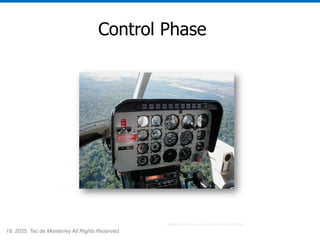
Control Phase
Overview
Seminario de proyectos Six Sigma
Esta foto de Autor desconocido está bajo licencia CC BY-SA-NC
2.
2, 2025. Tecde Monterrey All Rights Reserved.
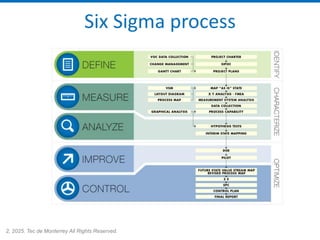
Six Sigma process
3.
3, 2025. Tecde Monterrey All Rights Reserved.
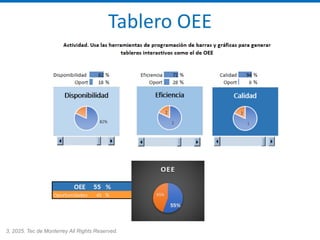
Tablero OEE
4.
4, 2025. Tecde Monterrey All Rights Reserved.
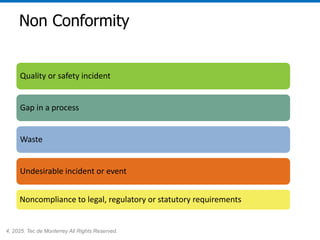
Non Conformity
Quality or safety incident
Gap in a process
Waste
Undesirable incident or event
Noncompliance to legal, regulatory or statutory requirements
5.
5, 2025. Tecde Monterrey All Rights Reserved.
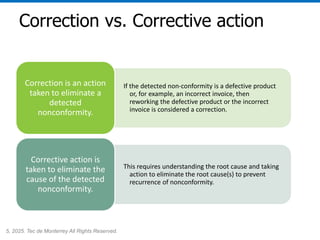
Correction vs. Corrective action
If the detected non-conformity is a defective product
or, for example, an incorrect invoice, then
reworking the defective product or the incorrect
invoice is considered a correction.
Correction is an action
taken to eliminate a
detected
nonconformity.
This requires understanding the root cause and taking
action to eliminate the root cause(s) to prevent
recurrence of nonconformity.
Corrective action is
taken to eliminate the
cause of the detected
nonconformity.
6.
6, 2025. Tecde Monterrey All Rights Reserved.
Improvement techniques
Esta foto de Autor desconocido está bajo licencia CC BY-SA-NC
7.
7, 2025. Tecde Monterrey All Rights Reserved.
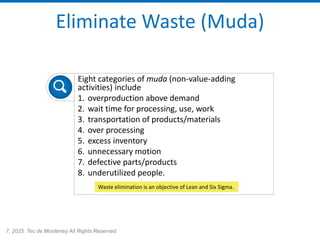
Eliminate Waste (Muda)
Eight categories of muda (non-value-adding
activities) include
1. overproduction above demand
2. wait time for processing, use, work
3. transportation of products/materials
4. over processing
5. excess inventory
6. unnecessary motion
7. defective parts/products
8. underutilized people.
Waste elimination is an objective of Lean and Six Sigma.
8.
8, 2025. Tecde Monterrey All Rights Reserved.
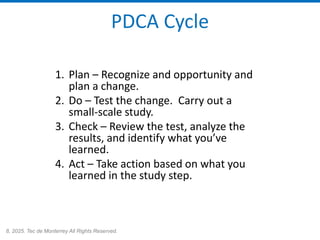
PDCA Cycle
1. Plan – Recognize and opportunity and
plan a change.
2. Do – Test the change. Carry out a
small-scale study.
3. Check – Review the test, analyze the
results, and identify what you’ve
learned.
4. Act – Take action based on what you
learned in the study step.
9.
9, 2025. Tecde Monterrey All Rights Reserved.
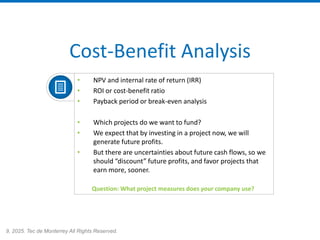
Cost-Benefit Analysis
• NPV and internal rate of return (IRR)
• ROI or cost-benefit ratio
• Payback period or break-even analysis
• Which projects do we want to fund?
• We expect that by investing in a project now, we will
generate future profits.
• But there are uncertainties about future cash flows, so we
should “discount” future profits, and favor projects that
earn more, sooner.
Question: What project measures does your company use?
10.
10, 2025. Tecde Monterrey All Rights Reserved.
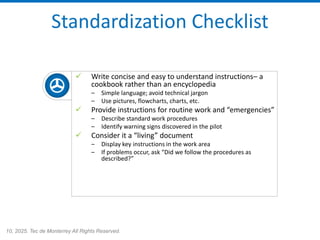
Standardization Checklist
✓ Write concise and easy to understand instructions– a
cookbook rather than an encyclopedia
– Simple language; avoid technical jargon
– Use pictures, flowcharts, charts, etc.
✓ Provide instructions for routine work and “emergencies”
– Describe standard work procedures
– Identify warning signs discovered in the pilot
✓ Consider it a “living” document
– Display key instructions in the work area
– If problems occur, ask “Did we follow the procedures as
described?”
11.
11, 2025. Tecde Monterrey All Rights Reserved.
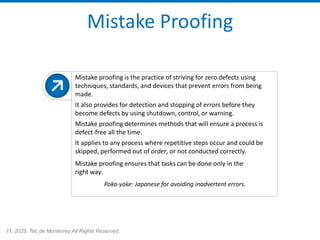
Mistake Proofing
Mistake proofing is the practice of striving for zero defects using
techniques, standards, and devices that prevent errors from being
made.
It also provides for detection and stopping of errors before they
become defects by using shutdown, control, or warning.
Mistake proofing determines methods that will ensure a process is
defect-free all the time.
It applies to any process where repetitive steps occur and could be
skipped, performed out of order, or not conducted correctly.
Mistake proofing ensures that tasks can be done only in the
right way.
Poka-yoke: Japanese for avoiding inadvertent errors.
12.
12, 2025. Tecde Monterrey All Rights Reserved.
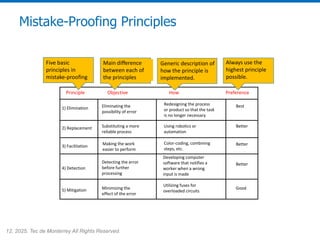
Principle Objective How Preference
1) Elimination Eliminating the
possibility of error
Redesigning the process
or product so that the task
is no longer necessary
Best
2) Replacement Substituting a more
reliable process
Using robotics or
automation
Better
3) Facilitation
Making the work
easier to perform
Color-coding, combining
steps, etc.
Better
4) Detection
Detecting the error
before further
processing
Developing computer
software that notifies a
worker when a wrong
input is made
Better
5) Mitigation Minimizing the
effect of the error
Utilizing fuses for
overloaded circuits
Good
Mistake-Proofing Principles
Five basic
principles in
mistake-proofing
Main difference
between each of
the principles
Generic description of
how the principle is
implemented.
Always use the
highest principle
possible.
13.
13, 2025. Tecde Monterrey All Rights Reserved.
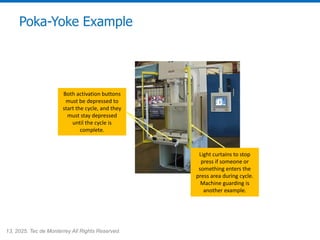
Poka-Yoke Example
Both activation buttons
must be depressed to
start the cycle, and they
must stay depressed
until the cycle is
complete.
Light curtains to stop
press if someone or
something enters the
press area during cycle.
Machine guarding is
another example.
14.
14, 2025. Tecde Monterrey All Rights Reserved.
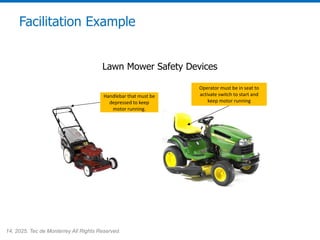
Operator must be in seat to
activate switch to start and
keep motor running
Facilitation Example
Lawn Mower Safety Devices
Handlebar that must be
depressed to keep
motor running.
15.
15, 2025. Tecde Monterrey All Rights Reserved.
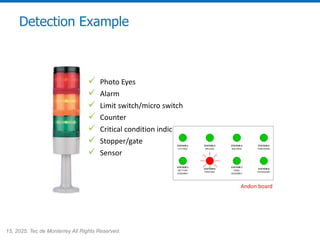
Detection Example
✓ Photo Eyes
✓ Alarm
✓ Limit switch/micro switch
✓ Counter
✓ Critical condition indicator
✓ Stopper/gate
✓ Sensor
Andon board
16.
16, 2025. Tecde Monterrey All Rights Reserved.
Mitigation Example
Automobile Air Bag
17.
17, 2025. Tecde Monterrey All Rights Reserved.
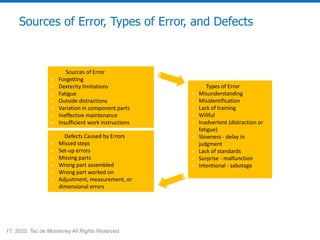
Sources of Error, Types of Error, and Defects
Sources of Error
✓ Forgetting
✓ Dexterity limitations
✓ Fatigue
✓ Outside distractions
✓ Variation in component parts
✓ Ineffective maintenance
✓ Insufficient work instructions
Types of Error
✓ Misunderstanding
✓ Misidentification
✓ Lack of training
✓ Willful
✓ Inadvertent (distraction or
fatigue)
✓ Slowness - delay in
judgment
✓ Lack of standards
✓ Surprise - malfunction
✓ Intentional - sabotage
Defects Caused by Errors
✓ Missed steps
✓ Set-up errors
✓ Missing parts
✓ Wrong part assembled
✓ Wrong part worked on
✓ Adjustment, measurement, or
dimensional errors
18.
18, 2025. Tecde Monterrey All Rights Reserved.
Control Phase
Esta foto de Autor desconocido está bajo licencia CC BY-SA-NC
19.
19, 2025. Tecde Monterrey All Rights Reserved.
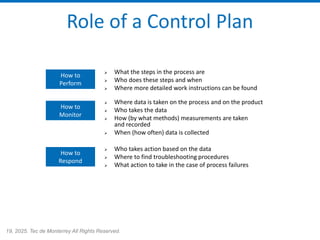
Role of a Control Plan
➢ What the steps in the process are
➢ Who does these steps and when
➢ Where more detailed work instructions can be found
➢ Where data is taken on the process and on the product
➢ Who takes the data
➢ How (by what methods) measurements are taken
and recorded
➢ When (how often) data is collected
➢ Who takes action based on the data
➢ Where to find troubleshooting procedures
➢ What action to take in the case of process failures
How to
Perform
How to
Respond
How to
Monitor
20.
20, 2025. Tecde Monterrey All Rights Reserved.
Benefits of a Control Plan
✓ Provides a systematic “memory” of
the improved status of a project.
✓ Provides for timely process
troubleshooting and repair.
✓ Aids in training and audit activities.
✓ Serves as a living document within
the process to sustain process
improvements.
21.
21, 2025. Tecde Monterrey All Rights Reserved.
Control Plan – Key Points
The control plan is
✓ a living document that needs to be updated when the
process changes
✓ an addition to procedures/work instructions, not a
replacement
✓ developed by the team, not just the Green Belt and the
Black Belt
The control plan needs to contain realistic controls that are
rigorously enforced.
The format is not as important as the content.
22.
22, 2025. Tecde Monterrey All Rights Reserved.
What We Have Learned
Participants examined the following:
✓ Standardization and
Documentation
✓ Control Charts
✓ Mistake Proofing
✓ Control Plans
23.
23, 2025. Tecde Monterrey All Rights Reserved.
1. Book (Certified Six Sigma Black Belt)
2. Question bank (asq.org)
3. Glossary (asq.org)
4. Formula sheets (from CSSBB book)
Happy path to pass certification exam