Mariana - Tennyson
• First impressions of the poem as a whole.

• What happens in the narrative?

• Write a couple of sentences summarising the
  narrative (the story of the poem).
• Expand the annotations on the poem to
  include other features that you discovered
  last week.
Exam-style question
• We will be focussing on the first question in
  the exam paper – on one poem and only
  analysing how they story is told.
• There are no marks for contextual details or
  for comparison with other texts.

• You will be attempting a question from the
  exam and have it marked.
Language, form and structure
• AO2 Demonstrate detailed critical
  understanding in analysing the ways in
  which structure, form and language shape
  meanings in literary texts.

      Analyse how Tennyson has built the text,
      including technical details, and how the
      story is developed from this.
      DO NOT TALK ABOUT CONTEXT.
What do we mean by form and
         structure?
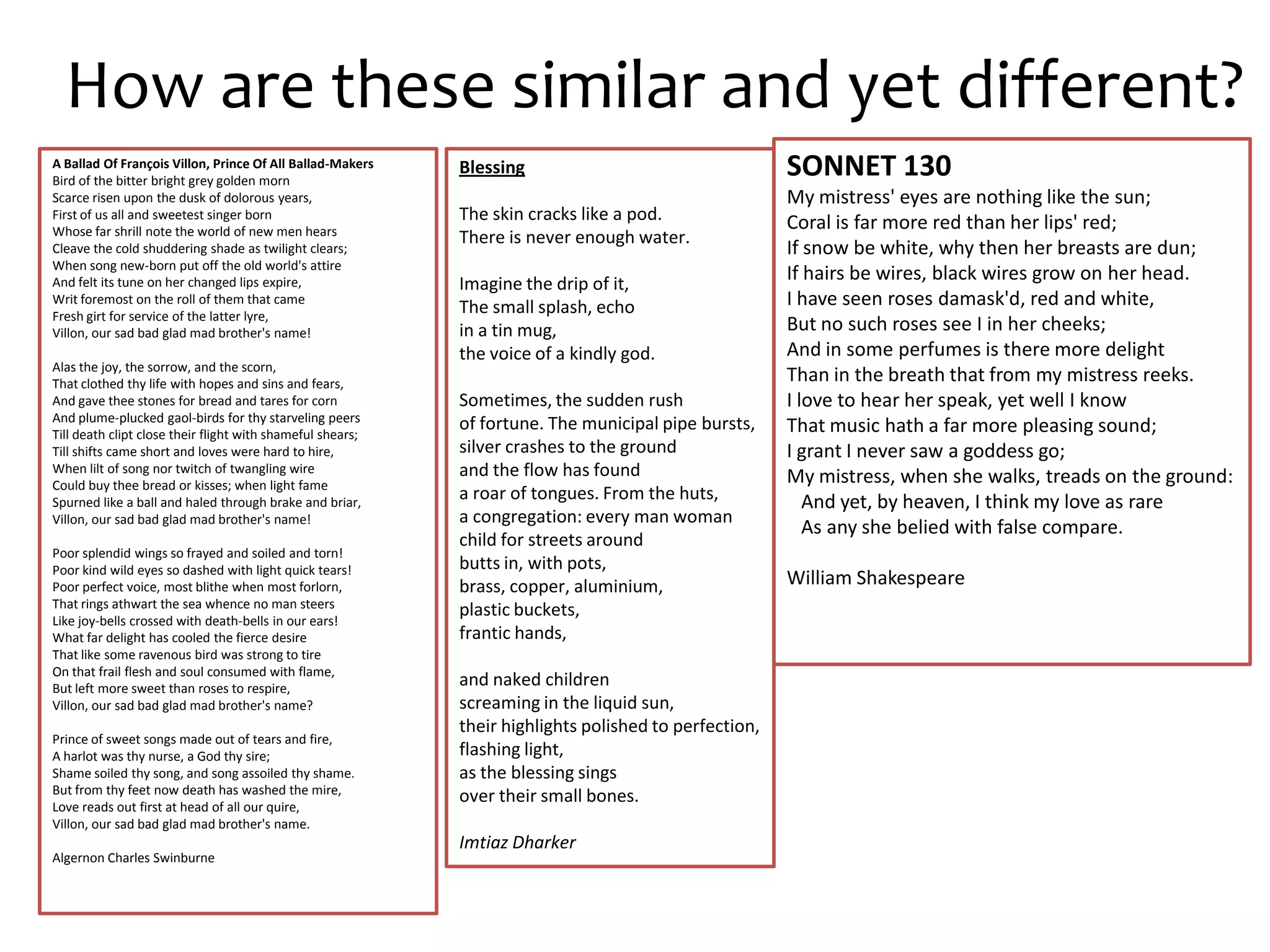
How are these similar and yet different?
A Ballad Of François Villon, Prince Of All Ballad-Makers
Bird of the bitter bright grey golden morn
                                                            Blessing                                   SONNET 130
Scarce risen upon the dusk of dolorous years,                                                          My mistress' eyes are nothing like the sun;
First of us all and sweetest singer born                    The skin cracks like a pod.                Coral is far more red than her lips' red;
Whose far shrill note the world of new men hears
                                                            There is never enough water.
Cleave the cold shuddering shade as twilight clears;                                                   If snow be white, why then her breasts are dun;
When song new-born put off the old world's attire
And felt its tune on her changed lips expire,               Imagine the drip of it,
                                                                                                       If hairs be wires, black wires grow on her head.
Writ foremost on the roll of them that came
                                                            The small splash, echo                     I have seen roses damask'd, red and white,
Fresh girt for service of the latter lyre,
Villon, our sad bad glad mad brother's name!                in a tin mug,                              But no such roses see I in her cheeks;
                                                            the voice of a kindly god.                 And in some perfumes is there more delight
Alas the joy, the sorrow, and the scorn,
That clothed thy life with hopes and sins and fears,
                                                                                                       Than in the breath that from my mistress reeks.
And gave thee stones for bread and tares for corn           Sometimes, the sudden rush                 I love to hear her speak, yet well I know
And plume-plucked gaol-birds for thy starveling peers
                                                            of fortune. The municipal pipe bursts,     That music hath a far more pleasing sound;
Till death clipt close their flight with shameful shears;
Till shifts came short and loves were hard to hire,         silver crashes to the ground               I grant I never saw a goddess go;
When lilt of song nor twitch of twangling wire              and the flow has found                     My mistress, when she walks, treads on the ground:
Could buy thee bread or kisses; when light fame
Spurned like a ball and haled through brake and briar,
                                                            a roar of tongues. From the huts,             And yet, by heaven, I think my love as rare
Villon, our sad bad glad mad brother's name!                a congregation: every man woman
                                                                                                          As any she belied with false compare.
                                                            child for streets around
Poor splendid wings so frayed and soiled and torn!
Poor kind wild eyes so dashed with light quick tears!       butts in, with pots,
Poor perfect voice, most blithe when most forlorn,          brass, copper, aluminium,                  William Shakespeare
That rings athwart the sea whence no man steers
Like joy-bells crossed with death-bells in our ears!
                                                            plastic buckets,
What far delight has cooled the fierce desire               frantic hands,
That like some ravenous bird was strong to tire
On that frail flesh and soul consumed with flame,
But left more sweet than roses to respire,
                                                            and naked children
Villon, our sad bad glad mad brother's name?                screaming in the liquid sun,
                                                            their highlights polished to perfection,
Prince of sweet songs made out of tears and fire,
A harlot was thy nurse, a God thy sire;                     flashing light,
Shame soiled thy song, and song assoiled thy shame.         as the blessing sings
But from thy feet now death has washed the mire,
Love reads out first at head of all our quire,
                                                            over their small bones.
Villon, our sad bad glad mad brother's name.
                                                            Imtiaz Dharker
Algernon Charles Swinburne
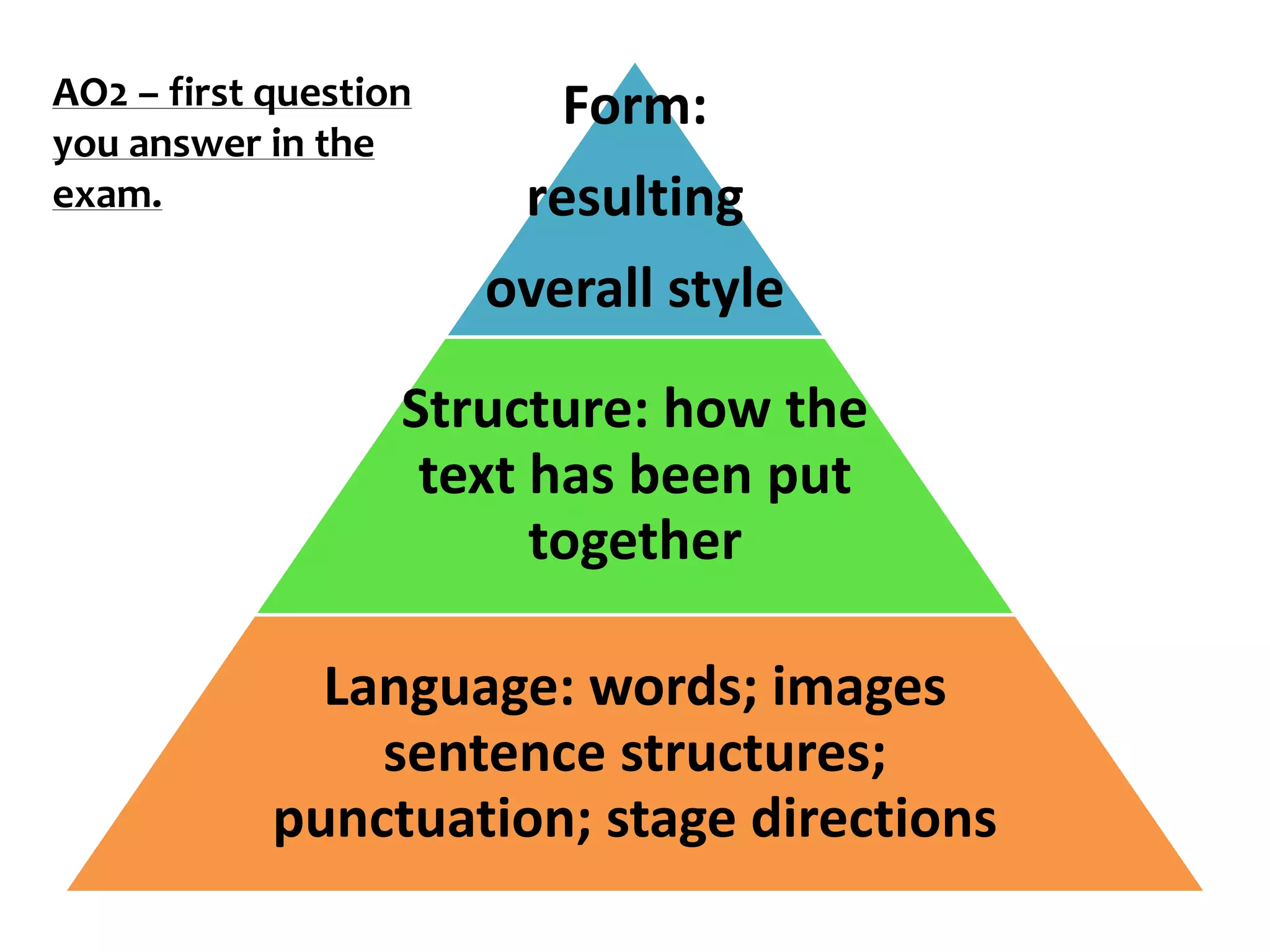
AO2 – first question      Form:
you answer in the
exam.                   resulting
                       overall style

                   Structure: how the
                    text has been put
                         together

              Language: words; images
                sentence structures;
            punctuation; stage directions
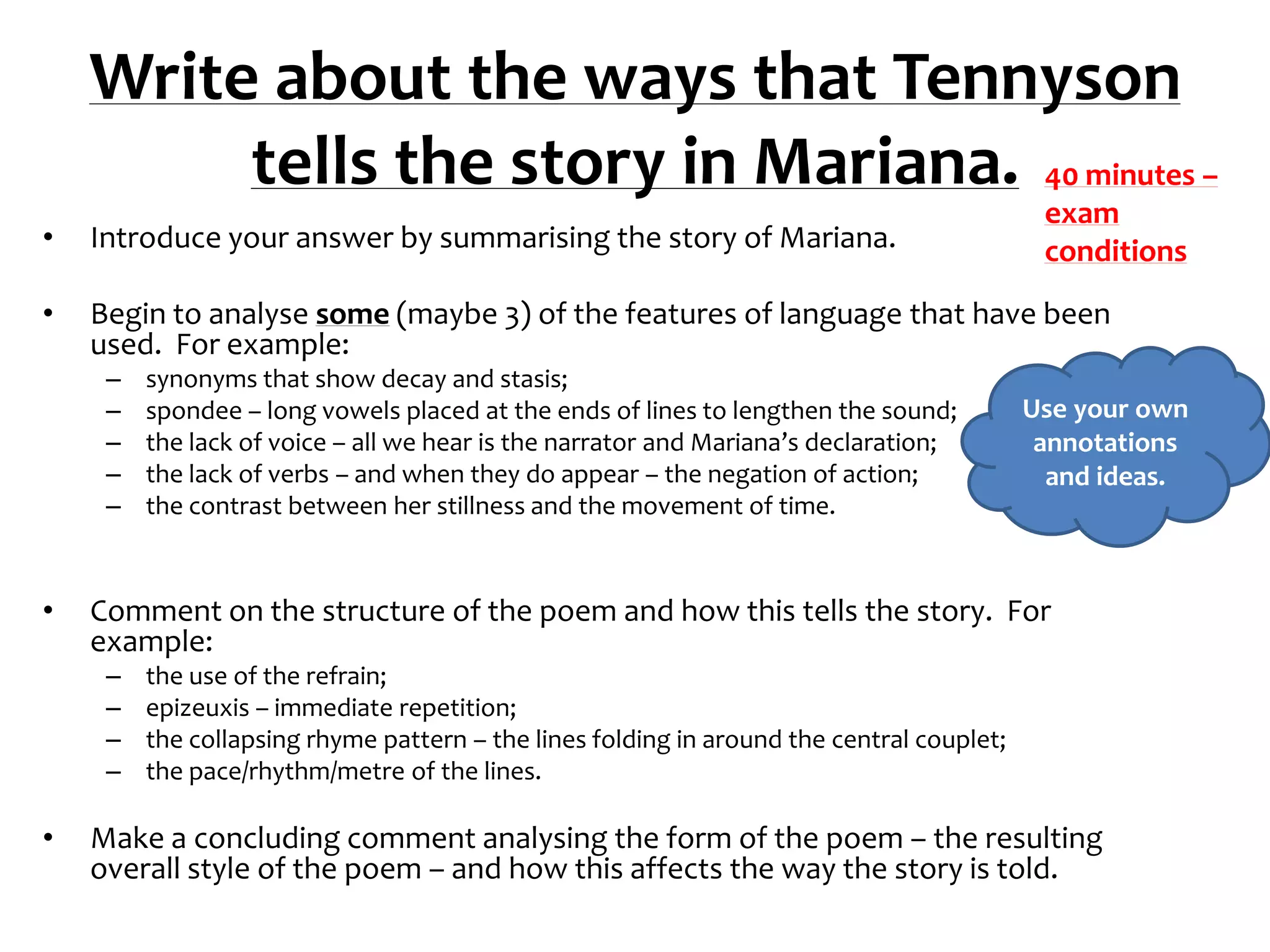
Write about the ways that Tennyson
         tells the story in Mariana. 40 minutes –
                                                                                            exam
•   Introduce your answer by summarising the story of Mariana.                              conditions
•   Begin to analyse some (maybe 3) of the features of language that have been
    used. For example:
     –   synonyms that show decay and stasis;
     –   spondee – long vowels placed at the ends of lines to lengthen the sound;          Use your own
     –   the lack of voice – all we hear is the narrator and Mariana’s declaration;         annotations
     –   the lack of verbs – and when they do appear – the negation of action;               and ideas.
     –   the contrast between her stillness and the movement of time.


•   Comment on the structure of the poem and how this tells the story. For
    example:
     –   the use of the refrain;
     –   epizeuxis – immediate repetition;
     –   the collapsing rhyme pattern – the lines folding in around the central couplet;
     –   the pace/rhythm/metre of the lines.

•   Make a concluding comment analysing the form of the poem – the resulting
    overall style of the poem – and how this affects the way the story is told.

Mariana development

  • 1.
    Mariana - Tennyson •First impressions of the poem as a whole. • What happens in the narrative? • Write a couple of sentences summarising the narrative (the story of the poem).
  • 2.
    • Expand theannotations on the poem to include other features that you discovered last week.
  • 3.
    Exam-style question • Wewill be focussing on the first question in the exam paper – on one poem and only analysing how they story is told. • There are no marks for contextual details or for comparison with other texts. • You will be attempting a question from the exam and have it marked.
  • 4.
    Language, form andstructure • AO2 Demonstrate detailed critical understanding in analysing the ways in which structure, form and language shape meanings in literary texts. Analyse how Tennyson has built the text, including technical details, and how the story is developed from this. DO NOT TALK ABOUT CONTEXT.
  • 5.
    What do wemean by form and structure?
  • 6.
    How are thesesimilar and yet different?
  • 7.
    How are thesesimilar and yet different?
  • 8.
    How are thesesimilar and yet different?
  • 9.
    How are thesesimilar and yet different? A Ballad Of François Villon, Prince Of All Ballad-Makers Bird of the bitter bright grey golden morn Blessing SONNET 130 Scarce risen upon the dusk of dolorous years, My mistress' eyes are nothing like the sun; First of us all and sweetest singer born The skin cracks like a pod. Coral is far more red than her lips' red; Whose far shrill note the world of new men hears There is never enough water. Cleave the cold shuddering shade as twilight clears; If snow be white, why then her breasts are dun; When song new-born put off the old world's attire And felt its tune on her changed lips expire, Imagine the drip of it, If hairs be wires, black wires grow on her head. Writ foremost on the roll of them that came The small splash, echo I have seen roses damask'd, red and white, Fresh girt for service of the latter lyre, Villon, our sad bad glad mad brother's name! in a tin mug, But no such roses see I in her cheeks; the voice of a kindly god. And in some perfumes is there more delight Alas the joy, the sorrow, and the scorn, That clothed thy life with hopes and sins and fears, Than in the breath that from my mistress reeks. And gave thee stones for bread and tares for corn Sometimes, the sudden rush I love to hear her speak, yet well I know And plume-plucked gaol-birds for thy starveling peers of fortune. The municipal pipe bursts, That music hath a far more pleasing sound; Till death clipt close their flight with shameful shears; Till shifts came short and loves were hard to hire, silver crashes to the ground I grant I never saw a goddess go; When lilt of song nor twitch of twangling wire and the flow has found My mistress, when she walks, treads on the ground: Could buy thee bread or kisses; when light fame Spurned like a ball and haled through brake and briar, a roar of tongues. From the huts, And yet, by heaven, I think my love as rare Villon, our sad bad glad mad brother's name! a congregation: every man woman As any she belied with false compare. child for streets around Poor splendid wings so frayed and soiled and torn! Poor kind wild eyes so dashed with light quick tears! butts in, with pots, Poor perfect voice, most blithe when most forlorn, brass, copper, aluminium, William Shakespeare That rings athwart the sea whence no man steers Like joy-bells crossed with death-bells in our ears! plastic buckets, What far delight has cooled the fierce desire frantic hands, That like some ravenous bird was strong to tire On that frail flesh and soul consumed with flame, But left more sweet than roses to respire, and naked children Villon, our sad bad glad mad brother's name? screaming in the liquid sun, their highlights polished to perfection, Prince of sweet songs made out of tears and fire, A harlot was thy nurse, a God thy sire; flashing light, Shame soiled thy song, and song assoiled thy shame. as the blessing sings But from thy feet now death has washed the mire, Love reads out first at head of all our quire, over their small bones. Villon, our sad bad glad mad brother's name. Imtiaz Dharker Algernon Charles Swinburne
  • 10.
    AO2 – firstquestion Form: you answer in the exam. resulting overall style Structure: how the text has been put together Language: words; images sentence structures; punctuation; stage directions
  • 11.
    Write about theways that Tennyson tells the story in Mariana. 40 minutes – exam • Introduce your answer by summarising the story of Mariana. conditions • Begin to analyse some (maybe 3) of the features of language that have been used. For example: – synonyms that show decay and stasis; – spondee – long vowels placed at the ends of lines to lengthen the sound; Use your own – the lack of voice – all we hear is the narrator and Mariana’s declaration; annotations – the lack of verbs – and when they do appear – the negation of action; and ideas. – the contrast between her stillness and the movement of time. • Comment on the structure of the poem and how this tells the story. For example: – the use of the refrain; – epizeuxis – immediate repetition; – the collapsing rhyme pattern – the lines folding in around the central couplet; – the pace/rhythm/metre of the lines. • Make a concluding comment analysing the form of the poem – the resulting overall style of the poem – and how this affects the way the story is told.