The WRITE Time for Poetry


              Holly Marsh
www.thewritetimeforpoetry.blogspot.com
Welcome
 INVITATION
    If you are a dreamer, come in.
    If you are a dreamer, a wisher, a liar,
    A hope-er, a pray-er, a magic bean
    buyer . . .
    If you're a pretender, come sit by my
    fire,
    For we have some flax golden tales to
    spin.
    Come in!
    Come in!
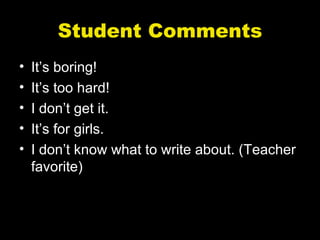
Student Comments
•   It’s boring!
•   It’s too hard!
•   I don’t get it.
•   It’s for girls.
•   I don’t know what to write about. (Teacher
    favorite)
Students Lack…
• Motivation
• Inspiration
• Stamina
What is the key to
   getting your
     students
    motivated,
  inspired, and
 having stamina?
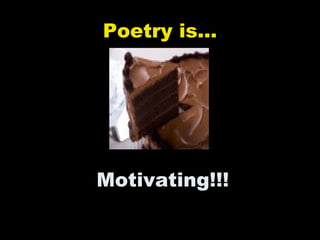
Poetry is…


Motivating!!!
Poetry is…


Inspiring!
Poetry is…


Stamina Building!
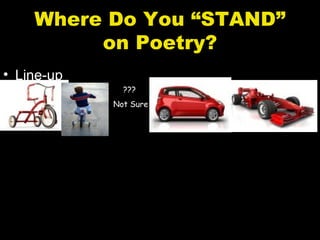
Where Do You “STAND”
         on Poetry?
• Line-up
              ???
            Not Sure
Immerse Your Students in
        Poetry
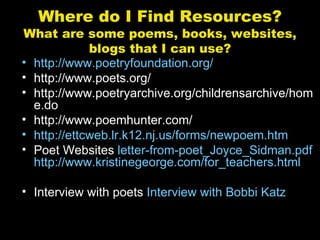
Where do I Find Resources?
What are some poems, books, websites,
             blogs that I can use?
• http://www.poetryfoundation.org/
• http://www.poets.org/
• http://www.poetryarchive.org/childrensarchive/hom
  e.do
• http://www.poemhunter.com/
• http://ettcweb.lr.k12.nj.us/forms/newpoem.htm
• Poet Websites letter-from-poet_Joyce_Sidman.pdf
  http://www.kristinegeorge.com/for_teachers.html

• Interview with poets Interview with Bobbi Katz
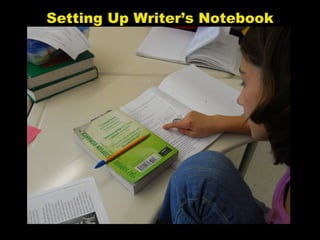
Setting Up Writer’s Notebook
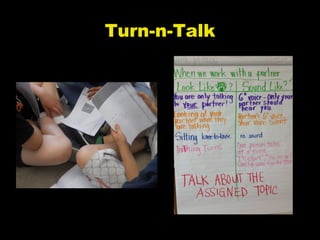
Turn-n-Talk
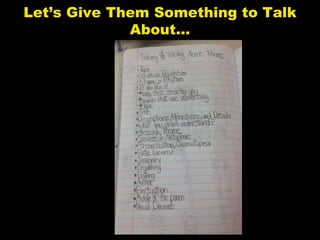
Let’s Give Them Something to Talk
             About…
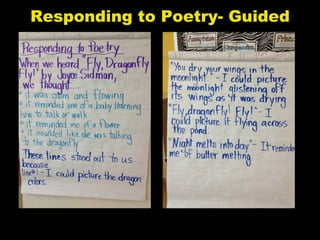
Responding to Poetry- Guided
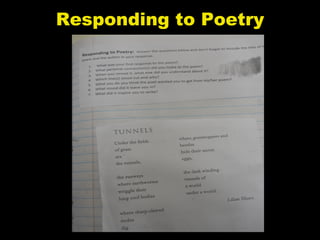
Responding to Poetry
How Do I Get My Students
    to Dig Deeper?
                  How To Eat a Poem
                      by Eve Merriam
                     Don't be polite.
                            Bite in.
    Pick it up with your fingers and lick the juice that
                may run down your chin.
      It is ready and ripe now, whenever you are.
      You do not need a knife or fork or spoon
              or plate or napkin or tablecloth.
                   For there is no core
                           or stem
                            or rind
                             or pit
                           or seed
                            or skin
                       to throw away.
TeachWriteShare
         Framework
• In a nutshell…
  – I do it; You watch
     • Teacher thinks aloud, explains, models.
  – We do it: I do it, you help. You do it, I help.
     • Teacher and students
     • Shared Writing or Interactive Writing
  – You do it; I watch.
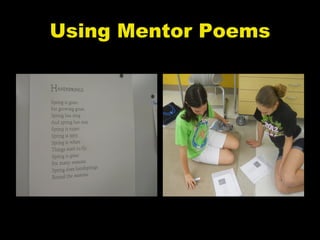
Using Mentor Poems
Talking and Thinking
about Mentor Poems
More Thinking and
     Talking
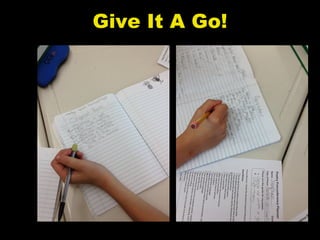
Give It A Go!
Poetry Carousel
Big Plans for Poetry
• Poetry Units of Study
  – Theme
  – Author Study
  – Types of Poetry
     • Mask Poetry
     • List Poetry
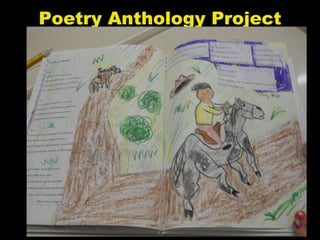
  – Poetry Anthology Project
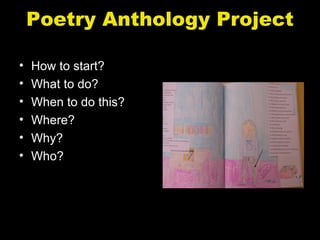
Poetry Anthology Project

•   How to start?
•   What to do?
•   When to do this?
•   Where?
•   Why?
•   Who?
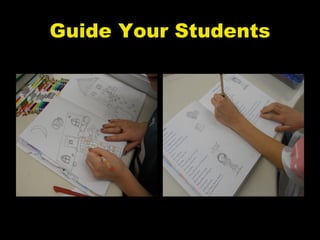
Guide Your Students
Parts are due each week
           Poetry Anthology Project
           Dear Students,
           This year, you will be keeping a poetry anthology. In it, you will be collecting
                    published poetry you love and be writing many of your own poems.
                    The following is an explanation of what I will expect you to do.
           Gather a few poetry books at the beginning of each month. You can borrow
                    some from the class library or take some out of our school library or the
                    public library. Spend some time each day reading and enjoying poems.
                     Identify those you love by placing a sticky note on the pages of your
                    books or recording the title and book from which you found the poem.
           By the beginning of the next week, you should have found at least one
                    poem you especially love. Copy or photocopy it. It will eventually get
                    pasted onto the left side of your book. The right side will be for your
                    own writing. If you type a copy of the poem, be sure you type it exactly
                    as the poet wrote it. Do not change any spelling, punctuation or line
                    breaks.
           Now you are ready to search through your writer’s notebook for entries
                    that you think could easily sit beside the published poem. You will see
                    that your writing has a lot in common with published poetry; perhaps the
                    subject is the same, the style, the mood or the feeling.
           Once you have identified the entry you will use, you have some choices to
                    make. You can use everything you know about writing poetry and
                    rework the entry so that it becomes a poem. You may, however,
                    decide to use the entry as it is. If so, you need to revise, edit and type
                    it. It will go onto the right side of the page opposite the published piece.
           We will set aside a time somewhere around the middle of the month for you to
                    share your work. At that time, you can schedule a conference to get
                    feedback and help with revising your work.
           Illustrate the poems, choosing a medium and style that best suits the subject
                    and mood of each poem. Plan your illustration before you paste your
                    poems in. This way, you can be sure you’ve used all the space wisely.
                    You may do one illustration across both pages or you may choose to
                    illustrate each one separately.
           Try to vary the medium you use each month. Remember to think about how
                    the images created in writing will influence the images you create with
                    your art.
           Your anthology is due the last school day of every month. On this day,
                    you will have an opportunity to share your work with your classmates
                    and get their feedback. At the beginning of each month, you will
                    receive a blank calendar/checklist to help you schedule time to work on
                    this project. You will be expected to turn the calendar/checklist,
                    signed by a parent, in to me.
           By the end of the school year, each of you will have a collection you will be
                    very proud of and will cherish. You will be amazed at how your work
                    changes over the course of the year.
           I can’t wait to see the remarkable work you will do this year!
           Happy Reading and Writing,
           Mrs. Marsh
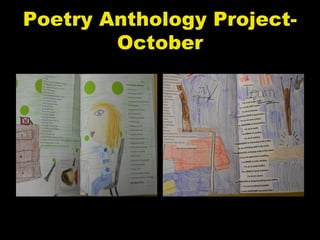
Poetry Anthology Project-
        October
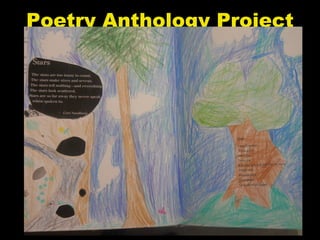
Poetry Anthology Project
NOT ?
"The Pen" by Muhammed al-Ghuzzi
  Take a pen in your uncertain fingers.
          Trust, and be assured
That the whole world is a sky-blue butterfly
  And words are the nets to capture it.


Thank you and Good Luck on your Poetry Journey!

The WRITE time for poetry 2012 presentation

  • 1.
    The WRITE Timefor Poetry Holly Marsh www.thewritetimeforpoetry.blogspot.com
  • 2.
    Welcome INVITATION If you are a dreamer, come in. If you are a dreamer, a wisher, a liar, A hope-er, a pray-er, a magic bean buyer . . . If you're a pretender, come sit by my fire, For we have some flax golden tales to spin. Come in! Come in!
  • 4.
    Student Comments • It’s boring! • It’s too hard! • I don’t get it. • It’s for girls. • I don’t know what to write about. (Teacher favorite)
  • 5.
    Students Lack… • Motivation •Inspiration • Stamina
  • 6.
    What is thekey to getting your students motivated, inspired, and having stamina?
  • 7.
  • 8.
  • 9.
  • 10.
    Where Do You“STAND” on Poetry? • Line-up ??? Not Sure
  • 11.
  • 12.
    Where do IFind Resources? What are some poems, books, websites, blogs that I can use? • http://www.poetryfoundation.org/ • http://www.poets.org/ • http://www.poetryarchive.org/childrensarchive/hom e.do • http://www.poemhunter.com/ • http://ettcweb.lr.k12.nj.us/forms/newpoem.htm • Poet Websites letter-from-poet_Joyce_Sidman.pdf http://www.kristinegeorge.com/for_teachers.html • Interview with poets Interview with Bobbi Katz
  • 13.
  • 14.
  • 15.
    Let’s Give ThemSomething to Talk About…
  • 16.
  • 17.
  • 18.
    How Do IGet My Students to Dig Deeper? How To Eat a Poem by Eve Merriam Don't be polite. Bite in. Pick it up with your fingers and lick the juice that may run down your chin. It is ready and ripe now, whenever you are. You do not need a knife or fork or spoon or plate or napkin or tablecloth. For there is no core or stem or rind or pit or seed or skin to throw away.
  • 19.
    TeachWriteShare Framework • In a nutshell… – I do it; You watch • Teacher thinks aloud, explains, models. – We do it: I do it, you help. You do it, I help. • Teacher and students • Shared Writing or Interactive Writing – You do it; I watch.
  • 20.
  • 21.
  • 22.
  • 23.
  • 24.
  • 25.
    Big Plans forPoetry • Poetry Units of Study – Theme – Author Study – Types of Poetry • Mask Poetry • List Poetry – Poetry Anthology Project
  • 26.
    Poetry Anthology Project • How to start? • What to do? • When to do this? • Where? • Why? • Who?
  • 27.
  • 28.
    Parts are dueeach week Poetry Anthology Project Dear Students, This year, you will be keeping a poetry anthology. In it, you will be collecting published poetry you love and be writing many of your own poems. The following is an explanation of what I will expect you to do. Gather a few poetry books at the beginning of each month. You can borrow some from the class library or take some out of our school library or the public library. Spend some time each day reading and enjoying poems. Identify those you love by placing a sticky note on the pages of your books or recording the title and book from which you found the poem. By the beginning of the next week, you should have found at least one poem you especially love. Copy or photocopy it. It will eventually get pasted onto the left side of your book. The right side will be for your own writing. If you type a copy of the poem, be sure you type it exactly as the poet wrote it. Do not change any spelling, punctuation or line breaks. Now you are ready to search through your writer’s notebook for entries that you think could easily sit beside the published poem. You will see that your writing has a lot in common with published poetry; perhaps the subject is the same, the style, the mood or the feeling. Once you have identified the entry you will use, you have some choices to make. You can use everything you know about writing poetry and rework the entry so that it becomes a poem. You may, however, decide to use the entry as it is. If so, you need to revise, edit and type it. It will go onto the right side of the page opposite the published piece. We will set aside a time somewhere around the middle of the month for you to share your work. At that time, you can schedule a conference to get feedback and help with revising your work. Illustrate the poems, choosing a medium and style that best suits the subject and mood of each poem. Plan your illustration before you paste your poems in. This way, you can be sure you’ve used all the space wisely. You may do one illustration across both pages or you may choose to illustrate each one separately. Try to vary the medium you use each month. Remember to think about how the images created in writing will influence the images you create with your art. Your anthology is due the last school day of every month. On this day, you will have an opportunity to share your work with your classmates and get their feedback. At the beginning of each month, you will receive a blank calendar/checklist to help you schedule time to work on this project. You will be expected to turn the calendar/checklist, signed by a parent, in to me. By the end of the school year, each of you will have a collection you will be very proud of and will cherish. You will be amazed at how your work changes over the course of the year. I can’t wait to see the remarkable work you will do this year! Happy Reading and Writing, Mrs. Marsh
  • 29.
  • 30.
  • 31.
  • 32.
  • 33.
    "The Pen" byMuhammed al-Ghuzzi Take a pen in your uncertain fingers. Trust, and be assured That the whole world is a sky-blue butterfly And words are the nets to capture it. Thank you and Good Luck on your Poetry Journey!

Editor's Notes

  • #8 Delicious Fun Exciting Wish Making A Celebration A Tasty Treat It makes you want to stick your finger in and lick the icing!
  • #9 Peel back layers to reveal a gem Worth all the hard work Precious time spent mining for a quality piece Brilliant
  • #10 Helps support struggling readers and writers. It lets creative ideas learned flow into other areas of writing. It connects reading and writing. It closes the gap between our challenged readers and writers and our advanced readers and writers.
  • #12 Read lots of poetry aloud. Notice what poets do. Have poetry everywhere in the classroom. Let students absorb like a sponge.