Poetry 
John Miguel F. Morales 
BSE-English
THE ELEMENTS of POETRY 
• Form 
• Whenever we look at a poem, the first thing we will probably 
notice is its form. In other words, poems have a given FORM. 
One poem will look very different from another, and still another 
poem will look very distinct from the second one, and so on. 
Each poet uses the "form" which will most effectively EXPRESS 
what he wants to convey to other human beings.
FORMS of POETRY 
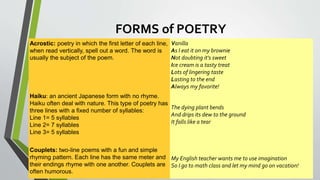
Acrostic: poetry in which the first letter of each line, 
when read vertically, spell out a word. The word is 
usually the subject of the poem. 
Vanilla 
As I eat it on my brownie 
Not doubting it's sweet 
Ice cream is a tasty treat 
Lots of lingering taste 
Lasting to the end 
Always my favorite! 
Haiku: an ancient Japanese form with no rhyme. 
Haiku often deal with nature. This type of poetry has 
three lines with a fixed number of syllables: 
Line 1= 5 syllables 
Line 2= 7 syllables 
Line 3= 5 syllables 
The dying plant bends 
And drips its dew to the ground 
It falls like a tear 
Couplets: two-line poems with a fun and simple 
rhyming pattern. Each line has the same meter and 
their endings rhyme with one another. Couplets are 
often humorous. 
My English teacher wants me to use imagination 
So I go to math class and let my mind go on vacation!
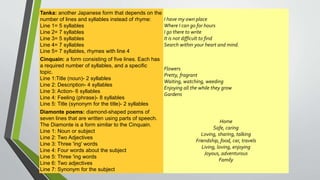
Tanka: another Japanese form that depends on the 
number of lines and syllables instead of rhyme: 
Line 1= 5 syllables 
Line 2= 7 syllables 
Line 3= 5 syllables 
Line 4= 7 syllables 
Line 5= 7 syllables, rhymes with line 4 
I have my own place 
Where I can go for hours 
I go there to write 
It is not difficult to find 
Search within your heart and mind. 
Cinquain: a form consisting of five lines. Each has 
a required number of syllables, and a specific 
topic. 
Line 1:Title (noun)- 2 syllables 
Line 2: Description- 4 syllables 
Line 3: Action- 6 syllables 
Line 4: Feeling (phrase)- 8 syllables 
Line 5: Title (synonym for the title)- 2 syllables 
Flowers 
Pretty, fragrant 
Waiting, watching, weeding 
Enjoying all the while they grow 
Gardens 
Diamonte poems: diamond-shaped poems of 
seven lines that are written using parts of speech. 
The Diamonte is a form similar to the Cinquain. 
Line 1: Noun or subject 
Line 2: Two Adjectives 
Line 3: Three 'ing' words 
Line 4: Four words about the subject 
Line 5: Three 'ing words 
Line 6: Two adjectives 
Line 7: Synonym for the subject 
Home 
Safe, caring 
Loving, sharing, talking 
Friendship, food, car, travels 
Living, loving, enjoying 
Joyous, adventurous 
Family
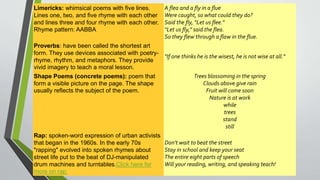
Limericks: whimsical poems with five lines. 
Lines one, two, and five rhyme with each other 
and lines three and four rhyme with each other. 
Rhyme pattern: AABBA 
A flea and a fly in a flue 
Were caught, so what could they do? 
Said the fly, "Let us flee." 
"Let us fly," said the flea. 
So they flew through a flaw in the flue. 
Proverbs: have been called the shortest art 
form. They use devices associated with poetry-rhyme, 
rhythm, and metaphors. They provide 
vivid imagery to teach a moral lesson. 
"If one thinks he is the wisest, he is not wise at all." 
Shape Poems (concrete poems): poem that 
form a visible picture on the page. The shape 
usually reflects the subject of the poem. 
Trees blossoming in the spring 
Clouds above give rain 
Fruit will come soon 
Nature is at work 
while 
trees 
stand 
still 
Rap: spoken-word expression of urban activists 
that began in the 1960s. In the early 70s 
"rapping" evolved into spoken rhymes about 
street life put to the beat of DJ-manipulated 
drum machines and turntables.Click here for 
more on rap. 
Don't wait to beat the street 
Stay in school and keep your seat 
The entire eight parts of speech 
Will your reading, writing, and speaking teach!
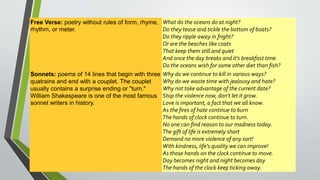
Free Verse: poetry without rules of form, rhyme, 
rhythm, or meter. 
What do the oceans do at night? 
Do they tease and tickle the bottom of boats? 
Do they ripple away in fright? 
Or are the beaches like coats 
That keep them still and quiet 
And once the day breaks and it's breakfast time 
Do the oceans wish for some other diet than fish? 
Sonnets: poems of 14 lines that begin with three 
quatrains and end with a couplet. The couplet 
usually contains a surprise ending or "turn." 
William Shakespeare is one of the most famous 
sonnet writers in history. 
Why do we continue to kill in various ways? 
Why do we waste time with jealousy and hate? 
Why not take advantage of the current date? 
Stop the violence now, don't let it grow. 
Love is important, a fact that we all know. 
As the fires of hate continue to burn 
The hands of clock continue to turn. 
No one can find reason to our madness today. 
The gift of life is extremely short 
Demand no more violence of any sort! 
With kindness, life's quality we can improve! 
As those hands on the clock continue to move. 
Day becomes night and night becomes day 
The hands of the clock keep ticking away.
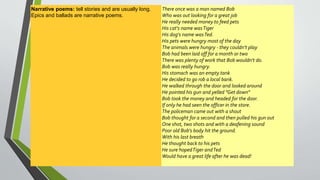
Narrative poems: tell stories and are usually long. 
Epics and ballads are narrative poems. 
There once was a man named Bob 
Who was out looking for a great job 
He really needed money to feed pets 
His cat's name was Tiger 
His dog's name was Ted. 
His pets were hungry most of the day 
The animals were hungry - they couldn't play 
Bob had been laid off for a month or two 
There was plenty of work that Bob wouldn't do. 
Bob was really hungry. 
His stomach was an empty tank 
He decided to go rob a local bank. 
He walked through the door and looked around 
He pointed his gun and yelled "Get down" 
Bob took the money and headed for the door. 
If only he had seen the officer in the store. 
The policeman came out with a shout 
Bob thought for a second and then pulled his gun out 
One shot, two shots and with a deafening sound 
Poor old Bob's body hit the ground. 
With his last breath 
He thought back to his pets 
He sure hoped Tiger and Ted 
Would have a great life after he was dead!
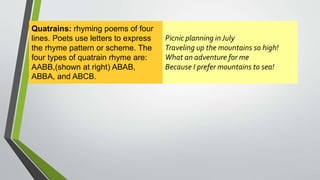
Quatrains: rhyming poems of four 
lines. Poets use letters to express 
the rhyme pattern or scheme. The 
four types of quatrain rhyme are: 
AABB,(shown at right) ABAB, 
ABBA, and ABCB. 
Picnic planning in July 
Traveling up the mountains so high! 
What an adventure for me 
Because I prefer mountains to sea!
LINE 
• A basic structural component of a poem. Lines can be 
written in free form, in syllabic form (e.g. haiku) or in metrical 
form. In the official classification, metrical lines can vary in 
length from the monometer (one foot) to the octameter 
(eight feet).
STANZAS 
• One or more lines that make up the basic units of a poem 
- separated from each other by spacing. 
• Stanza forms can also be classified by the number of 
lines they employ e.g. the couplet, the triplet, the 
quatrain etc.
RHYME 
• Rhyme is the SONIC imitation usually of end syllables of words. There are 
basically two kinds of rhyme used in poetry. The first is the most typical and 
best known by young people, END RHYME, in which the words at the end of 
a given line rhyme. The second kind of rhyme is called INTERNAL RHYME. 
This kind of rhyming is different from end rhyme in that the rhyming takes 
place somewhere within the line and not at the end. But most of us find it 
more natural to use rhyming at the end and not in the middle of our poem's 
lines. Still, the most widely read and enjoyed poetry artfully combines these 
and other patterns and techniques for the creation of the poems.
Meter 
• Is the regular pattern of stressed and unstressed syllables that make 
up a line of poetry. Meter gives rhythm and regularity to poetry.

Poetry

  • 1.
    Poetry John MiguelF. Morales BSE-English
  • 2.
    THE ELEMENTS ofPOETRY • Form • Whenever we look at a poem, the first thing we will probably notice is its form. In other words, poems have a given FORM. One poem will look very different from another, and still another poem will look very distinct from the second one, and so on. Each poet uses the "form" which will most effectively EXPRESS what he wants to convey to other human beings.
  • 3.
    FORMS of POETRY Acrostic: poetry in which the first letter of each line, when read vertically, spell out a word. The word is usually the subject of the poem. Vanilla As I eat it on my brownie Not doubting it's sweet Ice cream is a tasty treat Lots of lingering taste Lasting to the end Always my favorite! Haiku: an ancient Japanese form with no rhyme. Haiku often deal with nature. This type of poetry has three lines with a fixed number of syllables: Line 1= 5 syllables Line 2= 7 syllables Line 3= 5 syllables The dying plant bends And drips its dew to the ground It falls like a tear Couplets: two-line poems with a fun and simple rhyming pattern. Each line has the same meter and their endings rhyme with one another. Couplets are often humorous. My English teacher wants me to use imagination So I go to math class and let my mind go on vacation!
  • 4.
    Tanka: another Japaneseform that depends on the number of lines and syllables instead of rhyme: Line 1= 5 syllables Line 2= 7 syllables Line 3= 5 syllables Line 4= 7 syllables Line 5= 7 syllables, rhymes with line 4 I have my own place Where I can go for hours I go there to write It is not difficult to find Search within your heart and mind. Cinquain: a form consisting of five lines. Each has a required number of syllables, and a specific topic. Line 1:Title (noun)- 2 syllables Line 2: Description- 4 syllables Line 3: Action- 6 syllables Line 4: Feeling (phrase)- 8 syllables Line 5: Title (synonym for the title)- 2 syllables Flowers Pretty, fragrant Waiting, watching, weeding Enjoying all the while they grow Gardens Diamonte poems: diamond-shaped poems of seven lines that are written using parts of speech. The Diamonte is a form similar to the Cinquain. Line 1: Noun or subject Line 2: Two Adjectives Line 3: Three 'ing' words Line 4: Four words about the subject Line 5: Three 'ing words Line 6: Two adjectives Line 7: Synonym for the subject Home Safe, caring Loving, sharing, talking Friendship, food, car, travels Living, loving, enjoying Joyous, adventurous Family
  • 5.
    Limericks: whimsical poemswith five lines. Lines one, two, and five rhyme with each other and lines three and four rhyme with each other. Rhyme pattern: AABBA A flea and a fly in a flue Were caught, so what could they do? Said the fly, "Let us flee." "Let us fly," said the flea. So they flew through a flaw in the flue. Proverbs: have been called the shortest art form. They use devices associated with poetry-rhyme, rhythm, and metaphors. They provide vivid imagery to teach a moral lesson. "If one thinks he is the wisest, he is not wise at all." Shape Poems (concrete poems): poem that form a visible picture on the page. The shape usually reflects the subject of the poem. Trees blossoming in the spring Clouds above give rain Fruit will come soon Nature is at work while trees stand still Rap: spoken-word expression of urban activists that began in the 1960s. In the early 70s "rapping" evolved into spoken rhymes about street life put to the beat of DJ-manipulated drum machines and turntables.Click here for more on rap. Don't wait to beat the street Stay in school and keep your seat The entire eight parts of speech Will your reading, writing, and speaking teach!
  • 6.
    Free Verse: poetrywithout rules of form, rhyme, rhythm, or meter. What do the oceans do at night? Do they tease and tickle the bottom of boats? Do they ripple away in fright? Or are the beaches like coats That keep them still and quiet And once the day breaks and it's breakfast time Do the oceans wish for some other diet than fish? Sonnets: poems of 14 lines that begin with three quatrains and end with a couplet. The couplet usually contains a surprise ending or "turn." William Shakespeare is one of the most famous sonnet writers in history. Why do we continue to kill in various ways? Why do we waste time with jealousy and hate? Why not take advantage of the current date? Stop the violence now, don't let it grow. Love is important, a fact that we all know. As the fires of hate continue to burn The hands of clock continue to turn. No one can find reason to our madness today. The gift of life is extremely short Demand no more violence of any sort! With kindness, life's quality we can improve! As those hands on the clock continue to move. Day becomes night and night becomes day The hands of the clock keep ticking away.
  • 7.
    Narrative poems: tellstories and are usually long. Epics and ballads are narrative poems. There once was a man named Bob Who was out looking for a great job He really needed money to feed pets His cat's name was Tiger His dog's name was Ted. His pets were hungry most of the day The animals were hungry - they couldn't play Bob had been laid off for a month or two There was plenty of work that Bob wouldn't do. Bob was really hungry. His stomach was an empty tank He decided to go rob a local bank. He walked through the door and looked around He pointed his gun and yelled "Get down" Bob took the money and headed for the door. If only he had seen the officer in the store. The policeman came out with a shout Bob thought for a second and then pulled his gun out One shot, two shots and with a deafening sound Poor old Bob's body hit the ground. With his last breath He thought back to his pets He sure hoped Tiger and Ted Would have a great life after he was dead!
  • 8.
    Quatrains: rhyming poemsof four lines. Poets use letters to express the rhyme pattern or scheme. The four types of quatrain rhyme are: AABB,(shown at right) ABAB, ABBA, and ABCB. Picnic planning in July Traveling up the mountains so high! What an adventure for me Because I prefer mountains to sea!
  • 9.
    LINE • Abasic structural component of a poem. Lines can be written in free form, in syllabic form (e.g. haiku) or in metrical form. In the official classification, metrical lines can vary in length from the monometer (one foot) to the octameter (eight feet).
  • 10.
    STANZAS • Oneor more lines that make up the basic units of a poem - separated from each other by spacing. • Stanza forms can also be classified by the number of lines they employ e.g. the couplet, the triplet, the quatrain etc.
  • 11.
    RHYME • Rhymeis the SONIC imitation usually of end syllables of words. There are basically two kinds of rhyme used in poetry. The first is the most typical and best known by young people, END RHYME, in which the words at the end of a given line rhyme. The second kind of rhyme is called INTERNAL RHYME. This kind of rhyming is different from end rhyme in that the rhyming takes place somewhere within the line and not at the end. But most of us find it more natural to use rhyming at the end and not in the middle of our poem's lines. Still, the most widely read and enjoyed poetry artfully combines these and other patterns and techniques for the creation of the poems.
  • 12.
    Meter • Isthe regular pattern of stressed and unstressed syllables that make up a line of poetry. Meter gives rhythm and regularity to poetry.