Of all the things I wish I were
I wish I were a sparra …
In her book, In the Middle, Nancy Atwell
writes:
• “teachers I knew avoided teaching poetry because
they felt intimidated by it. They perceived poetry as
difficult to read, difficult to understand, and,
especially, difficult to talk about. They stopped
reading it the moment it stopped being required.
Seventy years ago half the literature taught to fourth
grades in the United States was poetry. Today, it’s 97
percent prose and just 3 percent poetry. Either we
love it, as I did, but can’t imagine how to begin to
help students experience it…or we don’t read it and
don’t love it … Poetry deserves better and kids
deserve better.”
• form of literature written in a rhythmical style; verse,
literature written in a metrical style
• A type of literature that expresses ideas, feelings, or tells
a story in a specific form (usually using lines and
stanzas)
• Like art it is very difficult to define because it is an
expression of what the poet thinks and feels and may
take any form the poet chooses for this expression.
• Poetry is a creative use of words which, like all art, is
intended to stir an emotion in the audience. Poetry
generally has some structure that separates it from
prose.
4
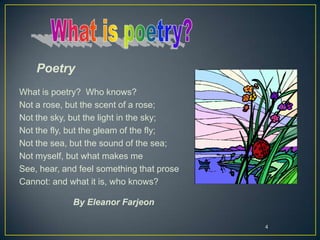
Poetry
What is poetry? Who knows?
Not a rose, but the scent of a rose;
Not the sky, but the light in the sky;
Not the fly, but the gleam of the fly;
Not the sea, but the sound of the sea;
Not myself, but what makes me
See, hear, and feel something that prose
Cannot: and what it is, who knows?
By Eleanor Farjeon
What is it about poetry that causes such strong
reactions to its literary concept?
Two streams of creation:
• Poetry written FOR children
• Rhymes and games created BY children
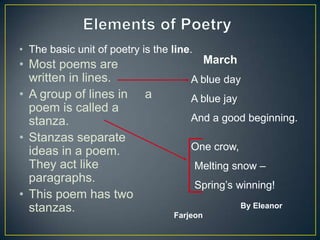
• The basic unit of poetry is the line.
• Most poems are
written in lines.
• A group of lines in a
poem is called a
stanza.
• Stanzas separate
ideas in a poem.
They act like
paragraphs.
• This poem has two
stanzas.
March
A blue day
A blue jay
And a good beginning.
One crow,
Melting snow –
Spring’s winning!
By Eleanor
Farjeon
KINDS OF STANZAS
Couplet = a two line stanza
Triplet (Tercet) = a three line stanza
Quatrain = a four line stanza
Quintet = a five line stanza
Sestet (Sextet)= a six line stanza
Septet = a seven line stanza
Octave = an eight line stanza
8
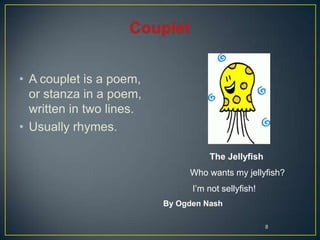
• A couplet is a poem,
or stanza in a poem,
written in two lines.
• Usually rhymes.
The Jellyfish
Who wants my jellyfish?
I’m not sellyfish!
By Ogden Nash
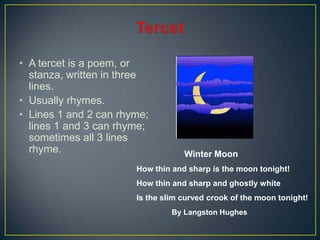
• A tercet is a poem, or
stanza, written in three
lines.
• Usually rhymes.
• Lines 1 and 2 can rhyme;
lines 1 and 3 can rhyme;
sometimes all 3 lines
rhyme. Winter Moon
How thin and sharp is the moon tonight!
How thin and sharp and ghostly white
Is the slim curved crook of the moon tonight!
By Langston Hughes
• A quatrain is a poem, or
stanza, written in four
lines.
• The quatrain is the most
common form of stanza
used in poetry.
• Usually rhymes.
• Can be written in variety
of rhyming patterns.
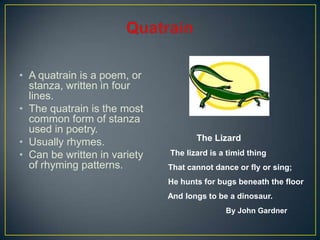
The Lizard
The lizard is a timid thing
That cannot dance or fly or sing;
He hunts for bugs beneath the floor
And longs to be a dinosaur.
By John Gardner
• A limerick is a funny
poem of 5 lines.
• Lines 1, 2 & 5 rhyme.
• Lines 3 & 4 are
shorter and rhyme.
• Line 5 refers to line 1.
• Limericks are a kind
of nonsense poem.
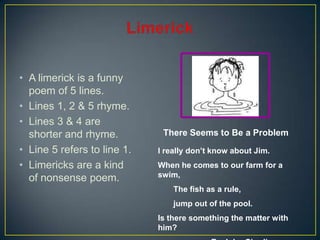
I really don’t know about Jim.
When he comes to our farm for a
swim,
The fish as a rule,
jump out of the pool.
Is there something the matter with
him?
There Seems to Be a Problem
12
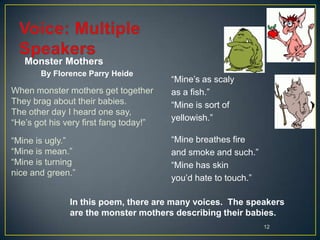
When monster mothers get together
They brag about their babies.
The other day I heard one say,
“He’s got his very first fang today!”
“Mine is ugly.”
“Mine is mean.”
“Mine is turning
nice and green.”
“Mine’s as scaly
as a fish.”
“Mine is sort of
yellowish.”
“Mine breathes fire
and smoke and such.”
“Mine has skin
you’d hate to touch.”
In this poem, there are many voices. The speakers
are the monster mothers describing their babies.
Monster Mothers
By Florence Parry Heide
SOME TYPES OF POETRY
WE WILL BE STUDYING
LYRIC
A short poem
Usually written in first person point of
view
Expresses an emotion or an idea or
describes a scene
Do not tell a story and are often musical
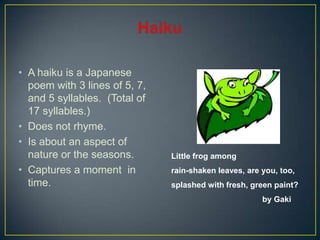
• A haiku is a Japanese
poem with 3 lines of 5, 7,
and 5 syllables. (Total of
17 syllables.)
• Does not rhyme.
• Is about an aspect of
nature or the seasons.
• Captures a moment in
time.
Little frog among
rain-shaken leaves, are you, too,
splashed with fresh, green paint?
by Gaki
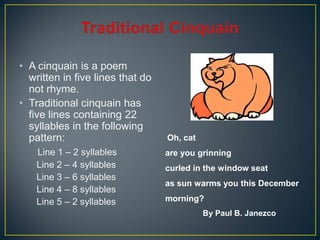
• A cinquain is a poem
written in five lines that do
not rhyme.
• Traditional cinquain has
five lines containing 22
syllables in the following
pattern:
Line 1 – 2 syllables
Line 2 – 4 syllables
Line 3 – 6 syllables
Line 4 – 8 syllables
Line 5 – 2 syllables
Oh, cat
are you grinning
curled in the window seat
as sun warms you this December
morning?
By Paul B. Janezco
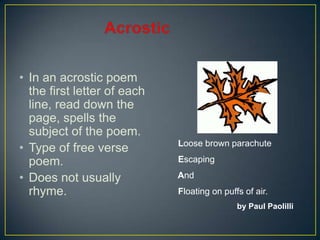
• In an acrostic poem
the first letter of each
line, read down the
page, spells the
subject of the poem.
• Type of free verse
poem.
• Does not usually
rhyme.
Loose brown parachute
Escaping
And
Floating on puffs of air.
by Paul Paolilli
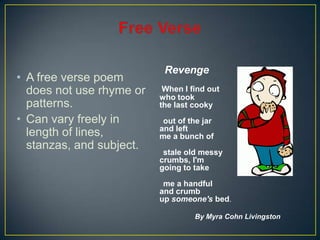
• A free verse poem
does not use rhyme or
patterns.
• Can vary freely in
length of lines,
stanzas, and subject.
Revenge
When I find out
who took
the last cooky
out of the jar
and left
me a bunch of
stale old messy
crumbs, I'm
going to take
me a handful
and crumb
up someone's bed.
By Myra Cohn Livingston
SHAKESPEAREAN SONNET
A fourteen line poem
with a specific rhyme
scheme.
The poem is written in
three quatrains and
ends with a couplet.
The rhyme scheme is
abab cdcd efef gg
Shall I compare thee to a summer’s day?
Thou art more lovely and more temperate.
Rough winds do shake the darling buds of May,
And summer’s lease hath all too short a date.
Sometimes too hot the eye of heaven shines,
And often is his gold complexion dimmed;
And every fair from fair sometimes declines,
By chance or nature’s changing course untrimmed.
But thy eternal summer shall not fade
Nor lose possession of that fair thou ow’st;
Nor shall Death brag thou wanderest in his shade,
When in eternal lines to time thou grow’st
So long as men can breathe or eyes can see,
So long lives this, and this gives life to thee.
NARRATIVE POEMS
 A poem that tells a
story.
 Generally longer
than the lyric styles
of poetry b/c the
poet needs to
establish characters
and a plot.
Examples of Narrative
Poems
“The Raven”
“The Highwayman”
“Casey at the Bat”
“The Walrus and the
Carpenter”
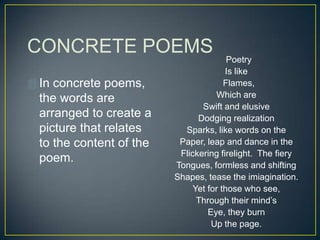
CONCRETE POEMS
 In concrete poems,
the words are
arranged to create a
picture that relates
to the content of the
poem.
Poetry
Is like
Flames,
Which are
Swift and elusive
Dodging realization
Sparks, like words on the
Paper, leap and dance in the
Flickering firelight. The fiery
Tongues, formless and shifting
Shapes, tease the imiagination.
Yet for those who see,
Through their mind’s
Eye, they burn
Up the page.
23
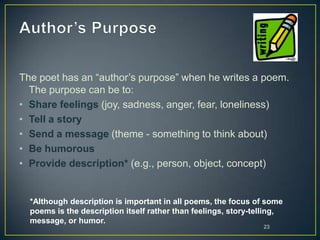
The poet has an “author’s purpose” when he writes a poem.
The purpose can be to:
• Share feelings (joy, sadness, anger, fear, loneliness)
• Tell a story
• Send a message (theme - something to think about)
• Be humorous
• Provide description* (e.g., person, object, concept)
*Although description is important in all poems, the focus of some
poems is the description itself rather than feelings, story-telling,
message, or humor.
•Poetry Stations
• Students are surrounded by poetry.
• Differentiation at every level: interest, choice, ability,
multiple intelligences.
• Creates a knowledge base for your students to draw
from and to refer to.
• Now kids have a vision of what non-
rhyming, contemporary (and modern)
poetry looks like.
• Yet students are not ready to go off and
write poems on their own.
• We must find poems that can act as
model/mentor texts to help guide them
through the writing process.
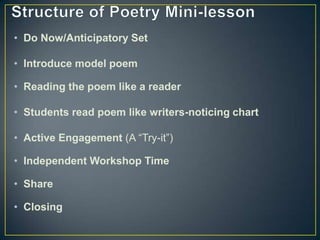
• Do Now/Anticipatory Set
• Introduce model poem
• Reading the poem like a reader
• Students read poem like writers-noticing chart
• Active Engagement (A “Try-it”)
• Independent Workshop Time
• Share
• Closing
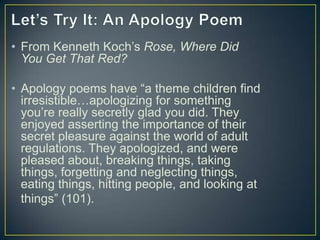
• From Kenneth Koch’s Rose, Where Did
You Get That Red?
• Apology poems have “a theme children find
irresistible…apologizing for something
you’re really secretly glad you did. They
enjoyed asserting the importance of their
secret pleasure against the world of adult
regulations. They apologized, and were
pleased about, breaking things, taking
things, forgetting and neglecting things,
eating things, hitting people, and looking at
things” (101).
• Have you ever had to apologize for something you
were not truly sorry for?
• Turn and talk to your neighbor
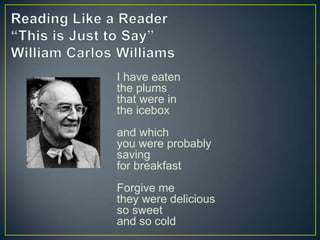
I have eaten
the plums
that were in
the icebox
and which
you were probably
saving
for breakfast
Forgive me
they were delicious
so sweet
and so cold
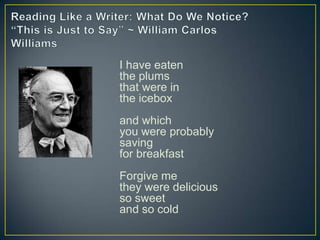
I have eaten
the plums
that were in
the icebox
and which
you were probably
saving
for breakfast
Forgive me
they were delicious
so sweet
and so cold
• Class would try one out together on board, in
groups, pairs or individually on common topic/idea
• Example: Sorry for being late, sorry for not doing
our homework, etc.
• Please try your own apology poem as I come
around to conference with you.
• Whole group share: sit in circle and read favorite
line or stanza
• Partner share
• Small group share
• Strategy highlight share
• Then, teacher would close the lesson.
The Pen
Take a pen in your uncertain fingers.
Trust, and be assured
That the whole world is a sky-blue butterfly
And words are the nets to capture it.
~Muhammad al-Ghuzzi

Poetry

  • 1.
    Of all thethings I wish I were I wish I were a sparra …
  • 2.
    In her book,In the Middle, Nancy Atwell writes: • “teachers I knew avoided teaching poetry because they felt intimidated by it. They perceived poetry as difficult to read, difficult to understand, and, especially, difficult to talk about. They stopped reading it the moment it stopped being required. Seventy years ago half the literature taught to fourth grades in the United States was poetry. Today, it’s 97 percent prose and just 3 percent poetry. Either we love it, as I did, but can’t imagine how to begin to help students experience it…or we don’t read it and don’t love it … Poetry deserves better and kids deserve better.”
  • 3.
    • form ofliterature written in a rhythmical style; verse, literature written in a metrical style • A type of literature that expresses ideas, feelings, or tells a story in a specific form (usually using lines and stanzas) • Like art it is very difficult to define because it is an expression of what the poet thinks and feels and may take any form the poet chooses for this expression. • Poetry is a creative use of words which, like all art, is intended to stir an emotion in the audience. Poetry generally has some structure that separates it from prose.
  • 4.
    4 Poetry What is poetry?Who knows? Not a rose, but the scent of a rose; Not the sky, but the light in the sky; Not the fly, but the gleam of the fly; Not the sea, but the sound of the sea; Not myself, but what makes me See, hear, and feel something that prose Cannot: and what it is, who knows? By Eleanor Farjeon
  • 5.
    What is itabout poetry that causes such strong reactions to its literary concept? Two streams of creation: • Poetry written FOR children • Rhymes and games created BY children
  • 6.
    • The basicunit of poetry is the line. • Most poems are written in lines. • A group of lines in a poem is called a stanza. • Stanzas separate ideas in a poem. They act like paragraphs. • This poem has two stanzas. March A blue day A blue jay And a good beginning. One crow, Melting snow – Spring’s winning! By Eleanor Farjeon
  • 7.
    KINDS OF STANZAS Couplet= a two line stanza Triplet (Tercet) = a three line stanza Quatrain = a four line stanza Quintet = a five line stanza Sestet (Sextet)= a six line stanza Septet = a seven line stanza Octave = an eight line stanza
  • 8.
    8 • A coupletis a poem, or stanza in a poem, written in two lines. • Usually rhymes. The Jellyfish Who wants my jellyfish? I’m not sellyfish! By Ogden Nash
  • 9.
    • A tercetis a poem, or stanza, written in three lines. • Usually rhymes. • Lines 1 and 2 can rhyme; lines 1 and 3 can rhyme; sometimes all 3 lines rhyme. Winter Moon How thin and sharp is the moon tonight! How thin and sharp and ghostly white Is the slim curved crook of the moon tonight! By Langston Hughes
  • 10.
    • A quatrainis a poem, or stanza, written in four lines. • The quatrain is the most common form of stanza used in poetry. • Usually rhymes. • Can be written in variety of rhyming patterns. The Lizard The lizard is a timid thing That cannot dance or fly or sing; He hunts for bugs beneath the floor And longs to be a dinosaur. By John Gardner
  • 11.
    • A limerickis a funny poem of 5 lines. • Lines 1, 2 & 5 rhyme. • Lines 3 & 4 are shorter and rhyme. • Line 5 refers to line 1. • Limericks are a kind of nonsense poem. I really don’t know about Jim. When he comes to our farm for a swim, The fish as a rule, jump out of the pool. Is there something the matter with him? There Seems to Be a Problem
  • 12.
    12 When monster mothersget together They brag about their babies. The other day I heard one say, “He’s got his very first fang today!” “Mine is ugly.” “Mine is mean.” “Mine is turning nice and green.” “Mine’s as scaly as a fish.” “Mine is sort of yellowish.” “Mine breathes fire and smoke and such.” “Mine has skin you’d hate to touch.” In this poem, there are many voices. The speakers are the monster mothers describing their babies. Monster Mothers By Florence Parry Heide
  • 13.
    SOME TYPES OFPOETRY WE WILL BE STUDYING
  • 14.
    LYRIC A short poem Usuallywritten in first person point of view Expresses an emotion or an idea or describes a scene Do not tell a story and are often musical
  • 15.
    • A haikuis a Japanese poem with 3 lines of 5, 7, and 5 syllables. (Total of 17 syllables.) • Does not rhyme. • Is about an aspect of nature or the seasons. • Captures a moment in time. Little frog among rain-shaken leaves, are you, too, splashed with fresh, green paint? by Gaki
  • 16.
    • A cinquainis a poem written in five lines that do not rhyme. • Traditional cinquain has five lines containing 22 syllables in the following pattern: Line 1 – 2 syllables Line 2 – 4 syllables Line 3 – 6 syllables Line 4 – 8 syllables Line 5 – 2 syllables Oh, cat are you grinning curled in the window seat as sun warms you this December morning? By Paul B. Janezco
  • 17.
    • In anacrostic poem the first letter of each line, read down the page, spells the subject of the poem. • Type of free verse poem. • Does not usually rhyme. Loose brown parachute Escaping And Floating on puffs of air. by Paul Paolilli
  • 18.
    • A freeverse poem does not use rhyme or patterns. • Can vary freely in length of lines, stanzas, and subject. Revenge When I find out who took the last cooky out of the jar and left me a bunch of stale old messy crumbs, I'm going to take me a handful and crumb up someone's bed. By Myra Cohn Livingston
  • 19.
    SHAKESPEAREAN SONNET A fourteenline poem with a specific rhyme scheme. The poem is written in three quatrains and ends with a couplet. The rhyme scheme is abab cdcd efef gg
  • 20.
    Shall I comparethee to a summer’s day? Thou art more lovely and more temperate. Rough winds do shake the darling buds of May, And summer’s lease hath all too short a date. Sometimes too hot the eye of heaven shines, And often is his gold complexion dimmed; And every fair from fair sometimes declines, By chance or nature’s changing course untrimmed. But thy eternal summer shall not fade Nor lose possession of that fair thou ow’st; Nor shall Death brag thou wanderest in his shade, When in eternal lines to time thou grow’st So long as men can breathe or eyes can see, So long lives this, and this gives life to thee.
  • 21.
    NARRATIVE POEMS  Apoem that tells a story.  Generally longer than the lyric styles of poetry b/c the poet needs to establish characters and a plot. Examples of Narrative Poems “The Raven” “The Highwayman” “Casey at the Bat” “The Walrus and the Carpenter”
  • 22.
    CONCRETE POEMS  Inconcrete poems, the words are arranged to create a picture that relates to the content of the poem. Poetry Is like Flames, Which are Swift and elusive Dodging realization Sparks, like words on the Paper, leap and dance in the Flickering firelight. The fiery Tongues, formless and shifting Shapes, tease the imiagination. Yet for those who see, Through their mind’s Eye, they burn Up the page.
  • 23.
    23 The poet hasan “author’s purpose” when he writes a poem. The purpose can be to: • Share feelings (joy, sadness, anger, fear, loneliness) • Tell a story • Send a message (theme - something to think about) • Be humorous • Provide description* (e.g., person, object, concept) *Although description is important in all poems, the focus of some poems is the description itself rather than feelings, story-telling, message, or humor.
  • 25.
    •Poetry Stations • Studentsare surrounded by poetry. • Differentiation at every level: interest, choice, ability, multiple intelligences. • Creates a knowledge base for your students to draw from and to refer to.
  • 26.
    • Now kidshave a vision of what non- rhyming, contemporary (and modern) poetry looks like. • Yet students are not ready to go off and write poems on their own. • We must find poems that can act as model/mentor texts to help guide them through the writing process.
  • 27.
    • Do Now/AnticipatorySet • Introduce model poem • Reading the poem like a reader • Students read poem like writers-noticing chart • Active Engagement (A “Try-it”) • Independent Workshop Time • Share • Closing
  • 28.
    • From KennethKoch’s Rose, Where Did You Get That Red? • Apology poems have “a theme children find irresistible…apologizing for something you’re really secretly glad you did. They enjoyed asserting the importance of their secret pleasure against the world of adult regulations. They apologized, and were pleased about, breaking things, taking things, forgetting and neglecting things, eating things, hitting people, and looking at things” (101).
  • 29.
    • Have youever had to apologize for something you were not truly sorry for? • Turn and talk to your neighbor
  • 30.
    I have eaten theplums that were in the icebox and which you were probably saving for breakfast Forgive me they were delicious so sweet and so cold
  • 31.
    I have eaten theplums that were in the icebox and which you were probably saving for breakfast Forgive me they were delicious so sweet and so cold
  • 32.
    • Class wouldtry one out together on board, in groups, pairs or individually on common topic/idea • Example: Sorry for being late, sorry for not doing our homework, etc.
  • 33.
    • Please tryyour own apology poem as I come around to conference with you.
  • 34.
    • Whole groupshare: sit in circle and read favorite line or stanza • Partner share • Small group share • Strategy highlight share • Then, teacher would close the lesson.
  • 35.
    The Pen Take apen in your uncertain fingers. Trust, and be assured That the whole world is a sky-blue butterfly And words are the nets to capture it. ~Muhammad al-Ghuzzi