RHYTHM AND METER
SOURCE: HTTP://WWW.ENGLISH.UPENN.EDU/~AFILREIS/
88/METER.HTML
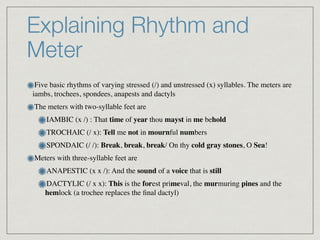
Explaining Rhythm and
Meter
Five basic rhythms of varying stressed (/) and unstressed (x) syllables. The meters are
iambs, trochees, spondees, anapests and dactyls	

The meters with two-syllable feet are	

IAMBIC (x /) : That time of year thou mayst in me behold	

TROCHAIC (/ x): Tell me not in mournful numbers	

SPONDAIC (/ /): Break, break, break/ On thy cold gray stones, O Sea!	

Meters with three-syllable feet are	

ANAPESTIC (x x /): And the sound of a voice that is still	

DACTYLIC (/ x x): This is the forest primeval, the murmuring pines and the
hemlock (a trochee replaces the final dactyl)
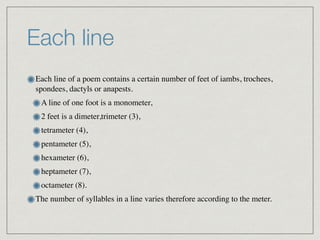
Each line
Each line of a poem contains a certain number of feet of iambs, trochees,
spondees, dactyls or anapests. 	

A line of one foot is a monometer, 	

2 feet is a dimeter,trimeter (3), 	

tetrameter (4), 	

pentameter (5), 	

hexameter (6), 	

heptameter (7),	

octameter (8). 	

The number of syllables in a line varies therefore according to the meter.
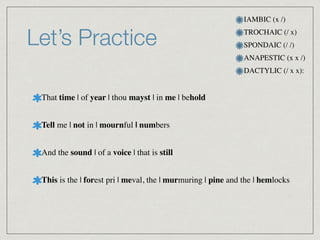
Let’s Practice
That time | of year | thou mayst | in me | behold 	

!
Tell me | not in | mournful | numbers 	

!
And the sound | of a voice | that is still	

!
This is the | forest pri | meval, the | murmuring | pine and the | hemlocks
IAMBIC (x /)	

TROCHAIC (/ x)	

SPONDAIC (/ /)	

ANAPESTIC (x x /)	

DACTYLIC (/ x x):
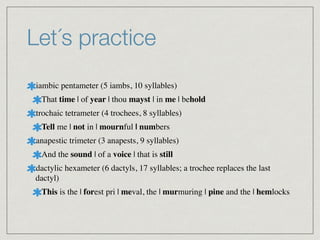
Let´s practice
iambic pentameter (5 iambs, 10 syllables)	

That time | of year | thou mayst | in me | behold 	

trochaic tetrameter (4 trochees, 8 syllables)	

Tell me | not in | mournful | numbers 	

anapestic trimeter (3 anapests, 9 syllables)	

And the sound | of a voice | that is still	

dactylic hexameter (6 dactyls, 17 syllables; a trochee replaces the last
dactyl)	

This is the | forest pri | meval, the | murmuring | pine and the | hemlocks

Rhythm and Meter in Poetry

  • 1.
    RHYTHM AND METER SOURCE:HTTP://WWW.ENGLISH.UPENN.EDU/~AFILREIS/ 88/METER.HTML
  • 2.
    Explaining Rhythm and Meter Fivebasic rhythms of varying stressed (/) and unstressed (x) syllables. The meters are iambs, trochees, spondees, anapests and dactyls The meters with two-syllable feet are IAMBIC (x /) : That time of year thou mayst in me behold TROCHAIC (/ x): Tell me not in mournful numbers SPONDAIC (/ /): Break, break, break/ On thy cold gray stones, O Sea! Meters with three-syllable feet are ANAPESTIC (x x /): And the sound of a voice that is still DACTYLIC (/ x x): This is the forest primeval, the murmuring pines and the hemlock (a trochee replaces the final dactyl)
  • 3.
    Each line Each lineof a poem contains a certain number of feet of iambs, trochees, spondees, dactyls or anapests. A line of one foot is a monometer, 2 feet is a dimeter,trimeter (3), tetrameter (4), pentameter (5), hexameter (6), heptameter (7), octameter (8). The number of syllables in a line varies therefore according to the meter.
  • 4.
    Let’s Practice That time| of year | thou mayst | in me | behold ! Tell me | not in | mournful | numbers ! And the sound | of a voice | that is still ! This is the | forest pri | meval, the | murmuring | pine and the | hemlocks IAMBIC (x /) TROCHAIC (/ x) SPONDAIC (/ /) ANAPESTIC (x x /) DACTYLIC (/ x x):
  • 5.
    Let´s practice iambic pentameter(5 iambs, 10 syllables) That time | of year | thou mayst | in me | behold trochaic tetrameter (4 trochees, 8 syllables) Tell me | not in | mournful | numbers anapestic trimeter (3 anapests, 9 syllables) And the sound | of a voice | that is still dactylic hexameter (6 dactyls, 17 syllables; a trochee replaces the last dactyl) This is the | forest pri | meval, the | murmuring | pine and the | hemlocks