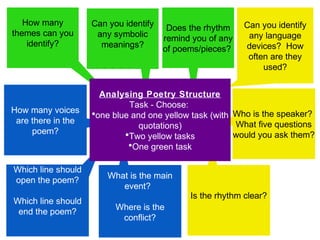
How many
themes can you
identify?
Can you identify
any symbolic
meanings?
Does the rhythm
remind you of any
of poems/pieces?
Can you identify
any language
devices? How
often are they
used?
Which line should
open the poem?
Which line should
end the poem?
What is the main
event?
Where is the
conflict?
Is the rhythm clear?
Who is the speaker?
What five questions
would you ask them?
How many voices
are there in the
poem?
Analysing Poetry Structure
Task - Choose:
•one blue and one yellow task (with
quotations)
•Two yellow tasks
•One green task
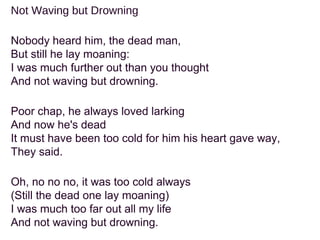
Not Waving but Drowning
Nobody heard him, the dead man,
But still he lay moaning:
I was much further out than you thought
And not waving but drowning.
Poor chap, he always loved larking
And now he's dead
It must have been too cold for him his heart gave way,
They said.
Oh, no no no, it was too cold always
(Still the dead one lay moaning)
I was much too far out all my life
And not waving but drowning.
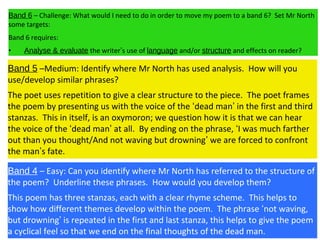
Band 4 – Easy: Can you identify where Mr North has referred to the structure of
the poem? Underline these phrases. How would you develop them?
This poem has three stanzas, each with a clear rhyme scheme. This helps to
show how different themes develop within the poem. The phrase ‘not waving,
but drowning’ is repeated in the first and last stanza, this helps to give the poem
a cyclical feel so that we end on the final thoughts of the dead man.
Band 5 –Medium: Identify where Mr North has used analysis. How will you
use/develop similar phrases?
The poet uses repetition to give a clear structure to the piece. The poet frames
the poem by presenting us with the voice of the ‘dead man’ in the first and third
stanzas. This in itself, is an oxymoron; we question how it is that we can hear
the voice of the ‘dead man’ at all. By ending on the phrase, ‘I was much farther
out than you thought/And not waving but drowning’ we are forced to confront
the man’s fate.
Band 6 – Challenge: What would I need to do in order to move my poem to a band 6? Set Mr North
some targets:
Band 6 requires:
•       Analyse & evaluate the writer’s use of language and/or structure and effects on reader?
Suggested Sentence Starters
•At the beginning of the poem...
•By the end of the poem...
•I believe the narrative is...
•The poet has used [insert language device] in order to...
•The use of [insert language device] helps the
reader/listener to...
•In the _______ stanza the speaker tells us ________.
This helps to develop the story because...
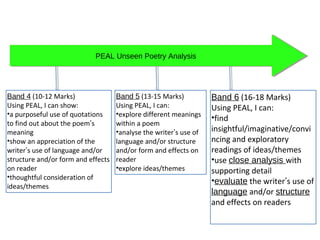
PEAL Unseen Poetry Analysis
Band 6 (16-18 Marks)
Using PEAL, I can:
•find
insightful/imaginative/convi
ncing and exploratory
readings of ideas/themes
•use close analysis with
supporting detail
•evaluate the writer’s use of
language and/or structure
and effects on readers
Band 5 (13-15 Marks)
Using PEAL, I can:
•explore different meanings
within a poem
•analyse the writer’s use of
language and/or structure
and/or form and effects on
reader
•explore ideas/themes
Band 4 (10-12 Marks)
Using PEAL, I can show:
•a purposeful use of quotations
to find out about the poem’s
meaning
•show an appreciation of the
writer’s use of language and/or
structure and/or form and effects
on reader
•thoughtful consideration of
ideas/themes
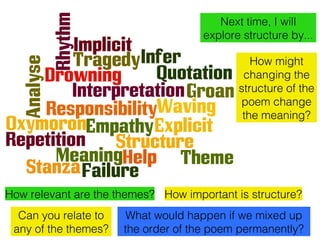
How important is structure?
What would happen if we mixed up
the order of the poem permanently?
How relevant are the themes?
How might
changing the
structure of the
poem change
the meaning?
Next time, I will
explore structure by...
Can you relate to
any of the themes?
How important is structure?
What would happen if we mixed up
the order of the poem permanently?
How relevant are the themes?
How might
changing the
structure of the
poem change
the meaning?
Next time, I will
explore structure by...
Can you relate to
any of the themes?

Poetry structure analysis

  • 1.
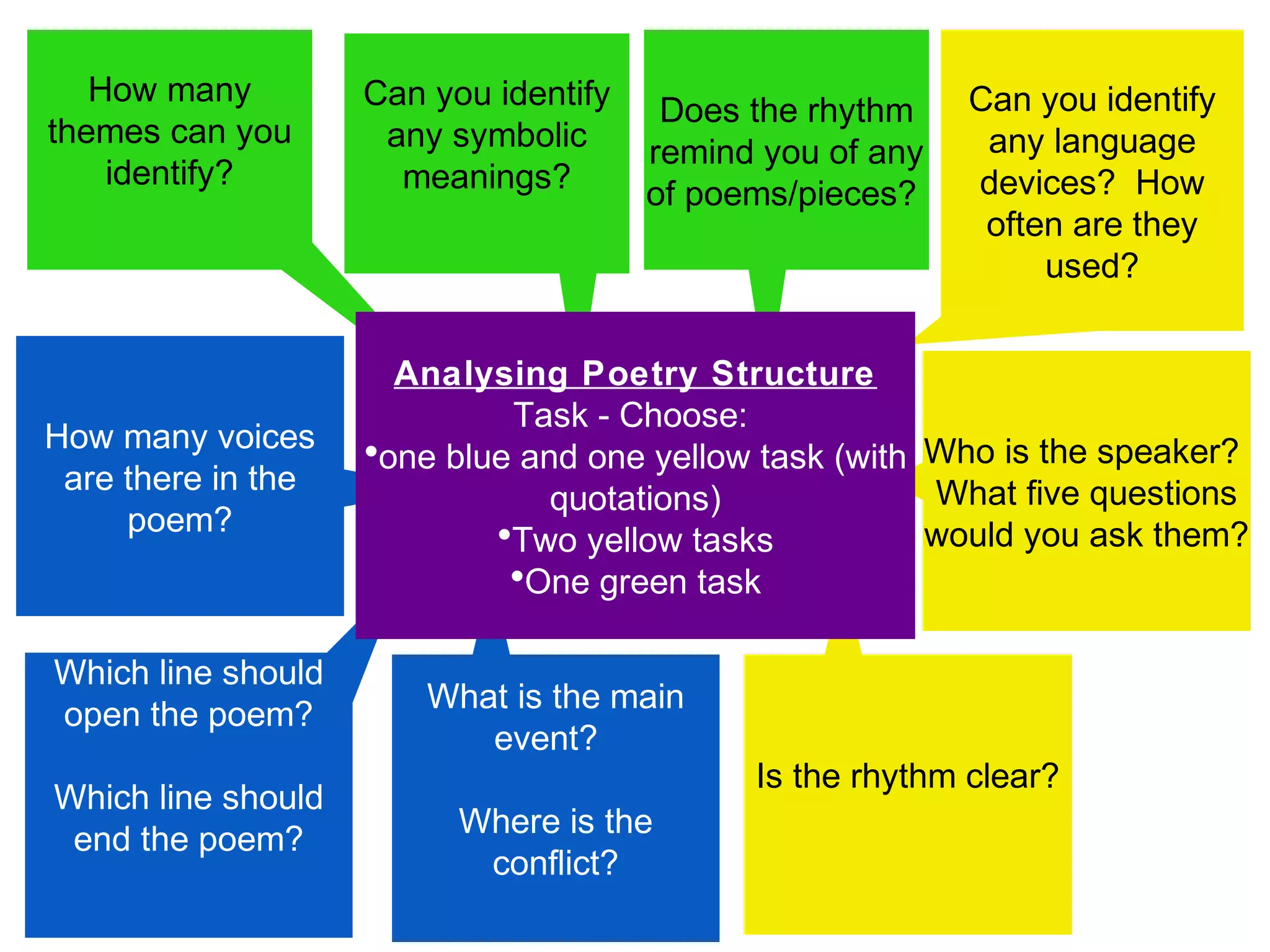
    How many themes canyou identify? Can you identify any symbolic meanings? Does the rhythm remind you of any of poems/pieces? Can you identify any language devices? How often are they used? Which line should open the poem? Which line should end the poem? What is the main event? Where is the conflict? Is the rhythm clear? Who is the speaker? What five questions would you ask them? How many voices are there in the poem? Analysing Poetry Structure Task - Choose: •one blue and one yellow task (with quotations) •Two yellow tasks •One green task
  • 2.
    Not Waving butDrowning Nobody heard him, the dead man, But still he lay moaning: I was much further out than you thought And not waving but drowning. Poor chap, he always loved larking And now he's dead It must have been too cold for him his heart gave way, They said. Oh, no no no, it was too cold always (Still the dead one lay moaning) I was much too far out all my life And not waving but drowning.
  • 3.
    Band 4 –Easy: Can you identify where Mr North has referred to the structure of the poem? Underline these phrases. How would you develop them? This poem has three stanzas, each with a clear rhyme scheme. This helps to show how different themes develop within the poem. The phrase ‘not waving, but drowning’ is repeated in the first and last stanza, this helps to give the poem a cyclical feel so that we end on the final thoughts of the dead man. Band 5 –Medium: Identify where Mr North has used analysis. How will you use/develop similar phrases? The poet uses repetition to give a clear structure to the piece. The poet frames the poem by presenting us with the voice of the ‘dead man’ in the first and third stanzas. This in itself, is an oxymoron; we question how it is that we can hear the voice of the ‘dead man’ at all. By ending on the phrase, ‘I was much farther out than you thought/And not waving but drowning’ we are forced to confront the man’s fate. Band 6 – Challenge: What would I need to do in order to move my poem to a band 6? Set Mr North some targets: Band 6 requires: •       Analyse & evaluate the writer’s use of language and/or structure and effects on reader?
  • 4.
    Suggested Sentence Starters •Atthe beginning of the poem... •By the end of the poem... •I believe the narrative is... •The poet has used [insert language device] in order to... •The use of [insert language device] helps the reader/listener to... •In the _______ stanza the speaker tells us ________. This helps to develop the story because...
  • 5.
    PEAL Unseen PoetryAnalysis Band 6 (16-18 Marks) Using PEAL, I can: •find insightful/imaginative/convi ncing and exploratory readings of ideas/themes •use close analysis with supporting detail •evaluate the writer’s use of language and/or structure and effects on readers Band 5 (13-15 Marks) Using PEAL, I can: •explore different meanings within a poem •analyse the writer’s use of language and/or structure and/or form and effects on reader •explore ideas/themes Band 4 (10-12 Marks) Using PEAL, I can show: •a purposeful use of quotations to find out about the poem’s meaning •show an appreciation of the writer’s use of language and/or structure and/or form and effects on reader •thoughtful consideration of ideas/themes
  • 6.
    How important isstructure? What would happen if we mixed up the order of the poem permanently? How relevant are the themes? How might changing the structure of the poem change the meaning? Next time, I will explore structure by... Can you relate to any of the themes?
  • 7.
    How important isstructure? What would happen if we mixed up the order of the poem permanently? How relevant are the themes? How might changing the structure of the poem change the meaning? Next time, I will explore structure by... Can you relate to any of the themes?