Types of Poetry Creative Writing
Genres of Poetry Narrative Poetry-  a narrative poem is one that tells a story. Types of narrative poetry include ballads and epics. (Think of Homer… not the guy from  The Simpsons!) Lyric Poetry-  a highly musical verse that expresses the emotions of the speaker. Common types are sonnets, odes, free verse and elegies. Dramatic poetry-  a dramatic poem is a verse that relies heavily on dramatic elements such as monologue, or dialogue. Two types of dramatic poetry are dramatic monologue and soliloquy.
Formal Verse Set patterns of rhythm and rhyme i.e.  Beowolf Based on scansion (the counting of stresses and syllables) and set verse pattern.  Sometimes, a rhyme scheme matters, but not always.
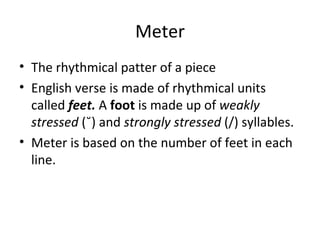
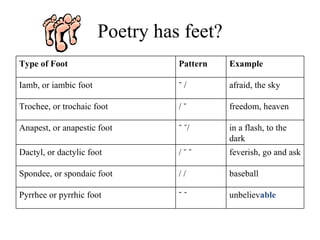
Meter The rhythmical patter of a piece English verse is made of rhythmical units called  feet.  A  foot  is made up of  weakly stressed  (˘) and  strongly stressed  (/) syllables. Meter is based on the number of feet in each line.
Poetry has feet? Type of Foot Pattern Example Iamb, or iambic foot ˘ / afraid, the sky Trochee, or trochaic foot / ˘ freedom, heaven Anapest, or anapestic foot ˘ ˘/ in a flash, to the dark Dactyl, or dactylic foot / ˘ ˘ feverish, go and ask Spondee, or spondaic foot / / baseball Pyrrhee or pyrrhic foot ˘ ˘ unbeliev able
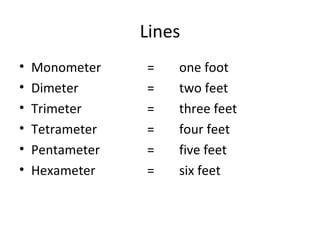
Lines Monometer  =  one foot Dimeter =  two feet Trimeter = three feet Tetrameter =  four feet Pentameter =  five feet Hexameter =  six feet
Playing With Feet See your worksheet.
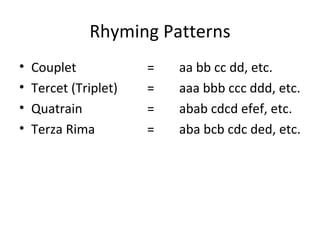
Rhyming Patterns Couplet =  aa bb cc dd, etc. Tercet (Triplet) = aaa bbb ccc ddd, etc. Quatrain =  abab cdcd efef, etc. Terza Rima =  aba bcb cdc ded, etc.
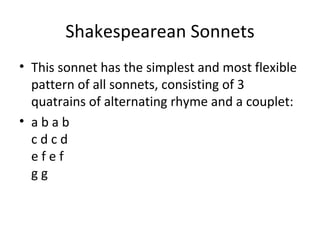
Shakespearean Sonnets This sonnet has the simplest and most flexible pattern of all sonnets, consisting of 3 quatrains of alternating rhyme and a couplet:  a b a b c d c d e f e f g g
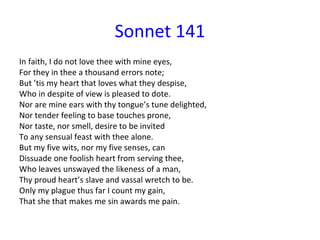
Sonnet 141 In faith, I do not love thee with mine eyes, For they in thee a thousand errors note; But ’tis my heart that loves what they despise, Who in despite of view is pleased to dote. Nor are mine ears with thy tongue’s tune delighted, Nor tender feeling to base touches prone, Nor taste, nor smell, desire to be invited To any sensual feast with thee alone. But my five wits, nor my five senses, can Dissuade one foolish heart from serving thee, Who leaves unswayed the likeness of a man, Thy proud heart’s slave and vassal wretch to be. Only my plague thus far I count my gain, That she that makes me sin awards me pain.
Group Sonnets Write a sonnet with your group (of 3 or 4) by alternating lines.
Blank Verse Unrhymed iambic pentameter  Shakespeare’s language (from the plays)
Transition Twentieth Century Likened to the transition from ballet to contemporary dance Started with Emily Dickinson & Walt Whitman Loosened forms
Free Verse Loosened rhythms Rhymes set askew Took on the rhythms of ordinary speech Practiced by poets who first taught themselves the rigors of earlier periods, of formal verse.
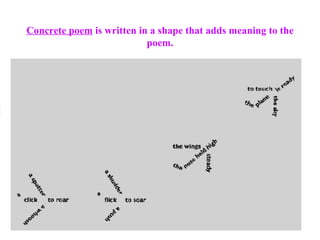
Concrete poem  is written in a shape that adds meaning to the poem.
I propose … that you begin to  play  with sound and rhythm.  … that you imitate what you like; imitation, which has been called the sincerest form of flattery, is also the most teaching form of play. … that you begin by writing poems about the subjects that matter to you.

Cw Typesof Poetry

  • 1.
    Types of PoetryCreative Writing
  • 2.
    Genres of PoetryNarrative Poetry- a narrative poem is one that tells a story. Types of narrative poetry include ballads and epics. (Think of Homer… not the guy from The Simpsons!) Lyric Poetry- a highly musical verse that expresses the emotions of the speaker. Common types are sonnets, odes, free verse and elegies. Dramatic poetry- a dramatic poem is a verse that relies heavily on dramatic elements such as monologue, or dialogue. Two types of dramatic poetry are dramatic monologue and soliloquy.
  • 3.
    Formal Verse Setpatterns of rhythm and rhyme i.e. Beowolf Based on scansion (the counting of stresses and syllables) and set verse pattern. Sometimes, a rhyme scheme matters, but not always.
  • 4.
    Meter The rhythmicalpatter of a piece English verse is made of rhythmical units called feet. A foot is made up of weakly stressed (˘) and strongly stressed (/) syllables. Meter is based on the number of feet in each line.
  • 5.
    Poetry has feet?Type of Foot Pattern Example Iamb, or iambic foot ˘ / afraid, the sky Trochee, or trochaic foot / ˘ freedom, heaven Anapest, or anapestic foot ˘ ˘/ in a flash, to the dark Dactyl, or dactylic foot / ˘ ˘ feverish, go and ask Spondee, or spondaic foot / / baseball Pyrrhee or pyrrhic foot ˘ ˘ unbeliev able
  • 6.
    Lines Monometer = one foot Dimeter = two feet Trimeter = three feet Tetrameter = four feet Pentameter = five feet Hexameter = six feet
  • 7.
    Playing With FeetSee your worksheet.
  • 8.
    Rhyming Patterns Couplet= aa bb cc dd, etc. Tercet (Triplet) = aaa bbb ccc ddd, etc. Quatrain = abab cdcd efef, etc. Terza Rima = aba bcb cdc ded, etc.
  • 9.
    Shakespearean Sonnets Thissonnet has the simplest and most flexible pattern of all sonnets, consisting of 3 quatrains of alternating rhyme and a couplet: a b a b c d c d e f e f g g
  • 10.
    Sonnet 141 Infaith, I do not love thee with mine eyes, For they in thee a thousand errors note; But ’tis my heart that loves what they despise, Who in despite of view is pleased to dote. Nor are mine ears with thy tongue’s tune delighted, Nor tender feeling to base touches prone, Nor taste, nor smell, desire to be invited To any sensual feast with thee alone. But my five wits, nor my five senses, can Dissuade one foolish heart from serving thee, Who leaves unswayed the likeness of a man, Thy proud heart’s slave and vassal wretch to be. Only my plague thus far I count my gain, That she that makes me sin awards me pain.
  • 11.
    Group Sonnets Writea sonnet with your group (of 3 or 4) by alternating lines.
  • 12.
    Blank Verse Unrhymediambic pentameter Shakespeare’s language (from the plays)
  • 13.
    Transition Twentieth CenturyLikened to the transition from ballet to contemporary dance Started with Emily Dickinson & Walt Whitman Loosened forms
  • 14.
    Free Verse Loosenedrhythms Rhymes set askew Took on the rhythms of ordinary speech Practiced by poets who first taught themselves the rigors of earlier periods, of formal verse.
  • 15.
    Concrete poem is written in a shape that adds meaning to the poem.
  • 16.
    I propose …that you begin to play with sound and rhythm. … that you imitate what you like; imitation, which has been called the sincerest form of flattery, is also the most teaching form of play. … that you begin by writing poems about the subjects that matter to you.