POETIC ASSESSMENT
By: MARVIN D. MORALES
VOCABULARY WORDS
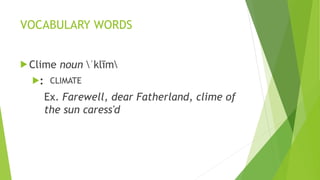
 Clime noun ˈklīm
: CLIMATE
Ex. Farewell, dear Fatherland, clime of
the sun caress'd
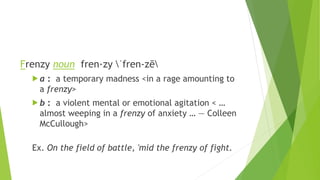
Frenzy noun fren·zy ˈfren-zē
 a : a temporary madness <in a rage amounting to
a frenzy>
 b : a violent mental or emotional agitation < …
almost weeping in a frenzy of anxiety … — Colleen
McCullough>
Ex. On the field of battle, 'mid the frenzy of fight.
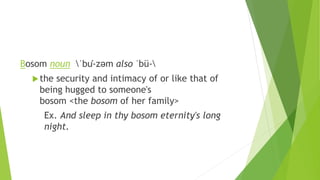
Bosom noun ˈbu̇-zəm also ˈbü-
the security and intimacy of or like that of
being hugged to someone's
bosom <the bosom of her family>
Ex. And sleep in thy bosom eternity's long
night.
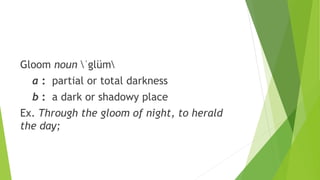
Gloom noun ˈglüm
a : partial or total darkness
b : a dark or shadowy place
Ex. Through the gloom of night, to herald
the day;
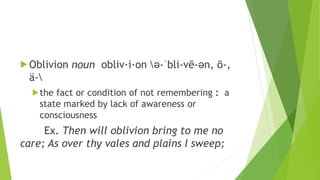
 Oblivion noun obliv·i·on ə-ˈbli-vē-ən, ō-,
ä-
the fact or condition of not remembering : a
state marked by lack of awareness or
consciousness
Ex. Then will oblivion bring to me no
care; As over thy vales and plains I sweep;
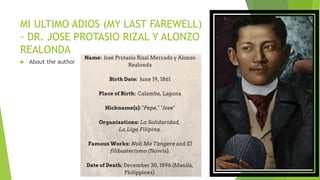
MI ULTIMO ADIOS (MY LAST FAREWELL)
- DR. JOSE PROTASIO RIZAL Y ALONZO
REALONDA
 About the author
MI ULTIMO ADIOS
LAST FAREWELL
MI ULTIMO ADIOS
MI ULTIMO ADIOS
LAST FAREWELL
 WITH ASSESSMENT
MI ULTIMO ADIOS
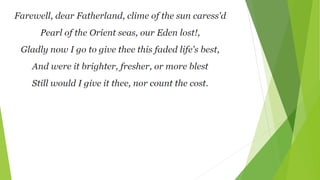
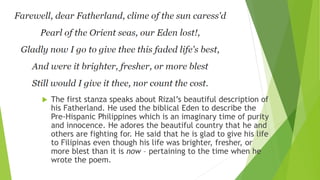
 The first stanza speaks about Rizal’s beautiful description of
his Fatherland. He used the biblical Eden to describe the
Pre-Hispanic Philippines which is an imaginary time of purity
and innocence. He adores the beautiful country that he and
others are fighting for. He said that he is glad to give his life
to Filipinas even though his life was brighter, fresher, or
more blest than it is now – pertaining to the time when he
wrote the poem.
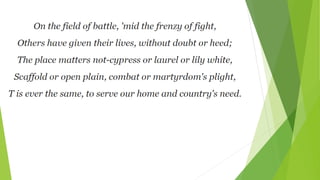
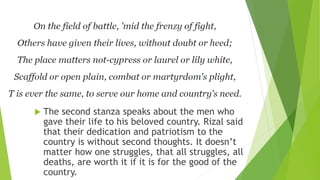
 The second stanza speaks about the men who
gave their life to his beloved country. Rizal said
that their dedication and patriotism to the
country is without second thoughts. It doesn’t
matter how one struggles, that all struggles, all
deaths, are worth it if it is for the good of the
country.
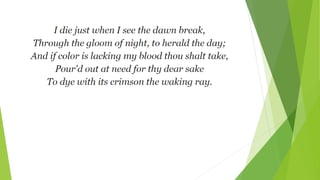
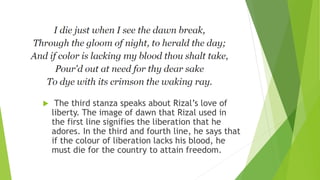
 The third stanza speaks about Rizal’s love of
liberty. The image of dawn that Rizal used in
the first line signifies the liberation that he
adores. In the third and fourth line, he says that
if the colour of liberation lacks his blood, he
must die for the country to attain freedom.
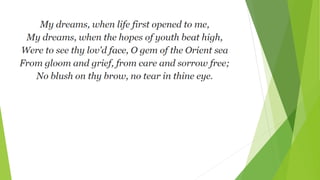
 The fourth stanza presents the flashback of Rizal’s
love for the patria that started when he was young.
He was young when he saw the martyrdom of the
GOMBURZA and promised that he would dedicate
himself to avenge one day for those victims. His
dreams were to see his country in eminent
liberation, free from sorrow and grief.
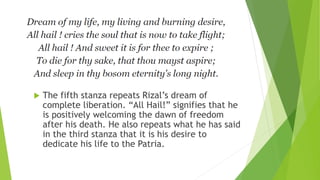
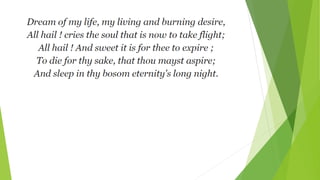
 The fifth stanza repeats Rizal’s dream of
complete liberation. “All Hail!” signifies that he
is positively welcoming the dawn of freedom
after his death. He also repeats what he has said
in the third stanza that it is his desire to
dedicate his life to the Patria.
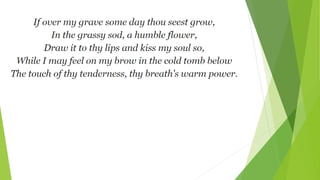
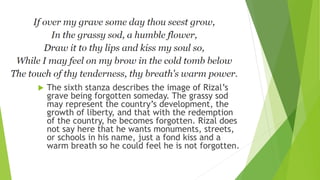
 The sixth stanza describes the image of Rizal’s
grave being forgotten someday. The grassy sod
may represent the country’s development, the
growth of liberty, and that with the redemption
of the country, he becomes forgotten. Rizal does
not say here that he wants monuments, streets,
or schools in his name, just a fond kiss and a
warm breath so he could feel he is not forgotten.
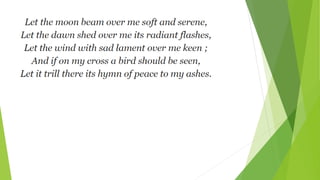
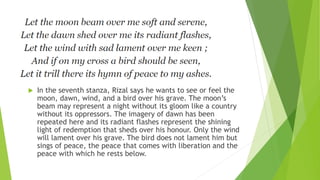
 In the seventh stanza, Rizal says he wants to see or feel the
moon, dawn, wind, and a bird over his grave. The moon’s
beam may represent a night without its gloom like a country
without its oppressors. The imagery of dawn has been
repeated here and its radiant flashes represent the shining
light of redemption that sheds over his honour. Only the wind
will lament over his grave. The bird does not lament him but
sings of peace, the peace that comes with liberation and the
peace with which he rests below.
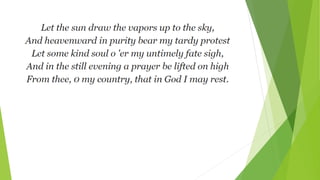
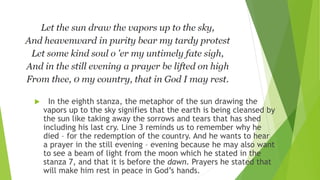
 In the eighth stanza, the metaphor of the sun drawing the
vapors up to the sky signifies that the earth is being cleansed by
the sun like taking away the sorrows and tears that has shed
including his last cry. Line 3 reminds us to remember why he
died – for the redemption of the country. And he wants to hear
a prayer in the still evening – evening because he may also want
to see a beam of light from the moon which he stated in the
stanza 7, and that it is before the dawn. Prayers he stated that
will make him rest in peace in God’s hands.
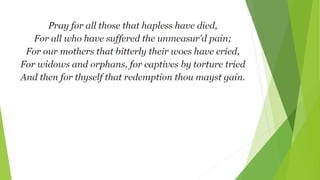
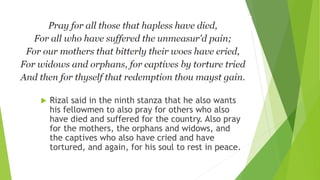
 Rizal said in the ninth stanza that he also wants
his fellowmen to also pray for others who also
have died and suffered for the country. Also pray
for the mothers, the orphans and widows, and
the captives who also have cried and have
tortured, and again, for his soul to rest in peace.
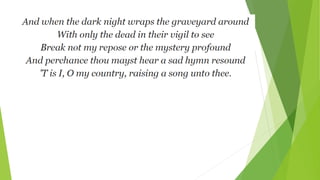
 The tenth stanza says that Rizal’s tomb is on
the graveyard with the other dead people.
Rizal says that in the night, he does not want
to be disturbed in his rest along with the others
and the mystery the graveyard contains. And
whenever we hear a sad song emanating from
the grave, it is he who sings for his fatherland.
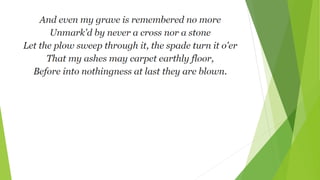
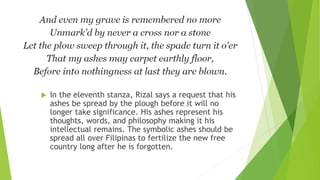
 In the eleventh stanza, Rizal says a request that his
ashes be spread by the plough before it will no
longer take significance. His ashes represent his
thoughts, words, and philosophy making it his
intellectual remains. The symbolic ashes should be
spread all over Filipinas to fertilize the new free
country long after he is forgotten.
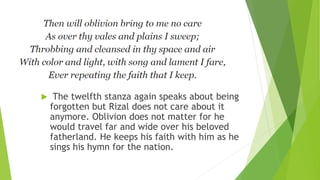
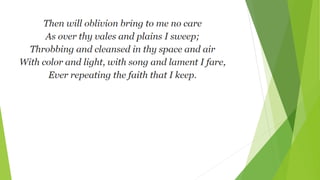
 The twelfth stanza again speaks about being
forgotten but Rizal does not care about it
anymore. Oblivion does not matter for he
would travel far and wide over his beloved
fatherland. He keeps his faith with him as he
sings his hymn for the nation.
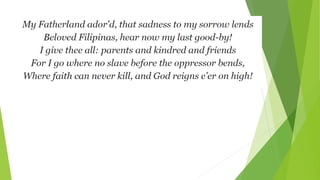
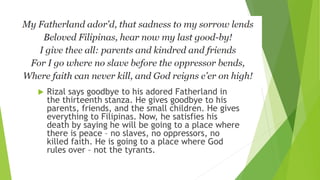
 Rizal says goodbye to his adored Fatherland in
the thirteenth stanza. He gives goodbye to his
parents, friends, and the small children. He gives
everything to Filipinas. Now, he satisfies his
death by saying he will be going to a place where
there is peace – no slaves, no oppressors, no
killed faith. He is going to a place where God
rules over – not the tyrants.
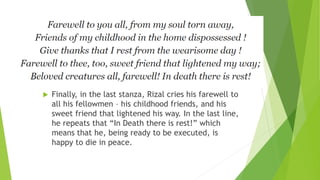
 Finally, in the last stanza, Rizal cries his farewell to
all his fellowmen – his childhood friends, and his
sweet friend that lightened his way. In the last line,
he repeats that “In Death there is rest!” which
means that he, being ready to be executed, is
happy to die in peace.

Poetic assessment

  • 1.
  • 2.
    VOCABULARY WORDS  Climenoun ˈklīm : CLIMATE Ex. Farewell, dear Fatherland, clime of the sun caress'd
  • 3.
    Frenzy noun fren·zyˈfren-zē  a : a temporary madness <in a rage amounting to a frenzy>  b : a violent mental or emotional agitation < … almost weeping in a frenzy of anxiety … — Colleen McCullough> Ex. On the field of battle, 'mid the frenzy of fight.
  • 4.
    Bosom noun ˈbu̇-zəmalso ˈbü- the security and intimacy of or like that of being hugged to someone's bosom <the bosom of her family> Ex. And sleep in thy bosom eternity's long night.
  • 5.
    Gloom noun ˈglüm a: partial or total darkness b : a dark or shadowy place Ex. Through the gloom of night, to herald the day;
  • 6.
     Oblivion nounobliv·i·on ə-ˈbli-vē-ən, ō-, ä- the fact or condition of not remembering : a state marked by lack of awareness or consciousness Ex. Then will oblivion bring to me no care; As over thy vales and plains I sweep;
  • 7.
    MI ULTIMO ADIOS(MY LAST FAREWELL) - DR. JOSE PROTASIO RIZAL Y ALONZO REALONDA  About the author
  • 27.
  • 28.
  • 42.
    MI ULTIMO ADIOS LASTFAREWELL  WITH ASSESSMENT
  • 43.
    MI ULTIMO ADIOS The first stanza speaks about Rizal’s beautiful description of his Fatherland. He used the biblical Eden to describe the Pre-Hispanic Philippines which is an imaginary time of purity and innocence. He adores the beautiful country that he and others are fighting for. He said that he is glad to give his life to Filipinas even though his life was brighter, fresher, or more blest than it is now – pertaining to the time when he wrote the poem.
  • 44.
     The secondstanza speaks about the men who gave their life to his beloved country. Rizal said that their dedication and patriotism to the country is without second thoughts. It doesn’t matter how one struggles, that all struggles, all deaths, are worth it if it is for the good of the country.
  • 45.
     The thirdstanza speaks about Rizal’s love of liberty. The image of dawn that Rizal used in the first line signifies the liberation that he adores. In the third and fourth line, he says that if the colour of liberation lacks his blood, he must die for the country to attain freedom.
  • 46.
     The fourthstanza presents the flashback of Rizal’s love for the patria that started when he was young. He was young when he saw the martyrdom of the GOMBURZA and promised that he would dedicate himself to avenge one day for those victims. His dreams were to see his country in eminent liberation, free from sorrow and grief.
  • 47.
     The fifthstanza repeats Rizal’s dream of complete liberation. “All Hail!” signifies that he is positively welcoming the dawn of freedom after his death. He also repeats what he has said in the third stanza that it is his desire to dedicate his life to the Patria.
  • 48.
     The sixthstanza describes the image of Rizal’s grave being forgotten someday. The grassy sod may represent the country’s development, the growth of liberty, and that with the redemption of the country, he becomes forgotten. Rizal does not say here that he wants monuments, streets, or schools in his name, just a fond kiss and a warm breath so he could feel he is not forgotten.
  • 49.
     In theseventh stanza, Rizal says he wants to see or feel the moon, dawn, wind, and a bird over his grave. The moon’s beam may represent a night without its gloom like a country without its oppressors. The imagery of dawn has been repeated here and its radiant flashes represent the shining light of redemption that sheds over his honour. Only the wind will lament over his grave. The bird does not lament him but sings of peace, the peace that comes with liberation and the peace with which he rests below.
  • 50.
     In theeighth stanza, the metaphor of the sun drawing the vapors up to the sky signifies that the earth is being cleansed by the sun like taking away the sorrows and tears that has shed including his last cry. Line 3 reminds us to remember why he died – for the redemption of the country. And he wants to hear a prayer in the still evening – evening because he may also want to see a beam of light from the moon which he stated in the stanza 7, and that it is before the dawn. Prayers he stated that will make him rest in peace in God’s hands.
  • 51.
     Rizal saidin the ninth stanza that he also wants his fellowmen to also pray for others who also have died and suffered for the country. Also pray for the mothers, the orphans and widows, and the captives who also have cried and have tortured, and again, for his soul to rest in peace.
  • 52.
     The tenthstanza says that Rizal’s tomb is on the graveyard with the other dead people. Rizal says that in the night, he does not want to be disturbed in his rest along with the others and the mystery the graveyard contains. And whenever we hear a sad song emanating from the grave, it is he who sings for his fatherland.
  • 53.
     In theeleventh stanza, Rizal says a request that his ashes be spread by the plough before it will no longer take significance. His ashes represent his thoughts, words, and philosophy making it his intellectual remains. The symbolic ashes should be spread all over Filipinas to fertilize the new free country long after he is forgotten.
  • 54.
     The twelfthstanza again speaks about being forgotten but Rizal does not care about it anymore. Oblivion does not matter for he would travel far and wide over his beloved fatherland. He keeps his faith with him as he sings his hymn for the nation.
  • 55.
     Rizal saysgoodbye to his adored Fatherland in the thirteenth stanza. He gives goodbye to his parents, friends, and the small children. He gives everything to Filipinas. Now, he satisfies his death by saying he will be going to a place where there is peace – no slaves, no oppressors, no killed faith. He is going to a place where God rules over – not the tyrants.
  • 56.
     Finally, inthe last stanza, Rizal cries his farewell to all his fellowmen – his childhood friends, and his sweet friend that lightened his way. In the last line, he repeats that “In Death there is rest!” which means that he, being ready to be executed, is happy to die in peace.