
Setting Up a PMO
By Ray Arpin, June 2017
Introduction
There are many possible definitions of a PMO, such as:
• Project Management Office
• Program Management Office
• Portfolio Management Office.
This paper is specifically to address the setting up of a new Project Management Office
(PMO) in an organization. The rule of thumb is to keep it simple, to start. Any change
is difficult and a new PMO must start slowly to generate small successes that will add
value to the organization.
The purpose of this document is to help an organization quickly and effectively setup a
PMO, and assumes that a PMO is a new concept for the organization.
There is a significant amount of information on the Internet about PMOs and how to
start one. Some of it is written by software or consulting companies to sell their
business offerings, and although it may be useful information, too much does not
address the simple basics for a successful PMO.
I welcome any feedback that may help an organization setup a new PMO.
Purpose
The first challenge is to identify the main purpose, or purposes, for the need of a PMO.
That will help determine where the PMO should reside within the organization.
An argument can be made that the PMO should reside directly above the function or
department that has identified that a PMO is needed. Ideally, a PMO should be high in
the organization because every function or department has the need for a PMO. The
reason is simply that every function or department “should be” initiating projects to
improve the business. For this paper, I will use the Information Technology (IT)
department as an example.
Needs
Generally speaking, a PMO is needed to address common, recurring problems or
opportunities, such as:
• There are no documented or followed processes or guidelines for creating or
managing projects
• Projects are exceeding time and budget; or project cancellations
• Staffing projects is difficult; resources are limited
• Project scope keeps changing
• There is no way to prioritize projects or determine the value of projects
• Little or no good reason to start a project – at least not for the good of the overall
organization
• There is no high level manager to champion the purpose for the project
• Little or no communication about the project…
The list can go on, but I will stop there.
Starting and Setup
Purpose of a PMO
A PMO can be established to become the expertise for how the organization will
manage projects. Start with the projects that have been successful and identify the
components that have made them a success. Then, begin to make those components
into the initial, documented standards for all future projects.
Examples may include:
• Project definition, planning, and how the project is managed
• Standard project terms, such as Phase, Activity, Task
If there are too many standards, people will reject the use. Experienced project
managers will know the basic standards that should apply to projects. Asking current
project managers will also help with change and acceptance of the standards.
I would not advocate using a major standard such as the Project Management Institute
(PMI), Project Management Book of Knowledge (PMBOK). It would be an overkill if you
are just starting a PMO. However, you can, and should, refer to such references that
can be used as examples, or as a model to grow and improve.
I have seen organizations build very complicated, robust, and all-encompassing
standards on their first roll out of a PMO. All have failed miserably.
Start Up
Take your best 2-3 project managers and make them part of the PMO structure. Most
successful PMOs start with 2-3 people. To begin, the PMO does not need to be, nor
should be, a separate box on the organization chart. Typically, the information
technology (IT) group is the first part of the organization that recognizes a need and
value of a PMO. However, in some organizations, another function or department may
have a need for a PMO.
Standards
Establishing standards allows for common understanding and faster training for new
employees, as well as a basis for evaluating successful results or need for
improvements – assuming the standards are followed.
The following standards can be used to start a PMO. Keep it to the basics.
1) Make sure that there is an “executive sponsor” for the establishment of a PMO.
An executive or high level manager is needed to help enforce standards and
make other parts of the organization understand the value. Critical.
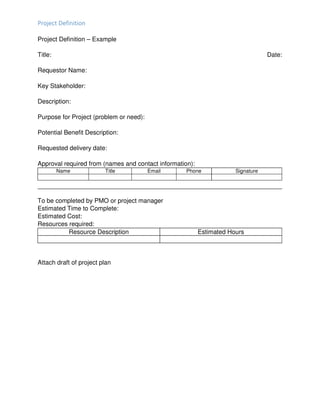
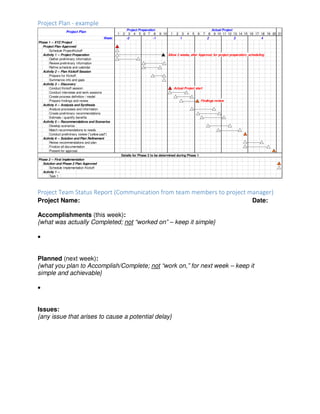
2) All project documentation should look the same. Examples are in Appendix A. At
first, this applies to
a. How a project is defined, headings, and content required
b. How the project plan should look (e.g., Phase, Activity, Task)
c. A standard format for communication of the project and status, both
internal for the project team and external to stakeholders
i. Status reports to stakeholders – monthly
ii. Project team status reports – weekly
iii. Depending on size and length of project, there should be at least a
quarterly status meeting with the project manager and
stakeholders; planned and scheduled in advance
3) All projects need to clearly indicate how the intended results will benefit the
organization and align with the goals and objectives
4) Estimated cost and staffing components; and a quantified expectation of the
results. This is helpful in justification and prioritization
5) Use a standard project management “methodology” or guidelines. If something
has been working fairly well, use it, and then see if it can be improved. Do not
implement some totally new standard, software, or tools. Do not assume that
everyone knows, train them in the same manner, preferably all together. Make
sure there is consensus and agreement on using the guidelines.
6) Project Change document is needed to avoid the common problem of “scope
creep” and serves as detailed information for approval and lessons-learned
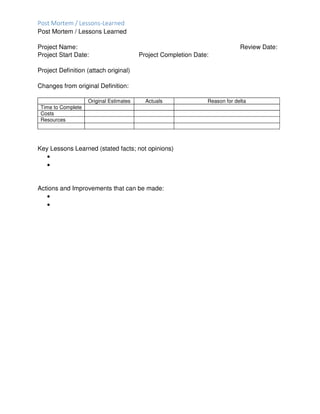
7) Conduct periodic project reviews at the PMO level with the project managers,
and always have a post mortem / lessons-learned at the end of every project. At
first, this will meet with excuses that there is no time, another project has to start,
or something else. However, the lessons-learned will help the establishment and
improvements of the PMO. Example in Appendix A.
8) A clearly defined escalation process should be established for both project
managers and stakeholders for any issues that cannot be resolved at their level.
This is another reason that an executive sponsor may be able to help if the PMO
needs assistance.
You can use existing documents, to start, as long as they are not too complicated or a
burden to create.
If there are standard documents that are agreed upon, place them in a central
repository so that any project manager or team member has easy access to them.
PMO Activities
The primary purpose of a PMO is to make sure that all projects are successful and
delivering the expected results. This includes guidance, training, establishing
processes, methodologies, and standards.
It is important to emphasize that the PMO is not a “ruling body” or control point. Rather,
it is to help project managers, project team members, and the organization as a whole
to get the most benefit from all projects. A PMO should facilitate, help, and improve, not
create bureaucracy, become a bottleneck, or additional overhead.
Always keep it simple and effective; not trying to use the latest fads or software – get
the basics established first.
The PMO should always be ready to make changes to be most effective for the
organization and ensure project success.
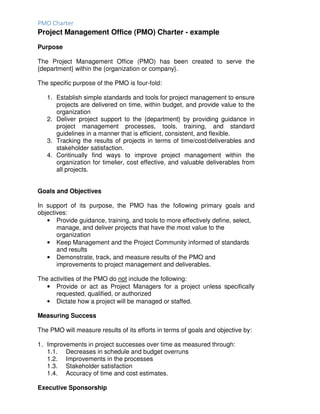
Establish a simple PMO Charter that explains the purpose of the PMO, its objectives,
the basic activities, and expected benefits. Use this to communicate with the project
teams and project stakeholders. The executive sponsor can also use it to communicate
with the rest of the organization. Example in Appendix A.
The PMO should establish and maintain a work flow diagram that clearly communicates
how a project is created, defined, and managed. The PMO should be responsible for
training and mentoring new project managers or team members on the standards and
work flow for the projects in the organization.
The PMO becomes the subject matter experts for projects.
Equally important, a PMO must establish metrics to show the continued value that the
PMO brings to the organization and projects, overall. Some measures may include:
• On time completion of projects
• Staying within estimated budget for projects
• Decreases in time to complete or project costs
• Stakeholder satisfaction with results of projects
• Project team satisfaction
• Meeting or exceeding expected results of the project
• Increased project management expertise
Therefore, if possible, a PMO should gather historical or current information on projects
so that the PMO can clearly show improvements.
For any additional information or suggestions, please contact Ray Arpin at
Ray@RayArpin.com
APPENDIX A – Examples
PMO Charter
Project Management Office (PMO) Charter - example
Purpose
The Project Management Office (PMO) has been created to serve the
{department} within the {organization or company}.
The specific purpose of the PMO is four-fold:
1. Establish simple standards and tools for project management to ensure
projects are delivered on time, within budget, and provide value to the
organization
2. Deliver project support to the {department} by providing guidance in
project management processes, tools, training, and standard
guidelines in a manner that is efficient, consistent, and flexible.
3. Tracking the results of projects in terms of time/cost/deliverables and
stakeholder satisfaction.
4. Continually find ways to improve project management within the
organization for timelier, cost effective, and valuable deliverables from
all projects.
Goals and Objectives
In support of its purpose, the PMO has the following primary goals and
objectives:
• Provide guidance, training, and tools to more effectively define, select,
manage, and deliver projects that have the most value to the
organization
• Keep Management and the Project Community informed of standards
and results
• Demonstrate, track, and measure results of the PMO and
improvements to project management and deliverables.
The activities of the PMO do not include the following:
• Provide or act as Project Managers for a project unless specifically
requested, qualified, or authorized
• Dictate how a project will be managed or staffed.
Measuring Success
The PMO will measure results of its efforts in terms of goals and objective by:
1. Improvements in project successes over time as measured through:
1.1. Decreases in schedule and budget overruns
1.2. Improvements in the processes
1.3. Stakeholder satisfaction
1.4. Accuracy of time and cost estimates.
Executive Sponsorship
Project Definition
Project Definition – Example
Title: Date:
Requestor Name:
Key Stakeholder:
Description:
Purpose for Project (problem or need):
Potential Benefit Description:
Requested delivery date:
Approval required from (names and contact information):
Name Title Email Phone Signature
To be completed by PMO or project manager
Estimated Time to Complete:
Estimated Cost:
Resources required:
Resource Description Estimated Hours
Attach draft of project plan
Project Plan - example
Project Team Status Report (Communication from team members to project manager)
Project Name: Date:
Accomplishments (this week):
{what was actually Completed; not “worked on” – keep it simple}
•
Planned (next week):
{what you plan to Accomplish/Complete; not “work on,” for next week – keep it
simple and achievable}
•
Issues:
{any issue that arises to cause a potential delay}
1 2 3 4 5 6 7 8 9 10 1 2 3 4 5 6 7 8 9 10 11 12 13 14 15 16 17 18 19 20 21
Phase 1 -- XYZ Project
Project Plan Approved
Schedule ProjectKickoff
Activity 1 -- Project Preparation Allow 2 weeks, after Approval, for project preparation; scheduling
Gather preliminary information
Review preliminary information
Refine schedule and calendar
Activity 2 -- Plan Kickoff Session
Prepare for Kickoff
Summarize info and gaps
Activity 3 -- Discovery
Conduct Kickoff session Actual Project start
Conduct interviews and work sessions
Create process definition / model
Prepare findings and review Findings review
Acitivty 4 -- Analysis and Synthesis
Analyze processes and information
Create preliminary recommendations
Estimate / quantify benefits
Activity 5 -- Recommendations and Scenarios
Develop scenarios
Match recommendations to needs
Conduct preliminary review ("yellow pad")
Activity 6 -- Solution and Plan Refinement
Revise recommendations and plan
Finalize all documentation
Present for approval
Phase 2 -- First Implementation
Solution and Phase 2 Plan Approved
Schedule Implementation Kickoff
Activity 1 --
Task 1
2
Project Plan
Week:
Details for Phase 2 to be determined during Phase 1
Project Preparation Actual Project
43-2 -1 1
Post Mortem / Lessons-Learned
Post Mortem / Lessons Learned
Project Name: Review Date:
Project Start Date: Project Completion Date:
Project Definition (attach original)
Changes from original Definition:
Original Estimates Actuals Reason for delta
Time to Complete
Costs
Resources
Key Lessons Learned (stated facts; not opinions)
•
•
Actions and Improvements that can be made:
•
•

Setting up a new PMO - Arpin

  • 1.
    Setting Up aPMO By Ray Arpin, June 2017 Introduction There are many possible definitions of a PMO, such as: • Project Management Office • Program Management Office • Portfolio Management Office. This paper is specifically to address the setting up of a new Project Management Office (PMO) in an organization. The rule of thumb is to keep it simple, to start. Any change is difficult and a new PMO must start slowly to generate small successes that will add value to the organization. The purpose of this document is to help an organization quickly and effectively setup a PMO, and assumes that a PMO is a new concept for the organization. There is a significant amount of information on the Internet about PMOs and how to start one. Some of it is written by software or consulting companies to sell their business offerings, and although it may be useful information, too much does not address the simple basics for a successful PMO. I welcome any feedback that may help an organization setup a new PMO. Purpose The first challenge is to identify the main purpose, or purposes, for the need of a PMO. That will help determine where the PMO should reside within the organization. An argument can be made that the PMO should reside directly above the function or department that has identified that a PMO is needed. Ideally, a PMO should be high in the organization because every function or department has the need for a PMO. The reason is simply that every function or department “should be” initiating projects to improve the business. For this paper, I will use the Information Technology (IT) department as an example. Needs Generally speaking, a PMO is needed to address common, recurring problems or opportunities, such as: • There are no documented or followed processes or guidelines for creating or managing projects • Projects are exceeding time and budget; or project cancellations • Staffing projects is difficult; resources are limited • Project scope keeps changing • There is no way to prioritize projects or determine the value of projects • Little or no good reason to start a project – at least not for the good of the overall organization • There is no high level manager to champion the purpose for the project
  • 2.
    • Little orno communication about the project… The list can go on, but I will stop there. Starting and Setup Purpose of a PMO A PMO can be established to become the expertise for how the organization will manage projects. Start with the projects that have been successful and identify the components that have made them a success. Then, begin to make those components into the initial, documented standards for all future projects. Examples may include: • Project definition, planning, and how the project is managed • Standard project terms, such as Phase, Activity, Task If there are too many standards, people will reject the use. Experienced project managers will know the basic standards that should apply to projects. Asking current project managers will also help with change and acceptance of the standards. I would not advocate using a major standard such as the Project Management Institute (PMI), Project Management Book of Knowledge (PMBOK). It would be an overkill if you are just starting a PMO. However, you can, and should, refer to such references that can be used as examples, or as a model to grow and improve. I have seen organizations build very complicated, robust, and all-encompassing standards on their first roll out of a PMO. All have failed miserably. Start Up Take your best 2-3 project managers and make them part of the PMO structure. Most successful PMOs start with 2-3 people. To begin, the PMO does not need to be, nor should be, a separate box on the organization chart. Typically, the information technology (IT) group is the first part of the organization that recognizes a need and value of a PMO. However, in some organizations, another function or department may have a need for a PMO. Standards Establishing standards allows for common understanding and faster training for new employees, as well as a basis for evaluating successful results or need for improvements – assuming the standards are followed. The following standards can be used to start a PMO. Keep it to the basics. 1) Make sure that there is an “executive sponsor” for the establishment of a PMO. An executive or high level manager is needed to help enforce standards and make other parts of the organization understand the value. Critical. 2) All project documentation should look the same. Examples are in Appendix A. At first, this applies to a. How a project is defined, headings, and content required b. How the project plan should look (e.g., Phase, Activity, Task) c. A standard format for communication of the project and status, both internal for the project team and external to stakeholders
  • 3.
    i. Status reportsto stakeholders – monthly ii. Project team status reports – weekly iii. Depending on size and length of project, there should be at least a quarterly status meeting with the project manager and stakeholders; planned and scheduled in advance 3) All projects need to clearly indicate how the intended results will benefit the organization and align with the goals and objectives 4) Estimated cost and staffing components; and a quantified expectation of the results. This is helpful in justification and prioritization 5) Use a standard project management “methodology” or guidelines. If something has been working fairly well, use it, and then see if it can be improved. Do not implement some totally new standard, software, or tools. Do not assume that everyone knows, train them in the same manner, preferably all together. Make sure there is consensus and agreement on using the guidelines. 6) Project Change document is needed to avoid the common problem of “scope creep” and serves as detailed information for approval and lessons-learned 7) Conduct periodic project reviews at the PMO level with the project managers, and always have a post mortem / lessons-learned at the end of every project. At first, this will meet with excuses that there is no time, another project has to start, or something else. However, the lessons-learned will help the establishment and improvements of the PMO. Example in Appendix A. 8) A clearly defined escalation process should be established for both project managers and stakeholders for any issues that cannot be resolved at their level. This is another reason that an executive sponsor may be able to help if the PMO needs assistance. You can use existing documents, to start, as long as they are not too complicated or a burden to create. If there are standard documents that are agreed upon, place them in a central repository so that any project manager or team member has easy access to them. PMO Activities The primary purpose of a PMO is to make sure that all projects are successful and delivering the expected results. This includes guidance, training, establishing processes, methodologies, and standards. It is important to emphasize that the PMO is not a “ruling body” or control point. Rather, it is to help project managers, project team members, and the organization as a whole to get the most benefit from all projects. A PMO should facilitate, help, and improve, not create bureaucracy, become a bottleneck, or additional overhead. Always keep it simple and effective; not trying to use the latest fads or software – get the basics established first. The PMO should always be ready to make changes to be most effective for the organization and ensure project success. Establish a simple PMO Charter that explains the purpose of the PMO, its objectives, the basic activities, and expected benefits. Use this to communicate with the project
  • 4.
    teams and projectstakeholders. The executive sponsor can also use it to communicate with the rest of the organization. Example in Appendix A. The PMO should establish and maintain a work flow diagram that clearly communicates how a project is created, defined, and managed. The PMO should be responsible for training and mentoring new project managers or team members on the standards and work flow for the projects in the organization. The PMO becomes the subject matter experts for projects. Equally important, a PMO must establish metrics to show the continued value that the PMO brings to the organization and projects, overall. Some measures may include: • On time completion of projects • Staying within estimated budget for projects • Decreases in time to complete or project costs • Stakeholder satisfaction with results of projects • Project team satisfaction • Meeting or exceeding expected results of the project • Increased project management expertise Therefore, if possible, a PMO should gather historical or current information on projects so that the PMO can clearly show improvements. For any additional information or suggestions, please contact Ray Arpin at Ray@RayArpin.com
  • 5.
  • 6.
    PMO Charter Project ManagementOffice (PMO) Charter - example Purpose The Project Management Office (PMO) has been created to serve the {department} within the {organization or company}. The specific purpose of the PMO is four-fold: 1. Establish simple standards and tools for project management to ensure projects are delivered on time, within budget, and provide value to the organization 2. Deliver project support to the {department} by providing guidance in project management processes, tools, training, and standard guidelines in a manner that is efficient, consistent, and flexible. 3. Tracking the results of projects in terms of time/cost/deliverables and stakeholder satisfaction. 4. Continually find ways to improve project management within the organization for timelier, cost effective, and valuable deliverables from all projects. Goals and Objectives In support of its purpose, the PMO has the following primary goals and objectives: • Provide guidance, training, and tools to more effectively define, select, manage, and deliver projects that have the most value to the organization • Keep Management and the Project Community informed of standards and results • Demonstrate, track, and measure results of the PMO and improvements to project management and deliverables. The activities of the PMO do not include the following: • Provide or act as Project Managers for a project unless specifically requested, qualified, or authorized • Dictate how a project will be managed or staffed. Measuring Success The PMO will measure results of its efforts in terms of goals and objective by: 1. Improvements in project successes over time as measured through: 1.1. Decreases in schedule and budget overruns 1.2. Improvements in the processes 1.3. Stakeholder satisfaction 1.4. Accuracy of time and cost estimates. Executive Sponsorship
  • 7.
    Project Definition Project Definition– Example Title: Date: Requestor Name: Key Stakeholder: Description: Purpose for Project (problem or need): Potential Benefit Description: Requested delivery date: Approval required from (names and contact information): Name Title Email Phone Signature To be completed by PMO or project manager Estimated Time to Complete: Estimated Cost: Resources required: Resource Description Estimated Hours Attach draft of project plan
  • 8.
    Project Plan -example Project Team Status Report (Communication from team members to project manager) Project Name: Date: Accomplishments (this week): {what was actually Completed; not “worked on” – keep it simple} • Planned (next week): {what you plan to Accomplish/Complete; not “work on,” for next week – keep it simple and achievable} • Issues: {any issue that arises to cause a potential delay} 1 2 3 4 5 6 7 8 9 10 1 2 3 4 5 6 7 8 9 10 11 12 13 14 15 16 17 18 19 20 21 Phase 1 -- XYZ Project Project Plan Approved Schedule ProjectKickoff Activity 1 -- Project Preparation Allow 2 weeks, after Approval, for project preparation; scheduling Gather preliminary information Review preliminary information Refine schedule and calendar Activity 2 -- Plan Kickoff Session Prepare for Kickoff Summarize info and gaps Activity 3 -- Discovery Conduct Kickoff session Actual Project start Conduct interviews and work sessions Create process definition / model Prepare findings and review Findings review Acitivty 4 -- Analysis and Synthesis Analyze processes and information Create preliminary recommendations Estimate / quantify benefits Activity 5 -- Recommendations and Scenarios Develop scenarios Match recommendations to needs Conduct preliminary review ("yellow pad") Activity 6 -- Solution and Plan Refinement Revise recommendations and plan Finalize all documentation Present for approval Phase 2 -- First Implementation Solution and Phase 2 Plan Approved Schedule Implementation Kickoff Activity 1 -- Task 1 2 Project Plan Week: Details for Phase 2 to be determined during Phase 1 Project Preparation Actual Project 43-2 -1 1
  • 9.
    Post Mortem /Lessons-Learned Post Mortem / Lessons Learned Project Name: Review Date: Project Start Date: Project Completion Date: Project Definition (attach original) Changes from original Definition: Original Estimates Actuals Reason for delta Time to Complete Costs Resources Key Lessons Learned (stated facts; not opinions) • • Actions and Improvements that can be made: • •