Project Management Offices
[PMOs]
Adson Cunha, MSc, PMP®
jaogc@cin.ufpe.br
Who am I?
• Visiting Scholar @ Centro de Estudos de Gestão – IST, Portugal
• PhD Candidate @ Center of Informatics – UFPE, Brazil
• Member @ Research Group in Project Management – UFPE, Brazil
• Project Management Office Member @ DATAPREV, Brazil
• Project Management Professional (PMP®)
• Consultant
What is a PMO?
“Management structure that standardizes
the project-related governance processes and
facilitates the sharing of resources,
methodologies, tools, and techniques”
(Project Management Institute, 2013, p. 10)
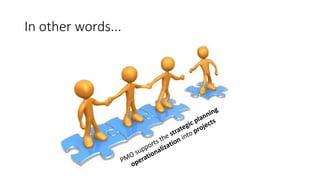
In other words...
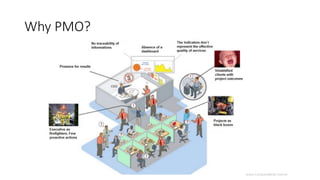
Why PMO?
PMOs can have different flavors
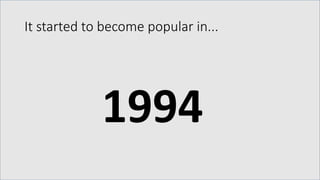
It started to become popular in...
1994
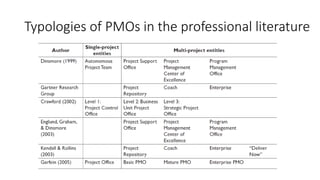
Typologies of PMOs in the professional literature
But in the reality it is much
more complex than simple
models
PMOs has been studied empirically since...
2004
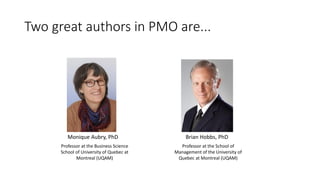
Two great authors in PMO are...
Monique Aubry, PhD
Professor at the Business Science
School of University of Quebec at
Montreal (UQAM)
Brian Hobbs, PhD
Professor at the School of
Management of the University of
Quebec at Montreal (UQAM)
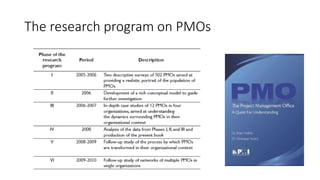
The research program on PMOs
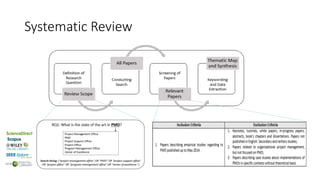
Let´s follow the state of
the art in PMO based on
a Systematic Review
BUT...
Systematic Review
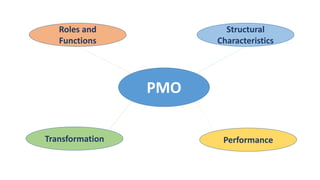
PMO
Roles and
Functions
Structural
Characteristics
PerformanceTransformation
ROLES AND FUNCTIONS
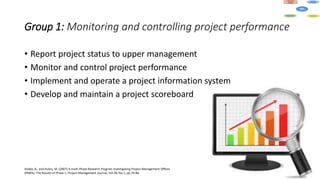
Group 1: Monitoring and controlling project performance
• Report project status to upper management
• Monitor and control project performance
• Implement and operate a project information system
• Develop and maintain a project scoreboard
Hobbs, B., and Aubry, M. (2007) A multi-Phase Research Program Investigating Project Management Offices
(PMOs): The Results of Phase 1, Project Management Journal, Vol.38, No.1, pp.74-86.
Group 2: Development of project management
competencies and methodologies
• Develop and implement a standard methodology
• Promote project management within the organization
• Develop competency of personnel, including training
• Provide mentoring for project managers
• Provide a set of tools without an effort to standardize
Hobbs, B., and Aubry, M. (2007) A multi-Phase Research Program Investigating Project Management Offices
(PMOs): The Results of Phase 1, Project Management Journal, Vol.38, No.1, pp.74-86.
Group 3: Multi-project management
• Coordinate between projects
• Identify, select, and prioritize new projects
• Manage one or more portfolios
• Manage one or more programs
• Allocate resources between projects
Hobbs, B., and Aubry, M. (2007) A multi-Phase Research Program Investigating Project Management Offices
(PMOs): The Results of Phase 1, Project Management Journal, Vol.38, No.1, pp.74-86.
Group 4: Strategic management
• Provide advice to upper management
• Participate in strategic planning
• Manage benefits
• Networking and environmental scanning
Hobbs, B., and Aubry, M. (2007) A multi-Phase Research Program Investigating Project Management Offices
(PMOs): The Results of Phase 1, Project Management Journal, Vol.38, No.1, pp.74-86.
Group 5: Organizational learning
• Monitor and control the performance of the PMO
• Manage archives of project documentation
• Conduct post-project reviews
• Conduct project audits
• Implement and manage a database of lessons learned
• Implement and manage a risk database
Hobbs, B., and Aubry, M. (2007) A multi-Phase Research Program Investigating Project Management Offices
(PMOs): The Results of Phase 1, Project Management Journal, Vol.38, No.1, pp.74-86.
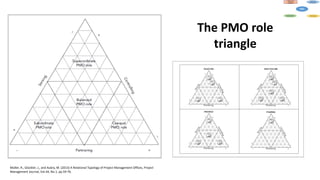
The PMO role
triangle
Müller, R., Glückler, J., and Aubry, M. (2013) A Relational Typology of Project Management Offices, Project
Management Journal, Vol.44, No.1, pp.59-76.
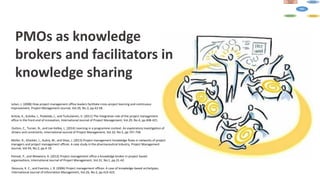
PMOs as knowledge
brokers and facilitators in
knowledge sharing
Julian, J. (2008) How project management office leaders facilitate cross-project learning and continuous
improvement, Project Management Journal, Vol.39, No.3, pp.43-58.
Arttoa, K., Kulvika, I., Poskelab, J., and Turkulainen, V. (2011) The integrative role of the project management
office in the front end of innovation, International Journal of Project Management, Vol.29, No.4, pp.408-421.
Dutton, C., Turner, N., and Lee-Kelley, L. (2014) Learning in a programme context: An exploratory investigation of
drivers and constraints, International Journal of Project Management, Vol.32, No.5, pp.747-758.
Müller, R., Glückler, J., Aubry, M., and Shao, J. (2013) Project management knowledge flows in networks of project
managers and project management offices: A case study in the pharmaceutical industry, Project Management
Journal, Vol.44, No.2, pp.4-19.
Pemsel, P., and Wiewiora, A. (2013) Project management office a knowledge broker in project-based
organisations, International Journal of Project Management, Vol.31, No.1, pp.31-42.
Desouza, K. C., and Evaristo, J. R. (2006) Project management offices: A case of knowledge-based archetypes,
International Journal of Information Management, Vol.26, No.5, pp.414-423.
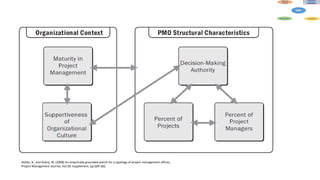
STRUCTURAL CHARACTERISTICS
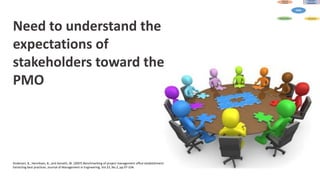
Need to understand the
expectations of
stakeholders toward the
PMO
Andersen, B., Henriksen, B., and Aarseth, W. (2007) Benchmarking of project management office establishment:
Extracting best practices, Journal of Management in Engineering, Vol.23, No.2, pp.97-104.
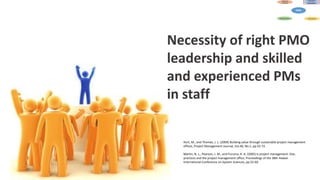
Necessity of right PMO
leadership and skilled
and experienced PMs
in staff
Hurt, M., and Thomas, J. L. (2009) Building value through sustainable project management
offices, Project Management Journal, Vol.40, No.1, pp.55-72.
Martin, N. L., Pearson, J. M., and Furumo, K. A. (2005) Is project management: Size,
practices and the project management office, Proceedings of the 38th Hawaii
International Conference on System Sciences, pp.52-60.
Community of PMOs
Aubry, M., Müller, and, Glückler, J. (2011) Exploring PMOs through community of practice theory, Project
Management Journal, Vol.42, No.5, pp.42-56.
Hobbs, B., and Aubry, M. (2008) An empirically grounded search for a typology of project management offices,
Project Management Journal, Vol.39, Supplement, pp.S69-S82.
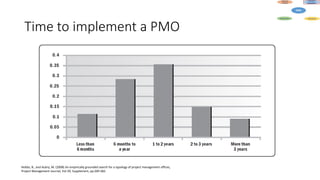
Time to implement a PMO
Hobbs, B., and Aubry, M. (2008) An empirically grounded search for a typology of project management offices,
Project Management Journal, Vol.39, Supplement, pp.S69-S82.
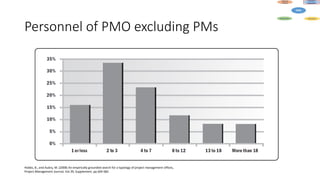
Personnel of PMO excluding PMs
Hobbs, B., and Aubry, M. (2008) An empirically grounded search for a typology of project management offices,
Project Management Journal, Vol.39, Supplement, pp.S69-S82.
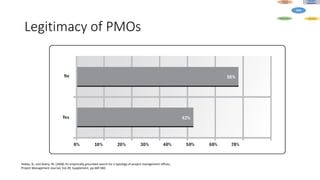
Legitimacy of PMOs
Hobbs, B., and Aubry, M. (2008) An empirically grounded search for a typology of project management offices,
Project Management Journal, Vol.39, Supplement, pp.S69-S82.
TRANSFORMATIONS
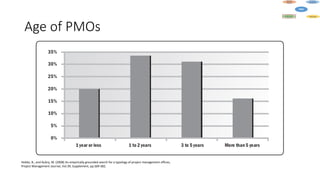
Age of PMOs
Hobbs, B., and Aubry, M. (2008) An empirically grounded search for a typology of project management offices,
Project Management Journal, Vol.39, Supplement, pp.S69-S82.
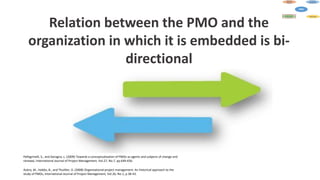
Relation between the PMO and the
organization in which it is embedded is bi-
directional
Aubry, M., Hobbs, B., and Thuillier, D. (2008) Organisational project management: An historical approach to the
study of PMOs, International Journal of Project Management, Vol.26, No.1, p.38-43.
Pellegrinelli, S., and Garagna, L. (2009) Towards a conceptualisation of PMOs as agents and subjects of change and
renewal, International Journal of Project Management, Vol.27, No.7, pp.649-656.
More energy and resources
should be dedicated to change
management
Aubry, M., Hobbs, B., Müller, R., and Blomquist, T. (2010a) Identifying forces driving PMO changes, Project
Management Journal, Vol.41, No.4, pp.30-45.
Events from the
surrounding social
system, internal
events, the philosophy
of management and
tensions to be resolved
Aubry, M., Müller, R., Hobbs, B., and Blomquist, T. (2010b) Project management offices in transition, International
Journal of Project Management, Vol.28, No.8, pp.766 - 778.
Hobbs, B., Aubry, M., and Thuillier, D. (2008) The project management office as an organisational innovation,
International Journal of Project Management, Vol.26, No.5, pp.547-555.
PERFORMANCE
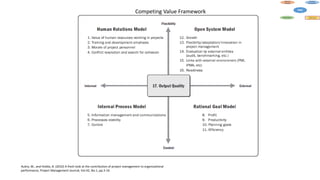
Aubry, M., and Hobbs, B. (2010) A fresh look at the contribution of project management to organizational
performance, Project Management Journal, Vol.42, No.1, pp.3-16.
Competing Value Framework
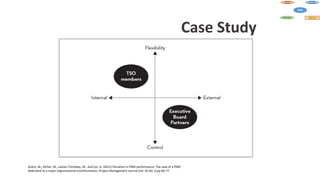
Aubry, M., Richer, M., Lavoie-Tremblay, M., and Cyr, G. (2011) Pluralism in PMO performance: The case of a PMO
dedicated to a major organizational transformation, Project Management Journal,Vol. 42,No. 6,pp.60-77.
Case Study
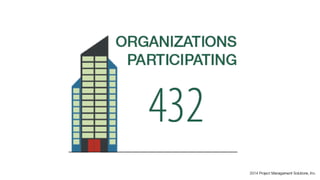
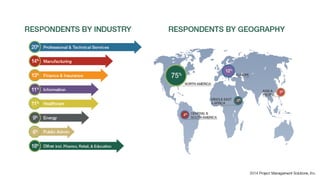
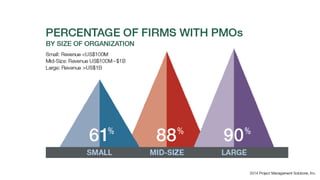
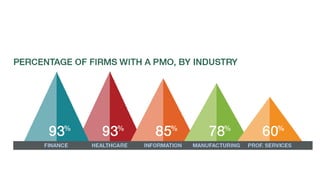
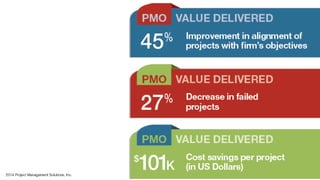
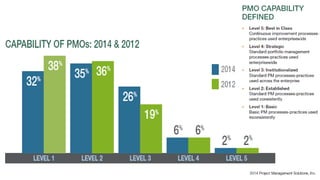
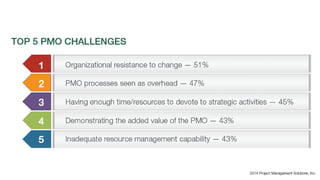
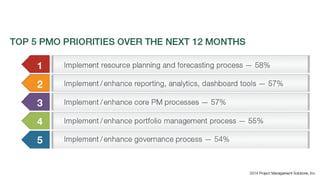
The State of the Project Management Office (PMO)
2014
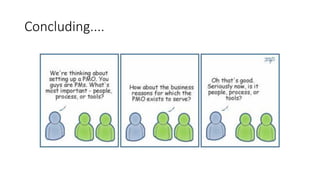
Concluding....
Project Management Offices
[PMOs]
Adson Cunha, MSc, PMP®
jaogc@cin.ufpe.br

Project Management Office (PMO): Characteristics, Roles, Functions, Transformations and Performance

  • 1.
    Project Management Offices [PMOs] AdsonCunha, MSc, PMP® jaogc@cin.ufpe.br
  • 2.
    Who am I? •Visiting Scholar @ Centro de Estudos de Gestão – IST, Portugal • PhD Candidate @ Center of Informatics – UFPE, Brazil • Member @ Research Group in Project Management – UFPE, Brazil • Project Management Office Member @ DATAPREV, Brazil • Project Management Professional (PMP®) • Consultant
  • 3.
    What is aPMO? “Management structure that standardizes the project-related governance processes and facilitates the sharing of resources, methodologies, tools, and techniques” (Project Management Institute, 2013, p. 10)
  • 4.
  • 5.
  • 6.
    PMOs can havedifferent flavors
  • 7.
    It started tobecome popular in... 1994
  • 8.
    Typologies of PMOsin the professional literature
  • 9.
    But in thereality it is much more complex than simple models
  • 10.
    PMOs has beenstudied empirically since... 2004
  • 11.
    Two great authorsin PMO are... Monique Aubry, PhD Professor at the Business Science School of University of Quebec at Montreal (UQAM) Brian Hobbs, PhD Professor at the School of Management of the University of Quebec at Montreal (UQAM)
  • 12.
  • 13.
    Let´s follow thestate of the art in PMO based on a Systematic Review BUT...
  • 14.
  • 15.
  • 16.
  • 17.
    Group 1: Monitoringand controlling project performance • Report project status to upper management • Monitor and control project performance • Implement and operate a project information system • Develop and maintain a project scoreboard Hobbs, B., and Aubry, M. (2007) A multi-Phase Research Program Investigating Project Management Offices (PMOs): The Results of Phase 1, Project Management Journal, Vol.38, No.1, pp.74-86.
  • 18.
    Group 2: Developmentof project management competencies and methodologies • Develop and implement a standard methodology • Promote project management within the organization • Develop competency of personnel, including training • Provide mentoring for project managers • Provide a set of tools without an effort to standardize Hobbs, B., and Aubry, M. (2007) A multi-Phase Research Program Investigating Project Management Offices (PMOs): The Results of Phase 1, Project Management Journal, Vol.38, No.1, pp.74-86.
  • 19.
    Group 3: Multi-projectmanagement • Coordinate between projects • Identify, select, and prioritize new projects • Manage one or more portfolios • Manage one or more programs • Allocate resources between projects Hobbs, B., and Aubry, M. (2007) A multi-Phase Research Program Investigating Project Management Offices (PMOs): The Results of Phase 1, Project Management Journal, Vol.38, No.1, pp.74-86.
  • 20.
    Group 4: Strategicmanagement • Provide advice to upper management • Participate in strategic planning • Manage benefits • Networking and environmental scanning Hobbs, B., and Aubry, M. (2007) A multi-Phase Research Program Investigating Project Management Offices (PMOs): The Results of Phase 1, Project Management Journal, Vol.38, No.1, pp.74-86.
  • 21.
    Group 5: Organizationallearning • Monitor and control the performance of the PMO • Manage archives of project documentation • Conduct post-project reviews • Conduct project audits • Implement and manage a database of lessons learned • Implement and manage a risk database Hobbs, B., and Aubry, M. (2007) A multi-Phase Research Program Investigating Project Management Offices (PMOs): The Results of Phase 1, Project Management Journal, Vol.38, No.1, pp.74-86.
  • 22.
    The PMO role triangle Müller,R., Glückler, J., and Aubry, M. (2013) A Relational Typology of Project Management Offices, Project Management Journal, Vol.44, No.1, pp.59-76.
  • 23.
    PMOs as knowledge brokersand facilitators in knowledge sharing Julian, J. (2008) How project management office leaders facilitate cross-project learning and continuous improvement, Project Management Journal, Vol.39, No.3, pp.43-58. Arttoa, K., Kulvika, I., Poskelab, J., and Turkulainen, V. (2011) The integrative role of the project management office in the front end of innovation, International Journal of Project Management, Vol.29, No.4, pp.408-421. Dutton, C., Turner, N., and Lee-Kelley, L. (2014) Learning in a programme context: An exploratory investigation of drivers and constraints, International Journal of Project Management, Vol.32, No.5, pp.747-758. Müller, R., Glückler, J., Aubry, M., and Shao, J. (2013) Project management knowledge flows in networks of project managers and project management offices: A case study in the pharmaceutical industry, Project Management Journal, Vol.44, No.2, pp.4-19. Pemsel, P., and Wiewiora, A. (2013) Project management office a knowledge broker in project-based organisations, International Journal of Project Management, Vol.31, No.1, pp.31-42. Desouza, K. C., and Evaristo, J. R. (2006) Project management offices: A case of knowledge-based archetypes, International Journal of Information Management, Vol.26, No.5, pp.414-423.
  • 24.
  • 25.
    Need to understandthe expectations of stakeholders toward the PMO Andersen, B., Henriksen, B., and Aarseth, W. (2007) Benchmarking of project management office establishment: Extracting best practices, Journal of Management in Engineering, Vol.23, No.2, pp.97-104.
  • 26.
    Necessity of rightPMO leadership and skilled and experienced PMs in staff Hurt, M., and Thomas, J. L. (2009) Building value through sustainable project management offices, Project Management Journal, Vol.40, No.1, pp.55-72. Martin, N. L., Pearson, J. M., and Furumo, K. A. (2005) Is project management: Size, practices and the project management office, Proceedings of the 38th Hawaii International Conference on System Sciences, pp.52-60.
  • 27.
    Community of PMOs Aubry,M., Müller, and, Glückler, J. (2011) Exploring PMOs through community of practice theory, Project Management Journal, Vol.42, No.5, pp.42-56.
  • 28.
    Hobbs, B., andAubry, M. (2008) An empirically grounded search for a typology of project management offices, Project Management Journal, Vol.39, Supplement, pp.S69-S82.
  • 29.
    Time to implementa PMO Hobbs, B., and Aubry, M. (2008) An empirically grounded search for a typology of project management offices, Project Management Journal, Vol.39, Supplement, pp.S69-S82.
  • 30.
    Personnel of PMOexcluding PMs Hobbs, B., and Aubry, M. (2008) An empirically grounded search for a typology of project management offices, Project Management Journal, Vol.39, Supplement, pp.S69-S82.
  • 31.
    Legitimacy of PMOs Hobbs,B., and Aubry, M. (2008) An empirically grounded search for a typology of project management offices, Project Management Journal, Vol.39, Supplement, pp.S69-S82.
  • 32.
  • 33.
    Age of PMOs Hobbs,B., and Aubry, M. (2008) An empirically grounded search for a typology of project management offices, Project Management Journal, Vol.39, Supplement, pp.S69-S82.
  • 34.
    Relation between thePMO and the organization in which it is embedded is bi- directional Aubry, M., Hobbs, B., and Thuillier, D. (2008) Organisational project management: An historical approach to the study of PMOs, International Journal of Project Management, Vol.26, No.1, p.38-43. Pellegrinelli, S., and Garagna, L. (2009) Towards a conceptualisation of PMOs as agents and subjects of change and renewal, International Journal of Project Management, Vol.27, No.7, pp.649-656.
  • 35.
    More energy andresources should be dedicated to change management Aubry, M., Hobbs, B., Müller, R., and Blomquist, T. (2010a) Identifying forces driving PMO changes, Project Management Journal, Vol.41, No.4, pp.30-45.
  • 36.
    Events from the surroundingsocial system, internal events, the philosophy of management and tensions to be resolved Aubry, M., Müller, R., Hobbs, B., and Blomquist, T. (2010b) Project management offices in transition, International Journal of Project Management, Vol.28, No.8, pp.766 - 778. Hobbs, B., Aubry, M., and Thuillier, D. (2008) The project management office as an organisational innovation, International Journal of Project Management, Vol.26, No.5, pp.547-555.
  • 37.
  • 38.
    Aubry, M., andHobbs, B. (2010) A fresh look at the contribution of project management to organizational performance, Project Management Journal, Vol.42, No.1, pp.3-16. Competing Value Framework
  • 39.
    Aubry, M., Richer,M., Lavoie-Tremblay, M., and Cyr, G. (2011) Pluralism in PMO performance: The case of a PMO dedicated to a major organizational transformation, Project Management Journal,Vol. 42,No. 6,pp.60-77. Case Study
  • 40.
    The State ofthe Project Management Office (PMO) 2014
  • 49.
  • 50.
    Project Management Offices [PMOs] AdsonCunha, MSc, PMP® jaogc@cin.ufpe.br