Project Leader Ramp-Up  Version:  1.1 Author:  Nguyen Lam Phuong Nov-2003 Instructor:  Le Hoang Son ©  2001 FPT-SOFT 04e-BM/NS/HDCV/FSOFT
Introduction Course Objective The purpose of this course is to make a short summary about the Fsoft processes & practices to be used in the project context. This course is not aimed to replace the normal training courses. Duration: 2 hours Targeted attendees:  Acting PL + to-be PL
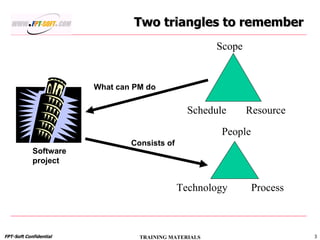
Two triangles to remember People Process Technology Software  project Scope Resource Schedule What can PM do Consists of
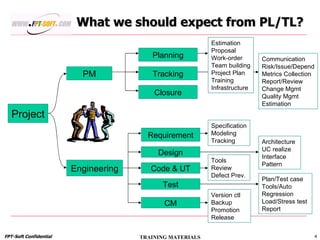
What we should expect from PL/TL? Project PM Engineering Requirement Design Code & UT Test CM Planning Tracking Closure Estimation Proposal Work-order Team building Project Plan Training Infrastructure Communication Risk/Issue/Depend Metrics Collection Report/Review Change Mgmt Quality Mgmt Estimation Specification Modeling Tracking Architecture UC realize Interface Pattern Tools Review Defect Prev. Plan/Test case Tools/Auto Regression Load/Stress test Report Version ctl Backup Promotion Release
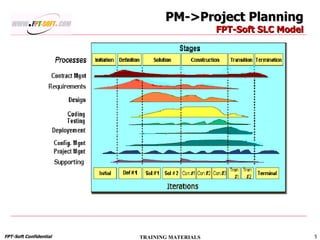
PM->Project Planning FPT-Soft SLC Model
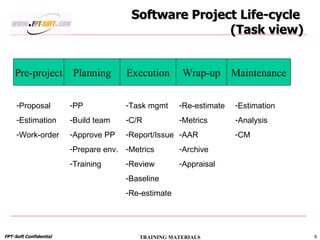
Software Project Life-cycle  (Task view) Pre-project Planning Execution Wrap-up Maintenance Proposal Estimation Work-order PP Build team Approve PP Prepare env. Training Task mgmt C/R Report/Issue Metrics  Review Baseline Re-estimate Re-estimate Metrics AAR Archive Appraisal Estimation Analysis CM
 
PMI Knowledge/Process areas Project Integration Management , describes the processes required to ensure that the various elements of the project are properly coordinated. It consists of project plan development, project plan execution, and overall change control. Project Scope Management , describes the processes required to ensure that the project includes all the work required, and only the work required, to complete the project successfully. It consists of initiation, scope planning, scope definition, scope verification, and scope change control. Project Time Management , describes the processes required to ensure timely completion of the project. It consists of activity definition, activity sequencing, activity duration estimating, schedule development, and schedule control. Project Cost Management , describes the processes required to ensure that the project is completed within the approved budget. It consists of resource planning, cost estimating, cost budgeting, and cost control. Project Quality Managemen t, describes the processes required to ensure that the project will satisfy the needs for which it was undertaken. It consists of quality planning, quality assurance, and quality control.
PMI Knowledge/Process areas Project Human Resource Management , describes the processes required to make the most effective use of the people involved with the project. It consists of organizational planning, staff acquisition, and team development. Project Communications Management , describes the processes required to ensure timely and appropriate generation, collection, dissemination, storage, and ultimate disposition of project information. It consists of communications planning, information distribution, performance reporting, and administrative closure. Project Risk Management , describes the processes concerned with identifying, analyzing, and responding to project risk. It consists of risk identification, risk quantification, risk response development, and risk response control. Project Procurement Management , describes the processes required to acquire goods and services from outside the performing organization. It consists of procurement planning, solicitation planning, solicitation, source selection, contract administration, and contract close-out.
Integration Management Estimation From size (UCP) -> effort. Adjustment  WBS (by SDLC or by Features/Modules) Schedule Required resources Proposal Technical solution (key only) Project approach Estimates (effort, cost, schedule) Work-Order Scope Resource (effort, time, money) Quality DP Project plan Project charter & induction guide Project deliverable and dependencies Project life-cycle and deviation/tailoring Resource plan (organization, infrastructure, finance, training, comm.) Quality plan Configuration management plan Risk assessment Project Report (weekly & milestone) Metrics & interpretation Non-metrics (risk/issues/proposal…) Change Management Requirement, Interface, Resources
Scope Management Contract review (acceptance criteria) Initial baseline (develop SRS or not? What’s the project input?) Requirement development Track dependency Change control Estimates & Customer approval CCB
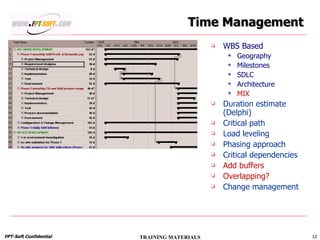
Time Management WBS Based Geography Milestones SDLC Architecture MIX Duration estimate (Delphi) Critical path Load leveling Phasing approach Critical dependencies Add buffers Overlapping? Change management
Cost Management Resource planning Human resource Non-human (computer, network, funds….) Cost control Big picture view of project Timesheet accuracy
Quality Management Non-functional requirements Norm based planning Timeliness Schedule deviation Effort utilization Customer satisfaction index Defect related … Activities  Quality assurance (training, DP) Quality control (tests & reviews, audit) Quality Management Interpret DMS report DP activities Interpret quality cost (test & review) Interpret effectiveness FSoft Tools PCB & norms & process DB FSOFT-Insight Project database Microsoft project / Excel DMS Timesheet Dashboard …  and a lot of templates
Human-resource management Team building Project Charter Staff vs. Contractor External SQA/PQA/Comm/Reviewers  Training Plan (who learns what, how, when) Waiver/Acceptance Team development
Risk Management Risk Planning/tracking Scope, resource, quality Risk due to tailoring/deviation & reason should be assessed Dependency Customer supplied products FPT interfaces  Type: Date, quality, impact -> contingency Issue tracking Escalation, action items Metrics collection Timesheet, Defect Budget control (ETC: defect, effort – by process/stage, schedule, size) Exception analysis (UCL/LCL) Completion rate against budget
Communication Communication attributes: message, audience, time, media Communication flows With client (status, issue, approve) With team members (onsite/offshore) With GLs, interfaces (escalation) Media: phone/mail/conf call
Engineering practices
Engineering -> Requirement General Software Specification Use-case model (static & dynamic view) Non-functional requirements Boundary (what will not be implemented) Be careful with data migration & interfacing with other system Classification (useful for phasing approach) Modeling GUI mock-up Page flows Load model Analysis Class model Entity model (logical view of data) Tracking Identification & rating Trace-ability toward design, code, test cases, release notes Changes Estimate (impact on schedule, effort, other modules) Negotiation (time to release, cost, quality)
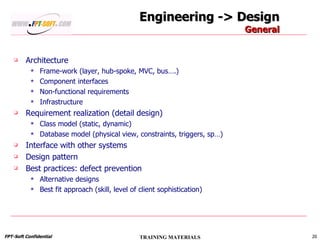
Engineering -> Design General Architecture Frame-work (layer, hub-spoke, MVC, bus….) Component interfaces Non-functional requirements Infrastructure Requirement realization (detail design) Class model (static, dynamic) Database model (physical view, constraints, triggers, sp…) Interface with other systems Design pattern Best practices: defect prevention Alternative designs Best fit approach (skill, level of client sophistication)
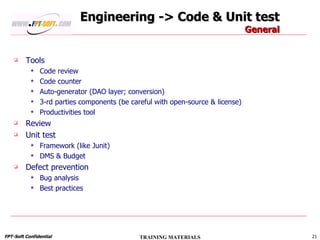
Engineering -> Code & Unit test General Tools Code review Code counter Auto-generator (DAO layer; conversion) 3-rd parties components (be careful with open-source & license) Productivities tool Review Unit test Framework (like Junit) DMS & Budget Defect prevention Bug analysis Best practices
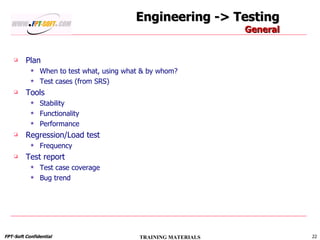
Engineering -> Testing General Plan When to test what, using what & by whom? Test cases (from SRS) Tools Stability Functionality Performance Regression/Load test Frequency Test report Test case coverage Bug trend
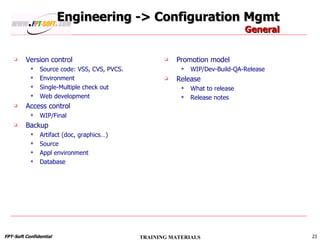
Engineering -> Configuration Mgmt General Version control Source code: VSS, CVS, PVCS. Environment Single-Multiple check out Web development Access control WIP/Final Backup Artifact (doc, graphics…) Source Appl environment Database Promotion model WIP/Dev-Build-QA-Release Release What to release Release notes
Resources & references FSOFT QMS SEI CMM Model PMI Model
Questions and Answers

Pm training (planning and tracking) - Project Leader Ramp-Up

  • 1.
    Project Leader Ramp-Up Version: 1.1 Author: Nguyen Lam Phuong Nov-2003 Instructor: Le Hoang Son © 2001 FPT-SOFT 04e-BM/NS/HDCV/FSOFT
  • 2.
    Introduction Course ObjectiveThe purpose of this course is to make a short summary about the Fsoft processes & practices to be used in the project context. This course is not aimed to replace the normal training courses. Duration: 2 hours Targeted attendees: Acting PL + to-be PL
  • 3.
    Two triangles toremember People Process Technology Software project Scope Resource Schedule What can PM do Consists of
  • 4.
    What we shouldexpect from PL/TL? Project PM Engineering Requirement Design Code & UT Test CM Planning Tracking Closure Estimation Proposal Work-order Team building Project Plan Training Infrastructure Communication Risk/Issue/Depend Metrics Collection Report/Review Change Mgmt Quality Mgmt Estimation Specification Modeling Tracking Architecture UC realize Interface Pattern Tools Review Defect Prev. Plan/Test case Tools/Auto Regression Load/Stress test Report Version ctl Backup Promotion Release
  • 5.
  • 6.
    Software Project Life-cycle (Task view) Pre-project Planning Execution Wrap-up Maintenance Proposal Estimation Work-order PP Build team Approve PP Prepare env. Training Task mgmt C/R Report/Issue Metrics Review Baseline Re-estimate Re-estimate Metrics AAR Archive Appraisal Estimation Analysis CM
  • 7.
  • 8.
    PMI Knowledge/Process areasProject Integration Management , describes the processes required to ensure that the various elements of the project are properly coordinated. It consists of project plan development, project plan execution, and overall change control. Project Scope Management , describes the processes required to ensure that the project includes all the work required, and only the work required, to complete the project successfully. It consists of initiation, scope planning, scope definition, scope verification, and scope change control. Project Time Management , describes the processes required to ensure timely completion of the project. It consists of activity definition, activity sequencing, activity duration estimating, schedule development, and schedule control. Project Cost Management , describes the processes required to ensure that the project is completed within the approved budget. It consists of resource planning, cost estimating, cost budgeting, and cost control. Project Quality Managemen t, describes the processes required to ensure that the project will satisfy the needs for which it was undertaken. It consists of quality planning, quality assurance, and quality control.
  • 9.
    PMI Knowledge/Process areasProject Human Resource Management , describes the processes required to make the most effective use of the people involved with the project. It consists of organizational planning, staff acquisition, and team development. Project Communications Management , describes the processes required to ensure timely and appropriate generation, collection, dissemination, storage, and ultimate disposition of project information. It consists of communications planning, information distribution, performance reporting, and administrative closure. Project Risk Management , describes the processes concerned with identifying, analyzing, and responding to project risk. It consists of risk identification, risk quantification, risk response development, and risk response control. Project Procurement Management , describes the processes required to acquire goods and services from outside the performing organization. It consists of procurement planning, solicitation planning, solicitation, source selection, contract administration, and contract close-out.
  • 10.
    Integration Management EstimationFrom size (UCP) -> effort. Adjustment WBS (by SDLC or by Features/Modules) Schedule Required resources Proposal Technical solution (key only) Project approach Estimates (effort, cost, schedule) Work-Order Scope Resource (effort, time, money) Quality DP Project plan Project charter & induction guide Project deliverable and dependencies Project life-cycle and deviation/tailoring Resource plan (organization, infrastructure, finance, training, comm.) Quality plan Configuration management plan Risk assessment Project Report (weekly & milestone) Metrics & interpretation Non-metrics (risk/issues/proposal…) Change Management Requirement, Interface, Resources
  • 11.
    Scope Management Contractreview (acceptance criteria) Initial baseline (develop SRS or not? What’s the project input?) Requirement development Track dependency Change control Estimates & Customer approval CCB
  • 12.
    Time Management WBSBased Geography Milestones SDLC Architecture MIX Duration estimate (Delphi) Critical path Load leveling Phasing approach Critical dependencies Add buffers Overlapping? Change management
  • 13.
    Cost Management Resourceplanning Human resource Non-human (computer, network, funds….) Cost control Big picture view of project Timesheet accuracy
  • 14.
    Quality Management Non-functionalrequirements Norm based planning Timeliness Schedule deviation Effort utilization Customer satisfaction index Defect related … Activities Quality assurance (training, DP) Quality control (tests & reviews, audit) Quality Management Interpret DMS report DP activities Interpret quality cost (test & review) Interpret effectiveness FSoft Tools PCB & norms & process DB FSOFT-Insight Project database Microsoft project / Excel DMS Timesheet Dashboard … and a lot of templates
  • 15.
    Human-resource management Teambuilding Project Charter Staff vs. Contractor External SQA/PQA/Comm/Reviewers Training Plan (who learns what, how, when) Waiver/Acceptance Team development
  • 16.
    Risk Management RiskPlanning/tracking Scope, resource, quality Risk due to tailoring/deviation & reason should be assessed Dependency Customer supplied products FPT interfaces Type: Date, quality, impact -> contingency Issue tracking Escalation, action items Metrics collection Timesheet, Defect Budget control (ETC: defect, effort – by process/stage, schedule, size) Exception analysis (UCL/LCL) Completion rate against budget
  • 17.
    Communication Communication attributes:message, audience, time, media Communication flows With client (status, issue, approve) With team members (onsite/offshore) With GLs, interfaces (escalation) Media: phone/mail/conf call
  • 18.
  • 19.
    Engineering -> RequirementGeneral Software Specification Use-case model (static & dynamic view) Non-functional requirements Boundary (what will not be implemented) Be careful with data migration & interfacing with other system Classification (useful for phasing approach) Modeling GUI mock-up Page flows Load model Analysis Class model Entity model (logical view of data) Tracking Identification & rating Trace-ability toward design, code, test cases, release notes Changes Estimate (impact on schedule, effort, other modules) Negotiation (time to release, cost, quality)
  • 20.
    Engineering -> DesignGeneral Architecture Frame-work (layer, hub-spoke, MVC, bus….) Component interfaces Non-functional requirements Infrastructure Requirement realization (detail design) Class model (static, dynamic) Database model (physical view, constraints, triggers, sp…) Interface with other systems Design pattern Best practices: defect prevention Alternative designs Best fit approach (skill, level of client sophistication)
  • 21.
    Engineering -> Code& Unit test General Tools Code review Code counter Auto-generator (DAO layer; conversion) 3-rd parties components (be careful with open-source & license) Productivities tool Review Unit test Framework (like Junit) DMS & Budget Defect prevention Bug analysis Best practices
  • 22.
    Engineering -> TestingGeneral Plan When to test what, using what & by whom? Test cases (from SRS) Tools Stability Functionality Performance Regression/Load test Frequency Test report Test case coverage Bug trend
  • 23.
    Engineering -> ConfigurationMgmt General Version control Source code: VSS, CVS, PVCS. Environment Single-Multiple check out Web development Access control WIP/Final Backup Artifact (doc, graphics…) Source Appl environment Database Promotion model WIP/Dev-Build-QA-Release Release What to release Release notes
  • 24.
    Resources & referencesFSOFT QMS SEI CMM Model PMI Model
  • 25.