The document outlines the key features and benefits of the new software application. It highlights how it improves efficiency and user experience. Additionally, it includes user testimonials and case studies demonstrating its effectiveness.
PM NOTEBOOK
CHAPTER 2– ORGANIZATIONS | ENTERPRISE ENVIRONMENTAL FACTORS
(EEFS)
DISCLAIMER: THE MATERIAL INCLUDED IN THIS DOCUMENT IS BASED ON DATA / INFORMATION
GATHERED FROM VARIOUS RELIABLE SOURCES. NONE OF THIS DATA / INFORMATION IS A PROPERTY
OF THE AUTHOR.
1
DISCLAIMER: THE MATERIAL INCLUDED IN THIS DOCUMENT IS
BASED ON DATA/INFORMATION GATHERED FROM VARIOUS
RELIABLE SOURCES. NONE OF THIS DATA/INFORMATION IS A
PROPERTY OF THE AUTHOR. NONE IS INTENDED TO MAKE A
PROFIT IN ANY WAY. THIS IS FOR PERSONAL USE ONLY.
3.
PM NOTEBOOK
CHAPTER 2– ORGANIZATIONS | ENTERPRISE ENVIRONMENTAL FACTORS
(EEFS)
DISCLAIMER: THE MATERIAL INCLUDED IN THIS DOCUMENT IS BASED ON DATA / INFORMATION
GATHERED FROM VARIOUS RELIABLE SOURCES. NONE OF THIS DATA / INFORMATION IS A PROPERTY
OF THE AUTHOR.
2
No great man ever complains of want of opportunity.
Ralph Waldo Emerson
4.
PM NOTEBOOK
CHAPTER 2– ORGANIZATIONS | ENTERPRISE ENVIRONMENTAL FACTORS
(EEFS)
DISCLAIMER: THE MATERIAL INCLUDED IN THIS DOCUMENT IS BASED ON DATA / INFORMATION
GATHERED FROM VARIOUS RELIABLE SOURCES. NONE OF THIS DATA / INFORMATION IS A PROPERTY
OF THE AUTHOR.
3
Table of Contents
Chapter 2 – Organizations ..................................................................................................................................... 4
Enterprise Environmental Factors (EEFs) ........................................................................................................... 4
Project Management Information System (PMIS)...................................................................................... 5
Organizational Process Assets (OPAs).............................................................................................................. 5
Organization System............................................................................................................................................ 6
Organizational Structure..................................................................................................................................... 6
Project-Based Organizations (PBO) .............................................................................................................. 8
Project Expediter vs. Project Coordinator ....................................................................................................... 8
Organizational Hierarchy.................................................................................................................................... 9
Project Management Office (PMO)................................................................................................................. 9
Organizational Project Management (OPM)................................................................................................. 9
Organizational Project Management Maturity Model (OPM3) ............................................................ 10
Capability Maturity Model Integration (CMMI)........................................................................................ 10
Project Environment........................................................................................................................................... 10
Project Complexity............................................................................................................................................. 10
Project Success Factors..................................................................................................................................... 11
Internal Factors ............................................................................................................................................... 11
External Factors............................................................................................................................................... 11
Additional Terms ................................................................................................................................................. 11
5.
PM NOTEBOOK
CHAPTER 2– ORGANIZATIONS | ENTERPRISE ENVIRONMENTAL FACTORS
(EEFS)
DISCLAIMER: THE MATERIAL INCLUDED IN THIS DOCUMENT IS BASED ON DATA / INFORMATION
GATHERED FROM VARIOUS RELIABLE SOURCES. NONE OF THIS DATA / INFORMATION IS A PROPERTY
OF THE AUTHOR.
4
If you want something done right… better hope you are in the right kind of
organization.
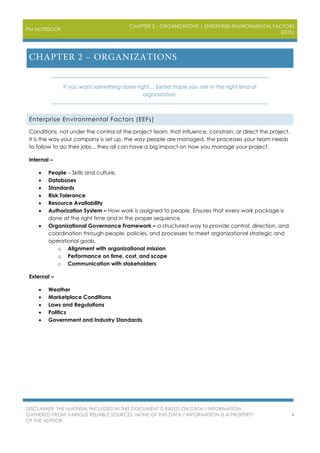
Enterprise Environmental Factors (EEFs)
Conditions, not under the control of the project team, that influence, constrain, or direct the project.
It is the way your company is set up, the way people are managed, the processes your team needs
to follow to do their jobs... they all can have a big impact on how you manage your project.
Internal –
People – Skills and culture.
Databases
Standards
Risk Tolerance
Resource Availability
Authorization System – How work is assigned to people. Ensures that every work package is
done at the right time and in the proper sequence.
Organizational Governance Framework – a structured way to provide control, direction, and
coordination through people, policies, and processes to meet organizational strategic and
operational goals.
o Alignment with organizational mission
o Performance on time, cost, and scope
o Communication with stakeholders
External –
Weather
Marketplace Conditions
Laws and Regulations
Politics
Government and Industry Standards
6.
PM NOTEBOOK
CHAPTER 2– ORGANIZATIONS | ORGANIZATIONAL PROCESS ASSETS
(OPAS)
DISCLAIMER: THE MATERIAL INCLUDED IN THIS DOCUMENT IS BASED ON DATA / INFORMATION
GATHERED FROM VARIOUS RELIABLE SOURCES. NONE OF THIS DATA / INFORMATION IS A PROPERTY
OF THE AUTHOR.
5
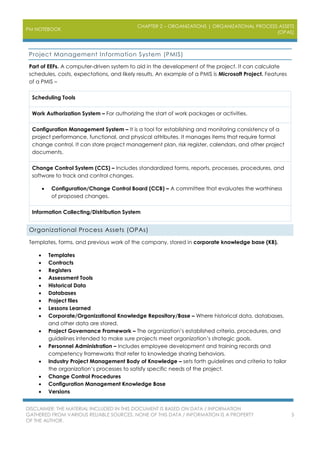
Project Management Information System (PMIS)
Part of EEFs. A computer-driven system to aid in the development of the project. It can calculate
schedules, costs, expectations, and likely results. An example of a PMIS is Microsoft Project. Features
of a PMIS –
Scheduling Tools
Work Authorization System – For authorizing the start of work packages or activities.
Configuration Management System – It is a tool for establishing and monitoring consistency of a
project performance, functional, and physical attributes. It manages items that require formal
change control. It can store project management plan, risk register, calendars, and other project
documents.
Change Control System (CCS) – Includes standardized forms, reports, processes, procedures, and
software to track and control changes.
Configuration/Change Control Board (CCB) – A committee that evaluates the worthiness
of proposed changes.
Information Collecting/Distribution System
Organizational Process Assets (OPAs)
Templates, forms, and previous work of the company, stored in corporate knowledge base (KB).
Templates
Contracts
Registers
Assessment Tools
Historical Data
Databases
Project files
Lessons Learned
Corporate/Organizational Knowledge Repository/Base – Where historical data, databases,
and other data are stored.
Project Governance Framework – The organization’s established criteria, procedures, and
guidelines intended to make sure projects meet organization’s strategic goals.
Personnel Administration – Includes employee development and training records and
competency frameworks that refer to knowledge sharing behaviors.
Industry Project Management Body of Knowledge – sets forth guidelines and criteria to tailor
the organization’s processes to satisfy specific needs of the project.
Change Control Procedures
Configuration Management Knowledge Base
Versions
7.
PM NOTEBOOK CHAPTER2 – ORGANIZATIONS | ORGANIZATION SYSTEM
DISCLAIMER: THE MATERIAL INCLUDED IN THIS DOCUMENT IS BASED ON DATA / INFORMATION
GATHERED FROM VARIOUS RELIABLE SOURCES. NONE OF THIS DATA / INFORMATION IS A PROPERTY
OF THE AUTHOR.
6
Baselines
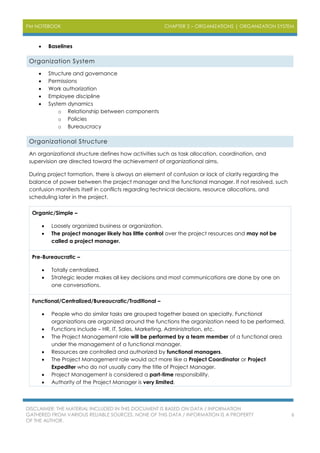
Organization System
Structure and governance
Permissions
Work authorization
Employee discipline
System dynamics
o Relationship between components
o Policies
o Bureaucracy
Organizational Structure
An organizational structure defines how activities such as task allocation, coordination, and
supervision are directed toward the achievement of organizational aims.
During project formation, there is always an element of confusion or lack of clarity regarding the
balance of power between the project manager and the functional manager. If not resolved, such
confusion manifests itself in conflicts regarding technical decisions, resource allocations, and
scheduling later in the project.
Organic/Simple –
Loosely organized business or organization.
The project manager likely has little control over the project resources and may not be
called a project manager.
Pre-Bureaucratic –
Totally centralized.
Strategic leader makes all key decisions and most communications are done by one on
one conversations.
Functional/Centralized/Bureaucratic/Traditional –
People who do similar tasks are grouped together based on specialty. Functional
organizations are organized around the functions the organization need to be performed.
Functions include – HR, IT, Sales, Marketing, Administration, etc.
The Project Management role will be performed by a team member of a functional area
under the management of a functional manager.
Resources are controlled and authorized by functional managers.
The Project Management role would act more like a Project Coordinator or Project
Expediter who do not usually carry the title of Project Manager.
Project Management is considered a part-time responsibility.
Authority of the Project Manager is very limited.
8.
PM NOTEBOOK CHAPTER2 – ORGANIZATIONS | ORGANIZATIONAL STRUCTURE
DISCLAIMER: THE MATERIAL INCLUDED IN THIS DOCUMENT IS BASED ON DATA / INFORMATION
GATHERED FROM VARIOUS RELIABLE SOURCES. NONE OF THIS DATA / INFORMATION IS A PROPERTY
OF THE AUTHOR.
7
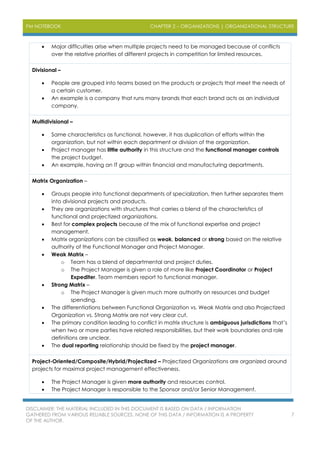
Major difficulties arise when multiple projects need to be managed because of conflicts
over the relative priorities of different projects in competition for limited resources.
Divisional –
People are grouped into teams based on the products or projects that meet the needs of
a certain customer.
An example is a company that runs many brands that each brand acts as an individual
company.
Multidivisional –
Same characteristics as functional, however, it has duplication of efforts within the
organization, but not within each department or division of the organization.
Project manager has little authority in this structure and the functional manager controls
the project budget.
An example, having an IT group within financial and manufacturing departments.
Matrix Organization –
Groups people into functional departments of specialization, then further separates them
into divisional projects and products.
They are organizations with structures that carries a blend of the characteristics of
functional and projectized organizations.
Best for complex projects because of the mix of functional expertise and project
management.
Matrix organizations can be classified as weak, balanced or strong based on the relative
authority of the Functional Manager and Project Manager.
Weak Matrix –
o Team has a blend of departmental and project duties.
o The Project Manager is given a role of more like Project Coordinator or Project
Expediter. Team members report to functional manager.
Strong Matrix –
o The Project Manager is given much more authority on resources and budget
spending.
The differentiations between Functional Organization vs. Weak Matrix and also Projectized
Organization vs. Strong Matrix are not very clear cut.
The primary condition leading to conflict in matrix structure is ambiguous jurisdictions that’s
when two or more parties have related responsibilities, but their work boundaries and role
definitions are unclear.
The dual reporting relationship should be fixed by the project manager.
Project-Oriented/Composite/Hybrid/Projectized – Projectized Organizations are organized around
projects for maximal project management effectiveness.
The Project Manager is given more authority and resources control.
The Project Manager is responsible to the Sponsor and/or Senior Management.
9.
PM NOTEBOOK
CHAPTER 2– ORGANIZATIONS | PROJECT EXPEDITER VS. PROJECT
COORDINATOR
DISCLAIMER: THE MATERIAL INCLUDED IN THIS DOCUMENT IS BASED ON DATA / INFORMATION
GATHERED FROM VARIOUS RELIABLE SOURCES. NONE OF THIS DATA / INFORMATION IS A PROPERTY
OF THE AUTHOR.
8
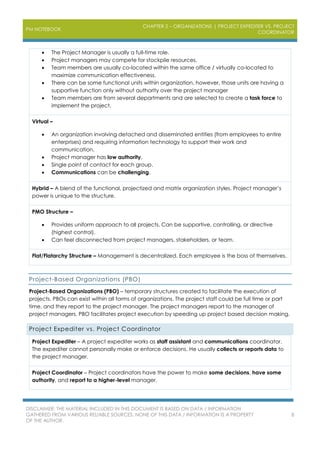
The Project Manager is usually a full-time role.
Project managers may compete for stockpile resources.
Team members are usually co-located within the same office / virtually co-located to
maximize communication effectiveness.
There can be some functional units within organization, however, those units are having a
supportive function only without authority over the project manager
Team members are from several departments and are selected to create a task force to
implement the project.
Virtual –
An organization involving detached and disseminated entities (from employees to entire
enterprises) and requiring information technology to support their work and
communication.
Project manager has low authority.
Single point of contact for each group.
Communications can be challenging.
Hybrid – A blend of the functional, projectized and matrix organization styles. Project manager’s
power is unique to the structure.
PMO Structure –
Provides uniform approach to all projects. Can be supportive, controlling, or directive
(highest control).
Can feel disconnected from project managers, stakeholders, or team.
Flat/Flatarchy Structure – Management is decentralized. Each employee is the boss of themselves.
Project-Based Organizations (PBO)
Project-Based Organizations (PBO) – temporary structures created to facilitate the execution of
projects. PBOs can exist within all forms of organizations. The project staff could be full time or part
time, and they report to the project manager. The project managers report to the manager of
project managers. PBO facilitates project execution by speeding up project based decision making.
Project Expediter vs. Project Coordinator
Project Expediter – A project expediter works as staff assistant and communications coordinator.
The expediter cannot personally make or enforce decisions. He usually collects or reports data to
the project manager.
Project Coordinator – Project coordinators have the power to make some decisions, have some
authority, and report to a higher-level manager.
10.
PM NOTEBOOK CHAPTER2 – ORGANIZATIONS | ORGANIZATIONAL HIERARCHY
DISCLAIMER: THE MATERIAL INCLUDED IN THIS DOCUMENT IS BASED ON DATA / INFORMATION
GATHERED FROM VARIOUS RELIABLE SOURCES. NONE OF THIS DATA / INFORMATION IS A PROPERTY
OF THE AUTHOR.
9
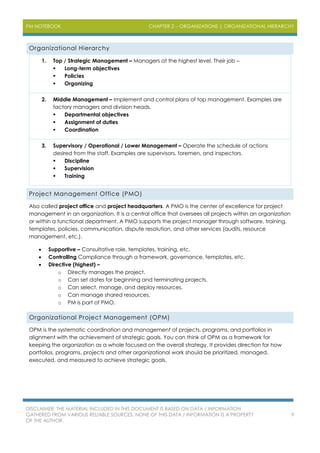
Organizational Hierarchy
1. Top / Strategic Management – Managers at the highest level. Their job –
Long-term objectives
Policies
Organizing
2. Middle Management – Implement and control plans of top management. Examples are
factory managers and division heads.
Departmental objectives
Assignment of duties
Coordination
3. Supervisory / Operational / Lower Management – Operate the schedule of actions
desired from the staff. Examples are supervisors, foremen, and inspectors.
Discipline
Supervision
Training
Project Management Office (PMO)
Also called project office and project headquarters. A PMO is the center of excellence for project
management in an organization. It is a central office that oversees all projects within an organization
or within a functional department. A PMO supports the project manager through software, training,
templates, policies, communication, dispute resolution, and other services (audits, resource
management, etc.).
Supportive – Consultative role, templates, training, etc.
Controlling Compliance through a framework, governance, templates, etc.
Directive (highest) –
o Directly manages the project.
o Can set dates for beginning and terminating projects.
o Can select, manage, and deploy resources.
o Can manage shared resources.
o PM is part of PMO.
Organizational Project Management (OPM)
OPM is the systematic coordination and management of projects, programs, and portfolios in
alignment with the achievement of strategic goals. You can think of OPM as a framework for
keeping the organization as a whole focused on the overall strategy. It provides direction for how
portfolios, programs, projects and other organizational work should be prioritized, managed,
executed, and measured to achieve strategic goals.
11.
PM NOTEBOOK CHAPTER2 – ORGANIZATIONS | PROJECT ENVIRONMENT
DISCLAIMER: THE MATERIAL INCLUDED IN THIS DOCUMENT IS BASED ON DATA / INFORMATION
GATHERED FROM VARIOUS RELIABLE SOURCES. NONE OF THIS DATA / INFORMATION IS A PROPERTY
OF THE AUTHOR.
10
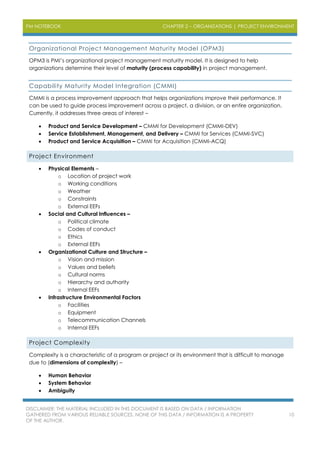
Organizational Project Management Maturity Model (OPM3)
OPM3 is PMI’s organizational project management maturity model. It is designed to help
organizations determine their level of maturity (process capability) in project management.
Capability Maturity Model Integration (CMMI)
CMMI is a process improvement approach that helps organizations improve their performance. It
can be used to guide process improvement across a project, a division, or an entire organization.
Currently, it addresses three areas of interest –
Product and Service Development – CMMI for Development (CMMI-DEV)
Service Establishment, Management, and Delivery – CMMI for Services (CMMI-SVC)
Product and Service Acquisition – CMMI for Acquisition (CMMI-ACQ)
Project Environment
Physical Elements –
o Location of project work
o Working conditions
o Weather
o Constraints
o External EEFs
Social and Cultural Influences –
o Political climate
o Codes of conduct
o Ethics
o External EEFs
Organizational Culture and Structure –
o Vision and mission
o Values and beliefs
o Cultural norms
o Hierarchy and authority
o Internal EEFs
Infrastructure Environmental Factors
o Facilities
o Equipment
o Telecommunication Channels
o Internal EEFs
Project Complexity
Complexity is a characteristic of a program or project or its environment that is difficult to manage
due to (dimensions of complexity) –
Human Behavior
System Behavior
Ambiguity
12.
PM NOTEBOOK CHAPTER2 – ORGANIZATIONS | PROJECT SUCCESS FACTORS
DISCLAIMER: THE MATERIAL INCLUDED IN THIS DOCUMENT IS BASED ON DATA / INFORMATION
GATHERED FROM VARIOUS RELIABLE SOURCES. NONE OF THIS DATA / INFORMATION IS A PROPERTY
OF THE AUTHOR.
11
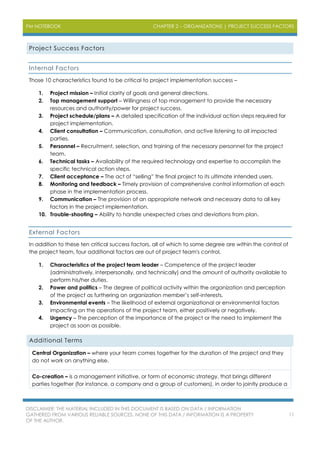
Project Success Factors
Internal Factors
Those 10 characteristics found to be critical to project implementation success –
1. Project mission – Initial clarity of goals and general directions.
2. Top management support – Willingness of top management to provide the necessary
resources and authority/power for project success.
3. Project schedule/plans – A detailed specification of the individual action steps required for
project implementation.
4. Client consultation – Communication, consultation, and active listening to all impacted
parties.
5. Personnel – Recruitment, selection, and training of the necessary personnel for the project
team.
6. Technical tasks – Availability of the required technology and expertise to accomplish the
specific technical action steps.
7. Client acceptance – The act of “selling” the final project to its ultimate intended users.
8. Monitoring and feedback – Timely provision of comprehensive control information at each
phase in the implementation process.
9. Communication – The provision of an appropriate network and necessary data to all key
factors in the project implementation.
10. Trouble-shooting – Ability to handle unexpected crises and deviations from plan.
External Factors
In addition to these ten critical success factors, all of which to some degree are within the control of
the project team, four additional factors are out of project team's control.
1. Characteristics of the project team leader – Competence of the project leader
(administratively, interpersonally, and technically) and the amount of authority available to
perform his/her duties.
2. Power and politics – The degree of political activity within the organization and perception
of the project as furthering an organization member’s self-interests.
3. Environmental events – The likelihood of external organizational or environmental factors
impacting on the operations of the project team, either positively or negatively.
4. Urgency – The perception of the importance of the project or the need to implement the
project as soon as possible.
Additional Terms
Central Organization – where your team comes together for the duration of the project and they
do not work on anything else.
Co-creation – is a management initiative, or form of economic strategy, that brings different
parties together (for instance, a company and a group of customers), in order to jointly produce a
13.
PM NOTEBOOK CHAPTER2 – ORGANIZATIONS | ADDITIONAL TERMS
DISCLAIMER: THE MATERIAL INCLUDED IN THIS DOCUMENT IS BASED ON DATA / INFORMATION
GATHERED FROM VARIOUS RELIABLE SOURCES. NONE OF THIS DATA / INFORMATION IS A PROPERTY
OF THE AUTHOR.
12
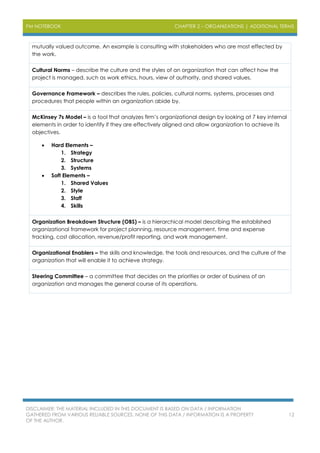
mutually valued outcome. An example is consulting with stakeholders who are most effected by
the work.
Cultural Norms – describe the culture and the styles of an organization that can affect how the
project is managed, such as work ethics, hours, view of authority, and shared values.
Governance Framework – describes the rules, policies, cultural norms, systems, processes and
procedures that people within an organization abide by.
McKinsey 7s Model – is a tool that analyzes firm’s organizational design by looking at 7 key internal
elements in order to identify if they are effectively aligned and allow organization to achieve its
objectives.
Hard Elements –
1. Strategy
2. Structure
3. Systems
Soft Elements –
1. Shared Values
2. Style
3. Staff
4. Skills
Organization Breakdown Structure (OBS) – is a hierarchical model describing the established
organizational framework for project planning, resource management, time and expense
tracking, cost allocation, revenue/profit reporting, and work management.
Organizational Enablers – the skills and knowledge, the tools and resources, and the culture of the
organization that will enable it to achieve strategy.
Steering Committee – a committee that decides on the priorities or order of business of an
organization and manages the general course of its operations.