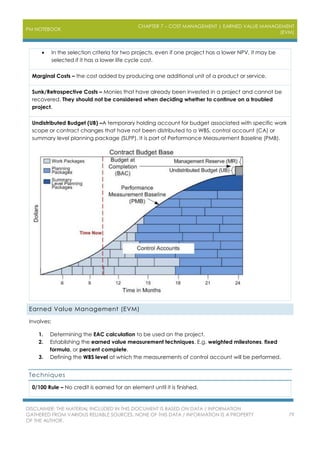


PM Notebook
Summarizing Project Management Concepts for the PMP
Exam
Mohammad Elsheimy Road to PMP
PM NOTEBOOK CHAPTER 1 – INTRODUCTION | PROJECT MANAGEMENT
DISCLAIMER: THE MATERIAL INCLUDED IN THIS DOCUMENT IS BASED ON DATA / INFORMATION
GATHERED FROM VARIOUS RELIABLE SOURCES. NONE OF THIS DATA / INFORMATION IS A PROPERTY
OF THE AUTHOR.
1
DISCLAIMER: THE MATERIAL INCLUDED IN THIS DOCUMENT IS
BASED ON DATA/INFORMATION GATHERED FROM VARIOUS
RELIABLE SOURCES. NONE OF THIS DATA/INFORMATION IS A
PROPERTY OF THE AUTHOR. NONE IS INTENDED TO MAKE A
PROFIT IN ANY WAY. THIS IS FOR PERSONAL USE ONLY.
PM NOTEBOOK CHAPTER 1 – INTRODUCTION | PROJECT MANAGEMENT
DISCLAIMER: THE MATERIAL INCLUDED IN THIS DOCUMENT IS BASED ON DATA / INFORMATION
GATHERED FROM VARIOUS RELIABLE SOURCES. NONE OF THIS DATA / INFORMATION IS A PROPERTY
OF THE AUTHOR.
2
No great man ever complains of want of opportunity.
Ralph Waldo Emerson
PM NOTEBOOK CHAPTER 1 – INTRODUCTION | PROJECT MANAGEMENT
DISCLAIMER: THE MATERIAL INCLUDED IN THIS DOCUMENT IS BASED ON DATA / INFORMATION
GATHERED FROM VARIOUS RELIABLE SOURCES. NONE OF THIS DATA / INFORMATION IS A PROPERTY
OF THE AUTHOR.
3
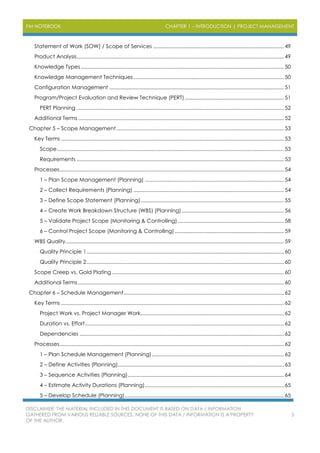
Table of Contents
Chapter 1 – Introduction ...................................................................................................................................... 13
Project Management........................................................................................................................................ 13
Portfolio, Program, Project and Operations.................................................................................................. 13
Project Initiation Context .................................................................................................................................. 13
Benefits Realization Management (BRM)...................................................................................................... 14
Identify Benefits............................................................................................................................................... 14
Execute Benefits.............................................................................................................................................. 14
Sustain Benefits................................................................................................................................................ 14
Business Documents........................................................................................................................................... 14
Business Case .................................................................................................................................................. 15
Benefit Management Plan ........................................................................................................................... 15
Project Selection Methods ............................................................................................................................... 15
Benefit Measurement Methods (Comparative Approach)................................................................... 16
Constrained Optimization Methods / Mathematical Model................................................................. 20
Non-Financial Considerations ...................................................................................................................... 20
Constraints ........................................................................................................................................................... 20
Theory of Constraints ..................................................................................................................................... 21
Project Lifecycle ................................................................................................................................................. 21
Project Management Methodology (PMM)................................................................................................. 22
Predictive Lifecycle / Plan-Driven / Waterfall ........................................................................................... 22
Iterative and Incremental Lifecycles / Iterations...................................................................................... 22
Adaptive Lifecycle / Change-Driven / Agile............................................................................................ 23
Hybrid Lifecycle / Structured Agile ............................................................................................................. 26
Gates Methodology ...................................................................................................................................... 26
Integrated Project Management (IPM) ..................................................................................................... 26
Projects integration Sustainable Methods (PRiSM)................................................................................... 26
Projects IN Controlled Environments (PRINCE2)........................................................................................ 27
Project Documents ............................................................................................................................................ 27
Additional Terms ................................................................................................................................................. 28
Chapter 2 – Organizations ................................................................................................................................... 30
Enterprise Environmental Factors (EEFs) ......................................................................................................... 30
Project Management Information System (PMIS).................................................................................... 30
Organizational Process Assets (OPAs)............................................................................................................ 31
PM NOTEBOOK CHAPTER 1 – INTRODUCTION | PROJECT MANAGEMENT
DISCLAIMER: THE MATERIAL INCLUDED IN THIS DOCUMENT IS BASED ON DATA / INFORMATION
GATHERED FROM VARIOUS RELIABLE SOURCES. NONE OF THIS DATA / INFORMATION IS A PROPERTY
OF THE AUTHOR.
4
Organization System.......................................................................................................................................... 31
Organizational Structure................................................................................................................................... 32
Project-Based Organizations (PBO) ............................................................................................................ 34
Project Expediter vs. Project Coordinator ..................................................................................................... 34
Organizational Hierarchy.................................................................................................................................. 34
Project Management Office (PMO)............................................................................................................... 35
Organizational Project Management (OPM)............................................................................................... 35
Organizational Project Management Maturity Model (OPM3) ............................................................ 35
Capability Maturity Model Integration (CMMI)........................................................................................ 35
Project Environment........................................................................................................................................... 36
Project Complexity............................................................................................................................................. 36
Project Success Factors..................................................................................................................................... 36
Internal Factors ............................................................................................................................................... 36
External Factors............................................................................................................................................... 37
Additional Terms ................................................................................................................................................. 37
Chapter 3 – The Process Framework .................................................................................................................. 39
Phases................................................................................................................................................................... 39
Phase-to-Phase Relationship........................................................................................................................ 39
Process Groups ................................................................................................................................................... 39
Knowledge Areas............................................................................................................................................... 39
Project Management Plans ............................................................................................................................. 40
Work Performance ............................................................................................................................................. 40
Additional Terms ................................................................................................................................................. 41
Chapter 4 – Integration Management.............................................................................................................. 42
Key Terms ............................................................................................................................................................. 42
Integration Types ............................................................................................................................................ 42
Changes, Defects, and Corrections........................................................................................................... 42
Processes.............................................................................................................................................................. 42
1 – Develop Project Charter (Initiating) ..................................................................................................... 42
2 – Develop Project Management Plan (Planning)................................................................................. 43
3 – Direct and Manage Project Work (Executing)................................................................................... 44
4 – Manage Project Knowledge (Executing)............................................................................................ 45
5 – Monitoring and Controlling Project Work (Monitoring & Controlling) ............................................ 45
6 – Perform Integrated Change Control (Monitoring & Controlling) ................................................... 46
7 – Closing Project or Phase (Closing) ........................................................................................................ 47
PM NOTEBOOK CHAPTER 1 – INTRODUCTION | PROJECT MANAGEMENT
DISCLAIMER: THE MATERIAL INCLUDED IN THIS DOCUMENT IS BASED ON DATA / INFORMATION
GATHERED FROM VARIOUS RELIABLE SOURCES. NONE OF THIS DATA / INFORMATION IS A PROPERTY
OF THE AUTHOR.
5
Statement of Work (SOW) / Scope of Services ............................................................................................ 49
Product Analysis.................................................................................................................................................. 49
Knowledge Types ............................................................................................................................................... 50
Knowledge Management Techniques.......................................................................................................... 50
Configuration Management ........................................................................................................................... 51
Program/Project Evaluation and Review Technique (PERT)...................................................................... 51
PERT Planning .................................................................................................................................................. 52
Additional Terms ................................................................................................................................................. 52
Chapter 5 – Scope Management...................................................................................................................... 53
Key Terms ............................................................................................................................................................. 53
Scope................................................................................................................................................................ 53
Requirements .................................................................................................................................................. 53
Processes.............................................................................................................................................................. 54
1 – Plan Scope Management (Planning) .................................................................................................. 54
2 – Collect Requirements (Planning) .......................................................................................................... 54
3 – Define Scope Statement (Planning)..................................................................................................... 55
4 – Create Work Breakdown Structure (WBS) (Planning)........................................................................ 56
5 – Validate Project Scope (Monitoring & Controlling)........................................................................... 58
6 – Control Project Scope (Monitoring & Controlling)............................................................................. 59
WBS Quality.......................................................................................................................................................... 59
Quality Principle 1........................................................................................................................................... 60
Quality Principle 2........................................................................................................................................... 60
Scope Creep vs. Gold Plating ......................................................................................................................... 60
Additional Terms ................................................................................................................................................. 60
Chapter 6 – Schedule Management................................................................................................................. 62
Key Terms ............................................................................................................................................................. 62
Project Work vs. Project Manager Work..................................................................................................... 62
Duration vs. Effort............................................................................................................................................ 62
Dependencies ................................................................................................................................................ 62
Processes.............................................................................................................................................................. 62
1 – Plan Schedule Management (Planning)............................................................................................. 62
2 – Define Activities (Planning)..................................................................................................................... 63
3 – Sequence Activities (Planning).............................................................................................................. 64
4 – Estimate Activity Durations (Planning).................................................................................................. 65
5 – Develop Schedule (Planning)................................................................................................................ 65
PM NOTEBOOK CHAPTER 1 – INTRODUCTION | PROJECT MANAGEMENT
DISCLAIMER: THE MATERIAL INCLUDED IN THIS DOCUMENT IS BASED ON DATA / INFORMATION
GATHERED FROM VARIOUS RELIABLE SOURCES. NONE OF THIS DATA / INFORMATION IS A PROPERTY
OF THE AUTHOR.
6
6 – Control Schedule (Monitoring & Controlling) ..................................................................................... 67
Activities ............................................................................................................................................................... 68
Types ................................................................................................................................................................. 68
Relationships.................................................................................................................................................... 69
Critical Path Method (CPM) / Logic-Driven Scheduling............................................................................. 70
Float / Slack ..................................................................................................................................................... 70
Components ................................................................................................................................................... 70
Critical Chain Method (CCM) ......................................................................................................................... 71
Schedule Compression ..................................................................................................................................... 71
Resource Optimization Techniques ................................................................................................................ 72
Additional Terms ................................................................................................................................................. 72
Chapter 7 – Cost Management.......................................................................................................................... 74
Key Terms ............................................................................................................................................................. 74
Cost Baseline ................................................................................................................................................... 74
Processes.............................................................................................................................................................. 74
1 – Plan Cost Management (Planning)...................................................................................................... 74
2 – Estimate Costs (Planning) ....................................................................................................................... 75
3 – Determine Budget (Planning)................................................................................................................ 76
5 – Control Costs (Monitoring & Controlling)............................................................................................. 77
Cost Types............................................................................................................................................................ 78
Direct / Indirect............................................................................................................................................... 78
Fixed / Variable............................................................................................................................................... 78
Additional Cost Types.................................................................................................................................... 78
Earned Value Management (EVM)................................................................................................................ 79
Techniques....................................................................................................................................................... 79
Performance ................................................................................................................................................... 80
Formulas ........................................................................................................................................................... 80
Additional Terms ................................................................................................................................................. 83
Chapter 8 – Quality Management..................................................................................................................... 84
Key Terms ............................................................................................................................................................. 84
Responsibility ................................................................................................................................................... 84
Quality Control vs. Quality Assurance ........................................................................................................ 84
Quality Approaches....................................................................................................................................... 85
Precision vs. Accuracy .................................................................................................................................. 85
Quality vs. Grade............................................................................................................................................ 85
PM NOTEBOOK CHAPTER 1 – INTRODUCTION | PROJECT MANAGEMENT
DISCLAIMER: THE MATERIAL INCLUDED IN THIS DOCUMENT IS BASED ON DATA / INFORMATION
GATHERED FROM VARIOUS RELIABLE SOURCES. NONE OF THIS DATA / INFORMATION IS A PROPERTY
OF THE AUTHOR.
7
Standards vs. Regulations ............................................................................................................................. 86
Auditing ............................................................................................................................................................ 86
Processes.............................................................................................................................................................. 86
1 – Plan Quality Management (Planning) ................................................................................................. 86
2 – Manage Quality / Quality Assurance (Executing)............................................................................. 87
3 – Control Quality (Monitoring & Controlling).......................................................................................... 88
Quality Theories................................................................................................................................................... 89
Deming’s 14 Points ......................................................................................................................................... 90
David Garvin’s Attributes of Quality ........................................................................................................... 90
Quality Improvement Techniques................................................................................................................... 91
Quality Costs ....................................................................................................................................................... 91
Inspection ............................................................................................................................................................ 92
Testing............................................................................................................................................................... 92
Statistical Sampling ........................................................................................................................................ 92
Design for X.......................................................................................................................................................... 93
Seven Basic Quality Tools (7QL)....................................................................................................................... 93
Variation Causes ................................................................................................................................................ 94
Causes .............................................................................................................................................................. 94
Variation........................................................................................................................................................... 94
Additional Terms ................................................................................................................................................. 95
Chapter 9 – Resources Management ............................................................................................................... 97
Key Terms ............................................................................................................................................................. 97
Processes.............................................................................................................................................................. 97
1 – Plan Resource Management (Planning) ............................................................................................. 97
2 – Estimate Activity Resources (Planning) ................................................................................................ 98
3 – Acquire Resources (Executing).............................................................................................................. 99
4 – Develop Project Team (Executing).....................................................................................................101
5 – Manage Project Team (Executing) ....................................................................................................101
6 – Control Resources (Monitoring & Controlling) ..................................................................................102
Roles and Responsibilities................................................................................................................................103
Responsibility Matrices.................................................................................................................................103
Organizational Charts..................................................................................................................................104
Roles of Project Sponsor/Initiator...............................................................................................................105
Roles of Project Team ..................................................................................................................................105
Roles of Stakeholders...................................................................................................................................106
PM NOTEBOOK CHAPTER 1 – INTRODUCTION | PROJECT MANAGEMENT
DISCLAIMER: THE MATERIAL INCLUDED IN THIS DOCUMENT IS BASED ON DATA / INFORMATION
GATHERED FROM VARIOUS RELIABLE SOURCES. NONE OF THIS DATA / INFORMATION IS A PROPERTY
OF THE AUTHOR.
8
Roles of Financial Manager........................................................................................................................106
Roles of Project Manager ...........................................................................................................................106
Roles of Program Manager ........................................................................................................................107
Roles of Portfolio Manager .........................................................................................................................107
Competency Model........................................................................................................................................107
Basic Social Power ...........................................................................................................................................108
Human Resource Theories ..............................................................................................................................109
Leadership Theories......................................................................................................................................109
Management Systems.................................................................................................................................112
Motivation Theories ......................................................................................................................................113
Tuckman’s Group Development Stages .................................................................................................116
Other Theories ...............................................................................................................................................116
Delegation of Authority...................................................................................................................................117
Delegation Steps ..........................................................................................................................................117
What to Delegate ........................................................................................................................................117
What not to Delegate .................................................................................................................................118
Guidelines for Effective Delegation..........................................................................................................118
Obstacles to Delegation.............................................................................................................................118
Types of Teams..................................................................................................................................................118
Virtual/Distributed Teams ............................................................................................................................119
Team Building Activities...................................................................................................................................119
Rewards and Recognition..............................................................................................................................119
Team Performance Review............................................................................................................................120
Personnel Assessment Tools / Team Performance Assessment ...........................................................120
Project Performance Appraisals................................................................................................................120
Conflict Management ....................................................................................................................................120
Sources of Conflicts......................................................................................................................................121
Conflict Resolving.........................................................................................................................................121
Stress Factors .................................................................................................................................................122
Influence Factors..........................................................................................................................................122
Additional Terms ...............................................................................................................................................122
Chapter 10 – Communication Management................................................................................................123
Key Terms ...........................................................................................................................................................123
Communication Methods/Styles...............................................................................................................123
Communication Model...............................................................................................................................123
PM NOTEBOOK CHAPTER 1 – INTRODUCTION | PROJECT MANAGEMENT
DISCLAIMER: THE MATERIAL INCLUDED IN THIS DOCUMENT IS BASED ON DATA / INFORMATION
GATHERED FROM VARIOUS RELIABLE SOURCES. NONE OF THIS DATA / INFORMATION IS A PROPERTY
OF THE AUTHOR.
9
Communication Direction ..........................................................................................................................124
Distribution Methods ....................................................................................................................................124
Communication Types ................................................................................................................................124
Communication Technology .....................................................................................................................124
Communication Flow ..................................................................................................................................124
Processes............................................................................................................................................................125
1 – Plan Communication Management..................................................................................................125
2 – Manage Communications (Executing) .............................................................................................126
3 – Monitor Communications (Monitoring & Controlling).....................................................................126
Aspects of Effective Communication ..........................................................................................................127
Listening..........................................................................................................................................................127
Message Impact...........................................................................................................................................128
5 Cs of Effective Communication .............................................................................................................128
Formulas .............................................................................................................................................................128
Additional Terms ...............................................................................................................................................128
Chapter 11 – Risk Management .......................................................................................................................130
Key Terms ...........................................................................................................................................................130
Risk Appetite vs. Risk Tolerance .................................................................................................................130
Risk Levels.......................................................................................................................................................131
Risk Sources....................................................................................................................................................131
Processes............................................................................................................................................................132
1 – Plan Risk Management (Planning)......................................................................................................132
2 – Identify Risks (Planning) .........................................................................................................................133
3 – Perform Qualitative Risk Analysis (Planning)......................................................................................134
4 – Perform Quantitative Risk Analysis (Planning)...................................................................................135
5 – Plan Risk Responses (Planning) ............................................................................................................136
6 – Implement Risk Responses (Executing) ..............................................................................................137
7 – Monitor Risks (Monitoring & Controlling) ............................................................................................138
Perspective Project Examination / Prompt Lists (Identification)..............................................................139
Risk Parameter Assessment (Qualitative).....................................................................................................139
Sensitivity Analysis (Quantitative) ..................................................................................................................140
Expected Monetary Value (Quantitative) ..................................................................................................140
Risk Types............................................................................................................................................................141
Event-Based Risks..........................................................................................................................................141
Nonevent-Based Risks..................................................................................................................................141
PM NOTEBOOK CHAPTER 1 – INTRODUCTION | PROJECT MANAGEMENT
DISCLAIMER: THE MATERIAL INCLUDED IN THIS DOCUMENT IS BASED ON DATA / INFORMATION
GATHERED FROM VARIOUS RELIABLE SOURCES. NONE OF THIS DATA / INFORMATION IS A PROPERTY
OF THE AUTHOR.
10
Risk Response Strategies .................................................................................................................................142
Negative Risks (Threats)...............................................................................................................................142
Positive Risks (Opportunities) ......................................................................................................................143
Contingent Response Strategy vs. Fallback Plan ......................................................................................143
Contingency Reserve vs. Management Reserve ......................................................................................143
Scales..................................................................................................................................................................144
Additional Terms ...............................................................................................................................................144
Chapter 12 – Procurement Management......................................................................................................145
Key Terms ...........................................................................................................................................................145
Contract Terms..............................................................................................................................................145
Processes............................................................................................................................................................146
1 – Plan Procurement Management (Planning) ....................................................................................146
2 – Conduct Procurements (Executing)...................................................................................................147
3 – Control Procurement (Monitoring & Controlling).............................................................................149
Make-or-Buy Analysis.......................................................................................................................................150
Factors ............................................................................................................................................................150
Formula...........................................................................................................................................................150
Negotiations......................................................................................................................................................151
Factors of Negotiations ...............................................................................................................................151
Agreement Types .............................................................................................................................................151
Procurement Documents ...............................................................................................................................152
Contract Types .................................................................................................................................................153
Fixed Price (FP) / Lump-Sum Contracts....................................................................................................153
Cost Plus (CP) / Cost-Reimbursable (CR) Contracts..............................................................................154
Time and Materials (T&M) / Unit Price Contracts ...................................................................................155
Incentives.......................................................................................................................................................155
Awards............................................................................................................................................................155
Risk...................................................................................................................................................................155
Point of Total Assumption (PTA) / Breakpoint..............................................................................................155
Formula...........................................................................................................................................................155
Example..........................................................................................................................................................156
Notes...............................................................................................................................................................156
Market Conditions............................................................................................................................................156
Handling Changes...........................................................................................................................................156
Centralized/Decentralized Contracting......................................................................................................157
PM NOTEBOOK CHAPTER 1 – INTRODUCTION | PROJECT MANAGEMENT
DISCLAIMER: THE MATERIAL INCLUDED IN THIS DOCUMENT IS BASED ON DATA / INFORMATION
GATHERED FROM VARIOUS RELIABLE SOURCES. NONE OF THIS DATA / INFORMATION IS A PROPERTY
OF THE AUTHOR.
11
Breaches ............................................................................................................................................................157
Alternative Dispute Resolution (ADR) .......................................................................................................157
Damages .......................................................................................................................................................158
Termination........................................................................................................................................................158
Additional Terms ...............................................................................................................................................159
Chapter 13 – Stakeholder Management........................................................................................................162
Key Terms ...........................................................................................................................................................162
Processes............................................................................................................................................................162
1 – Identify Stakeholders (Initiating) ..........................................................................................................162
2 – Planning Stakeholder Engagement (Planning)................................................................................163
3 – Manage Stakeholder Engagement (Executing)..............................................................................164
4 – Monitor Stakeholder Engagement (Monitoring & Controlling) .....................................................165
Stakeholder Analysis ........................................................................................................................................166
Stakeholder Stakes.......................................................................................................................................166
Stakeholder Influence .................................................................................................................................166
Stakeholder Classifications .........................................................................................................................166
Stakeholder Engagement Grid..................................................................................................................166
Salience Model.............................................................................................................................................167
Stakeholder Cube ........................................................................................................................................169
Stakeholder Influence Mapping................................................................................................................169
Stakeholder Engagement/Assessment Matrix........................................................................................170
Requirements vs. Expectations......................................................................................................................170
Additional Terms ...............................................................................................................................................170
Chapter 14 – Professional and Social Responsibility .....................................................................................171
Responsibility .....................................................................................................................................................171
Respect ..............................................................................................................................................................171
Fairness ...............................................................................................................................................................171
Honesty...............................................................................................................................................................171
Additional Terms ...............................................................................................................................................171
Appendix A – Data Analysis Techniques .........................................................................................................173
Appendix B – Data Gathering Techniques .....................................................................................................175
Appendix C – Data Representation Tools.......................................................................................................177
Appendix D – Decision-Making Techniques ...................................................................................................185
Appendix E – Estimating Techniques................................................................................................................187
3-Point Estimates...............................................................................................................................................187
PM NOTEBOOK CHAPTER 1 – INTRODUCTION | PROJECT MANAGEMENT
DISCLAIMER: THE MATERIAL INCLUDED IN THIS DOCUMENT IS BASED ON DATA / INFORMATION
GATHERED FROM VARIOUS RELIABLE SOURCES. NONE OF THIS DATA / INFORMATION IS A PROPERTY
OF THE AUTHOR.
12
Simple/Triangular Distribution .....................................................................................................................187
Beta Distribution / Weighted Average / PERT (Program/Project Evaluation Review Technique) 187
Other Estimating Techniques .........................................................................................................................188
Appendix F – Forecasting Methods..................................................................................................................190
Causal/Econometric Methods ......................................................................................................................190
Time Series Methods.........................................................................................................................................190
Judgmental Methods......................................................................................................................................191
Other methods..................................................................................................................................................192
Appendix G – Interpersonal/Team/Soft Skills..................................................................................................193
Reactive vs. Proactive.....................................................................................................................................195
Appendix H – Formula Sheet .............................................................................................................................196
Project Selection Methods .............................................................................................................................196
Depreciation .................................................................................................................................................196
Planned Value ..............................................................................................................................................196
Other Methods..............................................................................................................................................197
Schedule Management .................................................................................................................................197
Cost Management ..........................................................................................................................................197
Earned Value Management (EVM)..........................................................................................................197
Communication ...............................................................................................................................................200
Risk Management ............................................................................................................................................200
Procurements....................................................................................................................................................200
Estimates ............................................................................................................................................................201
PM NOTEBOOK CHAPTER 1 – INTRODUCTION | PROJECT MANAGEMENT
DISCLAIMER: THE MATERIAL INCLUDED IN THIS DOCUMENT IS BASED ON DATA / INFORMATION
GATHERED FROM VARIOUS RELIABLE SOURCES. NONE OF THIS DATA / INFORMATION IS A PROPERTY
OF THE AUTHOR.
13
Project Management
Project management is the application of knowledge, skills, tools, and techniques to manage
activities to meet the project requirements.
Portfolio, Program, Project and Operations
Portfolio –
 A group of projects, programs, and operations that are linked together by a business goal
to facilitate effective management to meet strategic business objectives.
 Usually the responsibility of senior management.
 Success is measures in terms of aggregate performance of portfolio components.
Program – A group of projects that are closely linked, to the point where managing them together
provides some benefit. Programs usually include an element of ongoing activity.
Project – a temporary endeavor that is progressively elaborated and produces a specific result.
 Tactical – One operational goal. Probably does not entail contributions by most
employees. e.g. Moving to a new building
 Strategic – has a primary goal of gaining the competitive advantage by focusing on the
organization's overall direction.
Operations/Processes –
 Ongoing work to support the business and systems of the organization.
 Permanent endeavors.
 Produce repetitive outputs.
Projects intersect with operations in many cases including –
 At each closeout phase.
 While expanding outputs.
 During the product development process.
 Until the end of the product life cycle.
 When improving operations or the product development lifecycle.
Project Initiation Context
Why projects are created –
1. Regulatory, legal, or social requirements.
2. Stakeholder requests.
3. Technological advances.
PM NOTEBOOK
CHAPTER 1 – INTRODUCTION | BENEFITS REALIZATION MANAGEMENT
(BRM)
DISCLAIMER: THE MATERIAL INCLUDED IN THIS DOCUMENT IS BASED ON DATA / INFORMATION
GATHERED FROM VARIOUS RELIABLE SOURCES. NONE OF THIS DATA / INFORMATION IS A PROPERTY
OF THE AUTHOR.
14
4. Create, improve, or fix products, processes, or services.
Benefits Realization Management (BRM)
Benefits Realization Management (BRM) – provides organizations with a way to measure how
projects and programs add true value to the enterprise.
Identify Benefits
Position the intended business results as criteria for determining the best project and program
investments by –
 Utilizing the appropriate tools, such as a benefits register, benefits realization roadmap, and
benefits breakdown structures.
 Confirming that key stakeholders, sponsors, and customers have reviewed and approved the
benefits realization roadmap.
 Developing meaningful metrics and key performance (KPI) indicators to measure the actual
delivery of benefits versus the planned benefits
Execute Benefits
Prepare to capture and realize both intended and unintended benefits to minimize risks to future
benefits and maximize the opportunity to gain additional benefits by –
 Ensuring the project or program remains aligned with the organization’s strategic objectives.
 Evaluating risks and KPIs related to financials, compliance, quality, safety, and stakeholder
satisfaction, as they might impact the delivery of benefits
 Recording progress and reporting to key stakeholders as directed in the communication plan
 Ensuring key stakeholders and beneficiaries have reviewed, understand, and act in
accordance with identified benefit realization dependencies.
Sustain Benefits
Deliver continuous value from outputs and outcomes once they transition back to the business by –
 Implementing the required change control based on defined level of tolerance, and taking
corrective action.
 Performing a benefits assessment, which includes formally verifying that the benefits have
been delivered and are being realized.
 Sharing crucial information about how the deliverables are contributing to business success.
 Monitoring the continued suitability of the new capability or other change factors.
 Monitoring actual benefit results against targets and managing for variances.
Business Documents
Contains, but not limited to –
PM NOTEBOOK CHAPTER 1 – INTRODUCTION | PROJECT SELECTION METHODS
DISCLAIMER: THE MATERIAL INCLUDED IN THIS DOCUMENT IS BASED ON DATA / INFORMATION
GATHERED FROM VARIOUS RELIABLE SOURCES. NONE OF THIS DATA / INFORMATION IS A PROPERTY
OF THE AUTHOR.
15
Business Case
A document studies why it is worth to spend money on the project (benefits/reasons/financial
validity.) It is the result of Business Case Analysis (BCA), it could be at program level and it is the
responsibility of project sponsor. It tells us the following –
 Identify business needs (business problems, opportunities, stakeholders affected, etc.)
 Project feasibility –
o Market Demand – For example, building more fuel-efficient cars in response to
gasoline shortages.
o Social Need
o Ecological/Environmental Impact
o Organizational Need
o Customer Requests
 Project determination (organization strategies, goals, objectives, known risks, gap analysis,
etc.)
 Analysis of the situation.
 Recommendations for the project.
 Documents high-level strategic and operational assumptions.
 Should be reviewed periodically on multi-phase projects to ensure the project is on track to
deliver the business benefits.
 Critical Success Factors – what constitutes success and the ways you know that you are
project is successful.
 Business value – the value/benefits that your project creates for the organization. It is
generally described in Business Case document.
o Tangible – Like monetary assets and market share.
o Intangible – Like goodwill, reputation and brand recognition.
Benefit Management Plan
Describes how and when the benefits of the deliverables of the project will bring and describes how
to measure the benefits (also including the alignment with organization strategies, assumptions and
risks). Often created by business analyst.
 Target Benefits – Such as expected tangible and intangible value.
 Strategic Alignment – How project benefits align to the business strategies.
 Timeframe – When will benefits be realized (by phase / short-term / long-term / ongoing /
etc.)
 Metrics – The measures to be used to show benefits realized, direct measures, and indirect
measures.
 Assumptions – The factors expected to be in place or to be in evidence.
 Risks – The risks for realization of benefits.
Project Selection Methods
Project Selection is a process to assess each project idea and select the project with the highest
priority.
PM NOTEBOOK CHAPTER 1 – INTRODUCTION | PROJECT SELECTION METHODS
DISCLAIMER: THE MATERIAL INCLUDED IN THIS DOCUMENT IS BASED ON DATA / INFORMATION
GATHERED FROM VARIOUS RELIABLE SOURCES. NONE OF THIS DATA / INFORMATION IS A PROPERTY
OF THE AUTHOR.
16
 Projects are still just suggestions at this stage, so the selection is often made based on only
brief descriptions of the project.
 Any selection technique must be evaluated based on the degree to which it will meet the
organization’s objective for the project.
 The most important criterion for building project selection method is realism.
Benefit Measurement Methods (Comparative Approach)
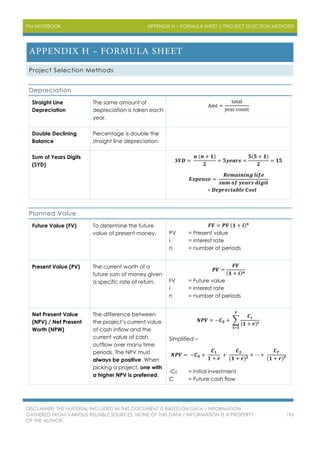
Depreciation
 Depreciation – A reduction in the value of an asset over time.
 Salvage Value – The estimate resale value of an asset at the end of its useful life.
 Book Value – The asset's cost minus the asset's accumulated depreciation
Straight Line Depreciation – The same amount of depreciation is taken each year.
E.g. A $1000 item with a 10-year useful life and no salvage value would be depreciated at $100
per year.
Accelerated Depreciation – Faster than straight line.
 Double Declining Balance
 Sum of Years Digits (SYD)
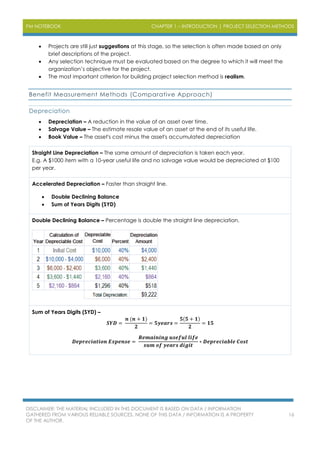
Double Declining Balance – Percentage is double the straight line depreciation.
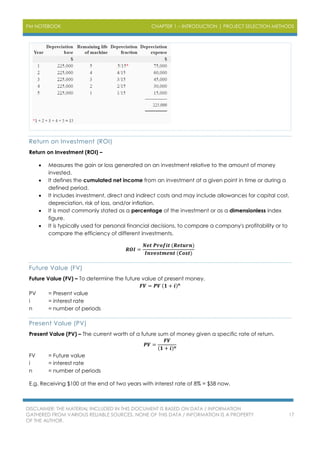
Sum of Years Digits (SYD) –
𝑺𝒀𝑫 =
𝒏 (𝒏 + 𝟏)
𝟐
= 𝟓𝒚𝒆𝒂𝒓𝒔 =
𝟓(𝟓 + 𝟏)
𝟐
= 𝟏𝟓
𝑫𝒆𝒑𝒓𝒆𝒄𝒊𝒂𝒕𝒊𝒐𝒏 𝑬𝒙𝒑𝒆𝒏𝒔𝒆 =
𝑹𝒆𝒎𝒂𝒊𝒏𝒊𝒏𝒈 𝒖𝒔𝒆𝒇𝒖𝒍 𝒍𝒊𝒇𝒆
𝒔𝒖𝒎 𝒐𝒇 𝒚𝒆𝒂𝒓𝒔 𝒅𝒊𝒈𝒊𝒕
∗ 𝑫𝒆𝒑𝒓𝒆𝒄𝒊𝒂𝒃𝒍𝒆 𝑪𝒐𝒔𝒕
PM NOTEBOOK CHAPTER 1 – INTRODUCTION | PROJECT SELECTION METHODS
DISCLAIMER: THE MATERIAL INCLUDED IN THIS DOCUMENT IS BASED ON DATA / INFORMATION
GATHERED FROM VARIOUS RELIABLE SOURCES. NONE OF THIS DATA / INFORMATION IS A PROPERTY
OF THE AUTHOR.
17
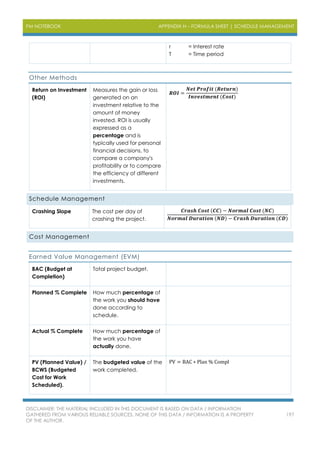
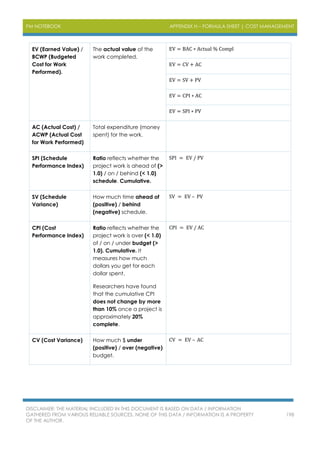
Return on Investment (ROI)
Return on Investment (ROI) –
 Measures the gain or loss generated on an investment relative to the amount of money
invested.
 It defines the cumulated net income from an investment at a given point in time or during a
defined period.
 It includes investment, direct and indirect costs and may include allowances for capital cost,
depreciation, risk of loss, and/or inflation.
 It is most commonly stated as a percentage of the investment or as a dimensionless index
figure.
 It is typically used for personal financial decisions, to compare a company's profitability or to
compare the efficiency of different investments.
𝑹𝑶𝑰 =
𝑵𝒆𝒕 𝑷𝒓𝒐𝒇𝒊𝒕 (𝑹𝒆𝒕𝒖𝒓𝒏)
𝑰𝒏𝒗𝒆𝒔𝒕𝒎𝒆𝒏𝒕 (𝑪𝒐𝒔𝒕)
Future Value (FV)
Future Value (FV) – To determine the future value of present money.
𝑭𝑽 = 𝑷𝑽 (𝟏 + 𝒊) 𝒏
PV = Present value
i = interest rate
n = number of periods
Present Value (PV)
Present Value (PV) – The current worth of a future sum of money given a specific rate of return.
𝑷𝑽 =
𝑭𝑽
(𝟏 + 𝒊) 𝒏
FV = Future value
i = interest rate
n = number of periods
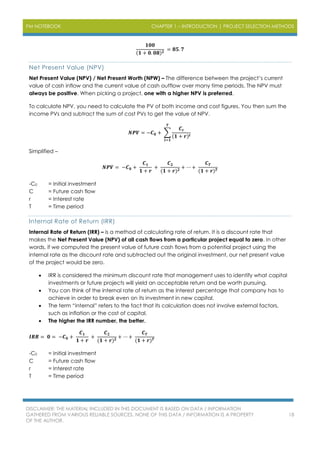
E.g. Receiving $100 at the end of two years with interest rate of 8% = $58 now.
PM NOTEBOOK CHAPTER 1 – INTRODUCTION | PROJECT SELECTION METHODS
DISCLAIMER: THE MATERIAL INCLUDED IN THIS DOCUMENT IS BASED ON DATA / INFORMATION
GATHERED FROM VARIOUS RELIABLE SOURCES. NONE OF THIS DATA / INFORMATION IS A PROPERTY
OF THE AUTHOR.
18
𝟏𝟎𝟎
(𝟏 + 𝟎. 𝟎𝟖) 𝟐
= 𝟖𝟓. 𝟕
Net Present Value (NPV)
Net Present Value (NPV) / Net Present Worth (NPW) – The difference between the project’s current
value of cash inflow and the current value of cash outflow over many time periods. The NPV must
always be positive. When picking a project, one with a higher NPV is preferred.
To calculate NPV, you need to calculate the PV of both income and cost figures. You then sum the
income PVs and subtract the sum of cost PVs to get the value of NPV.
𝑵𝑷𝑽 = −𝑪 𝟎 + ∑
𝑪𝒕
(𝟏 + 𝒓)𝒕
𝑻
𝒕=𝟏
Simplified –
𝑵𝑷𝑽 = −𝑪 𝟎 +
𝑪 𝟏
𝟏 + 𝒓
+
𝑪 𝟐
(𝟏 + 𝒓) 𝟐
+ ⋯ +
𝑪 𝑻
(𝟏 + 𝒓) 𝑻
-C0 = Initial investment
C = Future cash flow
r = Interest rate
T = Time period
Internal Rate of Return (IRR)
Internal Rate of Return (IRR) – is a method of calculating rate of return. It is a discount rate that
makes the Net Present Value (NPV) of all cash flows from a particular project equal to zero. In other
words, if we computed the present value of future cash flows from a potential project using the
internal rate as the discount rate and subtracted out the original investment, our net present value
of the project would be zero.
 IRR is considered the minimum discount rate that management uses to identify what capital
investments or future projects will yield an acceptable return and be worth pursuing.
 You can think of the internal rate of return as the interest percentage that company has to
achieve in order to break even on its investment in new capital.
 The term “internal” refers to the fact that its calculation does not involve external factors,
such as inflation or the cost of capital.
 The higher the IRR number, the better.
𝑰𝑹𝑹 = 𝟎 = −𝑪 𝟎 +
𝑪 𝟏
𝟏 + 𝒓
+
𝑪 𝟐
(𝟏 + 𝒓) 𝟐
+ ⋯ +
𝑪 𝑻
(𝟏 + 𝒓) 𝑻
-C0 = Initial investment
C = Future cash flow
r = Interest rate
T = Time period
PM NOTEBOOK CHAPTER 1 – INTRODUCTION | PROJECT SELECTION METHODS
DISCLAIMER: THE MATERIAL INCLUDED IN THIS DOCUMENT IS BASED ON DATA / INFORMATION
GATHERED FROM VARIOUS RELIABLE SOURCES. NONE OF THIS DATA / INFORMATION IS A PROPERTY
OF THE AUTHOR.
19
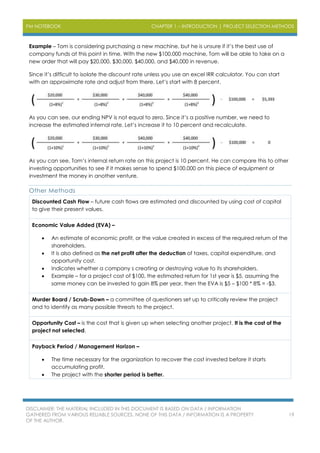
Example – Tom is considering purchasing a new machine, but he is unsure if it’s the best use of
company funds at this point in time. With the new $100,000 machine, Tom will be able to take on a
new order that will pay $20,000, $30,000, $40,000, and $40,000 in revenue.
Since it’s difficult to isolate the discount rate unless you use an excel IRR calculator. You can start
with an approximate rate and adjust from there. Let’s start with 8 percent.
As you can see, our ending NPV is not equal to zero. Since it’s a positive number, we need to
increase the estimated internal rate. Let’s increase it to 10 percent and recalculate.
As you can see, Tom’s internal return rate on this project is 10 percent. He can compare this to other
investing opportunities to see if it makes sense to spend $100,000 on this piece of equipment or
investment the money in another venture.
Other Methods
Discounted Cash Flow – future cash flows are estimated and discounted by using cost of capital
to give their present values.
Economic Value Added (EVA) –
 An estimate of economic profit, or the value created in excess of the required return of the
shareholders.
 It is also defined as the net profit after the deduction of taxes, capital expenditure, and
opportunity cost.
 Indicates whether a company s creating or destroying value to its shareholders.
 Example – for a project cost of $100, the estimated return for 1st year is $5, assuming the
same money can be invested to gain 8% per year, then the EVA is $5 – $100 * 8% = -$3.
Murder Board / Scrub-Down – a committee of questioners set up to critically review the project
and to identify as many possible threats to the project.
Opportunity Cost – is the cost that is given up when selecting another project. It is the cost of the
project not selected.
Payback Period / Management Horizon –
 The time necessary for the organization to recover the cost invested before it starts
accumulating profit.
 The project with the shorter period is better.
PM NOTEBOOK CHAPTER 1 – INTRODUCTION | CONSTRAINTS
DISCLAIMER: THE MATERIAL INCLUDED IN THIS DOCUMENT IS BASED ON DATA / INFORMATION
GATHERED FROM VARIOUS RELIABLE SOURCES. NONE OF THIS DATA / INFORMATION IS A PROPERTY
OF THE AUTHOR.
20
 The initial investment in the project will not impact the selection criteria when payback
period is used for project selection.
Peer Reviews – you present the project proposal to the peers in the organization. These peers
review the project and then recommend some best practices adopted in other projects. The
peers also check for the viability of the project.
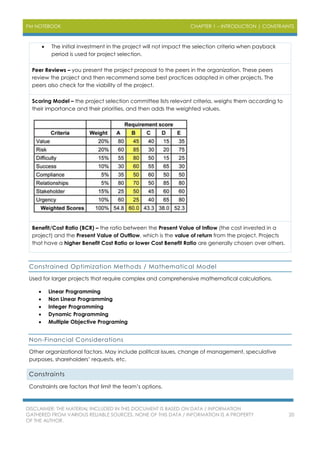
Scoring Model – the project selection committee lists relevant criteria, weighs them according to
their importance and their priorities, and then adds the weighted values.
Benefit/Cost Ratio (BCR) – the ratio between the Present Value of Inflow (the cost invested in a
project) and the Present Value of Outflow, which is the value of return from the project. Projects
that have a higher Benefit Cost Ratio or lower Cost Benefit Ratio are generally chosen over others.
Constrained Optimization Methods / Mathematical Model
Used for larger projects that require complex and comprehensive mathematical calculations.
 Linear Programming
 Non Linear Programming
 Integer Programming
 Dynamic Programming
 Multiple Objective Programing
Non-Financial Considerations
Other organizational factors. May include political issues, change of management, speculative
purposes, shareholders’ requests, etc.
Constraints
Constraints are factors that limit the team’s options.
PM NOTEBOOK CHAPTER 1 – INTRODUCTION | PROJECT LIFECYCLE
DISCLAIMER: THE MATERIAL INCLUDED IN THIS DOCUMENT IS BASED ON DATA / INFORMATION
GATHERED FROM VARIOUS RELIABLE SOURCES. NONE OF THIS DATA / INFORMATION IS A PROPERTY
OF THE AUTHOR.
21
1. Time
2. Cost
3. Scope – What should be included in the project and what should not.
4. Resources – People or material you need for your project.
5. Quality
6. Risk – Whenever you make assumptions about a project, you are introducing risk.
Triple Constraint / Iron Triangle – Time, cost and scope
Theory of Constraints
 Identifying the most important limiting factors, eliminate them, then looking at the next most
important limiting factors.
 Systematically improving that constraint until it is no longer the limiting factors.
 Constraints are often referred to as bottlenecks.
 The Goal by Dr. Eliyahu M. Goldratt
Project Lifecycle
Project Management Lifecycle – Refer to Initiation, Planning, Executing, Monitoring & Controlling,
and Closing (IPECC).
Project Lifecycle –
 Unique to each type of project.
 Refers to methodology and phases of a project within an organization.
 Each phase can consist of any activities from the process groups.
 Have a definite end.
 Phases may repeat.
 Phases are generally sequential but can overlap.
Product Lifecycle / Project Lifecycle Management (PLM) –
 The process of managing the entire lifecycle of a product from its conception, through
design and manufacture, to service and disposal.
 PLM integrates people, data, processes, and business systems to provide a product
information backbone for companies.
 A product can spawn or require many projects over its life and each project has its own
project lifecycle.
 Does not have a definite end.
 Phases occur only once.
 Phases are sequential.
The five stages of a product's life are –
1. Development / Conception – generating ideas and creating the product.
2. Introduction – marketing the product and selling it.
3. Growth – sales increase
PM NOTEBOOK
CHAPTER 1 – INTRODUCTION | PROJECT MANAGEMENT METHODOLOGY
(PMM)
DISCLAIMER: THE MATERIAL INCLUDED IN THIS DOCUMENT IS BASED ON DATA / INFORMATION
GATHERED FROM VARIOUS RELIABLE SOURCES. NONE OF THIS DATA / INFORMATION IS A PROPERTY
OF THE AUTHOR.
22
4. Maturity – product is accepted widely and sales are at their peak.
5. Decline / Withdrawal / Retirement – selling out all of your inventory and move on to the
next product.
Project Management Methodology (PMM)
A project management methodology is essentially a set of guiding principles and processes for
managing a project. Your choice of methodology defines how you work and communicate.
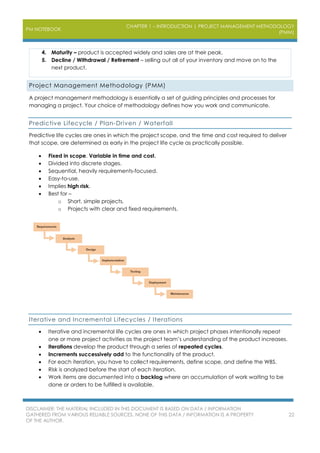
Predictive Lifecycle / Plan-Driven / Waterfall
Predictive life cycles are ones in which the project scope, and the time and cost required to deliver
that scope, are determined as early in the project life cycle as practically possible.
 Fixed in scope. Variable in time and cost.
 Divided into discrete stages.
 Sequential, heavily requirements-focused.
 Easy-to-use.
 Implies high risk.
 Best for –
o Short, simple projects.
o Projects with clear and fixed requirements.
Iterative and Incremental Lifecycles / Iterations
 Iterative and incremental life cycles are ones in which project phases intentionally repeat
one or more project activities as the project team’s understanding of the product increases.
 Iterations develop the product through a series of repeated cycles.
 Increments successively add to the functionality of the product.
 For each iteration, you have to collect requirements, define scope, and define the WBS.
 Risk is analyzed before the start of each iteration.
 Work items are documented into a backlog where an accumulation of work waiting to be
done or orders to be fulfilled is available.
PM NOTEBOOK
CHAPTER 1 – INTRODUCTION | PROJECT MANAGEMENT METHODOLOGY
(PMM)
DISCLAIMER: THE MATERIAL INCLUDED IN THIS DOCUMENT IS BASED ON DATA / INFORMATION
GATHERED FROM VARIOUS RELIABLE SOURCES. NONE OF THIS DATA / INFORMATION IS A PROPERTY
OF THE AUTHOR.
23
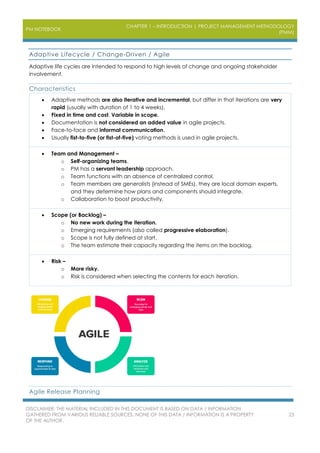
Adaptive Lifecycle / Change-Driven / Agile
Adaptive life cycles are intended to respond to high levels of change and ongoing stakeholder
involvement.
Characteristics
 Adaptive methods are also iterative and incremental, but differ in that iterations are very
rapid (usually with duration of 1 to 4 weeks).
 Fixed in time and cost. Variable in scope.
 Documentation is not considered an added value in agile projects.
 Face-to-face and informal communication.
 Usually fist-to-five (or fist-of-five) voting methods is used in agile projects.
 Team and Management –
o Self-organizing teams.
o PM has a servant leadership approach.
o Team functions with an absence of centralized control.
o Team members are generalists (instead of SMEs), they are local domain experts,
and they determine how plans and components should integrate.
o Collaboration to boost productivity.
 Scope (or Backlog) –
o No new work during the iteration.
o Emerging requirements (also called progressive elaboration).
o Scope is not fully defined at start.
o The team estimate their capacity regarding the items on the backlog.
 Risk –
o More risky.
o Risk is considered when selecting the contents for each iteration.
Agile Release Planning
PM NOTEBOOK
CHAPTER 1 – INTRODUCTION | PROJECT MANAGEMENT METHODOLOGY
(PMM)
DISCLAIMER: THE MATERIAL INCLUDED IN THIS DOCUMENT IS BASED ON DATA / INFORMATION
GATHERED FROM VARIOUS RELIABLE SOURCES. NONE OF THIS DATA / INFORMATION IS A PROPERTY
OF THE AUTHOR.
24
 High-level summary of when we expect the product to be released.
 Product roadmap.
 The number of iterations/sprints.
Iteration Burndown Chart
A chart that shows how quickly (rate/velocity) you and your team are burning through your
customer's user stories. It tracks the work remaining, and help analyzing the variance.
Terms
Backlog (Product Scope) – a prioritized list of requirements. Owned by product owner.
Grooming the Backlog / Backlog Refinement / Scrum Artifact – The owner of the product prioritizes
the backlog before each iteration/sprint of the project.
PM NOTEBOOK
CHAPTER 1 – INTRODUCTION | PROJECT MANAGEMENT METHODOLOGY
(PMM)
DISCLAIMER: THE MATERIAL INCLUDED IN THIS DOCUMENT IS BASED ON DATA / INFORMATION
GATHERED FROM VARIOUS RELIABLE SOURCES. NONE OF THIS DATA / INFORMATION IS A PROPERTY
OF THE AUTHOR.
25
Timebox – a previously agreed period of time during which a person or a team works steadily
towards completion of some goal.
Story Points – an abstract measure of effort required to implement a user story. The team work
together to agree on estimates in a group setting.
Scrum
 Scrum is a specialized agile method.
 Focuses on project team.
 Involves daily 15-minutes stand-up meeting.
 Can easily lead to scope creep because there’s no fixed end-date.
Sprint – Refers to an iteration or development cycle in Scrum.
Sprint Review – To look back at what worked in that sprint.
Retrospective – the last meeting done in a sprint. The entire team, including both the Scrum Master
and the product owner should participate to determine what could be changed that might
make the next sprint more productive.
Planning Poker / Scrum Poker – a consensus-based, mostly used to estimate effort or relative size
of development goals in software development. In planning poker, members of the group make
estimates by playing numbered cards face-down to the table, instead of speaking them aloud.
The cards are revealed, and the estimates are then discussed. By hiding the figures in this way, the
group can avoid the cognitive bias of anchoring, where the first number spoken aloud sets a
precedent for subsequent estimates.
Extreme Programming (XP)
Extreme programming (XP) is a software development methodology which is intended to improve
software quality and responsiveness to changing customer requirements.
 A type of agile software development.
PM NOTEBOOK
CHAPTER 1 – INTRODUCTION | PROJECT MANAGEMENT METHODOLOGY
(PMM)
DISCLAIMER: THE MATERIAL INCLUDED IN THIS DOCUMENT IS BASED ON DATA / INFORMATION
GATHERED FROM VARIOUS RELIABLE SOURCES. NONE OF THIS DATA / INFORMATION IS A PROPERTY
OF THE AUTHOR.
26
 Advocates frequent "releases" in short development cycles, which is intended to improve
productivity and introduce checkpoints at which new customer requirements can be
adopted.
 Analysis, design, coding, and testing phases are done everyday.
Hybrid Lifecycle / Structured Agile
A combination of predictive, iterative, incremental, and/or agile approaches is a hybrid approach.
Gates Methodology
Gates methodology is a project management technique in which an initiative or project (e.g., new
product development, process improvement, and business change) is divided into distinct stages or
phases, separated by decision points (known as gates.)
Gate / Tollgate / Phase Gate / Stage Gate / Water Gate / Kill Point / Exit Gate / Phase Exit Review
– a standardized control point where the projects phase is reviewed and/or audited and
approved (or not) to continue with the next phase. The gates allow to verify if the project reaches
the expected performance.
 Called a Kill Point because it is an opportunity to kill the project.
 Funding might occur at phase gates.
 Not necessary to have a phase gate at project closure.
Integrated Project Management (IPM)
 Sometimes called Integrated Project Delivery.
 Emphasizes sharing and standardization of processes across the organization.
 Requires extensive upfront planning to ensure that all processes are well-integrated.
Projects integration Sustainable Methods (PRiSM)
 Developed by Green Project Management (GPM) Global.
 Focuses on accounting for and minimizing adverse environmental impacts of the project.
 Extends beyond the end of the project to maximize sustainability.
PM NOTEBOOK CHAPTER 1 – INTRODUCTION | PROJECT DOCUMENTS
DISCLAIMER: THE MATERIAL INCLUDED IN THIS DOCUMENT IS BASED ON DATA / INFORMATION
GATHERED FROM VARIOUS RELIABLE SOURCES. NONE OF THIS DATA / INFORMATION IS A PROPERTY
OF THE AUTHOR.
27
Projects IN Controlled Environments (PRINCE2)
 Official project management methodology of the UK government.
 Requires extensive documentation.
 Based on 7 principles, 7 themes and 7 processes. The 7 PRINCE2 principles, for instance, are –
o Continued business justification
o Learn from experience
o Defined roles and responsibilities
o Manage by stages
o Manage by Exception
o Focus on products
o Tailor to suit the project environment
Project Documents
Refer to any project-related documents that are not part of the project management plan.
Activity Attributes Lessons Learned
Register
Quality Control
Measurements
Risk Report
Activity List Milestone List Quality Metrics Schedule Data
Assumptions Log Physical Resource
Assignments
Quality Reports Schedule Forecasts
Basis of Estimates Project Calendars Requirements
Documentation
Stakeholder Register
Change Log Project
Communications
Requirements
Traceability Matrix
Team Charter
PM NOTEBOOK CHAPTER 1 – INTRODUCTION | ADDITIONAL TERMS
DISCLAIMER: THE MATERIAL INCLUDED IN THIS DOCUMENT IS BASED ON DATA / INFORMATION
GATHERED FROM VARIOUS RELIABLE SOURCES. NONE OF THIS DATA / INFORMATION IS A PROPERTY
OF THE AUTHOR.
28
Cost Estimates Project Schedule Resource Breakdown
Structure
Test and Evaluation
Documents
Cost Forecasts Project Schedule
Network Diagram
Resource Calendars
Duration Estimates Project Scope
Statement
Resource
Requirements
Issue Log Project Team
Assignments
Risk Register
Additional Terms
Application Areas – The areas of expertise, industry, or function where a project is centered. E.g. IT,
healthcare, etc.
Cultural and Social Environment – How a project affects people and how these people may
affect the project. Includes economics, religions, demographics, etc.
MACD – Move, Add, Change, and Delete
Line of Business (LOB) – is a general term which refers to a product or a set of related products
that serve a particular customer transaction or business need.
Management by Exception (Financial) – The practice of examining the financial and operational
results of a business, and only bringing issues to the attention of management if results represent
substantial differences from the budgeted or expected amount.
PMI Talent Triangle –
1. Technical Project Management – enable the PM to effectively apply project
management knowledge. Examples are resource management, tailoring, risk
management, rolling-wave planning, integrated change control, etc.
2. Leadership / Interpersonal – allows PM to guide, motivate, and direct the team. Includes
influencing the organization, sharing power, creating an environment to meet project
objectives, and helping a group of people to bond.
3. Strategic and Business Management – ensure that the PM can see the high-level overview
of the organization and effectively negotiate and implement decisions and actions that
support strategic alignment and innovation.
Progressive Elaboration – Refers to the technique of which the plan for the particular project is
being continuously and constantly modified, detailed, and improved as newer and more
improved sets of information becomes available to the project management team.
PM NOTEBOOK CHAPTER 1 – INTRODUCTION | ADDITIONAL TERMS
DISCLAIMER: THE MATERIAL INCLUDED IN THIS DOCUMENT IS BASED ON DATA / INFORMATION
GATHERED FROM VARIOUS RELIABLE SOURCES. NONE OF THIS DATA / INFORMATION IS A PROPERTY
OF THE AUTHOR.
29
PM NOTEBOOK
CHAPTER 2 – ORGANIZATIONS | ENTERPRISE ENVIRONMENTAL FACTORS
(EEFS)
DISCLAIMER: THE MATERIAL INCLUDED IN THIS DOCUMENT IS BASED ON DATA / INFORMATION
GATHERED FROM VARIOUS RELIABLE SOURCES. NONE OF THIS DATA / INFORMATION IS A PROPERTY
OF THE AUTHOR.
30
If you want something done right… better hope you are in the right kind of
organization.
Enterprise Environmental Factors (EEFs)
Conditions, not under the control of the project team, that influence, constrain, or direct the project.
It is the way your company is set up, the way people are managed, the processes your team needs
to follow to do their jobs... they all can have a big impact on how you manage your project.
Internal –
 People – Skills and culture.
 Databases
 Standards
 Risk Tolerance
 Resource Availability
 Authorization System – How work is assigned to people. Ensures that every work package is
done at the right time and in the proper sequence.
 Organizational Governance Framework – a structured way to provide control, direction, and
coordination through people, policies, and processes to meet organizational strategic and
operational goals.
o Alignment with organizational mission
o Performance on time, cost, and scope
o Communication with stakeholders
External –
 Weather
 Marketplace Conditions
 Laws and Regulations
 Politics
 Government and Industry Standards
Project Management Information System (PMIS)
Part of EEFs. A computer-driven system to aid in the development of the project. It can calculate
schedules, costs, expectations, and likely results. An example of a PMIS is Microsoft Project. Features
of a PMIS –
Scheduling Tools
PM NOTEBOOK
CHAPTER 2 – ORGANIZATIONS | ORGANIZATIONAL PROCESS ASSETS
(OPAS)
DISCLAIMER: THE MATERIAL INCLUDED IN THIS DOCUMENT IS BASED ON DATA / INFORMATION
GATHERED FROM VARIOUS RELIABLE SOURCES. NONE OF THIS DATA / INFORMATION IS A PROPERTY
OF THE AUTHOR.
31
Work Authorization System – For authorizing the start of work packages or activities.
Configuration Management System – It is a tool for establishing and monitoring consistency of a
project performance, functional, and physical attributes. It manages items that require formal
change control. It can store project management plan, risk register, calendars, and other project
documents.
Change Control System (CCS) – Includes standardized forms, reports, processes, procedures, and
software to track and control changes.
 Configuration/Change Control Board (CCB) – A committee that evaluates the worthiness
of proposed changes.
Information Collecting/Distribution System
Organizational Process Assets (OPAs)
Templates, forms, and previous work of the company, stored in corporate knowledge base (KB).
 Templates
 Contracts
 Registers
 Assessment Tools
 Historical Data
 Databases
 Project files
 Lessons Learned
 Corporate/Organizational Knowledge Repository/Base – Where historical data, databases,
and other data are stored.
 Project Governance Framework – The organization’s established criteria, procedures, and
guidelines intended to make sure projects meet organization’s strategic goals.
 Personnel Administration – Includes employee development and training records and
competency frameworks that refer to knowledge sharing behaviors.
 Industry Project Management Body of Knowledge – sets forth guidelines and criteria to tailor
the organization’s processes to satisfy specific needs of the project.
 Change Control Procedures
 Configuration Management Knowledge Base
 Versions
 Baselines
Organization System
 Structure and governance
 Permissions
 Work authorization
 Employee discipline
PM NOTEBOOK CHAPTER 2 – ORGANIZATIONS | ORGANIZATIONAL STRUCTURE
DISCLAIMER: THE MATERIAL INCLUDED IN THIS DOCUMENT IS BASED ON DATA / INFORMATION
GATHERED FROM VARIOUS RELIABLE SOURCES. NONE OF THIS DATA / INFORMATION IS A PROPERTY
OF THE AUTHOR.
32
 System dynamics
o Relationship between components
o Policies
o Bureaucracy
Organizational Structure
An organizational structure defines how activities such as task allocation, coordination, and
supervision are directed toward the achievement of organizational aims.
During project formation, there is always an element of confusion or lack of clarity regarding the
balance of power between the project manager and the functional manager. If not resolved, such
confusion manifests itself in conflicts regarding technical decisions, resource allocations, and
scheduling later in the project.
Organic/Simple –
 Loosely organized business or organization.
 The project manager likely has little control over the project resources and may not be
called a project manager.
Pre-Bureaucratic –
 Totally centralized.
 Strategic leader makes all key decisions and most communications are done by one on
one conversations.
Functional/Centralized/Bureaucratic/Traditional –
 People who do similar tasks are grouped together based on specialty. Functional
organizations are organized around the functions the organization need to be performed.
 Functions include – HR, IT, Sales, Marketing, Administration, etc.
 The Project Management role will be performed by a team member of a functional area
under the management of a functional manager.
 Resources are controlled and authorized by functional managers.
 The Project Management role would act more like a Project Coordinator or Project
Expediter who do not usually carry the title of Project Manager.
 Project Management is considered a part-time responsibility.
 Authority of the Project Manager is very limited.
 Major difficulties arise when multiple projects need to be managed because of conflicts
over the relative priorities of different projects in competition for limited resources.
Divisional –
 People are grouped into teams based on the products or projects that meet the needs of
a certain customer.
PM NOTEBOOK CHAPTER 2 – ORGANIZATIONS | ORGANIZATIONAL STRUCTURE
DISCLAIMER: THE MATERIAL INCLUDED IN THIS DOCUMENT IS BASED ON DATA / INFORMATION
GATHERED FROM VARIOUS RELIABLE SOURCES. NONE OF THIS DATA / INFORMATION IS A PROPERTY
OF THE AUTHOR.
33
 An example is a company that runs many brands that each brand acts as an individual
company.
Multidivisional –
 Same characteristics as functional, however, it has duplication of efforts within the
organization, but not within each department or division of the organization.
 Project manager has little authority in this structure and the functional manager controls
the project budget.
 An example, having an IT group within financial and manufacturing departments.
Matrix Organization –
 Groups people into functional departments of specialization, then further separates them
into divisional projects and products.
 They are organizations with structures that carries a blend of the characteristics of
functional and projectized organizations.
 Best for complex projects because of the mix of functional expertise and project
management.
 Matrix organizations can be classified as weak, balanced or strong based on the relative
authority of the Functional Manager and Project Manager.
 Weak Matrix –
o Team has a blend of departmental and project duties.
o The Project Manager is given a role of more like Project Coordinator or Project
Expediter. Team members report to functional manager.
 Strong Matrix –
o The Project Manager is given much more authority on resources and budget
spending.
 The differentiations between Functional Organization vs. Weak Matrix and also Projectized
Organization vs. Strong Matrix are not very clear cut.
 The primary condition leading to conflict in matrix structure is ambiguous jurisdictions that’s
when two or more parties have related responsibilities, but their work boundaries and role
definitions are unclear.
 The dual reporting relationship should be fixed by the project manager.
Project-Oriented/Composite/Hybrid/Projectized – Projectized Organizations are organized around
projects for maximal project management effectiveness.
 The Project Manager is given more authority and resources control.
 The Project Manager is responsible to the Sponsor and/or Senior Management.
 The Project Manager is usually a full-time role.
 Project managers may compete for stockpile resources.
 Team members are usually co-located within the same office / virtually co-located to
maximize communication effectiveness.
 There can be some functional units within organization, however, those units are having a
supportive function only without authority over the project manager
PM NOTEBOOK
CHAPTER 2 – ORGANIZATIONS | PROJECT EXPEDITER VS. PROJECT
COORDINATOR
DISCLAIMER: THE MATERIAL INCLUDED IN THIS DOCUMENT IS BASED ON DATA / INFORMATION
GATHERED FROM VARIOUS RELIABLE SOURCES. NONE OF THIS DATA / INFORMATION IS A PROPERTY
OF THE AUTHOR.
34
 Team members are from several departments and are selected to create a task force to
implement the project.
Virtual –
 An organization involving detached and disseminated entities (from employees to entire
enterprises) and requiring information technology to support their work and
communication.
 Project manager has low authority.
 Single point of contact for each group.
 Communications can be challenging.
Hybrid – A blend of the functional, projectized and matrix organization styles. Project manager’s
power is unique to the structure.
PMO Structure –
 Provides uniform approach to all projects. Can be supportive, controlling, or directive
(highest control).
 Can feel disconnected from project managers, stakeholders, or team.
Flat/Flatarchy Structure – Management is decentralized. Each employee is the boss of themselves.
Project-Based Organizations (PBO)
Project-Based Organizations (PBO) – temporary structures created to facilitate the execution of
projects. PBOs can exist within all forms of organizations. The project staff could be full time or part
time, and they report to the project manager. The project managers report to the manager of
project managers. PBO facilitates project execution by speeding up project based decision making.
Project Expediter vs. Project Coordinator
Project Expediter – A project expediter works as staff assistant and communications coordinator.
The expediter cannot personally make or enforce decisions. He usually collects or reports data to
the project manager.
Project Coordinator – Project coordinators have the power to make some decisions, have some
authority, and report to a higher-level manager.
Organizational Hierarchy
1. Top / Strategic Management – Managers at the highest level. Their job –
 Long-term objectives
 Policies
 Organizing
PM NOTEBOOK CHAPTER 2 – ORGANIZATIONS | PROJECT MANAGEMENT OFFICE (PMO)
DISCLAIMER: THE MATERIAL INCLUDED IN THIS DOCUMENT IS BASED ON DATA / INFORMATION
GATHERED FROM VARIOUS RELIABLE SOURCES. NONE OF THIS DATA / INFORMATION IS A PROPERTY
OF THE AUTHOR.
35
2. Middle Management – Implement and control plans of top management. Examples are
factory managers and division heads.
 Departmental objectives
 Assignment of duties
 Coordination
3. Supervisory / Operational / Lower Management – Operate the schedule of actions
desired from the staff. Examples are supervisors, foremen, and inspectors.
 Discipline
 Supervision
 Training
Project Management Office (PMO)
Also called project office and project headquarters. A PMO is the center of excellence for project
management in an organization. It is a central office that oversees all projects within an organization
or within a functional department. A PMO supports the project manager through software, training,
templates, policies, communication, dispute resolution, and other services (audits, resource
management, etc.).
 Supportive – Consultative role, templates, training, etc.
 Controlling Compliance through a framework, governance, templates, etc.
 Directive (highest) –
o Directly manages the project.
o Can set dates for beginning and terminating projects.
o Can select, manage, and deploy resources.
o Can manage shared resources.
o PM is part of PMO.
Organizational Project Management (OPM)
OPM is the systematic coordination and management of projects, programs, and portfolios in
alignment with the achievement of strategic goals. You can think of OPM as a framework for
keeping the organization as a whole focused on the overall strategy. It provides direction for how
portfolios, programs, projects and other organizational work should be prioritized, managed,
executed, and measured to achieve strategic goals.
Organizational Project Management Maturity Model (OPM3)
OPM3 is PMI’s organizational project management maturity model. It is designed to help
organizations determine their level of maturity (process capability) in project management.
Capability Maturity Model Integration (CMMI)
CMMI is a process improvement approach that helps organizations improve their performance. It
can be used to guide process improvement across a project, a division, or an entire organization.
Currently, it addresses three areas of interest –
PM NOTEBOOK CHAPTER 2 – ORGANIZATIONS | PROJECT ENVIRONMENT
DISCLAIMER: THE MATERIAL INCLUDED IN THIS DOCUMENT IS BASED ON DATA / INFORMATION
GATHERED FROM VARIOUS RELIABLE SOURCES. NONE OF THIS DATA / INFORMATION IS A PROPERTY
OF THE AUTHOR.
36
 Product and Service Development – CMMI for Development (CMMI-DEV)
 Service Establishment, Management, and Delivery – CMMI for Services (CMMI-SVC)
 Product and Service Acquisition – CMMI for Acquisition (CMMI-ACQ)
Project Environment
 Physical Elements –
o Location of project work
o Working conditions
o Weather
o Constraints
o External EEFs
 Social and Cultural Influences –
o Political climate
o Codes of conduct
o Ethics
o External EEFs
 Organizational Culture and Structure –
o Vision and mission
o Values and beliefs
o Cultural norms
o Hierarchy and authority
o Internal EEFs
 Infrastructure Environmental Factors
o Facilities
o Equipment
o Telecommunication Channels
o Internal EEFs
Project Complexity
Complexity is a characteristic of a program or project or its environment that is difficult to manage
due to (dimensions of complexity) –
 Human Behavior
 System Behavior
 Ambiguity
Project Success Factors
Internal Factors
Those 10 characteristics found to be critical to project implementation success –
1. Project mission – Initial clarity of goals and general directions.
2. Top management support – Willingness of top management to provide the necessary
resources and authority/power for project success.
PM NOTEBOOK CHAPTER 2 – ORGANIZATIONS | ADDITIONAL TERMS
DISCLAIMER: THE MATERIAL INCLUDED IN THIS DOCUMENT IS BASED ON DATA / INFORMATION
GATHERED FROM VARIOUS RELIABLE SOURCES. NONE OF THIS DATA / INFORMATION IS A PROPERTY
OF THE AUTHOR.
37
3. Project schedule/plans – A detailed specification of the individual action steps required for
project implementation.
4. Client consultation – Communication, consultation, and active listening to all impacted
parties.
5. Personnel – Recruitment, selection, and training of the necessary personnel for the project
team.
6. Technical tasks – Availability of the required technology and expertise to accomplish the
specific technical action steps.
7. Client acceptance – The act of “selling” the final project to its ultimate intended users.
8. Monitoring and feedback – Timely provision of comprehensive control information at each
phase in the implementation process.
9. Communication – The provision of an appropriate network and necessary data to all key
factors in the project implementation.
10. Trouble-shooting – Ability to handle unexpected crises and deviations from plan.
External Factors
In addition to these ten critical success factors, all of which to some degree are within the control of
the project team, four additional factors are out of project team's control.
1. Characteristics of the project team leader – Competence of the project leader
(administratively, interpersonally, and technically) and the amount of authority available to
perform his/her duties.
2. Power and politics – The degree of political activity within the organization and perception
of the project as furthering an organization member’s self-interests.
3. Environmental events – The likelihood of external organizational or environmental factors
impacting on the operations of the project team, either positively or negatively.
4. Urgency – The perception of the importance of the project or the need to implement the
project as soon as possible.
Additional Terms
Central Organization – where your team comes together for the duration of the project and they
do not work on anything else.
Co-creation – is a management initiative, or form of economic strategy, that brings different
parties together (for instance, a company and a group of customers), in order to jointly produce a
mutually valued outcome. An example is consulting with stakeholders who are most effected by
the work.
Cultural Norms – describe the culture and the styles of an organization that can affect how the
project is managed, such as work ethics, hours, view of authority, and shared values.
Governance Framework – describes the rules, policies, cultural norms, systems, processes and
procedures that people within an organization abide by.
PM NOTEBOOK CHAPTER 2 – ORGANIZATIONS | ADDITIONAL TERMS
DISCLAIMER: THE MATERIAL INCLUDED IN THIS DOCUMENT IS BASED ON DATA / INFORMATION
GATHERED FROM VARIOUS RELIABLE SOURCES. NONE OF THIS DATA / INFORMATION IS A PROPERTY
OF THE AUTHOR.
38
McKinsey 7s Model – is a tool that analyzes firm’s organizational design by looking at 7 key internal
elements in order to identify if they are effectively aligned and allow organization to achieve its
objectives.
 Hard Elements –
1. Strategy
2. Structure
3. Systems
 Soft Elements –
1. Shared Values
2. Style
3. Staff
4. Skills
Organization Breakdown Structure (OBS) – is a hierarchical model describing the established
organizational framework for project planning, resource management, time and expense
tracking, cost allocation, revenue/profit reporting, and work management.
Organizational Enablers – the skills and knowledge, the tools and resources, and the culture of the
organization that will enable it to achieve strategy.
Steering Committee – a committee that decides on the priorities or order of business of an
organization and manages the general course of its operations.
PM NOTEBOOK CHAPTER 3 – THE PROCESS FRAMEWORK | PHASES
DISCLAIMER: THE MATERIAL INCLUDED IN THIS DOCUMENT IS BASED ON DATA / INFORMATION
GATHERED FROM VARIOUS RELIABLE SOURCES. NONE OF THIS DATA / INFORMATION IS A PROPERTY
OF THE AUTHOR.
39
Phases
Projects that are big, or complex, or simply need to be done in stages because of external
constraints can be divided into phases. Each phase must go through the five process groups and
must have its own project charter.
Phase-to-Phase Relationship
Strongly influences how requirements are managed.
Sequential Relationship – Each phases starts when the previous is 100% complete.
Overlapping Relationship –
 When multiple teams need to work independently on different parts of the project.
 Next phase may begin before the end of the previous phase.
 Introduces risk due to potential rework.
Iterative Relationship –
 When a single team starts planning for the next phase occurs while executing the previous
phase.
 Very common in agile software development.
Process Groups
The process groups help you organize the processes by the kind of work you do.
1. Initiating – Figure out project’s high level goals. Create and define a preliminary version of
your project’s scope.
2. Planning
3. Executing
4. Monitoring and Controlling –
 Monitoring – means collecting, measuring, assessing measurements and trends, and
identifying areas that require special attention.
 Controlling – means determining corrective and preventive actions, re-planning,
following up action plans, and confirming actions have improved performance issues.
5. Closing
Knowledge Areas
The knowledge areas help you organize processes by the subject matter you are dealing with.
1. Integration – Keeping everybody working towards the same goals and dealing with
changes.
PM NOTEBOOK
CHAPTER 3 – THE PROCESS FRAMEWORK | PROJECT MANAGEMENT
PLANS
DISCLAIMER: THE MATERIAL INCLUDED IN THIS DOCUMENT IS BASED ON DATA / INFORMATION
GATHERED FROM VARIOUS RELIABLE SOURCES. NONE OF THIS DATA / INFORMATION IS A PROPERTY
OF THE AUTHOR.
40
2. Scope – What will and will not be done on project.
3. Time
4. Cost
5. Quality – The right product, the most efficient way.
6. Risk – Things that could happen (positive or negative).
7. Procurement – Contracts.
8. Communication – Keeping everybody in the loop.
9. Resources
10. Stakeholder
Project Management Plans
Knowledge Areas Management Plans
Benefits Management Plan –
 Created by the project sponsor and the PM.
 It is an economic feasibility study used to establish the validity of benefits.
 Documents the owner of the benefits.
 Defines what benefits the project will create, when the benefits will be realized, and how
the benefits will be measured.
 Assumptions and risks considered in determining the benefit.
Change Management Plan – How change requests will be authorized and incorporated.
Configuration Management Plan – For managing changes to the deliverables and processes and
the resulting documentation.
Process Improvement Plan –
 How processes that are used on the project to complete the work or perform project
management activities will be evaluated and improved.
 Captures the details of activities he would be doing to enhance the value of the
process, including their inputs, outputs, and interfaces with other processes.
Requirements Management Plan – How requirements will be gathered, analyzed, documented,
and managed.
Work Performance
Work Performance Data (WPD) – The raw observations/data of the project’s status before any
analysis. It is the current status of various parameters. E.g. how much work is completed, how
much time has elapsed, compliance of requirements, activities started/finished, etc.
PM NOTEBOOK CHAPTER 3 – THE PROCESS FRAMEWORK | ADDITIONAL TERMS
DISCLAIMER: THE MATERIAL INCLUDED IN THIS DOCUMENT IS BASED ON DATA / INFORMATION
GATHERED FROM VARIOUS RELIABLE SOURCES. NONE OF THIS DATA / INFORMATION IS A PROPERTY
OF THE AUTHOR.
41
Work Performance Information (WPI) – Performance data after analysis and processing. It is the
data collected from various controlling processes, analyzed in context and integrated. E.g. status
of deliverables, forecasted estimated to complete, etc.
Work Performance Report – A compilation of work performance info for consumption for some
purpose (e.g. decision-making.)
 Progress Report – describes what has been accomplished.
 Status Report – describes where the project currently stands regarding performance
measurement baseline. It is for generating decisions, actions, and awareness.
 Forecast Report – predicts future project status and performance.
 Exception Report – When there are variances.
 Trends Report – examines project results over time to see if performance is improving or
deteriorating.
 Earned Value Report – integrates scope, cost, and schedule measures to assess project
performance.
Additional Terms
ITTO – Inputs, Tools & Techniques, and Outputs
PM NOTEBOOK CHAPTER 4 – INTEGRATION MANAGEMENT | KEY TERMS
DISCLAIMER: THE MATERIAL INCLUDED IN THIS DOCUMENT IS BASED ON DATA / INFORMATION
GATHERED FROM VARIOUS RELIABLE SOURCES. NONE OF THIS DATA / INFORMATION IS A PROPERTY
OF THE AUTHOR.
42
Key Terms
Integration – Keeping everybody working towards the same goals and dealing with changes.
Integration Types
Process-Level Integration – pre-defined actions will bring pre-defined results and that process
areas are integrated, meaning that what you do in one knowledge area affects other knowledge
areas.
Cognitive-Level Integration – Experience and maturity, leadership, and mastery of PM.
Context-Level Integration – the idea that the ways projects are managed have changed or
evolved as times have changed, with technology being a prime example.
Changes, Defects, and Corrections
Defect – Something faulty or erroneous in an item, procedure, component, or deliverable. In other
words, any deliverable that is not meeting its requirements.
Defect Repair (Rework) – When a component of the project does not meet specifications.
Corrective Action – Any action taken to bring expected future project performance in line with
the project management plan.
Preventive Action – Steps that you take to avoid anticipated or potential problems or deviations.
Processes
1 – Develop Project Charter (Initiating)
 A statement of objectives and milestones of a project.
 Usually it is the responsibility of project initiator, sponsor, or even portfolio steering committee.
Sometimes, the project manager creates it, and the sponsor approves it.
 Must be developed for all projects and for each phase.
 Must be broad enough so it does not need to change as the project progresses.
 Any change to the project charter should call into question whether project should continue.
 If the project is in progress and no project charter has been developed, you must continue
on the project without developing the charter as the project is already existed.
 It sets out –
 High-level goals and requirements
 Main stakeholders and sponsors
PM NOTEBOOK CHAPTER 4 – INTEGRATION MANAGEMENT | PROCESSES
DISCLAIMER: THE MATERIAL INCLUDED IN THIS DOCUMENT IS BASED ON DATA / INFORMATION
GATHERED FROM VARIOUS RELIABLE SOURCES. NONE OF THIS DATA / INFORMATION IS A PROPERTY
OF THE AUTHOR.
43
 Level of authorization of PM
 Links the project to the strategic plan and ongoing work of the organization.
 Summary milestone schedule
 Overall project risk
 Responsibilities
 Measurable project objectives
 Success criteria
 Preapproved financial resources
 Pre-assigned resources
 Approval requirements
 High-level assumptions and constraints
 Exit criteria
Inputs
1. Contracts/Agreements – What you agreed to do like SLAs and vendor contracts.
2. Business Documents
 Business Case
 Benefits Management Plan
3. Statement of Work (SOW)
4. Enterprise Environmental Factors (EEFs)
5. Organizational Process Assets (OPAs)
 Monitoring and Reporting Methods
Tools
1. Expert Judgment
2. Data Gathering Techniques
 Facilitation Techniques
3. Interpersonal/Team/Soft Skills
4. Meetings
Outputs
1. Project Charter
2. Assumptions Log – List of constraints and things that you believe to be true or false.
Assumptions that prove wrong can become risks for the project.
 All identified assumptions must be recorded, analyzed, and tested.
 High-level strategic and operational assumptions are documents in business case.
2 – Develop Project Management Plan (Planning)
 A formal approved document used to manage project execution.
 It defines how the project is executed, monitored and controlled. It also defines baselines.
 Broken into subsidiary plans each dedicated to a knowledge area.
 After baseline, change control is required to update the plan.
 Participants in creating the management plan are project manager, team members,
customers, and management.
 Requires formal approval from sponsor or key stakeholders.
PM NOTEBOOK CHAPTER 4 – INTEGRATION MANAGEMENT | PROCESSES
DISCLAIMER: THE MATERIAL INCLUDED IN THIS DOCUMENT IS BASED ON DATA / INFORMATION
GATHERED FROM VARIOUS RELIABLE SOURCES. NONE OF THIS DATA / INFORMATION IS A PROPERTY
OF THE AUTHOR.
44
 Contents of project management plan is primarily influenced by the application area and
complexity of project.
 Kick-off meeting –
o Happens after the plan is approved, and at the beginning of each phase.
o Establishes working relationships and standard format for global communication.
o Reviewing project plans.
o Establishing individual and group responsibilities and accountabilities.
Inputs
1. Project Charter
2. Outputs of the other planning processes
3. Enterprise Environmental Factors (EEFs)
4. Organizational Process Assets (OPAs)
Tools
1. Expert Judgment
2. Data Gathering Techniques
3. Interpersonal/Team/Soft Skills
4. Meetings
Outputs
1. Project Management Plan
 Project management processes that will be used on the project and the details degree.
 Knowledge area management plans – Scope, Schedule, Cost, Quality, Resources,
Communications, Risk, Procurements, and Stakeholder.
 Performance Measurement Baselines (PMB) – integrated scope-cost-schedule plan for
the project to measure and manage performance.
 Change Management Plan
 Configuration Management Plan
 Benefits Management Plan
 Project Lifecycle (Phases)
3 – Direct and Manage Project Work (Executing)
 Provide overall management of the project work.
 Implement approved changes.
 Lead and perform activities in the project management plan.
 Perform activities to accomplish project objectives.
Inputs
1. Approved Change Requests
2. Project Documents
3. Project Management Plan
4. Enterprise Environmental Factors (EEFs)
5. Organizational Process Assets (OPAs)
PM NOTEBOOK CHAPTER 4 – INTEGRATION MANAGEMENT | PROCESSES
DISCLAIMER: THE MATERIAL INCLUDED IN THIS DOCUMENT IS BASED ON DATA / INFORMATION
GATHERED FROM VARIOUS RELIABLE SOURCES. NONE OF THIS DATA / INFORMATION IS A PROPERTY
OF THE AUTHOR.
45
Tools
1. Expert Judgment
2. Project Management Information System (PMIS)
3. Meetings
Outputs
1. Work Performance Data – Created by measuring how well the processes from each
knowledge area are being performed.
2. Deliverables – Products, services, documents, plans, schedules, budget, blueprints, and
everything gets made along the way.
3. Issue Log – a documentation that contains a list of ongoing and closed issues of the project.
It lists issue type, who and when the issue raised, priority, status, and so on.
4. Implemented Change Requests
5. Project Document Updates – Used to manage information which is not part of the plan.
Prepared by PM for his own needs.
6. Project Management Plan Updates
7. OPA Updates
4 – Manage Project Knowledge (Executing)
A way of using existing knowledge within the organization to achieve the project’s objectives and
then using new knowledge gained on the project to contribute to the organizations body of
knowledge.
Inputs
1. Project Management Plan
2. Project Documents
3. Deliverables
4. EEFs
5. OPAs
Tools
1. Expert Judgment
2. Knowledge Management Techniques
3. Information Management
4. Interpersonal/Team/Soft Skills
Outputs
1. Lessons Learned Register
2. Project Management Plan Updates
3. OPA Updates
5 – Monitoring and Controlling Project Work (Monitoring & Controlling)
 Iterative activity
PM NOTEBOOK CHAPTER 4 – INTEGRATION MANAGEMENT | PROCESSES
DISCLAIMER: THE MATERIAL INCLUDED IN THIS DOCUMENT IS BASED ON DATA / INFORMATION
GATHERED FROM VARIOUS RELIABLE SOURCES. NONE OF THIS DATA / INFORMATION IS A PROPERTY
OF THE AUTHOR.
46
 Happens throughout the project
 Comparing actual project performance against project management plan.
Inputs
1. Project Management Plan
2. Project Documents
3. Work Performance Data
4. Agreements
5. Enterprise Environmental Factors (EEFs)
6. Organizational Process Assets (OPAs)
Tools
1. Expert Judgment
2. Data Analysis Techniques
3. Meetings
4. Decision Making
Outputs
1. Work Performance Information
2. Forecasts
3. Recommended Corrective Actions
4. Product Document Update
5. Project Management Plan Updates
6. Change Requests
6 – Perform Integrated Change Control (Monitoring & Controlling)
 How changes are managed and approved.
 Happens throughout the project after a baseline established.
 Responsibility of project manager.
 Verbal changes happen, but should be documented.
 Any change to project documents must be documented first in the change log and through
configuration control.
 When creating the outputs of processes in initiating and planning changes can be made
without a formal change request, however, once something lie the charter has been issued,
any requested changes would need to go through integrated change control.
 A change in one of the constraints should be evaluated for impacts on all of the other
constraints.
 You should consider terminating projects with excessive changes and starting new ones with
a more complete set of requirements.
 It is necessary to analyze and approve change requests promptly because slow decision
time may negatively affect time, cost or the feasibility of change.
Steps
Whenever there is a change, the following steps must be followed –
PM NOTEBOOK CHAPTER 4 – INTEGRATION MANAGEMENT | PROCESSES
DISCLAIMER: THE MATERIAL INCLUDED IN THIS DOCUMENT IS BASED ON DATA / INFORMATION
GATHERED FROM VARIOUS RELIABLE SOURCES. NONE OF THIS DATA / INFORMATION IS A PROPERTY
OF THE AUTHOR.
47
1. Logging the change request in change log.
2. Analyzing the impact of proposed change on all project constraints.
3. Sending all data to CCB for approval/postponing/rejection.
4. If approved, where there are variances, plans and baselines must be updated with new
work, and new work should be implemented by direct and manage work.
5. If postponed or rejected, the results must be communicated to requestor/stakeholder.
6. Logging the request status in change log.
Inputs
1. Change Requests
2. Work Performance Information
3. Project Management Plan
4. Enterprise Environmental Factors (EEFs)
5. Organizational Process Assets (OPAs)
Tools
1. Expert Judgment
2. Change Control Board (CCB) Meetings
3. Change Control Tools – Software, forms, etc.
4. Decision Making Techniques
5. Data Analysis Techniques
Outputs
1. Change Request Status Updates
2. Product Document Update
3. Project Management Plan Updates
4. Change Log
7 – Closing Project or Phase (Closing)
Steps
1. Validate Scope – Confirm all requirements have been met. Happens after Control Quality.
2. Get Formal Acceptance
3. Create Project Closure Documents
 Write Lessons Learned
4. Handover Deliverables
5. Close Contract
6. Release project team.
Stages
1. Work Closure
 Finalizing formal acceptance of work.
 Updating records to reflect results.
 Sign-off on work completed.
PM NOTEBOOK CHAPTER 4 – INTEGRATION MANAGEMENT | PROCESSES
DISCLAIMER: THE MATERIAL INCLUDED IN THIS DOCUMENT IS BASED ON DATA / INFORMATION
GATHERED FROM VARIOUS RELIABLE SOURCES. NONE OF THIS DATA / INFORMATION IS A PROPERTY
OF THE AUTHOR.
48
2. Contract Closure
 Finalizing open claims.
 Updating records to reflect results.
 Sign-off on work completed.
 Certificate of contract closure.
3. Administrative Closure – An internal process. The confirmation that all of your documents
and deliverables are correct.
 Closing project accounts
 Analyze project success or failure.
 Archive project information.
 Dealing with excess project material.
 Starting any warranty/guarantee work.
 Transferring product, service, or result to next phase.
 Reallocating project facilities, equipment, and other resources.
 Creating final project reports.
 Releasing project team.
 Measuring customer satisfaction.
Characteristics
 Closing Activities –
o Finalize project or phase records
o Audit project for success or failure
o Transfer project’s results to next phase, production, or operations
o Measure stakeholder satisfaction
 Early project closure implies full closure.
 All stakeholders must be involved in the creation of lessons learned.
 Success of the project is measured primarily by customer satisfaction.
 A project/phase is considered to be closed if the archives are completed.
 Risk is the lowest at this stage.
 Should not be delayed until project completion because useful information may be lost.
 At the end of each phases you should review your business case, project charter, and
benefits management plan.
Termination
 Sometimes there will be a termination manager who will carry out the closing procedures
except personnel performance evaluations (which is a core function of PM or whoever
supervising the work.)
 Causes of termination -
o Behavior-oriented reasons – account for the top causes of termination because it is
much more difficult to manage people than things.
o Excessive Changes – consider terminating projects with excessive changes and
starting new ones with a more complete set of requirements.
o Starvation – When the project no longer receives the resources needed to continue.
Inputs
1. Project Charter
PM NOTEBOOK
CHAPTER 4 – INTEGRATION MANAGEMENT | STATEMENT OF WORK (SOW)
/ SCOPE OF SERVICES
DISCLAIMER: THE MATERIAL INCLUDED IN THIS DOCUMENT IS BASED ON DATA / INFORMATION
GATHERED FROM VARIOUS RELIABLE SOURCES. NONE OF THIS DATA / INFORMATION IS A PROPERTY
OF THE AUTHOR.
49
2. Project Management Plan
3. Accepted Deliveries
4. Acceptance Criteria
5. Project Documents
 Procurement Documentation
6. Business Documents
 Business Case
Tools
1. Expert Judgment
2. Meetings –
 To confirm that deliverables have been accepted.
To validate that the exit criteria have been met.
 To formalize completion of contracts.
 To evaluate the satisfaction of the stakeholders.
 To gather lessons learned.
 To transfer knowledge.
 To celebrate success.
3. Data Analysis Techniques
Outputs
1. Final Product, Service, or Result
2. Final Report – should include recommendations for changing current practices.
3. Project Document Updates
4. Organizational Process Assets (OPAs)
 Lesson Learned
 Historical Information
Statement of Work (SOW) / Scope of Services
Created by customer or sponsor. No formal signs required. Defines the following –
 Purpose
 Project-specific activities and deliverables.
 Project durations and milestones.
 Resource hours.
 Billing rates.
 Service fees.
 Payment schedule and terms.
 Listing of representatives.
Product Analysis
Product Breakdown
PM NOTEBOOK CHAPTER 4 – INTEGRATION MANAGEMENT | KNOWLEDGE TYPES
DISCLAIMER: THE MATERIAL INCLUDED IN THIS DOCUMENT IS BASED ON DATA / INFORMATION
GATHERED FROM VARIOUS RELIABLE SOURCES. NONE OF THIS DATA / INFORMATION IS A PROPERTY
OF THE AUTHOR.
50
Requirements Analysis
System Analysis
System Engineering
Value Analysis (VA) –
 Concerned with existing products.
 Involves a current product being analyzed and evaluated by a team, to reduce costs,
improve product function or both.
 Value Analysis exercises use a plan which step-by-step, methodically evaluates the
product in a range of areas. These include costs, function, alternative components and
design aspects such as ease of manufacture and assembly.
 A significant part of VA is a technique called Functional Analysis, where the product is
broken down and reviewed as a number of assemblies. Here, the function is identified and
defined for each product assembly. Costs are also assigned to each one.
Value Engineering (VE) –
 Concerned with new products.
 It is applied during product development.
 The focus is on reducing costs, improving function or both, by way of teamwork-based
product evaluation and analysis.
 This takes place before any capital is invested in tooling, plant or equipment.
Knowledge Types
Formal/Explicit Knowledge – knowledge that can be quickly and easily expressed through
conversations, documentation, figures, and numbers.
 Codified explicit knowledge lacks context and is open to different interpretations.
Tacit Knowledge – knowledge that is more difficult to express or transfer to another person
because it is personal beliefs, values, knowledge gain from experience, and know-how when
doing a task.
 Tacit knowledge cannot be codified, however, creating an atmosphere of trust can
motivate people to share their tacit knowledge.
Knowledge Management Techniques
Communities of Practice and Special Interest Groups
Creativity and Ideas Management Techniques / Group Creativity Techniques – Like brainstorming,
affinity diagrams, mind mapping, etc.
PM NOTEBOOK
CHAPTER 4 – INTEGRATION MANAGEMENT | CONFIGURATION
MANAGEMENT
DISCLAIMER: THE MATERIAL INCLUDED IN THIS DOCUMENT IS BASED ON DATA / INFORMATION
GATHERED FROM VARIOUS RELIABLE SOURCES. NONE OF THIS DATA / INFORMATION IS A PROPERTY
OF THE AUTHOR.
51
Discussing Forums and Focus Groups
Knowledge Fairs and Cafes – Participants move between tents to learn fast lessons.
Meetings
Networking with Colleagues
Reverse Shadowing – The expert follows you; the expert offers coaching.
Storytelling – To explain tacit knowledge.
Training Events
Work Shadowing – To follow, or shadow, an expert.
 Passive – Following and observing without any engagement.
 Active – Following, observing and engaging.
Configuration Management
The process for applying technical and administrative direction and surveillance of the project
implementation. Involves a thorough change control system to ensure the project produces the
desired results.
Configuration Identification – The process of identifying attributes of products and labeling them
with unique identifiers.
Configuration Status Accounting (CSA) – Recording and reporting of information needed to
manage configuration items effectively, including a record of the approved configuration
documentation and identification numbers.
Configuration Control (Verification and Auditing) – Verification that the configuration identification
for a configuration item is accurate, complete, and will meet specified program needs.
Program/Project Evaluation and Review Technique (PERT)
Program Evaluation and Review Technique (PERT) is a technique adopted by organizations to
analyze and represent the activity in a project, and to illustrate the flow of events in a project. PERT
serves as a management tool to analyze, define and integrate events. PERT also illustrates the
activities and interdependencies in a project. The main goal of PERT is to reduce the cost and time
needed to complete a project.
PM NOTEBOOK CHAPTER 4 – INTEGRATION MANAGEMENT | ADDITIONAL TERMS
DISCLAIMER: THE MATERIAL INCLUDED IN THIS DOCUMENT IS BASED ON DATA / INFORMATION
GATHERED FROM VARIOUS RELIABLE SOURCES. NONE OF THIS DATA / INFORMATION IS A PROPERTY
OF THE AUTHOR.
52
PERT Planning
PERT planning usually involves the following steps –
1. Identifying Tasks and Milestones – Every project involves a series of required tasks. These tasks
are listed in a table allowing additional information on sequence and timing to be added
later.
2. Placing the Tasks in a Proper Sequence – The tasks are analyzed and placed in a sequence
to get the desired results.
3. Network Diagramming – A network diagram is drawn using the activity sequence data
showing the sequence of serial and parallel activities.
4. Time Estimating – This is the time required to carry out each activity, in three parts –
 Optimistic timing – The shortest time to complete an activity
 Most likely timing – The completion time having the highest probability
 Pessimistic timing – The longest time to complete an activity
5. Critical Path Estimating – This determines the total time required to complete a project.
Additional Terms
Performance Measurement Baselines (PMB) – A snapshot of your project’s scope, schedule and
cost.
 Scope Baseline
 Schedule Baseline
 Cost Baseline
Process Capability Baseline (PCB) – specifies what results to expect when a process is followed.
Using PCB, a project manager can predict, at the gross level, effort required at various stages,
defect densities, overall quality, and productivity.
Tailoring Processes – determining which processes are appropriate, and the appropriate degree
of rigor for each process. You need to measure tailoring needs for each project by considering
EEFs.
PM NOTEBOOK CHAPTER 5 – SCOPE MANAGEMENT | KEY TERMS
DISCLAIMER: THE MATERIAL INCLUDED IN THIS DOCUMENT IS BASED ON DATA / INFORMATION
GATHERED FROM VARIOUS RELIABLE SOURCES. NONE OF THIS DATA / INFORMATION IS A PROPERTY
OF THE AUTHOR.
53
Key Terms
Scope
Scope – The sum of products, services, and results to be provided as a project.
Product Scope – Features and functions (i.e. deliverables) of the product or service that you are
building.
 It is the product backlog in adaptive environments.
 It is derived from collect requirements.
 Validate scope is product scope confirmation.
 Measured against project requirements.
 Changes can be managed through requirements traceability matrix (RTM).
Project Scope – Work performed to deliver the product. I.e. Every single thing made by you and
the team (i.e. contents), and that includes the project plan and other project management
documents which people who use the product cannot see like plans, schedules, documents,
blueprints and specifications.
 Measured against project plan.
Requirements
Requirement – Condition or capability that is required to be present in product or service to satisfy
contract or specifications.
Business Requirements – high-level needs of the organization.
Product / Solution Requirements – features, functions, and characteristics of the product.
 Functional Requirements – behaviors and capabilities of the product. E.g. performance
requirements.
 Nonfunctional Requirements – environmental conditions or qualities. E.g. security
requirements and level-of-service requirements.
Project Requirements – actions, processes, and other conditions. Examples are acceptance
requirements, levels of service performance, safety, and compliance.
Quality Requirements – validate the successful completion of project requirement.
Stakeholder Requirements – needs of stakeholders.
PM NOTEBOOK CHAPTER 5 – SCOPE MANAGEMENT | PROCESSES
DISCLAIMER: THE MATERIAL INCLUDED IN THIS DOCUMENT IS BASED ON DATA / INFORMATION
GATHERED FROM VARIOUS RELIABLE SOURCES. NONE OF THIS DATA / INFORMATION IS A PROPERTY
OF THE AUTHOR.
54
Technical Requirements – How will the product be build? What are product specifications?
Transition Requirements – from the current state to the future state.
Processes
Please note that there is no specific order for Control and Validate Scope processes.
1 – Plan Scope Management (Planning)
 How scope will be defined, developed, monitored, controlled, and validated.
 How scope baseline will be approved and maintained.
 How formal acceptance of the deliverables happens.
 Each project’s scope management plan is unique.
 Can be developed in stages, or iterated, during project planning.
 The level of uncertainty in scope increases based on the scale of efforts required to identify
all the scope.
Inputs
1. Project Management Plan
2. Project Charter
3. OPAs
 Historical Information
4. EEFs
Tools
1. Expert Judgment
2. Data Analysis Techniques
3. Meetings
Outputs
1. Scope Management Plan – Defines how scope will be defined, developed, monitored,
controlled, and validated.
2. Requirements Management Plan –
 How requirements will be gathered, analyzed, documented, tacked, prioritized, and
managed. Contains –
 Contains Requirements Traceability Matrix (RTM)
 Metrics that will be used
2 – Collect Requirements (Planning)
 Can be performed once or at predefined points.
 Balancing stakeholder requirements, prioritizing them, and resolving and conflicts.
 Any suggested changes to the project charter need to be brought to the sponsor’s attention
for approval.
PM NOTEBOOK CHAPTER 5 – SCOPE MANAGEMENT | PROCESSES
DISCLAIMER: THE MATERIAL INCLUDED IN THIS DOCUMENT IS BASED ON DATA / INFORMATION
GATHERED FROM VARIOUS RELIABLE SOURCES. NONE OF THIS DATA / INFORMATION IS A PROPERTY
OF THE AUTHOR.
55
Inputs
1. Project Management Plan
2. Business Documents
3. Agreements
4. Stakeholder Register
5. Project Charter
6. EEFs
Tools
1. Expert Judgment
2. Data Gathering Techniques
 Context Diagrams / Level-0 Data Flow Diagram
 Prototypes
3. Data Analysis Techniques
4. Decision-Making Techniques
Outputs
1. Requirements Document
 Functional Requirements – Product behavior like features and bug-fixes.
 Non-functional Requirements (Quality Attributes) – Implicit expectations like
performance, reliability, error handling, and ease of use.
2. Requirements Traceability Matrix (RTM) / Trace Matrix (TM) – Parts of requirements
management plan. A table that maps and traces user requirements with modules and test
cases.
 Lists requirement names, links to business and project objectives, project scope and WBS
entries, relevant data, testing activities, status and comments.
 Helps to ensure that each requirement adds value as it links to the business and project
objectives.
 Provides a structure for managing changes to the product scope.
3 – Define Scope Statement (Planning)
 A detailed description of the project and product scope
 Establishes boundaries and acceptance criteria.
PM NOTEBOOK CHAPTER 5 – SCOPE MANAGEMENT | PROCESSES
DISCLAIMER: THE MATERIAL INCLUDED IN THIS DOCUMENT IS BASED ON DATA / INFORMATION
GATHERED FROM VARIOUS RELIABLE SOURCES. NONE OF THIS DATA / INFORMATION IS A PROPERTY
OF THE AUTHOR.
56
 Unrealistic schedules are the PM’s fault because they have not done planning in an iterative
way.
 Early scope definition is critical because it is the easiest time to influence project scope.
 The most misinterpretation of the scope statement is a result of imprecise language.
Inputs
1. Project Charter
2. Requirements Document
3. Project Management Plan
4. EEFs
5. OPAs
Tools
1. Expert Judgment
2. Data Analysis Techniques
 Alternatives Generation
3. Decision-Making Techniques
4. Interpersonal/Team/Soft Skills
5. Product Analysis Techniques
Outputs
1. Scope Statement –
 Product and project scope
 Deliverables
 Exclusions – What is not part of the project?
 Acceptance criteria
 Project Management Methodology (PMM)
 Assumptions and constraints – Like whether estimates will include indirect costs or not.
 Progressive Elaboration of the characteristics of the product, service, or result in the
project charter and requirements documentation.
2. Project Document Updates
 Stakeholder Register
 Requirements Documentation
 Requirements Traceability Matrix
4 – Create Work Breakdown Structure (WBS) (Planning)
 Organizes all project’s work into work packages by phase or by deliverable.
 Decomposition of project scope.
o Top-down approach – starting with the high-level pieces.
o Bottom-up approach – starting at the work package level.
 Smallest item is work package; one person can do the unit under 80 hours (recommended).
 Required.
 Not the activities list.
 Does not show dependencies.
PM NOTEBOOK CHAPTER 5 – SCOPE MANAGEMENT | PROCESSES
DISCLAIMER: THE MATERIAL INCLUDED IN THIS DOCUMENT IS BASED ON DATA / INFORMATION
GATHERED FROM VARIOUS RELIABLE SOURCES. NONE OF THIS DATA / INFORMATION IS A PROPERTY
OF THE AUTHOR.
57
 Work Breakdown Template (WBT) – Part of OPAs. Involves taking similar project WBS and
adapting it to the project in hand.
 The most valuable result of WBS is team buy-in.
 An affinity diagram can be used to enhance the creation of WBS.
 Scope baseline is the responsibility of project team.
 100% Rule – states that the WBS includes 100% of the work defined by the project scope and
captures all deliverables.
 8/80 Rule – A planning heuristic for creating the WBS. This rule states that the work package in
a WBS must take no more than 80 hours of labor to create and no fewer than 8 hours of labor
to create.
 When decomposing project work beware of excessive decomposition which can lead to –
o Non-productive management effort.
o Inefficient use of resources.
o Decreased efficiency in performing the work.
o Difficulty aggregating data over different levels of the WBS.
Inputs
1. Project Documents
 Requirements Document
 Scope Statement
2. Project Management Plan
3. OPAs
4. EEFs
Tools
1. Decomposition – Taking deliverables and coming up with work packages that will create
them.
2. Expert Judgment
Outputs
1. Product Document Updates
2. Scope Baseline –
 Scope Statement
1) Product and project scope
2) Deliverables
3) Acceptance criteria
4) Assumptions and constraints
5) What is not part of the project
 WBS
 WBS Dictionary – Contains details and control accounts of each work package. E.g.
Package ID, name, SOW, responsible organizations, milestones, account identifier,
required resources, acceptance criteria, technical references, and cost estimates.
Finalization
1. Embedding Control Accounts / Chart of Accounts –
PM NOTEBOOK CHAPTER 5 – SCOPE MANAGEMENT | PROCESSES
DISCLAIMER: THE MATERIAL INCLUDED IN THIS DOCUMENT IS BASED ON DATA / INFORMATION
GATHERED FROM VARIOUS RELIABLE SOURCES. NONE OF THIS DATA / INFORMATION IS A PROPERTY
OF THE AUTHOR.
58
 A tool that your company uses to aggregate and track individual work packages and
cost estimates.
 Represents the basic level at which project performance is measures and reported.
2. Embedding Code of Accounts / WBS Numbering – Unique identifiers. A numbering system for
each item in WBS. E.g. 5.3.1.
5 – Validate Project Scope (Monitoring & Controlling)
 To obtain a formal, written acceptance of the work products.
 Customer inspects the project work.
 Done at the completion of each phase, the whole project or at other points during project
monitoring and controlling.
 Happens multiple times in the project.
 Periodic walkthroughs, reviews, and audits help in gauging stakeholder satisfaction early and
planning for changes. Sign-offs avoid leaving room for future disputes.
 As the scope is completed, the project is complete. Additional work should be done as part
of a new project.
 Validation lifecycle –
1. Direct and Management Work -> Completed Deliverables
2. Control Quality -> Validated Deliverables
3. Validate Scope -> Verified/Accepted Deliverables
Inputs
1. Project Charter
2. Project Management Plan
3. EEFs
4. OPAs
5. Project Documents
 Requirements Document
 Requirements Traceability Matrix
6. Validated Deliverables – output of Control Quality.
Tools
1. Expert Judgment
2. Data Analysis Techniques
3. Interpersonal/Team/Soft Skills
4. Decision-Making Techniques
5. Product Analysis
6. Inspection
Outputs
1. Verified/Accepted Deliverables
2. Change Requests
3. Project Document Updates
PM NOTEBOOK CHAPTER 5 – SCOPE MANAGEMENT | WBS QUALITY
DISCLAIMER: THE MATERIAL INCLUDED IN THIS DOCUMENT IS BASED ON DATA / INFORMATION
GATHERED FROM VARIOUS RELIABLE SOURCES. NONE OF THIS DATA / INFORMATION IS A PROPERTY
OF THE AUTHOR.
59
6 – Control Project Scope (Monitoring & Controlling)
 Monitoring the status of the project and product scope.
 Maintaining scope baseline integrity.
 Measuring and assessing work performance data against the scope baseline.
 Keep the project in scope.
 Manage and incorporate change.
 Scope changes should not be approved if they relate to work that does not fit within the
project charter.
 Scope changes can happen due to –
o Missing requirements
o Failed audits
o New law
o Change requests
Inputs
1. Project Management Plan
2. Requirements Document
 Requirements Documentation
 Requirements Traceability Matrix
3. Work Performance Data
4. OPAs
Tools
1. Data Analysis Techniques
 Variance Analysis
 Trend Analysis
2. Project Performance Measurements – To assess the magnitude of variance, to determine the
cause of the variance, and to decide whether corrective or preventive action is required.
3. Configuration Management System
Outputs
1. Change Requests
2. Project Management Plan Updates
3. Project Document Updates
4. Work Performance Information
5. OPA Updates
 Lessons Learned
1) Causes of variation
2) Reasons certain corrective actions were chosen
WBS Quality
WBS quality refers to the degree to which a set of inherent characteristics fulfills requirements.
PM NOTEBOOK CHAPTER 5 – SCOPE MANAGEMENT | SCOPE CREEP VS. GOLD PLATING
DISCLAIMER: THE MATERIAL INCLUDED IN THIS DOCUMENT IS BASED ON DATA / INFORMATION
GATHERED FROM VARIOUS RELIABLE SOURCES. NONE OF THIS DATA / INFORMATION IS A PROPERTY
OF THE AUTHOR.
60
Quality Principle 1
Core Characteristics – A set of core characteristics must present in each WBS. Examples of core
characteristics are –
 Defines 100% of the work defined by the scope.
 Provides graphical, tabular, or textual breakdown of the project scope.
 Arranges all major and minor deliverables in a hierarchical structure.
 The WBS is created by those who will be performing the work.
 The WBS can be expressed as a chart or outline
 Elements are defined using nouns and adjectives – not verbs.
Use-Related Characteristics – Additional set of characteristics that may vary from WBS to another.
Examples are –
 Achieves a sufficient level of decomposition.
 Has a succinct, clear, and logically organized structure to meet project management and
oversight requirements.
 Is appropriate for control activities.
 Enables assignment of accountability at the appropriate level.
Quality Principle 2
 States that WBS quality characteristics apply at all levels of scope definition.
 There is no conceptual difference in a WBS for a project, program, or portfolio
 Differ only in breadth of content and scope.
Scope Creep vs. Gold Plating
Scope/Requirement/Function Creep / Kitchen Sink Syndrome – Continuous or uncontrolled growth
in the scope that occurs at any point after the project begins.
Gold Plating – Intentionally adding extra features or functions to the products which were not
included in the scope statement. It is usually done with no additional cost to the client. Strongly
not recommended.
Additional Terms
Business Analysis – Gathering and defining requirements, and ensuring that requirements satisfy
business needs. It begins with a needs assessment.
 BA has requirements responsibilities.
 PM has project delivery responsibilities.
PM NOTEBOOK CHAPTER 5 – SCOPE MANAGEMENT | ADDITIONAL TERMS
DISCLAIMER: THE MATERIAL INCLUDED IN THIS DOCUMENT IS BASED ON DATA / INFORMATION
GATHERED FROM VARIOUS RELIABLE SOURCES. NONE OF THIS DATA / INFORMATION IS A PROPERTY
OF THE AUTHOR.
61
Control Account Manager (CAM) – responsible for the planning, coordination and achievement
of all work within a control account and provides a single authority for all scope, technical and
cost issues for the CA. CAM can be assigned multiple control accounts.
Functional Analysis – Studies the goals of the product, how the product will be used, and the
expectations the customer has of the product once it leaves the project and moves into
operations.
Observations –
 Active – The observer interacts with the worker to ask questions and understand each step
of the work being completed.
 Passive – The observer records information about the work being completed without
interrupting the process; sometimes called the invisible observer.
Planning Package – A WBS entry located below a control account and above the work
packages. A planning package signifies that there is more planning that needs to be completed
for this specific deliverable.
Project Boundaries – What is included in project and what is not included.
System Analysis – Analyzing components and their relationships within the system.
System Engineering – Studies how the system should work, designs and creates a system model,
and then enacts the working system based on the project’s goals.
PM NOTEBOOK CHAPTER 6 – SCHEDULE MANAGEMENT | KEY TERMS
DISCLAIMER: THE MATERIAL INCLUDED IN THIS DOCUMENT IS BASED ON DATA / INFORMATION
GATHERED FROM VARIOUS RELIABLE SOURCES. NONE OF THIS DATA / INFORMATION IS A PROPERTY
OF THE AUTHOR.
62
Key Terms
Project Work vs. Project Manager Work
Project Work – The activities that will create the project scope.
Project Manager Work / Level-of-Effort (LOE) – The activities you have to do in order to manage
the project. E.g. quality control, inspection, creation of reports, etc.
Duration vs. Effort
Activity Duration / Calendar Time / Expected Activity Duration (EAD) – The total number of work
periods required to complete a task.
Effort/Person Hours – Total number of labor units required to complete a task.
Dependencies
Mandatory Dependencies / Hard Logic – Legally or contractually required order of activities. It is
the natural order of activities.
Discretionary Dependencies / Preferred/Preferential / Soft Logic – A preferred order of activities
defined by the team. Important when analyzing how to compress the schedule.
External Dependencies – Based on the needs or desires of a party outside the project. E.g.
vendors, inspectors, and other projects that deliver required components.
Internal Dependencies – A type of hard logic. Based on the needs of the project and may be
something the project team can control. E.g. waiting for team member who is taking a vacation,
requiring a specific order because the management asked for that.
Processes
1 – Plan Schedule Management (Planning)
 Schedule Model – The flow of your project activities in your activity list. It is a scaled down, less
complex representation of the actual project.
 Scheduling Methodology - defines the rules and approaches for the scheduling process.
 Units of measurement (hours, days, weeks).
 Control thresholds.
 Rules for performance measurements.
PM NOTEBOOK CHAPTER 6 – SCHEDULE MANAGEMENT | PROCESSES
DISCLAIMER: THE MATERIAL INCLUDED IN THIS DOCUMENT IS BASED ON DATA / INFORMATION
GATHERED FROM VARIOUS RELIABLE SOURCES. NONE OF THIS DATA / INFORMATION IS A PROPERTY
OF THE AUTHOR.
63
Inputs
1. Project Management Plan
 Scope Management Plan
 Development Approach
2. Project Charter
3. OPAs
4. EEFs
Tools
1. Expert Judgment
2. Data Analysis Techniques
 Alternatives Analysis
3. Meetings
Outputs
1. Schedule Management Plan
2 – Define Activities (Planning)
 Activity list is a separate document.
 Involves taking the WBS work packages and decomposing them into activities.
 Basis for estimating, scheduling, and controlling work.
Inputs
1. Project Management Plan
 Schedule Management Plan
 Scope Baseline – WBS, WBS Dictionary, Scope Statement
2. OPAs
3. EEFs
Tools
1. Decomposition – Decomposing WBS to activities.
2. Expert Judgment
3. Rolling Wave Planning – Planning the project in waves as the project proceeds and details
become clearer.
4. Meetings
Outputs
1. Activity List – Lower-level than WBS. Contains activity identifier, activity name, and
description.
2. Activity Attributes –
 Unique activity identifier
 WBS ID
 Activity label
PM NOTEBOOK CHAPTER 6 – SCHEDULE MANAGEMENT | PROCESSES
DISCLAIMER: THE MATERIAL INCLUDED IN THIS DOCUMENT IS BASED ON DATA / INFORMATION
GATHERED FROM VARIOUS RELIABLE SOURCES. NONE OF THIS DATA / INFORMATION IS A PROPERTY
OF THE AUTHOR.
64
3. Milestone List – Significant events with the project schedule. A milestone has a duration of
zero (0).
 Milestone Chart – A way to visualize project milestone schedule. An up triangle means
planned value. A down triangle means actual value. Line between the two shows how
much variance.
4. Change Requests
5. Project Management Plan Updates
3 – Sequence Activities (Planning)
Inputs
1. Project Management Plan
 Schedule Management Plan
 Scope Baseline
2. Project Documents
 Activity List
 Activity Attributes
 Assumptions Log
 Milestone List
3. OPAs
4. EEFs
Tools
1. Diagramming Models –
 Precedence Diagramming Method (PDM) / Network Diagram / Activity-on-Node (AON)
/ Pure Logic Diagram –
1) Most common.
2) Shows activities and relationships without a time scale.
 Arrow Diagramming Model (ADM) / Activity-on-Arrow (AOA) –
1) Uses finish-to-start representation only.
2) Arrows are used to represent activities.
3) May use dummy activities.
 Graphical Evaluation and Review Technique (GERT) –
1) Allows loops between activities (activities may be performed more than once.)
2) Some activities may not be performed or performed only in part.
2. Dependency Determination
3. Leads and Lags –
 Lead/Accelerated/Negative Time – When the successor (S) starts before predecessor
(P) is done. Allows activities to overlap.
 Lag/Waiting/Positive Time – When the successor starts after predecessor with some time.
4. Project Management Information System (PMIS)
Outputs
1. Project Schedule Network Diagram – A summary narrative can accompany the schedule
network diagram to describe the approach used to sequence the activities in the network.
PM NOTEBOOK CHAPTER 6 – SCHEDULE MANAGEMENT | PROCESSES
DISCLAIMER: THE MATERIAL INCLUDED IN THIS DOCUMENT IS BASED ON DATA / INFORMATION
GATHERED FROM VARIOUS RELIABLE SOURCES. NONE OF THIS DATA / INFORMATION IS A PROPERTY
OF THE AUTHOR.
65
2. Project Document Updates
 Activity List Updates
 Activity Attributes Updates
 Risk Register Updates
4 – Estimate Activity Durations (Planning)
 Estimating should be done by the person doing the work whenever possible to improve
accuracy.
 Padding – Extra time added to a schedule that you do not really think you need but that you
add just to feel confident in the estimate. Not acceptable project management practice.
Inputs
1. Project Management Plan
 Schedule Management Plan
 Scope Baseline
2. Project Documents
 Activity List
 Activity Attributes
 Assumptions Log
 Milestone List
 Resource Breakdown Structure (RBS)
 Resource Calendars
 Resource Requirements
 Risk Register
 Project Staff Assignments
3. EEFs
4. OPAs
Tools
1. Expert Judgment
2. Estimating Techniques
3. Data Analysis Techniques
 Alternatives Analysis
 Reserve Analysis / Contingency Reserve/Buffer – Adding extra time.
4. Group Decision-Making Techniques
5. Meetings
Outputs
1. Activity Duration Estimates
2. Basis of Estimates
3. Project Document Updates
5 – Develop Schedule (Planning)
 Unrealistic schedule is project manager’s fault.
PM NOTEBOOK CHAPTER 6 – SCHEDULE MANAGEMENT | PROCESSES
DISCLAIMER: THE MATERIAL INCLUDED IN THIS DOCUMENT IS BASED ON DATA / INFORMATION
GATHERED FROM VARIOUS RELIABLE SOURCES. NONE OF THIS DATA / INFORMATION IS A PROPERTY
OF THE AUTHOR.
66
 Calendar-based.
 Must be approved.
Inputs
1. Project Management Plan
 Schedule Management Plan
 Scope Baseline
2. Project Documents
 Activity List
 Activity Attributes
 Assumptions Log
 Milestone List
 Resource Breakdown Structure (RBS)
 Resource Calendars
 Resource Requirements
 Risk Register
 Project Schedule Network Diagram
 Activity Duration Estimates
 Project Staff Assignments
3. Agreements
4. EEFs
5. OPAs
Tools
1. Schedule Network Analysis
2. Critical Path Method (CPM)
3. Critical Chain Method (CCM)
4. Resource Optimization Techniques
5. Modeling Techniques –
 What-if Analysis
 Simulation – Using a computer to model uncertainty.
1) Monte Carlo Simulation
6. Project Management Information System (PMIS)
7. Leads and Lags
8. Schedule Compression
9. Agile Release Planning
Outputs
1. Project Schedule
2. Schedule Data – Detailed information about activities, activity attributes, resource
requirements, identified assumptions, alternate best-case and work-case schedules, and
contingency reserves.
3. Schedule Baseline
4. Project Calendars
5. Project Management Plan Updates
6. Project Document Updates
PM NOTEBOOK CHAPTER 6 – SCHEDULE MANAGEMENT | PROCESSES
DISCLAIMER: THE MATERIAL INCLUDED IN THIS DOCUMENT IS BASED ON DATA / INFORMATION
GATHERED FROM VARIOUS RELIABLE SOURCES. NONE OF THIS DATA / INFORMATION IS A PROPERTY
OF THE AUTHOR.
67
 Activity List
 Activity Attributes
 Risk Register
6 – Control Schedule (Monitoring & Controlling)
 Measuring and assessing work performance data against the schedule baseline.
 Involves taking corrective and preventive action over and over again.
 Involves prioritizing the remaining work and to properly allocate remaining resources based
on their availability.
 If the project is running ahead of the schedule, Project Manager should evaluate reducing
staff for the project. This could lead to savings for organization.
 Involves ensuring that the critical path does not change.
Inputs
1. Project Management Plan
 Schedule Management Plan
 Performance Measurement Baseline
1) Schedule Baseline
2) Scope Baseline
2. Project Documents
 Project Calendars
 Project Schedule
 Resource Calendar
 Schedule Data
3. Work Performance Data
4. OPAs
Tools
1. Data Analysis Techniques
 What-if Analysis
2. Project Management Information System (PMIS)
3. Performance Reviews –
 Schedule Variance (SV) – Indicates how much ahead (positive) or behind (negative)
schedule the project is. When a project finished SV will always be zero.
 Schedule Performance Index (SPI) – A measurement of schedule efficiency expressed
as the ratio of earned value (EV) to planned value (PV.)
 Trend Analysis
4. Resource Optimization Techniques
5. Adjusting Leads and Lags
Outputs
1. Work Performance Information
2. Schedule Forecasts
3. Change Requests
4. OPAs Updates
PM NOTEBOOK CHAPTER 6 – SCHEDULE MANAGEMENT | ACTIVITIES
DISCLAIMER: THE MATERIAL INCLUDED IN THIS DOCUMENT IS BASED ON DATA / INFORMATION
GATHERED FROM VARIOUS RELIABLE SOURCES. NONE OF THIS DATA / INFORMATION IS A PROPERTY
OF THE AUTHOR.
68
5. Project Management Plan Updates
6. Project Document Updates
Activities
Types
By Effort
Level-of-Effort (LOE) – Support activities. Like reporting and budgeting.
Discrete Effort – Activities required to complete project scope
Apportioned Effort – Project management work. Like quality assurance and communications.
By Duration
Effort-Driven Activities – The more labor we put on the sooner the activity can get done.
Fixed-Duration Activities – Adding more labor will not make the activity finish faster.
By Convergence
Merge Activities / Path Converge/Convergence – When two or more parallel activities are
merged together.
Burst Activities – When one activity is split into multiple activities.
By Sequence
Serial Activities – Those that flow from one to the next, in sequence.
Concurrent / Parallel – When one or more activities are completed on the same time.
Other Types
Dangling Activities / Open-Ended Activities – Any activity that is disconnected from either sides or
connected from both sides with relations that do not govern the links.
Dangling activities result in a schedule baseline that is not reliable due to the omission of
substantial sequential constraints.
PM NOTEBOOK CHAPTER 6 – SCHEDULE MANAGEMENT | ACTIVITIES
DISCLAIMER: THE MATERIAL INCLUDED IN THIS DOCUMENT IS BASED ON DATA / INFORMATION
GATHERED FROM VARIOUS RELIABLE SOURCES. NONE OF THIS DATA / INFORMATION IS A PROPERTY
OF THE AUTHOR.
69
Hammock Activity – It is a type of activity that is used for grouping smaller activities that hang
between two dates. The size of the hammock, or the duration of the hammock is calculated by
the start date of the earliest task, and the finish date of the last task.
Laddering Activities – It is when work elements in an activity are progressively released to the next
activity thus causing them to be overlapped during their execution.
Relationships
Types of relationships between two dependencies A (first) and B (second) –
1. Finish to Start (FS) – B(S) = A(F) [ + 1 ]
2. Start to Start (SS) – B(S) = A(S)
PM NOTEBOOK
CHAPTER 6 – SCHEDULE MANAGEMENT | CRITICAL PATH METHOD (CPM)
/ LOGIC-DRIVEN SCHEDULING
DISCLAIMER: THE MATERIAL INCLUDED IN THIS DOCUMENT IS BASED ON DATA / INFORMATION
GATHERED FROM VARIOUS RELIABLE SOURCES. NONE OF THIS DATA / INFORMATION IS A PROPERTY
OF THE AUTHOR.
70
3. Finish to Finish (FF) – B(F) = A(F)
4. Start to Finish (SF) – B(F) = A(S) [ - 1 ]
Critical Path Method (CPM) / Logic-Driven Scheduling
Critical Path Method involves measuring the longest sequence of activities, it focuses on activity
order.
 Critical Path (CP) – The string of activities that is longer than any other path. A delay in any
one of the critical activities will delay the whole project.
 Near-Critical Path – The path that is close in duration to the critical path. Sometimes, the
near-critical path becomes the critical.
Please note that following regarding critical path –
 Multiple critical paths increase project risk.
 Critical path has zero or negative float in case that there is a constraint set on the project
finish date.
Float / Slack
The amount of time that an activity can slip before it causes the project to be delayed.
Total Float (Slack) – The amount of time an activity can be delayed without delaying the project
end date. It cannot be aggregated, and is shared across the path.
Free Float – The amount of time an activity can be delayed without delaying the early start date
of its successor (S).
Project Float – The amount of time a project can be delayed without delaying the externally
imposed project completion date required by the customer or management.
Negative Float – Means that estimated completion date is after the desired date.
Components
 Early Start (ES) – The earliest time that an activity can start.
 Early Finish (EF) – The earliest time that an activity can finish.
 Late Start (LS) – The latest time that an activity can start.
 Late Finish (LF) – The latest time that an activity can finish without delaying the project.
 Forward Pass – For early start and finish.
ES = Maximum EF of all predecessors + 1
EF = ES + Duration − 1
 Backward Pass – For late start and finish.
LF – Minimum LS of all successors – 1
LS – LF − Duration + 1
PM NOTEBOOK
CHAPTER 6 – SCHEDULE MANAGEMENT | CRITICAL CHAIN METHOD
(CCM)
DISCLAIMER: THE MATERIAL INCLUDED IN THIS DOCUMENT IS BASED ON DATA / INFORMATION
GATHERED FROM VARIOUS RELIABLE SOURCES. NONE OF THIS DATA / INFORMATION IS A PROPERTY
OF THE AUTHOR.
71
 Float –
F = LF − EF or LS − ES
Critical Chain Method (CCM)
Critical Chain Method involves the longest sequence of activities considering activity buffers and
resource constraints.
 It focuses on resources.
 Focuses on managing the remaining buffer durations against the remaining duration of task
chains.
 Buffer –
o Protects the critical chain from slippage.
o The size of each buffer accounts for the uncertainty in the duration of the chain of
dependent tasks that lead up to the buffer.
o Usually set to 50-percent of the critical chain duration. While 50 percent sounds like a
lot, it is often less than the total of hidden safety margins in individual tasks.
Schedule Compression
Crashing – Adding resources or moving them around to shorten it.
 Applies to effort-driven activities.
 Adds cost.
 While crashing equal activities, choose the earlier one.
 First step in crashing is calculating the cost and time slope for each critical activity that can
be expedited.
 When crashing, start with the lowest crashing cost.
 Slope – The cost per day of crashing the project.
𝑪𝒓𝒂𝒔𝒉 𝑪𝒐𝒔𝒕 (𝑪𝑪) − 𝑵𝒐𝒓𝒎𝒂𝒍 𝑪𝒐𝒔𝒕 (𝑵𝑪)
𝑵𝒐𝒓𝒎𝒂𝒍 𝑫𝒖𝒓𝒂𝒕𝒊𝒐𝒏 (𝑵𝑫) − 𝑪𝒓𝒂𝒔𝒉 𝑫𝒖𝒓𝒂𝒕𝒊𝒐𝒏 (𝑪𝑫)
PM NOTEBOOK
CHAPTER 6 – SCHEDULE MANAGEMENT | RESOURCE OPTIMIZATION
TECHNIQUES
DISCLAIMER: THE MATERIAL INCLUDED IN THIS DOCUMENT IS BASED ON DATA / INFORMATION
GATHERED FROM VARIOUS RELIABLE SOURCES. NONE OF THIS DATA / INFORMATION IS A PROPERTY
OF THE AUTHOR.
72
 Law of Diminishing Returns – Refers to a point at which the level of profits or benefits
gained is less than the amount of money or energy invested (ROI). At this point, adding
more input will not produce a proportional increase in productivity.
Fast-tracking – Performing phases or activities in parallel or partially parallel. Adds risk.
Resource Optimization Techniques
To adjust the use of resources.
Resource Leveling – Adjusting start and finish dates based on resource constraints for balancing
demand of resources with the available supply.
 Used when individual bars of resource histogram extend beyond the maximum allowed
hours (i.e. over-allocation.)
 Used to produce a resource-limited schedule.
 May lengthen the schedule and increase cost.
 Include adding more resources or modifying the schedule.
Resource Smoothing – Adjusting activities so that requirements for resources do not exceed
certain predefined resource limits.
 Used when time constraint takes priority.
 Usually applied after leveling.
 May not optimize all resources.
Resource Reallocation – Moving activities from and to critical path.
Additional Terms
Control Threshold – A predetermined range of acceptable variances, such as +/–10 percent off
schedule.
PM NOTEBOOK CHAPTER 6 – SCHEDULE MANAGEMENT | ADDITIONAL TERMS
DISCLAIMER: THE MATERIAL INCLUDED IN THIS DOCUMENT IS BASED ON DATA / INFORMATION
GATHERED FROM VARIOUS RELIABLE SOURCES. NONE OF THIS DATA / INFORMATION IS A PROPERTY
OF THE AUTHOR.
73
Fragnet/Subnet – A representation of a project network diagram that is often used for outsourced
portions of a project, repetitive work within a project, or a subproject.
Kanban Board – is a work and workflow visualization tool that enables you to optimize the flow of
your work.
 Kanban for Work-in-Progress (WIP) – To visualize work in progress.
Lean Management – an approach to running an organization that supports the concept of
continuous improvement, a long-term approach to work that systematically seeks to achieve
small, incremental changes in processes in order to improve efficiency and quality.
 Uses a product backlog.
Sub-networks / Fragment Networks – Several identical or nearly identical series of activities that
are repeated throughout the project.
PM NOTEBOOK CHAPTER 7 – COST MANAGEMENT | KEY TERMS
DISCLAIMER: THE MATERIAL INCLUDED IN THIS DOCUMENT IS BASED ON DATA / INFORMATION
GATHERED FROM VARIOUS RELIABLE SOURCES. NONE OF THIS DATA / INFORMATION IS A PROPERTY
OF THE AUTHOR.
74
Key Terms
Cost Baseline
 A time-phased budget that project managers use to measure and monitor cost
performance.
 It is the total project budget minus the management reserve.
 Measures performance.
 Usually presented as s-curve. Low in the beginning and end, and high during the middle of
the project.
 The ability to influence the final characteristics of the product without impacting the cost is
highest at the start
 Large projects might have multiple cost baselines.
 Might show cash flow.
 Helps determine when the project will need cash.
 Step Funding – The points at which funding occurs in project.
Processes
1 – Plan Cost Management (Planning)
 Determines how the project will be funded.
 Includes decisions about how to finance project resources.
 Control thresholds.
 Level of accuracy.
 Reporting formats.
 Specifications for how estimates should be stated.
Inputs
1. Project Management Plan
 Schedule Management Plan
 Risk Management Plan
PM NOTEBOOK CHAPTER 7 – COST MANAGEMENT | PROCESSES
DISCLAIMER: THE MATERIAL INCLUDED IN THIS DOCUMENT IS BASED ON DATA / INFORMATION
GATHERED FROM VARIOUS RELIABLE SOURCES. NONE OF THIS DATA / INFORMATION IS A PROPERTY
OF THE AUTHOR.
75
2. Project Charter
3. EEFs
4. OPAs
Tools
1. Expert Judgment
2. Data Analysis Techniques
3. Meetings
Outputs
1. Cost Management Plan
2 – Estimate Costs (Planning)
 Should be prepared before the budget is complete.
Level of Accuracy
Budget Estimate / Top-Down / Analogous – Usually made during project planning. Got a range of
-10 to +25 percent from actual.
Definitive Estimate – As the project progresses, the estimate will become more refined. Got range
of +/-10 (sometimes -5 to +10) percent from actual. Used primarily for Level 1 of the WBS.
Examples of a definitive estimate are grassroots and engineering estimates.
Rough Order of Magnitude (ROM) / Ballpark Estimate – Very early estimation of a project’s level of
effort and cost to complete. Happens before fully-defining scope and requirements in the
initiating process. Got a range of -25% to +75%.
Inputs
1. Project Management Plan
 Cost Management Plan
 Quality Management Plan
 Scope Baseline
2. Project Documents
 Lessons Learned Register
 Project Schedule
 Resource Requirements
 Risk Register
3. EEFs
4. OPAs
Tools
1. Expert Judgment
PM NOTEBOOK CHAPTER 7 – COST MANAGEMENT | PROCESSES
DISCLAIMER: THE MATERIAL INCLUDED IN THIS DOCUMENT IS BASED ON DATA / INFORMATION
GATHERED FROM VARIOUS RELIABLE SOURCES. NONE OF THIS DATA / INFORMATION IS A PROPERTY
OF THE AUTHOR.
76
2. Estimating Techniques –
 Analogous Estimating
 Parametric Estimating
 Bottom-up Estimating
 3-Point Estimates
3. Data Analysis Techniques
 Alternatives Analysis
 Reserve Analysis
 Cost of Quality
 Vendor Bid Analysis – Evaluating contracts and procurements.
 Make-or-Buy Analysis
4. Project Management Information System (PMIS)
5. Decision-Making Techniques
Outputs
1. Activity Cost Estimates
2. Basis of Estimates (BOE) – A document that describes exactly how an estimate was
calculated. It lists rates, assumptions, deviations, reasoning, and all the details of the
estimate.
3. Project Document Updates
3 – Determine Budget (Planning)
 Aggregation of cost estimates.
 Authorized cost baseline.
 Excludes management reserves.
 Includes contingency reserves.
Inputs
1. Project Management Plan
 Cost Management Plan
 Resource Management Plan
 Scope Baseline
2. Project Documents
 Activity Cost Estimates
 Basis of Estimates (BOE)
 Project Schedule
 Risk Register
 Resource Documents
3. Business Documents
 Business Case
 Benefits Management Plan
4. Agreements
5. Risk Register
6. OPAs
PM NOTEBOOK CHAPTER 7 – COST MANAGEMENT | PROCESSES
DISCLAIMER: THE MATERIAL INCLUDED IN THIS DOCUMENT IS BASED ON DATA / INFORMATION
GATHERED FROM VARIOUS RELIABLE SOURCES. NONE OF THIS DATA / INFORMATION IS A PROPERTY
OF THE AUTHOR.
77
Tools
1. Cost Aggregation/Budgeting – Summing activity costs by work packages, then by control
accounts, then by the entire project.
2. Data Analysis Techniques
 Reserve Analysis
3. Expert Judgment
4. Historical Relationship Review
5. Funding Limit Reconciliation – Comparing project costs against funding limits to prevent
large variation in the funds. Includes applying corrective actions when needed.
6. Financing
Outputs
1. Cost Baseline
2. Project Funding Requirements
3. Project Document Updates
5 – Control Costs (Monitoring & Controlling)
 Informing appropriate stakeholders of authorized changes in the cost baseline.
 Monitoring cost performance to detect variances from the cost baseline.
 Ensuring that all appropriate changes are recorded accurately in the cost baseline.
 Influence the factors that create change to the authorized cost baseline.
Inputs
1. Project Management Plan
 Cost Management Plan
 Performance Measurement Baselines – Scope, schedule and cost.
2. Project Documents
 Lessons Learned
3. Project Funding Requirements
4. Work Performance Data
5. OPAs
Tools
1. Expert Judgment
2. Data Analysis Techniques
 Earned Value Management (EVM) – Comparing how the project’s doing compared to
the plan.
 Variance Analysis – focuses on cost and schedule to help explain the cause, issue, and
corrective action.
 Trend Analysis – examines project performance over time to determine performance
status.
 Reserve Analysis
3. To-Complete Performance Index (TCPI) – Figure out how well the project needs to perform in
the future in order to stay on budget.
PM NOTEBOOK CHAPTER 7 – COST MANAGEMENT | COST TYPES
DISCLAIMER: THE MATERIAL INCLUDED IN THIS DOCUMENT IS BASED ON DATA / INFORMATION
GATHERED FROM VARIOUS RELIABLE SOURCES. NONE OF THIS DATA / INFORMATION IS A PROPERTY
OF THE AUTHOR.
78
4. Forecasting Methods
5. Performance Reviews
6. Project Management Information System (PMIS)
Outputs
1. Work Performance Information
2. Cost Forecasts
3. Change Requests
4. Project Management Plan Updates
5. Project Document Updates
6. OPA Updates
Cost Types
Direct / Indirect
Direct Costs – Costs are attributed directly to the project work and cannot be shared among
projects. E.g. hotels, airfare, phone charges, team training, team salaries, etc.
Indirect Costs / Overhead Costs – Costs that are shared to more than one project. E.g. access to
training rooms, software licenses, taxes, corporate executives salaries, electricity, etc.
Fixed / Variable
Fixed Costs – Costs that remain constant throughout the life of the project. E.g. The cost of
consultant brought on to the project, setup costs, rent, utilities, etc.
Variable Costs – Costs that change based on the conditions applied in the project. E.g. the
number of meeting participants, the supply of and demand for materials, wages, etc.
Additional Cost Types
Implicit Costs – costs that has already occurred but is not necessarily shown or reported as a
separate expense. It represents an opportunity cost that arises when a company allocates internal
resources toward a project without any explicit compensation for the utilization of resources.
Lifecycle Costing (LCC) / Total Cost of Ownership (TCO) – The total cost of its ownership, and
includes all the costs that will be incurred during the life of the item to acquire it, operate it,
support it and finally dispose it.
 It provides the lowest long-term cost of ownership and should be used as a management
decision tool, in case of alternatives
 It includes direct and indirect costs.
 It includes periodic or continuing costs of operation and maintenance.
PM NOTEBOOK
CHAPTER 7 – COST MANAGEMENT | EARNED VALUE MANAGEMENT
(EVM)
DISCLAIMER: THE MATERIAL INCLUDED IN THIS DOCUMENT IS BASED ON DATA / INFORMATION
GATHERED FROM VARIOUS RELIABLE SOURCES. NONE OF THIS DATA / INFORMATION IS A PROPERTY
OF THE AUTHOR.
79
 In the selection criteria for two projects, even if one project has a lower NPV, it may be
selected if it has a lower life cycle cost.
Marginal Costs – the cost added by producing one additional unit of a product or service.
Sunk/Retrospective Costs – Monies that have already been invested in a project and cannot be
recovered. They should not be considered when deciding whether to continue on a troubled
project.
Undistributed Budget (UB) –A temporary holding account for budget associated with specific work
scope or contract changes that have not been distributed to a WBS, control account (CA) or
summary level planning package (SLPP). It is part of Performance Measurement Baseline (PMB).
Earned Value Management (EVM)
Involves:
1. Determining the EAC calculation to be used on the project.
2. Establishing the earned value measurement techniques. E.g. weighted milestones, fixed
formula, or percent complete.
3. Defining the WBS level at which the measurements of control account will be performed.
Techniques
0/100 Rule – No credit is earned for an element until it is finished.
PM NOTEBOOK
CHAPTER 7 – COST MANAGEMENT | EARNED VALUE MANAGEMENT
(EVM)
DISCLAIMER: THE MATERIAL INCLUDED IN THIS DOCUMENT IS BASED ON DATA / INFORMATION
GATHERED FROM VARIOUS RELIABLE SOURCES. NONE OF THIS DATA / INFORMATION IS A PROPERTY
OF THE AUTHOR.
80
50/50 Rule – means 50% credit is earned when an element of work is started, and the remaining
50% is earned upon completion.
25/75 and 20/80 Rules – assign more weight to finishing work than for starting it, but they also
motivate the project team to identify when an element of work is started, which can improve
awareness of work-in-progress.
Milestone Method –
 Helpful for work packages of long duration or groups of activities with milestones.
 Value is earned when the milestone is completed.
 Budget is assigned to the milestone rather than to the work package.
 Can be basic or weighted.
Performance
1. WBS Level – Define the points in the WBS where measurements of control accounts will be
performed.
2. Measurement Techniques / Formulas – Establish the EV measurement techniques such as
weighted milestones, fixed-formula, percent complete, etc. to be used.
3. Tracking Methods and Equations – for calculating EAC forecasts to provide a validity check
on the bottom-up estimates.
Formulas
Term Definition Formula
BAC (Budget at
Completion)
Total project budget.
Planned % Complete How much percentage of the work you
should have done according to schedule.
Actual % Complete How much percentage of the work you
have actually done.
PV (Planned Value) /
BCWS (Budgeted
Cost for Work
Scheduled)
The budgeted value of the work completed. PV = BAC ∗ Plan % Compl
EV = BAC ∗ Actual % Compl
PM NOTEBOOK
CHAPTER 7 – COST MANAGEMENT | EARNED VALUE MANAGEMENT
(EVM)
DISCLAIMER: THE MATERIAL INCLUDED IN THIS DOCUMENT IS BASED ON DATA / INFORMATION
GATHERED FROM VARIOUS RELIABLE SOURCES. NONE OF THIS DATA / INFORMATION IS A PROPERTY
OF THE AUTHOR.
81
EV (Earned Value) /
BCWP (Budgeted
Cost for Work
Performed)
The actual value of the work completed. EV = CV + AC
EV = SV + PV
EV = CPI ∗ AC
EV = SPI ∗ PV
AC (Actual Cost) /
ACWP (Actual Cost
for Work Performed)
Total expenditure (money spent) for the
work.
SPI (Schedule
Performance Index)
Ratio reflects whether the project work is
ahead of (> 1.0) / on / behind (<1.0)
schedule. Cumulative.
SPI = EV / PV
SV (Schedule
Variance)
How much time ahead of (positive) / behind
(negative) schedule.
SV = EV – PV
CPI (Cost
Performance Index)
Ratio reflects whether the project work is
over (< 1.0) of / on / under budget (> 1.0).
Cumulative. It measures how much dollars
you get for each dollar spent.
Researchers have found that the
cumulative CPI does not change by more
than 10% once a project is approximately
20% complete.
CPI = EV / AC
CV (Cost Variance) How much $ under (positive) / over
(negative) budget.
CV = EV – AC
EAC (Estimate at
Completion)
Estimates the planned cost at project finish. If no variances or you will
continue at the same rate
of spending (when current
variances are seen as
regular/typical of the
future) –
𝑬𝑨𝑪 = 𝑩𝑨𝑪 / 𝑪𝑷𝑰
Original rate calculation.
I.e. when variances are
irregular/atypical (when
there are variances but the
PM NOTEBOOK
CHAPTER 7 – COST MANAGEMENT | EARNED VALUE MANAGEMENT
(EVM)
DISCLAIMER: THE MATERIAL INCLUDED IN THIS DOCUMENT IS BASED ON DATA / INFORMATION
GATHERED FROM VARIOUS RELIABLE SOURCES. NONE OF THIS DATA / INFORMATION IS A PROPERTY
OF THE AUTHOR.
82
rest of the project will
continue at the normal
behavior) –
𝑬𝑨𝑪 = 𝑨𝑪 + ( 𝑩𝑨𝑪 – 𝑬𝑽)
Or
𝑬𝑨𝑪 = 𝑩𝑨𝑪 − 𝑪𝑽
Considering SPI and CPI
(when variances are
regular/typical) –
𝑬𝑨𝑪 = 𝑨𝑪 +
(𝑩𝑨𝑪 − 𝑬𝑽)
(𝑺𝑷𝑰 ∗ 𝑪𝑷𝑰)
New rate or the original rate
was fundamentally flawed –
EAC = AC + New Estimate
ETC (Estimate to
Complete)
Estimates the additional cost needed for the
project finish.
ETC = EAC – AC
VAC (Variance at
Completion)
Estimates the difference between EAC and
original planned value.
VAC = BAC – EAC
TCPI (To-Complete
Performance Index)
Ratio estimates efficiency needed to finish
the project on budget.
Higher value means stricter cost
management.
Budget-based (when we
need project to get back
to budget) –
𝑻𝑪𝑷𝑰 =
(𝑩𝑨𝑪 − 𝑬𝑽)
(𝑩𝑨𝑪 − 𝑨𝑪)
Estimation-based (to meet
the new estimate) –
𝑻𝑪𝑷𝑰 =
(𝑩𝑨𝑪 − 𝑬𝑽)
(𝑬𝑨𝑪 − 𝑨𝑪)
Project Variance The final variance, which is discovered only
at the project’s completion.
𝑽𝑨𝑹 = 𝑩𝑨𝑪 − 𝑨𝑪
PM NOTEBOOK CHAPTER 7 – COST MANAGEMENT | ADDITIONAL TERMS
DISCLAIMER: THE MATERIAL INCLUDED IN THIS DOCUMENT IS BASED ON DATA / INFORMATION
GATHERED FROM VARIOUS RELIABLE SOURCES. NONE OF THIS DATA / INFORMATION IS A PROPERTY
OF THE AUTHOR.
83
Additional Terms
Capital Expenditure – Money spent by a business or organization on acquiring or maintaining fixed
assets, such as land, buildings, and equipment.
Commercial Database – A cost-estimating approach that uses a database, typically software-
driven, to create the cost estimate for a project.
Cumulative Cost Curve / S-Curve –
 Enables PM to monitor cost variance at a glance.
 Shows the difference in height between the planned expenditure curve and the actual
expenditure curve representing the monetary value of variances at any given time.
Marginal Analysis – Study of the cost of improvements to a project or service and how the costs
contribute to an increase in revenue. Part of marginal analysis is calculating marginal costs.
Working Capital – Current assets minus current liabilities for an organization. I.e. the amount of
money the company has available to invest, including investments in projects.
PM NOTEBOOK CHAPTER 8 – QUALITY MANAGEMENT | KEY TERMS
DISCLAIMER: THE MATERIAL INCLUDED IN THIS DOCUMENT IS BASED ON DATA / INFORMATION
GATHERED FROM VARIOUS RELIABLE SOURCES. NONE OF THIS DATA / INFORMATION IS A PROPERTY
OF THE AUTHOR.
84
Key Terms
Quality –
 The totality of an entity that bears on its ability to satisfy stated or implied (nonfunctional)
needs.
 It is the degree to which the project fulfills requirements.
 It is planned, designed, and built-in.
Responsibility
 Responsibility of the entire organization.
 Senior management has ultimate responsibility for quality in the whole organization.
 Project manager has ultimate responsibility for quality in his project.
 Each team member must check his work by inspecting it himself.
 Quality should be checked before an activity or work package is completed.
 According to W. Edwards Deming, 58 percent of quality problems are attributable to the
management environment and the system in which the team works.
Quality Control vs. Quality Assurance
Quality Control (QC) – monitoring specific project results to determine if they comply with relevant
quality standards and identifying ways to assess performance, recommend necessary changes,
and eliminate causes of unsatisfactory performance.
 Focuses on inspecting for defects in deliverables.
 Done by PM, project team, or third party.
 It keeps errors out of customer’s hands.
Quality Assurance (QA) – A management process that ensures that the quality expectations are
met by means of implementing standards and verifying compliance.
 QA aims to plan quality into the project rather than to inspect quality into a deliverable.
 Focuses on prevention.
 Implies auditing.
 It keeps errors out of the process.
 Quality Policy/Program –
o Includes the overall intentions and the direction of the organization regarding
quality.
o Formally expressed by top management.
o If a quality policy does not exist, the project manager must create one for the
project.
o Examples of international policies –
PM NOTEBOOK CHAPTER 8 – QUALITY MANAGEMENT | KEY TERMS
DISCLAIMER: THE MATERIAL INCLUDED IN THIS DOCUMENT IS BASED ON DATA / INFORMATION
GATHERED FROM VARIOUS RELIABLE SOURCES. NONE OF THIS DATA / INFORMATION IS A PROPERTY
OF THE AUTHOR.
85
 ISO Program – help ensure that organizations have quality procedures and
that they follow them. It does not tell what quality should be, or describe a
recommended quality system.
 OSHA – standards for American safety.
 CISG – standard that governs international sales transactions.
Quality Approaches
Top-Down Quality –
 Initiated from management and senior leaders.
 Comes in forms of projects and scheduled events.
 Looks for big problems and major overhauls with high risk and/or cost.
Bottom-Down Quality –
 Initiated from managers and staff members.
 Happens all day.
 Typically small, low-cost, low-risk changes.
Precision vs. Accuracy
Precision – The closeness of two or more measurements to each other. I.e. The measure of
exactness.
Accuracy – The closeness of a measured value to a standard or known value. I.e. the measure of
correctness.
Quality vs. Grade
Quality – Meeting project scope, conformance to requirements and fitness for use. Low quality is
always a problem.
Grade – The class or category assigned to products or services having the same functional use but
different technical characteristics. Low grade is not always a problem.
PM NOTEBOOK CHAPTER 8 – QUALITY MANAGEMENT | PROCESSES
DISCLAIMER: THE MATERIAL INCLUDED IN THIS DOCUMENT IS BASED ON DATA / INFORMATION
GATHERED FROM VARIOUS RELIABLE SOURCES. NONE OF THIS DATA / INFORMATION IS A PROPERTY
OF THE AUTHOR.
86
Standards vs. Regulations
Standards – Optional. Established generally by private-sector bodies and that are available for use
by any person or organization, private or government. The term includes what are commonly
referred to as ‘industry standards’ as well as ‘consensus standards.
Regulations – Required. A rule of order having the force of law, prescribed by a superior or
competent authority, relating to the actions of those under the authority’s control. Regulations are
issued by various government departments and agencies.
Examples of regulations are building code for a city, the documented way to dispose old paint,
and the zoning for an industrial area.
Auditing
It is the process of a systematic examination of a quality system carried out by an internal or external
quality auditor or audit team. Auditing is used to –
 Part of quality assurance.
 Document the best practices used.
 Document any variances.
 Implement recommendations.
 Document quality audits in lessons learned register.
 Confirm the implementation of approved change requests including updates, corrective
actions, defect repairs and preventive actions.
 Involves sharing good practices introduced or implemented in similar projects in the
organization and/or industry.
 Modules to be audited are picked up based on the quality management plan.
Quality auditing is usually done by quality assurance department. PM can lead this effort if the
organization does not have such a department.
Processes
1 – Plan Quality Management (Planning)
 Defines quality policy.
 Defines quality assurance requirements.
 Defines how quality control activities will occur.
 Defines how to deal with nonconformance, corrective actions procedures, and continuous
improvement procedures.
Inputs
1. Project Management Plan
 Requirements Management Plan
 Stakeholder Management Plan
PM NOTEBOOK CHAPTER 8 – QUALITY MANAGEMENT | PROCESSES
DISCLAIMER: THE MATERIAL INCLUDED IN THIS DOCUMENT IS BASED ON DATA / INFORMATION
GATHERED FROM VARIOUS RELIABLE SOURCES. NONE OF THIS DATA / INFORMATION IS A PROPERTY
OF THE AUTHOR.
87
 Scope Baseline
2. Project Documents
 Risk Register
 Assumptions Log
 Requirements Documentation
3. EEFs
 Quality Policy
4. OPAs
Tools
1. Expert Judgment
2. Data Gathering Techniques
 Benchmarking
 Brainstorming
 Nominal Group Technique (NGT)
3. Data Analysis Techniques
 Cost-Benefit Analysis
 Design of Experiments (DOX)
4. Seven Basic Quality Tools
5. Decision-Making Techniques
6. Meetings
7. Cost of Quality (COQ)
Outputs
2. Quality Management Plan
3. Process Improvement Plan –
4. Quality Metrics – The system or standard for measurements and variances.
 On-time performance
 Cost control
 Defect frequency
5. Quality Checklists – the list of items to inspect or steps to be performed. It can also be a
picture with the item to inspect with space to note any defects found.
6. Project Document Updates
2 – Manage Quality / Quality Assurance (Executing)
 Occurs before and during the project.
 Continuous process improvement.
 Project team’s responsibility.
 Ensure that activities and processes comply with organizational and project policies.
 During this process, PM has the greatest impact on this quality of the project.
Inputs
1. Project Management Plan
 Quality Management Plan
 Process Improvement Plan
PM NOTEBOOK CHAPTER 8 – QUALITY MANAGEMENT | PROCESSES
DISCLAIMER: THE MATERIAL INCLUDED IN THIS DOCUMENT IS BASED ON DATA / INFORMATION
GATHERED FROM VARIOUS RELIABLE SOURCES. NONE OF THIS DATA / INFORMATION IS A PROPERTY
OF THE AUTHOR.
88
2. Project Documents
 Quality Metrics
 Quality Control Measurements
3. OPAs
Tools
1. Data Gathering Tools
 Checklists
2. Data Analysis Tools
 Alternatives Analysis
 Root Cause Analysis (RCA)
 Process Analysis
3. Decision Making Techniques
4. Quality Audits
5. Quality Improvement Analysis
6. Design for X
Outputs
1. Quality Reports
2. Test and Evaluation Documents
3. Change Requests
4. Project Management Plan Updates
5. Project Document Updates
3 – Control Quality (Monitoring & Controlling)
 All about inspection.
 Occurs throughout the project.
 Monitor and measure project results, deliverables, project management processes,
performance, cost, schedule, etc.
 Apply corrective actions.
 For problems, you have to do root-cause analysis.
 Implies statistical quality control, such as attribute and variable sampling and probability.
 Checking tolerances and observing control limits.
Inputs
1. Project Management Plan
 Quality Management Plan
2. Project Documents
 Quality Metrics
 Quality Checklists
 Test and Evaluation Documents
3. Deliverables
4. Work Performance Data
5. Approved Change Requests
6. OPAs
PM NOTEBOOK CHAPTER 8 – QUALITY MANAGEMENT | QUALITY THEORIES
DISCLAIMER: THE MATERIAL INCLUDED IN THIS DOCUMENT IS BASED ON DATA / INFORMATION
GATHERED FROM VARIOUS RELIABLE SOURCES. NONE OF THIS DATA / INFORMATION IS A PROPERTY
OF THE AUTHOR.
89
Tools
1. Data Gathering Tools
 Statistical Sampling
 Checklists
2. Data Analysis Techniques
 Performance Reviews
 Root-Cause Analysis
3. Inspection – Checking deliverables for defects. Also called walkthrough and product review.
4. Decision Analysis Techniques
5. Testing and Evaluating Deliverables –
6. Seven Basic Quality Tools
7. Meetings
Outputs
1. Quality Control Measurements – Numerical observations.
2. Validated Changes
3. Verified Deliverables
4. Change Requests
5. Work Performance Information
6. Project Document Updates
 Lesson Learned Updates
 Test and Evaluation Documents
 Completed Checklists
Quality Theories
Conformance to Requirements (Philip Crosby) – How well a product/service/project meets
requirements?
Zero Defects / Prevention (Philip Crosby) – management tool aimed at the reduction of defects
through prevention. It is directed at motivating people to prevent mistakes by developing a
constant, conscious desire to do their job right the first time.
Monetary Value (Philip Crosby) – Quality is measured in monetary value.
Fitness for Use/Purpose (Joseph Juran) – The effectiveness of the design of a product for its
intended purpose.
80/20 Rule / Vilfredo Pareto Principle / Principle of Factor Sparsity / Law of Vital Few (Joseph Juran)
– A rule that says that 80 percent of quality problems are caused by 20 percent of potential
sources of problems.
PM NOTEBOOK CHAPTER 8 – QUALITY MANAGEMENT | QUALITY THEORIES
DISCLAIMER: THE MATERIAL INCLUDED IN THIS DOCUMENT IS BASED ON DATA / INFORMATION
GATHERED FROM VARIOUS RELIABLE SOURCES. NONE OF THIS DATA / INFORMATION IS A PROPERTY
OF THE AUTHOR.
90
Deming’s 14 Points
Deming’s 14 Points on Quality Management, a core concept on implementing total quality
management, is a set of management practices directed by the top management to help
companies increase their quality and productivity –
1. Create purpose for improvements.
2. Adopt the new philosophy.
3. Cease dependence on inspection to achieve quality.
4. End the practice of awarding business on price alone; instead, minimize total cost by working
with a single supplier.
5. Continuous and forever improvement.
6. On-the-job training.
7. Leadership.
8. Drive out fear.
9. Break down barriers between staff areas.
10. Eliminate slogans, exhortations and targets for the workforce.
11. Eliminate numerical quotas for the workforce and numerical goals for management.
12. Remove barriers that rob people of pride of workmanship, and eliminate the annual rating or
merit system.
13. Institute education and self-improvement programs.
14. Involve all workers in the transformation.
David Garvin’s Attributes of Quality
According to David A. Garvin, there are eight attributes of quality –
Aesthetics – individual’s personal preference.
Conformance – meeting the standards.
Duration – the length of product’s life.
Features – additional characteristics that enhance the appeal.
Perceived Quality – the quality attributed to a good or service based on indirect measures.
Performance – primary operating characteristics.
Reliability – the likelihood that the product will not fail with a specific time period.
Serviceability – the speed with which the product can be put into service when it breaks down.
PM NOTEBOOK
CHAPTER 8 – QUALITY MANAGEMENT | QUALITY IMPROVEMENT
TECHNIQUES
DISCLAIMER: THE MATERIAL INCLUDED IN THIS DOCUMENT IS BASED ON DATA / INFORMATION
GATHERED FROM VARIOUS RELIABLE SOURCES. NONE OF THIS DATA / INFORMATION IS A PROPERTY
OF THE AUTHOR.
91
Quality Improvement Techniques
Constancy of Purpose –
 Documented and well-disseminated statement of purpose and vision.
 A set of strategic and tactical plans.
 An awareness by all members of the organization of the purpose, vision, goals, and
objectives and their roles in achieving them.
 Should be provided by top management.
Define, Measure, Analyze, Improve and Control (DMAIC) – a data-driven improvement cycle used
in Six Sigma projects for improving, optimizing and stabilizing business processes and designs.
Kaizen Technique – A Japanese management philosophy (established by Masaaki Imai) that
seeks achieving small, incremental changes in processes.
Plan-Do-Check-Act/Adjust (PDCA) / Shewhart Cycle / Deming Circle/Cycle/Wheel – Invented by
Walter Shewhart and popularized by W.E. Deming, it is an iterative approach about improving
your process.
Process Analysis – Focuses on identifying improvements that might be needed in process. It relies
on process improvement plan.
Six Sigma – A methodology for organizational process improvement and achieving high levels of
correctness with extremely reduced variances.
Total Productive Maintenance (TPM) – is a system (or set of tools) that aims at getting the most
efficient use of equipment and includes maintenance prevention, preventive maintenance, and
improvement-related maintenance for the company.
Total Quality Management (TQM) – a business philosophy to find methods to continuously improve
products, services, and business practices. It is concerned with meeting the needs and
expectations of customers. It attempts to move the focus of quality away from being a purely
operational activity into a major concern for the whole organization.
Quality Costs
Cost of Quality (COQ) / Cost of Conformance (COC) – The costs associated with preventing,
detecting, and remediating product issues related to quality. It should be lower than the cost of
nonconformance.
 Prevention / Quality Assurance Costs – Team training, safety measures, right tools, process
documentation, etc.
 Appraisal / Quality Control Costs – Measuring, testing, inspection, time consumed, etc.
PM NOTEBOOK CHAPTER 8 – QUALITY MANAGEMENT | INSPECTION
DISCLAIMER: THE MATERIAL INCLUDED IN THIS DOCUMENT IS BASED ON DATA / INFORMATION
GATHERED FROM VARIOUS RELIABLE SOURCES. NONE OF THIS DATA / INFORMATION IS A PROPERTY
OF THE AUTHOR.
92
Cost of Poor Quality / Nonconformance – The monies spent to recover from not adhering to the
expected level of quality.
 Internal Failure Costs – Rework, scrap, loss of sales, downtime, etc.
 External Failure Costs – Liabilities, warranties, lost business, etc.
Inspection
Testing
Regression Testing – a type of software testing that ensures that previously developed and tested
software still performs the same way after it is changed or interfaced with other software. Changes
may include software enhancements, patches, configuration changes, etc.
Stability Testing – method to check the quality and how the system or software behaves in
different environmental parameters like temperature, voltage etc.
Statistical Sampling
Selecting random part of a population for inspection.
PM NOTEBOOK CHAPTER 8 – QUALITY MANAGEMENT | DESIGN FOR X
DISCLAIMER: THE MATERIAL INCLUDED IN THIS DOCUMENT IS BASED ON DATA / INFORMATION
GATHERED FROM VARIOUS RELIABLE SOURCES. NONE OF THIS DATA / INFORMATION IS A PROPERTY
OF THE AUTHOR.
93
 Must be completed on a constant basis throughout the project.
 Can reduce the costs of quality control.
 The sample can be used for application of destructive tests.
Types
Attribute Sampling – Looking at the attributes of what we are creating and testing it so results are
either product conforms / pass / go / present or does not conform / fail / no-go / absent to
requirements (i.e. defect or not.)
Variable Sampling – Results are rated on a continuous scale that measures the degree of
conformity (i.e. how far from quality acceptance.) Examples of variable measurement data are
weight, diameter, strength, etc.
Additional Terms
Control Limits – Identify the boundaries of common variation in a statistically stable process or
process performance.
Mutual Exclusivity – When two events cannot occur in a single trial.
Statistical Independence – Probability of one event occurring does not affect the probability of
another event occurring.
Tolerances – Specified range of acceptable results.
Confidence Interval (CI) – it is the range of statistical values within which a result is expected to fall
with a specific probability. Instead of estimating the parameter by a single value, an interval likely
to include the parameter is given.
 The smaller the confidence interval, the more accurate the measurement is.
 If we want to decrease the confidence interval, i.e. we want a closer estimate, we need to
increase the sample size.
Design for X
Design for X / Design for Excellence (DFX) – is a general term that serves as a placeholder for
different design objectives. It is about considering all components of the design and how they affect
the X variable. An example is Design for Cost (DFC) where probability and cost reduction are the
main goals.
Seven Basic Quality Tools (7QL)
1. Cause-and-effect diagram (also known as the fishbone or Ishikawa diagram)
2. Check sheet
3. Control chart
4. Histogram
PM NOTEBOOK CHAPTER 8 – QUALITY MANAGEMENT | VARIATION CAUSES
DISCLAIMER: THE MATERIAL INCLUDED IN THIS DOCUMENT IS BASED ON DATA / INFORMATION
GATHERED FROM VARIOUS RELIABLE SOURCES. NONE OF THIS DATA / INFORMATION IS A PROPERTY
OF THE AUTHOR.
94
5. Pareto chart
6. Scatter diagram
7. Flow Chart
Variation Causes
One of the core advantages of control charts is the ability to distinguish variations and causes of
those variations.
Causes
5Ms – Manpower, Material, Method, Measurement, Machine
6Ms – Manpower, Material, Method, Measurement, Machine, Mother Nature
E Cause – Environment
Variation
Common Cause Variation / Random Variation / Noise / Non-controllable Variation / Within-Group
Variation / Inherent Variation / Natural Patterns / Chronic Losses – a fluctuation caused by
unknown factors resulting in a steady but random distribution of output around the average of the
data.
 It is the usual, historical, quantifiable variation in a system.
 Normal process variation is attributable to common causes that are part of the system.
 It is a measure of how well the process can perform when special cause variation
removed.
 A fundamental change is required to improve a process with a common cause. For
example, upgrade equipment, change procedures, or provide more training.
 Example – Many X’s with a small impact.
Common Cause Variability – is a source of variation caused by unknown factors that result in a
steady but random distribution of output around the average of the data.
Breakthrough – the accomplishment of any improvement that takes the organization to
unprecedented levels of performance by attacking common cause of variation.
Special Cause Variation – are unusual, not previously observed, and non-quantifiable variation.
 It is when data points fall outside the control limits, or show trend.
 Variation inherently unpredictable, even probabilistically;
 Evidence of some inherent change in the system or our knowledge of it.
 Easier to predict and handle than common causes.
 Examples are human errors and power failures.
PM NOTEBOOK CHAPTER 8 – QUALITY MANAGEMENT | ADDITIONAL TERMS
DISCLAIMER: THE MATERIAL INCLUDED IN THIS DOCUMENT IS BASED ON DATA / INFORMATION
GATHERED FROM VARIOUS RELIABLE SOURCES. NONE OF THIS DATA / INFORMATION IS A PROPERTY
OF THE AUTHOR.
95
Additional Terms
Cost of Quality/Conformance – This is the cost associated with the monies spent to attain the
expected level of quality.
Criticality Analysis – a techniques for analyzing design reliability. Involves the following steps:
 Developing a list of potential failure modes for each element.
 Then, each mode is given a numeric rating for frequency of occurrence (i.e. criticality)
and probability of detection.
 These data are used to assign risk priority number for prioritizing problems and guiding the
design effort.
Just-in-Time – Keeping only the inventory you need on hand when you need it. It is also about
delivering raw materials just when or before they are needed.
 Decreases the inventory investment.
 Too risky.
 A company uses JIT must achieve a high level of quality.
Prevention over Inspection – The cost of preventing mistakes is generally much less the cost of
correcting them.
Quality Function Deployment (QFD) - a method developed in Japan beginning to help transform
the voice of the customer (VOC) into engineering characteristics for a product.
 Provides better product definition and product development.
 Captures customer’s requirements.
 Ensures cross-functional teamwork.
 Links the main phases of product development, product planning, part deployment,
process planning, and production planning.
 A type of facilitated workshops.
 Needs are objectively sorted and prioritized, and goals are set for achieving them.
Taguchi Method – quality control approach to engineering that emphasizes the roles of research
and development, product design and product development in reducing the occurrence of
defects and failures in products.
 The Taguchi method considers design to be more important than the manufacturing
process in quality control and tries to eliminate variances in production before they can
occur.
 The Taguchi method uses statistical techniques to compute a loss function to determine
the cost of producing products that fail to achieve a target value.
 Loss Function / Cost Function - a function that maps an event or values of one or more
variables onto a real number intuitively representing some "cost" associated with the event.
PM NOTEBOOK CHAPTER 8 – QUALITY MANAGEMENT | ADDITIONAL TERMS
DISCLAIMER: THE MATERIAL INCLUDED IN THIS DOCUMENT IS BASED ON DATA / INFORMATION
GATHERED FROM VARIOUS RELIABLE SOURCES. NONE OF THIS DATA / INFORMATION IS A PROPERTY
OF THE AUTHOR.
96
Warranty – One party’s assurance to the other that goods will meet certain standards of quality,
including condition, reliability, description, function, or performance.
PM NOTEBOOK CHAPTER 9 – RESOURCES MANAGEMENT | KEY TERMS
DISCLAIMER: THE MATERIAL INCLUDED IN THIS DOCUMENT IS BASED ON DATA / INFORMATION
GATHERED FROM VARIOUS RELIABLE SOURCES. NONE OF THIS DATA / INFORMATION IS A PROPERTY
OF THE AUTHOR.
97
Key Terms
Authority – The level of decision-making ability.
Competency – Defines what talents, skills, and capabilities are needed to complete the project
work. It is the role’s depth of skills, knowledge, and experience.
Responsibility – Actions and expectations to complete the work.
Subordinate – Lower class, rank, or position than an employee.
Processes
1 – Plan Resource Management (Planning)
 Identify project team needs.
 Identify how you would acquire physical and human resources.
 Identify how resources will be released.
 Provide resource calendars.
 Define training needs.
 Define roles and responsibilities.
 Project reward and recognition system.
 Continually confirm resource availability.
 Compliance with government regulations, union contracts, and policies.
 Define procurement details of physical/human resources, lead time, and vendor fulfillment.
 Early in project, the resource pool might include people at different levels of expertise in
large numbers, but as the project progresses, the resource pool then can be limited to those
people who are knowledgeable about the project.
 Staff requirements can be represented as s-curve, low at the beginning, at a maximum
during execution, and then they may decrease.
Inputs
1. Project Management Plan
2. Project Charter
3. Project Documents
 Project Schedule
 Requirements Documentation
4. Activity Resource Requirements
5. EEFs
 Organizational structure
 Organization’s culture
 Geographic dispersion of team members
 Personnel administration functions
PM NOTEBOOK CHAPTER 9 – RESOURCES MANAGEMENT | PROCESSES
DISCLAIMER: THE MATERIAL INCLUDED IN THIS DOCUMENT IS BASED ON DATA / INFORMATION
GATHERED FROM VARIOUS RELIABLE SOURCES. NONE OF THIS DATA / INFORMATION IS A PROPERTY
OF THE AUTHOR.
98
 Marketplace conditions
6. OPAs
Tools
1. Data Representation Tools
 Hierarchy Charts
 Responsibility Matrices
2. Organizational Charts and Position Descriptions
3. Organizational Theories – Approaches to organizational analysis.
4. Expert Judgment
5. Meetings
Outputs
1. Resource Management Plan
 Staffing Management Plan – Who, when, for how long, and the reward system.
1) Acquisition plan – Whether the human resources will come from within the
organization or from external, contract sources.
2) Resource histogram – The number of resources used per time period and where
there is a spike in the need for resources.
3) Training Needs
4) Recognition and Awards
5) Resource Calendar – Availability, capabilities and skills of each HR or the quantity
and availability of equipment and other resources.
6) Release plan
7) Compliance to company rules
8) Safety policies to protect the resources
 Roles and Responsibilities (RAR)
 Project Organizational Chart
2. Team Charter – Should be developed by the whole team.
 Team values
 Communication guidelines
 Decision-making processes
 Conflict resolution process
 Meeting guidelines
 Team agreements
 Ground rules
3. Project Document Update
2 – Estimate Activity Resources (Planning)
Inputs
1. Project Management Plan
 Resource Management Plan
 Schedule Management Plan
 Scope Baseline
PM NOTEBOOK CHAPTER 9 – RESOURCES MANAGEMENT | PROCESSES
DISCLAIMER: THE MATERIAL INCLUDED IN THIS DOCUMENT IS BASED ON DATA / INFORMATION
GATHERED FROM VARIOUS RELIABLE SOURCES. NONE OF THIS DATA / INFORMATION IS A PROPERTY
OF THE AUTHOR.
99
 Activity List
 Assumptions Log
 Resource Calendars
 Risk Register
2. EEFs
3. OPAs
Tools
1. Expert Judgment
2. Data Analysis Techniques
 Alternative Analysis – Considering several different options.
3. Estimating Techniques
 Bottom-up Estimates
 Analogous Estimates
 Parametric Estimates
 Published Estimating Data –
1) Includes labor trades, material, and equipment costs.
2) Used when activity cannot be estimated with a reasonable degree of confidence.
4. Project Management Information System (PMIS)
5. Meetings
Outputs
1. Activity Resource Requirement
2. Basis of Estimates
3. Resource Breakdown Structure (RBS) –
 A variation of Organizational Breakdown Structure (OBS).
 A hierarchical list of resources related by function and resource type.
 Expose resource constraints and identify resource needs.
 Helpful in tracking project costs.
 Can be aligned with organization’s accounting system.
4. Project Document Updates
3 – Acquire Resources (Executing)
 Handling pre-assigned resources.
 Negotiating for the best possible resources.
 Hiring new employees.
 Outsourcing – very useful when
PM NOTEBOOK CHAPTER 9 – RESOURCES MANAGEMENT | PROCESSES
DISCLAIMER: THE MATERIAL INCLUDED IN THIS DOCUMENT IS BASED ON DATA / INFORMATION
GATHERED FROM VARIOUS RELIABLE SOURCES. NONE OF THIS DATA / INFORMATION IS A PROPERTY
OF THE AUTHOR.
100
o The company does not have excessive capacity for work.
o Company does not possess the sills needed for the work.
o Company is not concerned about protecting the information associated with the
work.
Inputs
1. Project Management Plan
 Resource Management Plan
 Procurement Management Plan
 Cost Baseline
2. Project Documents
3. Project Schedule
 Resource Calendars
 Resource Requirements
 Stakeholder Register
4. EEFs
 Recruitments practices
5. OPAs
Tools
1. Pre-assignments – Resources that are guaranteed to you when you start the project. It is part
of project charter or planning processes.
2. Interpersonal/Team/Soft Skills
 Negotiation – The most important tool. You negotiate for availability, costs, and ability.
You negotiate with functional manager in matrix organizations.
3. Acquisition – Going outside of the company to staff your time.
4. Decision-Making Techniques
5. Multi-Criteria Decision Analysis (MCDA) – Weighing factors like cost, skills, knowledge and
availability. Most applicable to solving problems that are characterized as a choice among
alternatives.
6. Virtual Teams
Outputs
1. Physical Resource Assignments
2. Project Staff Assignments
3. Team Directory - a documented list of project team members, their project roles, and
communication information.
4. Resource Calendars
5. Change Requests
6. Project Management Plan Updates
7. Project Document Updates
 Risk Register Updates
8. EEF Updates
9. OPA Updates
PM NOTEBOOK CHAPTER 9 – RESOURCES MANAGEMENT | PROCESSES
DISCLAIMER: THE MATERIAL INCLUDED IN THIS DOCUMENT IS BASED ON DATA / INFORMATION
GATHERED FROM VARIOUS RELIABLE SOURCES. NONE OF THIS DATA / INFORMATION IS A PROPERTY
OF THE AUTHOR.
101
4 – Develop Project Team (Executing)
 Keeping your team motivated and well managed.
 Improving the competencies and teamwork to enhance project performance.
 Reduce turnover rate.
Inputs
1. Project Management Plan
 Resource Management Plan
2. Project Documents
 Project Staff Assignments
 Resource Calendars
 Team Charter
3. EEFs
4. OPAs
Tools
1. Interpersonal/Team/Soft Skills
 Conflict Management
 Influencing
 Motivation
 Negotiation
 Team Building Activities
2. Training
 Planned Training – Examples are online, classroom, and on-the-job.
 Unplanned Training – Examples are conversations, observation and project
performance appraisals.
3. Colocation / War Room / Tight Matrix / Distributed Teams –
4. Virtual Teams
5. Communication Technology
6. Recognition and Rewards
7. Personnel Assessment Tools
8. Meetings
Outputs
1. Team Performance Assessment
2. Change Requests
3. Project Document Updates
4. EEF Updates – team members skills, competencies, and specialized knowledge.
5. OPA Updates
5 – Manage Project Team (Executing)
 Tracking team member performance.
 Offering feedback to team members.
 Managing team changes.
PM NOTEBOOK CHAPTER 9 – RESOURCES MANAGEMENT | PROCESSES
DISCLAIMER: THE MATERIAL INCLUDED IN THIS DOCUMENT IS BASED ON DATA / INFORMATION
GATHERED FROM VARIOUS RELIABLE SOURCES. NONE OF THIS DATA / INFORMATION IS A PROPERTY
OF THE AUTHOR.
102
 Resolving conflicts.
Inputs
1. Project Management Plan
 Resource Management Plan
2. Project Documents
 Project Staff Assignments
 Team Charter
3. Team Performance Assessment
4. Work Performance Reports
5. OPAs
6. EEFs
Tools
1. Observation and conversation – Observing work and communicating with team.
2. Interpersonal/Team/Soft Skills
 Conflict Management
 Decision-Making
 Leadership
3. Project Performance Appraisals – Looking at each person’s work and assessing his or her
performance.
4. Project Management Information System (PMIS)
Outputs
1. Change Requests
2. Project Management Plan Updates
3. Project Document Updates
 Issue Log
 Roles Description
 Project Staff Assignments
4. EEF Updates
6 – Control Resources (Monitoring & Controlling)
 Manage defective resources.
 Controlling resource allocation.
 Monitoring resource expenditures.
 Identifying and dealing with resource shortages or surpluses (leftovers).
 Informing appropriate stakeholders.
 Influencing the factors that can create resource utilization change.
Inputs
1. Project Management Plan
 Resource Management Plan
2. Project Documents
PM NOTEBOOK CHAPTER 9 – RESOURCES MANAGEMENT | ROLES AND RESPONSIBILITIES
DISCLAIMER: THE MATERIAL INCLUDED IN THIS DOCUMENT IS BASED ON DATA / INFORMATION
GATHERED FROM VARIOUS RELIABLE SOURCES. NONE OF THIS DATA / INFORMATION IS A PROPERTY
OF THE AUTHOR.
103
 Physical Resource Assignments
 Staff Assignments
 Project Schedule
 Resource Breakdown Structure
3. Work Performance Data
4. OPAs
Tools
1. Data Analysis Techniques
 Team Performance Reviews
 Trend Analysis
2. Interpersonal/Team/Soft Skills
3. Project Management Information System (PMIS)
Outputs
1. Work Performance Information
2. Change Requests
3. Project Management Plan Updates
4. Project Document Updates
Roles and Responsibilities
Responsibility Matrices
Participation by various roles in completing tasks or deliverables for a project or business process.
RAM Matrix – Responsibility Assignment Matrix
Identifies each person and his/her role in project. Uses symbol letters/codes. E.g. I for Implement.
RACI Matrix – Responsible, Accountable, Consulted, and Informed.
 Responsible – The individual(s) who actually complete the task.
 Accountable – The individual who is ultimately answerable for the activity or decision. Only
one accountable person can be assigned to an action.
RACI-VS Matrix – Responsible, Accountable, Consulted, Informed, Verifier, Signatory
PM NOTEBOOK CHAPTER 9 – RESOURCES MANAGEMENT | ROLES AND RESPONSIBILITIES
DISCLAIMER: THE MATERIAL INCLUDED IN THIS DOCUMENT IS BASED ON DATA / INFORMATION
GATHERED FROM VARIOUS RELIABLE SOURCES. NONE OF THIS DATA / INFORMATION IS A PROPERTY
OF THE AUTHOR.
104
 Verifier – Who checks whether the product meets acceptance criteria.
 Signatory – Who approves the decision and authorizes the product hand-off.
LRC Chart – Linear Responsibility Chart
Same as RACI but uses symbol codes/numbers.
Roles and Responsibility Chart
Same as RACI but uses a role instead of team member name.
Organizational Charts
Organizational Chart / Org Chart / Organigram / Organogram – is a diagram that shows the
structure of an organization and the relationships and relative ranks of its parts and positions/jobs.
Hierarchical –
 Better defines levels of authority and responsibility.
 Motivates employees with clear career paths and chances for promotion.
 Can slow down innovation or important changes due to increased bureaucracy.
 Can make employees toward the bottom of the chart feel undervalued.
Horizontal / Flat –
 Fosters more open communication.
 Improves coordination and speed of implementing new ideas.
 Can create confusion since employees do not have a clear supervisor to report to.
 Can be difficult to maintain once the company grows beyond start-up status.
Matrix –
PM NOTEBOOK CHAPTER 9 – RESOURCES MANAGEMENT | ROLES AND RESPONSIBILITIES
DISCLAIMER: THE MATERIAL INCLUDED IN THIS DOCUMENT IS BASED ON DATA / INFORMATION
GATHERED FROM VARIOUS RELIABLE SOURCES. NONE OF THIS DATA / INFORMATION IS A PROPERTY
OF THE AUTHOR.
105
 Allows supervisors to easily choose individuals by the needs of a project.
 Encourages employees to use their skills in various capacities aside from their original roles.
 Presents a conflict between department managers and project managers.
 Can change more frequently than other organizational chart types.
Roles of Project Sponsor/Initiator
 Financial resources.
 Has requirements to be done.
 Is a stakeholder.
 Serves as a voice of the project to those who do not know about the project, including
upper management.
 Provide project statement of work (if not done by the customer.)
 Determines priorities.
 Develops project charter.
 Determines reports needed by management.
 Supplies list of risks.
 May be included in change control board.
 Enforces quality policies.
 Protects the project from outside influences and changes.
 Provide formal acceptance of the deliverables.
Roles of Project Team
 Create WBS.
 Time-estimate their activities.
 Execute project management plan.
 Recommend changes to the project.
 Team member has control over his/her activities as long as the team member meets the
time, quality, cost, and scope objectives set up with the PM.
 Team member must keep the PM informed of the changes he/she makes in the way he/she
completes the activity so that PM can integrate them into the rest of the project and look for
any impact.
PM NOTEBOOK CHAPTER 9 – RESOURCES MANAGEMENT | ROLES AND RESPONSIBILITIES
DISCLAIMER: THE MATERIAL INCLUDED IN THIS DOCUMENT IS BASED ON DATA / INFORMATION
GATHERED FROM VARIOUS RELIABLE SOURCES. NONE OF THIS DATA / INFORMATION IS A PROPERTY
OF THE AUTHOR.
106
Roles of Stakeholders
 Create project charter and scope statement.
 May be included in change control board.
 Identify constraints.
 Identify requirements.
 May become risk owners.
Roles of Financial Manager
 Assign specific individuals to the team.
 Negotiate with PM regarding resources.
 Provide SMEs.
 Let PM know about other projects that may impact the project.
 Approve final schedule.
 Approve final project management plan.
 Recommend changes to the project.
 Manage activities within their functional areas.
 Assist with problems related to the team members’ performance.
Roles of Project Manager
 Assigned to the project no later than project initiating.
 Helps write project charter.
 Does not have to be technical expert.
 Influences the project team.
 Approves or rejects changes as authorized.
 Manages change control board.
 Develops time and cost reserves.
 Accountable for project success or failure.
 Performs project closing at the end of each phase and for the project as a whole.
 Determines resources, negotiate for them, confirm their availability, and acquire them.
 Creates project job descriptions for the team members.
 Inserts reports of team members’ performance info their official company employment
record.
 Create recognition and reward systems.
 Lead the team to achieve objects.
 Balance the competing objectives (e.g. time, cost, and scope). E.g. integration. PM is an
integrator.
 Communicate with stakeholders.
 Contribute to business value.
 Negotiations.
 Roles before the project –
o Gathering and documenting requirements.
o Writing project charter.
 Roles after the project –
o Support the project.
PM NOTEBOOK CHAPTER 9 – RESOURCES MANAGEMENT | COMPETENCY MODEL
DISCLAIMER: THE MATERIAL INCLUDED IN THIS DOCUMENT IS BASED ON DATA / INFORMATION
GATHERED FROM VARIOUS RELIABLE SOURCES. NONE OF THIS DATA / INFORMATION IS A PROPERTY
OF THE AUTHOR.
107
o Server as a semi for similar projects.
Sphere of Influence
 Stakeholder influences
o Project team
o Organizational managers
o PMO
o Steering committee
 Project
o Communication skills
o Positive attitude
 Organization
o Policies
o Modes of operations
o Underlying culture
o Political alliances
 Cultural and industry influences
o Current trends and practices
o Project management communities
o Project management education
o Application areas
 Leadership skills
Roles of Program Manager
 Manages related projects to achieve results not obtainable by managing each project
separately.
 Ensuring projects selected support the strategic goals of the organization.
Roles of Portfolio Manager
 Manages various projects or programs that may be largely unrelated to each other.
 Ensuring selected projects provide value to the organization.
Competency Model
Unconsciously Incompetent – Unaware of a skill that you do not have.
Consciously Incompetent – Aware that you do not have a skill.
Consciously Competent – Learn and practice the skill.
Unconsciously Competent – Do the skill without asking.
Chosen Conscious Competence – Practice and maintain the skill.
PM NOTEBOOK CHAPTER 9 – RESOURCES MANAGEMENT | BASIC SOCIAL POWER
DISCLAIMER: THE MATERIAL INCLUDED IN THIS DOCUMENT IS BASED ON DATA / INFORMATION
GATHERED FROM VARIOUS RELIABLE SOURCES. NONE OF THIS DATA / INFORMATION IS A PROPERTY
OF THE AUTHOR.
108
Basic Social Power
Authentic Power – Authentic project leaders are people with extraordinary integrity who are willing
to live by their core values. They have a strong sense of purpose and understand the motives that
drive them. This is an insight they have developed through introspection, observation, feedback
and years of experience. Authentic personality accepting others for what and who they are.
Authority Power – team members may have authority over other project team members, may
have the ability to make decisions, and perhaps even sign approvals for project work and
purchases.
Avoiding Power – When leader refuses to act, get involved, or make decisions.
Expert Power – The team respects you for your expertise in a specific area.
Guilt-Based Power – The project manager can make the team and stakeholders feel guilty to gain
compliance in the project.
Informational Power – To have power and control of data gathering and distribution of
information.
Ingratiating Power – To gain favor with team and stakeholders through flattery. False power.
Legitimate/Formal/Authoritative/Positional Power – What you use when you assign work to
someone who reports to you. In matrix organizations, PM does not have this power, because the
team does not report to directly to the PM.
Legitimate power has three forms – formal, reward, and penalty.
Personal/Charismatic Power – When the leader has warm personality that others like or has a
friendly demeanor.
Persuasive Power – Persuade people toward a specific outcome or decision. Like laissez-faire
leadership style.
Pressure-Based Power – The project manager can restrict choices to get the project team to
perform and do the project work.
Punishment/Punitive/Coercive/Penalty Power – Comes from the ability to penalize the team. It is
also when the team members are afraid of the project manager.
Referent Power – It has three meanings –
 PM power is based on a high level of identification with, admiration of, or respect for the
power holder / leader.
PM NOTEBOOK CHAPTER 9 – RESOURCES MANAGEMENT | HUMAN RESOURCE THEORIES
DISCLAIMER: THE MATERIAL INCLUDED IN THIS DOCUMENT IS BASED ON DATA / INFORMATION
GATHERED FROM VARIOUS RELIABLE SOURCES. NONE OF THIS DATA / INFORMATION IS A PROPERTY
OF THE AUTHOR.
109
 PM is respected because of her past experiences with the teams. I.e. PM’s credibility in the
organization.
 When PM refers to a name of authority or power holder when he tells the order. E.g. We
are going this way because this is the way Jane, the CEO, wants it done.
Reward/Inventive Power – Setting up rewards and recognition for the team. Most effective.
Situational Power – Project manager has power because of certain situations in the organizations.
E.g. change in leadership or project team.
Human Resource Theories
Leadership Theories
Kurt Lewin’s Leadership Styles
Autocratic / Top-Down / Authoritative –
 PM makes the decisions with little or no input from the people who will be doing the actual
work.
 This style lead to the most discontent and produces the least creative solutions.
 Autocratic leadership usually done in abusive manner.
 Useful when the leader is the only one with the technical skills and ability to make a
particular decision.
Democratic / Participative –
 The leader consults with the group in order to make decisions.
 Subordinates have input and are given choices.
 The leader is still heavily involved in guiding the decision and usually retains the right to
override team made choices as necessary.
Laissez-Faire / Delegative Leadership –
 Leaders are hands-off and allow group members to make the decisions, take initiative in
the actions, and creates goals.
 It sometimes feels like the leader is absent or does not make decisions.
 May be appropriate with a highly-skilled team, however, it is a kind of dangerous
leadership.
Daniel Goleman’s Leadership Styles
Affiliative –
 Leader focuses on group dynamics. Their goal is to create strong teams that work well
together.
PM NOTEBOOK CHAPTER 9 – RESOURCES MANAGEMENT | HUMAN RESOURCE THEORIES
DISCLAIMER: THE MATERIAL INCLUDED IN THIS DOCUMENT IS BASED ON DATA / INFORMATION
GATHERED FROM VARIOUS RELIABLE SOURCES. NONE OF THIS DATA / INFORMATION IS A PROPERTY
OF THE AUTHOR.
110
 Focuses on lowering stress levels and creating good relationships between members.
 New leaders coming in to an organization after a catastrophe will find this style of
leadership especially effective. It provides a strong foundation of trust and helps meet
people’s need to be understood and valued.
Coaching –
 Leader will do best working one-on-one with employees and helping them improve their
skills.
 Can be very effective with employees who are looking to improve their skills and develop
their careers.
 Leader need to be very careful not to slip into becoming too hands-on and
micromanaging.
Commanding / Coercive –
 Typically associated with the military.
 It differs from the Visionary/Authoritative style in that instructions tend to be much more
detailed instead of just focused on the end result.
 It differs from the Pacesetting style in that in that pacesetters are generally asking others to
follow their lead and keep up, while command/coercive leaders are usually sending
people out.
 Generally this is a negative style of leadership, but there are some situations where it can
be effective. The military is one good example. Situations that require quick decisions to
deal with a crisis are places where this style might be an effective choice.
Democratic –
 Involves allowing the group to collaboratively decide on the direction and goal.
 This style focuses on getting input from everyone and a high degree of involvement.
 In situations where a leadership role doesn’t come with any formal authority, democratic
leadership can be the only viable approach.
Pacesetting –
 Leaders focus on performance and typically set extremely high goals.
 Leads to an environment that is intensely focused on improvements or at least
improvements as defined by the leader.
 Can get fast results from a competent skilled team, but over time the results of exclusively
using this form of leadership is negative.
 Pacesetting leaders leave very little room for input from the rest of the team.
Visionary / Authoritative –
 Focuses on the vision or where the organization needs to go while leaving the actual
details up to the team. If an organization needs to go from point A to point B a visionary
leader will be best at defining what point B actually is. However, they may be less adept at
PM NOTEBOOK CHAPTER 9 – RESOURCES MANAGEMENT | HUMAN RESOURCE THEORIES
DISCLAIMER: THE MATERIAL INCLUDED IN THIS DOCUMENT IS BASED ON DATA / INFORMATION
GATHERED FROM VARIOUS RELIABLE SOURCES. NONE OF THIS DATA / INFORMATION IS A PROPERTY
OF THE AUTHOR.
111
creating a good map showing how to navigate from A to B or in defining the necessary
processes to support such a transition.
 Still is very effective because it holds people accountable for their results toward a goal.
Other Key Leadership Styles
Charismatic Leadership –
 The leader is motivating, has high energy, and inspires his team. It is a kind of do as I do
now.
Interactional Leadership –
 A hybrid of transactional, transformational, and charismatic leadership.
 The interactional leader wants the team to take action, is excited and inspired about the
project work, yet still holds the team accountable for their results.
Servant Leadership / Consultative / Bottom-up –
 The leader puts others first and focuses on the needs of the project team and people
served. It is most associated with adaptive, agile, or scrum.
 It has the theme that the leader carries food and water for the team. It means it makes
certain that team members have the things they need in order to make things done.
 Robert Greenleaf was the founder of servant leadership movement.
Situational Leadership (by Hershey and Blanchard) –
 Refers to a manager using different leadership styles based on the people and project
work who or she is dealing with.
Transactional Leadership / Management by Exception –
 Focuses on supervision, organization, and performance.
 It is all about rewards for top performers and punishments for bottom performers.
 It is called by exception because you are rewarded or punished; you are an exception to
the remainder of the group.
Transformational Leadership –
 Where a leader inspires and motivates his team. He works with subordinates to identify
needed change, creating a vision to guide the change through inspiration, and executing
the change with committed members of a group.
Additional Leadership Styles
Analytical – Depends on PM’s own technical knowledge and ability. Analytical manager often
make the technical decision for the project.
PM NOTEBOOK CHAPTER 9 – RESOURCES MANAGEMENT | HUMAN RESOURCE THEORIES
DISCLAIMER: THE MATERIAL INCLUDED IN THIS DOCUMENT IS BASED ON DATA / INFORMATION
GATHERED FROM VARIOUS RELIABLE SOURCES. NONE OF THIS DATA / INFORMATION IS A PROPERTY
OF THE AUTHOR.
112
Assertive - Confronts issues and displays confidence; establishes authority with respect.
Bureaucratic – Focuses on following procedures exactly. May be appropriate for work in which
details are critical or in which specific safety or other regulations must be strictly adhered to.
Consensus – Involves problem solving in a group.
Directing – telling others what to do.
Discussing – two way communications with the team.
Driver – PM constantly giving direction. His competitive attitude drives the team to win.
Facilitating – PM coordinates the input of the others.
Influencing – Emphasizes teamwork, team building, and team decision making. PM works with the
team to influence project implementation.
Participatory – Involve others; same as Democratic style.
Supporting – PM provides assistance along the way.
Task-oriented – Enforces task completion by deadline.
Team-Based - Emphasizes teamwork and working well together.
Management Systems
Renis Likert’s Management Systems
Renis Likert outlined four systems of management to show how managers and subordinates interact.
Benevolent –
 Same as exploitative, however, the negative factors are replaced with positive rewards as
the primary motivating factor.
 This system will typically have more communication and more teamwork than the
exploitative system, but still ranks relatively low on both factors.
 The problem with information not traveling back up the chain still exists and leadership still
lacks the data necessary to make the best decisions.
Consultative-Autocratic –
 PM solicits input from team members, but retains decision-making authority for him.
PM NOTEBOOK CHAPTER 9 – RESOURCES MANAGEMENT | HUMAN RESOURCE THEORIES
DISCLAIMER: THE MATERIAL INCLUDED IN THIS DOCUMENT IS BASED ON DATA / INFORMATION
GATHERED FROM VARIOUS RELIABLE SOURCES. NONE OF THIS DATA / INFORMATION IS A PROPERTY
OF THE AUTHOR.
113
 This style enjoys significantly more trust with subordinates and creates a great deal more
communication—even if some of it is filtered.
Exploitative –
 Falls under the autocratic/authoritative style.
 It is where subordinates follow the decisions of their leaders with little or no input.
 Exploitative systems typically have very poor communication and very little teamwork.
 It is interesting to note that there is also very little horizontal communication in this system.
 The environment created does not lend itself well to communication among peers which
leads to very little teamwork even within groups that work together.
Participative –
 There is much more interaction between leaders and subordinates and communication
flows freely.
 Motivation is based on rewards as well as the desire to perform well at mutually agreed
upon tasks toward mutually agreed upon goals.
 The degree of trust of subordinates for upper management is higher than consultative.
 The optimal system.
Motivation Theories
BF Skinner’s Reinforcement Theory –
 Proposes that you can change someone's behavior by using reinforcement, punishment,
and extinction.
 Rewards are used to reinforce the behavior you want and punishments are used to
prevent the behavior you do not want.
 Extinction is a means to stop someone from performing a learned behavior.
Herzberg’s Motivation-Hygiene Theory / Intrinsic vs. Extrinsic Motivation / Two Factor Theory –
States that there are certain factors in the workplace that causes job satisfaction.
 Hygiene factors – Fixing poor factors will help motivate the team and prevent
dissatisfaction, however, making good ones better will not improve motivation. Hygiene
factors are like working conditions, salary, and security.
 Promoting Agents / Motivators – Things that motivate employees. Like responsibility,
recognition, and self-actualizations.
John Stacey Adams’ Equity Theory – is based in the idea that individuals are motivated by fairness,
and if they identify inequities in the input or output ratios of themselves and their referent group,
they will seek to adjust their input to reach their perceived equity.
Maslow’s Hierarchy of Needs – People have needs, and until the lower ones are satisfied they
won’t even begin to think about the higher ones. Those needs drive our reason for work.
PM NOTEBOOK CHAPTER 9 – RESOURCES MANAGEMENT | HUMAN RESOURCE THEORIES
DISCLAIMER: THE MATERIAL INCLUDED IN THIS DOCUMENT IS BASED ON DATA / INFORMATION
GATHERED FROM VARIOUS RELIABLE SOURCES. NONE OF THIS DATA / INFORMATION IS A PROPERTY
OF THE AUTHOR.
114
1. Physiological Needs (Lowest) – Like air, food and warmth.
2. Safety and Security Needs – Personal, financial, health, stability, etc.
3. Social Needs – Love, affection, approval, friends, association, etc.
4. Esteem Needs – Accomplishment, acceptance, attention, appreciation, etc.
5. Self-Actualization (Highest) – Full realization of true self and potential, growth, and
learning.
McClelland’s Achievement Theory / Acquired Needs Theory / Three Needs Theory – States that
over time our needs change and they are acquired by our life experiences. It also states the
people are most motivated by the following –
 Power – He/she has a lot of control or influence in the company.
 Achievement – Recognition of well-performance. Those people should be given projects
that are challenging but are reachable.
 Affiliation – Being part of a working team and having good relationships with coworkers.
Thematic Apperception Test (TAT) – A projective measure intended to evaluate a person's
patterns of thought, attitudes, observational capacity, and emotional responses to ambiguous
test materials.
McGregor’s Theory X and Theory Y –
 Theory X –
o Assumes that employees are lazy, unmotivated, will do anything to avoid working,
and they have to be micromanaged.
o Micromanagement – PM is watching everything and does not trust his employees.
 Theory Y – Assumes that employees are happy to work and will take on additional duties
without being forced to.
Peter Drucker’s SMART Objectives / Management by Objective –
 Specific – simple, sensible, significant.
 Measurable – meaningful, motivating.
 Achievable – agreed, attainable.
 Relevant – reasonable, realistic and resourced, results-based.
 Time-bound – time-based, time limited, time/cost limited, timely, time-sensitive.
Robert S. Robin’s SMARTER Objectives – An updated version of SMART, originated by Robert S.
Robin.
 Evaluated
 Reviewed
Victor Vroom’s Expectancy Theory –
 Proposes an individual will behave or act in a certain way because they are motivated to
select a specific behavior over other behaviors due to what they expect the result of that
selected behavior will be.
PM NOTEBOOK CHAPTER 9 – RESOURCES MANAGEMENT | HUMAN RESOURCE THEORIES
DISCLAIMER: THE MATERIAL INCLUDED IN THIS DOCUMENT IS BASED ON DATA / INFORMATION
GATHERED FROM VARIOUS RELIABLE SOURCES. NONE OF THIS DATA / INFORMATION IS A PROPERTY
OF THE AUTHOR.
115
 The theory asserts that people think seriously about how much effort they should put into a
task before doing it.
 Motivation is linked to an expectation of a favorable outcome.
 I.e. people only respond to reward that are tied to achievable goals.
William Ouchi’s Theory Z – A Japanese theory states that workers are motivated by a sense of
commitment, opportunity, and advancement. It also implies lifelong employment.
Merrill and Reid's Personal Styles
 Outlines how each employee possesses a different motivational style.
 Each style should be handled differently in order to facilitate the optimal motivation as well
as job satisfaction.
 Recognizing the different styles of your employees can enable you to tailor your supervisory
style to each individual on your team.
Style What motivates them Most effective way to
motivate
Least effective way to
motivate
Driver These people are action
oriented; they focus on
achieving the goals and
look more towards short term
rather than long-term
achievement.
Ask for their input on ideas
and allow them to
critique.
Set a clear and quick
time-table for completing
projects.
Being directive.
Spending a lot of time
planning and reflecting
on ways to accomplish a
task.
Expressive These people are intuition
oriented; they like to involve
others and reject routine.
Try to make work
personally fulfilling and
enjoyable.
Find ways to involve them.
Assigning long tedious
tasks, where working
alone is necessary
Amiable These individuals are
relationship oriented.
They focus on building
supportive relationships with
co-workers.
Require group
collaboration and input
on procedures and goals.
They want everyone to be
involved.
Applying deadlines or
threats for not
accomplishing
something.
Analytical These individuals are thinking
oriented.
Adept at thinking about
solutions to problems.
Give them ample time to
plan before a task is due
to be completed.
Assign them complex
Asking them to come up
with a quick solution.
Using conflict with others
as a way to get results.
PM NOTEBOOK CHAPTER 9 – RESOURCES MANAGEMENT | HUMAN RESOURCE THEORIES
DISCLAIMER: THE MATERIAL INCLUDED IN THIS DOCUMENT IS BASED ON DATA / INFORMATION
GATHERED FROM VARIOUS RELIABLE SOURCES. NONE OF THIS DATA / INFORMATION IS A PROPERTY
OF THE AUTHOR.
116
Try to make a perfect plan
before taking action.
tasks where attention to
detail is important.
Tuckman’s Group Development Stages
Bruce Tuckman states that teams move through a process of 5 stages –
1. Forming – The team finding their roles.
2. Storming –
 The team forming opinions. Where clashes and conflicts happen.
 Hostility towards the project leader.
 PM must follow high directive and supportive approach.
 Riskiest.
3. Norming –
 Resolving differences and accommodating to each other.
 Confronting issues rather than people.
 PM must follow high supportive and low directive approach.
4. Performing –
 Working perfectly with each other.
 PM must follow low directive low directive and supportive approach.
5. Adjourning –
 When the work is close to completion.
 Most difficult for members where future looks uncertain.
 Management skills involve evaluating, reviewing, and improving.
 Leadership qualities are celebrating and bringing closure.
Please note that various circumstances can slip the team back to an earlier stage. For example,
replacing the project manager can get a performing team back to the storming stage.
Other Theories
Brooks’ Law – an observation about software project management according to which adding
human resources to a late software project makes it later.
Brooks' law may be applied for two key reasons –
 Ramp up time which is required by new project members for productivity because of the
complex nature of software projects are complex. This takes existing resources (personnel)
away from active development and places them in training roles.
 An increase in staff drives communication overhead, including the number and variety of
communication channels.
Halo Effect – The tendency for an impression created in one area to influence opinion in another
area. I.e. to rate team members high or low on all factors due to the impression of a high or low
rating in some specific factor.
PM NOTEBOOK CHAPTER 9 – RESOURCES MANAGEMENT | DELEGATION OF AUTHORITY
DISCLAIMER: THE MATERIAL INCLUDED IN THIS DOCUMENT IS BASED ON DATA / INFORMATION
GATHERED FROM VARIOUS RELIABLE SOURCES. NONE OF THIS DATA / INFORMATION IS A PROPERTY
OF THE AUTHOR.
117
 Peter Principle – A variation of halo effect in a hierarchy every employee tends to rise to
his/her level of incompetence.
Journey to Abiline / The Abiline Paradox / Management of Agreement – Originated by Jerry B.
Harvey. States that –
 Organizations frequently take actions in contradiction to what they really want to do and
therefore defeat the very purposes they are trying to achieve.
 The inability to manage agreement is a major source of organization dysfunction.
 I.e. it means that most people agree to do certain things as a group, or an organization,
which they personally do not agree or believe in… just to be a team player, to save face,
and/or to avoid conflict.
 I.e. Group decisions can have the paradox outcome, that a decision is jointly made or
approved that is not desired by any of the group members.
Law of Diminishing Returns – Refers to a point at which the level of profits or benefits gained is less
than the amount of money or energy invested (ROI). At this point, adding more input will not
produce a proportional increase in productivity.
Morse and Lorsch’s Contingency Theory – is an organizational theory that claims that there is no
best way to organize a corporation, to lead a company, or to make decisions. Instead, the
optimal course of action is contingent (dependent) upon the internal and external situation.
Parkinson’s Law – A theory that states – Work expands so as to fill the time available for its
completion.
Student Syndrome – leaving a lot of work until the last moment.
Delegation of Authority
According to F.C. Moore, Delegation means assigning work to others and giving them authority to
do so.
Delegation Steps
1. Assignment of duties to subordinates.
2. Transfer of authority.
3. Acceptance of assignment.
4. Creation of responsibility.
What to Delegate
 Routines.
 Tasks that require technical expertise.
 Some enjoyable things to others.
 Activities that will allow people to cross-train.
PM NOTEBOOK CHAPTER 9 – RESOURCES MANAGEMENT | TYPES OF TEAMS
DISCLAIMER: THE MATERIAL INCLUDED IN THIS DOCUMENT IS BASED ON DATA / INFORMATION
GATHERED FROM VARIOUS RELIABLE SOURCES. NONE OF THIS DATA / INFORMATION IS A PROPERTY
OF THE AUTHOR.
118
What not to Delegate
 Selection of key team players.
 Responsibility for monitoring team’s performance.
 Opportunity to reward/punish team members.
 Touch, personal matters, or crises.
Guidelines for Effective Delegation
 Establish mutually agreed upon results and performance standards related to tasks.
Delegate in terms of objectives rather than procedures to encourage creativity.
 Give team members authority necessary to accomplish the tasks.
 Ensure acceptance from the member. Build team members’ confidence in the use of the
delegated authority.
 Provide continuous support, training, and guidance.
 Demonstrate your confidence and trust in the abilities of project team members.
Obstacles to Delegation
Superiors or Delegators
 Wanting to do things personally.
 Insecurity.
 Retention of power.
 Lack of confidence in subordinates.
 Unwillingness to set standards of control.
 Personal factors.
Subordinates
 Lack of confidence.
 Fear of making mistakes.
 Lack of incentives.
 Absence of access to resources.
 Convenience.
Organizations
 Size of the organization.
 No precedent of delegation.
 Degree of centralization/decentralization.
Types of Teams
Dedicated / Full-time – The easiest team to work with. Most common in projectized organizations.
Part-Time – Most often seen in functional and matrix organizations.
PM NOTEBOOK CHAPTER 9 – RESOURCES MANAGEMENT | TEAM BUILDING ACTIVITIES
DISCLAIMER: THE MATERIAL INCLUDED IN THIS DOCUMENT IS BASED ON DATA / INFORMATION
GATHERED FROM VARIOUS RELIABLE SOURCES. NONE OF THIS DATA / INFORMATION IS A PROPERTY
OF THE AUTHOR.
119
Partnership – Consists of people from each of the participating organizations plus the PM from the
organization taking the lead on the project. Offer cost savings but difficult to manage.
Virtual – When there is geographic distance between organizations or offices involved on a
project.
Virtual/Distributed Teams
Virtual Teams / Non-colocation – Team members that are not located in the same location.
Challenges –
 Communication is paramount
 Feeling of isolation
 Gaps in sharing knowledge
 Difficulties in tracking progress and productivity
 Possible time zone difference
Advantages –
 People with mobility handicaps.
 Deletion or reduction of travel expenses.
 Ability to add experts who may not be in the same geographical area.
Colocation / War Room / Tight Matrix / Distributed Teams – Where team is located in the same
place.
 Studies show that such approach facilitates concurrent engineering by having designers
working next to manufacturing engineers.
 Cost-effective.
Team Building Activities
Ongoing activity and should start early in the life of the project. Help form the project team into a
cohesive group and lower down the turn over. Examples are –
 WBS creation.
 Taking classes together.
 Milestone parties.
 Holiday and birthday celebration.
 Outside-of-work trips.
Rewards and Recognition
 Must be achievable (i.e. tangible.)
 Must satisfy a need valued by the individual.
PM NOTEBOOK CHAPTER 9 – RESOURCES MANAGEMENT | TEAM PERFORMANCE REVIEW
DISCLAIMER: THE MATERIAL INCLUDED IN THIS DOCUMENT IS BASED ON DATA / INFORMATION
GATHERED FROM VARIOUS RELIABLE SOURCES. NONE OF THIS DATA / INFORMATION IS A PROPERTY
OF THE AUTHOR.
120
 Rewards for good work and behavior. No rewards if work is not acceptable because of
quality issues.
 Recognition is throughout the project, not only at the end.
 Intangible rewards could be equally or even more effective.
Fringe Benefits – The standard benefits formally given to all employees, such as profit sharing,
insurance, and education benefits.
Perquisites / Perks – Special rewards for employees, such as assigned parking spaces, corner
offices, and executive dining.
Zero-Sum Reward / Win-lose Rewards – Where only one person can win. Strongly not
recommended.
Team Performance Review
Personnel Assessment Tools / Team Performance Assessment
Technique of Develop Project Team. Focuses on team performance, not individuals. Determines your
team’s style of working and interacting.
 Attitudinal Surveys – attitudinal surveys can be defined as measuring the feelings of your
employees towards their work, colleagues, and company.
 Structured Interviews
Project Performance Appraisals
 Technique of Manage Project Team.
 Focuses on individuals.
 Evaluates employees’ performance by those who supervise them.
 Could be done as a 360-degree review.
 360-degree Feedback Approach – provides each employee the opportunity to receive
performance feedback from his or her supervisor, peers, reporting staff members, coworkers,
and customers.
 Re-clarify roles and responsibilities.
 Focuses on –
o Quality Level – technical success according to agreed-upon project objectives.
o Schedule Performance – finishing on time.
o Budget Performance – finishing within the financial constraints.
Conflict Management
 Conflicts should generally be resolved by PM unless the issue requires functional expertise. In
this case it is resolved by functional manager.
 Steps to resolving conflicts –
o Acknowledge that conflict exists.
PM NOTEBOOK CHAPTER 9 – RESOURCES MANAGEMENT | CONFLICT MANAGEMENT
DISCLAIMER: THE MATERIAL INCLUDED IN THIS DOCUMENT IS BASED ON DATA / INFORMATION
GATHERED FROM VARIOUS RELIABLE SOURCES. NONE OF THIS DATA / INFORMATION IS A PROPERTY
OF THE AUTHOR.
121
o Establish common ground or shared goals.
o Separate people from the problem.
o Solve the problem.
Sources of Conflicts
Higher intensity to lower -
1. Schedules – Top
2. Priorities – One project/person/target is more important than another, and gets more
budget, resource, time, prestige, or other perks.
3. Manpower / Resources – Scarce! Have to negotiate for them.
4. Technical opinions
5. Administrative procedures
6. Personalities
7. Costs
Conflict Resolving
Confronting / Win-win / Collaborating / Problem-Solving –
 Come face to face.
 Uses communication.
 Most effective.
 Not effective when there are too many people involved.
 Not effective when the parties involved have mutually exclusive views.
Compromising / Lose-lose / Middle-Ground / Reconciling – Finding solution that brings some
degree of satisfaction to both parties.
Smoothing / Accommodating –
 Minimizing the problem.
 Emphasizes agreement rather than differences of opinion.
 Conflict usually reappear again in another form.
Open Subordination – When negotiators are more concerned about positive relationships than
about substantive outcomes.
Forcing / Directing / Win-lose –
 One person wins, one person loses. End.
 Effective when –
o Time is of the essence.
o Quick decision is required.
o An issue is vital to the project’s well-being.
o Parties involved have mutually exclusive views.
PM NOTEBOOK CHAPTER 9 – RESOURCES MANAGEMENT | ADDITIONAL TERMS
DISCLAIMER: THE MATERIAL INCLUDED IN THIS DOCUMENT IS BASED ON DATA / INFORMATION
GATHERED FROM VARIOUS RELIABLE SOURCES. NONE OF THIS DATA / INFORMATION IS A PROPERTY
OF THE AUTHOR.
122
 Puts project managers at risk.
Withdrawal / Avoidance
Stress Factors
 Roles and relationships
o Role ambiguity
 Job Environment
 Personal Factors
 Project Environment / Climate
o Corporate politics
o Career development
o Selection of team members
Influence Factors
 Position taken by persons involved.
 Relative importance and intensity of the conflict.
 Time pressure for resolving the conflict.
Additional Terms
Ambiguous Jurisdictions – that’s when two or more parties have related responsibilities, but their
work boundaries and role definitions are unclear.
 This situation is found frequently in weak and strong matrix organizations because of the
“two-boss” concepts.
Bill of Materials (BOM) / Product Structure / Associated list – a list of the raw materials, sub-
assemblies, intermediate assemblies, sub-components, parts, and the quantities of each needed
to manufacture an end product.
Cross Training – Teaching your employees the skills and responsibilities of another position at your
company to increase their effectiveness.
Ground Rules – Basic principles and conditions.
Herding Cats – a futile attempt to control or organize a class of entities which are inherently
uncontrollable - as in the difficulty of attempting to command a large number of cats into a group
(herd).
Micromanagement – A management style where the manager closely observes and/or controls
the work of his subordinates/employees.
PM NOTEBOOK CHAPTER 10 – COMMUNICATION MANAGEMENT | KEY TERMS
DISCLAIMER: THE MATERIAL INCLUDED IN THIS DOCUMENT IS BASED ON DATA / INFORMATION
GATHERED FROM VARIOUS RELIABLE SOURCES. NONE OF THIS DATA / INFORMATION IS A PROPERTY
OF THE AUTHOR.
123
Key Terms
 Stakeholders should be included in project reviews and meetings.
 90% of project manager’s job is communication.
 Main target of communication is to prevent overloading stakeholders with minor details.
Communication Methods/Styles
Formal Written – Complex problems, legal documents, contracts, blueprints, specs, formal
documentation, etc.
Informal Written – Emails, memos, sticky notes, IMs, etc.
Formal Verbal – Presentations, speeches, talks, etc.
Informal Verbal – Calls, voicemails, meetings, etc.
Communication Model
Describe how the information flow between parties.
Sender
Encode – Adding emoticons to a chat message is an example of encoding.
Medium – The thing that is used to transfer the message.
Decode – The receiver receives message and decodes it based on culture, semantics, language,
and knowledge.
Receiver
Noise – The interference that can alter your message. E.g. receiver’s environment, experience,
language, and culture.
Barriers / Blockers – Things that block the message, idiomatic phrases are an example.
Acknowledgement – An acknowledgment shows receipt of the message.
Feedback – The message returned.
PM NOTEBOOK CHAPTER 10 – COMMUNICATION MANAGEMENT | KEY TERMS
DISCLAIMER: THE MATERIAL INCLUDED IN THIS DOCUMENT IS BASED ON DATA / INFORMATION
GATHERED FROM VARIOUS RELIABLE SOURCES. NONE OF THIS DATA / INFORMATION IS A PROPERTY
OF THE AUTHOR.
124
Communication Direction
Vertical – Up and down the levels of the organization.
Horizontal – Among peers. Essential for success.
Distribution Methods
Interactive – Where everyone exchanges information with one another. E.g. meetings,
conversations, instant messaging, and conference calls.
Push – Sending information to your stakeholders. E.g. Emails, blogs, company memos, and other
one-way communication.
 Does not ensure reception or understanding.
Pull – Where stakeholders get data themselves from internet, websites, etc. Used to distribute large
documents or to send information to many people.
Communication Types
 Interpersonal – Individuals, typically face-to-face.
 Small Group
 Public – Single speaker to a group.
 Mass –
 Networks and Social Computing
Communication Technology
The factors that influence the technology include –
 Whether the team is colocated.
 The confidentiality of any information that needs to be shared.
 Resources available to team members.
 How the organization's culture influence the way in which meetings and discussions are
normally conducted.
Communication Flow
Vertical Communications – Follow the organizational flowchart (from top to bottom.)
Horizontal Communications – Director-to-director.
PM NOTEBOOK CHAPTER 10 – COMMUNICATION MANAGEMENT | PROCESSES
DISCLAIMER: THE MATERIAL INCLUDED IN THIS DOCUMENT IS BASED ON DATA / INFORMATION
GATHERED FROM VARIOUS RELIABLE SOURCES. NONE OF THIS DATA / INFORMATION IS A PROPERTY
OF THE AUTHOR.
125
Processes
1 – Plan Communication Management
 Define who, what, and when.
 Defines stakeholder communication requirements.
 Define how communication is secured, archived, and accessed.
 Defines escalation processes, including time frames and the management chains.
 Analyze communication influences like time zone, culture, and working hours.
 Requirements are defined by combining the type and format of information needed with an
analysis of the value of that information.
 Communication requirements are determined based on –
o Organizational charts and logistics
o Project organization and stakeholder responsibility relationships
o Internal and external information needs.
Inputs
1. Project Management Plan
 Resource Management Plan
 Stakeholder Management Plan
2. Project Documents
 Stakeholder Register
 Requirements Documentation – For communication requirements.
 Organizational Charts
3. EEFs
 Organizational Structure
4. OPAs
Tools
1. Communication Requirements Analysis – Analyzing the kind of communication your
stakeholders need from the project so that they can make good decisions.
2. Communication Models – Demonstrate how various people associated with your project
send and receive their information.
3. Communication Technology
4. Communication Methods
5. Interpersonal/Team/Soft Skills
6. Data Representation Tools
 Stakeholder Engagement Assessment Matrix – Part of stakeholder management plan.
7. Meetings
8. Expert Judgment
Outputs
1. Communication Management Plan
2. Project Management Plan Updates
3. Project Document Updates
PM NOTEBOOK CHAPTER 10 – COMMUNICATION MANAGEMENT | PROCESSES
DISCLAIMER: THE MATERIAL INCLUDED IN THIS DOCUMENT IS BASED ON DATA / INFORMATION
GATHERED FROM VARIOUS RELIABLE SOURCES. NONE OF THIS DATA / INFORMATION IS A PROPERTY
OF THE AUTHOR.
126
 Stakeholder Register
2 – Manage Communications (Executing)
 Gathering and distributing project information.
Inputs
1. Project Management Plan
 Resource Management Plan
 Communication Management Plan
 Stakeholder Engagement Plan
2. Project Documents
 Quality Report
 Risk Report
 Stakeholder Register
3. Work Performance Reports – should be comprehensive, accurate, and available in a timely
way.
4. EEFs
5. OPAs
Tools
1. Communication Models
2. Communication Methods
3. Communication Technology
4. Performance Reporting – Emphasis is to ensure providing the needed information for each
audience level.
5. Project Information Management System
Outputs
1. Project Communications
2. Project Management Plan Updates
3. Project Document Updates
4. OPA Updates
3 – Monitor Communications (Monitoring & Controlling)
 Ensuring quality and effectiveness of communication.
 Ensuring that you follow quality management plan.
 Customer satisfaction surveys.
 Collecting lessons learned.
 Reviewing data from the issue log.
 PM cannot control all communications.
Inputs
1. Project Management Plan
PM NOTEBOOK
CHAPTER 10 – COMMUNICATION MANAGEMENT | ASPECTS OF
EFFECTIVE COMMUNICATION
DISCLAIMER: THE MATERIAL INCLUDED IN THIS DOCUMENT IS BASED ON DATA / INFORMATION
GATHERED FROM VARIOUS RELIABLE SOURCES. NONE OF THIS DATA / INFORMATION IS A PROPERTY
OF THE AUTHOR.
127
 Communication Management Plan
 Stakeholder Engagement Plan
2. Project Documents
 Project Communications
 Issue Log
3. Work Performance Data
4. EEFs
5. OPAs
Tools
1. Project Management Information System (PMIS)
2. Data Analysis Techniques
 Stakeholder Engagement Analysis
3. Interpersonal/Team/Soft Skills
4. Expert Judgment
5. Meetings
Outputs
1. Work Performance Information
2. Change Requests
3. Project Management Plan Updates
4. Project Document Updates
 Forecasts
 Performance Reports
 Issue Log
5. OPA Updates
Aspects of Effective Communication
Nonverbal Communication / Body Language – Any kind of communication that does not use
words. Like gestures, facial expressions, and physical appearance.
Paralingual Communication – Tone and pitch of your voice when you are talking to people.
Feedback – Responding to communication.
Listening
Empathic Listening – Seeing the world the way the other person sees it, with the goal of
understanding that person’s views and feelings. I.e. rephrasing the content and putting yourself in
the shoes of another.
Sympathic Listening - feeling compassion, sorrow, or pity for the hardships that another person
encounters.
PM NOTEBOOK CHAPTER 10 – COMMUNICATION MANAGEMENT | FORMULAS
DISCLAIMER: THE MATERIAL INCLUDED IN THIS DOCUMENT IS BASED ON DATA / INFORMATION
GATHERED FROM VARIOUS RELIABLE SOURCES. NONE OF THIS DATA / INFORMATION IS A PROPERTY
OF THE AUTHOR.
128
Effective Listening – attempting to understand the perspective of the speaker and empathize, not
sympathize, with him or her. It is when you take everything the speaker says and does into
consideration and ask questions when you do not understand. Implies active listening.
Active Listening – when the listener attempts to understand as clearly as possible what the
speaker says and gives a lot of feedback to someone who is speaking. It implies asking questions
and giving feedbacks.
Message Impact
Albert Maharabian, a researcher, discovered that –
 Words – account for 7% of message impact.
 Vocal Tones – account for 38% of message impact.
 Facial Expressions – account for 55% of message impact.
5 Cs of Effective Communication
1. Correct grammar and spelling
2. Concise expression and elimination of excessive words
3. Clear purpose and expression directed to the needs of the reader
4. Coherent logical flow of ideas
5. Controlling flow of words and ideas
Formulas
Lines/Channels of Communication
# Lines for n People =
n ∗ (n − 1)
2
Additional Terms
Communication Artifact – The physical thing that you create as a result of communication. E.g.
notice boards, newsletters, emails, presentations, focus groups, phone conversations, etc.
Communication Style Assessment – Doing as assessment of the best communication style (written,
verbal, etc.), the best format, and what is expected.
PM NOTEBOOK CHAPTER 10 – COMMUNICATION MANAGEMENT | ADDITIONAL TERMS
DISCLAIMER: THE MATERIAL INCLUDED IN THIS DOCUMENT IS BASED ON DATA / INFORMATION
GATHERED FROM VARIOUS RELIABLE SOURCES. NONE OF THIS DATA / INFORMATION IS A PROPERTY
OF THE AUTHOR.
129
Gripe Session – conference or other meeting at which sales people primarily offer complaints
about company products, personnel policy or environment. Usually taken to be a symptom of
poor motivation but may also reflect lack of positive planning by the management
Passive Communication – a style in which individuals have developed a pattern of avoiding
expressing their opinions or feelings, protecting their rights, and identifying and meeting their
needs. As a result, passive individuals do not respond overtly to hurtful or anger-inducing situations.
PM NOTEBOOK CHAPTER 11 – RISK MANAGEMENT | KEY TERMS
DISCLAIMER: THE MATERIAL INCLUDED IN THIS DOCUMENT IS BASED ON DATA / INFORMATION
GATHERED FROM VARIOUS RELIABLE SOURCES. NONE OF THIS DATA / INFORMATION IS A PROPERTY
OF THE AUTHOR.
130
Even the most carefully planned project can run into trouble.
Key Terms
Risk – Anything that might occur on your project and change the outcome of a project activity. It
is not always bad.
 Threat – Negative risk.
 Opportunity – Positive risk. Events and conditions that can help your project.
Risk Priority – Likelihood of a risk to occur (i.e. probability) and its projected impact.
Risk Urgency – Time criticality of a risk to occur.
Risk Severity – the combination of impact and probability.
Trigger / Event / Early Warning Signs – An indicator that a risk event could occur.
Risk Exposure – a quantified loss potential of business. Risk exposure is usually calculated by
multiplying the probability of an incident occurring by its potential losses.
Risk Efficiency – How quickly an organization identifies, analyzes, and create risk responses.
Uncertainty – A lack of knowledge about an event that reduces confidence in conclusions drawn
from the data.
Risk Owner – The individual or entity who is responsible for monitoring and responding to an
identified risk.
Risk Appetite vs. Risk Tolerance
Risk Appetite – the amount and type of risk that an organization is willing to take in order to meet
their strategic objectives. Some organizations might be willing to take a high risk if the reward is
high; others may want to play safe or go conservatively. An example is a sponsor who is willing to
accept little risk to the schedule of the project.
Risk Tolerance – It is the degree, amount, or volume of the risk that an organization or individual
will withstand. Risk tolerance tells you how sensitive the organization or people are to risks. High
tolerance means people are willing to take a high risk, and low tolerance means people are not
PM NOTEBOOK CHAPTER 11 – RISK MANAGEMENT | KEY TERMS
DISCLAIMER: THE MATERIAL INCLUDED IN THIS DOCUMENT IS BASED ON DATA / INFORMATION
GATHERED FROM VARIOUS RELIABLE SOURCES. NONE OF THIS DATA / INFORMATION IS A PROPERTY
OF THE AUTHOR.
131
willing to take many risks. Tolerance is more specific than appetite. An example is a sponsor who is
willing to accept schedule risk up to 1 days on the project.
 The more important the project, the lower the stakeholder tolerance is.
Risk Threshold – means the amount of risk that is acceptable to an organization. E.g. 14 days
delay in the schedule.
Risk Aversion / Utility Function – a way it express risk tolerance. It is the behavior of humans
(especially consumers and investors), when exposed to uncertainty, in attempting to lower that
uncertainty.
Risk Averse – Someone who does not want to take risks.
Risk Neutral – a person/or an organization which is indifferent to the risk.
Risk Prone / Risk Seeker – Someone who is willing to take risks at high-level.
Risk Levels
Individual Project Risk – the risks that we identify in the project.
Overall Project Risk – the effect of uncertainty on the project as a whole. It is the joint effect of all
risks in the project and other sources of uncertainty.
Risk Sources
 The customer or customer’s customers.
 Lack of project management effort.
 Lack of knowledge of project management.
 Suppliers.
 Resistance to change.
 Cultural differences.
 Schedule, cost, quality, scope, and resources.
 Customer/Stakeholder satisfaction.
PM NOTEBOOK CHAPTER 11 – RISK MANAGEMENT | PROCESSES
DISCLAIMER: THE MATERIAL INCLUDED IN THIS DOCUMENT IS BASED ON DATA / INFORMATION
GATHERED FROM VARIOUS RELIABLE SOURCES. NONE OF THIS DATA / INFORMATION IS A PROPERTY
OF THE AUTHOR.
132
Processes
1 – Plan Risk Management (Planning)
 Created by PM, project team, key stakeholders, risk management team, and persons of
authority.
 Risks may be delegated to the project team or escalated to higher levels.
 Define how key stakeholders will identify risks, analyze risks, create risk responses, and control
risks.
 Should include consideration of potential subcontracts based on capability and cost-
savings.
 Roles and responsibilities
 Enterprises might have pre-defined approach to risk management.
 Document costs of risk elements.
 Assignment of risk responsibilities.
 Risk probability and impact matrix definitions.
 Resources and funds needed for the risk management plan.
 Risk response planning procedures.
 Risk management process should result in decreases to the project’s estimated time and
cost.
 Risk categories.
 Due to uncertainty, risks are higher when the project starts and they decrease as the project
moves further.
 Risk impact (i.e. amount of stake) is lower when the project starts and it increases as the
project moves further.
Inputs
1. Project Charter
2. Project Management Plan
3. Project Documents
 Stakeholder Register
4. OPAs
5. EEFs
Tools
1. Data Analysis Techniques
 Stakeholder Analysis
2. Expert Judgment
3. Meetings
Outputs
1. Risk Management Plan
 Risk Categories
 Risk Breakdown Structure (RBS)
 Methodology – Methods and approaches to identifying and handling risks.
PM NOTEBOOK CHAPTER 11 – RISK MANAGEMENT | PROCESSES
DISCLAIMER: THE MATERIAL INCLUDED IN THIS DOCUMENT IS BASED ON DATA / INFORMATION
GATHERED FROM VARIOUS RELIABLE SOURCES. NONE OF THIS DATA / INFORMATION IS A PROPERTY
OF THE AUTHOR.
133
 Definitions of Probability and Impact
 Roles and Responsibilities
2 – Identify Risks (Planning)
 Ongoing activity throughout the project.
 The most important thing to address in project team meetings.
 Starts from the initiating phase. Project Charter lists high-level risks.
Inputs
1. Project Management Plan
 Risk Management Plan
 Cost Management Plan
 Schedule Management Plan
 Quality Management Plan
 Resource Management Plan
2. Project Documents
 Scope Baseline
 Cost Baseline –
1) Lists project assumptions that should be analyzed for risk.
2) Estimates that are aggressive or developed with a limited amount of information
are even more likely to entail risk.
 Schedule Baseline
 Activity Cost Estimates
 Activity Duration Estimates
 Issue Log
 Stakeholder Register
 Resource Requirements
3. Procurement Documents
4. Agreements
5. OPAs
6. EEFs
Tools
1. Data Gathering Techniques
 Interviews – with SMEs, stakeholders, and other experts.
 Brainstorming
 Delphi Technique
 Checklists – can be developed based on historical information and knowledge that has
been accumulated from previous similar projects and from other sources of information.
2. Data Analysis Techniques
 Root Cause Analysis (RCA) – Ishikawa diagram as an example.
3. Risk Identification Tools
4. Interpersonal/Team/Soft Skills
5. Documentation Review – An ongoing iterative activity that checks project plan, scope,
project files, and other project documents for risks.
PM NOTEBOOK CHAPTER 11 – RISK MANAGEMENT | PROCESSES
DISCLAIMER: THE MATERIAL INCLUDED IN THIS DOCUMENT IS BASED ON DATA / INFORMATION
GATHERED FROM VARIOUS RELIABLE SOURCES. NONE OF THIS DATA / INFORMATION IS A PROPERTY
OF THE AUTHOR.
134
6. Expert Judgment
7. Assumptions Analysis –
 Assumption Stability – Determines how reliable is the information that led to this
assumption
 Assumption Consequences
 False Assumption Effect
8. Perspective Project Examination / Prompt Lists
Outputs
1. Risk Register – Documents risk identification, status, progress, responses, trigger, outcomes,
risk owner, WBS references, timing, deadlines, etc.
2. Risk Report – A report that shows the overall project risk.
3. Project Document Updates
3 – Perform Qualitative Risk Analysis (Planning)
 Classifying into categories of likelihood (probability of occurrence) and impact, and then
ranking according to priority.
 Fast, and subjective approach to analysis.
 Can be done as risks are identified.
 You can use a cardinal or ordinal scale to indicate the seriousness of the risk.
 The odds of project success increase the closer you get to the end of the project.
 Imminent risks are usually higher urgency that distant risks.
 High priority risks that require an immediate response are moved on through the risk process,
low-priority risks are moved to the watchlist.
Inputs
1. Project Management Plan
 Risk Management Plan
2. Project Documents
 Risk Register
 Scope Baseline
 Stakeholder Register
3. EEFs
4. OPAs
Tools
1. Qualitative Tools
 Risk Data Quality Assessment – Looking into the accuracy, reliability, quality and
integrity of the data concerning the risk.
 Risk Parameter Assessment
 Risk Urgency Assessment – to identify those that have a high likelihood of happening
sooner rather than later. It is combined with the risk ranking to give a final risk severity
ranking.
 Risk Categorization
 Risk Probability and Impact Assessment
PM NOTEBOOK CHAPTER 11 – RISK MANAGEMENT | PROCESSES
DISCLAIMER: THE MATERIAL INCLUDED IN THIS DOCUMENT IS BASED ON DATA / INFORMATION
GATHERED FROM VARIOUS RELIABLE SOURCES. NONE OF THIS DATA / INFORMATION IS A PROPERTY
OF THE AUTHOR.
135
 Risk Prioritization
2. Expert Judgment
3. Data Gathering Techniques
4. Data Analysis Techniques
5. Data Representation Techniques
 Probability and Impact Matrix
 Risk Acceptability Bubble Charts – Represent risks by their impact, probability, and
proximity.
Outputs
1. Project Document Updates
 Risk Report
 Risk Register – List of prioritized risks that will move forward into quantitative analysis.
2. Watchlist – A list of noncritical risks for later review during the Control Risks process.
4 – Perform Quantitative Risk Analysis (Planning)
 Analyzing risks according to their impact to the project budget, schedule, or any other part
of the project.
 Determine cost and schedule reserves.
Inputs
1. Project Management Plan
 Risk Management Plan
 Cost Management Plan
 Schedule Management Plan
2. Project Documents
 Cost Baseline
 Risk Register
 Cost Estimates
 Cost Forecasts
 Duration Estimates
 Resource Requirements
PM NOTEBOOK CHAPTER 11 – RISK MANAGEMENT | PROCESSES
DISCLAIMER: THE MATERIAL INCLUDED IN THIS DOCUMENT IS BASED ON DATA / INFORMATION
GATHERED FROM VARIOUS RELIABLE SOURCES. NONE OF THIS DATA / INFORMATION IS A PROPERTY
OF THE AUTHOR.
136
3. EEFs
4. OPAs
Tools
1. Data Gathering Techniques
 Interviewing
2. Interpersonal/Team/Soft Skills
3. Data Representation Techniques
 Probability Distribution (Curves(
4. Data Analysis Techniques
 Simulations
 Sensitivity Analysis / Tornado Diagram
 Expected Monetary Value (EMV) Analysis
 Modeling and Simulation / Monte Carlo Analysis
5. Expert Judgment
Outputs
1. Project Document Updates
 Risk Report
 Risk Register
2. Initial amount of contingency time and cost reserves
5 – Plan Risk Responses (Planning)
 Risk Response Strategies – are the approaches we can make to dealing with the risks we
have identified and quantified.
 Enhance opportunities.
 Reduce or eliminate risks.
 Document risk responses.
 Tracks outcomes for lessons learned.
 Multiple plan strategies can be selected for a single risk.
 Analyzing cost of prevention vs. cost of responding is required.
 Team, other stakeholders, and experts should be involved in selecting a strategy.
 Risk response strategies must be communicated to management, stakeholders, and the
sponsor.
Inputs
1. Project Management Plan
 Risk Management Plan
 Resource Management Plan
 Cost Baseline
2. Project Documents
 Risk Register
 Risk Report
 Lessons Learned Register
 Resource Calendars
PM NOTEBOOK CHAPTER 11 – RISK MANAGEMENT | PROCESSES
DISCLAIMER: THE MATERIAL INCLUDED IN THIS DOCUMENT IS BASED ON DATA / INFORMATION
GATHERED FROM VARIOUS RELIABLE SOURCES. NONE OF THIS DATA / INFORMATION IS A PROPERTY
OF THE AUTHOR.
137
3. EEFs
4. OPAs
Tools
1. Risk Response Strategies
2. Contingent Response Strategies – Fallback plan or contingency plan.
3. Justifying Risk Reduction – Examination of the cost to eliminate the risk altogether in
proportion to the probability and impact and the risk score.
4. Data Gathering Techniques
5. Data Analysis Techniques
 Alternatives Analysis
 Cost-Benefit Analysis
6. Decision-Making Techniques
7. Interpersonal/Team/Soft Skills
8. Expert Judgment
Outputs
1. Project Management Plan Updates
2. Project Document Updates
 Risk Register – residual and secondary risks must be documented and reviewed
throughout the project.
 Risk Report
3. Change Requests
4. Final Contingency and Fallback Plans
6 – Implement Risk Responses (Executing)
 PM makes certain that the responses are carried out.
 Risk owners empowered to do risk responses.
Inputs
1. Project Management Plan
 Risk Management Plan
2. Project Documents
 Risk Register
 Risk Report
 Lessons Learned Register
 Project Team Assignments
3. OPAs
Tools
1. Expert Judgment
2. Interpersonal/Team Skills
3. Project Management Information System (PMIS)
PM NOTEBOOK CHAPTER 11 – RISK MANAGEMENT | PROCESSES
DISCLAIMER: THE MATERIAL INCLUDED IN THIS DOCUMENT IS BASED ON DATA / INFORMATION
GATHERED FROM VARIOUS RELIABLE SOURCES. NONE OF THIS DATA / INFORMATION IS A PROPERTY
OF THE AUTHOR.
138
Outputs
1. Change Requests
2. Project Document Updates
7 – Monitor Risks (Monitoring & Controlling)
 Constantly monitor how your project is doing compared to your risk register.
 Evaluate risk response effectiveness.
 Review risk approach, assumption validity, risk management policy effectiveness, procedures
followed, and project strategy validity.
 Constantly look for the occurrence of risk triggers.
 Monitor residual risks.
 Collect and communicate risk status.
 Revisit the watchlist.
 Recommend corrective actions.
 Use contingency reserves and adjust for approved changes.
 Closing of risks that are no longer applicable. Associated risk reserve of closed risks must be
returned to the company.
 Workarounds – unplanned responses developed to deal with the occurrence of
unanticipated events or problems on a project (or to deal with accepted risks.) Workarounds
are commonly developed in monitor risks process.
Inputs
1. Project Management Plan
 Risk Management Plan
2. Project Documents
 Risk Register
 Risk Report
 Issue Log
3. Work Performance Data
4. Work Performance Reports
Tools
1. Data Analysis Techniques
 Variance and Trend Analysis
 Contingency Reserve Analysis – Checking how much reserve remains and how much
might be needed.
 Technical Performance Analysis –
1) Compares technical accomplishments to date to the project plan’s schedule of
technical achievement.
2) Deviation can help to forecast the degree of success in achieving the project
scope.
2. Risk Audits –
PM NOTEBOOK
CHAPTER 11 – RISK MANAGEMENT | PERSPECTIVE PROJECT
EXAMINATION / PROMPT LISTS (IDENTIFICATION)
DISCLAIMER: THE MATERIAL INCLUDED IN THIS DOCUMENT IS BASED ON DATA / INFORMATION
GATHERED FROM VARIOUS RELIABLE SOURCES. NONE OF THIS DATA / INFORMATION IS A PROPERTY
OF THE AUTHOR.
139
 Task-by-task, risk-by-risk analysis. Involves examination and documentation of the
effectiveness of responses in dealing with identified risks and their root causes in addition
to the effectiveness of risk management plan.
 More exhaustive and usually done by external party.
 A schedule for implementing risk audits must be defined in the risk management plan.
 A review is conducted by the team and should be scheduled regularly.
3. Risk Reassessment –
 Ongoing activity aims to find any new risks that have come up.
 Regularly scheduled.
4. Meetings
Outputs
1. Work Performance Information
2. Change Requests
3. Project Management Plan Updates
4. Project Document Updates
 Closing of risks
 Workarounds
5. OPA Updates
Perspective Project Examination / Prompt Lists (Identification)
Prompt List – A predetermined list of risk categories that might give rise to individual project risk and
that could also act as sources of overall project risk.
SWOT – Strengths, Weaknesses, Opportunities, and Threats
PEST/PESTEL – Political, Economic, Social, Technological, Legal and Environmental
TECOP – Technical, Environmental, Commercial, Operational, and Political
VUCA – Volatility, Uncertainty, Complexity, and Ambiguity
Risk Parameter Assessment (Qualitative)
Connectivity – Determines how connected a risk is to the other risks with the project.
Controllability – Determines how easily the outcome of the risk event can be controlled.
Detectability – Determines how easily the evidence of a risk’s occurrence be detected.
Dormancy – Determines how long after the risk has occurred before its impact is noticed.
Manageability – Determines how easily the risk be managed.
PM NOTEBOOK
CHAPTER 11 – RISK MANAGEMENT | SENSITIVITY ANALYSIS
(QUANTITATIVE)
DISCLAIMER: THE MATERIAL INCLUDED IN THIS DOCUMENT IS BASED ON DATA / INFORMATION
GATHERED FROM VARIOUS RELIABLE SOURCES. NONE OF THIS DATA / INFORMATION IS A PROPERTY
OF THE AUTHOR.
140
Propinquity – Determines the risk perception by key stakeholders.
Proximity – Determines how long before the risk will affect a project objective.
Strategic Impact – Determines the size of impact the risk will have on the strategic goals.
Urgency – Assessing the time criticality of a risk to occur using factors –
1. Time available
2. warning signs
3. risk rating score
Sensitivity Analysis (Quantitative)
Sensitivity Analysis is a study where we see the real impact/effect of one risk on the project goals.
Usually it creates tornado diagram.
 Examines each project risk on its own.
 Goal is to determine which individual risks have the greatest impact.
 Can examine how the risk affect the NPV, IRR, etc.
Expected Monetary Value (Quantitative)
Expected Monetary Value (EMV) Analysis lets you examine costs of all the paths you might take
through the project and assign monetary value to each decision. Implies decision tree analysis.
 Uses probability-impact matrix and risk exposure.
 Results in contingency reserve estimates.
 Performed during quantitative risk analysis and revised during risk response planning when
calculating contingency reserves.
Formula –
𝑬𝒙$𝑽 = ∑ 𝑽𝒊 𝑷𝒊
𝒏
𝒊=𝟏
Where – Vi = The monetary value of event i.
Pi = Probability of occurrence of event i.
PM NOTEBOOK CHAPTER 11 – RISK MANAGEMENT | RISK TYPES
DISCLAIMER: THE MATERIAL INCLUDED IN THIS DOCUMENT IS BASED ON DATA / INFORMATION
GATHERED FROM VARIOUS RELIABLE SOURCES. NONE OF THIS DATA / INFORMATION IS A PROPERTY
OF THE AUTHOR.
141
Risk Types
Event-Based Risks
Normal Risks
Business Risk – Might have positive outcome. Examples are stocks and investments.
Pure / Insurable Risks – Risks that have only negative outcome. Examples are natural disasters,
thefts, and fires.
Residual Risks – Risks that are expected to remain after the planned response of risk has been
taken, as well as those that have been accepted.
Secondary Risks – Risks which arise as direct outcome of implementing a response for another risk.
Nonevent-Based Risks
Ambiguity Risks / Epistemic Uncertainty – Risks that have an uncertain, unclear nature, such as
new laws or regulations, complexity of project, and the marketplace conditions.
Emergent Risks / Ontological Uncertainty / Unknown Unknowns / Black Swans – They arise from
limitations in our conceptual frameworks or world-view. These are risks which we are unable to see
because they are outside our experience or mind set, so we don’t know that we should be
looking for them.
 Unknown-but-knowable unknowns – There are some uncertainties that we currently do not
know, but which we could find out about. This is where the risk process can help. The aim is
to expose those unknowns that could be known, so we can deal with them effectively.
 Unknown-and-unknowable unknowns – These are much more difficult to deal with, since
by definition we can never discover them unless and until they happen. They are genuine
emergent risks, which we could not predict with even the best risk process.
PM NOTEBOOK CHAPTER 11 – RISK MANAGEMENT | RISK RESPONSE STRATEGIES
DISCLAIMER: THE MATERIAL INCLUDED IN THIS DOCUMENT IS BASED ON DATA / INFORMATION
GATHERED FROM VARIOUS RELIABLE SOURCES. NONE OF THIS DATA / INFORMATION IS A PROPERTY
OF THE AUTHOR.
142
Emergent risks can be handled by developing strong project resilience.
Project Resilience / Bounce-back Ability – The awareness of unknowable-unknowns (risks that can
be identified after they happen.) It is the art of noticing, interpreting, preparing, containing and
recovering from risks. It can also defined as the capacity to maintain core purpose and integrity in
the face of external or internal shock and change.
 Right level of budget and schedule contingencies.
 Flexible project processes.
 Frequent reviews of early warning signs.
Project scope or strategy can be adjusted as part of risk response.
Variability Risks / Aleatoric Uncertainty – A type of risk based on the variations that may occur in
the project, such as production, number of quality errors, the number of system trial days,
exchange rates, and unseasonal weather conditions.
Risk Response Strategies
Negative Risks (Threats)
Acceptance – For low-level risks or for risks that you have little control over (like weather) or when
the cost to mitigate or avoid a risk is the same as negative consequences if the risk even occurs.
Using the acceptance strategy means that the severity of the risk is lower than our risk tolerance
level.
 Active Acceptance – to make a plan for what to do when and if the risk occurs. Much
more effective.
o Involves the creation of contingency plans.
o Implies a secondary risk – the wrong thing that can be done to solve the problem
because its solution was not clearly thought out under pressure in the heat of the
moment.
 Passive Acceptance – leaves actions to be determined as needed (workarounds). It is
when the cost of developing a plan and documenting it can be higher than the cost of
dealing with the risk without preparation. The cost of developing a plan and documenting
it can be higher than the cost of dealing with the risk without preparation.
Please note that a decision to accept a risk must be communicated to stakeholders.
Avoidance –
 Eliminate the threat by eliminating the cause. An example is removing the work package
or person.
 Reducing the impact of a risk event by reducing the possibility of its occurrence.
 Expanding the scope of the project to eliminate the cause. An example is adding
additional level of testing to prevent the threat.
PM NOTEBOOK
CHAPTER 11 – RISK MANAGEMENT | CONTINGENT RESPONSE STRATEGY
VS. FALLBACK PLAN
DISCLAIMER: THE MATERIAL INCLUDED IN THIS DOCUMENT IS BASED ON DATA / INFORMATION
GATHERED FROM VARIOUS RELIABLE SOURCES. NONE OF THIS DATA / INFORMATION IS A PROPERTY
OF THE AUTHOR.
143
Escalation – For risks out of PM’s ability to respond.
Mitigation / Reduction –
 Taking some sort of action to reduce the probability and impact of event.
 May involve prototypes to reduce the risk of scaling up from a bench-scale model of a
process or product.
Transference / Procurement / Deflecting / Allocating – Make another party responsible for the risks
by purchasing insurances or warranties or by outsourcing the work.
 Insurance exchanges an unknown cost impact of a known risk for a known cost impact.
For example, the cost impact of a risk of fire becomes known; it is the cost of the insurance.
 Transferring a risk will leave some risk behind. For example, when outsourcing the other
party might run into trouble or schedule delays.
Positive Risks (Opportunities)
Accepting
Enhancing – Making the opportunity more probable by influencing its triggers.
Escalating – For opportunities out of PM’s ability to respond.
Exploiting – Make full use of the opportunity.
Sharing – When it is hard to take the advantage on your own.
Contingent Response Strategy vs. Fallback Plan
Contingent Response Strategy – A planned and prepared response to an unplanned risk
occurring. As with a fallback plan, the contingent response strategy is a critical communication
tool to ensure that all team members know what actions to take when the specified risk event
occurs.
Fallback Plan – Developed in advance of a risk event occurring and is designed to be used when
the primary risk response proves not to be effective. Think of the fallback plan as the Plan B.
Contingency Reserve vs. Management Reserve
Contingency Reserve – The kind of reserve for identified risks.
 Included in cost and schedule baselines.
 It may be percentage of the estimation, a fixed number, or may be developed by using
quantitative analysis methods such as Monte Carlo simulation.
PM NOTEBOOK CHAPTER 11 – RISK MANAGEMENT | SCALES
DISCLAIMER: THE MATERIAL INCLUDED IN THIS DOCUMENT IS BASED ON DATA / INFORMATION
GATHERED FROM VARIOUS RELIABLE SOURCES. NONE OF THIS DATA / INFORMATION IS A PROPERTY
OF THE AUTHOR.
144
 Would be incorrect to start with a zero value for contingency reserve.
 For known unknowns.
 If risks do not occur, the associated time or cost reserves should be returned to the
company, rather than used to address other issues on the project.
Management Reserve – Company’s project reserve for unexpected, unplanned overruns or risks.
 Not part of cost or schedule baselines.
 Part of total cost budget.
 PM needs management permission to use this reserve.
 For unknown unknowns.
Scales
Cardinal Scales – A ranking approach to identify the probability and impact by using a numerical
value, from 0.01 (very low) to 1.0 (certain).
Ordinal Scales – A ranking approach that identifies and ranks the risks from very high to very
unlikely or to some other value.
Red, Amber, and Green (RAG) Rating – An ordinal scale that uses red, amber, and green to
capture probability, impact and risk score.
Additional Terms
Fait Accompli – a thing that has already happened or been decided before those affected hear
about it, leaving them with no option but to accept it.
PM NOTEBOOK CHAPTER 12 – PROCUREMENT MANAGEMENT | KEY TERMS
DISCLAIMER: THE MATERIAL INCLUDED IN THIS DOCUMENT IS BASED ON DATA / INFORMATION
GATHERED FROM VARIOUS RELIABLE SOURCES. NONE OF THIS DATA / INFORMATION IS A PROPERTY
OF THE AUTHOR.
145
Key Terms
Contract – An agreement between two or more persons that creates an obligation to do (or not
to do) a particular thing. Changes to a contract require an addendum contract.
 Unilateral – contract signed by one party. An example is a purchase order.
 Bilateral – contract signed by two parties.
 Severable Contract – is a contract that is actually composed of several separate contracts
concluded between the same parties, so that failing (breaching) one part of such a
'severable' contract does not breach the whole contract.
Components of a legally enforceable contract –
 Legal capacity
 Mutual assent
 Consideration
 Legality
 Appropriate contract form
Agreement – Same as contract, however, it can be used to express and outline the intentions of
project. Project charter and project management plans are examples of agreements that are not
contracts.
Third Party – for contract purposes means a party that did not sign the contract.
Consideration – Value offered and accepted by people or organizations entering into contracts.
Might refer to payment.
Contract Terms
Price – The amount the seller charges the buyer.
Target Profit/Fee – The amount of money the seller has left over after costs are paid. It is planned
into the price the seller provides the buyer.
Target Cost – This is how much an item costs the seller to create, develop, or purchase. Buyer’s
costs can include a seller’s costs and profit.
Final/Target Price – It is the final price. 𝑷𝒓𝒊𝒄𝒆 = 𝑪𝒐𝒔𝒕 + 𝑭𝒆𝒆
Ceiling Price – The highest price the buyer will pay. It is a way for the buyer to encourage the seller
to control costs.
PM NOTEBOOK CHAPTER 12 – PROCUREMENT MANAGEMENT | PROCESSES
DISCLAIMER: THE MATERIAL INCLUDED IN THIS DOCUMENT IS BASED ON DATA / INFORMATION
GATHERED FROM VARIOUS RELIABLE SOURCES. NONE OF THIS DATA / INFORMATION IS A PROPERTY
OF THE AUTHOR.
146
Buyer/Seller Share Ratio (BSR) – Overruns and underruns sharing between seller and buyer. E.g.
90/10.
Processes
1 – Plan Procurement Management (Planning)
 Identifies the outside procurement needs of the project and parameters under which the
contractors will be procured.
 Defines independent estimates.
 Defines lead time required.
 Defines the characteristics of work if here’s a procurement office.
 Defines roles and responsibilities for PM, project team, and procurement office.
 Definition of legal jurisdiction.
 When writing payment terms, it is especially important to link progress made to
compensation paid.
 Selecting contract type.
 Defines procurement documents and terms and conditions for contract.
 Performing Make-or-Buy analysis.
 Long-term Contracting Relationships –
o Vendors generally more inclined to invest in process and quality improvement
because they gave a higher probability of recovering their costs.
o Permits better planning and encourages better communication and partnering.
o Reduces buyer-related costs by simplifying accounting, collections, and other
administrative tasks.
 Defines source selection criteria.
o If the value of the procurement is relatively small, qualifications-only selection
method is applied. This method involves establishing a short list and selecting the
bidder with the best credibility, qualifications, and experience.
Inputs
1. Project Management Plan
 Scope Management Plan
 Schedule Management Plan
 Resource Management Plan
2. Project Documents
 Project Charter
 Milestone List
 Project Schedule
 Requirements Documentation
 Risk Register
 Stakeholder Register
3. Business Documents
 Business Case
 Benefits Management Plan
PM NOTEBOOK CHAPTER 12 – PROCUREMENT MANAGEMENT | PROCESSES
DISCLAIMER: THE MATERIAL INCLUDED IN THIS DOCUMENT IS BASED ON DATA / INFORMATION
GATHERED FROM VARIOUS RELIABLE SOURCES. NONE OF THIS DATA / INFORMATION IS A PROPERTY
OF THE AUTHOR.
147
4. Stakeholder Register
5. EEFs
6. OPAs
Tools
1. Expert Judgment
2. Data Analysis Techniques
 Make-or-Buy Analysis
 Source Selection Analysis
3. Data Gathering Techniques
 Market Research – Reviews, conferences, published reports, etc.
4. Meetings
Outputs
1. Procurement Management Plan
2. Procurement Documentation
 Procurement Strategy
 Procurement/Contract Statement of Work (SOW/CSOW) – Specific all the work, activities,
deliverables timelines, meetings, reports, communications, as well as acceptance
criteria. May be revised during contract negotiation, but it should be finalized by the
time the contract is signed.
 Bid Documents
 Procurement Documents
3. Make-or-Buy Decisions
4. Independent Cost Estimates – Cost estimates of the work to be performed created by the
procuring organization or by a third party to provide a reasonableness check against the
submitted proposals.
 Serve as a benchmark on proposed responses.
 Used internally in the organization and cannot be shared with the potential sellers.
5. Source Selection Criteria – A set of attributes desired by the buyer which a seller is required
to meet or exceed to be selected for a contract.
6. Project Document Updates
7. Change Requests
2 – Conduct Procurements (Executing)
 Obtaining seller responses.
 Selecting the seller.
 A contract, offer, or acceptance may be verbal or written, though written is preferred.
 Local culture and laws may have influence upon the enforceability of a contract.
 When projects are awarded to a vendor under competitive processes, additional cost
estimating work can be required of the project team to examine the price of individual
deliverables and to derive a cost that supports the final total project cost.
 There may be differences between seller’s price and independent cost estimates due to –
o Inadequate SOW.
o Seller misunderstood the SOW.
PM NOTEBOOK CHAPTER 12 – PROCUREMENT MANAGEMENT | PROCESSES
DISCLAIMER: THE MATERIAL INCLUDED IN THIS DOCUMENT IS BASED ON DATA / INFORMATION
GATHERED FROM VARIOUS RELIABLE SOURCES. NONE OF THIS DATA / INFORMATION IS A PROPERTY
OF THE AUTHOR.
148
o Seller failed to respond.
Inputs
1. Project Management Plan
 Procurement Management Plan
 Scope Management Plan
 Requirements Management Plan
 Risk Management Plan
2. Procurement Documentation
 Procurement SOW
3. Project Documents
 Cost Baseline
 Requirements Documentation
 Schedule
 Risk Register
 Stakeholder Register
4. Source Selection Criteria
5. Seller Proposals
6. OPAs
7. EEFs
Tools
1. Expert Judgment
2. Advertising – To facilitate a large number of responses.
3. Bidder/Pre-proposal/Pre-bid/Contractor/Vendor Conferences/Meetings – to ensure a
common and correct understanding of the scope of work being procured.
4. Data Analysis Techniques – To determine whether or not the vendor is capable of
completing the project with the criteria specified.
 Proposal Evaluation Techniques – Working closely with the seller to figure out if his
proposal really is appropriate for the work.
5. Weighting System – Weights are assigned to the values of the proposals, and each proposal
is scored to ensure that the best seller is awarded the contract.
6. Procurement Negotiations –
 May not be used for sealed-bids.
7. Independent Cost Estimates
8. Qualified Seller List – Company’s list of sellers who is considered qualified to work with them.
Outputs
1. Selected Sellers
2. Agreements
3. Project Document Updates
 Resource Calendar
4. Project Management Plan Updates
5. Change Requests
6. OPA Updates
PM NOTEBOOK CHAPTER 12 – PROCUREMENT MANAGEMENT | PROCESSES
DISCLAIMER: THE MATERIAL INCLUDED IN THIS DOCUMENT IS BASED ON DATA / INFORMATION
GATHERED FROM VARIOUS RELIABLE SOURCES. NONE OF THIS DATA / INFORMATION IS A PROPERTY
OF THE AUTHOR.
149
3 – Control Procurement (Monitoring & Controlling)
 Ensuring that the seller and buyer live up to the contract.
 PM and the contract administrator work together.
 If the seller does not fulfill their contractual requirements there should be legal remedies or
alternative dispute resolutions based on the terms of the contract.
 Changes to the contract should be made formally in writing.
 Review invoices.
 Manage changes.
 Authorize payments to the seller.
 Resolve disputes.
 Monitor and control risk.
 Supervising the work.
 Procurement manager (contract administrator) is the only one with the authority to change
the contract.
 When there are many changes, it might be best to terminate the contract and start fresh
through negotiating a new contract.
 Early termination involves compensating the seller for preparations and any completed or
accepted work.
Inputs
1. Project Management Plan
 Procurement Management Plan
2. Agreement
3. Procurement Documents
4. Work Performance Data
5. Approved Change Requests
6. EEFs
7. OPAs
Tools
1. Expert Judgment
2. Procurement Administration
 Payment System – Usually established by accounting department.
 Records Management System – To track invoices, mails, instructions, etc.
 Performance Review – Reviewing the work.
 Inspection and Audits –
1) To identify success and failures that warrant recognition in the preparation or
administration of other procurement contracts.
2) Reviewing actual product, service, and deliverables.
3) Examining billing and identifying any variances.
4) Ensuring reconciliation between what was purchased and what was delivered.
5) Ensuring that contractor adheres to customer’s policies, processes, and procedures.
 Contract Change Control System
3. Claims Administration – Ways to resolve a dispute.
 Handling Constructive Changes
PM NOTEBOOK CHAPTER 12 – PROCUREMENT MANAGEMENT | MAKE-OR-BUY ANALYSIS
DISCLAIMER: THE MATERIAL INCLUDED IN THIS DOCUMENT IS BASED ON DATA / INFORMATION
GATHERED FROM VARIOUS RELIABLE SOURCES. NONE OF THIS DATA / INFORMATION IS A PROPERTY
OF THE AUTHOR.
150
 Alternative Dispute Resolution (ADR) – the use of methods such as mediation or
arbitration to resolve a dispute without resort to litigation.
 Contract Interpretation – Based on an analysis of the intent of the parties. Never easy
and frequently requires a lawyer’s assistance.
4. Data Analysis Techniques
 Procurement Performance Reviews – Reviewing how the seller is working (e.g. team
observation).
 Earned Value Analysis
 Trend Analysis
Outputs
1. Closed Procurements
2. Completed Deliverables
3. Work Performance Information
4. Procurement Documentation Updates
 Procurement File – Where you put all emails, letters, records, reports, etc.
5. Change Requests
6. Project Document Updates
7. Project Management Plan Updates
8. OPA Updates
Make-or-Buy Analysis
The company needs to make a decision about whether to do the project work themselves or to
outsource some or all of the work.
Factors
 Value delivered by vendors meeting the needs.
 Core capabilities of the organization.
 Risks associated with meeting the need in a cost-effective way.

Formula
The following formula can be used to get how long will it take for the lease cost to be the same as
the purchase cost.
𝒎𝒐𝒏𝒕𝒉 𝒄𝒐𝒖𝒏𝒕 = 𝒂𝒃𝒔(
𝒃𝒖𝒊𝒍𝒅 𝒄𝒐𝒔𝒕𝒔 − 𝒃𝒖𝒚 𝒄𝒐𝒔𝒕𝒔
𝒃𝒖𝒊𝒍𝒅 𝒎𝒕𝒉𝒍𝒚 𝒇𝒆𝒆𝒔 − 𝒃𝒖𝒚 𝒎𝒕𝒉𝒍𝒚 𝒇𝒆𝒆𝒔
)
Same formula can be represented in another way –
𝒃𝒖𝒊𝒍𝒅 𝒎𝒕𝒉𝒍𝒚 𝒇𝒆𝒆𝒔 ∗ 𝒎𝒕𝒉 𝒄𝒏𝒕 = 𝒃𝒖𝒚 𝒄𝒐𝒔𝒕𝒔 + 𝒃𝒖𝒚 𝒎𝒕𝒉𝒍𝒚 𝒇𝒆𝒆𝒔 ∗ 𝒎𝒕𝒉 𝒄𝒏𝒕
Example – To develop an item, monthly lease is $120. To purchase the same item, the investment
cost is $1000 and the monthly maintenance cost is $20. How long will it take for the lease cost to be
the same as the purchase cost?
PM NOTEBOOK CHAPTER 12 – PROCUREMENT MANAGEMENT | NEGOTIATIONS
DISCLAIMER: THE MATERIAL INCLUDED IN THIS DOCUMENT IS BASED ON DATA / INFORMATION
GATHERED FROM VARIOUS RELIABLE SOURCES. NONE OF THIS DATA / INFORMATION IS A PROPERTY
OF THE AUTHOR.
151
𝒂𝒃𝒔 (
𝟎 − 𝟏𝟎𝟎𝟎
𝟏𝟐𝟎 − 𝟐𝟎
) = 𝟏𝟎 𝒎𝒐𝒏𝒕𝒉𝒔
Or
𝟏𝟐𝟎𝑴 = 𝟏𝟎𝟎𝟎 + 𝟐𝟎𝑴
𝟏𝟐𝟎𝑴 − 𝟐𝟎𝑴 = 𝟏𝟎𝟎𝟎
𝟏𝟎𝟎𝑴 = 𝟏𝟎𝟎𝟎
𝑴 = 𝟏𝟎
Negotiations
 Negotiations can be shortened when there is an integrity in relationship and prior history with
the vendor.
 Usually not needed in a fixed-price contract because the scope is complete and the lowest
bidder is selected based on price.
Factors of Negotiations
 Compromise ability
 Adaptability
 Good faith
Agreement Types
Collective Bargaining Agreement (CBA) / Labor Agreement / Union Agreement / Union Contract –
A written legal contract between an employer and organized labor. It sets down and defines
conditions of employment and procedures for dispute resolution. The terms and conditions of the
union is always considered external constraints to your project. The union is considered a
stakeholder.
Master Service Agreement (MSA) – is a contract reached between parties, in which the parties
agree to most of the terms that will govern future transactions or future agreements. It addresses
general services, deliverables, payments, expenses, audits, license grants, and other relationship-
governing topics.
There is some differences between MSA and SOW –
 MSA is the governing document for the entire relationship, while the SOW usually deals with
the specifics of a single project or scope of work.
 MSA requires all the parties to sign on, SOW does not include signs.
 Larger scale clients usually prefer to lead with an MSA.
 Large Agile projects use MSA as a governing contract for the overall engagement, while
adaptive work being place in an appendix or addendum to allow changes.
Memorandum of Understanding (MOU) / Memorandum of Agreement (MOA) – A nonbinding
agreement between two or more parties outlining terms, actions, and details of an understanding
including each parties’ requirements and responsibilities.
PM NOTEBOOK
CHAPTER 12 – PROCUREMENT MANAGEMENT | PROCUREMENT
DOCUMENTS
DISCLAIMER: THE MATERIAL INCLUDED IN THIS DOCUMENT IS BASED ON DATA / INFORMATION
GATHERED FROM VARIOUS RELIABLE SOURCES. NONE OF THIS DATA / INFORMATION IS A PROPERTY
OF THE AUTHOR.
152
There is no difference between MOU and MOA although some people think that MOA implies a
more significant commitment than on MOU.
Nondisclosure Agreement (NDA) – an agreement between the buyer and prospective sellers
identifying the information or documents they will hold confidential and control, and who in the
organization will have access to the confidential information.
Service Level Agreement (SLA) – a contract between a service provider (either internal or
external) and the end user that defines the level of service expected from the service provider.
SLAs are output-based in that their purpose is specifically to define what the customer will receive.
Teaming Agreement – The teaming agreement is a joint venture when two sellers feel that their
chances of winning a contract will enhance when they join teams for one procurement, they will
sign a teaming agreement with each other to address the legal and business aspects of the
assignment. The agreement clearly defines what role each seller will take.
Terms of Reference (TOR) – Defines the obligations for the seller; tasks, standards, schedule, etc. It is
very similar to the SOW.
Procurement Documents
Bid – From seller to buyer. Price is the determining factor in the decision-making process.
Quotation – From seller to buyer. Price is the determining factor in the decision-making process.
Proposal –
 From seller to buyer.
 Other factors such as skill sets, reputation, and ideas are the determining factor in the
decision-making process.
Invitation for Bid (IFB) –
 To ask seller to submit proposals.
 Used when price is the only criteria that is needed for evaluating offers.
Request for Quote (RFQ) –
 Typically smaller in size and scope.
 Used when client seeks price, availability, and quantity of items.
 Judges primarily on price.
 Purchase is committed to buying.
Request for Proposal (RFP) / Request for Offer (RFO) –
 To ask seller to submit proposals.
PM NOTEBOOK CHAPTER 12 – PROCUREMENT MANAGEMENT | CONTRACT TYPES
DISCLAIMER: THE MATERIAL INCLUDED IN THIS DOCUMENT IS BASED ON DATA / INFORMATION
GATHERED FROM VARIOUS RELIABLE SOURCES. NONE OF THIS DATA / INFORMATION IS A PROPERTY
OF THE AUTHOR.
153
 Used when know what they want to achieve, but they do not have the expertise or time to
figure out how to get there.
Request for Information (RFI) –
 To collect written information about the capabilities of various suppliers.
 Used when buyer does not have sufficient information to write a detailed request.
Request for Tender (RFT) –
 Formal, structured invitation to suppliers to submit a bid to supply products or services.
 Used where the Owner knows in detail what they want.
 Purchaser is committed to buying.
Letter of Intent (LOI) – is a document outlining one or more agreements between two or more
parties before the agreements are finalized. It indicates that the seller will be awarded the
contract, although it is not legally-binding.
Contract Types
Fixed Price (FP) / Lump-Sum Contracts
A predetermined fixed price. Used when the product is well defined. Profit is unknown to the buyer.
Firm Fixed Price (FFP) – Means that buyer will going to pay one amount regardless of how much it
costs the contractor to do the work.
Example – Contract = $100,000.
Fixed Price plus Incentive Fee (FPIF) – A fixed price contract with a maximum price (ceiling) for
cost overruns and an additional financial incentive tied for achieving agreed metrics (schedule,
technical performance, etc.)
Types –
 Firm – The target for the incentive is fixed.
 Successive – one or more revisions of target cost / profit may be made during
performance.
Example – Contract = $100,000. For every month early the project is finished, an additional $10,000
is paid to the seller.
Fixed Price plus Award Fee (FPAF) – A fixed price contract with an additional financial award
based on buyer’s evaluation of the seller’s performance.
Example – Contract = $100,000. For every month performance exceeds the planned level, an
additional $5,000 is awarded to the seller, with a maximum award of $50,000.
PM NOTEBOOK CHAPTER 12 – PROCUREMENT MANAGEMENT | CONTRACT TYPES
DISCLAIMER: THE MATERIAL INCLUDED IN THIS DOCUMENT IS BASED ON DATA / INFORMATION
GATHERED FROM VARIOUS RELIABLE SOURCES. NONE OF THIS DATA / INFORMATION IS A PROPERTY
OF THE AUTHOR.
154
Fixed Price with Economic Price Adjustment (FPEPA) – A fixed price contract which allow for price
adjustment upward or downward if the contract is for multiple years. It considers inflation, cost
increases and decreases, stability of market, and labor conditions. Contract officer should ensure
that contingency allowances are not duplicated by inclusion in both the base price and he
adjustment requested by the contractor.
Example – Contract = $100,000, but a price increase will be allowed in year two based on the US
Consumer Price Index report for year one.
Fixed Price with Prospective Price Redetermination – A fixed price contract which allow for price
redetermination at a stated time or times during performance.
Fixed Price with Retrospective Price Redetermination – A fixed price contract which allow for price
redetermination within the ceiling after completion of the contract.
Example – Research and development contracts.
Firm Fixed Price Level-of-Effort – A fixed price contract that implies the delivery of specified
quantity of labor (usually, a number of hours) that are to be devoted to the performance of a
certain task. The contract does not require the completion of a task, only delivery of the level of
effort.
Cost Plus (CP) / Cost-Reimbursable (CR) Contracts
Involved payment based on seller’s actual costs as well as a fee or incentive for meeting or
exceeding project objectives. Can be used when scope of work can’t be defined early.
Cost plus Fixed Fee (CPFF) – Buyer will pay actual costs plus an agreed amount (or fixed fee) on
top of that. The fee is constant unless the scope changes.
Example – Contract = Cost plus a fee of $10,000.
Cost plus Incentive Fee (CPIF) – Buyer will pay actual costs plus an additional financial incentive
tied for achieving agreed metrics.
Example – Contract = $500,000 target cost plus $50,000 target fee. The buyer and seller share any
cost savings or overruns at 80% to the buyer and 20% to the seller.
Cost plus Percentage of Costs (CPPC) – Buyer will pay actual costs plus an agreed percentage of
the costs on top of that. Generally not allowed for US federal acquisitions or procurements and is
bad for buyers everywhere because seller profit is based on a percentage of everything billed to
the buyer for the project, what incentive is there to control costs?
Example – Contract = Cost plus 10% of costs as fee.
PM NOTEBOOK
CHAPTER 12 – PROCUREMENT MANAGEMENT | POINT OF TOTAL
ASSUMPTION (PTA) / BREAKPOINT
DISCLAIMER: THE MATERIAL INCLUDED IN THIS DOCUMENT IS BASED ON DATA / INFORMATION
GATHERED FROM VARIOUS RELIABLE SOURCES. NONE OF THIS DATA / INFORMATION IS A PROPERTY
OF THE AUTHOR.
155
Cost plus Award Fee (CPAF) – Buyer will pay actual costs plus an additional financial award based
on buyer’s evaluation of the seller’s performance.
Example – Contract = Cost plus a base fee award for meeting buyer-specified performance
criteria. Maximum award available in $50,000.
Time and Materials (T&M) / Unit Price Contracts
 May be priced on a per-hour or per-item basis (fixed price) but the total number of hours or
items is not determined.
 Are often used for staff augmentation, acquisition of experts and any outside support.
 Lots of T&M contracts include a cost not to exceed clause to limit costs.
 Should be used for low dollar and short duration contracts.
Incentives
Incentives are formula based. They are the benefits the seller may receive for aligning with the
buyer’s objectives. It is usually expressed as a ratio – e.g. 90/10 (buyer/seller). This ratio describes how
the cost savings or cost overrun will be shared.
Awards
In many instances, the award paid is judged subjectively. Therefore, procedures must be in place in
advance for giving out the ward, and a board must be established to help make the decision fairly.
Risk
Risk from buyer’s view point (from maximum to minimum) –
Point of Total Assumption (PTA) / Breakpoint
PTA also called breakpoint is the point on the cost line of profit-cost curve determined by contract
elements associated with a fixed price incentive contract, above which the seller effectively bears
all the costs of a cost overrun.
For example, the seller finishes work at lower cost, there is an incentive, and this maximizes the Seller’s
gains.
Formula
𝑷𝑻𝑨 =
(𝑪𝒆𝒊𝒍𝒊𝒏𝒈 𝑷𝒓𝒊𝒄𝒆 − 𝑻𝒂𝒓𝒈𝒆𝒕 𝑷𝒓𝒊𝒄𝒆)
𝑩𝒖𝒚𝒆𝒓′ 𝒔 𝑺𝒉𝒂𝒓𝒆 𝑹𝒂𝒕𝒊𝒐
+ 𝑻𝒂𝒓𝒈𝒆𝒕 𝑪𝒐𝒔𝒕
CPPC CPFF CPAF CPIF T&M FPEPA FPIF FFP
PM NOTEBOOK CHAPTER 12 – PROCUREMENT MANAGEMENT | MARKET CONDITIONS
DISCLAIMER: THE MATERIAL INCLUDED IN THIS DOCUMENT IS BASED ON DATA / INFORMATION
GATHERED FROM VARIOUS RELIABLE SOURCES. NONE OF THIS DATA / INFORMATION IS A PROPERTY
OF THE AUTHOR.
156
Example
 Target Cost – $60,000
 Target Fee – $15,000
 Target Price – $75,000
 Ceiling Price – $100,000
 Buyer-Seller Share Ratio – 60/40 = 0.6 (buyer)
𝑷𝑻𝑨 =
𝟏𝟎𝟎, 𝟎𝟎𝟎 − 𝟕𝟓, 𝟎𝟎𝟎
𝟎. 𝟔
+ 𝟔𝟎, 𝟎𝟎𝟎 = 𝟏𝟎𝟏, 𝟔𝟔𝟔
𝑪𝒐𝒔𝒕 𝑶𝒗𝒆𝒓𝒓𝒖𝒏 = 𝟏𝟎𝟏, 𝟔𝟔𝟔 − 𝟔𝟎, 𝟎𝟎𝟎 = 𝟒𝟏, 𝟔𝟔𝟔
𝑩𝒖𝒚𝒆𝒓 𝒔𝒉𝒂𝒓𝒆 𝒓𝒂𝒕𝒊𝒐 𝒐𝒇 𝒄𝒐𝒔𝒕 𝒐𝒗𝒆𝒓𝒓𝒖𝒏 = 𝟒𝟏, 𝟔𝟔𝟔 ∗ 𝟎. 𝟔 = 𝟐𝟓, 𝟎𝟎𝟎
𝑨𝒎𝒐𝒖𝒏𝒕 𝒃𝒖𝒚𝒆𝒓 𝒑𝒂𝒚𝒔 𝒂𝒕 𝑷𝑻𝑨 = 𝑻𝒂𝒓𝒈𝒆𝒕 𝑷𝒓𝒊𝒄𝒆 + 𝑩𝒖𝒚𝒆𝒓 𝑺𝒉𝒂𝒓𝒆 𝒐𝒇 𝑪𝒐𝒔𝒕 𝑶𝒗𝒆𝒓𝒓𝒖𝒏
𝑨𝒎𝒐𝒖𝒏𝒕 𝒃𝒖𝒚𝒆𝒓 𝒑𝒂𝒚𝒔 𝒂𝒕 𝑷𝑻𝑨 = 𝟕𝟓, 𝟎𝟎𝟎 + 𝟐𝟓, 𝟎𝟎𝟎 = 𝟏𝟎𝟎, 𝟎𝟎𝟎
From here on, even if the actual cost rises to $150,000 (or more), buyer still pays $100,000 only.
𝑨𝒎𝒐𝒖𝒏𝒕 𝑺𝒆𝒍𝒍𝒆𝒓 𝑹𝒆𝒄𝒆𝒊𝒗𝒆𝒅 = 𝑨𝒎𝒐𝒖𝒏𝒕 𝑩𝒖𝒚𝒆𝒓 𝑷𝒂𝒚𝒔
𝑨𝒎𝒐𝒖𝒏𝒕 𝑺𝒆𝒍𝒍𝒆𝒓 𝑴𝒂𝒌𝒆𝒔 = 𝟏𝟎𝟎, 𝟎𝟎𝟎 − 𝟏𝟎𝟏, 𝟔𝟔𝟔 = −𝟏, 𝟔𝟔𝟔 (𝒏𝒆𝒕 𝒍𝒐𝒔𝒔)
Notes
 Beyond the Point of Total Assumption, the seller’s profitability decreases, and their initiative
and interest to complete the project may diminish too. Therefore, the PTA is also a risk trigger.
 At or above PTA, buyer pays the Ceiling Price.
 At or above PTA, the contract price is fixed, and is equal to the Ceiling Price.
 At PTA, Buyer-Seller share ratio becomes 0 –100.
 At PTA, a Fixed Price Incentive Fee (FPIF) contract becomes a Firm Fixed Price (FFP) contract.
 PTA does not mean point of zero profit for the seller. At PTA, seller may be making profit or
loss, or no profit and no loss.
 Beyond PTA, all costs on the project are completely borne by the seller.
 Seller is usually more concerned about the PTA.
Market Conditions
Sole Source – The only seller who is providing such service or product.
Single Source – Where there are lots of sellers but you prefer to work with just this one.
Oligopoly – a state of limited competition, in which a market is shared by a small number of
producers or sellers and actions of one producer/seller affect the others.
Handling Changes
Directive Changes – Where the buyer formally requests a seller to do a change.
PM NOTEBOOK
CHAPTER 12 – PROCUREMENT MANAGEMENT |
CENTRALIZED/DECENTRALIZED CONTRACTING
DISCLAIMER: THE MATERIAL INCLUDED IN THIS DOCUMENT IS BASED ON DATA / INFORMATION
GATHERED FROM VARIOUS RELIABLE SOURCES. NONE OF THIS DATA / INFORMATION IS A PROPERTY
OF THE AUTHOR.
157
Constructive/Contested/Circumstantial Changes – Also called claims. Changes that are due to
certain circumstances. Normally the price of those changes are settled between the parties,
however, if negotiations fail, it becomes disputes.
Centralized/Decentralized Contracting
Centralized Contracting Environment – Where there is one procurement department, and
procurement manager may handle procurements on many projects.
Decentralized Contracting Environment – A procurement manager is assigned to one project full-
time and reports directly to the project manager.
Breaches
Breach / Default – When any obligation of the contract is not met.
 A breach on the seller’s part cannot be fixed by a breach on the buyer’s part. For
example, buyer cannot stop ALL payments on a breach (this would also be a breach).
They can, however, stop payments on disputed amount.
 The response to a breach must always be to issue a letter formally notifying the other party
of the breach.
Material Breach – A breach that is significant enough to give the aggrieved party the right to
collect damages or to sue for the breach of the contract.
Liable – to be responsible for something according to the law. When in breach of contract, the
breaching party is often held liable.
Plaintiff – a party who seeks legal action against another party in a court of law. This may be an
individual filing a civil lawsuit against another party, or the prosecutor in a criminal case.
Claim – An assertion that the buyer did something that has hurt the seller and the seller is asking for
compensation.
 Usually addressed through contract change control system.
 Many claims are not resolved until after the work is completed.
Alternative Dispute Resolution (ADR)
The following ways, in order, can be used to resolve a conflict -
Negotiation
PM NOTEBOOK CHAPTER 12 – PROCUREMENT MANAGEMENT | TERMINATION
DISCLAIMER: THE MATERIAL INCLUDED IN THIS DOCUMENT IS BASED ON DATA / INFORMATION
GATHERED FROM VARIOUS RELIABLE SOURCES. NONE OF THIS DATA / INFORMATION IS A PROPERTY
OF THE AUTHOR.
158
Arbitration / Mediation – A method to resolve disputes that uses private third parties to render a
decision on the dispute. A neutral party (arbitrator) hears and resolves the dispute. Usually faster
and cheaper than the courts.
Litigation / Trial Engagement – Trying a vendor on small scale first.
Damages
Compensatory Damages / Actual Damages – money awarded to a plaintiff to compensate for
damages, injury, or another incurred loss. Compensatory damages are awarded in civil court
cases where loss has occurred as a result of the negligence or unlawful conduct of another party.
Consequential Damages / Special Damages – are damages that can be proven to have
occurred because of the failure of one party to meet a contractual obligation. They go beyond
the contract itself and into the actions garnished from the failure to fulfill.
General Damages – a monetary amount awarded for something that has no specific dollar value,
such as pain and suffering, inability to perform certain functions, or loss of consortium.
Incidental Damages – costs that were not expected in the normal execution of the contract, but
arose due to the breach of the contract. Such costs may include –
 Inspection of items.
 Transportation or care of items.
 Expenses or commissions incurred in connection with incident or delay of items.
 Storing of defective items until the supplier can retrieve them.
Liquidated and Ascertained Damages (LAD) – The amount of money that contracting parties
agree on as the amount of damages one of them can recover if the other breaches the contract.
The main benefits of using LADs is that they reduce time and costs in court proceedings and that
they become payable upon the occurrence of the specified breach.
 Can be expressed in terms of a per diem rate for each day of project delay
 LADs Free Period / LADs Holiday – a grace period during which the contractor has no
liability for delay.
Punitive Damages – damages exceeding simple compensation and awarded to punish the
defendant.
Termination
For Cause – if the seller breaches the contract. Here, the seller is generally paid for work
completed buy not for work in process.
PM NOTEBOOK CHAPTER 12 – PROCUREMENT MANAGEMENT | ADDITIONAL TERMS
DISCLAIMER: THE MATERIAL INCLUDED IN THIS DOCUMENT IS BASED ON DATA / INFORMATION
GATHERED FROM VARIOUS RELIABLE SOURCES. NONE OF THIS DATA / INFORMATION IS A PROPERTY
OF THE AUTHOR.
159
For Convenience – when the buyer no longer want the work done. Here, the seller is paid for work
completed and work in process.
Additional Terms
Addendum Contract – The type of contract which contains additional terms, obligations or
information.
Agent – The authorized representative of each party.
Assignment – Circumstances under which one party (assignor) can assign its right or obligations
under the contract to another (assignee).
Bond – a guarantee the terms of a contract are fulfilled. If the contracted party fails to fulfill its
duties according to the agreed upon terms, the contract owner can claim against the bond to
recover financial losses or a stated default provision.
An example is the performance and payment bond which guarantees that the project will be
completed as promised in the contact’s specifications and that all subcontractors and material
suppliers will be paid in full, protecting the project owner.
Business Partner – External organization that have a special relationship with the enterprise and
provide specialized expertise.
Competitive Contract – any contract that opens a bidding process, or competition, wherein the
winning entity is awarded the contract.
Confidentiality – What information must not be made known or given to third parties?
Conflict of Interest – a situation in which the concerns or aims of two different parties are
incompatible. It also refers to the situation in which a person is in a position to derive personal
benefit from actions or decisions made in their official capacity. A seller who is a friend or relative
to the project manager is an example. Having lunch with the proposed seller is another example.
Delegation of Authority – means division of authority and powers downwards to the subordinate.
In this context, it is when the management gives PM the authority to sign contracts.
Force Majeure / Cas Fortuit / Acts of God / Act of Nature – Irresistible unforeseeable circumstances
that prevent someone from fulfilling work or a contract like war, riot, natural disaster, etc. Usually
resolved by the seller receiving an extension of time on the project.
In the Black – Vendor is making money.
In the Red – Vendor is losing money.
PM NOTEBOOK CHAPTER 12 – PROCUREMENT MANAGEMENT | ADDITIONAL TERMS
DISCLAIMER: THE MATERIAL INCLUDED IN THIS DOCUMENT IS BASED ON DATA / INFORMATION
GATHERED FROM VARIOUS RELIABLE SOURCES. NONE OF THIS DATA / INFORMATION IS A PROPERTY
OF THE AUTHOR.
160
Indemnification / Liability – a provision under which one party (or both parties) commit to
compensate the other (or each other) for any harm or loss arising out of the contract. An example
of indemnity is insurance contract.
 Mutual/Cross Indemnity / Knock-for-knock Indemnity – is one where each party agrees to
hold harmless the other party against certain losses for a breach of contract. This means
loss or damage sits where it falls, regardless of who is at fault. They appear in a lot of Oil
and Gas contracts.
Independent Contractor – Seller is not an employee of the buyer.
Intellectual Property – states who owns the intellectual property (patents, trademarks, copyrights,
processes, source code, books etc.) used in connection with or developed as part of the
contract.
No-cost Settlement –
 When a contract (project) is terminated (killed) and neither the client nor the vendor
receive any money because of the contract termination.
 Usually in this situation, the vendor did not incur a lot of costs and decides to waive any
invoices due by the client.
 Additionally, the client waives his right (if that right exists in the contract) to get be
reimbursed for a penalty because the contract is terminated.
Order of Precedence – sets out the order in which the contract documents take precedence in
the event of an inconsistency. This avoids confusion and debate, which could lead to litigation.
Ownership – Who will own the tangible items (materials, buildings, equipment, etc.) used in
connection with or developed as part of the contract?
Privity – The contractual relationship between the buyer and the seller.
Retainage – The amount of money (usually 5% or 10%) withheld from each payment. This money is
paid when all the final work is complete. It helps ensure completion.
Risk of Loss – This allocates the risk between the parties to a contract in the event goods or
services are lost or destroyed during the performance of a contract.
Screening System – A tool that filters or screens out vendors that do not qualify for the contract.
Sealed-bid Auction – a type of auction process in which all bidders simultaneously submit sealed
bids to the auctioneer, so that no bidder knows how much the other auction participants have
bid. The highest bidder is usually declared the winner of the bidding process.
PM NOTEBOOK CHAPTER 12 – PROCUREMENT MANAGEMENT | ADDITIONAL TERMS
DISCLAIMER: THE MATERIAL INCLUDED IN THIS DOCUMENT IS BASED ON DATA / INFORMATION
GATHERED FROM VARIOUS RELIABLE SOURCES. NONE OF THIS DATA / INFORMATION IS A PROPERTY
OF THE AUTHOR.
161
Seller Rating Systems – Tools defined by organizations to evaluate previous experience with
vendors. They could track performance, quality, and contract compliance.
Site Access – Describes any requirements for access to the site where the work will be performed.
Special Provisions/Conditions – Additions, changes, or deletions to contracts that are not covered
in the standard specifications.
Time is of the Essence – Delivery dates are strictly binding.
Waivers – voluntary action of a person or party that removes that person's or party's right or
particular ability in an agreement. PM must realize that he or she can intentionally or
unintentionally give up a right in the contract through conduct, inadvertent failure to enforce, or
lack of oversight.
Work for Hire (WFH) – When the work provided under the contract will be owned by the buyer.
PM NOTEBOOK CHAPTER 13 – STAKEHOLDER MANAGEMENT | KEY TERMS
DISCLAIMER: THE MATERIAL INCLUDED IN THIS DOCUMENT IS BASED ON DATA / INFORMATION
GATHERED FROM VARIOUS RELIABLE SOURCES. NONE OF THIS DATA / INFORMATION IS A PROPERTY
OF THE AUTHOR.
162
Key Terms
A stakeholder is anyone who is affected either positively or negatively by the cost, time, scope,
resources, quality, or risks of your project, or anyone who can influence your project. Some kinds of
stakeholders are –
 Sponsor
 Consumers/Users
 Seller, suppliers, and vendors
 Organizational Groups – Your project might have effect on groups outside the project for
example, sales team and internal support team.
 Business Partner – You might have a contract with a company providing material that affect
your project.
 Functional Manager
Processes
1 – Identify Stakeholders (Initiating)
 Identifying people, groups, and organizations.
 Defining how the stakeholders could affect the project.
 Should be regularly updated especially when a stakeholder is no longer impacted by the
project.
 Identifies the appropriate focus for each stakeholder or a groups of stakeholders.
Inputs
1. Project Charter
2. Business Documents
 Business Case
 Benefits Management Plan
3. Project Management Plan
 Communication Management Plan
 Stakeholder Engagement Plan
4. Procurement Documents
 Parties of the contract are key stakeholders
5. Project Documents
6. Agreements
7. OPAs
 Lessons learned database
 Historical information
 Templates
8. EEFs
Tools
PM NOTEBOOK CHAPTER 13 – STAKEHOLDER MANAGEMENT | PROCESSES
DISCLAIMER: THE MATERIAL INCLUDED IN THIS DOCUMENT IS BASED ON DATA / INFORMATION
GATHERED FROM VARIOUS RELIABLE SOURCES. NONE OF THIS DATA / INFORMATION IS A PROPERTY
OF THE AUTHOR.
163
1. Data Gathering Techniques
 Questionnaires and Surveys
 Brainstorming
2. Data Analysis Techniques
 Stakeholder Analysis – Interviewing stakeholders to find out the value the project has for
them.
 Document Analysis
3. Data Representation Techniques
 Stakeholder Mapping/Representation
4. Expert Judgment
5. Meetings
6. Profile Analysis Meeting – to develop a deeper understanding of major project stakeholders.
The meeting can be used to exchange and analyze information about roles, interests,
knowledge, and the overall position of each stakeholder about the project.
Outputs
1. Stakeholder Register – Lists stakeholders and their groups, roles, responsibilities, requirements
(i.e. goals and expectations), concerns, classifications, contact information, geographic
location, and other relevant information. Shared with others at the discretion of the PM.
2. Change Requests
3. Project Management Plan Updates
4. Project Document Updates
2 – Planning Stakeholder Engagement (Planning)
 Provide a clear plan that is actionable to interact with stakeholders to support the project’s
interests.
 Developing management strategies.
 Analysis of stakeholder needs.
 How stakeholders are prioritized within the project.
 How and why various project information will be distributed to stakeholders.
 Includes identified interrelationships and potential overlap between stakeholders.
 Should be done in the following cases –
o Start of a new phase.
o Changes to the organization or the industry.
o New stakeholders or current stakeholders leave.
o Process outputs that trigger review of stakeholder engagement strategies.
 Stakeholder influence is highest during the initial stages, and gets progressively lower as the
project progresses.
Inputs
1. Project Charter
2. Project Management Plan
 Communication Management Plan
 Resource Management Plan
3. Project Documents
PM NOTEBOOK CHAPTER 13 – STAKEHOLDER MANAGEMENT | PROCESSES
DISCLAIMER: THE MATERIAL INCLUDED IN THIS DOCUMENT IS BASED ON DATA / INFORMATION
GATHERED FROM VARIOUS RELIABLE SOURCES. NONE OF THIS DATA / INFORMATION IS A PROPERTY
OF THE AUTHOR.
164
4. Agreements
5. EEFs
6. OPAs
Tools
1. Data Gathering Techniques
2. Data Analysis Techniques
3. Decision-Making Analysis
 Prioritization / Ranking
4. Data Representation Techniques
 Stakeholder Engagement Matrices – Main goal is to identify communication gaps.
5. Meetings
6. Expert Judgment
Outputs
1. Stakeholder Engagement Plan
3 – Manage Stakeholder Engagement (Executing)
 Obtain, confirm, and maintain stakeholder commitment.
 Addressing stakeholder needs and keeping communication lines open.
 Address potential concerns and risk.
 Clarifying and resolving issues.
 Increase the likelihood of stakeholders’ acceptance of project goals.
 Is the responsibility of project manager.
 Differences between or among stakeholders should be resolved in favor of the customer.
Inputs
1. Project Management Plan
 Stakeholder Engagement Plan
 Communication Management Plan
 Change Management Plan
2. Project Documents
 Stakeholder Register
 Change Log
3. EEFs
4. OPAs
 Historical Information
Tools
5. Data Analysis Techniques – Figures how engaged your stakeholders are today, and how
engaged you want them to be.
6. Communication Skills
7. Interpersonal/Team Skills
 Resolving Conflicts
PM NOTEBOOK CHAPTER 13 – STAKEHOLDER MANAGEMENT | PROCESSES
DISCLAIMER: THE MATERIAL INCLUDED IN THIS DOCUMENT IS BASED ON DATA / INFORMATION
GATHERED FROM VARIOUS RELIABLE SOURCES. NONE OF THIS DATA / INFORMATION IS A PROPERTY
OF THE AUTHOR.
165
 Building Trust
 Active Listening
 Overcoming Resistance to Change
8. Ground Rules
9. Expert Judgment
10. Meetings
Outputs
1. Issue Log
2. Change Requests
3. Project Management Plan Updates
4. Project Document Updates
4 – Monitor Stakeholder Engagement (Monitoring & Controlling)
 Reviewing if stakeholder needs are being addressed and if changes need to be made.
Inputs
1. Project Management Plan
 Stakeholder Engagement Plan
 Resource Management Plan
 Communication Management Plan
2. Work Performance Data
3. Project Documents
 Issue Log
 Stakeholder Register
4. EEFs
5. OPAs
Tools
1. Data Analysis Techniques
 Stakeholder Analysis
 Root Cause Analysis (RCA)
 Alternatives Analysis
2. Decision-Making Techniques
3. Data Representation Techniques
 Table Reporting
 Spreadsheets
 Stakeholder Engagement Assessment Matrix
4. Communication Skills
 Presentations
5. Interpersonal/Team Skills
6. Information Management System – Stored reports on project performance.
7. Expert Judgment
8. Meetings
PM NOTEBOOK CHAPTER 13 – STAKEHOLDER MANAGEMENT | STAKEHOLDER ANALYSIS
DISCLAIMER: THE MATERIAL INCLUDED IN THIS DOCUMENT IS BASED ON DATA / INFORMATION
GATHERED FROM VARIOUS RELIABLE SOURCES. NONE OF THIS DATA / INFORMATION IS A PROPERTY
OF THE AUTHOR.
166
Outputs
1. Work Performance Information
2. Change Requests
3. Project Document Updates
4. Project Management Plan Updates
5. OPA Updates
 Lessons Learned
Stakeholder Analysis
1. Identification of stakeholders and their interest, influence, project contributions, contact
information, and expectations.
2. Prioritizations of stakeholders based on their power, influence, and impact.
3. Anticipation and planning how stakeholders will respond in different project scenarios.
Stakeholder Stakes
 Interest Level – how they affected by your project.
 Rights – whether they have legal or moral rights.
 Ownership – whether they own an asset that is going to be affected by your project.
 Knowledge – they are considered SMEs specially when collecting the requirements.
 Contribution – how they contribute to the project. Do they provide funds, resources, or
support to the project?
Stakeholder Influence
Things to consider when analyzing how stakeholders influence the project and project team and
how the project manager influence the stakeholders –
1. Upward – Senior management, customers, and steering committee.
2. Downward – Project team, SMEs, and consultants.
3. Outward – Suppliers, vendors, government agencies, customers, or public.
4. Sideward – Other PMs, and middle management.
5. Prioritization – Some stakeholders have greater priority than others.
Stakeholder Classifications
1. Internal / External
2. Unaware / Resistant / Neutral / Supportive / Leading
Stakeholder Engagement Grid
Plotting stakeholders on a grid based on two parameters –
 Power / Influence – authority (power) / active involvement (influence).
 Power / Interest – authority (power) / level of concern (interest).
 Influence / Impact – active involvement (influence) / ability to effect changes (impact).
PM NOTEBOOK CHAPTER 13 – STAKEHOLDER MANAGEMENT | STAKEHOLDER ANALYSIS
DISCLAIMER: THE MATERIAL INCLUDED IN THIS DOCUMENT IS BASED ON DATA / INFORMATION
GATHERED FROM VARIOUS RELIABLE SOURCES. NONE OF THIS DATA / INFORMATION IS A PROPERTY
OF THE AUTHOR.
167
Salience Model
A way of analyzing stakeholders based on three parameters –
 Power – Power is the authority or influence of the stakeholder on your project or its objective.
 Legitimacy – is the genuineness of involvement with your project. You do not want to
manage a stakeholder closely who does not have legitimate interest in your project.
 Urgency – the degree to which stakeholder requirements call for immediate attention. It
shows how time sensitive the requirements are from the stakeholder.
Salience model uses Venn diagram (also called Set Diagram / Primary Diagram) to represent logical
groups or stakeholders.
Advantages
PM NOTEBOOK CHAPTER 13 – STAKEHOLDER MANAGEMENT | STAKEHOLDER ANALYSIS
DISCLAIMER: THE MATERIAL INCLUDED IN THIS DOCUMENT IS BASED ON DATA / INFORMATION
GATHERED FROM VARIOUS RELIABLE SOURCES. NONE OF THIS DATA / INFORMATION IS A PROPERTY
OF THE AUTHOR.
168
 Useful for large complex communities of stakeholders.
 Useful for determining the relative importance of the identified stakeholders.
Categorization
According to the salience model, stakeholders are categorize into four categories –
Group Power Legitimacy Urgency Details
Latent Stakeholders
Dormant High Needs to be managed prudently. E.g.
a top-management stakeholder who
does not take part in any meetings and
has no interest in your project.
Discretionary High Needs regular communication. E.g.
NGOs and charitable organizations.
Demanding High Needs careful management because
they can affect other stakeholders. E.g.
neighbors.
Expectant Stakeholders Active and expect something.
Dominant High High E.g. local authorities in a construction
project.
Dangerous High High E.g. working in remote area where a
group of terrorists act as a dangerous
stakeholders.
The security of your team members is
paramount to you; therefore, you must
identify these stakeholders and find
ways to mitigate the threats they pose
to your team or your project.
Dependent High High Not managed too closely. E.g. local
residents in a construction project.
Definitive/Core
Stakeholders
High High High
Non-stakeholders
PM NOTEBOOK CHAPTER 13 – STAKEHOLDER MANAGEMENT | STAKEHOLDER ANALYSIS
DISCLAIMER: THE MATERIAL INCLUDED IN THIS DOCUMENT IS BASED ON DATA / INFORMATION
GATHERED FROM VARIOUS RELIABLE SOURCES. NONE OF THIS DATA / INFORMATION IS A PROPERTY
OF THE AUTHOR.
169
Stakeholder Cube
Supported mapping stakeholders on 3 axes –
 Interest – active or passive.
 Power – influential or insignificant.
 Attitude – backer or blocker.
Categorization
This approach facilitates the development of eight typologies –
1. Insignificant active backer
2. Insignificant passive backer
3. Insignificant active blocker
4. Insignificant passive blocker
5. Influential active backer
6. Influential passive backer
7. Influential active blocker
8. Influential passive blocker
Stakeholder Influence Mapping
Used when you need to consider three things –
1. Importance of stakeholders – Represented by item size.
2. Relationships among stakeholders – represented by lines/arrows.
3. Amount of Influence stakeholders have over others – represented by the heaviness of colors
of item and the lines.
PM NOTEBOOK
CHAPTER 13 – STAKEHOLDER MANAGEMENT | REQUIREMENTS VS.
EXPECTATIONS
DISCLAIMER: THE MATERIAL INCLUDED IN THIS DOCUMENT IS BASED ON DATA / INFORMATION
GATHERED FROM VARIOUS RELIABLE SOURCES. NONE OF THIS DATA / INFORMATION IS A PROPERTY
OF THE AUTHOR.
170
Stakeholder Engagement/Assessment Matrix
A way of analyzing and portraying the level (Current or C) and direction (Desired or D) of
stakeholder engagement. Recommended classification is as follows –
 Unaware – does not know about the project or its benefits and other impacts.
 Resistant – aware of the project and its impacts, but resistance to the change.
 Neutral – aware of the project, not resistant or supportive.
 Supportive – aware of the project, and supports the change and potential impacts.
 Leading – aware of the project and potential impacts, and actively ensuring its success.
Requirements vs. Expectations
Stakeholder Requirement – is what someone needs to get out of your project. E.g. get a
reputation as a great DJ.
Stakeholder Expectations – are what they think will actually happen. E.g. Venue will have a top-
class sound system.
Additional Terms
Profile Analysis Meeting – To examine and document the roles in the project. The role’s interests,
concerns, influence, project knowledge, and attitude are documented.
PM NOTEBOOK
CHAPTER 14 – PROFESSIONAL AND SOCIAL RESPONSIBILITY |
RESPONSIBILITY
DISCLAIMER: THE MATERIAL INCLUDED IN THIS DOCUMENT IS BASED ON DATA / INFORMATION
GATHERED FROM VARIOUS RELIABLE SOURCES. NONE OF THIS DATA / INFORMATION IS A PROPERTY
OF THE AUTHOR.
171
Responsibility
 It is unethical to provide a project schedule that you do not believe to be accurate.
 Make decisions based on the best interests of the company and the team, as well as society.
 Only accept assignments you are qualified to complete.
 Make sure the sponsor knows of any gaps in your qualifications before accepting the
assignment.
 Acknowledge your own errors.
 If you witness or are aware of unethical behavior, hold the owner accountable first. If he or
she continues, report it o management and to those the behavior affects.
 There should be no violation to the fundamental rights. For example, any discrimination
treatment should be strongly denied.
 PM must bid on only projects for which his or her employer has relevant expertise and skills.
Respect
 Consider that the reputation of each of your team members is in your hands.
 Consider that how well the project goes will reflect on their careers.
Fairness
 Continuously look for conflicts of interest and disclose them.
 Conflict of Interest – a situation in which the concerns or aims of two different parties are
incompatible. It also refers to the situation in which a person is in a position to derive personal
benefit from actions or decisions made in their official capacity. A seller who is a friend or
relative to the project manager is an example. Having lunch with the proposed seller is
another example.
Honesty
 Be truthful.
Additional Terms
Culture Shock – Initial reaction to foreign environment.
Ethnocentrism – evaluation of other cultures according to preconceptions originating in the
standards and customs of one's own culture. For example, believing that one’s culture is superior
to others.
PM NOTEBOOK
CHAPTER 14 – PROFESSIONAL AND SOCIAL RESPONSIBILITY | ADDITIONAL
TERMS
DISCLAIMER: THE MATERIAL INCLUDED IN THIS DOCUMENT IS BASED ON DATA / INFORMATION
GATHERED FROM VARIOUS RELIABLE SOURCES. NONE OF THIS DATA / INFORMATION IS A PROPERTY
OF THE AUTHOR.
172
Sapir-Whorf Hypothesis – the theory that an individual's thoughts and actions are determined by
the language or languages that individual speaks.
PM NOTEBOOK APPENDIX A – DATA ANALYSIS TECHNIQUES | ADDITIONAL TERMS
DISCLAIMER: THE MATERIAL INCLUDED IN THIS DOCUMENT IS BASED ON DATA / INFORMATION
GATHERED FROM VARIOUS RELIABLE SOURCES. NONE OF THIS DATA / INFORMATION IS A PROPERTY
OF THE AUTHOR.
173
Methods that analyze problems, fact or status in order to accurately forecast potential outcomes.
Alternatives Generation/Analysis – Finding corrective and preventive actions to fix and prevent
problems.
Break-Even Analysis / Profit Contribution Analysis – a method that is used by most of organizations
to determine, a relationship between costs, revenue, and their profits at different levels of output.
Cost-Benefit Analysis – Looking at how much the proposed actions will cost versus how much you
will gain from going them.
Design of Experiments (DOE/DOX) – Statistical method for identifying which factors will result in the
best outcome. It is a way to test variables to find the most appropriate outcome for the project. It
is fast and accurate.
Earned-Value Analysis – A suite of formulas that helps showing project performance.
Regression Analysis – A set of statistical processes for estimating the relationships among variables
like cost, labor, and other project metrics. It uses historical data and predicts what future values
may be.
More – https –//www.analyticsvidhya.com/blog/2015/08/comprehensive-guide-regression
 Linear
 Non-linear
Root Cause Analysis (RCA) / Casual Analysis – Determining what activities, people, organizational
processes, or other factors are contributing to an effect.
Trend Analysis – Practice of collecting information and attempting to spot a pattern. It is a
mathematical technique that uses historical results to predict future outcome. It is used to track
variances in cost and schedule performance.
Variance Analysis –
 The constant quantitative investigation/comparison of the difference between actual and
planned behavior.
 Process depends on application area, the standard used, and the industry.
What-If Analysis / Project Simulation –
 Monte Carlo Simulation – Produces distributions of possible outcome values. You get a
much more realistic way of describing uncertainty of variables in risk analysis.
o Most accurate because it simulates actual details.
PM NOTEBOOK APPENDIX A – DATA ANALYSIS TECHNIQUES | ADDITIONAL TERMS
DISCLAIMER: THE MATERIAL INCLUDED IN THIS DOCUMENT IS BASED ON DATA / INFORMATION
GATHERED FROM VARIOUS RELIABLE SOURCES. NONE OF THIS DATA / INFORMATION IS A PROPERTY
OF THE AUTHOR.
174
o Utilizes constraints, risks, issues, and different probability distributions (S-Curve) to
show the likelihood of a desired outcome, or loss, in the project.
o Usually done with a computer-based program.
o Takes into account path convergence (merged paths in the activity diagram.)
o S-Curve – A type of curve that shows the growth of a variable in terms of another
variable, often expressed as units of time.
PM NOTEBOOK APPENDIX B – DATA GATHERING TECHNIQUES | ADDITIONAL TERMS
DISCLAIMER: THE MATERIAL INCLUDED IN THIS DOCUMENT IS BASED ON DATA / INFORMATION
GATHERED FROM VARIOUS RELIABLE SOURCES. NONE OF THIS DATA / INFORMATION IS A PROPERTY
OF THE AUTHOR.
175
Agile Requirements Gathering –
 User Stories – Describe functionality or features. Includes Role (who), Goal (what), and
Motivation (benefits.)
Benchmarking –
 Comparing your processes and practices with processes and practices in other
organizations.
 Set an external basis for performance.
 Very time-consuming and costly.
 Inhibit team’s activity because the focus is on studying solutions that have been used
elsewhere, rather than developing new, innovative ideas.
 Can create some false goals and internal competition.
 Truth and accuracy in reporting is mandatory.
Brainstorming – used to produce ideas and increase creativity. The downside of this technique is
that only vocal people tend to participate.
Brainwriting – Same as brainstorming, however, involves written ideas instead of verbal.
Accommodates the downside of brainstorming in that all people tend to participate.
 6-3-5 Brainwriting – consists of 6 participants supervised by a moderator who are required
to write down 3 ideas on a specific worksheet within 5 minutes. The outcome after 6
rounds, during which participants swap their worksheets passing them on to the team
member sitting at their right, is 108 ideas generated in 30 minutes.
Check sheets / Tally Sheets – Used to collect data in real time at the location where the data is
generated.
Checklists – A list of items or steps to be performed.
Delphi Technique –
 Several rounds of anonymous questionnaires.
 A request for information is sent to the experts, their responses are compiled, and the
results are sent back to them for further review until consensus is reached.
Document Analysis – Reading through all of the existing documents of product.
Facilitated Workshops – Meetings of SMEs of different functions.
 Primary technique to define cross functional requirements.
 Help in quick reconciliation of stakeholder differences.
PM NOTEBOOK APPENDIX B – DATA GATHERING TECHNIQUES | ADDITIONAL TERMS
DISCLAIMER: THE MATERIAL INCLUDED IN THIS DOCUMENT IS BASED ON DATA / INFORMATION
GATHERED FROM VARIOUS RELIABLE SOURCES. NONE OF THIS DATA / INFORMATION IS A PROPERTY
OF THE AUTHOR.
176
 Help to discover, discuss, and resolve issues more quickly.
JAD (Joint Application Development) – SMEs and development team meet together.
Focus Groups – Meetings of stakeholders and Subject Matter Experts (SMEs) of one function.
Implies a neutral moderator.
Interviews
Nominal Group Technique (NGT) – Implies a facilitator. Gathers information by asking individuals to
respond to questions and then asking them to prioritize the ideas, then privately voting on the
ideas to find the highest-scoring ideas. Also defined as brainstorming with small groups, and then
working with larger groups to expand the results.
Observations (Shadowing) – How people who will use your deliverables perform their jobs. I.e.
watching a potential user of the product at work (passive) and, in some cases, participating in the
work to help identify requirements (active).
Prototypes –
 Main purpose is to obtain early feedback on requirements from stakeholders.
 Supports the concept of progressive elaboration because it is used in iterative cycles of
mock-up creation, user experimentation, feedback generation, and prototype revision.
Types of prototypes –
 Throwaway/Rapid Prototypes – a model that will eventually be discarded rather than
becoming part of the final solution.
 Functional/Revolutionary Prototypes – a model that will eventually become part of the
solution.
 Storyboarding – methodology that uses a series of sketches or pictures to demonstrate an
end to end solution for a user scenario.
Questionnaires and Surveys
Reviewing Historical Records
PM NOTEBOOK APPENDIX C – DATA REPRESENTATION TOOLS | ADDITIONAL TERMS
DISCLAIMER: THE MATERIAL INCLUDED IN THIS DOCUMENT IS BASED ON DATA / INFORMATION
GATHERED FROM VARIOUS RELIABLE SOURCES. NONE OF THIS DATA / INFORMATION IS A PROPERTY
OF THE AUTHOR.
177
Affinity Diagram (KJ Diagram) – Decomposing
and organizing data based on natural
relationships. Can be used to organize ideas and
patterns of thoughts.
Bubble Chart – is a variation of a scatter chart in
which the data points are replaced with
bubbles, and an additional dimension of the
data is represented in the size of the bubbles.
Just like a scatter chart, a bubble chart does not
use a category axis — both horizontal and
vertical axes are value axes.
Burndown Chart – A chart that shows how
quickly (rate/velocity) you and your team are
burning through your customer's user stories. It
tracks the work remaining, and help analyzing
the variance in an iteration-based plan.
Cause and Effect Diagram – A visualization tool
for categorizing the potential causes of a
problem in order to identify its root causes.
Variations are –
 Fishbone / Ishikawa
 Why-Why Diagram
Steps to find causes of a problem –
PM NOTEBOOK APPENDIX C – DATA REPRESENTATION TOOLS | ADDITIONAL TERMS
DISCLAIMER: THE MATERIAL INCLUDED IN THIS DOCUMENT IS BASED ON DATA / INFORMATION
GATHERED FROM VARIOUS RELIABLE SOURCES. NONE OF THIS DATA / INFORMATION IS A PROPERTY
OF THE AUTHOR.
178
1. Identify the problem as a gap to be
closed or as an objective to be
achieved.
2. Looking at the problem statement and
asking “why” until a root cause has been
identified.
3. Taking an action
Context Diagram / Level-0/Context-Level Data
Flow Diagram – A specialized type of flow
diagrams that defines the boundaries between
the system, or part of a system, and its
environment, showing the entities that interact
with it and the flow of information between
components.
Control Charts – A line graph of data plotted
used to study how a process changes over time.
Components –
 Upper Control Limit (UCL)
 Average / Mean
 Lower Control Limit (LCL)
 Normal Distribution Curve / Bell-Shaped
Curve – Shows valid data range.
 Control Limit – usually set to +/-3 sigma or
+/- 6 sigma.
Types –
PM NOTEBOOK APPENDIX C – DATA REPRESENTATION TOOLS | ADDITIONAL TERMS
DISCLAIMER: THE MATERIAL INCLUDED IN THIS DOCUMENT IS BASED ON DATA / INFORMATION
GATHERED FROM VARIOUS RELIABLE SOURCES. NONE OF THIS DATA / INFORMATION IS A PROPERTY
OF THE AUTHOR.
179
 Variable Chart – Used with continuous
data.
 Attribute Chart – For use with discrete
data. Attribute data have only two
values: conforming and nonconforming.
Characteristics –
 Out of Control/State – When a data falls
outside of the limits.
 Assignable/Special Cause – When an
out-of-control process requires
investigation.
 Rule of Seven – When 7 data points in a
row fall on one side of the mean.
 Specification Limits – Customer’s
expectations and requirements. To meet
those requirements, your limits must be
stricter than customer’s.
 The graph without the lines is called Run
Chart.
Decision Tree – a decision support tool that uses
a tree-like graph or model of decisions and their
possible consequences, including chance event
outcomes, resource costs, and utility. Usually
used within Quantitative risk analysis and
Expected Monetary Value analysis.
 Decision Nodes (Squares) – Show a
decision.
 Event/Chance Nodes (Circles) – Show
possibilities of certain results.
 Consequence/End Nodes (Bar/Triangle)
– Shows the final outcome of a decision.
PM NOTEBOOK APPENDIX C – DATA REPRESENTATION TOOLS | ADDITIONAL TERMS
DISCLAIMER: THE MATERIAL INCLUDED IN THIS DOCUMENT IS BASED ON DATA / INFORMATION
GATHERED FROM VARIOUS RELIABLE SOURCES. NONE OF THIS DATA / INFORMATION IS A PROPERTY
OF THE AUTHOR.
180
Flowcharts / Process Map – Illustrates the flow of
a process throughout a system. Helps
anticipating where problems might occur.
 SIPOC – A flowchart type that shows the
connections among suppliers, inputs,
process, outputs, customers.
Force Field Analysis – Analyzing pressures for and
against a decision.
Grantt Chart – plots current work schedule
against calendar. Gives quick insights into task
schedules and resource utilizations.
PM NOTEBOOK APPENDIX C – DATA REPRESENTATION TOOLS | ADDITIONAL TERMS
DISCLAIMER: THE MATERIAL INCLUDED IN THIS DOCUMENT IS BASED ON DATA / INFORMATION
GATHERED FROM VARIOUS RELIABLE SOURCES. NONE OF THIS DATA / INFORMATION IS A PROPERTY
OF THE AUTHOR.
181
Histograms – A type of bar charts, has no
particular order and used to represent
 Central Tendency
 Dispersion
 Shape of Statistical Distribution
Influence Diagram - graphical representations of
situations showing causal influences, time
ordering of events, and other relationships
among variables and outcomes.
Interrelationship Digraphs – Allows you to see
and analyze relationships among numerous
different issues.
Matrix Diagrams – Tables, spreadsheets and
pivot tables.
PM NOTEBOOK APPENDIX C – DATA REPRESENTATION TOOLS | ADDITIONAL TERMS
DISCLAIMER: THE MATERIAL INCLUDED IN THIS DOCUMENT IS BASED ON DATA / INFORMATION
GATHERED FROM VARIOUS RELIABLE SOURCES. NONE OF THIS DATA / INFORMATION IS A PROPERTY
OF THE AUTHOR.
182
Manpower/Resource Histogram – Shows how
many people / hours are needed to get a job
done over time, so you can schedule the right
number of workers for each stage of a project.
Mind Maps – Decomposing and grouping
brainstormed ideas.
Pareto Charts/Diagrams – A type of histogram
that contains both bars and a line graph, where
individual values are represented in descending
order by bars, and the cumulative total is
represented by the line.
 Basic Pareto – identifies that vital few
contributors that account for most
quality problems.
 Weighted Pareto – gives a measure of
significance to factors that may not
appear significant at first (such as cost,
time, and criticality.)
 Comparative Pareto – focuses on any
number of program options or actions.
80/20 Rule / Vilfredo Pareto Principle / Principle
of Factor Sparsity / Solzo Rule / Law of Vital Few
(Joseph Juran) – A rule that says that 80 percent
of quality problems are caused by 20 percent of
potential sources of problems.
PM NOTEBOOK APPENDIX C – DATA REPRESENTATION TOOLS | ADDITIONAL TERMS
DISCLAIMER: THE MATERIAL INCLUDED IN THIS DOCUMENT IS BASED ON DATA / INFORMATION
GATHERED FROM VARIOUS RELIABLE SOURCES. NONE OF THIS DATA / INFORMATION IS A PROPERTY
OF THE AUTHOR.
183
Process Decision Program Chart (PDPC) – to
identify the consequential impact of failure on
activity plans, and create appropriate
contingency plans to limit risks.
Run Chart – a line graph of data plotted over
time.
 Trend – Where 5 or more sequential data
points are all going up or are all going
down.
Scatter Diagram / Correlation Chart – A graph in
which the values of two variables are plotted
along two axes, the pattern of the resulting
points revealing any correlation present.
Correlation –
 Regression/Correlation Line – To show the
correlation. Can be used for estimation
and forecasting.
 Positive/Proportional Correlation – As one
quantity increases, so does the other.
 Negative/Inverse Correlation – As one
quantity increases, the other decreases.
 No Correlation – Both quantities vary with
no clear relationship.
Variables –
 Independent Variable – variable that
does not change by other variables.
 Dependent Variable – variable that
changes based on the change of
another variable.
PM NOTEBOOK APPENDIX C – DATA REPRESENTATION TOOLS | ADDITIONAL TERMS
DISCLAIMER: THE MATERIAL INCLUDED IN THIS DOCUMENT IS BASED ON DATA / INFORMATION
GATHERED FROM VARIOUS RELIABLE SOURCES. NONE OF THIS DATA / INFORMATION IS A PROPERTY
OF THE AUTHOR.
184
Tornado Diagram / Sensitivity Analysis – A
special bar chart which is a graphical output of
a comparative sensitivity analysis. It is meant to
give you an idea of which factors are most
important to the decision / risk at hand.
Tree Diagram – can be used to find the number
of possible outcomes and calculate the
probability of possible outcomes. Each branch in
a tree diagram represents a possible outcome.
Venn Diagram / Primary Diagram / Set Diagram
– a diagram representing logical sets pictorially
as circles or closed curves within an enclosing
rectangle (the universal set), common elements
of the sets being represented by intersections of
the circles. You can see the Venn Diagram in
Salience Model stakeholder analysis technique.
PM NOTEBOOK APPENDIX D – DECISION-MAKING TECHNIQUES | ADDITIONAL TERMS
DISCLAIMER: THE MATERIAL INCLUDED IN THIS DOCUMENT IS BASED ON DATA / INFORMATION
GATHERED FROM VARIOUS RELIABLE SOURCES. NONE OF THIS DATA / INFORMATION IS A PROPERTY
OF THE AUTHOR.
185
Coin Flip – Randomly choosing.
Command – Making decision and informing your team about it.
Consensus – To offer a few options and get everybody to agree on one of them.
Consultation – Consulting your decision with your team. Used when acceptance and quality are
both important.
Decision-Matrix Method / Pugh Method / Pugh Concept Selection – Using a prioritization matrix to
weigh factors like cost, skills, knowledge and availability. Most applicable to solving problems that
are characterized as a choice among alternatives.
Alternate methods with same meaning –
 Multi-Criteria Decision Analysis (MCDA)
 Multi-Attribute Utility Theory (MAUT)
 Paired Comparison Analysis / Pairwise Comparison
Dictatorship/Autocratic – When one person makes the decision for the whole group.
Fist of/to Five – a technique used by agile software development teams to poll team members
and help achieve consensus.
 Closed fist – No support.
 1 finger – Major concerns.
 2 fingers – Minor issues.
 3 fingers – Not in total agreement. Need more discussion.
 4 fingers – Agree.
 Five fingers – Full support.
Voting
PM NOTEBOOK APPENDIX D – DECISION-MAKING TECHNIQUES | ADDITIONAL TERMS
DISCLAIMER: THE MATERIAL INCLUDED IN THIS DOCUMENT IS BASED ON DATA / INFORMATION
GATHERED FROM VARIOUS RELIABLE SOURCES. NONE OF THIS DATA / INFORMATION IS A PROPERTY
OF THE AUTHOR.
186
 Unanimity – Everyone agrees.
 Majority – More than half agree.
 Plurality – The idea that gets the most votes wins.
 Consensus – General agreement.
PM NOTEBOOK APPENDIX E – ESTIMATING TECHNIQUES | 3-POINT ESTIMATES
DISCLAIMER: THE MATERIAL INCLUDED IN THIS DOCUMENT IS BASED ON DATA / INFORMATION
GATHERED FROM VARIOUS RELIABLE SOURCES. NONE OF THIS DATA / INFORMATION IS A PROPERTY
OF THE AUTHOR.
187
3-Point Estimates
Uses 3 estimates – Optimistic (O), Most-likely (M), and Pessimistic (P)
Simple/Triangular Distribution
Used infrequently.
ESA =
(O + P + M)
3
Beta Distribution / Weighted Average / PERT (Program/Project Evaluation Review
Technique)
More commonly used technique.
Formula
Σ =
(O + P + 4M)
6
Sigma / Standard Deviation
Characteristics
 It indicates the degree of variation from the average (mean.)
 Indicates the standard error in the estimate and provide the idea of accuracy.
 The larger the standard deviation, the larger the risk in the estimate.
Formula
σ =
(P − O)
6
Details
 ± 1 Sigma – Equals 68.27% which means approximately 317,300 of 1 million items will have
problems.
 ± 2 Sigma – Equals 95.46% which means approximately 45,400 of 1 million items will have
problems.
 ± 3 Sigma – Equals 99.73% which means approximately 2,700 of 1 million items will have
problems. This is the common standard deviation.
 ± 6 Sigma (Six Sigma) – Equals 99.9999998% which means that less than 1.5 out of 1 million
items will have problems.
PM NOTEBOOK
APPENDIX E – ESTIMATING TECHNIQUES | OTHER ESTIMATING
TECHNIQUES
DISCLAIMER: THE MATERIAL INCLUDED IN THIS DOCUMENT IS BASED ON DATA / INFORMATION
GATHERED FROM VARIOUS RELIABLE SOURCES. NONE OF THIS DATA / INFORMATION IS A PROPERTY
OF THE AUTHOR.
188
Normal Distribution Curve
Beta Variance
Variance of an activity = Sigma squared.
VARPERT = σ2
= (
(P − O)
6
)
2
Path Standard Deviation
You can calculate a path’s standard deviation by –
1. Calculating standard deviation of each activity.
2. Deriving variance from the standard deviation of each activity.
3. Cumulating all variances.
4. Deriving overall standard deviation from the cumulated variance.
Other Estimating Techniques
Analogous Estimating / Top-down Estimating –
 Relies of historical data from a similar activity or project.
 High-level estimates. Not based on detailed data.
 Form of expert judgment.
PM NOTEBOOK
APPENDIX E – ESTIMATING TECHNIQUES | OTHER ESTIMATING
TECHNIQUES
DISCLAIMER: THE MATERIAL INCLUDED IN THIS DOCUMENT IS BASED ON DATA / INFORMATION
GATHERED FROM VARIOUS RELIABLE SOURCES. NONE OF THIS DATA / INFORMATION IS A PROPERTY
OF THE AUTHOR.
189
 Less time, and less accurate.
Bottom-up Estimating – Breaking down complex activities into pieces, and working out the
resource assignments for each of those simpler pieces.
 Requires a fully decomposed WBS.
 Very time consuming, most expensive, yet most accurate.
 Completed with project team.
Definitive Estimate – One of the most accurate. Very late estimate associated with bottom-up
estimating. You need the WBS in order to create the definitive estimate. The range of variance for
the estimate can be from –5% to +10%.
Heuristics – Generally accepted rules, best practices, or simple the rule of thumb. E.g. Design work
is always 15 percent of the total project length.
Historical Relationships – Those are the parameters for parametric and analogous estimating.
Information that affect the estimates –
 Accuracy of historical information.
 Quantifiable parameters.
 Scalable models.
One-Point Estimating – To submit one estimate per activity.
 Forces people into padding their estimates.
 Hides important information about risks and uncertainties.
 Often results in the estimators working against the PM to protect themselves.
Parametric Estimating – Using algorithms on historical data and project parameters. Examples are
cost per yard, cost per unit, dollars per module, etc.
 Adjustment Factor – An additional parameter. E.g. cost per unit plus the delivery.
 Regression Analysis
 Learning Curve – An approach that assumes the cost per unit decreases the more units
workers complete, because workers learn as they complete the required work.
Specifically, each time output doubles, work hours per unit decrease by a fixed
percentage (learning rate.)
Resource cost rates can be gathered in various ways include –
 Gathering quotes.
 Standard rates with escalation factors (for contract.)
 Commercial databases.
 Published price lists.
PM NOTEBOOK
APPENDIX F – FORECASTING METHODS | CAUSAL/ECONOMETRIC
METHODS
DISCLAIMER: THE MATERIAL INCLUDED IN THIS DOCUMENT IS BASED ON DATA / INFORMATION
GATHERED FROM VARIOUS RELIABLE SOURCES. NONE OF THIS DATA / INFORMATION IS A PROPERTY
OF THE AUTHOR.
190
Published Estimating Data – Articles, books journals, etc. that collect, analyze, and publish data
from other people’s projects.
Rough Order of Magnitude (ROM) / Ballpark Estimate – Very early estimation of a project’s level of
effort and cost to complete. Happens before fully-defining scope and requirements in the
initiating process. Got a range of -25% to +75%.
Scientific/Sophisticated Wild-Ass Guess (SWAG) – Rough estimate made by an expert based on
an experience. Happens when there is not enough time or information to deliver exact estimate.
Forecasting – predicting future project performance based the current performance to date.
Causal/Econometric Methods
This method assumes that it is possible to identify the underlying factors that might influence what is
being forecasted. For example, sales of ice cream might be associated with weather conditions.
Autoregressive Moving Average (ARMA) – A statistical analysis model that uses time series data to
predict future trends.
Econometrics – one of the tools economists use to forecast future developments in the economy.
In the simplest terms, econometricians measure past relationships among such variables as
consumer spending, household income, tax rates, interest rates, employment, and the like, and
then try to forecast how changes in some variables will affect the future course of others.
Regression Analysis – A set of statistical processes for estimating the relationships among variables
like cost, labor, and other project metrics.
 Linear
 Non-linear
Time Series Methods
This method uses historical data to estimate future outcomes.
Earned Value Management (EVM) – To quantify variances.
Extrapolation – the action of estimating or concluding something by assuming that existing trends
will continue or a current method will remain applicable.
PM NOTEBOOK APPENDIX F – FORECASTING METHODS | JUDGMENTAL METHODS
DISCLAIMER: THE MATERIAL INCLUDED IN THIS DOCUMENT IS BASED ON DATA / INFORMATION
GATHERED FROM VARIOUS RELIABLE SOURCES. NONE OF THIS DATA / INFORMATION IS A PROPERTY
OF THE AUTHOR.
191
Growth curve – A growth curve is an empirical model of the evolution of a quantity over time.
Linear prediction – is a mathematical operation where future values of a discrete-time signal are
estimated as a linear function of previous samples.
Moving Average (MA) – a mathematical result that is calculated by averaging a number of past
data points.
Trend Estimation – a statistical technique to aid interpretation of data.
Judgmental Methods
Incorporate intuitive judgment, opinions and subjective probability estimates, and is used in cases
where there is lack of historical data or during completely new and unique market conditions.
Composite forecasts – This function combines forecasts from alternative forecasting methods
(such as times series, casual, and/or judgmental) for a particular brand, product family or product.
Each forecast is based on the same historical data but uses a different technique.
Delphi method – a forecasting method based on the results of questionnaires sent to a panel of
experts. Several rounds of questionnaires are sent out, and the anonymous responses are
aggregated and shared with the group after each round. The experts are allowed to adjust their
answers in subsequent rounds.
Forecast by analogy – a forecasting method that assumes that two different kinds of phenomena
share the same model of behavior.
Scenario building – a policy analysis tool that helps describe a possible set of future conditions
Surveys
Technology forecasting – attempts to predict the future characteristics of useful technological
machines, procedures or techniques.
PM NOTEBOOK APPENDIX F – FORECASTING METHODS | OTHER METHODS
DISCLAIMER: THE MATERIAL INCLUDED IN THIS DOCUMENT IS BASED ON DATA / INFORMATION
GATHERED FROM VARIOUS RELIABLE SOURCES. NONE OF THIS DATA / INFORMATION IS A PROPERTY
OF THE AUTHOR.
192
Other methods
Ensemble forecasting – a method used in numerical weather prediction. Instead of making a
single forecast of the most likely weather, a set (or ensemble) of forecasts is produced. This set of
forecasts aims to give an indication of the range of possible future states of the atmosphere.
Probabilistic forecasting – represents an estimation of the respective probabilities for all the
possible future outcomes of a random variable.
Simulation
PM NOTEBOOK APPENDIX G – INTERPERSONAL/TEAM/SOFT SKILLS | OTHER METHODS
DISCLAIMER: THE MATERIAL INCLUDED IN THIS DOCUMENT IS BASED ON DATA / INFORMATION
GATHERED FROM VARIOUS RELIABLE SOURCES. NONE OF THIS DATA / INFORMATION IS A PROPERTY
OF THE AUTHOR.
193
Coaching – When you coach people, you help them develop their skills and get better at what
they do.
Communication – Open and honest.
Conflict Management
Emotional Intelligence (EI) – is the ability to identify and manage your own emotions and the
emotions of others.
 Inbound – Self-management and self-awareness.
 Outbound – Relationship management.
Helps in –
 Emotionally control team.
 Reduction in staff turnover.
Facilitation – Structured ways to help people reach common understandings and solve problems.
Numerous professionals refer to themselves as facilitators –
 Project Manager
 Trainers, Teachers, and Instructors
 Coaches
Examples of facilitation techniques –
 Affinity Analysis/Clustering – Categorizing sticky notes.
 Brainstorming
 Flip Charting and Post-It Notes
 The T – Focusing technique that ends endless unstructured debates and produces a better
quality decision.
Influencing – The way you work as a PM can set the standard for your teammates.
Lateral Thinking – the process of seeking additional options, exploring unlikely paths, and
attempting to escape from established patterns, labels, and classifications.
Types of lateral thinking –
 Free Association
 Reversal
 Distortion
 Literalization
PM NOTEBOOK APPENDIX G – INTERPERSONAL/TEAM/SOFT SKILLS | OTHER METHODS
DISCLAIMER: THE MATERIAL INCLUDED IN THIS DOCUMENT IS BASED ON DATA / INFORMATION
GATHERED FROM VARIOUS RELIABLE SOURCES. NONE OF THIS DATA / INFORMATION IS A PROPERTY
OF THE AUTHOR.
194
Leadership Skills – Developing a vision and strategy, and motivating people to achieve them.
Management Skills – Accounting, procurement, logistics, etc.
Meetings – Most important is the list of issues to be discussed.
Mentoring – an experienced person (mentor) assists another (mentoree) in developing specific
skills and knowledge that will enhance the less-experienced person's professional and personal
growth.
Motivation – Helping team to be satisfied with the job they are doing.
Negotiation – Helping team come to an agreement.
 Win-win outcomes occur when each side of a dispute feels they have won.
 Win-lose situations result when only one side perceives the outcome as positive.
 Lose-lose means that all parties end up being worse off.
 Yield-lose/win strategy wherein one party yields to the other party (or parties) to protect
and preserve the relationships involved.
Factors of negotiation:
 Compromise ability
 Adaptability
 Good faith
Political and cultural awareness – Understanding similarities and differences in the working
environments across your team.
Problem Solving Skills –
1. Identify the problem
2. Define the problem and break it into manageable problems
3. Investigate and gather data
4. Analyze data
5. Solve
6. Check if the problem has been solved
Team Building – Helping your team to bond.
 Puzzles and games
 Ice breakers
 WBS creation and other team-bonding activities
Trust Building
PM NOTEBOOK
APPENDIX G – INTERPERSONAL/TEAM/SOFT SKILLS | REACTIVE VS.
PROACTIVE
DISCLAIMER: THE MATERIAL INCLUDED IN THIS DOCUMENT IS BASED ON DATA / INFORMATION
GATHERED FROM VARIOUS RELIABLE SOURCES. NONE OF THIS DATA / INFORMATION IS A PROPERTY
OF THE AUTHOR.
195
Reactive vs. Proactive
Reactive – Reacting to the past rather than anticipating the future.
Proactive – Acting before a situation becomes a source of confrontation or crisis.
PM NOTEBOOK APPENDIX H – FORMULA SHEET | PROJECT SELECTION METHODS
DISCLAIMER: THE MATERIAL INCLUDED IN THIS DOCUMENT IS BASED ON DATA / INFORMATION
GATHERED FROM VARIOUS RELIABLE SOURCES. NONE OF THIS DATA / INFORMATION IS A PROPERTY
OF THE AUTHOR.
196
Project Selection Methods
Depreciation
Straight Line
Depreciation
The same amount of
depreciation is taken each
year.
Amt =
total
year count
Double Declining
Balance
Percentage is double the
straight line depreciation
Sum of Years Digits
(SYD)
𝑺𝒀𝑫 =
𝒏 (𝒏 + 𝟏)
𝟐
= 𝟓𝒚𝒆𝒂𝒓𝒔 =
𝟓(𝟓 + 𝟏)
𝟐
= 𝟏𝟓
𝑬𝒙𝒑𝒆𝒏𝒔𝒆 =
𝑹𝒆𝒎𝒂𝒊𝒏𝒊𝒏𝒈 𝒍𝒊𝒇𝒆
𝒔𝒖𝒎 𝒐𝒇 𝒚𝒆𝒂𝒓𝒔 𝒅𝒊𝒈𝒊𝒕
∗ 𝑫𝒆𝒑𝒓𝒆𝒄𝒊𝒂𝒃𝒍𝒆 𝑪𝒐𝒔𝒕
Planned Value
Future Value (FV) To determine the future
value of present money.
𝑭𝑽 = 𝑷𝑽 (𝟏 + 𝒊) 𝒏
PV = Present value
i = interest rate
n = number of periods
Present Value (PV) The current worth of a
future sum of money given
a specific rate of return.
𝑷𝑽 =
𝑭𝑽
(𝟏 + 𝒊) 𝒏
FV = Future value
i = interest rate
n = number of periods
Net Present Value
(NPV) / Net Present
Worth (NPW)
The difference between
the project’s current value
of cash inflow and the
current value of cash
outflow over many time
periods. The NPV must
always be positive. When
picking a project, one with
a higher NPV is preferred.
𝑵𝑷𝑽 = −𝑪 𝟎 + ∑
𝑪𝒕
(𝟏 + 𝒓) 𝒕
𝑻
𝒕=𝟏
Simplified –
𝑵𝑷𝑽 = −𝑪 𝟎 +
𝑪 𝟏
𝟏 + 𝒓
+
𝑪 𝟐
(𝟏 + 𝒓) 𝟐
+ ⋯ +
𝑪 𝑻
(𝟏 + 𝒓) 𝑻
-C0 = Initial investment
C = Future cash flow
PM NOTEBOOK APPENDIX H – FORMULA SHEET | SCHEDULE MANAGEMENT
DISCLAIMER: THE MATERIAL INCLUDED IN THIS DOCUMENT IS BASED ON DATA / INFORMATION
GATHERED FROM VARIOUS RELIABLE SOURCES. NONE OF THIS DATA / INFORMATION IS A PROPERTY
OF THE AUTHOR.
197
r = Interest rate
T = Time period
Other Methods
Return on Investment
(ROI)
Measures the gain or loss
generated on an
investment relative to the
amount of money
invested. ROI is usually
expressed as a
percentage and is
typically used for personal
financial decisions, to
compare a company's
profitability or to compare
the efficiency of different
investments.
𝑹𝑶𝑰 =
𝑵𝒆𝒕 𝑷𝒓𝒐𝒇𝒊𝒕 (𝑹𝒆𝒕𝒖𝒓𝒏)
𝑰𝒏𝒗𝒆𝒔𝒕𝒎𝒆𝒏𝒕 (𝑪𝒐𝒔𝒕)
Schedule Management
Crashing Slope The cost per day of
crashing the project.
𝑪𝒓𝒂𝒔𝒉 𝑪𝒐𝒔𝒕 (𝑪𝑪) − 𝑵𝒐𝒓𝒎𝒂𝒍 𝑪𝒐𝒔𝒕 (𝑵𝑪)
𝑵𝒐𝒓𝒎𝒂𝒍 𝑫𝒖𝒓𝒂𝒕𝒊𝒐𝒏 (𝑵𝑫) − 𝑪𝒓𝒂𝒔𝒉 𝑫𝒖𝒓𝒂𝒕𝒊𝒐𝒏 (𝑪𝑫)
Cost Management
Earned Value Management (EVM)
BAC (Budget at
Completion)
Total project budget.
Planned % Complete How much percentage of
the work you should have
done according to
schedule.
Actual % Complete How much percentage of
the work you have
actually done.
PV (Planned Value) /
BCWS (Budgeted
Cost for Work
Scheduled).
The budgeted value of the
work completed.
PV = BAC ∗ Plan % Compl
PM NOTEBOOK APPENDIX H – FORMULA SHEET | COST MANAGEMENT
DISCLAIMER: THE MATERIAL INCLUDED IN THIS DOCUMENT IS BASED ON DATA / INFORMATION
GATHERED FROM VARIOUS RELIABLE SOURCES. NONE OF THIS DATA / INFORMATION IS A PROPERTY
OF THE AUTHOR.
198
EV (Earned Value) /
BCWP (Budgeted
Cost for Work
Performed).
The actual value of the
work completed.
EV = BAC ∗ Actual % Compl
EV = CV + AC
EV = SV + PV
EV = CPI ∗ AC
EV = SPI ∗ PV
AC (Actual Cost) /
ACWP (Actual Cost
for Work Performed)
Total expenditure (money
spent) for the work.
SPI (Schedule
Performance Index)
Ratio reflects whether the
project work is ahead of (>
1.0) / on / behind (< 1.0)
schedule. Cumulative.
SPI = EV / PV
SV (Schedule
Variance)
How much time ahead of
(positive) / behind
(negative) schedule.
SV = EV – PV
CPI (Cost
Performance Index)
Ratio reflects whether the
project work is over (< 1.0)
of / on / under budget (>
1.0). Cumulative. It
measures how much
dollars you get for each
dollar spent.
Researchers have found
that the cumulative CPI
does not change by more
than 10% once a project is
approximately 20%
complete.
CPI = EV / AC
CV (Cost Variance) How much $ under
(positive) / over (negative)
budget.
CV = EV – AC
PM NOTEBOOK APPENDIX H – FORMULA SHEET | COST MANAGEMENT
DISCLAIMER: THE MATERIAL INCLUDED IN THIS DOCUMENT IS BASED ON DATA / INFORMATION
GATHERED FROM VARIOUS RELIABLE SOURCES. NONE OF THIS DATA / INFORMATION IS A PROPERTY
OF THE AUTHOR.
199
EAC (Estimate at
Completion)
Estimates the planned cost
at project finish.
If no variances or you will continue at the
same rate of spending (when current
variances are seen as regular/typical of the
future) –
𝑬𝑨𝑪 = 𝑩𝑨𝑪 / 𝑪𝑷𝑰
Original rate calculation. I.e. when variances
are irregular/atypical (when there are
variances but the rest of the project will
continue at the normal behavior) –
𝑬𝑨𝑪 = 𝑨𝑪 + ( 𝑩𝑨𝑪 – 𝑬𝑽)
Or
𝑬𝑨𝑪 = 𝑩𝑨𝑪 − 𝑪𝑽
Considering SPI and CPI (when variances are
regular/typical) –
𝑬𝑨𝑪 = 𝑨𝑪 +
(𝑩𝑨𝑪 − 𝑬𝑽)
(𝑺𝑷𝑰 ∗ 𝑪𝑷𝑰)
New rate or the original rate was
fundamentally flawed –
EAC = AC + New Estimate
ETC (Estimate to
Complete)
Estimates the additional
cost needed for the
project finish.
ETC = EAC – AC
VAC (Variance at
Completion)
Estimates the difference
between EAC and original
planned value.
VAC = BAC – EAC
TCPI (To-Complete
Performance Index)
Ratio estimates efficiency
needed to finish the
project on budget.
Higher value means
stricter cost management.
Budget-based (when we need project to get
back to budget) –
𝑻𝑪𝑷𝑰 =
(𝑩𝑨𝑪 − 𝑬𝑽)
(𝑩𝑨𝑪 − 𝑨𝑪)
Estimation-based (to meet the new estimate)
–
PM NOTEBOOK APPENDIX H – FORMULA SHEET | COMMUNICATION
DISCLAIMER: THE MATERIAL INCLUDED IN THIS DOCUMENT IS BASED ON DATA / INFORMATION
GATHERED FROM VARIOUS RELIABLE SOURCES. NONE OF THIS DATA / INFORMATION IS A PROPERTY
OF THE AUTHOR.
200
𝑻𝑪𝑷𝑰 =
(𝑩𝑨𝑪 − 𝑬𝑽)
(𝑬𝑨𝑪 − 𝑨𝑪)
Project Variance The final variance, which is
discovered only at the
project’s completion.
𝑽𝑨𝑹 = 𝑩𝑨𝑪 − 𝑨𝑪
Communication
Lines/Channels of
Communication
# Lines for n People =
n ∗ (n − 1)
2
Risk Management
Expected Monetary
Value (EMV)
EVM lets you examine
costs of all the paths you
might take through the
project and assign
monetary value to each
decision. Implies decision
tree analysis.
𝑬𝒙$𝑽 = ∑ 𝑽𝒊 𝑷𝒊
𝒏
𝒊=𝟏
Vi = The monetary value of event i.
Pi = Probability of occurrence of event i.
Procurements
Make-or-Buy
Analysis
The following formula can
be used to get how long
will it take for the lease
cost to be the same as the
purchase cost.
𝒎𝒐𝒏𝒕𝒉 𝒄𝒐𝒖𝒏𝒕
= 𝒂𝒃𝒔(
𝒃𝒖𝒊𝒍𝒅 𝒄𝒐𝒔𝒕𝒔 − 𝒃𝒖𝒚 𝒄𝒐𝒔𝒕𝒔
𝒃𝒖𝒊𝒍𝒅 𝒎𝒕𝒉𝒍𝒚 𝒇𝒆𝒆𝒔 − 𝒃𝒖𝒚 𝒎𝒕𝒉𝒍𝒚 𝒇𝒆𝒆𝒔
)
Same formula can be represented in another
way –
𝒃𝒖𝒊𝒍𝒅 𝒎𝒕𝒉𝒍𝒚 𝒇𝒆𝒆𝒔 ∗ 𝒎𝒕𝒉 𝒄𝒏𝒕
= 𝒃𝒖𝒚 𝒄𝒐𝒔𝒕𝒔 + 𝒃𝒖𝒚 𝒎𝒕𝒉𝒍𝒚 𝒇𝒆𝒆𝒔
∗ 𝒎𝒕𝒉 𝒄𝒏𝒕
Point of Total
Assumption (PTA)
PTA is the point on the cost
line of profit-cost curve
determined by contract
elements associated with
a fixed price incentive
contract, above which the
seller effectively bears all
the costs of a cost overrun.
𝑷𝑻𝑨 =
(𝑪𝒆𝒊𝒍𝒊𝒏𝒈 𝑷𝒓𝒊𝒄𝒆 − 𝑻𝒂𝒓𝒈𝒆𝒕 𝑷𝒓𝒊𝒄𝒆)
𝑩𝒖𝒚𝒆𝒓′ 𝒔 𝑺𝒉𝒂𝒓𝒆 𝑹𝒂𝒕𝒊𝒐
+ 𝑻𝒂𝒓𝒈𝒆𝒕 𝑪𝒐𝒔𝒕
PM NOTEBOOK APPENDIX H – FORMULA SHEET | ESTIMATES
DISCLAIMER: THE MATERIAL INCLUDED IN THIS DOCUMENT IS BASED ON DATA / INFORMATION
GATHERED FROM VARIOUS RELIABLE SOURCES. NONE OF THIS DATA / INFORMATION IS A PROPERTY
OF THE AUTHOR.
201
Estimates
Simple/Triangular
Distribution
ESA =
(O + P + M)
3
Beta/PERT Estimate
Σ =
(O + P + 4M)
6
Beta Standard
Deviation / Sigma
σ =
(P − O)
6
Beta Variance
VARPERT = σ2
= (
(P − O)
6
)
2

PM Notebook

  • 1.
    PM Notebook Summarizing ProjectManagement Concepts for the PMP Exam Mohammad Elsheimy Road to PMP
  • 2.
    PM NOTEBOOK CHAPTER1 – INTRODUCTION | PROJECT MANAGEMENT DISCLAIMER: THE MATERIAL INCLUDED IN THIS DOCUMENT IS BASED ON DATA / INFORMATION GATHERED FROM VARIOUS RELIABLE SOURCES. NONE OF THIS DATA / INFORMATION IS A PROPERTY OF THE AUTHOR. 1 DISCLAIMER: THE MATERIAL INCLUDED IN THIS DOCUMENT IS BASED ON DATA/INFORMATION GATHERED FROM VARIOUS RELIABLE SOURCES. NONE OF THIS DATA/INFORMATION IS A PROPERTY OF THE AUTHOR. NONE IS INTENDED TO MAKE A PROFIT IN ANY WAY. THIS IS FOR PERSONAL USE ONLY.
  • 3.
    PM NOTEBOOK CHAPTER1 – INTRODUCTION | PROJECT MANAGEMENT DISCLAIMER: THE MATERIAL INCLUDED IN THIS DOCUMENT IS BASED ON DATA / INFORMATION GATHERED FROM VARIOUS RELIABLE SOURCES. NONE OF THIS DATA / INFORMATION IS A PROPERTY OF THE AUTHOR. 2 No great man ever complains of want of opportunity. Ralph Waldo Emerson
  • 4.
    PM NOTEBOOK CHAPTER1 – INTRODUCTION | PROJECT MANAGEMENT DISCLAIMER: THE MATERIAL INCLUDED IN THIS DOCUMENT IS BASED ON DATA / INFORMATION GATHERED FROM VARIOUS RELIABLE SOURCES. NONE OF THIS DATA / INFORMATION IS A PROPERTY OF THE AUTHOR. 3 Table of Contents Chapter 1 – Introduction ...................................................................................................................................... 13 Project Management........................................................................................................................................ 13 Portfolio, Program, Project and Operations.................................................................................................. 13 Project Initiation Context .................................................................................................................................. 13 Benefits Realization Management (BRM)...................................................................................................... 14 Identify Benefits............................................................................................................................................... 14 Execute Benefits.............................................................................................................................................. 14 Sustain Benefits................................................................................................................................................ 14 Business Documents........................................................................................................................................... 14 Business Case .................................................................................................................................................. 15 Benefit Management Plan ........................................................................................................................... 15 Project Selection Methods ............................................................................................................................... 15 Benefit Measurement Methods (Comparative Approach)................................................................... 16 Constrained Optimization Methods / Mathematical Model................................................................. 20 Non-Financial Considerations ...................................................................................................................... 20 Constraints ........................................................................................................................................................... 20 Theory of Constraints ..................................................................................................................................... 21 Project Lifecycle ................................................................................................................................................. 21 Project Management Methodology (PMM)................................................................................................. 22 Predictive Lifecycle / Plan-Driven / Waterfall ........................................................................................... 22 Iterative and Incremental Lifecycles / Iterations...................................................................................... 22 Adaptive Lifecycle / Change-Driven / Agile............................................................................................ 23 Hybrid Lifecycle / Structured Agile ............................................................................................................. 26 Gates Methodology ...................................................................................................................................... 26 Integrated Project Management (IPM) ..................................................................................................... 26 Projects integration Sustainable Methods (PRiSM)................................................................................... 26 Projects IN Controlled Environments (PRINCE2)........................................................................................ 27 Project Documents ............................................................................................................................................ 27 Additional Terms ................................................................................................................................................. 28 Chapter 2 – Organizations ................................................................................................................................... 30 Enterprise Environmental Factors (EEFs) ......................................................................................................... 30 Project Management Information System (PMIS).................................................................................... 30 Organizational Process Assets (OPAs)............................................................................................................ 31
  • 5.
    PM NOTEBOOK CHAPTER1 – INTRODUCTION | PROJECT MANAGEMENT DISCLAIMER: THE MATERIAL INCLUDED IN THIS DOCUMENT IS BASED ON DATA / INFORMATION GATHERED FROM VARIOUS RELIABLE SOURCES. NONE OF THIS DATA / INFORMATION IS A PROPERTY OF THE AUTHOR. 4 Organization System.......................................................................................................................................... 31 Organizational Structure................................................................................................................................... 32 Project-Based Organizations (PBO) ............................................................................................................ 34 Project Expediter vs. Project Coordinator ..................................................................................................... 34 Organizational Hierarchy.................................................................................................................................. 34 Project Management Office (PMO)............................................................................................................... 35 Organizational Project Management (OPM)............................................................................................... 35 Organizational Project Management Maturity Model (OPM3) ............................................................ 35 Capability Maturity Model Integration (CMMI)........................................................................................ 35 Project Environment........................................................................................................................................... 36 Project Complexity............................................................................................................................................. 36 Project Success Factors..................................................................................................................................... 36 Internal Factors ............................................................................................................................................... 36 External Factors............................................................................................................................................... 37 Additional Terms ................................................................................................................................................. 37 Chapter 3 – The Process Framework .................................................................................................................. 39 Phases................................................................................................................................................................... 39 Phase-to-Phase Relationship........................................................................................................................ 39 Process Groups ................................................................................................................................................... 39 Knowledge Areas............................................................................................................................................... 39 Project Management Plans ............................................................................................................................. 40 Work Performance ............................................................................................................................................. 40 Additional Terms ................................................................................................................................................. 41 Chapter 4 – Integration Management.............................................................................................................. 42 Key Terms ............................................................................................................................................................. 42 Integration Types ............................................................................................................................................ 42 Changes, Defects, and Corrections........................................................................................................... 42 Processes.............................................................................................................................................................. 42 1 – Develop Project Charter (Initiating) ..................................................................................................... 42 2 – Develop Project Management Plan (Planning)................................................................................. 43 3 – Direct and Manage Project Work (Executing)................................................................................... 44 4 – Manage Project Knowledge (Executing)............................................................................................ 45 5 – Monitoring and Controlling Project Work (Monitoring & Controlling) ............................................ 45 6 – Perform Integrated Change Control (Monitoring & Controlling) ................................................... 46 7 – Closing Project or Phase (Closing) ........................................................................................................ 47
  • 6.
    PM NOTEBOOK CHAPTER1 – INTRODUCTION | PROJECT MANAGEMENT DISCLAIMER: THE MATERIAL INCLUDED IN THIS DOCUMENT IS BASED ON DATA / INFORMATION GATHERED FROM VARIOUS RELIABLE SOURCES. NONE OF THIS DATA / INFORMATION IS A PROPERTY OF THE AUTHOR. 5 Statement of Work (SOW) / Scope of Services ............................................................................................ 49 Product Analysis.................................................................................................................................................. 49 Knowledge Types ............................................................................................................................................... 50 Knowledge Management Techniques.......................................................................................................... 50 Configuration Management ........................................................................................................................... 51 Program/Project Evaluation and Review Technique (PERT)...................................................................... 51 PERT Planning .................................................................................................................................................. 52 Additional Terms ................................................................................................................................................. 52 Chapter 5 – Scope Management...................................................................................................................... 53 Key Terms ............................................................................................................................................................. 53 Scope................................................................................................................................................................ 53 Requirements .................................................................................................................................................. 53 Processes.............................................................................................................................................................. 54 1 – Plan Scope Management (Planning) .................................................................................................. 54 2 – Collect Requirements (Planning) .......................................................................................................... 54 3 – Define Scope Statement (Planning)..................................................................................................... 55 4 – Create Work Breakdown Structure (WBS) (Planning)........................................................................ 56 5 – Validate Project Scope (Monitoring & Controlling)........................................................................... 58 6 – Control Project Scope (Monitoring & Controlling)............................................................................. 59 WBS Quality.......................................................................................................................................................... 59 Quality Principle 1........................................................................................................................................... 60 Quality Principle 2........................................................................................................................................... 60 Scope Creep vs. Gold Plating ......................................................................................................................... 60 Additional Terms ................................................................................................................................................. 60 Chapter 6 – Schedule Management................................................................................................................. 62 Key Terms ............................................................................................................................................................. 62 Project Work vs. Project Manager Work..................................................................................................... 62 Duration vs. Effort............................................................................................................................................ 62 Dependencies ................................................................................................................................................ 62 Processes.............................................................................................................................................................. 62 1 – Plan Schedule Management (Planning)............................................................................................. 62 2 – Define Activities (Planning)..................................................................................................................... 63 3 – Sequence Activities (Planning).............................................................................................................. 64 4 – Estimate Activity Durations (Planning).................................................................................................. 65 5 – Develop Schedule (Planning)................................................................................................................ 65
  • 7.
    PM NOTEBOOK CHAPTER1 – INTRODUCTION | PROJECT MANAGEMENT DISCLAIMER: THE MATERIAL INCLUDED IN THIS DOCUMENT IS BASED ON DATA / INFORMATION GATHERED FROM VARIOUS RELIABLE SOURCES. NONE OF THIS DATA / INFORMATION IS A PROPERTY OF THE AUTHOR. 6 6 – Control Schedule (Monitoring & Controlling) ..................................................................................... 67 Activities ............................................................................................................................................................... 68 Types ................................................................................................................................................................. 68 Relationships.................................................................................................................................................... 69 Critical Path Method (CPM) / Logic-Driven Scheduling............................................................................. 70 Float / Slack ..................................................................................................................................................... 70 Components ................................................................................................................................................... 70 Critical Chain Method (CCM) ......................................................................................................................... 71 Schedule Compression ..................................................................................................................................... 71 Resource Optimization Techniques ................................................................................................................ 72 Additional Terms ................................................................................................................................................. 72 Chapter 7 – Cost Management.......................................................................................................................... 74 Key Terms ............................................................................................................................................................. 74 Cost Baseline ................................................................................................................................................... 74 Processes.............................................................................................................................................................. 74 1 – Plan Cost Management (Planning)...................................................................................................... 74 2 – Estimate Costs (Planning) ....................................................................................................................... 75 3 – Determine Budget (Planning)................................................................................................................ 76 5 – Control Costs (Monitoring & Controlling)............................................................................................. 77 Cost Types............................................................................................................................................................ 78 Direct / Indirect............................................................................................................................................... 78 Fixed / Variable............................................................................................................................................... 78 Additional Cost Types.................................................................................................................................... 78 Earned Value Management (EVM)................................................................................................................ 79 Techniques....................................................................................................................................................... 79 Performance ................................................................................................................................................... 80 Formulas ........................................................................................................................................................... 80 Additional Terms ................................................................................................................................................. 83 Chapter 8 – Quality Management..................................................................................................................... 84 Key Terms ............................................................................................................................................................. 84 Responsibility ................................................................................................................................................... 84 Quality Control vs. Quality Assurance ........................................................................................................ 84 Quality Approaches....................................................................................................................................... 85 Precision vs. Accuracy .................................................................................................................................. 85 Quality vs. Grade............................................................................................................................................ 85
  • 8.
    PM NOTEBOOK CHAPTER1 – INTRODUCTION | PROJECT MANAGEMENT DISCLAIMER: THE MATERIAL INCLUDED IN THIS DOCUMENT IS BASED ON DATA / INFORMATION GATHERED FROM VARIOUS RELIABLE SOURCES. NONE OF THIS DATA / INFORMATION IS A PROPERTY OF THE AUTHOR. 7 Standards vs. Regulations ............................................................................................................................. 86 Auditing ............................................................................................................................................................ 86 Processes.............................................................................................................................................................. 86 1 – Plan Quality Management (Planning) ................................................................................................. 86 2 – Manage Quality / Quality Assurance (Executing)............................................................................. 87 3 – Control Quality (Monitoring & Controlling).......................................................................................... 88 Quality Theories................................................................................................................................................... 89 Deming’s 14 Points ......................................................................................................................................... 90 David Garvin’s Attributes of Quality ........................................................................................................... 90 Quality Improvement Techniques................................................................................................................... 91 Quality Costs ....................................................................................................................................................... 91 Inspection ............................................................................................................................................................ 92 Testing............................................................................................................................................................... 92 Statistical Sampling ........................................................................................................................................ 92 Design for X.......................................................................................................................................................... 93 Seven Basic Quality Tools (7QL)....................................................................................................................... 93 Variation Causes ................................................................................................................................................ 94 Causes .............................................................................................................................................................. 94 Variation........................................................................................................................................................... 94 Additional Terms ................................................................................................................................................. 95 Chapter 9 – Resources Management ............................................................................................................... 97 Key Terms ............................................................................................................................................................. 97 Processes.............................................................................................................................................................. 97 1 – Plan Resource Management (Planning) ............................................................................................. 97 2 – Estimate Activity Resources (Planning) ................................................................................................ 98 3 – Acquire Resources (Executing).............................................................................................................. 99 4 – Develop Project Team (Executing).....................................................................................................101 5 – Manage Project Team (Executing) ....................................................................................................101 6 – Control Resources (Monitoring & Controlling) ..................................................................................102 Roles and Responsibilities................................................................................................................................103 Responsibility Matrices.................................................................................................................................103 Organizational Charts..................................................................................................................................104 Roles of Project Sponsor/Initiator...............................................................................................................105 Roles of Project Team ..................................................................................................................................105 Roles of Stakeholders...................................................................................................................................106
  • 9.
    PM NOTEBOOK CHAPTER1 – INTRODUCTION | PROJECT MANAGEMENT DISCLAIMER: THE MATERIAL INCLUDED IN THIS DOCUMENT IS BASED ON DATA / INFORMATION GATHERED FROM VARIOUS RELIABLE SOURCES. NONE OF THIS DATA / INFORMATION IS A PROPERTY OF THE AUTHOR. 8 Roles of Financial Manager........................................................................................................................106 Roles of Project Manager ...........................................................................................................................106 Roles of Program Manager ........................................................................................................................107 Roles of Portfolio Manager .........................................................................................................................107 Competency Model........................................................................................................................................107 Basic Social Power ...........................................................................................................................................108 Human Resource Theories ..............................................................................................................................109 Leadership Theories......................................................................................................................................109 Management Systems.................................................................................................................................112 Motivation Theories ......................................................................................................................................113 Tuckman’s Group Development Stages .................................................................................................116 Other Theories ...............................................................................................................................................116 Delegation of Authority...................................................................................................................................117 Delegation Steps ..........................................................................................................................................117 What to Delegate ........................................................................................................................................117 What not to Delegate .................................................................................................................................118 Guidelines for Effective Delegation..........................................................................................................118 Obstacles to Delegation.............................................................................................................................118 Types of Teams..................................................................................................................................................118 Virtual/Distributed Teams ............................................................................................................................119 Team Building Activities...................................................................................................................................119 Rewards and Recognition..............................................................................................................................119 Team Performance Review............................................................................................................................120 Personnel Assessment Tools / Team Performance Assessment ...........................................................120 Project Performance Appraisals................................................................................................................120 Conflict Management ....................................................................................................................................120 Sources of Conflicts......................................................................................................................................121 Conflict Resolving.........................................................................................................................................121 Stress Factors .................................................................................................................................................122 Influence Factors..........................................................................................................................................122 Additional Terms ...............................................................................................................................................122 Chapter 10 – Communication Management................................................................................................123 Key Terms ...........................................................................................................................................................123 Communication Methods/Styles...............................................................................................................123 Communication Model...............................................................................................................................123
  • 10.
    PM NOTEBOOK CHAPTER1 – INTRODUCTION | PROJECT MANAGEMENT DISCLAIMER: THE MATERIAL INCLUDED IN THIS DOCUMENT IS BASED ON DATA / INFORMATION GATHERED FROM VARIOUS RELIABLE SOURCES. NONE OF THIS DATA / INFORMATION IS A PROPERTY OF THE AUTHOR. 9 Communication Direction ..........................................................................................................................124 Distribution Methods ....................................................................................................................................124 Communication Types ................................................................................................................................124 Communication Technology .....................................................................................................................124 Communication Flow ..................................................................................................................................124 Processes............................................................................................................................................................125 1 – Plan Communication Management..................................................................................................125 2 – Manage Communications (Executing) .............................................................................................126 3 – Monitor Communications (Monitoring & Controlling).....................................................................126 Aspects of Effective Communication ..........................................................................................................127 Listening..........................................................................................................................................................127 Message Impact...........................................................................................................................................128 5 Cs of Effective Communication .............................................................................................................128 Formulas .............................................................................................................................................................128 Additional Terms ...............................................................................................................................................128 Chapter 11 – Risk Management .......................................................................................................................130 Key Terms ...........................................................................................................................................................130 Risk Appetite vs. Risk Tolerance .................................................................................................................130 Risk Levels.......................................................................................................................................................131 Risk Sources....................................................................................................................................................131 Processes............................................................................................................................................................132 1 – Plan Risk Management (Planning)......................................................................................................132 2 – Identify Risks (Planning) .........................................................................................................................133 3 – Perform Qualitative Risk Analysis (Planning)......................................................................................134 4 – Perform Quantitative Risk Analysis (Planning)...................................................................................135 5 – Plan Risk Responses (Planning) ............................................................................................................136 6 – Implement Risk Responses (Executing) ..............................................................................................137 7 – Monitor Risks (Monitoring & Controlling) ............................................................................................138 Perspective Project Examination / Prompt Lists (Identification)..............................................................139 Risk Parameter Assessment (Qualitative).....................................................................................................139 Sensitivity Analysis (Quantitative) ..................................................................................................................140 Expected Monetary Value (Quantitative) ..................................................................................................140 Risk Types............................................................................................................................................................141 Event-Based Risks..........................................................................................................................................141 Nonevent-Based Risks..................................................................................................................................141
  • 11.
    PM NOTEBOOK CHAPTER1 – INTRODUCTION | PROJECT MANAGEMENT DISCLAIMER: THE MATERIAL INCLUDED IN THIS DOCUMENT IS BASED ON DATA / INFORMATION GATHERED FROM VARIOUS RELIABLE SOURCES. NONE OF THIS DATA / INFORMATION IS A PROPERTY OF THE AUTHOR. 10 Risk Response Strategies .................................................................................................................................142 Negative Risks (Threats)...............................................................................................................................142 Positive Risks (Opportunities) ......................................................................................................................143 Contingent Response Strategy vs. Fallback Plan ......................................................................................143 Contingency Reserve vs. Management Reserve ......................................................................................143 Scales..................................................................................................................................................................144 Additional Terms ...............................................................................................................................................144 Chapter 12 – Procurement Management......................................................................................................145 Key Terms ...........................................................................................................................................................145 Contract Terms..............................................................................................................................................145 Processes............................................................................................................................................................146 1 – Plan Procurement Management (Planning) ....................................................................................146 2 – Conduct Procurements (Executing)...................................................................................................147 3 – Control Procurement (Monitoring & Controlling).............................................................................149 Make-or-Buy Analysis.......................................................................................................................................150 Factors ............................................................................................................................................................150 Formula...........................................................................................................................................................150 Negotiations......................................................................................................................................................151 Factors of Negotiations ...............................................................................................................................151 Agreement Types .............................................................................................................................................151 Procurement Documents ...............................................................................................................................152 Contract Types .................................................................................................................................................153 Fixed Price (FP) / Lump-Sum Contracts....................................................................................................153 Cost Plus (CP) / Cost-Reimbursable (CR) Contracts..............................................................................154 Time and Materials (T&M) / Unit Price Contracts ...................................................................................155 Incentives.......................................................................................................................................................155 Awards............................................................................................................................................................155 Risk...................................................................................................................................................................155 Point of Total Assumption (PTA) / Breakpoint..............................................................................................155 Formula...........................................................................................................................................................155 Example..........................................................................................................................................................156 Notes...............................................................................................................................................................156 Market Conditions............................................................................................................................................156 Handling Changes...........................................................................................................................................156 Centralized/Decentralized Contracting......................................................................................................157
  • 12.
    PM NOTEBOOK CHAPTER1 – INTRODUCTION | PROJECT MANAGEMENT DISCLAIMER: THE MATERIAL INCLUDED IN THIS DOCUMENT IS BASED ON DATA / INFORMATION GATHERED FROM VARIOUS RELIABLE SOURCES. NONE OF THIS DATA / INFORMATION IS A PROPERTY OF THE AUTHOR. 11 Breaches ............................................................................................................................................................157 Alternative Dispute Resolution (ADR) .......................................................................................................157 Damages .......................................................................................................................................................158 Termination........................................................................................................................................................158 Additional Terms ...............................................................................................................................................159 Chapter 13 – Stakeholder Management........................................................................................................162 Key Terms ...........................................................................................................................................................162 Processes............................................................................................................................................................162 1 – Identify Stakeholders (Initiating) ..........................................................................................................162 2 – Planning Stakeholder Engagement (Planning)................................................................................163 3 – Manage Stakeholder Engagement (Executing)..............................................................................164 4 – Monitor Stakeholder Engagement (Monitoring & Controlling) .....................................................165 Stakeholder Analysis ........................................................................................................................................166 Stakeholder Stakes.......................................................................................................................................166 Stakeholder Influence .................................................................................................................................166 Stakeholder Classifications .........................................................................................................................166 Stakeholder Engagement Grid..................................................................................................................166 Salience Model.............................................................................................................................................167 Stakeholder Cube ........................................................................................................................................169 Stakeholder Influence Mapping................................................................................................................169 Stakeholder Engagement/Assessment Matrix........................................................................................170 Requirements vs. Expectations......................................................................................................................170 Additional Terms ...............................................................................................................................................170 Chapter 14 – Professional and Social Responsibility .....................................................................................171 Responsibility .....................................................................................................................................................171 Respect ..............................................................................................................................................................171 Fairness ...............................................................................................................................................................171 Honesty...............................................................................................................................................................171 Additional Terms ...............................................................................................................................................171 Appendix A – Data Analysis Techniques .........................................................................................................173 Appendix B – Data Gathering Techniques .....................................................................................................175 Appendix C – Data Representation Tools.......................................................................................................177 Appendix D – Decision-Making Techniques ...................................................................................................185 Appendix E – Estimating Techniques................................................................................................................187 3-Point Estimates...............................................................................................................................................187
  • 13.
    PM NOTEBOOK CHAPTER1 – INTRODUCTION | PROJECT MANAGEMENT DISCLAIMER: THE MATERIAL INCLUDED IN THIS DOCUMENT IS BASED ON DATA / INFORMATION GATHERED FROM VARIOUS RELIABLE SOURCES. NONE OF THIS DATA / INFORMATION IS A PROPERTY OF THE AUTHOR. 12 Simple/Triangular Distribution .....................................................................................................................187 Beta Distribution / Weighted Average / PERT (Program/Project Evaluation Review Technique) 187 Other Estimating Techniques .........................................................................................................................188 Appendix F – Forecasting Methods..................................................................................................................190 Causal/Econometric Methods ......................................................................................................................190 Time Series Methods.........................................................................................................................................190 Judgmental Methods......................................................................................................................................191 Other methods..................................................................................................................................................192 Appendix G – Interpersonal/Team/Soft Skills..................................................................................................193 Reactive vs. Proactive.....................................................................................................................................195 Appendix H – Formula Sheet .............................................................................................................................196 Project Selection Methods .............................................................................................................................196 Depreciation .................................................................................................................................................196 Planned Value ..............................................................................................................................................196 Other Methods..............................................................................................................................................197 Schedule Management .................................................................................................................................197 Cost Management ..........................................................................................................................................197 Earned Value Management (EVM)..........................................................................................................197 Communication ...............................................................................................................................................200 Risk Management ............................................................................................................................................200 Procurements....................................................................................................................................................200 Estimates ............................................................................................................................................................201
  • 14.
    PM NOTEBOOK CHAPTER1 – INTRODUCTION | PROJECT MANAGEMENT DISCLAIMER: THE MATERIAL INCLUDED IN THIS DOCUMENT IS BASED ON DATA / INFORMATION GATHERED FROM VARIOUS RELIABLE SOURCES. NONE OF THIS DATA / INFORMATION IS A PROPERTY OF THE AUTHOR. 13 Project Management Project management is the application of knowledge, skills, tools, and techniques to manage activities to meet the project requirements. Portfolio, Program, Project and Operations Portfolio –  A group of projects, programs, and operations that are linked together by a business goal to facilitate effective management to meet strategic business objectives.  Usually the responsibility of senior management.  Success is measures in terms of aggregate performance of portfolio components. Program – A group of projects that are closely linked, to the point where managing them together provides some benefit. Programs usually include an element of ongoing activity. Project – a temporary endeavor that is progressively elaborated and produces a specific result.  Tactical – One operational goal. Probably does not entail contributions by most employees. e.g. Moving to a new building  Strategic – has a primary goal of gaining the competitive advantage by focusing on the organization's overall direction. Operations/Processes –  Ongoing work to support the business and systems of the organization.  Permanent endeavors.  Produce repetitive outputs. Projects intersect with operations in many cases including –  At each closeout phase.  While expanding outputs.  During the product development process.  Until the end of the product life cycle.  When improving operations or the product development lifecycle. Project Initiation Context Why projects are created – 1. Regulatory, legal, or social requirements. 2. Stakeholder requests. 3. Technological advances.
  • 15.
    PM NOTEBOOK CHAPTER 1– INTRODUCTION | BENEFITS REALIZATION MANAGEMENT (BRM) DISCLAIMER: THE MATERIAL INCLUDED IN THIS DOCUMENT IS BASED ON DATA / INFORMATION GATHERED FROM VARIOUS RELIABLE SOURCES. NONE OF THIS DATA / INFORMATION IS A PROPERTY OF THE AUTHOR. 14 4. Create, improve, or fix products, processes, or services. Benefits Realization Management (BRM) Benefits Realization Management (BRM) – provides organizations with a way to measure how projects and programs add true value to the enterprise. Identify Benefits Position the intended business results as criteria for determining the best project and program investments by –  Utilizing the appropriate tools, such as a benefits register, benefits realization roadmap, and benefits breakdown structures.  Confirming that key stakeholders, sponsors, and customers have reviewed and approved the benefits realization roadmap.  Developing meaningful metrics and key performance (KPI) indicators to measure the actual delivery of benefits versus the planned benefits Execute Benefits Prepare to capture and realize both intended and unintended benefits to minimize risks to future benefits and maximize the opportunity to gain additional benefits by –  Ensuring the project or program remains aligned with the organization’s strategic objectives.  Evaluating risks and KPIs related to financials, compliance, quality, safety, and stakeholder satisfaction, as they might impact the delivery of benefits  Recording progress and reporting to key stakeholders as directed in the communication plan  Ensuring key stakeholders and beneficiaries have reviewed, understand, and act in accordance with identified benefit realization dependencies. Sustain Benefits Deliver continuous value from outputs and outcomes once they transition back to the business by –  Implementing the required change control based on defined level of tolerance, and taking corrective action.  Performing a benefits assessment, which includes formally verifying that the benefits have been delivered and are being realized.  Sharing crucial information about how the deliverables are contributing to business success.  Monitoring the continued suitability of the new capability or other change factors.  Monitoring actual benefit results against targets and managing for variances. Business Documents Contains, but not limited to –
  • 16.
    PM NOTEBOOK CHAPTER1 – INTRODUCTION | PROJECT SELECTION METHODS DISCLAIMER: THE MATERIAL INCLUDED IN THIS DOCUMENT IS BASED ON DATA / INFORMATION GATHERED FROM VARIOUS RELIABLE SOURCES. NONE OF THIS DATA / INFORMATION IS A PROPERTY OF THE AUTHOR. 15 Business Case A document studies why it is worth to spend money on the project (benefits/reasons/financial validity.) It is the result of Business Case Analysis (BCA), it could be at program level and it is the responsibility of project sponsor. It tells us the following –  Identify business needs (business problems, opportunities, stakeholders affected, etc.)  Project feasibility – o Market Demand – For example, building more fuel-efficient cars in response to gasoline shortages. o Social Need o Ecological/Environmental Impact o Organizational Need o Customer Requests  Project determination (organization strategies, goals, objectives, known risks, gap analysis, etc.)  Analysis of the situation.  Recommendations for the project.  Documents high-level strategic and operational assumptions.  Should be reviewed periodically on multi-phase projects to ensure the project is on track to deliver the business benefits.  Critical Success Factors – what constitutes success and the ways you know that you are project is successful.  Business value – the value/benefits that your project creates for the organization. It is generally described in Business Case document. o Tangible – Like monetary assets and market share. o Intangible – Like goodwill, reputation and brand recognition. Benefit Management Plan Describes how and when the benefits of the deliverables of the project will bring and describes how to measure the benefits (also including the alignment with organization strategies, assumptions and risks). Often created by business analyst.  Target Benefits – Such as expected tangible and intangible value.  Strategic Alignment – How project benefits align to the business strategies.  Timeframe – When will benefits be realized (by phase / short-term / long-term / ongoing / etc.)  Metrics – The measures to be used to show benefits realized, direct measures, and indirect measures.  Assumptions – The factors expected to be in place or to be in evidence.  Risks – The risks for realization of benefits. Project Selection Methods Project Selection is a process to assess each project idea and select the project with the highest priority.
  • 17.
    PM NOTEBOOK CHAPTER1 – INTRODUCTION | PROJECT SELECTION METHODS DISCLAIMER: THE MATERIAL INCLUDED IN THIS DOCUMENT IS BASED ON DATA / INFORMATION GATHERED FROM VARIOUS RELIABLE SOURCES. NONE OF THIS DATA / INFORMATION IS A PROPERTY OF THE AUTHOR. 16  Projects are still just suggestions at this stage, so the selection is often made based on only brief descriptions of the project.  Any selection technique must be evaluated based on the degree to which it will meet the organization’s objective for the project.  The most important criterion for building project selection method is realism. Benefit Measurement Methods (Comparative Approach) Depreciation  Depreciation – A reduction in the value of an asset over time.  Salvage Value – The estimate resale value of an asset at the end of its useful life.  Book Value – The asset's cost minus the asset's accumulated depreciation Straight Line Depreciation – The same amount of depreciation is taken each year. E.g. A $1000 item with a 10-year useful life and no salvage value would be depreciated at $100 per year. Accelerated Depreciation – Faster than straight line.  Double Declining Balance  Sum of Years Digits (SYD) Double Declining Balance – Percentage is double the straight line depreciation. Sum of Years Digits (SYD) – 𝑺𝒀𝑫 = 𝒏 (𝒏 + 𝟏) 𝟐 = 𝟓𝒚𝒆𝒂𝒓𝒔 = 𝟓(𝟓 + 𝟏) 𝟐 = 𝟏𝟓 𝑫𝒆𝒑𝒓𝒆𝒄𝒊𝒂𝒕𝒊𝒐𝒏 𝑬𝒙𝒑𝒆𝒏𝒔𝒆 = 𝑹𝒆𝒎𝒂𝒊𝒏𝒊𝒏𝒈 𝒖𝒔𝒆𝒇𝒖𝒍 𝒍𝒊𝒇𝒆 𝒔𝒖𝒎 𝒐𝒇 𝒚𝒆𝒂𝒓𝒔 𝒅𝒊𝒈𝒊𝒕 ∗ 𝑫𝒆𝒑𝒓𝒆𝒄𝒊𝒂𝒃𝒍𝒆 𝑪𝒐𝒔𝒕
  • 18.
    PM NOTEBOOK CHAPTER1 – INTRODUCTION | PROJECT SELECTION METHODS DISCLAIMER: THE MATERIAL INCLUDED IN THIS DOCUMENT IS BASED ON DATA / INFORMATION GATHERED FROM VARIOUS RELIABLE SOURCES. NONE OF THIS DATA / INFORMATION IS A PROPERTY OF THE AUTHOR. 17 Return on Investment (ROI) Return on Investment (ROI) –  Measures the gain or loss generated on an investment relative to the amount of money invested.  It defines the cumulated net income from an investment at a given point in time or during a defined period.  It includes investment, direct and indirect costs and may include allowances for capital cost, depreciation, risk of loss, and/or inflation.  It is most commonly stated as a percentage of the investment or as a dimensionless index figure.  It is typically used for personal financial decisions, to compare a company's profitability or to compare the efficiency of different investments. 𝑹𝑶𝑰 = 𝑵𝒆𝒕 𝑷𝒓𝒐𝒇𝒊𝒕 (𝑹𝒆𝒕𝒖𝒓𝒏) 𝑰𝒏𝒗𝒆𝒔𝒕𝒎𝒆𝒏𝒕 (𝑪𝒐𝒔𝒕) Future Value (FV) Future Value (FV) – To determine the future value of present money. 𝑭𝑽 = 𝑷𝑽 (𝟏 + 𝒊) 𝒏 PV = Present value i = interest rate n = number of periods Present Value (PV) Present Value (PV) – The current worth of a future sum of money given a specific rate of return. 𝑷𝑽 = 𝑭𝑽 (𝟏 + 𝒊) 𝒏 FV = Future value i = interest rate n = number of periods E.g. Receiving $100 at the end of two years with interest rate of 8% = $58 now.
  • 19.
    PM NOTEBOOK CHAPTER1 – INTRODUCTION | PROJECT SELECTION METHODS DISCLAIMER: THE MATERIAL INCLUDED IN THIS DOCUMENT IS BASED ON DATA / INFORMATION GATHERED FROM VARIOUS RELIABLE SOURCES. NONE OF THIS DATA / INFORMATION IS A PROPERTY OF THE AUTHOR. 18 𝟏𝟎𝟎 (𝟏 + 𝟎. 𝟎𝟖) 𝟐 = 𝟖𝟓. 𝟕 Net Present Value (NPV) Net Present Value (NPV) / Net Present Worth (NPW) – The difference between the project’s current value of cash inflow and the current value of cash outflow over many time periods. The NPV must always be positive. When picking a project, one with a higher NPV is preferred. To calculate NPV, you need to calculate the PV of both income and cost figures. You then sum the income PVs and subtract the sum of cost PVs to get the value of NPV. 𝑵𝑷𝑽 = −𝑪 𝟎 + ∑ 𝑪𝒕 (𝟏 + 𝒓)𝒕 𝑻 𝒕=𝟏 Simplified – 𝑵𝑷𝑽 = −𝑪 𝟎 + 𝑪 𝟏 𝟏 + 𝒓 + 𝑪 𝟐 (𝟏 + 𝒓) 𝟐 + ⋯ + 𝑪 𝑻 (𝟏 + 𝒓) 𝑻 -C0 = Initial investment C = Future cash flow r = Interest rate T = Time period Internal Rate of Return (IRR) Internal Rate of Return (IRR) – is a method of calculating rate of return. It is a discount rate that makes the Net Present Value (NPV) of all cash flows from a particular project equal to zero. In other words, if we computed the present value of future cash flows from a potential project using the internal rate as the discount rate and subtracted out the original investment, our net present value of the project would be zero.  IRR is considered the minimum discount rate that management uses to identify what capital investments or future projects will yield an acceptable return and be worth pursuing.  You can think of the internal rate of return as the interest percentage that company has to achieve in order to break even on its investment in new capital.  The term “internal” refers to the fact that its calculation does not involve external factors, such as inflation or the cost of capital.  The higher the IRR number, the better. 𝑰𝑹𝑹 = 𝟎 = −𝑪 𝟎 + 𝑪 𝟏 𝟏 + 𝒓 + 𝑪 𝟐 (𝟏 + 𝒓) 𝟐 + ⋯ + 𝑪 𝑻 (𝟏 + 𝒓) 𝑻 -C0 = Initial investment C = Future cash flow r = Interest rate T = Time period
  • 20.
    PM NOTEBOOK CHAPTER1 – INTRODUCTION | PROJECT SELECTION METHODS DISCLAIMER: THE MATERIAL INCLUDED IN THIS DOCUMENT IS BASED ON DATA / INFORMATION GATHERED FROM VARIOUS RELIABLE SOURCES. NONE OF THIS DATA / INFORMATION IS A PROPERTY OF THE AUTHOR. 19 Example – Tom is considering purchasing a new machine, but he is unsure if it’s the best use of company funds at this point in time. With the new $100,000 machine, Tom will be able to take on a new order that will pay $20,000, $30,000, $40,000, and $40,000 in revenue. Since it’s difficult to isolate the discount rate unless you use an excel IRR calculator. You can start with an approximate rate and adjust from there. Let’s start with 8 percent. As you can see, our ending NPV is not equal to zero. Since it’s a positive number, we need to increase the estimated internal rate. Let’s increase it to 10 percent and recalculate. As you can see, Tom’s internal return rate on this project is 10 percent. He can compare this to other investing opportunities to see if it makes sense to spend $100,000 on this piece of equipment or investment the money in another venture. Other Methods Discounted Cash Flow – future cash flows are estimated and discounted by using cost of capital to give their present values. Economic Value Added (EVA) –  An estimate of economic profit, or the value created in excess of the required return of the shareholders.  It is also defined as the net profit after the deduction of taxes, capital expenditure, and opportunity cost.  Indicates whether a company s creating or destroying value to its shareholders.  Example – for a project cost of $100, the estimated return for 1st year is $5, assuming the same money can be invested to gain 8% per year, then the EVA is $5 – $100 * 8% = -$3. Murder Board / Scrub-Down – a committee of questioners set up to critically review the project and to identify as many possible threats to the project. Opportunity Cost – is the cost that is given up when selecting another project. It is the cost of the project not selected. Payback Period / Management Horizon –  The time necessary for the organization to recover the cost invested before it starts accumulating profit.  The project with the shorter period is better.
  • 21.
    PM NOTEBOOK CHAPTER1 – INTRODUCTION | CONSTRAINTS DISCLAIMER: THE MATERIAL INCLUDED IN THIS DOCUMENT IS BASED ON DATA / INFORMATION GATHERED FROM VARIOUS RELIABLE SOURCES. NONE OF THIS DATA / INFORMATION IS A PROPERTY OF THE AUTHOR. 20  The initial investment in the project will not impact the selection criteria when payback period is used for project selection. Peer Reviews – you present the project proposal to the peers in the organization. These peers review the project and then recommend some best practices adopted in other projects. The peers also check for the viability of the project. Scoring Model – the project selection committee lists relevant criteria, weighs them according to their importance and their priorities, and then adds the weighted values. Benefit/Cost Ratio (BCR) – the ratio between the Present Value of Inflow (the cost invested in a project) and the Present Value of Outflow, which is the value of return from the project. Projects that have a higher Benefit Cost Ratio or lower Cost Benefit Ratio are generally chosen over others. Constrained Optimization Methods / Mathematical Model Used for larger projects that require complex and comprehensive mathematical calculations.  Linear Programming  Non Linear Programming  Integer Programming  Dynamic Programming  Multiple Objective Programing Non-Financial Considerations Other organizational factors. May include political issues, change of management, speculative purposes, shareholders’ requests, etc. Constraints Constraints are factors that limit the team’s options.
  • 22.
    PM NOTEBOOK CHAPTER1 – INTRODUCTION | PROJECT LIFECYCLE DISCLAIMER: THE MATERIAL INCLUDED IN THIS DOCUMENT IS BASED ON DATA / INFORMATION GATHERED FROM VARIOUS RELIABLE SOURCES. NONE OF THIS DATA / INFORMATION IS A PROPERTY OF THE AUTHOR. 21 1. Time 2. Cost 3. Scope – What should be included in the project and what should not. 4. Resources – People or material you need for your project. 5. Quality 6. Risk – Whenever you make assumptions about a project, you are introducing risk. Triple Constraint / Iron Triangle – Time, cost and scope Theory of Constraints  Identifying the most important limiting factors, eliminate them, then looking at the next most important limiting factors.  Systematically improving that constraint until it is no longer the limiting factors.  Constraints are often referred to as bottlenecks.  The Goal by Dr. Eliyahu M. Goldratt Project Lifecycle Project Management Lifecycle – Refer to Initiation, Planning, Executing, Monitoring & Controlling, and Closing (IPECC). Project Lifecycle –  Unique to each type of project.  Refers to methodology and phases of a project within an organization.  Each phase can consist of any activities from the process groups.  Have a definite end.  Phases may repeat.  Phases are generally sequential but can overlap. Product Lifecycle / Project Lifecycle Management (PLM) –  The process of managing the entire lifecycle of a product from its conception, through design and manufacture, to service and disposal.  PLM integrates people, data, processes, and business systems to provide a product information backbone for companies.  A product can spawn or require many projects over its life and each project has its own project lifecycle.  Does not have a definite end.  Phases occur only once.  Phases are sequential. The five stages of a product's life are – 1. Development / Conception – generating ideas and creating the product. 2. Introduction – marketing the product and selling it. 3. Growth – sales increase
  • 23.
    PM NOTEBOOK CHAPTER 1– INTRODUCTION | PROJECT MANAGEMENT METHODOLOGY (PMM) DISCLAIMER: THE MATERIAL INCLUDED IN THIS DOCUMENT IS BASED ON DATA / INFORMATION GATHERED FROM VARIOUS RELIABLE SOURCES. NONE OF THIS DATA / INFORMATION IS A PROPERTY OF THE AUTHOR. 22 4. Maturity – product is accepted widely and sales are at their peak. 5. Decline / Withdrawal / Retirement – selling out all of your inventory and move on to the next product. Project Management Methodology (PMM) A project management methodology is essentially a set of guiding principles and processes for managing a project. Your choice of methodology defines how you work and communicate. Predictive Lifecycle / Plan-Driven / Waterfall Predictive life cycles are ones in which the project scope, and the time and cost required to deliver that scope, are determined as early in the project life cycle as practically possible.  Fixed in scope. Variable in time and cost.  Divided into discrete stages.  Sequential, heavily requirements-focused.  Easy-to-use.  Implies high risk.  Best for – o Short, simple projects. o Projects with clear and fixed requirements. Iterative and Incremental Lifecycles / Iterations  Iterative and incremental life cycles are ones in which project phases intentionally repeat one or more project activities as the project team’s understanding of the product increases.  Iterations develop the product through a series of repeated cycles.  Increments successively add to the functionality of the product.  For each iteration, you have to collect requirements, define scope, and define the WBS.  Risk is analyzed before the start of each iteration.  Work items are documented into a backlog where an accumulation of work waiting to be done or orders to be fulfilled is available.
  • 24.
    PM NOTEBOOK CHAPTER 1– INTRODUCTION | PROJECT MANAGEMENT METHODOLOGY (PMM) DISCLAIMER: THE MATERIAL INCLUDED IN THIS DOCUMENT IS BASED ON DATA / INFORMATION GATHERED FROM VARIOUS RELIABLE SOURCES. NONE OF THIS DATA / INFORMATION IS A PROPERTY OF THE AUTHOR. 23 Adaptive Lifecycle / Change-Driven / Agile Adaptive life cycles are intended to respond to high levels of change and ongoing stakeholder involvement. Characteristics  Adaptive methods are also iterative and incremental, but differ in that iterations are very rapid (usually with duration of 1 to 4 weeks).  Fixed in time and cost. Variable in scope.  Documentation is not considered an added value in agile projects.  Face-to-face and informal communication.  Usually fist-to-five (or fist-of-five) voting methods is used in agile projects.  Team and Management – o Self-organizing teams. o PM has a servant leadership approach. o Team functions with an absence of centralized control. o Team members are generalists (instead of SMEs), they are local domain experts, and they determine how plans and components should integrate. o Collaboration to boost productivity.  Scope (or Backlog) – o No new work during the iteration. o Emerging requirements (also called progressive elaboration). o Scope is not fully defined at start. o The team estimate their capacity regarding the items on the backlog.  Risk – o More risky. o Risk is considered when selecting the contents for each iteration. Agile Release Planning
  • 25.
    PM NOTEBOOK CHAPTER 1– INTRODUCTION | PROJECT MANAGEMENT METHODOLOGY (PMM) DISCLAIMER: THE MATERIAL INCLUDED IN THIS DOCUMENT IS BASED ON DATA / INFORMATION GATHERED FROM VARIOUS RELIABLE SOURCES. NONE OF THIS DATA / INFORMATION IS A PROPERTY OF THE AUTHOR. 24  High-level summary of when we expect the product to be released.  Product roadmap.  The number of iterations/sprints. Iteration Burndown Chart A chart that shows how quickly (rate/velocity) you and your team are burning through your customer's user stories. It tracks the work remaining, and help analyzing the variance. Terms Backlog (Product Scope) – a prioritized list of requirements. Owned by product owner. Grooming the Backlog / Backlog Refinement / Scrum Artifact – The owner of the product prioritizes the backlog before each iteration/sprint of the project.
  • 26.
    PM NOTEBOOK CHAPTER 1– INTRODUCTION | PROJECT MANAGEMENT METHODOLOGY (PMM) DISCLAIMER: THE MATERIAL INCLUDED IN THIS DOCUMENT IS BASED ON DATA / INFORMATION GATHERED FROM VARIOUS RELIABLE SOURCES. NONE OF THIS DATA / INFORMATION IS A PROPERTY OF THE AUTHOR. 25 Timebox – a previously agreed period of time during which a person or a team works steadily towards completion of some goal. Story Points – an abstract measure of effort required to implement a user story. The team work together to agree on estimates in a group setting. Scrum  Scrum is a specialized agile method.  Focuses on project team.  Involves daily 15-minutes stand-up meeting.  Can easily lead to scope creep because there’s no fixed end-date. Sprint – Refers to an iteration or development cycle in Scrum. Sprint Review – To look back at what worked in that sprint. Retrospective – the last meeting done in a sprint. The entire team, including both the Scrum Master and the product owner should participate to determine what could be changed that might make the next sprint more productive. Planning Poker / Scrum Poker – a consensus-based, mostly used to estimate effort or relative size of development goals in software development. In planning poker, members of the group make estimates by playing numbered cards face-down to the table, instead of speaking them aloud. The cards are revealed, and the estimates are then discussed. By hiding the figures in this way, the group can avoid the cognitive bias of anchoring, where the first number spoken aloud sets a precedent for subsequent estimates. Extreme Programming (XP) Extreme programming (XP) is a software development methodology which is intended to improve software quality and responsiveness to changing customer requirements.  A type of agile software development.
  • 27.
    PM NOTEBOOK CHAPTER 1– INTRODUCTION | PROJECT MANAGEMENT METHODOLOGY (PMM) DISCLAIMER: THE MATERIAL INCLUDED IN THIS DOCUMENT IS BASED ON DATA / INFORMATION GATHERED FROM VARIOUS RELIABLE SOURCES. NONE OF THIS DATA / INFORMATION IS A PROPERTY OF THE AUTHOR. 26  Advocates frequent "releases" in short development cycles, which is intended to improve productivity and introduce checkpoints at which new customer requirements can be adopted.  Analysis, design, coding, and testing phases are done everyday. Hybrid Lifecycle / Structured Agile A combination of predictive, iterative, incremental, and/or agile approaches is a hybrid approach. Gates Methodology Gates methodology is a project management technique in which an initiative or project (e.g., new product development, process improvement, and business change) is divided into distinct stages or phases, separated by decision points (known as gates.) Gate / Tollgate / Phase Gate / Stage Gate / Water Gate / Kill Point / Exit Gate / Phase Exit Review – a standardized control point where the projects phase is reviewed and/or audited and approved (or not) to continue with the next phase. The gates allow to verify if the project reaches the expected performance.  Called a Kill Point because it is an opportunity to kill the project.  Funding might occur at phase gates.  Not necessary to have a phase gate at project closure. Integrated Project Management (IPM)  Sometimes called Integrated Project Delivery.  Emphasizes sharing and standardization of processes across the organization.  Requires extensive upfront planning to ensure that all processes are well-integrated. Projects integration Sustainable Methods (PRiSM)  Developed by Green Project Management (GPM) Global.  Focuses on accounting for and minimizing adverse environmental impacts of the project.  Extends beyond the end of the project to maximize sustainability.
  • 28.
    PM NOTEBOOK CHAPTER1 – INTRODUCTION | PROJECT DOCUMENTS DISCLAIMER: THE MATERIAL INCLUDED IN THIS DOCUMENT IS BASED ON DATA / INFORMATION GATHERED FROM VARIOUS RELIABLE SOURCES. NONE OF THIS DATA / INFORMATION IS A PROPERTY OF THE AUTHOR. 27 Projects IN Controlled Environments (PRINCE2)  Official project management methodology of the UK government.  Requires extensive documentation.  Based on 7 principles, 7 themes and 7 processes. The 7 PRINCE2 principles, for instance, are – o Continued business justification o Learn from experience o Defined roles and responsibilities o Manage by stages o Manage by Exception o Focus on products o Tailor to suit the project environment Project Documents Refer to any project-related documents that are not part of the project management plan. Activity Attributes Lessons Learned Register Quality Control Measurements Risk Report Activity List Milestone List Quality Metrics Schedule Data Assumptions Log Physical Resource Assignments Quality Reports Schedule Forecasts Basis of Estimates Project Calendars Requirements Documentation Stakeholder Register Change Log Project Communications Requirements Traceability Matrix Team Charter
  • 29.
    PM NOTEBOOK CHAPTER1 – INTRODUCTION | ADDITIONAL TERMS DISCLAIMER: THE MATERIAL INCLUDED IN THIS DOCUMENT IS BASED ON DATA / INFORMATION GATHERED FROM VARIOUS RELIABLE SOURCES. NONE OF THIS DATA / INFORMATION IS A PROPERTY OF THE AUTHOR. 28 Cost Estimates Project Schedule Resource Breakdown Structure Test and Evaluation Documents Cost Forecasts Project Schedule Network Diagram Resource Calendars Duration Estimates Project Scope Statement Resource Requirements Issue Log Project Team Assignments Risk Register Additional Terms Application Areas – The areas of expertise, industry, or function where a project is centered. E.g. IT, healthcare, etc. Cultural and Social Environment – How a project affects people and how these people may affect the project. Includes economics, religions, demographics, etc. MACD – Move, Add, Change, and Delete Line of Business (LOB) – is a general term which refers to a product or a set of related products that serve a particular customer transaction or business need. Management by Exception (Financial) – The practice of examining the financial and operational results of a business, and only bringing issues to the attention of management if results represent substantial differences from the budgeted or expected amount. PMI Talent Triangle – 1. Technical Project Management – enable the PM to effectively apply project management knowledge. Examples are resource management, tailoring, risk management, rolling-wave planning, integrated change control, etc. 2. Leadership / Interpersonal – allows PM to guide, motivate, and direct the team. Includes influencing the organization, sharing power, creating an environment to meet project objectives, and helping a group of people to bond. 3. Strategic and Business Management – ensure that the PM can see the high-level overview of the organization and effectively negotiate and implement decisions and actions that support strategic alignment and innovation. Progressive Elaboration – Refers to the technique of which the plan for the particular project is being continuously and constantly modified, detailed, and improved as newer and more improved sets of information becomes available to the project management team.
  • 30.
    PM NOTEBOOK CHAPTER1 – INTRODUCTION | ADDITIONAL TERMS DISCLAIMER: THE MATERIAL INCLUDED IN THIS DOCUMENT IS BASED ON DATA / INFORMATION GATHERED FROM VARIOUS RELIABLE SOURCES. NONE OF THIS DATA / INFORMATION IS A PROPERTY OF THE AUTHOR. 29
  • 31.
    PM NOTEBOOK CHAPTER 2– ORGANIZATIONS | ENTERPRISE ENVIRONMENTAL FACTORS (EEFS) DISCLAIMER: THE MATERIAL INCLUDED IN THIS DOCUMENT IS BASED ON DATA / INFORMATION GATHERED FROM VARIOUS RELIABLE SOURCES. NONE OF THIS DATA / INFORMATION IS A PROPERTY OF THE AUTHOR. 30 If you want something done right… better hope you are in the right kind of organization. Enterprise Environmental Factors (EEFs) Conditions, not under the control of the project team, that influence, constrain, or direct the project. It is the way your company is set up, the way people are managed, the processes your team needs to follow to do their jobs... they all can have a big impact on how you manage your project. Internal –  People – Skills and culture.  Databases  Standards  Risk Tolerance  Resource Availability  Authorization System – How work is assigned to people. Ensures that every work package is done at the right time and in the proper sequence.  Organizational Governance Framework – a structured way to provide control, direction, and coordination through people, policies, and processes to meet organizational strategic and operational goals. o Alignment with organizational mission o Performance on time, cost, and scope o Communication with stakeholders External –  Weather  Marketplace Conditions  Laws and Regulations  Politics  Government and Industry Standards Project Management Information System (PMIS) Part of EEFs. A computer-driven system to aid in the development of the project. It can calculate schedules, costs, expectations, and likely results. An example of a PMIS is Microsoft Project. Features of a PMIS – Scheduling Tools
  • 32.
    PM NOTEBOOK CHAPTER 2– ORGANIZATIONS | ORGANIZATIONAL PROCESS ASSETS (OPAS) DISCLAIMER: THE MATERIAL INCLUDED IN THIS DOCUMENT IS BASED ON DATA / INFORMATION GATHERED FROM VARIOUS RELIABLE SOURCES. NONE OF THIS DATA / INFORMATION IS A PROPERTY OF THE AUTHOR. 31 Work Authorization System – For authorizing the start of work packages or activities. Configuration Management System – It is a tool for establishing and monitoring consistency of a project performance, functional, and physical attributes. It manages items that require formal change control. It can store project management plan, risk register, calendars, and other project documents. Change Control System (CCS) – Includes standardized forms, reports, processes, procedures, and software to track and control changes.  Configuration/Change Control Board (CCB) – A committee that evaluates the worthiness of proposed changes. Information Collecting/Distribution System Organizational Process Assets (OPAs) Templates, forms, and previous work of the company, stored in corporate knowledge base (KB).  Templates  Contracts  Registers  Assessment Tools  Historical Data  Databases  Project files  Lessons Learned  Corporate/Organizational Knowledge Repository/Base – Where historical data, databases, and other data are stored.  Project Governance Framework – The organization’s established criteria, procedures, and guidelines intended to make sure projects meet organization’s strategic goals.  Personnel Administration – Includes employee development and training records and competency frameworks that refer to knowledge sharing behaviors.  Industry Project Management Body of Knowledge – sets forth guidelines and criteria to tailor the organization’s processes to satisfy specific needs of the project.  Change Control Procedures  Configuration Management Knowledge Base  Versions  Baselines Organization System  Structure and governance  Permissions  Work authorization  Employee discipline
  • 33.
    PM NOTEBOOK CHAPTER2 – ORGANIZATIONS | ORGANIZATIONAL STRUCTURE DISCLAIMER: THE MATERIAL INCLUDED IN THIS DOCUMENT IS BASED ON DATA / INFORMATION GATHERED FROM VARIOUS RELIABLE SOURCES. NONE OF THIS DATA / INFORMATION IS A PROPERTY OF THE AUTHOR. 32  System dynamics o Relationship between components o Policies o Bureaucracy Organizational Structure An organizational structure defines how activities such as task allocation, coordination, and supervision are directed toward the achievement of organizational aims. During project formation, there is always an element of confusion or lack of clarity regarding the balance of power between the project manager and the functional manager. If not resolved, such confusion manifests itself in conflicts regarding technical decisions, resource allocations, and scheduling later in the project. Organic/Simple –  Loosely organized business or organization.  The project manager likely has little control over the project resources and may not be called a project manager. Pre-Bureaucratic –  Totally centralized.  Strategic leader makes all key decisions and most communications are done by one on one conversations. Functional/Centralized/Bureaucratic/Traditional –  People who do similar tasks are grouped together based on specialty. Functional organizations are organized around the functions the organization need to be performed.  Functions include – HR, IT, Sales, Marketing, Administration, etc.  The Project Management role will be performed by a team member of a functional area under the management of a functional manager.  Resources are controlled and authorized by functional managers.  The Project Management role would act more like a Project Coordinator or Project Expediter who do not usually carry the title of Project Manager.  Project Management is considered a part-time responsibility.  Authority of the Project Manager is very limited.  Major difficulties arise when multiple projects need to be managed because of conflicts over the relative priorities of different projects in competition for limited resources. Divisional –  People are grouped into teams based on the products or projects that meet the needs of a certain customer.
  • 34.
    PM NOTEBOOK CHAPTER2 – ORGANIZATIONS | ORGANIZATIONAL STRUCTURE DISCLAIMER: THE MATERIAL INCLUDED IN THIS DOCUMENT IS BASED ON DATA / INFORMATION GATHERED FROM VARIOUS RELIABLE SOURCES. NONE OF THIS DATA / INFORMATION IS A PROPERTY OF THE AUTHOR. 33  An example is a company that runs many brands that each brand acts as an individual company. Multidivisional –  Same characteristics as functional, however, it has duplication of efforts within the organization, but not within each department or division of the organization.  Project manager has little authority in this structure and the functional manager controls the project budget.  An example, having an IT group within financial and manufacturing departments. Matrix Organization –  Groups people into functional departments of specialization, then further separates them into divisional projects and products.  They are organizations with structures that carries a blend of the characteristics of functional and projectized organizations.  Best for complex projects because of the mix of functional expertise and project management.  Matrix organizations can be classified as weak, balanced or strong based on the relative authority of the Functional Manager and Project Manager.  Weak Matrix – o Team has a blend of departmental and project duties. o The Project Manager is given a role of more like Project Coordinator or Project Expediter. Team members report to functional manager.  Strong Matrix – o The Project Manager is given much more authority on resources and budget spending.  The differentiations between Functional Organization vs. Weak Matrix and also Projectized Organization vs. Strong Matrix are not very clear cut.  The primary condition leading to conflict in matrix structure is ambiguous jurisdictions that’s when two or more parties have related responsibilities, but their work boundaries and role definitions are unclear.  The dual reporting relationship should be fixed by the project manager. Project-Oriented/Composite/Hybrid/Projectized – Projectized Organizations are organized around projects for maximal project management effectiveness.  The Project Manager is given more authority and resources control.  The Project Manager is responsible to the Sponsor and/or Senior Management.  The Project Manager is usually a full-time role.  Project managers may compete for stockpile resources.  Team members are usually co-located within the same office / virtually co-located to maximize communication effectiveness.  There can be some functional units within organization, however, those units are having a supportive function only without authority over the project manager
  • 35.
    PM NOTEBOOK CHAPTER 2– ORGANIZATIONS | PROJECT EXPEDITER VS. PROJECT COORDINATOR DISCLAIMER: THE MATERIAL INCLUDED IN THIS DOCUMENT IS BASED ON DATA / INFORMATION GATHERED FROM VARIOUS RELIABLE SOURCES. NONE OF THIS DATA / INFORMATION IS A PROPERTY OF THE AUTHOR. 34  Team members are from several departments and are selected to create a task force to implement the project. Virtual –  An organization involving detached and disseminated entities (from employees to entire enterprises) and requiring information technology to support their work and communication.  Project manager has low authority.  Single point of contact for each group.  Communications can be challenging. Hybrid – A blend of the functional, projectized and matrix organization styles. Project manager’s power is unique to the structure. PMO Structure –  Provides uniform approach to all projects. Can be supportive, controlling, or directive (highest control).  Can feel disconnected from project managers, stakeholders, or team. Flat/Flatarchy Structure – Management is decentralized. Each employee is the boss of themselves. Project-Based Organizations (PBO) Project-Based Organizations (PBO) – temporary structures created to facilitate the execution of projects. PBOs can exist within all forms of organizations. The project staff could be full time or part time, and they report to the project manager. The project managers report to the manager of project managers. PBO facilitates project execution by speeding up project based decision making. Project Expediter vs. Project Coordinator Project Expediter – A project expediter works as staff assistant and communications coordinator. The expediter cannot personally make or enforce decisions. He usually collects or reports data to the project manager. Project Coordinator – Project coordinators have the power to make some decisions, have some authority, and report to a higher-level manager. Organizational Hierarchy 1. Top / Strategic Management – Managers at the highest level. Their job –  Long-term objectives  Policies  Organizing
  • 36.
    PM NOTEBOOK CHAPTER2 – ORGANIZATIONS | PROJECT MANAGEMENT OFFICE (PMO) DISCLAIMER: THE MATERIAL INCLUDED IN THIS DOCUMENT IS BASED ON DATA / INFORMATION GATHERED FROM VARIOUS RELIABLE SOURCES. NONE OF THIS DATA / INFORMATION IS A PROPERTY OF THE AUTHOR. 35 2. Middle Management – Implement and control plans of top management. Examples are factory managers and division heads.  Departmental objectives  Assignment of duties  Coordination 3. Supervisory / Operational / Lower Management – Operate the schedule of actions desired from the staff. Examples are supervisors, foremen, and inspectors.  Discipline  Supervision  Training Project Management Office (PMO) Also called project office and project headquarters. A PMO is the center of excellence for project management in an organization. It is a central office that oversees all projects within an organization or within a functional department. A PMO supports the project manager through software, training, templates, policies, communication, dispute resolution, and other services (audits, resource management, etc.).  Supportive – Consultative role, templates, training, etc.  Controlling Compliance through a framework, governance, templates, etc.  Directive (highest) – o Directly manages the project. o Can set dates for beginning and terminating projects. o Can select, manage, and deploy resources. o Can manage shared resources. o PM is part of PMO. Organizational Project Management (OPM) OPM is the systematic coordination and management of projects, programs, and portfolios in alignment with the achievement of strategic goals. You can think of OPM as a framework for keeping the organization as a whole focused on the overall strategy. It provides direction for how portfolios, programs, projects and other organizational work should be prioritized, managed, executed, and measured to achieve strategic goals. Organizational Project Management Maturity Model (OPM3) OPM3 is PMI’s organizational project management maturity model. It is designed to help organizations determine their level of maturity (process capability) in project management. Capability Maturity Model Integration (CMMI) CMMI is a process improvement approach that helps organizations improve their performance. It can be used to guide process improvement across a project, a division, or an entire organization. Currently, it addresses three areas of interest –
  • 37.
    PM NOTEBOOK CHAPTER2 – ORGANIZATIONS | PROJECT ENVIRONMENT DISCLAIMER: THE MATERIAL INCLUDED IN THIS DOCUMENT IS BASED ON DATA / INFORMATION GATHERED FROM VARIOUS RELIABLE SOURCES. NONE OF THIS DATA / INFORMATION IS A PROPERTY OF THE AUTHOR. 36  Product and Service Development – CMMI for Development (CMMI-DEV)  Service Establishment, Management, and Delivery – CMMI for Services (CMMI-SVC)  Product and Service Acquisition – CMMI for Acquisition (CMMI-ACQ) Project Environment  Physical Elements – o Location of project work o Working conditions o Weather o Constraints o External EEFs  Social and Cultural Influences – o Political climate o Codes of conduct o Ethics o External EEFs  Organizational Culture and Structure – o Vision and mission o Values and beliefs o Cultural norms o Hierarchy and authority o Internal EEFs  Infrastructure Environmental Factors o Facilities o Equipment o Telecommunication Channels o Internal EEFs Project Complexity Complexity is a characteristic of a program or project or its environment that is difficult to manage due to (dimensions of complexity) –  Human Behavior  System Behavior  Ambiguity Project Success Factors Internal Factors Those 10 characteristics found to be critical to project implementation success – 1. Project mission – Initial clarity of goals and general directions. 2. Top management support – Willingness of top management to provide the necessary resources and authority/power for project success.
  • 38.
    PM NOTEBOOK CHAPTER2 – ORGANIZATIONS | ADDITIONAL TERMS DISCLAIMER: THE MATERIAL INCLUDED IN THIS DOCUMENT IS BASED ON DATA / INFORMATION GATHERED FROM VARIOUS RELIABLE SOURCES. NONE OF THIS DATA / INFORMATION IS A PROPERTY OF THE AUTHOR. 37 3. Project schedule/plans – A detailed specification of the individual action steps required for project implementation. 4. Client consultation – Communication, consultation, and active listening to all impacted parties. 5. Personnel – Recruitment, selection, and training of the necessary personnel for the project team. 6. Technical tasks – Availability of the required technology and expertise to accomplish the specific technical action steps. 7. Client acceptance – The act of “selling” the final project to its ultimate intended users. 8. Monitoring and feedback – Timely provision of comprehensive control information at each phase in the implementation process. 9. Communication – The provision of an appropriate network and necessary data to all key factors in the project implementation. 10. Trouble-shooting – Ability to handle unexpected crises and deviations from plan. External Factors In addition to these ten critical success factors, all of which to some degree are within the control of the project team, four additional factors are out of project team's control. 1. Characteristics of the project team leader – Competence of the project leader (administratively, interpersonally, and technically) and the amount of authority available to perform his/her duties. 2. Power and politics – The degree of political activity within the organization and perception of the project as furthering an organization member’s self-interests. 3. Environmental events – The likelihood of external organizational or environmental factors impacting on the operations of the project team, either positively or negatively. 4. Urgency – The perception of the importance of the project or the need to implement the project as soon as possible. Additional Terms Central Organization – where your team comes together for the duration of the project and they do not work on anything else. Co-creation – is a management initiative, or form of economic strategy, that brings different parties together (for instance, a company and a group of customers), in order to jointly produce a mutually valued outcome. An example is consulting with stakeholders who are most effected by the work. Cultural Norms – describe the culture and the styles of an organization that can affect how the project is managed, such as work ethics, hours, view of authority, and shared values. Governance Framework – describes the rules, policies, cultural norms, systems, processes and procedures that people within an organization abide by.
  • 39.
    PM NOTEBOOK CHAPTER2 – ORGANIZATIONS | ADDITIONAL TERMS DISCLAIMER: THE MATERIAL INCLUDED IN THIS DOCUMENT IS BASED ON DATA / INFORMATION GATHERED FROM VARIOUS RELIABLE SOURCES. NONE OF THIS DATA / INFORMATION IS A PROPERTY OF THE AUTHOR. 38 McKinsey 7s Model – is a tool that analyzes firm’s organizational design by looking at 7 key internal elements in order to identify if they are effectively aligned and allow organization to achieve its objectives.  Hard Elements – 1. Strategy 2. Structure 3. Systems  Soft Elements – 1. Shared Values 2. Style 3. Staff 4. Skills Organization Breakdown Structure (OBS) – is a hierarchical model describing the established organizational framework for project planning, resource management, time and expense tracking, cost allocation, revenue/profit reporting, and work management. Organizational Enablers – the skills and knowledge, the tools and resources, and the culture of the organization that will enable it to achieve strategy. Steering Committee – a committee that decides on the priorities or order of business of an organization and manages the general course of its operations.
  • 40.
    PM NOTEBOOK CHAPTER3 – THE PROCESS FRAMEWORK | PHASES DISCLAIMER: THE MATERIAL INCLUDED IN THIS DOCUMENT IS BASED ON DATA / INFORMATION GATHERED FROM VARIOUS RELIABLE SOURCES. NONE OF THIS DATA / INFORMATION IS A PROPERTY OF THE AUTHOR. 39 Phases Projects that are big, or complex, or simply need to be done in stages because of external constraints can be divided into phases. Each phase must go through the five process groups and must have its own project charter. Phase-to-Phase Relationship Strongly influences how requirements are managed. Sequential Relationship – Each phases starts when the previous is 100% complete. Overlapping Relationship –  When multiple teams need to work independently on different parts of the project.  Next phase may begin before the end of the previous phase.  Introduces risk due to potential rework. Iterative Relationship –  When a single team starts planning for the next phase occurs while executing the previous phase.  Very common in agile software development. Process Groups The process groups help you organize the processes by the kind of work you do. 1. Initiating – Figure out project’s high level goals. Create and define a preliminary version of your project’s scope. 2. Planning 3. Executing 4. Monitoring and Controlling –  Monitoring – means collecting, measuring, assessing measurements and trends, and identifying areas that require special attention.  Controlling – means determining corrective and preventive actions, re-planning, following up action plans, and confirming actions have improved performance issues. 5. Closing Knowledge Areas The knowledge areas help you organize processes by the subject matter you are dealing with. 1. Integration – Keeping everybody working towards the same goals and dealing with changes.
  • 41.
    PM NOTEBOOK CHAPTER 3– THE PROCESS FRAMEWORK | PROJECT MANAGEMENT PLANS DISCLAIMER: THE MATERIAL INCLUDED IN THIS DOCUMENT IS BASED ON DATA / INFORMATION GATHERED FROM VARIOUS RELIABLE SOURCES. NONE OF THIS DATA / INFORMATION IS A PROPERTY OF THE AUTHOR. 40 2. Scope – What will and will not be done on project. 3. Time 4. Cost 5. Quality – The right product, the most efficient way. 6. Risk – Things that could happen (positive or negative). 7. Procurement – Contracts. 8. Communication – Keeping everybody in the loop. 9. Resources 10. Stakeholder Project Management Plans Knowledge Areas Management Plans Benefits Management Plan –  Created by the project sponsor and the PM.  It is an economic feasibility study used to establish the validity of benefits.  Documents the owner of the benefits.  Defines what benefits the project will create, when the benefits will be realized, and how the benefits will be measured.  Assumptions and risks considered in determining the benefit. Change Management Plan – How change requests will be authorized and incorporated. Configuration Management Plan – For managing changes to the deliverables and processes and the resulting documentation. Process Improvement Plan –  How processes that are used on the project to complete the work or perform project management activities will be evaluated and improved.  Captures the details of activities he would be doing to enhance the value of the process, including their inputs, outputs, and interfaces with other processes. Requirements Management Plan – How requirements will be gathered, analyzed, documented, and managed. Work Performance Work Performance Data (WPD) – The raw observations/data of the project’s status before any analysis. It is the current status of various parameters. E.g. how much work is completed, how much time has elapsed, compliance of requirements, activities started/finished, etc.
  • 42.
    PM NOTEBOOK CHAPTER3 – THE PROCESS FRAMEWORK | ADDITIONAL TERMS DISCLAIMER: THE MATERIAL INCLUDED IN THIS DOCUMENT IS BASED ON DATA / INFORMATION GATHERED FROM VARIOUS RELIABLE SOURCES. NONE OF THIS DATA / INFORMATION IS A PROPERTY OF THE AUTHOR. 41 Work Performance Information (WPI) – Performance data after analysis and processing. It is the data collected from various controlling processes, analyzed in context and integrated. E.g. status of deliverables, forecasted estimated to complete, etc. Work Performance Report – A compilation of work performance info for consumption for some purpose (e.g. decision-making.)  Progress Report – describes what has been accomplished.  Status Report – describes where the project currently stands regarding performance measurement baseline. It is for generating decisions, actions, and awareness.  Forecast Report – predicts future project status and performance.  Exception Report – When there are variances.  Trends Report – examines project results over time to see if performance is improving or deteriorating.  Earned Value Report – integrates scope, cost, and schedule measures to assess project performance. Additional Terms ITTO – Inputs, Tools & Techniques, and Outputs
  • 43.
    PM NOTEBOOK CHAPTER4 – INTEGRATION MANAGEMENT | KEY TERMS DISCLAIMER: THE MATERIAL INCLUDED IN THIS DOCUMENT IS BASED ON DATA / INFORMATION GATHERED FROM VARIOUS RELIABLE SOURCES. NONE OF THIS DATA / INFORMATION IS A PROPERTY OF THE AUTHOR. 42 Key Terms Integration – Keeping everybody working towards the same goals and dealing with changes. Integration Types Process-Level Integration – pre-defined actions will bring pre-defined results and that process areas are integrated, meaning that what you do in one knowledge area affects other knowledge areas. Cognitive-Level Integration – Experience and maturity, leadership, and mastery of PM. Context-Level Integration – the idea that the ways projects are managed have changed or evolved as times have changed, with technology being a prime example. Changes, Defects, and Corrections Defect – Something faulty or erroneous in an item, procedure, component, or deliverable. In other words, any deliverable that is not meeting its requirements. Defect Repair (Rework) – When a component of the project does not meet specifications. Corrective Action – Any action taken to bring expected future project performance in line with the project management plan. Preventive Action – Steps that you take to avoid anticipated or potential problems or deviations. Processes 1 – Develop Project Charter (Initiating)  A statement of objectives and milestones of a project.  Usually it is the responsibility of project initiator, sponsor, or even portfolio steering committee. Sometimes, the project manager creates it, and the sponsor approves it.  Must be developed for all projects and for each phase.  Must be broad enough so it does not need to change as the project progresses.  Any change to the project charter should call into question whether project should continue.  If the project is in progress and no project charter has been developed, you must continue on the project without developing the charter as the project is already existed.  It sets out –  High-level goals and requirements  Main stakeholders and sponsors
  • 44.
    PM NOTEBOOK CHAPTER4 – INTEGRATION MANAGEMENT | PROCESSES DISCLAIMER: THE MATERIAL INCLUDED IN THIS DOCUMENT IS BASED ON DATA / INFORMATION GATHERED FROM VARIOUS RELIABLE SOURCES. NONE OF THIS DATA / INFORMATION IS A PROPERTY OF THE AUTHOR. 43  Level of authorization of PM  Links the project to the strategic plan and ongoing work of the organization.  Summary milestone schedule  Overall project risk  Responsibilities  Measurable project objectives  Success criteria  Preapproved financial resources  Pre-assigned resources  Approval requirements  High-level assumptions and constraints  Exit criteria Inputs 1. Contracts/Agreements – What you agreed to do like SLAs and vendor contracts. 2. Business Documents  Business Case  Benefits Management Plan 3. Statement of Work (SOW) 4. Enterprise Environmental Factors (EEFs) 5. Organizational Process Assets (OPAs)  Monitoring and Reporting Methods Tools 1. Expert Judgment 2. Data Gathering Techniques  Facilitation Techniques 3. Interpersonal/Team/Soft Skills 4. Meetings Outputs 1. Project Charter 2. Assumptions Log – List of constraints and things that you believe to be true or false. Assumptions that prove wrong can become risks for the project.  All identified assumptions must be recorded, analyzed, and tested.  High-level strategic and operational assumptions are documents in business case. 2 – Develop Project Management Plan (Planning)  A formal approved document used to manage project execution.  It defines how the project is executed, monitored and controlled. It also defines baselines.  Broken into subsidiary plans each dedicated to a knowledge area.  After baseline, change control is required to update the plan.  Participants in creating the management plan are project manager, team members, customers, and management.  Requires formal approval from sponsor or key stakeholders.
  • 45.
    PM NOTEBOOK CHAPTER4 – INTEGRATION MANAGEMENT | PROCESSES DISCLAIMER: THE MATERIAL INCLUDED IN THIS DOCUMENT IS BASED ON DATA / INFORMATION GATHERED FROM VARIOUS RELIABLE SOURCES. NONE OF THIS DATA / INFORMATION IS A PROPERTY OF THE AUTHOR. 44  Contents of project management plan is primarily influenced by the application area and complexity of project.  Kick-off meeting – o Happens after the plan is approved, and at the beginning of each phase. o Establishes working relationships and standard format for global communication. o Reviewing project plans. o Establishing individual and group responsibilities and accountabilities. Inputs 1. Project Charter 2. Outputs of the other planning processes 3. Enterprise Environmental Factors (EEFs) 4. Organizational Process Assets (OPAs) Tools 1. Expert Judgment 2. Data Gathering Techniques 3. Interpersonal/Team/Soft Skills 4. Meetings Outputs 1. Project Management Plan  Project management processes that will be used on the project and the details degree.  Knowledge area management plans – Scope, Schedule, Cost, Quality, Resources, Communications, Risk, Procurements, and Stakeholder.  Performance Measurement Baselines (PMB) – integrated scope-cost-schedule plan for the project to measure and manage performance.  Change Management Plan  Configuration Management Plan  Benefits Management Plan  Project Lifecycle (Phases) 3 – Direct and Manage Project Work (Executing)  Provide overall management of the project work.  Implement approved changes.  Lead and perform activities in the project management plan.  Perform activities to accomplish project objectives. Inputs 1. Approved Change Requests 2. Project Documents 3. Project Management Plan 4. Enterprise Environmental Factors (EEFs) 5. Organizational Process Assets (OPAs)
  • 46.
    PM NOTEBOOK CHAPTER4 – INTEGRATION MANAGEMENT | PROCESSES DISCLAIMER: THE MATERIAL INCLUDED IN THIS DOCUMENT IS BASED ON DATA / INFORMATION GATHERED FROM VARIOUS RELIABLE SOURCES. NONE OF THIS DATA / INFORMATION IS A PROPERTY OF THE AUTHOR. 45 Tools 1. Expert Judgment 2. Project Management Information System (PMIS) 3. Meetings Outputs 1. Work Performance Data – Created by measuring how well the processes from each knowledge area are being performed. 2. Deliverables – Products, services, documents, plans, schedules, budget, blueprints, and everything gets made along the way. 3. Issue Log – a documentation that contains a list of ongoing and closed issues of the project. It lists issue type, who and when the issue raised, priority, status, and so on. 4. Implemented Change Requests 5. Project Document Updates – Used to manage information which is not part of the plan. Prepared by PM for his own needs. 6. Project Management Plan Updates 7. OPA Updates 4 – Manage Project Knowledge (Executing) A way of using existing knowledge within the organization to achieve the project’s objectives and then using new knowledge gained on the project to contribute to the organizations body of knowledge. Inputs 1. Project Management Plan 2. Project Documents 3. Deliverables 4. EEFs 5. OPAs Tools 1. Expert Judgment 2. Knowledge Management Techniques 3. Information Management 4. Interpersonal/Team/Soft Skills Outputs 1. Lessons Learned Register 2. Project Management Plan Updates 3. OPA Updates 5 – Monitoring and Controlling Project Work (Monitoring & Controlling)  Iterative activity
  • 47.
    PM NOTEBOOK CHAPTER4 – INTEGRATION MANAGEMENT | PROCESSES DISCLAIMER: THE MATERIAL INCLUDED IN THIS DOCUMENT IS BASED ON DATA / INFORMATION GATHERED FROM VARIOUS RELIABLE SOURCES. NONE OF THIS DATA / INFORMATION IS A PROPERTY OF THE AUTHOR. 46  Happens throughout the project  Comparing actual project performance against project management plan. Inputs 1. Project Management Plan 2. Project Documents 3. Work Performance Data 4. Agreements 5. Enterprise Environmental Factors (EEFs) 6. Organizational Process Assets (OPAs) Tools 1. Expert Judgment 2. Data Analysis Techniques 3. Meetings 4. Decision Making Outputs 1. Work Performance Information 2. Forecasts 3. Recommended Corrective Actions 4. Product Document Update 5. Project Management Plan Updates 6. Change Requests 6 – Perform Integrated Change Control (Monitoring & Controlling)  How changes are managed and approved.  Happens throughout the project after a baseline established.  Responsibility of project manager.  Verbal changes happen, but should be documented.  Any change to project documents must be documented first in the change log and through configuration control.  When creating the outputs of processes in initiating and planning changes can be made without a formal change request, however, once something lie the charter has been issued, any requested changes would need to go through integrated change control.  A change in one of the constraints should be evaluated for impacts on all of the other constraints.  You should consider terminating projects with excessive changes and starting new ones with a more complete set of requirements.  It is necessary to analyze and approve change requests promptly because slow decision time may negatively affect time, cost or the feasibility of change. Steps Whenever there is a change, the following steps must be followed –
  • 48.
    PM NOTEBOOK CHAPTER4 – INTEGRATION MANAGEMENT | PROCESSES DISCLAIMER: THE MATERIAL INCLUDED IN THIS DOCUMENT IS BASED ON DATA / INFORMATION GATHERED FROM VARIOUS RELIABLE SOURCES. NONE OF THIS DATA / INFORMATION IS A PROPERTY OF THE AUTHOR. 47 1. Logging the change request in change log. 2. Analyzing the impact of proposed change on all project constraints. 3. Sending all data to CCB for approval/postponing/rejection. 4. If approved, where there are variances, plans and baselines must be updated with new work, and new work should be implemented by direct and manage work. 5. If postponed or rejected, the results must be communicated to requestor/stakeholder. 6. Logging the request status in change log. Inputs 1. Change Requests 2. Work Performance Information 3. Project Management Plan 4. Enterprise Environmental Factors (EEFs) 5. Organizational Process Assets (OPAs) Tools 1. Expert Judgment 2. Change Control Board (CCB) Meetings 3. Change Control Tools – Software, forms, etc. 4. Decision Making Techniques 5. Data Analysis Techniques Outputs 1. Change Request Status Updates 2. Product Document Update 3. Project Management Plan Updates 4. Change Log 7 – Closing Project or Phase (Closing) Steps 1. Validate Scope – Confirm all requirements have been met. Happens after Control Quality. 2. Get Formal Acceptance 3. Create Project Closure Documents  Write Lessons Learned 4. Handover Deliverables 5. Close Contract 6. Release project team. Stages 1. Work Closure  Finalizing formal acceptance of work.  Updating records to reflect results.  Sign-off on work completed.
  • 49.
    PM NOTEBOOK CHAPTER4 – INTEGRATION MANAGEMENT | PROCESSES DISCLAIMER: THE MATERIAL INCLUDED IN THIS DOCUMENT IS BASED ON DATA / INFORMATION GATHERED FROM VARIOUS RELIABLE SOURCES. NONE OF THIS DATA / INFORMATION IS A PROPERTY OF THE AUTHOR. 48 2. Contract Closure  Finalizing open claims.  Updating records to reflect results.  Sign-off on work completed.  Certificate of contract closure. 3. Administrative Closure – An internal process. The confirmation that all of your documents and deliverables are correct.  Closing project accounts  Analyze project success or failure.  Archive project information.  Dealing with excess project material.  Starting any warranty/guarantee work.  Transferring product, service, or result to next phase.  Reallocating project facilities, equipment, and other resources.  Creating final project reports.  Releasing project team.  Measuring customer satisfaction. Characteristics  Closing Activities – o Finalize project or phase records o Audit project for success or failure o Transfer project’s results to next phase, production, or operations o Measure stakeholder satisfaction  Early project closure implies full closure.  All stakeholders must be involved in the creation of lessons learned.  Success of the project is measured primarily by customer satisfaction.  A project/phase is considered to be closed if the archives are completed.  Risk is the lowest at this stage.  Should not be delayed until project completion because useful information may be lost.  At the end of each phases you should review your business case, project charter, and benefits management plan. Termination  Sometimes there will be a termination manager who will carry out the closing procedures except personnel performance evaluations (which is a core function of PM or whoever supervising the work.)  Causes of termination - o Behavior-oriented reasons – account for the top causes of termination because it is much more difficult to manage people than things. o Excessive Changes – consider terminating projects with excessive changes and starting new ones with a more complete set of requirements. o Starvation – When the project no longer receives the resources needed to continue. Inputs 1. Project Charter
  • 50.
    PM NOTEBOOK CHAPTER 4– INTEGRATION MANAGEMENT | STATEMENT OF WORK (SOW) / SCOPE OF SERVICES DISCLAIMER: THE MATERIAL INCLUDED IN THIS DOCUMENT IS BASED ON DATA / INFORMATION GATHERED FROM VARIOUS RELIABLE SOURCES. NONE OF THIS DATA / INFORMATION IS A PROPERTY OF THE AUTHOR. 49 2. Project Management Plan 3. Accepted Deliveries 4. Acceptance Criteria 5. Project Documents  Procurement Documentation 6. Business Documents  Business Case Tools 1. Expert Judgment 2. Meetings –  To confirm that deliverables have been accepted. To validate that the exit criteria have been met.  To formalize completion of contracts.  To evaluate the satisfaction of the stakeholders.  To gather lessons learned.  To transfer knowledge.  To celebrate success. 3. Data Analysis Techniques Outputs 1. Final Product, Service, or Result 2. Final Report – should include recommendations for changing current practices. 3. Project Document Updates 4. Organizational Process Assets (OPAs)  Lesson Learned  Historical Information Statement of Work (SOW) / Scope of Services Created by customer or sponsor. No formal signs required. Defines the following –  Purpose  Project-specific activities and deliverables.  Project durations and milestones.  Resource hours.  Billing rates.  Service fees.  Payment schedule and terms.  Listing of representatives. Product Analysis Product Breakdown
  • 51.
    PM NOTEBOOK CHAPTER4 – INTEGRATION MANAGEMENT | KNOWLEDGE TYPES DISCLAIMER: THE MATERIAL INCLUDED IN THIS DOCUMENT IS BASED ON DATA / INFORMATION GATHERED FROM VARIOUS RELIABLE SOURCES. NONE OF THIS DATA / INFORMATION IS A PROPERTY OF THE AUTHOR. 50 Requirements Analysis System Analysis System Engineering Value Analysis (VA) –  Concerned with existing products.  Involves a current product being analyzed and evaluated by a team, to reduce costs, improve product function or both.  Value Analysis exercises use a plan which step-by-step, methodically evaluates the product in a range of areas. These include costs, function, alternative components and design aspects such as ease of manufacture and assembly.  A significant part of VA is a technique called Functional Analysis, where the product is broken down and reviewed as a number of assemblies. Here, the function is identified and defined for each product assembly. Costs are also assigned to each one. Value Engineering (VE) –  Concerned with new products.  It is applied during product development.  The focus is on reducing costs, improving function or both, by way of teamwork-based product evaluation and analysis.  This takes place before any capital is invested in tooling, plant or equipment. Knowledge Types Formal/Explicit Knowledge – knowledge that can be quickly and easily expressed through conversations, documentation, figures, and numbers.  Codified explicit knowledge lacks context and is open to different interpretations. Tacit Knowledge – knowledge that is more difficult to express or transfer to another person because it is personal beliefs, values, knowledge gain from experience, and know-how when doing a task.  Tacit knowledge cannot be codified, however, creating an atmosphere of trust can motivate people to share their tacit knowledge. Knowledge Management Techniques Communities of Practice and Special Interest Groups Creativity and Ideas Management Techniques / Group Creativity Techniques – Like brainstorming, affinity diagrams, mind mapping, etc.
  • 52.
    PM NOTEBOOK CHAPTER 4– INTEGRATION MANAGEMENT | CONFIGURATION MANAGEMENT DISCLAIMER: THE MATERIAL INCLUDED IN THIS DOCUMENT IS BASED ON DATA / INFORMATION GATHERED FROM VARIOUS RELIABLE SOURCES. NONE OF THIS DATA / INFORMATION IS A PROPERTY OF THE AUTHOR. 51 Discussing Forums and Focus Groups Knowledge Fairs and Cafes – Participants move between tents to learn fast lessons. Meetings Networking with Colleagues Reverse Shadowing – The expert follows you; the expert offers coaching. Storytelling – To explain tacit knowledge. Training Events Work Shadowing – To follow, or shadow, an expert.  Passive – Following and observing without any engagement.  Active – Following, observing and engaging. Configuration Management The process for applying technical and administrative direction and surveillance of the project implementation. Involves a thorough change control system to ensure the project produces the desired results. Configuration Identification – The process of identifying attributes of products and labeling them with unique identifiers. Configuration Status Accounting (CSA) – Recording and reporting of information needed to manage configuration items effectively, including a record of the approved configuration documentation and identification numbers. Configuration Control (Verification and Auditing) – Verification that the configuration identification for a configuration item is accurate, complete, and will meet specified program needs. Program/Project Evaluation and Review Technique (PERT) Program Evaluation and Review Technique (PERT) is a technique adopted by organizations to analyze and represent the activity in a project, and to illustrate the flow of events in a project. PERT serves as a management tool to analyze, define and integrate events. PERT also illustrates the activities and interdependencies in a project. The main goal of PERT is to reduce the cost and time needed to complete a project.
  • 53.
    PM NOTEBOOK CHAPTER4 – INTEGRATION MANAGEMENT | ADDITIONAL TERMS DISCLAIMER: THE MATERIAL INCLUDED IN THIS DOCUMENT IS BASED ON DATA / INFORMATION GATHERED FROM VARIOUS RELIABLE SOURCES. NONE OF THIS DATA / INFORMATION IS A PROPERTY OF THE AUTHOR. 52 PERT Planning PERT planning usually involves the following steps – 1. Identifying Tasks and Milestones – Every project involves a series of required tasks. These tasks are listed in a table allowing additional information on sequence and timing to be added later. 2. Placing the Tasks in a Proper Sequence – The tasks are analyzed and placed in a sequence to get the desired results. 3. Network Diagramming – A network diagram is drawn using the activity sequence data showing the sequence of serial and parallel activities. 4. Time Estimating – This is the time required to carry out each activity, in three parts –  Optimistic timing – The shortest time to complete an activity  Most likely timing – The completion time having the highest probability  Pessimistic timing – The longest time to complete an activity 5. Critical Path Estimating – This determines the total time required to complete a project. Additional Terms Performance Measurement Baselines (PMB) – A snapshot of your project’s scope, schedule and cost.  Scope Baseline  Schedule Baseline  Cost Baseline Process Capability Baseline (PCB) – specifies what results to expect when a process is followed. Using PCB, a project manager can predict, at the gross level, effort required at various stages, defect densities, overall quality, and productivity. Tailoring Processes – determining which processes are appropriate, and the appropriate degree of rigor for each process. You need to measure tailoring needs for each project by considering EEFs.
  • 54.
    PM NOTEBOOK CHAPTER5 – SCOPE MANAGEMENT | KEY TERMS DISCLAIMER: THE MATERIAL INCLUDED IN THIS DOCUMENT IS BASED ON DATA / INFORMATION GATHERED FROM VARIOUS RELIABLE SOURCES. NONE OF THIS DATA / INFORMATION IS A PROPERTY OF THE AUTHOR. 53 Key Terms Scope Scope – The sum of products, services, and results to be provided as a project. Product Scope – Features and functions (i.e. deliverables) of the product or service that you are building.  It is the product backlog in adaptive environments.  It is derived from collect requirements.  Validate scope is product scope confirmation.  Measured against project requirements.  Changes can be managed through requirements traceability matrix (RTM). Project Scope – Work performed to deliver the product. I.e. Every single thing made by you and the team (i.e. contents), and that includes the project plan and other project management documents which people who use the product cannot see like plans, schedules, documents, blueprints and specifications.  Measured against project plan. Requirements Requirement – Condition or capability that is required to be present in product or service to satisfy contract or specifications. Business Requirements – high-level needs of the organization. Product / Solution Requirements – features, functions, and characteristics of the product.  Functional Requirements – behaviors and capabilities of the product. E.g. performance requirements.  Nonfunctional Requirements – environmental conditions or qualities. E.g. security requirements and level-of-service requirements. Project Requirements – actions, processes, and other conditions. Examples are acceptance requirements, levels of service performance, safety, and compliance. Quality Requirements – validate the successful completion of project requirement. Stakeholder Requirements – needs of stakeholders.
  • 55.
    PM NOTEBOOK CHAPTER5 – SCOPE MANAGEMENT | PROCESSES DISCLAIMER: THE MATERIAL INCLUDED IN THIS DOCUMENT IS BASED ON DATA / INFORMATION GATHERED FROM VARIOUS RELIABLE SOURCES. NONE OF THIS DATA / INFORMATION IS A PROPERTY OF THE AUTHOR. 54 Technical Requirements – How will the product be build? What are product specifications? Transition Requirements – from the current state to the future state. Processes Please note that there is no specific order for Control and Validate Scope processes. 1 – Plan Scope Management (Planning)  How scope will be defined, developed, monitored, controlled, and validated.  How scope baseline will be approved and maintained.  How formal acceptance of the deliverables happens.  Each project’s scope management plan is unique.  Can be developed in stages, or iterated, during project planning.  The level of uncertainty in scope increases based on the scale of efforts required to identify all the scope. Inputs 1. Project Management Plan 2. Project Charter 3. OPAs  Historical Information 4. EEFs Tools 1. Expert Judgment 2. Data Analysis Techniques 3. Meetings Outputs 1. Scope Management Plan – Defines how scope will be defined, developed, monitored, controlled, and validated. 2. Requirements Management Plan –  How requirements will be gathered, analyzed, documented, tacked, prioritized, and managed. Contains –  Contains Requirements Traceability Matrix (RTM)  Metrics that will be used 2 – Collect Requirements (Planning)  Can be performed once or at predefined points.  Balancing stakeholder requirements, prioritizing them, and resolving and conflicts.  Any suggested changes to the project charter need to be brought to the sponsor’s attention for approval.
  • 56.
    PM NOTEBOOK CHAPTER5 – SCOPE MANAGEMENT | PROCESSES DISCLAIMER: THE MATERIAL INCLUDED IN THIS DOCUMENT IS BASED ON DATA / INFORMATION GATHERED FROM VARIOUS RELIABLE SOURCES. NONE OF THIS DATA / INFORMATION IS A PROPERTY OF THE AUTHOR. 55 Inputs 1. Project Management Plan 2. Business Documents 3. Agreements 4. Stakeholder Register 5. Project Charter 6. EEFs Tools 1. Expert Judgment 2. Data Gathering Techniques  Context Diagrams / Level-0 Data Flow Diagram  Prototypes 3. Data Analysis Techniques 4. Decision-Making Techniques Outputs 1. Requirements Document  Functional Requirements – Product behavior like features and bug-fixes.  Non-functional Requirements (Quality Attributes) – Implicit expectations like performance, reliability, error handling, and ease of use. 2. Requirements Traceability Matrix (RTM) / Trace Matrix (TM) – Parts of requirements management plan. A table that maps and traces user requirements with modules and test cases.  Lists requirement names, links to business and project objectives, project scope and WBS entries, relevant data, testing activities, status and comments.  Helps to ensure that each requirement adds value as it links to the business and project objectives.  Provides a structure for managing changes to the product scope. 3 – Define Scope Statement (Planning)  A detailed description of the project and product scope  Establishes boundaries and acceptance criteria.
  • 57.
    PM NOTEBOOK CHAPTER5 – SCOPE MANAGEMENT | PROCESSES DISCLAIMER: THE MATERIAL INCLUDED IN THIS DOCUMENT IS BASED ON DATA / INFORMATION GATHERED FROM VARIOUS RELIABLE SOURCES. NONE OF THIS DATA / INFORMATION IS A PROPERTY OF THE AUTHOR. 56  Unrealistic schedules are the PM’s fault because they have not done planning in an iterative way.  Early scope definition is critical because it is the easiest time to influence project scope.  The most misinterpretation of the scope statement is a result of imprecise language. Inputs 1. Project Charter 2. Requirements Document 3. Project Management Plan 4. EEFs 5. OPAs Tools 1. Expert Judgment 2. Data Analysis Techniques  Alternatives Generation 3. Decision-Making Techniques 4. Interpersonal/Team/Soft Skills 5. Product Analysis Techniques Outputs 1. Scope Statement –  Product and project scope  Deliverables  Exclusions – What is not part of the project?  Acceptance criteria  Project Management Methodology (PMM)  Assumptions and constraints – Like whether estimates will include indirect costs or not.  Progressive Elaboration of the characteristics of the product, service, or result in the project charter and requirements documentation. 2. Project Document Updates  Stakeholder Register  Requirements Documentation  Requirements Traceability Matrix 4 – Create Work Breakdown Structure (WBS) (Planning)  Organizes all project’s work into work packages by phase or by deliverable.  Decomposition of project scope. o Top-down approach – starting with the high-level pieces. o Bottom-up approach – starting at the work package level.  Smallest item is work package; one person can do the unit under 80 hours (recommended).  Required.  Not the activities list.  Does not show dependencies.
  • 58.
    PM NOTEBOOK CHAPTER5 – SCOPE MANAGEMENT | PROCESSES DISCLAIMER: THE MATERIAL INCLUDED IN THIS DOCUMENT IS BASED ON DATA / INFORMATION GATHERED FROM VARIOUS RELIABLE SOURCES. NONE OF THIS DATA / INFORMATION IS A PROPERTY OF THE AUTHOR. 57  Work Breakdown Template (WBT) – Part of OPAs. Involves taking similar project WBS and adapting it to the project in hand.  The most valuable result of WBS is team buy-in.  An affinity diagram can be used to enhance the creation of WBS.  Scope baseline is the responsibility of project team.  100% Rule – states that the WBS includes 100% of the work defined by the project scope and captures all deliverables.  8/80 Rule – A planning heuristic for creating the WBS. This rule states that the work package in a WBS must take no more than 80 hours of labor to create and no fewer than 8 hours of labor to create.  When decomposing project work beware of excessive decomposition which can lead to – o Non-productive management effort. o Inefficient use of resources. o Decreased efficiency in performing the work. o Difficulty aggregating data over different levels of the WBS. Inputs 1. Project Documents  Requirements Document  Scope Statement 2. Project Management Plan 3. OPAs 4. EEFs Tools 1. Decomposition – Taking deliverables and coming up with work packages that will create them. 2. Expert Judgment Outputs 1. Product Document Updates 2. Scope Baseline –  Scope Statement 1) Product and project scope 2) Deliverables 3) Acceptance criteria 4) Assumptions and constraints 5) What is not part of the project  WBS  WBS Dictionary – Contains details and control accounts of each work package. E.g. Package ID, name, SOW, responsible organizations, milestones, account identifier, required resources, acceptance criteria, technical references, and cost estimates. Finalization 1. Embedding Control Accounts / Chart of Accounts –
  • 59.
    PM NOTEBOOK CHAPTER5 – SCOPE MANAGEMENT | PROCESSES DISCLAIMER: THE MATERIAL INCLUDED IN THIS DOCUMENT IS BASED ON DATA / INFORMATION GATHERED FROM VARIOUS RELIABLE SOURCES. NONE OF THIS DATA / INFORMATION IS A PROPERTY OF THE AUTHOR. 58  A tool that your company uses to aggregate and track individual work packages and cost estimates.  Represents the basic level at which project performance is measures and reported. 2. Embedding Code of Accounts / WBS Numbering – Unique identifiers. A numbering system for each item in WBS. E.g. 5.3.1. 5 – Validate Project Scope (Monitoring & Controlling)  To obtain a formal, written acceptance of the work products.  Customer inspects the project work.  Done at the completion of each phase, the whole project or at other points during project monitoring and controlling.  Happens multiple times in the project.  Periodic walkthroughs, reviews, and audits help in gauging stakeholder satisfaction early and planning for changes. Sign-offs avoid leaving room for future disputes.  As the scope is completed, the project is complete. Additional work should be done as part of a new project.  Validation lifecycle – 1. Direct and Management Work -> Completed Deliverables 2. Control Quality -> Validated Deliverables 3. Validate Scope -> Verified/Accepted Deliverables Inputs 1. Project Charter 2. Project Management Plan 3. EEFs 4. OPAs 5. Project Documents  Requirements Document  Requirements Traceability Matrix 6. Validated Deliverables – output of Control Quality. Tools 1. Expert Judgment 2. Data Analysis Techniques 3. Interpersonal/Team/Soft Skills 4. Decision-Making Techniques 5. Product Analysis 6. Inspection Outputs 1. Verified/Accepted Deliverables 2. Change Requests 3. Project Document Updates
  • 60.
    PM NOTEBOOK CHAPTER5 – SCOPE MANAGEMENT | WBS QUALITY DISCLAIMER: THE MATERIAL INCLUDED IN THIS DOCUMENT IS BASED ON DATA / INFORMATION GATHERED FROM VARIOUS RELIABLE SOURCES. NONE OF THIS DATA / INFORMATION IS A PROPERTY OF THE AUTHOR. 59 6 – Control Project Scope (Monitoring & Controlling)  Monitoring the status of the project and product scope.  Maintaining scope baseline integrity.  Measuring and assessing work performance data against the scope baseline.  Keep the project in scope.  Manage and incorporate change.  Scope changes should not be approved if they relate to work that does not fit within the project charter.  Scope changes can happen due to – o Missing requirements o Failed audits o New law o Change requests Inputs 1. Project Management Plan 2. Requirements Document  Requirements Documentation  Requirements Traceability Matrix 3. Work Performance Data 4. OPAs Tools 1. Data Analysis Techniques  Variance Analysis  Trend Analysis 2. Project Performance Measurements – To assess the magnitude of variance, to determine the cause of the variance, and to decide whether corrective or preventive action is required. 3. Configuration Management System Outputs 1. Change Requests 2. Project Management Plan Updates 3. Project Document Updates 4. Work Performance Information 5. OPA Updates  Lessons Learned 1) Causes of variation 2) Reasons certain corrective actions were chosen WBS Quality WBS quality refers to the degree to which a set of inherent characteristics fulfills requirements.
  • 61.
    PM NOTEBOOK CHAPTER5 – SCOPE MANAGEMENT | SCOPE CREEP VS. GOLD PLATING DISCLAIMER: THE MATERIAL INCLUDED IN THIS DOCUMENT IS BASED ON DATA / INFORMATION GATHERED FROM VARIOUS RELIABLE SOURCES. NONE OF THIS DATA / INFORMATION IS A PROPERTY OF THE AUTHOR. 60 Quality Principle 1 Core Characteristics – A set of core characteristics must present in each WBS. Examples of core characteristics are –  Defines 100% of the work defined by the scope.  Provides graphical, tabular, or textual breakdown of the project scope.  Arranges all major and minor deliverables in a hierarchical structure.  The WBS is created by those who will be performing the work.  The WBS can be expressed as a chart or outline  Elements are defined using nouns and adjectives – not verbs. Use-Related Characteristics – Additional set of characteristics that may vary from WBS to another. Examples are –  Achieves a sufficient level of decomposition.  Has a succinct, clear, and logically organized structure to meet project management and oversight requirements.  Is appropriate for control activities.  Enables assignment of accountability at the appropriate level. Quality Principle 2  States that WBS quality characteristics apply at all levels of scope definition.  There is no conceptual difference in a WBS for a project, program, or portfolio  Differ only in breadth of content and scope. Scope Creep vs. Gold Plating Scope/Requirement/Function Creep / Kitchen Sink Syndrome – Continuous or uncontrolled growth in the scope that occurs at any point after the project begins. Gold Plating – Intentionally adding extra features or functions to the products which were not included in the scope statement. It is usually done with no additional cost to the client. Strongly not recommended. Additional Terms Business Analysis – Gathering and defining requirements, and ensuring that requirements satisfy business needs. It begins with a needs assessment.  BA has requirements responsibilities.  PM has project delivery responsibilities.
  • 62.
    PM NOTEBOOK CHAPTER5 – SCOPE MANAGEMENT | ADDITIONAL TERMS DISCLAIMER: THE MATERIAL INCLUDED IN THIS DOCUMENT IS BASED ON DATA / INFORMATION GATHERED FROM VARIOUS RELIABLE SOURCES. NONE OF THIS DATA / INFORMATION IS A PROPERTY OF THE AUTHOR. 61 Control Account Manager (CAM) – responsible for the planning, coordination and achievement of all work within a control account and provides a single authority for all scope, technical and cost issues for the CA. CAM can be assigned multiple control accounts. Functional Analysis – Studies the goals of the product, how the product will be used, and the expectations the customer has of the product once it leaves the project and moves into operations. Observations –  Active – The observer interacts with the worker to ask questions and understand each step of the work being completed.  Passive – The observer records information about the work being completed without interrupting the process; sometimes called the invisible observer. Planning Package – A WBS entry located below a control account and above the work packages. A planning package signifies that there is more planning that needs to be completed for this specific deliverable. Project Boundaries – What is included in project and what is not included. System Analysis – Analyzing components and their relationships within the system. System Engineering – Studies how the system should work, designs and creates a system model, and then enacts the working system based on the project’s goals.
  • 63.
    PM NOTEBOOK CHAPTER6 – SCHEDULE MANAGEMENT | KEY TERMS DISCLAIMER: THE MATERIAL INCLUDED IN THIS DOCUMENT IS BASED ON DATA / INFORMATION GATHERED FROM VARIOUS RELIABLE SOURCES. NONE OF THIS DATA / INFORMATION IS A PROPERTY OF THE AUTHOR. 62 Key Terms Project Work vs. Project Manager Work Project Work – The activities that will create the project scope. Project Manager Work / Level-of-Effort (LOE) – The activities you have to do in order to manage the project. E.g. quality control, inspection, creation of reports, etc. Duration vs. Effort Activity Duration / Calendar Time / Expected Activity Duration (EAD) – The total number of work periods required to complete a task. Effort/Person Hours – Total number of labor units required to complete a task. Dependencies Mandatory Dependencies / Hard Logic – Legally or contractually required order of activities. It is the natural order of activities. Discretionary Dependencies / Preferred/Preferential / Soft Logic – A preferred order of activities defined by the team. Important when analyzing how to compress the schedule. External Dependencies – Based on the needs or desires of a party outside the project. E.g. vendors, inspectors, and other projects that deliver required components. Internal Dependencies – A type of hard logic. Based on the needs of the project and may be something the project team can control. E.g. waiting for team member who is taking a vacation, requiring a specific order because the management asked for that. Processes 1 – Plan Schedule Management (Planning)  Schedule Model – The flow of your project activities in your activity list. It is a scaled down, less complex representation of the actual project.  Scheduling Methodology - defines the rules and approaches for the scheduling process.  Units of measurement (hours, days, weeks).  Control thresholds.  Rules for performance measurements.
  • 64.
    PM NOTEBOOK CHAPTER6 – SCHEDULE MANAGEMENT | PROCESSES DISCLAIMER: THE MATERIAL INCLUDED IN THIS DOCUMENT IS BASED ON DATA / INFORMATION GATHERED FROM VARIOUS RELIABLE SOURCES. NONE OF THIS DATA / INFORMATION IS A PROPERTY OF THE AUTHOR. 63 Inputs 1. Project Management Plan  Scope Management Plan  Development Approach 2. Project Charter 3. OPAs 4. EEFs Tools 1. Expert Judgment 2. Data Analysis Techniques  Alternatives Analysis 3. Meetings Outputs 1. Schedule Management Plan 2 – Define Activities (Planning)  Activity list is a separate document.  Involves taking the WBS work packages and decomposing them into activities.  Basis for estimating, scheduling, and controlling work. Inputs 1. Project Management Plan  Schedule Management Plan  Scope Baseline – WBS, WBS Dictionary, Scope Statement 2. OPAs 3. EEFs Tools 1. Decomposition – Decomposing WBS to activities. 2. Expert Judgment 3. Rolling Wave Planning – Planning the project in waves as the project proceeds and details become clearer. 4. Meetings Outputs 1. Activity List – Lower-level than WBS. Contains activity identifier, activity name, and description. 2. Activity Attributes –  Unique activity identifier  WBS ID  Activity label
  • 65.
    PM NOTEBOOK CHAPTER6 – SCHEDULE MANAGEMENT | PROCESSES DISCLAIMER: THE MATERIAL INCLUDED IN THIS DOCUMENT IS BASED ON DATA / INFORMATION GATHERED FROM VARIOUS RELIABLE SOURCES. NONE OF THIS DATA / INFORMATION IS A PROPERTY OF THE AUTHOR. 64 3. Milestone List – Significant events with the project schedule. A milestone has a duration of zero (0).  Milestone Chart – A way to visualize project milestone schedule. An up triangle means planned value. A down triangle means actual value. Line between the two shows how much variance. 4. Change Requests 5. Project Management Plan Updates 3 – Sequence Activities (Planning) Inputs 1. Project Management Plan  Schedule Management Plan  Scope Baseline 2. Project Documents  Activity List  Activity Attributes  Assumptions Log  Milestone List 3. OPAs 4. EEFs Tools 1. Diagramming Models –  Precedence Diagramming Method (PDM) / Network Diagram / Activity-on-Node (AON) / Pure Logic Diagram – 1) Most common. 2) Shows activities and relationships without a time scale.  Arrow Diagramming Model (ADM) / Activity-on-Arrow (AOA) – 1) Uses finish-to-start representation only. 2) Arrows are used to represent activities. 3) May use dummy activities.  Graphical Evaluation and Review Technique (GERT) – 1) Allows loops between activities (activities may be performed more than once.) 2) Some activities may not be performed or performed only in part. 2. Dependency Determination 3. Leads and Lags –  Lead/Accelerated/Negative Time – When the successor (S) starts before predecessor (P) is done. Allows activities to overlap.  Lag/Waiting/Positive Time – When the successor starts after predecessor with some time. 4. Project Management Information System (PMIS) Outputs 1. Project Schedule Network Diagram – A summary narrative can accompany the schedule network diagram to describe the approach used to sequence the activities in the network.
  • 66.
    PM NOTEBOOK CHAPTER6 – SCHEDULE MANAGEMENT | PROCESSES DISCLAIMER: THE MATERIAL INCLUDED IN THIS DOCUMENT IS BASED ON DATA / INFORMATION GATHERED FROM VARIOUS RELIABLE SOURCES. NONE OF THIS DATA / INFORMATION IS A PROPERTY OF THE AUTHOR. 65 2. Project Document Updates  Activity List Updates  Activity Attributes Updates  Risk Register Updates 4 – Estimate Activity Durations (Planning)  Estimating should be done by the person doing the work whenever possible to improve accuracy.  Padding – Extra time added to a schedule that you do not really think you need but that you add just to feel confident in the estimate. Not acceptable project management practice. Inputs 1. Project Management Plan  Schedule Management Plan  Scope Baseline 2. Project Documents  Activity List  Activity Attributes  Assumptions Log  Milestone List  Resource Breakdown Structure (RBS)  Resource Calendars  Resource Requirements  Risk Register  Project Staff Assignments 3. EEFs 4. OPAs Tools 1. Expert Judgment 2. Estimating Techniques 3. Data Analysis Techniques  Alternatives Analysis  Reserve Analysis / Contingency Reserve/Buffer – Adding extra time. 4. Group Decision-Making Techniques 5. Meetings Outputs 1. Activity Duration Estimates 2. Basis of Estimates 3. Project Document Updates 5 – Develop Schedule (Planning)  Unrealistic schedule is project manager’s fault.
  • 67.
    PM NOTEBOOK CHAPTER6 – SCHEDULE MANAGEMENT | PROCESSES DISCLAIMER: THE MATERIAL INCLUDED IN THIS DOCUMENT IS BASED ON DATA / INFORMATION GATHERED FROM VARIOUS RELIABLE SOURCES. NONE OF THIS DATA / INFORMATION IS A PROPERTY OF THE AUTHOR. 66  Calendar-based.  Must be approved. Inputs 1. Project Management Plan  Schedule Management Plan  Scope Baseline 2. Project Documents  Activity List  Activity Attributes  Assumptions Log  Milestone List  Resource Breakdown Structure (RBS)  Resource Calendars  Resource Requirements  Risk Register  Project Schedule Network Diagram  Activity Duration Estimates  Project Staff Assignments 3. Agreements 4. EEFs 5. OPAs Tools 1. Schedule Network Analysis 2. Critical Path Method (CPM) 3. Critical Chain Method (CCM) 4. Resource Optimization Techniques 5. Modeling Techniques –  What-if Analysis  Simulation – Using a computer to model uncertainty. 1) Monte Carlo Simulation 6. Project Management Information System (PMIS) 7. Leads and Lags 8. Schedule Compression 9. Agile Release Planning Outputs 1. Project Schedule 2. Schedule Data – Detailed information about activities, activity attributes, resource requirements, identified assumptions, alternate best-case and work-case schedules, and contingency reserves. 3. Schedule Baseline 4. Project Calendars 5. Project Management Plan Updates 6. Project Document Updates
  • 68.
    PM NOTEBOOK CHAPTER6 – SCHEDULE MANAGEMENT | PROCESSES DISCLAIMER: THE MATERIAL INCLUDED IN THIS DOCUMENT IS BASED ON DATA / INFORMATION GATHERED FROM VARIOUS RELIABLE SOURCES. NONE OF THIS DATA / INFORMATION IS A PROPERTY OF THE AUTHOR. 67  Activity List  Activity Attributes  Risk Register 6 – Control Schedule (Monitoring & Controlling)  Measuring and assessing work performance data against the schedule baseline.  Involves taking corrective and preventive action over and over again.  Involves prioritizing the remaining work and to properly allocate remaining resources based on their availability.  If the project is running ahead of the schedule, Project Manager should evaluate reducing staff for the project. This could lead to savings for organization.  Involves ensuring that the critical path does not change. Inputs 1. Project Management Plan  Schedule Management Plan  Performance Measurement Baseline 1) Schedule Baseline 2) Scope Baseline 2. Project Documents  Project Calendars  Project Schedule  Resource Calendar  Schedule Data 3. Work Performance Data 4. OPAs Tools 1. Data Analysis Techniques  What-if Analysis 2. Project Management Information System (PMIS) 3. Performance Reviews –  Schedule Variance (SV) – Indicates how much ahead (positive) or behind (negative) schedule the project is. When a project finished SV will always be zero.  Schedule Performance Index (SPI) – A measurement of schedule efficiency expressed as the ratio of earned value (EV) to planned value (PV.)  Trend Analysis 4. Resource Optimization Techniques 5. Adjusting Leads and Lags Outputs 1. Work Performance Information 2. Schedule Forecasts 3. Change Requests 4. OPAs Updates
  • 69.
    PM NOTEBOOK CHAPTER6 – SCHEDULE MANAGEMENT | ACTIVITIES DISCLAIMER: THE MATERIAL INCLUDED IN THIS DOCUMENT IS BASED ON DATA / INFORMATION GATHERED FROM VARIOUS RELIABLE SOURCES. NONE OF THIS DATA / INFORMATION IS A PROPERTY OF THE AUTHOR. 68 5. Project Management Plan Updates 6. Project Document Updates Activities Types By Effort Level-of-Effort (LOE) – Support activities. Like reporting and budgeting. Discrete Effort – Activities required to complete project scope Apportioned Effort – Project management work. Like quality assurance and communications. By Duration Effort-Driven Activities – The more labor we put on the sooner the activity can get done. Fixed-Duration Activities – Adding more labor will not make the activity finish faster. By Convergence Merge Activities / Path Converge/Convergence – When two or more parallel activities are merged together. Burst Activities – When one activity is split into multiple activities. By Sequence Serial Activities – Those that flow from one to the next, in sequence. Concurrent / Parallel – When one or more activities are completed on the same time. Other Types Dangling Activities / Open-Ended Activities – Any activity that is disconnected from either sides or connected from both sides with relations that do not govern the links. Dangling activities result in a schedule baseline that is not reliable due to the omission of substantial sequential constraints.
  • 70.
    PM NOTEBOOK CHAPTER6 – SCHEDULE MANAGEMENT | ACTIVITIES DISCLAIMER: THE MATERIAL INCLUDED IN THIS DOCUMENT IS BASED ON DATA / INFORMATION GATHERED FROM VARIOUS RELIABLE SOURCES. NONE OF THIS DATA / INFORMATION IS A PROPERTY OF THE AUTHOR. 69 Hammock Activity – It is a type of activity that is used for grouping smaller activities that hang between two dates. The size of the hammock, or the duration of the hammock is calculated by the start date of the earliest task, and the finish date of the last task. Laddering Activities – It is when work elements in an activity are progressively released to the next activity thus causing them to be overlapped during their execution. Relationships Types of relationships between two dependencies A (first) and B (second) – 1. Finish to Start (FS) – B(S) = A(F) [ + 1 ] 2. Start to Start (SS) – B(S) = A(S)
  • 71.
    PM NOTEBOOK CHAPTER 6– SCHEDULE MANAGEMENT | CRITICAL PATH METHOD (CPM) / LOGIC-DRIVEN SCHEDULING DISCLAIMER: THE MATERIAL INCLUDED IN THIS DOCUMENT IS BASED ON DATA / INFORMATION GATHERED FROM VARIOUS RELIABLE SOURCES. NONE OF THIS DATA / INFORMATION IS A PROPERTY OF THE AUTHOR. 70 3. Finish to Finish (FF) – B(F) = A(F) 4. Start to Finish (SF) – B(F) = A(S) [ - 1 ] Critical Path Method (CPM) / Logic-Driven Scheduling Critical Path Method involves measuring the longest sequence of activities, it focuses on activity order.  Critical Path (CP) – The string of activities that is longer than any other path. A delay in any one of the critical activities will delay the whole project.  Near-Critical Path – The path that is close in duration to the critical path. Sometimes, the near-critical path becomes the critical. Please note that following regarding critical path –  Multiple critical paths increase project risk.  Critical path has zero or negative float in case that there is a constraint set on the project finish date. Float / Slack The amount of time that an activity can slip before it causes the project to be delayed. Total Float (Slack) – The amount of time an activity can be delayed without delaying the project end date. It cannot be aggregated, and is shared across the path. Free Float – The amount of time an activity can be delayed without delaying the early start date of its successor (S). Project Float – The amount of time a project can be delayed without delaying the externally imposed project completion date required by the customer or management. Negative Float – Means that estimated completion date is after the desired date. Components  Early Start (ES) – The earliest time that an activity can start.  Early Finish (EF) – The earliest time that an activity can finish.  Late Start (LS) – The latest time that an activity can start.  Late Finish (LF) – The latest time that an activity can finish without delaying the project.  Forward Pass – For early start and finish. ES = Maximum EF of all predecessors + 1 EF = ES + Duration − 1  Backward Pass – For late start and finish. LF – Minimum LS of all successors – 1 LS – LF − Duration + 1
  • 72.
    PM NOTEBOOK CHAPTER 6– SCHEDULE MANAGEMENT | CRITICAL CHAIN METHOD (CCM) DISCLAIMER: THE MATERIAL INCLUDED IN THIS DOCUMENT IS BASED ON DATA / INFORMATION GATHERED FROM VARIOUS RELIABLE SOURCES. NONE OF THIS DATA / INFORMATION IS A PROPERTY OF THE AUTHOR. 71  Float – F = LF − EF or LS − ES Critical Chain Method (CCM) Critical Chain Method involves the longest sequence of activities considering activity buffers and resource constraints.  It focuses on resources.  Focuses on managing the remaining buffer durations against the remaining duration of task chains.  Buffer – o Protects the critical chain from slippage. o The size of each buffer accounts for the uncertainty in the duration of the chain of dependent tasks that lead up to the buffer. o Usually set to 50-percent of the critical chain duration. While 50 percent sounds like a lot, it is often less than the total of hidden safety margins in individual tasks. Schedule Compression Crashing – Adding resources or moving them around to shorten it.  Applies to effort-driven activities.  Adds cost.  While crashing equal activities, choose the earlier one.  First step in crashing is calculating the cost and time slope for each critical activity that can be expedited.  When crashing, start with the lowest crashing cost.  Slope – The cost per day of crashing the project. 𝑪𝒓𝒂𝒔𝒉 𝑪𝒐𝒔𝒕 (𝑪𝑪) − 𝑵𝒐𝒓𝒎𝒂𝒍 𝑪𝒐𝒔𝒕 (𝑵𝑪) 𝑵𝒐𝒓𝒎𝒂𝒍 𝑫𝒖𝒓𝒂𝒕𝒊𝒐𝒏 (𝑵𝑫) − 𝑪𝒓𝒂𝒔𝒉 𝑫𝒖𝒓𝒂𝒕𝒊𝒐𝒏 (𝑪𝑫)
  • 73.
    PM NOTEBOOK CHAPTER 6– SCHEDULE MANAGEMENT | RESOURCE OPTIMIZATION TECHNIQUES DISCLAIMER: THE MATERIAL INCLUDED IN THIS DOCUMENT IS BASED ON DATA / INFORMATION GATHERED FROM VARIOUS RELIABLE SOURCES. NONE OF THIS DATA / INFORMATION IS A PROPERTY OF THE AUTHOR. 72  Law of Diminishing Returns – Refers to a point at which the level of profits or benefits gained is less than the amount of money or energy invested (ROI). At this point, adding more input will not produce a proportional increase in productivity. Fast-tracking – Performing phases or activities in parallel or partially parallel. Adds risk. Resource Optimization Techniques To adjust the use of resources. Resource Leveling – Adjusting start and finish dates based on resource constraints for balancing demand of resources with the available supply.  Used when individual bars of resource histogram extend beyond the maximum allowed hours (i.e. over-allocation.)  Used to produce a resource-limited schedule.  May lengthen the schedule and increase cost.  Include adding more resources or modifying the schedule. Resource Smoothing – Adjusting activities so that requirements for resources do not exceed certain predefined resource limits.  Used when time constraint takes priority.  Usually applied after leveling.  May not optimize all resources. Resource Reallocation – Moving activities from and to critical path. Additional Terms Control Threshold – A predetermined range of acceptable variances, such as +/–10 percent off schedule.
  • 74.
    PM NOTEBOOK CHAPTER6 – SCHEDULE MANAGEMENT | ADDITIONAL TERMS DISCLAIMER: THE MATERIAL INCLUDED IN THIS DOCUMENT IS BASED ON DATA / INFORMATION GATHERED FROM VARIOUS RELIABLE SOURCES. NONE OF THIS DATA / INFORMATION IS A PROPERTY OF THE AUTHOR. 73 Fragnet/Subnet – A representation of a project network diagram that is often used for outsourced portions of a project, repetitive work within a project, or a subproject. Kanban Board – is a work and workflow visualization tool that enables you to optimize the flow of your work.  Kanban for Work-in-Progress (WIP) – To visualize work in progress. Lean Management – an approach to running an organization that supports the concept of continuous improvement, a long-term approach to work that systematically seeks to achieve small, incremental changes in processes in order to improve efficiency and quality.  Uses a product backlog. Sub-networks / Fragment Networks – Several identical or nearly identical series of activities that are repeated throughout the project.
  • 75.
    PM NOTEBOOK CHAPTER7 – COST MANAGEMENT | KEY TERMS DISCLAIMER: THE MATERIAL INCLUDED IN THIS DOCUMENT IS BASED ON DATA / INFORMATION GATHERED FROM VARIOUS RELIABLE SOURCES. NONE OF THIS DATA / INFORMATION IS A PROPERTY OF THE AUTHOR. 74 Key Terms Cost Baseline  A time-phased budget that project managers use to measure and monitor cost performance.  It is the total project budget minus the management reserve.  Measures performance.  Usually presented as s-curve. Low in the beginning and end, and high during the middle of the project.  The ability to influence the final characteristics of the product without impacting the cost is highest at the start  Large projects might have multiple cost baselines.  Might show cash flow.  Helps determine when the project will need cash.  Step Funding – The points at which funding occurs in project. Processes 1 – Plan Cost Management (Planning)  Determines how the project will be funded.  Includes decisions about how to finance project resources.  Control thresholds.  Level of accuracy.  Reporting formats.  Specifications for how estimates should be stated. Inputs 1. Project Management Plan  Schedule Management Plan  Risk Management Plan
  • 76.
    PM NOTEBOOK CHAPTER7 – COST MANAGEMENT | PROCESSES DISCLAIMER: THE MATERIAL INCLUDED IN THIS DOCUMENT IS BASED ON DATA / INFORMATION GATHERED FROM VARIOUS RELIABLE SOURCES. NONE OF THIS DATA / INFORMATION IS A PROPERTY OF THE AUTHOR. 75 2. Project Charter 3. EEFs 4. OPAs Tools 1. Expert Judgment 2. Data Analysis Techniques 3. Meetings Outputs 1. Cost Management Plan 2 – Estimate Costs (Planning)  Should be prepared before the budget is complete. Level of Accuracy Budget Estimate / Top-Down / Analogous – Usually made during project planning. Got a range of -10 to +25 percent from actual. Definitive Estimate – As the project progresses, the estimate will become more refined. Got range of +/-10 (sometimes -5 to +10) percent from actual. Used primarily for Level 1 of the WBS. Examples of a definitive estimate are grassroots and engineering estimates. Rough Order of Magnitude (ROM) / Ballpark Estimate – Very early estimation of a project’s level of effort and cost to complete. Happens before fully-defining scope and requirements in the initiating process. Got a range of -25% to +75%. Inputs 1. Project Management Plan  Cost Management Plan  Quality Management Plan  Scope Baseline 2. Project Documents  Lessons Learned Register  Project Schedule  Resource Requirements  Risk Register 3. EEFs 4. OPAs Tools 1. Expert Judgment
  • 77.
    PM NOTEBOOK CHAPTER7 – COST MANAGEMENT | PROCESSES DISCLAIMER: THE MATERIAL INCLUDED IN THIS DOCUMENT IS BASED ON DATA / INFORMATION GATHERED FROM VARIOUS RELIABLE SOURCES. NONE OF THIS DATA / INFORMATION IS A PROPERTY OF THE AUTHOR. 76 2. Estimating Techniques –  Analogous Estimating  Parametric Estimating  Bottom-up Estimating  3-Point Estimates 3. Data Analysis Techniques  Alternatives Analysis  Reserve Analysis  Cost of Quality  Vendor Bid Analysis – Evaluating contracts and procurements.  Make-or-Buy Analysis 4. Project Management Information System (PMIS) 5. Decision-Making Techniques Outputs 1. Activity Cost Estimates 2. Basis of Estimates (BOE) – A document that describes exactly how an estimate was calculated. It lists rates, assumptions, deviations, reasoning, and all the details of the estimate. 3. Project Document Updates 3 – Determine Budget (Planning)  Aggregation of cost estimates.  Authorized cost baseline.  Excludes management reserves.  Includes contingency reserves. Inputs 1. Project Management Plan  Cost Management Plan  Resource Management Plan  Scope Baseline 2. Project Documents  Activity Cost Estimates  Basis of Estimates (BOE)  Project Schedule  Risk Register  Resource Documents 3. Business Documents  Business Case  Benefits Management Plan 4. Agreements 5. Risk Register 6. OPAs
  • 78.
    PM NOTEBOOK CHAPTER7 – COST MANAGEMENT | PROCESSES DISCLAIMER: THE MATERIAL INCLUDED IN THIS DOCUMENT IS BASED ON DATA / INFORMATION GATHERED FROM VARIOUS RELIABLE SOURCES. NONE OF THIS DATA / INFORMATION IS A PROPERTY OF THE AUTHOR. 77 Tools 1. Cost Aggregation/Budgeting – Summing activity costs by work packages, then by control accounts, then by the entire project. 2. Data Analysis Techniques  Reserve Analysis 3. Expert Judgment 4. Historical Relationship Review 5. Funding Limit Reconciliation – Comparing project costs against funding limits to prevent large variation in the funds. Includes applying corrective actions when needed. 6. Financing Outputs 1. Cost Baseline 2. Project Funding Requirements 3. Project Document Updates 5 – Control Costs (Monitoring & Controlling)  Informing appropriate stakeholders of authorized changes in the cost baseline.  Monitoring cost performance to detect variances from the cost baseline.  Ensuring that all appropriate changes are recorded accurately in the cost baseline.  Influence the factors that create change to the authorized cost baseline. Inputs 1. Project Management Plan  Cost Management Plan  Performance Measurement Baselines – Scope, schedule and cost. 2. Project Documents  Lessons Learned 3. Project Funding Requirements 4. Work Performance Data 5. OPAs Tools 1. Expert Judgment 2. Data Analysis Techniques  Earned Value Management (EVM) – Comparing how the project’s doing compared to the plan.  Variance Analysis – focuses on cost and schedule to help explain the cause, issue, and corrective action.  Trend Analysis – examines project performance over time to determine performance status.  Reserve Analysis 3. To-Complete Performance Index (TCPI) – Figure out how well the project needs to perform in the future in order to stay on budget.
  • 79.
    PM NOTEBOOK CHAPTER7 – COST MANAGEMENT | COST TYPES DISCLAIMER: THE MATERIAL INCLUDED IN THIS DOCUMENT IS BASED ON DATA / INFORMATION GATHERED FROM VARIOUS RELIABLE SOURCES. NONE OF THIS DATA / INFORMATION IS A PROPERTY OF THE AUTHOR. 78 4. Forecasting Methods 5. Performance Reviews 6. Project Management Information System (PMIS) Outputs 1. Work Performance Information 2. Cost Forecasts 3. Change Requests 4. Project Management Plan Updates 5. Project Document Updates 6. OPA Updates Cost Types Direct / Indirect Direct Costs – Costs are attributed directly to the project work and cannot be shared among projects. E.g. hotels, airfare, phone charges, team training, team salaries, etc. Indirect Costs / Overhead Costs – Costs that are shared to more than one project. E.g. access to training rooms, software licenses, taxes, corporate executives salaries, electricity, etc. Fixed / Variable Fixed Costs – Costs that remain constant throughout the life of the project. E.g. The cost of consultant brought on to the project, setup costs, rent, utilities, etc. Variable Costs – Costs that change based on the conditions applied in the project. E.g. the number of meeting participants, the supply of and demand for materials, wages, etc. Additional Cost Types Implicit Costs – costs that has already occurred but is not necessarily shown or reported as a separate expense. It represents an opportunity cost that arises when a company allocates internal resources toward a project without any explicit compensation for the utilization of resources. Lifecycle Costing (LCC) / Total Cost of Ownership (TCO) – The total cost of its ownership, and includes all the costs that will be incurred during the life of the item to acquire it, operate it, support it and finally dispose it.  It provides the lowest long-term cost of ownership and should be used as a management decision tool, in case of alternatives  It includes direct and indirect costs.  It includes periodic or continuing costs of operation and maintenance.
  • 80.
    PM NOTEBOOK CHAPTER 7– COST MANAGEMENT | EARNED VALUE MANAGEMENT (EVM) DISCLAIMER: THE MATERIAL INCLUDED IN THIS DOCUMENT IS BASED ON DATA / INFORMATION GATHERED FROM VARIOUS RELIABLE SOURCES. NONE OF THIS DATA / INFORMATION IS A PROPERTY OF THE AUTHOR. 79  In the selection criteria for two projects, even if one project has a lower NPV, it may be selected if it has a lower life cycle cost. Marginal Costs – the cost added by producing one additional unit of a product or service. Sunk/Retrospective Costs – Monies that have already been invested in a project and cannot be recovered. They should not be considered when deciding whether to continue on a troubled project. Undistributed Budget (UB) –A temporary holding account for budget associated with specific work scope or contract changes that have not been distributed to a WBS, control account (CA) or summary level planning package (SLPP). It is part of Performance Measurement Baseline (PMB). Earned Value Management (EVM) Involves: 1. Determining the EAC calculation to be used on the project. 2. Establishing the earned value measurement techniques. E.g. weighted milestones, fixed formula, or percent complete. 3. Defining the WBS level at which the measurements of control account will be performed. Techniques 0/100 Rule – No credit is earned for an element until it is finished.
  • 81.
    PM NOTEBOOK CHAPTER 7– COST MANAGEMENT | EARNED VALUE MANAGEMENT (EVM) DISCLAIMER: THE MATERIAL INCLUDED IN THIS DOCUMENT IS BASED ON DATA / INFORMATION GATHERED FROM VARIOUS RELIABLE SOURCES. NONE OF THIS DATA / INFORMATION IS A PROPERTY OF THE AUTHOR. 80 50/50 Rule – means 50% credit is earned when an element of work is started, and the remaining 50% is earned upon completion. 25/75 and 20/80 Rules – assign more weight to finishing work than for starting it, but they also motivate the project team to identify when an element of work is started, which can improve awareness of work-in-progress. Milestone Method –  Helpful for work packages of long duration or groups of activities with milestones.  Value is earned when the milestone is completed.  Budget is assigned to the milestone rather than to the work package.  Can be basic or weighted. Performance 1. WBS Level – Define the points in the WBS where measurements of control accounts will be performed. 2. Measurement Techniques / Formulas – Establish the EV measurement techniques such as weighted milestones, fixed-formula, percent complete, etc. to be used. 3. Tracking Methods and Equations – for calculating EAC forecasts to provide a validity check on the bottom-up estimates. Formulas Term Definition Formula BAC (Budget at Completion) Total project budget. Planned % Complete How much percentage of the work you should have done according to schedule. Actual % Complete How much percentage of the work you have actually done. PV (Planned Value) / BCWS (Budgeted Cost for Work Scheduled) The budgeted value of the work completed. PV = BAC ∗ Plan % Compl EV = BAC ∗ Actual % Compl
  • 82.
    PM NOTEBOOK CHAPTER 7– COST MANAGEMENT | EARNED VALUE MANAGEMENT (EVM) DISCLAIMER: THE MATERIAL INCLUDED IN THIS DOCUMENT IS BASED ON DATA / INFORMATION GATHERED FROM VARIOUS RELIABLE SOURCES. NONE OF THIS DATA / INFORMATION IS A PROPERTY OF THE AUTHOR. 81 EV (Earned Value) / BCWP (Budgeted Cost for Work Performed) The actual value of the work completed. EV = CV + AC EV = SV + PV EV = CPI ∗ AC EV = SPI ∗ PV AC (Actual Cost) / ACWP (Actual Cost for Work Performed) Total expenditure (money spent) for the work. SPI (Schedule Performance Index) Ratio reflects whether the project work is ahead of (> 1.0) / on / behind (<1.0) schedule. Cumulative. SPI = EV / PV SV (Schedule Variance) How much time ahead of (positive) / behind (negative) schedule. SV = EV – PV CPI (Cost Performance Index) Ratio reflects whether the project work is over (< 1.0) of / on / under budget (> 1.0). Cumulative. It measures how much dollars you get for each dollar spent. Researchers have found that the cumulative CPI does not change by more than 10% once a project is approximately 20% complete. CPI = EV / AC CV (Cost Variance) How much $ under (positive) / over (negative) budget. CV = EV – AC EAC (Estimate at Completion) Estimates the planned cost at project finish. If no variances or you will continue at the same rate of spending (when current variances are seen as regular/typical of the future) – 𝑬𝑨𝑪 = 𝑩𝑨𝑪 / 𝑪𝑷𝑰 Original rate calculation. I.e. when variances are irregular/atypical (when there are variances but the
  • 83.
    PM NOTEBOOK CHAPTER 7– COST MANAGEMENT | EARNED VALUE MANAGEMENT (EVM) DISCLAIMER: THE MATERIAL INCLUDED IN THIS DOCUMENT IS BASED ON DATA / INFORMATION GATHERED FROM VARIOUS RELIABLE SOURCES. NONE OF THIS DATA / INFORMATION IS A PROPERTY OF THE AUTHOR. 82 rest of the project will continue at the normal behavior) – 𝑬𝑨𝑪 = 𝑨𝑪 + ( 𝑩𝑨𝑪 – 𝑬𝑽) Or 𝑬𝑨𝑪 = 𝑩𝑨𝑪 − 𝑪𝑽 Considering SPI and CPI (when variances are regular/typical) – 𝑬𝑨𝑪 = 𝑨𝑪 + (𝑩𝑨𝑪 − 𝑬𝑽) (𝑺𝑷𝑰 ∗ 𝑪𝑷𝑰) New rate or the original rate was fundamentally flawed – EAC = AC + New Estimate ETC (Estimate to Complete) Estimates the additional cost needed for the project finish. ETC = EAC – AC VAC (Variance at Completion) Estimates the difference between EAC and original planned value. VAC = BAC – EAC TCPI (To-Complete Performance Index) Ratio estimates efficiency needed to finish the project on budget. Higher value means stricter cost management. Budget-based (when we need project to get back to budget) – 𝑻𝑪𝑷𝑰 = (𝑩𝑨𝑪 − 𝑬𝑽) (𝑩𝑨𝑪 − 𝑨𝑪) Estimation-based (to meet the new estimate) – 𝑻𝑪𝑷𝑰 = (𝑩𝑨𝑪 − 𝑬𝑽) (𝑬𝑨𝑪 − 𝑨𝑪) Project Variance The final variance, which is discovered only at the project’s completion. 𝑽𝑨𝑹 = 𝑩𝑨𝑪 − 𝑨𝑪
  • 84.
    PM NOTEBOOK CHAPTER7 – COST MANAGEMENT | ADDITIONAL TERMS DISCLAIMER: THE MATERIAL INCLUDED IN THIS DOCUMENT IS BASED ON DATA / INFORMATION GATHERED FROM VARIOUS RELIABLE SOURCES. NONE OF THIS DATA / INFORMATION IS A PROPERTY OF THE AUTHOR. 83 Additional Terms Capital Expenditure – Money spent by a business or organization on acquiring or maintaining fixed assets, such as land, buildings, and equipment. Commercial Database – A cost-estimating approach that uses a database, typically software- driven, to create the cost estimate for a project. Cumulative Cost Curve / S-Curve –  Enables PM to monitor cost variance at a glance.  Shows the difference in height between the planned expenditure curve and the actual expenditure curve representing the monetary value of variances at any given time. Marginal Analysis – Study of the cost of improvements to a project or service and how the costs contribute to an increase in revenue. Part of marginal analysis is calculating marginal costs. Working Capital – Current assets minus current liabilities for an organization. I.e. the amount of money the company has available to invest, including investments in projects.
  • 85.
    PM NOTEBOOK CHAPTER8 – QUALITY MANAGEMENT | KEY TERMS DISCLAIMER: THE MATERIAL INCLUDED IN THIS DOCUMENT IS BASED ON DATA / INFORMATION GATHERED FROM VARIOUS RELIABLE SOURCES. NONE OF THIS DATA / INFORMATION IS A PROPERTY OF THE AUTHOR. 84 Key Terms Quality –  The totality of an entity that bears on its ability to satisfy stated or implied (nonfunctional) needs.  It is the degree to which the project fulfills requirements.  It is planned, designed, and built-in. Responsibility  Responsibility of the entire organization.  Senior management has ultimate responsibility for quality in the whole organization.  Project manager has ultimate responsibility for quality in his project.  Each team member must check his work by inspecting it himself.  Quality should be checked before an activity or work package is completed.  According to W. Edwards Deming, 58 percent of quality problems are attributable to the management environment and the system in which the team works. Quality Control vs. Quality Assurance Quality Control (QC) – monitoring specific project results to determine if they comply with relevant quality standards and identifying ways to assess performance, recommend necessary changes, and eliminate causes of unsatisfactory performance.  Focuses on inspecting for defects in deliverables.  Done by PM, project team, or third party.  It keeps errors out of customer’s hands. Quality Assurance (QA) – A management process that ensures that the quality expectations are met by means of implementing standards and verifying compliance.  QA aims to plan quality into the project rather than to inspect quality into a deliverable.  Focuses on prevention.  Implies auditing.  It keeps errors out of the process.  Quality Policy/Program – o Includes the overall intentions and the direction of the organization regarding quality. o Formally expressed by top management. o If a quality policy does not exist, the project manager must create one for the project. o Examples of international policies –
  • 86.
    PM NOTEBOOK CHAPTER8 – QUALITY MANAGEMENT | KEY TERMS DISCLAIMER: THE MATERIAL INCLUDED IN THIS DOCUMENT IS BASED ON DATA / INFORMATION GATHERED FROM VARIOUS RELIABLE SOURCES. NONE OF THIS DATA / INFORMATION IS A PROPERTY OF THE AUTHOR. 85  ISO Program – help ensure that organizations have quality procedures and that they follow them. It does not tell what quality should be, or describe a recommended quality system.  OSHA – standards for American safety.  CISG – standard that governs international sales transactions. Quality Approaches Top-Down Quality –  Initiated from management and senior leaders.  Comes in forms of projects and scheduled events.  Looks for big problems and major overhauls with high risk and/or cost. Bottom-Down Quality –  Initiated from managers and staff members.  Happens all day.  Typically small, low-cost, low-risk changes. Precision vs. Accuracy Precision – The closeness of two or more measurements to each other. I.e. The measure of exactness. Accuracy – The closeness of a measured value to a standard or known value. I.e. the measure of correctness. Quality vs. Grade Quality – Meeting project scope, conformance to requirements and fitness for use. Low quality is always a problem. Grade – The class or category assigned to products or services having the same functional use but different technical characteristics. Low grade is not always a problem.
  • 87.
    PM NOTEBOOK CHAPTER8 – QUALITY MANAGEMENT | PROCESSES DISCLAIMER: THE MATERIAL INCLUDED IN THIS DOCUMENT IS BASED ON DATA / INFORMATION GATHERED FROM VARIOUS RELIABLE SOURCES. NONE OF THIS DATA / INFORMATION IS A PROPERTY OF THE AUTHOR. 86 Standards vs. Regulations Standards – Optional. Established generally by private-sector bodies and that are available for use by any person or organization, private or government. The term includes what are commonly referred to as ‘industry standards’ as well as ‘consensus standards. Regulations – Required. A rule of order having the force of law, prescribed by a superior or competent authority, relating to the actions of those under the authority’s control. Regulations are issued by various government departments and agencies. Examples of regulations are building code for a city, the documented way to dispose old paint, and the zoning for an industrial area. Auditing It is the process of a systematic examination of a quality system carried out by an internal or external quality auditor or audit team. Auditing is used to –  Part of quality assurance.  Document the best practices used.  Document any variances.  Implement recommendations.  Document quality audits in lessons learned register.  Confirm the implementation of approved change requests including updates, corrective actions, defect repairs and preventive actions.  Involves sharing good practices introduced or implemented in similar projects in the organization and/or industry.  Modules to be audited are picked up based on the quality management plan. Quality auditing is usually done by quality assurance department. PM can lead this effort if the organization does not have such a department. Processes 1 – Plan Quality Management (Planning)  Defines quality policy.  Defines quality assurance requirements.  Defines how quality control activities will occur.  Defines how to deal with nonconformance, corrective actions procedures, and continuous improvement procedures. Inputs 1. Project Management Plan  Requirements Management Plan  Stakeholder Management Plan
  • 88.
    PM NOTEBOOK CHAPTER8 – QUALITY MANAGEMENT | PROCESSES DISCLAIMER: THE MATERIAL INCLUDED IN THIS DOCUMENT IS BASED ON DATA / INFORMATION GATHERED FROM VARIOUS RELIABLE SOURCES. NONE OF THIS DATA / INFORMATION IS A PROPERTY OF THE AUTHOR. 87  Scope Baseline 2. Project Documents  Risk Register  Assumptions Log  Requirements Documentation 3. EEFs  Quality Policy 4. OPAs Tools 1. Expert Judgment 2. Data Gathering Techniques  Benchmarking  Brainstorming  Nominal Group Technique (NGT) 3. Data Analysis Techniques  Cost-Benefit Analysis  Design of Experiments (DOX) 4. Seven Basic Quality Tools 5. Decision-Making Techniques 6. Meetings 7. Cost of Quality (COQ) Outputs 2. Quality Management Plan 3. Process Improvement Plan – 4. Quality Metrics – The system or standard for measurements and variances.  On-time performance  Cost control  Defect frequency 5. Quality Checklists – the list of items to inspect or steps to be performed. It can also be a picture with the item to inspect with space to note any defects found. 6. Project Document Updates 2 – Manage Quality / Quality Assurance (Executing)  Occurs before and during the project.  Continuous process improvement.  Project team’s responsibility.  Ensure that activities and processes comply with organizational and project policies.  During this process, PM has the greatest impact on this quality of the project. Inputs 1. Project Management Plan  Quality Management Plan  Process Improvement Plan
  • 89.
    PM NOTEBOOK CHAPTER8 – QUALITY MANAGEMENT | PROCESSES DISCLAIMER: THE MATERIAL INCLUDED IN THIS DOCUMENT IS BASED ON DATA / INFORMATION GATHERED FROM VARIOUS RELIABLE SOURCES. NONE OF THIS DATA / INFORMATION IS A PROPERTY OF THE AUTHOR. 88 2. Project Documents  Quality Metrics  Quality Control Measurements 3. OPAs Tools 1. Data Gathering Tools  Checklists 2. Data Analysis Tools  Alternatives Analysis  Root Cause Analysis (RCA)  Process Analysis 3. Decision Making Techniques 4. Quality Audits 5. Quality Improvement Analysis 6. Design for X Outputs 1. Quality Reports 2. Test and Evaluation Documents 3. Change Requests 4. Project Management Plan Updates 5. Project Document Updates 3 – Control Quality (Monitoring & Controlling)  All about inspection.  Occurs throughout the project.  Monitor and measure project results, deliverables, project management processes, performance, cost, schedule, etc.  Apply corrective actions.  For problems, you have to do root-cause analysis.  Implies statistical quality control, such as attribute and variable sampling and probability.  Checking tolerances and observing control limits. Inputs 1. Project Management Plan  Quality Management Plan 2. Project Documents  Quality Metrics  Quality Checklists  Test and Evaluation Documents 3. Deliverables 4. Work Performance Data 5. Approved Change Requests 6. OPAs
  • 90.
    PM NOTEBOOK CHAPTER8 – QUALITY MANAGEMENT | QUALITY THEORIES DISCLAIMER: THE MATERIAL INCLUDED IN THIS DOCUMENT IS BASED ON DATA / INFORMATION GATHERED FROM VARIOUS RELIABLE SOURCES. NONE OF THIS DATA / INFORMATION IS A PROPERTY OF THE AUTHOR. 89 Tools 1. Data Gathering Tools  Statistical Sampling  Checklists 2. Data Analysis Techniques  Performance Reviews  Root-Cause Analysis 3. Inspection – Checking deliverables for defects. Also called walkthrough and product review. 4. Decision Analysis Techniques 5. Testing and Evaluating Deliverables – 6. Seven Basic Quality Tools 7. Meetings Outputs 1. Quality Control Measurements – Numerical observations. 2. Validated Changes 3. Verified Deliverables 4. Change Requests 5. Work Performance Information 6. Project Document Updates  Lesson Learned Updates  Test and Evaluation Documents  Completed Checklists Quality Theories Conformance to Requirements (Philip Crosby) – How well a product/service/project meets requirements? Zero Defects / Prevention (Philip Crosby) – management tool aimed at the reduction of defects through prevention. It is directed at motivating people to prevent mistakes by developing a constant, conscious desire to do their job right the first time. Monetary Value (Philip Crosby) – Quality is measured in monetary value. Fitness for Use/Purpose (Joseph Juran) – The effectiveness of the design of a product for its intended purpose. 80/20 Rule / Vilfredo Pareto Principle / Principle of Factor Sparsity / Law of Vital Few (Joseph Juran) – A rule that says that 80 percent of quality problems are caused by 20 percent of potential sources of problems.
  • 91.
    PM NOTEBOOK CHAPTER8 – QUALITY MANAGEMENT | QUALITY THEORIES DISCLAIMER: THE MATERIAL INCLUDED IN THIS DOCUMENT IS BASED ON DATA / INFORMATION GATHERED FROM VARIOUS RELIABLE SOURCES. NONE OF THIS DATA / INFORMATION IS A PROPERTY OF THE AUTHOR. 90 Deming’s 14 Points Deming’s 14 Points on Quality Management, a core concept on implementing total quality management, is a set of management practices directed by the top management to help companies increase their quality and productivity – 1. Create purpose for improvements. 2. Adopt the new philosophy. 3. Cease dependence on inspection to achieve quality. 4. End the practice of awarding business on price alone; instead, minimize total cost by working with a single supplier. 5. Continuous and forever improvement. 6. On-the-job training. 7. Leadership. 8. Drive out fear. 9. Break down barriers between staff areas. 10. Eliminate slogans, exhortations and targets for the workforce. 11. Eliminate numerical quotas for the workforce and numerical goals for management. 12. Remove barriers that rob people of pride of workmanship, and eliminate the annual rating or merit system. 13. Institute education and self-improvement programs. 14. Involve all workers in the transformation. David Garvin’s Attributes of Quality According to David A. Garvin, there are eight attributes of quality – Aesthetics – individual’s personal preference. Conformance – meeting the standards. Duration – the length of product’s life. Features – additional characteristics that enhance the appeal. Perceived Quality – the quality attributed to a good or service based on indirect measures. Performance – primary operating characteristics. Reliability – the likelihood that the product will not fail with a specific time period. Serviceability – the speed with which the product can be put into service when it breaks down.
  • 92.
    PM NOTEBOOK CHAPTER 8– QUALITY MANAGEMENT | QUALITY IMPROVEMENT TECHNIQUES DISCLAIMER: THE MATERIAL INCLUDED IN THIS DOCUMENT IS BASED ON DATA / INFORMATION GATHERED FROM VARIOUS RELIABLE SOURCES. NONE OF THIS DATA / INFORMATION IS A PROPERTY OF THE AUTHOR. 91 Quality Improvement Techniques Constancy of Purpose –  Documented and well-disseminated statement of purpose and vision.  A set of strategic and tactical plans.  An awareness by all members of the organization of the purpose, vision, goals, and objectives and their roles in achieving them.  Should be provided by top management. Define, Measure, Analyze, Improve and Control (DMAIC) – a data-driven improvement cycle used in Six Sigma projects for improving, optimizing and stabilizing business processes and designs. Kaizen Technique – A Japanese management philosophy (established by Masaaki Imai) that seeks achieving small, incremental changes in processes. Plan-Do-Check-Act/Adjust (PDCA) / Shewhart Cycle / Deming Circle/Cycle/Wheel – Invented by Walter Shewhart and popularized by W.E. Deming, it is an iterative approach about improving your process. Process Analysis – Focuses on identifying improvements that might be needed in process. It relies on process improvement plan. Six Sigma – A methodology for organizational process improvement and achieving high levels of correctness with extremely reduced variances. Total Productive Maintenance (TPM) – is a system (or set of tools) that aims at getting the most efficient use of equipment and includes maintenance prevention, preventive maintenance, and improvement-related maintenance for the company. Total Quality Management (TQM) – a business philosophy to find methods to continuously improve products, services, and business practices. It is concerned with meeting the needs and expectations of customers. It attempts to move the focus of quality away from being a purely operational activity into a major concern for the whole organization. Quality Costs Cost of Quality (COQ) / Cost of Conformance (COC) – The costs associated with preventing, detecting, and remediating product issues related to quality. It should be lower than the cost of nonconformance.  Prevention / Quality Assurance Costs – Team training, safety measures, right tools, process documentation, etc.  Appraisal / Quality Control Costs – Measuring, testing, inspection, time consumed, etc.
  • 93.
    PM NOTEBOOK CHAPTER8 – QUALITY MANAGEMENT | INSPECTION DISCLAIMER: THE MATERIAL INCLUDED IN THIS DOCUMENT IS BASED ON DATA / INFORMATION GATHERED FROM VARIOUS RELIABLE SOURCES. NONE OF THIS DATA / INFORMATION IS A PROPERTY OF THE AUTHOR. 92 Cost of Poor Quality / Nonconformance – The monies spent to recover from not adhering to the expected level of quality.  Internal Failure Costs – Rework, scrap, loss of sales, downtime, etc.  External Failure Costs – Liabilities, warranties, lost business, etc. Inspection Testing Regression Testing – a type of software testing that ensures that previously developed and tested software still performs the same way after it is changed or interfaced with other software. Changes may include software enhancements, patches, configuration changes, etc. Stability Testing – method to check the quality and how the system or software behaves in different environmental parameters like temperature, voltage etc. Statistical Sampling Selecting random part of a population for inspection.
  • 94.
    PM NOTEBOOK CHAPTER8 – QUALITY MANAGEMENT | DESIGN FOR X DISCLAIMER: THE MATERIAL INCLUDED IN THIS DOCUMENT IS BASED ON DATA / INFORMATION GATHERED FROM VARIOUS RELIABLE SOURCES. NONE OF THIS DATA / INFORMATION IS A PROPERTY OF THE AUTHOR. 93  Must be completed on a constant basis throughout the project.  Can reduce the costs of quality control.  The sample can be used for application of destructive tests. Types Attribute Sampling – Looking at the attributes of what we are creating and testing it so results are either product conforms / pass / go / present or does not conform / fail / no-go / absent to requirements (i.e. defect or not.) Variable Sampling – Results are rated on a continuous scale that measures the degree of conformity (i.e. how far from quality acceptance.) Examples of variable measurement data are weight, diameter, strength, etc. Additional Terms Control Limits – Identify the boundaries of common variation in a statistically stable process or process performance. Mutual Exclusivity – When two events cannot occur in a single trial. Statistical Independence – Probability of one event occurring does not affect the probability of another event occurring. Tolerances – Specified range of acceptable results. Confidence Interval (CI) – it is the range of statistical values within which a result is expected to fall with a specific probability. Instead of estimating the parameter by a single value, an interval likely to include the parameter is given.  The smaller the confidence interval, the more accurate the measurement is.  If we want to decrease the confidence interval, i.e. we want a closer estimate, we need to increase the sample size. Design for X Design for X / Design for Excellence (DFX) – is a general term that serves as a placeholder for different design objectives. It is about considering all components of the design and how they affect the X variable. An example is Design for Cost (DFC) where probability and cost reduction are the main goals. Seven Basic Quality Tools (7QL) 1. Cause-and-effect diagram (also known as the fishbone or Ishikawa diagram) 2. Check sheet 3. Control chart 4. Histogram
  • 95.
    PM NOTEBOOK CHAPTER8 – QUALITY MANAGEMENT | VARIATION CAUSES DISCLAIMER: THE MATERIAL INCLUDED IN THIS DOCUMENT IS BASED ON DATA / INFORMATION GATHERED FROM VARIOUS RELIABLE SOURCES. NONE OF THIS DATA / INFORMATION IS A PROPERTY OF THE AUTHOR. 94 5. Pareto chart 6. Scatter diagram 7. Flow Chart Variation Causes One of the core advantages of control charts is the ability to distinguish variations and causes of those variations. Causes 5Ms – Manpower, Material, Method, Measurement, Machine 6Ms – Manpower, Material, Method, Measurement, Machine, Mother Nature E Cause – Environment Variation Common Cause Variation / Random Variation / Noise / Non-controllable Variation / Within-Group Variation / Inherent Variation / Natural Patterns / Chronic Losses – a fluctuation caused by unknown factors resulting in a steady but random distribution of output around the average of the data.  It is the usual, historical, quantifiable variation in a system.  Normal process variation is attributable to common causes that are part of the system.  It is a measure of how well the process can perform when special cause variation removed.  A fundamental change is required to improve a process with a common cause. For example, upgrade equipment, change procedures, or provide more training.  Example – Many X’s with a small impact. Common Cause Variability – is a source of variation caused by unknown factors that result in a steady but random distribution of output around the average of the data. Breakthrough – the accomplishment of any improvement that takes the organization to unprecedented levels of performance by attacking common cause of variation. Special Cause Variation – are unusual, not previously observed, and non-quantifiable variation.  It is when data points fall outside the control limits, or show trend.  Variation inherently unpredictable, even probabilistically;  Evidence of some inherent change in the system or our knowledge of it.  Easier to predict and handle than common causes.  Examples are human errors and power failures.
  • 96.
    PM NOTEBOOK CHAPTER8 – QUALITY MANAGEMENT | ADDITIONAL TERMS DISCLAIMER: THE MATERIAL INCLUDED IN THIS DOCUMENT IS BASED ON DATA / INFORMATION GATHERED FROM VARIOUS RELIABLE SOURCES. NONE OF THIS DATA / INFORMATION IS A PROPERTY OF THE AUTHOR. 95 Additional Terms Cost of Quality/Conformance – This is the cost associated with the monies spent to attain the expected level of quality. Criticality Analysis – a techniques for analyzing design reliability. Involves the following steps:  Developing a list of potential failure modes for each element.  Then, each mode is given a numeric rating for frequency of occurrence (i.e. criticality) and probability of detection.  These data are used to assign risk priority number for prioritizing problems and guiding the design effort. Just-in-Time – Keeping only the inventory you need on hand when you need it. It is also about delivering raw materials just when or before they are needed.  Decreases the inventory investment.  Too risky.  A company uses JIT must achieve a high level of quality. Prevention over Inspection – The cost of preventing mistakes is generally much less the cost of correcting them. Quality Function Deployment (QFD) - a method developed in Japan beginning to help transform the voice of the customer (VOC) into engineering characteristics for a product.  Provides better product definition and product development.  Captures customer’s requirements.  Ensures cross-functional teamwork.  Links the main phases of product development, product planning, part deployment, process planning, and production planning.  A type of facilitated workshops.  Needs are objectively sorted and prioritized, and goals are set for achieving them. Taguchi Method – quality control approach to engineering that emphasizes the roles of research and development, product design and product development in reducing the occurrence of defects and failures in products.  The Taguchi method considers design to be more important than the manufacturing process in quality control and tries to eliminate variances in production before they can occur.  The Taguchi method uses statistical techniques to compute a loss function to determine the cost of producing products that fail to achieve a target value.  Loss Function / Cost Function - a function that maps an event or values of one or more variables onto a real number intuitively representing some "cost" associated with the event.
  • 97.
    PM NOTEBOOK CHAPTER8 – QUALITY MANAGEMENT | ADDITIONAL TERMS DISCLAIMER: THE MATERIAL INCLUDED IN THIS DOCUMENT IS BASED ON DATA / INFORMATION GATHERED FROM VARIOUS RELIABLE SOURCES. NONE OF THIS DATA / INFORMATION IS A PROPERTY OF THE AUTHOR. 96 Warranty – One party’s assurance to the other that goods will meet certain standards of quality, including condition, reliability, description, function, or performance.
  • 98.
    PM NOTEBOOK CHAPTER9 – RESOURCES MANAGEMENT | KEY TERMS DISCLAIMER: THE MATERIAL INCLUDED IN THIS DOCUMENT IS BASED ON DATA / INFORMATION GATHERED FROM VARIOUS RELIABLE SOURCES. NONE OF THIS DATA / INFORMATION IS A PROPERTY OF THE AUTHOR. 97 Key Terms Authority – The level of decision-making ability. Competency – Defines what talents, skills, and capabilities are needed to complete the project work. It is the role’s depth of skills, knowledge, and experience. Responsibility – Actions and expectations to complete the work. Subordinate – Lower class, rank, or position than an employee. Processes 1 – Plan Resource Management (Planning)  Identify project team needs.  Identify how you would acquire physical and human resources.  Identify how resources will be released.  Provide resource calendars.  Define training needs.  Define roles and responsibilities.  Project reward and recognition system.  Continually confirm resource availability.  Compliance with government regulations, union contracts, and policies.  Define procurement details of physical/human resources, lead time, and vendor fulfillment.  Early in project, the resource pool might include people at different levels of expertise in large numbers, but as the project progresses, the resource pool then can be limited to those people who are knowledgeable about the project.  Staff requirements can be represented as s-curve, low at the beginning, at a maximum during execution, and then they may decrease. Inputs 1. Project Management Plan 2. Project Charter 3. Project Documents  Project Schedule  Requirements Documentation 4. Activity Resource Requirements 5. EEFs  Organizational structure  Organization’s culture  Geographic dispersion of team members  Personnel administration functions
  • 99.
    PM NOTEBOOK CHAPTER9 – RESOURCES MANAGEMENT | PROCESSES DISCLAIMER: THE MATERIAL INCLUDED IN THIS DOCUMENT IS BASED ON DATA / INFORMATION GATHERED FROM VARIOUS RELIABLE SOURCES. NONE OF THIS DATA / INFORMATION IS A PROPERTY OF THE AUTHOR. 98  Marketplace conditions 6. OPAs Tools 1. Data Representation Tools  Hierarchy Charts  Responsibility Matrices 2. Organizational Charts and Position Descriptions 3. Organizational Theories – Approaches to organizational analysis. 4. Expert Judgment 5. Meetings Outputs 1. Resource Management Plan  Staffing Management Plan – Who, when, for how long, and the reward system. 1) Acquisition plan – Whether the human resources will come from within the organization or from external, contract sources. 2) Resource histogram – The number of resources used per time period and where there is a spike in the need for resources. 3) Training Needs 4) Recognition and Awards 5) Resource Calendar – Availability, capabilities and skills of each HR or the quantity and availability of equipment and other resources. 6) Release plan 7) Compliance to company rules 8) Safety policies to protect the resources  Roles and Responsibilities (RAR)  Project Organizational Chart 2. Team Charter – Should be developed by the whole team.  Team values  Communication guidelines  Decision-making processes  Conflict resolution process  Meeting guidelines  Team agreements  Ground rules 3. Project Document Update 2 – Estimate Activity Resources (Planning) Inputs 1. Project Management Plan  Resource Management Plan  Schedule Management Plan  Scope Baseline
  • 100.
    PM NOTEBOOK CHAPTER9 – RESOURCES MANAGEMENT | PROCESSES DISCLAIMER: THE MATERIAL INCLUDED IN THIS DOCUMENT IS BASED ON DATA / INFORMATION GATHERED FROM VARIOUS RELIABLE SOURCES. NONE OF THIS DATA / INFORMATION IS A PROPERTY OF THE AUTHOR. 99  Activity List  Assumptions Log  Resource Calendars  Risk Register 2. EEFs 3. OPAs Tools 1. Expert Judgment 2. Data Analysis Techniques  Alternative Analysis – Considering several different options. 3. Estimating Techniques  Bottom-up Estimates  Analogous Estimates  Parametric Estimates  Published Estimating Data – 1) Includes labor trades, material, and equipment costs. 2) Used when activity cannot be estimated with a reasonable degree of confidence. 4. Project Management Information System (PMIS) 5. Meetings Outputs 1. Activity Resource Requirement 2. Basis of Estimates 3. Resource Breakdown Structure (RBS) –  A variation of Organizational Breakdown Structure (OBS).  A hierarchical list of resources related by function and resource type.  Expose resource constraints and identify resource needs.  Helpful in tracking project costs.  Can be aligned with organization’s accounting system. 4. Project Document Updates 3 – Acquire Resources (Executing)  Handling pre-assigned resources.  Negotiating for the best possible resources.  Hiring new employees.  Outsourcing – very useful when
  • 101.
    PM NOTEBOOK CHAPTER9 – RESOURCES MANAGEMENT | PROCESSES DISCLAIMER: THE MATERIAL INCLUDED IN THIS DOCUMENT IS BASED ON DATA / INFORMATION GATHERED FROM VARIOUS RELIABLE SOURCES. NONE OF THIS DATA / INFORMATION IS A PROPERTY OF THE AUTHOR. 100 o The company does not have excessive capacity for work. o Company does not possess the sills needed for the work. o Company is not concerned about protecting the information associated with the work. Inputs 1. Project Management Plan  Resource Management Plan  Procurement Management Plan  Cost Baseline 2. Project Documents 3. Project Schedule  Resource Calendars  Resource Requirements  Stakeholder Register 4. EEFs  Recruitments practices 5. OPAs Tools 1. Pre-assignments – Resources that are guaranteed to you when you start the project. It is part of project charter or planning processes. 2. Interpersonal/Team/Soft Skills  Negotiation – The most important tool. You negotiate for availability, costs, and ability. You negotiate with functional manager in matrix organizations. 3. Acquisition – Going outside of the company to staff your time. 4. Decision-Making Techniques 5. Multi-Criteria Decision Analysis (MCDA) – Weighing factors like cost, skills, knowledge and availability. Most applicable to solving problems that are characterized as a choice among alternatives. 6. Virtual Teams Outputs 1. Physical Resource Assignments 2. Project Staff Assignments 3. Team Directory - a documented list of project team members, their project roles, and communication information. 4. Resource Calendars 5. Change Requests 6. Project Management Plan Updates 7. Project Document Updates  Risk Register Updates 8. EEF Updates 9. OPA Updates
  • 102.
    PM NOTEBOOK CHAPTER9 – RESOURCES MANAGEMENT | PROCESSES DISCLAIMER: THE MATERIAL INCLUDED IN THIS DOCUMENT IS BASED ON DATA / INFORMATION GATHERED FROM VARIOUS RELIABLE SOURCES. NONE OF THIS DATA / INFORMATION IS A PROPERTY OF THE AUTHOR. 101 4 – Develop Project Team (Executing)  Keeping your team motivated and well managed.  Improving the competencies and teamwork to enhance project performance.  Reduce turnover rate. Inputs 1. Project Management Plan  Resource Management Plan 2. Project Documents  Project Staff Assignments  Resource Calendars  Team Charter 3. EEFs 4. OPAs Tools 1. Interpersonal/Team/Soft Skills  Conflict Management  Influencing  Motivation  Negotiation  Team Building Activities 2. Training  Planned Training – Examples are online, classroom, and on-the-job.  Unplanned Training – Examples are conversations, observation and project performance appraisals. 3. Colocation / War Room / Tight Matrix / Distributed Teams – 4. Virtual Teams 5. Communication Technology 6. Recognition and Rewards 7. Personnel Assessment Tools 8. Meetings Outputs 1. Team Performance Assessment 2. Change Requests 3. Project Document Updates 4. EEF Updates – team members skills, competencies, and specialized knowledge. 5. OPA Updates 5 – Manage Project Team (Executing)  Tracking team member performance.  Offering feedback to team members.  Managing team changes.
  • 103.
    PM NOTEBOOK CHAPTER9 – RESOURCES MANAGEMENT | PROCESSES DISCLAIMER: THE MATERIAL INCLUDED IN THIS DOCUMENT IS BASED ON DATA / INFORMATION GATHERED FROM VARIOUS RELIABLE SOURCES. NONE OF THIS DATA / INFORMATION IS A PROPERTY OF THE AUTHOR. 102  Resolving conflicts. Inputs 1. Project Management Plan  Resource Management Plan 2. Project Documents  Project Staff Assignments  Team Charter 3. Team Performance Assessment 4. Work Performance Reports 5. OPAs 6. EEFs Tools 1. Observation and conversation – Observing work and communicating with team. 2. Interpersonal/Team/Soft Skills  Conflict Management  Decision-Making  Leadership 3. Project Performance Appraisals – Looking at each person’s work and assessing his or her performance. 4. Project Management Information System (PMIS) Outputs 1. Change Requests 2. Project Management Plan Updates 3. Project Document Updates  Issue Log  Roles Description  Project Staff Assignments 4. EEF Updates 6 – Control Resources (Monitoring & Controlling)  Manage defective resources.  Controlling resource allocation.  Monitoring resource expenditures.  Identifying and dealing with resource shortages or surpluses (leftovers).  Informing appropriate stakeholders.  Influencing the factors that can create resource utilization change. Inputs 1. Project Management Plan  Resource Management Plan 2. Project Documents
  • 104.
    PM NOTEBOOK CHAPTER9 – RESOURCES MANAGEMENT | ROLES AND RESPONSIBILITIES DISCLAIMER: THE MATERIAL INCLUDED IN THIS DOCUMENT IS BASED ON DATA / INFORMATION GATHERED FROM VARIOUS RELIABLE SOURCES. NONE OF THIS DATA / INFORMATION IS A PROPERTY OF THE AUTHOR. 103  Physical Resource Assignments  Staff Assignments  Project Schedule  Resource Breakdown Structure 3. Work Performance Data 4. OPAs Tools 1. Data Analysis Techniques  Team Performance Reviews  Trend Analysis 2. Interpersonal/Team/Soft Skills 3. Project Management Information System (PMIS) Outputs 1. Work Performance Information 2. Change Requests 3. Project Management Plan Updates 4. Project Document Updates Roles and Responsibilities Responsibility Matrices Participation by various roles in completing tasks or deliverables for a project or business process. RAM Matrix – Responsibility Assignment Matrix Identifies each person and his/her role in project. Uses symbol letters/codes. E.g. I for Implement. RACI Matrix – Responsible, Accountable, Consulted, and Informed.  Responsible – The individual(s) who actually complete the task.  Accountable – The individual who is ultimately answerable for the activity or decision. Only one accountable person can be assigned to an action. RACI-VS Matrix – Responsible, Accountable, Consulted, Informed, Verifier, Signatory
  • 105.
    PM NOTEBOOK CHAPTER9 – RESOURCES MANAGEMENT | ROLES AND RESPONSIBILITIES DISCLAIMER: THE MATERIAL INCLUDED IN THIS DOCUMENT IS BASED ON DATA / INFORMATION GATHERED FROM VARIOUS RELIABLE SOURCES. NONE OF THIS DATA / INFORMATION IS A PROPERTY OF THE AUTHOR. 104  Verifier – Who checks whether the product meets acceptance criteria.  Signatory – Who approves the decision and authorizes the product hand-off. LRC Chart – Linear Responsibility Chart Same as RACI but uses symbol codes/numbers. Roles and Responsibility Chart Same as RACI but uses a role instead of team member name. Organizational Charts Organizational Chart / Org Chart / Organigram / Organogram – is a diagram that shows the structure of an organization and the relationships and relative ranks of its parts and positions/jobs. Hierarchical –  Better defines levels of authority and responsibility.  Motivates employees with clear career paths and chances for promotion.  Can slow down innovation or important changes due to increased bureaucracy.  Can make employees toward the bottom of the chart feel undervalued. Horizontal / Flat –  Fosters more open communication.  Improves coordination and speed of implementing new ideas.  Can create confusion since employees do not have a clear supervisor to report to.  Can be difficult to maintain once the company grows beyond start-up status. Matrix –
  • 106.
    PM NOTEBOOK CHAPTER9 – RESOURCES MANAGEMENT | ROLES AND RESPONSIBILITIES DISCLAIMER: THE MATERIAL INCLUDED IN THIS DOCUMENT IS BASED ON DATA / INFORMATION GATHERED FROM VARIOUS RELIABLE SOURCES. NONE OF THIS DATA / INFORMATION IS A PROPERTY OF THE AUTHOR. 105  Allows supervisors to easily choose individuals by the needs of a project.  Encourages employees to use their skills in various capacities aside from their original roles.  Presents a conflict between department managers and project managers.  Can change more frequently than other organizational chart types. Roles of Project Sponsor/Initiator  Financial resources.  Has requirements to be done.  Is a stakeholder.  Serves as a voice of the project to those who do not know about the project, including upper management.  Provide project statement of work (if not done by the customer.)  Determines priorities.  Develops project charter.  Determines reports needed by management.  Supplies list of risks.  May be included in change control board.  Enforces quality policies.  Protects the project from outside influences and changes.  Provide formal acceptance of the deliverables. Roles of Project Team  Create WBS.  Time-estimate their activities.  Execute project management plan.  Recommend changes to the project.  Team member has control over his/her activities as long as the team member meets the time, quality, cost, and scope objectives set up with the PM.  Team member must keep the PM informed of the changes he/she makes in the way he/she completes the activity so that PM can integrate them into the rest of the project and look for any impact.
  • 107.
    PM NOTEBOOK CHAPTER9 – RESOURCES MANAGEMENT | ROLES AND RESPONSIBILITIES DISCLAIMER: THE MATERIAL INCLUDED IN THIS DOCUMENT IS BASED ON DATA / INFORMATION GATHERED FROM VARIOUS RELIABLE SOURCES. NONE OF THIS DATA / INFORMATION IS A PROPERTY OF THE AUTHOR. 106 Roles of Stakeholders  Create project charter and scope statement.  May be included in change control board.  Identify constraints.  Identify requirements.  May become risk owners. Roles of Financial Manager  Assign specific individuals to the team.  Negotiate with PM regarding resources.  Provide SMEs.  Let PM know about other projects that may impact the project.  Approve final schedule.  Approve final project management plan.  Recommend changes to the project.  Manage activities within their functional areas.  Assist with problems related to the team members’ performance. Roles of Project Manager  Assigned to the project no later than project initiating.  Helps write project charter.  Does not have to be technical expert.  Influences the project team.  Approves or rejects changes as authorized.  Manages change control board.  Develops time and cost reserves.  Accountable for project success or failure.  Performs project closing at the end of each phase and for the project as a whole.  Determines resources, negotiate for them, confirm their availability, and acquire them.  Creates project job descriptions for the team members.  Inserts reports of team members’ performance info their official company employment record.  Create recognition and reward systems.  Lead the team to achieve objects.  Balance the competing objectives (e.g. time, cost, and scope). E.g. integration. PM is an integrator.  Communicate with stakeholders.  Contribute to business value.  Negotiations.  Roles before the project – o Gathering and documenting requirements. o Writing project charter.  Roles after the project – o Support the project.
  • 108.
    PM NOTEBOOK CHAPTER9 – RESOURCES MANAGEMENT | COMPETENCY MODEL DISCLAIMER: THE MATERIAL INCLUDED IN THIS DOCUMENT IS BASED ON DATA / INFORMATION GATHERED FROM VARIOUS RELIABLE SOURCES. NONE OF THIS DATA / INFORMATION IS A PROPERTY OF THE AUTHOR. 107 o Server as a semi for similar projects. Sphere of Influence  Stakeholder influences o Project team o Organizational managers o PMO o Steering committee  Project o Communication skills o Positive attitude  Organization o Policies o Modes of operations o Underlying culture o Political alliances  Cultural and industry influences o Current trends and practices o Project management communities o Project management education o Application areas  Leadership skills Roles of Program Manager  Manages related projects to achieve results not obtainable by managing each project separately.  Ensuring projects selected support the strategic goals of the organization. Roles of Portfolio Manager  Manages various projects or programs that may be largely unrelated to each other.  Ensuring selected projects provide value to the organization. Competency Model Unconsciously Incompetent – Unaware of a skill that you do not have. Consciously Incompetent – Aware that you do not have a skill. Consciously Competent – Learn and practice the skill. Unconsciously Competent – Do the skill without asking. Chosen Conscious Competence – Practice and maintain the skill.
  • 109.
    PM NOTEBOOK CHAPTER9 – RESOURCES MANAGEMENT | BASIC SOCIAL POWER DISCLAIMER: THE MATERIAL INCLUDED IN THIS DOCUMENT IS BASED ON DATA / INFORMATION GATHERED FROM VARIOUS RELIABLE SOURCES. NONE OF THIS DATA / INFORMATION IS A PROPERTY OF THE AUTHOR. 108 Basic Social Power Authentic Power – Authentic project leaders are people with extraordinary integrity who are willing to live by their core values. They have a strong sense of purpose and understand the motives that drive them. This is an insight they have developed through introspection, observation, feedback and years of experience. Authentic personality accepting others for what and who they are. Authority Power – team members may have authority over other project team members, may have the ability to make decisions, and perhaps even sign approvals for project work and purchases. Avoiding Power – When leader refuses to act, get involved, or make decisions. Expert Power – The team respects you for your expertise in a specific area. Guilt-Based Power – The project manager can make the team and stakeholders feel guilty to gain compliance in the project. Informational Power – To have power and control of data gathering and distribution of information. Ingratiating Power – To gain favor with team and stakeholders through flattery. False power. Legitimate/Formal/Authoritative/Positional Power – What you use when you assign work to someone who reports to you. In matrix organizations, PM does not have this power, because the team does not report to directly to the PM. Legitimate power has three forms – formal, reward, and penalty. Personal/Charismatic Power – When the leader has warm personality that others like or has a friendly demeanor. Persuasive Power – Persuade people toward a specific outcome or decision. Like laissez-faire leadership style. Pressure-Based Power – The project manager can restrict choices to get the project team to perform and do the project work. Punishment/Punitive/Coercive/Penalty Power – Comes from the ability to penalize the team. It is also when the team members are afraid of the project manager. Referent Power – It has three meanings –  PM power is based on a high level of identification with, admiration of, or respect for the power holder / leader.
  • 110.
    PM NOTEBOOK CHAPTER9 – RESOURCES MANAGEMENT | HUMAN RESOURCE THEORIES DISCLAIMER: THE MATERIAL INCLUDED IN THIS DOCUMENT IS BASED ON DATA / INFORMATION GATHERED FROM VARIOUS RELIABLE SOURCES. NONE OF THIS DATA / INFORMATION IS A PROPERTY OF THE AUTHOR. 109  PM is respected because of her past experiences with the teams. I.e. PM’s credibility in the organization.  When PM refers to a name of authority or power holder when he tells the order. E.g. We are going this way because this is the way Jane, the CEO, wants it done. Reward/Inventive Power – Setting up rewards and recognition for the team. Most effective. Situational Power – Project manager has power because of certain situations in the organizations. E.g. change in leadership or project team. Human Resource Theories Leadership Theories Kurt Lewin’s Leadership Styles Autocratic / Top-Down / Authoritative –  PM makes the decisions with little or no input from the people who will be doing the actual work.  This style lead to the most discontent and produces the least creative solutions.  Autocratic leadership usually done in abusive manner.  Useful when the leader is the only one with the technical skills and ability to make a particular decision. Democratic / Participative –  The leader consults with the group in order to make decisions.  Subordinates have input and are given choices.  The leader is still heavily involved in guiding the decision and usually retains the right to override team made choices as necessary. Laissez-Faire / Delegative Leadership –  Leaders are hands-off and allow group members to make the decisions, take initiative in the actions, and creates goals.  It sometimes feels like the leader is absent or does not make decisions.  May be appropriate with a highly-skilled team, however, it is a kind of dangerous leadership. Daniel Goleman’s Leadership Styles Affiliative –  Leader focuses on group dynamics. Their goal is to create strong teams that work well together.
  • 111.
    PM NOTEBOOK CHAPTER9 – RESOURCES MANAGEMENT | HUMAN RESOURCE THEORIES DISCLAIMER: THE MATERIAL INCLUDED IN THIS DOCUMENT IS BASED ON DATA / INFORMATION GATHERED FROM VARIOUS RELIABLE SOURCES. NONE OF THIS DATA / INFORMATION IS A PROPERTY OF THE AUTHOR. 110  Focuses on lowering stress levels and creating good relationships between members.  New leaders coming in to an organization after a catastrophe will find this style of leadership especially effective. It provides a strong foundation of trust and helps meet people’s need to be understood and valued. Coaching –  Leader will do best working one-on-one with employees and helping them improve their skills.  Can be very effective with employees who are looking to improve their skills and develop their careers.  Leader need to be very careful not to slip into becoming too hands-on and micromanaging. Commanding / Coercive –  Typically associated with the military.  It differs from the Visionary/Authoritative style in that instructions tend to be much more detailed instead of just focused on the end result.  It differs from the Pacesetting style in that in that pacesetters are generally asking others to follow their lead and keep up, while command/coercive leaders are usually sending people out.  Generally this is a negative style of leadership, but there are some situations where it can be effective. The military is one good example. Situations that require quick decisions to deal with a crisis are places where this style might be an effective choice. Democratic –  Involves allowing the group to collaboratively decide on the direction and goal.  This style focuses on getting input from everyone and a high degree of involvement.  In situations where a leadership role doesn’t come with any formal authority, democratic leadership can be the only viable approach. Pacesetting –  Leaders focus on performance and typically set extremely high goals.  Leads to an environment that is intensely focused on improvements or at least improvements as defined by the leader.  Can get fast results from a competent skilled team, but over time the results of exclusively using this form of leadership is negative.  Pacesetting leaders leave very little room for input from the rest of the team. Visionary / Authoritative –  Focuses on the vision or where the organization needs to go while leaving the actual details up to the team. If an organization needs to go from point A to point B a visionary leader will be best at defining what point B actually is. However, they may be less adept at
  • 112.
    PM NOTEBOOK CHAPTER9 – RESOURCES MANAGEMENT | HUMAN RESOURCE THEORIES DISCLAIMER: THE MATERIAL INCLUDED IN THIS DOCUMENT IS BASED ON DATA / INFORMATION GATHERED FROM VARIOUS RELIABLE SOURCES. NONE OF THIS DATA / INFORMATION IS A PROPERTY OF THE AUTHOR. 111 creating a good map showing how to navigate from A to B or in defining the necessary processes to support such a transition.  Still is very effective because it holds people accountable for their results toward a goal. Other Key Leadership Styles Charismatic Leadership –  The leader is motivating, has high energy, and inspires his team. It is a kind of do as I do now. Interactional Leadership –  A hybrid of transactional, transformational, and charismatic leadership.  The interactional leader wants the team to take action, is excited and inspired about the project work, yet still holds the team accountable for their results. Servant Leadership / Consultative / Bottom-up –  The leader puts others first and focuses on the needs of the project team and people served. It is most associated with adaptive, agile, or scrum.  It has the theme that the leader carries food and water for the team. It means it makes certain that team members have the things they need in order to make things done.  Robert Greenleaf was the founder of servant leadership movement. Situational Leadership (by Hershey and Blanchard) –  Refers to a manager using different leadership styles based on the people and project work who or she is dealing with. Transactional Leadership / Management by Exception –  Focuses on supervision, organization, and performance.  It is all about rewards for top performers and punishments for bottom performers.  It is called by exception because you are rewarded or punished; you are an exception to the remainder of the group. Transformational Leadership –  Where a leader inspires and motivates his team. He works with subordinates to identify needed change, creating a vision to guide the change through inspiration, and executing the change with committed members of a group. Additional Leadership Styles Analytical – Depends on PM’s own technical knowledge and ability. Analytical manager often make the technical decision for the project.
  • 113.
    PM NOTEBOOK CHAPTER9 – RESOURCES MANAGEMENT | HUMAN RESOURCE THEORIES DISCLAIMER: THE MATERIAL INCLUDED IN THIS DOCUMENT IS BASED ON DATA / INFORMATION GATHERED FROM VARIOUS RELIABLE SOURCES. NONE OF THIS DATA / INFORMATION IS A PROPERTY OF THE AUTHOR. 112 Assertive - Confronts issues and displays confidence; establishes authority with respect. Bureaucratic – Focuses on following procedures exactly. May be appropriate for work in which details are critical or in which specific safety or other regulations must be strictly adhered to. Consensus – Involves problem solving in a group. Directing – telling others what to do. Discussing – two way communications with the team. Driver – PM constantly giving direction. His competitive attitude drives the team to win. Facilitating – PM coordinates the input of the others. Influencing – Emphasizes teamwork, team building, and team decision making. PM works with the team to influence project implementation. Participatory – Involve others; same as Democratic style. Supporting – PM provides assistance along the way. Task-oriented – Enforces task completion by deadline. Team-Based - Emphasizes teamwork and working well together. Management Systems Renis Likert’s Management Systems Renis Likert outlined four systems of management to show how managers and subordinates interact. Benevolent –  Same as exploitative, however, the negative factors are replaced with positive rewards as the primary motivating factor.  This system will typically have more communication and more teamwork than the exploitative system, but still ranks relatively low on both factors.  The problem with information not traveling back up the chain still exists and leadership still lacks the data necessary to make the best decisions. Consultative-Autocratic –  PM solicits input from team members, but retains decision-making authority for him.
  • 114.
    PM NOTEBOOK CHAPTER9 – RESOURCES MANAGEMENT | HUMAN RESOURCE THEORIES DISCLAIMER: THE MATERIAL INCLUDED IN THIS DOCUMENT IS BASED ON DATA / INFORMATION GATHERED FROM VARIOUS RELIABLE SOURCES. NONE OF THIS DATA / INFORMATION IS A PROPERTY OF THE AUTHOR. 113  This style enjoys significantly more trust with subordinates and creates a great deal more communication—even if some of it is filtered. Exploitative –  Falls under the autocratic/authoritative style.  It is where subordinates follow the decisions of their leaders with little or no input.  Exploitative systems typically have very poor communication and very little teamwork.  It is interesting to note that there is also very little horizontal communication in this system.  The environment created does not lend itself well to communication among peers which leads to very little teamwork even within groups that work together. Participative –  There is much more interaction between leaders and subordinates and communication flows freely.  Motivation is based on rewards as well as the desire to perform well at mutually agreed upon tasks toward mutually agreed upon goals.  The degree of trust of subordinates for upper management is higher than consultative.  The optimal system. Motivation Theories BF Skinner’s Reinforcement Theory –  Proposes that you can change someone's behavior by using reinforcement, punishment, and extinction.  Rewards are used to reinforce the behavior you want and punishments are used to prevent the behavior you do not want.  Extinction is a means to stop someone from performing a learned behavior. Herzberg’s Motivation-Hygiene Theory / Intrinsic vs. Extrinsic Motivation / Two Factor Theory – States that there are certain factors in the workplace that causes job satisfaction.  Hygiene factors – Fixing poor factors will help motivate the team and prevent dissatisfaction, however, making good ones better will not improve motivation. Hygiene factors are like working conditions, salary, and security.  Promoting Agents / Motivators – Things that motivate employees. Like responsibility, recognition, and self-actualizations. John Stacey Adams’ Equity Theory – is based in the idea that individuals are motivated by fairness, and if they identify inequities in the input or output ratios of themselves and their referent group, they will seek to adjust their input to reach their perceived equity. Maslow’s Hierarchy of Needs – People have needs, and until the lower ones are satisfied they won’t even begin to think about the higher ones. Those needs drive our reason for work.
  • 115.
    PM NOTEBOOK CHAPTER9 – RESOURCES MANAGEMENT | HUMAN RESOURCE THEORIES DISCLAIMER: THE MATERIAL INCLUDED IN THIS DOCUMENT IS BASED ON DATA / INFORMATION GATHERED FROM VARIOUS RELIABLE SOURCES. NONE OF THIS DATA / INFORMATION IS A PROPERTY OF THE AUTHOR. 114 1. Physiological Needs (Lowest) – Like air, food and warmth. 2. Safety and Security Needs – Personal, financial, health, stability, etc. 3. Social Needs – Love, affection, approval, friends, association, etc. 4. Esteem Needs – Accomplishment, acceptance, attention, appreciation, etc. 5. Self-Actualization (Highest) – Full realization of true self and potential, growth, and learning. McClelland’s Achievement Theory / Acquired Needs Theory / Three Needs Theory – States that over time our needs change and they are acquired by our life experiences. It also states the people are most motivated by the following –  Power – He/she has a lot of control or influence in the company.  Achievement – Recognition of well-performance. Those people should be given projects that are challenging but are reachable.  Affiliation – Being part of a working team and having good relationships with coworkers. Thematic Apperception Test (TAT) – A projective measure intended to evaluate a person's patterns of thought, attitudes, observational capacity, and emotional responses to ambiguous test materials. McGregor’s Theory X and Theory Y –  Theory X – o Assumes that employees are lazy, unmotivated, will do anything to avoid working, and they have to be micromanaged. o Micromanagement – PM is watching everything and does not trust his employees.  Theory Y – Assumes that employees are happy to work and will take on additional duties without being forced to. Peter Drucker’s SMART Objectives / Management by Objective –  Specific – simple, sensible, significant.  Measurable – meaningful, motivating.  Achievable – agreed, attainable.  Relevant – reasonable, realistic and resourced, results-based.  Time-bound – time-based, time limited, time/cost limited, timely, time-sensitive. Robert S. Robin’s SMARTER Objectives – An updated version of SMART, originated by Robert S. Robin.  Evaluated  Reviewed Victor Vroom’s Expectancy Theory –  Proposes an individual will behave or act in a certain way because they are motivated to select a specific behavior over other behaviors due to what they expect the result of that selected behavior will be.
  • 116.
    PM NOTEBOOK CHAPTER9 – RESOURCES MANAGEMENT | HUMAN RESOURCE THEORIES DISCLAIMER: THE MATERIAL INCLUDED IN THIS DOCUMENT IS BASED ON DATA / INFORMATION GATHERED FROM VARIOUS RELIABLE SOURCES. NONE OF THIS DATA / INFORMATION IS A PROPERTY OF THE AUTHOR. 115  The theory asserts that people think seriously about how much effort they should put into a task before doing it.  Motivation is linked to an expectation of a favorable outcome.  I.e. people only respond to reward that are tied to achievable goals. William Ouchi’s Theory Z – A Japanese theory states that workers are motivated by a sense of commitment, opportunity, and advancement. It also implies lifelong employment. Merrill and Reid's Personal Styles  Outlines how each employee possesses a different motivational style.  Each style should be handled differently in order to facilitate the optimal motivation as well as job satisfaction.  Recognizing the different styles of your employees can enable you to tailor your supervisory style to each individual on your team. Style What motivates them Most effective way to motivate Least effective way to motivate Driver These people are action oriented; they focus on achieving the goals and look more towards short term rather than long-term achievement. Ask for their input on ideas and allow them to critique. Set a clear and quick time-table for completing projects. Being directive. Spending a lot of time planning and reflecting on ways to accomplish a task. Expressive These people are intuition oriented; they like to involve others and reject routine. Try to make work personally fulfilling and enjoyable. Find ways to involve them. Assigning long tedious tasks, where working alone is necessary Amiable These individuals are relationship oriented. They focus on building supportive relationships with co-workers. Require group collaboration and input on procedures and goals. They want everyone to be involved. Applying deadlines or threats for not accomplishing something. Analytical These individuals are thinking oriented. Adept at thinking about solutions to problems. Give them ample time to plan before a task is due to be completed. Assign them complex Asking them to come up with a quick solution. Using conflict with others as a way to get results.
  • 117.
    PM NOTEBOOK CHAPTER9 – RESOURCES MANAGEMENT | HUMAN RESOURCE THEORIES DISCLAIMER: THE MATERIAL INCLUDED IN THIS DOCUMENT IS BASED ON DATA / INFORMATION GATHERED FROM VARIOUS RELIABLE SOURCES. NONE OF THIS DATA / INFORMATION IS A PROPERTY OF THE AUTHOR. 116 Try to make a perfect plan before taking action. tasks where attention to detail is important. Tuckman’s Group Development Stages Bruce Tuckman states that teams move through a process of 5 stages – 1. Forming – The team finding their roles. 2. Storming –  The team forming opinions. Where clashes and conflicts happen.  Hostility towards the project leader.  PM must follow high directive and supportive approach.  Riskiest. 3. Norming –  Resolving differences and accommodating to each other.  Confronting issues rather than people.  PM must follow high supportive and low directive approach. 4. Performing –  Working perfectly with each other.  PM must follow low directive low directive and supportive approach. 5. Adjourning –  When the work is close to completion.  Most difficult for members where future looks uncertain.  Management skills involve evaluating, reviewing, and improving.  Leadership qualities are celebrating and bringing closure. Please note that various circumstances can slip the team back to an earlier stage. For example, replacing the project manager can get a performing team back to the storming stage. Other Theories Brooks’ Law – an observation about software project management according to which adding human resources to a late software project makes it later. Brooks' law may be applied for two key reasons –  Ramp up time which is required by new project members for productivity because of the complex nature of software projects are complex. This takes existing resources (personnel) away from active development and places them in training roles.  An increase in staff drives communication overhead, including the number and variety of communication channels. Halo Effect – The tendency for an impression created in one area to influence opinion in another area. I.e. to rate team members high or low on all factors due to the impression of a high or low rating in some specific factor.
  • 118.
    PM NOTEBOOK CHAPTER9 – RESOURCES MANAGEMENT | DELEGATION OF AUTHORITY DISCLAIMER: THE MATERIAL INCLUDED IN THIS DOCUMENT IS BASED ON DATA / INFORMATION GATHERED FROM VARIOUS RELIABLE SOURCES. NONE OF THIS DATA / INFORMATION IS A PROPERTY OF THE AUTHOR. 117  Peter Principle – A variation of halo effect in a hierarchy every employee tends to rise to his/her level of incompetence. Journey to Abiline / The Abiline Paradox / Management of Agreement – Originated by Jerry B. Harvey. States that –  Organizations frequently take actions in contradiction to what they really want to do and therefore defeat the very purposes they are trying to achieve.  The inability to manage agreement is a major source of organization dysfunction.  I.e. it means that most people agree to do certain things as a group, or an organization, which they personally do not agree or believe in… just to be a team player, to save face, and/or to avoid conflict.  I.e. Group decisions can have the paradox outcome, that a decision is jointly made or approved that is not desired by any of the group members. Law of Diminishing Returns – Refers to a point at which the level of profits or benefits gained is less than the amount of money or energy invested (ROI). At this point, adding more input will not produce a proportional increase in productivity. Morse and Lorsch’s Contingency Theory – is an organizational theory that claims that there is no best way to organize a corporation, to lead a company, or to make decisions. Instead, the optimal course of action is contingent (dependent) upon the internal and external situation. Parkinson’s Law – A theory that states – Work expands so as to fill the time available for its completion. Student Syndrome – leaving a lot of work until the last moment. Delegation of Authority According to F.C. Moore, Delegation means assigning work to others and giving them authority to do so. Delegation Steps 1. Assignment of duties to subordinates. 2. Transfer of authority. 3. Acceptance of assignment. 4. Creation of responsibility. What to Delegate  Routines.  Tasks that require technical expertise.  Some enjoyable things to others.  Activities that will allow people to cross-train.
  • 119.
    PM NOTEBOOK CHAPTER9 – RESOURCES MANAGEMENT | TYPES OF TEAMS DISCLAIMER: THE MATERIAL INCLUDED IN THIS DOCUMENT IS BASED ON DATA / INFORMATION GATHERED FROM VARIOUS RELIABLE SOURCES. NONE OF THIS DATA / INFORMATION IS A PROPERTY OF THE AUTHOR. 118 What not to Delegate  Selection of key team players.  Responsibility for monitoring team’s performance.  Opportunity to reward/punish team members.  Touch, personal matters, or crises. Guidelines for Effective Delegation  Establish mutually agreed upon results and performance standards related to tasks. Delegate in terms of objectives rather than procedures to encourage creativity.  Give team members authority necessary to accomplish the tasks.  Ensure acceptance from the member. Build team members’ confidence in the use of the delegated authority.  Provide continuous support, training, and guidance.  Demonstrate your confidence and trust in the abilities of project team members. Obstacles to Delegation Superiors or Delegators  Wanting to do things personally.  Insecurity.  Retention of power.  Lack of confidence in subordinates.  Unwillingness to set standards of control.  Personal factors. Subordinates  Lack of confidence.  Fear of making mistakes.  Lack of incentives.  Absence of access to resources.  Convenience. Organizations  Size of the organization.  No precedent of delegation.  Degree of centralization/decentralization. Types of Teams Dedicated / Full-time – The easiest team to work with. Most common in projectized organizations. Part-Time – Most often seen in functional and matrix organizations.
  • 120.
    PM NOTEBOOK CHAPTER9 – RESOURCES MANAGEMENT | TEAM BUILDING ACTIVITIES DISCLAIMER: THE MATERIAL INCLUDED IN THIS DOCUMENT IS BASED ON DATA / INFORMATION GATHERED FROM VARIOUS RELIABLE SOURCES. NONE OF THIS DATA / INFORMATION IS A PROPERTY OF THE AUTHOR. 119 Partnership – Consists of people from each of the participating organizations plus the PM from the organization taking the lead on the project. Offer cost savings but difficult to manage. Virtual – When there is geographic distance between organizations or offices involved on a project. Virtual/Distributed Teams Virtual Teams / Non-colocation – Team members that are not located in the same location. Challenges –  Communication is paramount  Feeling of isolation  Gaps in sharing knowledge  Difficulties in tracking progress and productivity  Possible time zone difference Advantages –  People with mobility handicaps.  Deletion or reduction of travel expenses.  Ability to add experts who may not be in the same geographical area. Colocation / War Room / Tight Matrix / Distributed Teams – Where team is located in the same place.  Studies show that such approach facilitates concurrent engineering by having designers working next to manufacturing engineers.  Cost-effective. Team Building Activities Ongoing activity and should start early in the life of the project. Help form the project team into a cohesive group and lower down the turn over. Examples are –  WBS creation.  Taking classes together.  Milestone parties.  Holiday and birthday celebration.  Outside-of-work trips. Rewards and Recognition  Must be achievable (i.e. tangible.)  Must satisfy a need valued by the individual.
  • 121.
    PM NOTEBOOK CHAPTER9 – RESOURCES MANAGEMENT | TEAM PERFORMANCE REVIEW DISCLAIMER: THE MATERIAL INCLUDED IN THIS DOCUMENT IS BASED ON DATA / INFORMATION GATHERED FROM VARIOUS RELIABLE SOURCES. NONE OF THIS DATA / INFORMATION IS A PROPERTY OF THE AUTHOR. 120  Rewards for good work and behavior. No rewards if work is not acceptable because of quality issues.  Recognition is throughout the project, not only at the end.  Intangible rewards could be equally or even more effective. Fringe Benefits – The standard benefits formally given to all employees, such as profit sharing, insurance, and education benefits. Perquisites / Perks – Special rewards for employees, such as assigned parking spaces, corner offices, and executive dining. Zero-Sum Reward / Win-lose Rewards – Where only one person can win. Strongly not recommended. Team Performance Review Personnel Assessment Tools / Team Performance Assessment Technique of Develop Project Team. Focuses on team performance, not individuals. Determines your team’s style of working and interacting.  Attitudinal Surveys – attitudinal surveys can be defined as measuring the feelings of your employees towards their work, colleagues, and company.  Structured Interviews Project Performance Appraisals  Technique of Manage Project Team.  Focuses on individuals.  Evaluates employees’ performance by those who supervise them.  Could be done as a 360-degree review.  360-degree Feedback Approach – provides each employee the opportunity to receive performance feedback from his or her supervisor, peers, reporting staff members, coworkers, and customers.  Re-clarify roles and responsibilities.  Focuses on – o Quality Level – technical success according to agreed-upon project objectives. o Schedule Performance – finishing on time. o Budget Performance – finishing within the financial constraints. Conflict Management  Conflicts should generally be resolved by PM unless the issue requires functional expertise. In this case it is resolved by functional manager.  Steps to resolving conflicts – o Acknowledge that conflict exists.
  • 122.
    PM NOTEBOOK CHAPTER9 – RESOURCES MANAGEMENT | CONFLICT MANAGEMENT DISCLAIMER: THE MATERIAL INCLUDED IN THIS DOCUMENT IS BASED ON DATA / INFORMATION GATHERED FROM VARIOUS RELIABLE SOURCES. NONE OF THIS DATA / INFORMATION IS A PROPERTY OF THE AUTHOR. 121 o Establish common ground or shared goals. o Separate people from the problem. o Solve the problem. Sources of Conflicts Higher intensity to lower - 1. Schedules – Top 2. Priorities – One project/person/target is more important than another, and gets more budget, resource, time, prestige, or other perks. 3. Manpower / Resources – Scarce! Have to negotiate for them. 4. Technical opinions 5. Administrative procedures 6. Personalities 7. Costs Conflict Resolving Confronting / Win-win / Collaborating / Problem-Solving –  Come face to face.  Uses communication.  Most effective.  Not effective when there are too many people involved.  Not effective when the parties involved have mutually exclusive views. Compromising / Lose-lose / Middle-Ground / Reconciling – Finding solution that brings some degree of satisfaction to both parties. Smoothing / Accommodating –  Minimizing the problem.  Emphasizes agreement rather than differences of opinion.  Conflict usually reappear again in another form. Open Subordination – When negotiators are more concerned about positive relationships than about substantive outcomes. Forcing / Directing / Win-lose –  One person wins, one person loses. End.  Effective when – o Time is of the essence. o Quick decision is required. o An issue is vital to the project’s well-being. o Parties involved have mutually exclusive views.
  • 123.
    PM NOTEBOOK CHAPTER9 – RESOURCES MANAGEMENT | ADDITIONAL TERMS DISCLAIMER: THE MATERIAL INCLUDED IN THIS DOCUMENT IS BASED ON DATA / INFORMATION GATHERED FROM VARIOUS RELIABLE SOURCES. NONE OF THIS DATA / INFORMATION IS A PROPERTY OF THE AUTHOR. 122  Puts project managers at risk. Withdrawal / Avoidance Stress Factors  Roles and relationships o Role ambiguity  Job Environment  Personal Factors  Project Environment / Climate o Corporate politics o Career development o Selection of team members Influence Factors  Position taken by persons involved.  Relative importance and intensity of the conflict.  Time pressure for resolving the conflict. Additional Terms Ambiguous Jurisdictions – that’s when two or more parties have related responsibilities, but their work boundaries and role definitions are unclear.  This situation is found frequently in weak and strong matrix organizations because of the “two-boss” concepts. Bill of Materials (BOM) / Product Structure / Associated list – a list of the raw materials, sub- assemblies, intermediate assemblies, sub-components, parts, and the quantities of each needed to manufacture an end product. Cross Training – Teaching your employees the skills and responsibilities of another position at your company to increase their effectiveness. Ground Rules – Basic principles and conditions. Herding Cats – a futile attempt to control or organize a class of entities which are inherently uncontrollable - as in the difficulty of attempting to command a large number of cats into a group (herd). Micromanagement – A management style where the manager closely observes and/or controls the work of his subordinates/employees.
  • 124.
    PM NOTEBOOK CHAPTER10 – COMMUNICATION MANAGEMENT | KEY TERMS DISCLAIMER: THE MATERIAL INCLUDED IN THIS DOCUMENT IS BASED ON DATA / INFORMATION GATHERED FROM VARIOUS RELIABLE SOURCES. NONE OF THIS DATA / INFORMATION IS A PROPERTY OF THE AUTHOR. 123 Key Terms  Stakeholders should be included in project reviews and meetings.  90% of project manager’s job is communication.  Main target of communication is to prevent overloading stakeholders with minor details. Communication Methods/Styles Formal Written – Complex problems, legal documents, contracts, blueprints, specs, formal documentation, etc. Informal Written – Emails, memos, sticky notes, IMs, etc. Formal Verbal – Presentations, speeches, talks, etc. Informal Verbal – Calls, voicemails, meetings, etc. Communication Model Describe how the information flow between parties. Sender Encode – Adding emoticons to a chat message is an example of encoding. Medium – The thing that is used to transfer the message. Decode – The receiver receives message and decodes it based on culture, semantics, language, and knowledge. Receiver Noise – The interference that can alter your message. E.g. receiver’s environment, experience, language, and culture. Barriers / Blockers – Things that block the message, idiomatic phrases are an example. Acknowledgement – An acknowledgment shows receipt of the message. Feedback – The message returned.
  • 125.
    PM NOTEBOOK CHAPTER10 – COMMUNICATION MANAGEMENT | KEY TERMS DISCLAIMER: THE MATERIAL INCLUDED IN THIS DOCUMENT IS BASED ON DATA / INFORMATION GATHERED FROM VARIOUS RELIABLE SOURCES. NONE OF THIS DATA / INFORMATION IS A PROPERTY OF THE AUTHOR. 124 Communication Direction Vertical – Up and down the levels of the organization. Horizontal – Among peers. Essential for success. Distribution Methods Interactive – Where everyone exchanges information with one another. E.g. meetings, conversations, instant messaging, and conference calls. Push – Sending information to your stakeholders. E.g. Emails, blogs, company memos, and other one-way communication.  Does not ensure reception or understanding. Pull – Where stakeholders get data themselves from internet, websites, etc. Used to distribute large documents or to send information to many people. Communication Types  Interpersonal – Individuals, typically face-to-face.  Small Group  Public – Single speaker to a group.  Mass –  Networks and Social Computing Communication Technology The factors that influence the technology include –  Whether the team is colocated.  The confidentiality of any information that needs to be shared.  Resources available to team members.  How the organization's culture influence the way in which meetings and discussions are normally conducted. Communication Flow Vertical Communications – Follow the organizational flowchart (from top to bottom.) Horizontal Communications – Director-to-director.
  • 126.
    PM NOTEBOOK CHAPTER10 – COMMUNICATION MANAGEMENT | PROCESSES DISCLAIMER: THE MATERIAL INCLUDED IN THIS DOCUMENT IS BASED ON DATA / INFORMATION GATHERED FROM VARIOUS RELIABLE SOURCES. NONE OF THIS DATA / INFORMATION IS A PROPERTY OF THE AUTHOR. 125 Processes 1 – Plan Communication Management  Define who, what, and when.  Defines stakeholder communication requirements.  Define how communication is secured, archived, and accessed.  Defines escalation processes, including time frames and the management chains.  Analyze communication influences like time zone, culture, and working hours.  Requirements are defined by combining the type and format of information needed with an analysis of the value of that information.  Communication requirements are determined based on – o Organizational charts and logistics o Project organization and stakeholder responsibility relationships o Internal and external information needs. Inputs 1. Project Management Plan  Resource Management Plan  Stakeholder Management Plan 2. Project Documents  Stakeholder Register  Requirements Documentation – For communication requirements.  Organizational Charts 3. EEFs  Organizational Structure 4. OPAs Tools 1. Communication Requirements Analysis – Analyzing the kind of communication your stakeholders need from the project so that they can make good decisions. 2. Communication Models – Demonstrate how various people associated with your project send and receive their information. 3. Communication Technology 4. Communication Methods 5. Interpersonal/Team/Soft Skills 6. Data Representation Tools  Stakeholder Engagement Assessment Matrix – Part of stakeholder management plan. 7. Meetings 8. Expert Judgment Outputs 1. Communication Management Plan 2. Project Management Plan Updates 3. Project Document Updates
  • 127.
    PM NOTEBOOK CHAPTER10 – COMMUNICATION MANAGEMENT | PROCESSES DISCLAIMER: THE MATERIAL INCLUDED IN THIS DOCUMENT IS BASED ON DATA / INFORMATION GATHERED FROM VARIOUS RELIABLE SOURCES. NONE OF THIS DATA / INFORMATION IS A PROPERTY OF THE AUTHOR. 126  Stakeholder Register 2 – Manage Communications (Executing)  Gathering and distributing project information. Inputs 1. Project Management Plan  Resource Management Plan  Communication Management Plan  Stakeholder Engagement Plan 2. Project Documents  Quality Report  Risk Report  Stakeholder Register 3. Work Performance Reports – should be comprehensive, accurate, and available in a timely way. 4. EEFs 5. OPAs Tools 1. Communication Models 2. Communication Methods 3. Communication Technology 4. Performance Reporting – Emphasis is to ensure providing the needed information for each audience level. 5. Project Information Management System Outputs 1. Project Communications 2. Project Management Plan Updates 3. Project Document Updates 4. OPA Updates 3 – Monitor Communications (Monitoring & Controlling)  Ensuring quality and effectiveness of communication.  Ensuring that you follow quality management plan.  Customer satisfaction surveys.  Collecting lessons learned.  Reviewing data from the issue log.  PM cannot control all communications. Inputs 1. Project Management Plan
  • 128.
    PM NOTEBOOK CHAPTER 10– COMMUNICATION MANAGEMENT | ASPECTS OF EFFECTIVE COMMUNICATION DISCLAIMER: THE MATERIAL INCLUDED IN THIS DOCUMENT IS BASED ON DATA / INFORMATION GATHERED FROM VARIOUS RELIABLE SOURCES. NONE OF THIS DATA / INFORMATION IS A PROPERTY OF THE AUTHOR. 127  Communication Management Plan  Stakeholder Engagement Plan 2. Project Documents  Project Communications  Issue Log 3. Work Performance Data 4. EEFs 5. OPAs Tools 1. Project Management Information System (PMIS) 2. Data Analysis Techniques  Stakeholder Engagement Analysis 3. Interpersonal/Team/Soft Skills 4. Expert Judgment 5. Meetings Outputs 1. Work Performance Information 2. Change Requests 3. Project Management Plan Updates 4. Project Document Updates  Forecasts  Performance Reports  Issue Log 5. OPA Updates Aspects of Effective Communication Nonverbal Communication / Body Language – Any kind of communication that does not use words. Like gestures, facial expressions, and physical appearance. Paralingual Communication – Tone and pitch of your voice when you are talking to people. Feedback – Responding to communication. Listening Empathic Listening – Seeing the world the way the other person sees it, with the goal of understanding that person’s views and feelings. I.e. rephrasing the content and putting yourself in the shoes of another. Sympathic Listening - feeling compassion, sorrow, or pity for the hardships that another person encounters.
  • 129.
    PM NOTEBOOK CHAPTER10 – COMMUNICATION MANAGEMENT | FORMULAS DISCLAIMER: THE MATERIAL INCLUDED IN THIS DOCUMENT IS BASED ON DATA / INFORMATION GATHERED FROM VARIOUS RELIABLE SOURCES. NONE OF THIS DATA / INFORMATION IS A PROPERTY OF THE AUTHOR. 128 Effective Listening – attempting to understand the perspective of the speaker and empathize, not sympathize, with him or her. It is when you take everything the speaker says and does into consideration and ask questions when you do not understand. Implies active listening. Active Listening – when the listener attempts to understand as clearly as possible what the speaker says and gives a lot of feedback to someone who is speaking. It implies asking questions and giving feedbacks. Message Impact Albert Maharabian, a researcher, discovered that –  Words – account for 7% of message impact.  Vocal Tones – account for 38% of message impact.  Facial Expressions – account for 55% of message impact. 5 Cs of Effective Communication 1. Correct grammar and spelling 2. Concise expression and elimination of excessive words 3. Clear purpose and expression directed to the needs of the reader 4. Coherent logical flow of ideas 5. Controlling flow of words and ideas Formulas Lines/Channels of Communication # Lines for n People = n ∗ (n − 1) 2 Additional Terms Communication Artifact – The physical thing that you create as a result of communication. E.g. notice boards, newsletters, emails, presentations, focus groups, phone conversations, etc. Communication Style Assessment – Doing as assessment of the best communication style (written, verbal, etc.), the best format, and what is expected.
  • 130.
    PM NOTEBOOK CHAPTER10 – COMMUNICATION MANAGEMENT | ADDITIONAL TERMS DISCLAIMER: THE MATERIAL INCLUDED IN THIS DOCUMENT IS BASED ON DATA / INFORMATION GATHERED FROM VARIOUS RELIABLE SOURCES. NONE OF THIS DATA / INFORMATION IS A PROPERTY OF THE AUTHOR. 129 Gripe Session – conference or other meeting at which sales people primarily offer complaints about company products, personnel policy or environment. Usually taken to be a symptom of poor motivation but may also reflect lack of positive planning by the management Passive Communication – a style in which individuals have developed a pattern of avoiding expressing their opinions or feelings, protecting their rights, and identifying and meeting their needs. As a result, passive individuals do not respond overtly to hurtful or anger-inducing situations.
  • 131.
    PM NOTEBOOK CHAPTER11 – RISK MANAGEMENT | KEY TERMS DISCLAIMER: THE MATERIAL INCLUDED IN THIS DOCUMENT IS BASED ON DATA / INFORMATION GATHERED FROM VARIOUS RELIABLE SOURCES. NONE OF THIS DATA / INFORMATION IS A PROPERTY OF THE AUTHOR. 130 Even the most carefully planned project can run into trouble. Key Terms Risk – Anything that might occur on your project and change the outcome of a project activity. It is not always bad.  Threat – Negative risk.  Opportunity – Positive risk. Events and conditions that can help your project. Risk Priority – Likelihood of a risk to occur (i.e. probability) and its projected impact. Risk Urgency – Time criticality of a risk to occur. Risk Severity – the combination of impact and probability. Trigger / Event / Early Warning Signs – An indicator that a risk event could occur. Risk Exposure – a quantified loss potential of business. Risk exposure is usually calculated by multiplying the probability of an incident occurring by its potential losses. Risk Efficiency – How quickly an organization identifies, analyzes, and create risk responses. Uncertainty – A lack of knowledge about an event that reduces confidence in conclusions drawn from the data. Risk Owner – The individual or entity who is responsible for monitoring and responding to an identified risk. Risk Appetite vs. Risk Tolerance Risk Appetite – the amount and type of risk that an organization is willing to take in order to meet their strategic objectives. Some organizations might be willing to take a high risk if the reward is high; others may want to play safe or go conservatively. An example is a sponsor who is willing to accept little risk to the schedule of the project. Risk Tolerance – It is the degree, amount, or volume of the risk that an organization or individual will withstand. Risk tolerance tells you how sensitive the organization or people are to risks. High tolerance means people are willing to take a high risk, and low tolerance means people are not
  • 132.
    PM NOTEBOOK CHAPTER11 – RISK MANAGEMENT | KEY TERMS DISCLAIMER: THE MATERIAL INCLUDED IN THIS DOCUMENT IS BASED ON DATA / INFORMATION GATHERED FROM VARIOUS RELIABLE SOURCES. NONE OF THIS DATA / INFORMATION IS A PROPERTY OF THE AUTHOR. 131 willing to take many risks. Tolerance is more specific than appetite. An example is a sponsor who is willing to accept schedule risk up to 1 days on the project.  The more important the project, the lower the stakeholder tolerance is. Risk Threshold – means the amount of risk that is acceptable to an organization. E.g. 14 days delay in the schedule. Risk Aversion / Utility Function – a way it express risk tolerance. It is the behavior of humans (especially consumers and investors), when exposed to uncertainty, in attempting to lower that uncertainty. Risk Averse – Someone who does not want to take risks. Risk Neutral – a person/or an organization which is indifferent to the risk. Risk Prone / Risk Seeker – Someone who is willing to take risks at high-level. Risk Levels Individual Project Risk – the risks that we identify in the project. Overall Project Risk – the effect of uncertainty on the project as a whole. It is the joint effect of all risks in the project and other sources of uncertainty. Risk Sources  The customer or customer’s customers.  Lack of project management effort.  Lack of knowledge of project management.  Suppliers.  Resistance to change.  Cultural differences.  Schedule, cost, quality, scope, and resources.  Customer/Stakeholder satisfaction.
  • 133.
    PM NOTEBOOK CHAPTER11 – RISK MANAGEMENT | PROCESSES DISCLAIMER: THE MATERIAL INCLUDED IN THIS DOCUMENT IS BASED ON DATA / INFORMATION GATHERED FROM VARIOUS RELIABLE SOURCES. NONE OF THIS DATA / INFORMATION IS A PROPERTY OF THE AUTHOR. 132 Processes 1 – Plan Risk Management (Planning)  Created by PM, project team, key stakeholders, risk management team, and persons of authority.  Risks may be delegated to the project team or escalated to higher levels.  Define how key stakeholders will identify risks, analyze risks, create risk responses, and control risks.  Should include consideration of potential subcontracts based on capability and cost- savings.  Roles and responsibilities  Enterprises might have pre-defined approach to risk management.  Document costs of risk elements.  Assignment of risk responsibilities.  Risk probability and impact matrix definitions.  Resources and funds needed for the risk management plan.  Risk response planning procedures.  Risk management process should result in decreases to the project’s estimated time and cost.  Risk categories.  Due to uncertainty, risks are higher when the project starts and they decrease as the project moves further.  Risk impact (i.e. amount of stake) is lower when the project starts and it increases as the project moves further. Inputs 1. Project Charter 2. Project Management Plan 3. Project Documents  Stakeholder Register 4. OPAs 5. EEFs Tools 1. Data Analysis Techniques  Stakeholder Analysis 2. Expert Judgment 3. Meetings Outputs 1. Risk Management Plan  Risk Categories  Risk Breakdown Structure (RBS)  Methodology – Methods and approaches to identifying and handling risks.
  • 134.
    PM NOTEBOOK CHAPTER11 – RISK MANAGEMENT | PROCESSES DISCLAIMER: THE MATERIAL INCLUDED IN THIS DOCUMENT IS BASED ON DATA / INFORMATION GATHERED FROM VARIOUS RELIABLE SOURCES. NONE OF THIS DATA / INFORMATION IS A PROPERTY OF THE AUTHOR. 133  Definitions of Probability and Impact  Roles and Responsibilities 2 – Identify Risks (Planning)  Ongoing activity throughout the project.  The most important thing to address in project team meetings.  Starts from the initiating phase. Project Charter lists high-level risks. Inputs 1. Project Management Plan  Risk Management Plan  Cost Management Plan  Schedule Management Plan  Quality Management Plan  Resource Management Plan 2. Project Documents  Scope Baseline  Cost Baseline – 1) Lists project assumptions that should be analyzed for risk. 2) Estimates that are aggressive or developed with a limited amount of information are even more likely to entail risk.  Schedule Baseline  Activity Cost Estimates  Activity Duration Estimates  Issue Log  Stakeholder Register  Resource Requirements 3. Procurement Documents 4. Agreements 5. OPAs 6. EEFs Tools 1. Data Gathering Techniques  Interviews – with SMEs, stakeholders, and other experts.  Brainstorming  Delphi Technique  Checklists – can be developed based on historical information and knowledge that has been accumulated from previous similar projects and from other sources of information. 2. Data Analysis Techniques  Root Cause Analysis (RCA) – Ishikawa diagram as an example. 3. Risk Identification Tools 4. Interpersonal/Team/Soft Skills 5. Documentation Review – An ongoing iterative activity that checks project plan, scope, project files, and other project documents for risks.
  • 135.
    PM NOTEBOOK CHAPTER11 – RISK MANAGEMENT | PROCESSES DISCLAIMER: THE MATERIAL INCLUDED IN THIS DOCUMENT IS BASED ON DATA / INFORMATION GATHERED FROM VARIOUS RELIABLE SOURCES. NONE OF THIS DATA / INFORMATION IS A PROPERTY OF THE AUTHOR. 134 6. Expert Judgment 7. Assumptions Analysis –  Assumption Stability – Determines how reliable is the information that led to this assumption  Assumption Consequences  False Assumption Effect 8. Perspective Project Examination / Prompt Lists Outputs 1. Risk Register – Documents risk identification, status, progress, responses, trigger, outcomes, risk owner, WBS references, timing, deadlines, etc. 2. Risk Report – A report that shows the overall project risk. 3. Project Document Updates 3 – Perform Qualitative Risk Analysis (Planning)  Classifying into categories of likelihood (probability of occurrence) and impact, and then ranking according to priority.  Fast, and subjective approach to analysis.  Can be done as risks are identified.  You can use a cardinal or ordinal scale to indicate the seriousness of the risk.  The odds of project success increase the closer you get to the end of the project.  Imminent risks are usually higher urgency that distant risks.  High priority risks that require an immediate response are moved on through the risk process, low-priority risks are moved to the watchlist. Inputs 1. Project Management Plan  Risk Management Plan 2. Project Documents  Risk Register  Scope Baseline  Stakeholder Register 3. EEFs 4. OPAs Tools 1. Qualitative Tools  Risk Data Quality Assessment – Looking into the accuracy, reliability, quality and integrity of the data concerning the risk.  Risk Parameter Assessment  Risk Urgency Assessment – to identify those that have a high likelihood of happening sooner rather than later. It is combined with the risk ranking to give a final risk severity ranking.  Risk Categorization  Risk Probability and Impact Assessment
  • 136.
    PM NOTEBOOK CHAPTER11 – RISK MANAGEMENT | PROCESSES DISCLAIMER: THE MATERIAL INCLUDED IN THIS DOCUMENT IS BASED ON DATA / INFORMATION GATHERED FROM VARIOUS RELIABLE SOURCES. NONE OF THIS DATA / INFORMATION IS A PROPERTY OF THE AUTHOR. 135  Risk Prioritization 2. Expert Judgment 3. Data Gathering Techniques 4. Data Analysis Techniques 5. Data Representation Techniques  Probability and Impact Matrix  Risk Acceptability Bubble Charts – Represent risks by their impact, probability, and proximity. Outputs 1. Project Document Updates  Risk Report  Risk Register – List of prioritized risks that will move forward into quantitative analysis. 2. Watchlist – A list of noncritical risks for later review during the Control Risks process. 4 – Perform Quantitative Risk Analysis (Planning)  Analyzing risks according to their impact to the project budget, schedule, or any other part of the project.  Determine cost and schedule reserves. Inputs 1. Project Management Plan  Risk Management Plan  Cost Management Plan  Schedule Management Plan 2. Project Documents  Cost Baseline  Risk Register  Cost Estimates  Cost Forecasts  Duration Estimates  Resource Requirements
  • 137.
    PM NOTEBOOK CHAPTER11 – RISK MANAGEMENT | PROCESSES DISCLAIMER: THE MATERIAL INCLUDED IN THIS DOCUMENT IS BASED ON DATA / INFORMATION GATHERED FROM VARIOUS RELIABLE SOURCES. NONE OF THIS DATA / INFORMATION IS A PROPERTY OF THE AUTHOR. 136 3. EEFs 4. OPAs Tools 1. Data Gathering Techniques  Interviewing 2. Interpersonal/Team/Soft Skills 3. Data Representation Techniques  Probability Distribution (Curves( 4. Data Analysis Techniques  Simulations  Sensitivity Analysis / Tornado Diagram  Expected Monetary Value (EMV) Analysis  Modeling and Simulation / Monte Carlo Analysis 5. Expert Judgment Outputs 1. Project Document Updates  Risk Report  Risk Register 2. Initial amount of contingency time and cost reserves 5 – Plan Risk Responses (Planning)  Risk Response Strategies – are the approaches we can make to dealing with the risks we have identified and quantified.  Enhance opportunities.  Reduce or eliminate risks.  Document risk responses.  Tracks outcomes for lessons learned.  Multiple plan strategies can be selected for a single risk.  Analyzing cost of prevention vs. cost of responding is required.  Team, other stakeholders, and experts should be involved in selecting a strategy.  Risk response strategies must be communicated to management, stakeholders, and the sponsor. Inputs 1. Project Management Plan  Risk Management Plan  Resource Management Plan  Cost Baseline 2. Project Documents  Risk Register  Risk Report  Lessons Learned Register  Resource Calendars
  • 138.
    PM NOTEBOOK CHAPTER11 – RISK MANAGEMENT | PROCESSES DISCLAIMER: THE MATERIAL INCLUDED IN THIS DOCUMENT IS BASED ON DATA / INFORMATION GATHERED FROM VARIOUS RELIABLE SOURCES. NONE OF THIS DATA / INFORMATION IS A PROPERTY OF THE AUTHOR. 137 3. EEFs 4. OPAs Tools 1. Risk Response Strategies 2. Contingent Response Strategies – Fallback plan or contingency plan. 3. Justifying Risk Reduction – Examination of the cost to eliminate the risk altogether in proportion to the probability and impact and the risk score. 4. Data Gathering Techniques 5. Data Analysis Techniques  Alternatives Analysis  Cost-Benefit Analysis 6. Decision-Making Techniques 7. Interpersonal/Team/Soft Skills 8. Expert Judgment Outputs 1. Project Management Plan Updates 2. Project Document Updates  Risk Register – residual and secondary risks must be documented and reviewed throughout the project.  Risk Report 3. Change Requests 4. Final Contingency and Fallback Plans 6 – Implement Risk Responses (Executing)  PM makes certain that the responses are carried out.  Risk owners empowered to do risk responses. Inputs 1. Project Management Plan  Risk Management Plan 2. Project Documents  Risk Register  Risk Report  Lessons Learned Register  Project Team Assignments 3. OPAs Tools 1. Expert Judgment 2. Interpersonal/Team Skills 3. Project Management Information System (PMIS)
  • 139.
    PM NOTEBOOK CHAPTER11 – RISK MANAGEMENT | PROCESSES DISCLAIMER: THE MATERIAL INCLUDED IN THIS DOCUMENT IS BASED ON DATA / INFORMATION GATHERED FROM VARIOUS RELIABLE SOURCES. NONE OF THIS DATA / INFORMATION IS A PROPERTY OF THE AUTHOR. 138 Outputs 1. Change Requests 2. Project Document Updates 7 – Monitor Risks (Monitoring & Controlling)  Constantly monitor how your project is doing compared to your risk register.  Evaluate risk response effectiveness.  Review risk approach, assumption validity, risk management policy effectiveness, procedures followed, and project strategy validity.  Constantly look for the occurrence of risk triggers.  Monitor residual risks.  Collect and communicate risk status.  Revisit the watchlist.  Recommend corrective actions.  Use contingency reserves and adjust for approved changes.  Closing of risks that are no longer applicable. Associated risk reserve of closed risks must be returned to the company.  Workarounds – unplanned responses developed to deal with the occurrence of unanticipated events or problems on a project (or to deal with accepted risks.) Workarounds are commonly developed in monitor risks process. Inputs 1. Project Management Plan  Risk Management Plan 2. Project Documents  Risk Register  Risk Report  Issue Log 3. Work Performance Data 4. Work Performance Reports Tools 1. Data Analysis Techniques  Variance and Trend Analysis  Contingency Reserve Analysis – Checking how much reserve remains and how much might be needed.  Technical Performance Analysis – 1) Compares technical accomplishments to date to the project plan’s schedule of technical achievement. 2) Deviation can help to forecast the degree of success in achieving the project scope. 2. Risk Audits –
  • 140.
    PM NOTEBOOK CHAPTER 11– RISK MANAGEMENT | PERSPECTIVE PROJECT EXAMINATION / PROMPT LISTS (IDENTIFICATION) DISCLAIMER: THE MATERIAL INCLUDED IN THIS DOCUMENT IS BASED ON DATA / INFORMATION GATHERED FROM VARIOUS RELIABLE SOURCES. NONE OF THIS DATA / INFORMATION IS A PROPERTY OF THE AUTHOR. 139  Task-by-task, risk-by-risk analysis. Involves examination and documentation of the effectiveness of responses in dealing with identified risks and their root causes in addition to the effectiveness of risk management plan.  More exhaustive and usually done by external party.  A schedule for implementing risk audits must be defined in the risk management plan.  A review is conducted by the team and should be scheduled regularly. 3. Risk Reassessment –  Ongoing activity aims to find any new risks that have come up.  Regularly scheduled. 4. Meetings Outputs 1. Work Performance Information 2. Change Requests 3. Project Management Plan Updates 4. Project Document Updates  Closing of risks  Workarounds 5. OPA Updates Perspective Project Examination / Prompt Lists (Identification) Prompt List – A predetermined list of risk categories that might give rise to individual project risk and that could also act as sources of overall project risk. SWOT – Strengths, Weaknesses, Opportunities, and Threats PEST/PESTEL – Political, Economic, Social, Technological, Legal and Environmental TECOP – Technical, Environmental, Commercial, Operational, and Political VUCA – Volatility, Uncertainty, Complexity, and Ambiguity Risk Parameter Assessment (Qualitative) Connectivity – Determines how connected a risk is to the other risks with the project. Controllability – Determines how easily the outcome of the risk event can be controlled. Detectability – Determines how easily the evidence of a risk’s occurrence be detected. Dormancy – Determines how long after the risk has occurred before its impact is noticed. Manageability – Determines how easily the risk be managed.
  • 141.
    PM NOTEBOOK CHAPTER 11– RISK MANAGEMENT | SENSITIVITY ANALYSIS (QUANTITATIVE) DISCLAIMER: THE MATERIAL INCLUDED IN THIS DOCUMENT IS BASED ON DATA / INFORMATION GATHERED FROM VARIOUS RELIABLE SOURCES. NONE OF THIS DATA / INFORMATION IS A PROPERTY OF THE AUTHOR. 140 Propinquity – Determines the risk perception by key stakeholders. Proximity – Determines how long before the risk will affect a project objective. Strategic Impact – Determines the size of impact the risk will have on the strategic goals. Urgency – Assessing the time criticality of a risk to occur using factors – 1. Time available 2. warning signs 3. risk rating score Sensitivity Analysis (Quantitative) Sensitivity Analysis is a study where we see the real impact/effect of one risk on the project goals. Usually it creates tornado diagram.  Examines each project risk on its own.  Goal is to determine which individual risks have the greatest impact.  Can examine how the risk affect the NPV, IRR, etc. Expected Monetary Value (Quantitative) Expected Monetary Value (EMV) Analysis lets you examine costs of all the paths you might take through the project and assign monetary value to each decision. Implies decision tree analysis.  Uses probability-impact matrix and risk exposure.  Results in contingency reserve estimates.  Performed during quantitative risk analysis and revised during risk response planning when calculating contingency reserves. Formula – 𝑬𝒙$𝑽 = ∑ 𝑽𝒊 𝑷𝒊 𝒏 𝒊=𝟏 Where – Vi = The monetary value of event i. Pi = Probability of occurrence of event i.
  • 142.
    PM NOTEBOOK CHAPTER11 – RISK MANAGEMENT | RISK TYPES DISCLAIMER: THE MATERIAL INCLUDED IN THIS DOCUMENT IS BASED ON DATA / INFORMATION GATHERED FROM VARIOUS RELIABLE SOURCES. NONE OF THIS DATA / INFORMATION IS A PROPERTY OF THE AUTHOR. 141 Risk Types Event-Based Risks Normal Risks Business Risk – Might have positive outcome. Examples are stocks and investments. Pure / Insurable Risks – Risks that have only negative outcome. Examples are natural disasters, thefts, and fires. Residual Risks – Risks that are expected to remain after the planned response of risk has been taken, as well as those that have been accepted. Secondary Risks – Risks which arise as direct outcome of implementing a response for another risk. Nonevent-Based Risks Ambiguity Risks / Epistemic Uncertainty – Risks that have an uncertain, unclear nature, such as new laws or regulations, complexity of project, and the marketplace conditions. Emergent Risks / Ontological Uncertainty / Unknown Unknowns / Black Swans – They arise from limitations in our conceptual frameworks or world-view. These are risks which we are unable to see because they are outside our experience or mind set, so we don’t know that we should be looking for them.  Unknown-but-knowable unknowns – There are some uncertainties that we currently do not know, but which we could find out about. This is where the risk process can help. The aim is to expose those unknowns that could be known, so we can deal with them effectively.  Unknown-and-unknowable unknowns – These are much more difficult to deal with, since by definition we can never discover them unless and until they happen. They are genuine emergent risks, which we could not predict with even the best risk process.
  • 143.
    PM NOTEBOOK CHAPTER11 – RISK MANAGEMENT | RISK RESPONSE STRATEGIES DISCLAIMER: THE MATERIAL INCLUDED IN THIS DOCUMENT IS BASED ON DATA / INFORMATION GATHERED FROM VARIOUS RELIABLE SOURCES. NONE OF THIS DATA / INFORMATION IS A PROPERTY OF THE AUTHOR. 142 Emergent risks can be handled by developing strong project resilience. Project Resilience / Bounce-back Ability – The awareness of unknowable-unknowns (risks that can be identified after they happen.) It is the art of noticing, interpreting, preparing, containing and recovering from risks. It can also defined as the capacity to maintain core purpose and integrity in the face of external or internal shock and change.  Right level of budget and schedule contingencies.  Flexible project processes.  Frequent reviews of early warning signs. Project scope or strategy can be adjusted as part of risk response. Variability Risks / Aleatoric Uncertainty – A type of risk based on the variations that may occur in the project, such as production, number of quality errors, the number of system trial days, exchange rates, and unseasonal weather conditions. Risk Response Strategies Negative Risks (Threats) Acceptance – For low-level risks or for risks that you have little control over (like weather) or when the cost to mitigate or avoid a risk is the same as negative consequences if the risk even occurs. Using the acceptance strategy means that the severity of the risk is lower than our risk tolerance level.  Active Acceptance – to make a plan for what to do when and if the risk occurs. Much more effective. o Involves the creation of contingency plans. o Implies a secondary risk – the wrong thing that can be done to solve the problem because its solution was not clearly thought out under pressure in the heat of the moment.  Passive Acceptance – leaves actions to be determined as needed (workarounds). It is when the cost of developing a plan and documenting it can be higher than the cost of dealing with the risk without preparation. The cost of developing a plan and documenting it can be higher than the cost of dealing with the risk without preparation. Please note that a decision to accept a risk must be communicated to stakeholders. Avoidance –  Eliminate the threat by eliminating the cause. An example is removing the work package or person.  Reducing the impact of a risk event by reducing the possibility of its occurrence.  Expanding the scope of the project to eliminate the cause. An example is adding additional level of testing to prevent the threat.
  • 144.
    PM NOTEBOOK CHAPTER 11– RISK MANAGEMENT | CONTINGENT RESPONSE STRATEGY VS. FALLBACK PLAN DISCLAIMER: THE MATERIAL INCLUDED IN THIS DOCUMENT IS BASED ON DATA / INFORMATION GATHERED FROM VARIOUS RELIABLE SOURCES. NONE OF THIS DATA / INFORMATION IS A PROPERTY OF THE AUTHOR. 143 Escalation – For risks out of PM’s ability to respond. Mitigation / Reduction –  Taking some sort of action to reduce the probability and impact of event.  May involve prototypes to reduce the risk of scaling up from a bench-scale model of a process or product. Transference / Procurement / Deflecting / Allocating – Make another party responsible for the risks by purchasing insurances or warranties or by outsourcing the work.  Insurance exchanges an unknown cost impact of a known risk for a known cost impact. For example, the cost impact of a risk of fire becomes known; it is the cost of the insurance.  Transferring a risk will leave some risk behind. For example, when outsourcing the other party might run into trouble or schedule delays. Positive Risks (Opportunities) Accepting Enhancing – Making the opportunity more probable by influencing its triggers. Escalating – For opportunities out of PM’s ability to respond. Exploiting – Make full use of the opportunity. Sharing – When it is hard to take the advantage on your own. Contingent Response Strategy vs. Fallback Plan Contingent Response Strategy – A planned and prepared response to an unplanned risk occurring. As with a fallback plan, the contingent response strategy is a critical communication tool to ensure that all team members know what actions to take when the specified risk event occurs. Fallback Plan – Developed in advance of a risk event occurring and is designed to be used when the primary risk response proves not to be effective. Think of the fallback plan as the Plan B. Contingency Reserve vs. Management Reserve Contingency Reserve – The kind of reserve for identified risks.  Included in cost and schedule baselines.  It may be percentage of the estimation, a fixed number, or may be developed by using quantitative analysis methods such as Monte Carlo simulation.
  • 145.
    PM NOTEBOOK CHAPTER11 – RISK MANAGEMENT | SCALES DISCLAIMER: THE MATERIAL INCLUDED IN THIS DOCUMENT IS BASED ON DATA / INFORMATION GATHERED FROM VARIOUS RELIABLE SOURCES. NONE OF THIS DATA / INFORMATION IS A PROPERTY OF THE AUTHOR. 144  Would be incorrect to start with a zero value for contingency reserve.  For known unknowns.  If risks do not occur, the associated time or cost reserves should be returned to the company, rather than used to address other issues on the project. Management Reserve – Company’s project reserve for unexpected, unplanned overruns or risks.  Not part of cost or schedule baselines.  Part of total cost budget.  PM needs management permission to use this reserve.  For unknown unknowns. Scales Cardinal Scales – A ranking approach to identify the probability and impact by using a numerical value, from 0.01 (very low) to 1.0 (certain). Ordinal Scales – A ranking approach that identifies and ranks the risks from very high to very unlikely or to some other value. Red, Amber, and Green (RAG) Rating – An ordinal scale that uses red, amber, and green to capture probability, impact and risk score. Additional Terms Fait Accompli – a thing that has already happened or been decided before those affected hear about it, leaving them with no option but to accept it.
  • 146.
    PM NOTEBOOK CHAPTER12 – PROCUREMENT MANAGEMENT | KEY TERMS DISCLAIMER: THE MATERIAL INCLUDED IN THIS DOCUMENT IS BASED ON DATA / INFORMATION GATHERED FROM VARIOUS RELIABLE SOURCES. NONE OF THIS DATA / INFORMATION IS A PROPERTY OF THE AUTHOR. 145 Key Terms Contract – An agreement between two or more persons that creates an obligation to do (or not to do) a particular thing. Changes to a contract require an addendum contract.  Unilateral – contract signed by one party. An example is a purchase order.  Bilateral – contract signed by two parties.  Severable Contract – is a contract that is actually composed of several separate contracts concluded between the same parties, so that failing (breaching) one part of such a 'severable' contract does not breach the whole contract. Components of a legally enforceable contract –  Legal capacity  Mutual assent  Consideration  Legality  Appropriate contract form Agreement – Same as contract, however, it can be used to express and outline the intentions of project. Project charter and project management plans are examples of agreements that are not contracts. Third Party – for contract purposes means a party that did not sign the contract. Consideration – Value offered and accepted by people or organizations entering into contracts. Might refer to payment. Contract Terms Price – The amount the seller charges the buyer. Target Profit/Fee – The amount of money the seller has left over after costs are paid. It is planned into the price the seller provides the buyer. Target Cost – This is how much an item costs the seller to create, develop, or purchase. Buyer’s costs can include a seller’s costs and profit. Final/Target Price – It is the final price. 𝑷𝒓𝒊𝒄𝒆 = 𝑪𝒐𝒔𝒕 + 𝑭𝒆𝒆 Ceiling Price – The highest price the buyer will pay. It is a way for the buyer to encourage the seller to control costs.
  • 147.
    PM NOTEBOOK CHAPTER12 – PROCUREMENT MANAGEMENT | PROCESSES DISCLAIMER: THE MATERIAL INCLUDED IN THIS DOCUMENT IS BASED ON DATA / INFORMATION GATHERED FROM VARIOUS RELIABLE SOURCES. NONE OF THIS DATA / INFORMATION IS A PROPERTY OF THE AUTHOR. 146 Buyer/Seller Share Ratio (BSR) – Overruns and underruns sharing between seller and buyer. E.g. 90/10. Processes 1 – Plan Procurement Management (Planning)  Identifies the outside procurement needs of the project and parameters under which the contractors will be procured.  Defines independent estimates.  Defines lead time required.  Defines the characteristics of work if here’s a procurement office.  Defines roles and responsibilities for PM, project team, and procurement office.  Definition of legal jurisdiction.  When writing payment terms, it is especially important to link progress made to compensation paid.  Selecting contract type.  Defines procurement documents and terms and conditions for contract.  Performing Make-or-Buy analysis.  Long-term Contracting Relationships – o Vendors generally more inclined to invest in process and quality improvement because they gave a higher probability of recovering their costs. o Permits better planning and encourages better communication and partnering. o Reduces buyer-related costs by simplifying accounting, collections, and other administrative tasks.  Defines source selection criteria. o If the value of the procurement is relatively small, qualifications-only selection method is applied. This method involves establishing a short list and selecting the bidder with the best credibility, qualifications, and experience. Inputs 1. Project Management Plan  Scope Management Plan  Schedule Management Plan  Resource Management Plan 2. Project Documents  Project Charter  Milestone List  Project Schedule  Requirements Documentation  Risk Register  Stakeholder Register 3. Business Documents  Business Case  Benefits Management Plan
  • 148.
    PM NOTEBOOK CHAPTER12 – PROCUREMENT MANAGEMENT | PROCESSES DISCLAIMER: THE MATERIAL INCLUDED IN THIS DOCUMENT IS BASED ON DATA / INFORMATION GATHERED FROM VARIOUS RELIABLE SOURCES. NONE OF THIS DATA / INFORMATION IS A PROPERTY OF THE AUTHOR. 147 4. Stakeholder Register 5. EEFs 6. OPAs Tools 1. Expert Judgment 2. Data Analysis Techniques  Make-or-Buy Analysis  Source Selection Analysis 3. Data Gathering Techniques  Market Research – Reviews, conferences, published reports, etc. 4. Meetings Outputs 1. Procurement Management Plan 2. Procurement Documentation  Procurement Strategy  Procurement/Contract Statement of Work (SOW/CSOW) – Specific all the work, activities, deliverables timelines, meetings, reports, communications, as well as acceptance criteria. May be revised during contract negotiation, but it should be finalized by the time the contract is signed.  Bid Documents  Procurement Documents 3. Make-or-Buy Decisions 4. Independent Cost Estimates – Cost estimates of the work to be performed created by the procuring organization or by a third party to provide a reasonableness check against the submitted proposals.  Serve as a benchmark on proposed responses.  Used internally in the organization and cannot be shared with the potential sellers. 5. Source Selection Criteria – A set of attributes desired by the buyer which a seller is required to meet or exceed to be selected for a contract. 6. Project Document Updates 7. Change Requests 2 – Conduct Procurements (Executing)  Obtaining seller responses.  Selecting the seller.  A contract, offer, or acceptance may be verbal or written, though written is preferred.  Local culture and laws may have influence upon the enforceability of a contract.  When projects are awarded to a vendor under competitive processes, additional cost estimating work can be required of the project team to examine the price of individual deliverables and to derive a cost that supports the final total project cost.  There may be differences between seller’s price and independent cost estimates due to – o Inadequate SOW. o Seller misunderstood the SOW.
  • 149.
    PM NOTEBOOK CHAPTER12 – PROCUREMENT MANAGEMENT | PROCESSES DISCLAIMER: THE MATERIAL INCLUDED IN THIS DOCUMENT IS BASED ON DATA / INFORMATION GATHERED FROM VARIOUS RELIABLE SOURCES. NONE OF THIS DATA / INFORMATION IS A PROPERTY OF THE AUTHOR. 148 o Seller failed to respond. Inputs 1. Project Management Plan  Procurement Management Plan  Scope Management Plan  Requirements Management Plan  Risk Management Plan 2. Procurement Documentation  Procurement SOW 3. Project Documents  Cost Baseline  Requirements Documentation  Schedule  Risk Register  Stakeholder Register 4. Source Selection Criteria 5. Seller Proposals 6. OPAs 7. EEFs Tools 1. Expert Judgment 2. Advertising – To facilitate a large number of responses. 3. Bidder/Pre-proposal/Pre-bid/Contractor/Vendor Conferences/Meetings – to ensure a common and correct understanding of the scope of work being procured. 4. Data Analysis Techniques – To determine whether or not the vendor is capable of completing the project with the criteria specified.  Proposal Evaluation Techniques – Working closely with the seller to figure out if his proposal really is appropriate for the work. 5. Weighting System – Weights are assigned to the values of the proposals, and each proposal is scored to ensure that the best seller is awarded the contract. 6. Procurement Negotiations –  May not be used for sealed-bids. 7. Independent Cost Estimates 8. Qualified Seller List – Company’s list of sellers who is considered qualified to work with them. Outputs 1. Selected Sellers 2. Agreements 3. Project Document Updates  Resource Calendar 4. Project Management Plan Updates 5. Change Requests 6. OPA Updates
  • 150.
    PM NOTEBOOK CHAPTER12 – PROCUREMENT MANAGEMENT | PROCESSES DISCLAIMER: THE MATERIAL INCLUDED IN THIS DOCUMENT IS BASED ON DATA / INFORMATION GATHERED FROM VARIOUS RELIABLE SOURCES. NONE OF THIS DATA / INFORMATION IS A PROPERTY OF THE AUTHOR. 149 3 – Control Procurement (Monitoring & Controlling)  Ensuring that the seller and buyer live up to the contract.  PM and the contract administrator work together.  If the seller does not fulfill their contractual requirements there should be legal remedies or alternative dispute resolutions based on the terms of the contract.  Changes to the contract should be made formally in writing.  Review invoices.  Manage changes.  Authorize payments to the seller.  Resolve disputes.  Monitor and control risk.  Supervising the work.  Procurement manager (contract administrator) is the only one with the authority to change the contract.  When there are many changes, it might be best to terminate the contract and start fresh through negotiating a new contract.  Early termination involves compensating the seller for preparations and any completed or accepted work. Inputs 1. Project Management Plan  Procurement Management Plan 2. Agreement 3. Procurement Documents 4. Work Performance Data 5. Approved Change Requests 6. EEFs 7. OPAs Tools 1. Expert Judgment 2. Procurement Administration  Payment System – Usually established by accounting department.  Records Management System – To track invoices, mails, instructions, etc.  Performance Review – Reviewing the work.  Inspection and Audits – 1) To identify success and failures that warrant recognition in the preparation or administration of other procurement contracts. 2) Reviewing actual product, service, and deliverables. 3) Examining billing and identifying any variances. 4) Ensuring reconciliation between what was purchased and what was delivered. 5) Ensuring that contractor adheres to customer’s policies, processes, and procedures.  Contract Change Control System 3. Claims Administration – Ways to resolve a dispute.  Handling Constructive Changes
  • 151.
    PM NOTEBOOK CHAPTER12 – PROCUREMENT MANAGEMENT | MAKE-OR-BUY ANALYSIS DISCLAIMER: THE MATERIAL INCLUDED IN THIS DOCUMENT IS BASED ON DATA / INFORMATION GATHERED FROM VARIOUS RELIABLE SOURCES. NONE OF THIS DATA / INFORMATION IS A PROPERTY OF THE AUTHOR. 150  Alternative Dispute Resolution (ADR) – the use of methods such as mediation or arbitration to resolve a dispute without resort to litigation.  Contract Interpretation – Based on an analysis of the intent of the parties. Never easy and frequently requires a lawyer’s assistance. 4. Data Analysis Techniques  Procurement Performance Reviews – Reviewing how the seller is working (e.g. team observation).  Earned Value Analysis  Trend Analysis Outputs 1. Closed Procurements 2. Completed Deliverables 3. Work Performance Information 4. Procurement Documentation Updates  Procurement File – Where you put all emails, letters, records, reports, etc. 5. Change Requests 6. Project Document Updates 7. Project Management Plan Updates 8. OPA Updates Make-or-Buy Analysis The company needs to make a decision about whether to do the project work themselves or to outsource some or all of the work. Factors  Value delivered by vendors meeting the needs.  Core capabilities of the organization.  Risks associated with meeting the need in a cost-effective way.  Formula The following formula can be used to get how long will it take for the lease cost to be the same as the purchase cost. 𝒎𝒐𝒏𝒕𝒉 𝒄𝒐𝒖𝒏𝒕 = 𝒂𝒃𝒔( 𝒃𝒖𝒊𝒍𝒅 𝒄𝒐𝒔𝒕𝒔 − 𝒃𝒖𝒚 𝒄𝒐𝒔𝒕𝒔 𝒃𝒖𝒊𝒍𝒅 𝒎𝒕𝒉𝒍𝒚 𝒇𝒆𝒆𝒔 − 𝒃𝒖𝒚 𝒎𝒕𝒉𝒍𝒚 𝒇𝒆𝒆𝒔 ) Same formula can be represented in another way – 𝒃𝒖𝒊𝒍𝒅 𝒎𝒕𝒉𝒍𝒚 𝒇𝒆𝒆𝒔 ∗ 𝒎𝒕𝒉 𝒄𝒏𝒕 = 𝒃𝒖𝒚 𝒄𝒐𝒔𝒕𝒔 + 𝒃𝒖𝒚 𝒎𝒕𝒉𝒍𝒚 𝒇𝒆𝒆𝒔 ∗ 𝒎𝒕𝒉 𝒄𝒏𝒕 Example – To develop an item, monthly lease is $120. To purchase the same item, the investment cost is $1000 and the monthly maintenance cost is $20. How long will it take for the lease cost to be the same as the purchase cost?
  • 152.
    PM NOTEBOOK CHAPTER12 – PROCUREMENT MANAGEMENT | NEGOTIATIONS DISCLAIMER: THE MATERIAL INCLUDED IN THIS DOCUMENT IS BASED ON DATA / INFORMATION GATHERED FROM VARIOUS RELIABLE SOURCES. NONE OF THIS DATA / INFORMATION IS A PROPERTY OF THE AUTHOR. 151 𝒂𝒃𝒔 ( 𝟎 − 𝟏𝟎𝟎𝟎 𝟏𝟐𝟎 − 𝟐𝟎 ) = 𝟏𝟎 𝒎𝒐𝒏𝒕𝒉𝒔 Or 𝟏𝟐𝟎𝑴 = 𝟏𝟎𝟎𝟎 + 𝟐𝟎𝑴 𝟏𝟐𝟎𝑴 − 𝟐𝟎𝑴 = 𝟏𝟎𝟎𝟎 𝟏𝟎𝟎𝑴 = 𝟏𝟎𝟎𝟎 𝑴 = 𝟏𝟎 Negotiations  Negotiations can be shortened when there is an integrity in relationship and prior history with the vendor.  Usually not needed in a fixed-price contract because the scope is complete and the lowest bidder is selected based on price. Factors of Negotiations  Compromise ability  Adaptability  Good faith Agreement Types Collective Bargaining Agreement (CBA) / Labor Agreement / Union Agreement / Union Contract – A written legal contract between an employer and organized labor. It sets down and defines conditions of employment and procedures for dispute resolution. The terms and conditions of the union is always considered external constraints to your project. The union is considered a stakeholder. Master Service Agreement (MSA) – is a contract reached between parties, in which the parties agree to most of the terms that will govern future transactions or future agreements. It addresses general services, deliverables, payments, expenses, audits, license grants, and other relationship- governing topics. There is some differences between MSA and SOW –  MSA is the governing document for the entire relationship, while the SOW usually deals with the specifics of a single project or scope of work.  MSA requires all the parties to sign on, SOW does not include signs.  Larger scale clients usually prefer to lead with an MSA.  Large Agile projects use MSA as a governing contract for the overall engagement, while adaptive work being place in an appendix or addendum to allow changes. Memorandum of Understanding (MOU) / Memorandum of Agreement (MOA) – A nonbinding agreement between two or more parties outlining terms, actions, and details of an understanding including each parties’ requirements and responsibilities.
  • 153.
    PM NOTEBOOK CHAPTER 12– PROCUREMENT MANAGEMENT | PROCUREMENT DOCUMENTS DISCLAIMER: THE MATERIAL INCLUDED IN THIS DOCUMENT IS BASED ON DATA / INFORMATION GATHERED FROM VARIOUS RELIABLE SOURCES. NONE OF THIS DATA / INFORMATION IS A PROPERTY OF THE AUTHOR. 152 There is no difference between MOU and MOA although some people think that MOA implies a more significant commitment than on MOU. Nondisclosure Agreement (NDA) – an agreement between the buyer and prospective sellers identifying the information or documents they will hold confidential and control, and who in the organization will have access to the confidential information. Service Level Agreement (SLA) – a contract between a service provider (either internal or external) and the end user that defines the level of service expected from the service provider. SLAs are output-based in that their purpose is specifically to define what the customer will receive. Teaming Agreement – The teaming agreement is a joint venture when two sellers feel that their chances of winning a contract will enhance when they join teams for one procurement, they will sign a teaming agreement with each other to address the legal and business aspects of the assignment. The agreement clearly defines what role each seller will take. Terms of Reference (TOR) – Defines the obligations for the seller; tasks, standards, schedule, etc. It is very similar to the SOW. Procurement Documents Bid – From seller to buyer. Price is the determining factor in the decision-making process. Quotation – From seller to buyer. Price is the determining factor in the decision-making process. Proposal –  From seller to buyer.  Other factors such as skill sets, reputation, and ideas are the determining factor in the decision-making process. Invitation for Bid (IFB) –  To ask seller to submit proposals.  Used when price is the only criteria that is needed for evaluating offers. Request for Quote (RFQ) –  Typically smaller in size and scope.  Used when client seeks price, availability, and quantity of items.  Judges primarily on price.  Purchase is committed to buying. Request for Proposal (RFP) / Request for Offer (RFO) –  To ask seller to submit proposals.
  • 154.
    PM NOTEBOOK CHAPTER12 – PROCUREMENT MANAGEMENT | CONTRACT TYPES DISCLAIMER: THE MATERIAL INCLUDED IN THIS DOCUMENT IS BASED ON DATA / INFORMATION GATHERED FROM VARIOUS RELIABLE SOURCES. NONE OF THIS DATA / INFORMATION IS A PROPERTY OF THE AUTHOR. 153  Used when know what they want to achieve, but they do not have the expertise or time to figure out how to get there. Request for Information (RFI) –  To collect written information about the capabilities of various suppliers.  Used when buyer does not have sufficient information to write a detailed request. Request for Tender (RFT) –  Formal, structured invitation to suppliers to submit a bid to supply products or services.  Used where the Owner knows in detail what they want.  Purchaser is committed to buying. Letter of Intent (LOI) – is a document outlining one or more agreements between two or more parties before the agreements are finalized. It indicates that the seller will be awarded the contract, although it is not legally-binding. Contract Types Fixed Price (FP) / Lump-Sum Contracts A predetermined fixed price. Used when the product is well defined. Profit is unknown to the buyer. Firm Fixed Price (FFP) – Means that buyer will going to pay one amount regardless of how much it costs the contractor to do the work. Example – Contract = $100,000. Fixed Price plus Incentive Fee (FPIF) – A fixed price contract with a maximum price (ceiling) for cost overruns and an additional financial incentive tied for achieving agreed metrics (schedule, technical performance, etc.) Types –  Firm – The target for the incentive is fixed.  Successive – one or more revisions of target cost / profit may be made during performance. Example – Contract = $100,000. For every month early the project is finished, an additional $10,000 is paid to the seller. Fixed Price plus Award Fee (FPAF) – A fixed price contract with an additional financial award based on buyer’s evaluation of the seller’s performance. Example – Contract = $100,000. For every month performance exceeds the planned level, an additional $5,000 is awarded to the seller, with a maximum award of $50,000.
  • 155.
    PM NOTEBOOK CHAPTER12 – PROCUREMENT MANAGEMENT | CONTRACT TYPES DISCLAIMER: THE MATERIAL INCLUDED IN THIS DOCUMENT IS BASED ON DATA / INFORMATION GATHERED FROM VARIOUS RELIABLE SOURCES. NONE OF THIS DATA / INFORMATION IS A PROPERTY OF THE AUTHOR. 154 Fixed Price with Economic Price Adjustment (FPEPA) – A fixed price contract which allow for price adjustment upward or downward if the contract is for multiple years. It considers inflation, cost increases and decreases, stability of market, and labor conditions. Contract officer should ensure that contingency allowances are not duplicated by inclusion in both the base price and he adjustment requested by the contractor. Example – Contract = $100,000, but a price increase will be allowed in year two based on the US Consumer Price Index report for year one. Fixed Price with Prospective Price Redetermination – A fixed price contract which allow for price redetermination at a stated time or times during performance. Fixed Price with Retrospective Price Redetermination – A fixed price contract which allow for price redetermination within the ceiling after completion of the contract. Example – Research and development contracts. Firm Fixed Price Level-of-Effort – A fixed price contract that implies the delivery of specified quantity of labor (usually, a number of hours) that are to be devoted to the performance of a certain task. The contract does not require the completion of a task, only delivery of the level of effort. Cost Plus (CP) / Cost-Reimbursable (CR) Contracts Involved payment based on seller’s actual costs as well as a fee or incentive for meeting or exceeding project objectives. Can be used when scope of work can’t be defined early. Cost plus Fixed Fee (CPFF) – Buyer will pay actual costs plus an agreed amount (or fixed fee) on top of that. The fee is constant unless the scope changes. Example – Contract = Cost plus a fee of $10,000. Cost plus Incentive Fee (CPIF) – Buyer will pay actual costs plus an additional financial incentive tied for achieving agreed metrics. Example – Contract = $500,000 target cost plus $50,000 target fee. The buyer and seller share any cost savings or overruns at 80% to the buyer and 20% to the seller. Cost plus Percentage of Costs (CPPC) – Buyer will pay actual costs plus an agreed percentage of the costs on top of that. Generally not allowed for US federal acquisitions or procurements and is bad for buyers everywhere because seller profit is based on a percentage of everything billed to the buyer for the project, what incentive is there to control costs? Example – Contract = Cost plus 10% of costs as fee.
  • 156.
    PM NOTEBOOK CHAPTER 12– PROCUREMENT MANAGEMENT | POINT OF TOTAL ASSUMPTION (PTA) / BREAKPOINT DISCLAIMER: THE MATERIAL INCLUDED IN THIS DOCUMENT IS BASED ON DATA / INFORMATION GATHERED FROM VARIOUS RELIABLE SOURCES. NONE OF THIS DATA / INFORMATION IS A PROPERTY OF THE AUTHOR. 155 Cost plus Award Fee (CPAF) – Buyer will pay actual costs plus an additional financial award based on buyer’s evaluation of the seller’s performance. Example – Contract = Cost plus a base fee award for meeting buyer-specified performance criteria. Maximum award available in $50,000. Time and Materials (T&M) / Unit Price Contracts  May be priced on a per-hour or per-item basis (fixed price) but the total number of hours or items is not determined.  Are often used for staff augmentation, acquisition of experts and any outside support.  Lots of T&M contracts include a cost not to exceed clause to limit costs.  Should be used for low dollar and short duration contracts. Incentives Incentives are formula based. They are the benefits the seller may receive for aligning with the buyer’s objectives. It is usually expressed as a ratio – e.g. 90/10 (buyer/seller). This ratio describes how the cost savings or cost overrun will be shared. Awards In many instances, the award paid is judged subjectively. Therefore, procedures must be in place in advance for giving out the ward, and a board must be established to help make the decision fairly. Risk Risk from buyer’s view point (from maximum to minimum) – Point of Total Assumption (PTA) / Breakpoint PTA also called breakpoint is the point on the cost line of profit-cost curve determined by contract elements associated with a fixed price incentive contract, above which the seller effectively bears all the costs of a cost overrun. For example, the seller finishes work at lower cost, there is an incentive, and this maximizes the Seller’s gains. Formula 𝑷𝑻𝑨 = (𝑪𝒆𝒊𝒍𝒊𝒏𝒈 𝑷𝒓𝒊𝒄𝒆 − 𝑻𝒂𝒓𝒈𝒆𝒕 𝑷𝒓𝒊𝒄𝒆) 𝑩𝒖𝒚𝒆𝒓′ 𝒔 𝑺𝒉𝒂𝒓𝒆 𝑹𝒂𝒕𝒊𝒐 + 𝑻𝒂𝒓𝒈𝒆𝒕 𝑪𝒐𝒔𝒕 CPPC CPFF CPAF CPIF T&M FPEPA FPIF FFP
  • 157.
    PM NOTEBOOK CHAPTER12 – PROCUREMENT MANAGEMENT | MARKET CONDITIONS DISCLAIMER: THE MATERIAL INCLUDED IN THIS DOCUMENT IS BASED ON DATA / INFORMATION GATHERED FROM VARIOUS RELIABLE SOURCES. NONE OF THIS DATA / INFORMATION IS A PROPERTY OF THE AUTHOR. 156 Example  Target Cost – $60,000  Target Fee – $15,000  Target Price – $75,000  Ceiling Price – $100,000  Buyer-Seller Share Ratio – 60/40 = 0.6 (buyer) 𝑷𝑻𝑨 = 𝟏𝟎𝟎, 𝟎𝟎𝟎 − 𝟕𝟓, 𝟎𝟎𝟎 𝟎. 𝟔 + 𝟔𝟎, 𝟎𝟎𝟎 = 𝟏𝟎𝟏, 𝟔𝟔𝟔 𝑪𝒐𝒔𝒕 𝑶𝒗𝒆𝒓𝒓𝒖𝒏 = 𝟏𝟎𝟏, 𝟔𝟔𝟔 − 𝟔𝟎, 𝟎𝟎𝟎 = 𝟒𝟏, 𝟔𝟔𝟔 𝑩𝒖𝒚𝒆𝒓 𝒔𝒉𝒂𝒓𝒆 𝒓𝒂𝒕𝒊𝒐 𝒐𝒇 𝒄𝒐𝒔𝒕 𝒐𝒗𝒆𝒓𝒓𝒖𝒏 = 𝟒𝟏, 𝟔𝟔𝟔 ∗ 𝟎. 𝟔 = 𝟐𝟓, 𝟎𝟎𝟎 𝑨𝒎𝒐𝒖𝒏𝒕 𝒃𝒖𝒚𝒆𝒓 𝒑𝒂𝒚𝒔 𝒂𝒕 𝑷𝑻𝑨 = 𝑻𝒂𝒓𝒈𝒆𝒕 𝑷𝒓𝒊𝒄𝒆 + 𝑩𝒖𝒚𝒆𝒓 𝑺𝒉𝒂𝒓𝒆 𝒐𝒇 𝑪𝒐𝒔𝒕 𝑶𝒗𝒆𝒓𝒓𝒖𝒏 𝑨𝒎𝒐𝒖𝒏𝒕 𝒃𝒖𝒚𝒆𝒓 𝒑𝒂𝒚𝒔 𝒂𝒕 𝑷𝑻𝑨 = 𝟕𝟓, 𝟎𝟎𝟎 + 𝟐𝟓, 𝟎𝟎𝟎 = 𝟏𝟎𝟎, 𝟎𝟎𝟎 From here on, even if the actual cost rises to $150,000 (or more), buyer still pays $100,000 only. 𝑨𝒎𝒐𝒖𝒏𝒕 𝑺𝒆𝒍𝒍𝒆𝒓 𝑹𝒆𝒄𝒆𝒊𝒗𝒆𝒅 = 𝑨𝒎𝒐𝒖𝒏𝒕 𝑩𝒖𝒚𝒆𝒓 𝑷𝒂𝒚𝒔 𝑨𝒎𝒐𝒖𝒏𝒕 𝑺𝒆𝒍𝒍𝒆𝒓 𝑴𝒂𝒌𝒆𝒔 = 𝟏𝟎𝟎, 𝟎𝟎𝟎 − 𝟏𝟎𝟏, 𝟔𝟔𝟔 = −𝟏, 𝟔𝟔𝟔 (𝒏𝒆𝒕 𝒍𝒐𝒔𝒔) Notes  Beyond the Point of Total Assumption, the seller’s profitability decreases, and their initiative and interest to complete the project may diminish too. Therefore, the PTA is also a risk trigger.  At or above PTA, buyer pays the Ceiling Price.  At or above PTA, the contract price is fixed, and is equal to the Ceiling Price.  At PTA, Buyer-Seller share ratio becomes 0 –100.  At PTA, a Fixed Price Incentive Fee (FPIF) contract becomes a Firm Fixed Price (FFP) contract.  PTA does not mean point of zero profit for the seller. At PTA, seller may be making profit or loss, or no profit and no loss.  Beyond PTA, all costs on the project are completely borne by the seller.  Seller is usually more concerned about the PTA. Market Conditions Sole Source – The only seller who is providing such service or product. Single Source – Where there are lots of sellers but you prefer to work with just this one. Oligopoly – a state of limited competition, in which a market is shared by a small number of producers or sellers and actions of one producer/seller affect the others. Handling Changes Directive Changes – Where the buyer formally requests a seller to do a change.
  • 158.
    PM NOTEBOOK CHAPTER 12– PROCUREMENT MANAGEMENT | CENTRALIZED/DECENTRALIZED CONTRACTING DISCLAIMER: THE MATERIAL INCLUDED IN THIS DOCUMENT IS BASED ON DATA / INFORMATION GATHERED FROM VARIOUS RELIABLE SOURCES. NONE OF THIS DATA / INFORMATION IS A PROPERTY OF THE AUTHOR. 157 Constructive/Contested/Circumstantial Changes – Also called claims. Changes that are due to certain circumstances. Normally the price of those changes are settled between the parties, however, if negotiations fail, it becomes disputes. Centralized/Decentralized Contracting Centralized Contracting Environment – Where there is one procurement department, and procurement manager may handle procurements on many projects. Decentralized Contracting Environment – A procurement manager is assigned to one project full- time and reports directly to the project manager. Breaches Breach / Default – When any obligation of the contract is not met.  A breach on the seller’s part cannot be fixed by a breach on the buyer’s part. For example, buyer cannot stop ALL payments on a breach (this would also be a breach). They can, however, stop payments on disputed amount.  The response to a breach must always be to issue a letter formally notifying the other party of the breach. Material Breach – A breach that is significant enough to give the aggrieved party the right to collect damages or to sue for the breach of the contract. Liable – to be responsible for something according to the law. When in breach of contract, the breaching party is often held liable. Plaintiff – a party who seeks legal action against another party in a court of law. This may be an individual filing a civil lawsuit against another party, or the prosecutor in a criminal case. Claim – An assertion that the buyer did something that has hurt the seller and the seller is asking for compensation.  Usually addressed through contract change control system.  Many claims are not resolved until after the work is completed. Alternative Dispute Resolution (ADR) The following ways, in order, can be used to resolve a conflict - Negotiation
  • 159.
    PM NOTEBOOK CHAPTER12 – PROCUREMENT MANAGEMENT | TERMINATION DISCLAIMER: THE MATERIAL INCLUDED IN THIS DOCUMENT IS BASED ON DATA / INFORMATION GATHERED FROM VARIOUS RELIABLE SOURCES. NONE OF THIS DATA / INFORMATION IS A PROPERTY OF THE AUTHOR. 158 Arbitration / Mediation – A method to resolve disputes that uses private third parties to render a decision on the dispute. A neutral party (arbitrator) hears and resolves the dispute. Usually faster and cheaper than the courts. Litigation / Trial Engagement – Trying a vendor on small scale first. Damages Compensatory Damages / Actual Damages – money awarded to a plaintiff to compensate for damages, injury, or another incurred loss. Compensatory damages are awarded in civil court cases where loss has occurred as a result of the negligence or unlawful conduct of another party. Consequential Damages / Special Damages – are damages that can be proven to have occurred because of the failure of one party to meet a contractual obligation. They go beyond the contract itself and into the actions garnished from the failure to fulfill. General Damages – a monetary amount awarded for something that has no specific dollar value, such as pain and suffering, inability to perform certain functions, or loss of consortium. Incidental Damages – costs that were not expected in the normal execution of the contract, but arose due to the breach of the contract. Such costs may include –  Inspection of items.  Transportation or care of items.  Expenses or commissions incurred in connection with incident or delay of items.  Storing of defective items until the supplier can retrieve them. Liquidated and Ascertained Damages (LAD) – The amount of money that contracting parties agree on as the amount of damages one of them can recover if the other breaches the contract. The main benefits of using LADs is that they reduce time and costs in court proceedings and that they become payable upon the occurrence of the specified breach.  Can be expressed in terms of a per diem rate for each day of project delay  LADs Free Period / LADs Holiday – a grace period during which the contractor has no liability for delay. Punitive Damages – damages exceeding simple compensation and awarded to punish the defendant. Termination For Cause – if the seller breaches the contract. Here, the seller is generally paid for work completed buy not for work in process.
  • 160.
    PM NOTEBOOK CHAPTER12 – PROCUREMENT MANAGEMENT | ADDITIONAL TERMS DISCLAIMER: THE MATERIAL INCLUDED IN THIS DOCUMENT IS BASED ON DATA / INFORMATION GATHERED FROM VARIOUS RELIABLE SOURCES. NONE OF THIS DATA / INFORMATION IS A PROPERTY OF THE AUTHOR. 159 For Convenience – when the buyer no longer want the work done. Here, the seller is paid for work completed and work in process. Additional Terms Addendum Contract – The type of contract which contains additional terms, obligations or information. Agent – The authorized representative of each party. Assignment – Circumstances under which one party (assignor) can assign its right or obligations under the contract to another (assignee). Bond – a guarantee the terms of a contract are fulfilled. If the contracted party fails to fulfill its duties according to the agreed upon terms, the contract owner can claim against the bond to recover financial losses or a stated default provision. An example is the performance and payment bond which guarantees that the project will be completed as promised in the contact’s specifications and that all subcontractors and material suppliers will be paid in full, protecting the project owner. Business Partner – External organization that have a special relationship with the enterprise and provide specialized expertise. Competitive Contract – any contract that opens a bidding process, or competition, wherein the winning entity is awarded the contract. Confidentiality – What information must not be made known or given to third parties? Conflict of Interest – a situation in which the concerns or aims of two different parties are incompatible. It also refers to the situation in which a person is in a position to derive personal benefit from actions or decisions made in their official capacity. A seller who is a friend or relative to the project manager is an example. Having lunch with the proposed seller is another example. Delegation of Authority – means division of authority and powers downwards to the subordinate. In this context, it is when the management gives PM the authority to sign contracts. Force Majeure / Cas Fortuit / Acts of God / Act of Nature – Irresistible unforeseeable circumstances that prevent someone from fulfilling work or a contract like war, riot, natural disaster, etc. Usually resolved by the seller receiving an extension of time on the project. In the Black – Vendor is making money. In the Red – Vendor is losing money.
  • 161.
    PM NOTEBOOK CHAPTER12 – PROCUREMENT MANAGEMENT | ADDITIONAL TERMS DISCLAIMER: THE MATERIAL INCLUDED IN THIS DOCUMENT IS BASED ON DATA / INFORMATION GATHERED FROM VARIOUS RELIABLE SOURCES. NONE OF THIS DATA / INFORMATION IS A PROPERTY OF THE AUTHOR. 160 Indemnification / Liability – a provision under which one party (or both parties) commit to compensate the other (or each other) for any harm or loss arising out of the contract. An example of indemnity is insurance contract.  Mutual/Cross Indemnity / Knock-for-knock Indemnity – is one where each party agrees to hold harmless the other party against certain losses for a breach of contract. This means loss or damage sits where it falls, regardless of who is at fault. They appear in a lot of Oil and Gas contracts. Independent Contractor – Seller is not an employee of the buyer. Intellectual Property – states who owns the intellectual property (patents, trademarks, copyrights, processes, source code, books etc.) used in connection with or developed as part of the contract. No-cost Settlement –  When a contract (project) is terminated (killed) and neither the client nor the vendor receive any money because of the contract termination.  Usually in this situation, the vendor did not incur a lot of costs and decides to waive any invoices due by the client.  Additionally, the client waives his right (if that right exists in the contract) to get be reimbursed for a penalty because the contract is terminated. Order of Precedence – sets out the order in which the contract documents take precedence in the event of an inconsistency. This avoids confusion and debate, which could lead to litigation. Ownership – Who will own the tangible items (materials, buildings, equipment, etc.) used in connection with or developed as part of the contract? Privity – The contractual relationship between the buyer and the seller. Retainage – The amount of money (usually 5% or 10%) withheld from each payment. This money is paid when all the final work is complete. It helps ensure completion. Risk of Loss – This allocates the risk between the parties to a contract in the event goods or services are lost or destroyed during the performance of a contract. Screening System – A tool that filters or screens out vendors that do not qualify for the contract. Sealed-bid Auction – a type of auction process in which all bidders simultaneously submit sealed bids to the auctioneer, so that no bidder knows how much the other auction participants have bid. The highest bidder is usually declared the winner of the bidding process.
  • 162.
    PM NOTEBOOK CHAPTER12 – PROCUREMENT MANAGEMENT | ADDITIONAL TERMS DISCLAIMER: THE MATERIAL INCLUDED IN THIS DOCUMENT IS BASED ON DATA / INFORMATION GATHERED FROM VARIOUS RELIABLE SOURCES. NONE OF THIS DATA / INFORMATION IS A PROPERTY OF THE AUTHOR. 161 Seller Rating Systems – Tools defined by organizations to evaluate previous experience with vendors. They could track performance, quality, and contract compliance. Site Access – Describes any requirements for access to the site where the work will be performed. Special Provisions/Conditions – Additions, changes, or deletions to contracts that are not covered in the standard specifications. Time is of the Essence – Delivery dates are strictly binding. Waivers – voluntary action of a person or party that removes that person's or party's right or particular ability in an agreement. PM must realize that he or she can intentionally or unintentionally give up a right in the contract through conduct, inadvertent failure to enforce, or lack of oversight. Work for Hire (WFH) – When the work provided under the contract will be owned by the buyer.
  • 163.
    PM NOTEBOOK CHAPTER13 – STAKEHOLDER MANAGEMENT | KEY TERMS DISCLAIMER: THE MATERIAL INCLUDED IN THIS DOCUMENT IS BASED ON DATA / INFORMATION GATHERED FROM VARIOUS RELIABLE SOURCES. NONE OF THIS DATA / INFORMATION IS A PROPERTY OF THE AUTHOR. 162 Key Terms A stakeholder is anyone who is affected either positively or negatively by the cost, time, scope, resources, quality, or risks of your project, or anyone who can influence your project. Some kinds of stakeholders are –  Sponsor  Consumers/Users  Seller, suppliers, and vendors  Organizational Groups – Your project might have effect on groups outside the project for example, sales team and internal support team.  Business Partner – You might have a contract with a company providing material that affect your project.  Functional Manager Processes 1 – Identify Stakeholders (Initiating)  Identifying people, groups, and organizations.  Defining how the stakeholders could affect the project.  Should be regularly updated especially when a stakeholder is no longer impacted by the project.  Identifies the appropriate focus for each stakeholder or a groups of stakeholders. Inputs 1. Project Charter 2. Business Documents  Business Case  Benefits Management Plan 3. Project Management Plan  Communication Management Plan  Stakeholder Engagement Plan 4. Procurement Documents  Parties of the contract are key stakeholders 5. Project Documents 6. Agreements 7. OPAs  Lessons learned database  Historical information  Templates 8. EEFs Tools
  • 164.
    PM NOTEBOOK CHAPTER13 – STAKEHOLDER MANAGEMENT | PROCESSES DISCLAIMER: THE MATERIAL INCLUDED IN THIS DOCUMENT IS BASED ON DATA / INFORMATION GATHERED FROM VARIOUS RELIABLE SOURCES. NONE OF THIS DATA / INFORMATION IS A PROPERTY OF THE AUTHOR. 163 1. Data Gathering Techniques  Questionnaires and Surveys  Brainstorming 2. Data Analysis Techniques  Stakeholder Analysis – Interviewing stakeholders to find out the value the project has for them.  Document Analysis 3. Data Representation Techniques  Stakeholder Mapping/Representation 4. Expert Judgment 5. Meetings 6. Profile Analysis Meeting – to develop a deeper understanding of major project stakeholders. The meeting can be used to exchange and analyze information about roles, interests, knowledge, and the overall position of each stakeholder about the project. Outputs 1. Stakeholder Register – Lists stakeholders and their groups, roles, responsibilities, requirements (i.e. goals and expectations), concerns, classifications, contact information, geographic location, and other relevant information. Shared with others at the discretion of the PM. 2. Change Requests 3. Project Management Plan Updates 4. Project Document Updates 2 – Planning Stakeholder Engagement (Planning)  Provide a clear plan that is actionable to interact with stakeholders to support the project’s interests.  Developing management strategies.  Analysis of stakeholder needs.  How stakeholders are prioritized within the project.  How and why various project information will be distributed to stakeholders.  Includes identified interrelationships and potential overlap between stakeholders.  Should be done in the following cases – o Start of a new phase. o Changes to the organization or the industry. o New stakeholders or current stakeholders leave. o Process outputs that trigger review of stakeholder engagement strategies.  Stakeholder influence is highest during the initial stages, and gets progressively lower as the project progresses. Inputs 1. Project Charter 2. Project Management Plan  Communication Management Plan  Resource Management Plan 3. Project Documents
  • 165.
    PM NOTEBOOK CHAPTER13 – STAKEHOLDER MANAGEMENT | PROCESSES DISCLAIMER: THE MATERIAL INCLUDED IN THIS DOCUMENT IS BASED ON DATA / INFORMATION GATHERED FROM VARIOUS RELIABLE SOURCES. NONE OF THIS DATA / INFORMATION IS A PROPERTY OF THE AUTHOR. 164 4. Agreements 5. EEFs 6. OPAs Tools 1. Data Gathering Techniques 2. Data Analysis Techniques 3. Decision-Making Analysis  Prioritization / Ranking 4. Data Representation Techniques  Stakeholder Engagement Matrices – Main goal is to identify communication gaps. 5. Meetings 6. Expert Judgment Outputs 1. Stakeholder Engagement Plan 3 – Manage Stakeholder Engagement (Executing)  Obtain, confirm, and maintain stakeholder commitment.  Addressing stakeholder needs and keeping communication lines open.  Address potential concerns and risk.  Clarifying and resolving issues.  Increase the likelihood of stakeholders’ acceptance of project goals.  Is the responsibility of project manager.  Differences between or among stakeholders should be resolved in favor of the customer. Inputs 1. Project Management Plan  Stakeholder Engagement Plan  Communication Management Plan  Change Management Plan 2. Project Documents  Stakeholder Register  Change Log 3. EEFs 4. OPAs  Historical Information Tools 5. Data Analysis Techniques – Figures how engaged your stakeholders are today, and how engaged you want them to be. 6. Communication Skills 7. Interpersonal/Team Skills  Resolving Conflicts
  • 166.
    PM NOTEBOOK CHAPTER13 – STAKEHOLDER MANAGEMENT | PROCESSES DISCLAIMER: THE MATERIAL INCLUDED IN THIS DOCUMENT IS BASED ON DATA / INFORMATION GATHERED FROM VARIOUS RELIABLE SOURCES. NONE OF THIS DATA / INFORMATION IS A PROPERTY OF THE AUTHOR. 165  Building Trust  Active Listening  Overcoming Resistance to Change 8. Ground Rules 9. Expert Judgment 10. Meetings Outputs 1. Issue Log 2. Change Requests 3. Project Management Plan Updates 4. Project Document Updates 4 – Monitor Stakeholder Engagement (Monitoring & Controlling)  Reviewing if stakeholder needs are being addressed and if changes need to be made. Inputs 1. Project Management Plan  Stakeholder Engagement Plan  Resource Management Plan  Communication Management Plan 2. Work Performance Data 3. Project Documents  Issue Log  Stakeholder Register 4. EEFs 5. OPAs Tools 1. Data Analysis Techniques  Stakeholder Analysis  Root Cause Analysis (RCA)  Alternatives Analysis 2. Decision-Making Techniques 3. Data Representation Techniques  Table Reporting  Spreadsheets  Stakeholder Engagement Assessment Matrix 4. Communication Skills  Presentations 5. Interpersonal/Team Skills 6. Information Management System – Stored reports on project performance. 7. Expert Judgment 8. Meetings
  • 167.
    PM NOTEBOOK CHAPTER13 – STAKEHOLDER MANAGEMENT | STAKEHOLDER ANALYSIS DISCLAIMER: THE MATERIAL INCLUDED IN THIS DOCUMENT IS BASED ON DATA / INFORMATION GATHERED FROM VARIOUS RELIABLE SOURCES. NONE OF THIS DATA / INFORMATION IS A PROPERTY OF THE AUTHOR. 166 Outputs 1. Work Performance Information 2. Change Requests 3. Project Document Updates 4. Project Management Plan Updates 5. OPA Updates  Lessons Learned Stakeholder Analysis 1. Identification of stakeholders and their interest, influence, project contributions, contact information, and expectations. 2. Prioritizations of stakeholders based on their power, influence, and impact. 3. Anticipation and planning how stakeholders will respond in different project scenarios. Stakeholder Stakes  Interest Level – how they affected by your project.  Rights – whether they have legal or moral rights.  Ownership – whether they own an asset that is going to be affected by your project.  Knowledge – they are considered SMEs specially when collecting the requirements.  Contribution – how they contribute to the project. Do they provide funds, resources, or support to the project? Stakeholder Influence Things to consider when analyzing how stakeholders influence the project and project team and how the project manager influence the stakeholders – 1. Upward – Senior management, customers, and steering committee. 2. Downward – Project team, SMEs, and consultants. 3. Outward – Suppliers, vendors, government agencies, customers, or public. 4. Sideward – Other PMs, and middle management. 5. Prioritization – Some stakeholders have greater priority than others. Stakeholder Classifications 1. Internal / External 2. Unaware / Resistant / Neutral / Supportive / Leading Stakeholder Engagement Grid Plotting stakeholders on a grid based on two parameters –  Power / Influence – authority (power) / active involvement (influence).  Power / Interest – authority (power) / level of concern (interest).  Influence / Impact – active involvement (influence) / ability to effect changes (impact).
  • 168.
    PM NOTEBOOK CHAPTER13 – STAKEHOLDER MANAGEMENT | STAKEHOLDER ANALYSIS DISCLAIMER: THE MATERIAL INCLUDED IN THIS DOCUMENT IS BASED ON DATA / INFORMATION GATHERED FROM VARIOUS RELIABLE SOURCES. NONE OF THIS DATA / INFORMATION IS A PROPERTY OF THE AUTHOR. 167 Salience Model A way of analyzing stakeholders based on three parameters –  Power – Power is the authority or influence of the stakeholder on your project or its objective.  Legitimacy – is the genuineness of involvement with your project. You do not want to manage a stakeholder closely who does not have legitimate interest in your project.  Urgency – the degree to which stakeholder requirements call for immediate attention. It shows how time sensitive the requirements are from the stakeholder. Salience model uses Venn diagram (also called Set Diagram / Primary Diagram) to represent logical groups or stakeholders. Advantages
  • 169.
    PM NOTEBOOK CHAPTER13 – STAKEHOLDER MANAGEMENT | STAKEHOLDER ANALYSIS DISCLAIMER: THE MATERIAL INCLUDED IN THIS DOCUMENT IS BASED ON DATA / INFORMATION GATHERED FROM VARIOUS RELIABLE SOURCES. NONE OF THIS DATA / INFORMATION IS A PROPERTY OF THE AUTHOR. 168  Useful for large complex communities of stakeholders.  Useful for determining the relative importance of the identified stakeholders. Categorization According to the salience model, stakeholders are categorize into four categories – Group Power Legitimacy Urgency Details Latent Stakeholders Dormant High Needs to be managed prudently. E.g. a top-management stakeholder who does not take part in any meetings and has no interest in your project. Discretionary High Needs regular communication. E.g. NGOs and charitable organizations. Demanding High Needs careful management because they can affect other stakeholders. E.g. neighbors. Expectant Stakeholders Active and expect something. Dominant High High E.g. local authorities in a construction project. Dangerous High High E.g. working in remote area where a group of terrorists act as a dangerous stakeholders. The security of your team members is paramount to you; therefore, you must identify these stakeholders and find ways to mitigate the threats they pose to your team or your project. Dependent High High Not managed too closely. E.g. local residents in a construction project. Definitive/Core Stakeholders High High High Non-stakeholders
  • 170.
    PM NOTEBOOK CHAPTER13 – STAKEHOLDER MANAGEMENT | STAKEHOLDER ANALYSIS DISCLAIMER: THE MATERIAL INCLUDED IN THIS DOCUMENT IS BASED ON DATA / INFORMATION GATHERED FROM VARIOUS RELIABLE SOURCES. NONE OF THIS DATA / INFORMATION IS A PROPERTY OF THE AUTHOR. 169 Stakeholder Cube Supported mapping stakeholders on 3 axes –  Interest – active or passive.  Power – influential or insignificant.  Attitude – backer or blocker. Categorization This approach facilitates the development of eight typologies – 1. Insignificant active backer 2. Insignificant passive backer 3. Insignificant active blocker 4. Insignificant passive blocker 5. Influential active backer 6. Influential passive backer 7. Influential active blocker 8. Influential passive blocker Stakeholder Influence Mapping Used when you need to consider three things – 1. Importance of stakeholders – Represented by item size. 2. Relationships among stakeholders – represented by lines/arrows. 3. Amount of Influence stakeholders have over others – represented by the heaviness of colors of item and the lines.
  • 171.
    PM NOTEBOOK CHAPTER 13– STAKEHOLDER MANAGEMENT | REQUIREMENTS VS. EXPECTATIONS DISCLAIMER: THE MATERIAL INCLUDED IN THIS DOCUMENT IS BASED ON DATA / INFORMATION GATHERED FROM VARIOUS RELIABLE SOURCES. NONE OF THIS DATA / INFORMATION IS A PROPERTY OF THE AUTHOR. 170 Stakeholder Engagement/Assessment Matrix A way of analyzing and portraying the level (Current or C) and direction (Desired or D) of stakeholder engagement. Recommended classification is as follows –  Unaware – does not know about the project or its benefits and other impacts.  Resistant – aware of the project and its impacts, but resistance to the change.  Neutral – aware of the project, not resistant or supportive.  Supportive – aware of the project, and supports the change and potential impacts.  Leading – aware of the project and potential impacts, and actively ensuring its success. Requirements vs. Expectations Stakeholder Requirement – is what someone needs to get out of your project. E.g. get a reputation as a great DJ. Stakeholder Expectations – are what they think will actually happen. E.g. Venue will have a top- class sound system. Additional Terms Profile Analysis Meeting – To examine and document the roles in the project. The role’s interests, concerns, influence, project knowledge, and attitude are documented.
  • 172.
    PM NOTEBOOK CHAPTER 14– PROFESSIONAL AND SOCIAL RESPONSIBILITY | RESPONSIBILITY DISCLAIMER: THE MATERIAL INCLUDED IN THIS DOCUMENT IS BASED ON DATA / INFORMATION GATHERED FROM VARIOUS RELIABLE SOURCES. NONE OF THIS DATA / INFORMATION IS A PROPERTY OF THE AUTHOR. 171 Responsibility  It is unethical to provide a project schedule that you do not believe to be accurate.  Make decisions based on the best interests of the company and the team, as well as society.  Only accept assignments you are qualified to complete.  Make sure the sponsor knows of any gaps in your qualifications before accepting the assignment.  Acknowledge your own errors.  If you witness or are aware of unethical behavior, hold the owner accountable first. If he or she continues, report it o management and to those the behavior affects.  There should be no violation to the fundamental rights. For example, any discrimination treatment should be strongly denied.  PM must bid on only projects for which his or her employer has relevant expertise and skills. Respect  Consider that the reputation of each of your team members is in your hands.  Consider that how well the project goes will reflect on their careers. Fairness  Continuously look for conflicts of interest and disclose them.  Conflict of Interest – a situation in which the concerns or aims of two different parties are incompatible. It also refers to the situation in which a person is in a position to derive personal benefit from actions or decisions made in their official capacity. A seller who is a friend or relative to the project manager is an example. Having lunch with the proposed seller is another example. Honesty  Be truthful. Additional Terms Culture Shock – Initial reaction to foreign environment. Ethnocentrism – evaluation of other cultures according to preconceptions originating in the standards and customs of one's own culture. For example, believing that one’s culture is superior to others.
  • 173.
    PM NOTEBOOK CHAPTER 14– PROFESSIONAL AND SOCIAL RESPONSIBILITY | ADDITIONAL TERMS DISCLAIMER: THE MATERIAL INCLUDED IN THIS DOCUMENT IS BASED ON DATA / INFORMATION GATHERED FROM VARIOUS RELIABLE SOURCES. NONE OF THIS DATA / INFORMATION IS A PROPERTY OF THE AUTHOR. 172 Sapir-Whorf Hypothesis – the theory that an individual's thoughts and actions are determined by the language or languages that individual speaks.
  • 174.
    PM NOTEBOOK APPENDIXA – DATA ANALYSIS TECHNIQUES | ADDITIONAL TERMS DISCLAIMER: THE MATERIAL INCLUDED IN THIS DOCUMENT IS BASED ON DATA / INFORMATION GATHERED FROM VARIOUS RELIABLE SOURCES. NONE OF THIS DATA / INFORMATION IS A PROPERTY OF THE AUTHOR. 173 Methods that analyze problems, fact or status in order to accurately forecast potential outcomes. Alternatives Generation/Analysis – Finding corrective and preventive actions to fix and prevent problems. Break-Even Analysis / Profit Contribution Analysis – a method that is used by most of organizations to determine, a relationship between costs, revenue, and their profits at different levels of output. Cost-Benefit Analysis – Looking at how much the proposed actions will cost versus how much you will gain from going them. Design of Experiments (DOE/DOX) – Statistical method for identifying which factors will result in the best outcome. It is a way to test variables to find the most appropriate outcome for the project. It is fast and accurate. Earned-Value Analysis – A suite of formulas that helps showing project performance. Regression Analysis – A set of statistical processes for estimating the relationships among variables like cost, labor, and other project metrics. It uses historical data and predicts what future values may be. More – https –//www.analyticsvidhya.com/blog/2015/08/comprehensive-guide-regression  Linear  Non-linear Root Cause Analysis (RCA) / Casual Analysis – Determining what activities, people, organizational processes, or other factors are contributing to an effect. Trend Analysis – Practice of collecting information and attempting to spot a pattern. It is a mathematical technique that uses historical results to predict future outcome. It is used to track variances in cost and schedule performance. Variance Analysis –  The constant quantitative investigation/comparison of the difference between actual and planned behavior.  Process depends on application area, the standard used, and the industry. What-If Analysis / Project Simulation –  Monte Carlo Simulation – Produces distributions of possible outcome values. You get a much more realistic way of describing uncertainty of variables in risk analysis. o Most accurate because it simulates actual details.
  • 175.
    PM NOTEBOOK APPENDIXA – DATA ANALYSIS TECHNIQUES | ADDITIONAL TERMS DISCLAIMER: THE MATERIAL INCLUDED IN THIS DOCUMENT IS BASED ON DATA / INFORMATION GATHERED FROM VARIOUS RELIABLE SOURCES. NONE OF THIS DATA / INFORMATION IS A PROPERTY OF THE AUTHOR. 174 o Utilizes constraints, risks, issues, and different probability distributions (S-Curve) to show the likelihood of a desired outcome, or loss, in the project. o Usually done with a computer-based program. o Takes into account path convergence (merged paths in the activity diagram.) o S-Curve – A type of curve that shows the growth of a variable in terms of another variable, often expressed as units of time.
  • 176.
    PM NOTEBOOK APPENDIXB – DATA GATHERING TECHNIQUES | ADDITIONAL TERMS DISCLAIMER: THE MATERIAL INCLUDED IN THIS DOCUMENT IS BASED ON DATA / INFORMATION GATHERED FROM VARIOUS RELIABLE SOURCES. NONE OF THIS DATA / INFORMATION IS A PROPERTY OF THE AUTHOR. 175 Agile Requirements Gathering –  User Stories – Describe functionality or features. Includes Role (who), Goal (what), and Motivation (benefits.) Benchmarking –  Comparing your processes and practices with processes and practices in other organizations.  Set an external basis for performance.  Very time-consuming and costly.  Inhibit team’s activity because the focus is on studying solutions that have been used elsewhere, rather than developing new, innovative ideas.  Can create some false goals and internal competition.  Truth and accuracy in reporting is mandatory. Brainstorming – used to produce ideas and increase creativity. The downside of this technique is that only vocal people tend to participate. Brainwriting – Same as brainstorming, however, involves written ideas instead of verbal. Accommodates the downside of brainstorming in that all people tend to participate.  6-3-5 Brainwriting – consists of 6 participants supervised by a moderator who are required to write down 3 ideas on a specific worksheet within 5 minutes. The outcome after 6 rounds, during which participants swap their worksheets passing them on to the team member sitting at their right, is 108 ideas generated in 30 minutes. Check sheets / Tally Sheets – Used to collect data in real time at the location where the data is generated. Checklists – A list of items or steps to be performed. Delphi Technique –  Several rounds of anonymous questionnaires.  A request for information is sent to the experts, their responses are compiled, and the results are sent back to them for further review until consensus is reached. Document Analysis – Reading through all of the existing documents of product. Facilitated Workshops – Meetings of SMEs of different functions.  Primary technique to define cross functional requirements.  Help in quick reconciliation of stakeholder differences.
  • 177.
    PM NOTEBOOK APPENDIXB – DATA GATHERING TECHNIQUES | ADDITIONAL TERMS DISCLAIMER: THE MATERIAL INCLUDED IN THIS DOCUMENT IS BASED ON DATA / INFORMATION GATHERED FROM VARIOUS RELIABLE SOURCES. NONE OF THIS DATA / INFORMATION IS A PROPERTY OF THE AUTHOR. 176  Help to discover, discuss, and resolve issues more quickly. JAD (Joint Application Development) – SMEs and development team meet together. Focus Groups – Meetings of stakeholders and Subject Matter Experts (SMEs) of one function. Implies a neutral moderator. Interviews Nominal Group Technique (NGT) – Implies a facilitator. Gathers information by asking individuals to respond to questions and then asking them to prioritize the ideas, then privately voting on the ideas to find the highest-scoring ideas. Also defined as brainstorming with small groups, and then working with larger groups to expand the results. Observations (Shadowing) – How people who will use your deliverables perform their jobs. I.e. watching a potential user of the product at work (passive) and, in some cases, participating in the work to help identify requirements (active). Prototypes –  Main purpose is to obtain early feedback on requirements from stakeholders.  Supports the concept of progressive elaboration because it is used in iterative cycles of mock-up creation, user experimentation, feedback generation, and prototype revision. Types of prototypes –  Throwaway/Rapid Prototypes – a model that will eventually be discarded rather than becoming part of the final solution.  Functional/Revolutionary Prototypes – a model that will eventually become part of the solution.  Storyboarding – methodology that uses a series of sketches or pictures to demonstrate an end to end solution for a user scenario. Questionnaires and Surveys Reviewing Historical Records
  • 178.
    PM NOTEBOOK APPENDIXC – DATA REPRESENTATION TOOLS | ADDITIONAL TERMS DISCLAIMER: THE MATERIAL INCLUDED IN THIS DOCUMENT IS BASED ON DATA / INFORMATION GATHERED FROM VARIOUS RELIABLE SOURCES. NONE OF THIS DATA / INFORMATION IS A PROPERTY OF THE AUTHOR. 177 Affinity Diagram (KJ Diagram) – Decomposing and organizing data based on natural relationships. Can be used to organize ideas and patterns of thoughts. Bubble Chart – is a variation of a scatter chart in which the data points are replaced with bubbles, and an additional dimension of the data is represented in the size of the bubbles. Just like a scatter chart, a bubble chart does not use a category axis — both horizontal and vertical axes are value axes. Burndown Chart – A chart that shows how quickly (rate/velocity) you and your team are burning through your customer's user stories. It tracks the work remaining, and help analyzing the variance in an iteration-based plan. Cause and Effect Diagram – A visualization tool for categorizing the potential causes of a problem in order to identify its root causes. Variations are –  Fishbone / Ishikawa  Why-Why Diagram Steps to find causes of a problem –
  • 179.
    PM NOTEBOOK APPENDIXC – DATA REPRESENTATION TOOLS | ADDITIONAL TERMS DISCLAIMER: THE MATERIAL INCLUDED IN THIS DOCUMENT IS BASED ON DATA / INFORMATION GATHERED FROM VARIOUS RELIABLE SOURCES. NONE OF THIS DATA / INFORMATION IS A PROPERTY OF THE AUTHOR. 178 1. Identify the problem as a gap to be closed or as an objective to be achieved. 2. Looking at the problem statement and asking “why” until a root cause has been identified. 3. Taking an action Context Diagram / Level-0/Context-Level Data Flow Diagram – A specialized type of flow diagrams that defines the boundaries between the system, or part of a system, and its environment, showing the entities that interact with it and the flow of information between components. Control Charts – A line graph of data plotted used to study how a process changes over time. Components –  Upper Control Limit (UCL)  Average / Mean  Lower Control Limit (LCL)  Normal Distribution Curve / Bell-Shaped Curve – Shows valid data range.  Control Limit – usually set to +/-3 sigma or +/- 6 sigma. Types –
  • 180.
    PM NOTEBOOK APPENDIXC – DATA REPRESENTATION TOOLS | ADDITIONAL TERMS DISCLAIMER: THE MATERIAL INCLUDED IN THIS DOCUMENT IS BASED ON DATA / INFORMATION GATHERED FROM VARIOUS RELIABLE SOURCES. NONE OF THIS DATA / INFORMATION IS A PROPERTY OF THE AUTHOR. 179  Variable Chart – Used with continuous data.  Attribute Chart – For use with discrete data. Attribute data have only two values: conforming and nonconforming. Characteristics –  Out of Control/State – When a data falls outside of the limits.  Assignable/Special Cause – When an out-of-control process requires investigation.  Rule of Seven – When 7 data points in a row fall on one side of the mean.  Specification Limits – Customer’s expectations and requirements. To meet those requirements, your limits must be stricter than customer’s.  The graph without the lines is called Run Chart. Decision Tree – a decision support tool that uses a tree-like graph or model of decisions and their possible consequences, including chance event outcomes, resource costs, and utility. Usually used within Quantitative risk analysis and Expected Monetary Value analysis.  Decision Nodes (Squares) – Show a decision.  Event/Chance Nodes (Circles) – Show possibilities of certain results.  Consequence/End Nodes (Bar/Triangle) – Shows the final outcome of a decision.
  • 181.
    PM NOTEBOOK APPENDIXC – DATA REPRESENTATION TOOLS | ADDITIONAL TERMS DISCLAIMER: THE MATERIAL INCLUDED IN THIS DOCUMENT IS BASED ON DATA / INFORMATION GATHERED FROM VARIOUS RELIABLE SOURCES. NONE OF THIS DATA / INFORMATION IS A PROPERTY OF THE AUTHOR. 180 Flowcharts / Process Map – Illustrates the flow of a process throughout a system. Helps anticipating where problems might occur.  SIPOC – A flowchart type that shows the connections among suppliers, inputs, process, outputs, customers. Force Field Analysis – Analyzing pressures for and against a decision. Grantt Chart – plots current work schedule against calendar. Gives quick insights into task schedules and resource utilizations.
  • 182.
    PM NOTEBOOK APPENDIXC – DATA REPRESENTATION TOOLS | ADDITIONAL TERMS DISCLAIMER: THE MATERIAL INCLUDED IN THIS DOCUMENT IS BASED ON DATA / INFORMATION GATHERED FROM VARIOUS RELIABLE SOURCES. NONE OF THIS DATA / INFORMATION IS A PROPERTY OF THE AUTHOR. 181 Histograms – A type of bar charts, has no particular order and used to represent  Central Tendency  Dispersion  Shape of Statistical Distribution Influence Diagram - graphical representations of situations showing causal influences, time ordering of events, and other relationships among variables and outcomes. Interrelationship Digraphs – Allows you to see and analyze relationships among numerous different issues. Matrix Diagrams – Tables, spreadsheets and pivot tables.
  • 183.
    PM NOTEBOOK APPENDIXC – DATA REPRESENTATION TOOLS | ADDITIONAL TERMS DISCLAIMER: THE MATERIAL INCLUDED IN THIS DOCUMENT IS BASED ON DATA / INFORMATION GATHERED FROM VARIOUS RELIABLE SOURCES. NONE OF THIS DATA / INFORMATION IS A PROPERTY OF THE AUTHOR. 182 Manpower/Resource Histogram – Shows how many people / hours are needed to get a job done over time, so you can schedule the right number of workers for each stage of a project. Mind Maps – Decomposing and grouping brainstormed ideas. Pareto Charts/Diagrams – A type of histogram that contains both bars and a line graph, where individual values are represented in descending order by bars, and the cumulative total is represented by the line.  Basic Pareto – identifies that vital few contributors that account for most quality problems.  Weighted Pareto – gives a measure of significance to factors that may not appear significant at first (such as cost, time, and criticality.)  Comparative Pareto – focuses on any number of program options or actions. 80/20 Rule / Vilfredo Pareto Principle / Principle of Factor Sparsity / Solzo Rule / Law of Vital Few (Joseph Juran) – A rule that says that 80 percent of quality problems are caused by 20 percent of potential sources of problems.
  • 184.
    PM NOTEBOOK APPENDIXC – DATA REPRESENTATION TOOLS | ADDITIONAL TERMS DISCLAIMER: THE MATERIAL INCLUDED IN THIS DOCUMENT IS BASED ON DATA / INFORMATION GATHERED FROM VARIOUS RELIABLE SOURCES. NONE OF THIS DATA / INFORMATION IS A PROPERTY OF THE AUTHOR. 183 Process Decision Program Chart (PDPC) – to identify the consequential impact of failure on activity plans, and create appropriate contingency plans to limit risks. Run Chart – a line graph of data plotted over time.  Trend – Where 5 or more sequential data points are all going up or are all going down. Scatter Diagram / Correlation Chart – A graph in which the values of two variables are plotted along two axes, the pattern of the resulting points revealing any correlation present. Correlation –  Regression/Correlation Line – To show the correlation. Can be used for estimation and forecasting.  Positive/Proportional Correlation – As one quantity increases, so does the other.  Negative/Inverse Correlation – As one quantity increases, the other decreases.  No Correlation – Both quantities vary with no clear relationship. Variables –  Independent Variable – variable that does not change by other variables.  Dependent Variable – variable that changes based on the change of another variable.
  • 185.
    PM NOTEBOOK APPENDIXC – DATA REPRESENTATION TOOLS | ADDITIONAL TERMS DISCLAIMER: THE MATERIAL INCLUDED IN THIS DOCUMENT IS BASED ON DATA / INFORMATION GATHERED FROM VARIOUS RELIABLE SOURCES. NONE OF THIS DATA / INFORMATION IS A PROPERTY OF THE AUTHOR. 184 Tornado Diagram / Sensitivity Analysis – A special bar chart which is a graphical output of a comparative sensitivity analysis. It is meant to give you an idea of which factors are most important to the decision / risk at hand. Tree Diagram – can be used to find the number of possible outcomes and calculate the probability of possible outcomes. Each branch in a tree diagram represents a possible outcome. Venn Diagram / Primary Diagram / Set Diagram – a diagram representing logical sets pictorially as circles or closed curves within an enclosing rectangle (the universal set), common elements of the sets being represented by intersections of the circles. You can see the Venn Diagram in Salience Model stakeholder analysis technique.
  • 186.
    PM NOTEBOOK APPENDIXD – DECISION-MAKING TECHNIQUES | ADDITIONAL TERMS DISCLAIMER: THE MATERIAL INCLUDED IN THIS DOCUMENT IS BASED ON DATA / INFORMATION GATHERED FROM VARIOUS RELIABLE SOURCES. NONE OF THIS DATA / INFORMATION IS A PROPERTY OF THE AUTHOR. 185 Coin Flip – Randomly choosing. Command – Making decision and informing your team about it. Consensus – To offer a few options and get everybody to agree on one of them. Consultation – Consulting your decision with your team. Used when acceptance and quality are both important. Decision-Matrix Method / Pugh Method / Pugh Concept Selection – Using a prioritization matrix to weigh factors like cost, skills, knowledge and availability. Most applicable to solving problems that are characterized as a choice among alternatives. Alternate methods with same meaning –  Multi-Criteria Decision Analysis (MCDA)  Multi-Attribute Utility Theory (MAUT)  Paired Comparison Analysis / Pairwise Comparison Dictatorship/Autocratic – When one person makes the decision for the whole group. Fist of/to Five – a technique used by agile software development teams to poll team members and help achieve consensus.  Closed fist – No support.  1 finger – Major concerns.  2 fingers – Minor issues.  3 fingers – Not in total agreement. Need more discussion.  4 fingers – Agree.  Five fingers – Full support. Voting
  • 187.
    PM NOTEBOOK APPENDIXD – DECISION-MAKING TECHNIQUES | ADDITIONAL TERMS DISCLAIMER: THE MATERIAL INCLUDED IN THIS DOCUMENT IS BASED ON DATA / INFORMATION GATHERED FROM VARIOUS RELIABLE SOURCES. NONE OF THIS DATA / INFORMATION IS A PROPERTY OF THE AUTHOR. 186  Unanimity – Everyone agrees.  Majority – More than half agree.  Plurality – The idea that gets the most votes wins.  Consensus – General agreement.
  • 188.
    PM NOTEBOOK APPENDIXE – ESTIMATING TECHNIQUES | 3-POINT ESTIMATES DISCLAIMER: THE MATERIAL INCLUDED IN THIS DOCUMENT IS BASED ON DATA / INFORMATION GATHERED FROM VARIOUS RELIABLE SOURCES. NONE OF THIS DATA / INFORMATION IS A PROPERTY OF THE AUTHOR. 187 3-Point Estimates Uses 3 estimates – Optimistic (O), Most-likely (M), and Pessimistic (P) Simple/Triangular Distribution Used infrequently. ESA = (O + P + M) 3 Beta Distribution / Weighted Average / PERT (Program/Project Evaluation Review Technique) More commonly used technique. Formula Σ = (O + P + 4M) 6 Sigma / Standard Deviation Characteristics  It indicates the degree of variation from the average (mean.)  Indicates the standard error in the estimate and provide the idea of accuracy.  The larger the standard deviation, the larger the risk in the estimate. Formula σ = (P − O) 6 Details  ± 1 Sigma – Equals 68.27% which means approximately 317,300 of 1 million items will have problems.  ± 2 Sigma – Equals 95.46% which means approximately 45,400 of 1 million items will have problems.  ± 3 Sigma – Equals 99.73% which means approximately 2,700 of 1 million items will have problems. This is the common standard deviation.  ± 6 Sigma (Six Sigma) – Equals 99.9999998% which means that less than 1.5 out of 1 million items will have problems.
  • 189.
    PM NOTEBOOK APPENDIX E– ESTIMATING TECHNIQUES | OTHER ESTIMATING TECHNIQUES DISCLAIMER: THE MATERIAL INCLUDED IN THIS DOCUMENT IS BASED ON DATA / INFORMATION GATHERED FROM VARIOUS RELIABLE SOURCES. NONE OF THIS DATA / INFORMATION IS A PROPERTY OF THE AUTHOR. 188 Normal Distribution Curve Beta Variance Variance of an activity = Sigma squared. VARPERT = σ2 = ( (P − O) 6 ) 2 Path Standard Deviation You can calculate a path’s standard deviation by – 1. Calculating standard deviation of each activity. 2. Deriving variance from the standard deviation of each activity. 3. Cumulating all variances. 4. Deriving overall standard deviation from the cumulated variance. Other Estimating Techniques Analogous Estimating / Top-down Estimating –  Relies of historical data from a similar activity or project.  High-level estimates. Not based on detailed data.  Form of expert judgment.
  • 190.
    PM NOTEBOOK APPENDIX E– ESTIMATING TECHNIQUES | OTHER ESTIMATING TECHNIQUES DISCLAIMER: THE MATERIAL INCLUDED IN THIS DOCUMENT IS BASED ON DATA / INFORMATION GATHERED FROM VARIOUS RELIABLE SOURCES. NONE OF THIS DATA / INFORMATION IS A PROPERTY OF THE AUTHOR. 189  Less time, and less accurate. Bottom-up Estimating – Breaking down complex activities into pieces, and working out the resource assignments for each of those simpler pieces.  Requires a fully decomposed WBS.  Very time consuming, most expensive, yet most accurate.  Completed with project team. Definitive Estimate – One of the most accurate. Very late estimate associated with bottom-up estimating. You need the WBS in order to create the definitive estimate. The range of variance for the estimate can be from –5% to +10%. Heuristics – Generally accepted rules, best practices, or simple the rule of thumb. E.g. Design work is always 15 percent of the total project length. Historical Relationships – Those are the parameters for parametric and analogous estimating. Information that affect the estimates –  Accuracy of historical information.  Quantifiable parameters.  Scalable models. One-Point Estimating – To submit one estimate per activity.  Forces people into padding their estimates.  Hides important information about risks and uncertainties.  Often results in the estimators working against the PM to protect themselves. Parametric Estimating – Using algorithms on historical data and project parameters. Examples are cost per yard, cost per unit, dollars per module, etc.  Adjustment Factor – An additional parameter. E.g. cost per unit plus the delivery.  Regression Analysis  Learning Curve – An approach that assumes the cost per unit decreases the more units workers complete, because workers learn as they complete the required work. Specifically, each time output doubles, work hours per unit decrease by a fixed percentage (learning rate.) Resource cost rates can be gathered in various ways include –  Gathering quotes.  Standard rates with escalation factors (for contract.)  Commercial databases.  Published price lists.
  • 191.
    PM NOTEBOOK APPENDIX F– FORECASTING METHODS | CAUSAL/ECONOMETRIC METHODS DISCLAIMER: THE MATERIAL INCLUDED IN THIS DOCUMENT IS BASED ON DATA / INFORMATION GATHERED FROM VARIOUS RELIABLE SOURCES. NONE OF THIS DATA / INFORMATION IS A PROPERTY OF THE AUTHOR. 190 Published Estimating Data – Articles, books journals, etc. that collect, analyze, and publish data from other people’s projects. Rough Order of Magnitude (ROM) / Ballpark Estimate – Very early estimation of a project’s level of effort and cost to complete. Happens before fully-defining scope and requirements in the initiating process. Got a range of -25% to +75%. Scientific/Sophisticated Wild-Ass Guess (SWAG) – Rough estimate made by an expert based on an experience. Happens when there is not enough time or information to deliver exact estimate. Forecasting – predicting future project performance based the current performance to date. Causal/Econometric Methods This method assumes that it is possible to identify the underlying factors that might influence what is being forecasted. For example, sales of ice cream might be associated with weather conditions. Autoregressive Moving Average (ARMA) – A statistical analysis model that uses time series data to predict future trends. Econometrics – one of the tools economists use to forecast future developments in the economy. In the simplest terms, econometricians measure past relationships among such variables as consumer spending, household income, tax rates, interest rates, employment, and the like, and then try to forecast how changes in some variables will affect the future course of others. Regression Analysis – A set of statistical processes for estimating the relationships among variables like cost, labor, and other project metrics.  Linear  Non-linear Time Series Methods This method uses historical data to estimate future outcomes. Earned Value Management (EVM) – To quantify variances. Extrapolation – the action of estimating or concluding something by assuming that existing trends will continue or a current method will remain applicable.
  • 192.
    PM NOTEBOOK APPENDIXF – FORECASTING METHODS | JUDGMENTAL METHODS DISCLAIMER: THE MATERIAL INCLUDED IN THIS DOCUMENT IS BASED ON DATA / INFORMATION GATHERED FROM VARIOUS RELIABLE SOURCES. NONE OF THIS DATA / INFORMATION IS A PROPERTY OF THE AUTHOR. 191 Growth curve – A growth curve is an empirical model of the evolution of a quantity over time. Linear prediction – is a mathematical operation where future values of a discrete-time signal are estimated as a linear function of previous samples. Moving Average (MA) – a mathematical result that is calculated by averaging a number of past data points. Trend Estimation – a statistical technique to aid interpretation of data. Judgmental Methods Incorporate intuitive judgment, opinions and subjective probability estimates, and is used in cases where there is lack of historical data or during completely new and unique market conditions. Composite forecasts – This function combines forecasts from alternative forecasting methods (such as times series, casual, and/or judgmental) for a particular brand, product family or product. Each forecast is based on the same historical data but uses a different technique. Delphi method – a forecasting method based on the results of questionnaires sent to a panel of experts. Several rounds of questionnaires are sent out, and the anonymous responses are aggregated and shared with the group after each round. The experts are allowed to adjust their answers in subsequent rounds. Forecast by analogy – a forecasting method that assumes that two different kinds of phenomena share the same model of behavior. Scenario building – a policy analysis tool that helps describe a possible set of future conditions Surveys Technology forecasting – attempts to predict the future characteristics of useful technological machines, procedures or techniques.
  • 193.
    PM NOTEBOOK APPENDIXF – FORECASTING METHODS | OTHER METHODS DISCLAIMER: THE MATERIAL INCLUDED IN THIS DOCUMENT IS BASED ON DATA / INFORMATION GATHERED FROM VARIOUS RELIABLE SOURCES. NONE OF THIS DATA / INFORMATION IS A PROPERTY OF THE AUTHOR. 192 Other methods Ensemble forecasting – a method used in numerical weather prediction. Instead of making a single forecast of the most likely weather, a set (or ensemble) of forecasts is produced. This set of forecasts aims to give an indication of the range of possible future states of the atmosphere. Probabilistic forecasting – represents an estimation of the respective probabilities for all the possible future outcomes of a random variable. Simulation
  • 194.
    PM NOTEBOOK APPENDIXG – INTERPERSONAL/TEAM/SOFT SKILLS | OTHER METHODS DISCLAIMER: THE MATERIAL INCLUDED IN THIS DOCUMENT IS BASED ON DATA / INFORMATION GATHERED FROM VARIOUS RELIABLE SOURCES. NONE OF THIS DATA / INFORMATION IS A PROPERTY OF THE AUTHOR. 193 Coaching – When you coach people, you help them develop their skills and get better at what they do. Communication – Open and honest. Conflict Management Emotional Intelligence (EI) – is the ability to identify and manage your own emotions and the emotions of others.  Inbound – Self-management and self-awareness.  Outbound – Relationship management. Helps in –  Emotionally control team.  Reduction in staff turnover. Facilitation – Structured ways to help people reach common understandings and solve problems. Numerous professionals refer to themselves as facilitators –  Project Manager  Trainers, Teachers, and Instructors  Coaches Examples of facilitation techniques –  Affinity Analysis/Clustering – Categorizing sticky notes.  Brainstorming  Flip Charting and Post-It Notes  The T – Focusing technique that ends endless unstructured debates and produces a better quality decision. Influencing – The way you work as a PM can set the standard for your teammates. Lateral Thinking – the process of seeking additional options, exploring unlikely paths, and attempting to escape from established patterns, labels, and classifications. Types of lateral thinking –  Free Association  Reversal  Distortion  Literalization
  • 195.
    PM NOTEBOOK APPENDIXG – INTERPERSONAL/TEAM/SOFT SKILLS | OTHER METHODS DISCLAIMER: THE MATERIAL INCLUDED IN THIS DOCUMENT IS BASED ON DATA / INFORMATION GATHERED FROM VARIOUS RELIABLE SOURCES. NONE OF THIS DATA / INFORMATION IS A PROPERTY OF THE AUTHOR. 194 Leadership Skills – Developing a vision and strategy, and motivating people to achieve them. Management Skills – Accounting, procurement, logistics, etc. Meetings – Most important is the list of issues to be discussed. Mentoring – an experienced person (mentor) assists another (mentoree) in developing specific skills and knowledge that will enhance the less-experienced person's professional and personal growth. Motivation – Helping team to be satisfied with the job they are doing. Negotiation – Helping team come to an agreement.  Win-win outcomes occur when each side of a dispute feels they have won.  Win-lose situations result when only one side perceives the outcome as positive.  Lose-lose means that all parties end up being worse off.  Yield-lose/win strategy wherein one party yields to the other party (or parties) to protect and preserve the relationships involved. Factors of negotiation:  Compromise ability  Adaptability  Good faith Political and cultural awareness – Understanding similarities and differences in the working environments across your team. Problem Solving Skills – 1. Identify the problem 2. Define the problem and break it into manageable problems 3. Investigate and gather data 4. Analyze data 5. Solve 6. Check if the problem has been solved Team Building – Helping your team to bond.  Puzzles and games  Ice breakers  WBS creation and other team-bonding activities Trust Building
  • 196.
    PM NOTEBOOK APPENDIX G– INTERPERSONAL/TEAM/SOFT SKILLS | REACTIVE VS. PROACTIVE DISCLAIMER: THE MATERIAL INCLUDED IN THIS DOCUMENT IS BASED ON DATA / INFORMATION GATHERED FROM VARIOUS RELIABLE SOURCES. NONE OF THIS DATA / INFORMATION IS A PROPERTY OF THE AUTHOR. 195 Reactive vs. Proactive Reactive – Reacting to the past rather than anticipating the future. Proactive – Acting before a situation becomes a source of confrontation or crisis.
  • 197.
    PM NOTEBOOK APPENDIXH – FORMULA SHEET | PROJECT SELECTION METHODS DISCLAIMER: THE MATERIAL INCLUDED IN THIS DOCUMENT IS BASED ON DATA / INFORMATION GATHERED FROM VARIOUS RELIABLE SOURCES. NONE OF THIS DATA / INFORMATION IS A PROPERTY OF THE AUTHOR. 196 Project Selection Methods Depreciation Straight Line Depreciation The same amount of depreciation is taken each year. Amt = total year count Double Declining Balance Percentage is double the straight line depreciation Sum of Years Digits (SYD) 𝑺𝒀𝑫 = 𝒏 (𝒏 + 𝟏) 𝟐 = 𝟓𝒚𝒆𝒂𝒓𝒔 = 𝟓(𝟓 + 𝟏) 𝟐 = 𝟏𝟓 𝑬𝒙𝒑𝒆𝒏𝒔𝒆 = 𝑹𝒆𝒎𝒂𝒊𝒏𝒊𝒏𝒈 𝒍𝒊𝒇𝒆 𝒔𝒖𝒎 𝒐𝒇 𝒚𝒆𝒂𝒓𝒔 𝒅𝒊𝒈𝒊𝒕 ∗ 𝑫𝒆𝒑𝒓𝒆𝒄𝒊𝒂𝒃𝒍𝒆 𝑪𝒐𝒔𝒕 Planned Value Future Value (FV) To determine the future value of present money. 𝑭𝑽 = 𝑷𝑽 (𝟏 + 𝒊) 𝒏 PV = Present value i = interest rate n = number of periods Present Value (PV) The current worth of a future sum of money given a specific rate of return. 𝑷𝑽 = 𝑭𝑽 (𝟏 + 𝒊) 𝒏 FV = Future value i = interest rate n = number of periods Net Present Value (NPV) / Net Present Worth (NPW) The difference between the project’s current value of cash inflow and the current value of cash outflow over many time periods. The NPV must always be positive. When picking a project, one with a higher NPV is preferred. 𝑵𝑷𝑽 = −𝑪 𝟎 + ∑ 𝑪𝒕 (𝟏 + 𝒓) 𝒕 𝑻 𝒕=𝟏 Simplified – 𝑵𝑷𝑽 = −𝑪 𝟎 + 𝑪 𝟏 𝟏 + 𝒓 + 𝑪 𝟐 (𝟏 + 𝒓) 𝟐 + ⋯ + 𝑪 𝑻 (𝟏 + 𝒓) 𝑻 -C0 = Initial investment C = Future cash flow
  • 198.
    PM NOTEBOOK APPENDIXH – FORMULA SHEET | SCHEDULE MANAGEMENT DISCLAIMER: THE MATERIAL INCLUDED IN THIS DOCUMENT IS BASED ON DATA / INFORMATION GATHERED FROM VARIOUS RELIABLE SOURCES. NONE OF THIS DATA / INFORMATION IS A PROPERTY OF THE AUTHOR. 197 r = Interest rate T = Time period Other Methods Return on Investment (ROI) Measures the gain or loss generated on an investment relative to the amount of money invested. ROI is usually expressed as a percentage and is typically used for personal financial decisions, to compare a company's profitability or to compare the efficiency of different investments. 𝑹𝑶𝑰 = 𝑵𝒆𝒕 𝑷𝒓𝒐𝒇𝒊𝒕 (𝑹𝒆𝒕𝒖𝒓𝒏) 𝑰𝒏𝒗𝒆𝒔𝒕𝒎𝒆𝒏𝒕 (𝑪𝒐𝒔𝒕) Schedule Management Crashing Slope The cost per day of crashing the project. 𝑪𝒓𝒂𝒔𝒉 𝑪𝒐𝒔𝒕 (𝑪𝑪) − 𝑵𝒐𝒓𝒎𝒂𝒍 𝑪𝒐𝒔𝒕 (𝑵𝑪) 𝑵𝒐𝒓𝒎𝒂𝒍 𝑫𝒖𝒓𝒂𝒕𝒊𝒐𝒏 (𝑵𝑫) − 𝑪𝒓𝒂𝒔𝒉 𝑫𝒖𝒓𝒂𝒕𝒊𝒐𝒏 (𝑪𝑫) Cost Management Earned Value Management (EVM) BAC (Budget at Completion) Total project budget. Planned % Complete How much percentage of the work you should have done according to schedule. Actual % Complete How much percentage of the work you have actually done. PV (Planned Value) / BCWS (Budgeted Cost for Work Scheduled). The budgeted value of the work completed. PV = BAC ∗ Plan % Compl
  • 199.
    PM NOTEBOOK APPENDIXH – FORMULA SHEET | COST MANAGEMENT DISCLAIMER: THE MATERIAL INCLUDED IN THIS DOCUMENT IS BASED ON DATA / INFORMATION GATHERED FROM VARIOUS RELIABLE SOURCES. NONE OF THIS DATA / INFORMATION IS A PROPERTY OF THE AUTHOR. 198 EV (Earned Value) / BCWP (Budgeted Cost for Work Performed). The actual value of the work completed. EV = BAC ∗ Actual % Compl EV = CV + AC EV = SV + PV EV = CPI ∗ AC EV = SPI ∗ PV AC (Actual Cost) / ACWP (Actual Cost for Work Performed) Total expenditure (money spent) for the work. SPI (Schedule Performance Index) Ratio reflects whether the project work is ahead of (> 1.0) / on / behind (< 1.0) schedule. Cumulative. SPI = EV / PV SV (Schedule Variance) How much time ahead of (positive) / behind (negative) schedule. SV = EV – PV CPI (Cost Performance Index) Ratio reflects whether the project work is over (< 1.0) of / on / under budget (> 1.0). Cumulative. It measures how much dollars you get for each dollar spent. Researchers have found that the cumulative CPI does not change by more than 10% once a project is approximately 20% complete. CPI = EV / AC CV (Cost Variance) How much $ under (positive) / over (negative) budget. CV = EV – AC
  • 200.
    PM NOTEBOOK APPENDIXH – FORMULA SHEET | COST MANAGEMENT DISCLAIMER: THE MATERIAL INCLUDED IN THIS DOCUMENT IS BASED ON DATA / INFORMATION GATHERED FROM VARIOUS RELIABLE SOURCES. NONE OF THIS DATA / INFORMATION IS A PROPERTY OF THE AUTHOR. 199 EAC (Estimate at Completion) Estimates the planned cost at project finish. If no variances or you will continue at the same rate of spending (when current variances are seen as regular/typical of the future) – 𝑬𝑨𝑪 = 𝑩𝑨𝑪 / 𝑪𝑷𝑰 Original rate calculation. I.e. when variances are irregular/atypical (when there are variances but the rest of the project will continue at the normal behavior) – 𝑬𝑨𝑪 = 𝑨𝑪 + ( 𝑩𝑨𝑪 – 𝑬𝑽) Or 𝑬𝑨𝑪 = 𝑩𝑨𝑪 − 𝑪𝑽 Considering SPI and CPI (when variances are regular/typical) – 𝑬𝑨𝑪 = 𝑨𝑪 + (𝑩𝑨𝑪 − 𝑬𝑽) (𝑺𝑷𝑰 ∗ 𝑪𝑷𝑰) New rate or the original rate was fundamentally flawed – EAC = AC + New Estimate ETC (Estimate to Complete) Estimates the additional cost needed for the project finish. ETC = EAC – AC VAC (Variance at Completion) Estimates the difference between EAC and original planned value. VAC = BAC – EAC TCPI (To-Complete Performance Index) Ratio estimates efficiency needed to finish the project on budget. Higher value means stricter cost management. Budget-based (when we need project to get back to budget) – 𝑻𝑪𝑷𝑰 = (𝑩𝑨𝑪 − 𝑬𝑽) (𝑩𝑨𝑪 − 𝑨𝑪) Estimation-based (to meet the new estimate) –
  • 201.
    PM NOTEBOOK APPENDIXH – FORMULA SHEET | COMMUNICATION DISCLAIMER: THE MATERIAL INCLUDED IN THIS DOCUMENT IS BASED ON DATA / INFORMATION GATHERED FROM VARIOUS RELIABLE SOURCES. NONE OF THIS DATA / INFORMATION IS A PROPERTY OF THE AUTHOR. 200 𝑻𝑪𝑷𝑰 = (𝑩𝑨𝑪 − 𝑬𝑽) (𝑬𝑨𝑪 − 𝑨𝑪) Project Variance The final variance, which is discovered only at the project’s completion. 𝑽𝑨𝑹 = 𝑩𝑨𝑪 − 𝑨𝑪 Communication Lines/Channels of Communication # Lines for n People = n ∗ (n − 1) 2 Risk Management Expected Monetary Value (EMV) EVM lets you examine costs of all the paths you might take through the project and assign monetary value to each decision. Implies decision tree analysis. 𝑬𝒙$𝑽 = ∑ 𝑽𝒊 𝑷𝒊 𝒏 𝒊=𝟏 Vi = The monetary value of event i. Pi = Probability of occurrence of event i. Procurements Make-or-Buy Analysis The following formula can be used to get how long will it take for the lease cost to be the same as the purchase cost. 𝒎𝒐𝒏𝒕𝒉 𝒄𝒐𝒖𝒏𝒕 = 𝒂𝒃𝒔( 𝒃𝒖𝒊𝒍𝒅 𝒄𝒐𝒔𝒕𝒔 − 𝒃𝒖𝒚 𝒄𝒐𝒔𝒕𝒔 𝒃𝒖𝒊𝒍𝒅 𝒎𝒕𝒉𝒍𝒚 𝒇𝒆𝒆𝒔 − 𝒃𝒖𝒚 𝒎𝒕𝒉𝒍𝒚 𝒇𝒆𝒆𝒔 ) Same formula can be represented in another way – 𝒃𝒖𝒊𝒍𝒅 𝒎𝒕𝒉𝒍𝒚 𝒇𝒆𝒆𝒔 ∗ 𝒎𝒕𝒉 𝒄𝒏𝒕 = 𝒃𝒖𝒚 𝒄𝒐𝒔𝒕𝒔 + 𝒃𝒖𝒚 𝒎𝒕𝒉𝒍𝒚 𝒇𝒆𝒆𝒔 ∗ 𝒎𝒕𝒉 𝒄𝒏𝒕 Point of Total Assumption (PTA) PTA is the point on the cost line of profit-cost curve determined by contract elements associated with a fixed price incentive contract, above which the seller effectively bears all the costs of a cost overrun. 𝑷𝑻𝑨 = (𝑪𝒆𝒊𝒍𝒊𝒏𝒈 𝑷𝒓𝒊𝒄𝒆 − 𝑻𝒂𝒓𝒈𝒆𝒕 𝑷𝒓𝒊𝒄𝒆) 𝑩𝒖𝒚𝒆𝒓′ 𝒔 𝑺𝒉𝒂𝒓𝒆 𝑹𝒂𝒕𝒊𝒐 + 𝑻𝒂𝒓𝒈𝒆𝒕 𝑪𝒐𝒔𝒕
  • 202.
    PM NOTEBOOK APPENDIXH – FORMULA SHEET | ESTIMATES DISCLAIMER: THE MATERIAL INCLUDED IN THIS DOCUMENT IS BASED ON DATA / INFORMATION GATHERED FROM VARIOUS RELIABLE SOURCES. NONE OF THIS DATA / INFORMATION IS A PROPERTY OF THE AUTHOR. 201 Estimates Simple/Triangular Distribution ESA = (O + P + M) 3 Beta/PERT Estimate Σ = (O + P + 4M) 6 Beta Standard Deviation / Sigma σ = (P − O) 6 Beta Variance VARPERT = σ2 = ( (P − O) 6 ) 2