PM Notebook
Summarizing Project Management Concepts for the PMP
Exam
Mohammad Elsheimy Road to PMP
PM NOTEBOOK APPENDIX E – ESTIMATING TECHNIQUES | 3-POINT ESTIMATES
DISCLAIMER: THE MATERIAL INCLUDED IN THIS DOCUMENT IS BASED ON DATA / INFORMATION
GATHERED FROM VARIOUS RELIABLE SOURCES. NONE OF THIS DATA / INFORMATION IS A PROPERTY
OF THE AUTHOR.
1
DISCLAIMER: THE MATERIAL INCLUDED IN THIS DOCUMENT IS
BASED ON DATA/INFORMATION GATHERED FROM VARIOUS
RELIABLE SOURCES. NONE OF THIS DATA/INFORMATION IS A
PROPERTY OF THE AUTHOR. NONE IS INTENDED TO MAKE A
PROFIT IN ANY WAY. THIS IS FOR PERSONAL USE ONLY.
PM NOTEBOOK APPENDIX E – ESTIMATING TECHNIQUES | 3-POINT ESTIMATES
DISCLAIMER: THE MATERIAL INCLUDED IN THIS DOCUMENT IS BASED ON DATA / INFORMATION
GATHERED FROM VARIOUS RELIABLE SOURCES. NONE OF THIS DATA / INFORMATION IS A PROPERTY
OF THE AUTHOR.
2
No great man ever complains of want of opportunity.
Ralph Waldo Emerson
PM NOTEBOOK APPENDIX E – ESTIMATING TECHNIQUES | 3-POINT ESTIMATES
DISCLAIMER: THE MATERIAL INCLUDED IN THIS DOCUMENT IS BASED ON DATA / INFORMATION
GATHERED FROM VARIOUS RELIABLE SOURCES. NONE OF THIS DATA / INFORMATION IS A PROPERTY
OF THE AUTHOR.
3
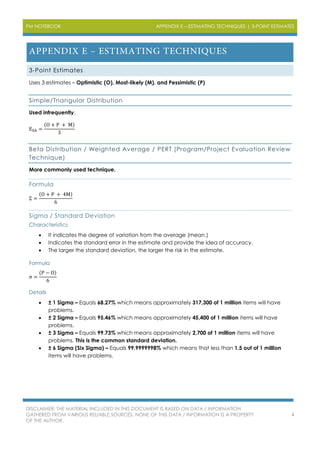
Table of Contents
Appendix E – Estimating Techniques.................................................................................................................... 4
3-Point Estimates................................................................................................................................................... 4
Simple/Triangular Distribution ......................................................................................................................... 4
Beta Distribution / Weighted Average / PERT (Program/Project Evaluation Review Technique) .... 4
Other Estimating Techniques ............................................................................................................................. 5
PM NOTEBOOK APPENDIX E – ESTIMATING TECHNIQUES | 3-POINT ESTIMATES
DISCLAIMER: THE MATERIAL INCLUDED IN THIS DOCUMENT IS BASED ON DATA / INFORMATION
GATHERED FROM VARIOUS RELIABLE SOURCES. NONE OF THIS DATA / INFORMATION IS A PROPERTY
OF THE AUTHOR.
4
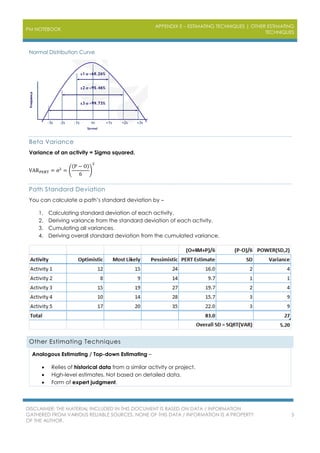
3-Point Estimates
Uses 3 estimates – Optimistic (O), Most-likely (M), and Pessimistic (P)
Simple/Triangular Distribution
Used infrequently.
ESA =
(O + P + M)
3
Beta Distribution / Weighted Average / PERT (Program/Project Evaluation Review
Technique)
More commonly used technique.
Formula
Σ =
(O + P + 4M)
6
Sigma / Standard Deviation
Characteristics
 It indicates the degree of variation from the average (mean.)
 Indicates the standard error in the estimate and provide the idea of accuracy.
 The larger the standard deviation, the larger the risk in the estimate.
Formula
σ =
(P − O)
6
Details
 ± 1 Sigma – Equals 68.27% which means approximately 317,300 of 1 million items will have
problems.
 ± 2 Sigma – Equals 95.46% which means approximately 45,400 of 1 million items will have
problems.
 ± 3 Sigma – Equals 99.73% which means approximately 2,700 of 1 million items will have
problems. This is the common standard deviation.
 ± 6 Sigma (Six Sigma) – Equals 99.9999998% which means that less than 1.5 out of 1 million
items will have problems.
PM NOTEBOOK
APPENDIX E – ESTIMATING TECHNIQUES | OTHER ESTIMATING
TECHNIQUES
DISCLAIMER: THE MATERIAL INCLUDED IN THIS DOCUMENT IS BASED ON DATA / INFORMATION
GATHERED FROM VARIOUS RELIABLE SOURCES. NONE OF THIS DATA / INFORMATION IS A PROPERTY
OF THE AUTHOR.
5
Normal Distribution Curve
Beta Variance
Variance of an activity = Sigma squared.
VARPERT = σ2
= (
(P − O)
6
)
2
Path Standard Deviation
You can calculate a path’s standard deviation by –
1. Calculating standard deviation of each activity.
2. Deriving variance from the standard deviation of each activity.
3. Cumulating all variances.
4. Deriving overall standard deviation from the cumulated variance.
Other Estimating Techniques
Analogous Estimating / Top-down Estimating –
 Relies of historical data from a similar activity or project.
 High-level estimates. Not based on detailed data.
 Form of expert judgment.
PM NOTEBOOK
APPENDIX E – ESTIMATING TECHNIQUES | OTHER ESTIMATING
TECHNIQUES
DISCLAIMER: THE MATERIAL INCLUDED IN THIS DOCUMENT IS BASED ON DATA / INFORMATION
GATHERED FROM VARIOUS RELIABLE SOURCES. NONE OF THIS DATA / INFORMATION IS A PROPERTY
OF THE AUTHOR.
6
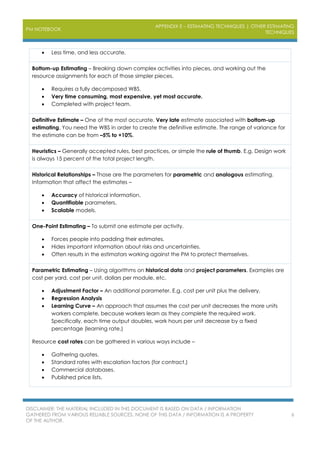
 Less time, and less accurate.
Bottom-up Estimating – Breaking down complex activities into pieces, and working out the
resource assignments for each of those simpler pieces.
 Requires a fully decomposed WBS.
 Very time consuming, most expensive, yet most accurate.
 Completed with project team.
Definitive Estimate – One of the most accurate. Very late estimate associated with bottom-up
estimating. You need the WBS in order to create the definitive estimate. The range of variance for
the estimate can be from –5% to +10%.
Heuristics – Generally accepted rules, best practices, or simple the rule of thumb. E.g. Design work
is always 15 percent of the total project length.
Historical Relationships – Those are the parameters for parametric and analogous estimating.
Information that affect the estimates –
 Accuracy of historical information.
 Quantifiable parameters.
 Scalable models.
One-Point Estimating – To submit one estimate per activity.
 Forces people into padding their estimates.
 Hides important information about risks and uncertainties.
 Often results in the estimators working against the PM to protect themselves.
Parametric Estimating – Using algorithms on historical data and project parameters. Examples are
cost per yard, cost per unit, dollars per module, etc.
 Adjustment Factor – An additional parameter. E.g. cost per unit plus the delivery.
 Regression Analysis
 Learning Curve – An approach that assumes the cost per unit decreases the more units
workers complete, because workers learn as they complete the required work.
Specifically, each time output doubles, work hours per unit decrease by a fixed
percentage (learning rate.)
Resource cost rates can be gathered in various ways include –
 Gathering quotes.
 Standard rates with escalation factors (for contract.)
 Commercial databases.
 Published price lists.
PM NOTEBOOK
APPENDIX E – ESTIMATING TECHNIQUES | OTHER ESTIMATING
TECHNIQUES
DISCLAIMER: THE MATERIAL INCLUDED IN THIS DOCUMENT IS BASED ON DATA / INFORMATION
GATHERED FROM VARIOUS RELIABLE SOURCES. NONE OF THIS DATA / INFORMATION IS A PROPERTY
OF THE AUTHOR.
7
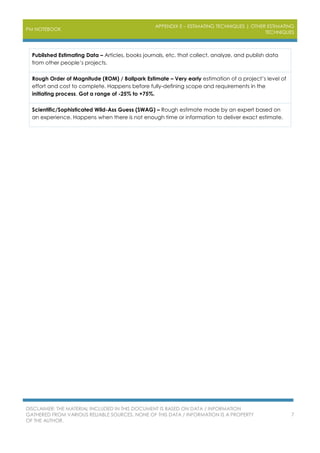
Published Estimating Data – Articles, books journals, etc. that collect, analyze, and publish data
from other people’s projects.
Rough Order of Magnitude (ROM) / Ballpark Estimate – Very early estimation of a project’s level of
effort and cost to complete. Happens before fully-defining scope and requirements in the
initiating process. Got a range of -25% to +75%.
Scientific/Sophisticated Wild-Ass Guess (SWAG) – Rough estimate made by an expert based on
an experience. Happens when there is not enough time or information to deliver exact estimate.

PM Notebook - Appendix E - Estimating Techniques

  • 1.
    PM Notebook Summarizing ProjectManagement Concepts for the PMP Exam Mohammad Elsheimy Road to PMP
  • 2.
    PM NOTEBOOK APPENDIXE – ESTIMATING TECHNIQUES | 3-POINT ESTIMATES DISCLAIMER: THE MATERIAL INCLUDED IN THIS DOCUMENT IS BASED ON DATA / INFORMATION GATHERED FROM VARIOUS RELIABLE SOURCES. NONE OF THIS DATA / INFORMATION IS A PROPERTY OF THE AUTHOR. 1 DISCLAIMER: THE MATERIAL INCLUDED IN THIS DOCUMENT IS BASED ON DATA/INFORMATION GATHERED FROM VARIOUS RELIABLE SOURCES. NONE OF THIS DATA/INFORMATION IS A PROPERTY OF THE AUTHOR. NONE IS INTENDED TO MAKE A PROFIT IN ANY WAY. THIS IS FOR PERSONAL USE ONLY.
  • 3.
    PM NOTEBOOK APPENDIXE – ESTIMATING TECHNIQUES | 3-POINT ESTIMATES DISCLAIMER: THE MATERIAL INCLUDED IN THIS DOCUMENT IS BASED ON DATA / INFORMATION GATHERED FROM VARIOUS RELIABLE SOURCES. NONE OF THIS DATA / INFORMATION IS A PROPERTY OF THE AUTHOR. 2 No great man ever complains of want of opportunity. Ralph Waldo Emerson
  • 4.
    PM NOTEBOOK APPENDIXE – ESTIMATING TECHNIQUES | 3-POINT ESTIMATES DISCLAIMER: THE MATERIAL INCLUDED IN THIS DOCUMENT IS BASED ON DATA / INFORMATION GATHERED FROM VARIOUS RELIABLE SOURCES. NONE OF THIS DATA / INFORMATION IS A PROPERTY OF THE AUTHOR. 3 Table of Contents Appendix E – Estimating Techniques.................................................................................................................... 4 3-Point Estimates................................................................................................................................................... 4 Simple/Triangular Distribution ......................................................................................................................... 4 Beta Distribution / Weighted Average / PERT (Program/Project Evaluation Review Technique) .... 4 Other Estimating Techniques ............................................................................................................................. 5
  • 5.
    PM NOTEBOOK APPENDIXE – ESTIMATING TECHNIQUES | 3-POINT ESTIMATES DISCLAIMER: THE MATERIAL INCLUDED IN THIS DOCUMENT IS BASED ON DATA / INFORMATION GATHERED FROM VARIOUS RELIABLE SOURCES. NONE OF THIS DATA / INFORMATION IS A PROPERTY OF THE AUTHOR. 4 3-Point Estimates Uses 3 estimates – Optimistic (O), Most-likely (M), and Pessimistic (P) Simple/Triangular Distribution Used infrequently. ESA = (O + P + M) 3 Beta Distribution / Weighted Average / PERT (Program/Project Evaluation Review Technique) More commonly used technique. Formula Σ = (O + P + 4M) 6 Sigma / Standard Deviation Characteristics  It indicates the degree of variation from the average (mean.)  Indicates the standard error in the estimate and provide the idea of accuracy.  The larger the standard deviation, the larger the risk in the estimate. Formula σ = (P − O) 6 Details  ± 1 Sigma – Equals 68.27% which means approximately 317,300 of 1 million items will have problems.  ± 2 Sigma – Equals 95.46% which means approximately 45,400 of 1 million items will have problems.  ± 3 Sigma – Equals 99.73% which means approximately 2,700 of 1 million items will have problems. This is the common standard deviation.  ± 6 Sigma (Six Sigma) – Equals 99.9999998% which means that less than 1.5 out of 1 million items will have problems.
  • 6.
    PM NOTEBOOK APPENDIX E– ESTIMATING TECHNIQUES | OTHER ESTIMATING TECHNIQUES DISCLAIMER: THE MATERIAL INCLUDED IN THIS DOCUMENT IS BASED ON DATA / INFORMATION GATHERED FROM VARIOUS RELIABLE SOURCES. NONE OF THIS DATA / INFORMATION IS A PROPERTY OF THE AUTHOR. 5 Normal Distribution Curve Beta Variance Variance of an activity = Sigma squared. VARPERT = σ2 = ( (P − O) 6 ) 2 Path Standard Deviation You can calculate a path’s standard deviation by – 1. Calculating standard deviation of each activity. 2. Deriving variance from the standard deviation of each activity. 3. Cumulating all variances. 4. Deriving overall standard deviation from the cumulated variance. Other Estimating Techniques Analogous Estimating / Top-down Estimating –  Relies of historical data from a similar activity or project.  High-level estimates. Not based on detailed data.  Form of expert judgment.
  • 7.
    PM NOTEBOOK APPENDIX E– ESTIMATING TECHNIQUES | OTHER ESTIMATING TECHNIQUES DISCLAIMER: THE MATERIAL INCLUDED IN THIS DOCUMENT IS BASED ON DATA / INFORMATION GATHERED FROM VARIOUS RELIABLE SOURCES. NONE OF THIS DATA / INFORMATION IS A PROPERTY OF THE AUTHOR. 6  Less time, and less accurate. Bottom-up Estimating – Breaking down complex activities into pieces, and working out the resource assignments for each of those simpler pieces.  Requires a fully decomposed WBS.  Very time consuming, most expensive, yet most accurate.  Completed with project team. Definitive Estimate – One of the most accurate. Very late estimate associated with bottom-up estimating. You need the WBS in order to create the definitive estimate. The range of variance for the estimate can be from –5% to +10%. Heuristics – Generally accepted rules, best practices, or simple the rule of thumb. E.g. Design work is always 15 percent of the total project length. Historical Relationships – Those are the parameters for parametric and analogous estimating. Information that affect the estimates –  Accuracy of historical information.  Quantifiable parameters.  Scalable models. One-Point Estimating – To submit one estimate per activity.  Forces people into padding their estimates.  Hides important information about risks and uncertainties.  Often results in the estimators working against the PM to protect themselves. Parametric Estimating – Using algorithms on historical data and project parameters. Examples are cost per yard, cost per unit, dollars per module, etc.  Adjustment Factor – An additional parameter. E.g. cost per unit plus the delivery.  Regression Analysis  Learning Curve – An approach that assumes the cost per unit decreases the more units workers complete, because workers learn as they complete the required work. Specifically, each time output doubles, work hours per unit decrease by a fixed percentage (learning rate.) Resource cost rates can be gathered in various ways include –  Gathering quotes.  Standard rates with escalation factors (for contract.)  Commercial databases.  Published price lists.
  • 8.
    PM NOTEBOOK APPENDIX E– ESTIMATING TECHNIQUES | OTHER ESTIMATING TECHNIQUES DISCLAIMER: THE MATERIAL INCLUDED IN THIS DOCUMENT IS BASED ON DATA / INFORMATION GATHERED FROM VARIOUS RELIABLE SOURCES. NONE OF THIS DATA / INFORMATION IS A PROPERTY OF THE AUTHOR. 7 Published Estimating Data – Articles, books journals, etc. that collect, analyze, and publish data from other people’s projects. Rough Order of Magnitude (ROM) / Ballpark Estimate – Very early estimation of a project’s level of effort and cost to complete. Happens before fully-defining scope and requirements in the initiating process. Got a range of -25% to +75%. Scientific/Sophisticated Wild-Ass Guess (SWAG) – Rough estimate made by an expert based on an experience. Happens when there is not enough time or information to deliver exact estimate.