Putting the Project
Pieces Together
Estimating Training
Agenda Items
 Estimating Introduction
 Tools and Techniques Overview
 Rough-Order-of Magnitude (ROM)
Estimates
 Intermediate Estimates.
 Definitive Estimates.
 Help and References
 Additional Questions
Training Goals
 To understand Estimating Tools and
Techniques.
 To learn enough about the various
methods to use them effectively.
 To know where you can access more
information and supporting materials.
Estimating Introduction
• An approximate judgment or
opinion regarding the value,
amount, size, weight, timing,
etc.
• Based on documented
assumptions.
What is an estimate?
There are three primary estimating
techniques/types used by OIS.
OIS Primary Estimating
Types
 Rough-Order-of-Magnitude
(ROM) Estimates
( + - 50%)
 Intermediate Estimates
(+ or – 30%)
 Definitive Estimates
(+ or – 20%)
One technique or all may be used on a project.
What is it?
Rough-order-of-magnitude (ROM)
Approach
 An estimate obtained based on
very limited data.
 Consider to have + or – 50%
accuracy range.
 Usually the first estimate
developed or requested.
Supplies a range of values rather
than a single estimate.
Three Key Questions:
Rough-Order-of-Magnitude
--When is it
Appropriate?
 What is the Purpose of the estimate?
 How precise of an estimate do I NEED?
 How much time do I have?
--Both can be used with a limited
amount of information
ROM Estimating Techniques
 Parametric Estimating -uses a
statistical relationships
 Analogous Estimating - Using
actual or historical data, a
form of expert judgment.
What do I need to do a
Parametric Estimate?
Parametric Estimating
 Initial business and
technical complexity score.
ROM Parametric
Estimating Spreadsheet.
ROM Parametric Estimating
Spreadsheet
How do I do a Parametric Estimate?
Parametric Estimating Steps
1. Complete the Business and
Technical Complexity Assessment
tool.
2. Enter results in ROM Parametric
Estimating Spreadsheet.
3. Make adjustments to estimate.
What do I need to do a
Analogous Estimate?
Analogous Estimating
 A recognized group of
technologists and
estimating experts.
 The product description
or Product Charter.
How do I do an Analogous Estimate?
Analogous Estimating Steps
1. Identify similar projects or activities.
2. Obtain actuals or historical data. How much did
the similar project or activities cost?
3. Re-evaluate and document the similarities and
differences.
4. Apply expert judgment and decide on estimate.
5. Document the estimate and estimating
assumptions.
Do NOT use Rough-Order-of
Magnitude…
When a precise or high level of confidence in
an estimate is needed!
What is it?
Intermediate Approach
 Used in support of a preliminary plan, a
partial plan, or a plan that does not require
precise estimating.
 Considered to be within “+ or – 30%”
accuracy.
 Often developed to support
the project plan in the early
phases of the project.
Intermediate—When should
I use it?
 What is the purpose of the estimate?
 When is an estimate needed for the project?
 What level of precision is needed?
 What is the estimate intended to cover?
Four Key Questions:
--Both require a
lower level of
detail about the
project to be
defined.
Intermediate Estimating
Techniques
 Parametric Estimating
 An estimating technique that uses a
statistical relationship between data
and other variables to calculate an
estimate. A Mathematical model.
(Percentage Based Estimating.)
 Delphi Estimating
 The Delphi estimating technique
uses a group of subject matter experts
who develop estimates independently,
discuss differences and assumptions,
and go through one or more revision
cycles, until a single estimates is
agreed upon.
What do I need to do an
Intermediate Parametric
Estimate?
Parametric Estimating
(Intermediate)
 Detailed Estimates of an
early phase.
Intermediate Parametric
Estimating Spreadsheet.
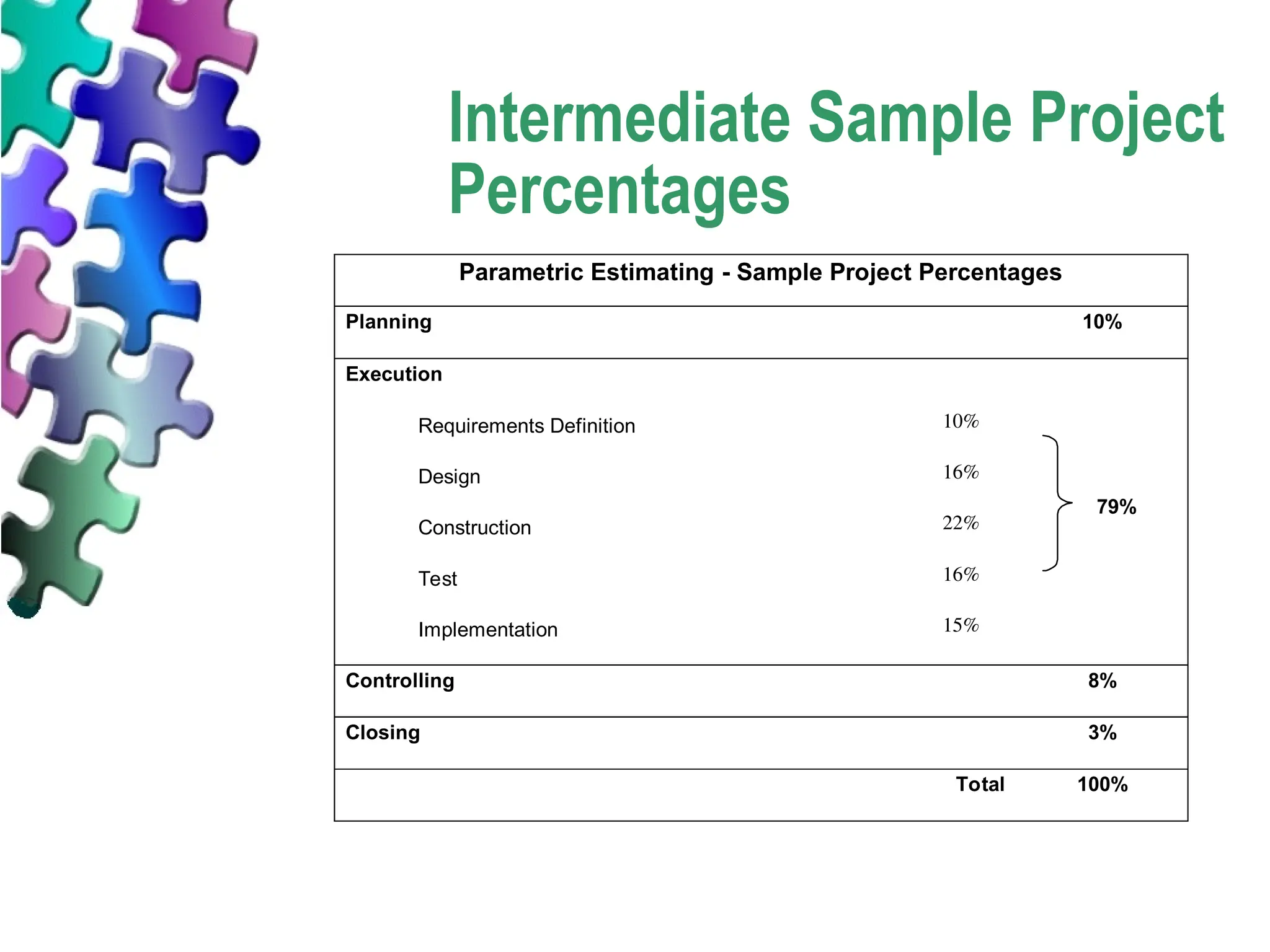
Intermediate Sample Project
Percentages
Parametric Estimating - Sample Project Percentages
Planning 10%
Execution
Requirements Definition 10%
Design 16%
Construction 22%
Test 16%
Implementation 15%
79%
Controlling 8%
Closing 3%
Total 100%
How do I do a Parametric Estimate?
Parametric Estimating Steps
1. Adjust the recommended work
effort percentages
2. Enter the total known dollar and
duration estimates for the early
sub-phase.
What do I need to do a
Delphi Estimate?
Delphi Estimating
 A Group of SMEs
 The product description
and Work Breakdown
Structure
Estimating Facilitator
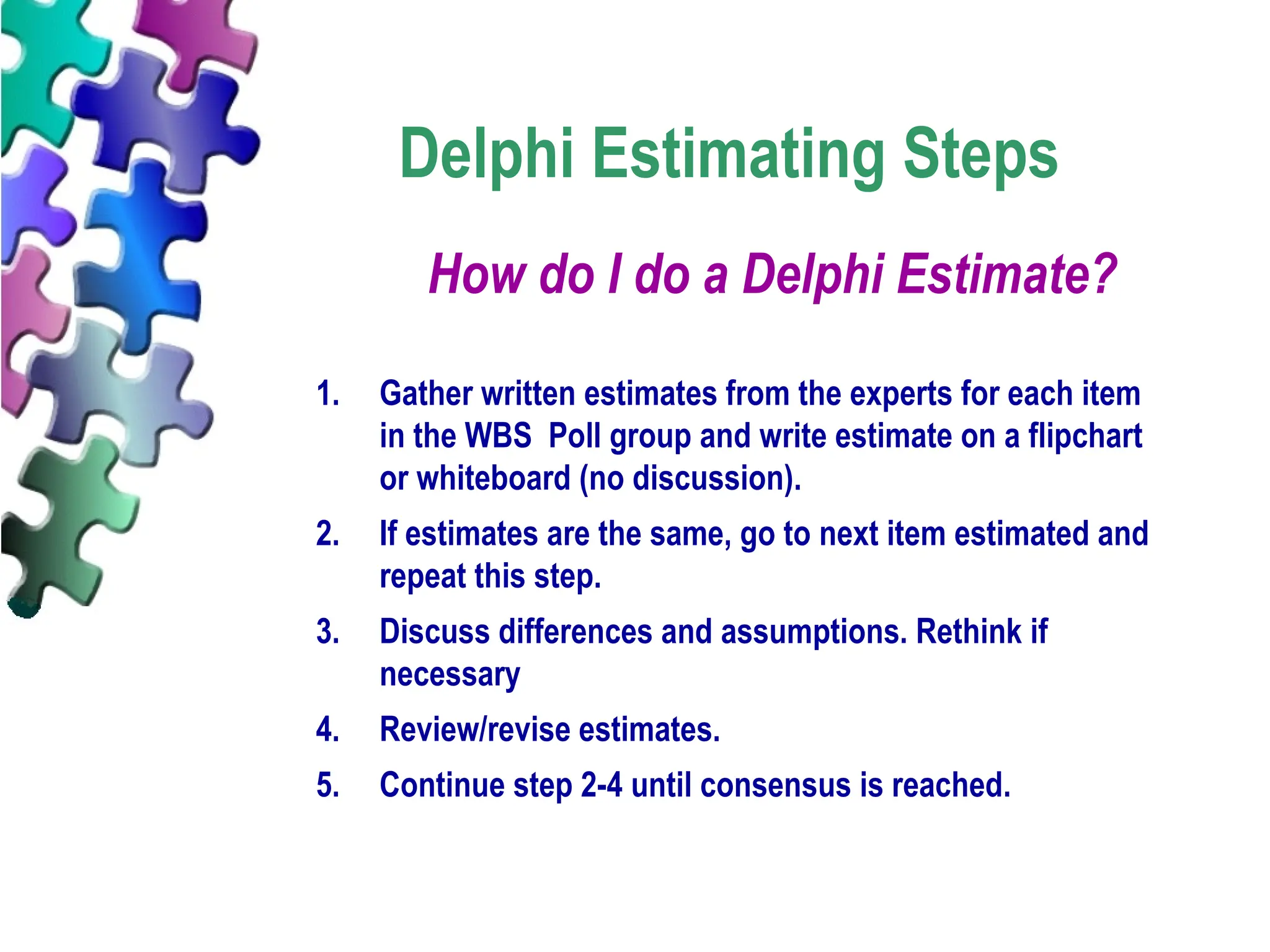
How do I do a Delphi Estimate?
Delphi Estimating Steps
1. Gather written estimates from the experts for each item
in the WBS Poll group and write estimate on a flipchart
or whiteboard (no discussion).
2. If estimates are the same, go to next item estimated and
repeat this step.
3. Discuss differences and assumptions. Rethink if
necessary
4. Review/revise estimates.
5. Continue step 2-4 until consensus is reached.
Consensus
--Consensus means either each
estimator strongly agrees with the
estimate or can live with it.
--Consensus is not reached if an
estimator strongly disagrees with
the estimate.
What is it?
Definitive Approach
 Used to develop the precise
estimates needed to tactically
manage and complete a
project.
 Considered to have a
“+ or – 20%” accuracy.
 The most accurate estimate for the
amount of work and resources.
 The estimate the organization will
commit to for the project baseline.
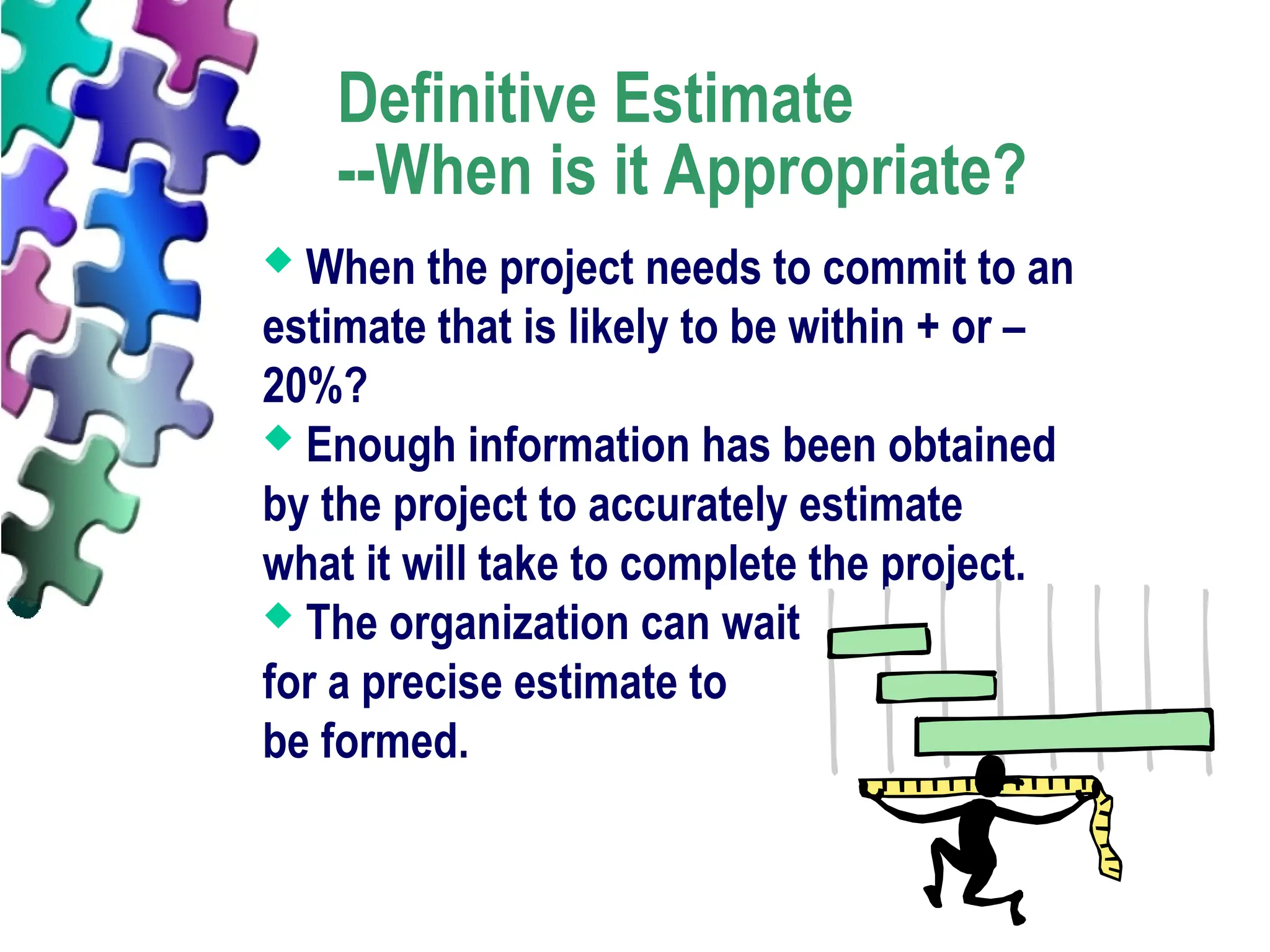
Definitive Estimate
--When is it Appropriate?
 When the project needs to commit to an
estimate that is likely to be within + or –
20%?
 Enough information has been obtained
by the project to accurately estimate
what it will take to complete the project.
 The organization can wait
for a precise estimate to
be formed.
--Variations on the
use of three
estimates, most
optimistic, most
likely and most
pessimistic to
determine a single
estimate.
Definitive Estimating
Techniques
 Forecasting
 Requires a strong historical base
 Triangulation
 Range
 PERT (Recommended
Approach)
What is a PERT Estimate?
PERT Estimating
Program Evaluation Review
Technique
• Uses optimistic, pessimistic, and
most likely estimates.
• Most likely estimate is weighted
more heavily
Other Facts
PERT Estimating
-- One single estimate is not always accurate and by using three
estimates, risk factors can be incorporated.
--Using identified risks to estimate:
Most pessimistic (many risk will occur) + most likely (weighted average
number of risks will occur) + most optimistic (few risks will occur)/6
= The Single, most accurate estimate.
Estimate = Pessimistic + (4 x Likely) + Optimistic / 6
What do I need to do a PERT?
PERT Estimating--
Prerequisites
 WBS
 PERT Analysis Formula
 Sources for estimates
What steps do I use?
PERT Estimating Steps
1. Ascertain the most optimistic, most
likely and most pessimistic estimates.
2. Use the PERT formula to calculate a
single estimate.
3. Apply the single estimate to each item
in the WBS.
Wrap It Up!
Help and References
 Available on the PMO Web site or in hardcopy
 Project Management Process Guide
 Estimating Templates
 Estimating Examples
 Estimating Technique - Assessment
 http://www.dhs.state.or.us/admin/pmo/
 Contact the PMO for assistance
 hardcopy binder of materials
 email – Sanford.Kahn@state.or.us
 phone - 378-2101 x 236
Additional Questions
Please take some time for
Class Evaluation!

estimating for a better project management.ppt

  • 1.
    Putting the Project PiecesTogether Estimating Training
  • 2.
    Agenda Items  EstimatingIntroduction  Tools and Techniques Overview  Rough-Order-of Magnitude (ROM) Estimates  Intermediate Estimates.  Definitive Estimates.  Help and References  Additional Questions
  • 3.
    Training Goals  Tounderstand Estimating Tools and Techniques.  To learn enough about the various methods to use them effectively.  To know where you can access more information and supporting materials.
  • 4.
    Estimating Introduction • Anapproximate judgment or opinion regarding the value, amount, size, weight, timing, etc. • Based on documented assumptions. What is an estimate? There are three primary estimating techniques/types used by OIS.
  • 5.
    OIS Primary Estimating Types Rough-Order-of-Magnitude (ROM) Estimates ( + - 50%)  Intermediate Estimates (+ or – 30%)  Definitive Estimates (+ or – 20%) One technique or all may be used on a project.
  • 6.
    What is it? Rough-order-of-magnitude(ROM) Approach  An estimate obtained based on very limited data.  Consider to have + or – 50% accuracy range.  Usually the first estimate developed or requested. Supplies a range of values rather than a single estimate.
  • 7.
    Three Key Questions: Rough-Order-of-Magnitude --Whenis it Appropriate?  What is the Purpose of the estimate?  How precise of an estimate do I NEED?  How much time do I have?
  • 8.
    --Both can beused with a limited amount of information ROM Estimating Techniques  Parametric Estimating -uses a statistical relationships  Analogous Estimating - Using actual or historical data, a form of expert judgment.
  • 9.
    What do Ineed to do a Parametric Estimate? Parametric Estimating  Initial business and technical complexity score. ROM Parametric Estimating Spreadsheet.
  • 10.
  • 11.
    How do Ido a Parametric Estimate? Parametric Estimating Steps 1. Complete the Business and Technical Complexity Assessment tool. 2. Enter results in ROM Parametric Estimating Spreadsheet. 3. Make adjustments to estimate.
  • 12.
    What do Ineed to do a Analogous Estimate? Analogous Estimating  A recognized group of technologists and estimating experts.  The product description or Product Charter.
  • 13.
    How do Ido an Analogous Estimate? Analogous Estimating Steps 1. Identify similar projects or activities. 2. Obtain actuals or historical data. How much did the similar project or activities cost? 3. Re-evaluate and document the similarities and differences. 4. Apply expert judgment and decide on estimate. 5. Document the estimate and estimating assumptions.
  • 14.
    Do NOT useRough-Order-of Magnitude… When a precise or high level of confidence in an estimate is needed!
  • 15.
    What is it? IntermediateApproach  Used in support of a preliminary plan, a partial plan, or a plan that does not require precise estimating.  Considered to be within “+ or – 30%” accuracy.  Often developed to support the project plan in the early phases of the project.
  • 16.
    Intermediate—When should I useit?  What is the purpose of the estimate?  When is an estimate needed for the project?  What level of precision is needed?  What is the estimate intended to cover? Four Key Questions:
  • 17.
    --Both require a lowerlevel of detail about the project to be defined. Intermediate Estimating Techniques  Parametric Estimating  An estimating technique that uses a statistical relationship between data and other variables to calculate an estimate. A Mathematical model. (Percentage Based Estimating.)  Delphi Estimating  The Delphi estimating technique uses a group of subject matter experts who develop estimates independently, discuss differences and assumptions, and go through one or more revision cycles, until a single estimates is agreed upon.
  • 18.
    What do Ineed to do an Intermediate Parametric Estimate? Parametric Estimating (Intermediate)  Detailed Estimates of an early phase. Intermediate Parametric Estimating Spreadsheet.
  • 19.
    Intermediate Sample Project Percentages ParametricEstimating - Sample Project Percentages Planning 10% Execution Requirements Definition 10% Design 16% Construction 22% Test 16% Implementation 15% 79% Controlling 8% Closing 3% Total 100%
  • 20.
    How do Ido a Parametric Estimate? Parametric Estimating Steps 1. Adjust the recommended work effort percentages 2. Enter the total known dollar and duration estimates for the early sub-phase.
  • 21.
    What do Ineed to do a Delphi Estimate? Delphi Estimating  A Group of SMEs  The product description and Work Breakdown Structure Estimating Facilitator
  • 22.
    How do Ido a Delphi Estimate? Delphi Estimating Steps 1. Gather written estimates from the experts for each item in the WBS Poll group and write estimate on a flipchart or whiteboard (no discussion). 2. If estimates are the same, go to next item estimated and repeat this step. 3. Discuss differences and assumptions. Rethink if necessary 4. Review/revise estimates. 5. Continue step 2-4 until consensus is reached.
  • 23.
    Consensus --Consensus means eithereach estimator strongly agrees with the estimate or can live with it. --Consensus is not reached if an estimator strongly disagrees with the estimate.
  • 24.
    What is it? DefinitiveApproach  Used to develop the precise estimates needed to tactically manage and complete a project.  Considered to have a “+ or – 20%” accuracy.  The most accurate estimate for the amount of work and resources.  The estimate the organization will commit to for the project baseline.
  • 25.
    Definitive Estimate --When isit Appropriate?  When the project needs to commit to an estimate that is likely to be within + or – 20%?  Enough information has been obtained by the project to accurately estimate what it will take to complete the project.  The organization can wait for a precise estimate to be formed.
  • 26.
    --Variations on the useof three estimates, most optimistic, most likely and most pessimistic to determine a single estimate. Definitive Estimating Techniques  Forecasting  Requires a strong historical base  Triangulation  Range  PERT (Recommended Approach)
  • 27.
    What is aPERT Estimate? PERT Estimating Program Evaluation Review Technique • Uses optimistic, pessimistic, and most likely estimates. • Most likely estimate is weighted more heavily
  • 28.
    Other Facts PERT Estimating --One single estimate is not always accurate and by using three estimates, risk factors can be incorporated. --Using identified risks to estimate: Most pessimistic (many risk will occur) + most likely (weighted average number of risks will occur) + most optimistic (few risks will occur)/6 = The Single, most accurate estimate. Estimate = Pessimistic + (4 x Likely) + Optimistic / 6 Estimate = Pessimistic + (4 x Likely) + Optimistic / 6
  • 29.
    What do Ineed to do a PERT? PERT Estimating-- Prerequisites  WBS  PERT Analysis Formula  Sources for estimates
  • 30.
    What steps doI use? PERT Estimating Steps 1. Ascertain the most optimistic, most likely and most pessimistic estimates. 2. Use the PERT formula to calculate a single estimate. 3. Apply the single estimate to each item in the WBS.
  • 31.
  • 32.
    Help and References Available on the PMO Web site or in hardcopy  Project Management Process Guide  Estimating Templates  Estimating Examples  Estimating Technique - Assessment  http://www.dhs.state.or.us/admin/pmo/  Contact the PMO for assistance  hardcopy binder of materials  email – Sanford.Kahn@state.or.us  phone - 378-2101 x 236
  • 34.
  • 35.
    Please take sometime for Class Evaluation!