

S   E   C   T   I   O   N   O   N   E


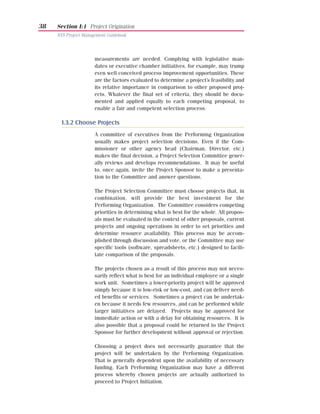
Project Management
            Lifecycle
                                 I
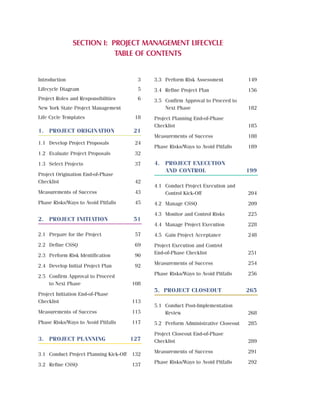
SECTION I: PROJECT MANAGEMENT LIFECYCLE
                           TABLE OF CONTENTS


Introduction                              3   3.3 Perform Risk Assessment           149
Lifecycle Diagram                         5   3.4 Refine Project Plan               156
Project Roles and Responsibilities        6   3.5 Confirm Approval to Proceed to
New York State Project Management                 Next Phase                        182
Life Cycle Templates                     18   Project Planning End-of-Phase
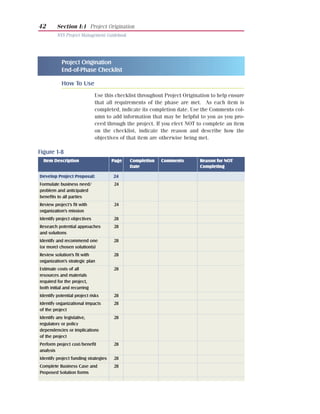
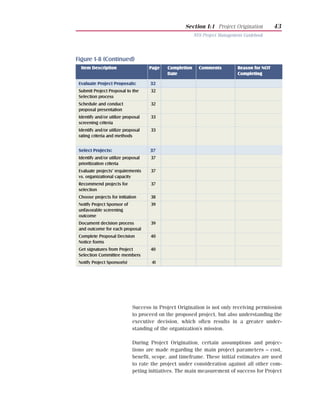
                                              Checklist                             185
1. PROJECT ORIGINATION                   21
                                              Measurements of Success               188
1.1 Develop Project Proposals            24
                                              Phase Risks/Ways to Avoid Pitfalls    189
1.2 Evaluate Project Proposals           32

1.3 Select Projects                      37   4. PROJECT EXECUTION
                                                 AND CONTROL                        199
Project Origination End-of-Phase
Checklist                                42
                                              4.1 Conduct Project Execution and
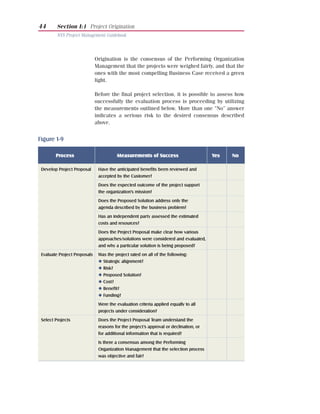
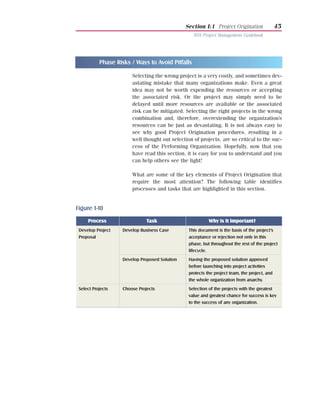
Measurements of Success                  43       Control Kick-Off                  204
Phase Risks/Ways to Avoid Pitfalls       45   4.2 Manage CSSQ                       209

                                              4.3 Monitor and Control Risks         225
2. PROJECT INITIATION                    51
                                              4.4 Manage Project Execution          228
2.1 Prepare for the Project              57   4.5 Gain Project Acceptance           248
2.2 Define CSSQ                          69   Project Execution and Control
                                              End-of-Phase Checklist                251
2.3 Perform Risk Identification          90
                                              Measurements of Success               254
2.4 Develop Initial Project Plan         92
                                              Phase Risks/Ways to Avoid Pitfalls    256
2.5 Confirm Approval to Proceed
    to Next Phase                       108
                                              5. PROJECT CLOSEOUT                   265
Project Initiation End-of-Phase
Checklist                               113
                                              5.1 Conduct Post-Implementation
Measurements of Success                 115       Review                            268
Phase Risks/Ways to Avoid Pitfalls      117   5.2 Perform Administrative Closeout   285

                                              Project Closeout End-of-Phase
3. PROJECT PLANNING                     127   Checklist                             289

                                              Measurements of Success               291
3.1 Conduct Project Planning Kick-Off   132
                                              Phase Risks/Ways to Avoid Pitfalls    292
3.2 Refine CSSQ                         137
Section I Introduction
There are two different lifecycles that work in conjunction with one another
throughout the course of every project. The project lifecycle describes the
tasks that must be completed to produce a product or service. Different proj-
ect lifecycles exist for specific products and services. (For example, the life-
cycle followed to build a house is very different from the lifecycle followed to
develop a software package.) The project management lifecycle defines how
to manage a project. It will always be the same, regardless of the project life-
cycle being employed.

One of a Project Manager’s challenges is to understand how to align the spe-
cific project lifecycle with the project management lifecycle. Project tasks
and project management tasks are concurrent and ongoing, and can be asso-
ciated by project management deliverables. The Project Schedule, for exam-
ple, contains both project and project management tasks. Phases in the two
lifecycles will overlap, depending upon the project lifecycle being employed.
The Project Manager needs to be aware of how the inputs and outputs of one
lifecycle affect and shape the other.

The material in this section is organized according to the project manage-
ment lifecycle. While no two projects are exactly alike, all projects should
progress through the same five project management phases:

 1. In Project Origination an individual proposes a project to create a prod-
    uct or develop a service that can solve a problem or address a need in the
    Performing Organization. The Performing Organization then submits the
    proposal to an evaluation and selection process. If selected, a budget or
    further management commitment for the project may also be required
    before a Project Manager is actually assigned and the project is author-
    ized to progress to Project Initiation. Depending upon the standards and
    practices of the Performing Organization, a time delay between the pro-
    ject’s proposal and selection and its actual initiation may occur.

 2. At the beginning of Project Initiation, a Project Manager is assigned. The
    Project Manager works with the Project Sponsor to identify the necessary
    resources and team members needed to further develop the key project
    parameters – Cost, Scope, Schedule, and Quality (CSSQ). The Project
    Team documents its charge in the form of a Project Charter, which is
    based on the Project Proposal, which includes the initial Business Case.
    Approval of the Project Charter by the Project Sponsor authorizes the
    designated team to begin the initial planning effort. The initial Project
    Plan resulting from Project Initiation differs in the level of detail and the
    validity of its estimates from Project Origination, and must be at a level
    sufficient to acquire any additional resources needed to progress to the

                                                                               3
4   Section I Project Management Lifecycle
    NYS Project Management Guidebook


           next phase. The Project Plan also includes plans for involving and com-
           municating with all the parties that are affected by the project, as well as
           identification of an initial set of foreseeable risks that can threaten the
           project. At the conclusion of Project Initiation, based on the initial plan-
           ning documents, the Business Case is revised and re-evaluated and a
           decision is made to either halt the project, or proceed to Project Planning.

       3. Project Planning builds on the work done in Project Initiation, refining
          and augmenting CSSQ and Project Plan deliverables. Usually, addition-
          al members join the Project Team, and they assist the Project Manager
          in further elaborating the details of the Cost, Scope, Schedule and
          Quality. A number of key elements are added to the Project Plan, includ-
          ing project-specific items such as change control, acceptance manage-
          ment and issue management, as well as externally-focused items such as
          organizational change management and project transition. The initial
          list of project risks is augmented, and detailed mitigation plans are
          developed. Project Planning marks the completion of the Project Plan –
          i.e., no work is left uncovered. However, some of the later phases of the
          project work may continue to be planned in more depth (e.g., Transition
          and Implementation details may not be developed until later in Project
          Execution). At the conclusion of Project Planning, the Business Case is
          revised and re-evaluated based on the completed planning documents
          and a decision is again made to either halt the project, or to commit the
          resources necessary for Project Execution and Control.

       4. Project Execution and Control is where most of the resources are
          applied/expended on the project. A significant number of team members
          will join the project at the beginning of this phase. The primary task of
          the Project Manager during Project Execution and Control is to enable
          the Project Team to execute the tasks on the defined Project Schedule
          and develop the product or service the project is expected to deliver. The
          Project Manager uses the processes and plans prepared during Project
          Initiation and Project Planning to manage the project, while preparing
          the organization for the implementation of the product/service and for
          transitioning the product/service responsibility from the Project Team to
          the Performing Organization.

       5. In Project Closeout, the Project Team assesses the outcome of the proj-
          ect, as well as the performance of the Project Team and the Performing
          Organization. This is accomplished primarily through soliciting and eval-
          uating feedback from Customers, Project Team members, Consumers and
          other stakeholders. The primary purpose of this assessment is to docu-
          ment best practices and lessons learned for use on future projects. Key
          project metrics are also captured to enable the Performing Organization
          to compare and evaluate performance measurements across projects.

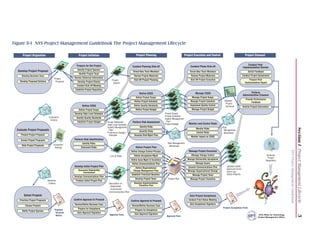
           The following diagram illustrates every phase, process and task in the
           project lifecycle.
Figure 0-1 NYS Project Management Guidebook The Project Management Lifecycle

       Project Origination                                Project Initiation                                      Project Planning                                 Project Execution and Control                           Project Closeout


                                                        Prepare for the Project                                                                                                                                              Conduct Post-
                                                                                                              Conduct Planning Kick-off                                 Conduct Phase Kick-off                           Implementation Review
                                                         Identify Project Sponsor
  Develop Project Proposal                                                                                     Orient New Team Members                                 Orient New Team Members                                 Solicit Feedback
                                                          Identify Project Team
      Develop Business Case                                                                                     Review Project Materials                                Review Project Materials                         Conduct Project Assessment
                                          Project     Review Historical Information
                                                                                          Project               Kick Off Project Planning                               Kick Off Project Execution                             Prepare Post-
    Develop Proposed Solution              Proposal      Develop Project Charter                                                                                                                                           Implementation Report
                                                                                           Charter
                                                        Conduct Kick-off Meeting
                                                       Establish Project Repository
                                                                                                                     Refine CSSQ                                            Manage CSSQ                                         Perform
                                                                                                                                                                                                                         Administrative Closeout
                                                                                                                 Refine Project Scope                                    Manage Project Scope
                                                                                                                                                                                                                            Provide Performance
                                                                                                                Refine Project Schedule                                 Manage Project Schedule       Updated
                                                                                                                                                                                                                                 Feedback
                                                                                                                                                                                                       Project
                                                              Define CSSQ                                      Refine Quality Standards                                Implement Quality Control       Schedule          Archive Project Information
                                                          Define Project Scope                                   Refine Project Budget                                   Manage Project Budget
                                                      Develop High-Level Schedule                                                             Project Scope
                                    Evaluation                                                                                                Project Schedule
                                                        Identify Quality Standards                                                            Quality Management
                                     Criteria
                                                         Establish Project Budget     Scope Statement         Perform Risk Assessment          Plan
                                                                                      High-Level Schedule                                     Project Budget          Monitor and Control Risks
                                                                                      Quality Management             Identify Risks                                                                  Risk


                                                                                                                                                                                                                                                                                                         Section I Project Management Lifecycle
                                                                                                                                                                             Monitor Risks
  Evaluate Project Proposals                                                           Plan                          Quantify Risks                                                                   Management
                                                                                      Preliminary Budget                                                                     Control Risks            Worksheet
     Present Project Proposal                                                          Estimate                 Develop Risk Mgmt Plan
                                                                                                                                                                        Monitor Impact on CSSQ
     Screen Project Proposals                         Perform Risk Identification
                                                              Identify Risks                                                                    Risk Management
      Rate Project Proposals             Evaluation
                                                                                                                                                 Worksheet
                                          Ratings            Document Risks                                      Refine Project Plan


                                                                                                                                                                                                                                                                      NYS Project Management Guidebook
                                                                                                             Define Change Control Process                            Manage Project Execution
                                                                                        List of Risks          Define Acceptance Mgmt                                   Manage Change Control                                                      Archived
                                                                                                                                                                                                                                                    Project
                                                                                                             Define Issue Mgmt & Escalation                          Manage Deliverable Acceptance
                                                                                                                                                                                                                                                  Repository
                                                                                                              Refine Communications Plan                                     Manage Issues
                                                      Develop Initial Project Plan                                                                                    Execute Communications Plan       Updated CSSQ
                                                                                                                 Define Organizational                                                                  Approval Forms
                                                          Document Stakeholder                                 Change Management Plan                                Manage Organizational Change
                                                              Involvement                                                                                                                               Issue Log
                                                                                                             Establish Time/Cost Baseline                                Manage Project Team            Status Reports
                                                      Develop Communications Plan
                                                                                                                 Develop Project Team            Project Plan          Manage Project Transition
                                   Selection           Produce Initial Project Plan
                                    Criteria                                           Description of          Develop Implementation/
                                                                                        Stakeholder                Transition Plan
                                                                                        Involvement
                                                                                       Communications Plan
        Select Projects                                                                                                                                                Gain Project Acceptance
    Prioritize Project Proposals                      Confirm Approval to Proceed                            Confirm Approval to Proceed                              Conduct Final Status Meeting
                                                      Review/Refine Business Case                                                                                      Gain Acceptance Signature
         Choose Projects                                                                                     Review/Refine Business Case
                                                         Prepare for Acceptance                                                                                                                      Project Acceptance Form
      Notify Project Sponsor              Proposal                                                              Prepare for Acceptance
                                           Decision      Gain Approval Signature
                                                                                       Approval Form            Gain Approval Signature                                                                                                   NYS Office for Technology


                                                                                                                                                                                                                                                                                                         5
                                           Notice                                                                                              Approval Form                                                                             Project Management Office
6   Section I Project Management Lifecycle
    NYS Project Management Guidebook


      Project Roles and Responsibilities

                     Throughout this Guidebook, reference is made to specific roles
                     that must be performed at various times throughout the life of
                     the project. The following section provides an overview of the
                     various roles that are required on projects, what the responsibil-
                     ities are for each role, and some examples of how organizations
                     have filled those roles on projecs of varying size.

                     There are many groups of people involved in the project lifecycle.

                     The Project Team is a group that is responsible for planning
                     and executing the project. It consists of a Project Manager and
                     a variable number of Project Team members, who are brought
                     in to deliver their tasks according to the Project Schedule.
                     I The Project Manager is the person who is responsible for
                       ensuring that the Project Team completes the project. The
                       Project Manager develops the Project Plan with the team
                       and manages the team’s performance of project tasks. It is
                       also the responsibility of the Project Manager to secure
                       acceptance and approval of deliverables from the Project
                       Sponsor and Stakeholders.
                     I The Project Team Members are responsible for executing
                       tasks and producing deliverables as outlined in the Project
                       Plan and directed by the Project Manager, at whatever
                       level of effort or participation has been defined for them.
                       On larger projects, some Project Team members may serve
                       as Team Leaders, providing task and technical leadership.

                     The Project Sponsor is a manager with demonstrable interest
                     in the outcome of the project who is responsible for securing
                     spending authority and resources for the project. Ideally, the
                     Project Sponsor should be the highest-ranking manager possi-
                     ble, in proportion to the project size and scope. The Project
                     Sponsor initiates the Project Proposal process, champions the
                     project in the Performing Organization, and is the ultimate
                     decision-maker for the project. The Project Sponsor provides
                     support for the Project Manager, approves major deliverables,
                     and signs off on approvals to proceed to each succeeding proj-
                     ect phase. The Project Sponsor may elect to delegate any of the
                     above responsibilities to other personnel either on or outside
                     the Project Team.
Section I Project Management Lifecycle            7
                           NYS Project Management Guidebook


Performing Organization Management (POM) includes all
members of the organization’s management team that may
exert influence on Project Team members or be affected by and
involved in the development and implementation of the product
of the project. The committees that are formed to evaluate and
select proposed projects for the Performing Organization are
comprised of members of the Performing Organization
Management.
I The Project Proposal Team is a group responsible for
  preparing the Project Proposal in the Origination phase. It
  is organized by the Project Sponsor.
I The Project Selection Committee comprises members of
  the Performing Organization Management team who meet
  on a regular basis to evaluate Project Proposals and select
  projects for initiation. They maintain the Project Proposal
  rating models and project selection criteria.

Customers comprise the business units that identified the
need for the product or service the project will develop.
Customers can be at all levels of an organization, from
Commissioner to entry-level clerk. Since it is frequently not
feasible for all the Customers to be directly involved in the proj-
ect, the following roles are identified:
I Customer Representatives are members of the Customer
  community that are identified and made available to the
  project for their subject matter expertise. Their responsi-
  bility is to accurately represent their business units’ needs
  to the Project Team, and to validate the deliverables that
  describe the product or service that the project will
  produce. Customer Representatives are also expected to
  bring back to the Customer community the information
  about the project. Towards the end of the project,
  Customer Representatives will test the product or service
  the project is developing, using and evaluating it while
  providing feedback to the Project Team.
I Customer Decision-Makers are those members of the
  Customer community who have been designated to make
  project decisions on behalf of major business units that
  will use, or will be affected by, the product or service
  the project will deliver. Customer Decision-Makers are
  members of the POM responsible for achieving consensus
  of their business unit on project issues and outputs, and
  communicating it to the Project Team. They attend project
  meetings as requested by the Project Manager, review and
8   Section I Project Management Lifecycle
    NYS Project Management Guidebook


                        approve process deliverables, and provide subject matter
                        expertise to the Project Team. On some projects, they may
                        also serve as Customer Representatives.

                     Consumers include all the people that will use the product or
                     service that the project is developing. Consumers internal to
                     the Performing Organizations may also be Customers.

                     Internal Stakeholders include all the people that are in any
                     way affected by the new product or service within the
                     Performing Organization. This may include the Project Team,
                     the Performing Organization Management, Customers, as well
                     as Customer co-workers who will be affected by the change in
                     Customer work practices due to the new product or service;
                     Customer managers affected by modified workflows or logistics;
                     Customer correspondents affected by the quantity or quality of
                     newly available information; and other similarly affected groups.

                     External Stakeholders include all the people outside the
                     Performing Organization that are in any way affected by the
                     new product or service. Within the context of New York State
                     Government, this group may include the Legislature, the
                     Executive Chamber, other agencies, the media, and the citi-
                     zens. Consumers may also be External Stakeholders.

                     Vendors are contracted to provide additional products or serv-
                     ices the project will require and may be members of the Project
                     Team.

                     The following examples illustrate how agency titles map to proj-
                     ect roles on small, medium and large projects. Each example
                     includes project description, comparison of project roles and
                     agency titles, and a project organizational chart.
Section I Project Management Lifecycle          9
                                                 NYS Project Management Guidebook


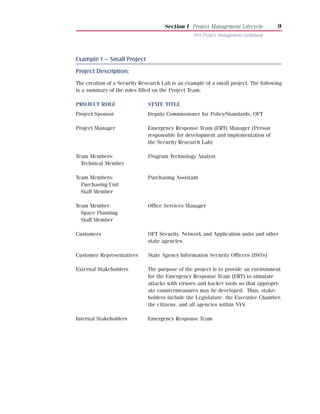
Example 1 – Small Project
Project Description:
The creation of a Security Research Lab is an example of a small project. The following
is a summary of the roles filled on the Project Team:

PROJECT ROLE                  STATE TITLE
Project Sponsor               Deputy Commissioner for Policy/Standards, OFT

Project Manager               Emergency Response Team (ERT) Manager (Person
                              responsible for development and implementation of
                              the Security Research Lab)

Team Members:                 Program Technology Analyst
  Technical Member

Team Members:                 Purchasing Assistant
  Purchasing Unit
  Staff Member

Team Member:                  Office Services Manager
  Space Planning
  Staff Member

Customers                     OFT Security, Network and Application units and other
                              state agencies.

Customer Representatives      State Agency Information Security Officers (ISO’s)

External Stakeholders         The purpose of the project is to provide an environment
                              for the Emergency Response Team (ERT) to simulate
                              attacks with viruses and hacker tools so that appropri-
                              ate countermeasures may be developed. Thus, stake-
                              holders include the Legislature, the Executive Chamber,
                              the citizens, and all agencies within NYS.

Internal Stakeholders         Emergency Response Team
10      Section I Project Management Lifecycle
        NYS Project Management Guidebook


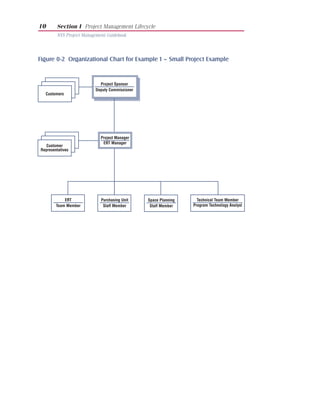
Figure 0-2 Organizational Chart for Example 1 – Small Project Example


                           Project Sponsor
                         Deputy Commissioner
  Customers


                            Project Manager
                             ERT Manager
  Customer
Representatives


            ERT             Purchasing Unit    Space Planning     Technical Team Member
        Team Member          Staff Member       Staff Member    Program Technology Analyst
Section I Project Management Lifecycle         11
                                                NYS Project Management Guidebook


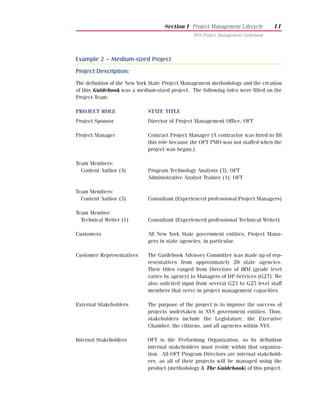
Example 2 – Medium-sized Project
Project Description:
The definition of the New York State Project Management methodology and the creation
of this Guidebook was a medium-sized project. The following roles were filled on the
Project Team:

PROJECT ROLE                 STATE TITLE
Project Sponsor              Director of Project Management Office, OFT

Project Manager              Contract Project Manager (A contractor was hired to fill
                             this role because the OFT PMO was not staffed when the
                             project was begun.)

Team Members:
  Content Author (4)         Program Technology Analysts (3), OFT
                             Administrative Analyst Trainee (1), OFT

Team Members:
  Content Author (3)         Consultant (Experienced professional Project Managers)

Team Member:
  Technical Writer (1)       Consultant (Experienced professional Technical Writer)

Customers                    All New York State government entities, Project Mana-
                             gers in state agencies, in particular.

Customer Representatives     The Guidebook Advisory Committee was made up of rep-
                             resentatives from approximately 20 state agencies.
                             Their titles ranged from Directors of IRM (grade level
                             varies by agency) to Managers of DP Services (G27). We
                             also solicited input from several G23 to G25 level staff
                             members that serve in project management capacities.

External Stakeholders        The purpose of the project is to improve the success of
                             projects undertaken in NYS government entities. Thus,
                             stakeholders include the Legislature, the Executive
                             Chamber, the citizens, and all agencies within NYS.

Internal Stakeholders        OFT is the Performing Organization, so by definition
                             internal stakeholders must reside within that organiza-
                             tion. All OFT Program Directors are internal stakehold-
                             ers, as all of their projects will be managed using the
                             product (methodology & The Guidebook) of this project.
12       Section I Project Management Lifecycle
         NYS Project Management Guidebook


Subject Matter Experts                OFT Strategic Assessment and Acquisition Team, OGS
                                      Procurement Group, OFT Counsel’s Office, OFT Contract
                                      Management Office.


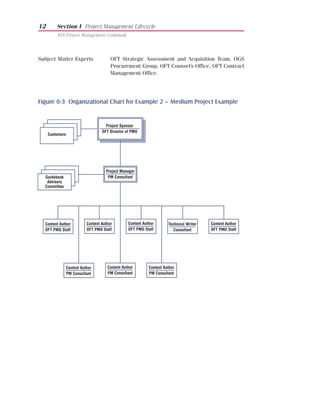
Figure 0-3 Organizational Chart for Example 2 – Medium Project Example


                                   Project Sponsor
                                 OFT Director of PMO
     Customers


                                   Project Manager
  Guidebook                         PM Consultant
   Advisory
  Committee


  Content Author         Content Author        Content Author       Technical Writer   Content Author
  OFT PMO Staff          OFT PMO Staff         OFT PMO Staff           Consultant      OFT PMO Staff


              Content Author        Content Author        Content Author
              PM Consultant         PM Consultant         PM Consultant
Section I Project Management Lifecycle         13
                                                 NYS Project Management Guidebook


Example 3 – Large Project
Project Description:
The New York State Workers’ Compensation Board OPTICS project was a large-sized
project. The following roles were filled on the Project Team:

PROJECT ROLE                  STATE TITLE
Project Sponsors              Chairman of the Workers’ Compensation Board
                              Designees in his absence were the Executive Director,
                              the Deputy Executive Director

Project Manager               Director of the Information Management Services
                              Division


Teams
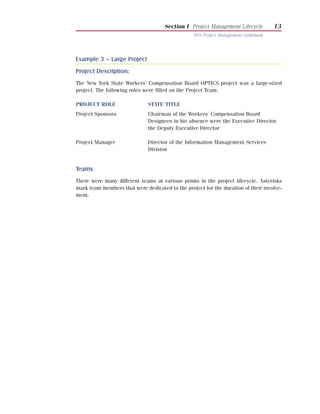
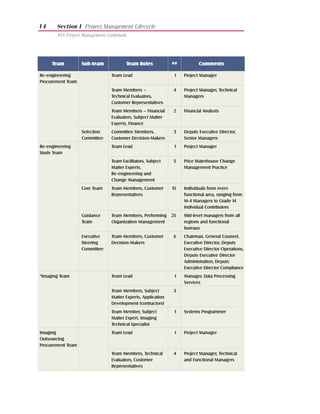
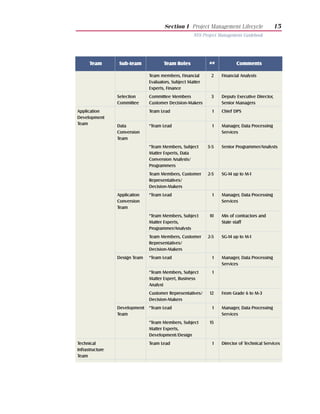
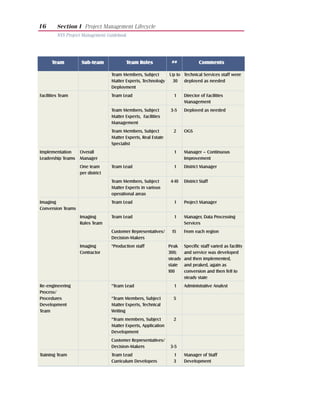
There were many different teams at various points in the project lifecycle. Asterisks
mark team members that were dedicated to the project for the duration of their involve-
ment.
14     Section I Project Management Lifecycle
       NYS Project Management Guidebook


     Team          Sub-team               Team Roles          ##          Comments

Re-engineering                  Team Lead                      1   Project Manager
Procurement Team
                                Team Members –                 4   Project Manager, Technical
                                Technical Evaluators,              Managers
                                Customer Representatives
                                Team Members – Financial       2   Financial Analysts
                                Evaluators, Subject Matter
                                Experts, Finance
                   Selection    Committee Members,            3    Deputy Executive Director,
                   Committee    Customer Decision-Makers           Senior Managers
Re-engineering                  Team Lead                      1   Project Manager
Study Team
                                Team Facilitators, Subject    5    Price Waterhouse Change
                                Matter Experts,                    Management Practice
                                Re-engineering and
                                Change Management
                   Core Team    Team Members, Customer        15   Individuals from every
                                Representatives                    functional area, ranging from
                                                                   M-4 Managers to Grade 14
                                                                   Individual Contributors
                   Guidance     Team Members, Performing      25   Mid-level managers from all
                   Team         Organization Management            regions and functional
                                                                   bureaus
                   Executive    Team Members, Customer        6    Chairman, General Counsel,
                   Steering     Decision-Makers                    Executive Director, Deputy
                   Committee                                       Executive Director Operations,
                                                                   Deputy Executive Director
                                                                   Administration, Deputy
                                                                   Executive Director Compliance
*Imaging Team                   Team Lead                      1   Manager, Data Processing
                                                                   Services
                                Team Members, Subject         3
                                Matter Experts, Application
                                Development (contractors)
                                Team Member, Subject           1   Systems Programmer
                                Matter Expert, Imaging
                                Technical Specialist
Imaging                         Team Lead                      1   Project Manager
Outsourcing
Procurement Team
                                Team Members, Technical        4   Project Manager, Technical
                                Evaluators, Customer               and Functional Managers
                                Representatives
Section I Project Management Lifecycle                 15
                                                     NYS Project Management Guidebook


      Team        Sub-team            Team Roles            ##           Comments

                               Team members, Financial       2    Financial Analysts
                               Evaluators, Subject Matter
                               Experts, Finance
                 Selection     Committee Members             3    Deputy Executive Director,
                 Committee     Customer Decision-Makers           Senior Managers
Application                    Team Lead                      1   Chief DPS
Development
Team             Data          *Team Lead                     1   Manager, Data Processing
                 Conversion                                       Services
                 Team
                               *Team Members, Subject       3-5   Senior Programmer/Analysts
                               Matter Experts, Data
                               Conversion Analysts/
                               Programmers
                               Team Members, Customer       2-5   SG-14 up to M-1
                               Representatives/
                               Decision-Makers
                 Application   *Team Lead                     1   Manager, Data Processing
                 Conversion                                       Services
                 Team
                               *Team Members, Subject        10   Mix of contractors and
                               Matter Experts,                    State staff
                               Programmer/Analysts
                               Team Members, Customer       2-5   SG-14 up to M-1
                               Representatives/
                               Decision-Makers
                 Design Team   *Team Lead                     1   Manager, Data Processing
                                                                  Services
                               *Team Members, Subject         1
                               Matter Expert, Business
                               Analyst
                               Customer Representatives/     12   From Grade 6 to M-3
                               Decision-Makers
                 Development   *Team Lead                     1   Manager, Data Processing
                 Team                                             Services
                               *Team Members, Subject        15
                               Matter Experts,
                               Development/Design
Technical                      Team Lead                      1   Director of Technical Services
Infrastructure
Team
16       Section I Project Management Lifecycle
         NYS Project Management Guidebook


      Team          Sub-team                Team Roles           ##              Comments

                                  Team Members, Subject      Up to Technical Services staff were
                                  Matter Experts, Technology  30 deployed as needed
                                  Deployment
Facilities Team                   Team Lead                        1     Director of Facilities
                                                                         Management
                                  Team Members, Subject          3-5     Deployed as needed
                                  Matter Experts, Facilities
                                  Management
                                  Team Members, Subject           2      OGS
                                  Matter Experts, Real Estate
                                  Specialist
Implementation     Overall                                         1     Manager – Continuous
Leadership Teams   Manager                                               Improvement
                   One team       Team Lead                        1     District Manager
                   per district
                                  Team Members, Subject          4-10    District Staff
                                  Matter Experts in various
                                  operational areas
Imaging                           Team Lead                        1     Project Manager
Conversion Teams
                   Imaging        Team Lead                        1     Manager, Data Processing
                   Rules Team                                            Services
                                  Customer Representatives/      15      From each region
                                  Decision-Makers
                   Imaging        *Production staff             Peak     Specific staff varied as facility
                   Contractor                                   300;     and service was developed
                                                                steady   and then implemented,
                                                                state    and peaked, again as
                                                                100      conversion and then fell to
                                                                         steady state
Re-engineering                    *Team Lead                       1     Administrative Analyst
Process/
Procedures                        *Team Members, Subject          5
Development                       Matter Experts, Technical
Team                              Writing
                                  *Team members, Subject          2
                                  Matter Experts, Application
                                  Development
                                  Customer Representatives/
                                  Decision-Makers                3-5
Training Team                     Team Lead                       1      Manager of Staff
                                  Curriculum Developers           3      Development
Section I Project Management Lifecycle            17
                                                                                                NYS Project Management Guidebook


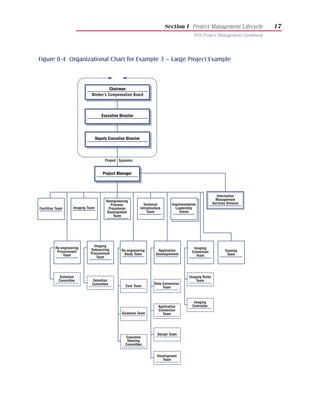
Figure 0-4 Organizational Chart for Example 3 – Large Project Example


                                         Chairman
                               Worker’s Compensation Board


                                       Executive Director


                                    Deputy Executive Director


                                         Project Sponsors


                                        Project Manager


                                                                                                                Information
                                          Reengineering                                                         Management
                                             Process/             Technical         Implementation            Services Division
Facilities Team      Imaging Team           Procedures          Infrastructure        Leadership
                                           Development               Team               Teams
                                               Team


                                Imaging
          Re-engineering      Outsourcing                                                       Imaging
           Procurement                             Re-engineering          Application         Conversion             Training
                              Procurement           Study Team            Developmment                                 Team
              Team               Team                                                            Team


             Selection                                                                        Imaging Rules
            Committee           Selection                                                         Team
                               Committee                                 Data Conversion
                                                     Core Team                Team


                                                                                                 Imaging
                                                                            Application         Contractor
                                                                            Conversion
                                                   Guidance Team              Team


                                                                           Design Team
                                                      Executive
                                                      Steering
                                                     Committee


                                                                           Development
                                                                              Team
18        Section I Project Management Lifecycle
          NYS Project Management Guidebook


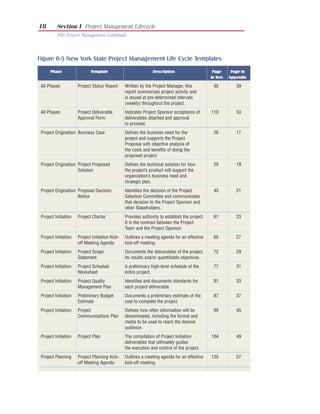
Figure 0-5 New York State Project Management Life Cycle Templates
 NYS Project Management Guidebook Templates for Section I
      Phase                  Template                           Description                      Page      Page in
                                                                                                in Text   Appendix

 All Phases           Project Status Report      Written by the Project Manager, this            95          39
                                                 report summarizes project activity and
                                                 is issued at pre-determined intervals
                                                 (weekly) throughout the project.
 All Phases           Project Deliverable        Indicates Project Sponsor acceptance of        110          53
                      Approval Form              deliverables attached and approval
                                                 to proceed.
 Project Origination Business Case               Defines the business need for the               26          17
                                                 project and supports the Project
                                                 Proposal with objective analysis of
                                                 the costs and benefits of doing the
                                                 proposed project.
 Project Origination Project Proposed            Defines the technical solution for how          29          19
                     Solution                    the project’s product will support the
                                                 organization’s business need and
                                                 strategic plan.
 Project Origination Proposal Decision           Identifies the decision of the Project          40          21
                     Notice                      Selection Committee and communicates
                                                 that decision to the Project Sponsor and
                                                 other Stakeholders.
 Project Initiation   Project Charter            Provides authority to establish the project.    61          23
                                                 It is the contract between the Project
                                                 Team and the Project Sponsor.
 Project Initiation   Project Initiation Kick-   Outlines a meeting agenda for an effective      65          27
                      off Meeting Agenda         kick-off meeting.
 Project Initiation   Project Scope              Documents the deliverables of the project,      72          29
                      Statement                  its results and/or quantifiable objectives.
 Project Initiation   Project Schedule           A preliminary high-level schedule of the        77          31
                      Worksheet                  entire project.
 Project Initiation   Project Quality            Identifies and documents standards for          81          33
                      Management Plan            each project deliverable.
 Project Initiation   Preliminary Budget         Documents a preliminary estimate of the         87          37
                      Estimate                   cost to complete the project.
 Project Initiation   Project                    Defines how often information will be           99          45
                      Communications Plan        disseminated, including the format and
                                                 media to be used to reach the desired
                                                 audience.
 Project Initiation   Project Plan               The compilation of Project Initiation          104          49
                                                 deliverables that ultimately guides
                                                 the execution and control of the project.
 Project Planning     Project Planning Kick-     Outlines a meeting agenda for an effective     135          57
                      off Meeting Agenda         kick-off meeting.
Section I Project Management Lifecycle                    19
                                                             NYS Project Management Guidebook


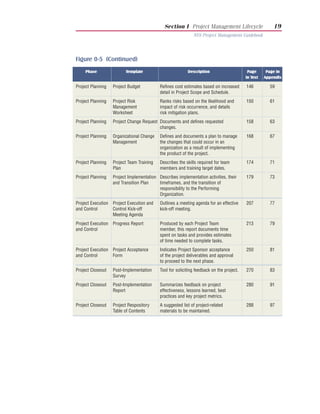
Figure 0-5 (Continued)
     Phase               Template                         Description                      Page      Page in
                                                                                          in Text   Appendix

Project Planning   Project Budget          Refines cost estimates based on increased      146         59
                                           detail in Project Scope and Schedule.
Project Planning   Project Risk            Ranks risks based on the likelihood and        150         61
                   Management              impact of risk occurrence, and details
                   Worksheet               risk mitigation plans.
Project Planning   Project Change Request Documents and defines requested                 158         63
                                          changes.
Project Planning   Organizational Change   Defines and documents a plan to manage         168         67
                   Management              the changes that could occur in an
                                           organization as a result of implementing
                                           the product of the project.
Project Planning   Project Team Training   Describes the skills required for team         174         71
                   Plan                    members and training target dates.
Project Planning   Project Implementation Describes implementation activities, their      179         73
                   and Transition Plan    timeframes, and the transition of
                                          responsibility to the Performing
                                          Organization.
Project Execution Project Execution and    Outlines a meeting agenda for an effective     207         77
and Control       Control Kick-off         kick-off meeting.
                  Meeting Agenda
Project Execution Progress Report          Produced by each Project Team                  213         79
and Control                                member, this report documents time
                                           spent on tasks and provides estimates
                                           of time needed to complete tasks.
Project Execution Project Acceptance       Indicates Project Sponsor acceptance           250         81
and Control       Form                     of the project deliverables and approval
                                           to proceed to the next phase.
Project Closeout   Post-Implementation     Tool for soliciting feedback on the project.   270         83
                   Survey
Project Closeout   Post-Implementation     Summarizes feedback on project                 280         91
                   Report                  effectiveness, lessons learned, best
                                           practices and key project metrics.
Project Closeout   Project Respository     A suggested list of project-related            288         97
                   Table of Contents       materials to be maintained.
Section I:1 Project Origination       21
                                          NYS Project Management Guidebook


1   PROJECT ORIGINATION

    Purpose

                The purpose of Project Origination is to evaluate projects pro-
                posed for the next planning cycle and to reach a consensus on
                the projects to be selected. During this phase, the strength of a
                project’s Business Case is tested, and the viability of the
                Proposed Solution is explored. A determination is made as to
                whether the project is consistent with the agency’s strategic
                plan and affordable within budget guidelines.

                The Project Proposal process may actually be part of the budget
                cycle, serving as the justification for budget requests. In this
                case, Project Proposals may need to be created a full budget
                cycle prior to the project’s anticipated initiation.

                Other factors that impact Project Origination include statutory
                requirements, regulations, legislative restrictions, and civil
                service rules.

                Each organization has its own approach to green-lighting
                desired projects. The approach outlined below is only one of
                many possible variations of the evaluation and selection pro-
                cess. There are some general principles, however, that apply to
                any effective evaluation and selection process:
                N The deciding body must have enough information about the
                   merits of the project’s Business Case and the viability of its
                   Proposed Solution to make a meaningful evaluation;
                N The competing projects’ merits must be evaluated and
                   compared using a consistently applied methodology;
                N The selection process must take into consideration the
                   project’s fit with the organizational mission and strategic
                   plan.


    List of Processes

                The three major processes in this phase of the project manage-
                ment lifecycle are:
                N Develop Project Proposal, where the initial Business
                   Case is made, and initial project parameters are defined;
                N Evaluate Project Proposals, where cost/benefit analysis
                   is performed, and the projects are evaluated against a set
                   of specific business criteria; and
22     Section I:1 Project Origination
       NYS Project Management Guidebook


                              N Select Projects, where a consensus is reached on the pro-
                                   ject’s feasibility and relative importance in comparison to
                                   other proposed projects, and a decision is formally made
                                   regarding the Project Proposal.

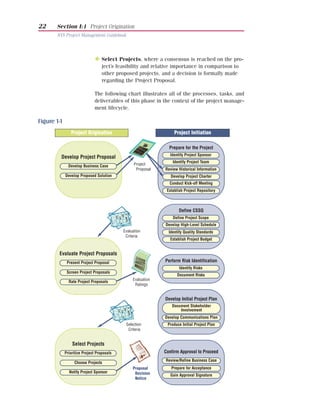
                              The following chart illustrates all of the processes, tasks, and
                              deliverables of this phase in the context of the project manage-
                              ment lifecycle.

Figure 1-1
                Project Origination                                Project Initiation

                                                                Prepare for the Project
                                                                 Identify Project Sponsor
         Develop Project Proposal
                                                                  Identify Project Team
               Develop Business Case              Project
                                                   Proposal   Review Historical Information
             Develop Proposed Solution                           Develop Project Charter
                                                                Conduct Kick-off Meeting
                                                               Establish Project Repository


                                                                      Define CSSQ
                                                                  Define Project Scope
                                                              Develop High-Level Schedule
                                            Evaluation          Identify Quality Standards
                                             Criteria
                                                                 Establish Project Budget


        Evaluate Project Proposals
              Present Project Proposal                        Perform Risk Identification
                                                                      Identify Risks
              Screen Project Proposals
                                                                     Document Risks
                                                 Evaluation
               Rate Project Proposals
                                                  Ratings


                                                              Develop Initial Project Plan
                                                                  Document Stakeholder
                                                                      Involvement
                                                              Develop Communications Plan
                                             Selection         Produce Initial Project Plan
                                              Criteria


                 Select Projects
             Prioritize Project Proposals                     Confirm Approval to Proceed
                                                              Review/Refine Business Case
                  Choose Projects
                                                 Proposal        Prepare for Acceptance
               Notify Project Sponsor             Decision       Gain Approval Signature
                                                  Notice
Section I:1 Project Origination           23
                                                         NYS Project Management Guidebook


          List of Roles

                      The following roles are involved in carrying out the processes
                      of this phase. The detailed descriptions of these roles can be
                      found in the Section I Introduction.
                          N Project Sponsor
                          N Project Proposal Team
                          N Project Selection Committee


          List of Deliverables

                      Since a Project Manager is not usually assigned to the project
                      at this time, members of the Performing Organization Manage-
                      ment prepare and review Project Origination deliverables.

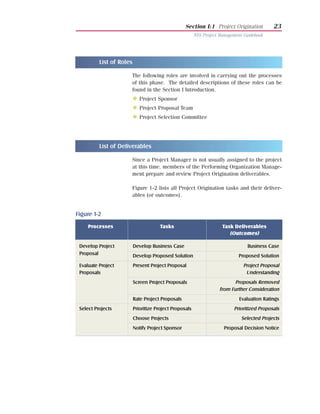
                      Figure 1-2 lists all Project Origination tasks and their deliver-
                      ables (or outcomes).


Figure 1-2
     Processes                         Tasks                          Task Deliverables
                                                                         (Outcomes)

 Develop Project          Develop Business Case                                  Business Case
 Proposal                 Develop Proposed Solution                          Proposed Solution
 Evaluate Project         Present Project Proposal                              Project Proposal
 Proposals                                                                       Understanding
                          Screen Project Proposals                          Proposals Removed
                                                                     from Further Consideration
                          Rate Project Proposals                              Evaluation Ratings
 Select Projects          Prioritize Project Proposals                     Prioritized Proposals
                          Choose Projects                                      Selected Projects
                          Notify Project Sponsor                       Proposal Decision Notice
24     Section I:1 Project Origination
       NYS Project Management Guidebook


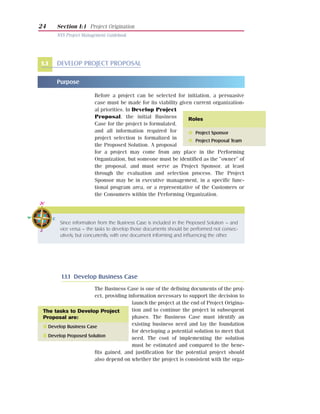
1.1    DEVELOP PROJECT PROPOSAL

       Purpose

                        Before a project can be selected for initiation, a persuasive
                        case must be made for its viability given current organization-
                        al priorities. In Develop Project
                        Proposal, the initial Business          Roles
                        Case for the project is formulated,
                        and all information required for        G Project Sponsor
                        project selection is formalized in      G Project Proposal Team
                        the Proposed Solution. A proposal
                        for a project may come from any place in the Performing
                        Organization, but someone must be identified as the “owner” of
                        the proposal, and must serve as Project Sponsor, at least
                        through the evaluation and selection process. The Project
                        Sponsor may be in executive management, in a specific func-
                        tional program area, or a representative of the Customers or
                        the Consumers within the Performing Organization.


        Since information from the Business Case is included in the Proposed Solution – and
        vice versa – the tasks to develop those documents should be performed not consec-
        utively, but concurrently, with one document informing and influencing the other.


         Tasks

         1.1.1 Develop Business Case
                       The Business Case is one of the defining documents of the proj-
                       ect, providing information necessary to support the decision to
                                        launch the project at the end of Project Origina-
 The tasks to Develop Project           tion and to continue the project in subsequent
 Proposal are:                          phases. The Business Case must identify an
 I Develop Business Case                existing business need and lay the foundation
                                        for developing a potential solution to meet that
 I Develop Proposed Solution
                                        need. The cost of implementing the solution
                                        must be estimated and compared to the bene-
                       fits gained, and justification for the potential project should
                       also depend on whether the project is consistent with the orga-
Section I:1 Project Origination            25
                                                       NYS Project Management Guidebook


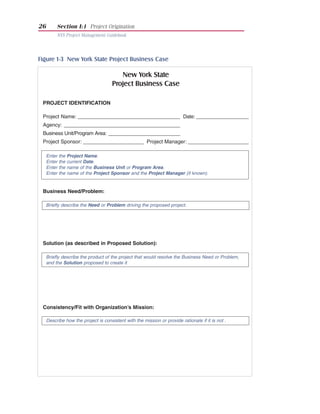
                        nization’s mission. For a sample Business Case template, see
                        Figure 1-3, the New York State Project Business Case.

                        The Business Case must provide a compelling case for the proj-
                        ect. A careful study should be made of expected benefits to the
                        organization implementing the project. An analysis of the costs,
                        benefits and risks associated with the proposed approach can
                        be made, and the justification necessary to obtain the proper
                        level of commitment from the decision-maker(s) can be formu-
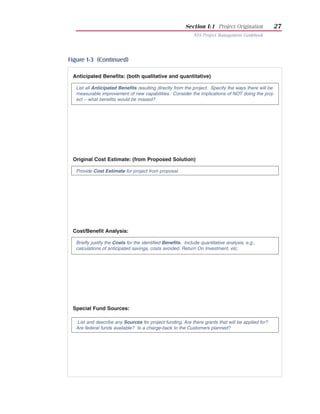
                        lated. Once an original cost estimate for the project is derived
                        during Develop Proposed Solution. The Business Case can also
                        identify special funding sources available for the proposed ini-
                        tiative, and should align the project’s costs with the agency
                        budget cycle. If the project is going to span multiple budget
                        cycles, a multi-year strategy for project funding should be dis-
                        cussed with the agency fiscal officer, who may find it useful to
                        review the Business Case with another constituency – the
                        Division of the Budget (DoB).


        During Project Origination, any estimates are acknowledged to be high-level at best. As
        the project progresses through the Initiation and Planning phases, those estimates will
        become more precise as more is learned about the true parameters of the project, and
additional go/no go decisions will be made based on the latest information. It is also impor-
tant to note that, in order to define project parameters with adequate precision, Initiation and
Planning will require substantial resources, and initial estimates should reflect that fact.


                        Before presenting the proposal for evaluation, the Project
                        Sponsor should have the Business Case reviewed by the people
                        most intimately familiar with its imperatives – Customer
                        Decision-Makers.

                        The Business Case will continue to be a critical component of
                        the decision-making process throughout the entire project man-
                        agement lifecycle – from the initial decision to proceed with the
                        project to the decisions made at periodic project reviews to
                        continue, modify or terminate the project. At the end of each
                        project management phase and whenever there is a significant
                        change to the project or the business function, the Business
                        Case will be reviewed and re-validated.
26        Section I:1 Project Origination
          NYS Project Management Guidebook


Figure 1-3 New York State Project Business Case

                                          New York State
                                       Project Business Case

 PROJECT IDENTIFICATION

 Project Name: _____________________________________ Date: ___________________
 Agency: __________________________________________
 Business Unit/Program Area: __________________________
 Project Sponsor: ______________________ Project Manager: ______________________

     Enter   the   Project Name.
     Enter   the   current Date.
     Enter   the   name of the Business Unit or Program Area.
     Enter   the   name of the Project Sponsor and the Project Manager (if known).


 Business Need/Problem:

     Briefly describe the Need or Problem driving the proposed project.


 Solution (as described in Proposed Solution):

     Briefly describe the product of the project that would resolve the Business Need or Problem,
     and the Solution proposed to create it


 Consistency/Fit with Organization’s Mission:

     Describe how the project is consistent with the mission or provide rationale if it is not .
Section I:1 Project Origination          27
                                                             NYS Project Management Guidebook


Figure 1-3 (Continued)

 Anticipated Benefits: (both qualitative and quantitative)

  List all Anticipated Benefits resulting directly from the project. Specify the ways there will be
  measurable improvement of new capabilities. Consider the implications of NOT doing the proj-
  ect – what benefits would be missed?


 Original Cost Estimate: (from Proposed Solution)

  Provide Cost Estimate for project from proposal.


 Cost/Benefit Analysis:

  Briefly justify the Costs for the identified Benefits. Include quantitative analysis, e.g.,
  calculations of anticipated savings, costs avoided, Return On Investment, etc.


 Special Fund Sources:

  List and describe any Sources for project funding. Are there grants that will be applied for?
  Are federal funds available? Is a charge-back to the Customers planned?
28   Section I:1 Project Origination
     NYS Project Management Guidebook


       1.1.2 Develop Proposed Solution
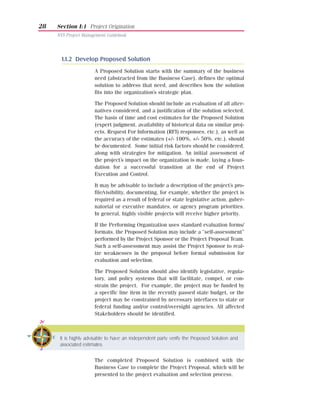
                      A Proposed Solution starts with the summary of the business
                      need (abstracted from the Business Case), defines the optimal
                      solution to address that need, and describes how the solution
                      fits into the organization’s strategic plan.

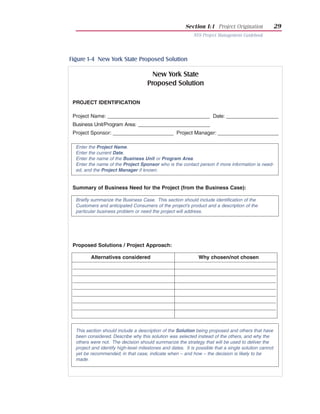
                      The Proposed Solution should include an evaluation of all alter-
                      natives considered, and a justification of the solution selected.
                      The basis of time and cost estimates for the Proposed Solution
                      (expert judgment, availability of historical data on similar proj-
                      ects, Request For Information (RFI) responses, etc.), as well as
                      the accuracy of the estimates (+/- 100%, +/- 50%, etc.), should
                      be documented. Some initial risk factors should be considered,
                      along with strategies for mitigation. An initial assessment of
                      the project’s impact on the organization is made, laying a foun-
                      dation for a successful transition at the end of Project
                      Execution and Control.

                      It may be advisable to include a description of the project’s pro-
                      file/visibility, documenting, for example, whether the project is
                      required as a result of federal or state legislative action, guber-
                      natorial or executive mandates, or agency program priorities.
                      In general, highly visible projects will receive higher priority.

                      If the Performing Organization uses standard evaluation forms/
                      formats, the Proposed Solution may include a “self-assessment”
                      performed by the Project Sponsor or the Project Proposal Team.
                      Such a self-assessment may assist the Project Sponsor to real-
                      ize weaknesses in the proposal before formal submission for
                      evaluation and selection.

                      The Proposed Solution should also identify legislative, regula-
                      tory, and policy systems that will facilitate, compel, or con-
                      strain the project. For example, the project may be funded by
                      a specific line item in the recently passed state budget, or the
                      project may be constrained by necessary interfaces to state or
                      federal funding and/or control/oversight agencies. All affected
                      Stakeholders should be identified.


      It is highly advisable to have an independent party verify the Proposed Solution and
      associated estimates.


                      The completed Proposed Solution is combined with the
                      Business Case to complete the Project Proposal, which will be
                      presented to the project evaluation and selection process.
Section I:1 Project Origination                29
                                                            NYS Project Management Guidebook


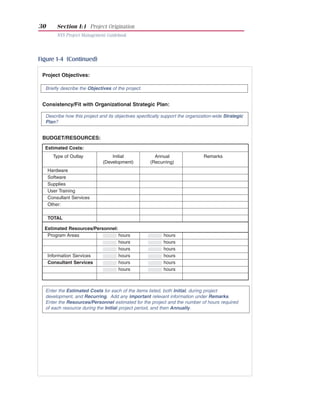
Figure 1-4 New York State Proposed Solution

                                       New York State
                                     Proposed Solution

 PROJECT IDENTIFICATION

 Project Name: _____________________________________ Date: ___________________
 Business Unit/Program Area: __________________________
 Project Sponsor: ______________________ Project Manager: ______________________

  Enter the Project Name.
  Enter the current Date.
  Enter the name of the Business Unit or Program Area.
  Enter the name of the Project Sponsor who is the contact person if more information is need-
  ed, and the Project Manager if known.


 Summary of Business Need for the Project (from the Business Case):

  Briefly summarize the Business Case. This section should include identification of the
  Customers and anticipated Consumers of the project’s product and a description of the
  particular business problem or need the project will address.


 Proposed Solutions / Project Approach:

         Alternatives considered                              Why chosen/not chosen


  This section should include a description of the Solution being proposed and others that have
  been considered. Describe why this solution was selected instead of the others, and why the
  others were not. The decision should summarize the strategy that will be used to deliver the
  project and identify high-level milestones and dates. It is possible that a single solution cannot
  yet be recommended; in that case, indicate when – and how – the decision is likely to be
  made.
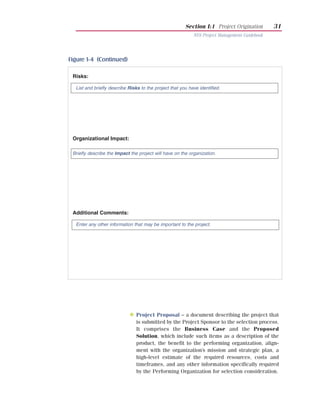
30       Section I:1 Project Origination
         NYS Project Management Guidebook


Figure 1-4 (Continued)

 Project Objectives:

  Briefly describe the Objectives of the project.


 Consistency/Fit with Organizational Strategic Plan:

  Describe how this project and its objectives specifically support the organization-wide Strategic
  Plan?


 BUDGET/RESOURCES:
  Estimated Costs:
       Type of Outlay             Initial              Annual                  Remarks
                              (Development)          (Recurring)
     Hardware
     Software
     Supplies
     User Training
     Consultant Services
     Other:

     TOTAL

  Estimated Resources/Personnel:
   Program Areas                 hours                      hours
                                 hours                      hours
                                 hours                      hours
   Information Services          hours                      hours
   Consultant Services           hours                      hours
                                 hours                      hours


  Enter the Estimated Costs for each of the items listed, both Initial, during project
  development, and Recurring. Add any important relevant information under Remarks.
  Enter the Resources/Personnel estimated for the project and the number of hours required
  of each resource during the Initial project period, and then Annually.
Section I:1 Project Origination        31
                                                            NYS Project Management Guidebook


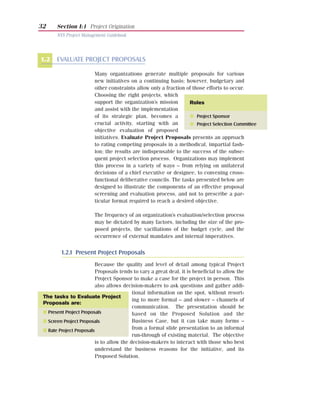
Figure 1-4 (Continued)

 Risks:

  List and briefly describe Risks to the project that you have identified.


 Organizational Impact:

 Briefly describe the Impact the project will have on the organization.


 Additional Comments:

  Enter any other information that may be important to the project.


            Deliverable

                            N Project Proposal – a document describing the project that
                                is submitted by the Project Sponsor to the selection process.
                                It comprises the Business Case and the Proposed
                                Solution, which include such items as a description of the
                                product, the benefit to the performing organization, align-
                                ment with the organization’s mission and strategic plan, a
                                high-level estimate of the required resources, costs and
                                timeframes, and any other information specifically required
                                by the Performing Organization for selection consideration.
32     Section I:1 Project Origination
       NYS Project Management Guidebook


1.2    EVALUATE PROJECT PROPOSALS

                        Many organizations generate multiple proposals for various
                        new initiatives on a continuing basis; however, budgetary and
                        other constraints allow only a fraction of those efforts to occur.
                        Choosing the right projects, which
                        support the organization’s mission       Roles
                        and assist with the implementation
                        of its strategic plan, becomes a         G Project Sponsor
                        crucial activity, starting with an       G Project Selection Committee
                        objective evaluation of proposed
                        initiatives. Evaluate Project Proposals presents an approach
                        to rating competing proposals in a methodical, impartial fash-
                        ion; the results are indispensable to the success of the subse-
                        quent project selection process. Organizations may implement
                        this process in a variety of ways – from relying on unilateral
                        decisions of a chief executive or designee, to convening cross-
                        functional deliberative councils. The tasks presented below are
                        designed to illustrate the components of an effective proposal
                        screening and evaluation process, and not to prescribe a par-
                        ticular format required to reach a desired objective.

                        The frequency of an organization’s evaluation/selection process
                        may be dictated by many factors, including the size of the pro-
                        posed projects, the vacillations of the budget cycle, and the
                        occurrence of external mandates and internal imperatives.


         1.2.1 Present Project Proposals
                         Because the quality and level of detail among typical Project
                         Proposals tends to vary a great deal, it is beneficial to allow the
                         Project Sponsor to make a case for the project in person. This
                         also allows decision-makers to ask questions and gather addi-
                                          tional information on the spot, without resort-
 The tasks to Evaluate Project
                                          ing to more formal – and slower – channels of
 Proposals are:
                                          communication. The presentation should be
 I Present Project Proposals              based on the Proposed Solution and the
 I Screen Project Proposals               Business Case, but it can take many forms –
 I Rate Project Proposals                 from a formal slide presentation to an informal
                                          run-through of existing material. The objective
                         is to allow the decision-makers to interact with those who best
                         understand the business reasons for the initiative, and its
                         Proposed Solution.
Section I:1 Project Origination        33
                                       NYS Project Management Guidebook


1.2.2 Screen Project Proposals
            Before a great deal of effort is expended on rating, prioritizing
            and selecting presented projects, it may be useful to screen com-
            peting proposals by asking some important questions, such as:
            N Does the project support the organization’s mission?
            N Does the Proposed Solution align with the organization’s
               strategic plan/technical architecture?
            N Is there an available/plausible funding source for this effort?
            N Does the project’s cost/benefit analysis justify its initiation?

            Unless a project is legislatively (or otherwise) mandated, simply
            working through these questions will result in elimination of
            some proposals from further consideration. The Project Sponsor
            should be notified, and the decision should be documented on
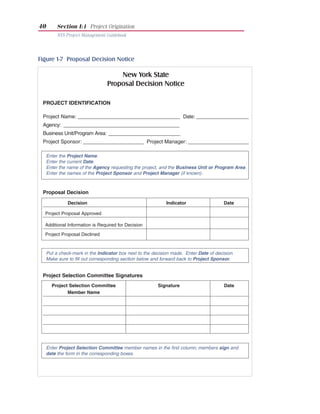
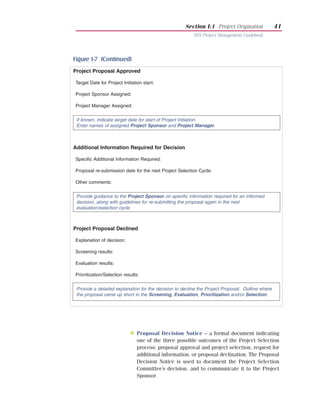
            the Proposal Decision Notice form (see Figure 1-7).


1.2.3 Rate Project Proposals
            Rating of Project Proposals is generally performed by executive
            management or by a group designated by executive manage-
            ment (Project Selection Committee). The group may meet on a
            regular or an as-needed basis to perform this function, or the
            rating of proposals may be an integral part of the organization-
            al strategic/tactical planning and budgeting process.

            The process is usually formal, with specific forms/formats and
            procedures. In smaller organizations, however, it may be more
            informal, and may even be combined with the selection process.
            In these cases, a brief presentation to the Commissioner,
            Director, or other organization head may be all that is required
            to commit resources (funding, personnel, equipment, etc.) and
            initiate the project.

            Proposals are generally rated according to a set of specific
            business criteria. The process may include a broad technical
            review to determine if the proposal follows current agency
            standards and technical architectures. The funding associated
            with a project is also a critical component of the rating process.
            A Performing Organization may have unique rules regarding
            funding for proposals. During Project Origination, the Project
            Sponsor must identify whether funds are expected from the
            Performing Organization’s current/future operating budget, or
            whether additional funding sources are available.
34      Section I:1 Project Origination
        NYS Project Management Guidebook


                          The level of approvals needed may vary depending on whether
                          the project exceeds or falls below defined thresholds. Thresholds
                          may be based on cost, involvement of more than one function-
                          al area, project needs within or outside of standards and pro-
                          cedures, or other areas specific to the Performing Organi-
                          zation. The rating process generally assigns a score to each
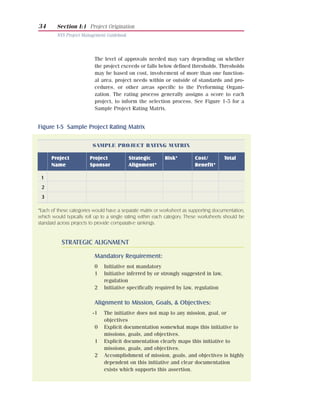
                          project, to inform the selection process. See Figure 1-5 for a
                          Sample Project Rating Matrix.


Figure 1-5 Sample Project Rating Matrix

                         SAMPLE PROJECT RATING MATRIX

      Project           Project            Strategic       Risk*         Cost/         Total
      Name              Sponsor            Alignment*                    Benefit*

 1
 2
 3

*Each of these categories would have a separate matrix or worksheet as supporting documentation,
which would typically roll up to a single rating within each category. These worksheets should be
standard across projects to provide comparative rankings.


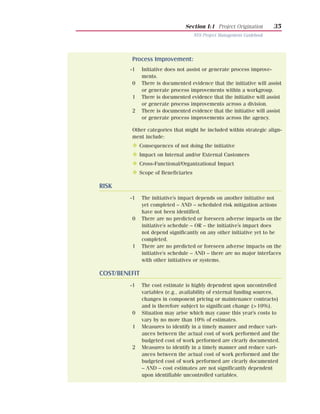
           STRATEGIC ALIGNMENT

                          Mandatory Requirement:
                          0    Initiative not mandatory
                          1    Initiative inferred by or strongly suggested in law,
                               regulation
                          2    Initiative specifically required by law, regulation

                          Alignment to Mission, Goals, & Objectives:
                         -1    The initiative does not map to any mission, goal, or
                               objectives
                          0    Explicit documentation somewhat maps this initiative to
                               missions, goals, and objectives.
                          1    Explicit documentation clearly maps this initiative to
                               missions, goals, and objectives.
                          2    Accomplishment of mission, goals, and objectives is highly
                               dependent on this initiative and clear documentation
                               exists which supports this assertion.
Section I:1 Project Origination          35
                                       NYS Project Management Guidebook


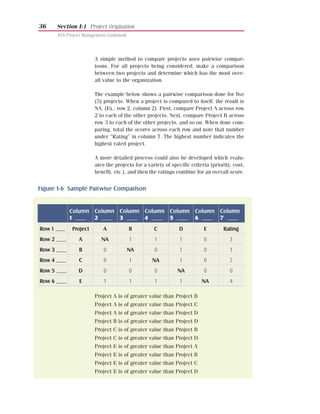
         Process Improvement:
         -1    Initiative does not assist or generate process improve-
               ments.
         0     There is documented evidence that the initiative will assist
               or generate process improvements within a workgroup.
         1     There is documented evidence that the initiative will assist
               or generate process improvements across a division.
         2     There is documented evidence that the initiative will assist
               or generate process improvements across the agency.

         Other categories that might be included within strategic align-
         ment include:
         N    Consequences of not doing the initiative
         N    Impact on Internal and/or External Customers
         N    Cross-Functional/Organizational Impact
         N    Scope of Beneficiaries

RISK
         -1    The initiative’s impact depends on another initiative not
               yet completed – AND – scheduled risk mitigation actions
               have not been identified.
         0     There are no predicted or foreseen adverse impacts on the
               initiative’s schedule – OR – the initiative’s impact does
               not depend significantly on any other initiative yet to be
               completed.
         1     There are no predicted or foreseen adverse impacts on the
               initiative’s schedule – AND – there are no major interfaces
               with other initiatives or systems.

COST/BENEFIT
         -1    The cost estimate is highly dependent upon uncontrolled
               variables (e.g., availability of external funding sources,
               changes in component pricing or maintenance contracts)
               and is therefore subject to significant change (> 10%).
         0     Situation may arise which may cause this year’s costs to
               vary by no more than 10% of estimates.
         1     Measures to identify in a timely manner and reduce vari-
               ances between the actual cost of work performed and the
               budgeted cost of work performed are clearly documented.
         2     Measures to identify in a timely manner and reduce vari-
               ances between the actual cost of work performed and the
               budgeted cost of work performed are clearly documented
               – AND – cost estimates are not significantly dependent
               upon identifiable uncontrolled variables.
36    Section I:1 Project Origination
      NYS Project Management Guidebook


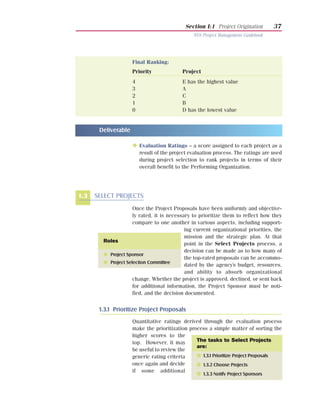
                       A simple method to compare projects uses pairwise compar-
                       isons. For all projects being considered, make a comparison
                       between two projects and determine which has the most over-
                       all value to the organization.

                       The example below shows a pairwise comparison done for five
                       (5) projects. When a project is compared to itself, the result is
                       NA. (Ex.: row 2, column 2) First, compare Project A across row
                       2 to each of the other projects. Next, compare Project B across
                       row 3 to each of the other projects, and so on. When done com-
                       paring, total the scores across each row and note that number
                       under “Rating” in column 7. The highest number indicates the
                       highest rated project.

                       A more detailed process could also be developed which evalu-
                       ates the projects for a variety of specific criteria (priority, cost,
                       benefit, etc.), and then the ratings combine for an overall score.


Figure 1-6 Sample Pairwise Comparison


           Column Column Column Column Column Column Column
           1 —— 2 —— 3 —— 4 —— 5 —— 6 —— 7 ——
Row 1 ——     Project       A             B        C           D          E        Rating
Row 2 ——        A         NA             1        1           1          0           3
Row 3 ——        B          0             NA       0           1          0           1
Row 4 ——        C          0             1       NA           1          0           2
Row 5 ——        D          0             0        0          NA          0           0
Row 6 ——        E          1             1        1           1         NA           4

                       Project A is of greater value than Project B
                       Project A is of greater value than Project C
                       Project A is of greater value than Project D
                       Project B is of greater value than Project D
                       Project C is of greater value than Project B
                       Project C is of greater value than Project D
                       Project E is of greater value than Project A
                       Project E is of greater value than Project B
                       Project E is of greater value than Project C
                       Project E is of greater value than Project D
Section I:1 Project Origination        37
                                                NYS Project Management Guidebook


                     Final Ranking:
                     Priority              Project
                     4                     E has the highest value
                     3                     A
                     2                     C
                     1                     B
                     0                     D has the lowest value


       Deliverable

                     N Evaluation Ratings – a score assigned to each project as a
                         result of the project evaluation process. The ratings are used
                         during project selection to rank projects in terms of their
                         overall benefit to the Performing Organization.


1.3   SELECT PROJECTS
                     Once the Project Proposals have been uniformly and objective-
                     ly rated, it is necessary to prioritize them to reflect how they
                     compare to one another in various aspects, including support-
                                            ing current organizational priorities, the
                                            mission and the strategic plan. At that
        Roles
                                            point in the Select Projects process, a
                                            decision can be made as to how many of
        G Project Sponsor
                                            the top-rated proposals can be accommo-
        G Project Selection Committee
                                            dated by the agency’s budget, resources,
                                            and ability to absorb organizational
                     change. Whether the project is approved, declined, or sent back
                     for additional information, the Project Sponsor must be noti-
                     fied, and the decision documented.


       1.3.1 Prioritize Project Proposals
                     Quantitative ratings derived through the evaluation process
                     make the prioritization process a simple matter of sorting the
                     higher scores to the
                     top. However, it may       The tasks to Select Projects
                                                are:
                     be useful to review the
                     generic rating criteria    I 1.3.1 Prioritize Project Proposals
                     once again and decide      I 1.3.2 Choose Projects
                     if some additional
                                                  I 1.3.3 Notify Project Sponsors
38   Section I:1 Project Origination
     NYS Project Management Guidebook


                      measurements are needed. Complying with legislative man-
                      dates or executive chamber initiatives, for example, may trump
                      even well conceived process improvement opportunities. These
                      are the factors evaluated to determine a project’s feasibility and
                      its relative importance in comparison to other proposed proj-
                      ects. Whatever the final set of criteria, they should be docu-
                      mented and applied equally to each competing proposal, to
                      enable a fair and competent selection process.

       1.3.2 Choose Projects
                      A committee of executives from the Performing Organization
                      usually makes project selection decisions. Even if the Com-
                      missioner or other agency head (Chairman, Director, etc.)
                      makes the final decision, a Project Selection Committee gener-
                      ally reviews and develops recommendations. It may be useful
                      to, once again, invite the Project Sponsor to make a presenta-
                      tion to the Committee and answer questions.

                      The Project Selection Committee must choose projects that, in
                      combination, will provide the best investment for the
                      Performing Organization. The Committee considers competing
                      priorities in determining what is best for the whole. All propos-
                      als must be evaluated in the context of other proposals, current
                      projects and ongoing operations in order to set priorities and
                      determine resource availability. This process may be accom-
                      plished through discussion and vote, or the Committee may use
                      specific tools (software, spreadsheets, etc.) designed to facili-
                      tate comparison of the proposals.

                      The projects chosen as a result of this process may not neces-
                      sarily reflect what is best for an individual employee or a single
                      work unit. Sometimes a lower-priority project will be approved
                      simply because it is low-risk or low-cost, and can deliver need-
                      ed benefits or services. Sometimes a project can be undertak-
                      en because it needs few resources, and can be performed while
                      larger initiatives are delayed. Projects may be approved for
                      immediate action or with a delay for obtaining resources. It is
                      also possible that a proposal could be returned to the Project
                      Sponsor for further development without approval or rejection.

                      Choosing a project does not necessarily guarantee that the
                      project will be undertaken by the Performing Organization.
                      That is generally dependent upon the availability of necessary
                      funding. Each Performing Organization may have a different
                      process whereby chosen projects are actually authorized to
                      proceed to Project Initiation.
Section I:1 Project Origination       39
                                      NYS Project Management Guidebook


1.3.3 Notify Project Sponsors
            Once the decisions have been made, it is imperative to docu-
            ment them and to explain their rationale to the Project
            Sponsors and other Stakeholders. One of three outcomes can
            occur:
             1. A decision is made to proceed with the project. In this
                case, a determination must be made when Project
                Initiation can begin. At that point a Project Manager
                must be assigned to the project. The finance office must
                be brought on board to ensure adequate funding for the
                project, and control agencies may be notified that the
                project is being initiated.
             2. A decision cannot be made on the project without some
                additional information. In this case, the specific informa-
                tion required for an informed decision should be docu-
                mented, and communicated to the Project Sponsor, along
                with some guidelines for submitting the proposal again in
                the next evaluation/selection cycle.
             3. A decision is made to decline the proposal. In this case,
                a detailed explanation for the decision should accompany
                the message, outlining where the proposal came up short
                in the screening, evaluation, prioritization and/or
                selection.

            In all three cases, the same Proposal Decision Notice can be used
            to document and communicate the decision (see Figure 1-7).
40        Section I:1 Project Origination
          NYS Project Management Guidebook


Figure 1-7 Proposal Decision Notice

                                     New York State
                                 Proposal Decision Notice

 PROJECT IDENTIFICATION

 Project Name: _____________________________________ Date: ___________________
 Agency: __________________________________________
 Business Unit/Program Area: __________________________
 Project Sponsor: ______________________ Project Manager: ______________________

     Enter the Project Name.
     Enter the current Date.
     Enter the name of the Agency requesting the project, and the Business Unit or Program Area.
     Enter the names of the Project Sponsor and Project Manager (if known).


 Proposal Decision

               Decision                                      Indicator                  Date

  Project Proposal Approved

  Additional Information is Required for Decision

  Project Proposal Declined


     Put a check-mark in the Indicator box next to the decision made. Enter Date of decision.
     Make sure to fill out corresponding section below and forward back to Project Sponsor.


 Project Selection Committee Signatures
       Project Selection Committee                       Signature                      Date
              Member Name


     Enter Project Selection Committee member names in the first column; members sign and
     date the form in the corresponding boxes.
Section I:1 Project Origination              41
                                                         NYS Project Management Guidebook


Figure 1-7 (Continued)
Project Proposal Approved

Target Date for Project Initiation start:

Project Sponsor Assigned:

Project Manager Assigned:


 If known, indicate target date for start of Project Initiation.
 Enter names of assigned Project Sponsor and Project Manager.


Additional Information Required for Decision

Specific Additional Information Required:

Proposal re-submission date for the next Project Selection Cycle:

Other comments:


 Provide guidance to the Project Sponsor on specific information required for an informed
 decision, along with guidelines for re-submitting the proposal again in the next
 evaluation/selection cycle.


Project Proposal Declined

Explanation of decision:

Screening results:

Evaluation results:

Prioritization/Selection results:


 Provide a detailed explanation for the decision to decline the Project Proposal. Outline where
 the proposal came up short in the Screening, Evaluation, Prioritization and/or Selection.


           Deliverable

                            N Proposal Decision Notice – a formal document indicating
                                one of the three possible outcomes of the Project Selection
                                process: proposal approval and project selection, request for
                                additional information, or proposal declination. The Proposal
                                Decision Notice is used to document the Project Selection
                                Committee’s decision, and to communicate it to the Project
                                Sponsor.
42       Section I:1 Project Origination
         NYS Project Management Guidebook


           Project Origination
           End-of-Phase Checklist

           How To Use
                              Use this checklist throughout Project Origination to help ensure
                              that all requirements of the phase are met. As each item is
                              completed, indicate its completion date. Use the Comments col-
                              umn to add information that may be helpful to you as you pro-
                              ceed through the project. If you elect NOT to complete an item
                              on the checklist, indicate the reason and describe how the
                              objectives of that item are otherwise being met.

Figure 1-8
  Item Description                    Page   Completion   Comments         Reason for NOT
                                             Date                          Completing

Develop Project Proposal:             24
Formulate business need/              24
problem and anticipated
benefits to all parties
Review project’s fit with             24
organization’s mission
Identify project objectives           28
Research potential approaches         28
and solutions
Identify and recommend one            28
(or more) chosen solution(s)
Review solution’s fit with            28
organization’s strategic plan
Estimate costs of all                 28
resources and materials
required for the project,
both initial and recurring
Identify potential project risks      28
Identify organizational impacts       28
of the project
Identify any legislative,             28
regulatory or policy
dependencies or implications
of the project
Perform project cost/benefit          28
analysis
Identify project funding strategies   28
Complete Business Case and            28
Proposed Solution forms
Section I:1 Project Origination           43
                                                        NYS Project Management Guidebook


Figure 1-8 (Continued)
  Item Description                  Page   Completion     Comments          Reason for NOT
                                           Date                             Completing

 Evaluate Project Proposals:        32
 Submit Project Proposal to the     32
 Selection process
 Schedule and conduct               32
 proposal presentation
 Identify and/or utilize proposal   33
 screening criteria
 Identify and/or utilize proposal   33
 rating criteria and methods


 Select Projects:                   37
 Identify and/or utilize proposal   37
 prioritization criteria
 Evaluate projects’ requirements    37
 vs. organizational capacity
 Recommend projects for             37
 selection
 Choose projects for initiation     38
 Notify Project Sponsor of          39
 unfavorable screening
 outcome
 Document decision process          39
 and outcome for each proposal
 Complete Proposal Decision         40
 Notice forms
 Get signatures from Project        40
 Selection Committee members
 Notify Project Sponsor(s)           41


           Measurements of Success

                             Success in Project Origination is not only receiving permission
                             to proceed on the proposed project, but also understanding the
                             executive decision, which often results in a greater under-
                             standing of the organization’s mission.

                             During Project Origination, certain assumptions and projec-
                             tions are made regarding the main project parameters – cost,
                             benefit, scope, and timeframe. These initial estimates are used
                             to rate the project under consideration against all other com-
                             peting initiatives. The main measurement of success for Project
44       Section I:1 Project Origination
         NYS Project Management Guidebook


                              Origination is the consensus of the Performing Organization
                              Management that the projects were weighed fairly, and that the
                              ones with the most compelling Business Case received a green
                              light.

                              Before the final project selection, it is possible to assess how
                              successfully the evaluation process is proceeding by utilizing
                              the measurements outlined below. More than one “No” answer
                              indicates a serious risk to the desired consensus described
                              above.


Figure 1-9

        Process                         Measurements of Success                        Yes   No

 Develop Project Proposal      Have the anticipated benefits been reviewed and
                               accepted by the Customer?
                               Does the expected outcome of the project support
                               the organization’s mission?
                               Does the Proposed Solution address only the
                               agenda described by the business problem?
                               Has an independent party assessed the estimated
                               costs and resources?
                               Does the Project Proposal make clear how various
                               approaches/solutions were considered and evaluated,
                               and why a particular solution is being proposed?
 Evaluate Project Proposals    Was the project rated on all of the following:
                               N Strategic alignment?
                               N Risk?
                               N Proposed Solution?
                               N Cost?
                               N Benefit?
                               N Funding?
                               Were the evaluation criteria applied equally to all
                               projects under consideration?
 Select Projects               Does the Project Proposal Team understand the
                               reasons for the project’s approval or declination, or
                               for additional information that is required?
                               Is there a consensus among the Performing
                               Organization Management that the selection process
                               was objective and fair?
Section I:1 Project Origination                45
                                                   NYS Project Management Guidebook


           Phase Risks / Ways to Avoid Pitfalls

                        Selecting the wrong project is a very costly, and sometimes dev-
                        astating mistake that many organizations make. Even a great
                        idea may not be worth expending the resources or accepting
                        the associated risk. Or the project may simply need to be
                        delayed until more resources are available or the associated
                        risk can be mitigated. Selecting the right projects in the wrong
                        combination and, therefore, overextending the organization’s
                        resources can be just as devastating. It is not always easy to
                        see why good Project Origination procedures, resulting in a
                        well thought out selection of projects, are so critical to the suc-
                        cess of the Performing Organization. Hopefully, now that you
                        have read this section, it is easy for you to understand and you
                        can help others see the light!

                        What are some of the key elements of Project Origination that
                        require the most attention? The following table identifies
                        processes and tasks that are highlighted in this section.


Figure 1-10
     Process                   Task                        Why is it important?
 Develop Project    Develop Business Case        This document is the basis of the project’s
 Proposal                                        acceptance or rejection not only in this
                                                 phase, but throughout the rest of the project
                                                 lifecycle.
                    Develop Proposed Solution    Having the proposed solution approved
                                                 before launching into project activities
                                                 protects the project team, the project, and
                                                 the whole organization from anarchy.
 Select Projects    Choose Projects              Selection of the projects with the greatest
                                                 value and greatest chance for success is key
                                                 to the success of any organization.
46   Section I:1 Project Origination
     NYS Project Management Guidebook


       PITFALL #1 – IT’S NOT THAT EXPENSIVE, LET’S DO IT!
                      A high-level cost/benefit analysis must be included in your pro-
                      posal. It might initially appear that a wonderful benefit to your
                      employees is to supply donuts every day. It might build morale.
                      It might increase their energy levels from the sugar high.
                      However, what are the costs? Good donuts cost money. Could
                      agency funds be expended elsewhere for greater benefit? Is
                      there a less distracting morale builder? There may be
                      decreased productivity as the post-sugar slump hits. Should
                      fresh fruit be considered instead? Cleaning costs might
                      increase as crumb trails cover the floors. You might need to
                      hire pest control as the ants and mice move in. Should the idea
                      of an agency-provided snack be vetoed, as the outcome would
                      actually be more of a problem than it is a benefit?

                      Your proposal must clearly show that you have at least consid-
                      ered the cons as well as the pros. It must show that you have
                      examined the costs as well as the benefits. It must exhibit that
                      you’ve considered the long-term ramifications as well as the
                      short-term gains.


       PITFALL #2 – CHICKEN BEFORE EGG, INITIATION BEFORE APPROVAL
                      It’s very tempting to get the project started before you get final
                      approval as a way of showing management what a great idea it
                      is. (“I’ll show them what a good idea this is and they won’t be
                      able to say no!”) For novice Project Managers, and for organi-
                      zations first implementing a formal methodology, it may be very
                      easy to go too far into Project Initiation and Project Planning
                      while you create the proposal for the project. (“Once we expend
                      the resources to do the planning, it doesn’t even make sense to
                      turn down the Project Proposal.”)

                      Moving into Project Initiation and Project Planning before the
                      project has received approval through the project selection
                      process can lead to wasted time and resources, especially if the
                      project is not ultimately approved. If this is done repeatedly, it
                      could lead to a loss of trust in those involved – the originator of
                      the proposal as well as the selection committee and the Project
                      Sponsor. A delicate balance must be maintained between pro-
                      viding enough information to adequately support your Project
                      Proposal and expending too much time and effort (read
                      “expense”) at this phase. But don’t ever throw anything out! If
                      you accidentally gather more information than you need, save it
                      for Project Initiation and Planning after your proposal IS
                      approved.
Section I:1 Project Origination            47
                                                  NYS Project Management Guidebook


         PITFALL #3 – ONE-PLUS-ONE DOES NOT EQUAL TWO
                       Selecting the proper combination of projects to be worked on
                       simultaneously within an organization is often a delicate bal-
                       ancing act. If Project A is going to take six months, and Project
                       B is going to take eight months, you cannot conclude that work-
                       ing on the two projects simultaneously means they will both be
                       done at the end of eight months. Both projects may require the
                       same resource during the first two months. Even if both proj-
                       ects are very high priority, it may make more sense to delay the
                       start of one for several months to allow resources to concen-
                       trate in one place. The outcome may very well be that more
                       total work can be accomplished.

                       For example, if you have one staff person doing a task in two
                       different cities that requires three days each, she can get both
                       tasks done in 10 days if she spends three consecutive days in city
                       A and three consecutive days in city B. However, if you make
                       her do both by spending one day at a time in each city, you add
                       travel days and weekends for a total of seven additional days.


           1   2   3    4   5   6    7   8   9   10 11 12 13 14 15 16 17 18 19
Scenario 1:
A              X   X    X
Travel     X                X            X                X
B                                            X   X   X


Scenario 2:
A              X                             X                             X
Travel     X       X        X            X       X        X            X        X         X
B                       X                            X                               X


                       This may seem to be an extreme example, but it has a similar
                       effect to going back and forth between tasks. It takes time to
                       repeatedly wrap up and pick up new tasks. Too many projects
                       at once can result in so much task thrashing that very little gets
                       done.

                       Determining the proper combination of projects to be done at
                       the same time requires that each project have clear resource
                       requirements and time schedules. At a high level, this can be
                       determined during Project Origination. Dependencies between
                       projects must be considered at this time.
48   Section I:1 Project Origination
     NYS Project Management Guidebook


       PITFALL #4 – CONGRATULATIONS! YOUR PROJECT WAS SELECTED.
       NOW WAIT.
                      The vagaries of the state budget process are such that months,
                      if not years, may have elapsed between that euphoric moment
                      you learned that your dream project passed its final Origination
                      hurdle, and the day that you, wizened, weary and bedraggled –
                      but infinitely more astute – actually performed the first
                      Initiation task by asking, “Whazzit all about?”

                      Often, by the time the project actually gets going, original play-
                      ers have either gone to bigger and better things, or have for-
                      gotten all about your puny little project, and the only thing that
                      stands between your success and oblivion is good documenta-
                      tion. Dust off that old Business Case; dig out that forgotten
                      Proposed Solution; and shake that Proposal Decision Notice
                      into any face that dares to challenge your authority to proceed.

                      Anticipate – and mitigate – the consequences of the likely delay
                      by developing good Origination documentation, keeping it ready
                      and up to date, and keeping your eyes peeled for good candi-
                      dates for the eventual Project Team.


 ?        Frequently Asked Questions

                      Why should project selection be done at the enterprise
                      level? I know how to run my division!

                      No one has expertise in every area. Division heads do not usu-
                      ally know all of the activities in every other division. How often
                      have you seen more than one division inventing solutions to the
                      same problem? Not only do you waste resources developing
                      multiple solutions, you then continue to waste resources main-
                      taining two solutions to one problem. An enterprise view, with
                      appropriate executive oversight, of all initiatives is vital to
                      coordinate activities and maximize productive use of time.

                      How am I supposed to make the Commissioner
                      (Chairman, Director, etc.) understand the importance of
                      this proposal? They are just too far removed.

                      It is your responsibility to provide information that is sufficient
                      to enable the Performing Organization’s executive management
                      to understand the value of your project in the written proposal.
Section I:1 Project Origination         49
                           NYS Project Management Guidebook


Show the benefits. Identify the targeted Customers. Explain the
significance of the product. Illustrate the value at the level nec-
essary to promote a clear understanding. Use the proposal to
educate the executive management on the merits of your idea.


Why should we expend the time and effort to create a
proposal when we could just start doing the work?

If everyone followed this philosophy, the organization would be
pulling itself in so many directions that perhaps nothing of value
would ever get done. Managers and executives need to manage
the work of the organization to ensure its alignment with its
mission. Proposals provide executive management with the
information they need to manage the organization’s resources.


Why should we wait for their approval?

Forging ahead without the appropriate approvals results in
wasted resources if the proposal is declined, significantly
altered, or delayed. For example, moving ahead without
approval could cause you to use technology that executive man-
agement has already chosen to replace and you will now have
to start over with a new hardware and software platform. The
executive staff representatives on the selection committee may
be privy to information that is not publicly announced yet. It is
the responsibility of the executive staff to determine the prior-
ities that staff is to address.
Project mgmt life cycle origination

Project mgmt life cycle origination

  • 1.
    S E C T I O N O N E Project Management Lifecycle I
  • 2.
    SECTION I: PROJECTMANAGEMENT LIFECYCLE TABLE OF CONTENTS Introduction 3 3.3 Perform Risk Assessment 149 Lifecycle Diagram 5 3.4 Refine Project Plan 156 Project Roles and Responsibilities 6 3.5 Confirm Approval to Proceed to New York State Project Management Next Phase 182 Life Cycle Templates 18 Project Planning End-of-Phase Checklist 185 1. PROJECT ORIGINATION 21 Measurements of Success 188 1.1 Develop Project Proposals 24 Phase Risks/Ways to Avoid Pitfalls 189 1.2 Evaluate Project Proposals 32 1.3 Select Projects 37 4. PROJECT EXECUTION AND CONTROL 199 Project Origination End-of-Phase Checklist 42 4.1 Conduct Project Execution and Measurements of Success 43 Control Kick-Off 204 Phase Risks/Ways to Avoid Pitfalls 45 4.2 Manage CSSQ 209 4.3 Monitor and Control Risks 225 2. PROJECT INITIATION 51 4.4 Manage Project Execution 228 2.1 Prepare for the Project 57 4.5 Gain Project Acceptance 248 2.2 Define CSSQ 69 Project Execution and Control End-of-Phase Checklist 251 2.3 Perform Risk Identification 90 Measurements of Success 254 2.4 Develop Initial Project Plan 92 Phase Risks/Ways to Avoid Pitfalls 256 2.5 Confirm Approval to Proceed to Next Phase 108 5. PROJECT CLOSEOUT 265 Project Initiation End-of-Phase Checklist 113 5.1 Conduct Post-Implementation Measurements of Success 115 Review 268 Phase Risks/Ways to Avoid Pitfalls 117 5.2 Perform Administrative Closeout 285 Project Closeout End-of-Phase 3. PROJECT PLANNING 127 Checklist 289 Measurements of Success 291 3.1 Conduct Project Planning Kick-Off 132 Phase Risks/Ways to Avoid Pitfalls 292 3.2 Refine CSSQ 137
  • 3.
    Section I Introduction Thereare two different lifecycles that work in conjunction with one another throughout the course of every project. The project lifecycle describes the tasks that must be completed to produce a product or service. Different proj- ect lifecycles exist for specific products and services. (For example, the life- cycle followed to build a house is very different from the lifecycle followed to develop a software package.) The project management lifecycle defines how to manage a project. It will always be the same, regardless of the project life- cycle being employed. One of a Project Manager’s challenges is to understand how to align the spe- cific project lifecycle with the project management lifecycle. Project tasks and project management tasks are concurrent and ongoing, and can be asso- ciated by project management deliverables. The Project Schedule, for exam- ple, contains both project and project management tasks. Phases in the two lifecycles will overlap, depending upon the project lifecycle being employed. The Project Manager needs to be aware of how the inputs and outputs of one lifecycle affect and shape the other. The material in this section is organized according to the project manage- ment lifecycle. While no two projects are exactly alike, all projects should progress through the same five project management phases: 1. In Project Origination an individual proposes a project to create a prod- uct or develop a service that can solve a problem or address a need in the Performing Organization. The Performing Organization then submits the proposal to an evaluation and selection process. If selected, a budget or further management commitment for the project may also be required before a Project Manager is actually assigned and the project is author- ized to progress to Project Initiation. Depending upon the standards and practices of the Performing Organization, a time delay between the pro- ject’s proposal and selection and its actual initiation may occur. 2. At the beginning of Project Initiation, a Project Manager is assigned. The Project Manager works with the Project Sponsor to identify the necessary resources and team members needed to further develop the key project parameters – Cost, Scope, Schedule, and Quality (CSSQ). The Project Team documents its charge in the form of a Project Charter, which is based on the Project Proposal, which includes the initial Business Case. Approval of the Project Charter by the Project Sponsor authorizes the designated team to begin the initial planning effort. The initial Project Plan resulting from Project Initiation differs in the level of detail and the validity of its estimates from Project Origination, and must be at a level sufficient to acquire any additional resources needed to progress to the 3
  • 4.
    4 Section I Project Management Lifecycle NYS Project Management Guidebook next phase. The Project Plan also includes plans for involving and com- municating with all the parties that are affected by the project, as well as identification of an initial set of foreseeable risks that can threaten the project. At the conclusion of Project Initiation, based on the initial plan- ning documents, the Business Case is revised and re-evaluated and a decision is made to either halt the project, or proceed to Project Planning. 3. Project Planning builds on the work done in Project Initiation, refining and augmenting CSSQ and Project Plan deliverables. Usually, addition- al members join the Project Team, and they assist the Project Manager in further elaborating the details of the Cost, Scope, Schedule and Quality. A number of key elements are added to the Project Plan, includ- ing project-specific items such as change control, acceptance manage- ment and issue management, as well as externally-focused items such as organizational change management and project transition. The initial list of project risks is augmented, and detailed mitigation plans are developed. Project Planning marks the completion of the Project Plan – i.e., no work is left uncovered. However, some of the later phases of the project work may continue to be planned in more depth (e.g., Transition and Implementation details may not be developed until later in Project Execution). At the conclusion of Project Planning, the Business Case is revised and re-evaluated based on the completed planning documents and a decision is again made to either halt the project, or to commit the resources necessary for Project Execution and Control. 4. Project Execution and Control is where most of the resources are applied/expended on the project. A significant number of team members will join the project at the beginning of this phase. The primary task of the Project Manager during Project Execution and Control is to enable the Project Team to execute the tasks on the defined Project Schedule and develop the product or service the project is expected to deliver. The Project Manager uses the processes and plans prepared during Project Initiation and Project Planning to manage the project, while preparing the organization for the implementation of the product/service and for transitioning the product/service responsibility from the Project Team to the Performing Organization. 5. In Project Closeout, the Project Team assesses the outcome of the proj- ect, as well as the performance of the Project Team and the Performing Organization. This is accomplished primarily through soliciting and eval- uating feedback from Customers, Project Team members, Consumers and other stakeholders. The primary purpose of this assessment is to docu- ment best practices and lessons learned for use on future projects. Key project metrics are also captured to enable the Performing Organization to compare and evaluate performance measurements across projects. The following diagram illustrates every phase, process and task in the project lifecycle.
  • 5.
    Figure 0-1 NYSProject Management Guidebook The Project Management Lifecycle Project Origination Project Initiation Project Planning Project Execution and Control Project Closeout Prepare for the Project Conduct Post- Conduct Planning Kick-off Conduct Phase Kick-off Implementation Review Identify Project Sponsor Develop Project Proposal Orient New Team Members Orient New Team Members Solicit Feedback Identify Project Team Develop Business Case Review Project Materials Review Project Materials Conduct Project Assessment Project Review Historical Information Project Kick Off Project Planning Kick Off Project Execution Prepare Post- Develop Proposed Solution Proposal Develop Project Charter Implementation Report Charter Conduct Kick-off Meeting Establish Project Repository Refine CSSQ Manage CSSQ Perform Administrative Closeout Refine Project Scope Manage Project Scope Provide Performance Refine Project Schedule Manage Project Schedule Updated Feedback Project Define CSSQ Refine Quality Standards Implement Quality Control Schedule Archive Project Information Define Project Scope Refine Project Budget Manage Project Budget Develop High-Level Schedule Project Scope Evaluation Project Schedule Identify Quality Standards Quality Management Criteria Establish Project Budget Scope Statement Perform Risk Assessment Plan High-Level Schedule Project Budget Monitor and Control Risks Quality Management Identify Risks Risk Section I Project Management Lifecycle Monitor Risks Evaluate Project Proposals Plan Quantify Risks Management Preliminary Budget Control Risks Worksheet Present Project Proposal Estimate Develop Risk Mgmt Plan Monitor Impact on CSSQ Screen Project Proposals Perform Risk Identification Identify Risks Risk Management Rate Project Proposals Evaluation Worksheet Ratings Document Risks Refine Project Plan NYS Project Management Guidebook Define Change Control Process Manage Project Execution List of Risks Define Acceptance Mgmt Manage Change Control Archived Project Define Issue Mgmt & Escalation Manage Deliverable Acceptance Repository Refine Communications Plan Manage Issues Develop Initial Project Plan Execute Communications Plan Updated CSSQ Define Organizational Approval Forms Document Stakeholder Change Management Plan Manage Organizational Change Involvement Issue Log Establish Time/Cost Baseline Manage Project Team Status Reports Develop Communications Plan Develop Project Team Project Plan Manage Project Transition Selection Produce Initial Project Plan Criteria Description of Develop Implementation/ Stakeholder Transition Plan Involvement Communications Plan Select Projects Gain Project Acceptance Prioritize Project Proposals Confirm Approval to Proceed Confirm Approval to Proceed Conduct Final Status Meeting Review/Refine Business Case Gain Acceptance Signature Choose Projects Review/Refine Business Case Prepare for Acceptance Project Acceptance Form Notify Project Sponsor Proposal Prepare for Acceptance Decision Gain Approval Signature Approval Form Gain Approval Signature NYS Office for Technology 5 Notice Approval Form Project Management Office
  • 6.
    6 Section I Project Management Lifecycle NYS Project Management Guidebook Project Roles and Responsibilities Throughout this Guidebook, reference is made to specific roles that must be performed at various times throughout the life of the project. The following section provides an overview of the various roles that are required on projects, what the responsibil- ities are for each role, and some examples of how organizations have filled those roles on projecs of varying size. There are many groups of people involved in the project lifecycle. The Project Team is a group that is responsible for planning and executing the project. It consists of a Project Manager and a variable number of Project Team members, who are brought in to deliver their tasks according to the Project Schedule. I The Project Manager is the person who is responsible for ensuring that the Project Team completes the project. The Project Manager develops the Project Plan with the team and manages the team’s performance of project tasks. It is also the responsibility of the Project Manager to secure acceptance and approval of deliverables from the Project Sponsor and Stakeholders. I The Project Team Members are responsible for executing tasks and producing deliverables as outlined in the Project Plan and directed by the Project Manager, at whatever level of effort or participation has been defined for them. On larger projects, some Project Team members may serve as Team Leaders, providing task and technical leadership. The Project Sponsor is a manager with demonstrable interest in the outcome of the project who is responsible for securing spending authority and resources for the project. Ideally, the Project Sponsor should be the highest-ranking manager possi- ble, in proportion to the project size and scope. The Project Sponsor initiates the Project Proposal process, champions the project in the Performing Organization, and is the ultimate decision-maker for the project. The Project Sponsor provides support for the Project Manager, approves major deliverables, and signs off on approvals to proceed to each succeeding proj- ect phase. The Project Sponsor may elect to delegate any of the above responsibilities to other personnel either on or outside the Project Team.
  • 7.
    Section I ProjectManagement Lifecycle 7 NYS Project Management Guidebook Performing Organization Management (POM) includes all members of the organization’s management team that may exert influence on Project Team members or be affected by and involved in the development and implementation of the product of the project. The committees that are formed to evaluate and select proposed projects for the Performing Organization are comprised of members of the Performing Organization Management. I The Project Proposal Team is a group responsible for preparing the Project Proposal in the Origination phase. It is organized by the Project Sponsor. I The Project Selection Committee comprises members of the Performing Organization Management team who meet on a regular basis to evaluate Project Proposals and select projects for initiation. They maintain the Project Proposal rating models and project selection criteria. Customers comprise the business units that identified the need for the product or service the project will develop. Customers can be at all levels of an organization, from Commissioner to entry-level clerk. Since it is frequently not feasible for all the Customers to be directly involved in the proj- ect, the following roles are identified: I Customer Representatives are members of the Customer community that are identified and made available to the project for their subject matter expertise. Their responsi- bility is to accurately represent their business units’ needs to the Project Team, and to validate the deliverables that describe the product or service that the project will produce. Customer Representatives are also expected to bring back to the Customer community the information about the project. Towards the end of the project, Customer Representatives will test the product or service the project is developing, using and evaluating it while providing feedback to the Project Team. I Customer Decision-Makers are those members of the Customer community who have been designated to make project decisions on behalf of major business units that will use, or will be affected by, the product or service the project will deliver. Customer Decision-Makers are members of the POM responsible for achieving consensus of their business unit on project issues and outputs, and communicating it to the Project Team. They attend project meetings as requested by the Project Manager, review and
  • 8.
    8 Section I Project Management Lifecycle NYS Project Management Guidebook approve process deliverables, and provide subject matter expertise to the Project Team. On some projects, they may also serve as Customer Representatives. Consumers include all the people that will use the product or service that the project is developing. Consumers internal to the Performing Organizations may also be Customers. Internal Stakeholders include all the people that are in any way affected by the new product or service within the Performing Organization. This may include the Project Team, the Performing Organization Management, Customers, as well as Customer co-workers who will be affected by the change in Customer work practices due to the new product or service; Customer managers affected by modified workflows or logistics; Customer correspondents affected by the quantity or quality of newly available information; and other similarly affected groups. External Stakeholders include all the people outside the Performing Organization that are in any way affected by the new product or service. Within the context of New York State Government, this group may include the Legislature, the Executive Chamber, other agencies, the media, and the citi- zens. Consumers may also be External Stakeholders. Vendors are contracted to provide additional products or serv- ices the project will require and may be members of the Project Team. The following examples illustrate how agency titles map to proj- ect roles on small, medium and large projects. Each example includes project description, comparison of project roles and agency titles, and a project organizational chart.
  • 9.
    Section I ProjectManagement Lifecycle 9 NYS Project Management Guidebook Example 1 – Small Project Project Description: The creation of a Security Research Lab is an example of a small project. The following is a summary of the roles filled on the Project Team: PROJECT ROLE STATE TITLE Project Sponsor Deputy Commissioner for Policy/Standards, OFT Project Manager Emergency Response Team (ERT) Manager (Person responsible for development and implementation of the Security Research Lab) Team Members: Program Technology Analyst Technical Member Team Members: Purchasing Assistant Purchasing Unit Staff Member Team Member: Office Services Manager Space Planning Staff Member Customers OFT Security, Network and Application units and other state agencies. Customer Representatives State Agency Information Security Officers (ISO’s) External Stakeholders The purpose of the project is to provide an environment for the Emergency Response Team (ERT) to simulate attacks with viruses and hacker tools so that appropri- ate countermeasures may be developed. Thus, stake- holders include the Legislature, the Executive Chamber, the citizens, and all agencies within NYS. Internal Stakeholders Emergency Response Team
  • 10.
    10 Section I Project Management Lifecycle NYS Project Management Guidebook Figure 0-2 Organizational Chart for Example 1 – Small Project Example Project Sponsor Deputy Commissioner Customers Project Manager ERT Manager Customer Representatives ERT Purchasing Unit Space Planning Technical Team Member Team Member Staff Member Staff Member Program Technology Analyst
  • 11.
    Section I ProjectManagement Lifecycle 11 NYS Project Management Guidebook Example 2 – Medium-sized Project Project Description: The definition of the New York State Project Management methodology and the creation of this Guidebook was a medium-sized project. The following roles were filled on the Project Team: PROJECT ROLE STATE TITLE Project Sponsor Director of Project Management Office, OFT Project Manager Contract Project Manager (A contractor was hired to fill this role because the OFT PMO was not staffed when the project was begun.) Team Members: Content Author (4) Program Technology Analysts (3), OFT Administrative Analyst Trainee (1), OFT Team Members: Content Author (3) Consultant (Experienced professional Project Managers) Team Member: Technical Writer (1) Consultant (Experienced professional Technical Writer) Customers All New York State government entities, Project Mana- gers in state agencies, in particular. Customer Representatives The Guidebook Advisory Committee was made up of rep- resentatives from approximately 20 state agencies. Their titles ranged from Directors of IRM (grade level varies by agency) to Managers of DP Services (G27). We also solicited input from several G23 to G25 level staff members that serve in project management capacities. External Stakeholders The purpose of the project is to improve the success of projects undertaken in NYS government entities. Thus, stakeholders include the Legislature, the Executive Chamber, the citizens, and all agencies within NYS. Internal Stakeholders OFT is the Performing Organization, so by definition internal stakeholders must reside within that organiza- tion. All OFT Program Directors are internal stakehold- ers, as all of their projects will be managed using the product (methodology & The Guidebook) of this project.
  • 12.
    12 Section I Project Management Lifecycle NYS Project Management Guidebook Subject Matter Experts OFT Strategic Assessment and Acquisition Team, OGS Procurement Group, OFT Counsel’s Office, OFT Contract Management Office. Figure 0-3 Organizational Chart for Example 2 – Medium Project Example Project Sponsor OFT Director of PMO Customers Project Manager Guidebook PM Consultant Advisory Committee Content Author Content Author Content Author Technical Writer Content Author OFT PMO Staff OFT PMO Staff OFT PMO Staff Consultant OFT PMO Staff Content Author Content Author Content Author PM Consultant PM Consultant PM Consultant
  • 13.
    Section I ProjectManagement Lifecycle 13 NYS Project Management Guidebook Example 3 – Large Project Project Description: The New York State Workers’ Compensation Board OPTICS project was a large-sized project. The following roles were filled on the Project Team: PROJECT ROLE STATE TITLE Project Sponsors Chairman of the Workers’ Compensation Board Designees in his absence were the Executive Director, the Deputy Executive Director Project Manager Director of the Information Management Services Division Teams There were many different teams at various points in the project lifecycle. Asterisks mark team members that were dedicated to the project for the duration of their involve- ment.
  • 14.
    14 Section I Project Management Lifecycle NYS Project Management Guidebook Team Sub-team Team Roles ## Comments Re-engineering Team Lead 1 Project Manager Procurement Team Team Members – 4 Project Manager, Technical Technical Evaluators, Managers Customer Representatives Team Members – Financial 2 Financial Analysts Evaluators, Subject Matter Experts, Finance Selection Committee Members, 3 Deputy Executive Director, Committee Customer Decision-Makers Senior Managers Re-engineering Team Lead 1 Project Manager Study Team Team Facilitators, Subject 5 Price Waterhouse Change Matter Experts, Management Practice Re-engineering and Change Management Core Team Team Members, Customer 15 Individuals from every Representatives functional area, ranging from M-4 Managers to Grade 14 Individual Contributors Guidance Team Members, Performing 25 Mid-level managers from all Team Organization Management regions and functional bureaus Executive Team Members, Customer 6 Chairman, General Counsel, Steering Decision-Makers Executive Director, Deputy Committee Executive Director Operations, Deputy Executive Director Administration, Deputy Executive Director Compliance *Imaging Team Team Lead 1 Manager, Data Processing Services Team Members, Subject 3 Matter Experts, Application Development (contractors) Team Member, Subject 1 Systems Programmer Matter Expert, Imaging Technical Specialist Imaging Team Lead 1 Project Manager Outsourcing Procurement Team Team Members, Technical 4 Project Manager, Technical Evaluators, Customer and Functional Managers Representatives
  • 15.
    Section I ProjectManagement Lifecycle 15 NYS Project Management Guidebook Team Sub-team Team Roles ## Comments Team members, Financial 2 Financial Analysts Evaluators, Subject Matter Experts, Finance Selection Committee Members 3 Deputy Executive Director, Committee Customer Decision-Makers Senior Managers Application Team Lead 1 Chief DPS Development Team Data *Team Lead 1 Manager, Data Processing Conversion Services Team *Team Members, Subject 3-5 Senior Programmer/Analysts Matter Experts, Data Conversion Analysts/ Programmers Team Members, Customer 2-5 SG-14 up to M-1 Representatives/ Decision-Makers Application *Team Lead 1 Manager, Data Processing Conversion Services Team *Team Members, Subject 10 Mix of contractors and Matter Experts, State staff Programmer/Analysts Team Members, Customer 2-5 SG-14 up to M-1 Representatives/ Decision-Makers Design Team *Team Lead 1 Manager, Data Processing Services *Team Members, Subject 1 Matter Expert, Business Analyst Customer Representatives/ 12 From Grade 6 to M-3 Decision-Makers Development *Team Lead 1 Manager, Data Processing Team Services *Team Members, Subject 15 Matter Experts, Development/Design Technical Team Lead 1 Director of Technical Services Infrastructure Team
  • 16.
    16 Section I Project Management Lifecycle NYS Project Management Guidebook Team Sub-team Team Roles ## Comments Team Members, Subject Up to Technical Services staff were Matter Experts, Technology 30 deployed as needed Deployment Facilities Team Team Lead 1 Director of Facilities Management Team Members, Subject 3-5 Deployed as needed Matter Experts, Facilities Management Team Members, Subject 2 OGS Matter Experts, Real Estate Specialist Implementation Overall 1 Manager – Continuous Leadership Teams Manager Improvement One team Team Lead 1 District Manager per district Team Members, Subject 4-10 District Staff Matter Experts in various operational areas Imaging Team Lead 1 Project Manager Conversion Teams Imaging Team Lead 1 Manager, Data Processing Rules Team Services Customer Representatives/ 15 From each region Decision-Makers Imaging *Production staff Peak Specific staff varied as facility Contractor 300; and service was developed steady and then implemented, state and peaked, again as 100 conversion and then fell to steady state Re-engineering *Team Lead 1 Administrative Analyst Process/ Procedures *Team Members, Subject 5 Development Matter Experts, Technical Team Writing *Team members, Subject 2 Matter Experts, Application Development Customer Representatives/ Decision-Makers 3-5 Training Team Team Lead 1 Manager of Staff Curriculum Developers 3 Development
  • 17.
    Section I ProjectManagement Lifecycle 17 NYS Project Management Guidebook Figure 0-4 Organizational Chart for Example 3 – Large Project Example Chairman Worker’s Compensation Board Executive Director Deputy Executive Director Project Sponsors Project Manager Information Reengineering Management Process/ Technical Implementation Services Division Facilities Team Imaging Team Procedures Infrastructure Leadership Development Team Teams Team Imaging Re-engineering Outsourcing Imaging Procurement Re-engineering Application Conversion Training Procurement Study Team Developmment Team Team Team Team Selection Imaging Rules Committee Selection Team Committee Data Conversion Core Team Team Imaging Application Contractor Conversion Guidance Team Team Design Team Executive Steering Committee Development Team
  • 18.
    18 Section I Project Management Lifecycle NYS Project Management Guidebook Figure 0-5 New York State Project Management Life Cycle Templates NYS Project Management Guidebook Templates for Section I Phase Template Description Page Page in in Text Appendix All Phases Project Status Report Written by the Project Manager, this 95 39 report summarizes project activity and is issued at pre-determined intervals (weekly) throughout the project. All Phases Project Deliverable Indicates Project Sponsor acceptance of 110 53 Approval Form deliverables attached and approval to proceed. Project Origination Business Case Defines the business need for the 26 17 project and supports the Project Proposal with objective analysis of the costs and benefits of doing the proposed project. Project Origination Project Proposed Defines the technical solution for how 29 19 Solution the project’s product will support the organization’s business need and strategic plan. Project Origination Proposal Decision Identifies the decision of the Project 40 21 Notice Selection Committee and communicates that decision to the Project Sponsor and other Stakeholders. Project Initiation Project Charter Provides authority to establish the project. 61 23 It is the contract between the Project Team and the Project Sponsor. Project Initiation Project Initiation Kick- Outlines a meeting agenda for an effective 65 27 off Meeting Agenda kick-off meeting. Project Initiation Project Scope Documents the deliverables of the project, 72 29 Statement its results and/or quantifiable objectives. Project Initiation Project Schedule A preliminary high-level schedule of the 77 31 Worksheet entire project. Project Initiation Project Quality Identifies and documents standards for 81 33 Management Plan each project deliverable. Project Initiation Preliminary Budget Documents a preliminary estimate of the 87 37 Estimate cost to complete the project. Project Initiation Project Defines how often information will be 99 45 Communications Plan disseminated, including the format and media to be used to reach the desired audience. Project Initiation Project Plan The compilation of Project Initiation 104 49 deliverables that ultimately guides the execution and control of the project. Project Planning Project Planning Kick- Outlines a meeting agenda for an effective 135 57 off Meeting Agenda kick-off meeting.
  • 19.
    Section I ProjectManagement Lifecycle 19 NYS Project Management Guidebook Figure 0-5 (Continued) Phase Template Description Page Page in in Text Appendix Project Planning Project Budget Refines cost estimates based on increased 146 59 detail in Project Scope and Schedule. Project Planning Project Risk Ranks risks based on the likelihood and 150 61 Management impact of risk occurrence, and details Worksheet risk mitigation plans. Project Planning Project Change Request Documents and defines requested 158 63 changes. Project Planning Organizational Change Defines and documents a plan to manage 168 67 Management the changes that could occur in an organization as a result of implementing the product of the project. Project Planning Project Team Training Describes the skills required for team 174 71 Plan members and training target dates. Project Planning Project Implementation Describes implementation activities, their 179 73 and Transition Plan timeframes, and the transition of responsibility to the Performing Organization. Project Execution Project Execution and Outlines a meeting agenda for an effective 207 77 and Control Control Kick-off kick-off meeting. Meeting Agenda Project Execution Progress Report Produced by each Project Team 213 79 and Control member, this report documents time spent on tasks and provides estimates of time needed to complete tasks. Project Execution Project Acceptance Indicates Project Sponsor acceptance 250 81 and Control Form of the project deliverables and approval to proceed to the next phase. Project Closeout Post-Implementation Tool for soliciting feedback on the project. 270 83 Survey Project Closeout Post-Implementation Summarizes feedback on project 280 91 Report effectiveness, lessons learned, best practices and key project metrics. Project Closeout Project Respository A suggested list of project-related 288 97 Table of Contents materials to be maintained.
  • 21.
    Section I:1 ProjectOrigination 21 NYS Project Management Guidebook 1 PROJECT ORIGINATION Purpose The purpose of Project Origination is to evaluate projects pro- posed for the next planning cycle and to reach a consensus on the projects to be selected. During this phase, the strength of a project’s Business Case is tested, and the viability of the Proposed Solution is explored. A determination is made as to whether the project is consistent with the agency’s strategic plan and affordable within budget guidelines. The Project Proposal process may actually be part of the budget cycle, serving as the justification for budget requests. In this case, Project Proposals may need to be created a full budget cycle prior to the project’s anticipated initiation. Other factors that impact Project Origination include statutory requirements, regulations, legislative restrictions, and civil service rules. Each organization has its own approach to green-lighting desired projects. The approach outlined below is only one of many possible variations of the evaluation and selection pro- cess. There are some general principles, however, that apply to any effective evaluation and selection process: N The deciding body must have enough information about the merits of the project’s Business Case and the viability of its Proposed Solution to make a meaningful evaluation; N The competing projects’ merits must be evaluated and compared using a consistently applied methodology; N The selection process must take into consideration the project’s fit with the organizational mission and strategic plan. List of Processes The three major processes in this phase of the project manage- ment lifecycle are: N Develop Project Proposal, where the initial Business Case is made, and initial project parameters are defined; N Evaluate Project Proposals, where cost/benefit analysis is performed, and the projects are evaluated against a set of specific business criteria; and
  • 22.
    22 Section I:1 Project Origination NYS Project Management Guidebook N Select Projects, where a consensus is reached on the pro- ject’s feasibility and relative importance in comparison to other proposed projects, and a decision is formally made regarding the Project Proposal. The following chart illustrates all of the processes, tasks, and deliverables of this phase in the context of the project manage- ment lifecycle. Figure 1-1 Project Origination Project Initiation Prepare for the Project Identify Project Sponsor Develop Project Proposal Identify Project Team Develop Business Case Project Proposal Review Historical Information Develop Proposed Solution Develop Project Charter Conduct Kick-off Meeting Establish Project Repository Define CSSQ Define Project Scope Develop High-Level Schedule Evaluation Identify Quality Standards Criteria Establish Project Budget Evaluate Project Proposals Present Project Proposal Perform Risk Identification Identify Risks Screen Project Proposals Document Risks Evaluation Rate Project Proposals Ratings Develop Initial Project Plan Document Stakeholder Involvement Develop Communications Plan Selection Produce Initial Project Plan Criteria Select Projects Prioritize Project Proposals Confirm Approval to Proceed Review/Refine Business Case Choose Projects Proposal Prepare for Acceptance Notify Project Sponsor Decision Gain Approval Signature Notice
  • 23.
    Section I:1 ProjectOrigination 23 NYS Project Management Guidebook List of Roles The following roles are involved in carrying out the processes of this phase. The detailed descriptions of these roles can be found in the Section I Introduction. N Project Sponsor N Project Proposal Team N Project Selection Committee List of Deliverables Since a Project Manager is not usually assigned to the project at this time, members of the Performing Organization Manage- ment prepare and review Project Origination deliverables. Figure 1-2 lists all Project Origination tasks and their deliver- ables (or outcomes). Figure 1-2 Processes Tasks Task Deliverables (Outcomes) Develop Project Develop Business Case Business Case Proposal Develop Proposed Solution Proposed Solution Evaluate Project Present Project Proposal Project Proposal Proposals Understanding Screen Project Proposals Proposals Removed from Further Consideration Rate Project Proposals Evaluation Ratings Select Projects Prioritize Project Proposals Prioritized Proposals Choose Projects Selected Projects Notify Project Sponsor Proposal Decision Notice
  • 24.
    24 Section I:1 Project Origination NYS Project Management Guidebook 1.1 DEVELOP PROJECT PROPOSAL Purpose Before a project can be selected for initiation, a persuasive case must be made for its viability given current organization- al priorities. In Develop Project Proposal, the initial Business Roles Case for the project is formulated, and all information required for G Project Sponsor project selection is formalized in G Project Proposal Team the Proposed Solution. A proposal for a project may come from any place in the Performing Organization, but someone must be identified as the “owner” of the proposal, and must serve as Project Sponsor, at least through the evaluation and selection process. The Project Sponsor may be in executive management, in a specific func- tional program area, or a representative of the Customers or the Consumers within the Performing Organization. Since information from the Business Case is included in the Proposed Solution – and vice versa – the tasks to develop those documents should be performed not consec- utively, but concurrently, with one document informing and influencing the other. Tasks 1.1.1 Develop Business Case The Business Case is one of the defining documents of the proj- ect, providing information necessary to support the decision to launch the project at the end of Project Origina- The tasks to Develop Project tion and to continue the project in subsequent Proposal are: phases. The Business Case must identify an I Develop Business Case existing business need and lay the foundation for developing a potential solution to meet that I Develop Proposed Solution need. The cost of implementing the solution must be estimated and compared to the bene- fits gained, and justification for the potential project should also depend on whether the project is consistent with the orga-
  • 25.
    Section I:1 ProjectOrigination 25 NYS Project Management Guidebook nization’s mission. For a sample Business Case template, see Figure 1-3, the New York State Project Business Case. The Business Case must provide a compelling case for the proj- ect. A careful study should be made of expected benefits to the organization implementing the project. An analysis of the costs, benefits and risks associated with the proposed approach can be made, and the justification necessary to obtain the proper level of commitment from the decision-maker(s) can be formu- lated. Once an original cost estimate for the project is derived during Develop Proposed Solution. The Business Case can also identify special funding sources available for the proposed ini- tiative, and should align the project’s costs with the agency budget cycle. If the project is going to span multiple budget cycles, a multi-year strategy for project funding should be dis- cussed with the agency fiscal officer, who may find it useful to review the Business Case with another constituency – the Division of the Budget (DoB). During Project Origination, any estimates are acknowledged to be high-level at best. As the project progresses through the Initiation and Planning phases, those estimates will become more precise as more is learned about the true parameters of the project, and additional go/no go decisions will be made based on the latest information. It is also impor- tant to note that, in order to define project parameters with adequate precision, Initiation and Planning will require substantial resources, and initial estimates should reflect that fact. Before presenting the proposal for evaluation, the Project Sponsor should have the Business Case reviewed by the people most intimately familiar with its imperatives – Customer Decision-Makers. The Business Case will continue to be a critical component of the decision-making process throughout the entire project man- agement lifecycle – from the initial decision to proceed with the project to the decisions made at periodic project reviews to continue, modify or terminate the project. At the end of each project management phase and whenever there is a significant change to the project or the business function, the Business Case will be reviewed and re-validated.
  • 26.
    26 Section I:1 Project Origination NYS Project Management Guidebook Figure 1-3 New York State Project Business Case New York State Project Business Case PROJECT IDENTIFICATION Project Name: _____________________________________ Date: ___________________ Agency: __________________________________________ Business Unit/Program Area: __________________________ Project Sponsor: ______________________ Project Manager: ______________________ Enter the Project Name. Enter the current Date. Enter the name of the Business Unit or Program Area. Enter the name of the Project Sponsor and the Project Manager (if known). Business Need/Problem: Briefly describe the Need or Problem driving the proposed project. Solution (as described in Proposed Solution): Briefly describe the product of the project that would resolve the Business Need or Problem, and the Solution proposed to create it Consistency/Fit with Organization’s Mission: Describe how the project is consistent with the mission or provide rationale if it is not .
  • 27.
    Section I:1 ProjectOrigination 27 NYS Project Management Guidebook Figure 1-3 (Continued) Anticipated Benefits: (both qualitative and quantitative) List all Anticipated Benefits resulting directly from the project. Specify the ways there will be measurable improvement of new capabilities. Consider the implications of NOT doing the proj- ect – what benefits would be missed? Original Cost Estimate: (from Proposed Solution) Provide Cost Estimate for project from proposal. Cost/Benefit Analysis: Briefly justify the Costs for the identified Benefits. Include quantitative analysis, e.g., calculations of anticipated savings, costs avoided, Return On Investment, etc. Special Fund Sources: List and describe any Sources for project funding. Are there grants that will be applied for? Are federal funds available? Is a charge-back to the Customers planned?
  • 28.
    28 Section I:1 Project Origination NYS Project Management Guidebook 1.1.2 Develop Proposed Solution A Proposed Solution starts with the summary of the business need (abstracted from the Business Case), defines the optimal solution to address that need, and describes how the solution fits into the organization’s strategic plan. The Proposed Solution should include an evaluation of all alter- natives considered, and a justification of the solution selected. The basis of time and cost estimates for the Proposed Solution (expert judgment, availability of historical data on similar proj- ects, Request For Information (RFI) responses, etc.), as well as the accuracy of the estimates (+/- 100%, +/- 50%, etc.), should be documented. Some initial risk factors should be considered, along with strategies for mitigation. An initial assessment of the project’s impact on the organization is made, laying a foun- dation for a successful transition at the end of Project Execution and Control. It may be advisable to include a description of the project’s pro- file/visibility, documenting, for example, whether the project is required as a result of federal or state legislative action, guber- natorial or executive mandates, or agency program priorities. In general, highly visible projects will receive higher priority. If the Performing Organization uses standard evaluation forms/ formats, the Proposed Solution may include a “self-assessment” performed by the Project Sponsor or the Project Proposal Team. Such a self-assessment may assist the Project Sponsor to real- ize weaknesses in the proposal before formal submission for evaluation and selection. The Proposed Solution should also identify legislative, regula- tory, and policy systems that will facilitate, compel, or con- strain the project. For example, the project may be funded by a specific line item in the recently passed state budget, or the project may be constrained by necessary interfaces to state or federal funding and/or control/oversight agencies. All affected Stakeholders should be identified. It is highly advisable to have an independent party verify the Proposed Solution and associated estimates. The completed Proposed Solution is combined with the Business Case to complete the Project Proposal, which will be presented to the project evaluation and selection process.
  • 29.
    Section I:1 ProjectOrigination 29 NYS Project Management Guidebook Figure 1-4 New York State Proposed Solution New York State Proposed Solution PROJECT IDENTIFICATION Project Name: _____________________________________ Date: ___________________ Business Unit/Program Area: __________________________ Project Sponsor: ______________________ Project Manager: ______________________ Enter the Project Name. Enter the current Date. Enter the name of the Business Unit or Program Area. Enter the name of the Project Sponsor who is the contact person if more information is need- ed, and the Project Manager if known. Summary of Business Need for the Project (from the Business Case): Briefly summarize the Business Case. This section should include identification of the Customers and anticipated Consumers of the project’s product and a description of the particular business problem or need the project will address. Proposed Solutions / Project Approach: Alternatives considered Why chosen/not chosen This section should include a description of the Solution being proposed and others that have been considered. Describe why this solution was selected instead of the others, and why the others were not. The decision should summarize the strategy that will be used to deliver the project and identify high-level milestones and dates. It is possible that a single solution cannot yet be recommended; in that case, indicate when – and how – the decision is likely to be made.
  • 30.
    30 Section I:1 Project Origination NYS Project Management Guidebook Figure 1-4 (Continued) Project Objectives: Briefly describe the Objectives of the project. Consistency/Fit with Organizational Strategic Plan: Describe how this project and its objectives specifically support the organization-wide Strategic Plan? BUDGET/RESOURCES: Estimated Costs: Type of Outlay Initial Annual Remarks (Development) (Recurring) Hardware Software Supplies User Training Consultant Services Other: TOTAL Estimated Resources/Personnel: Program Areas hours hours hours hours hours hours Information Services hours hours Consultant Services hours hours hours hours Enter the Estimated Costs for each of the items listed, both Initial, during project development, and Recurring. Add any important relevant information under Remarks. Enter the Resources/Personnel estimated for the project and the number of hours required of each resource during the Initial project period, and then Annually.
  • 31.
    Section I:1 ProjectOrigination 31 NYS Project Management Guidebook Figure 1-4 (Continued) Risks: List and briefly describe Risks to the project that you have identified. Organizational Impact: Briefly describe the Impact the project will have on the organization. Additional Comments: Enter any other information that may be important to the project. Deliverable N Project Proposal – a document describing the project that is submitted by the Project Sponsor to the selection process. It comprises the Business Case and the Proposed Solution, which include such items as a description of the product, the benefit to the performing organization, align- ment with the organization’s mission and strategic plan, a high-level estimate of the required resources, costs and timeframes, and any other information specifically required by the Performing Organization for selection consideration.
  • 32.
    32 Section I:1 Project Origination NYS Project Management Guidebook 1.2 EVALUATE PROJECT PROPOSALS Many organizations generate multiple proposals for various new initiatives on a continuing basis; however, budgetary and other constraints allow only a fraction of those efforts to occur. Choosing the right projects, which support the organization’s mission Roles and assist with the implementation of its strategic plan, becomes a G Project Sponsor crucial activity, starting with an G Project Selection Committee objective evaluation of proposed initiatives. Evaluate Project Proposals presents an approach to rating competing proposals in a methodical, impartial fash- ion; the results are indispensable to the success of the subse- quent project selection process. Organizations may implement this process in a variety of ways – from relying on unilateral decisions of a chief executive or designee, to convening cross- functional deliberative councils. The tasks presented below are designed to illustrate the components of an effective proposal screening and evaluation process, and not to prescribe a par- ticular format required to reach a desired objective. The frequency of an organization’s evaluation/selection process may be dictated by many factors, including the size of the pro- posed projects, the vacillations of the budget cycle, and the occurrence of external mandates and internal imperatives. 1.2.1 Present Project Proposals Because the quality and level of detail among typical Project Proposals tends to vary a great deal, it is beneficial to allow the Project Sponsor to make a case for the project in person. This also allows decision-makers to ask questions and gather addi- tional information on the spot, without resort- The tasks to Evaluate Project ing to more formal – and slower – channels of Proposals are: communication. The presentation should be I Present Project Proposals based on the Proposed Solution and the I Screen Project Proposals Business Case, but it can take many forms – I Rate Project Proposals from a formal slide presentation to an informal run-through of existing material. The objective is to allow the decision-makers to interact with those who best understand the business reasons for the initiative, and its Proposed Solution.
  • 33.
    Section I:1 ProjectOrigination 33 NYS Project Management Guidebook 1.2.2 Screen Project Proposals Before a great deal of effort is expended on rating, prioritizing and selecting presented projects, it may be useful to screen com- peting proposals by asking some important questions, such as: N Does the project support the organization’s mission? N Does the Proposed Solution align with the organization’s strategic plan/technical architecture? N Is there an available/plausible funding source for this effort? N Does the project’s cost/benefit analysis justify its initiation? Unless a project is legislatively (or otherwise) mandated, simply working through these questions will result in elimination of some proposals from further consideration. The Project Sponsor should be notified, and the decision should be documented on the Proposal Decision Notice form (see Figure 1-7). 1.2.3 Rate Project Proposals Rating of Project Proposals is generally performed by executive management or by a group designated by executive manage- ment (Project Selection Committee). The group may meet on a regular or an as-needed basis to perform this function, or the rating of proposals may be an integral part of the organization- al strategic/tactical planning and budgeting process. The process is usually formal, with specific forms/formats and procedures. In smaller organizations, however, it may be more informal, and may even be combined with the selection process. In these cases, a brief presentation to the Commissioner, Director, or other organization head may be all that is required to commit resources (funding, personnel, equipment, etc.) and initiate the project. Proposals are generally rated according to a set of specific business criteria. The process may include a broad technical review to determine if the proposal follows current agency standards and technical architectures. The funding associated with a project is also a critical component of the rating process. A Performing Organization may have unique rules regarding funding for proposals. During Project Origination, the Project Sponsor must identify whether funds are expected from the Performing Organization’s current/future operating budget, or whether additional funding sources are available.
  • 34.
    34 Section I:1 Project Origination NYS Project Management Guidebook The level of approvals needed may vary depending on whether the project exceeds or falls below defined thresholds. Thresholds may be based on cost, involvement of more than one function- al area, project needs within or outside of standards and pro- cedures, or other areas specific to the Performing Organi- zation. The rating process generally assigns a score to each project, to inform the selection process. See Figure 1-5 for a Sample Project Rating Matrix. Figure 1-5 Sample Project Rating Matrix SAMPLE PROJECT RATING MATRIX Project Project Strategic Risk* Cost/ Total Name Sponsor Alignment* Benefit* 1 2 3 *Each of these categories would have a separate matrix or worksheet as supporting documentation, which would typically roll up to a single rating within each category. These worksheets should be standard across projects to provide comparative rankings. STRATEGIC ALIGNMENT Mandatory Requirement: 0 Initiative not mandatory 1 Initiative inferred by or strongly suggested in law, regulation 2 Initiative specifically required by law, regulation Alignment to Mission, Goals, & Objectives: -1 The initiative does not map to any mission, goal, or objectives 0 Explicit documentation somewhat maps this initiative to missions, goals, and objectives. 1 Explicit documentation clearly maps this initiative to missions, goals, and objectives. 2 Accomplishment of mission, goals, and objectives is highly dependent on this initiative and clear documentation exists which supports this assertion.
  • 35.
    Section I:1 ProjectOrigination 35 NYS Project Management Guidebook Process Improvement: -1 Initiative does not assist or generate process improve- ments. 0 There is documented evidence that the initiative will assist or generate process improvements within a workgroup. 1 There is documented evidence that the initiative will assist or generate process improvements across a division. 2 There is documented evidence that the initiative will assist or generate process improvements across the agency. Other categories that might be included within strategic align- ment include: N Consequences of not doing the initiative N Impact on Internal and/or External Customers N Cross-Functional/Organizational Impact N Scope of Beneficiaries RISK -1 The initiative’s impact depends on another initiative not yet completed – AND – scheduled risk mitigation actions have not been identified. 0 There are no predicted or foreseen adverse impacts on the initiative’s schedule – OR – the initiative’s impact does not depend significantly on any other initiative yet to be completed. 1 There are no predicted or foreseen adverse impacts on the initiative’s schedule – AND – there are no major interfaces with other initiatives or systems. COST/BENEFIT -1 The cost estimate is highly dependent upon uncontrolled variables (e.g., availability of external funding sources, changes in component pricing or maintenance contracts) and is therefore subject to significant change (> 10%). 0 Situation may arise which may cause this year’s costs to vary by no more than 10% of estimates. 1 Measures to identify in a timely manner and reduce vari- ances between the actual cost of work performed and the budgeted cost of work performed are clearly documented. 2 Measures to identify in a timely manner and reduce vari- ances between the actual cost of work performed and the budgeted cost of work performed are clearly documented – AND – cost estimates are not significantly dependent upon identifiable uncontrolled variables.
  • 36.
    36 Section I:1 Project Origination NYS Project Management Guidebook A simple method to compare projects uses pairwise compar- isons. For all projects being considered, make a comparison between two projects and determine which has the most over- all value to the organization. The example below shows a pairwise comparison done for five (5) projects. When a project is compared to itself, the result is NA. (Ex.: row 2, column 2) First, compare Project A across row 2 to each of the other projects. Next, compare Project B across row 3 to each of the other projects, and so on. When done com- paring, total the scores across each row and note that number under “Rating” in column 7. The highest number indicates the highest rated project. A more detailed process could also be developed which evalu- ates the projects for a variety of specific criteria (priority, cost, benefit, etc.), and then the ratings combine for an overall score. Figure 1-6 Sample Pairwise Comparison Column Column Column Column Column Column Column 1 —— 2 —— 3 —— 4 —— 5 —— 6 —— 7 —— Row 1 —— Project A B C D E Rating Row 2 —— A NA 1 1 1 0 3 Row 3 —— B 0 NA 0 1 0 1 Row 4 —— C 0 1 NA 1 0 2 Row 5 —— D 0 0 0 NA 0 0 Row 6 —— E 1 1 1 1 NA 4 Project A is of greater value than Project B Project A is of greater value than Project C Project A is of greater value than Project D Project B is of greater value than Project D Project C is of greater value than Project B Project C is of greater value than Project D Project E is of greater value than Project A Project E is of greater value than Project B Project E is of greater value than Project C Project E is of greater value than Project D
  • 37.
    Section I:1 ProjectOrigination 37 NYS Project Management Guidebook Final Ranking: Priority Project 4 E has the highest value 3 A 2 C 1 B 0 D has the lowest value Deliverable N Evaluation Ratings – a score assigned to each project as a result of the project evaluation process. The ratings are used during project selection to rank projects in terms of their overall benefit to the Performing Organization. 1.3 SELECT PROJECTS Once the Project Proposals have been uniformly and objective- ly rated, it is necessary to prioritize them to reflect how they compare to one another in various aspects, including support- ing current organizational priorities, the mission and the strategic plan. At that Roles point in the Select Projects process, a decision can be made as to how many of G Project Sponsor the top-rated proposals can be accommo- G Project Selection Committee dated by the agency’s budget, resources, and ability to absorb organizational change. Whether the project is approved, declined, or sent back for additional information, the Project Sponsor must be noti- fied, and the decision documented. 1.3.1 Prioritize Project Proposals Quantitative ratings derived through the evaluation process make the prioritization process a simple matter of sorting the higher scores to the top. However, it may The tasks to Select Projects are: be useful to review the generic rating criteria I 1.3.1 Prioritize Project Proposals once again and decide I 1.3.2 Choose Projects if some additional I 1.3.3 Notify Project Sponsors
  • 38.
    38 Section I:1 Project Origination NYS Project Management Guidebook measurements are needed. Complying with legislative man- dates or executive chamber initiatives, for example, may trump even well conceived process improvement opportunities. These are the factors evaluated to determine a project’s feasibility and its relative importance in comparison to other proposed proj- ects. Whatever the final set of criteria, they should be docu- mented and applied equally to each competing proposal, to enable a fair and competent selection process. 1.3.2 Choose Projects A committee of executives from the Performing Organization usually makes project selection decisions. Even if the Com- missioner or other agency head (Chairman, Director, etc.) makes the final decision, a Project Selection Committee gener- ally reviews and develops recommendations. It may be useful to, once again, invite the Project Sponsor to make a presenta- tion to the Committee and answer questions. The Project Selection Committee must choose projects that, in combination, will provide the best investment for the Performing Organization. The Committee considers competing priorities in determining what is best for the whole. All propos- als must be evaluated in the context of other proposals, current projects and ongoing operations in order to set priorities and determine resource availability. This process may be accom- plished through discussion and vote, or the Committee may use specific tools (software, spreadsheets, etc.) designed to facili- tate comparison of the proposals. The projects chosen as a result of this process may not neces- sarily reflect what is best for an individual employee or a single work unit. Sometimes a lower-priority project will be approved simply because it is low-risk or low-cost, and can deliver need- ed benefits or services. Sometimes a project can be undertak- en because it needs few resources, and can be performed while larger initiatives are delayed. Projects may be approved for immediate action or with a delay for obtaining resources. It is also possible that a proposal could be returned to the Project Sponsor for further development without approval or rejection. Choosing a project does not necessarily guarantee that the project will be undertaken by the Performing Organization. That is generally dependent upon the availability of necessary funding. Each Performing Organization may have a different process whereby chosen projects are actually authorized to proceed to Project Initiation.
  • 39.
    Section I:1 ProjectOrigination 39 NYS Project Management Guidebook 1.3.3 Notify Project Sponsors Once the decisions have been made, it is imperative to docu- ment them and to explain their rationale to the Project Sponsors and other Stakeholders. One of three outcomes can occur: 1. A decision is made to proceed with the project. In this case, a determination must be made when Project Initiation can begin. At that point a Project Manager must be assigned to the project. The finance office must be brought on board to ensure adequate funding for the project, and control agencies may be notified that the project is being initiated. 2. A decision cannot be made on the project without some additional information. In this case, the specific informa- tion required for an informed decision should be docu- mented, and communicated to the Project Sponsor, along with some guidelines for submitting the proposal again in the next evaluation/selection cycle. 3. A decision is made to decline the proposal. In this case, a detailed explanation for the decision should accompany the message, outlining where the proposal came up short in the screening, evaluation, prioritization and/or selection. In all three cases, the same Proposal Decision Notice can be used to document and communicate the decision (see Figure 1-7).
  • 40.
    40 Section I:1 Project Origination NYS Project Management Guidebook Figure 1-7 Proposal Decision Notice New York State Proposal Decision Notice PROJECT IDENTIFICATION Project Name: _____________________________________ Date: ___________________ Agency: __________________________________________ Business Unit/Program Area: __________________________ Project Sponsor: ______________________ Project Manager: ______________________ Enter the Project Name. Enter the current Date. Enter the name of the Agency requesting the project, and the Business Unit or Program Area. Enter the names of the Project Sponsor and Project Manager (if known). Proposal Decision Decision Indicator Date Project Proposal Approved Additional Information is Required for Decision Project Proposal Declined Put a check-mark in the Indicator box next to the decision made. Enter Date of decision. Make sure to fill out corresponding section below and forward back to Project Sponsor. Project Selection Committee Signatures Project Selection Committee Signature Date Member Name Enter Project Selection Committee member names in the first column; members sign and date the form in the corresponding boxes.
  • 41.
    Section I:1 ProjectOrigination 41 NYS Project Management Guidebook Figure 1-7 (Continued) Project Proposal Approved Target Date for Project Initiation start: Project Sponsor Assigned: Project Manager Assigned: If known, indicate target date for start of Project Initiation. Enter names of assigned Project Sponsor and Project Manager. Additional Information Required for Decision Specific Additional Information Required: Proposal re-submission date for the next Project Selection Cycle: Other comments: Provide guidance to the Project Sponsor on specific information required for an informed decision, along with guidelines for re-submitting the proposal again in the next evaluation/selection cycle. Project Proposal Declined Explanation of decision: Screening results: Evaluation results: Prioritization/Selection results: Provide a detailed explanation for the decision to decline the Project Proposal. Outline where the proposal came up short in the Screening, Evaluation, Prioritization and/or Selection. Deliverable N Proposal Decision Notice – a formal document indicating one of the three possible outcomes of the Project Selection process: proposal approval and project selection, request for additional information, or proposal declination. The Proposal Decision Notice is used to document the Project Selection Committee’s decision, and to communicate it to the Project Sponsor.
  • 42.
    42 Section I:1 Project Origination NYS Project Management Guidebook Project Origination End-of-Phase Checklist How To Use Use this checklist throughout Project Origination to help ensure that all requirements of the phase are met. As each item is completed, indicate its completion date. Use the Comments col- umn to add information that may be helpful to you as you pro- ceed through the project. If you elect NOT to complete an item on the checklist, indicate the reason and describe how the objectives of that item are otherwise being met. Figure 1-8 Item Description Page Completion Comments Reason for NOT Date Completing Develop Project Proposal: 24 Formulate business need/ 24 problem and anticipated benefits to all parties Review project’s fit with 24 organization’s mission Identify project objectives 28 Research potential approaches 28 and solutions Identify and recommend one 28 (or more) chosen solution(s) Review solution’s fit with 28 organization’s strategic plan Estimate costs of all 28 resources and materials required for the project, both initial and recurring Identify potential project risks 28 Identify organizational impacts 28 of the project Identify any legislative, 28 regulatory or policy dependencies or implications of the project Perform project cost/benefit 28 analysis Identify project funding strategies 28 Complete Business Case and 28 Proposed Solution forms
  • 43.
    Section I:1 ProjectOrigination 43 NYS Project Management Guidebook Figure 1-8 (Continued) Item Description Page Completion Comments Reason for NOT Date Completing Evaluate Project Proposals: 32 Submit Project Proposal to the 32 Selection process Schedule and conduct 32 proposal presentation Identify and/or utilize proposal 33 screening criteria Identify and/or utilize proposal 33 rating criteria and methods Select Projects: 37 Identify and/or utilize proposal 37 prioritization criteria Evaluate projects’ requirements 37 vs. organizational capacity Recommend projects for 37 selection Choose projects for initiation 38 Notify Project Sponsor of 39 unfavorable screening outcome Document decision process 39 and outcome for each proposal Complete Proposal Decision 40 Notice forms Get signatures from Project 40 Selection Committee members Notify Project Sponsor(s) 41 Measurements of Success Success in Project Origination is not only receiving permission to proceed on the proposed project, but also understanding the executive decision, which often results in a greater under- standing of the organization’s mission. During Project Origination, certain assumptions and projec- tions are made regarding the main project parameters – cost, benefit, scope, and timeframe. These initial estimates are used to rate the project under consideration against all other com- peting initiatives. The main measurement of success for Project
  • 44.
    44 Section I:1 Project Origination NYS Project Management Guidebook Origination is the consensus of the Performing Organization Management that the projects were weighed fairly, and that the ones with the most compelling Business Case received a green light. Before the final project selection, it is possible to assess how successfully the evaluation process is proceeding by utilizing the measurements outlined below. More than one “No” answer indicates a serious risk to the desired consensus described above. Figure 1-9 Process Measurements of Success Yes No Develop Project Proposal Have the anticipated benefits been reviewed and accepted by the Customer? Does the expected outcome of the project support the organization’s mission? Does the Proposed Solution address only the agenda described by the business problem? Has an independent party assessed the estimated costs and resources? Does the Project Proposal make clear how various approaches/solutions were considered and evaluated, and why a particular solution is being proposed? Evaluate Project Proposals Was the project rated on all of the following: N Strategic alignment? N Risk? N Proposed Solution? N Cost? N Benefit? N Funding? Were the evaluation criteria applied equally to all projects under consideration? Select Projects Does the Project Proposal Team understand the reasons for the project’s approval or declination, or for additional information that is required? Is there a consensus among the Performing Organization Management that the selection process was objective and fair?
  • 45.
    Section I:1 ProjectOrigination 45 NYS Project Management Guidebook Phase Risks / Ways to Avoid Pitfalls Selecting the wrong project is a very costly, and sometimes dev- astating mistake that many organizations make. Even a great idea may not be worth expending the resources or accepting the associated risk. Or the project may simply need to be delayed until more resources are available or the associated risk can be mitigated. Selecting the right projects in the wrong combination and, therefore, overextending the organization’s resources can be just as devastating. It is not always easy to see why good Project Origination procedures, resulting in a well thought out selection of projects, are so critical to the suc- cess of the Performing Organization. Hopefully, now that you have read this section, it is easy for you to understand and you can help others see the light! What are some of the key elements of Project Origination that require the most attention? The following table identifies processes and tasks that are highlighted in this section. Figure 1-10 Process Task Why is it important? Develop Project Develop Business Case This document is the basis of the project’s Proposal acceptance or rejection not only in this phase, but throughout the rest of the project lifecycle. Develop Proposed Solution Having the proposed solution approved before launching into project activities protects the project team, the project, and the whole organization from anarchy. Select Projects Choose Projects Selection of the projects with the greatest value and greatest chance for success is key to the success of any organization.
  • 46.
    46 Section I:1 Project Origination NYS Project Management Guidebook PITFALL #1 – IT’S NOT THAT EXPENSIVE, LET’S DO IT! A high-level cost/benefit analysis must be included in your pro- posal. It might initially appear that a wonderful benefit to your employees is to supply donuts every day. It might build morale. It might increase their energy levels from the sugar high. However, what are the costs? Good donuts cost money. Could agency funds be expended elsewhere for greater benefit? Is there a less distracting morale builder? There may be decreased productivity as the post-sugar slump hits. Should fresh fruit be considered instead? Cleaning costs might increase as crumb trails cover the floors. You might need to hire pest control as the ants and mice move in. Should the idea of an agency-provided snack be vetoed, as the outcome would actually be more of a problem than it is a benefit? Your proposal must clearly show that you have at least consid- ered the cons as well as the pros. It must show that you have examined the costs as well as the benefits. It must exhibit that you’ve considered the long-term ramifications as well as the short-term gains. PITFALL #2 – CHICKEN BEFORE EGG, INITIATION BEFORE APPROVAL It’s very tempting to get the project started before you get final approval as a way of showing management what a great idea it is. (“I’ll show them what a good idea this is and they won’t be able to say no!”) For novice Project Managers, and for organi- zations first implementing a formal methodology, it may be very easy to go too far into Project Initiation and Project Planning while you create the proposal for the project. (“Once we expend the resources to do the planning, it doesn’t even make sense to turn down the Project Proposal.”) Moving into Project Initiation and Project Planning before the project has received approval through the project selection process can lead to wasted time and resources, especially if the project is not ultimately approved. If this is done repeatedly, it could lead to a loss of trust in those involved – the originator of the proposal as well as the selection committee and the Project Sponsor. A delicate balance must be maintained between pro- viding enough information to adequately support your Project Proposal and expending too much time and effort (read “expense”) at this phase. But don’t ever throw anything out! If you accidentally gather more information than you need, save it for Project Initiation and Planning after your proposal IS approved.
  • 47.
    Section I:1 ProjectOrigination 47 NYS Project Management Guidebook PITFALL #3 – ONE-PLUS-ONE DOES NOT EQUAL TWO Selecting the proper combination of projects to be worked on simultaneously within an organization is often a delicate bal- ancing act. If Project A is going to take six months, and Project B is going to take eight months, you cannot conclude that work- ing on the two projects simultaneously means they will both be done at the end of eight months. Both projects may require the same resource during the first two months. Even if both proj- ects are very high priority, it may make more sense to delay the start of one for several months to allow resources to concen- trate in one place. The outcome may very well be that more total work can be accomplished. For example, if you have one staff person doing a task in two different cities that requires three days each, she can get both tasks done in 10 days if she spends three consecutive days in city A and three consecutive days in city B. However, if you make her do both by spending one day at a time in each city, you add travel days and weekends for a total of seven additional days. 1 2 3 4 5 6 7 8 9 10 11 12 13 14 15 16 17 18 19 Scenario 1: A X X X Travel X X X X B X X X Scenario 2: A X X X Travel X X X X X X X X X B X X X This may seem to be an extreme example, but it has a similar effect to going back and forth between tasks. It takes time to repeatedly wrap up and pick up new tasks. Too many projects at once can result in so much task thrashing that very little gets done. Determining the proper combination of projects to be done at the same time requires that each project have clear resource requirements and time schedules. At a high level, this can be determined during Project Origination. Dependencies between projects must be considered at this time.
  • 48.
    48 Section I:1 Project Origination NYS Project Management Guidebook PITFALL #4 – CONGRATULATIONS! YOUR PROJECT WAS SELECTED. NOW WAIT. The vagaries of the state budget process are such that months, if not years, may have elapsed between that euphoric moment you learned that your dream project passed its final Origination hurdle, and the day that you, wizened, weary and bedraggled – but infinitely more astute – actually performed the first Initiation task by asking, “Whazzit all about?” Often, by the time the project actually gets going, original play- ers have either gone to bigger and better things, or have for- gotten all about your puny little project, and the only thing that stands between your success and oblivion is good documenta- tion. Dust off that old Business Case; dig out that forgotten Proposed Solution; and shake that Proposal Decision Notice into any face that dares to challenge your authority to proceed. Anticipate – and mitigate – the consequences of the likely delay by developing good Origination documentation, keeping it ready and up to date, and keeping your eyes peeled for good candi- dates for the eventual Project Team. ? Frequently Asked Questions Why should project selection be done at the enterprise level? I know how to run my division! No one has expertise in every area. Division heads do not usu- ally know all of the activities in every other division. How often have you seen more than one division inventing solutions to the same problem? Not only do you waste resources developing multiple solutions, you then continue to waste resources main- taining two solutions to one problem. An enterprise view, with appropriate executive oversight, of all initiatives is vital to coordinate activities and maximize productive use of time. How am I supposed to make the Commissioner (Chairman, Director, etc.) understand the importance of this proposal? They are just too far removed. It is your responsibility to provide information that is sufficient to enable the Performing Organization’s executive management to understand the value of your project in the written proposal.
  • 49.
    Section I:1 ProjectOrigination 49 NYS Project Management Guidebook Show the benefits. Identify the targeted Customers. Explain the significance of the product. Illustrate the value at the level nec- essary to promote a clear understanding. Use the proposal to educate the executive management on the merits of your idea. Why should we expend the time and effort to create a proposal when we could just start doing the work? If everyone followed this philosophy, the organization would be pulling itself in so many directions that perhaps nothing of value would ever get done. Managers and executives need to manage the work of the organization to ensure its alignment with its mission. Proposals provide executive management with the information they need to manage the organization’s resources. Why should we wait for their approval? Forging ahead without the appropriate approvals results in wasted resources if the proposal is declined, significantly altered, or delayed. For example, moving ahead without approval could cause you to use technology that executive man- agement has already chosen to replace and you will now have to start over with a new hardware and software platform. The executive staff representatives on the selection committee may be privy to information that is not publicly announced yet. It is the responsibility of the executive staff to determine the prior- ities that staff is to address.