Percival Lowell
-A Great Astronomer
-was absolutely convinced that somewhere
beyond Neptune there was an
undiscovered 9th Planet (Planet X)
-he died in 1916 exhausted by his search
Clyde W. Tombaugh
-was the first to discovered Pluto as the 9th
planet in the Solar System from the Arizona's
Lowell Observatory.
Pluto
-It was discovered on February 18th,1930 where
in it was publicly announced on March 13th,
1930.
-was the coldest, smallest, and outermost planet.
(The sky is so dark in Pluto that a person would be able
to see stars during day)
-was the Roman god of darkness and the
underworld.
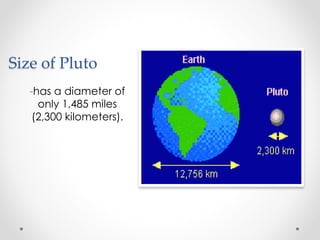
Size of Pluto
-has a diameter of
only 1,485 miles
(2,300 kilometers).
Mass and Gravity of Pluto
 Pluto's mass is about 1.29 x 10²² kg. This
is about 1/500th of the mass of the
Earth.
 The gravity on Pluto is 8% of the gravity on
Earth. (Ex. A 100 pound person on Pluto
would weigh only 8 pounds.)
LENGTH OF A DAY AND YEAR ON
PLUTO
 Each day on Pluto takes 6.39 Earth
days.
 Each year on Pluto takes 248 Earth
years (that is, it takes 248 Earth
years for Pluto to orbit the Sun
once).
PLUTO'S ORBIT
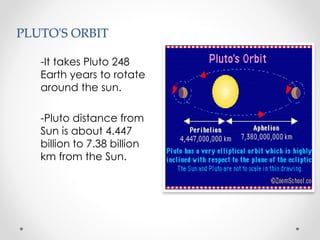
-It takes Pluto 248
Earth years to rotate
around the sun.
-Pluto distance from
Sun is about 4.447
billion to 7.38 billion
km from the Sun.
Temperature on Pluto
-Pluto is very, very cold. The average
temperature on Pluto is –390° F (–235° C)
Pluto’s Atmosphere
-Pluto has a very thin atmosphere of
nitrogen and methane.
-The atmosphere forms when Pluto is
closest to the Sun and the frozen
methane is vaporized by the solar heat.
When it is farther from the Sun, the
methane freezes again.
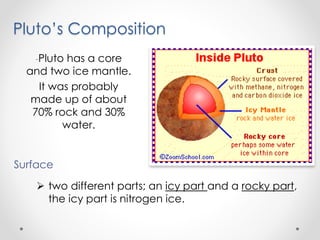
Pluto’s Composition
-Pluto has a core
and two ice mantle.
It was probably
made up of about
70% rock and 30%
water.
Surface
 two different parts; an icy part and a rocky part,
the icy part is nitrogen ice.
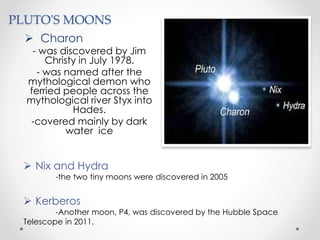
PLUTO'S MOONS
 Charon
- was discovered by Jim
Christy in July 1978.
- was named after the
mythological demon who
ferried people across the
mythological river Styx into
Hades.
-covered mainly by dark
water ice
 Nix and Hydra
-the two tiny moons were discovered in 2005
 Kerberos
-Another moon, P4, was discovered by the Hubble Space
Telescope in 2011.
Pluto and Charon
-were called double planets
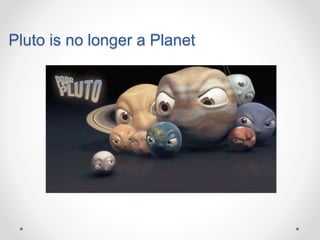
Pluto is no longer a Planet
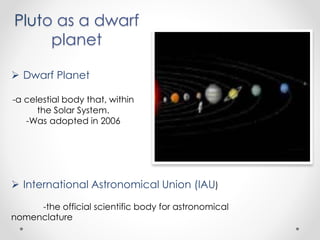
Pluto as a dwarf
planet
 Dwarf Planet
-a celestial body that, within
the Solar System.
-Was adopted in 2006
 International Astronomical Union (IAU)
-the official scientific body for astronomical
nomenclature
What is a planet today?
 According to the new definition, a full-
fledged planet is an object that orbits
the sun and is large enough to have
become round due to the force of its
own gravity. In addition, a planet has to
dominate the neighborhood around its
orbit.
No spacecraft has visited Pluto,
though in July 2015 the spacecraft
New horizons, which was
launched in 2006, is scheduled to
fly by Pluto on it’s way to the
Kuiper belt.
References:
 www.outerspace.com
 www.astronomy.com
 history-of-space-exploration.com
 wikipedia.org/wiki/NASA_Research_Center
Pluto (5th Outer Planet)

Pluto (5th Outer Planet)

  • 2.
    Percival Lowell -A GreatAstronomer -was absolutely convinced that somewhere beyond Neptune there was an undiscovered 9th Planet (Planet X) -he died in 1916 exhausted by his search Clyde W. Tombaugh -was the first to discovered Pluto as the 9th planet in the Solar System from the Arizona's Lowell Observatory.
  • 3.
    Pluto -It was discoveredon February 18th,1930 where in it was publicly announced on March 13th, 1930. -was the coldest, smallest, and outermost planet. (The sky is so dark in Pluto that a person would be able to see stars during day) -was the Roman god of darkness and the underworld.
  • 4.
    Size of Pluto -hasa diameter of only 1,485 miles (2,300 kilometers).
  • 5.
    Mass and Gravityof Pluto  Pluto's mass is about 1.29 x 10²² kg. This is about 1/500th of the mass of the Earth.  The gravity on Pluto is 8% of the gravity on Earth. (Ex. A 100 pound person on Pluto would weigh only 8 pounds.)
  • 6.
    LENGTH OF ADAY AND YEAR ON PLUTO  Each day on Pluto takes 6.39 Earth days.  Each year on Pluto takes 248 Earth years (that is, it takes 248 Earth years for Pluto to orbit the Sun once).
  • 7.
    PLUTO'S ORBIT -It takesPluto 248 Earth years to rotate around the sun. -Pluto distance from Sun is about 4.447 billion to 7.38 billion km from the Sun.
  • 8.
    Temperature on Pluto -Plutois very, very cold. The average temperature on Pluto is –390° F (–235° C) Pluto’s Atmosphere -Pluto has a very thin atmosphere of nitrogen and methane. -The atmosphere forms when Pluto is closest to the Sun and the frozen methane is vaporized by the solar heat. When it is farther from the Sun, the methane freezes again.
  • 9.
    Pluto’s Composition -Pluto hasa core and two ice mantle. It was probably made up of about 70% rock and 30% water. Surface  two different parts; an icy part and a rocky part, the icy part is nitrogen ice.
  • 10.
    PLUTO'S MOONS  Charon -was discovered by Jim Christy in July 1978. - was named after the mythological demon who ferried people across the mythological river Styx into Hades. -covered mainly by dark water ice  Nix and Hydra -the two tiny moons were discovered in 2005  Kerberos -Another moon, P4, was discovered by the Hubble Space Telescope in 2011.
  • 11.
    Pluto and Charon -werecalled double planets
  • 12.
    Pluto is nolonger a Planet
  • 13.
    Pluto as adwarf planet  Dwarf Planet -a celestial body that, within the Solar System. -Was adopted in 2006  International Astronomical Union (IAU) -the official scientific body for astronomical nomenclature
  • 14.
    What is aplanet today?  According to the new definition, a full- fledged planet is an object that orbits the sun and is large enough to have become round due to the force of its own gravity. In addition, a planet has to dominate the neighborhood around its orbit.
  • 15.
    No spacecraft hasvisited Pluto, though in July 2015 the spacecraft New horizons, which was launched in 2006, is scheduled to fly by Pluto on it’s way to the Kuiper belt.
  • 16.
    References:  www.outerspace.com  www.astronomy.com history-of-space-exploration.com  wikipedia.org/wiki/NASA_Research_Center