MODULE 4
ELEMENTS OF PLUMBING
What is Plumbing?
Plumbing – is the art and technique of installing
pipes, fixtures and other apparatuses in
buildings for bringing in the supply, liquids
substances and/or ingredients and removing
them; and such water, liquid and other carried –
wastes hazardous to health, sanitation, life,
property, also the pipes and fixtures after
installation i.e., the plumbing system.
(Section 217.6 NPC 1999)
What is a Plumbing System?
Plumbing System includes all potable water
supply and distribution pipes, all plumbing
fixtures and traps; all sanitary and storm
drainage systems; vent pipes, roof drains,
leaders and downspouts, and all building drains
and sewers, including their respective joints and
connections; devices, receptacles, and
appurtenances within the property; water lines
in the premises; potable, tap, hot and chilled
water piping; potable water treating or using
equipment; fuel gas piping; water heaters and
vents for same. (Sec.217.12 NPC 1999)
What are the major components of the
Plumbing System?
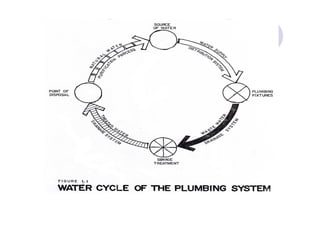
The system constitute the following:
1. Water supply & Distribution System
carries water from the water source, street main or a
pump to the building & to various points of use.
2. Plumbing Fixtures
The receptacles that receive the supplied water &
allow the building occupants to avail & use the water
3. Drainage, Waste & Vent
The piping network within the building which conveys
from the plumbing fixtures all wastes and rainwater
to a treatment facility & point of disposal.
TYPICAL PLUMBING
SYSTEM OF A TOILET AND
BATH
Who is the Plumber?

The Plumber is the one who works or
engages in the business of installing
in buildings the pipes, fixtures and
other apparatus for bringing in the
water supply and removing liquid and
waterborne wastes.
What are the different categories of
Plumbers?
There are 3 categories of plumbers:
1. Apprentice Plumber – a beginner at the trade who
usually serves for 3 to 5 years as a helper to a
journeyman.
2. Journeyman Plumber – has served his
apprenticeship and is competent to perform the tasks of
installing and repairing the plumbing system.
3. Master Plumber – a person technically and legally
qualified and licensed to practice the profession of
master plumbing without limitations in accordance with
R.A. 1378, having passed the examinations conducted
by the Professional Regulation Commission, has
received a Certificate of Registration from the Board of
Master Plumbing and possesses the current License to
Practice. (Sec. 214.5 NPC 1999)
What is the Plumbing Code?
The Plumbing Code is manifestation of the
right of the government to regulate the
practice of the plumbing profession based
on the principle of the protection of public
health.
The basic goal of the National Plumbing
Code of the Philippines is to ensure the
qualified observance of the latest
provisions of the plumbing &
environmental laws.
What are the basic principles that
govern the National Plumbing Code of
the Philippines?
There are 22 basic principles of the 1999
National Plumbing Code of the Philippines
which are updates of the tenets in the
“Plumbing Law of the Philippines”
approved on 18 June 1955 as amended
on 28 November 1959 and revised on 21
December 1999.
The basic principles are as follows:
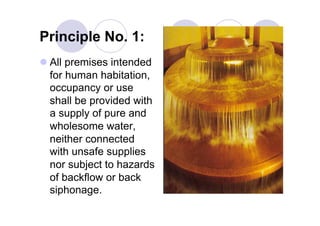
Principle No. 1:
All premises intended
for human habitation,
occupancy or use
shall be provided with
a supply of pure and
wholesome water,
neither connected
with unsafe supplies
nor subject to hazards
of backflow or back
siphonage.
Principle No. 2:
Plumbing fixtures,
devices and
appurtenances shall
be supplied with
water in sufficient
volume & at a
pressure adequate to
enable them to
function satisfactorily
& without undue noise
under normal
conditions of use.
Principle No. 3:
Plumbing shall be
designed and
adjusted to use the
minimum quantity
of water consistent
with proper
performance and
cleaning.
Principle No. 4:
Devices for heating
and storing water
shall be so
designed and
installed as to
prevent dangers
from explosion
through
overheating.
Principle No. 5:
Every building having
plumbing fixtures
installed & intended for
human habitation,
occupancy or use on
premises abutting on a
street, alley or easement
where there is a public
sewer, shall be
connected to the public
sewer system.
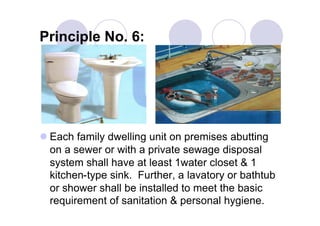
Principle No. 6:
Each family dwelling unit on premises abutting
on a sewer or with a private sewage disposal
system shall have at least 1water closet & 1
kitchen-type sink. Further, a lavatory or bathtub
or shower shall be installed to meet the basic
requirement of sanitation & personal hygiene.
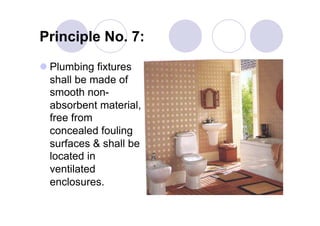
Principle No. 7:
Plumbing fixtures
shall be made of
smooth non-
absorbent material,
free from
concealed fouling
surfaces & shall be
located in
ventilated
enclosures.
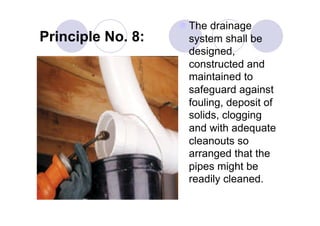
Principle No. 8:
The drainage
system shall be
designed,
constructed and
maintained to
safeguard against
fouling, deposit of
solids, clogging
and with adequate
cleanouts so
arranged that the
pipes might be
readily cleaned.
Principle No. 9:
All piping of plumbing
systems shall be of
durable NAMPAP –
APPROVED
materials, free from
defective
workmanship,
designed &
constructed by
Registered Master
Plumbers to ensure
satisfactory service.
Principle No. 10:
Each fixture
directly connected
to the drainage
system shall be
equipped with
water – sealed
trap.
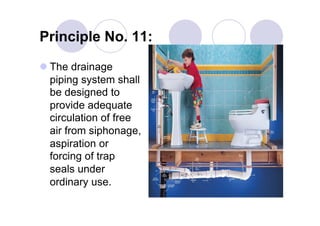
Principle No. 11:
The drainage
piping system shall
be designed to
provide adequate
circulation of free
air from siphonage,
aspiration or
forcing of trap
seals under
ordinary use.
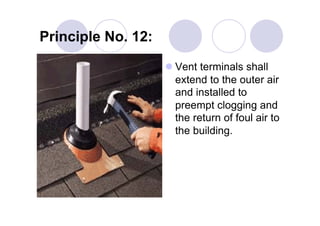
Principle No. 12:
Vent terminals shall
extend to the outer air
and installed to
preempt clogging and
the return of foul air to
the building.
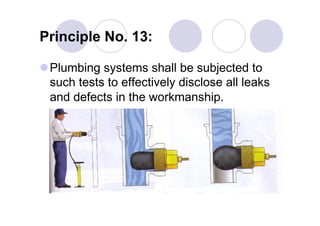
Principle No. 13:
Plumbing systems shall be subjected to
such tests to effectively disclose all leaks
and defects in the workmanship.
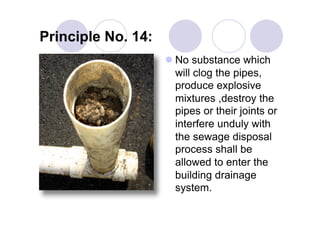
Principle No. 14:
No substance which
will clog the pipes,
produce explosive
mixtures ,destroy the
pipes or their joints or
interfere unduly with
the sewage disposal
process shall be
allowed to enter the
building drainage
system.
Principle No. 15:
Proper protection shall be
provided to prevent
contamination of food,
water, sterile goods &
similar materials by
backflow of sewage.
When necessary, the
fixture, device or
appliance shall be
connected indirectly with
the building drainage
system.
Principle No. 16:
No water closet shall be located in a room
or compartment which is not properly
lighted or ventilated.
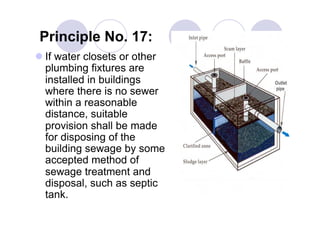
Principle No. 17:
If water closets or other
plumbing fixtures are
installed in buildings
where there is no sewer
within a reasonable
distance, suitable
provision shall be made
for disposing of the
building sewage by some
accepted method of
sewage treatment and
disposal, such as septic
tank.
Principle No. 18:
Where a plumbing drainage system may be
subject to backflow of sewage, suitable provision
shall be made to prevent its overflow in the
building.
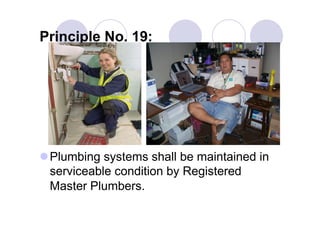
Principle No. 19:
Plumbing systems shall be maintained in
serviceable condition by Registered
Master Plumbers.
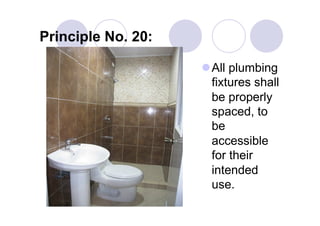
Principle No. 20:
All plumbing
fixtures shall
be properly
spaced, to
be
accessible
for their
intended
use.
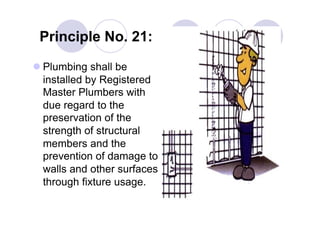
Principle No. 21:
Plumbing shall be
installed by Registered
Master Plumbers with
due regard to the
preservation of the
strength of structural
members and the
prevention of damage to
walls and other surfaces
through fixture usage.
Principle No. 22:
Sewage or other
waste from a
plumbing system
which may be
deleterious to
surface or sub –
surface waters
shall not be
discharge into the
ground or onto any
waterway, unless
first rendered
innocuous through
subjection to some
acceptable form of
treatment.
plumbing principles.pdf

plumbing principles.pdf

  • 1.
  • 2.
    What is Plumbing? Plumbing– is the art and technique of installing pipes, fixtures and other apparatuses in buildings for bringing in the supply, liquids substances and/or ingredients and removing them; and such water, liquid and other carried – wastes hazardous to health, sanitation, life, property, also the pipes and fixtures after installation i.e., the plumbing system. (Section 217.6 NPC 1999)
  • 3.
    What is aPlumbing System? Plumbing System includes all potable water supply and distribution pipes, all plumbing fixtures and traps; all sanitary and storm drainage systems; vent pipes, roof drains, leaders and downspouts, and all building drains and sewers, including their respective joints and connections; devices, receptacles, and appurtenances within the property; water lines in the premises; potable, tap, hot and chilled water piping; potable water treating or using equipment; fuel gas piping; water heaters and vents for same. (Sec.217.12 NPC 1999)
  • 5.
    What are themajor components of the Plumbing System? The system constitute the following: 1. Water supply & Distribution System carries water from the water source, street main or a pump to the building & to various points of use. 2. Plumbing Fixtures The receptacles that receive the supplied water & allow the building occupants to avail & use the water 3. Drainage, Waste & Vent The piping network within the building which conveys from the plumbing fixtures all wastes and rainwater to a treatment facility & point of disposal.
  • 6.
    TYPICAL PLUMBING SYSTEM OFA TOILET AND BATH
  • 7.
    Who is thePlumber?  The Plumber is the one who works or engages in the business of installing in buildings the pipes, fixtures and other apparatus for bringing in the water supply and removing liquid and waterborne wastes.
  • 8.
    What are thedifferent categories of Plumbers? There are 3 categories of plumbers: 1. Apprentice Plumber – a beginner at the trade who usually serves for 3 to 5 years as a helper to a journeyman. 2. Journeyman Plumber – has served his apprenticeship and is competent to perform the tasks of installing and repairing the plumbing system. 3. Master Plumber – a person technically and legally qualified and licensed to practice the profession of master plumbing without limitations in accordance with R.A. 1378, having passed the examinations conducted by the Professional Regulation Commission, has received a Certificate of Registration from the Board of Master Plumbing and possesses the current License to Practice. (Sec. 214.5 NPC 1999)
  • 9.
    What is thePlumbing Code? The Plumbing Code is manifestation of the right of the government to regulate the practice of the plumbing profession based on the principle of the protection of public health. The basic goal of the National Plumbing Code of the Philippines is to ensure the qualified observance of the latest provisions of the plumbing & environmental laws.
  • 10.
    What are thebasic principles that govern the National Plumbing Code of the Philippines? There are 22 basic principles of the 1999 National Plumbing Code of the Philippines which are updates of the tenets in the “Plumbing Law of the Philippines” approved on 18 June 1955 as amended on 28 November 1959 and revised on 21 December 1999. The basic principles are as follows:
  • 11.
    Principle No. 1: Allpremises intended for human habitation, occupancy or use shall be provided with a supply of pure and wholesome water, neither connected with unsafe supplies nor subject to hazards of backflow or back siphonage.
  • 12.
    Principle No. 2: Plumbingfixtures, devices and appurtenances shall be supplied with water in sufficient volume & at a pressure adequate to enable them to function satisfactorily & without undue noise under normal conditions of use.
  • 13.
    Principle No. 3: Plumbingshall be designed and adjusted to use the minimum quantity of water consistent with proper performance and cleaning.
  • 14.
    Principle No. 4: Devicesfor heating and storing water shall be so designed and installed as to prevent dangers from explosion through overheating.
  • 15.
    Principle No. 5: Everybuilding having plumbing fixtures installed & intended for human habitation, occupancy or use on premises abutting on a street, alley or easement where there is a public sewer, shall be connected to the public sewer system.
  • 16.
    Principle No. 6: Eachfamily dwelling unit on premises abutting on a sewer or with a private sewage disposal system shall have at least 1water closet & 1 kitchen-type sink. Further, a lavatory or bathtub or shower shall be installed to meet the basic requirement of sanitation & personal hygiene.
  • 17.
    Principle No. 7: Plumbingfixtures shall be made of smooth non- absorbent material, free from concealed fouling surfaces & shall be located in ventilated enclosures.
  • 18.
    Principle No. 8: Thedrainage system shall be designed, constructed and maintained to safeguard against fouling, deposit of solids, clogging and with adequate cleanouts so arranged that the pipes might be readily cleaned.
  • 19.
    Principle No. 9: Allpiping of plumbing systems shall be of durable NAMPAP – APPROVED materials, free from defective workmanship, designed & constructed by Registered Master Plumbers to ensure satisfactory service.
  • 20.
    Principle No. 10: Eachfixture directly connected to the drainage system shall be equipped with water – sealed trap.
  • 21.
    Principle No. 11: Thedrainage piping system shall be designed to provide adequate circulation of free air from siphonage, aspiration or forcing of trap seals under ordinary use.
  • 22.
    Principle No. 12: Ventterminals shall extend to the outer air and installed to preempt clogging and the return of foul air to the building.
  • 23.
    Principle No. 13: Plumbingsystems shall be subjected to such tests to effectively disclose all leaks and defects in the workmanship.
  • 24.
    Principle No. 14: Nosubstance which will clog the pipes, produce explosive mixtures ,destroy the pipes or their joints or interfere unduly with the sewage disposal process shall be allowed to enter the building drainage system.
  • 25.
    Principle No. 15: Properprotection shall be provided to prevent contamination of food, water, sterile goods & similar materials by backflow of sewage. When necessary, the fixture, device or appliance shall be connected indirectly with the building drainage system.
  • 26.
    Principle No. 16: Nowater closet shall be located in a room or compartment which is not properly lighted or ventilated.
  • 27.
    Principle No. 17: Ifwater closets or other plumbing fixtures are installed in buildings where there is no sewer within a reasonable distance, suitable provision shall be made for disposing of the building sewage by some accepted method of sewage treatment and disposal, such as septic tank.
  • 28.
    Principle No. 18: Wherea plumbing drainage system may be subject to backflow of sewage, suitable provision shall be made to prevent its overflow in the building.
  • 29.
    Principle No. 19: Plumbingsystems shall be maintained in serviceable condition by Registered Master Plumbers.
  • 30.
    Principle No. 20: Allplumbing fixtures shall be properly spaced, to be accessible for their intended use.
  • 31.
    Principle No. 21: Plumbingshall be installed by Registered Master Plumbers with due regard to the preservation of the strength of structural members and the prevention of damage to walls and other surfaces through fixture usage.
  • 32.
    Principle No. 22: Sewageor other waste from a plumbing system which may be deleterious to surface or sub – surface waters shall not be discharge into the ground or onto any waterway, unless first rendered innocuous through subjection to some acceptable form of treatment.