 Telepharmacy is the delivery of pharmaceutical care
via telecommunications to patients in locations
where they may not have direct contact with a
pharmacist
 It includes and retains the active role of the
pharmacist as the primary health care provider in
the delivery of pharmacy services.
2
 To make high quality healthcare available to
traditionally under privileged population
 Save the time wasted by both the health care providers
and patients in travelling
 Case monitoring, home care and remote critical care
 Reduce costs of medical care
 Survey and track diseases
3
1) Store and forward
2) Interactive services
3) Remote monitoring
4) Mobile telepharmacy
4
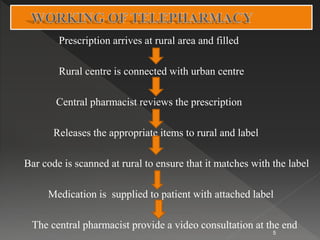
Prescription arrives at rural area and filled
Rural centre is connected with urban centre
Central pharmacist reviews the prescription
Releases the appropriate items to rural and label
Bar code is scanned at rural to ensure that it matches with the label
Medication is supplied to patient with attached label
The central pharmacist provide a video consultation at the end
5
 It is important that patients are comfortable with the
telepharmacy technology prior to receiving services.
Consideration should be given to formally marketing the
telepharmacy concept to the public prior to implementing
services.
 This can help the patients and public feel more comfortable and
willing to use the services. Special attention and consideration
should be given to orientation and education of senior citizens
who have not been exposed to, or do not have, extensive
experience with technology.
6
1. Becoming familiar with the laws and rules
a) General principles & first point of contact
b) License Application - National Council for
Prescription Drug Programs (NCPDP) Drug
Enforcement Administration (DEA)
c) Third Party Reimbursement
2. Assess the need
3. Develop community partners
4. Secure a physical location
7
 Computer - QS-1, Midco Data, PDX, Rx30, IsoRx
 patient medication profile
 screening for drug interactions
 generating prescription vial labels with patient
instructions
 billing third party payers
 Video
8
 Acceptance of this modality
 Financial unavailability
 Literacy rate and diversity in languages
 Technical constraints
9
 Access to healthcare services
 Economic benefits
 Patient satisfaction
 Effective patient counselling
 Minimal scarcity of pharmacist
10
 Pharmacy regulation laws
 Operational difficulties
 More time, effort and money
 Reluctance to use technology
11
 Rural residents and communities lack easy access to
healthcare services often due to geographical and
demographical factors.
 Telepharmacy holds significant promise as a
technology to improve access to pharmaceutical care
for people living in rural and remote communities.
12
1. Roohi fathima, et al. Telepharmacy, ejbps, 2018, Volume
5, Issue 3, 176-182.
2. Devang P Parikh, et al. Growth and Development of
Telemedicine, ijmsph, 2014, vol 3, issue 5, 527-531.
3. Arjun Poudel, et al. Telepharmacy: a pharmacist’s
perspective on the clinical benefits and challenges, iprp,
2016, vol 5, 75-82.
13
14

Telepharmacy

  • 2.
     Telepharmacy isthe delivery of pharmaceutical care via telecommunications to patients in locations where they may not have direct contact with a pharmacist  It includes and retains the active role of the pharmacist as the primary health care provider in the delivery of pharmacy services. 2
  • 3.
     To makehigh quality healthcare available to traditionally under privileged population  Save the time wasted by both the health care providers and patients in travelling  Case monitoring, home care and remote critical care  Reduce costs of medical care  Survey and track diseases 3
  • 4.
    1) Store andforward 2) Interactive services 3) Remote monitoring 4) Mobile telepharmacy 4
  • 5.
    Prescription arrives atrural area and filled Rural centre is connected with urban centre Central pharmacist reviews the prescription Releases the appropriate items to rural and label Bar code is scanned at rural to ensure that it matches with the label Medication is supplied to patient with attached label The central pharmacist provide a video consultation at the end 5
  • 6.
     It isimportant that patients are comfortable with the telepharmacy technology prior to receiving services. Consideration should be given to formally marketing the telepharmacy concept to the public prior to implementing services.  This can help the patients and public feel more comfortable and willing to use the services. Special attention and consideration should be given to orientation and education of senior citizens who have not been exposed to, or do not have, extensive experience with technology. 6
  • 7.
    1. Becoming familiarwith the laws and rules a) General principles & first point of contact b) License Application - National Council for Prescription Drug Programs (NCPDP) Drug Enforcement Administration (DEA) c) Third Party Reimbursement 2. Assess the need 3. Develop community partners 4. Secure a physical location 7
  • 8.
     Computer -QS-1, Midco Data, PDX, Rx30, IsoRx  patient medication profile  screening for drug interactions  generating prescription vial labels with patient instructions  billing third party payers  Video 8
  • 9.
     Acceptance ofthis modality  Financial unavailability  Literacy rate and diversity in languages  Technical constraints 9
  • 10.
     Access tohealthcare services  Economic benefits  Patient satisfaction  Effective patient counselling  Minimal scarcity of pharmacist 10
  • 11.
     Pharmacy regulationlaws  Operational difficulties  More time, effort and money  Reluctance to use technology 11
  • 12.
     Rural residentsand communities lack easy access to healthcare services often due to geographical and demographical factors.  Telepharmacy holds significant promise as a technology to improve access to pharmaceutical care for people living in rural and remote communities. 12
  • 13.
    1. Roohi fathima,et al. Telepharmacy, ejbps, 2018, Volume 5, Issue 3, 176-182. 2. Devang P Parikh, et al. Growth and Development of Telemedicine, ijmsph, 2014, vol 3, issue 5, 527-531. 3. Arjun Poudel, et al. Telepharmacy: a pharmacist’s perspective on the clinical benefits and challenges, iprp, 2016, vol 5, 75-82. 13
  • 14.