www.eatwellproject.euPolicies to promote healthy eating in Europe: instruments and their effectiveness (EATWELL)Professor W Bruce TraillHead of Department of Food Economics and MarketingThe University of Reading
Outline1. Brief outline of Eatwell2. Nutrition policies in Europe3. Evidence on evaluation approaches and policy effectiveness (limited)www.eatwellproject.eu
www.eatwellproject.eu1. Background to EatwellAn obesity ‘epidemic’   Implications for health (€70b per year European health care costs)Diet quality also matters  (healthcare costs perhaps as great as obesity?)Concern about the sustainability of health care systemsEconomic productivity also suffersGovernments  have  recognised  the scale of the problem and are anxious to reverse current trendsA desire that policy be ‘evidence-based’
Objectives of EatwellBenchmark policy interventions and their evaluations in the EUUndertake new evaluations using modern econometric techniques applied to secondary data on diets  Assess lessons the public sector can learn from the private sector with respect to healthy eating promotionwww.eatwellproject.eu
Objectives (continued)Assess public, private and stakeholder acceptance of alternative interventionsRecommend evaluation strategiesDevelop proposals for effective and acceptable policy interventionswww.eatwellproject.eu
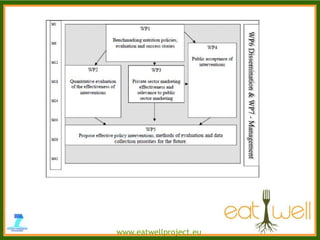
www.eatwellproject.eu
7.
2. Nutrition Policies in Europewww.eatwellproject.eu
Benchmarking nutrition policies in Europe, their evaluation and identification of successes and failuresPolicy interventions: any government action which can affect people’s healthy eating behaviour by (a) supporting more informed choice; (b) changing the market environmentHealthy eating: the adherence to the nutrition recommendations of WHO and eating to maintain healthy weight www.eatwellproject.eu
www.eatwellproject.euMethodClassification of policy types Mapping of interventions (exhaustive in terms of policy types) through:information services of governmental websitesgeneral search in databases, journals, World Wide Webdirect consultation with policy makers and local public servants previous reviews
www.eatwellproject.euDistribution of detected interventions by type of policy action.
3.  Evaluation methods and policy effectivenessReview of existing evaluations of detected policies through:official evaluation documents Where necessary supplemented by evidence from other countries and academic literaturewww.eatwellproject.eu
Good Evaluation principlesthe choice of an outcome variable should be consistent with the policy objective;sampling and measurement strategy should guarantee representativeness of the data; appropriate consideration should be given to confounding factors and specification of the counterfactual; self-selection and other  biases should be purged; and Evaluation should go beyond average outcomes and capture disparities in population sub-groups.www.eatwellproject.eu
Information measureswww.eatwellproject.eu
www.eatwellproject.eu
ConclusionsThe evidence base needs further development!  Evaluation of policies is uncommon and unsophisticated.  Information measures are necessary for informed choice, but have limited impact on diets (at least in the short run)Changing the market environment has generally been avoided.  It is probably more effective but may be considered ‘interventionist’www.eatwellproject.eu
Thank  you!17

Plenary4 b trail

  • 1.
    www.eatwellproject.euPolicies to promotehealthy eating in Europe: instruments and their effectiveness (EATWELL)Professor W Bruce TraillHead of Department of Food Economics and MarketingThe University of Reading
  • 2.
    Outline1. Brief outlineof Eatwell2. Nutrition policies in Europe3. Evidence on evaluation approaches and policy effectiveness (limited)www.eatwellproject.eu
  • 3.
    www.eatwellproject.eu1. Background toEatwellAn obesity ‘epidemic’ Implications for health (€70b per year European health care costs)Diet quality also matters (healthcare costs perhaps as great as obesity?)Concern about the sustainability of health care systemsEconomic productivity also suffersGovernments have recognised the scale of the problem and are anxious to reverse current trendsA desire that policy be ‘evidence-based’
  • 4.
    Objectives of EatwellBenchmarkpolicy interventions and their evaluations in the EUUndertake new evaluations using modern econometric techniques applied to secondary data on diets Assess lessons the public sector can learn from the private sector with respect to healthy eating promotionwww.eatwellproject.eu
  • 5.
    Objectives (continued)Assess public,private and stakeholder acceptance of alternative interventionsRecommend evaluation strategiesDevelop proposals for effective and acceptable policy interventionswww.eatwellproject.eu
  • 6.
  • 7.
  • 8.
    2. Nutrition Policiesin Europewww.eatwellproject.eu
  • 9.
    Benchmarking nutrition policiesin Europe, their evaluation and identification of successes and failuresPolicy interventions: any government action which can affect people’s healthy eating behaviour by (a) supporting more informed choice; (b) changing the market environmentHealthy eating: the adherence to the nutrition recommendations of WHO and eating to maintain healthy weight www.eatwellproject.eu
  • 10.
    www.eatwellproject.euMethodClassification of policytypes Mapping of interventions (exhaustive in terms of policy types) through:information services of governmental websitesgeneral search in databases, journals, World Wide Webdirect consultation with policy makers and local public servants previous reviews
  • 11.
    www.eatwellproject.euDistribution of detectedinterventions by type of policy action.
  • 12.
    3. Evaluationmethods and policy effectivenessReview of existing evaluations of detected policies through:official evaluation documents Where necessary supplemented by evidence from other countries and academic literaturewww.eatwellproject.eu
  • 13.
    Good Evaluation principlesthechoice of an outcome variable should be consistent with the policy objective;sampling and measurement strategy should guarantee representativeness of the data; appropriate consideration should be given to confounding factors and specification of the counterfactual; self-selection and other biases should be purged; and Evaluation should go beyond average outcomes and capture disparities in population sub-groups.www.eatwellproject.eu
  • 14.
  • 15.
  • 16.
    ConclusionsThe evidence baseneeds further development! Evaluation of policies is uncommon and unsophisticated. Information measures are necessary for informed choice, but have limited impact on diets (at least in the short run)Changing the market environment has generally been avoided. It is probably more effective but may be considered ‘interventionist’www.eatwellproject.eu
  • 17.