Fiona Carragher FRCPath @DepCSOFiona
Deputy Chief Scientific Officer for England
england.amrdiagnostics@nhs.net
UK AMR Diagnostics Collaborative:
Maximising the use of diagnostic technology to
tackle AMR
November 2018
The UK AMR Strategy: a tripartite approach
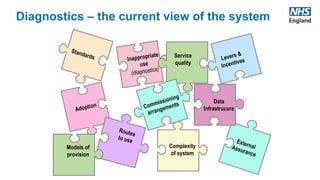
Diagnostics – the current view of the system
Complexity
of system
Models of
provision
Service
quality
Data
Infrastrucure
UK AMRDC- Providing a single point of
focus for the system
System
Leadership
Strategic
Direction
UK
Oversight
Local
connectivity
& good
practice
System
Alignment
Nat’l Policy,
Levers,
Incentives,
UKAMRDC
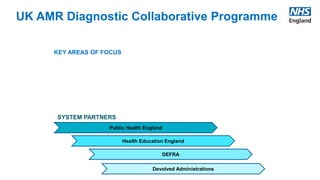
UK AMR Diagnostic Collaborative Programme
SYSTEM PARTNERS
Public Health England
Health Education England
DEFRA
KEY AREAS OF FOCUS
Devolved Administrations
Diagnostic stewardship- definition
• Coordinated professional guidance and
interventions to improve patient understanding, care
and management through the appropriate use of
clinical assessment and clinical scoring algorithms,
biomarker tests and/or microbiological diagnostics to
guide therapeutic decisions or screening strategies.
• It should promote appropriate, timely diagnostic
testing, including specimen collection, and pathogen
identification and accurate, timely and audited reporting
of results to guide care. It should discourage
unnecessary diagnostic testing and the use of tests that
yield misleading results.
• Diagnostic Stewardship should utilize microbiological
data, including accurate and representative AMR
surveillance data to inform local treatment guidelines,
and AMR control strategies, and should be an integral
component of measures to improve antimicrobial
stewardship and infection prevention and control
WHO 2016: Diagnostic stewardship
A guide to implementation in antimicrobial resistance
surveillance sites
UK AMR DC 18/19 areas of focus
-Diagnostic Stewardship
• Use of biomarkers eg CRP/Procalcitonin in acute
settings or as POCT in the community
• Quality improvement approach to diagnostics within
the blood culture pathway enabling timely review of
antibiotic therapy
• Urinary infections: Tackling inappropriate use of
urinary diagnostics and focus on the urine culture
pathway
UK wide building on good practise, driving
quality improvement and addressing variation
Innovation: challenging ourselves
to go further, faster
Handheld
‘lab on a chip’
High throughput
genomic technologies
Point of
care
testing
Evolving technologies
Disruptive approaches –
What else can we learn from:
Big data,
analytics & AI
Developing
world
approaches
Animal
Health
Other
scientific
specialisms
UK AMR Diagnostic Collaborative
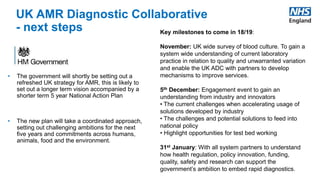
- next steps
• The government will shortly be setting out a
refreshed UK strategy for AMR, this is likely to
set out a longer term vision accompanied by a
shorter term 5 year National Action Plan
• The new plan will take a coordinated approach,
setting out challenging ambitions for the next
five years and commitments across humans,
animals, food and the environment.
Key milestones to come in 18/19:
November: UK wide survey of blood culture. To gain a
system wide understanding of current laboratory
practice in relation to quality and unwarranted variation
and enable the UK ADC with partners to develop
mechanisms to improve services.
5th December: Engagement event to gain an
understanding from industry and innovators
• The current challenges when accelerating usage of
solutions developed by industry
• The challenges and potential solutions to feed into
national policy
• Highlight opportunities for test bed working
31st January: With all system partners to understand
how health regulation, policy innovation, funding,
quality, safety and research can support the
government’s ambition to embed rapid diagnostics.
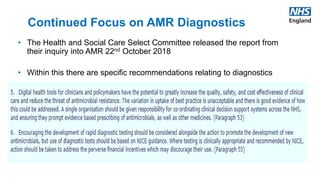
• The Health and Social Care Select Committee released the report from
their inquiry into AMR 22nd October 2018
• Within this there are specific recommendations relating to diagnostics
Continued Focus on AMR Diagnostics
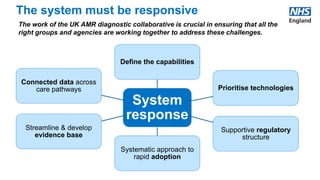
The system must be responsive
System
response
Define the capabilities
Prioritise technologies
Supportive regulatory
structure
Systematic approach to
rapid adoption
Streamline & develop
evidence base
Connected data across
care pathways
The work of the UK AMR diagnostic collaborative is crucial in ensuring that all the
right groups and agencies are working together to address these challenges.
The UKAMRDC
Working in partnership
UKAMRDC

UK AMR Diagnositics Collaborative

  • 1.
    Fiona Carragher FRCPath@DepCSOFiona Deputy Chief Scientific Officer for England england.amrdiagnostics@nhs.net UK AMR Diagnostics Collaborative: Maximising the use of diagnostic technology to tackle AMR November 2018
  • 2.
    The UK AMRStrategy: a tripartite approach
  • 3.
    Diagnostics – thecurrent view of the system Complexity of system Models of provision Service quality Data Infrastrucure
  • 4.
    UK AMRDC- Providinga single point of focus for the system System Leadership Strategic Direction UK Oversight Local connectivity & good practice System Alignment Nat’l Policy, Levers, Incentives, UKAMRDC
  • 5.
    UK AMR DiagnosticCollaborative Programme SYSTEM PARTNERS Public Health England Health Education England DEFRA KEY AREAS OF FOCUS Devolved Administrations
  • 6.
    Diagnostic stewardship- definition •Coordinated professional guidance and interventions to improve patient understanding, care and management through the appropriate use of clinical assessment and clinical scoring algorithms, biomarker tests and/or microbiological diagnostics to guide therapeutic decisions or screening strategies. • It should promote appropriate, timely diagnostic testing, including specimen collection, and pathogen identification and accurate, timely and audited reporting of results to guide care. It should discourage unnecessary diagnostic testing and the use of tests that yield misleading results. • Diagnostic Stewardship should utilize microbiological data, including accurate and representative AMR surveillance data to inform local treatment guidelines, and AMR control strategies, and should be an integral component of measures to improve antimicrobial stewardship and infection prevention and control WHO 2016: Diagnostic stewardship A guide to implementation in antimicrobial resistance surveillance sites
  • 7.
    UK AMR DC18/19 areas of focus -Diagnostic Stewardship • Use of biomarkers eg CRP/Procalcitonin in acute settings or as POCT in the community • Quality improvement approach to diagnostics within the blood culture pathway enabling timely review of antibiotic therapy • Urinary infections: Tackling inappropriate use of urinary diagnostics and focus on the urine culture pathway UK wide building on good practise, driving quality improvement and addressing variation
  • 8.
    Innovation: challenging ourselves togo further, faster Handheld ‘lab on a chip’ High throughput genomic technologies Point of care testing Evolving technologies Disruptive approaches – What else can we learn from: Big data, analytics & AI Developing world approaches Animal Health Other scientific specialisms
  • 9.
    UK AMR DiagnosticCollaborative - next steps • The government will shortly be setting out a refreshed UK strategy for AMR, this is likely to set out a longer term vision accompanied by a shorter term 5 year National Action Plan • The new plan will take a coordinated approach, setting out challenging ambitions for the next five years and commitments across humans, animals, food and the environment. Key milestones to come in 18/19: November: UK wide survey of blood culture. To gain a system wide understanding of current laboratory practice in relation to quality and unwarranted variation and enable the UK ADC with partners to develop mechanisms to improve services. 5th December: Engagement event to gain an understanding from industry and innovators • The current challenges when accelerating usage of solutions developed by industry • The challenges and potential solutions to feed into national policy • Highlight opportunities for test bed working 31st January: With all system partners to understand how health regulation, policy innovation, funding, quality, safety and research can support the government’s ambition to embed rapid diagnostics.
  • 10.
    • The Healthand Social Care Select Committee released the report from their inquiry into AMR 22nd October 2018 • Within this there are specific recommendations relating to diagnostics Continued Focus on AMR Diagnostics
  • 11.
    The system mustbe responsive System response Define the capabilities Prioritise technologies Supportive regulatory structure Systematic approach to rapid adoption Streamline & develop evidence base Connected data across care pathways The work of the UK AMR diagnostic collaborative is crucial in ensuring that all the right groups and agencies are working together to address these challenges.
  • 12.
    The UKAMRDC Working inpartnership UKAMRDC

Editor's Notes

  • #3 Antimicrobial resistance arises when the organisms that cause infection evolve ways to survive treatment. Once standard treatments are ineffective, it is easier for infections to persist and spread. The inappropriate use of anti-infectives and antimicrobials in both human and animal medicine, and unintentional exposure, for example through environmental contamination and food, is rapidly accelerating the pace at which it develops and spreads. By 2030, the global human consumption of antibiotics is forecast to rise by more than 30% and animal antimicrobial use is also expected to increase, especially in low- and middle-income countries. The rise and spread of antimicrobial resistance is creating a new generation of ‘superbugs’ that cannot be treated with existing medicines. Already, antimicrobial resistance is estimated to cause 700,000 deaths around the world each year. That figure is predicted to rise to 10 million, alongside a cumulative cost of $100 trillion, by 2050 if no action is taken. The 2013–2018 strategy and UK Government ambitions on antimicrobial resistance have helped reduce antibiotic use in both humans and food-producing animals The UK programme is currently focused on delivery of those ambitions through 4 core programmes (infection, prescribing, diagnostics, animal use) and 3 supporting work-streams (surveillance and behaviour, education and training, global and domestic research and drug pipeline activity).
  • #7 Diagnostics as part of the multi-professional approach ‘a seamless partnership between laboratories, pharmacists and clinicians’
  • #9 Biomarkers, immunology, genomics
  • #12 Define the capabilities that new technologies should deliver in different settings Prioritise technologies which have the potential to both assess the pathogen as well as resistance that can inform and reduce antibiotic prescribing Encourage industry to focus on the development of multiplex systems reflecting the clinical presentations that are often affected by multiple organisms Ensure that regulations in relation to licencing facilitate rapid adoption of priority technologies, Streamline the development of the evidence base for many tests and fast track clinical trial data to aid implementation into clinical use Ensure the availability of test results both to support clinical decision making and epidemiology.