PLC (Programmable
Logic Controller)
Presented by : Mohit Ojha
Contents :
 What is PLC?
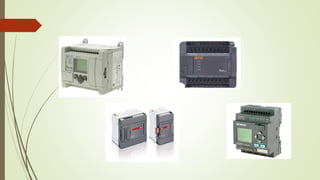
 Leading Manufacturers of PLC
 Need of PLC in Automation
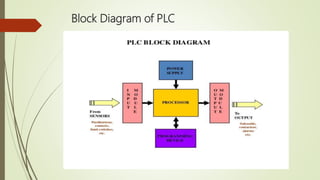
 Block diagram of PLC
 PLC Instruction set
 Nomenclature in Programming PLC
 How it can be programmed?
 Understanding Ladder Logics
 Where to use PLC?
 Advantages
 Disadvantages
What is PLC?
PLC is a Programmable Logic Controller , which is in
solid state /computerized industrial controller which
performs discrete or sequential logic in industrial
environment.
It is a digital operating electronic device which consist
of internal memory to store the program to perform
specific functions such as logic , sequence , counting ,
timing etc.
Leading Manufacturers of PLC :
Need of PLC in Automation
 In automation of Industries , Plants or Processes.
 Developing a control system for controlling and monitoring
it.
 Efficient working.
 Easy and economical solutions for automation.
 Improve mass productivity of large scale industries
 Maintain the quality and quantity of material
 Avoids severe accidents and errors.
 Reduces the manpower.
 Higher accuracy in less time while production.
Block Diagram of PLC
PLC instruction set
 NORMALLY OPEN (NO) :
 NORMALLY CLOSED (NC) :
Contact State of contact Contact act as
NO
1 (ON) close switch
0 (OFF) open switch
Contact State of contact Contact act as
NC
1 (OFF) close switch
0 (ON) open switch
 CONTACT COIL OR OUTPUT COIL :
 INVERSE CONTACT OR OUTPUT COIL :
 SET INSTRUCTION OR SET COIL :
 RESET INSTRUCTION OR RESET COIL :
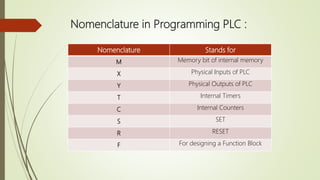
Nomenclature in Programming PLC :
Nomenclature Stands for
M Memory bit of internal memory
X Physical Inputs of PLC
Y Physical Outputs of PLC
T Internal Timers
C Internal Counters
S SET
R RESET
F For designing a Function Block
How it can be Programmed?
PLC programming languages :
 Graphical languages :
 Ladder Logic Diagram (LD)
 Function Block Diagram (FBD)
 Sequential Function Chart (SFT)
 Text based languages :
 Instruction list (IL)
 Structured text (ST)
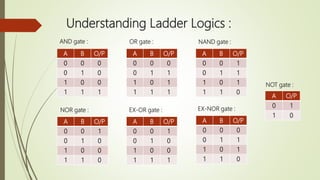
Understanding Ladder Logics :
A B O/P
0 0 0
0 1 0
1 0 0
1 1 1
A B O/P
0 0 0
0 1 1
1 0 1
1 1 1
A B O/P
0 0 1
0 1 1
1 0 1
1 1 0
A B O/P
0 0 1
0 1 0
1 0 0
1 1 0
A B O/P
0 0 1
0 1 0
1 0 0
1 1 1
A B O/P
0 0 0
0 1 1
1 0 1
1 1 0
AND gate : OR gate : NAND gate :
NOR gate : EX-OR gate : EX-NOR gate :
A O/P
0 1
1 0
NOT gate :
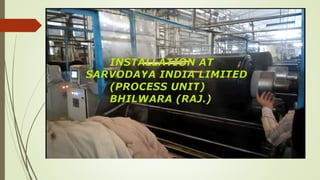
Where to use PLC?
 Textile Industries :
 Automatic Jigger Dyeing Machine
 Speedframe Machine automation
 Other Industries :
 Pump and Motor Control applications
 Cooling towers
 Water level controller and monitoring
 Automation of flood gates of Dams etc.
Automatic Electronic Jigger Dyeing
Machine
Speedframe Machine automation
ADVANTAGES :
 Faster scan time.
 Intelligent input/output modules.
 High speed
 Reliable
 Minimum maintenance.
 Flexibility in programming and reprogramming.
 Small in size.
 Easier modification.
 A wide range of control application.
 Capable to communicate with computers in plant.
 Troubleshooting programs in easy which reduces downtime.
DISADVANTAGES :
 Some PLC’s turn ON , when the power is restored which may
cause any accident.
 For specific small scale industries electromechanical systems
like Relay based systems are less costly than PLC.
 PLC gets affected under high temperature, vibrations
conditions but both of these can be overcome while
installation of PLC.
THANK YOU ...!!!

Basics of PLC

  • 1.
  • 2.
    Contents :  Whatis PLC?  Leading Manufacturers of PLC  Need of PLC in Automation  Block diagram of PLC  PLC Instruction set  Nomenclature in Programming PLC  How it can be programmed?  Understanding Ladder Logics  Where to use PLC?  Advantages  Disadvantages
  • 3.
    What is PLC? PLCis a Programmable Logic Controller , which is in solid state /computerized industrial controller which performs discrete or sequential logic in industrial environment. It is a digital operating electronic device which consist of internal memory to store the program to perform specific functions such as logic , sequence , counting , timing etc.
  • 4.
  • 6.
    Need of PLCin Automation  In automation of Industries , Plants or Processes.  Developing a control system for controlling and monitoring it.  Efficient working.  Easy and economical solutions for automation.  Improve mass productivity of large scale industries  Maintain the quality and quantity of material  Avoids severe accidents and errors.  Reduces the manpower.  Higher accuracy in less time while production.
  • 7.
  • 8.
    PLC instruction set NORMALLY OPEN (NO) :  NORMALLY CLOSED (NC) : Contact State of contact Contact act as NO 1 (ON) close switch 0 (OFF) open switch Contact State of contact Contact act as NC 1 (OFF) close switch 0 (ON) open switch
  • 9.
     CONTACT COILOR OUTPUT COIL :  INVERSE CONTACT OR OUTPUT COIL :  SET INSTRUCTION OR SET COIL :  RESET INSTRUCTION OR RESET COIL :
  • 10.
    Nomenclature in ProgrammingPLC : Nomenclature Stands for M Memory bit of internal memory X Physical Inputs of PLC Y Physical Outputs of PLC T Internal Timers C Internal Counters S SET R RESET F For designing a Function Block
  • 11.
    How it canbe Programmed? PLC programming languages :  Graphical languages :  Ladder Logic Diagram (LD)  Function Block Diagram (FBD)  Sequential Function Chart (SFT)  Text based languages :  Instruction list (IL)  Structured text (ST)
  • 12.
    Understanding Ladder Logics: A B O/P 0 0 0 0 1 0 1 0 0 1 1 1 A B O/P 0 0 0 0 1 1 1 0 1 1 1 1 A B O/P 0 0 1 0 1 1 1 0 1 1 1 0 A B O/P 0 0 1 0 1 0 1 0 0 1 1 0 A B O/P 0 0 1 0 1 0 1 0 0 1 1 1 A B O/P 0 0 0 0 1 1 1 0 1 1 1 0 AND gate : OR gate : NAND gate : NOR gate : EX-OR gate : EX-NOR gate : A O/P 0 1 1 0 NOT gate :
  • 13.
    Where to usePLC?  Textile Industries :  Automatic Jigger Dyeing Machine  Speedframe Machine automation  Other Industries :  Pump and Motor Control applications  Cooling towers  Water level controller and monitoring  Automation of flood gates of Dams etc.
  • 14.
  • 15.
  • 18.
    ADVANTAGES :  Fasterscan time.  Intelligent input/output modules.  High speed  Reliable  Minimum maintenance.  Flexibility in programming and reprogramming.  Small in size.  Easier modification.  A wide range of control application.  Capable to communicate with computers in plant.  Troubleshooting programs in easy which reduces downtime.
  • 19.
    DISADVANTAGES :  SomePLC’s turn ON , when the power is restored which may cause any accident.  For specific small scale industries electromechanical systems like Relay based systems are less costly than PLC.  PLC gets affected under high temperature, vibrations conditions but both of these can be overcome while installation of PLC.
  • 20.