Presented by
Amit kr Singh (2SD13EC007)
Guided by Hemant Singh (2SD13EC031)
Dr. S. V. Viraktamath Nagmani (2SD13EC058)
Assistant professor, Dept. of ECE Gaurav Kumar (2SD12EC035)
SDM COLLEGE OF ENGINEERING AND TECHNOLOGY,DHARWAD
(An Autonomous Institution affiliated to VTU, Belagavi)
Department of Electronics and Communication Engineering
1
Contents
Introduction
Why automation?
PLC
PLC scan
Ladder Logic
Ladder logic Program
Visualisation
Hardware required
Advantages and Disadvantages
Conclusion
Reference
Introduction
The current scenario in industries is to embrace new
technologies to proceed towards automation. The same
vision is exercised in liquid filling and mixing plants like
paint industries and pharmaceutical industries.
To meet the customer demands and accelerate the process,
all operations are nearly automated.
This project executes a method for automatic liquid filling
and mixing process which results in increased productivity
with increased accuracy.
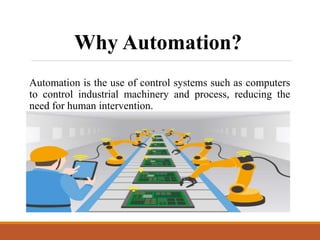
Automation is the use of control systems such as computers
to control industrial machinery and process, reducing the
need for human intervention.
Why Automation?
Programmable Logic Controller
(PLC)
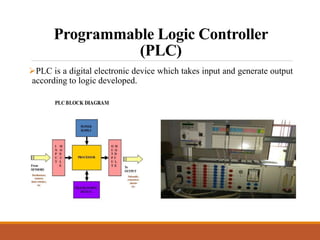
PLC is a digital electronic device which takes input and generate output
according to logic developed.
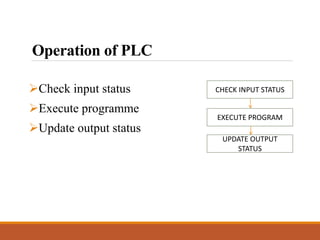
Operation of PLC
Check input status
Execute programme
Update output status
CHECK INPUT STATUS
EXECUTE PROGRAM
UPDATE OUTPUT
STATUS
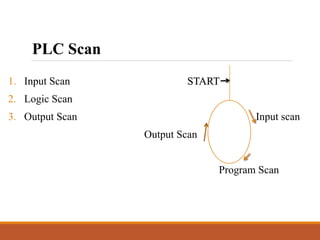
PLC SCAN
1. Input Scan START
2. Logic Scan
3. Output Scan Input scan
Output Scan
Program Scan
PLC Scan
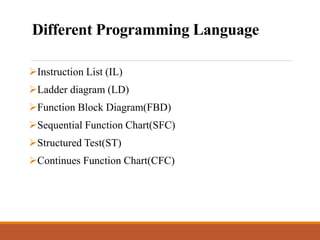
Different Programming Language
Instruction List (IL)
Ladder diagram (LD)
Function Block Diagram(FBD)
Sequential Function Chart(SFC)
Structured Test(ST)
Continues Function Chart(CFC)
LADDER LOGIC
Ladder Logic has evolved into a programming language that represent
a program by graphical diagram.
—[ ]— Normally open contact
—[]— Normally closed
—( )— Normally inactive coil
—()— Normally active ("not") coil
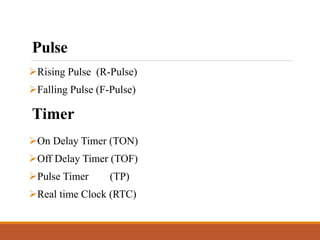
Pulse
Rising Pulse (R-Pulse)
Falling Pulse (F-Pulse)
On Delay Timer (TON)
Off Delay Timer (TOF)
Pulse Timer (TP)
Real time Clock (RTC)
Timer
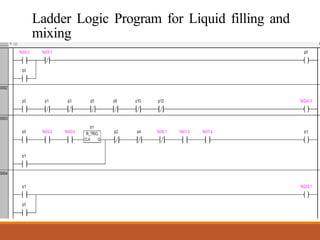
Ladder Logic Program for Liquid filling and
mixing
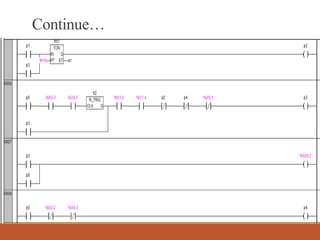
Continue…
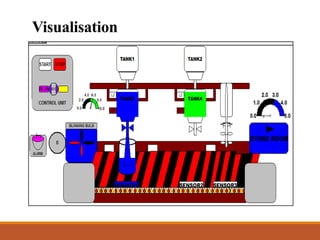
Visualisation
HARDWARE REQUIRED
Conveyor system
Selector switch
Relay
Sensors
Submersible pump
Pneumatic system
Solenoid valve
Alarm and blinking bulb
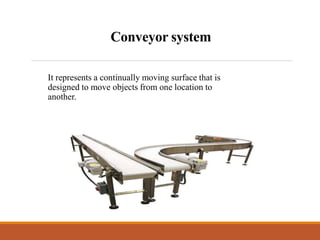
Conveyor system
It represents a continually moving surface that is
designed to move objects from one location to
another.
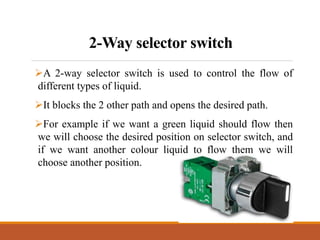
2-Way selector switch
A 2-way selector switch is used to control the flow of
different types of liquid.
It blocks the 2 other path and opens the desired path.
For example if we want a green liquid should flow then
we will choose the desired position on selector switch, and
if we want another colour liquid to flow them we will
choose another position.
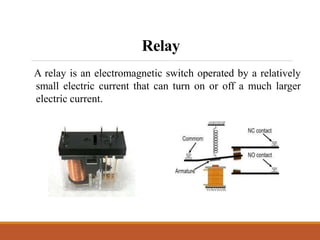
Relay
A relay is an electromagnetic switch operated by a relatively
small electric current that can turn on or off a much larger
electric current.
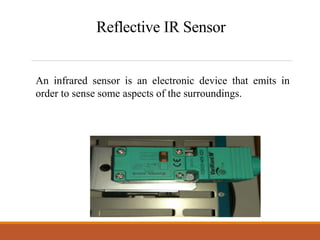
Reflective IR Sensor
An infrared sensor is an electronic device that emits in
order to sense some aspects of the surroundings.
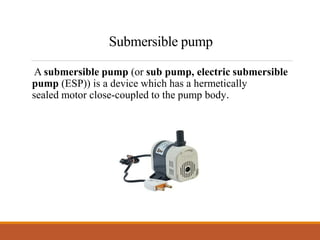
Submersible pump
A submersible pump (or sub pump, electric submersible
pump (ESP)) is a device which has a hermetically
sealed motor close-coupled to the pump body.
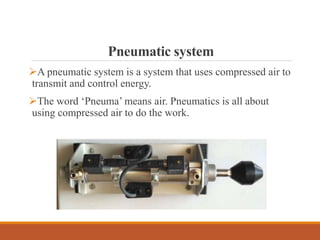
Pneumatic system
A pneumatic system is a system that uses compressed air to
transmit and control energy.
The word ‘Pneuma’ means air. Pneumatics is all about
using compressed air to do the work.
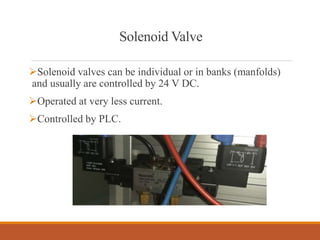
Solenoid Valve
Solenoid valves can be individual or in banks (manfolds)
and usually are controlled by 24 V DC.
Operated at very less current.
Controlled by PLC.
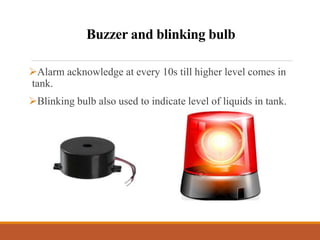
Buzzer and blinking bulb
Alarm acknowledge at every 10s till higher level comes in
tank.
Blinking bulb also used to indicate level of liquids in tank.
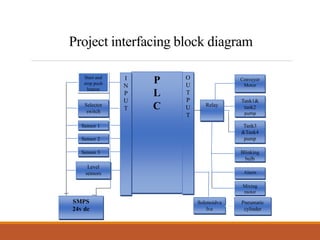
Project interfacing block diagram
Tank1&
tank2
pump
SMPS
24v dc
Start and
stop push
button
Sensor 1
Sensor 2
Sensor 3
Selector
switch
Level
sensors
P
L
C
I
N
P
U
T
O
U
T
P
U
T
Relay
Conveyor
Motor
Tank3
&Tank4
pump
Blinking
bulb
Alarm
Solenoidva
lve
Pneumatic
cylinder
Mixing
motor
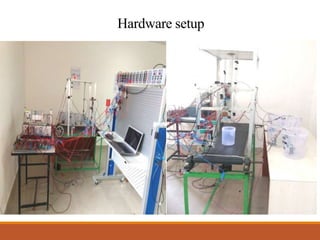
Hardware setup
Advantages
Reliable
Increase in Accuracy
Reduction in men-power
Increase in production rate
Disadvantages
 Difficult to find error, require skill full work force
Initial cost is high
Conclusion
This project has proposed an application of automation
illustrating PLC based fully automatic untouched liquid
filling and mixing system. The system meets the demand of
high speed production using the least mechanism
requirements.
The system has proved to work effectively avoiding
unnecessary spill wastage of liquids. The system also
provides high accuracy and precision in proportion of liquid
filling and mixing. Although proposed system illustrates the
mixing process of two liquids, any numbers of liquids may
be mixed in varying proportion.
Reference
[1]. K. Kalaivani, V. Anjalipriya, P. Surendar, "Monitoring and control of
grain storage using PLC", Int. J. Res. Eng. Technol., vol. 1, no. 3, pp. 282-288,
2012.
[2]. S. Naik, J. Dias, J. D. Costa, J. Martin, B. D. Costa, "Optimized
preparations of chemical mixtures using PLC and SCADA", Int. J. Electr.
Electron. Res., vol. 3, no. 2, pp. 242-24 2015.
[3]. M. Trivedi, V. Sheoran, D. Tailor, "An analysis and control of a closed
loop conveyor system using PLC and sensors", Int. J. Innov. Emerg. Res. Eng.,
vol. 1, no. 1, pp. 1-6, 2014.
[4]. G. B. Shinde, V. P. Ghadage, A. A. Gadhave, D. K. Shedge, "PLC based
auto weighing control system", Int. J. Eng. Tech. Res., vol. 3, no. 3, pp. 213-
216, 2015.
[5]. P. Dheeraj, S. R. Suralkar, "Automatic multivariate liquid filling system
and conveyor control using PLC and SCADA", Int. J. Emerg. Technol. Adv.
Eng., vol. 4, no. 12, pp. 362-365, 2014.
Automatic liquid filling and mixing process using PLC

Automatic liquid filling and mixing process using PLC

  • 1.
    Presented by Amit krSingh (2SD13EC007) Guided by Hemant Singh (2SD13EC031) Dr. S. V. Viraktamath Nagmani (2SD13EC058) Assistant professor, Dept. of ECE Gaurav Kumar (2SD12EC035) SDM COLLEGE OF ENGINEERING AND TECHNOLOGY,DHARWAD (An Autonomous Institution affiliated to VTU, Belagavi) Department of Electronics and Communication Engineering 1
  • 2.
    Contents Introduction Why automation? PLC PLC scan LadderLogic Ladder logic Program Visualisation Hardware required Advantages and Disadvantages Conclusion Reference
  • 3.
    Introduction The current scenarioin industries is to embrace new technologies to proceed towards automation. The same vision is exercised in liquid filling and mixing plants like paint industries and pharmaceutical industries. To meet the customer demands and accelerate the process, all operations are nearly automated. This project executes a method for automatic liquid filling and mixing process which results in increased productivity with increased accuracy.
  • 4.
    Automation is theuse of control systems such as computers to control industrial machinery and process, reducing the need for human intervention. Why Automation?
  • 5.
    Programmable Logic Controller (PLC) PLCis a digital electronic device which takes input and generate output according to logic developed.
  • 6.
    Operation of PLC Checkinput status Execute programme Update output status CHECK INPUT STATUS EXECUTE PROGRAM UPDATE OUTPUT STATUS
  • 7.
    PLC SCAN 1. InputScan START 2. Logic Scan 3. Output Scan Input scan Output Scan Program Scan PLC Scan
  • 8.
    Different Programming Language InstructionList (IL) Ladder diagram (LD) Function Block Diagram(FBD) Sequential Function Chart(SFC) Structured Test(ST) Continues Function Chart(CFC)
  • 9.
    LADDER LOGIC Ladder Logichas evolved into a programming language that represent a program by graphical diagram. —[ ]— Normally open contact —[]— Normally closed —( )— Normally inactive coil —()— Normally active ("not") coil
  • 10.
    Pulse Rising Pulse (R-Pulse) FallingPulse (F-Pulse) On Delay Timer (TON) Off Delay Timer (TOF) Pulse Timer (TP) Real time Clock (RTC) Timer
  • 11.
    Ladder Logic Programfor Liquid filling and mixing
  • 12.
  • 13.
  • 14.
    HARDWARE REQUIRED Conveyor system Selectorswitch Relay Sensors Submersible pump Pneumatic system Solenoid valve Alarm and blinking bulb
  • 15.
    Conveyor system It representsa continually moving surface that is designed to move objects from one location to another.
  • 16.
    2-Way selector switch A2-way selector switch is used to control the flow of different types of liquid. It blocks the 2 other path and opens the desired path. For example if we want a green liquid should flow then we will choose the desired position on selector switch, and if we want another colour liquid to flow them we will choose another position.
  • 17.
    Relay A relay isan electromagnetic switch operated by a relatively small electric current that can turn on or off a much larger electric current.
  • 18.
    Reflective IR Sensor Aninfrared sensor is an electronic device that emits in order to sense some aspects of the surroundings.
  • 19.
    Submersible pump A submersiblepump (or sub pump, electric submersible pump (ESP)) is a device which has a hermetically sealed motor close-coupled to the pump body.
  • 20.
    Pneumatic system A pneumaticsystem is a system that uses compressed air to transmit and control energy. The word ‘Pneuma’ means air. Pneumatics is all about using compressed air to do the work.
  • 21.
    Solenoid Valve Solenoid valvescan be individual or in banks (manfolds) and usually are controlled by 24 V DC. Operated at very less current. Controlled by PLC.
  • 22.
    Buzzer and blinkingbulb Alarm acknowledge at every 10s till higher level comes in tank. Blinking bulb also used to indicate level of liquids in tank.
  • 23.
    Project interfacing blockdiagram Tank1& tank2 pump SMPS 24v dc Start and stop push button Sensor 1 Sensor 2 Sensor 3 Selector switch Level sensors P L C I N P U T O U T P U T Relay Conveyor Motor Tank3 &Tank4 pump Blinking bulb Alarm Solenoidva lve Pneumatic cylinder Mixing motor
  • 24.
  • 25.
    Advantages Reliable Increase in Accuracy Reductionin men-power Increase in production rate
  • 26.
    Disadvantages  Difficult tofind error, require skill full work force Initial cost is high
  • 27.
    Conclusion This project hasproposed an application of automation illustrating PLC based fully automatic untouched liquid filling and mixing system. The system meets the demand of high speed production using the least mechanism requirements. The system has proved to work effectively avoiding unnecessary spill wastage of liquids. The system also provides high accuracy and precision in proportion of liquid filling and mixing. Although proposed system illustrates the mixing process of two liquids, any numbers of liquids may be mixed in varying proportion.
  • 28.
    Reference [1]. K. Kalaivani,V. Anjalipriya, P. Surendar, "Monitoring and control of grain storage using PLC", Int. J. Res. Eng. Technol., vol. 1, no. 3, pp. 282-288, 2012. [2]. S. Naik, J. Dias, J. D. Costa, J. Martin, B. D. Costa, "Optimized preparations of chemical mixtures using PLC and SCADA", Int. J. Electr. Electron. Res., vol. 3, no. 2, pp. 242-24 2015. [3]. M. Trivedi, V. Sheoran, D. Tailor, "An analysis and control of a closed loop conveyor system using PLC and sensors", Int. J. Innov. Emerg. Res. Eng., vol. 1, no. 1, pp. 1-6, 2014. [4]. G. B. Shinde, V. P. Ghadage, A. A. Gadhave, D. K. Shedge, "PLC based auto weighing control system", Int. J. Eng. Tech. Res., vol. 3, no. 3, pp. 213- 216, 2015. [5]. P. Dheeraj, S. R. Suralkar, "Automatic multivariate liquid filling system and conveyor control using PLC and SCADA", Int. J. Emerg. Technol. Adv. Eng., vol. 4, no. 12, pp. 362-365, 2014.

Editor's Notes