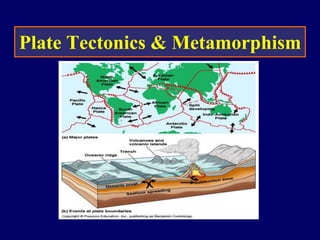
Plate Tectonics & Metamorphism
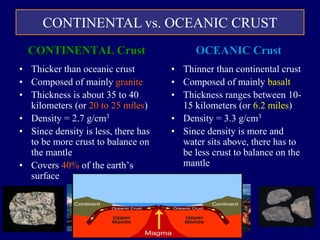
CONTINENTAL vs. OCEANIC CRUST
CONTINENTAL Crust
• Thicker than oceanic crust
• Composed of mainly granite
• Thickness is about 35 to 40
kilometers (or 20 to 25 miles)
• Density = 2.7 g/cm3
• Since density is less, there has
to be more crust to balance on
the mantle
• Covers 40% of the earth’s
surface
OCEANIC Crust
• Thinner than continental crust
• Composed of mainly basalt
• Thickness ranges between 10-
15 kilometers (or 6.2 miles)
• Density = 3.3 g/cm3
• Since density is more and
water sits above, there has to
be less crust to balance on the
mantle
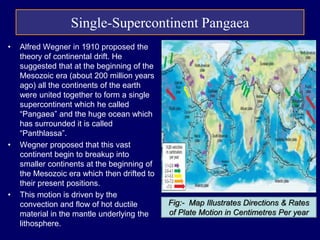
• Alfred Wegner in 1910 proposed the
theory of continental drift. He
suggested that at the beginning of the
Mesozoic era (about 200 million years
ago) all the continents of the earth
were united together to form a single
supercontinent which he called
“Pangaea” and the huge ocean which
has surrounded it is called
“Panthlassa”.
• Wegner proposed that this vast
continent begin to breakup into
smaller continents at the beginning of
the Mesozoic era which then drifted to
their present positions.
• This motion is driven by the
convection and flow of hot ductile
material in the mantle underlying the
lithosphere.
Fig:- Map Illustrates Directions & Rates
of Plate Motion in Centimetres Per year
Single-Supercontinent Pangaea
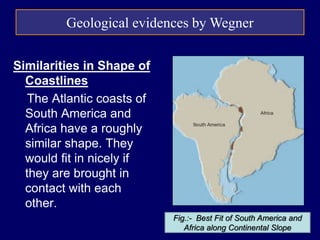
Similarities in Shape of
Coastlines
The Atlantic coasts of
South America and
Africa have a roughly
similar shape. They
would fit in nicely if
they are brought in
contact with each
other.
Fig.:- Best Fit of South America and
Africa along Continental Slope
Geological evidences by Wegner
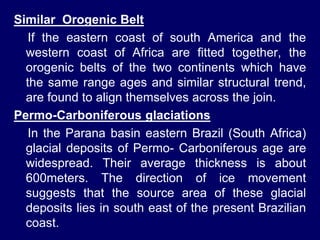
Similar Orogenic Belt
If the eastern coast of south America and the
western coast of Africa are fitted together, the
orogenic belts of the two continents which have
the same range ages and similar structural trend,
are found to align themselves across the join.
Permo-Carboniferous glaciations
In the Parana basin eastern Brazil (South Africa)
glacial deposits of Permo- Carboniferous age are
widespread. Their average thickness is about
600meters. The direction of ice movement
suggests that the source area of these glacial
deposits lies in south east of the present Brazilian
coast.
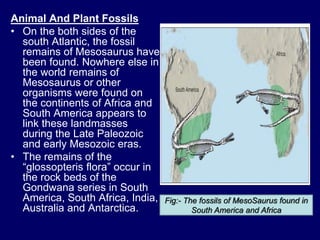
Animal And Plant Fossils
• On the both sides of the
south Atlantic, the fossil
remains of Mesosaurus have
been found. Nowhere else in
the world remains of
Mesosaurus or other
organisms were found on
the continents of Africa and
South America appears to
link these landmasses
during the Late Paleozoic
and early Mesozoic eras.
• The remains of the
“glossopteris flora” occur in
the rock beds of the
Gondwana series in South
America, South Africa, India,
Australia and Antarctica.
Fig:- The fossils of MesoSaurus found in
South America and Africa
PLATE TECTONICS
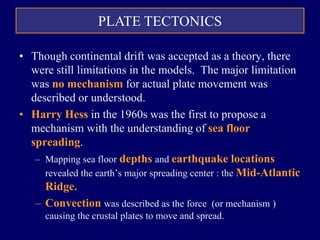
• Though continental drift was accepted as a theory, there
were still limitations in the models. The major limitation
was no mechanism for actual plate movement was
described or understood.
• Harry Hess in the 1960s was the first to propose a
mechanism with the understanding of sea floor
spreading.
– Mapping sea floor depths and earthquake locations
revealed the earth’s major spreading center : the Mid-Atlantic
Ridge.
– Convection was described as the force (or mechanism )
causing the crustal plates to move and spread.
PLATE TECTONICS
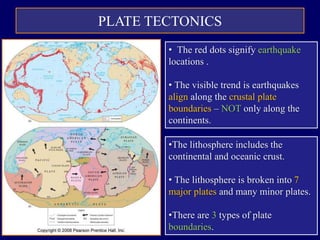
• The red dots signify earthquake
locations .
• The visible trend is earthquakes
align along the crustal plate
boundaries – NOT only along the
continents.
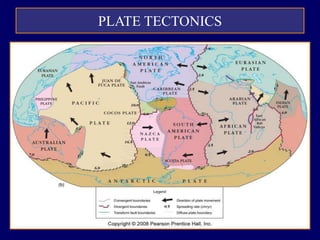
•The lithosphere includes the
continental and oceanic crust.
• The lithosphere is broken into 7
major plates and many minor plates.
•There are 3 types of plate
boundaries.
PLATE TECTONICS
PLATE TECTONICS
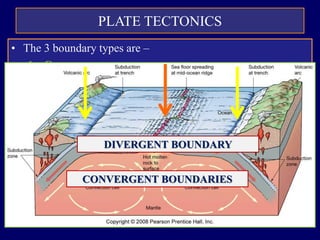
• The 3 boundary types are –
1. Convergent
• plates come together, collide, forced up and/or down, crust
is destroyed
2. Divergent
• plates move apart, divide, new crust is formed
3. Transform
• plates slide past one another, crust remains intact
CONVERGENT BOUNDARIES
DIVERGENT BOUNDARY
PLATE TECTONICS
TRANSFORM BOUNDARY
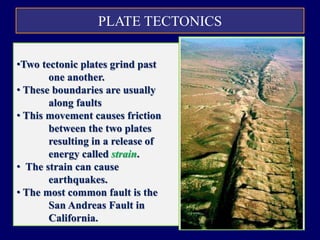
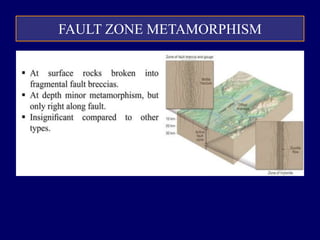
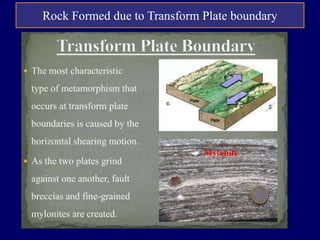
•Two tectonic plates grind past
one another.
• These boundaries are usually
along faults
• This movement causes friction
between the two plates
resulting in a release of
energy called strain.
• The strain can cause
earthquakes.
• The most common fault is the
San Andreas Fault in
California.
TYPES OF METAMORPHISM
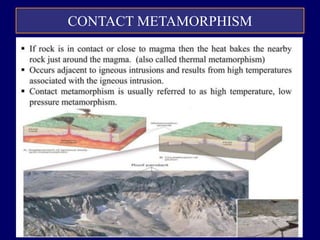
CONTACT METAMORPHISM
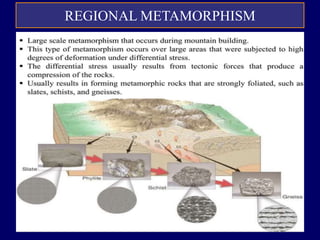
REGIONAL METAMORPHISM
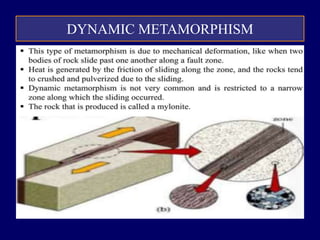
DYNAMIC METAMORPHISM
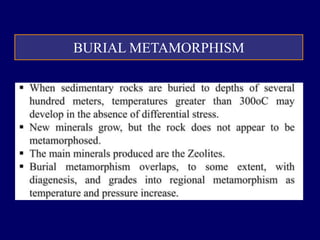
BURIAL METAMORPHISM
FAULT ZONE METAMORPHISM
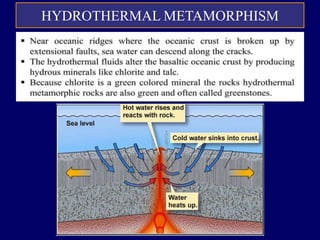
HYDROTHERMAL METAMORPHISM
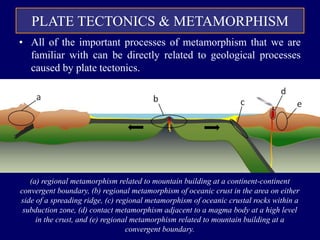
• All of the important processes of metamorphism that we are
familiar with can be directly related to geological processes
caused by plate tectonics.
PLATE TECTONICS & METAMORPHISM
(a) regional metamorphism related to mountain building at a continent-continent
convergent boundary, (b) regional metamorphism of oceanic crust in the area on either
side of a spreading ridge, (c) regional metamorphism of oceanic crustal rocks within a
subduction zone, (d) contact metamorphism adjacent to a magma body at a high level
in the crust, and (e) regional metamorphism related to mountain building at a
convergent boundary.
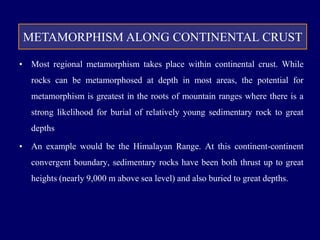
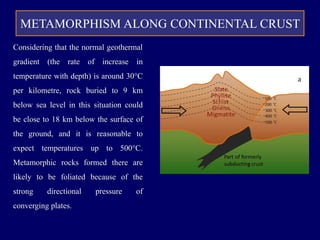
METAMORPHISM ALONG CONTINENTAL CRUST
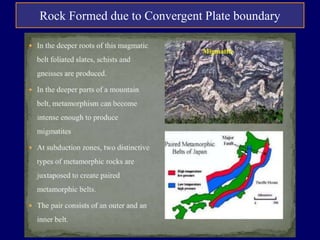
• Most regional metamorphism takes place within continental crust. While
rocks can be metamorphosed at depth in most areas, the potential for
metamorphism is greatest in the roots of mountain ranges where there is a
strong likelihood for burial of relatively young sedimentary rock to great
depths
• An example would be the Himalayan Range. At this continent-continent
convergent boundary, sedimentary rocks have been both thrust up to great
heights (nearly 9,000 m above sea level) and also buried to great depths.
METAMORPHISM ALONG CONTINENTAL CRUST
Considering that the normal geothermal
gradient (the rate of increase in
temperature with depth) is around 30°C
per kilometre, rock buried to 9 km
below sea level in this situation could
be close to 18 km below the surface of
the ground, and it is reasonable to
expect temperatures up to 500°C.
Metamorphic rocks formed there are
likely to be foliated because of the
strong directional pressure of
converging plates.
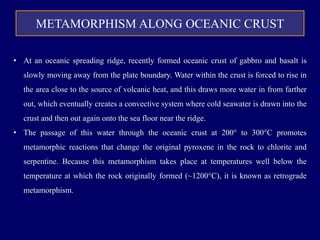
METAMORPHISM ALONG OCEANIC CRUST
• At an oceanic spreading ridge, recently formed oceanic crust of gabbro and basalt is
slowly moving away from the plate boundary. Water within the crust is forced to rise in
the area close to the source of volcanic heat, and this draws more water in from farther
out, which eventually creates a convective system where cold seawater is drawn into the
crust and then out again onto the sea floor near the ridge.
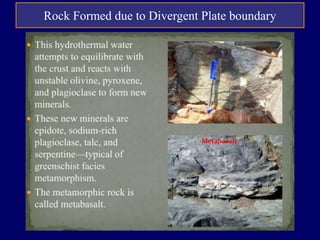
• The passage of this water through the oceanic crust at 200° to 300°C promotes
metamorphic reactions that change the original pyroxene in the rock to chlorite and
serpentine. Because this metamorphism takes place at temperatures well below the
temperature at which the rock originally formed (~1200°C), it is known as retrograde
metamorphism.
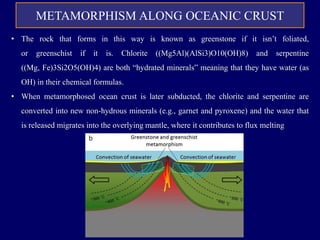
METAMORPHISM ALONG OCEANIC CRUST
• The rock that forms in this way is known as greenstone if it isn’t foliated,
or greenschist if it is. Chlorite ((Mg5Al)(AlSi3)O10(OH)8) and serpentine
((Mg, Fe)3Si2O5(OH)4) are both “hydrated minerals” meaning that they have water (as
OH) in their chemical formulas.
• When metamorphosed ocean crust is later subducted, the chlorite and serpentine are
converted into new non-hydrous minerals (e.g., garnet and pyroxene) and the water that
is released migrates into the overlying mantle, where it contributes to flux melting
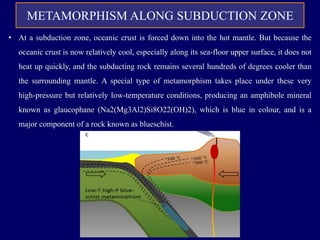
METAMORPHISM ALONG SUBDUCTION ZONE
• At a subduction zone, oceanic crust is forced down into the hot mantle. But because the
oceanic crust is now relatively cool, especially along its sea-floor upper surface, it does not
heat up quickly, and the subducting rock remains several hundreds of degrees cooler than
the surrounding mantle. A special type of metamorphism takes place under these very
high-pressure but relatively low-temperature conditions, producing an amphibole mineral
known as glaucophane (Na2(Mg3Al2)Si8O22(OH)2), which is blue in colour, and is a
major component of a rock known as blueschist.
Rock Formed due to Divergent Plate boundary
Rock Formed due to Convergent Plate boundary
Rock Formed due to Transform Plate boundary

Plate_Tectonics & Metamorphism.ppt

  • 1.
    Plate Tectonics &Metamorphism
  • 2.
    CONTINENTAL vs. OCEANICCRUST CONTINENTAL Crust • Thicker than oceanic crust • Composed of mainly granite • Thickness is about 35 to 40 kilometers (or 20 to 25 miles) • Density = 2.7 g/cm3 • Since density is less, there has to be more crust to balance on the mantle • Covers 40% of the earth’s surface OCEANIC Crust • Thinner than continental crust • Composed of mainly basalt • Thickness ranges between 10- 15 kilometers (or 6.2 miles) • Density = 3.3 g/cm3 • Since density is more and water sits above, there has to be less crust to balance on the mantle
  • 3.
    • Alfred Wegnerin 1910 proposed the theory of continental drift. He suggested that at the beginning of the Mesozoic era (about 200 million years ago) all the continents of the earth were united together to form a single supercontinent which he called “Pangaea” and the huge ocean which has surrounded it is called “Panthlassa”. • Wegner proposed that this vast continent begin to breakup into smaller continents at the beginning of the Mesozoic era which then drifted to their present positions. • This motion is driven by the convection and flow of hot ductile material in the mantle underlying the lithosphere. Fig:- Map Illustrates Directions & Rates of Plate Motion in Centimetres Per year Single-Supercontinent Pangaea
  • 4.
    Similarities in Shapeof Coastlines The Atlantic coasts of South America and Africa have a roughly similar shape. They would fit in nicely if they are brought in contact with each other. Fig.:- Best Fit of South America and Africa along Continental Slope Geological evidences by Wegner
  • 5.
    Similar Orogenic Belt Ifthe eastern coast of south America and the western coast of Africa are fitted together, the orogenic belts of the two continents which have the same range ages and similar structural trend, are found to align themselves across the join. Permo-Carboniferous glaciations In the Parana basin eastern Brazil (South Africa) glacial deposits of Permo- Carboniferous age are widespread. Their average thickness is about 600meters. The direction of ice movement suggests that the source area of these glacial deposits lies in south east of the present Brazilian coast.
  • 6.
    Animal And PlantFossils • On the both sides of the south Atlantic, the fossil remains of Mesosaurus have been found. Nowhere else in the world remains of Mesosaurus or other organisms were found on the continents of Africa and South America appears to link these landmasses during the Late Paleozoic and early Mesozoic eras. • The remains of the “glossopteris flora” occur in the rock beds of the Gondwana series in South America, South Africa, India, Australia and Antarctica. Fig:- The fossils of MesoSaurus found in South America and Africa
  • 7.
    PLATE TECTONICS • Thoughcontinental drift was accepted as a theory, there were still limitations in the models. The major limitation was no mechanism for actual plate movement was described or understood. • Harry Hess in the 1960s was the first to propose a mechanism with the understanding of sea floor spreading. – Mapping sea floor depths and earthquake locations revealed the earth’s major spreading center : the Mid-Atlantic Ridge. – Convection was described as the force (or mechanism ) causing the crustal plates to move and spread.
  • 8.
    PLATE TECTONICS • Thered dots signify earthquake locations . • The visible trend is earthquakes align along the crustal plate boundaries – NOT only along the continents. •The lithosphere includes the continental and oceanic crust. • The lithosphere is broken into 7 major plates and many minor plates. •There are 3 types of plate boundaries.
  • 9.
  • 10.
    PLATE TECTONICS • The3 boundary types are – 1. Convergent • plates come together, collide, forced up and/or down, crust is destroyed 2. Divergent • plates move apart, divide, new crust is formed 3. Transform • plates slide past one another, crust remains intact CONVERGENT BOUNDARIES DIVERGENT BOUNDARY
  • 11.
    PLATE TECTONICS TRANSFORM BOUNDARY •Twotectonic plates grind past one another. • These boundaries are usually along faults • This movement causes friction between the two plates resulting in a release of energy called strain. • The strain can cause earthquakes. • The most common fault is the San Andreas Fault in California.
  • 12.
  • 13.
  • 14.
  • 15.
  • 16.
  • 17.
  • 18.
  • 19.
    • All ofthe important processes of metamorphism that we are familiar with can be directly related to geological processes caused by plate tectonics. PLATE TECTONICS & METAMORPHISM (a) regional metamorphism related to mountain building at a continent-continent convergent boundary, (b) regional metamorphism of oceanic crust in the area on either side of a spreading ridge, (c) regional metamorphism of oceanic crustal rocks within a subduction zone, (d) contact metamorphism adjacent to a magma body at a high level in the crust, and (e) regional metamorphism related to mountain building at a convergent boundary.
  • 20.
    METAMORPHISM ALONG CONTINENTALCRUST • Most regional metamorphism takes place within continental crust. While rocks can be metamorphosed at depth in most areas, the potential for metamorphism is greatest in the roots of mountain ranges where there is a strong likelihood for burial of relatively young sedimentary rock to great depths • An example would be the Himalayan Range. At this continent-continent convergent boundary, sedimentary rocks have been both thrust up to great heights (nearly 9,000 m above sea level) and also buried to great depths.
  • 21.
    METAMORPHISM ALONG CONTINENTALCRUST Considering that the normal geothermal gradient (the rate of increase in temperature with depth) is around 30°C per kilometre, rock buried to 9 km below sea level in this situation could be close to 18 km below the surface of the ground, and it is reasonable to expect temperatures up to 500°C. Metamorphic rocks formed there are likely to be foliated because of the strong directional pressure of converging plates.
  • 22.
    METAMORPHISM ALONG OCEANICCRUST • At an oceanic spreading ridge, recently formed oceanic crust of gabbro and basalt is slowly moving away from the plate boundary. Water within the crust is forced to rise in the area close to the source of volcanic heat, and this draws more water in from farther out, which eventually creates a convective system where cold seawater is drawn into the crust and then out again onto the sea floor near the ridge. • The passage of this water through the oceanic crust at 200° to 300°C promotes metamorphic reactions that change the original pyroxene in the rock to chlorite and serpentine. Because this metamorphism takes place at temperatures well below the temperature at which the rock originally formed (~1200°C), it is known as retrograde metamorphism.
  • 23.
    METAMORPHISM ALONG OCEANICCRUST • The rock that forms in this way is known as greenstone if it isn’t foliated, or greenschist if it is. Chlorite ((Mg5Al)(AlSi3)O10(OH)8) and serpentine ((Mg, Fe)3Si2O5(OH)4) are both “hydrated minerals” meaning that they have water (as OH) in their chemical formulas. • When metamorphosed ocean crust is later subducted, the chlorite and serpentine are converted into new non-hydrous minerals (e.g., garnet and pyroxene) and the water that is released migrates into the overlying mantle, where it contributes to flux melting
  • 24.
    METAMORPHISM ALONG SUBDUCTIONZONE • At a subduction zone, oceanic crust is forced down into the hot mantle. But because the oceanic crust is now relatively cool, especially along its sea-floor upper surface, it does not heat up quickly, and the subducting rock remains several hundreds of degrees cooler than the surrounding mantle. A special type of metamorphism takes place under these very high-pressure but relatively low-temperature conditions, producing an amphibole mineral known as glaucophane (Na2(Mg3Al2)Si8O22(OH)2), which is blue in colour, and is a major component of a rock known as blueschist.
  • 25.
    Rock Formed dueto Divergent Plate boundary
  • 26.
    Rock Formed dueto Convergent Plate boundary
  • 27.
    Rock Formed dueto Transform Plate boundary