Seminar Presentation
on
Institute of Engineering and Technology, Deen Dayal Upadhyaya Gorakhpur University, Gorakhpur
Plastic Solar Cell Technology
Under the Supervision of
Dr. Narendra Yadava
Assistant Professor
Department of Electronics and Communication Engineering
Presented By:
Akash Chaudhary
IV Year (ECE)
2214830010005
CONTENT
1. Introduction
2. Conventional Solar Cells :-
A. Working Principle
B. Applications
C. Advantages
D. Disadvantages
3. Plastic Solar Cells :-
E. Device Architecture
F. Designing
G. Working Principle
H. Applications
I. Advantages
J. Disadvantages
4. Comparison between Conventional SC and Plastic SC
5. Conclusion
6. References
1. INTRODUCTION :-
With the ever-increasing demand of electrical energy everyone is
looking towards Sun as a source of electrical energy along with its role as
an important source of thermal energy. The sun always shines and
provides energy to the earth in the form of light, even on cloudy days.
Solar panels convert this light into electricity.
At the heart of all photovoltaic devices are two separate layers of
materials, one with an abundance of electrons those function as a
‘Negative pole’ and one with an abundance of holes(vacant positively-
charged energy spaces) that functioned as a ‘positive pole’. When photons
from the Sun are absorbed , their energy is transferred to the extra
electron in negative pole , causing them to flow to positive pole &
creating new holes that start flowing to the negative pole, thus producing
electrical current which can be used to power other devices.
2. CONVENTIONAL SOLAR CELLS :-
•A solar cell is a device that converts the light energy into electrical
energy. Usually light from the sun is used to generate electricity from
such a device hence the name solar cell.
•Conventional Solar cells are built from semiconductors
(polycrystalline silicon or , in the case of highest efficiency , crystalline
gallium arsenide).
•Usually mono-crystalline or poly-crystalline materials are needed for
higher efficiency.
• The conventional solar cells , which are very expensive semiconductor
laminates , coverts , at most , 35% of sun’s energy into electricity .
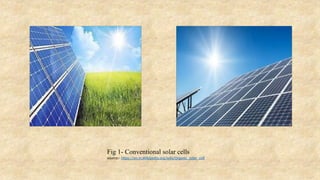
Fig 1- Conventional solar cells
source:- https://en.m.Wikipedia.org/wiki/Organic_solar_cell
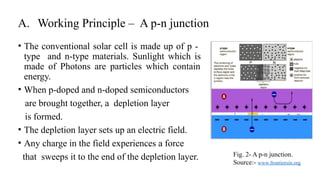
A. Working Principle – A p-n junction
• The conventional solar cell is made up of p -
type and n-type materials. Sunlight which is
made of Photons are particles which contain
energy.
• When p-doped and n-doped semiconductors
are brought together, a depletion layer
is formed.
• The depletion layer sets up an electric field.
• Any charge in the field experiences a force
that sweeps it to the end of the depletion layer. Fig. 2- A p-n junction.
Source:- www.frontiersin.org
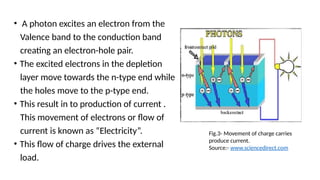
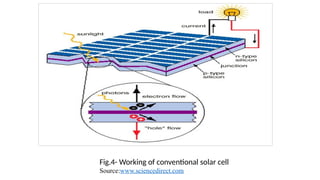
• A photon excites an electron from the
Valence band to the conduction band
creating an electron-hole pair.
• The excited electrons in the depletion
layer move towards the n-type end while
the holes move to the p-type end.
• This result in to production of current .
This movement of electrons or flow of
current is known as “Electricity”.
• This flow of charge drives the external
load.
Fig.3- Movement of charge carries
produce current.
Source:- www.sciencedirect.com
Fig.4- Working of conventional solar cell
Source:www.sciencedirect.com
B. Applications :-
• Generating electricity for space vehicles.
• To drive solar powered vehicles .
• Power for facilities like repeater stations for TV , radio etc. in remote
locations.
• As an off-grid energy source .
• Alternative energy source for household purpose where normal
electricity is not feasible.
• Power source for small devices like pocket calculators and wrist watches
.
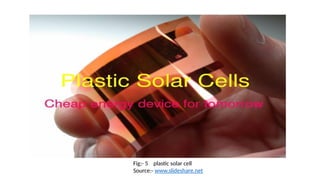
Fig;- 5 plastic solar cell
Source:- www.slideshare.net
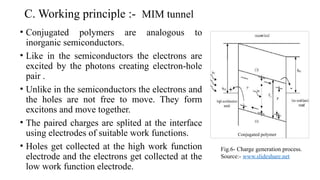
C. Working principle :- MIM tunnel
• Conjugated polymers are analogous to
inorganic semiconductors.
• Like in the semiconductors the electrons are
excited by the photons creating electron-hole
pair .
• Unlike in the semiconductors the electrons and
the holes are not free to move. They form
excitons and move together.
• The paired charges are splited at the interface
using electrodes of suitable work functions.
• Holes get collected at the high work function
electrode and the electrons get collected at the
low work function electrode.
Conjugated polymer
Fig.6- Charge generation process.
Source:- www.slideshare.net
D. Applications :-
• Plastic formulations open the possibility of printing
solar cells onto various structures.
• It is also used in wearable computing devices.
• It is used for many imaging applications in the medical
field and for fibre optic communication.
• Ultra high efficient plastic solar cells are expected to
work well in low- light conditions and under artificial
light .
• A hydrogen powered car painted with the fil could
potentially convert energy into electricity to continually
recharge the car’s battery.
• The US military already placed orders for PV material
as part of on- going development programmers with
Army, Navy , and Air force.
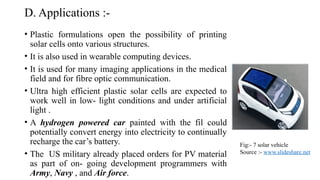
Fig:- 7 solar vehicle
Source :- www.slideshare.net
E. Advantages :-
• The manufacturing technique of PSC is very easy.
• This can be built on various substrates.
• They are considered to be 30% more efficient when compared to
conventional solar cells.
• They are more efficient and more practical in application.
• Traditional solar cells are more bulky panels. This is very compact.
• PSCs are feasible as they can be even sewn into fabric, thus having
vast applications.
• They have the potential to turn the sun’s power into a clean, green and
consistent source of energy .
F. Disadvantages :-
• The biggest problem with these cells is cost effectiveness , but that
could change with new material.
• Relatively shorter life span when continuously exposed to sun-
light .
• It could possibly require constant monitoring.
• The maintenance cost is also very high.
• The degradation rate of these solar cells are very fast.
• The improvement process is still going on to get a better version
of plastic solar cells.
4. Comparison between Conventional SC and Plastic SC :-
Conventional solar cell
• Made of some special materials
called semiconductors.
• Expensive because of
manufacturing process.
• Requires large space.
• Efficiency is less.
• It won’t work under cloudy
conditions.
• It can’t harness the sun’s
invisible infrared rays.
Plastic solar cells
• Constructed using Nano-
technology.
• Cost is less because less material
is required .
• Compact and requires less space.
• Efficiency is more.
• Due to Nano-technology, it can
work even on a cloudy day.
• It can harness the sun’s invisible
infrared rays.
5. CONCLUSION :-
Harnessing of non-conventional energies is a human necessity. The
conventional solar cells which we are using are not yet reached the
economically feasibility . Hence the concept and developing a plastic
solar cell would account to economically feasibility and mass usage.
Plastic solar cells help in exploiting the infrared radiations from the
sun’s rays . The major advantage they enjoy is that they can even work
on cloudy days, which is not possible former. They are more compact
and less bulky. Scientists are working on making this more cheap.
If the solar farms can become a reality, it could possibly solve the
planet’s problem of depending too much on the fossil fuels, without a
chance of even polluting the environment .
6. References :-
1. https://en.m.Wikipedia.org/wiki/Organic_solar_cell
2. www.frontiersin.org
3. www.sciencedirect.com
4. www.slideshare.net
5. www.quora.com
6. https://www.elprocus.com
7. Google images
Plastic solar cell technology seminar project.pptx

Plastic solar cell technology seminar project.pptx

  • 1.
    Seminar Presentation on Institute ofEngineering and Technology, Deen Dayal Upadhyaya Gorakhpur University, Gorakhpur Plastic Solar Cell Technology Under the Supervision of Dr. Narendra Yadava Assistant Professor Department of Electronics and Communication Engineering Presented By: Akash Chaudhary IV Year (ECE) 2214830010005
  • 2.
    CONTENT 1. Introduction 2. ConventionalSolar Cells :- A. Working Principle B. Applications C. Advantages D. Disadvantages 3. Plastic Solar Cells :- E. Device Architecture F. Designing G. Working Principle H. Applications I. Advantages J. Disadvantages 4. Comparison between Conventional SC and Plastic SC 5. Conclusion 6. References
  • 3.
    1. INTRODUCTION :- Withthe ever-increasing demand of electrical energy everyone is looking towards Sun as a source of electrical energy along with its role as an important source of thermal energy. The sun always shines and provides energy to the earth in the form of light, even on cloudy days. Solar panels convert this light into electricity. At the heart of all photovoltaic devices are two separate layers of materials, one with an abundance of electrons those function as a ‘Negative pole’ and one with an abundance of holes(vacant positively- charged energy spaces) that functioned as a ‘positive pole’. When photons from the Sun are absorbed , their energy is transferred to the extra electron in negative pole , causing them to flow to positive pole & creating new holes that start flowing to the negative pole, thus producing electrical current which can be used to power other devices.
  • 4.
    2. CONVENTIONAL SOLARCELLS :- •A solar cell is a device that converts the light energy into electrical energy. Usually light from the sun is used to generate electricity from such a device hence the name solar cell. •Conventional Solar cells are built from semiconductors (polycrystalline silicon or , in the case of highest efficiency , crystalline gallium arsenide). •Usually mono-crystalline or poly-crystalline materials are needed for higher efficiency. • The conventional solar cells , which are very expensive semiconductor laminates , coverts , at most , 35% of sun’s energy into electricity .
  • 5.
    Fig 1- Conventionalsolar cells source:- https://en.m.Wikipedia.org/wiki/Organic_solar_cell
  • 6.
    A. Working Principle– A p-n junction • The conventional solar cell is made up of p - type and n-type materials. Sunlight which is made of Photons are particles which contain energy. • When p-doped and n-doped semiconductors are brought together, a depletion layer is formed. • The depletion layer sets up an electric field. • Any charge in the field experiences a force that sweeps it to the end of the depletion layer. Fig. 2- A p-n junction. Source:- www.frontiersin.org
  • 7.
    • A photonexcites an electron from the Valence band to the conduction band creating an electron-hole pair. • The excited electrons in the depletion layer move towards the n-type end while the holes move to the p-type end. • This result in to production of current . This movement of electrons or flow of current is known as “Electricity”. • This flow of charge drives the external load. Fig.3- Movement of charge carries produce current. Source:- www.sciencedirect.com
  • 8.
    Fig.4- Working ofconventional solar cell Source:www.sciencedirect.com
  • 9.
    B. Applications :- •Generating electricity for space vehicles. • To drive solar powered vehicles . • Power for facilities like repeater stations for TV , radio etc. in remote locations. • As an off-grid energy source . • Alternative energy source for household purpose where normal electricity is not feasible. • Power source for small devices like pocket calculators and wrist watches .
  • 10.
    Fig;- 5 plasticsolar cell Source:- www.slideshare.net
  • 11.
    C. Working principle:- MIM tunnel • Conjugated polymers are analogous to inorganic semiconductors. • Like in the semiconductors the electrons are excited by the photons creating electron-hole pair . • Unlike in the semiconductors the electrons and the holes are not free to move. They form excitons and move together. • The paired charges are splited at the interface using electrodes of suitable work functions. • Holes get collected at the high work function electrode and the electrons get collected at the low work function electrode. Conjugated polymer Fig.6- Charge generation process. Source:- www.slideshare.net
  • 12.
    D. Applications :- •Plastic formulations open the possibility of printing solar cells onto various structures. • It is also used in wearable computing devices. • It is used for many imaging applications in the medical field and for fibre optic communication. • Ultra high efficient plastic solar cells are expected to work well in low- light conditions and under artificial light . • A hydrogen powered car painted with the fil could potentially convert energy into electricity to continually recharge the car’s battery. • The US military already placed orders for PV material as part of on- going development programmers with Army, Navy , and Air force. Fig:- 7 solar vehicle Source :- www.slideshare.net
  • 13.
    E. Advantages :- •The manufacturing technique of PSC is very easy. • This can be built on various substrates. • They are considered to be 30% more efficient when compared to conventional solar cells. • They are more efficient and more practical in application. • Traditional solar cells are more bulky panels. This is very compact. • PSCs are feasible as they can be even sewn into fabric, thus having vast applications. • They have the potential to turn the sun’s power into a clean, green and consistent source of energy .
  • 14.
    F. Disadvantages :- •The biggest problem with these cells is cost effectiveness , but that could change with new material. • Relatively shorter life span when continuously exposed to sun- light . • It could possibly require constant monitoring. • The maintenance cost is also very high. • The degradation rate of these solar cells are very fast. • The improvement process is still going on to get a better version of plastic solar cells.
  • 15.
    4. Comparison betweenConventional SC and Plastic SC :- Conventional solar cell • Made of some special materials called semiconductors. • Expensive because of manufacturing process. • Requires large space. • Efficiency is less. • It won’t work under cloudy conditions. • It can’t harness the sun’s invisible infrared rays. Plastic solar cells • Constructed using Nano- technology. • Cost is less because less material is required . • Compact and requires less space. • Efficiency is more. • Due to Nano-technology, it can work even on a cloudy day. • It can harness the sun’s invisible infrared rays.
  • 16.
    5. CONCLUSION :- Harnessingof non-conventional energies is a human necessity. The conventional solar cells which we are using are not yet reached the economically feasibility . Hence the concept and developing a plastic solar cell would account to economically feasibility and mass usage. Plastic solar cells help in exploiting the infrared radiations from the sun’s rays . The major advantage they enjoy is that they can even work on cloudy days, which is not possible former. They are more compact and less bulky. Scientists are working on making this more cheap. If the solar farms can become a reality, it could possibly solve the planet’s problem of depending too much on the fossil fuels, without a chance of even polluting the environment .
  • 17.
    6. References :- 1.https://en.m.Wikipedia.org/wiki/Organic_solar_cell 2. www.frontiersin.org 3. www.sciencedirect.com 4. www.slideshare.net 5. www.quora.com 6. https://www.elprocus.com 7. Google images