QualityMoldShop,Inc.
PlasticInjectionMolding
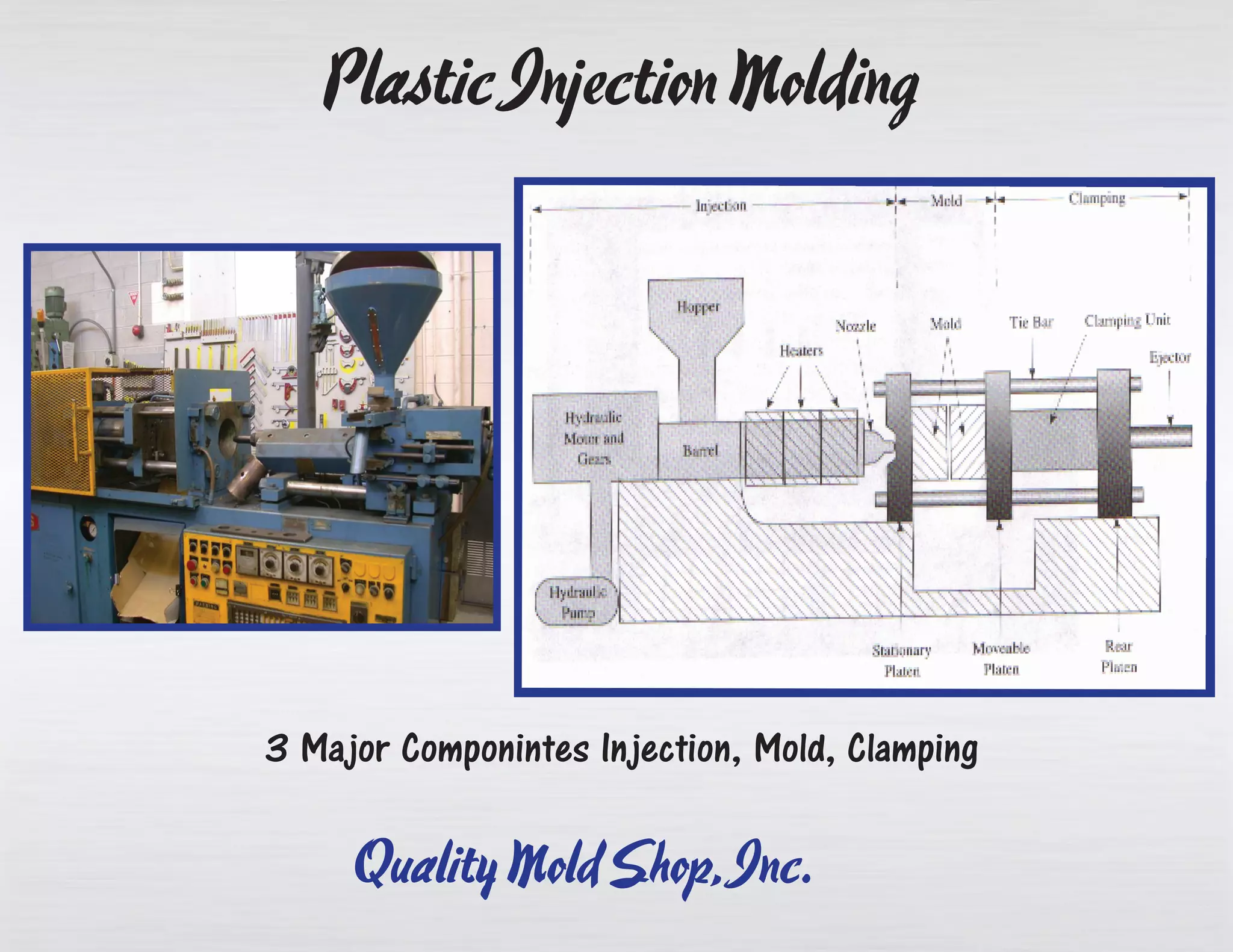
3 Major Componintes Injection, Mold, Clamping
Plastic Injection Molding is an assembling system for making parts
from thermoplastic and thermoset materials.
Rather than the expulsion (which makes nonstop parts of steady
cross area), infusion shaping makes discrete parts
(with perplexing and variable cross areas).
Liquid plastic is infused at high pressure into a shape, which is the
reverse of the coveted shape.
The mold is produced using metal, typically either steel or aluminum.
Generally utilized for assembling an assortment of parts, from the littlest
segment to whole body boards of autos.
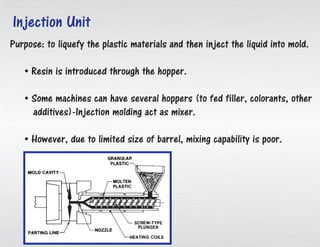
Reason: to melt the plastic materials and afterward infuse the fluid into a
shape.
• Resin is presented through the container.
• Some machines can have a few containers (to fed filler, colorants, other
added substances)- Injection molding go about as blender.
• However, because of constrained size of barrel, blending capacity is poor.
Injection Unit
• From container – gap (bolster throat).
• Barrel is an overwhelming steel chamber made to withstand the weight and
temperature required in melting the pitch.
• 2 sorts of framework utilized as a part of injection embellishment;
• Reciprocating screw-like extruder screw yet with interesting
responding activity.
• Ram injector.
Injection Unit
• Design of screw-like an expulsion screw.
• 3 areas:
• Feed area to propel the melted plastic.
• Compression area to soften the resin.
• Metering area to homogenize the tar and direct it forward.
• The screw of infusion trim machine is shorter than extruder, L/D
proportions are 12:1 and 20:1.
• Low L/D proportions propose the blending is less proficient in the infusion
forming machine.
• The pressure proportion (distance across of root at nourish zone to the
measurement of root at metering zone) frequently in the scope of 2:1 and 5:1.
• Low pressure proportion implies less mechanical activity is included amid dissolving
process.
Injection Unit
• Proper estimation of the measure of an infusion embellishment is weight
of pitch that can be infused, called shot size.
• Typical shot size range from 20g to 20 kg.
• Since shot size relies on upon the thickness of the plastic, PS has
been picked as the standard for rating the machine.
Injection Unit
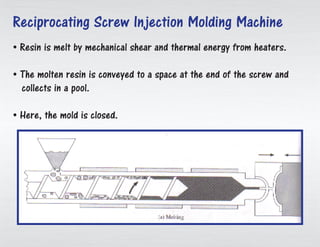
• Resin is liquefied by mechanical shear and warm vitality from radiators.
• The liquid gum is passed on to a space toward the finish of the screw and
gathers in a pool.
• Here, the form is shut.
Reciprocating Screw Injection Molding Machine
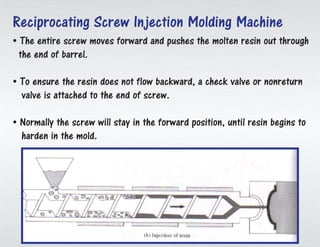
• The whole screw advances and drives the liquid sap out through
the finish of barrel.
• To guarantee the gum does not stream in reverse, a check valve or
nonreturn valve is connected to the finish of screw.
• Normally the fasten will remain the forward position, until tar starts to
solidify in the form.
Reciprocating Screw Injection Molding Machine
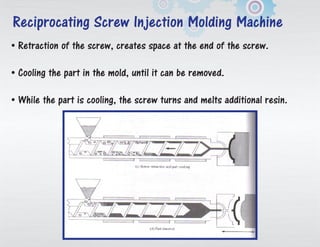
• Retraction of the screw, makes space toward the finish of the screw.
• Cooling the part in the shape, until it can be expelled.
• While the part is cooling, the screw turns and melts extra tar.
Reciprocating Screw Injection Molding Machine
Advantages:
• More uniform melting.
• Improved mixing or additives and dispersion throughout the resin.
• Lower injection pressure.
• Fewer stresses in the part.
• Faster total cycle.
Reciprocating Screw Injection Molding Machine
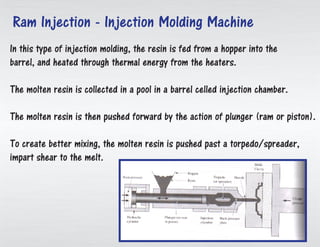
In this sort of infusion molding, the tar is bolstered from a container into the
barrel, and warmed through warm energy from the radiators.
The liquid plastic is gathered in a pool in a barrel celled infusion chamber.
The liquid plastic is then pushed forward by the activity of plunger (smash or
cylinder).
To make better blending, the liquid tar is pushed past a torpedo/spreader,
confer shear to the soften.
Ram Injection - Injection Molding Machine
Preceding the infusion of the liquid plastic into the form, the two parts of
the shape should first be safely shut by the clasping unit. At the point when
the shape is connected to the infusion shaping machine, every half is settled
to a huge plate, called a platen. The front portion of the form, called the
shape hole, is mounted to a stationary platen and lines up with the spout of
the infusion unit. The back portion of the shape, called the form center, is
mounted to a mobile platen, which slides along the tie bars. The powerfully
fueled bracing engine activates clasping bars that drive the moveable platen
towards the stationary platen and apply adequate constrain to keep the shape
safely shut while the material is infused and consequently cools. After the
required cooling time, the shape is then opened by the cinching engine. An
discharge framework, which is connected to the back portion of the shape, is
impelled by the ejector bar and drives the set part out of the open hole.
Clamping Unit
Clearly, the form must be cooled all together for the production to happen.
Due to the warmth limit, modesty, and accessibility of water, water is utilized
as the essential cooling specialist. To cool the shape, water can be directed
through the shape to represent speedy cooling times. Generally a colder
shape is more effective on the grounds that this takes into account speedier
process durations. Nonetheless, this is not generally genuine in light
of the fact that crystalline materials require the
inverse: a hotter form and lengthier process duration.
Lubrication and Cooling
• A proper machine for good melting and injecting of the resin.
• The proper resin to appropriate part performance.
• A good mold for part definition and removal.
• Proper operation for efficient molding cycle (mold cycle depends on the
design of the mold and manufacturing parameters).
The key to success in injection molding is to have:
Polystyrene (low-cost, lacking the strength and longevity of other materials).
ABS or acrylonitrile butadiene styrene (a co-polymer or mixture of compounds
used for everything from Lego parts to electronics housings).
Nylon (chemically resistant, heat-resistant, tough and flexible - used for combs).
Polypropylene (tough and flexible - used for containers).
PVC (more common in extrusions as used for pipes, window frames, or as the
insulation on wiring where it is rendered flexible by the inclusion of a high
proportion of plasticiser).
The Most Commonly Used Thermoplastic Materials
•Aerospace components
•Automotive components
•Avionics components
•Cable assemblies
•Computer electronics
•Electronics components
•Encapsulations
•New product design &development
•R&D labs Test specimens
•Engineering prototypes
•Geophysics
•Instrumentation
•Marketing samples
•Material quality testing
•Medical & dental products
•Medical laboratories
•Model shops, toys, hobby
General Plastic Injection Molding Applications
Injection molding is one of the most important processes for plastics and it
has a very wide list of kinds of products it can produce, which
makes it very versatile.
Conclusion
Contact Us
http://www.quality-mold.com/
931-668-3876
QualityMoldShop,Inc.

Plastic Injection Molding 101: The Basics

  • 1.
  • 2.
    Plastic Injection Moldingis an assembling system for making parts from thermoplastic and thermoset materials. Rather than the expulsion (which makes nonstop parts of steady cross area), infusion shaping makes discrete parts (with perplexing and variable cross areas). Liquid plastic is infused at high pressure into a shape, which is the reverse of the coveted shape. The mold is produced using metal, typically either steel or aluminum. Generally utilized for assembling an assortment of parts, from the littlest segment to whole body boards of autos.
  • 3.
    Reason: to meltthe plastic materials and afterward infuse the fluid into a shape. • Resin is presented through the container. • Some machines can have a few containers (to fed filler, colorants, other added substances)- Injection molding go about as blender. • However, because of constrained size of barrel, blending capacity is poor. Injection Unit
  • 4.
    • From container– gap (bolster throat). • Barrel is an overwhelming steel chamber made to withstand the weight and temperature required in melting the pitch. • 2 sorts of framework utilized as a part of injection embellishment; • Reciprocating screw-like extruder screw yet with interesting responding activity. • Ram injector. Injection Unit
  • 5.
    • Design ofscrew-like an expulsion screw. • 3 areas: • Feed area to propel the melted plastic. • Compression area to soften the resin. • Metering area to homogenize the tar and direct it forward. • The screw of infusion trim machine is shorter than extruder, L/D proportions are 12:1 and 20:1. • Low L/D proportions propose the blending is less proficient in the infusion forming machine. • The pressure proportion (distance across of root at nourish zone to the measurement of root at metering zone) frequently in the scope of 2:1 and 5:1. • Low pressure proportion implies less mechanical activity is included amid dissolving process. Injection Unit
  • 6.
    • Proper estimationof the measure of an infusion embellishment is weight of pitch that can be infused, called shot size. • Typical shot size range from 20g to 20 kg. • Since shot size relies on upon the thickness of the plastic, PS has been picked as the standard for rating the machine. Injection Unit
  • 7.
    • Resin isliquefied by mechanical shear and warm vitality from radiators. • The liquid gum is passed on to a space toward the finish of the screw and gathers in a pool. • Here, the form is shut. Reciprocating Screw Injection Molding Machine
  • 8.
    • The wholescrew advances and drives the liquid sap out through the finish of barrel. • To guarantee the gum does not stream in reverse, a check valve or nonreturn valve is connected to the finish of screw. • Normally the fasten will remain the forward position, until tar starts to solidify in the form. Reciprocating Screw Injection Molding Machine
  • 9.
    • Retraction ofthe screw, makes space toward the finish of the screw. • Cooling the part in the shape, until it can be expelled. • While the part is cooling, the screw turns and melts extra tar. Reciprocating Screw Injection Molding Machine
  • 10.
    Advantages: • More uniformmelting. • Improved mixing or additives and dispersion throughout the resin. • Lower injection pressure. • Fewer stresses in the part. • Faster total cycle. Reciprocating Screw Injection Molding Machine
  • 11.
    In this sortof infusion molding, the tar is bolstered from a container into the barrel, and warmed through warm energy from the radiators. The liquid plastic is gathered in a pool in a barrel celled infusion chamber. The liquid plastic is then pushed forward by the activity of plunger (smash or cylinder). To make better blending, the liquid tar is pushed past a torpedo/spreader, confer shear to the soften. Ram Injection - Injection Molding Machine
  • 12.
    Preceding the infusionof the liquid plastic into the form, the two parts of the shape should first be safely shut by the clasping unit. At the point when the shape is connected to the infusion shaping machine, every half is settled to a huge plate, called a platen. The front portion of the form, called the shape hole, is mounted to a stationary platen and lines up with the spout of the infusion unit. The back portion of the shape, called the form center, is mounted to a mobile platen, which slides along the tie bars. The powerfully fueled bracing engine activates clasping bars that drive the moveable platen towards the stationary platen and apply adequate constrain to keep the shape safely shut while the material is infused and consequently cools. After the required cooling time, the shape is then opened by the cinching engine. An discharge framework, which is connected to the back portion of the shape, is impelled by the ejector bar and drives the set part out of the open hole. Clamping Unit
  • 13.
    Clearly, the formmust be cooled all together for the production to happen. Due to the warmth limit, modesty, and accessibility of water, water is utilized as the essential cooling specialist. To cool the shape, water can be directed through the shape to represent speedy cooling times. Generally a colder shape is more effective on the grounds that this takes into account speedier process durations. Nonetheless, this is not generally genuine in light of the fact that crystalline materials require the inverse: a hotter form and lengthier process duration. Lubrication and Cooling
  • 14.
    • A propermachine for good melting and injecting of the resin. • The proper resin to appropriate part performance. • A good mold for part definition and removal. • Proper operation for efficient molding cycle (mold cycle depends on the design of the mold and manufacturing parameters). The key to success in injection molding is to have:
  • 15.
    Polystyrene (low-cost, lackingthe strength and longevity of other materials). ABS or acrylonitrile butadiene styrene (a co-polymer or mixture of compounds used for everything from Lego parts to electronics housings). Nylon (chemically resistant, heat-resistant, tough and flexible - used for combs). Polypropylene (tough and flexible - used for containers). PVC (more common in extrusions as used for pipes, window frames, or as the insulation on wiring where it is rendered flexible by the inclusion of a high proportion of plasticiser). The Most Commonly Used Thermoplastic Materials
  • 16.
    •Aerospace components •Automotive components •Avionicscomponents •Cable assemblies •Computer electronics •Electronics components •Encapsulations •New product design &development •R&D labs Test specimens •Engineering prototypes •Geophysics •Instrumentation •Marketing samples •Material quality testing •Medical & dental products •Medical laboratories •Model shops, toys, hobby General Plastic Injection Molding Applications
  • 17.
    Injection molding isone of the most important processes for plastics and it has a very wide list of kinds of products it can produce, which makes it very versatile. Conclusion
  • 18.