


GUJRAT
POWER
ENGINEERING
&
RESEARCH
INSTITUTE
NAME :- THAKKAR VIJAYKUMAR B.
ENROLLMENT NO:- 161043119012
TOPIC:- INJECTION MOULDING
GUIDED BY:-
A.V.J SIR
INJECTION MOULDING
What is injection moulding ?
Injection molding is the most commonly used
manufacturing process for the fabrication of plastic parts.
A wide variety of products are manufactured using
injection molding, which vary greatly in their size,
complexity, and application. The injection molding
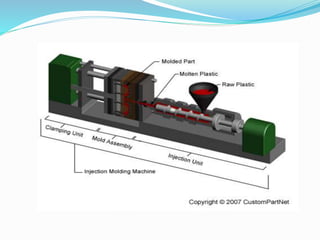
process requires the use of an injection molding machine,
raw plastic material, and a mold. The plastic is melted in
the injection molding machine and then injected into the
mold, where it cools and solidifies into the final part.
Injection molding is used to produce thin-walled plastic
parts for a wide variety of applications, one of the most
common being plastic housings. Plastic housing is a thin-
walled enclosure, often requiring many ribs and bosses on
the interior. These housings are used in a variety of
products including household appliances, consumer
electronics, power tools, and as automotive dashboards.
Other common thin-walled products include different
types of open containers, such as buckets. Injection
molding is also used to produce several everyday items
such as toothbrushes or small plastic toys. Many medical
devices, including valves and syringes, are manufactured
using injection molding as well.
Process Of Cycle?
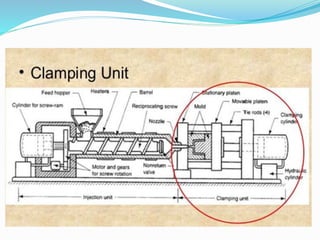
A. Clamping - Prior to the injection of the material into the mold,
the two halves of the mold must first be securely closed by the
clamping unit. Each half of the mold is attached to the injection
molding machine and one half is allowed to slide. The hydraulically
powered clamping unit pushes the mold halves together and exerts
sufficient force to keep the mold securely closed while the material
is injected. The time required to close and clamp the mold is
dependent upon the machine - larger machines will require more
time. This time can be estimated from the dry cycle time of the
machine.
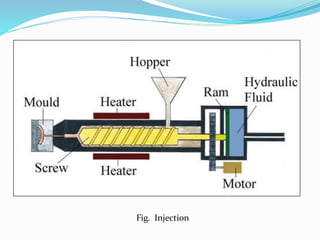
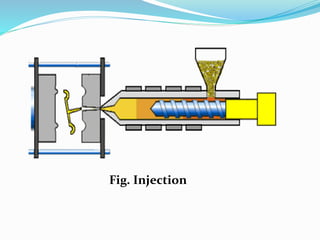
B. Injection - The raw plastic material, usually in the form
of pellets, is fed into the injection molding machine, and
advanced towards the mold by the injection unit. During
this process, the material is melted by heat and pressure.
The molten plastic is then injected into the mold very
quickly and the buildup of pressure packs and holds the
material. The amount of material that is injected is
referred to as the shot. The injection time is difficult to
calculate accurately due to the complex and changing flow
of the molten plastic into the mold. However, the injection
time can be estimated by the shot volume, injection
pressure, and injection power.
Fig. Injection
C. Cooling - The molten plastic that is inside the mold
begins to cool as soon as it makes contact with the interior
mold surfaces. As the plastic cools, it will solidify into the
shape of the desired part. However, during cooling
some shrinkage of the part may occur. The packing of
material in the injection stage allows additional material
to flow into the mold and reduce the amount of visible
shrinkage. The mold can not be opened until the required
cooling time has elapsed. The cooling time can be
estimated from several thermodynamic properties of the
plastic and the maximum wall thickness of the part.
D. Ejection - After sufficient time has passed, the cooled
part may be ejected from the mold by the ejection system,
which is attached to the rear half of the mold. When the
mold is opened, a mechanism is used to push the part out
of the mold. Force must be applied to eject the part
because during cooling the part shrinks and adheres to the
mold. In order to facilitate the ejection of the part, a mold
release agent can be sprayed onto the surfaces of the mold
cavity prior to injection of the material. The time that is
required to open the mold and eject the part can be
estimated from the dry cycle time of the machine and
should include time for the part to fall free of the mold.
Once the part is ejected, the mold can be clamped shut for
the next shot to be injected.
Fig. Injection
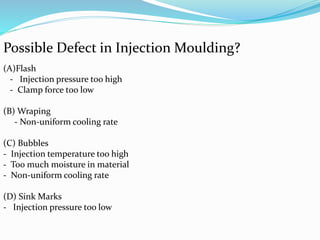
Possible Defect in Injection Moulding?
(A)Flash
- Injection pressure too high
- Clamp force too low
(B) Wraping
- Non-uniform cooling rate
(C) Bubbles
- Injection temperature too high
- Too much moisture in material
- Non-uniform cooling rate
(D) Sink Marks
- Injection pressure too low
http://www.google.com
http://www.wikipedia.org
http://www.custompartnet.com/wu/InjectionMolding
https://www.toolcraft.co.uk/plastic-injection-moulding/advice/help-injection-moulding-
process.htm
Injection moulding

Injection moulding

  • 1.
    GUJRAT POWER ENGINEERING & RESEARCH INSTITUTE NAME :- THAKKARVIJAYKUMAR B. ENROLLMENT NO:- 161043119012 TOPIC:- INJECTION MOULDING GUIDED BY:- A.V.J SIR
  • 2.
    INJECTION MOULDING What isinjection moulding ? Injection molding is the most commonly used manufacturing process for the fabrication of plastic parts. A wide variety of products are manufactured using injection molding, which vary greatly in their size, complexity, and application. The injection molding process requires the use of an injection molding machine, raw plastic material, and a mold. The plastic is melted in the injection molding machine and then injected into the mold, where it cools and solidifies into the final part.
  • 4.
    Injection molding isused to produce thin-walled plastic parts for a wide variety of applications, one of the most common being plastic housings. Plastic housing is a thin- walled enclosure, often requiring many ribs and bosses on the interior. These housings are used in a variety of products including household appliances, consumer electronics, power tools, and as automotive dashboards. Other common thin-walled products include different types of open containers, such as buckets. Injection molding is also used to produce several everyday items such as toothbrushes or small plastic toys. Many medical devices, including valves and syringes, are manufactured using injection molding as well.
  • 5.
    Process Of Cycle? A.Clamping - Prior to the injection of the material into the mold, the two halves of the mold must first be securely closed by the clamping unit. Each half of the mold is attached to the injection molding machine and one half is allowed to slide. The hydraulically powered clamping unit pushes the mold halves together and exerts sufficient force to keep the mold securely closed while the material is injected. The time required to close and clamp the mold is dependent upon the machine - larger machines will require more time. This time can be estimated from the dry cycle time of the machine.
  • 7.
    B. Injection -The raw plastic material, usually in the form of pellets, is fed into the injection molding machine, and advanced towards the mold by the injection unit. During this process, the material is melted by heat and pressure. The molten plastic is then injected into the mold very quickly and the buildup of pressure packs and holds the material. The amount of material that is injected is referred to as the shot. The injection time is difficult to calculate accurately due to the complex and changing flow of the molten plastic into the mold. However, the injection time can be estimated by the shot volume, injection pressure, and injection power.
  • 8.
  • 9.
    C. Cooling -The molten plastic that is inside the mold begins to cool as soon as it makes contact with the interior mold surfaces. As the plastic cools, it will solidify into the shape of the desired part. However, during cooling some shrinkage of the part may occur. The packing of material in the injection stage allows additional material to flow into the mold and reduce the amount of visible shrinkage. The mold can not be opened until the required cooling time has elapsed. The cooling time can be estimated from several thermodynamic properties of the plastic and the maximum wall thickness of the part.
  • 10.
    D. Ejection -After sufficient time has passed, the cooled part may be ejected from the mold by the ejection system, which is attached to the rear half of the mold. When the mold is opened, a mechanism is used to push the part out of the mold. Force must be applied to eject the part because during cooling the part shrinks and adheres to the mold. In order to facilitate the ejection of the part, a mold release agent can be sprayed onto the surfaces of the mold cavity prior to injection of the material. The time that is required to open the mold and eject the part can be estimated from the dry cycle time of the machine and should include time for the part to fall free of the mold. Once the part is ejected, the mold can be clamped shut for the next shot to be injected.
  • 11.
  • 12.
    Possible Defect inInjection Moulding? (A)Flash - Injection pressure too high - Clamp force too low (B) Wraping - Non-uniform cooling rate (C) Bubbles - Injection temperature too high - Too much moisture in material - Non-uniform cooling rate (D) Sink Marks - Injection pressure too low
  • 13.