PLASMODIUM SPECIES
PRESENTED BY: IDREES AHMED KHAN
Disease:
• Malaria is caused primarily by four plasmodia:
Plasmodium vivax.
Plasmodium ovale,
Plasmodium malariae.
Plasmodium falciparum.
• Plasmodium vivax and plasmodium falciparum are more common
causes of malaria.
• Plasmodium vivax is most widely distributed.
• Plasmodium falciparum causes the most serious disease.
• A fifth species Plasmodium knowlesi is found in southeast Asia.
• Worldwide, malaria is one of the most common infectious diseases
and one of the leading cause of death.
Important Properties:
• The vector and definitive host for plasmodia is the female Anopheles
mosquito.
• There are two phases in the life cycle
Sexual cycle: which occurs primarily in Mosquitoes.
Asexual cycle: which occurs in humans, the intermediate hosts.
The sexual cycle is called sporogony because sporozoites are
produced.
Asexual cycle is called Schizogony because schizonts are made.
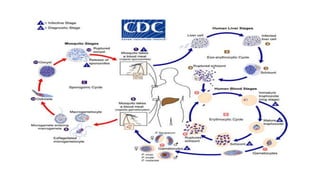
LIFE CYCLE:
• The life cycle in humans begins with the introduction of sporozoites
into the blood from the saliva of the biting mosquito.
• The sporozoites are taken up the hepatocytes within 30 minutes.
• This “exoerythrocytic” phase consist of cell multiplication and
differentiation into merozoites.
• Merozoites are released from the liver cells and infect red blood cells.
• During the erythrocytic phase the organism differentiates into a ring
shaped trophozoite
• The ring form grows into an ameboid form and then differentiates
into a schizonts filled with merozoites.
• After release the merozoites infect other erythrocytes.
• This cycle in the red blood cells repeats at regular intervals typical for
each species.
• The periodic release of merozoites causes the typical recurrent
symptoms of chills. Fever and sweats seen in malaria patients.
Pathogenesis:
• Red cell are destroyed both by the release of the merozoites and by
the action of the spleen to first sequester the infected red cells and
then to lyse them.
• The enlarge spleen characteristic of malaria is due to the congestion
of sinusoids with erythrocytes, coupled with hyperplasia of
lymphocytes and macrophages
• Malaria caused by Falciparum is more severe than that caused by
other plasmodia by occlusion of the capillaries with aggregates of
parasitized red cells.
• This lead to life-threating hemorrhage and necrosis particularly in the
brain(cerebral malaria).
• Extensive hemolysis and kidney damage occur, with resulting
hemoglobinuria.
• The dark color of the patients urine has given rise to the term
“Blackwater fever”.The hemoglobinuria can lead to acute renal failure.
• The timing of the fever cycle is 72 hours for P.malariae and 48 hours
for the other plasmodia.
• Disease caused by P.malariae is called quartan malaria because it
recurs every fourth day.
• Wheras malaria caused by other plasmodia is called tertian malaria
because it recurs every third day .
• Tertian malaria is subdivided into malignant malaria,caused by
P.falciparum and benign malaria caused by P.vivax and P.Ovale.
• Plasmodium falciparum infects red cell of all ages so causes a high
level of parasitemia.
• P.vivax infect only reticulocytes.
• P.malariae infects only mature red cells, they produce much lower
levels of parasites in the blood.
• Individual with sickle cell trait (heterozygotes) are protected against
malaria because their red cells have too little ATPase activity and can
not produce sufficient energy to support the growth of the parasite.
• People glucose-6-phosphatase dehydrogenase(G6PD) deficiency are
also protected against the severe effects of falciparum malaria.
Clinical findings:
• Abrupt onset of fever and chills, accompanied by
headache,myalgias,and arthralgias about 2 weeks after the mosquito
bite.
• The fever spike,which can reach 41C.
• Splenomegaly is seen in most patients.
Laboratory Diagnosis:
• Microscopic examination of the blood using thick and thin Giemsa
stained smears.
• The thick smear is used to screen for the presence of orgainisms and
the thin smears is used for species identification.
• Schuffner’s dots are found in P.vivax and P.ovale.These are
intracytoplasmic granules that stain red using the Romanovsky stain.
• PCR-based test
• ELISA test
Treatment:
• Chloroquine is the drug of choice for treatment of uncomplicated
malaria.
• Primaquine
• Artemether plus lumefantrine.
Prevention:
• Chloroquine in areas where organism are sensitive.
• Primaquine to prevent relapses of P.vivax or P.ovale.
• Using insecticides and by draining water from breeding areas.
• Using nets and mosquito repellent.
MCQS# 1
• Black water fever is a special manifestation of malaria caused by;
• a. P. falciparum
b. P. malariae
c. P. ovale
d. P. vivax
MCQ#2
• Which of the following agent can be used to prevent malaria?
• A.Mabendazole
• B.Chloroquine
• C.Inactivated vaccine
• D.Praziquantel
MCQ#3
• MCQ Malaria 3. After sporozoite gain entrance to human body it
undergoes developmental cycle first in liver than in RBC, only after
which fever is seen. This incubation period varies between
plasmodium species, and ………….. species has longest incubation
period.
a. P. falciparum
b. P. malariae
c. P. ovale
d. P. vivax
MCQ#4
• Mosquito responsible for malaria transmission
A. Aedes aegypti
B. Aedes albopictus
C. Anopheles
D. Haemagogus
Answer key:
• 1.a
• 2.b
• 3.b
• 4.c

Plasmodium species

  • 1.
  • 2.
    Disease: • Malaria iscaused primarily by four plasmodia: Plasmodium vivax. Plasmodium ovale, Plasmodium malariae. Plasmodium falciparum.
  • 3.
    • Plasmodium vivaxand plasmodium falciparum are more common causes of malaria. • Plasmodium vivax is most widely distributed. • Plasmodium falciparum causes the most serious disease. • A fifth species Plasmodium knowlesi is found in southeast Asia. • Worldwide, malaria is one of the most common infectious diseases and one of the leading cause of death.
  • 4.
    Important Properties: • Thevector and definitive host for plasmodia is the female Anopheles mosquito. • There are two phases in the life cycle Sexual cycle: which occurs primarily in Mosquitoes. Asexual cycle: which occurs in humans, the intermediate hosts.
  • 5.
    The sexual cycleis called sporogony because sporozoites are produced. Asexual cycle is called Schizogony because schizonts are made.
  • 7.
    LIFE CYCLE: • Thelife cycle in humans begins with the introduction of sporozoites into the blood from the saliva of the biting mosquito. • The sporozoites are taken up the hepatocytes within 30 minutes. • This “exoerythrocytic” phase consist of cell multiplication and differentiation into merozoites. • Merozoites are released from the liver cells and infect red blood cells. • During the erythrocytic phase the organism differentiates into a ring shaped trophozoite
  • 8.
    • The ringform grows into an ameboid form and then differentiates into a schizonts filled with merozoites. • After release the merozoites infect other erythrocytes. • This cycle in the red blood cells repeats at regular intervals typical for each species. • The periodic release of merozoites causes the typical recurrent symptoms of chills. Fever and sweats seen in malaria patients.
  • 9.
    Pathogenesis: • Red cellare destroyed both by the release of the merozoites and by the action of the spleen to first sequester the infected red cells and then to lyse them. • The enlarge spleen characteristic of malaria is due to the congestion of sinusoids with erythrocytes, coupled with hyperplasia of lymphocytes and macrophages
  • 10.
    • Malaria causedby Falciparum is more severe than that caused by other plasmodia by occlusion of the capillaries with aggregates of parasitized red cells. • This lead to life-threating hemorrhage and necrosis particularly in the brain(cerebral malaria). • Extensive hemolysis and kidney damage occur, with resulting hemoglobinuria. • The dark color of the patients urine has given rise to the term “Blackwater fever”.The hemoglobinuria can lead to acute renal failure.
  • 11.
    • The timingof the fever cycle is 72 hours for P.malariae and 48 hours for the other plasmodia. • Disease caused by P.malariae is called quartan malaria because it recurs every fourth day. • Wheras malaria caused by other plasmodia is called tertian malaria because it recurs every third day . • Tertian malaria is subdivided into malignant malaria,caused by P.falciparum and benign malaria caused by P.vivax and P.Ovale.
  • 12.
    • Plasmodium falciparuminfects red cell of all ages so causes a high level of parasitemia. • P.vivax infect only reticulocytes. • P.malariae infects only mature red cells, they produce much lower levels of parasites in the blood.
  • 13.
    • Individual withsickle cell trait (heterozygotes) are protected against malaria because their red cells have too little ATPase activity and can not produce sufficient energy to support the growth of the parasite. • People glucose-6-phosphatase dehydrogenase(G6PD) deficiency are also protected against the severe effects of falciparum malaria.
  • 14.
    Clinical findings: • Abruptonset of fever and chills, accompanied by headache,myalgias,and arthralgias about 2 weeks after the mosquito bite. • The fever spike,which can reach 41C. • Splenomegaly is seen in most patients.
  • 15.
    Laboratory Diagnosis: • Microscopicexamination of the blood using thick and thin Giemsa stained smears. • The thick smear is used to screen for the presence of orgainisms and the thin smears is used for species identification. • Schuffner’s dots are found in P.vivax and P.ovale.These are intracytoplasmic granules that stain red using the Romanovsky stain. • PCR-based test • ELISA test
  • 16.
    Treatment: • Chloroquine isthe drug of choice for treatment of uncomplicated malaria. • Primaquine • Artemether plus lumefantrine.
  • 17.
    Prevention: • Chloroquine inareas where organism are sensitive. • Primaquine to prevent relapses of P.vivax or P.ovale. • Using insecticides and by draining water from breeding areas. • Using nets and mosquito repellent.
  • 18.
    MCQS# 1 • Blackwater fever is a special manifestation of malaria caused by; • a. P. falciparum b. P. malariae c. P. ovale d. P. vivax
  • 19.
    MCQ#2 • Which ofthe following agent can be used to prevent malaria? • A.Mabendazole • B.Chloroquine • C.Inactivated vaccine • D.Praziquantel
  • 20.
    MCQ#3 • MCQ Malaria3. After sporozoite gain entrance to human body it undergoes developmental cycle first in liver than in RBC, only after which fever is seen. This incubation period varies between plasmodium species, and ………….. species has longest incubation period. a. P. falciparum b. P. malariae c. P. ovale d. P. vivax
  • 21.
    MCQ#4 • Mosquito responsiblefor malaria transmission A. Aedes aegypti B. Aedes albopictus C. Anopheles D. Haemagogus
  • 22.
    Answer key: • 1.a •2.b • 3.b • 4.c