Succession
• The term was given by Hult
(1885).
• It is a sequence of changes in
the community structure of
an ecosystem over a period
of time.
• A change in the composition
and nature of plant
community of a habitat over
the years is known plant
succession.
Example
• For example, if a cultivated field is left fallow for some time.
Annual weeds will appear in the first year. Numerous perennial
species will appear in the second year. In later years, few bushes
and some trees will make their appetence.
• In this way there is a change in the plant communities year after
year. So, succession is a process in which there is a successive
occupation of an area by different plant communities.
Pioneer species
Grasses
ForestTrees
Climax community is
the stable endpoint of
succession which lasts
a long time
Causes of Succession
There are two main causes of
succession.
1. Physiographic Factors (Physical
Causes).
Those factors which are
associated with the physical
nature of the area.
2. Biotic factors.
A change in the
environment is produced by the
community.
• Any of the factors, apart
from climatic, biotic and
edaphic factors.
• That affect the prevailing
conditions within a habitat
and the distribution of the
plants and animals.
• It includes the physical and
chemical factors of the
environment.
• Such factors include the
topography of the area,
altitude, drainage
conditions, degree of
erosion, slope of the land,
etc.
Physiographic
Factors
A change in the habitat may be
produced by:
• The silting in of a lake or pond,
• Chemical changes by leaching or
accumulation of salts.
• Flooding of plains.
• Soil erosion.
• Change in temperature.
• Rainfall.
• Melting of glaciers.
• Land Sliding.
• Volcanic action.
Such changes will cause change in
community. Plant successional
changes are rapid in habitat with
moderate environment, but such
changes become slow in area with
extremes of environment.
Physiographic
Factors
• A change in the environment is
produced by the community.
• Such as various activities of
organisms.
• Many biological or living
agencies also affects the
vegetation in many aspects.
• Grazing, cutting, clearing,
cultivation, harvesting and
deforestation, all caused by
living agencies, are directly
responsible for vegetational
change.
• The parasitic plants and
animals also affect the
vegetation and destroy it.
Biotic Factors
Biotic Factors
• The death and decay of organisms add organic matter.
• It releases humus by decomposition.
• It increases water holding capacity.
• It also increases the nutrients content of soil which affects
soil organisms.
• By these factors, habitat is modified and become less
favorable for the established species.
• And become more favorable for new coming species.
Types of Succession
• There are two types of succession.
Types of succession
Primary
Succession
Development of
plant
community on
barren area.
Secondary
Succession
Development of
plant
community on
distributed
area.
Primary Succession
• The development of plant
community in a barren area where
no community existed before is
called primary succession.
• It usually starts with the lower
organisms.
• It take a longer time to reach the
climax community.
• An example of an area in which a
community has never lived before
would be a new lava or rock from
a volcano that makes a new island.
• The stages of primary succession include pioneer species including
microorganisms, plants (lichens and mosses), grassy stage, smaller
shrubs and trees.
• The first group of organisms establishing on a bare rock or sand is
known as pioneers, primary community.
• Animal begin to return when there is food there for them to eat.
• When it is a fully functioning ecosystem, it has reached to the
climax community stage.
• That type of vegetation which develop ultimately will permanent
and will be in equilibrium with the climate is known as climax
communities.
• It is the highest type of vegetation e.g., trees in a forest.
• A stage after which no plant succession take place is called climax
stage.
Primary Succession
Types of
Primary
Succession
• Following are it’s type depending
upon the substratum and based on
it’s habitat. (hydric, mesic & xeric)
1. Hydarch:
Succession beginning in watery
habitats like ponds, lakes and
marshes is called hydarch while
sequence of its developmental
stages is called hydrosere. Wet
habitat is hydric.
2. Xerarch:
Succession beginning on dry
habitat is termed as xerarch. Its
developmental stages are called
xerosere while the dry habitat is
termed as xeric.
• Hydrach has two habitats.
i. Hydrosere:
It is stage where plants colonize in
fresh water, as at a pond margin. e.g.
Monmouth shire-ox-bow lakes.
ii. Halosere:
It is stage where plant colonize at
the surface of saline soil, salt marshes
and sea estuaries. e.g. The North shore
of the Gower, lanrhidian salt marsh.
• Xerarch has two habitats.
i. Lithosere:
Successional stages at the surface of
a rock is called lithosere.
ii. Psammosere:
Successional stages at the surface of
sandy soil.
Types of
Primary
Succession
(Contd.)
Secondary Succession
• Secondary succession, type
of succession in which plants and animals
re-colonize a habitat after a major
disturbance.
i. Devastating flood
ii. Wildfire
iii. Landslide
iv. Lava flow
v. Human activity (e.g., farming or road or
building construction)
• Secondary succession starts from
previously built up substrata with already
existing living matter.
• It starts on already colonized surface.
• It may start from fairly complex
organisms.
• It takes a shorter time or duration to reach
a climax community.
• If damage is slight, the secondary succession become primary.
• If damage is severe, the secondary succession may remain different.
• The damage to the original communities modifies the habitat by
changing the moisture conditions, organic matter may be destroyed.
• Nutrients in the soil become lesser.
• Soil erosion may rapid.
• It happens more rapidly than primary succession.
• Because previous community has left its marks in the form of
improved soil and seeds.
• The stages of secondary succession are similar to those of primary
succession.
• Primary succession always begins on a barren surface, whereas
secondary succession begins in environments that already possess
soil.
Secondary Succession
An example of Secondary Succession by stages:
1. An area of growth.
2. A disturbance, such as a fire, starts.
3. The fire destroys the vegetation.
4. The fire leaves behind empty, but not destroyed soil.
5. Grasses and other herbaceous plants grow back first.
6. Small bushes and trees begin to colonize the public area.
7. Fast-growing evergreen trees and bamboo trees develop to their
fullest, while shade-tolerant trees develop in the understory.
8. The short-lived and shade-intolerant evergreen trees die as the
larger deciduous trees overtop them.
9. The ecosystem is now back to a similar state to where it began.
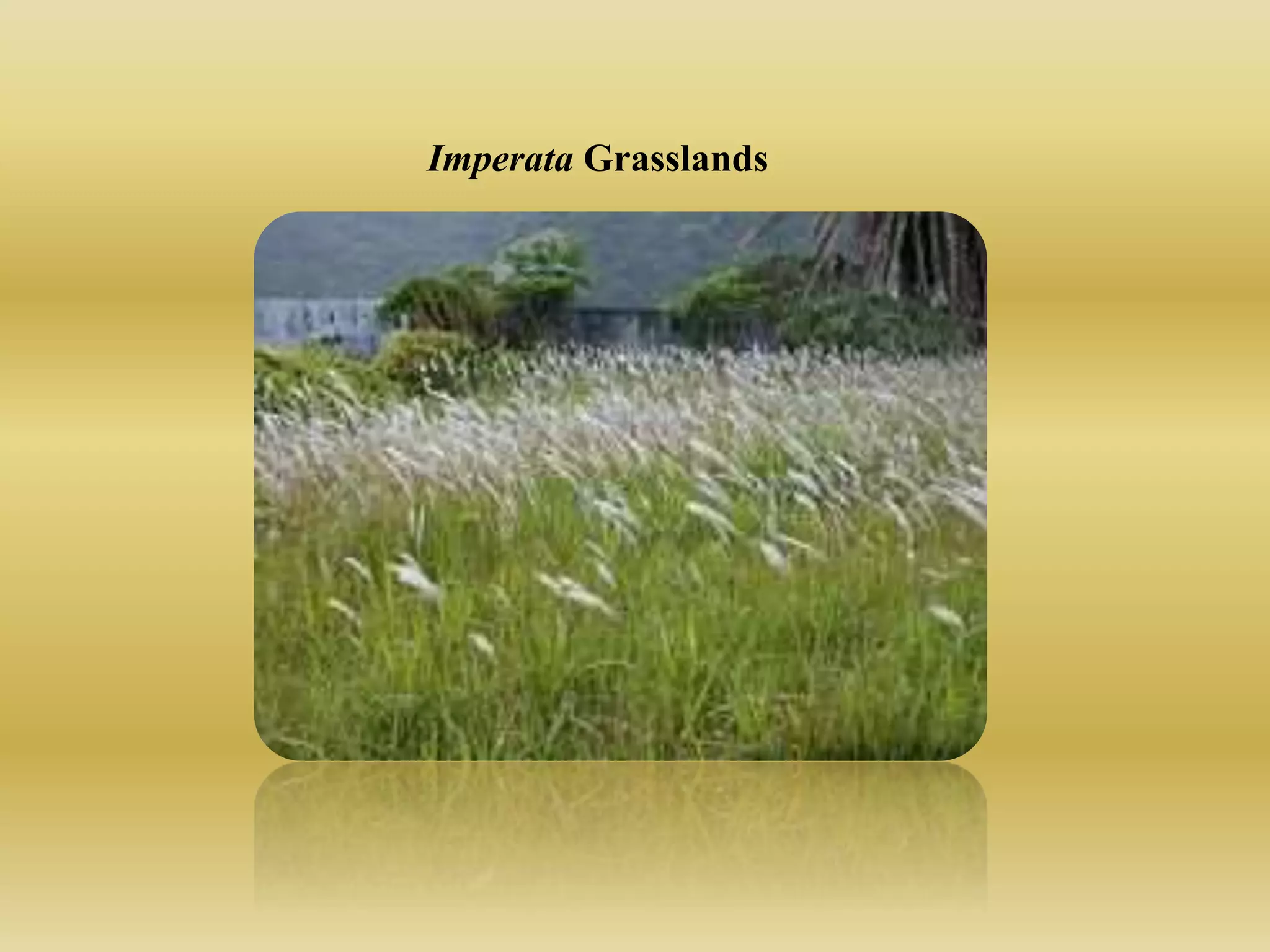
10. Imperata grassland
Imperata Grasslands
Plant Succession, Causes and it's Types

Plant Succession, Causes and it's Types

  • 3.
    Succession • The termwas given by Hult (1885). • It is a sequence of changes in the community structure of an ecosystem over a period of time. • A change in the composition and nature of plant community of a habitat over the years is known plant succession.
  • 4.
    Example • For example,if a cultivated field is left fallow for some time. Annual weeds will appear in the first year. Numerous perennial species will appear in the second year. In later years, few bushes and some trees will make their appetence. • In this way there is a change in the plant communities year after year. So, succession is a process in which there is a successive occupation of an area by different plant communities.
  • 5.
    Pioneer species Grasses ForestTrees Climax communityis the stable endpoint of succession which lasts a long time
  • 6.
    Causes of Succession Thereare two main causes of succession. 1. Physiographic Factors (Physical Causes). Those factors which are associated with the physical nature of the area. 2. Biotic factors. A change in the environment is produced by the community.
  • 7.
    • Any ofthe factors, apart from climatic, biotic and edaphic factors. • That affect the prevailing conditions within a habitat and the distribution of the plants and animals. • It includes the physical and chemical factors of the environment. • Such factors include the topography of the area, altitude, drainage conditions, degree of erosion, slope of the land, etc. Physiographic Factors
  • 8.
    A change inthe habitat may be produced by: • The silting in of a lake or pond, • Chemical changes by leaching or accumulation of salts. • Flooding of plains. • Soil erosion. • Change in temperature. • Rainfall. • Melting of glaciers. • Land Sliding. • Volcanic action. Such changes will cause change in community. Plant successional changes are rapid in habitat with moderate environment, but such changes become slow in area with extremes of environment. Physiographic Factors
  • 16.
    • A changein the environment is produced by the community. • Such as various activities of organisms. • Many biological or living agencies also affects the vegetation in many aspects. • Grazing, cutting, clearing, cultivation, harvesting and deforestation, all caused by living agencies, are directly responsible for vegetational change. • The parasitic plants and animals also affect the vegetation and destroy it. Biotic Factors
  • 17.
    Biotic Factors • Thedeath and decay of organisms add organic matter. • It releases humus by decomposition. • It increases water holding capacity. • It also increases the nutrients content of soil which affects soil organisms. • By these factors, habitat is modified and become less favorable for the established species. • And become more favorable for new coming species.
  • 18.
    Types of Succession •There are two types of succession. Types of succession Primary Succession Development of plant community on barren area. Secondary Succession Development of plant community on distributed area.
  • 19.
    Primary Succession • Thedevelopment of plant community in a barren area where no community existed before is called primary succession. • It usually starts with the lower organisms. • It take a longer time to reach the climax community. • An example of an area in which a community has never lived before would be a new lava or rock from a volcano that makes a new island.
  • 20.
    • The stagesof primary succession include pioneer species including microorganisms, plants (lichens and mosses), grassy stage, smaller shrubs and trees. • The first group of organisms establishing on a bare rock or sand is known as pioneers, primary community. • Animal begin to return when there is food there for them to eat. • When it is a fully functioning ecosystem, it has reached to the climax community stage. • That type of vegetation which develop ultimately will permanent and will be in equilibrium with the climate is known as climax communities. • It is the highest type of vegetation e.g., trees in a forest. • A stage after which no plant succession take place is called climax stage. Primary Succession
  • 22.
    Types of Primary Succession • Followingare it’s type depending upon the substratum and based on it’s habitat. (hydric, mesic & xeric) 1. Hydarch: Succession beginning in watery habitats like ponds, lakes and marshes is called hydarch while sequence of its developmental stages is called hydrosere. Wet habitat is hydric. 2. Xerarch: Succession beginning on dry habitat is termed as xerarch. Its developmental stages are called xerosere while the dry habitat is termed as xeric.
  • 23.
    • Hydrach hastwo habitats. i. Hydrosere: It is stage where plants colonize in fresh water, as at a pond margin. e.g. Monmouth shire-ox-bow lakes. ii. Halosere: It is stage where plant colonize at the surface of saline soil, salt marshes and sea estuaries. e.g. The North shore of the Gower, lanrhidian salt marsh. • Xerarch has two habitats. i. Lithosere: Successional stages at the surface of a rock is called lithosere. ii. Psammosere: Successional stages at the surface of sandy soil. Types of Primary Succession (Contd.)
  • 26.
    Secondary Succession • Secondarysuccession, type of succession in which plants and animals re-colonize a habitat after a major disturbance. i. Devastating flood ii. Wildfire iii. Landslide iv. Lava flow v. Human activity (e.g., farming or road or building construction) • Secondary succession starts from previously built up substrata with already existing living matter. • It starts on already colonized surface. • It may start from fairly complex organisms. • It takes a shorter time or duration to reach a climax community.
  • 28.
    • If damageis slight, the secondary succession become primary. • If damage is severe, the secondary succession may remain different. • The damage to the original communities modifies the habitat by changing the moisture conditions, organic matter may be destroyed. • Nutrients in the soil become lesser. • Soil erosion may rapid. • It happens more rapidly than primary succession. • Because previous community has left its marks in the form of improved soil and seeds. • The stages of secondary succession are similar to those of primary succession. • Primary succession always begins on a barren surface, whereas secondary succession begins in environments that already possess soil. Secondary Succession
  • 29.
    An example ofSecondary Succession by stages: 1. An area of growth. 2. A disturbance, such as a fire, starts. 3. The fire destroys the vegetation. 4. The fire leaves behind empty, but not destroyed soil. 5. Grasses and other herbaceous plants grow back first. 6. Small bushes and trees begin to colonize the public area. 7. Fast-growing evergreen trees and bamboo trees develop to their fullest, while shade-tolerant trees develop in the understory. 8. The short-lived and shade-intolerant evergreen trees die as the larger deciduous trees overtop them. 9. The ecosystem is now back to a similar state to where it began. 10. Imperata grassland
  • 30.