FOREST
MENSURATIO
N
DR. INDRESH
KUMAR
FOREST MENSURATION
Definition of Forest Mensuration
Forest Mensuration is that branch of
forestry that deals with the determination
of dimensions (e, g; diameter, height,
volume etc.), form, age, and increment of
single trees, stands or whole woods, either
standing or after felling.
OBJECTIVES OF
FOREST
MANSURATION
Forest Mensuration serves
the following objects:
1. Basis for sale
2. Basis of management
3. Measurement for research
4. Measurement for planning
• Basis for sale
Before any sale and purchase, the quantity
of timber or other produce and their prices
are estimated.
• Basis of management
For proper management, knowledge of the
quantity of timber standing in forest and its
increment on every year or in a period of
years is necessary. This leads to the
development of methods of preparing forest
inventories using satellite imageries.
• Measurement for research
In order to find out which treatment and
method of management would maximize
production, it is necessary to layout
experiments to compare the results of different
treatments. This requires the layout of sample
plots and their periodic measurements.
Measurement for
planning
With the steeply(तेजी से) increasing
population and rising standards of living every
year, the gap between the demands and
supplies of timber and other forest products .
For this purpose, fast-growing species have to
be introduced.
Thus, Forest Mensuration supplies basic
statistical data to plan for the future and serves
to check the viability of projects.
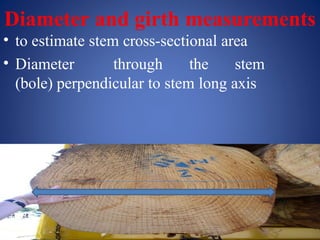
Diameter and girth measurements
• to estimate stem cross-sectional area
• Diameter through the stem
(bole) perpendicular to stem long axis
Diameter Measurement
• Dendrometer: general term used
for instruments designed to measure
diameter.(place tape flat, tight, &
level at 1.37 m above ground )
Calipers
Diameter Tape
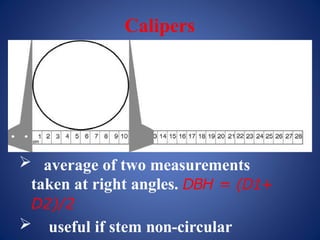
Calipers
 average of two measurements
taken at right angles. DBH = (D1+
D2)/2
 useful if stem non-circular
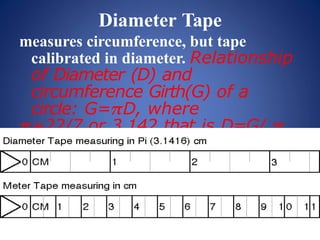
Diameter Tape
measures circumference, but tape
calibrated in diameter. Relationship
of Diameter (D) and
circumference Girth(G) of a
circle: G=𝝅D, where
𝝅=22/7 or 3.142 that is D=G/ 𝝅
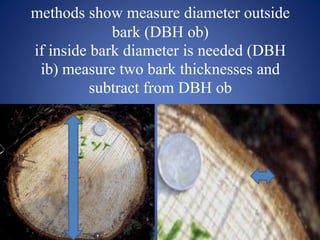
methods show measure diameter outside
bark (DBH ob)
if inside bark diameter is needed (DBH
ib) measure two bark thicknesses and
subtract from DBH ob
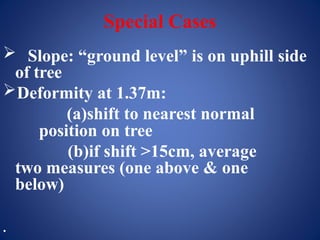
Special Cases
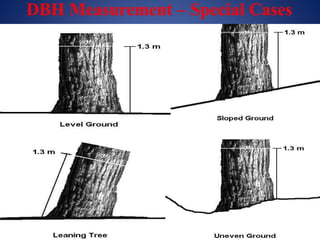
 Slope: “ground level” is on uphill side
of tree
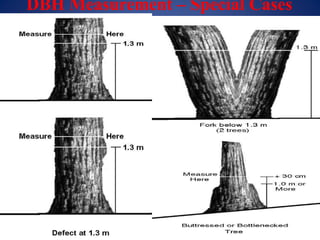
Deformity at 1.37m:
(a)shift to nearest normal
position on tree
(b)if shift >15cm, average
two measures (one above & one
below)
•
DBH Measurement – Special Cases
HIEGHT MEASUREMENT
OF TREES
Total height of the tree is the straight
line distance from the tip of the
leading shoot (or from the highest
point of the crown where there is
no leader) to the ground level,
usually measured on slopes from
the uphill side of the tree.
Objective
• To find out tree volume
• To read volume tables,
form factor table, yield
tables, etc
• To find out productive capacity
of the site
• To find out the site quality of a
Different Heights of Tree
• Bole Height: The distance between ground
level and Crown Point is called bole
height, Crown Point is The position of the
first crown forming living ordeal branch.
• Commercial Bole Height: If the height
of bole that is usually fit for utilization
as timber called commercial bole
height.
• Height of Standard Timber Bole : Height
of the standard timber bole is from the
ground level to diameter over bark
Stump height: The height of the top of the stump
above ground which gives the tree stem is lift
attached to the ground after felling ( 20 to 30
cm), called stump height. Value of standing tree
before felling is called stumpage value.
Crown length: The vertical measurement
of the crown of the tree from the tip to the
point half way between the lower green
branches forming green crown all round
and the lowest green branch on the bole,
called crown length.
THANK

mypptpdf-210316033549-output.pptx FORESTRY

  • 1.
  • 2.
    FOREST MENSURATION Definition ofForest Mensuration Forest Mensuration is that branch of forestry that deals with the determination of dimensions (e, g; diameter, height, volume etc.), form, age, and increment of single trees, stands or whole woods, either standing or after felling.
  • 3.
    OBJECTIVES OF FOREST MANSURATION Forest Mensurationserves the following objects: 1. Basis for sale 2. Basis of management 3. Measurement for research 4. Measurement for planning
  • 4.
    • Basis forsale Before any sale and purchase, the quantity of timber or other produce and their prices are estimated. • Basis of management For proper management, knowledge of the quantity of timber standing in forest and its increment on every year or in a period of years is necessary. This leads to the development of methods of preparing forest inventories using satellite imageries.
  • 5.
    • Measurement forresearch In order to find out which treatment and method of management would maximize production, it is necessary to layout experiments to compare the results of different treatments. This requires the layout of sample plots and their periodic measurements.
  • 6.
    Measurement for planning With thesteeply(तेजी से) increasing population and rising standards of living every year, the gap between the demands and supplies of timber and other forest products . For this purpose, fast-growing species have to be introduced. Thus, Forest Mensuration supplies basic statistical data to plan for the future and serves to check the viability of projects.
  • 7.
    Diameter and girthmeasurements • to estimate stem cross-sectional area • Diameter through the stem (bole) perpendicular to stem long axis
  • 8.
    Diameter Measurement • Dendrometer:general term used for instruments designed to measure diameter.(place tape flat, tight, & level at 1.37 m above ground ) Calipers Diameter Tape
  • 9.
    Calipers  average oftwo measurements taken at right angles. DBH = (D1+ D2)/2  useful if stem non-circular
  • 10.
    Diameter Tape measures circumference,but tape calibrated in diameter. Relationship of Diameter (D) and circumference Girth(G) of a circle: G=𝝅D, where 𝝅=22/7 or 3.142 that is D=G/ 𝝅
  • 11.
    methods show measurediameter outside bark (DBH ob) if inside bark diameter is needed (DBH ib) measure two bark thicknesses and subtract from DBH ob
  • 12.
    Special Cases  Slope:“ground level” is on uphill side of tree Deformity at 1.37m: (a)shift to nearest normal position on tree (b)if shift >15cm, average two measures (one above & one below) •
  • 13.
    DBH Measurement –Special Cases
  • 14.
    DBH Measurement –Special Cases
  • 15.
    HIEGHT MEASUREMENT OF TREES Totalheight of the tree is the straight line distance from the tip of the leading shoot (or from the highest point of the crown where there is no leader) to the ground level, usually measured on slopes from the uphill side of the tree.
  • 16.
    Objective • To findout tree volume • To read volume tables, form factor table, yield tables, etc • To find out productive capacity of the site • To find out the site quality of a
  • 17.
    Different Heights ofTree • Bole Height: The distance between ground level and Crown Point is called bole height, Crown Point is The position of the first crown forming living ordeal branch. • Commercial Bole Height: If the height of bole that is usually fit for utilization as timber called commercial bole height. • Height of Standard Timber Bole : Height of the standard timber bole is from the ground level to diameter over bark
  • 18.
    Stump height: Theheight of the top of the stump above ground which gives the tree stem is lift attached to the ground after felling ( 20 to 30 cm), called stump height. Value of standing tree before felling is called stumpage value. Crown length: The vertical measurement of the crown of the tree from the tip to the point half way between the lower green branches forming green crown all round and the lowest green branch on the bole, called crown length.
  • 19.