PLANT & ANIMAL
CELL
0
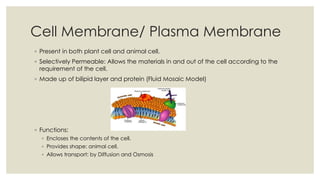
Cell Membrane/ Plasma Membrane
◦ Present in both plant cell and animal cell.
◦ Selectively Permeable: Allows the materials in and out of the cell according to the
requirement of the cell.
◦ Made up of bilipid layer and protein (Fluid Mosaic Model)
◦ Functions:
◦ Encloses the contents of the cell.
◦ Provides shape: animal cell.
◦ Allows transport: by Diffusion and Osmosis
Cell Wall
◦ Present only in a plant cell.
◦ Hard and rigid.
◦ Fully permeable.
◦ Made up of Cellulose in plant and peptidoglycan in bacteria.
◦ Functions:
◦ Protection
◦ Gives shape and turgidity.
Cytoplasm
◦ Contains 80-90% water and many organic and inorganic compounds.
◦ Colloidal, Viscous, Jelly like fluid inside the cell.
◦ Functions:
◦ Contains enzymes responsible for all the metabolic activity taking place inside the cell.
Nucleus(Director/ Brain of the Cell)
◦ Covered by a double membranous nuclear membrane in a Eukaryotic Cell.
◦ contains DNA, RNA, Protein, nucleolus, and Chromatin network
◦ Functions:
◦ Controls the activity of the cell.
◦ Initiates cell division.
◦ It has the chromosomes or DNA which controls the hereditary characters.
Mitochondria (The Power House of
The Cell / Storage Batteries)
◦ Double membranous structure.
◦ Autonomous body as contains its own DNA which self duplicates.
◦ mtDNA is useful for maternity testing.
◦ Functions:
◦ The main seat of respiration.
◦ Stores energy in the form of ATP molecules.
Golgi Bodies(Shipping Department of Cell)
◦ Discovered by Camillo Golgi in 1898.
◦ Originates from RER.
◦ Contains Sac like Cisternae and Vesicles.
◦ Has two faces – cis face or receiving face and trans face or supplying face.
◦ Functions:
◦ Modification, Packaging and transport of materials
◦ Synthesis of lysosomes, plasma membrane
Endoplasmic Reticulum (Framework of Cell)
◦ A network of membranes.
◦ RER bears ribosomes and appears rough
◦ SER do not have ribosomes
◦ Functions:
◦ Transport of materials from one cell to other.
◦ Provides a surface for the synthesis of material – Proteins in RER and Lipids in SER.
◦ Formation of lysosomes, Golgi bodies and vacuoles
◦ Membrane Biogenesis
◦ Detoxification of harmful substances in the liver.
Vacuole
◦ Arise from ER and GB
◦ Surrounded by tonoplast and filled with cell sap
◦ Functions:
◦ Store cell sap which may be liquid or solid food, toxic byproduct.
◦ Provide rigidity and turgidity to plant cell
Lysosomes (Suicidal bags of Cell, natural
scavenger, cellular housekeeper)
◦ Membrane-bound organelles
◦ Present in all animal cells and few plant cells
◦ Tiny circular single membrane-bound structures filled with digestive enzymes
◦ Functions:
◦ Intracellular digestion of food in unicellular organisms.
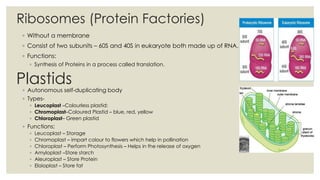
Ribosomes (Protein Factories)
◦ Without a membrane
◦ Consist of two subunits – 60S and 40S in eukaryote both made up of RNA.
◦ Functions:
◦ Synthesis of Proteins in a process called translation.
Plastids
◦ Autonomous self-duplicating body
◦ Types-
◦ Leucoplast –Colourless plastid;
◦ Chromoplast–Coloured Plastid – blue, red, yellow
◦ Chloroplast– Green plastid
◦ Functions:
◦ Leucoplast – Storage
◦ Chromoplast – impart colour to flowers which help in pollination
◦ Chloroplast – Perform Photosynthesis – Helps in the release of oxygen
◦ Amyloplast –Store starch
◦ Aleuroplast – Store Protein
◦ Elaioplast – Store fat

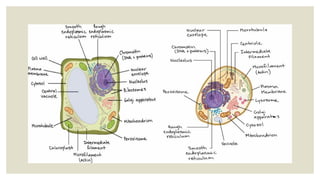
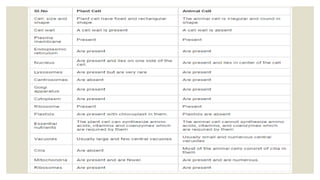
Plant and Animal cell differences

  • 1.
  • 2.
  • 4.
    Cell Membrane/ PlasmaMembrane ◦ Present in both plant cell and animal cell. ◦ Selectively Permeable: Allows the materials in and out of the cell according to the requirement of the cell. ◦ Made up of bilipid layer and protein (Fluid Mosaic Model) ◦ Functions: ◦ Encloses the contents of the cell. ◦ Provides shape: animal cell. ◦ Allows transport: by Diffusion and Osmosis
  • 5.
    Cell Wall ◦ Presentonly in a plant cell. ◦ Hard and rigid. ◦ Fully permeable. ◦ Made up of Cellulose in plant and peptidoglycan in bacteria. ◦ Functions: ◦ Protection ◦ Gives shape and turgidity. Cytoplasm ◦ Contains 80-90% water and many organic and inorganic compounds. ◦ Colloidal, Viscous, Jelly like fluid inside the cell. ◦ Functions: ◦ Contains enzymes responsible for all the metabolic activity taking place inside the cell.
  • 6.
    Nucleus(Director/ Brain ofthe Cell) ◦ Covered by a double membranous nuclear membrane in a Eukaryotic Cell. ◦ contains DNA, RNA, Protein, nucleolus, and Chromatin network ◦ Functions: ◦ Controls the activity of the cell. ◦ Initiates cell division. ◦ It has the chromosomes or DNA which controls the hereditary characters. Mitochondria (The Power House of The Cell / Storage Batteries) ◦ Double membranous structure. ◦ Autonomous body as contains its own DNA which self duplicates. ◦ mtDNA is useful for maternity testing. ◦ Functions: ◦ The main seat of respiration. ◦ Stores energy in the form of ATP molecules.
  • 7.
    Golgi Bodies(Shipping Departmentof Cell) ◦ Discovered by Camillo Golgi in 1898. ◦ Originates from RER. ◦ Contains Sac like Cisternae and Vesicles. ◦ Has two faces – cis face or receiving face and trans face or supplying face. ◦ Functions: ◦ Modification, Packaging and transport of materials ◦ Synthesis of lysosomes, plasma membrane Endoplasmic Reticulum (Framework of Cell) ◦ A network of membranes. ◦ RER bears ribosomes and appears rough ◦ SER do not have ribosomes ◦ Functions: ◦ Transport of materials from one cell to other. ◦ Provides a surface for the synthesis of material – Proteins in RER and Lipids in SER. ◦ Formation of lysosomes, Golgi bodies and vacuoles ◦ Membrane Biogenesis ◦ Detoxification of harmful substances in the liver.
  • 8.
    Vacuole ◦ Arise fromER and GB ◦ Surrounded by tonoplast and filled with cell sap ◦ Functions: ◦ Store cell sap which may be liquid or solid food, toxic byproduct. ◦ Provide rigidity and turgidity to plant cell Lysosomes (Suicidal bags of Cell, natural scavenger, cellular housekeeper) ◦ Membrane-bound organelles ◦ Present in all animal cells and few plant cells ◦ Tiny circular single membrane-bound structures filled with digestive enzymes ◦ Functions: ◦ Intracellular digestion of food in unicellular organisms.
  • 9.
    Ribosomes (Protein Factories) ◦Without a membrane ◦ Consist of two subunits – 60S and 40S in eukaryote both made up of RNA. ◦ Functions: ◦ Synthesis of Proteins in a process called translation. Plastids ◦ Autonomous self-duplicating body ◦ Types- ◦ Leucoplast –Colourless plastid; ◦ Chromoplast–Coloured Plastid – blue, red, yellow ◦ Chloroplast– Green plastid ◦ Functions: ◦ Leucoplast – Storage ◦ Chromoplast – impart colour to flowers which help in pollination ◦ Chloroplast – Perform Photosynthesis – Helps in the release of oxygen ◦ Amyloplast –Store starch ◦ Aleuroplast – Store Protein ◦ Elaioplast – Store fat