Jit Kumar Gupta,
Chief Town Planner
Sahara Prime City Ltd,
Area Office , Chandigarh
Using Land as a
Resource for
Municipal Resource
Mobilization
Population Scenario-World
 World population recorded:World population recorded:
 1 Billion in 18041 Billion in 1804
 2 Billion in 1927 (123 yrs. Later)2 Billion in 1927 (123 yrs. Later)
 3 Billion in 1960 (33 yrs. Later)3 Billion in 1960 (33 yrs. Later)
 4 Billion in 1974 (14 yrs. Later)4 Billion in 1974 (14 yrs. Later)
 5 Billion in 1987 (13 yrs. Later)5 Billion in 1987 (13 yrs. Later)
 6 Billion in 1999 (12 yrs. Later)6 Billion in 1999 (12 yrs. Later)
 7 Billion in 2010 (11 yrs. Later)7 Billion in 2010 (11 yrs. Later)
 UNO population projection ranges from7.9-10.9UNO population projection ranges from7.9-10.9
billion for 2050.billion for 2050.
 China and Indian have population over 1 billionChina and Indian have population over 1 billion
 India to become most populated country by 2036.India to become most populated country by 2036.
 Tokyo largest Urban Agglomeration with 26.4Tokyo largest Urban Agglomeration with 26.4
million residents (2001).million residents (2001).
 19 Urban Agglomerations with + 10 million19 Urban Agglomerations with + 10 million
population in world out of which 3 are in Indiapopulation in world out of which 3 are in India
(Mumbai, Kolkata & Delhi).(Mumbai, Kolkata & Delhi).
Population Scenario- India-2011
 Population of India reached
 250 million in 1919
 500 million in 1966 (47 yrs. Later)
 1000 million in 2000 ( 34 yrs. Later)
 1027 million in 2001 (1yr Later)
 1210 million in 2011 (10 yrs. Later)
 By 2050 India to have population of 1800 million
with 50% living in Urban India.
 Urban India 285.39 million in 2001 (5161 towns)
 377 million in 2011- (7935 towns)
 Metropolitan Centres -5 (1951)- -53 (2011)
 10 m plus- nil (1951)- 3 (2011) -6 (2031)
 Greater Mumbai with 18.37 million is the most
populous city (2011).
 Increased population requires more housing, more
educational institutional/commercial space
 By 2031, India to add 700-900msqm of residential
/commercial space
Population Scenario- India-2011
Urban Pop. Distribution(2011)-377 m (31.1 %)- 7935
towns/cities
-Mega Cities with Pop > 10m -4% of total pop
- Cities with Population 5-10m- 3%
- Cities with Population 1-5m- 6%
- Cities with Population 0.1-1m- 9%
- Cities with Population < 0.1 m- 9%
** Rural Pop Distribution(2011) - 833 m ( 68.9%)
-6,40, 867 villages
---- Very large (>10k), large villages(>5k)-17%
-- Medium villages (2-5 k)—24%
--- Small villages (1-2000) — 17%
------Hamlets (5 00-1000) — 8%
---- Small Hamlets(<5 00)— 3%
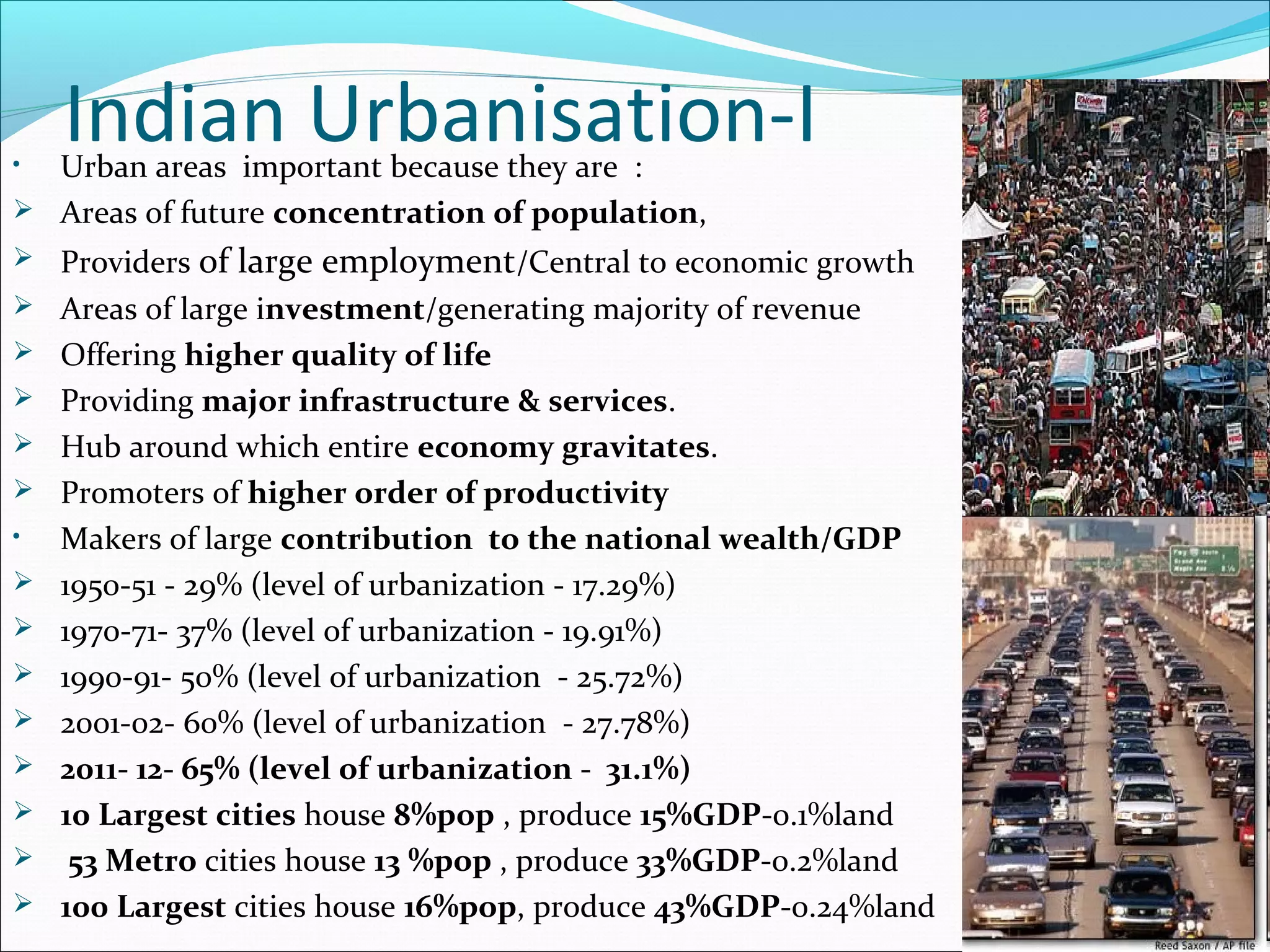
Indian Urbanisation-I• Urban areas important because they are :
 Areas of future concentration of population,
 Providers of large employment/Central to economic growth
 Areas of large investment/generating majority of revenue
 Offering higher quality of life
 Providing major infrastructure & services.
 Hub around which entire economy gravitates.
 Promoters of higher order of productivity
• Makers of large contribution to the national wealth/GDP
 1950-51 - 29% (level of urbanization - 17.29%)
 1970-71- 37% (level of urbanization - 19.91%)
 1990-91- 50% (level of urbanization - 25.72%)
 2001-02- 60% (level of urbanization - 27.78%)
 2011- 12- 65% (level of urbanization - 31.1%)
 10 Largest cities house 8%pop , produce 15%GDP-0.1%land
 53 Metro cities house 13 %pop , produce 33%GDP-0.2%land
 100 Largest cities house 16%pop, produce 43%GDP-0.24%land
Indian Urbanisation-II• Urbanization perceived both as determinant and
consequence of economic development.
• There exists positive co-relationship between level of
development and urbanization .
• Urban growth and economic growth go hand in hand
• Economic well being of country hinges on productivity
of urban settlements.
• Building good cities critical to boosting rural economy
by improved urban consumption
• Urban centers need to be planned & developed to
 Attract investment
 Provide Employment.
 Ensure quality of life.
 Make them more Sustainable, Productive, Livable,
Humane and Eco friendly.
 Lack of serious policies to manage Urban India will
lead to jeopardizing growth besides risking
employment generation.
URBAN INDIA- 2030-Mckinsey Global Inst-
As per India Urban Awakening :Building Inclusive
Cities-Report- April, 2010 :
 590 m people to live in Urban India-twice the US population
 70% GDP generated by cities
 80% Revenue generated by cities
 4 fold increase in per capita income
 5 times the number by which GDP would multiply
 270 million people net increase in working age group
 70% of new jobs(170 mil) generated in cities
 91 M urban households will be middle class up from 22 M
 68 Cities will be Metrop0lises-Europe has 35 only
 $ 1.2 T capital needed for investment to meet projected demand
 700-900 million sqms of residential/ commercial area needed
annually- a new Chicago to be created
 2.5 billion sqms roads paved-20times created in last decade
 7400km (350-4ookm/year) of metro needed to be constructed-
20times created in last decade
 200 mil Rural Indians to benefit-living close to top 70 cities
 75%urban India to live in bottom segment earning Rs 80 perday
Urbanisation-issues
Despite distinct advantages , Urban centers
 Poorly managed and governed.
 Fail to meet the challenges of urban dynamism
 Haphazard /Unplanned pattern of development.
 Enormous growth of slums
 Poor quality of life
 Failure to meet basic needs of
1. Shelter
2. Services
3. Land ,Water/ Sanitation
• Population , Poverty , Pollution and traffic have emerged
as the greatest threat and challenge to Indian Cities.
• Indian Urbanisation is rightly called :
 Urbanisation of Population
 Urbanisation of Poverty
 Urbanisation of Pollution
STATE OF INFRASTRUCTURES-INDIA
Water Supply- 105 lpcd (Norm-150lpcd)- Gap(2007-45 lit)-94billion
lpd
Sewerage treatment-30% (Norm- 100%)- Gap(2007-70% )-109 billion
lpd
Solid Waste- 72% ( Norm 100%)- Gap(2007-28%)- 82mt/annum
Public Transport- 30% of total trips- (Norm 50%)-
 Gap(2007-@20% )- Private Transport-4,40,000lakh kms,
Railway based mass transport 6400 kms
Slum Population-24%-( norm 0%)-Housing Shortage -38mdu
Park & open Spaces-2.7 Sqm-( norm 9 sqm)
As per High Powered Committee Report on Urban Infrastructure
and Services- 2011
-Projected Investment for Urban Infrastructure for next 20 Years
(2012-13) to (2031-32)-Rs 39.2 Lakh Crores( excluding cost of land)
-O&M requirement for maintaining old & new assets- Rs 19.9 Lakh
Crores
Urban Local Bodies-74th
CAA 1992
Urban Local Bodies has history spanning more than 330 years.
First local body in Madras in 1688 followed by Mayor’s Courts
in Mumbai/Kolkata - 1720
 LSG’s strengthened in 1793 by Vesting of powers to levy
 taxes on lands for sanitation & giving more functions ,
 replacing majority of official with non-official members and
 enlarging functional domain by a diarchal system of governance
 empowering provincial governments to control them through a
minister.
Punjab Municipal Act was enacted in 1911- more than 100
years ago
Basic structure / functional domain remained stagnant-
diluted over the years
Urban Local Bodies-74th
CAA 1992
GRANTED CONSTITUTIONAL STATUS TO
ULBs-institutions of SELF-GOVERNANCE
- Changed FEDERAL STRUCTURE TO
THREE DISTINCT GOVTS
-PROVIDED CONTINUITY- Fixed Tenure,
Reservations for WOMEN/SC/ST
- ULBs divided into Three Tier Structure, Constitution of
Ward Committees
Defined Functions, Authority, Power,
 Constitution of DPCs at District level,
 Constitution of MPCs at Metropolitan level,
 Constitution of State ELECTION Commission, ,
 Constitution of State FINANCE Commission,
Municipal Functions under 74th
C A Act
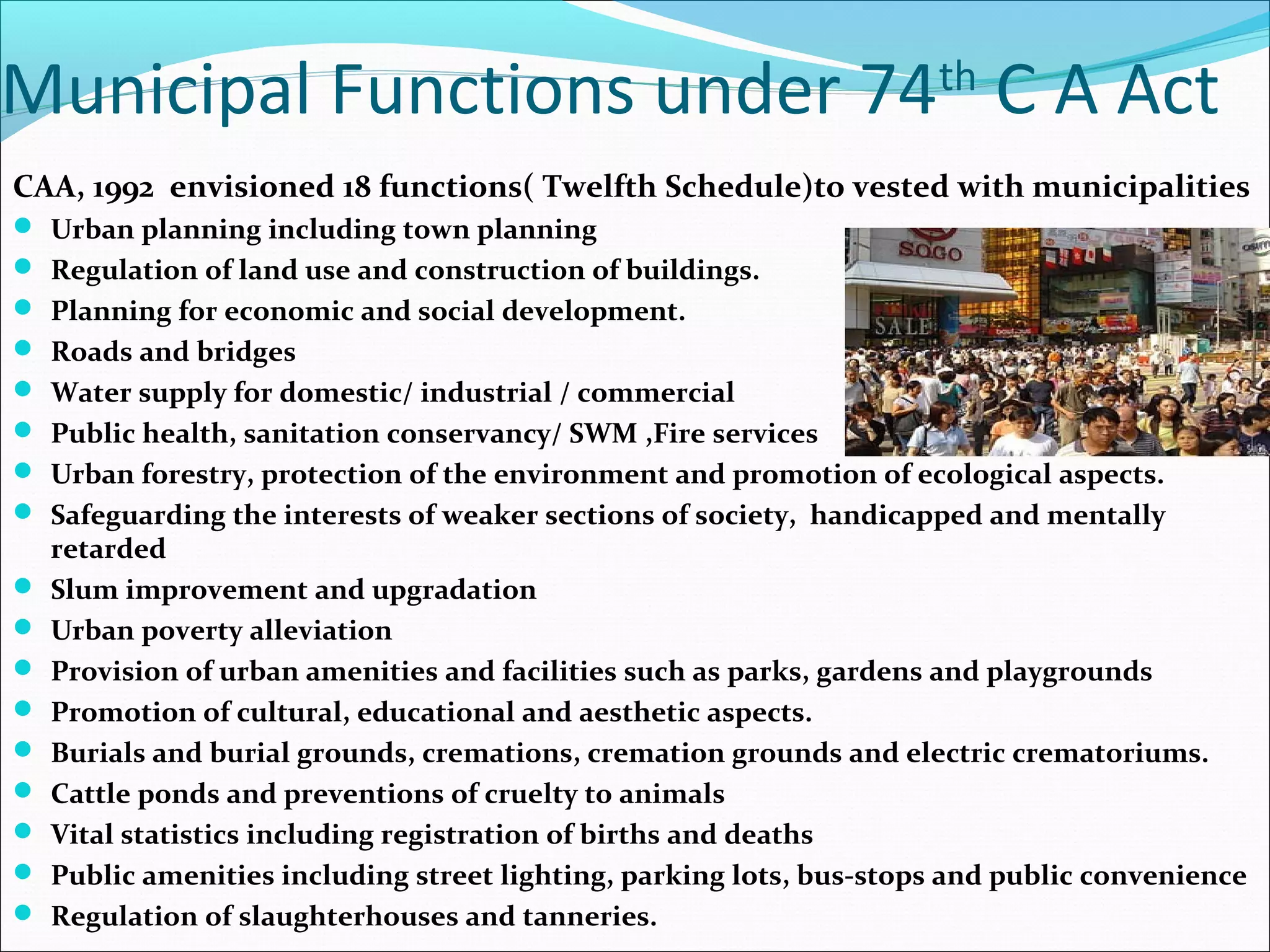
CAA, 1992 envisioned 18 functions( Twelfth Schedule)to vested with municipalities
 Urban planning including town planning
 Regulation of land use and construction of buildings.
 Planning for economic and social development.
 Roads and bridges
 Water supply for domestic/ industrial / commercial
 Public health, sanitation conservancy/ SWM ,Fire services
 Urban forestry, protection of the environment and promotion of ecological aspects.
 Safeguarding the interests of weaker sections of society, handicapped and mentally
retarded
 Slum improvement and upgradation
 Urban poverty alleviation
 Provision of urban amenities and facilities such as parks, gardens and playgrounds
 Promotion of cultural, educational and aesthetic aspects.
 Burials and burial grounds, cremations, cremation grounds and electric crematoriums.
 Cattle ponds and preventions of cruelty to animals
 Vital statistics including registration of births and deaths
 Public amenities including street lighting, parking lots, bus-stops and public convenience
 Regulation of slaughterhouses and tanneries.
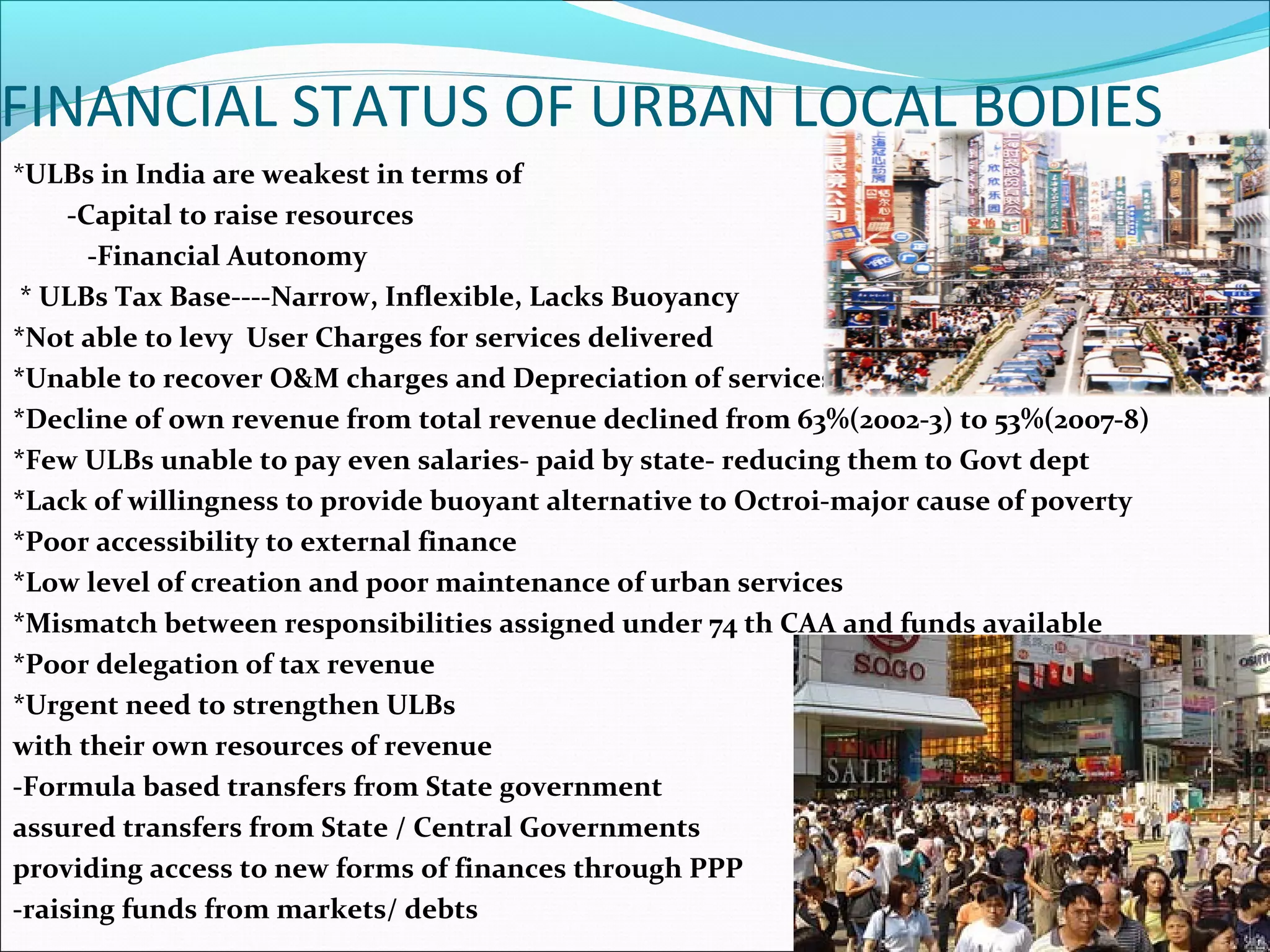
FINANCIAL STATUS OF URBAN LOCAL BODIES
*ULBs in India are weakest in terms of
-Capital to raise resources
-Financial Autonomy
* ULBs Tax Base----Narrow, Inflexible, Lacks Buoyancy
*Not able to levy User Charges for services delivered
*Unable to recover O&M charges and Depreciation of services
*Decline of own revenue from total revenue declined from 63%(2002-3) to 53%(2007-8)
*Few ULBs unable to pay even salaries- paid by state- reducing them to Govt dept
*Lack of willingness to provide buoyant alternative to Octroi-major cause of poverty
*Poor accessibility to external finance
*Low level of creation and poor maintenance of urban services
*Mismatch between responsibilities assigned under 74 th CAA and funds available
*Poor delegation of tax revenue
*Urgent need to strengthen ULBs
with their own resources of revenue
-Formula based transfers from State government
assured transfers from State / Central Governments
providing access to new forms of finances through PPP
-raising funds from markets/ debts
LAND BASED FINANCIAL FRESOURCES
• Property Tax-Patna 1992 ABS,Bangalore(440-780 crores-2007-08-09,
• Betterment Charges-Land values improved by public infra-
applicable in southern states, charged with building permits/layout plans
• Town Planning Schemes-Gujrat Maharashtra
• Pricing (Tradable) Floor Area Ratio-
Ahmedabad( upto 0.45 in defined areas with cost Rs 1000-2000psm
depending on location), Mumbai-2008( 1-1.33)with cost Rs 4900psm
in Manori to Rs 23,000 psm in Bandra
• Development Charges- Haryana, Punjab& other states
• Land Use Conversion Charges-Punjab, Haryana,
• Impact Fee-impact of buildings on public infra, calculated on
incremental cost of infra provision/services,Hydrabad multi storeyed
buildings
• Vacant Land Tax-Tamil Nadu 0.7-2% market value, Andhra,
reduced from 2-0.5% yield lot of revenue, PUDA @3%
• Optimum Utilization of Vacant Govt. Lands-
Punjab Govt,
LAND BASED FINANCIAL RESOURCES
• Transfer of Development Rights(TDR)-master
plan roads,Mumbai in lieu of land required for public roads
• Accommodation Reservation(AR)- Public
amenities,-Mumbai -dispensaries, police post, community
centres, convenient shopping
• Parking Charges-Chandigarh, Delhi,
• Advertisement Rights - Bus que shelters, garbage dumps,
toilets, advertisement spaces, transport nodes, along transportation
network, Electric poles, local buses, landscaping /beautifying traffic
rotaries, Planting trees,
• Hyderabad M Corp netted 230% during 1998-2000
• Air Space Development Rights-New Mumbai
Railway stations ,Mobile Towers
• Infrastructure TDR- STP,SWM Plants water works-
Mumbai
LAND BASED FINANCIAL RESOURCES
• User Charges- Gulbera –Karnatka 24x7 water
supply
• water, sewerage, swm, Recovery 50% of O&M,, 8cities
under Jnnurm- mumbai, pune, nasik, bangalore,chennai
recovered 100%O&M charges for WS,SEW, 6cities made full
cost recovery of SWM
• Licensing Private Colonies-Haryana,UP,Punjab
• -Change of Land use Charges –License fee- Development
charges-Departmental charges- Scrutiny fee, License
Renewal Charges –Building Scrutiny fee, Compounding
Charges
• PROMOTING PLANNED DEVELOPMENT-
BEST OPTION TO RAISE REVENUE FROM
LAND-Aero city Mohali, Chandigarh, Panchkula, KMP bye-
pass,
LAND BASED FINANCIAL RESOURCES
• Property Tax-- Most important tax
• Rates Fixed by State Government , levied /collected at local level
• Property tax revenue stands at0.16-0.24% of GDP
• Developing nation-0.6%, Developed nations-3-4% of GDP
• PROBLEMS
• Poor Assessment Rate(56%),Weak Collection
efficiency(37%),Flawed methods of valuation, Loss on account of
exemptions(11.7%), Poor Enforcement
• OPTIONS
• Implement GIS to map all properties,
• Updating Register of assesses,
• Periodic Revaluation of properties,
• Adopting Area Based method of Valuation,
• Adopting simple &transparent method of valuation,
• Provide self assessment,
• Provide on line payment facility,
• Tax to cover all properties,
• ULBs to have freedom to fix tax rates
• closer co-ordination between Revenue and TCP Deptt,
• Setting up Property Tax Board
CONCLUSIONS• Inserting Local Bodies Finance List on the lines of
Union and State lists in the Constitution
• Create a list of “Exclusive Taxes’ for ULBs, giving
freedom to determine rates, levy and collect taxes-
Property, Profession Entertainment, Advertisement
taxes
• Constitutionally ensuring a pre-defined percentage of
state revenue from taxes raised from all goods and
services-Revenue Shared Tax
• Revenue sharing on the basis of formula designed by
State Finance Commissions
• Strengthening SFC to improve their capacity &giving
credibility to their recommendation son the pattern of
Central Finance Commission
• Capacity building and improving credibility of ULBs in
urban governance , delivery of services and their credit
worthiness for accessing market funds
• Leveraging Private Sector resources through PPP model
• Raising Funds from the market
• Promoting Planned Development of cities
CONCLUSIONS
Urgent need for promoting strong partnership
between City, State and National Governments
to:
 promote rapid economic growth
placing cities at the centre of development
 for building a modern Urban India which is:
- Economically productive
- - Operationally Efficient
- - Socially just
- - Environmentally sustainable and
- -Physically well planned
- Provider of assured quality of life ,even to the
poorest of the poor, to lead a dignified life.
THANKS
FOR YOUR
PATIENCE
AND TIME

Using land as resource for municipal fianace

  • 1.
    Jit Kumar Gupta, ChiefTown Planner Sahara Prime City Ltd, Area Office , Chandigarh Using Land as a Resource for Municipal Resource Mobilization
  • 2.
    Population Scenario-World  Worldpopulation recorded:World population recorded:  1 Billion in 18041 Billion in 1804  2 Billion in 1927 (123 yrs. Later)2 Billion in 1927 (123 yrs. Later)  3 Billion in 1960 (33 yrs. Later)3 Billion in 1960 (33 yrs. Later)  4 Billion in 1974 (14 yrs. Later)4 Billion in 1974 (14 yrs. Later)  5 Billion in 1987 (13 yrs. Later)5 Billion in 1987 (13 yrs. Later)  6 Billion in 1999 (12 yrs. Later)6 Billion in 1999 (12 yrs. Later)  7 Billion in 2010 (11 yrs. Later)7 Billion in 2010 (11 yrs. Later)  UNO population projection ranges from7.9-10.9UNO population projection ranges from7.9-10.9 billion for 2050.billion for 2050.  China and Indian have population over 1 billionChina and Indian have population over 1 billion  India to become most populated country by 2036.India to become most populated country by 2036.  Tokyo largest Urban Agglomeration with 26.4Tokyo largest Urban Agglomeration with 26.4 million residents (2001).million residents (2001).  19 Urban Agglomerations with + 10 million19 Urban Agglomerations with + 10 million population in world out of which 3 are in Indiapopulation in world out of which 3 are in India (Mumbai, Kolkata & Delhi).(Mumbai, Kolkata & Delhi).
  • 3.
    Population Scenario- India-2011 Population of India reached  250 million in 1919  500 million in 1966 (47 yrs. Later)  1000 million in 2000 ( 34 yrs. Later)  1027 million in 2001 (1yr Later)  1210 million in 2011 (10 yrs. Later)  By 2050 India to have population of 1800 million with 50% living in Urban India.  Urban India 285.39 million in 2001 (5161 towns)  377 million in 2011- (7935 towns)  Metropolitan Centres -5 (1951)- -53 (2011)  10 m plus- nil (1951)- 3 (2011) -6 (2031)  Greater Mumbai with 18.37 million is the most populous city (2011).  Increased population requires more housing, more educational institutional/commercial space  By 2031, India to add 700-900msqm of residential /commercial space
  • 4.
    Population Scenario- India-2011 UrbanPop. Distribution(2011)-377 m (31.1 %)- 7935 towns/cities -Mega Cities with Pop > 10m -4% of total pop - Cities with Population 5-10m- 3% - Cities with Population 1-5m- 6% - Cities with Population 0.1-1m- 9% - Cities with Population < 0.1 m- 9% ** Rural Pop Distribution(2011) - 833 m ( 68.9%) -6,40, 867 villages ---- Very large (>10k), large villages(>5k)-17% -- Medium villages (2-5 k)—24% --- Small villages (1-2000) — 17% ------Hamlets (5 00-1000) — 8% ---- Small Hamlets(<5 00)— 3%
  • 5.
    Indian Urbanisation-I• Urbanareas important because they are :  Areas of future concentration of population,  Providers of large employment/Central to economic growth  Areas of large investment/generating majority of revenue  Offering higher quality of life  Providing major infrastructure & services.  Hub around which entire economy gravitates.  Promoters of higher order of productivity • Makers of large contribution to the national wealth/GDP  1950-51 - 29% (level of urbanization - 17.29%)  1970-71- 37% (level of urbanization - 19.91%)  1990-91- 50% (level of urbanization - 25.72%)  2001-02- 60% (level of urbanization - 27.78%)  2011- 12- 65% (level of urbanization - 31.1%)  10 Largest cities house 8%pop , produce 15%GDP-0.1%land  53 Metro cities house 13 %pop , produce 33%GDP-0.2%land  100 Largest cities house 16%pop, produce 43%GDP-0.24%land
  • 6.
    Indian Urbanisation-II• Urbanizationperceived both as determinant and consequence of economic development. • There exists positive co-relationship between level of development and urbanization . • Urban growth and economic growth go hand in hand • Economic well being of country hinges on productivity of urban settlements. • Building good cities critical to boosting rural economy by improved urban consumption • Urban centers need to be planned & developed to  Attract investment  Provide Employment.  Ensure quality of life.  Make them more Sustainable, Productive, Livable, Humane and Eco friendly.  Lack of serious policies to manage Urban India will lead to jeopardizing growth besides risking employment generation.
  • 7.
    URBAN INDIA- 2030-MckinseyGlobal Inst- As per India Urban Awakening :Building Inclusive Cities-Report- April, 2010 :  590 m people to live in Urban India-twice the US population  70% GDP generated by cities  80% Revenue generated by cities  4 fold increase in per capita income  5 times the number by which GDP would multiply  270 million people net increase in working age group  70% of new jobs(170 mil) generated in cities  91 M urban households will be middle class up from 22 M  68 Cities will be Metrop0lises-Europe has 35 only  $ 1.2 T capital needed for investment to meet projected demand  700-900 million sqms of residential/ commercial area needed annually- a new Chicago to be created  2.5 billion sqms roads paved-20times created in last decade  7400km (350-4ookm/year) of metro needed to be constructed- 20times created in last decade  200 mil Rural Indians to benefit-living close to top 70 cities  75%urban India to live in bottom segment earning Rs 80 perday
  • 8.
    Urbanisation-issues Despite distinct advantages, Urban centers  Poorly managed and governed.  Fail to meet the challenges of urban dynamism  Haphazard /Unplanned pattern of development.  Enormous growth of slums  Poor quality of life  Failure to meet basic needs of 1. Shelter 2. Services 3. Land ,Water/ Sanitation • Population , Poverty , Pollution and traffic have emerged as the greatest threat and challenge to Indian Cities. • Indian Urbanisation is rightly called :  Urbanisation of Population  Urbanisation of Poverty  Urbanisation of Pollution
  • 9.
    STATE OF INFRASTRUCTURES-INDIA WaterSupply- 105 lpcd (Norm-150lpcd)- Gap(2007-45 lit)-94billion lpd Sewerage treatment-30% (Norm- 100%)- Gap(2007-70% )-109 billion lpd Solid Waste- 72% ( Norm 100%)- Gap(2007-28%)- 82mt/annum Public Transport- 30% of total trips- (Norm 50%)-  Gap(2007-@20% )- Private Transport-4,40,000lakh kms, Railway based mass transport 6400 kms Slum Population-24%-( norm 0%)-Housing Shortage -38mdu Park & open Spaces-2.7 Sqm-( norm 9 sqm) As per High Powered Committee Report on Urban Infrastructure and Services- 2011 -Projected Investment for Urban Infrastructure for next 20 Years (2012-13) to (2031-32)-Rs 39.2 Lakh Crores( excluding cost of land) -O&M requirement for maintaining old & new assets- Rs 19.9 Lakh Crores
  • 10.
    Urban Local Bodies-74th CAA1992 Urban Local Bodies has history spanning more than 330 years. First local body in Madras in 1688 followed by Mayor’s Courts in Mumbai/Kolkata - 1720  LSG’s strengthened in 1793 by Vesting of powers to levy  taxes on lands for sanitation & giving more functions ,  replacing majority of official with non-official members and  enlarging functional domain by a diarchal system of governance  empowering provincial governments to control them through a minister. Punjab Municipal Act was enacted in 1911- more than 100 years ago Basic structure / functional domain remained stagnant- diluted over the years
  • 11.
    Urban Local Bodies-74th CAA1992 GRANTED CONSTITUTIONAL STATUS TO ULBs-institutions of SELF-GOVERNANCE - Changed FEDERAL STRUCTURE TO THREE DISTINCT GOVTS -PROVIDED CONTINUITY- Fixed Tenure, Reservations for WOMEN/SC/ST - ULBs divided into Three Tier Structure, Constitution of Ward Committees Defined Functions, Authority, Power,  Constitution of DPCs at District level,  Constitution of MPCs at Metropolitan level,  Constitution of State ELECTION Commission, ,  Constitution of State FINANCE Commission,
  • 15.
    Municipal Functions under74th C A Act CAA, 1992 envisioned 18 functions( Twelfth Schedule)to vested with municipalities  Urban planning including town planning  Regulation of land use and construction of buildings.  Planning for economic and social development.  Roads and bridges  Water supply for domestic/ industrial / commercial  Public health, sanitation conservancy/ SWM ,Fire services  Urban forestry, protection of the environment and promotion of ecological aspects.  Safeguarding the interests of weaker sections of society, handicapped and mentally retarded  Slum improvement and upgradation  Urban poverty alleviation  Provision of urban amenities and facilities such as parks, gardens and playgrounds  Promotion of cultural, educational and aesthetic aspects.  Burials and burial grounds, cremations, cremation grounds and electric crematoriums.  Cattle ponds and preventions of cruelty to animals  Vital statistics including registration of births and deaths  Public amenities including street lighting, parking lots, bus-stops and public convenience  Regulation of slaughterhouses and tanneries.
  • 16.
    FINANCIAL STATUS OFURBAN LOCAL BODIES *ULBs in India are weakest in terms of -Capital to raise resources -Financial Autonomy * ULBs Tax Base----Narrow, Inflexible, Lacks Buoyancy *Not able to levy User Charges for services delivered *Unable to recover O&M charges and Depreciation of services *Decline of own revenue from total revenue declined from 63%(2002-3) to 53%(2007-8) *Few ULBs unable to pay even salaries- paid by state- reducing them to Govt dept *Lack of willingness to provide buoyant alternative to Octroi-major cause of poverty *Poor accessibility to external finance *Low level of creation and poor maintenance of urban services *Mismatch between responsibilities assigned under 74 th CAA and funds available *Poor delegation of tax revenue *Urgent need to strengthen ULBs with their own resources of revenue -Formula based transfers from State government assured transfers from State / Central Governments providing access to new forms of finances through PPP -raising funds from markets/ debts
  • 17.
    LAND BASED FINANCIALFRESOURCES • Property Tax-Patna 1992 ABS,Bangalore(440-780 crores-2007-08-09, • Betterment Charges-Land values improved by public infra- applicable in southern states, charged with building permits/layout plans • Town Planning Schemes-Gujrat Maharashtra • Pricing (Tradable) Floor Area Ratio- Ahmedabad( upto 0.45 in defined areas with cost Rs 1000-2000psm depending on location), Mumbai-2008( 1-1.33)with cost Rs 4900psm in Manori to Rs 23,000 psm in Bandra • Development Charges- Haryana, Punjab& other states • Land Use Conversion Charges-Punjab, Haryana, • Impact Fee-impact of buildings on public infra, calculated on incremental cost of infra provision/services,Hydrabad multi storeyed buildings • Vacant Land Tax-Tamil Nadu 0.7-2% market value, Andhra, reduced from 2-0.5% yield lot of revenue, PUDA @3% • Optimum Utilization of Vacant Govt. Lands- Punjab Govt,
  • 18.
    LAND BASED FINANCIALRESOURCES • Transfer of Development Rights(TDR)-master plan roads,Mumbai in lieu of land required for public roads • Accommodation Reservation(AR)- Public amenities,-Mumbai -dispensaries, police post, community centres, convenient shopping • Parking Charges-Chandigarh, Delhi, • Advertisement Rights - Bus que shelters, garbage dumps, toilets, advertisement spaces, transport nodes, along transportation network, Electric poles, local buses, landscaping /beautifying traffic rotaries, Planting trees, • Hyderabad M Corp netted 230% during 1998-2000 • Air Space Development Rights-New Mumbai Railway stations ,Mobile Towers • Infrastructure TDR- STP,SWM Plants water works- Mumbai
  • 19.
    LAND BASED FINANCIALRESOURCES • User Charges- Gulbera –Karnatka 24x7 water supply • water, sewerage, swm, Recovery 50% of O&M,, 8cities under Jnnurm- mumbai, pune, nasik, bangalore,chennai recovered 100%O&M charges for WS,SEW, 6cities made full cost recovery of SWM • Licensing Private Colonies-Haryana,UP,Punjab • -Change of Land use Charges –License fee- Development charges-Departmental charges- Scrutiny fee, License Renewal Charges –Building Scrutiny fee, Compounding Charges • PROMOTING PLANNED DEVELOPMENT- BEST OPTION TO RAISE REVENUE FROM LAND-Aero city Mohali, Chandigarh, Panchkula, KMP bye- pass,
  • 20.
    LAND BASED FINANCIALRESOURCES • Property Tax-- Most important tax • Rates Fixed by State Government , levied /collected at local level • Property tax revenue stands at0.16-0.24% of GDP • Developing nation-0.6%, Developed nations-3-4% of GDP • PROBLEMS • Poor Assessment Rate(56%),Weak Collection efficiency(37%),Flawed methods of valuation, Loss on account of exemptions(11.7%), Poor Enforcement • OPTIONS • Implement GIS to map all properties, • Updating Register of assesses, • Periodic Revaluation of properties, • Adopting Area Based method of Valuation, • Adopting simple &transparent method of valuation, • Provide self assessment, • Provide on line payment facility, • Tax to cover all properties, • ULBs to have freedom to fix tax rates • closer co-ordination between Revenue and TCP Deptt, • Setting up Property Tax Board
  • 21.
    CONCLUSIONS• Inserting LocalBodies Finance List on the lines of Union and State lists in the Constitution • Create a list of “Exclusive Taxes’ for ULBs, giving freedom to determine rates, levy and collect taxes- Property, Profession Entertainment, Advertisement taxes • Constitutionally ensuring a pre-defined percentage of state revenue from taxes raised from all goods and services-Revenue Shared Tax • Revenue sharing on the basis of formula designed by State Finance Commissions • Strengthening SFC to improve their capacity &giving credibility to their recommendation son the pattern of Central Finance Commission • Capacity building and improving credibility of ULBs in urban governance , delivery of services and their credit worthiness for accessing market funds • Leveraging Private Sector resources through PPP model • Raising Funds from the market • Promoting Planned Development of cities
  • 22.
    CONCLUSIONS Urgent need forpromoting strong partnership between City, State and National Governments to:  promote rapid economic growth placing cities at the centre of development  for building a modern Urban India which is: - Economically productive - - Operationally Efficient - - Socially just - - Environmentally sustainable and - -Physically well planned - Provider of assured quality of life ,even to the poorest of the poor, to lead a dignified life.
  • 23.